Get Premium
Dark mode theme is available exclusively for premium users. Learn more about the benefits of subscribing.
No fees, cancel anytime.

 Dark Mode Ad-Free Browsing Unlimited Content
 Ad-Free Browsing Unlimited Content Dark Mode
Join 1.2 million Panda readers who get the best art, memes, and fun stories every week!

In the fourth episode of The Pitt season 2, a patient’s simple ER visit for a leg scrape quickly turns into a nightmare.
Debbie Cohen, a hardworking restaurant server, returns to the ER writhing in pain, and even antibiotics are of no help to her.
The episode ends on a cliffhanger as Dr. Langdon delivers a grim diagnosis. Based on the closing scene, there is a strong possibility of the patient having “MRSA.”
Here is everything you need to know about the medical condition and the harsh reality that the medical drama hopes to tackle with its introduction.
Spoilers ahead!
Image credits: HBO Max
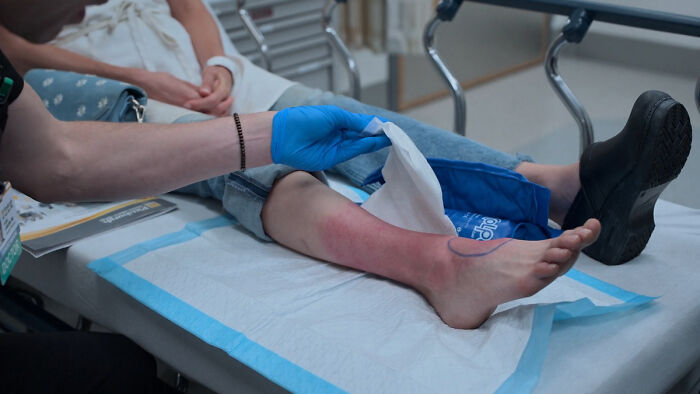
The ending of episode 4 sees Dr. Langdon examine Debbie Cohen, played by guest star Mara Klein, who previously visited the ER to treat a leg injury. However, her pain has gotten worse, and Langdon suspects she may have contracted MRSA, a ruthless “superbug” that feasts on open wounds.
According to the Centers for Disease Control and Prevention (CDC), MRSA is a type of bacteria that is resistant to several antibiotics. It stems from Staphylococcus aureus (staph), a germ that is present on the skin or in the nose of one out of every three people.
It can lead to serious health complications, such as lung infections, bloodstream infections, sepsis, and even death in some instances. MRSA outbreaks are common in hospitals, prisons, and nursing homes, where people often have open wounds.
Image credits: HBO Max
In July 2019, the University of Pittsburgh Medical Center (UPMC) Children’s Hospital reported a dozen cases of MRSA at its neonatal intensive care unit (NICU). Six of them were babies, with one of them being symptomatic, while six employees also tested positive for the infection.
Although the outbreak did not prove fatal, the CDC reported that more than 70,000 annual cases of severe MRSA infection, causing roughly 9000 demises.
Image credits: HBO Max
In 2025, two researchers from Pittsburgh developed a system to track hospital-acquired or healthcare-associated infections, reportedly preventing 62 infections and five de*ths at UPMC Presby by May of that year.
Given Pittsburgh’s history with MRSA and other hospital-acquired infections, it is safe to assume that Debbie’s case was included to tackle the scary reality of such medical conditions that are common but difficult to treat and can also prove fatal in some cases.
Image credits: HBO Max
A preview for the following episode suggests that Debbie’s case will take a new direction as Langdon and Dr. Robby disagree over how to treat her condition. Since MRSA can be transmitted through contact with a symptomatic patient, the entire ER could be at risk of facing a potential outbreak.
A scene in the preview also teased that the medical drama will tackle the harsh reality of wrongful termination, as Debbie’s boss tries to fire her for contracting the infection, and Robby, in turn, threatens to sue him.
Image credits: HBO Max
In 2011, Florida-based IT worker Morris Yomtov was allegedly fired after contracting MRSA. Similar instances have occurred over the years, including a recent case of a Texas woman with the infection getting terminated for safety reasons.
Therefore, it is likely that season 2 will explore the legal complexities surrounding the termination of employees because of hospital-acquired or community-acquired infections.
The Pitt is currently streaming on HBO Max.

By entering your email and clicking Subscribe, you're agreeing to let us send you customized marketing messages about us and our advertising partners. You are also agreeing to our Privacy Policy.
Thank you! You've successfully subscribed to newsletters!


 No fees, cancel anytime








9
0