30 Grammar Rules That Many People Fail To Use Correctly, As Pointed Out By Members Of This Online Group
Isn’t it weird that humans learn how to use language to communicate with others without needing to put in that much effort? But if we want to write and read or to perfect it and make our linguistic abilities more sophisticated, we need to actually study the language. Despite starting strong and already being able to talk and understand others in childhood, we spend years learning our languages at school, but in the end, not everyone manages to acquire it completely.
Those who are more receptive to languages often get irritated by the mistakes other people make in spoken or written language. It really shows in a Reddit thread where a person asked “What is something that most people don’t use correctly?” and half of the answers consisted of people naming misused words and grammar errors others make.
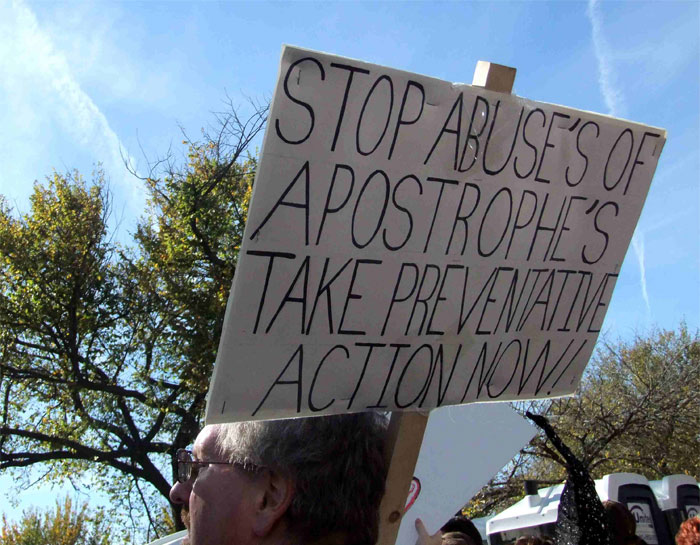
Image credits: Martha Soukup
More info: Reddit
This post may include affiliate links.
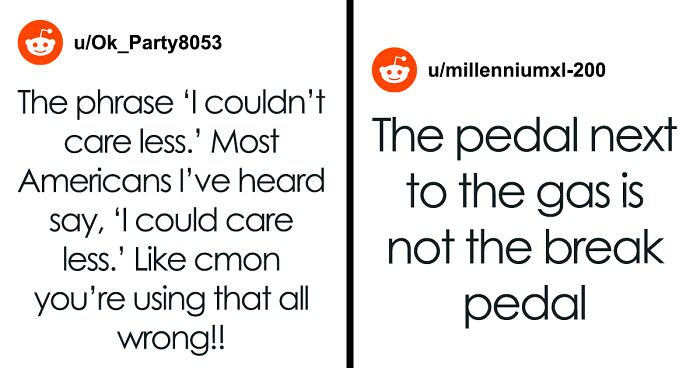
The phrase “I couldn’t care less” Most Americans I’ve heard say, “I could care less”. Like cmon you’re using that all wrong!!
This isn’t really a double negative in either way. It’s still wrong to say “I could care less” because by implication if you can care less, you care a bit. The correct phrase is “I couldn’t care less” the implication there is “I really cannot find a way to care about you or your problem, I’m all out of care!”
Exactly, "I couldn't care less" indicates that you are at rock bottom of the caring scale.
Load More Replies...Same, as when Beyoncé says in "Single Ladies", "I could care less what you think".
Load More Replies...But maybe they are using it correctly and actually mean to be saying, “I do care some. I’m fact, I could care less, but I choose not to.”
That justification gets trotted out a lot... From what they were saying it's not been the case so far.
Load More Replies...Incredibly: should’ve. I’ve seen a ton of people write “should of” when they mean should’ve (as in should have) and in my opinion that’s worse than confusing “then/than”.
It comes from the way it's pronounced, and it's exclusively a mistake that native English speakers make.
Very true. I learned English in large part by reading and you couldn't make me write "should of" with a shotgun pointed at my head. I make plenty of spelling mistakes, mind you, especially since I suck at typing and I rely on spellcheck a lot (which just corrected a misspelled "suck" as "such" rending the previous sentence meaningless), but not that one.
Load More Replies...This is my own personal pet peeve. I originally spoke Italian but I learned English to more than passable levels. Because I also studied Latin and Greek (not that much, mind you), and because I read a lot (that's how I learned English) I could not make sense of why people wrote "should of". Until I sounded it off, that is. That told me people don't read enough, and what they read reinforces the mistake. I am all for language changing organically, but I hope this monstrosity never takes hold as "acceptable English".
Getting Then/Than confused annoys me almost as much as Affect/Effect. I'll never understand how anyone, let alone an alarmingly large number of people always get the two confused. Also what is it with "that's just how I say it". *My fist makes contact with persons mouth.* "WHAAAAT....that's just how I correct ones poor use of the English language."
Suggested corrections on your comment: comma after "people", question mark after "(a)lso what is it.....", apostrophe missing between n and s in "persons", and apostrophe between e and s in "persons". :)
Load More Replies...This one has to be the stupidest and most annoying of all! To me this proves that many people are just not capable of questioning the most obvious things. If you are a native speaker and have been writing “should of” and “must of” all your life without ever - not once - asking yourself “what the f**k does this mean, anyway, and why am I saying this?”, you are just an idiot that completely lacks the ability to think critically. No excuse.
Omg the punctuation to accompany the self-righteousness! 😂🤣🤦🏼♀️
Load More Replies...The sad part is, because of the prevalence, and yes, the similar soundings, this will eventually become acceptable. And sooner rather than later too.
It's one of my main pet peeves. Almost makes me scream when I read should of, could of, would of. AAARGH!!!
The word loose. They mistake it for lose
One of the most common spelling confusions in the English language, apparently. It's quite easy to see why, I suppose. The one that really grinds my gears for some reason is 'shepard' instead of 'shepherd' when people start discussing their dogs.
Shepherd is not that hard to spell if you remember it as sheep herd with a short sheep.
Load More Replies...As an ELA teacher, I told my kids to remember it as, "The moose is on the loose."
Non-English speaker here. I have to confess these make me stumble: lose/loose, chose/choose. I usually google the word up to make sure I’m choosing the right one.
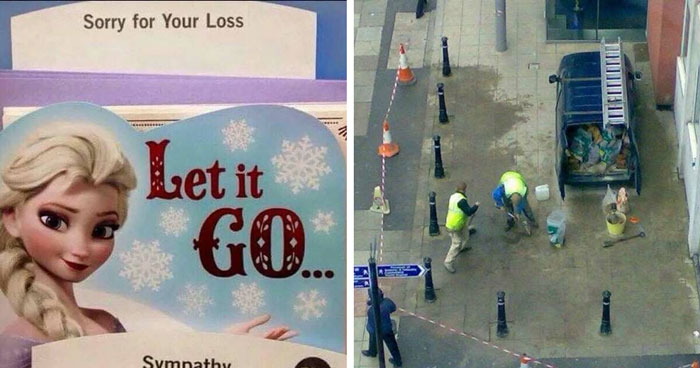
When someone is sending condolences and writes "sorry for your lost..."
What really pissed my mom off was people saying this aft! Meaning this afternoon>
The they're/there/their and to/too/two. It's a pet peeve of mine when people say "This is to boring." In any situation when they use the wrong "to." My mates had taken University-level English classes in highschool yet they still make the "there" or "to" mistakes, and it makes my blood boil.

I didn’t even go to college and I still manage to use the right one every single time.
I'm not an English native speaker and these grammatical errors really make my head hurts.
Same. I have trouble with some other English words, but these were clear from the start. Not sure why these mistakes are so common but they do make me cringe every time.
Load More Replies...You mean when they write or type "This is to boring", if they say it it sounds then same. ;)
Don't know about you, but my pronunciation of to and too is different.
Load More Replies...HINT: Use the extra "o" to make "too" when the thing you're talking about is "extra." Example: they ate "too much pizza." Ok, that isn't possible, but you get the idea!
As a non-native speaker (I'm German) I am really amazed how many people get this wrong although it's their mother tongue. This is nothing I would ever confuse.
This is how I teach it… two, too, to: the W in “two” is formed by putting 2 letter V’s together, so it’s the number 2. “Too” means “as well” or “excessively,” so it has an excess letter O (also, “weLL” and “exceSSively” have double letters, just like “tOO”). “To” is a preposition (prePOSITION - think “position”). To change position, you “go to” a different place. Both “go” and “to” have one letter O. There, their, they’re: “There” contains the word “here” (tHERE). Over “there” or over “here.” It’s position/direction. “Their” contains the word “heir” (tHEIR). Heirs inherit possessions. “Their” indicates ownership/possession. “They’re” is “they are”. With the apostrophe, you can see it is two words. (Apostrophes take the place of omitted letters in contracted words. I teach it this way: When a surgeon does surgery, they take out something unnecessary, and then they need to put a stitch in its place. The apostrophe is the “stitch,” which indicates a letter/s have been removed.)
I’m quite young, and I always use the right forms, I’ve always made it my goal to have perfect grammar while writing, mainly for school.
Less vs. fewer. Less is for uncountable nouns: you have less time, less pain, less work to do. Fewer is for countable nouns: you have fewer apples, fewer cans of soup, fewer distractions. People usually use less when they should use fewer; it rarely happens the other way around. People will say "there are less cars on the road," but they probably won't say "there is fewer traffic." There is a related problem with much vs. many. To be fair, what is countable and uncountable can get complicated, and it's easy to make mistakes (I do it too). You can't have fewer money, you can only have fewer dollars and cents (money, amusingly, is uncountable). You can't have fewer pizza, but you can have fewer pizzas (pluralization of something uncountable makes it countable).

I understand this is technically correct, but not only does this not impede effective communication (you know exactly what they meant) but since language evolves over time, I suspect in the future this distinction will be eliminated and these two words cross-pollenating one another will be considered acceptable, or if nothing else slang.
You got downvoted, but I balanced it out -- I see what you did there :)
Load More Replies...Yeah I need to try to have fewer distractions too, or less distraction in general.
Load More Replies...I kind of feel like the word fewer is becoming one of those words that...well, fewer and fewer people use. Lol. It might altogether disappear not too far down the road. Like the word whom. Nobody uses it anymore. I think that will happen to fewer.
I do most of these things correctly sometimes I wonder if it was where you were educated - I'm a Brit. If I did not say a word or write a word, in the proper context I was told!
The pedal next to the gas is not the break pedal
It could be, if you push it to hard! You see what I did their? Im pleased with that. :-)
I have an accelerator, brake, and clutch in my car. My car runs on petrol, not liquified petroleum gas. I'm confused by why there would be a pedal next to the gas unless you just farted in the footwell.
Although when you are accelerating and hit that pedal it does break the momentum. If you don't hit it soon enough, you can break your car.
If it is the break pedal, you’re doing something very wrong. (I mean, I guess it breaks your connection to the gas tank maybe, but still.)
I'm gonna go get an expresso and excetera.
On the drink and food theme: 'Cold slaw' - an alternative to having the salad hot from the oven? In Australia there's a grocery chain called Coles, I maintain Coleslaw is the regulation governing their hours.
When people put 'ect' instead of 'etc' - the 'et' is a clue, it means 'and' as in 'and so on'.
And take a "pixture" of it... Pretty neat if you "ax" me.
I'm fine with saying et cetera, guilty on espresso. I blame it on my X.
My older brother pronounces it "expresso" so I had to train myself not to.
Load More Replies...Your/You’re.
Desert versus dessert. I’m having desert tonight after dinner! No…. Just think, you’d rather have TWO deSSerts (yummy food) and only ONE deSert (dry hot sandy place).
When in doubt i remember the song ‘desert rose..’ (by Sting) and be sure of my pronunciation :)
Load More Replies...“If you don’t know the difference between they’re there and their, your an idiot” My favorite quote
'thy' and 'thou art' are less likely to be confused with each other by idiots
I know all my proper words but im just too lazy to go back and change them after i typed it up.
Than/then
"Than" is used when you are comparing two items. Use "then" when you are discussing order in time. Examples: I ate pizza, and "then" took a nap! I ate more pizza "than" wings!
"thEn" is timE - that's how I remember when I'm unsure.
Load More Replies...I understand why people screw up your and you’re, their, there and they’re. But I don’t get this one,
For me, it's the other way around. The their, they're and there are logical. The than vs then is two different words to memorise.
Load More Replies...Apostrophes.
Apostrophes are such a pain to explain as they can indicate two things - possession (such as Robert's book or Mary's bicycle) and abbreviation (where letters have been omitted should've, would've, could've, won't). Then you have to try to explain it's to someone. Is it possession or abbreviation? Its is possession and it's is abbreviation. And they go "what?".
It’s always a big joke over here. The Green Grocer’s Apostrophe. Do you want carrot’s? Maybe you’re in the market for parsip’s? A bag of apple’s? It’s a bit of a joke that green grocers always stick in an apostrophe.
Centuries ago… the word “wil” was used for present tense “to wish.” “Wold” was the past tense. But the pronunciation of the two tenses were often conflated. “Wil” was often “wol” or “wo.” The negative form being “wo not.” (The negative form of “wold” was “wold not.”) Eventually, we settled on “will” and “would.” Wouldn’t makes sense. BUT… the negative form of “wo not” stuck around. So, instead of willn’t, we still say won’t.
Load More Replies...Might I suggest the book "Eats Shoots and Leaves" by Lynn Truss, which was also a program on british television.
Of all the one's I think thi's is the one that get's me the mo'st. People who really think you put an apostrophe whenever it end's in 's and even st. Fir'st like so you've just never ever read any book's. It hurt's me so much just sarca'stically u'sing the'se apo'strophe's
Not to mention indicating possession of proper nouns ending with 'S'. JAMES' vs JIM'S. Please tell me it's not JAMES'S. I will freak out.
I prefer the new way where the apostrophe serves in a contraction and a space serves for posession; Mary s bicycle, Mary's asleep now. Much less confusion there.
grumpyoldmanBrad said: Affect/Effect Daddict replied: It's so easy. Affect is a verb. Except when it's a noun. Effect is a noun. Except when it's a verb. No idea why people mix these up.

Affect is first, effect is second. Usually in casual conversation, affect will be a verb (her emotions affected the decision), and effect will be a noun (the effect was that she got two dozen donuts instead of one). Affect as a noun means sort of your vibe, as in (his affect was one of confidence), effect as a verb is basically the same as affect, doing something that changes something else, but effect is usually used when making that specific change was the goal (he wanted to effect a change in legislation). Affect as a verb means your action has some consequences in the situation around you, effect as a verb means you are doing something for the specific purpose of making that change. One is unintentional, the other is intentional. Hope that clears things up.
Very good. You got the joke. Or did the joke get you?
Load More Replies...I just try and think ...does it affect them??? or does it simply cause an effect??? once I put it in usage....generally it is easier....
Affect happens before the event, effect happened after the event. A before E is always how I remember it
I cannot keep these straight to save my life. I just avoid using both these words as often as possible
This one trips me up all the time. Can never get it right. Anyone have an tips to get it right?
Oh Lort! I have trouble with this one all the time. I have to stop and think about. And its/it's. I consider myself to be highly intelligent, but these mess me up.
its = that which belongs to it. similar to "his" "hers" it's = it is. Similar to "he's", "she's"
Load More Replies...APART If you participated in something you were “a part” of it. If you are “apart” from something or someone you are deliberately not a part.
My pet peeve is "alot". "Allot" means to award or to allocate. "A Lot" means "a bunch".
If "alot" bothers you ( it bothers me, too ), you need the "Hyperbole and a Half" cartoon about it: http://hyperboleandahalf.blogspot.com/2010/04/alot-is-better-than-you-at-everything.html
Load More Replies...This is also used in Dutch and more embarrassingly: Apartheid = policy or system of segregation or discrimination on grounds of race. The word apartheid was used in South Africa and the Dutch implemented it. https://www.sahistory.org.za/people/hendrik-frensch-verwoerd
Always interesting when you learn the origin of a word.
Load More Replies...THAT! "I'm apart of a new production" - "Oh, I'm so sorry, you didn't get the part?" - *confused staring by O.P.*
I get irked over "alright" as opposed to "all right." Then there's "a'ight."
"Anyways" the correct word is "anyway". Anyway already denotes any possible way. Adding an S does nothing other than show your ignorance.
I see this as a kind of colloquialism. I use it even though I know it's not technically correct.
You are correct. It’s the same as saying besides or towards. The S is not needed, but has become common. This is one of the speech oddities I don’t get annoyed with - especially with casual conversation. Not everyone needs to speak as if they’re addressing the cultured masses 24/7.
Load More Replies...Clearly the superior choice, and sounds delightfully charming. :)
Load More Replies...It's in the Oxford English Dictionary, as an informal or dialectic variation of "anyway". Screen-Sho...b92282.png
I listen to a podcast where one of the host says "Anywhosleby" and I love it so much... I likely spelled that wrong though.
Literally
Webster's dictionary has literally changed the definition of the word to include today's people's common misuse of the word as "figuratively" or "virtually". So the word has literally list all meaning.
The dictionary just describes how words are used.
Load More Replies...People have been using "literally" as a hyperbolic intensifier for literally hundreds of years. Charles Dickens used it. Charlotte Brontë, Mark Twain, James Joyce, F. Scott Fitzgerald... get off it people. https://www.youtube.com/watch?v=fu5XDrdD7KM
At this point this should be considered a correct, ironic use of the word, and not a mistake.
It's either wrong, or redundant! I can understand if something is generally spoken in a figurative way and when in a rare occurrence it really happens you use the "literally" to point that out (Exple: "When you're a POS Billionaire, you can be literally out of this world while people are starving"), but it's generally used in the most banal case: "I was literally drinking coffee when I literally saw the news on T.V"...
pronounced "litrally" like Rob Lowe in Parks and Rec. Drives me mad.
One of my daughter's friends was mentioning an embarrassing situation and said "I literally died of embarrassment" and I told her I was mad her parents didn't invite me to the funeral. She didn't get the joke, but I think she realized she didn't literally die
I literally always use literally because I literally am using it purely for dramatic effect to emphasize how...ya know, yeah. Literally is used way too much. It's used for emphasis but just becomes annoying when it's every second sentence.
Language is fluid and changes according to popular use. If enough people misuse a word long enough it often becomes standard use. New words are also added to the Oxford dictionary every year.
The word “cavalry.” People often say “Calvary” instead.
This is an example of linguistically metathesis. Some people may be annoyed by what they consider to be substandard mispronunciations, but this is how many modern day words were formed. It’s completely NORMAL. And often, can’t be helped. We don’t fault people for having accents… and this is really not that different. When we mishear and subsequently mispronounce a word, consistently over time, it’s ingrained in our vernacular. There’s nothing wrong with that! It’s not an indication of intelligence. And, again, it’s super common! (Horse used to be fros, relevant used to be revelant, introduce used to be interduce, clasp used to be clapse.) Look up “cavalry” in the dictionary… it also lists the nonstandard pronunciation “ ˈkal-və-rē.” It’s a recognized pronunciation!
Manger versus manager. Try putting that you were an “Operations Manger” on a resume…..
Same with saying “payed” instead of “paid”. This one drives me insane the most.
Nothing wrong with them saying it, it's when the write it down that it annoys me!
Yes. This comment. All these people policing grammar but using "say" or "speak" about a mistake that could only be noticed in writing. I suspect we have grammarian posers in our midst
Load More Replies...how would you know it was incorrect if they said it? They sound the same. Only works in writing.
THIS! I guess they're extrapolating from prayed and played -- but, sorry, English is tricky, learn the irregular verbs. Drives me mad.
This one! I am in payroll and the sheer amount of times I've seen this is mind boggling to me.
*exspecially
This one is annoying! How does a person pronounce it “axe”??? I never understood this one. Asssssssssskkkkkkkk.
Load More Replies...Or excaped.....that one makes me want to....defenestrate as a form of escape.
or Pacific instead of specific >:(. Sure, you're being an ocean about which flavour you want. Very ocean.
breath, breathe, and breathing. Makes me wanna kill someone more than I already do.
It's sad that "native speakers" make these errors more than second language speakers.
Load More Replies...I love it when people neither capitalize nor use full sentences. Keep it simple folks: the silent "e" turns "breath" (rhymes with "meth") into "breathe" (rhymes with "seethe").
Ok, question... Is it spelled "theater" or "theatre"? I always spell it the second way.
So, it really depends on where you live. The second is more acceptable in Europe and other Eastern countries, whereas the first is generally used in America. Same with "gray" and "grey". Pretty much everywhere you see something spelled more elegantly, it's probably not the American use. (I am an American, and I have been since the dawn of America's independence).
Load More Replies...AtomBombBaby42042 said: Woman/women! smooshf**kie replied: Right! But people don't get man/men wrong. Why is it that people can tell the difference between man/men but not woman/women?

Is this a thing? I can't recall seeing someone mix up woman and women. Is it happening a lot?
Yes, it happens so often I don't always see that anymore. Internet is ruining my grammar. /jk
Load More Replies...But if it’s supposed to be singular possessive, they only missed the apostrophe.
Load More Replies...In fairness, it's really strange that the second syllables change spelling, but the pronunciation change is in the first syllable!
;
and if you forget one, somehow errors will appear all over your code that have nothing to do with a missing semi-
Load More Replies...Friendly reminder that semi-colons join two related independent clauses together. If either side of the semi-colon cannot stand on its own as a complete sentence, you probably want a comma instead. (Correct example: "I was late for work today; I couldn't find my favorite sweater." Incorrect example: "I was late for work today; because I couldn't find my favorite sweater.")
Yes! I was going to add this and saw that you had. It is not only a separator; it is a separator that is used for a specific purpose. You could write a song for Schoolhouse Rock! ;-)
Load More Replies...Punctuation! And, please, stop, with all, the completely unnecessary, and useless, , commas! Oh, and the word THAT! Most of the time, you’re safe to take the word “that” out of a sentence. “She was insistent ‘that’ she wasn’t responsible for the mess.”
English is a pro-drop language for complementisers. Which means that using "that" and not using "that" between clauses are both acceptable.
Load More Replies...My students: Is a semicolon just the regular eyes or the winky ones? Me: :/ Also me: The winky ones. ;)
Ok, so, I learned how to properly use the “;” and was using it when necessary, but every time the person reading would comment “what’s that?” “I don’t think that’s how you use that” “isn’t a semi-colon only used like…” and I found it so damn infuriating I just stopped using it. Too many people in the world just go blank when they see one OR stop reading what you’ve written to ponder its use.
Weary vs wary too. I am weary of the misuse of homynyms.

Weary is not a homonym of wary but, for all I know, could be a homynym, whatever that is.
Wear is pronounced the same as the start of wary. It is pronounced differently when it is part of weary.
Load More Replies...Except they're not 'homonyms', they're not even homophones as they're pronounced differently.
They’re what I would consider to be a near homophone… like further and farther. But ZAPanda’s comment is correct… on the east coast (back east), I’ve heard them pronounced the same way before. It’s definitely regional.
Load More Replies...this could be a regional homonym. I pronounce it WEER-E and WHere-E, so its not a homonym for me.
And using weary instead of leery: "I was weary of going into a haunted house..." 🙄
Unless you ARE tired of going into haunted houses. :)
Load More Replies...You can be "wary of" and "leery of" something. You cannot be "weary of" something.
Yes you can. Weary is tired of something. You can be tired or weary of all the news for example.
Load More Replies...The problem is that their meanings are only subtly different. “I am weary (tired, worn out) from” vs “I am wary (suspicious, exasperated) of” are definitely different, but they often lead to similar sentiments. This is an example of how nuance really matters in language.
errr... how is "supicious" only subtly different to "tired"?
Load More Replies...Punctuation
Be specific. Personally I struggle with miss used commers, but full stops don't bother me.
Grammer
Fun fact: A ship's boat is called a Pinnace. This is why spelling and grammar is important when you want to take a closer look at or potentially sail one.
Oh be-have! And you probably don't want ask for a pine tree using the Latin name
Load More Replies...Many times using I instead of me is incorrect. For example, Tim went to the movie with him and I. This requires the objective case and should be him and me!!!! I is used incorrectly all the time these days by people thinking that they are using correct grammar and being smart.
Barley when they mean barely. That one grinds my gears.
When barley flowers, it’s barely a flower, but it’s ready for flour.
Load More Replies...I gave you an upvote but I was groaning the entire time…. ⭐️⭐️⭐️⭐️⭐️
Load More Replies...If you have a “bear with you,” I suggest you start running. This one really is debatable. “Bare with me” would indicate you are uncovering or revealing something. And honestly, whenever I have heard someone use the expression, that is exactly what they are doing. No they are not stripping down, but an expression that implies that if you continue to listen, they will eventually reveal the reason they are boring you to death.
Load More Replies..."Begs the question" It doesn't mean to raise the question. It's a form of circular reasoning where the argument requires the conclusion to be true, rather than the argument supporting the conclusion.
Interesting. I have only ever heard it used as "raises the question" and never the other.
That's what it means now. Words and phrases change meaning over time.
Load More Replies..."Begging the question" applies to statements such as "Have you stopped beating your wife?" when the actual spousal abuse hasn't been established.
This is a difficult concept for many to get, so it’s no wonder many people don’t know how to use it correctly. It’s just confusing why so many people use it incorrectly.
There are many phrases from logic, which are misused or misunderstood.
Not anymore it doesn't. Words and phrases change meaning over time... at one time the words awful and awesome had the exact same meaning. Not anymore. "Begs the question" is an example of a change that is happening right now. Virtually nobody uses its original meaning anymore... that meaning has died.
Oh YES! This is one that annoys me all the time. So glad someone else has noticed.
Fair enough, the author is talking about what in classical rhetoric is called petitio principii but 'begs the question' meant to mean 'raise the question' has been in use for hundreds of years.
The colon and semicolon.
It's not even hard. A semicolon is a punctuation mark used to separate items in a list or to link independent but related clauses, whereas the colon is the longest part of the large intestine.
Indeed. I always fondly remember my grandmother whenever I smell a whiff of colon. 😇
Load More Replies...My students: Is a semicolon just the regular eyes or the winky ones? Me: :/ Also me: The winky ones. ;)
i.e., stands for "id est" (in other words); e.g., stands for exempli gratia (for example)
People say: You can't have your cake and eat it too. The traditional correct phrase is: You can't eat your cake and have it too. Nowadays the two ways of saying it are pretty much used interchangeably.

Does it make a difference though? Philosophically? In Switzerland we have that saying aswell, slightly different. There’s a bread called weggli, and it often has a chocolate coin(foifer). And usually when you share one get the weggli, the other the coin: thus :you can’t have the weggli and the foifer.
Yes, the order matters. You can have your cake, and then eat it, but you cannot eat your cake and still have it afterwards.
Load More Replies...This is my biggest pet peeve! You most certainly can HAVE your cake and EAT it. What you cannot do is EAT your cake and still HAVE your cake. The correct phrasing is 'You can't eat your cake and have it, too."
Meh, I feel like the implication is that one can't both preserve the cake and gobble it up; one can either save it or eat it, in which case it's gone. This one seems fine to me.
Load More Replies...Truth is if you eat the damn cake you're stuck with it forever. Just leave it, your clothes'll fit better.
People who say “you can't have your cake and eat it too" are dumbasses who obviously don't understand what you're supposed to do with cake. :)
The phrase that got Theodore Kaczynski AKA The Unibomber busted. In his manifesto, which the terrorist sent to newspapers in the wake of his bombings, Kaczynski advocated the undoing of the industrial revolution, writing: "As for the negative consequences of eliminating industrial society — well, you can’t eat your cake and have it too." Apparently he wrote the same misuse of the phrase in letters to his mother, which was recognized by his SIL and his brother who were instrumental in his capture.
That train has left the station a long time ago. The ship has sailed, crossed the atlantic and hit an iceberg. It's a done deal. Of course, the popular expression makes no logical sense, but that's how languages work.
It would make a lot more sense to say "You can't eat your cake and keep it too."
The English language
One time I passed a couple of college students. One was from Iran and the other from Korea. They were speaking in English, but their accents were so strong I could barely understand more than every third word. I was impressed how they could understand each other.
Try going to Glasgow - you'll hear native speakers you won't be able to understand without a bit of practice.
Load More Replies...The phrase : "For all intensive purposes" WRONG, it is actually: "For all INTENTS and purposes"
All in the good ol' USA, woman in California dated an airman from Louisianna who'd been stationed in her town. He called her when he'd been back home for a few weeks before shipping out overseas and she couldn't understand him .
US here, I remember one Hungarian making fun of another; "He is saying 'breed' he means 'breeze' -they were both trying to say 'breathe'
On the contrary, the English language is superb in that users can say completely incorrect words in the wrong order and yet the listener will still understand the intended meaning. It is entirely the reason why it is so widely used.
For sure--it's so tricky. I taught for many years and found, strangely, that international students scored better on grammar tests than native speakers. They learned the rules of grammar as they learned the language, but those of us who grow up speaking English just use what we hear.
I had a phenomenal English teacher from 6-8th grade. She was strict but she really hammered it into us. She used three years of repetition and strict rules and it absolutely worked on me.
When I was a GTA working on my Master's I graded for a sophomore level American History class. There were 149 students in the class. And it was not a "multi guess or fill in the blank test" it was all identifications and essays. I did ALL the grading. And yes, it was a pain, BUT I really enjoyed it. EXCEPT for the time we had two Chinese students in the class. What in the hell they were doing in that class, I have no idea, BUT their English was so poor that I do not know how they even understood the lectures. And their tests, ohmygawd, they were impossible to read because I had NO idea what in the hell they were writing about. But, I attempted to "understand" and finally their tests were graded. The only good thing was I spent almost the entire time grading their tests laughing so hard the other GTA's would try to help because they wanted to see what was so funny.
The words “everyday” and “awhile”.
But "everyday" means something different to "every day", which is what I assume you are getting at.
They are both legitimate words. People just don't know how to use them.
mixing them up. every day = on each day. Everyday = boring.
Load More Replies...Everyday is a perfectly fine adjective and awhile is perfectly fine as an adverb (if somewhat archaic). It just means 'for a while'.
Everyday is a legit word - you could sub quotidian if you prefer. Awhile is just an abomination.
I'm afraid you're wrong. You will find 'awhile' in any dictionary. Won't you stay awhile? = Won't you stay for a while?
Load More Replies...Plurals
Plurals in different languages are quite strange. In English is usually by adding an "s" or "es". In Danish it seems to be by adding "er". In French they start messing about with the words before it as well.
English is reasonable with plurals. In Romanian (and not only) nouns have genders, three of them, the terminations for the plurals are all over the place and explaining that and the correct plurals to non-natives is both hard and a source of very funny questions 🙂
Load More Replies...The "grocer's apostrophe" used for plurals. "The grocers' apostrophe, also known as the greengrocers' apostrophe, is defined by WordSpy as "An apostrophe erroneously inserted before the final 's' in the plural form of a word. Also: greengrocer's apostrophe."
Also ‘you’ll’ for ‘y’all’
You'll = you will, y'all = you all. One is a contraction the other is slang. Unless you live under a rock not sure how to confuse these two.
Both are contractions, and both are informal. They get confused for each other because they sound similar, especially to the ear of someone learning to read and to write English.
Load More Replies...Well, language evolves and we just have to get used to it. However there is a place in hell for everyone who cannot understand that “two”, “too” and “to” are different. When I find the two of them, they will be too afraid to complain. Aargh mumble complain!
Y'all is just a plural "you" when you're addressing more than one person. If you're addressing a crown, it's "all y'all." Reminds me of the method Terry Pratchett's trolls use to count (one, two, many, lots).
Lately, more and more people are pronouncing the word "theater" as if it only has two syllables, and rhymes with "sweeter."
I know English is an ever-evolving language, but that’s just wrong!
I have not heard this! But "lie-berry" in place of "lie-brerry" (library) does grate on me a bit, I'll admit.
either pronunciation is correct. In the US north, it's 2, in the US south it's 3. Either is correct. Look it up in a dictionary.
I'm in the north and I've never heard this with only 2 syllables.
Load More Replies...Isn't this a British vs American pronunciation thing? I'm in the UK and pronounce it with three syllables 'thee-a-tre' but also spell it theatre.
The only people who pronounce that word with three syllables spell it theatre.
Which is strange because "theater" looks more like the 3-syllable pronunciation.
Load More Replies...Homonyms are really hard for dyslexic people, it has nothing to do with ignorance. Linguistic discrimination exists, so does literacy privilege. If you can understand what the meaning was just roll with it.

My mum and Gran were both English teachers. I grew up having these grammatical rules emphasised regularly, then I had a severely dyslexic daughter and realised how insane the English language is. Now when I come across the mistakes talked about here I try to remember that English may be a second language, they may be dyslexic or they just had a crappy teacher.
On behalf of my dyslexic family members, thank you. It's a shame that people get judged and slammed for something they are little able to change.
Load More Replies...I mean if I know what the person is trying to say. I'm not going to make them feel bad about spelling errors. It's like being upset because someone breaths the same air as you. People are dyslexic or have a harder time with spelling and writing. If you know good and well what the person means and you still go out of your way to bring up the spelling error. That makes you the b******e. To busy tearing people down for things that don't truly matter. People have just lost all understanding and regard for everything and everyone. Being s h i t t y when there's really no need. Is just sad really. Now if you truly cannot comprehend what someone is saying. You still don't need to point out their errors. You can kindly and respectfully talk to them and say I'm not really understanding but I want to, can you explain more? I guess making people feel less than is okay to some people. But it's really not.
The greatest feature of English is its fluidity and capacity to expand and include. Grammar totalitarianism is tiresome. For example, both Shakespeare and Twain use "between you and I" although it's grammatically "incorrect". If you are a better writer than either of these authors, fine. Otherwise, STFU, and enjoy the beautiful flexibility of the English language. Did you get your point across? Were you consistent? That's all you need to do. That said, putting the $ after a number is an indicator of moral decay. :-)
Definitely v defiantly Whenever anyone says they are defiantly going to do something, I imagine them with a determined jutted chin as they face their battle.
I'm hoping that's just a very common typo that auto correct misses because it still nominally makes sense. You see quiet and quite get mixed up in a similar way.
Load More Replies..."Nucular" instead of nuclear. The worst part is when a "scientist" says it in a movie, which spoils everything for me, because it just hits you in the face that he's an actor who misread it from the script.
It's unforgivable that politicians who ACTUALLY have their finger on the button cannot correctly say the word nuclear. It could be the last hoorah, say it right!
Load More Replies...I'm generally ok with grammar, except one situation: Affect vs Effect. I have a sense of which to use normally, or for some sentences, but at other times I'm totally unsure which is correct. So I just generally avoid it, and that seems to be pretty effective 😉
Homonyms are really hard for dyslexic people, it has nothing to do with ignorance. Linguistic discrimination exists, so does literacy privilege. If you can understand what the meaning was just roll with it.
My mum and Gran were both English teachers. I grew up having these grammatical rules emphasised regularly, then I had a severely dyslexic daughter and realised how insane the English language is. Now when I come across the mistakes talked about here I try to remember that English may be a second language, they may be dyslexic or they just had a crappy teacher.
On behalf of my dyslexic family members, thank you. It's a shame that people get judged and slammed for something they are little able to change.
Load More Replies...I mean if I know what the person is trying to say. I'm not going to make them feel bad about spelling errors. It's like being upset because someone breaths the same air as you. People are dyslexic or have a harder time with spelling and writing. If you know good and well what the person means and you still go out of your way to bring up the spelling error. That makes you the b******e. To busy tearing people down for things that don't truly matter. People have just lost all understanding and regard for everything and everyone. Being s h i t t y when there's really no need. Is just sad really. Now if you truly cannot comprehend what someone is saying. You still don't need to point out their errors. You can kindly and respectfully talk to them and say I'm not really understanding but I want to, can you explain more? I guess making people feel less than is okay to some people. But it's really not.


The greatest feature of English is its fluidity and capacity to expand and include. Grammar totalitarianism is tiresome. For example, both Shakespeare and Twain use "between you and I" although it's grammatically "incorrect". If you are a better writer than either of these authors, fine. Otherwise, STFU, and enjoy the beautiful flexibility of the English language. Did you get your point across? Were you consistent? That's all you need to do. That said, putting the $ after a number is an indicator of moral decay. :-)
Definitely v defiantly Whenever anyone says they are defiantly going to do something, I imagine them with a determined jutted chin as they face their battle.
I'm hoping that's just a very common typo that auto correct misses because it still nominally makes sense. You see quiet and quite get mixed up in a similar way.
Load More Replies..."Nucular" instead of nuclear. The worst part is when a "scientist" says it in a movie, which spoils everything for me, because it just hits you in the face that he's an actor who misread it from the script.
It's unforgivable that politicians who ACTUALLY have their finger on the button cannot correctly say the word nuclear. It could be the last hoorah, say it right!
Load More Replies...I'm generally ok with grammar, except one situation: Affect vs Effect. I have a sense of which to use normally, or for some sentences, but at other times I'm totally unsure which is correct. So I just generally avoid it, and that seems to be pretty effective 😉