Get Premium
Dark mode theme is available exclusively for premium users. Learn more about the benefits of subscribing.
No fees, cancel anytime.

 Dark Mode Ad-Free Browsing Unlimited Content
 Ad-Free Browsing Unlimited Content Dark Mode
Join 1.2 million Panda readers who get the best art, memes, and fun stories every week!

A therapist’s warning about modern teenagers has struck a nerve online, with thousands of people agreeing that young people are missing out on an important part of growing up.
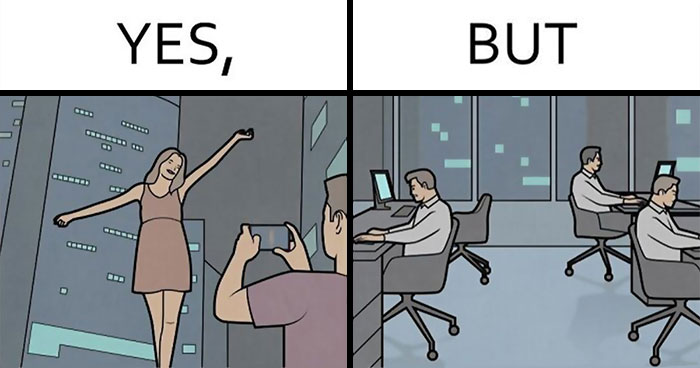
Hattie Awe, a family therapist who works with adolescents, believes constant phone use and endless social media scrolling are preventing teens from experiencing boredom.
Her comments quickly sparked discussion online, with many people sharing their own experiences.
“100% TRUE. Creativity requires some level of boredom,” one commenter wrote.
Image credits: Hattie Awe
According to Awe, one of the biggest changes she has noticed while working with teenagers is a lack of exploration.
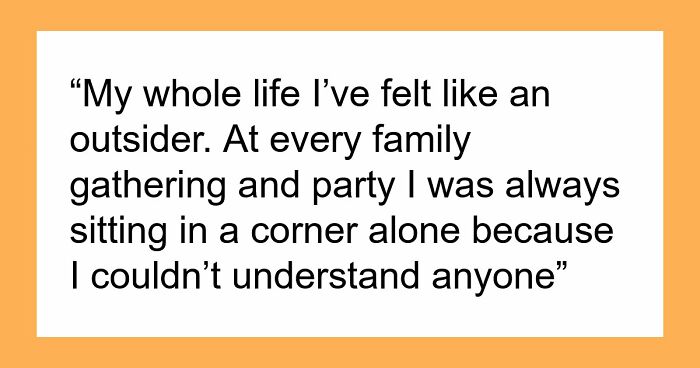
In the past, young people often filled their free time by trying new hobbies, spending time with friends, creating art, experimenting with fashion, reading, or simply letting their minds wander.
Today, she shared, smartphones have largely replaced those experiences.
Rather than sitting with boredom, many teens immediately reach for their phones whenever they have a spare moment.
Image credits: Ivan Prokhorov/Unsplash (not an actual photo)
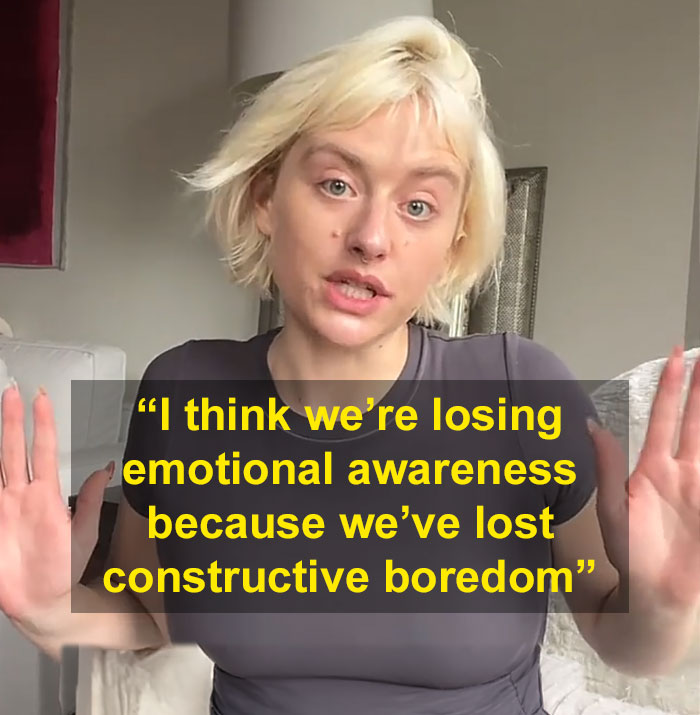
Awe described the missing ingredient as “constructive boredom“, the kind of boredom that pushes people to think, create, imagine, and discover new interests.
“To sit with boredom is a prerequisite to finding your purpose,” she told Newsweek.
“Aimless time creates art, fashion, discourse, revelations, understanding, perspective; it allows us to wander into what drives us.”
Image credits: Kaboom Pics/Pexels (not an actual photo)
She further explained that this process plays a major role in helping people figure out who they are.
“Aimless time creates art, fashion, discourse, revelations, understanding, perspective,” Awe explained.
For her, boredom is not wasted time. It’s often where creativity begins.
Image credits: Hattie Awe
@miss.mad.hatter♬ original sound – Hottytot
Awe alleged the problem goes beyond hobbies and creativity.
She believes constant digital stimulation leaves little room for emotional processing and self-reflection.
“Younger generations are struggling to go inward and process their emotions because they are constantly engaging with new content,” she explained.
According to her, people need quiet moments to understand what they are feeling.
“Emotional insight and reflection happen when we are allotted time to sit with it and explore,” Awe said.
“We have effectively removed any time intended for emotional processing, insight or reflection.”
Instead of dealing with uncomfortable emotions, many people now distract themselves by scrolling through endless content.
Image credits: Hattie Awe
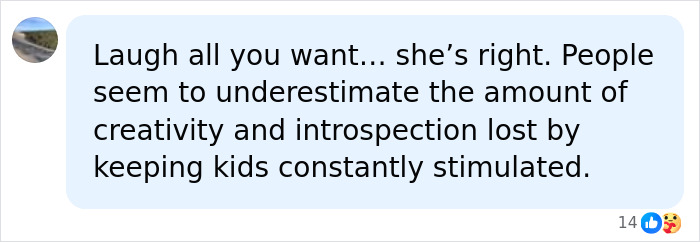
Online, several netizens agreed with her concerns, with one writing, “Laugh all you want, she’s right.”
“People seem to underestimate the amount of creativity and introspection lost by keeping kids constantly stimulated.”
Another added, “I believe the lack of critical thinking comes along with that.”
Image credits: Victoria Romulo/Unsplash (not an actual photo)
Awe explained that social media is changing how young people form their views of the world.
In previous generations, teenagers mainly compared their opinions with family members, classmates, and close friends.
Now, they are exposed to millions of opinions every day.
“With the rise of social media, they are no longer comparing their thoughts to their friends‘, but millions of people,” Awe said.
“They can open their phone or devices and scroll infinitely, without ever running out of content.”
Image credits: Hattie Awe
She added that constant exposure to others’ thoughts can make it difficult for teenagers to distinguish their own beliefs from what they see online.
“For teenagers, it can be hard to differentiate what other people think versus the individual ingesting the content,” she explained.
The therapist also pointed out that the internet never forgets.
Many teenagers know that anything they post, share, or say online could remain visible for years.
Image credits: Vitaly Gariev/Unsplash (not an actual photo)
As a result, some may become more cautious about expressing themselves or changing their opinions as they grow.
Awe argued that making mistakes and evolving your views are important parts of growing up, but social media can sometimes make young people afraid to take those risks.
Image credits: Natalia Blauth/Unsplash (not an actual photo)
Although the conversation focuses on younger generations, Awe stated adults are not immune to the same problem.
In fact, she believes children often learn these habits by watching the adults around them.
Parents who spend hours scrolling after work may be unintentionally teaching their children to do the same.
“To think that this trend only impacts children is naïve,” Awe said.
She believes excessive phone use is “robbing all of us of a quality of life.”
Image credits: Hattie Awe
Apparently, many online readers agreed.
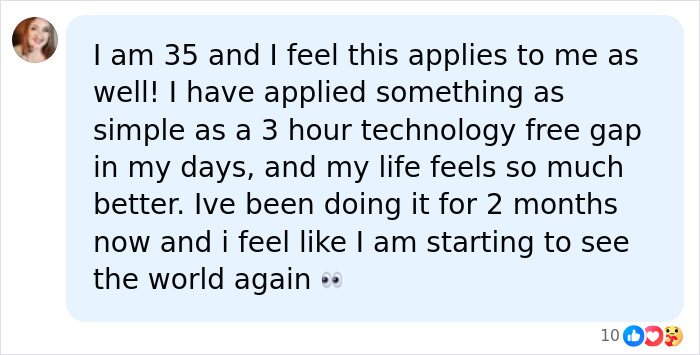
“I am 35, and I feel this applies to me as well,” one commenter shared.
“I have applied something as simple as a 3-hour technology-free gap in my days, and my life feels so much better. I’ve been doing it for 2 months now, and I feel like I am starting to see the world again.”
Others pointed out that boredom often leads to some of life’s most meaningful experiences.
“Being at school all day or daycare will definitely affect curiosity, that’s for sure,” one person commented.
Image credits: Hattie Awe
Awe’s recommendation was straightforward- spend more time away from screens.
“Use your phone when you need it but then put it away,” she advised.
She suggested creating phone-free periods during the day, such as before breakfast, during commutes, or while spending time outdoors.
“Train the brain to find comfort in existing, without music or stimulation, just watching,” Awe said.
She also encouraged people to pick up hobbies that challenge them creatively, physically, intellectually, or socially.
“Pick up a hobby,” she said. “It could be something creative, active, intellectual, or something to do with others.”

By entering your email and clicking Subscribe, you're agreeing to let us send you customized marketing messages about us and our advertising partners. You are also agreeing to our Privacy Policy.
Thank you! You've successfully subscribed to newsletters!



Is this something you would like to share with the rest of the class?
Load More Replies...
I'm 61 and an only child. When I was bored my mom would say 'go outside. read a book.' I'm really into crafts and would end up making a lot of stuff, or coloring, drawing, reading, etc. I still do crafts!

Twiddling my thumbs and yawning from the very depths of my soul - what’s so wrong with that? 🤷🏽
Is this something you would like to share with the rest of the class?
Load More Replies... I'm 61 and an only child. When I was bored my mom would say 'go outside. read a book.' I'm really into crafts and would end up making a lot of stuff, or coloring, drawing, reading, etc. I still do crafts!
Twiddling my thumbs and yawning from the very depths of my soul - what’s so wrong with that? 🤷🏽






































 No fees, cancel anytime


























22
5