Get Premium
Dark mode theme is available exclusively for premium users. Learn more about the benefits of subscribing.
No fees, cancel anytime.

 Dark Mode Ad-Free Browsing Unlimited Content
 Ad-Free Browsing Unlimited Content Dark Mode
Join 1.2 million Panda readers who get the best art, memes, and fun stories every week!
Music is probably in every person's life in some shape or form. Whether you listen, play, or maybe even compose, it's one of the art forms many people enjoy. 66% of Americans say they learned to play a musical instrument at some point in their lives, and even if they don't anymore, the appreciation for music most likely is still there.
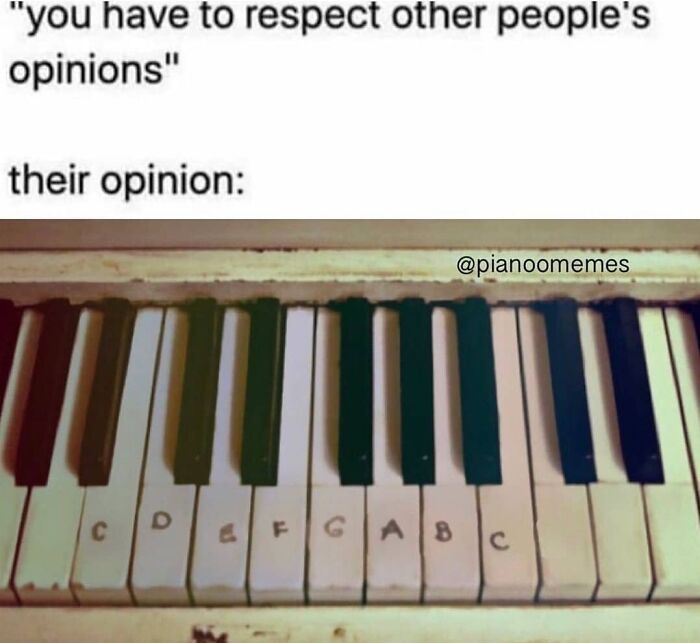
Today, we're dedicating a post to some funny memes about music. It's our tribute to music enthusiasts, artists, singers, composers, prodigies, and struggling students alike. So scroll down and let the music flow with the memes from the Best Music Memes Instagram page!
Because we're true classical music lovers here, we reached out to American musician and composer Elaine Fine, who has years of experience and 200 pieces of chamber music and three operas under her belt.
She graciously agreed to tell Bored Panda more about her journey as a musician and how she started writing about music. Also, we picked her brain about why the stereotype that classical music is for rich people only persists to this day, and she even shared her favorite classical music pun. Read her expert insights below!
Elaine Fine: Musical Assumptions | Elaine Fine's Thematic Catalogue
This post may include affiliate links.
Elaine Fine began writing about music in the late 1980s, shortly after she got a job as a classical music director at a college radio station. "I started writing articles and reviews of recordings for music magazines, and then the internet made it possible for me to write anything I wanted to about music (or anything else) on my Musical Assumptions blog, and share it with like-minded and interested people." Fine has been sharing ideas and music freely in the musical blogosphere for almost two decades!
"Like many people who consider music their vocation, I came of musical age when I was a teenager," she goes on. "I grew up in a musical family where I had access to a great many books about music and was able to attend as many concerts as could fit into my days and nights. Talking about music and thinking about music came naturally to me. Practicing and performing also came naturally, but writing about music did not.
"I spent my college years at Juilliard during the 1970s, where academic expectations were very low," she adds. "I learned the mechanics of writing as an adult after I married a college English professor. I am grateful to him for showing me how to improve as a writer."

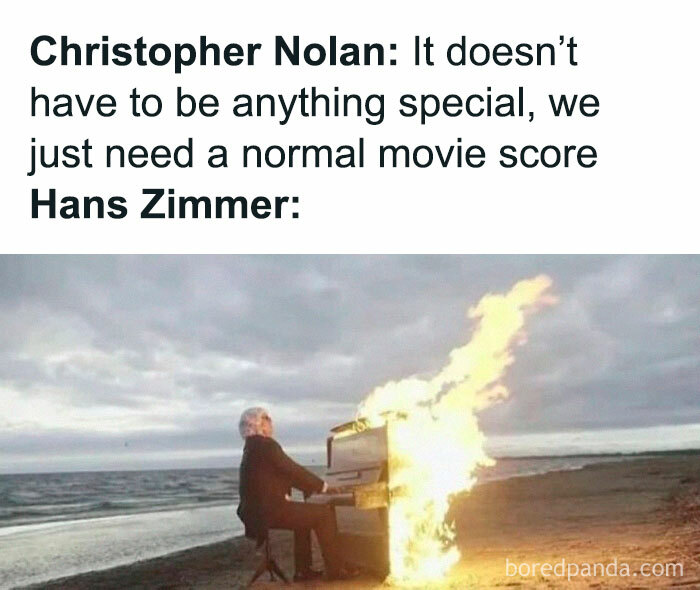
He does put a lot of effort into his scores and is paid handsomely for it. It definitely makes the movie so much better. We don’t do grand opera anymore but movie scores have taken their place.
We asked Elaine Fine what she thinks about people assuming that classical music is a rich person's hobby. "This fallacy might come from the centuries-old practice of rich elite people hiring musicians to write and perform for them," Fine suggests. However, the reality couldn't be more different.
"Most fully employed performing musicians are and have been working-class people who struggle to be able to afford and maintain their instruments," she explains. "What we now call 'classical music' was once music that was enjoyed by everyone. Opera was popular music during the 18th and 19th centuries all over Europe."
"In the twentieth century, new forms of popular music drew audiences through recordings and radio," Fine goes on to explain the "roots" of what we call 'classical music.' "At the same time, atonal music entered into and dominated much of the academic musical world and concert halls. Many people preferred listening to the more melodic popular music that was being written and performed and stopped going to classical concerts."
"21st-century music is, so far, more welcoming to listeners, and musical organizations work extremely hard to make audiences feel welcome and comfortable. The modern classical music world is anything but elitist," Fine concludes. "And classical music concerts are far more affordable than concerts by popular artists."
Since this is, after all, a list of funny music posts, we asked Elaine to share some humor from the classical music world. "Musicians are notorious for making puns," she told us. "One of my favorite punny musical stories is about a composition lesson that the British composer Samuel Coleridge-Taylor (1875-1912) had with the equally British composer Charles Villiers Stanford (1852-1924). Stanford spilled his cup of tea on his student's music and said, 'My dear, your music is now in the key of T.'"

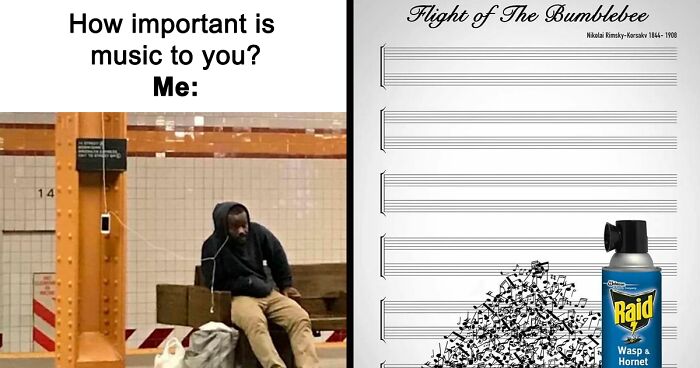
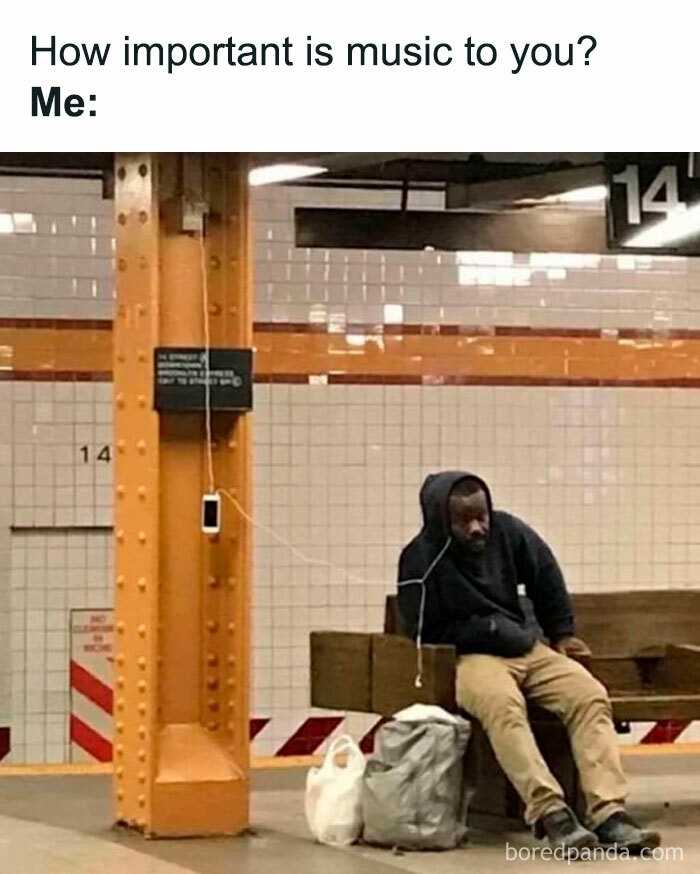
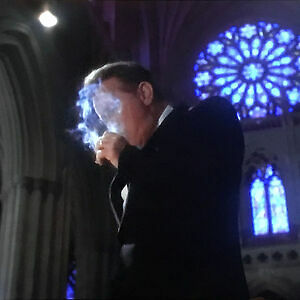
Yeah! No doubt he's listening to music and not answering a call. Not the mic part on his ear. :D
We probably know why we like music, but what exactly happens to our nervous system when we listen to (or are making) it? Well, it gets our blood flowing to our limbic system, which processes emotions and controls our memory. When our ears perceive music, the limbic system "lights up."
Dopamine then triggers the sensations of pleasure and well-being. Interestingly, we don't even need to be able to recognize the rhythm and melody of a song. Studies of people who have suffered brain damage show that people can recognize the emotion conveyed by a piece of music without distinguishing its melody.

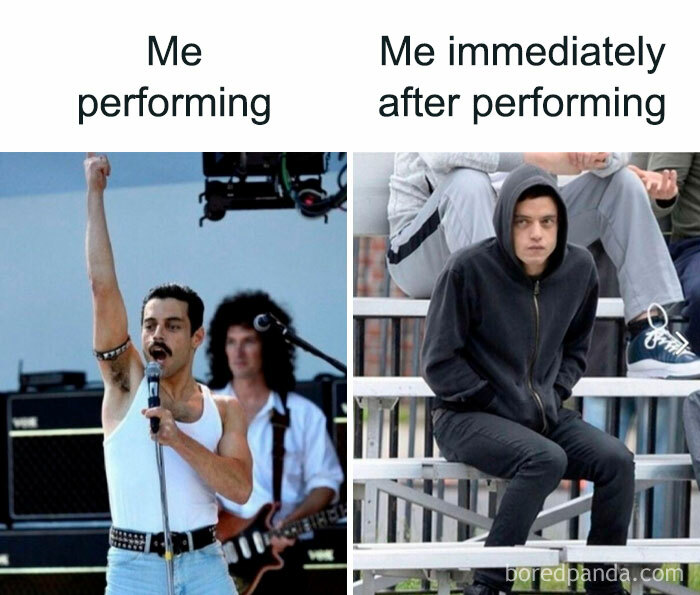
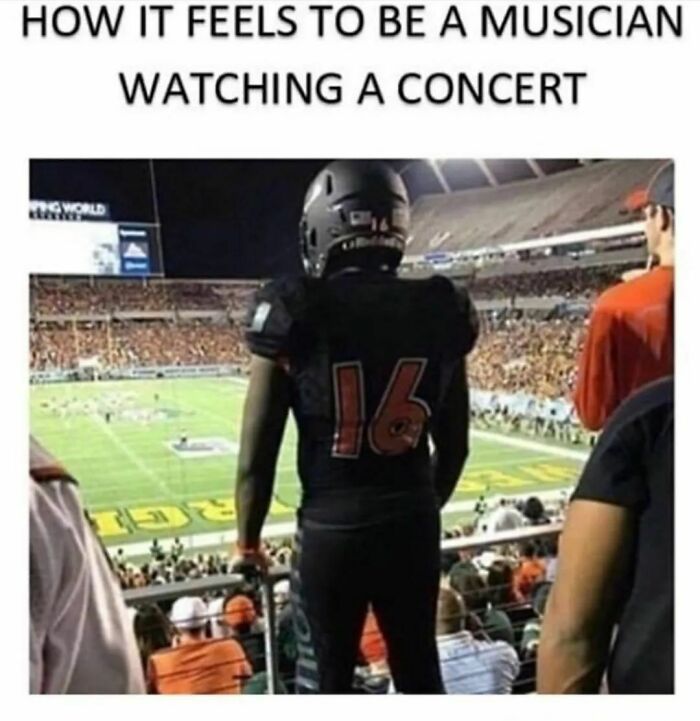
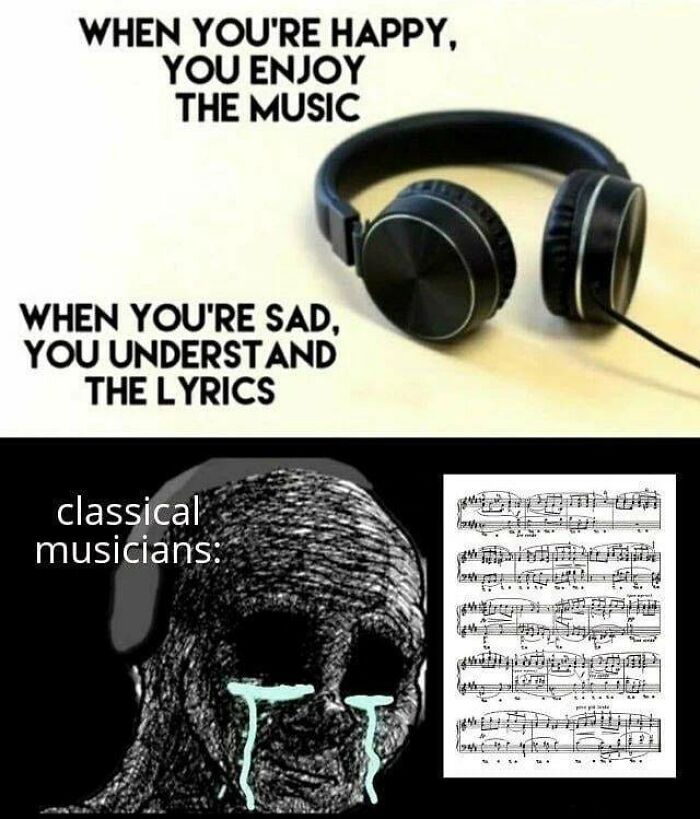
That's the life of stage-people. We are there to make you happy because we know how it feels to be unhappy.
Have you ever wondered why women listen to music while they're in labor? And why do some family members choose to say goodbye to their loved ones while music plays in the background? It's because music has some pain-relieving qualities. It's not a pain killer, of course, but it's a good distraction.
Interestingly, we don't even need to be able to recognize the rhythm and melody of a song. Studies of people who have suffered brain damage show that people can recognize the emotion conveyed by a piece of music without distinguishing its melody.
However, not all people can enjoy the wonders of music. Musical anhedonia is a condition where people feel apathy to music; they're simply not moved by it at all. Only roughly 3-5% of the population has it, but there's nothing inherently wrong with them. Their auditory and reward regions don't "light up" in response to hearing or making music.
On the other side of the spectrum, there are hyper-hedonics. These are people who say they wouldn't be able to live without music. In their brains, the strongest transfer of information happens between the auditory and reward systems of the brain. One of such people is Paul Silvia, a psychology professor at the University of Carolina at Greensboro. "I hear music in my mind a lot, and I can get chills from this imagined music," he told The Atlantic.




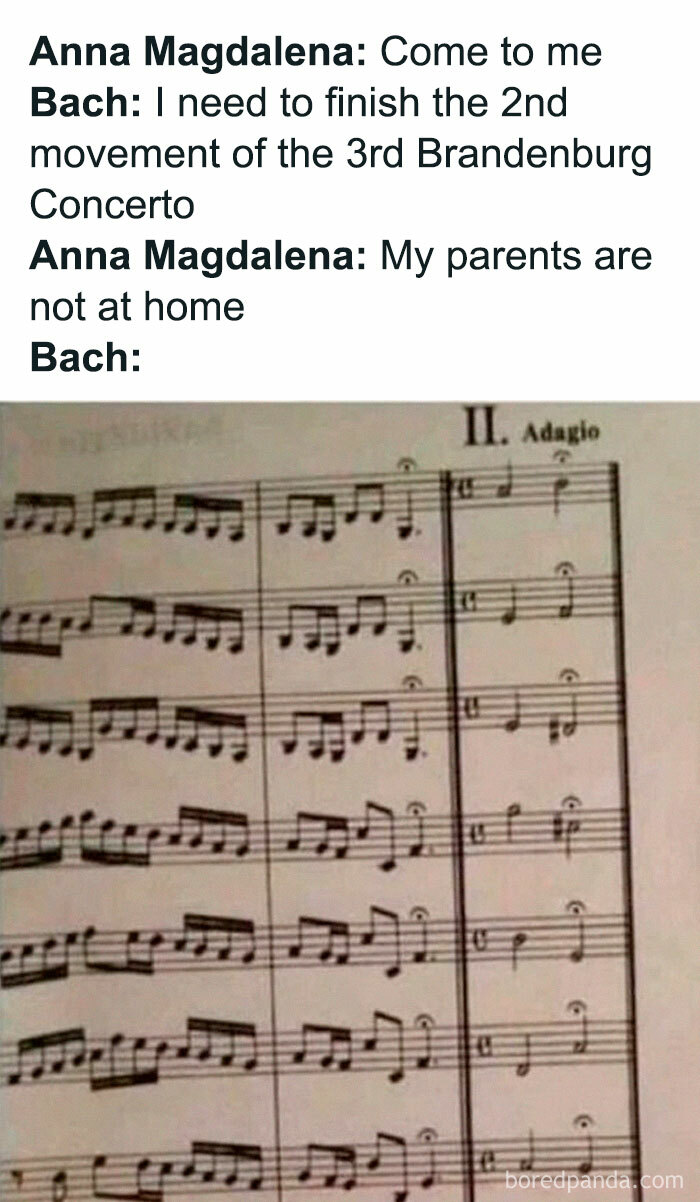
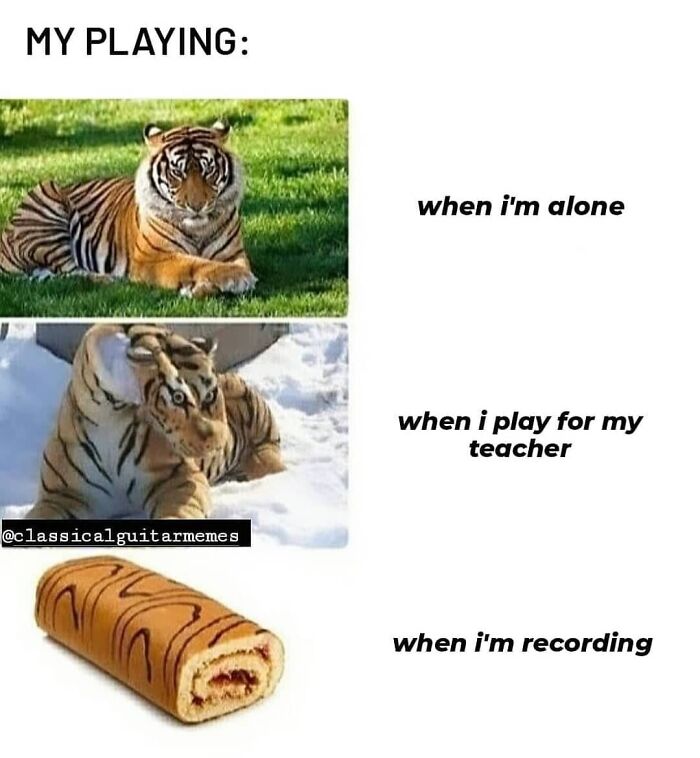
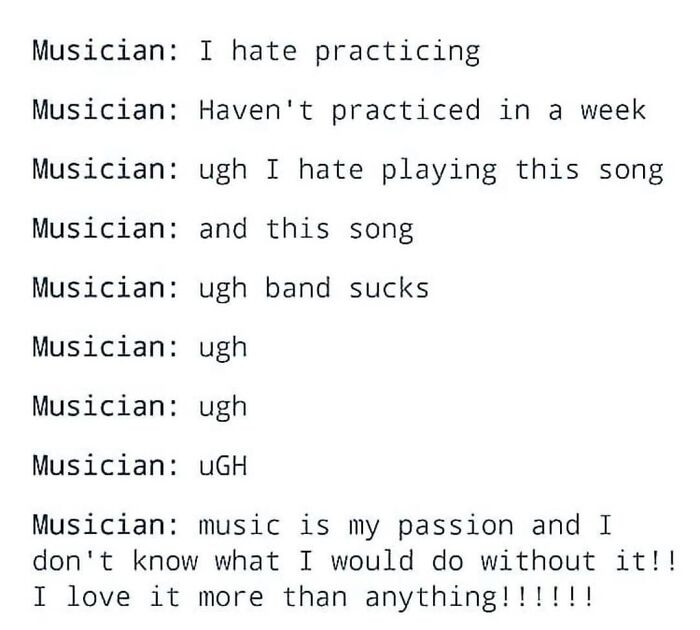
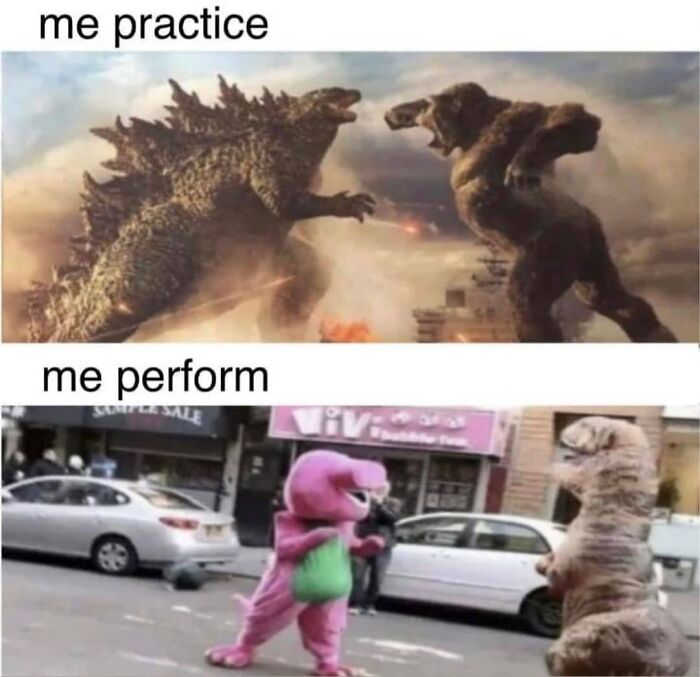
I can't stand Brandenburg concerto no 3. I had to practice nearly every day for roughly 3 months. It was awful.
The chills Silvia is describing have an official name: frisson. Researchers from USC found that more than 50% of people get feelings like shivers, a lump in their throat, or goosebumps when they listen to music. While scientists are not entirely sure what causes us to experience the shivers, they have a few theories.
One theory is that listening to music releases dopamine into our brains. The sudden rush of dopamine supposedly causes us to have a physiological reaction as well, making us feel goosebumps. Other scientists say it's the emotional connection we might feel to a piece of music. However, one study has found that it's more about people's openness to experiences.

"It's the cognitive components of 'Openness to Experience' – such as making mental predictions about how the music is going to unfold or engaging in musical imagery (a way of processing music that combines listening with daydreaming) – that are associated with frisson to a greater degree than the emotional components," one of the authors of the study, Mitchell Colver, claims.
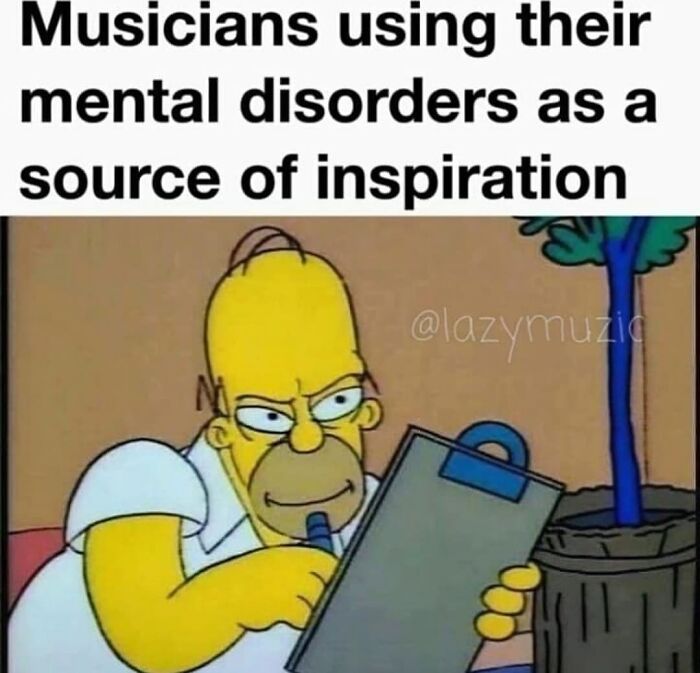
My favorite Simpsons bit: Lisa at jazz club watching a performance and another patron says it sounds like she is hitting a baby with a cat, Lisa replied that "you have to listen to the notes she's not playing" guy replies "I could do that at home"😭
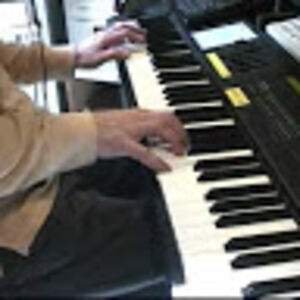
To anyone who loves orchestrated music, today's film soundtrack composers are writing music just as fantastic as the classical composers.
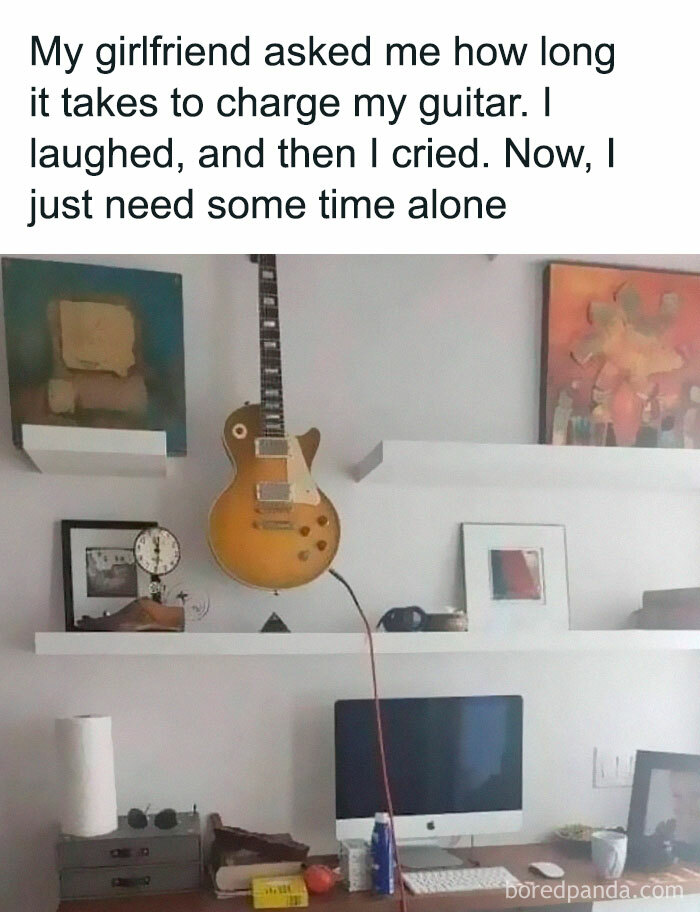
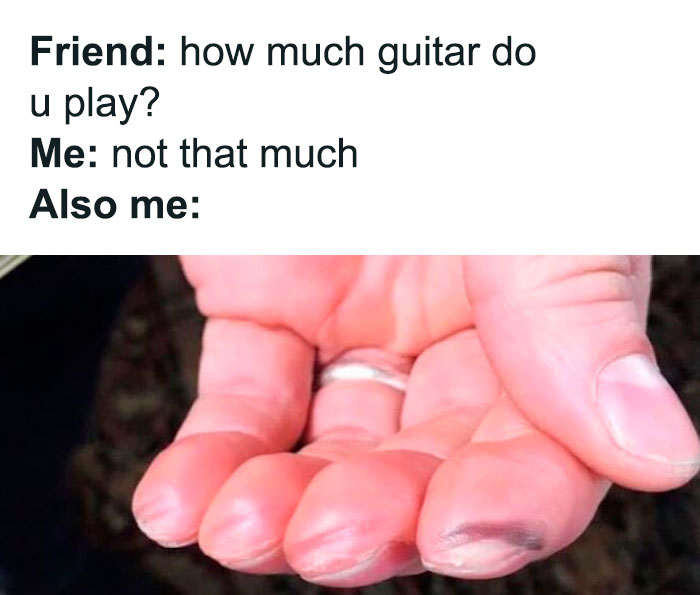
this is me with my guitar. And when that someone is one of my heroes (i have heroes in smaller bands) i will manage to strap that guitar on backwards and upside down.


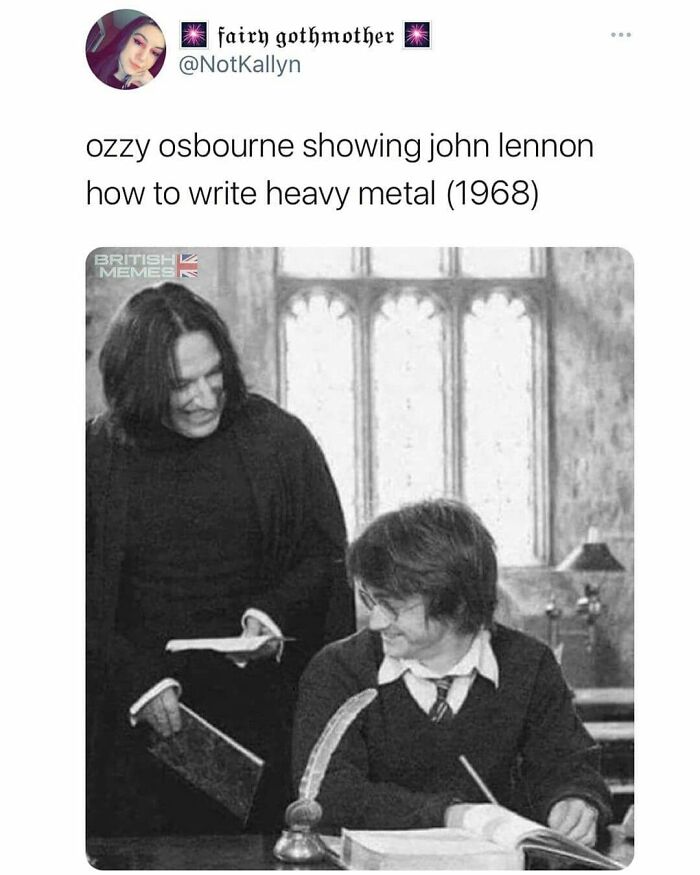
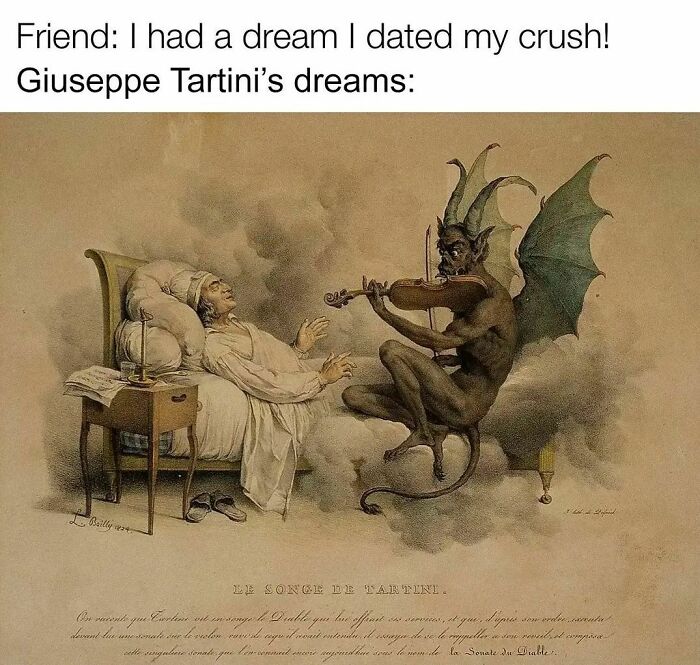
so we are witnessing the creation of the song I want you (she's so heavy) ? :P
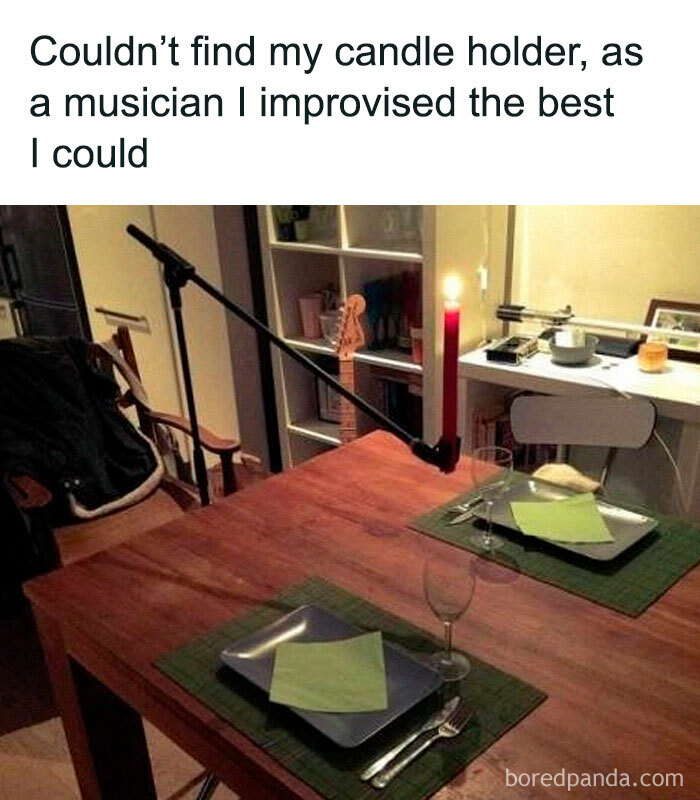
my wife knows when she can/has to unplug a guitar or not .... its the active jackson, she knows that
Or the other way around: https://www.classicfm.com/composers/mozart/maria-joao-pires-wrong-piano-concerto/
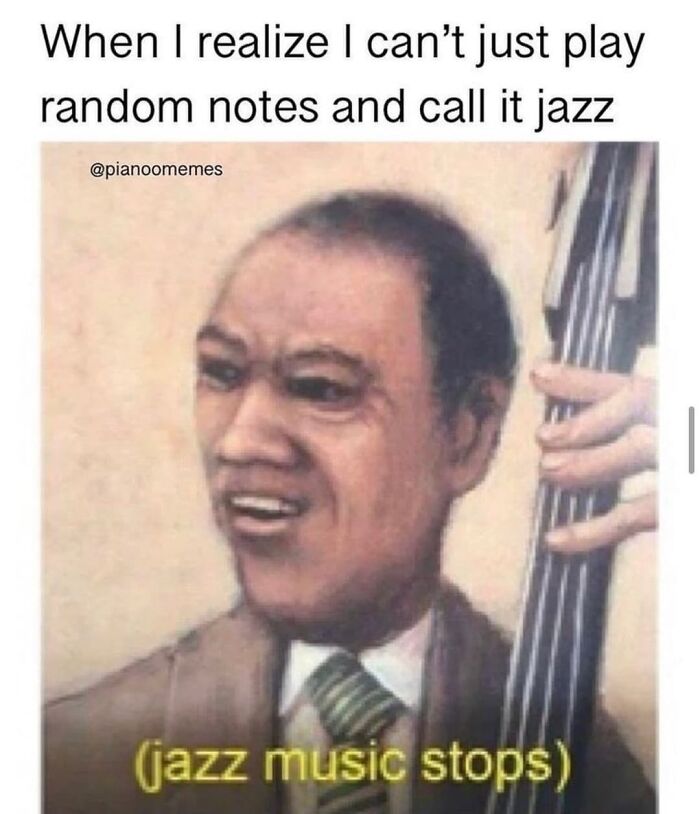
Wrong notes for jazz improvisors just become grace notes or leading tones to transpose to a new key.
My friend told me the story of his piano lessons as a kid. His teacher called his mother and said "Dave seems to enjoy the music but he does not seem to be improving at all. How long is he practicing every day?" His mother answered " Oh we don't own a piano."
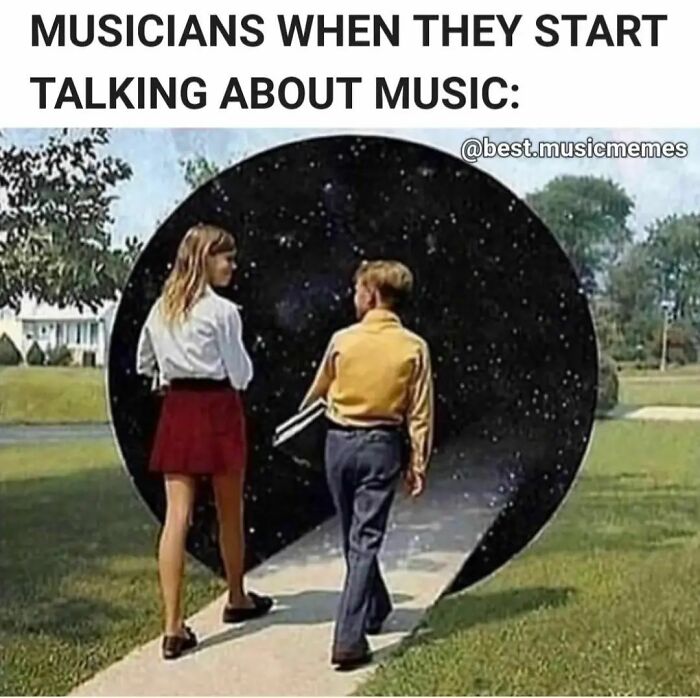
Jazz musician here with years of ear training and music theory knowledge. I can confirm any music we hear triggers automatic analysis in our brain.
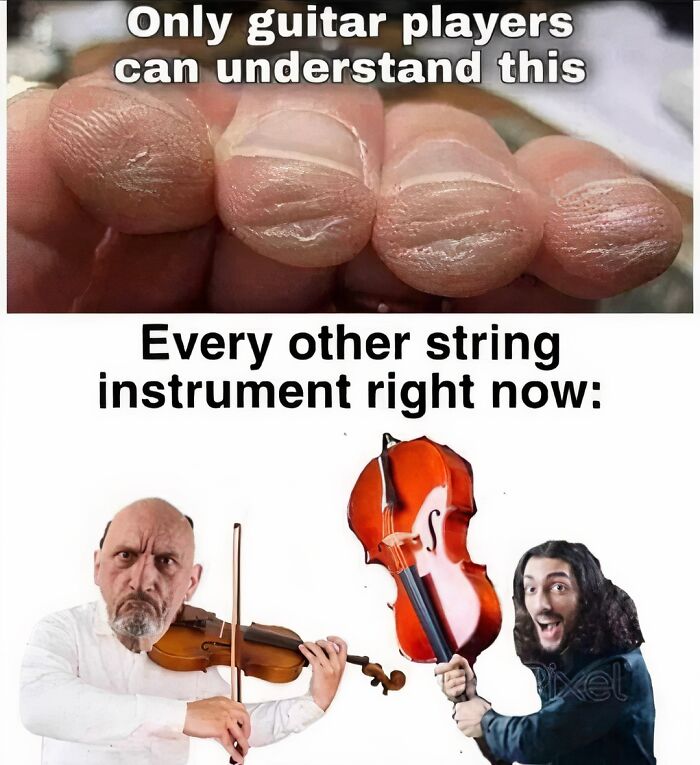
Back in high school I had a duet being judged at the state competition... broke an E tuning up right before we were supposed to go in. My conductor reached into his jacket pocket and triumphantly pulled out a set of spare strings that he usually doesn't carry but grabbed because of a premonition.
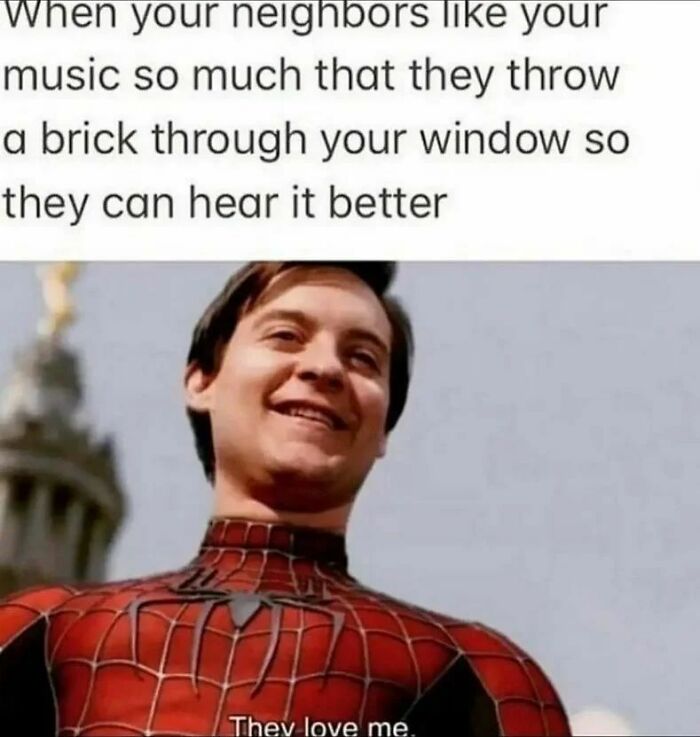
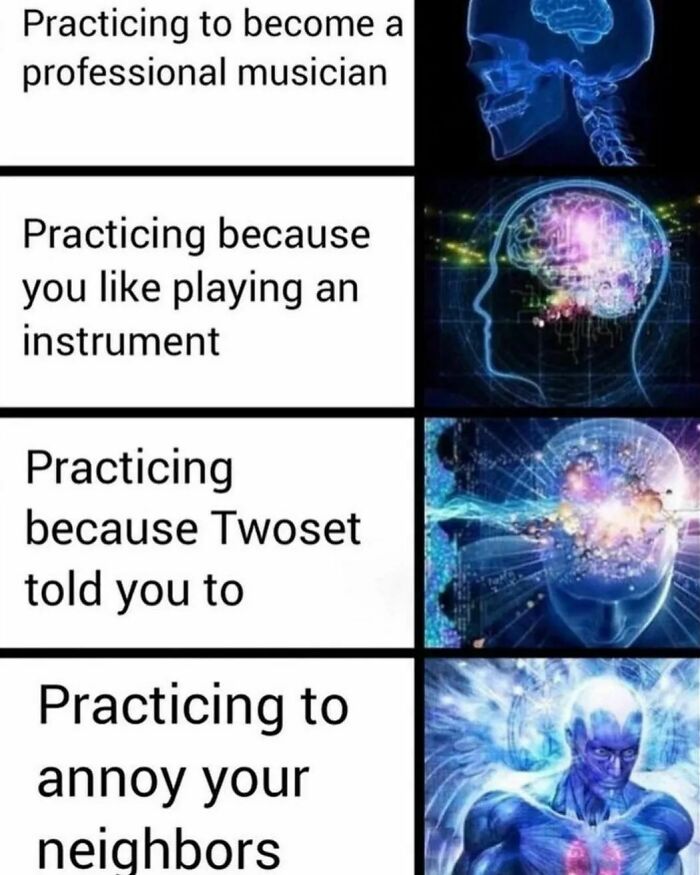
No no no. The last one is “practicing to show off to your neighbours “
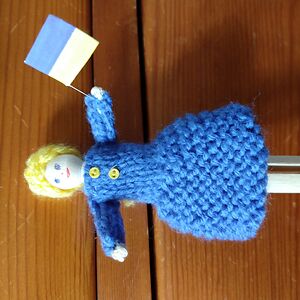
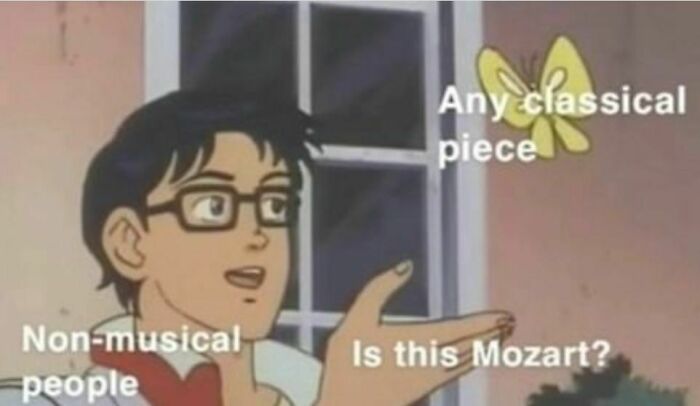
Well that's just mean, I know lots about classical music.... As long as it featured in Fantasia 😂
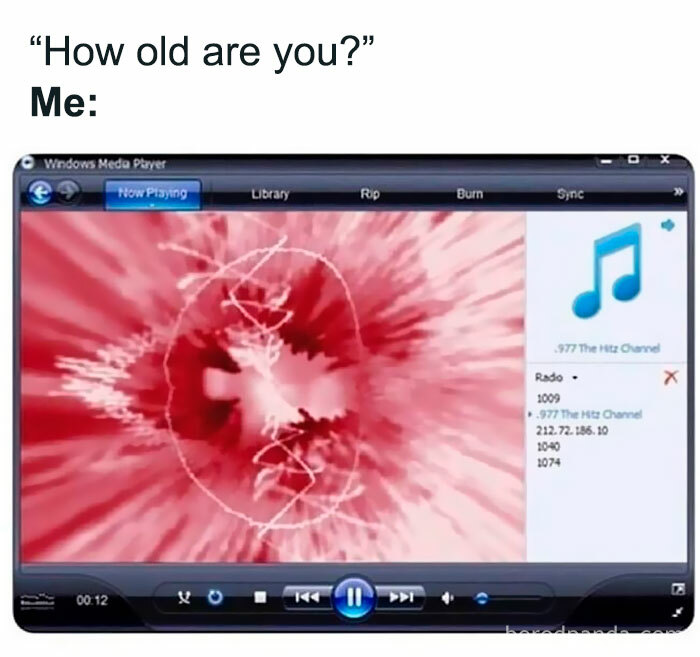
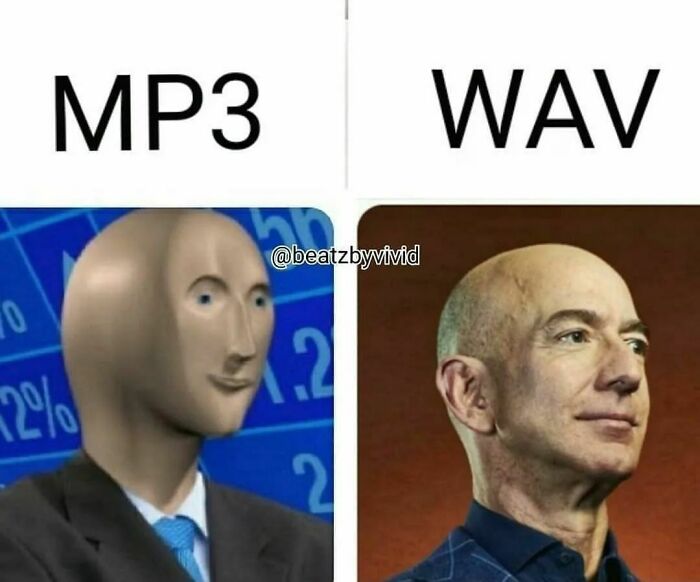
now imagine that mp3, but listened through a smartphone speaker B1fXXWnM3x...761142.png 
True! We ear trained musicians play for fun and enjoyment. Classical orchestra musicians I have met were forced to learn the violin by their parents and never even listen to classical music. It is often simply a job skill for them.
Anecdote: My friend was a sax player for years with the Maynard Ferguson big band. All the horn player prided themselves on their breath capacity and they ran long distance often. One day they invited their drummer Peter Erskine to go along for a run. Peter outran all of the horn players. The reason was Peter regularly practiced yoga and the yoga breathing exercises.
i once told a professional artist that i worked as a cleaner at a school for special needs kids. He said "be nice to them because they will all be professional artists one day"
Even more rare and thrilling is for a jazz musician to meet any other jazz musician. They are very rare in this modern world.

Got some bad news for ya: if yer just sampling other people's music and mixing it: you aren't a musician.
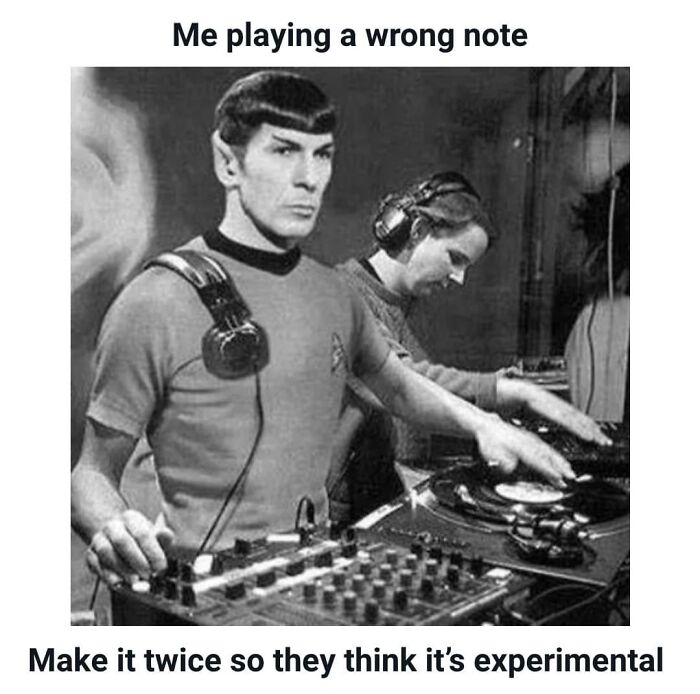
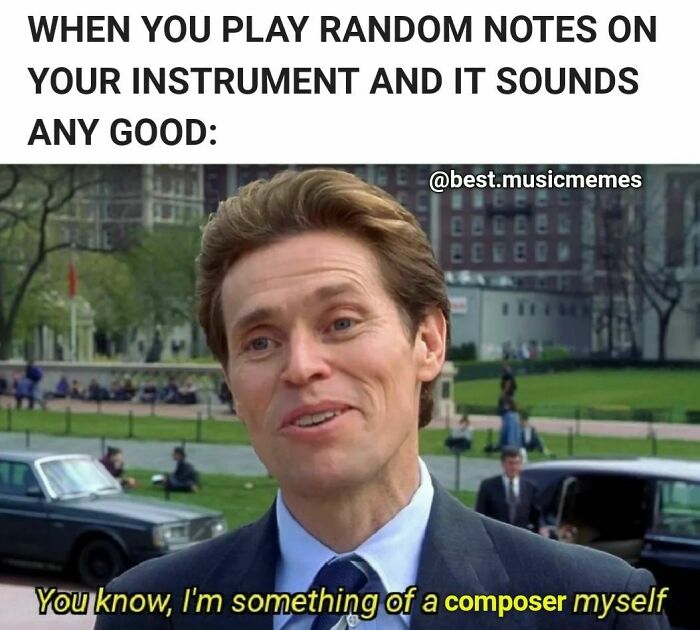
me with my saxophone. Its not that hard to impress people while playing some random notes fast.
All of the best musicians I knew had an element of OCD. They had to practice or they felt somehow incomplete. They also were perfectionists and absolutely never quit until they had played the music perfect.
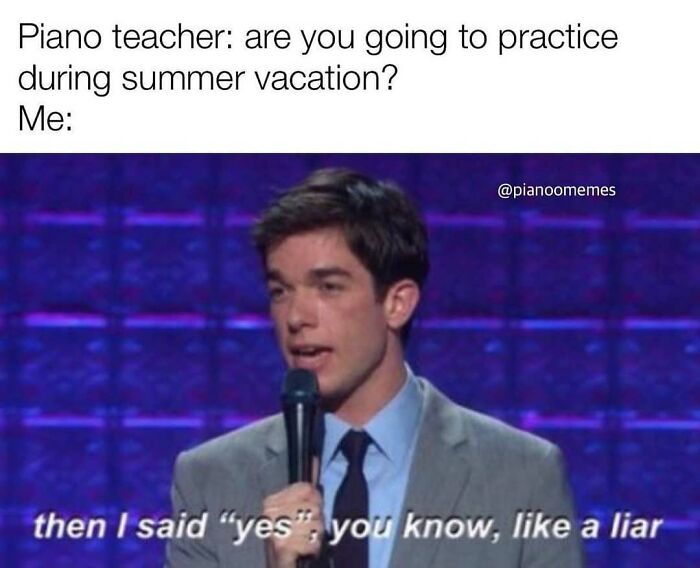
I have a rule for myself during holidays. I don’t have to learn new music. I try to play old favourites every day. Very helpful
How do you get a rock guitarist to turn his volume down? Put sheet music in front of him.
If you think about it, only the composer really groks the piece of music. He notates the score just to be able to hear an orchestra play it. The orchestral musicians are essentially robots who can translate written notation into sound. And yes, synthesizers and computers can also play back sheet music perfectly. But that human randomness is what gives live music its richness and warmth.
Jazz is not random notes. There is tons of music theory and harmonic rules we use. The non trained non musician just does not understand it and cannot hear the harmony and scales we have learned. It is like asking someone who never passed algebra to understand and appreciate the science and math required to send a spacecraft to the moon.
As a jazz pianist, I think the music in Hell would be endlessly streaming Christmas music, alternating between Rap, HipHop, Country and microtuning Eastern stringed instruments. Maybe also little free from jazz.

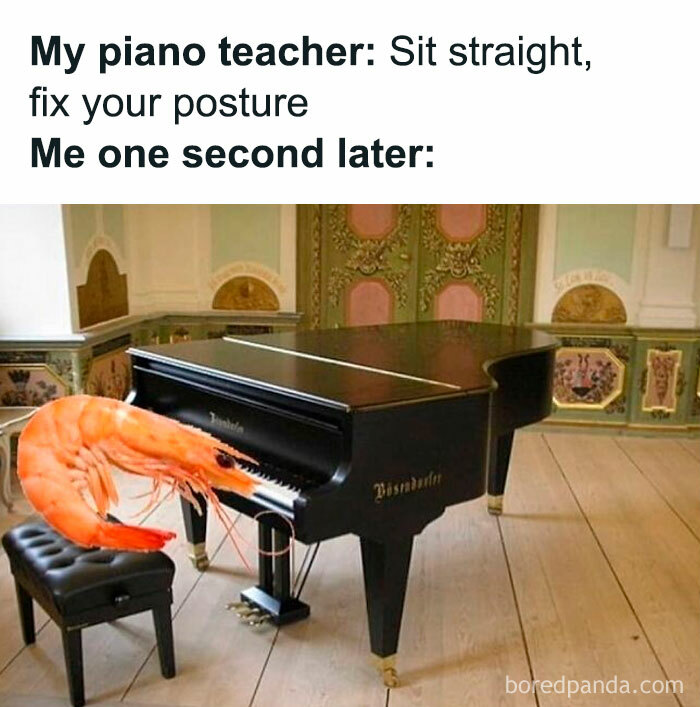
i so wish i knew this quote 50 yrs ago. my lovely grandmother had promised the instrument and lessons for any instrument that i wanted to play. i LOVED the cello so told her and was met with an emphatic NO - choose something else. why? because in her mind i would not be able to sit 'like a lady'. wtf??!!! to this day i regret not being able to learn that instrument. nan - love you and miss you but boy did you have some strange ideas.
Fantastic I was procrastinating practicing (Debussy Arabesque #1j and will now get moving. Thx
i so wish i knew this quote 50 yrs ago. my lovely grandmother had promised the instrument and lessons for any instrument that i wanted to play. i LOVED the cello so told her and was met with an emphatic NO - choose something else. why? because in her mind i would not be able to sit 'like a lady'. wtf??!!! to this day i regret not being able to learn that instrument. nan - love you and miss you but boy did you have some strange ideas.
Fantastic I was procrastinating practicing (Debussy Arabesque #1j and will now get moving. Thx














 No fees, cancel anytime