Get Premium
Dark mode theme is available exclusively for premium users. Learn more about the benefits of subscribing.
No fees, cancel anytime.

 Dark Mode Ad-Free Browsing Unlimited Content
 Ad-Free Browsing Unlimited Content Dark Mode
Join 1.2 million Panda readers who get the best art, memes, and fun stories every week!


Learning happens wherever we happen to be. And though we absolutely love cozy old libraries, they’re not the only way to expand your knowledge about the world. Even social media, with the help of high-quality photos, can help with that.
That’s where the ‘History Archaeology People’ Facebook page comes in. It is a project that is dedicated to educating and entertaining the internet with some of the most powerful photos from ages past. We’ve collected some of the most interesting images to share with you, Pandas, from buildings and artifacts to statues and works of art. They might just give you a whole new perspective about the history of the human race.
This post may include affiliate links.
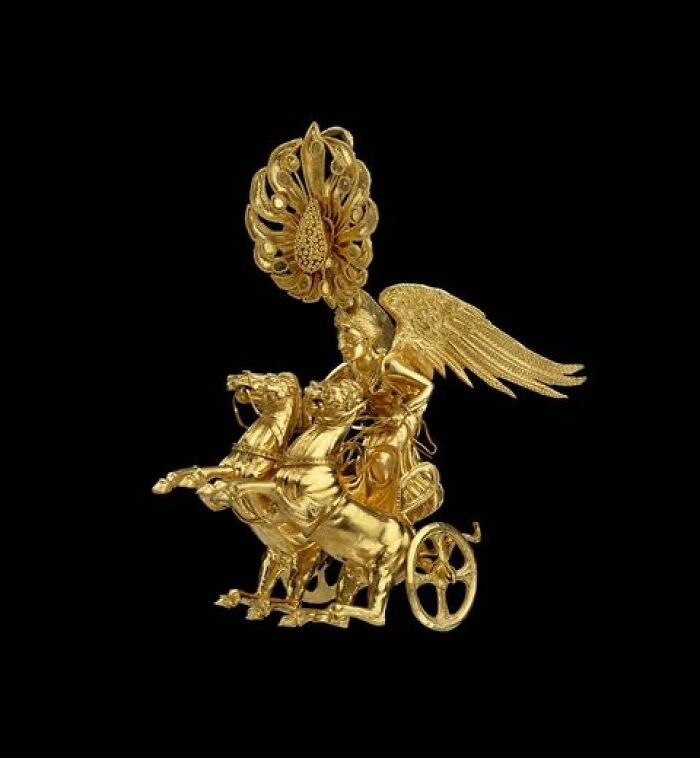
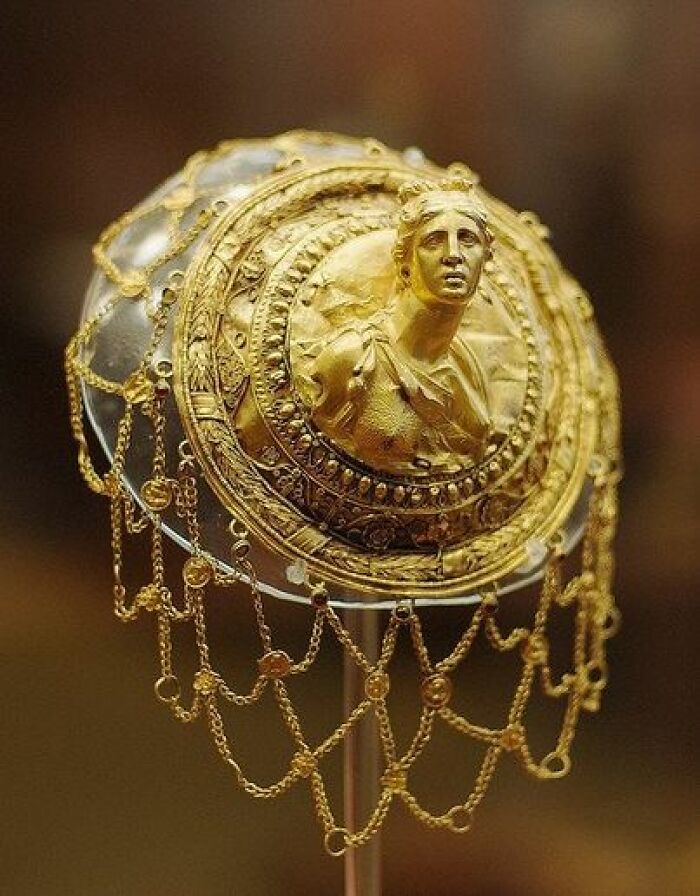
Magnificent earring with Goddess Nike driving a two-horse chariot.
Greek, late Classical or Early Hellenistic Period.
About 350–325 B.C
Dimensions : Height: 5cm !!! , Weight: 15.8 gm .
Medium : Gold and enamel .

Nike is the Greek goddess of Victory, so this was likely a lucky charm of sort.
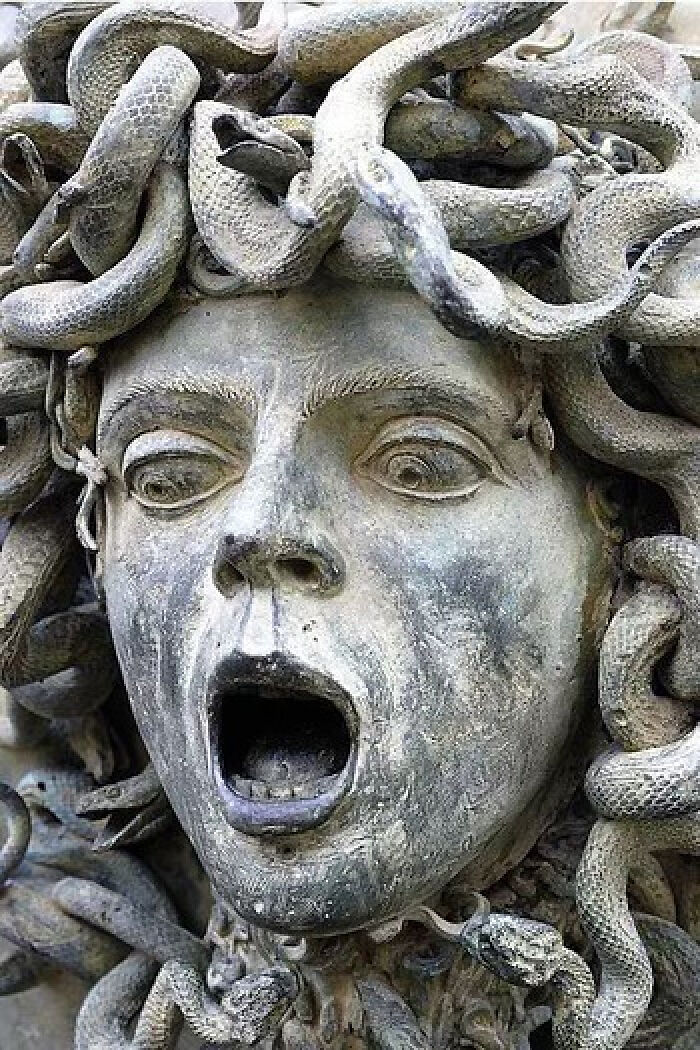
Medusa sculpture at Hadrian’s Villa,Tivoli ( 2nd century AD).
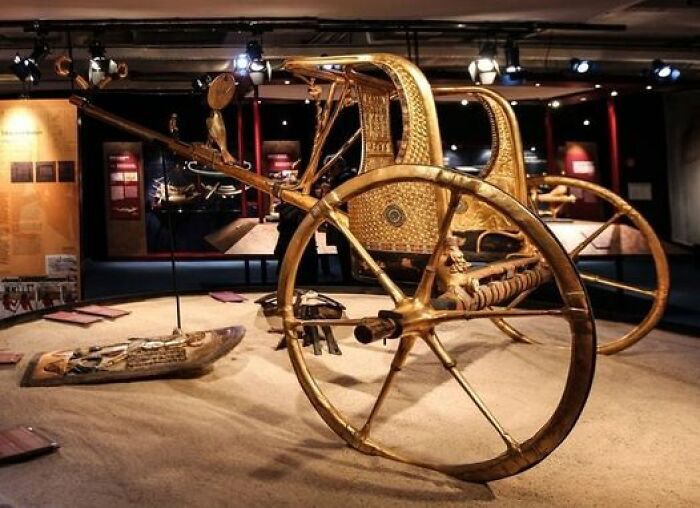
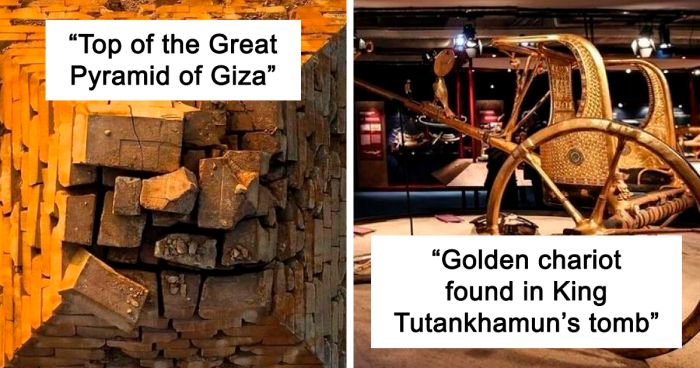
Golden chariot found in King Tutankhamun's tomb

It was unthinkable to bury a king wothout a charriot back then - in this case the king in question might not have been so fond, though. While earlier theories thought Tutankhamun might have been murdered, newer research (2013) makes it more likely that he was run over by a chariot after being wounded in a chariot race. He had serious injuries at his side and chest, which earlier egyptogogist chalked up to careless embalming. This probably was also the reason why, in complete contradiction to the usual customs, the heart was removed from the body - the researchers supposed it was damaged to badly to be of any use in the afterlife.
At the time of writing, the ‘History Archaeology People’ page had 16k followers on Facebook. The curators of the project maintain a steady stream of new posts in the feed, in order to give their loyal followers interesting topics to mull over.
The page doesn’t just concentrate on a single historical period or geographical location either: it covers a very wide range of topics. However, there is a particular emphasis on Ancient Egypt. It’s a treat for anyone like us, who are thoroughly fascinated by it.
ARCHAEOLOGY
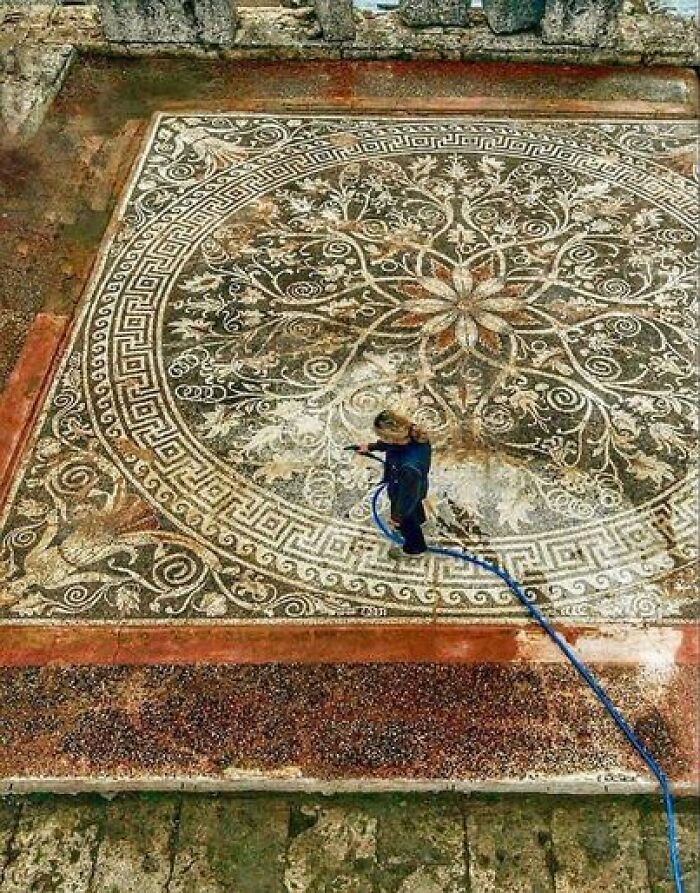
One of biggest pre-roman mosaics ever found. Highly elaborate, meant to show power of Kingdom of Macedonia.
Palace of Aigai, known today as Vergina, is considered not only biggest, but together with Parthenon, most significant building of classical Greece.
Constructed during reign of Philip II (359-336 BC) on a raised outcrop in Vergina in northern Greece, palace, a remarkable landmark and symbol of power and beauty three times size of Parthenon, was visible from whole Macedonian basin.
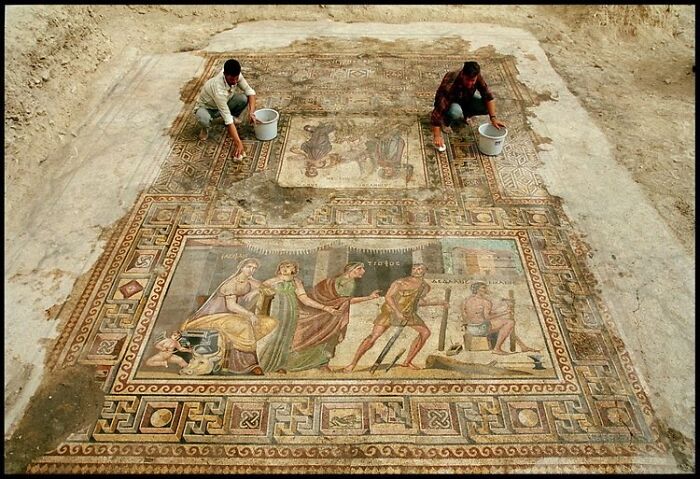
Magnificent roman mosaic of Zeugma (Turkey).It represents the myth of Queen Pasiphaé (sitting on her throne).
Situated in South-eastern Turkey, Zeugma, literally “bridge” or “crossing” in ancient Greek, owes its name to the fact that it was located at the major ancient crossing point on the river Euphrates. The ancient term Zeugma actually referred to the twin cities on the opposing banks of the river. They were Hellenistic settlements established by commander Seleucus Nicator around 300 BCE.
Greek Gold Diadem, Black Sea , ca. 300 BC

"I need a bug hat! But make it golden and fancy!" "Yes your highness!" image-33.jpg 
When we were smaller, many of us would dream about all the awesome things that we’d do when we grew up. While some people wanted to be astronauts, rockstars, and scientists, others were drawn to a life of adventure. Namely, discovering the treasures of the past. And if you sincerely want to be an archeologist, you can certainly follow that career path—it’s very viable.
In the United States, the average base salary of an archeologist in 2023 was $66,757 per year, according to Indeed. In the meantime, historians make an average of $73,896 per year in the US. So if archeology or history are a passion of yours, you can turn it into something more than just a passing hobby.
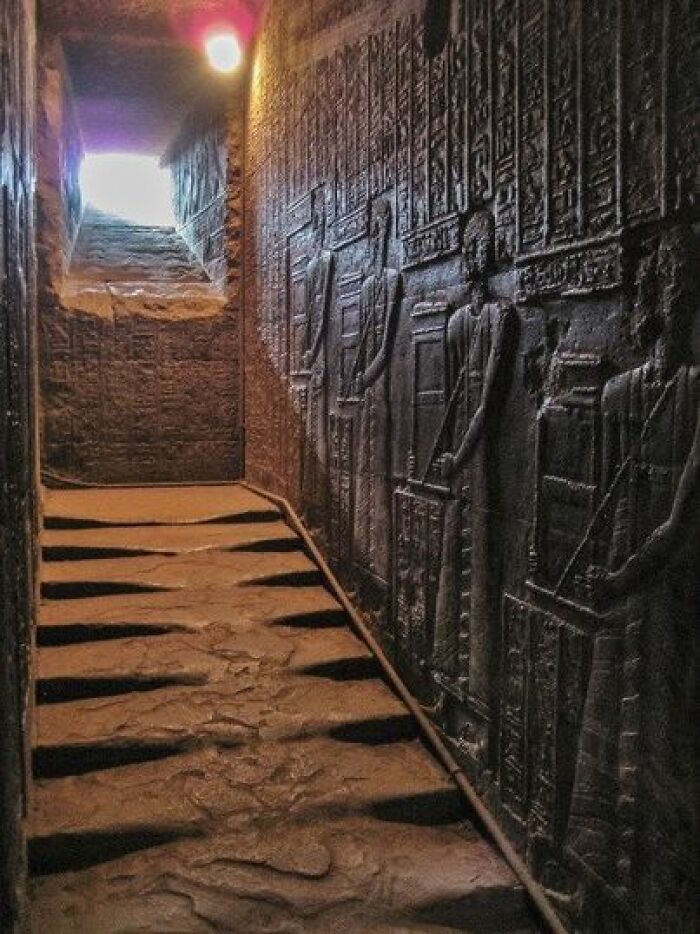
Ptolemaic Temple of the Goddess Hathor at Nitentóre (Dendera):
The western staircase leading to the roof of the Temple.
On the wall at right, detail of the procession : four priests carrying shrines .
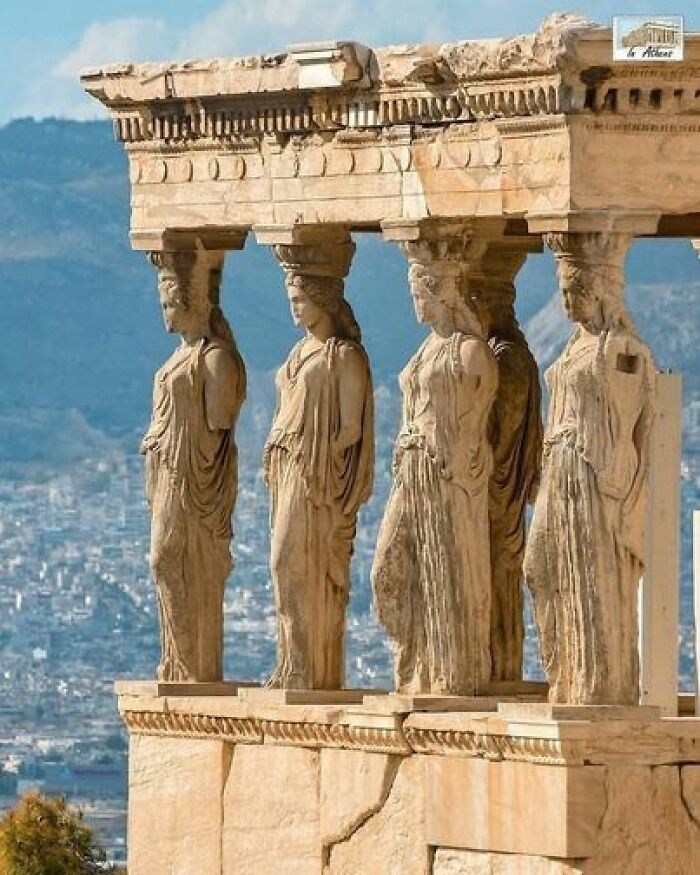
Erechtheion - Caryatids
Ancient Greek temple on the north side of the Acropolis of Athens.
Caryatid, greek: Καρυάτις - Karyatid, literally means "maiden of Karyai"
Caryatid is the name given to an architectural column which takes the form of a standing female figure. The first examples come from ancient Greek architecture .

If I remember correctly, traces of paint have been found on these statues. Not only were they fully clothed, the clothes were painted in bright colours.
However, both paths require a lot of patience and dedication. You need the right degrees and to develop a whole host of skills before you start looking for Indiana Jones costumes in earnest. For starters, you should aim to get at least a bachelor’s degree in archeology. Alternatively, consider a related field, including anthropology, history, or geography if there are no archeology courses available near you.
Your next step would be to continue studying and gaining hands-on experience. As you start your master’s degree (and hopefully even a doctorate!), you can apply for fieldwork, write and publish academic papers, and hone in on the area of study that you find the most interesting. It’s really important that you’re passionate about what you study because you’ll be doing a lot of it.
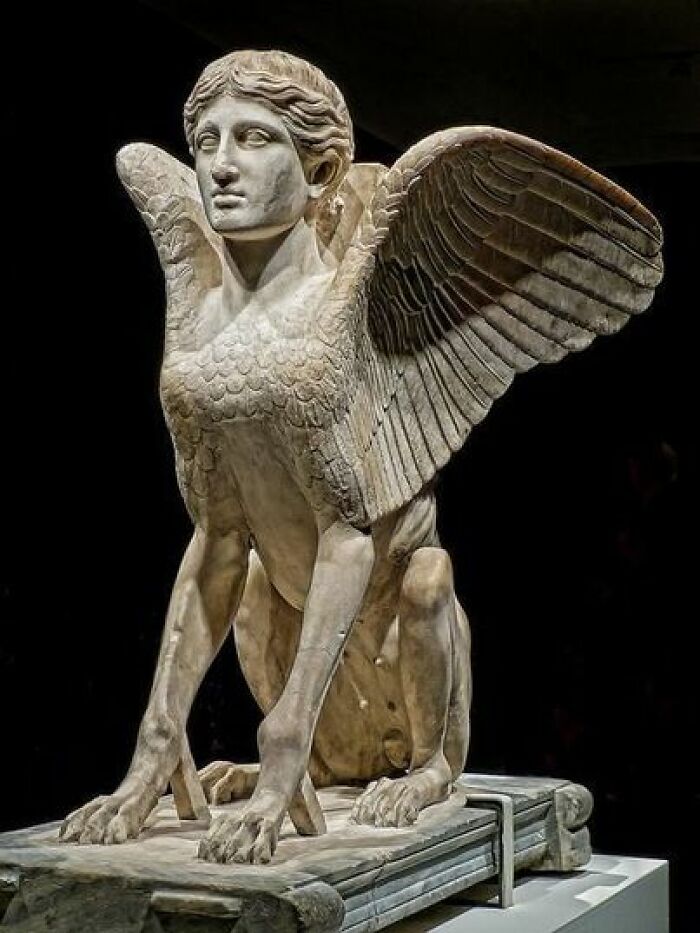
Sphinx of Lanuvium.
Near Rome. Roman, about AD 120–140.

Always so weird seeing statues of a sphinx like this. Albeit, this is the depiction of what they are supposed to look like according to myth, but I always visualize the one in Egypt. This is a bit more creepy looking.
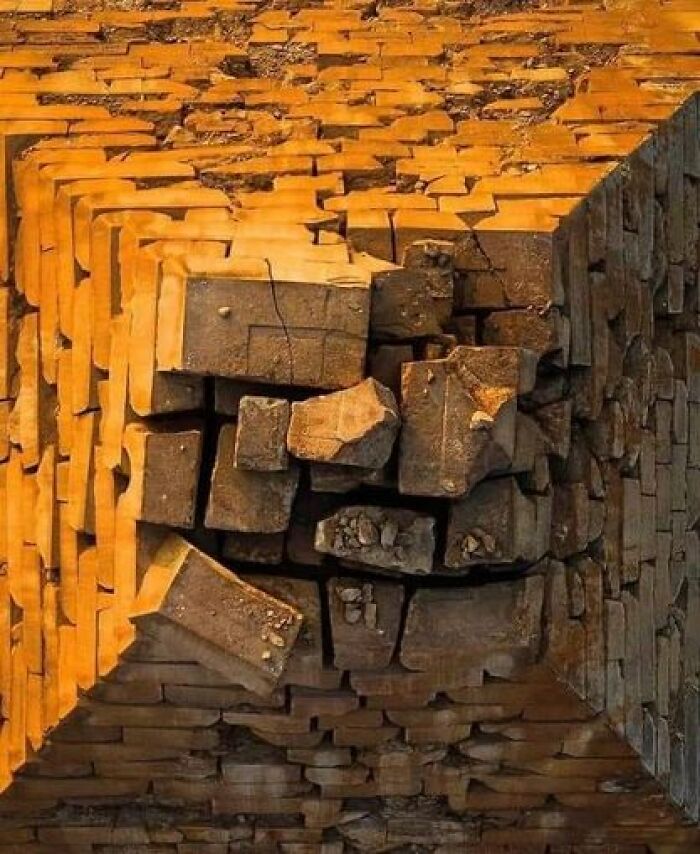
Top of the Great Pyramid of Giza

That isn't the top of the Great Pyramid (Khufu's Pyramid). It's the top of the other one (Khafre's Pyramid).
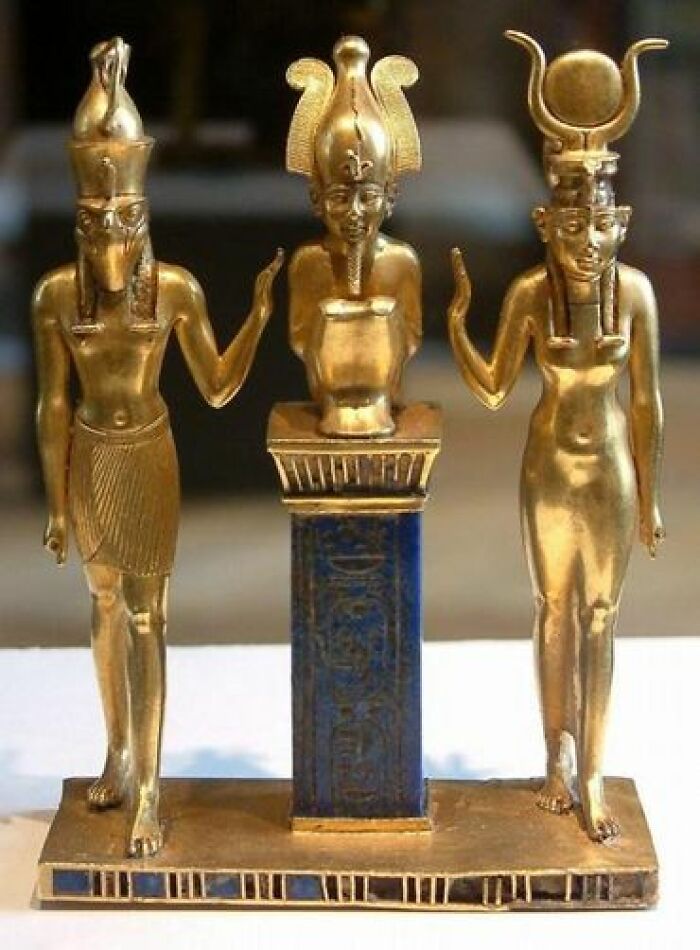
Holy triad of the Osiris family (Horus, Osiris and Isis).
Gold and lapis lazuli .Was once part of an pendant and bears the Cartouche of Pharao Osorkon II as well as an inscription at the bottom. Egypt, 22nd dynasty. 874 to 850 BC.
If you have a solid education, lots of hands-on experience, and a good reputation in the academic community, finding a full-time job (whether at a university or elsewhere) will be far easier than just with a high school diploma and a handful of wishful thinking. Excavations are serious business, so you want to be seen as someone who’s reliable and capable.
There are far more types of archeologists than many people realize. Not everyone has to study ancient tombs like historical archeologists! For instance, you could study to become an underwater or maritime archeologist and survey the remains of ancient shipwrecks and cities beneath the waves. This requires a very different skill set than your colleagues might have for land surveys.
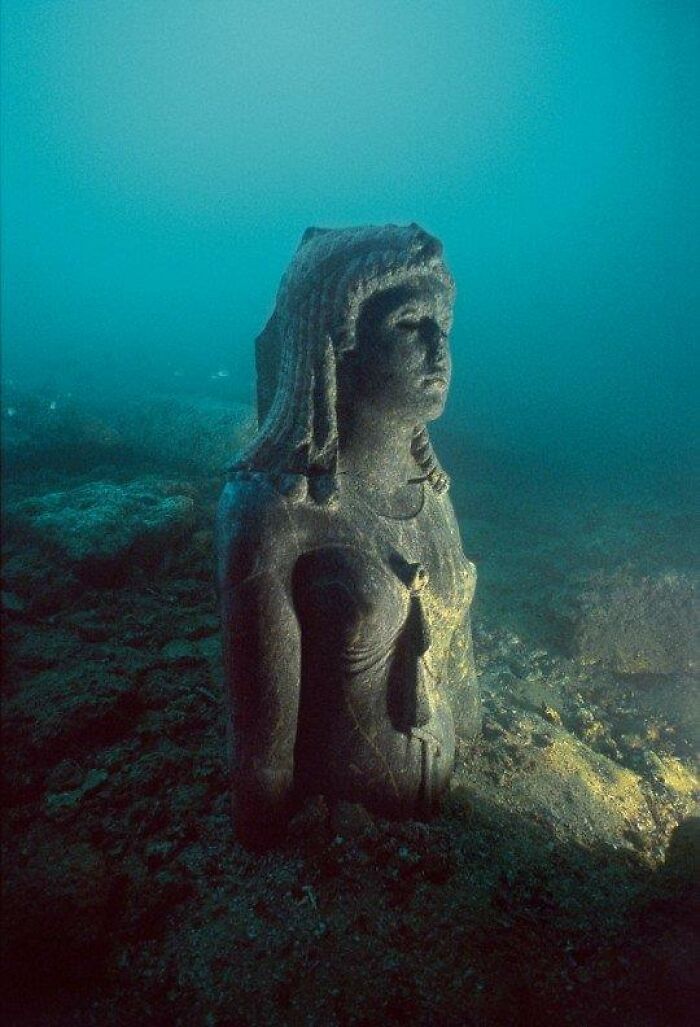
The Dark Queen, statue probably depicting the Ptolemaic queen Cleopatra III (ruled 142–101 BC).
Discovered in the lost, sunken city of Thonis-Heracleion
Lost city of Heraklion
Port of Thonis-Heraklion ,a lost ancient Egyptian city submerged beneath the sea 1,200 years ago .
Heraklion (Greek: Ἡράκλειον), also known as Thonis (Θῶνις), was an ancient Egyptian city near Alexandria whose ruins are located in Abu Qir Bay, currently 2.5 km off the coast, under 10 m (30 ft) of water.
Its importance grew particularly during the waning days of the Pharaohs—the late period, when it was Egypt's main port for international trade and collection of taxes.
Heracleion was originally built on some adjoining islands in the Nile Delta, and was intersected by canals. It possessed a number of harbors and anchorages, was the sister city of Naucratis, and was superseded by Alexandria.
Giant 16 foot statues have been uncovered and brought to the surface while archaeologists have found hundreds of smaller statues of minor gods on the sea floor.
Slabs of stone inscribed in both ancient Greek and Ancient Egyptian have also been brought to the surface.
Dr Damian Robinson, director of the Oxford Centre for Maritime Archaeology said :
“The site has an amazing preservation ,
“We are getting a rich picture of things like the trade that was going on there and the nature of the maritime economy in the Egyptian late period. There were things were coming in from Greece and the Phoenicians.

Nice bit of nightmare fuel for whoever swam up on this the first time..
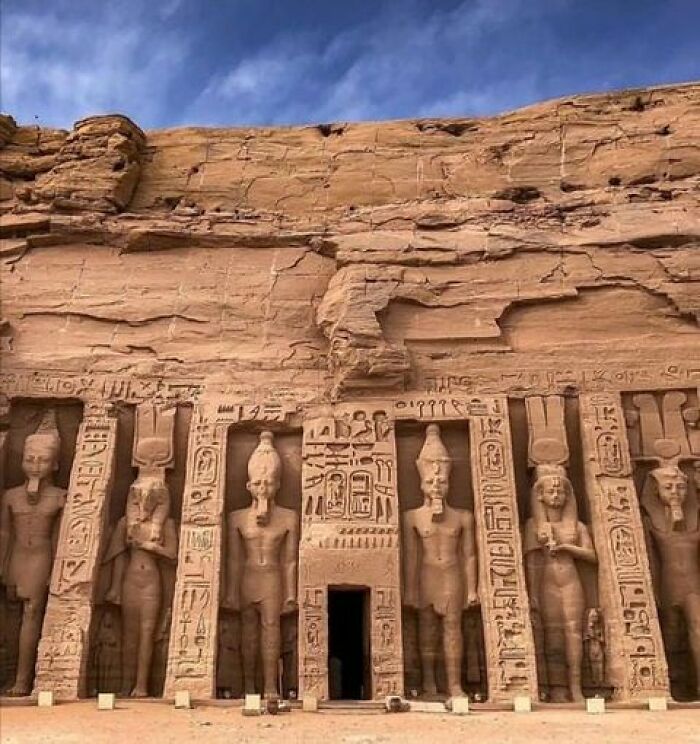
Temple of Nefertari.
As the better known Ramesses temple of Abu Simble, this one, too, was relocated in the 60s to make place for the Nasser reservoir in an act of international cooperation that is still thought to have been an absolute technological marvel. It is supposed that these temples and their rescue played a huge role in forming the idea of the UN world heritage convention and the UNESCO world heritage list in the early 70s..
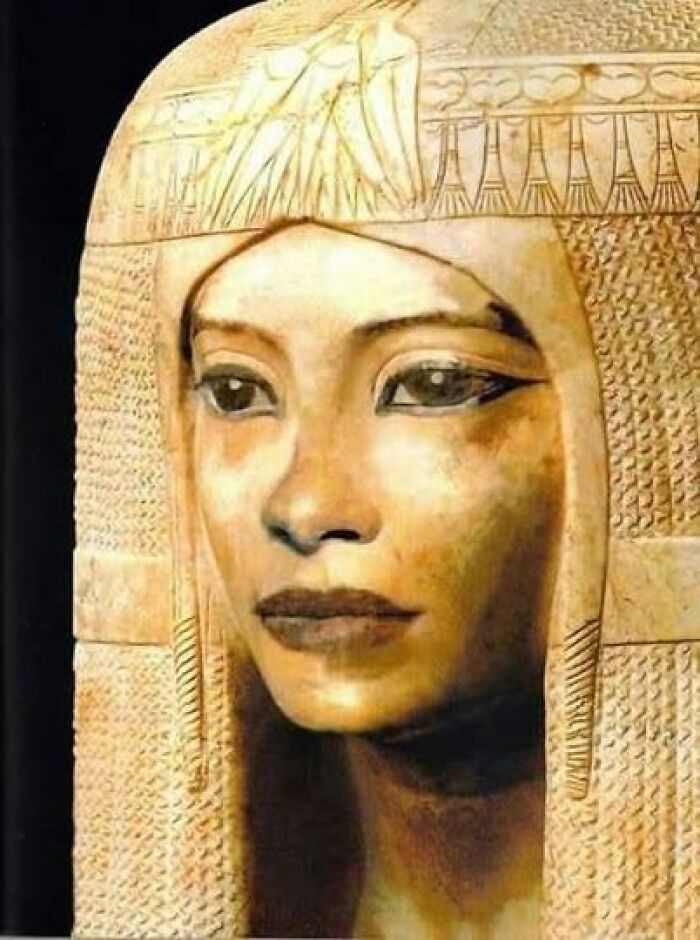
Egyptian mummy mask, 19th dynasty, reign of Ramses II (wood).
In this carved image that seems to come to life, you can once again appreciate the talent of the ancient Egyptian artists.

it actually looks like this https://www.facebook.com/112001578818426/photos/a.121942364491014/3174154312603122/?paipv=0&eav=AfamjpbSs78DPHEQSjvrFTA0is2b8mDgD8nbdi35R-FlDlNx6UyMI6_gzGUhG0pB_wc&_rdr
Meanwhile, ethnoarcheologists study the habits and customs of ancient cultures. They might look at how modern groups live and use those clues to try to figure out information about their predecessors. Environmental archeologists, however, focus on the plants and animals that were present during a particular period of time and the relationship between them and ancient cultures.
We’d love to hear which of the pics featured in this list you like the most, dear Pandas. Feel free to share your thoughts about them and your favorite historical periods in the comments. In the meantime, let us know if you actually work as an archeologist or historian, or if you’ve studied something in a related field!
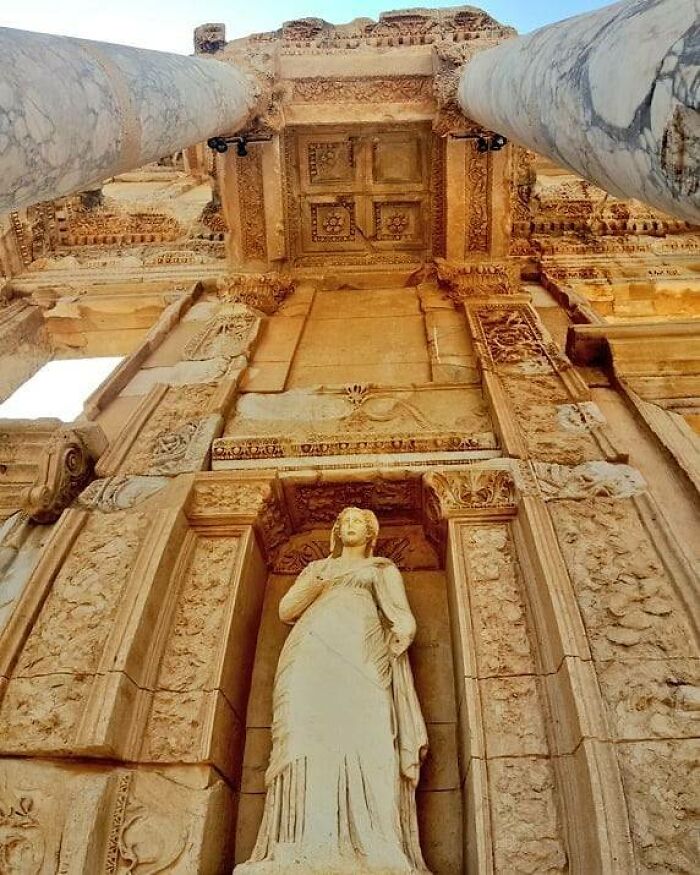
The Celsus Library, Ephesus.
This is one of the most beautiful structures in Ephesus. It was built in 117 A.D. to store about 12,000 scrolls and to serve as a mausoleum for Tiberius Julius Celsus Polemaeanus (Roman proconsul of Ephesus).
The scrolls of the manuscripts were kept in cupboards in niches on the walls.There were double walls behind the bookcases to prevent them from the extremes of temperature and humidity.
The capacity of the library was more than 12,000 scrolls. It was the third richest library in ancient times after the Alexandria and Pergamum.
The facade of the library has two levels , with Corinthian style columns on the ground floor and three entrances to the building. There is three windows openings in the upper floor.
The statues in the niches of the columns today are the copies of the originals. The statues symbolize wisdom (Sophia), knowledge (Episteme), intelligence (Ennoia) and valor (Arete).
The interior of the library was destroyed, supposedly by an earthquake in 262 A.D., (though other evidence points to a fire during a Gothic invasion in that same year).
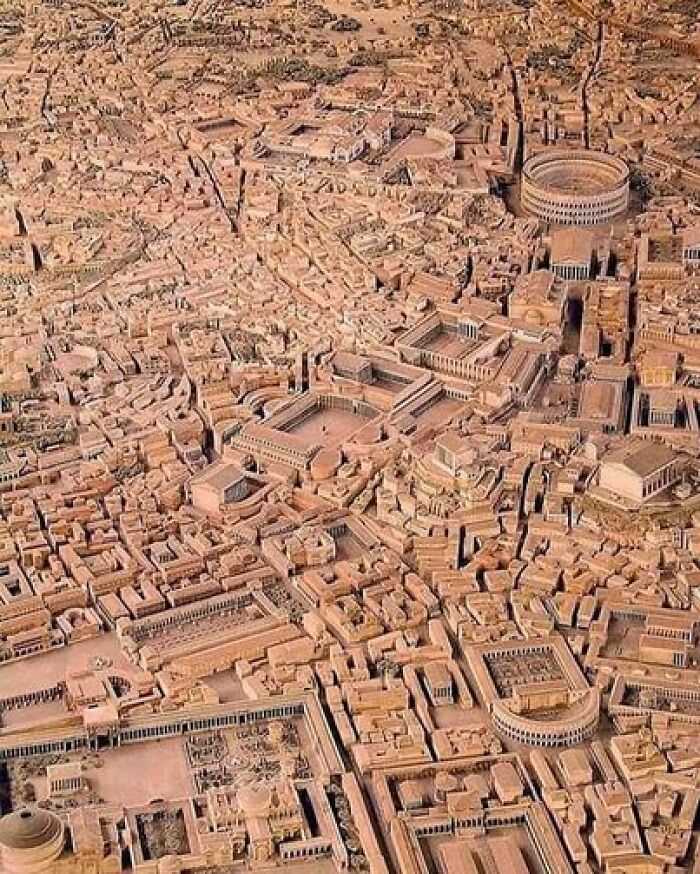
Great model of imperial Rome.
Exhibited in the Museum of Roman Civilization, it is a square of about 24 meters on a side, which can be seen from the upper floor. Its construction began in 1933 by the architect Gismondi, according to the detailed archaeological map drawn at the end of the century by Rodolfo Lanciani. The model is updated with the latest archaeological findings.
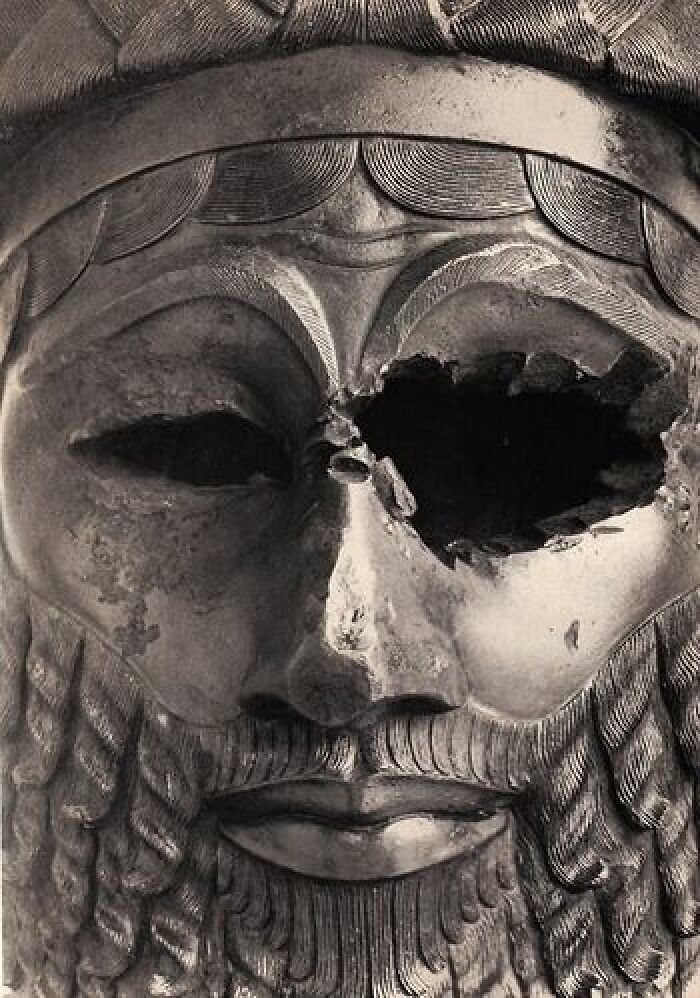
Bronze Head of King Sargon of Akkad, 2306 B.C
"The head of Sargon plainly has been mutilated. In addition to the severing of the head from its lost body, the image bears various marks of violence—the left eye socket has been gouged out, the nose has been flattened at the tip, the ears have been cut off, and the ends of the beard have been broken. Although it has been suggested that the eye socket was damaged by someone attempting to remove an inset of precious material, there is no evidence that the hole ever contained anything at all and, in any case, the other damage still demands explanation. The desecration of the royal portrait was almost certainly intentional and most likely an act of political iconoclasm, possibly carried out at the time of Nineveh’s fall to the Medes and Babylonians in the early seventh century BCE. The selective disfiguration of the head suggests that the goal was not to wipe away all presence of the royal figure, but rather to leave it in a state of defeat and humiliation."
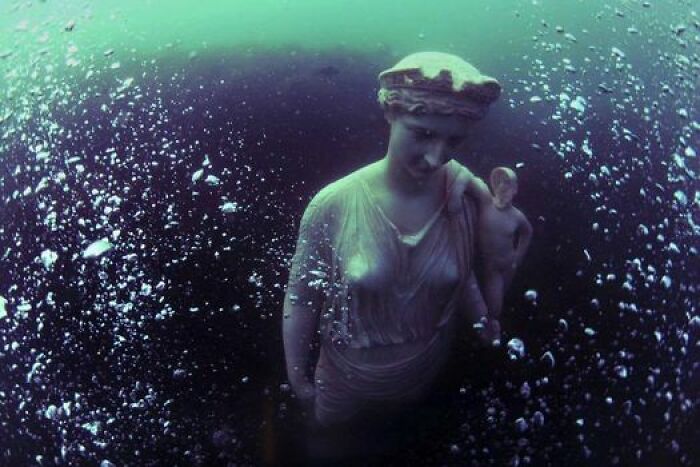
Submerged Statue of Baia City
Baia was an ancient Roman town situated on the northwest shore of the Gulf of Naples. It was a fashionable resort for centuries in antiquity, particularly towards the end of the Roman Republic, when it was reckoned as superior to Pompeii, Herculaneum and Capri by people rich who built luxurious villas here from 100 BC.
The lower part of the town later became submerged in the sea due to local volcanic seismic activity .

I'm really hoping that the underwater archaeologists can bring up as many statues and buildings that survived the volcanic disaster that is possible in the next 100 years. Maybe put the whole city together again. What a brilliant display!
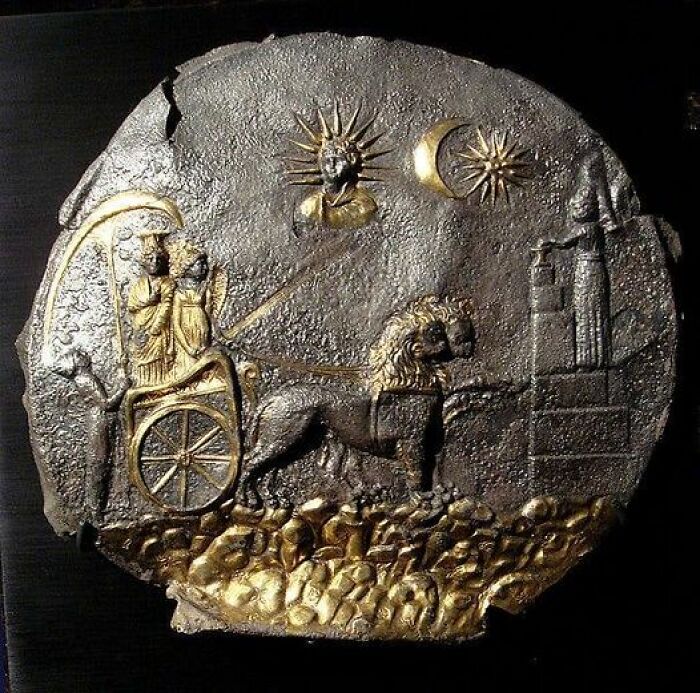
Greek traces in Asia.
A magnificent hybrid Greek and Oriental image.
Ceremonial Plaque depicting Cybele on her chariot, early 3rd century B.C.Afghanistan, Aï Khanum.
One of the oldest antiquities found at Aï Khanum, this spectacular disk depicts Cybele, the goddess of nature, and Nike, the personification of Victory, on a chariot drawn by two lions through a mountainous landscape. It is a remarkable example of hybrid Greek and Oriental imagery that typified the arts of Hellenized Asia. Ancient Near Eastern features include: the parasol—a royal symbol—here held by a priest; the stepped altar; the shape of the chariot; the scalloped pattern indicating mountainous terrain; and the moon crescent and the star. The cult of Cybele originated in Anatolia but had long been adopted by the Greeks. Also borrowed from the Greek tradition are the representation of the winged Nike, the bust of the sun god Helios, and the naturalistic rendering of the drapery and the lions. The overall composition of the scene, however, lacking any indication of perspective, is more typical of Near Eastern art.
Materials & dimensions:
Gilded silver; D. 1/25–2/25 in. x Diam. 9 7/8 in. (1–2 mm x 25 cm)
National Museum of Afghanistan, Kabul, 04.42.7

And in the upper central part you can see the Statue of Liberty emerging from NY fog
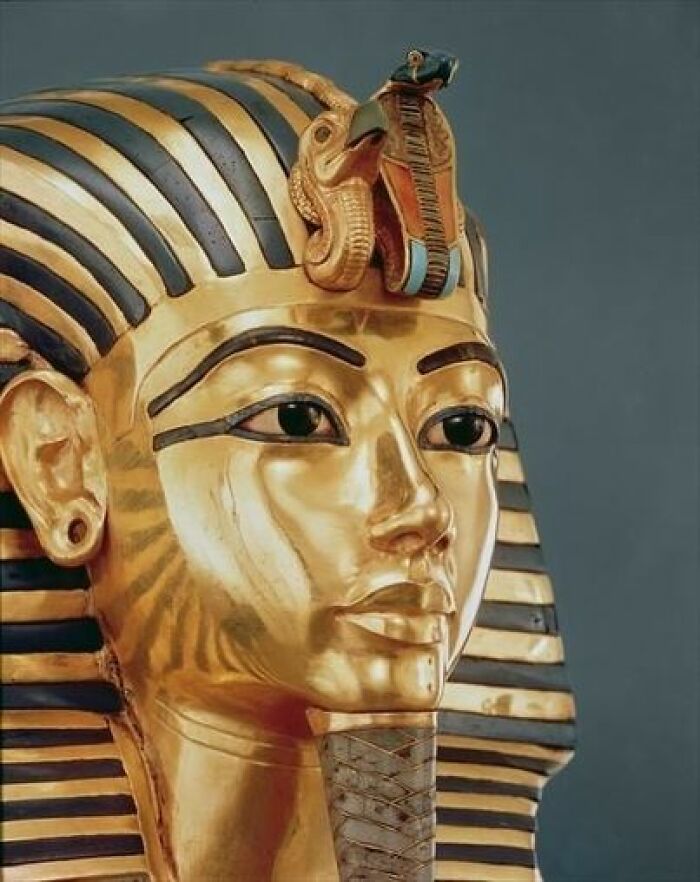
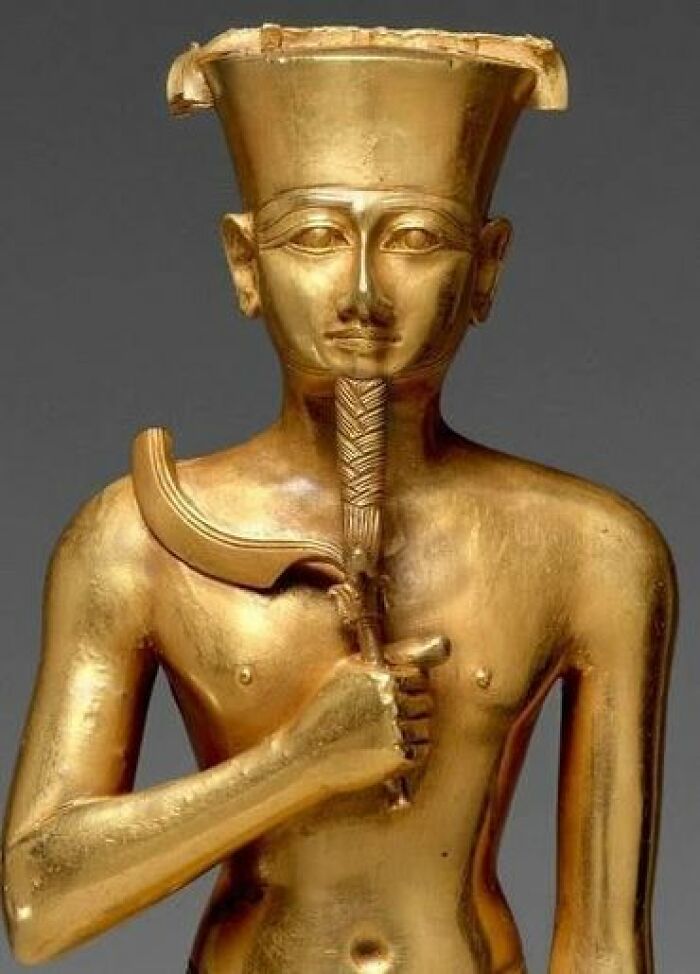
Mask of Tutankhamun,topped by the royal insignia of the “Two Ladies”.

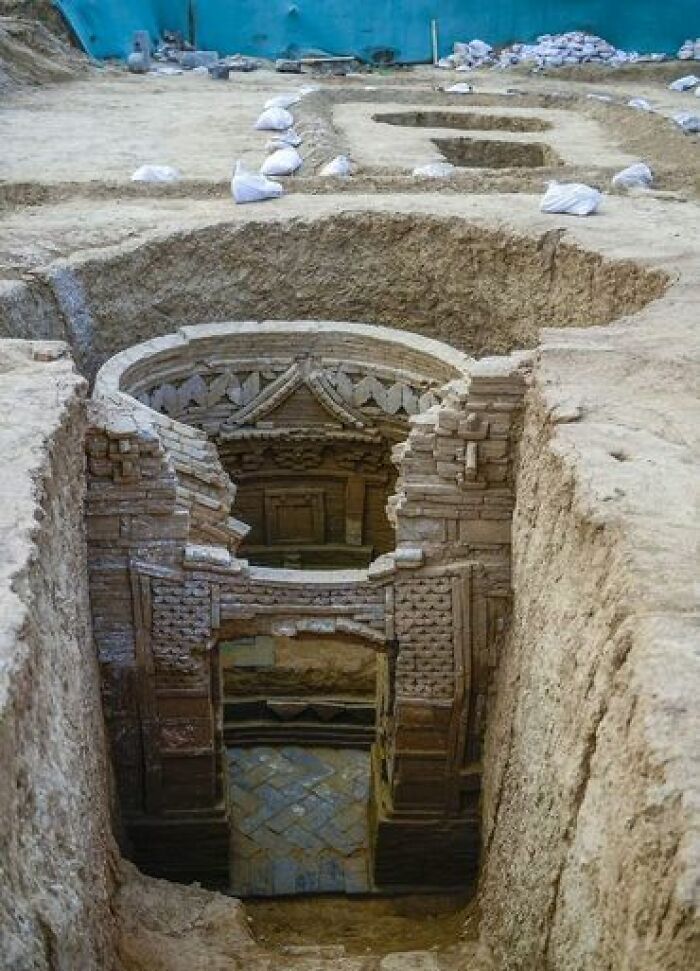
Archeo news.
A group of 12 Medieval Underground Tombs discovered in China. These beautiful structures to protect wealthy dead in afterlife, dating from Yuan Dynasty (1271-1368 CE) were discovered during archaeological research in Jinan, Shandong Province in eastern China.
Beautiful! The Chinese were as meticulous as the Egyptians in the caring of their dead.
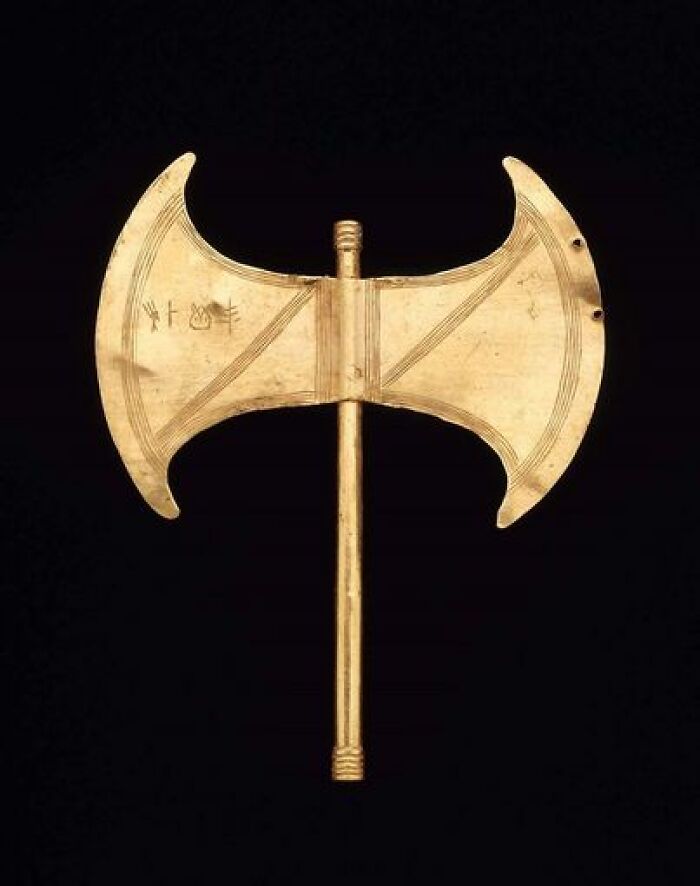
Votive double axe
Early Aegean, Minoan
About 1550–1500 B.C.
Dimensions: Length 9 cm ; width 8.3 cm .
Gold double axe composed of thin sheet gold mounted on a hollow gold shaft and outlined by bands of five incised lines. On left blade, inscription of four undeciphered signs . Two pierced holes on right blade.
The axe was deposited in a sacred cave as a votive offering.
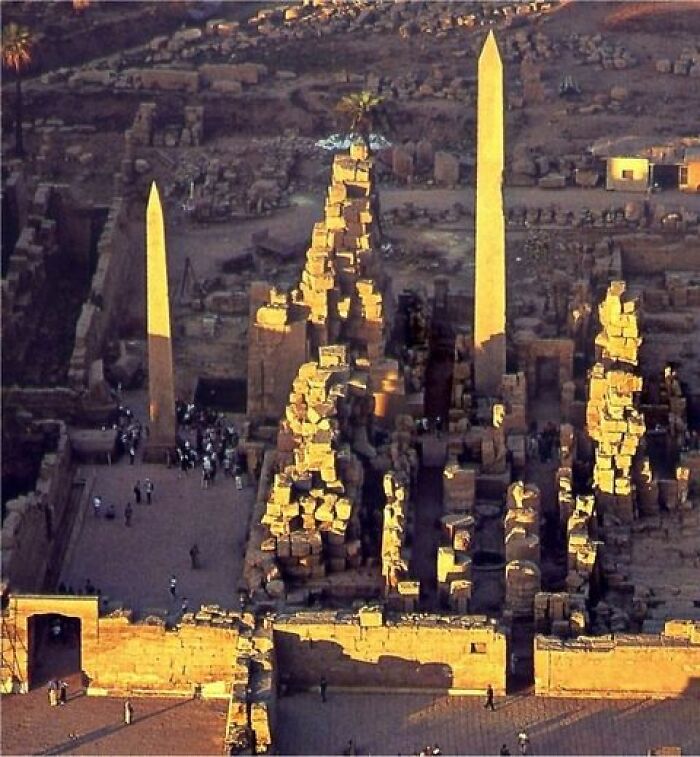
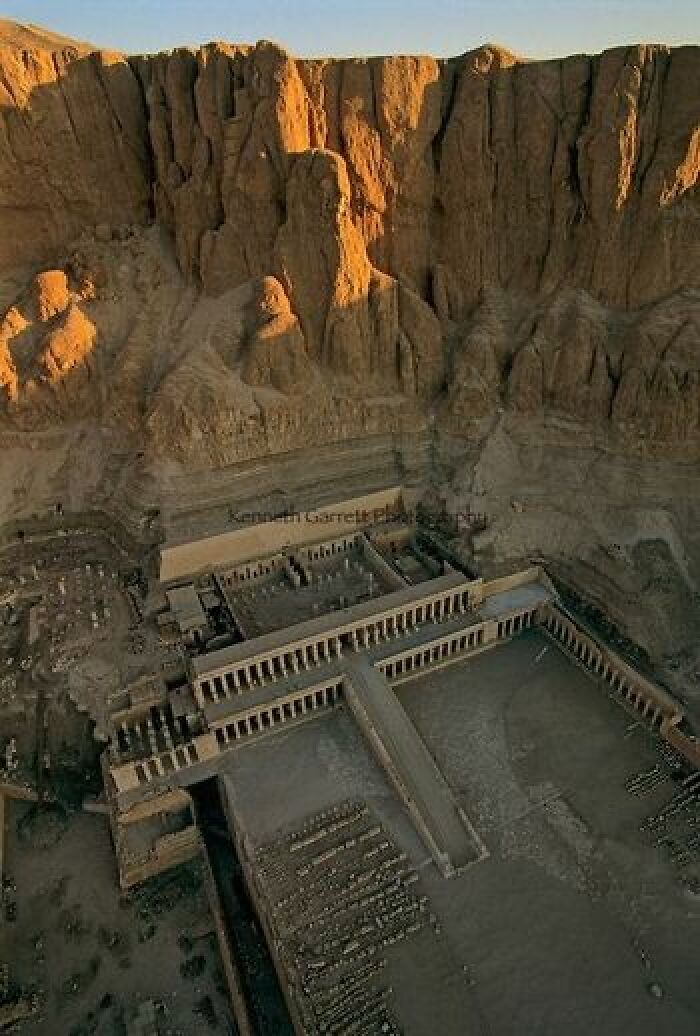
HATSHEPSUT (1507 A.C. – 1456 A.C. )
Karnak, Obelisk of nearly 30 meters high and 350 tons.
What a wonderful queen/ Pharoah for Egypt! There was at least 20 years of prosperity in spite of her son-in-law. Her tomb is big and beautiful and I'd love to see it someday.
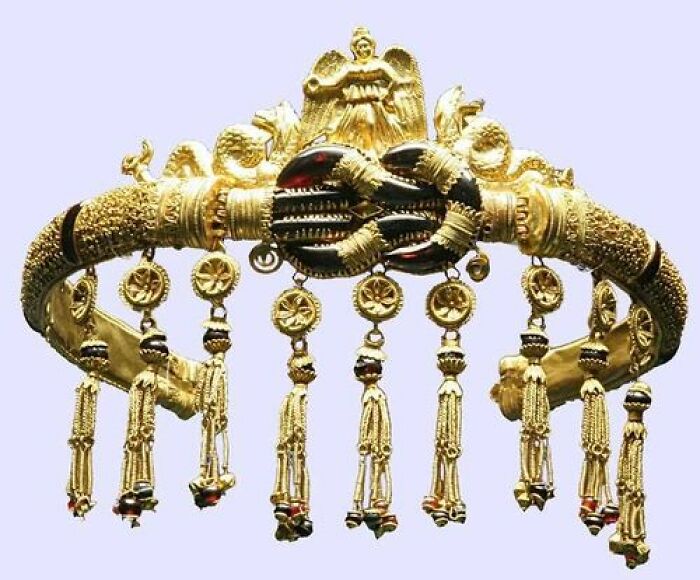
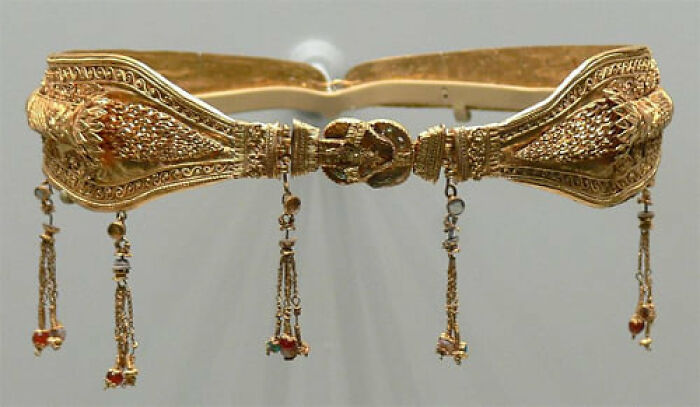
Magnificent ptolemaic Diadem (225–175 B.C.).
Part of Ptolemaic Jewelry Collection (16) - Getty Museum
Made in Egypt probably Alexandria.
Medium: Gold with various inlaid and attached stones, including garnet, cornelian, pearl, bone, moonstone, amethyst, emerald, and glass paste
This diadem has a cord allowing an fit and a Herakles knot clasp known for its apotropaic powers and its status as a symbol of fertility.
It seems possible that the original owner was a woman of the exclusive circle of dynastic princesses, who, ornamented in her golden finery, served the queen in one of the royal cults.
It seems that all of this was fine craftsmanship was lost when Rome died and Visigoth and other uncultured people overcame the continent where it divided itself into tribal nations again.
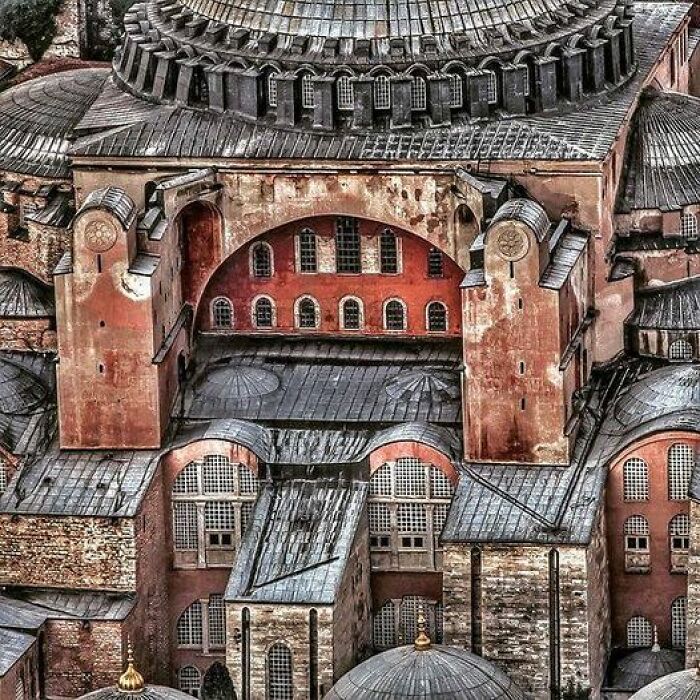
Hagia Sophia
The Hagia Sophia is an enormous architectural marvel in Istanbul, Turkey, that was originally built as a Christian basilica nearly 1,500 years ago.
The Hagia Sophia anchors the Old City of Istanbul and has served for centuries as a landmark for both Christians and Muslims, as its significance has shifted with that of the dominant culture in the Turkish city.
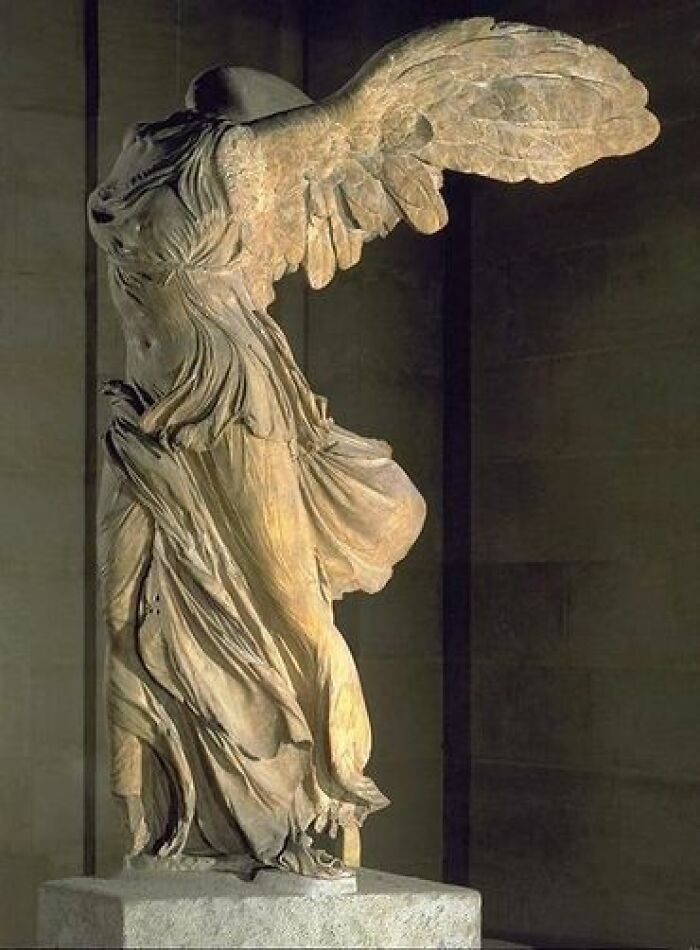
Winged Victory of Samothrace (Nike of Samothrace) - Marble, 2nd century BCE.

A copy used to rule at the Prince’s Gate in Toronto, Canada. It was the entrance to the original training grounds for soldiers, which became the grounds of the Canadian National Ex.
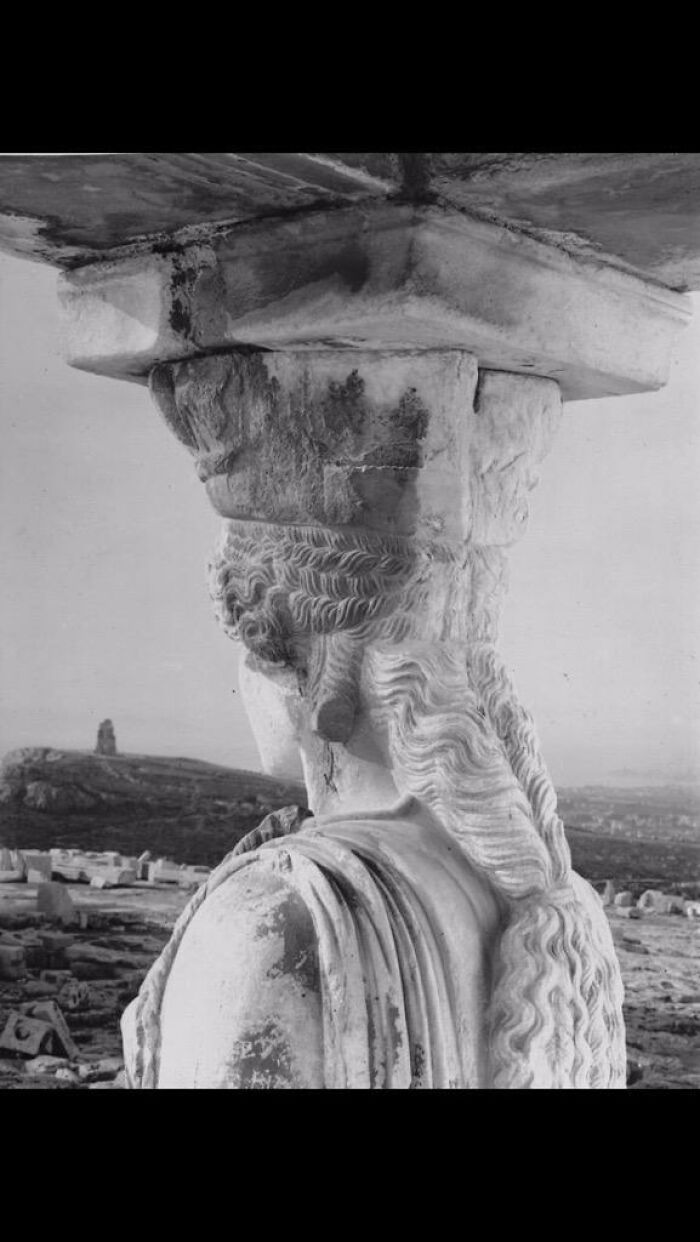
Erechtheion Caryatid 1928-1929
Caryatid, greek: Καρυάτις - Karyatid, literally means "maiden of Karyai"
Caryatid is the name given to an architectural column which takes the form of a standing female figure. The first examples come from ancient Greek architecture .
The term Caryatid first appears in the 4th century BCE in reference to Karyai in Laconia where women often danced balancing a basket on their heads in honour of Artemis and where Caryatids were used in Archaic architecture. They were an evolution of the earlier korai statues of both male and female figures prevalent throughout the Archaic period and used as columns in Ionian architecture. These were themselves an evolution of Persian columns which often employed animal figures within the column design.
Archaic Caryatids were usually used in the porches of Treasury buildings which were built to house offerings from specific states at religious sanctuaries such as Delphi and Olympia. The most important treasury at Delphi was from the Siphnians (c. 525 BCE) and this and at least two other Treasuries had Caryatids. Caryatids of this period often have a short column drum above the head in order to facilitate the join with the column capital.
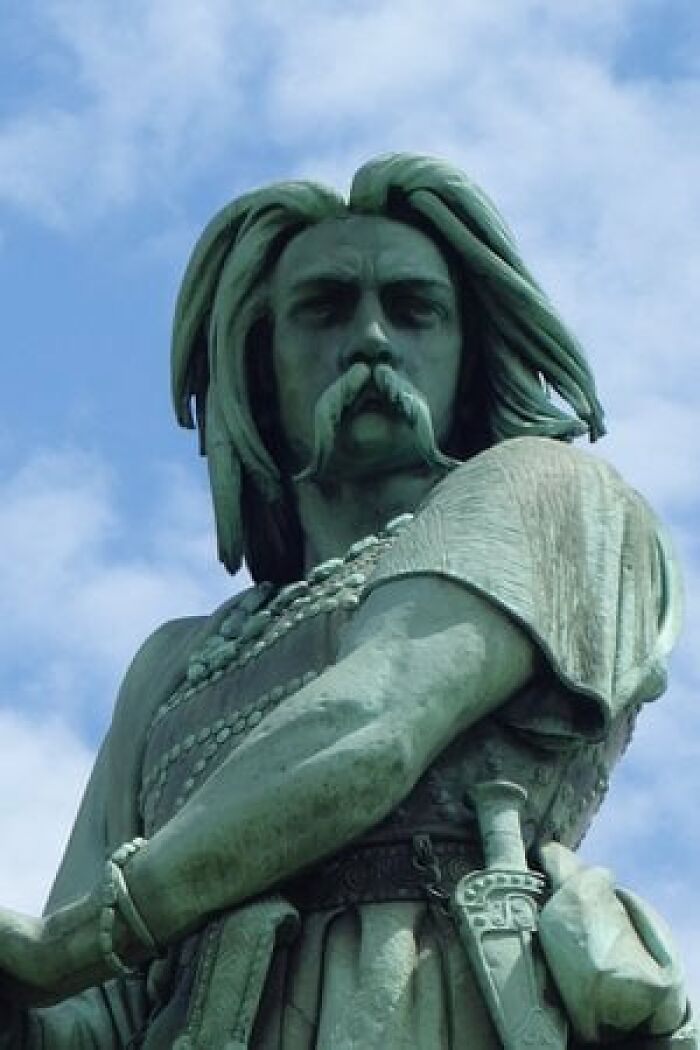
The great leader Vercingetorix formally surrendered to romans and a period of relative peace and prosperity was established in this region . The gaulish were incorporporated to empire , Caesar apparently showed a politics of some magnanimity and not of annihilation.
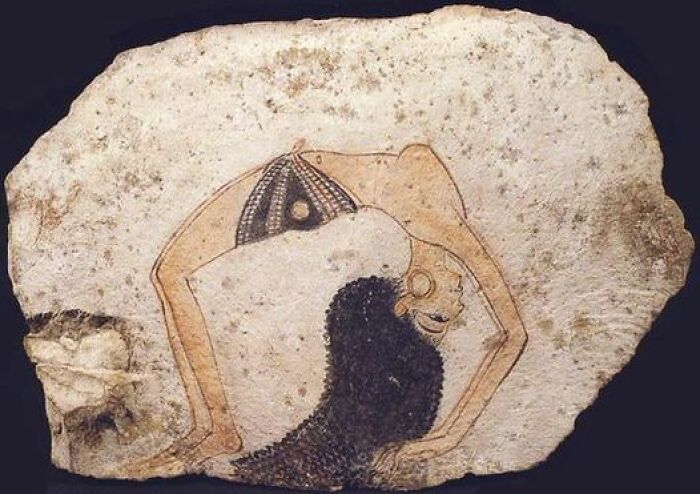
Ostracon - Ancient Egypt
In ancient Egypt ,"Ostracon" : pieces of broken pottery or stone (most often limestone) were used as notepads as they were a cheaper and more plentiful option than papyrus which was costly and time consuming to make.
Were used by students in scribal schools to practice their writing and by administrators to write notes, keep tallies of goods and calculate taxation.
They were used to scribble messages and draw preparatory sketches for artworks. The ancient Egyptians also used them to make votive offerings to gods and to the deceased.
Hunting with eagles , Nomadic tradition .
This millennial nomadic tradition is still current today .The Golden Eagle Festival, celebrated in Bayan-Ölgii Province ( Altai Mountains of Western Mongolia ), brings together the community’s best hunters ( about 40) ,during the first weekend in October each year.
These honoured eagle trainers ride into the festival atop exceptionally groomed horses while wearing traditional regalia.
Surrounded by an astounding Mongolian mountain range, the Festival is a fantastic cultural event where specially trained golden eagles shows its speed, agility, and accuracy.
Hunting with eagles is a traditional form of falconry found throughout the Eurasian steppe, practiced by Kazakh and Kyrgyz people in contemporary Kazakhstan and Kyrgyzstan, as well as in Bayan-Ölgii, Mongolia, and Xinjiang, China.
In 936-45 AD the Khitans, a nomadic people from Manchuria, conquered part of north China but retained many nomadic traditions, including eagle hunting.
Some Archaeologists trace back falconry in Central Asia to the first millennium BC.
During the communist period in Kazakhstan, many Kazakhs fled for Mongolia,settling in Bayan-Ölgii Province and bringing with them their tradition of hunting with eagles. There are an estimated 250 eagle hunters in Bayan-Ölgii, in the Altai Mountains of western Mongolian.
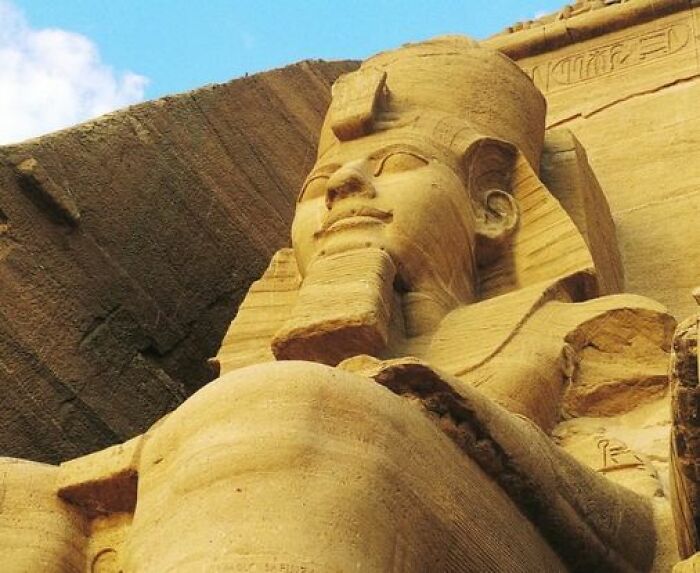
Abu Simbel, one of the most spectacular buildings in Egypt, is a complex made up of two temples excavated in the rock, one of them is dedicated to Ramses II and the other to Nefertari, his first wife and his favorite.
The original architects had constructed an absolute marvel: The door opeings were shaped in a way that once a year at sunrise the light would fall in a specific way, illuminating the sculpture of Ramesses in the temple's inner sanctum, exactly on the anniversary of his enthronement. When moving the structure, the engineers even managed to keep this feature in principle - only the light is late some days now.
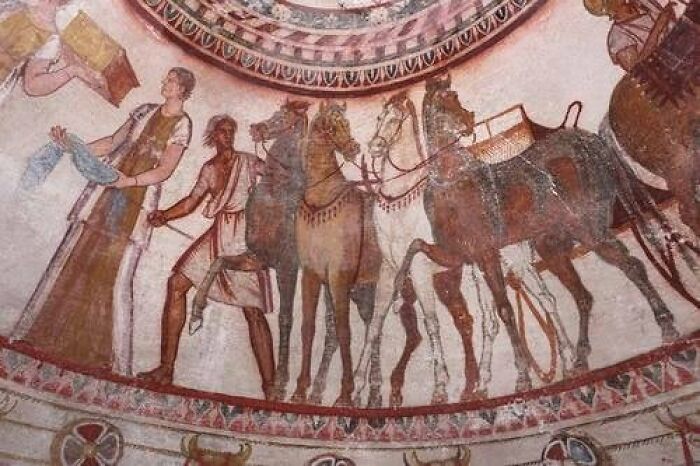
Thracian Tomb of Kazanlak - UNESCO World Heritage
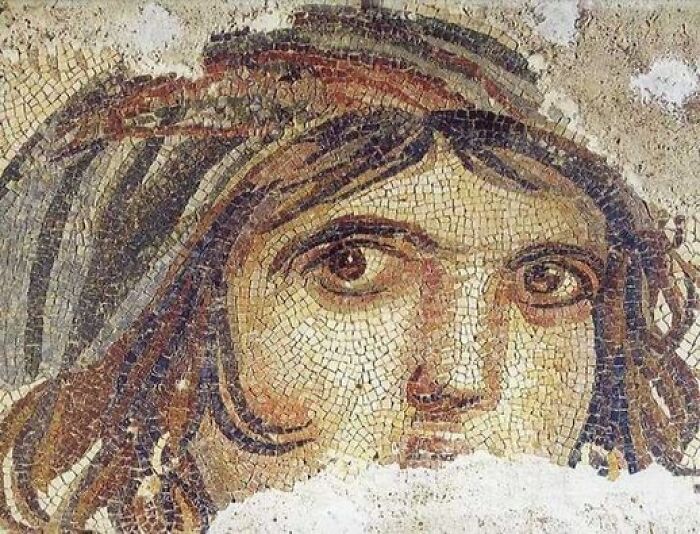
Gipsy Woman - Mosaic Roman villas at Zeugma ( Turkey ).
1st cent BC to AD 3rd cent .
The use of mosaics was an expensive practical, which involved creating a smooth floor,highly decorative, designed to impress. ZEUGMA : an important point near the Euphrates on the Silk Road .
These days, the word zeugma means two ways. I wonder if that comes from the name of the place.
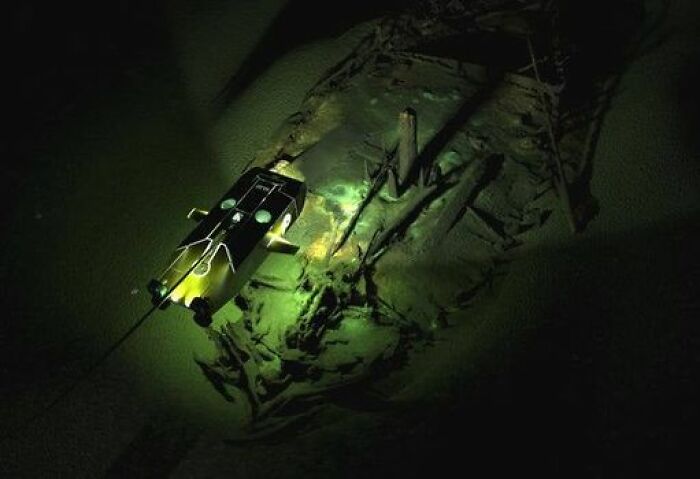
Centuries of Preserved Shipwrecks Found in the Black Sea
A wreck dating back to the Byzantine Empire is illuminated by the Surveyor ROV in this reconstructed 3D image. Part of the mast still stands upright. In the low-oxygen depths of the Black Sea, the organisms that normally eat through the wood of shipwrecks can't survive, making conditions ideal for preservation.
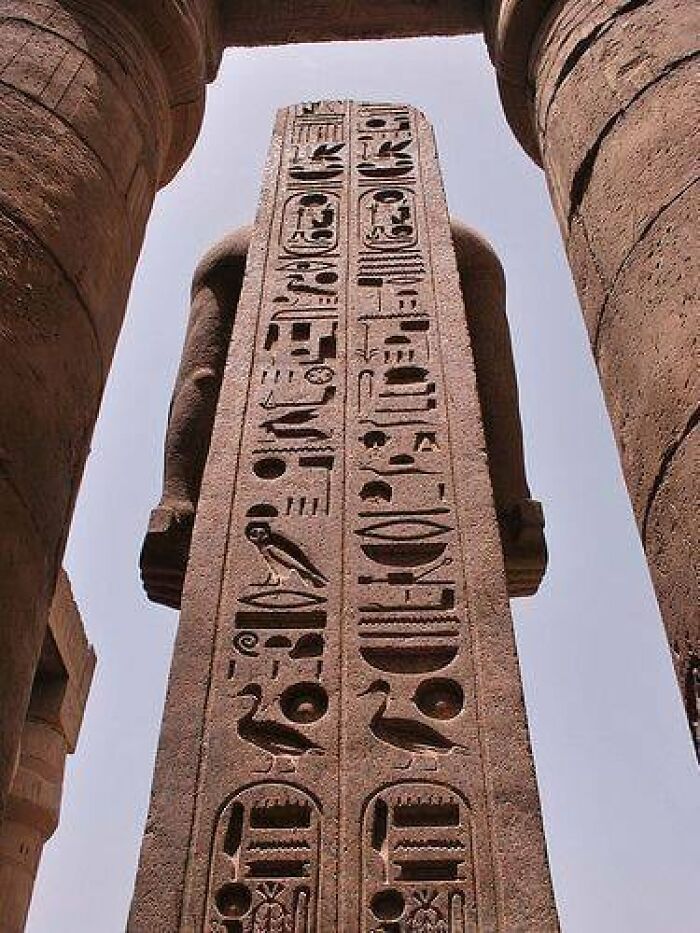
Magnificent stela behind a statue of King Ramses II, with his double Shennu (cartouches) at the top. Luxor Temple.

Similar to today's laying of foundation stones, the royal builders in ancient Egypt also donated so-called foundation gifts on the occasion of the start of construction of large temples, which were added during the foundation ritual, among other things, at the four corners of a building complex or in special pits. The hieroglyphs are framed by an oval cartouche bound into a schen loop, which stands for duration and infinite recurrence of cyclically conceived time. Below the cartouche is the sign for "feast" - Heb, symbolized by a semicircular alabaster bowl. Above, the cartouche is crowned by a sun disk with double feathers. To the right and left of the name cartouche one sees two long palm panicles bent upwards towards the center, which stand for the word "year" and in combination with the tadpoles squatting on two Schen rings - the numeral sign for 100,000 - express the wish for infinite duration of the king's reign.
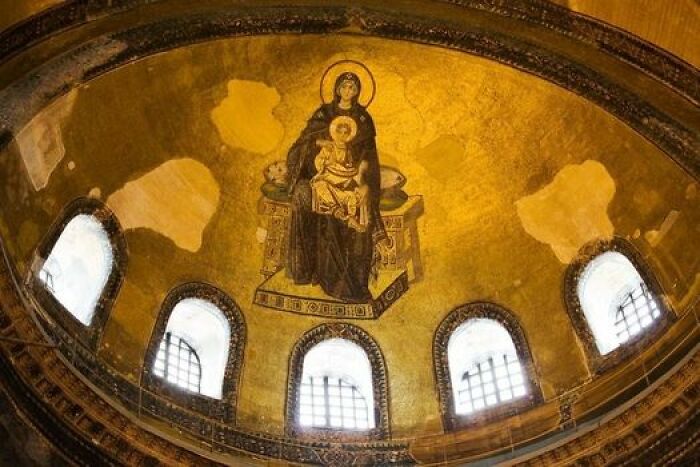
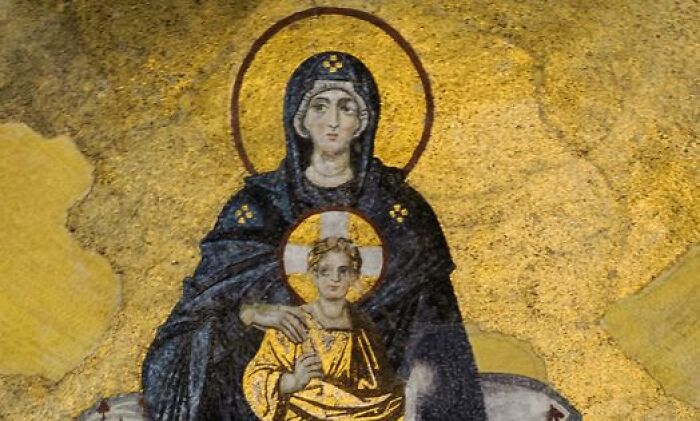
Theotokos
The Apse Mosaic in the Hagia Sophia shows the Virgin Mary holding baby Jesus. It is 13 feet tall.
Theotokos : title of Mary, mother of Jesus, used especially in Eastern Christianity.
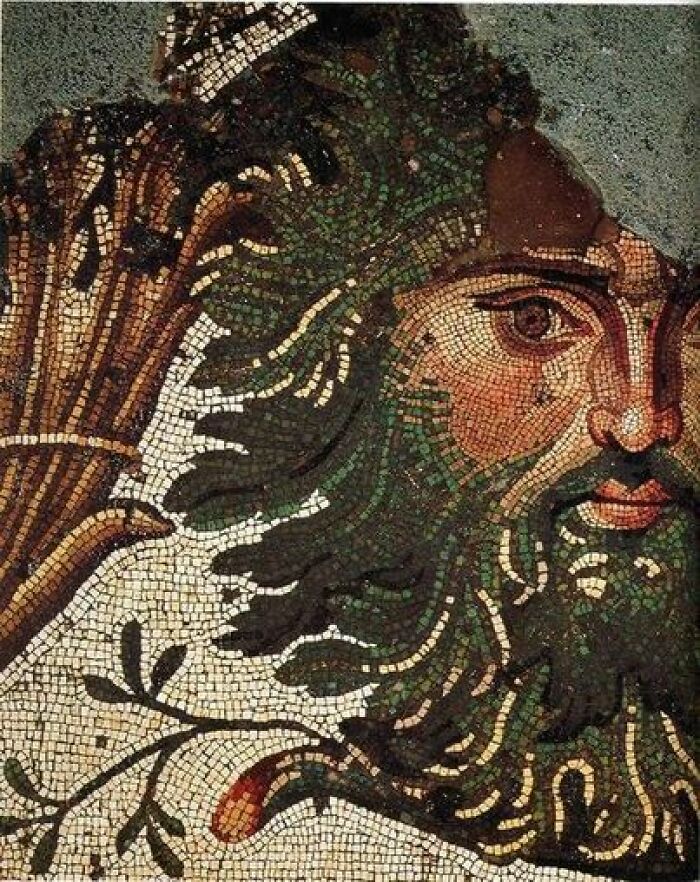
Byzantine mosaic floor of the Great Palace of Constantinople.
For over a thousand years, from the fourth century until the Ottoman conquest in 1453, the art of mosaic formed an integral part of the decoration of monumental buildings in Constantinople.
Ancient sources mention the mosaic floors that decorated the palaces of Byzantine emperors and they refer also to the teams of mosaic makers who travelled from Constantinople to various parts of the empire, sometimes taking with them the materials they needed. The remains of a mosaic floor of the Great Palace of Constantinople, gives some idea of the superb craftsmanship of these mosaicists.

Absolutely gorgeous! How these, and so many other relics, blow my mind.
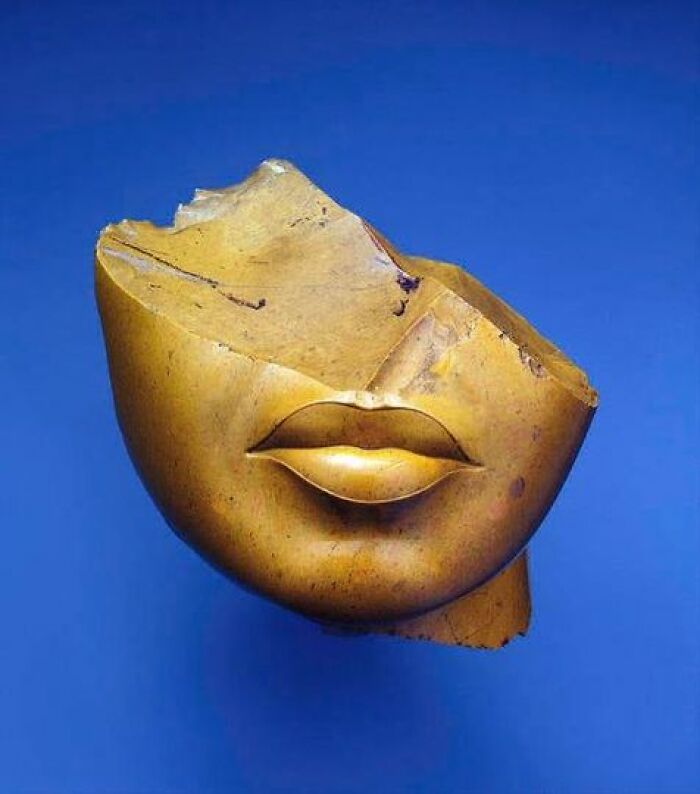
Fragment of a Queen's Face (Nefertiti ? , Kiya? )
ca. 1353–1336 B.C.

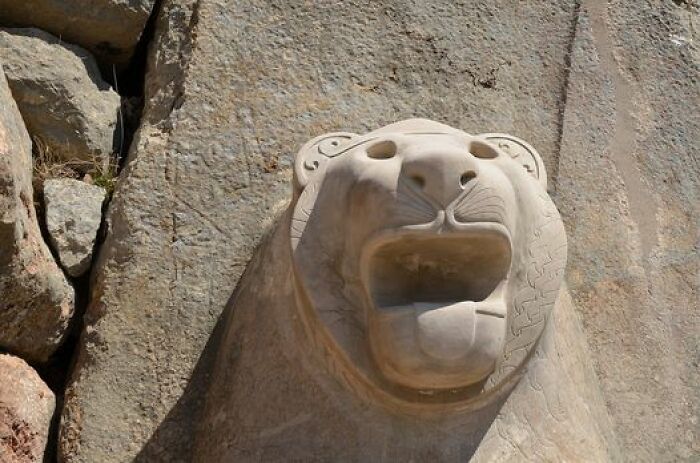
Lion Gate in Hattusa, the capital of the Hittite Empire.
(Detail)
The Lion Gate demonstrates the details of Hittite sculpture of the 14th century BCE period and represents excellent piece of Hittite art.
The capital of the Hittites - Hattusa - was surrounded by massive fortifications when the Hittite civilization had a status of the Near East superpower. The walls were erected using the natural shape of the terrain or completely changing it, depending on the architectural and strategic needs. At least six gates let people enter the interior of the city. The Lion Gate is the first one that can be seen when following the official sightseeing route around Hattusa.
The Lion Gate, built in the early 14th century BCE, is located in the south-western part of the fortifications.
The statues of the front halves of two lions that gave the gate its customary name, were carved in huge blocks of rock on both sides of the external doors. The silhouettes of these wild animals with open jaws and wide open eyes probably played a protective function - they were to scare away evil spirits from the city. This explanation has been deduced by the researchers on the basis of the similarity of the lion theme to other such representations, known from Hittite and Mesopotamian architecture.
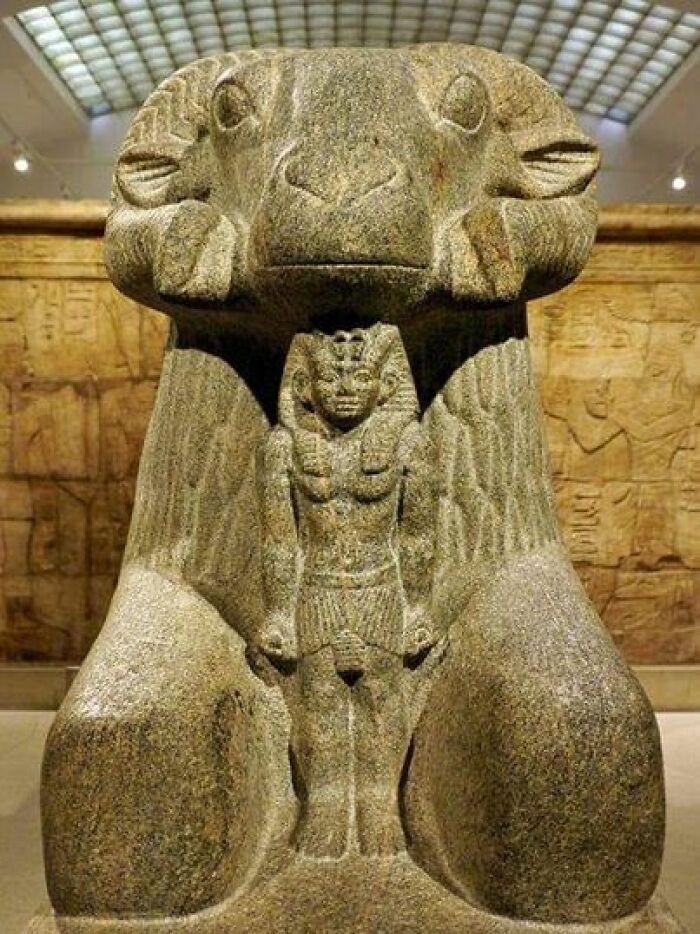
Amon, king of the Egyptian deities, in the form of a ram protecting Taharqa.
The British Museum/Heritage-Images
Taharqa (reigned ca. 688-ca. 663 BC) was a Nubian pharaoh of Egypt and Qore (king) of the Kingdom of Kush.
He was the last ruler of the Twenty-fifth Dynasty, the so-called Ethiopian Dynasty, and was driven out of Lower Egypt by the Assyrians as they began to conquer Egypt.
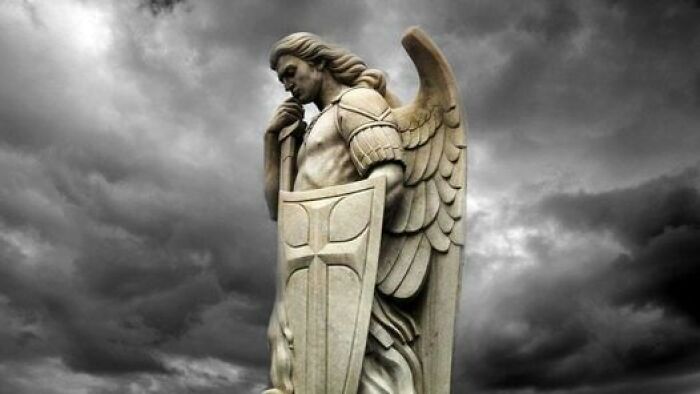
Archangel Michael
He is the General of God according to the Jewish, Christian (Catholic, Orthodox, Coptic and Anglican Churches) and Islamic traditions, "prince of the heavenly host" in the fight against evil, he is a model to follow in the Christian imagination.
Hagia Sophia , Byzantine art.
The Holy Theotokos .
The Virgin Mary is the Theotokos, the mother of Jesus Christ.
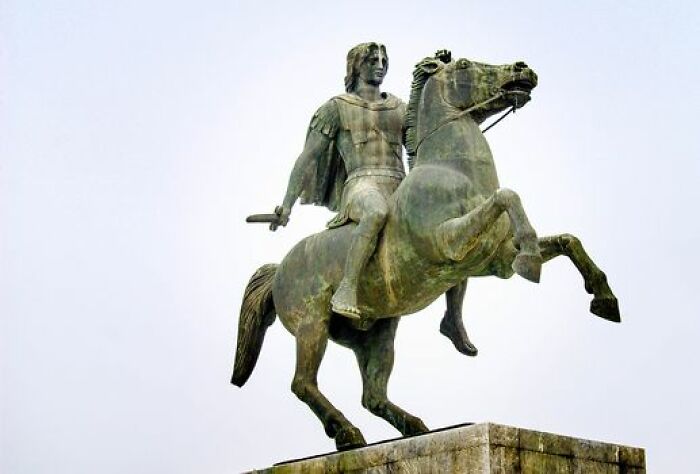
Alexander The Great , was born in Pella , 20/21 July 356 BC.
Died: 10 or 11 June 323 BC (aged 32).
"Is King Alexander alive? He lives and reigns and the world takes over"
Alexander the Great Monument, Thessaloniki, Greece
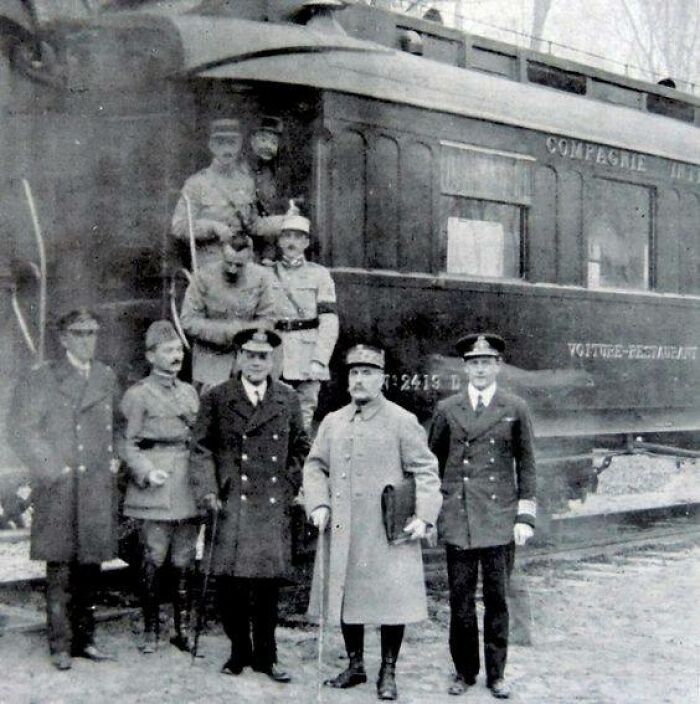
NOV 11 , 100th anniversary of the end of of World War I.
At 11th hour of the 11th day of the 11th month of 1918, the cessation of hostilities took effect along the Western Front in France.
Compiègne, France : General Weygand, Admiral Wemyss and Marshall Foch after signing the armistice with Germany to mark the end of of World War I.

After Hitler had invaded France in 1940 and the French agreed to a surrender, Hitler arranged for the above coach to be moved to the exact same spot shown in the picture. Talk above getting petty revenge.
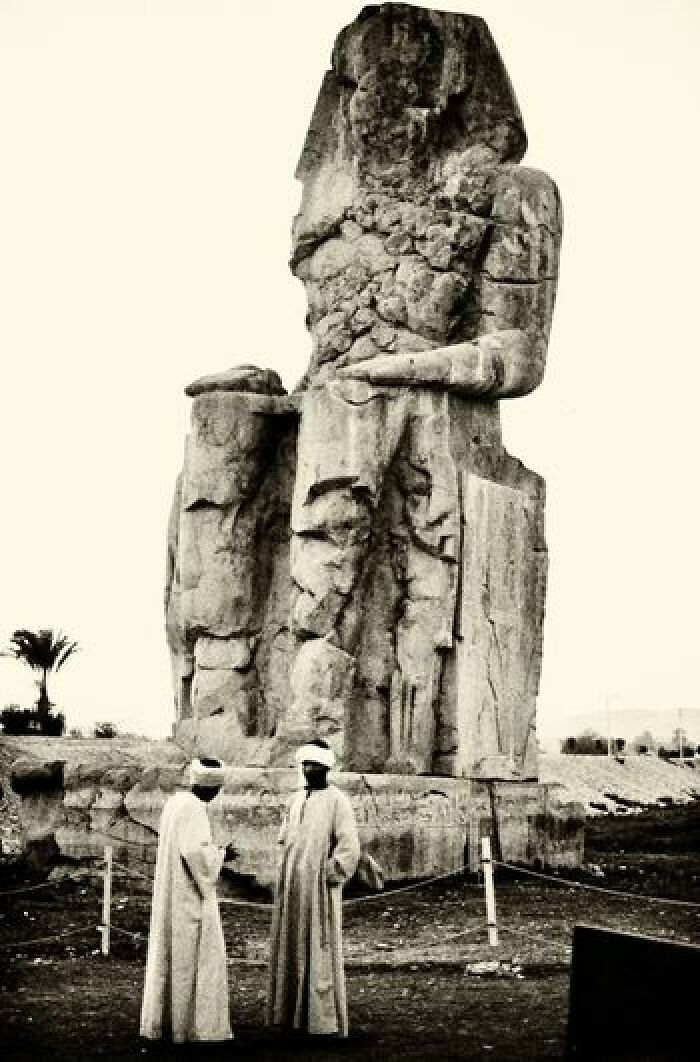
Colossi of Memnon - Statues of Pharaoh Amenhotep III.

I wonder what my HOA would do if I dropped one of these in my front yard
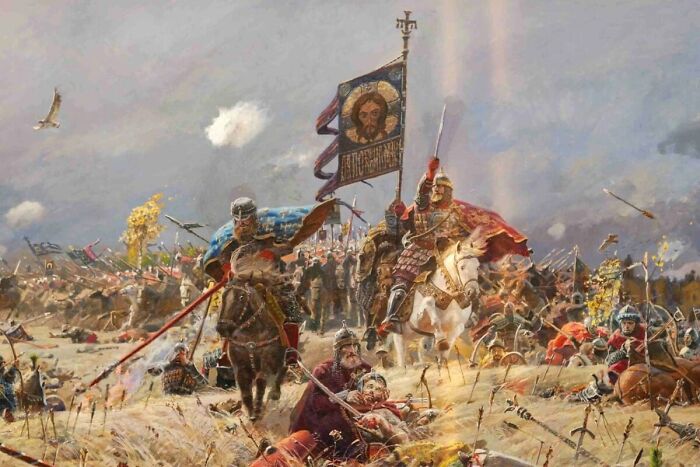
BATTLE OF KOSOVO - 1389
The day of the battle, known in Serbian as Vidovdan (St. Vitus' day) and celebrated according to the Julian calendar ,corresponding to 28 June Gregorian in the 20th and 21st centuries. That day, a coalition of Balkan princes were defeated by the Ottoman Sultan Murad I.
The leaders of both armies, Lazar of Serbia and Murad I , lost their lives in the battle.
On June 28, 1389, the Serbian Tsar Lazar was defeated by the Ottoman Empire in the legendary Battle of Kosovo Polje, one of the decisive events in the disappearance of the medieval kingdom of Serbia, which would not regain its independence until 1878. Since then, Kosovo would become the great founding myth of the Serbian people, united in the adversity, sacrifice and blood of that battlefield. The legendary narration of that combat, from one generation to the next, was one of the main elements by which the Serbian identity maintained its essence for five centuries, until it regained its independence in 1878. Kosovo is therefore considered the cradle of that nation, being there the most sacred temples of the Serbian autocephalous church, including its headquarters, located in Péc.
A few years earlier, the Ottomans had defeated Serbs and Bulgarians at the Battle of Maritza (1371), shortly after they had conquered the city of Adrianople (1369) which they renamed Edirne. And in 1389 the Serbian prince Lazar Hrebeljanovic assembled an army to try to stop the Turkish advance towards the Heart of Europe, counting on the support of the Bosnian king, Tvrtko I and some Serbian nobles.
Armenian National Clothing , TARAZ .
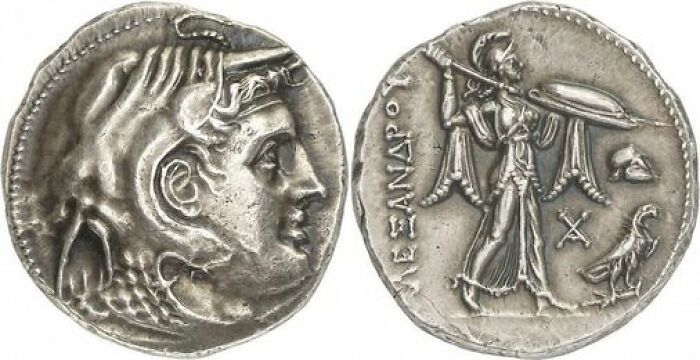
Alexander the Great ,Silver Tetradrachm
Struck around 300 BC in Ptolemaic Egypt (Kingdom of Ptolemy I Soter), this silver coin posthumously depicts Alexander as Conqueror of India , wearing an elephant skin headdress (a reference to his victory over King Porus).
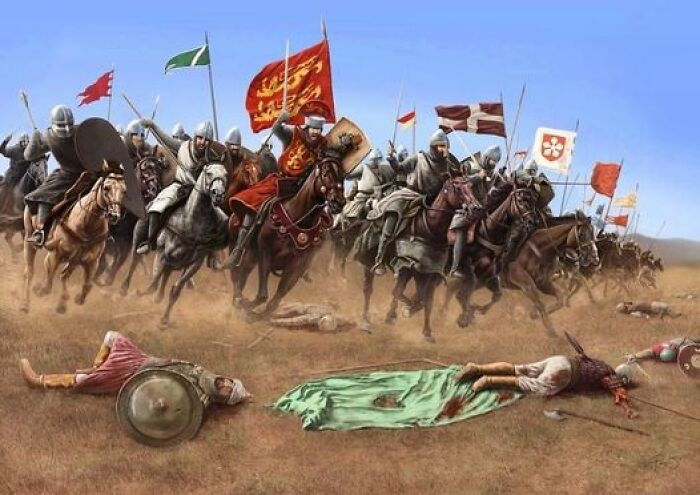
Battle of Arsuf
September 7, 1191 - Richard the Lionheart defeats Saladin at the Battle of Arsuf. Richard's forces number 11,200, Saladin's army is 25,000 strong. Despite their numerical disadvantage, the crusaders inflict an overwhelming defeat on Saladin. Around half of the Sultan's troops are slain over the course of three charges by the Christian knights. Richard himself is at the forefront of the fighting. The battle secures crusader control of the southern Palestinian coast.
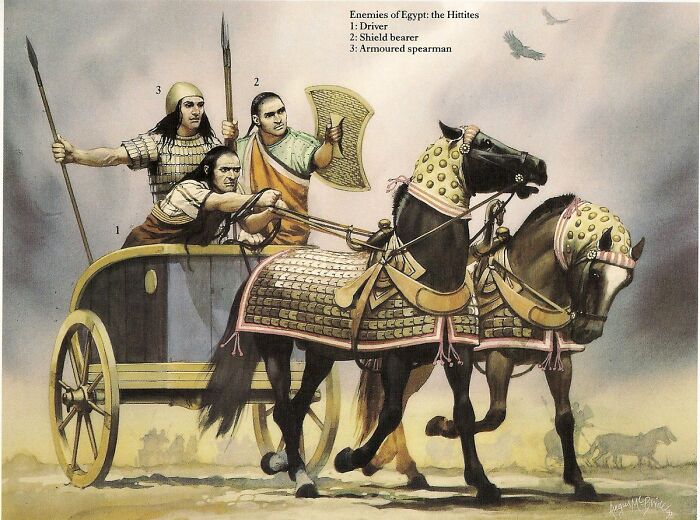
Hittite Chariot
The hittites developed a chariot of lighter wheels, with four spokes rather than eight.
It could hold 3 warriors (one more) because the axis was placed in the middle of the chariot and not at the back as in the Egyptians.
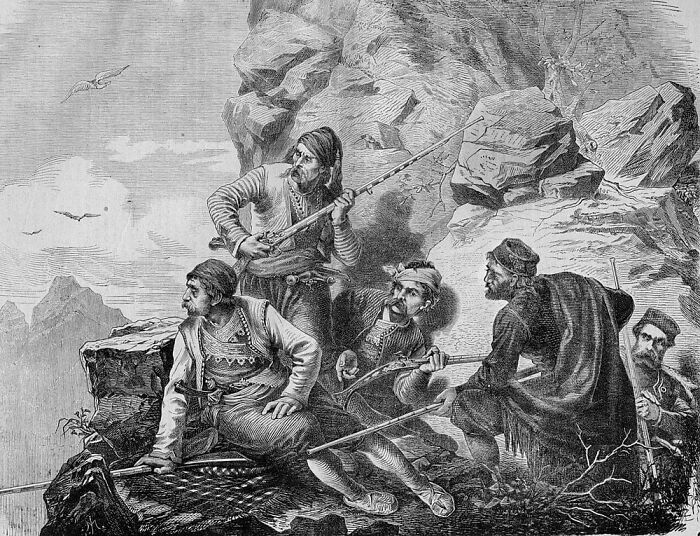
The Herzegovina uprising of 1875–77 (Serbo-Croatian language: Hercegovački ustanak, Serbian Cyrillic language: Херцеговачки устанак ) was an uprising led by ethnic Serbs against the Ottoman Empire, firstly and predominantly in Herzegovina (hence its name), from where it spread into Bosnia. It is the most significant of the rebellions against Ottoman rule in Herzegovina.
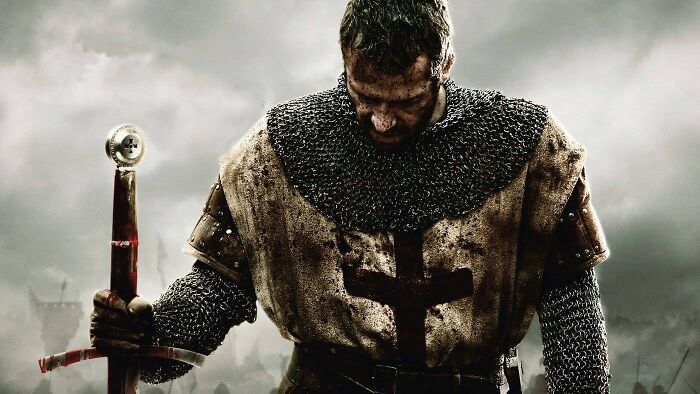
Templar Knights.
The Crusades started in 1095 and were great military expeditions undertaken by the Christian nations of Europe for the purpose of rescuing the holy places of Palestine. They were eight in number,but there were several other expeditions which were insignificant in numbers or results.
After the First Crusade recaptured Jerusalem in 1099, many Christians made pilgrimages to various holy places in the Holy Land. Although the city of Jerusalem was under relatively secure control, the rest of the Holy Land was not. Marauding bandits preyed on pilgrims as they attempted to make the journey from the coast to the holy places.

Something interesting for a change from stories of family feuds and petty revenge and spite on coworkers and neighbours.

Something interesting for a change from stories of family feuds and petty revenge and spite on coworkers and neighbours.


































 No fees, cancel anytime