Get Premium
Dark mode theme is available exclusively for premium users. Learn more about the benefits of subscribing.
No fees, cancel anytime.

 Dark Mode Ad-Free Browsing Unlimited Content
 Ad-Free Browsing Unlimited Content Dark Mode
Join 1.2 million Panda readers who get the best art, memes, and fun stories every week!
We could argue that there's no such thing as a cultural taboo for Gen Z-ers. However, it would be very egocentric to think that. Although humanity as a whole is slowly steering towards being more open-minded and liberal, cultural taboos are here to stay. They might change and evolve in the future, yet it's unlikely that social taboos will cease to exist entirely since there rarely is a subject that the majority would agree on.
Even in a country as open and welcoming as the United States, there are still several taboo subjects to be aware of. Interestingly, in contrast to other nations, cultural taboos in America are seldom directly related to religion or tradition. Instead, taboos in America are often connected to public manners and social conduct, such as wolf whistling or talking about politics or business at the dinner table. And although particular, though very few, taboo things are exclusive to the US (e.g., not leaving a tip at a restaurant), many of them are universal, suggesting that in many countries around the world, the same things and behaviors are deemed socially inappropriate and might get one the side-eye.
However, it's interesting (and sometimes disturbing) that in some places, engaging in certain social taboos may not only result in receiving dirty looks from strangers but may also be punished by law. This is often the case in countries with strong religious grounds. Thus, it's interesting to note that sometimes, cultural taboos are not only enforced by society but also by laws, both federal and religious.
Curious to learn more about fellow Earth inhabitants, we scoured the internet to compile a list of taboos prevalent in certain parts of the world. Although we did our best to gather factually correct and up-to-date examples of taboos in different cultures, if you notice any discrepancies, we kindly ask you to point those out in the comments or send the writer an email so we can improve our content.
Also, we want to stress that the countries or cultures mentioned in brackets don't imply that everyone in that social group holds the same views. Are there any other cultural taboo examples that we forgot to mention? If so, share those in the comments.
This post may include affiliate links.
 Being late (Japan, South Korea, Germany & Switzerland) — Several cultures highly value punctuality, so call ahead if you see that you will be late.

For a while, my ex and my cousin both lived with me. One is late for everything and the other has to be half an hour early for everything. Both are equally irritating.
 Wearing shoes indoors (Worldwide) — Although Ireland, the UK, the USA, and Australia tend to be less stringent about this practice, the rest of the globe prefers to take off shoes before entering the home.
 Standing too close (Western world) — Personal space is held in high regard in many Western countries. It can be perceived as overly intimate or an invasion of personal space when people stand too close while conversing.
 Chewing with your mouth open (Western world) - In Western culture, it's considered inappropriate to chew with one's mouth open, and is seen as gross and ignorant.

Why say ‘worldwide’? This is not true worldwide. Yes, in western culture maybe.
 Not leaving any food on the plate (Paraguay & China) — To indicate that you are full and satisfied, it’s recommended to leave some food on the plate in certain countries.
 Direct eye contact (Traditional Owners of land in Australia) — While making eye contact is advised in the West as a sign of active listening, in Aboriginal Australian cultures, direct eye contact can be considered rude or even aggressive. The appropriate response in conversation would be to avert or lower your eyes to show proper respect.
 Taking photos of strangers (Worldwide) — Taking a picture of a stranger without their consent is considered a violation of their privacy. In some instances, it may even be unlawful. Before sharing the photos, it's polite to blur the faces of any people whose faces can be made out in the background.
 Leaving food on the plate (some European countries & Turkey) — If you leave food on the plate, the host might think you didn't like the meal. For Turks, leaving a portion on the plate is considered a sin.
 Starting to eat before everyone is at the table and has their food (Worldwide) — It’s standard practice to wait until everyone is seated at the table before digging into your food. If the host is serving the food, you should hold off on eating until after he or she has finished and is seated at the table.

It's definitely the polite thing to do. The only time it's acceptable, imo, if it's at a restaurant and someone's order was wrong and they say, "Please, go ahead."
Showing someone the soles of your feet (Asia & Middle East) — Many countries in Asia and the Middle East find exposing the soles of your feet to another person or tapping somebody with your feet highly offensive.

I find this hard to believe, since Muslims around the world kneel in rows without shoes in mosques all the time.
 Haggling (Japan & Sweden) — While it is less common in more developed economies, bartering for a price is part of the culture in some countries (Indonesia, Thailand, Cambodia, and India).
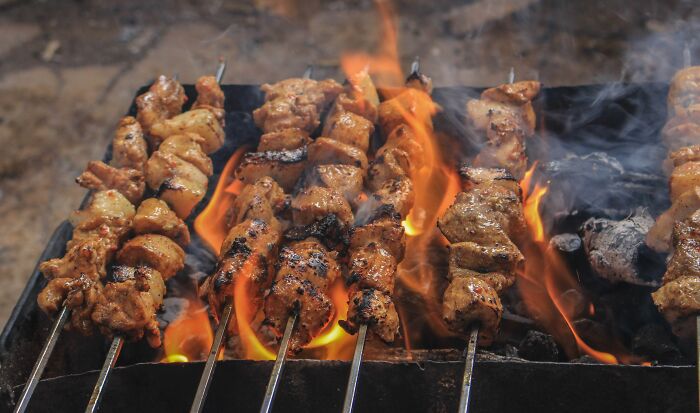 Eating pork (Jewish, Muslim, and some Christian countries) — Muslims don't eat pork primarily because the Holy Quran specifies that some foods are permitted while others are expressly listed as haram or forbidden. And one of those off-limits foods is pork. However, the Holy Quran also makes an exception, stating that you may eat it if you need food and have no other options but pork. This also aligns with Jewish beliefs, which follow kosher meat-eating customs and restrictions.
Most of those rules goes back hundreds or thousands years back. Pigs were really filthy animals, living in their own feces, carrying multiple diseases and posses health risk. Same goes for others prohibited animals. Also, Jews and Arabs were nomad tribes, cannot imagine transversing desert with bunch of unrully pigs.
 Men wearing a dress (Western world) — Although this is swiftly changing as gender norms start to blur, in the West, a man wearing a dress or a skirt may still get a lot of dirty looks, yet in certain other cultures, wearing traditional apparel that resembles a dress is acceptable. Scotland is one Western exception, where men are expected to wear traditional kilts.
 Spitting in public places (Worldwide) — Spitting in public sites is prohibited in numerous cities. However, it's interesting to note that police seldom enforce this. Still, spitting in public is generally frowned upon, so it's more strictly enforced culturally than legally.
Adultery (Worldwide) — A restriction against adultery is either written down or is considered taboo in almost every society's marital law. In reality, it seems adultery is as prevalent and, in some instances, as common as marriage. In Judaism and Christianity, one of the ten commandments is the prohibition of adultery.
Discussing business at dinner (Worldwide) — In some places, discussing business during a casual supper is considered impolite.

This one doesn't make sense to me. Some of the biggest deals/ mergers were cemented over a meal.
 Wearing shorts (Morocco) — Even at the height of summer, males are typically expected to wear long pants. Young men or boys may be seen wearing shorts, but long pants are often the most common.

In Trinidad we can't access any offices or government institutions in shorts, vests or flip flops...even when it's 35°C. Need to renew your driver's license but you're wearing shorts? Oh hell no. Lol
Polygamy (Western world) — While polygamy, or having multiple spouses at once, is still taboo in Western culture, it's relatively common worldwide. Of 200 sovereign states, 58 allow polygamy, including most African and Middle Eastern countries.
Menstruation (Worldwide) — Many cultures still view a woman as "unclean" when she has her period. In parts of Indonesia, India, western Nepal, and among tribes of Nigeria, menstruating women are still shunned from social and religious events and occasionally even their own kitchens. According to Unicef, 70% of Afghani females avoid taking a bath or shower during their periods out of concern about infertility.

In india menstruating women used to be banned from their kitchens and sometimes houses and made to stay somewhere else. They’re also banned from touching pickles because they might contaminate them and spoil them
Swearing (Worldwide) — Foul words can be found in most languages. However, swearing is frowned upon, especially in professional and formal settings.
Questioning authority figures (countries with authoritarian governments) — Citizens of nations under authoritarian governments often have fewer rights and privileges. They are restricted in their ability to freely practice their religion, express themselves, or elect their leaders in free and fair elections.
 Burping and flatulence (Worldwide) — Most countries view burping and flatulence as inappropriate behaviors in almost all social environments.
In old Eskimo culture these were signs of a good meal. Not sure what it's like now. But I'd say this is not worldwide.
 Asking a woman’s age (Western world) — Because youth is valued in Western cultures, some women find growing older disconcerting. Therefore, asking them their age could be seen as highly offensive.
 Showing your hair as a female (Muslim countries) — The fact that the hijab does not appear anywhere in the Qur'an surprises many people. When used, it serves as a "curtain" or "barrier" meant to keep others from the Prophet Muhammad's wives. More generally, the hijab indicates modest behavior, and both men and women must dress modestly according to the Qur'an.

Modest behavior... She looks like she's ready to go skiing or to rob a bank.
 Birth control (Catholic countries) — The Catholic Church has long insisted that using contraception to stop the conception of new human beings is inherently immoral.
 Celebrating birthdays (Jehovah's Witnesses) — Most holidays and occasions honoring people who aren't Jesus are not observed by Jehovah's Witnesses. That includes holidays like Mother's Day, Valentine's Day, and birthdays.
My best friend in high school was a Jehovah's Witness. They didn't celebrate Christmas, but he and his two brothers all got off-road motorcycles for their parents' wedding anniversary. I'll admit, I was a little jealous.
 Drinking alcohol (some Arabic countries) — While drinking alcohol is generally accepted in Judaism and Christianity, it is haram (or prohibited) in Islam.
 Don’t share a plate of food (Nepal) — Never share food from the same plate in Nepal because, in contrast to Korean eating, after it has been touched by one person, it is deemed nasty to be eaten by another.

Tons of reasons to not share food/ utensils etc... Get away from my plate ! Even at home, you can get your own!
Leaving the office before your boss (Japan) — The concept of "I can't leave until the boss does" is widespread in Japan. It's frowned upon for lower-level employees to leave the workplace before their supervisor, and doing so might hurt their chances of getting promoted.

That's a bit tricky when your boss is also the owner and has to lock up when everyone leaves, like my boss so...
 Couples arguing in public (Worldwide) — Although every couple has disagreements and arguments, most people expect couples to present a united front, at least in public.

I used to hate this when I was bartending. You were already arguing and you thought, "You know what'll improve this situation? Alcohol." No. Go home until you can behave in public.
 Refusing a gift (Worldwide) — Most cultures expect people to accept gifts respectfully. It may be offensive to the person who chose your present to let them know you don't like it or that you'd prefer to return it to the store.
 Bribery (Worldwide) — Even in cultures where bribery is a widespread and highly publicized problem, it's still considered taboo to discuss.
Not according to Clarence Thomas who is part of our Supreme Court.🤦♂️
 Public displays of affection (Worldwide) — Couples should avoid overt displays of affection, particularly among more traditional cultural groups. While "free love" and PDA are more widespread in the Western world, public handholding and kissing are frowned upon in conservative regions of the globe.
I can't wait for the day when EVERY couple can hug, kiss, or hold hands in all the countries of the world. Making out should remain private IMO, but there is no reason that holding hands should be an issue for any consenting adults anywhere.
Head touching or patting (some Asian countries) — In countries with sizable Buddhist populations, such as Thailand, China, Laos, Cambodia, and Myanmar, touching someone's head or hair is considered offensive since the head is considered sacred, and the body's purest part. Touching someone's head is an incredibly invasive gesture. This also applies to some Hindu religious cultures.
 Not leaving a tip at a restaurant (USA) — While tipping is not considered standard practice in some countries, it is in the United States of America. Although nothing would happen if you didn't tip, tipping in America has become so customary that not tipping would be considered rude.
Public nudity (Worldwide) — Generally, being fully naked in public is taboo. Nearly everywhere in the world, if you're seen walking around naked, expect people to be in complete awe (some take their phones out) and the police to show up.
Eating dog meat (Western world) — While it is taboo in Western countries, in some parts of China, South Korea, the Philippines, Thailand, Laos, Vietnam, and Cambodia, eating dog meat is acceptable.
 Placing your elbows on the table (Western world) — In Western countries, putting your elbows on the table is considered impolite.

I haven't observed anyone worrying about this since I was a young kid.
 Chewing gum in public (Worldwide) — Some view chewing gum as low-class and impolite. Gum is often spat out on the streets, which can also be associated with filthiness.
Chewing gum banned in schools in Australia, but I think that's more because kids will stick it to the underside of tables (I have seen more than one table top held on only by gum!), rather than it being impolite. I suppose if you are chewing it with your mouth open it could be rude too A lot of people would say it is a good thing where it is brands that promote fresh breath etc.
 Offering to split the bill (Thailand) — Whereas many cultures expect diners to divide the cost, the host is typically expected to pay the bill in Thailand.
If there is a "host" IMO that implies an invitation and thus them paying the bill, otherwise it should be stated beforehand (not a problem, though).
Standing above the tribal chief (African countries) — When speaking to a tribal leader in many African nations, people are expected to keep their heads below his.
 Discussing your wealth or income (Worldwide) - In Britain, like in many other countries, it is highly taboo to discuss your wealth and income. However, in a modern setting, the long-held restraint about money conversations might be more related to people's anxiety about their finances rather than being rude.
Showing your shoulders (Arab countries) — In many Arab nations, women are expected to dress conservatively. Western women visiting Morocco or UAE frequently drape shawls over their shoulders to show respect for their host culture.

Not just shoulders. Also midriff, back, knees, etc. And in some places, your head. Really if you want to be respected in these countries, just wear modest dresses and carry a scarf in case you want to enter a religious area or ceremony. And covering shoulders etc is also required when visiting Catholic churches.
Homosexuality (Most Muslim and Christian cultures) — As of 2023, 34 countries, predominantly in Europe and the Americas, have passed national legislation permitting homosexual marriage. However, some of the major religions have rules against homosexuality. According to the National Secular Society, more than 90% of the people who live in countries that forbid same-sex partnerships are Muslim or Christian.

As long as it's consenting adults I don't really care who you sleep with
Kosher (non-Jewish countries) — Similar to halal, kosher is a set of regulations governing what and how Jews can eat. Dairy and meat, for instance, cannot be consumed together.

In Israel you can buy pork products and seafood in markets and order them in restaurants.
Halal meat (non-Muslim countries) — Although halal is not just meant for Muslims, it's relatively taboo to use the halal method (butchering an animal by cutting the major blood vessels to ensure rapid and complete blood loss) in non-Muslim countries. Likewise, eating haram food (forbidden food) is considered taboo in Muslim countries.
Um. There's no taboo here about eating halal or kosher even if your not of that religion. Not that I'm aware of. A lot of times halal and kosher meat is cleaner.
Going against superstitions (Worldwide) — People often avoid doing superstitious things like opening an umbrella inside a house or moving a package of salt from one hand to another because they believe doing so will bring bad luck. Going against superstitions and doing the opposite is considered taboo. Christianity is generally against trusting in manmade superstitions.
Pointing at someone’s chest (Worldwide) — Pointing at objects is acceptable in many countries worldwide. However, it's considered rude and even provocative to point directly at someone, especially at their chest.
I haven't heard of it being chest-specific, but I also never understood the 'pointing is rude' thing in general. Why? Thankfully it is rarely mentioned in Australia these days.
 Yawning in public (Worldwide) - Yawning is considered rude and may be perceived as disrespectful since it indicates disinterest in the conversation. Covering our mouth can be a nonverbal gesture to indicate that you do not want to seem impolite—even if it doesn't disguise the yawn.

Isn't yawning kind of involuntary? I can apologize afterward, but I can't hold it like a fart.
Abortion (Worldwide) — Although many countries have legalized abortion, most religions continue to condemn it, and it's still considered taboo. As of April 26, 2023, 19 states in the USA have banned or restricted abortion.
Discussing religion at dinner (Worldwide) — Religion often causes disputes, much like politics. Discussing religion at work is also frowned upon in order to maintain an inclusive workplace.
 Putting your hands in your pockets (Worldwide) — Putting your hands in your pockets might be perceived as overly nonchalant, depending on the circumstance. Try to avoid reaching into your pockets when around influential individuals or those with whom you are doing business.
Never heard this. Maybe in the first half of last centenary? I did hear recently that people shouldn't have hands in their pockets when using stairs in case you fall. I just need to have something to do with my hands, so if I have pockets then I will use them!
 Talking about death (Western world) — Death and dying have always been taboo subjects in Western culture, despite their inevitable nature. Instead of just saying “die,” other expressions, such as “go to a better place,” are often used to “soften” the subject.
Taking drugs (Worldwide) — Non-medical drugs are outlawed in almost every country.
 Eating with your fingers (Western world) — Eating with your fingers is regarded as very impolite and low-class in formal settings.
 Using a fork instead of chopsticks (some Asian countries) — Due to the stigma attached to using a knife and fork at restaurants in Asia, some people opt not to do so.
Eating before saying a prayer (Christian cultures) — Before a meal, Christians have a long-standing tradition of pausing and giving thanks to God. If you are dining with a really religious household, you should refrain from starting to eat until the host says grace.































 No fees, cancel anytime