Get Premium
Dark mode theme is available exclusively for premium users. Learn more about the benefits of subscribing.
No fees, cancel anytime.

 Dark Mode Ad-Free Browsing Unlimited Content
 Ad-Free Browsing Unlimited Content Dark Mode
Join 1.2 million Panda readers who get the best art, memes, and fun stories every week!



According to estimates from Ethnologue, a research center for language intelligence, roughly 1.528 billion people speak English around the world, making it the most widely spoken language, followed by Mandarin Chinese (1.184 billion), Hindi (609 million), Spanish (559 million), and Arabic (335 million).
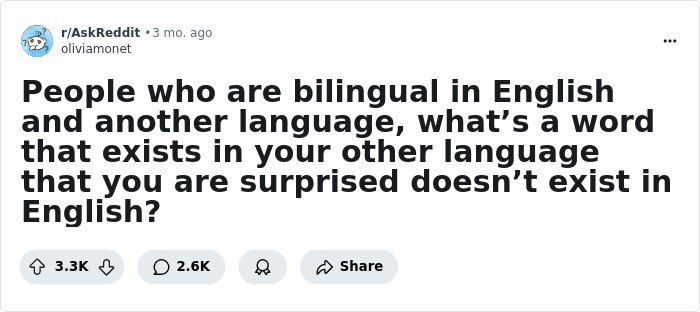
That means that about 19% — or 1 in 5 — of the global population are English speakers. However, popularity doesn’t it's the "best." (How could someone even quantify the quality of a language?) In fact, a recent discussion among bilingual Reddit users highlighted how many vivid, culturally rich, and deeply evocative words exist in other languages that simply have no direct equivalent in English. These words often express feelings, experiences, or social nuances that English speakers can only describe with a full phrase — if at all.
This post may include affiliate links.
 Kummerspeck ... Grief (or worry) bacon. It's the weight you gain from emotional eating.
I also like Backpfeifengesicht ... It's a face just asking to be slapped.
Irish. Beochaoineadh. Literally “alive crying”. It means a lament for those who still live but you know you may never see them again or is otherwise lost to you in a permanent, painful and irreversible way.
When you consider we’re a nation of people who have a history of leaving our loved ones behind in a desperate search for something better, it makes sense we have such a word.

I wonder if it can be used for Alzheimer's patients who are already detached from reality
“Alcahueta” - I learned that from my Colombian husband. It refers to an enabling mom who can see no wrong in their son, who is perfect in their eyes. I use it often when gossiping about relatives 🤣.

Funny, in Castilian Spanish means someone who is always trying to cover or facilitate a couple's romance, usually because it's illicit
 A beautiful expression we have in Italian is "arrangiati". There do exist turns of phrases in English that mean more or less the same thing, e.g. "do it yourself" or "you're on your own", but "arrangiati" is the imperative and reflexive of "arrangiare" (to organise, arrange, make do, manage) - basically "sort yourself". However, arrangiati has the same heft and directness, and general sentiment, of basically telling someone to go f**k themselves. No direct English translation leaves me satisfied as telling someone "arrangiati!" does.
Another one that comes to mind is "abbiocco", which is the drowsiness you get after a big meal. It is a tiredness and brain fog exclusively associated with a full belly. Very useful in Italy.
 A Filipina lady said "I was talking to my..." and stopped and asked me what the English word is for a parent of the person your kid married--the parent of your son or daughter in law. It's a relationship that we have no word for.

Yes, in my language we also have specific names for different sorts of relatives. For example, what is in English just uncle and aunt, we have different names depending if it is from mother’s or father’s side, then the difference between father or morher’s sister (and spouse) or brother (and spouse), etc. The same is for that whole group English treats just as “in-laws”.
 Sobremesa, it's the period of time you stay seated at the table talking after you're done eating.
Tocayo/tocaya is a person who shares your first name. I like it because my name is not that common, so I can say “hola, tocaya!” when I notice another one of us :).
In French, calling someone a “fatigant” .. someone who sucks the energy out of you.
 Finnish language is famous for "kalsarikännit" (getting drunk in your underwear), so I wasn't surprised it doesn't exist in English. But I was gobsmacked when I found out English has no casual word for "tuuletus/tuulettaminen" (a gesture for "yay!!!" or "wooo!!"). They just call it "goal celebration" or celebrating... Seems wild.

Tuuletus & tuulettaminen words have multiple meanings here. They can also mean opening a window and letting fresh air in. Or taking out rugs or blankets to freshen up. If you need new ideas, you can "tuulettaa" (air out?) your brain or thoughts, or you can take yourself outside to do something fun "tuulettumaan" after you've been marinating yourself at home the previous day due to the "kalsarikänni".
 Swedish: Lek (unstructured play or game) and spel (structured play or game).
For example a tug or war with my dog is lek, while monopoly is spel.
I do game design and while i can talk about structured and unstructured play i cant do so effortlessly with people knowing exactly what I mean.
痛快 (tong kuai) is something you say when something hurts but it feels good in Mandarin, like a super deep massage. It means happy pain :).
A new Spanish word that has become popular in recent years is *"cuñadismo"* (brother-in-law-ism) that means the opinions given by a know-it-all, like your BIL, that knows a faster way, knows a cheapest and better product, knows how to solve the problems of the world in one day...
Certain president is very adept to say cuñadismos.

My favorite Spanish term that applies to the American President is "Pendejo con Iniciativa", literally an "idiot with initiative"
I got a reverse one; I speak french and we don’t have a word for “Cheap” isn’t that crazy? Such a simple word. We just say not expensive or affordable.
Lagom. It means "the right amount" so "how many cookies do you want?" "lagom."
Lithuanian has two distinct words for law as in laws of physics, and law as in codex. We don't need to clarify if breaking a law is illegal, or impossible. Feels like a given to have!

Fizikos dėsnis (physics) and teisė (as to work in or study law) or įstatymas (when you do something wrong and break the law).
 Vaska (Swedish) = it means pouring something down the "vask" (kitchen sink). usually something expensive, for bragging rights, to show you are rich. you can say vaska about anything you destroy to show you are too rich to care. like, "im gonna vaska this car. god im so rich.".

Sounds like the liquid equivalent of lighting your cigar with a $100 bill!
Considering my language predates all European languages every being spoken in America; In Lakota (Sioux Nation) there are many words and phrases that, while technically have translation to a point, dont embody the cultural or spiritual implications of them in English. So Šúŋkawakȟáŋ would roughly translate to "Spirit Dog" but is a phrase that describes horses in the context of their impact on our people and their spiritual significance. It doesn't just mean "a horse." There are also MANY different ways and accompanying words/phrases that can accompany it that would change the implication of the words.
Another example would be Makȟá. The direct translation would be the earth but also means the soil, nature, the spirit of the earth and the creator spirit. Variations of its use would be Makȟáta: to be on the Earth or in nature. Makhíthma: to be in or one with the Earth/nature/the spirit of the creator. Or Uŋčí Makȟá which is used more strictly for ceremonial purposes.

... So what you're saying is that Fromsoft designed the Sioux language? (For the less video game-inclined: Fromsoft develops Dark Souls and Elden Ring. Their games are quite famous for being able to leave messages for other players to find, but the messages can only be created using word templates and a specific set of words. There is a large joke that every time you find a donkey or turtle, there will be at least one message referring to it as a dog because 'donkey' and 'turtle are not included in the set of usable words.)
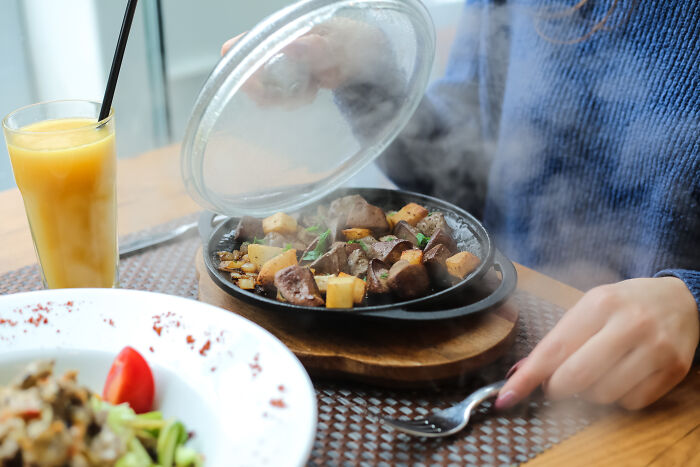 Spanish has caliente and piquante for hot food, meaning two different types of heat. I wish English had that.

In German: heiß (high temperature) or scharf (like a knife)
In German there's the "Doch"It's a word that means "nuh-uh". But it carries such power when being used. You can totally shut down someone's argument with just that word.
Apapachar, to hug with all your soul.
口寂しい 'Kuchisabishii' - Lonely Mouth, it's stress or boredom eating. Eating out of habit? or chewing on something to have something to do.
On the other hand, Esperar. Means both to wait and to hope, in Spanish. I guess the context helps, but in English we definitely use them in very different circumstances.
 Korean 눈치 (noon-chi)! it means the ability to notice other people’s subtle emotions or thoughts. for example, if someone kept talking about something that clearly bores the other person who is too polite to leave the conversation, you’d that that person doesn’t have noon-chi, or the ability to notice (that they want to talk about something else).
Schadenfreude..🇩🇪.. Rejoicing 😃 in someone else's misfortune 😔..
Otužovat se = getting your body used to cold temperatures in order to be healthy.
In French we have 2 words for "pride".
*Fierté* is the usually the pride you feel in your accomplishments or those of someone you like.
*Orgueil* is the pride you feel about who you are. It not as superficial as vanity but often has negative connotations.
Your wealthy boss shares his *fierté* about the money he's made. But *orgueil* will forever keep him from seeing his employees as an equal.
Sounds kinda like the difference between being proud and being prideful.
Flâner
That's when you stroll aimlessly through a city, just enjoying the surroundings without a set destination.

Friolento! (Friolero in other regions I believe) I'm a persona friolenta myself (Friolento means somebody that's too affected By the cold weather or it's constantly feeling cold).
In Polish - załatwić. It basically means to get something done, don’t ask me how.
In English, aunt/uncle are general terms that don't specify whether the person is from the mother’s side or the father’s side but in Arabic we have 2 different words for that.
Mother's side : Khal/Khala
Father's side: Amm/Amma.

Same in danish. In english Im an aunt. But in danish im 'moster' meaning moms sister. If my brother had a child I would be 'faster' meaning fathers sister. Uncle in danish is 'morbror' meaning mothers brother. Or 'farbror' meaning fathers brother. We have the same with grandparents. My grand parents on my mothers side is 'mormor meaning mothers mother. And' morfar' meaning mothers father. On my dads side it world 'farmor' meaning fathers mother. And 'farfar' meaning fathers father.
Eish. Word used as exclamation in South Africa to express a variety of feelings such as surprise, disgust, disappointment, fear, impatience, etc. Example: “Eish! My team lost the game” or “Eish… my manager asked me to work overtime”.
In indonesian we have "segan", which is an unwillingness to do something, but that unwillingness is driven by respect. segan is not reluctance, it is not timidity, it is not shyness, it is not awkward. it's kind of recognizing that you are bound by social hierarchical obligations/expectations and can't say or do what you want. like not telling the boss he's wrong, not challenging your elderly mother.
i guess this would map well to japanese. in indonesia, segan comes from javanese , which has rigid social stratification hard coded in the language.
what a great question, thanks mate!
"Uppehåll" in Swedish. Basically it means "right at this moment it is not raining" and I havent found and equivalent word in English yet.
In Punjabi we have names for almost every relationship you can imagine. For example, dad's older brothers wife is "Tha-ee" or your husband's sisters husband "nandoi" - it's kinda cool, because you always know who the person is referring to without having to explain.

God we have the same in marathi and it’s to the point where I can’t even remember anything anymore. The english word aunt depending on the relationship can mean kaku, maushi, atya, mami etc.
For me it's surprising that words "friend" and "cousin" don't have a gender. So you have to say "female friend/male cousin" instead of using a single word that exist in many languages (e.g. italian amico/amica, cugino/cugina etc).
Padkos. An Afrikaans word that literally translates to “road food” aka road trip food. The closest English translation is “provisions” but it’s not quite as specific.
Don’t know how to spell it but it’s pronounced “hoon” It’s a Malagasy word for he/she said but it implies that you’re giving the direct quote of what someone just said. More useful than just saying “he said”.
 Dygn (Swedish), it's a 24-hour span of time (and far less ambiguous than a day).
Portuguese- “saudade” . A feeling of homesickness for something.
I mentioned this one in a comment earlier. Saudade isn't homesickness, not exactly. Saudade is the loneliness that you feel when you are missing something or someone. You can feel this loneliness even when surrounded by friends. I can feel saudade for my hometown, but I can feel it for my son who is at university, or for my grandmother's cooking. You can even feel this when you're experiencing the thing that you're missing. So I have the feeling of saudade when I return to my home, but things aren't as they used to be. It is to be isolated in your nostalgia
 Chulé - bad foot odor
Cafuné - running your fingers through someone's scalp affectionately
Portuguese.
Estrenar, Spanish.
The closest word in English would be to debut, but it very specifically refers to a new outfit or article of clothing.
In Hungarian, we have the word **igénytelen**, which doesn’t have a perfect equivalent in English. It can describe a person who has low standards, a shabby appearance, poor-quality work, or someone who simply doesn't care to put in effort - depending on context. English has words like sloppy, undemanding, or shoddy, but none of them fully capture the layered, often judgmental tone igénytelen carries.
Also, we have two everyday words for "red": **piros** and **vörös**. Piros is a brighter, more playful red, while vörös is deeper, darker, and often used in formal or dramatic contexts - like blood, wine, or political symbolism. This distinction is unique in how widely it's used; most languages (like English) just say red and rely on modifiers. A few others (like Japanese or Korean) have poetic or specific terms for deep red, but Hungarian is rare in having two distinct, commonly used base words.
Adding to these, Hungarian also has **bezzeg**, a word that English speakers often find baffling. It's an adverb used to draw a sharp, often resentful or ironic, contrast. Imagine someone complaining, "I had to wait for hours, bezzeg he got in immediately!" English might use "but of course," "wouldn't you know it," or "mind you," but bezzeg crams a whole lot more into one word - there's often a hint of envy, a sense of injustice, or a smug "see, I told you so." It’s the linguistic equivalent of an emphatic, knowing sigh about the unfair (or predictably preferential) way things work for others compared to oneself or a previous, more ideal situation.
Then there's **hiányérzet**, a noun for which English lacks a single direct counterpart. It describes that distinct, often nagging and melancholic feeling that something specific is missing, a palpable sense of absence or incompleteness. You might say "a feeling of lack" or "a sense of longing for something absent," but hiányérzet pinpoints the specific emotional state of recognizing and being troubled by a void, whether it's a person, an opportunity, a sense of belonging, or even just an unnamed something that should be there. It’s more profound than just "missing something"; it's the awareness and feeling of the gap itself.
And let’s not forget **tutyimutyi**, a delightfully expressive term for a certain type of person. A tutyimutyi is generally a weak-willed, ineffectual, perhaps somewhat clueless individual, often seen as mollycoddled and lacking initiative or backbone. English words like "wimp," "milksop," "doormat," or "nebbish" get close to some aspects. However, tutyimutyi uniquely blends a sense of pity with exasperation, and sometimes even a touch of dismissive affection. It’s not necessarily a harsh insult; it often describes someone almost endearingly useless or frustratingly passive, a specific archetype that the single English terms don't quite capture in their full, culturally understood flavour.
Edit: style.
"Igénytelen" sounds like a perfect expression for my bio father who I know only superficially. Content with just surviving in a room in shoddy tenements, doing useless busywork that pays peanuts. He's kinda cool guy, I have no quarrel with him, but I'm often glad I didn't inherit this from him.
In Mexico we use malpasar to indicate that we've skipped or missed a meal. My mother would always be like "Niño! No te vayas a malpasar porque no hay nada que comer en la casa" to make sure I'd eat at school before coming home cuz my parents worked late.

We also use "malpasar" for any activity done in excess, like drinking heavily, sleeping late or overworking, and then suffering the consequences.
In Hebrew we have a word לפרגן le-far-gen
Which roughly means the opposite of gloating, as in being happy and cheering for someone who is happy and being supportive. In English I refer to this as being a "woo girl".

Similar to the Buddhist Pali word "mudita' -- symjpathetic joy -- taking pleasure or joy in someone else's success. I call it the emotion that causes you to say "Congratulations!" or "good for you!"
Not bilingual, but Mandarin Chinese has an 'us but not you lot' pronoun which is rather useful.

One problem lots of languages have is that there's no difference between "we" (including the person being spoken to) and "we" (not including the listener), i.e. "we're going to the movie" is ambiguous on if it includes the one reading / hearing it when it doesn't have context
There are two in Turkish:
1- Kaçıncı. The question word for order. If I can make up a english translation it would be “how manieth”. e.g. q: “Kaçıncı” president of United States is Obama? a: 44th. Can be expressed as “which place” if you’re talking about a competition.
2- Yok. Opposite of “exist”. In english, you have to say “doesn’t exist”.
Romjul (Norwegian) = the period between the end of Xmas and the new year.
Oh yeah, that special time of year when you forget what day of the week it is.
In french we have "tout à l'heure", the closest meaning is"later" but with a nuance.
While later mean a moment after, it does not tell when or even if it will happened. Meanwhile, "tout à l'heure " means a moment later, soon and is already planned.
When you tell people you are going to do something for example, using this variation is telling that you have a moment planned for that already, while later (tranlated "plus tard") means you will not do it now but later with no idea when or even if you'll ever do it.
I don't know if it was clear but it's frustrating when talking in English because it's hard to find other way to tell it easily when I am used to a simple phrase.
And you can also refer to the past with tout à l'heure. "Tout à l'heure, j'ai acheté des pommes" is (recent) past. "Tout à l'heure je vais acheter des pommes" is (close) future.
I constantly reach for “préciser” and fail to find an exact equivalent in English. It doesn’t quite mean “specify” or “detail”.
What really surprised me is that it appears there is no English word for German "satt". When you're not hungry any more, you are satt. In English, you usually say that you are "full", but that's not the same thing! Full means you cannot eat any more for lack of space, "satt" means you don't *want* to eat any more.
Also, "verdursten", dying from lack of water. When you die from lack of food, you starve, but what do you call it when someone dies from not getting enough water? "The desert researcher died from dehydration"?
satt = satiated (but no-one would say then in normal talk), and verdursten, weird there is no single word.
"dugnad"
Norwegian word for "people in a community getting together to get s**t done".
 Flemme (french).
It's basically a lack of motivation.
My first language is Spanish. I always feel weird when I'm talking to someone in English and have to refer to someone older than me as "you". It feels so informal! I'm used to using the term "usted".

"You" used to be the same as "usted" (and "vosotros", as well). The singular form was "thou", which has disappeared. In French we have the same distinction between "vouvoyer" and "tutoyer", but in English they "vouvoient" everyone. Which makes the job of translaters extremely difficult. At what moment are the characters intimate enough to use the familiar "tu"? Who initiates it?
Au. Like in Wachau, Wildschönau or Murtau.
It’s the dry portion of a river when it does not have too much water flowing.
I'm a 53 yo German, but today I've learned, that Au is a legit alternative to Aue, that nobody has ever used, but you.
 Gambiarra. Jury-rigging, workaround, improvisation, redneck engineering, I've seen all of them being used to translate it, none do gambiarra justice.
 Jutho
Jutho
It means something that has been eaten by one person that restricts another person from eating from the same portion or plate. It is a very common practice in the Nepalese or Indian culture but seems to have no concept in the western world.
Propil in Russian means you sold something you own to buy alcohol and drank all the alcohol.
I don’t speak Russian but:
*Vranyo*
It means lying, but more than that, it’s a lie that everybody involved with is OK with pretending, because calling it out would expose their own *vranyo*. It’s two parts lie, one part *a-wink-and-a-nod*, and one part corruption.
I've never been to Russia and I don't speak Russian, but this sounds eerily familiar.
Oa pronounced “wah” is a Malagasy word you add to the end of a sentence when you have to repeat yourself. Your tone can indicate that you’re repeating it and that it’s all good, or that the other person is dumb for not listening.
*"güirro"*
it's a Central American term, primarily Honduran, that typically refers to kids when they're being annoying like pests. it can be used as a term of endearment but usually used to convey frustration.
Oh we have so many words in French! They often refer to kids' body function : morveux (full of snot), chiard ( shìtter), merdeux (full of shìt)...
I like the term kilkanaście (a dozen or more, but less than twenty).
Useful when you don’t want to count a bunch of things but there’s really not too many of them.
I miss something akin to the German "Mahlzeit!", which is something you'd say to someone who's currently eating/about to eat.
Best you can do in English is "enjoy your food!" but it's too cumbersome and kind of a weird thing to say to a stranger. .
This is annoyed me for some while,
the word जूठा, it has a meaning& used for some food tained by saliva
ex- I wont eat this because it is brother's जूठा food.
Not quite the same, but "doubledipping" is putting a cracker/chip in dip/sauce twice, and therefore contaminating the dip/sauce with your spit. When I was a kid "backwash" was the word for drink that may have entered someone else's mouth. Like if you were sharing a glass with your sister, you'd warn her "No backwash!'.
 Schlep - yiddish meaning to take/carry someone or something somewhere but with angst. Have to schlep the kids to the dentist, have to schlep tables to David’s house for the yard sale.
Te quiero and te amo are both simply 'i love you' in English. But very different meanings.
I think it's the difference between love and care. In Italian they have " ti amo" and "ti voglio bene" which are different but both suitable for romantic love. " Ti voglio bene" seems more meaningful.
Not my language, but a language i started learning.
Japanese has しょうがない (shōganai) which essentially means "it is what it is", "it can't be helped". The weather is bad today but you still have to go to work, you might say しょうがない or if you're a more negative person, you might say.......
めんどくさい (mendokusai) is closest to "tedious" but doesn't quite have the same energy. It's kind of like a combination of "tedious", "annoying" and "bothersome". A person keeps nagging you about something you don't want to do, you could say they are めんどくさい. You got this new rug in your living room, but it's an antique, and you need to be really careful around it or you'll ruin it, so it ends up being kind of a pain in the a*s, the rug is めんどくさい.
I've watched Naruto for the last time like ~15 years ago but I can still hear Nara Shikamaru saying "Mendokusaaaai" 😆
Inat is a bosnian word that, as far as I know, has no translation in english or french. Doing something “iz inata” basically means doing something out of sheer stubbornness. Doing something just because someone said you cant or because someone thinks you won’t be able to.
This is hyper-specific, but in Hungarian there’s a common polite word for goodbye, “Viszontlátásra”. The ‘lat’ here means see so ‘goodbye’ from seeing you. However, if you just had a phone conversation you’d say the slightly different “Viszonthallásra” (notice the ‘hal’ in the middle there). Which means…listen. So like, saying goodbye specifically from listening. We don’t have that in English.
In vietnamese, there's a word that describes when you're tired of eating something; typically used in a long term sense and not in a "we've eaten the same leftovers 3 times this week" kind of way.
Arabic 🙋🏻♀️
It’s a word we say to a person who just had a shower or a fresh hair cut for the purpose of “almost” celebrating that or to let the person know they look fresh. Its نعيماً. Pronounced Na’eeman.
Another (phrase not word) we commonly say when bypassing anyone working, whether to a stranger on the street or someone at work, is يعطيك العافية. Which literally means: May God bring you prosperity and wellbeing. Pronounced: Ya’teek AlAfyah.
Døgn, the word for the 24 hour period between midnight and midnight.
Overmorgen has an English equivalent but nobody ever says overmorrow lol.
Also, formiddag, pre-noon, the time between the morning and noon, so like 8/9am ish until 1130ish.

Overmorgen sounds and means exactly the same in Dutch, and for 'formiddag' we have 'voormiddag'...
Am trilingual here
委屈 in Mandarin which means the suffering you went through that cannot be expressed thus making you resentful
生き甲斐 in Japanese which means a purpose one lives for.
Gourmand, in French, does not directly translate to glutton. Glutton and gluttony is a bit more severe in the meaning. We’d say “oh le gourmand” when someone takes food twice or “c’est de la gourmandise” when we are almost full and get another serving.
Miavona or miavonavona- Malagasy word for uppity or thinking you’re too good for certain people.
“He doesn’t hang out with us because he’s so miavona.”
You wave and say hi to your friend but get no response, you yell out “Miavonavona!”.
In Portuguese there is this beautiful word "Panapanã" that means a "flock/cloud/flutter/group of butterflies". There are words in English to describe it but the words are not specific.
I'm not surprised to be honest, but it's a beautiful word regardless!
Question, is it specific to butterflies or can it be used for moths as well? Delightful word either way~
As a native English speaker, I love Spanish's "ni modo", which I understand to mean something like "Well, the thing I was hoping for/trying isn't going to happen, but f**k it, we ball.".
Βρε/ρε
Hard to translate, but basically a cute and an offensive way to say "hey" respectively.
There is a word for a feeling between like and love in my language, or maybe there is a word for a stronger feeling than love, depends on what way you want to look at it.
there is a word that translates to "like" which is self explanatory, you have positive feelings towards someone/something and then there is a word that translates to "love" which is a strong positive feeling, either romantic or platonic. in my language there is another word that also translates to "love" but is almost exclusively used for romantic love and is kind of a "relationship milestone" when said out loud to the other person.
so basically we have two words that both translate to "love" in english but mean sort of different things because english lacks a word to distinguish between the two.

This puts me in mind of Greek's 'Philios', 'Eros', and 'Agape'. 'Philios' - 'Brotherly Love', or affection for one's family. 'Eros' - 'Romantic Love'. 'Agape' - 'Selfless love', as in 'Greater love hath no man than one who lays down his life for family / loved ones / country / etc.' (Needless to say, there can be considerable overlap in these.)
バイキング, Viking, means "All-you can eat buffet". Its japanese. Someone used the word "viking" to make it sound exotic and it stuck and now its a real word.
Baat daal diye.
The closest thing in English would be “they dropped the subject”. But I’ve never heard a non-Hindi speaker say that, and it doesn’t flow as well in most contexts.
Полтора in Russian means one & a half. I think it's an ancient, barely recognizable compound word "half of three" but I can't be sure. It's used very commonly.
I took a few years' worth of Spanish. The best I can think of is "quinceañera" (kin-se-an-ye-ra), which refers to a girl's 15th birthday celebration. The closest equivalent in English is a "Sweet 16;" same vibe, just a year later than a quinceañera.
The word figured prominently in the 2015 film "McFarland, USA" with Kevin Costner

English in its many varieties is a sponge. If we need a word, we'll just absorb it from another tongue.
It has been said that English follows other languages down dark alleys, accosts them, and then goes through their pockets looking for bits of loose syntax and vocabulary.
Load More Replies... Is it just me, or are a significant number of these 'English has no word for...' cases simply people with limited vocabularies? (I *will* grant you, though, that even where English *does* have such a word, it's often not in common usage.)
English in its many varieties is a sponge. If we need a word, we'll just absorb it from another tongue.
It has been said that English follows other languages down dark alleys, accosts them, and then goes through their pockets looking for bits of loose syntax and vocabulary.
Load More Replies... Is it just me, or are a significant number of these 'English has no word for...' cases simply people with limited vocabularies? (I *will* grant you, though, that even where English *does* have such a word, it's often not in common usage.)


































 No fees, cancel anytime