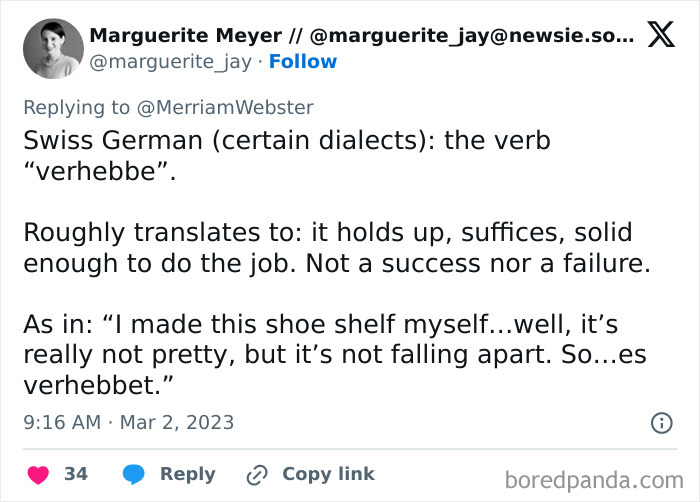
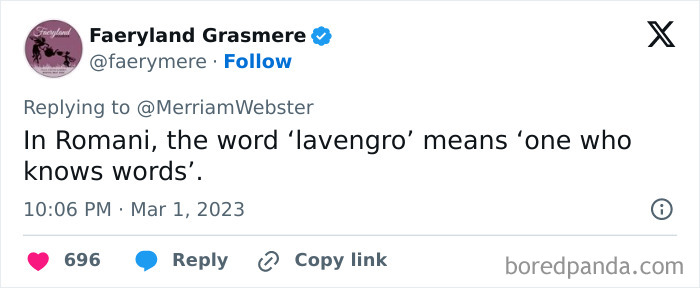
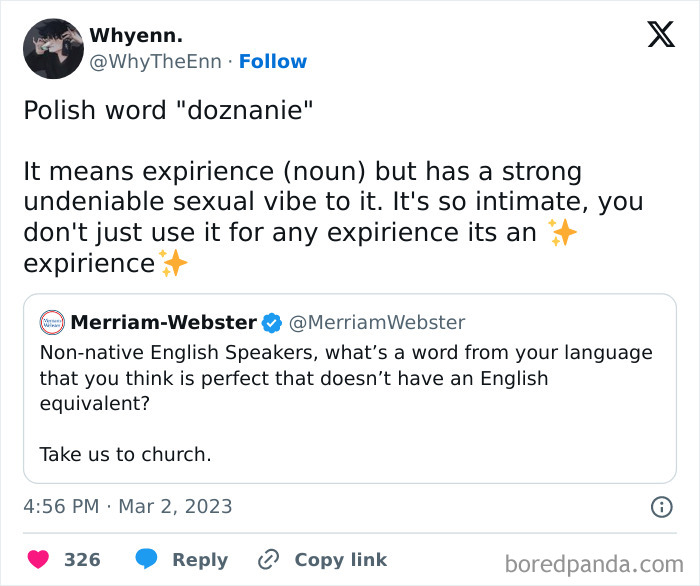
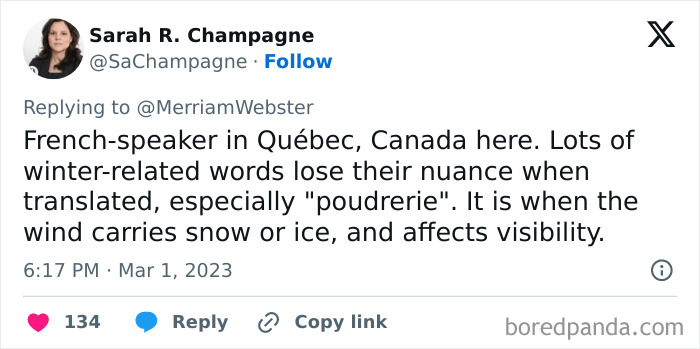
The world is a wondrous place, filled with breathtaking landscapes, rich cultures, and diverse people. While English serves as the global language that allows us to communicate with each other while traveling or connecting with friends from different nations, wouldn't it be amazing if we could effortlessly switch to the local language of the country we're visiting? Imagine immersing ourselves fully in the experience and expressing our thoughts with words that may not even exist in the English dictionary.
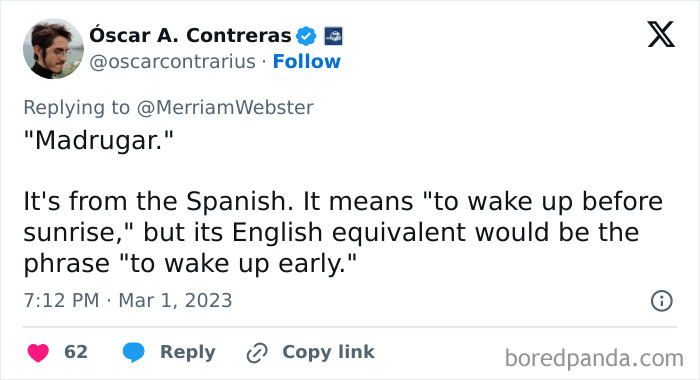
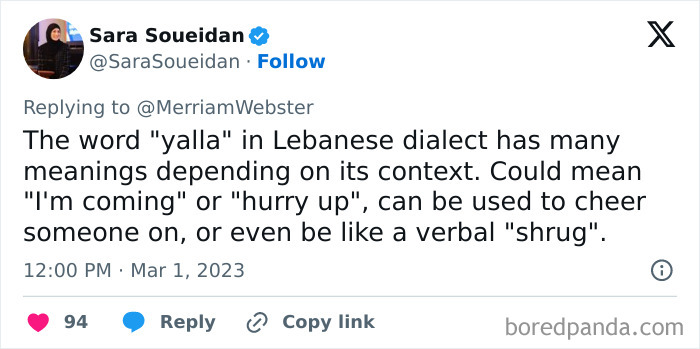
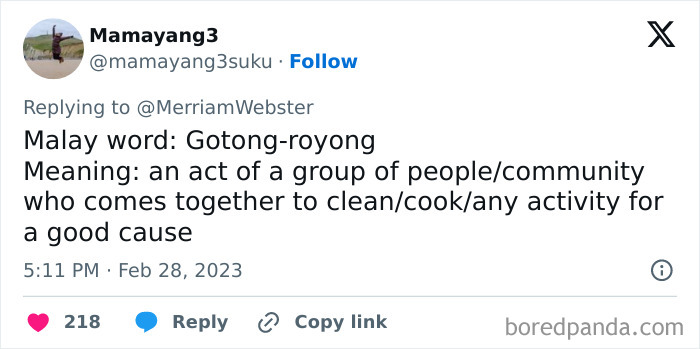
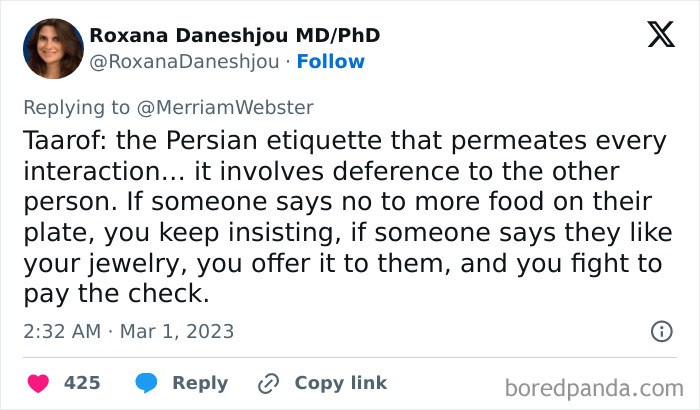
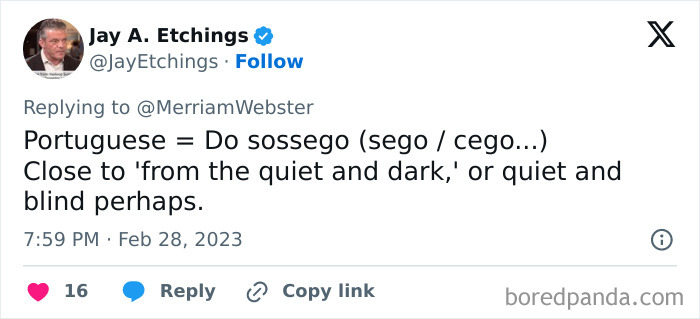
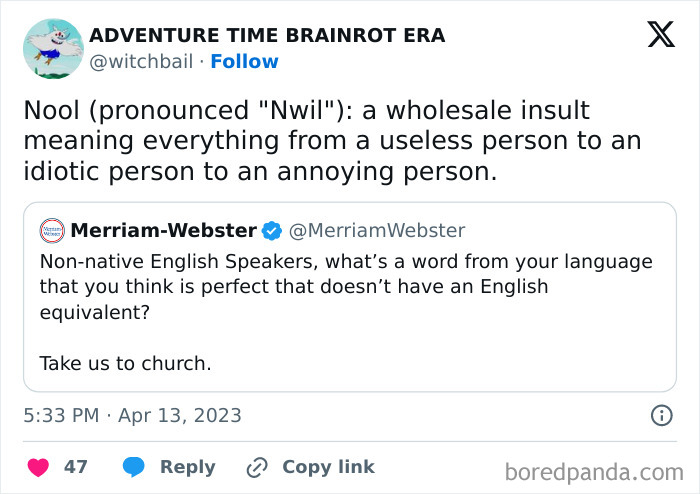
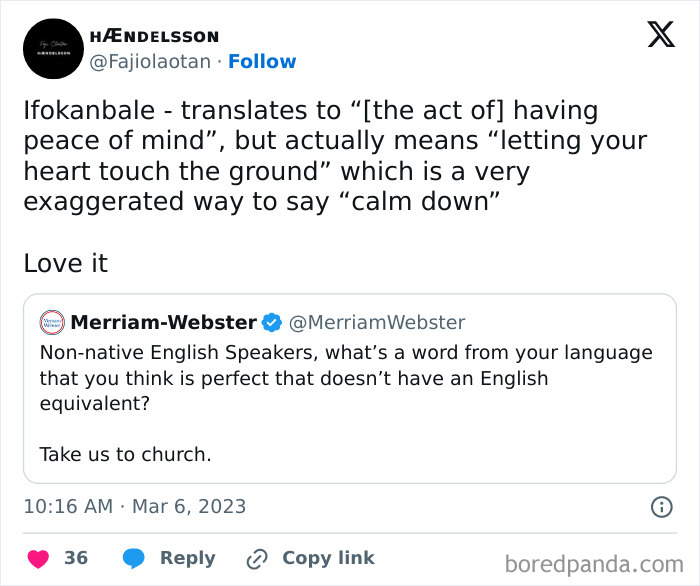
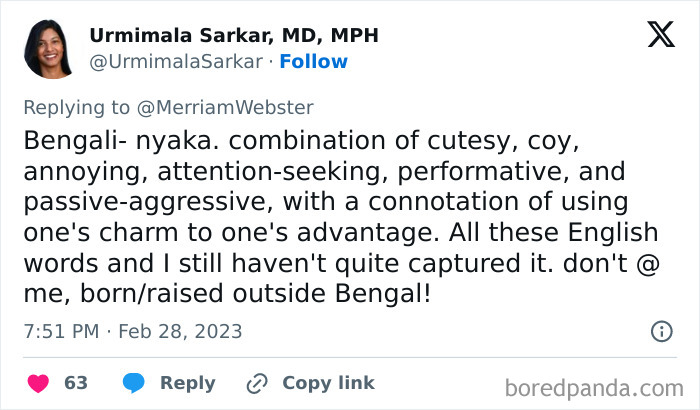
We've compiled examples of distinct words from Merriam Webster's Twitter thread, spanning different languages and often lacking direct English equivalents. These words are paired with their English meanings for clarity. Ranging from cozy and amusing to slightly weird, these words capture many unique situations. So, let's all have a "hygge" (the Danish word for cozy snug time) and start this philological journey together.
This post may include affiliate links.
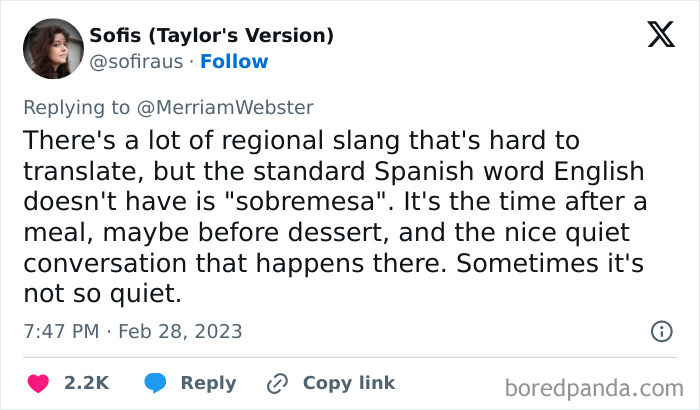
7am here, same. Usually 5, but the hurricane has postponed some things.
Load More Replies...I thought it was "dad morning" where he waits for everyone else to get up so he can tell everyone what time he was up.
Load More Replies...My daughter would love that one; she gets up at 5.30 each day just to get that moment before the world starts. 💖
While the English language boasts a vocabulary of over 750,000 words, it doesn't always provide the most fitting terms for every concept or emotion. The idea that Eskimos have countless words for snow might not be entirely true – in this instance, their languages actually have about as many snowy synonyms as English. However, it's still clear that a culture's language can be really interesting and revealing. For example, Italians, who enjoy longer meals, have a word for the circle of moisture left by a glass on a table.
In Welsh we would say cwtch (pronounced kootch - 'oo' as in book) as an equivalent.
People that hug like that are the best huggers. Leaves you feeling warm and safe.
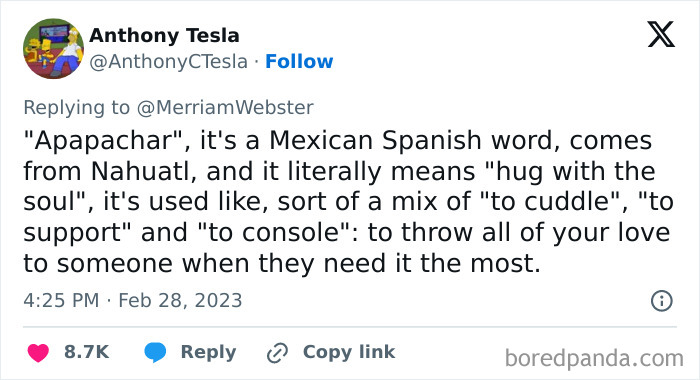
now i have the urge to hug someone randomly and say Apapachar but like in a magic houdini Wala kind of way ! I doing this to my kids everyday lol it's going to be my new thing
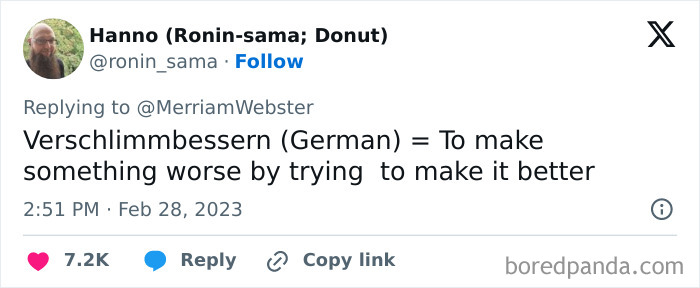
German here, if you wanna show of with correct grammar, it would be "I verschlimmbessere a lot" ;D (Ich verschlimmbessere, du verschlimmbesserst, er/sie/es verschlimmbessert, wir verschlimmbessern, ihr verschlimmbessert, sie verschlimmbessern)
Load More Replies...czechs have vulgar "dokurvit" which literaly "to f**k it up so bad you have to whore it out" which is the same, to make someing worse by trying to make it better.
Kinda like the GOP in the USA... "better" in their eyes actually means "to move backwards"
Please don't bring partisan politics into this interesting thread
Load More Replies...I have done this alot cool to know that there is a single word that means exactly that.
Linguists face a big challenge when they need to translate words that don't have an exact match in another language. These are called "untranslatable" words. It's hard to express the exact meaning and feeling of these words in a different language, so translators have to be creative to solve this problem. Let's see why some words are untranslatable and how translators can handle this tricky task.
積読. Reading books and buying books are separate hobbies! If you fall into this trap often, switch to using the library. The time limit will spur you on to read more!
I use the library so I don't spend all my money on books
Load More Replies...Wow, is there a japanese word for when it's yarn instead of books?? Asking for a friend :)
Oh, I'll read them eventually, but first I'm going to enjoy the anticipation.
I wonder if has something to do with the word tsunami, maybe tsu means wave or sea and tsundoku it's like a sea of books? But I don't speak any Japanese!
From an online article from the BBC: The word "doku" can be used as a verb to mean "reading". According to Prof Gerstle, the "tsun" in "tsundoku" originates in "tsumu" - a word meaning "to pile up".
Load More Replies...Yes! They shouldn't be understood as mutually exclusive. Hawaiian language did it right.
Did someone forget or just not know of “noblesse oblige”? English has become the sort of de facto language because first, we were invaded by pretty much everyone except the Greeks and Spartaca. Then we continued the tradition of invasion. Apparently, English is the most easy language to speak in pidgin and we’ll all do our best to figure out what you want to say. But it’s one of the most idiosyncratic languages when it comes to exceptions.
The Swedish Allemansrätt (all man's right) is like that. It means you have the right to walk in nature, even on other people's property (as long as you are not near a house), and pick mushrooms and berries for your own consumption, or a small bouquet of flowers, as long as you don't harm the nature or the animals, or leave permanent marks, or pick flowers/plants that are protected.
I have this happen a lot at work when I get depressed and lonely working from home.
When I was about seven I went to my mom all excited to ask why we couldn't have four stomachs like cows so I could have one just for dessert.
My mouth always feels better when it's eating, unless I have a cavity.
Happens with me all the time. Until I put myself on an 'eating plan' to keep my weight in control - not a diet, but of plan of what to eat when with the weekends being for more 'fun' food.
In cultures with deep histories and traditions, some ideas need special words or pictures that are unique to that culture. This is especially the case for sayings that might lose their real meaning if translated exactly into other languages. In these situations, skilled translators find different ways to explain these ideas without translating the words exactly. They might use words that mean the same thing, or they might compare the idea to things everyone knows to make sure the message gets across just right.
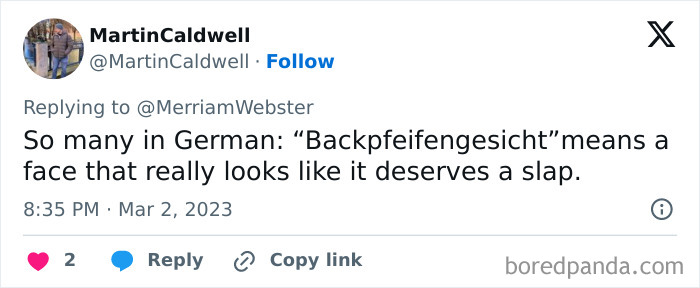
Sounds like the result of having a backpfeifengesicht
Load More Replies...True enough. I have more than once referred to someone, including politicians, as having a punchable face.
Load More Replies...Heimweh : longing for home ( and even better) fernweh: longing for a place that is not home / like longing for a faraway place
The word wanderlust is derived from german which in this case means Fernweh
Load More Replies...In danish we have almost the same, but not about the face, but about a person: øretæveindbydende
I recently accomplished the fixing of Kabelsalat. Unhooked everything here at my desk, rerouted everything, set it back up, and it worked. ( ! ) But I bet my cords in other places are tangling up in revenge.
Wollkotze when you wool is tangled and you have barely a chance to save it ("wool vomit")
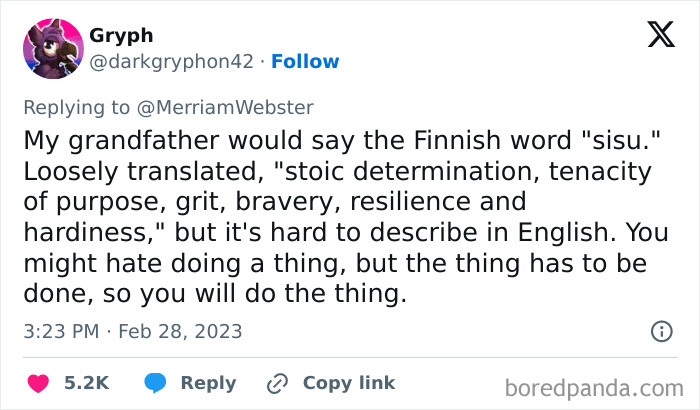
In Sweden we use this Finnish word, but, yeah, it is more to describe the Finns...
Load More Replies...Maybe, but more potent and with extra stubbornness
Load More Replies...I LOVE that word! It's so great to know that there are words in other languages to describe concepts I'm familiar with, but lack a word to adequately describe it.
People do that every day, it's called going to work for adults and school for kids.
When you learn a new language, you dive into a culture. You're likely to explore a country's history, language, and traditions – things you might never have discovered otherwise. This leads to a deeper appreciation for that place. You'll also understand why certain cultural practices exist and gain insight into the reasons behind them.

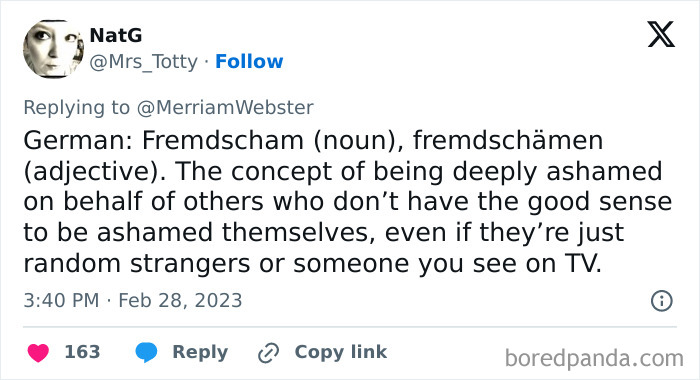
In Dutch it's 'plaatsvervangende schaamte'. The same two words as in English: vicarious shame.

Finns also have a word for this: myötähäpeä. The beginning mean roughly along and the end just means shame.
We have something similar in Swedish; Skämskudde (shame pillow). It's when you watch TV and it's sooo cringe-worthy that you have to hide behind a pillow, you can't watch it.
Okay I can relate to this so much! Sometimes I’m just watching a TV show and I’ve literally skipped an episode because it was so cringy 😭😭
Well, if it doesn't work properly, I'm returning it.
□ Wrong item □ Product no longer needed □ Product doesn't match the description □ Tsujigiri failed :(
Load More Replies...Lol!! I'm guessing they started locating sword shops in out of the way places after this word was added to the language.
When you're learning a language, it's important to talk with people who are native speakers. This helps you understand their culture and get to know them. Even though there might be differences, we're all just people at heart. Apart from our differences, all of us has shared experiences, though many of these experiences are different and birth words that can't be directly translated across languages.

We do have Jacobsladders in Dutch. When you see beams coming from the sun, because the sun is partially clouded. When beams come through the clouds. Not just light, but rays of sun.
I've never heard it being called that before, I wonder whether it's a regional thing.
Load More Replies...I'm fond of "yuunagi" (evening calm) myself. I also like "okaerinasai", which is how the Japanese say "welcome home".
I dunno; while I can’t quite put my finger on my unnamed, unknown thing I’m missing, I’m nearly certain it’s not you. 😉
Load More Replies...I wish I knew how to speak Hungarian, but Mom was worried we, my siblings and I, would not learn to speak English as she had to learn English the hard way growing up. Later on, Mom said she could have taught us both.
She wouldn‘t have to teach you anything. She would just have to interact normally with you in her native tongue. You would have picket up both languages on the go without being formally taught. Children absorb such things like sponges. This is why lots of European grow up knowing at least two languages, as we have lots of back and forth in migration inside the EU. I myself grew up speaking Polish at home and I picked up German from my friends and later Kindergarten and School. I speak better German now than I do Polish as I an not exposed to Polish that much any more and I cannot read or write that good, as no one ever taught me that, but I pass as a native speaker.
Load More Replies...Or simply a very silly idea that may have sounded good at first.
My life’s motto is “It seemed like a good idea at the time.” I didn’t pick it; it’s just the way things turned out. I’m thinking this German word is speaking to me, too.
Load More Replies...Also Treppenwitz - a witty retort that disappointingly only comes to you when you're halfway down the stairs and nearly out of the door
Never heard this one befor. Aus welcher Region kommst du?
Load More Replies...You likely have cherished books and movies from your upbringing. Well, guess what? People in other countries might not have read those books or watched those movies. They had their own unique childhood experiences.

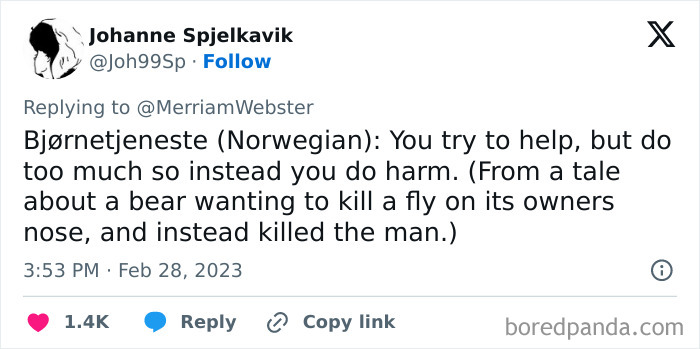
In German it's "Bärendienst", having the same figurative meaning (and probably also literally the same, if I do the guesswork right^^)
Load More Replies...Yes, goes in a similar direction. But we do have "Bärendienst" (bear's service), too, which seems to be the same concept as the Norwegian one. I think Bjørn (Nowegian)/Björn (Swedish, first comment) means bear, and "tjeneste/tjänst" is not far away from "Dienst".
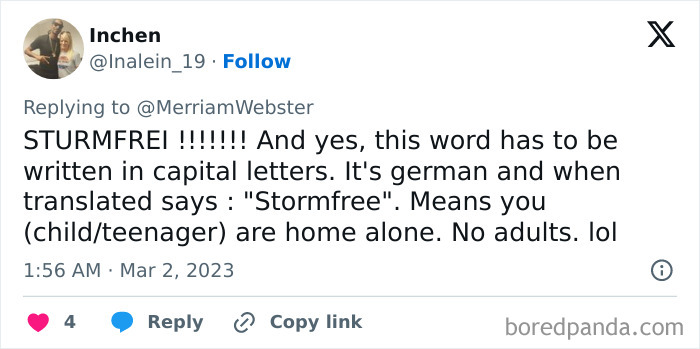
Load More Replies...See also schneefrei and hitzefrei! The best words for a school-age kid.
ahh, those are not the same. Schneefrei or Hitzefrei mean you don't have to be in school, but Sturmfrei has nothing to do with a storm. it means you are home alone and free whatever you want to do while your parents are away. Having a sturmfreie Bude means, call your friends to have a party. The word comes from "stürmen" "to storm" like in the castle is ready to be stormed. :-)
Load More Replies...In Scotland we have a word for this phenomenon- it's called an "empty"
I wonder what the 'sturm' refers to. Is the kid without storm because the parents are like a storm? Is it because the child is free to be as wild and storm-like as they want when they're alone? Is it because it used to happen when there was a storm, so the schools were closed but the parents might still have to go to work so that was the only day a child was home alone?
No, STURMFREI can be translated into Dutch with the saying "Als de kat van huis is, dan dansen de muizen op tafel." So basically house without chaparone.
Load More Replies...Because so many wonder: It was originally an old military term, meaning impregnable (regarding a castle or fortress or the like). So "sturm" doesn't refer to a weather condition, but is also used, like in english, for storming in a military sense. Sturmfrei - "free from storming" therefore means a place so heavily secured that it can't be successfully attacked.
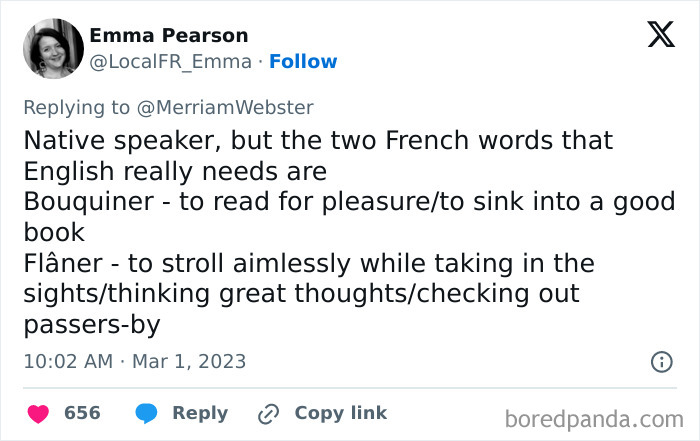
We ( Dutch) also use Flâner in almost precisely the same way. Flaneren. Typically one Flaneert when walking on a boulevard ( road alongside a beach) or so. It also has a bit to do with being seen by others. Like casually strolling alongside the beach taking in views / letting your mind wander wherever it wants/being seen by people at that beach or terraces, you stroll by...
We have 'flanera' in swe, but guessing it comes from French. And Swedish is not English...🙃
Ooh, I like bouquiner, we definitely need that in other languages too. Because there is indeed a big difference between reading in general, and sitting somewhere and enjoying your book. Enjoying your book is such a different experience than just reading the instructions on a package, it's actually somewhat weird that we use the same word for them. Because enjoying a book isn't about the technical act of looking at words and understanding them, it's about the experience and how it feels, so it definitely deserves it's own word.
I do this a lot on MARTA (public transit). Occasionally I've gotten so engrossed that I miss my stop.
Load More Replies...Flâner was first a passe-temps in the XIXth century, where it was as important to see as to be seen... and of course proving that you didn't have to work!
Spankulere in norwegian. It means to stroll around for the purpouse of walking and be seen by others walking. It was a nobility-thing, so I guess a bit nose-up and prancy fancy, but its a good word
Hmmm maybe, but flâner is not just while walking, like strolling down the street or something. Flâner - you can do that anywhere: in a shop, a bookstore, a park - it's just that feeling of aimlessly wandering/loitering somewhere.
Load More Replies...Through the untranslatable, we learn to connect, appreciate, and celebrate the shared humanity that unites us across the languages that shape our global community. Keep scrolling to find inspiration to learn a new language or pick up some new words for your daily conversations. For more related content, check out our previous posts here and here.
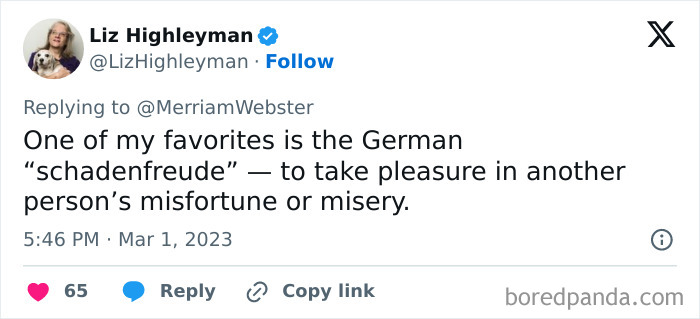
We have a word for that too in Dutch. Leedvermaak. Leed = sorrow , vermaak = entertainment....
A woman who has used me sexually and then rejected me coldly and cruelly later actually asked my advice on how she could hook up with my best friend. I gave her detailed suggestions and strategies (all very, very bad) which she swallowed whole. I got to sit back and watch the entire catastrophe play out right in front of me while she kept asking for further ideas. I don't think of this incident often, but I always do when I hear the word "schadenfreude".
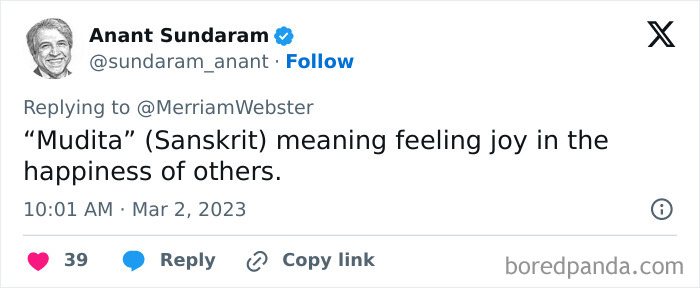
It's very very rarely used in modern Danish, but we also have the opposite: "Glædesfro" - to be delighted by other people's fortune and happiness.
i thought schadenfreude meant one's bad deeds coming home to roost. Anyone have one word for "what goes around comes around?"
Is it the kind of conversation, where you wake up in the morning, and think "Oh, no! I can never talk to that person, again." ?
No, it's when you find someone that you feel you can trust, people should never gossip about something that comes up in trúnó. Never.
Load More Replies...Also "tardeo", going for a drink (or more) in the afternoon rather than in the evening because you want to be home at a respectable hour
mum getting drunk and insulting an belittling dad or whoever she has decided that has not lived up to her high standards.
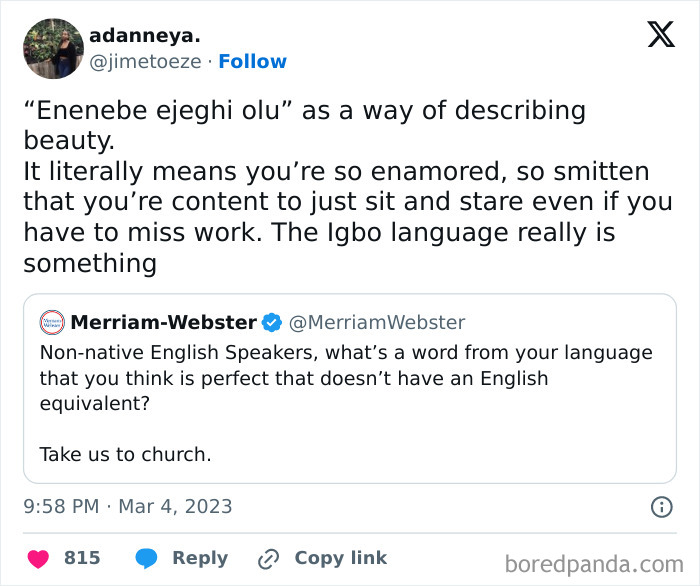
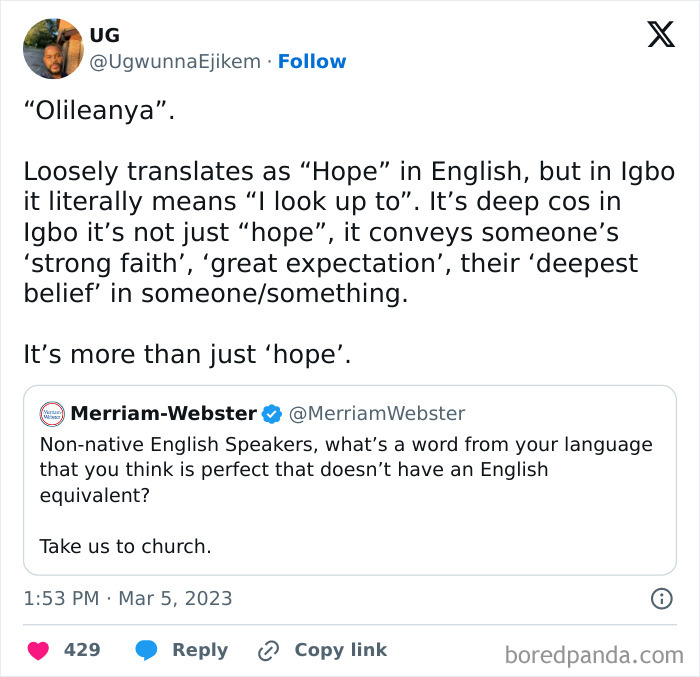
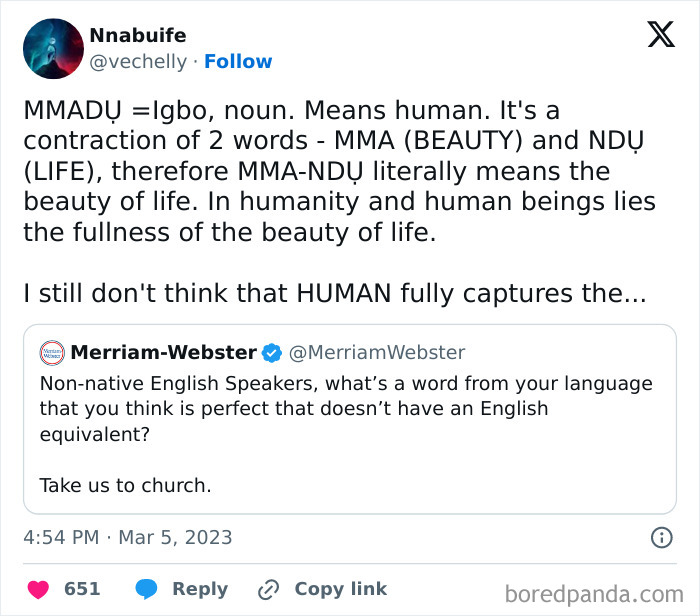
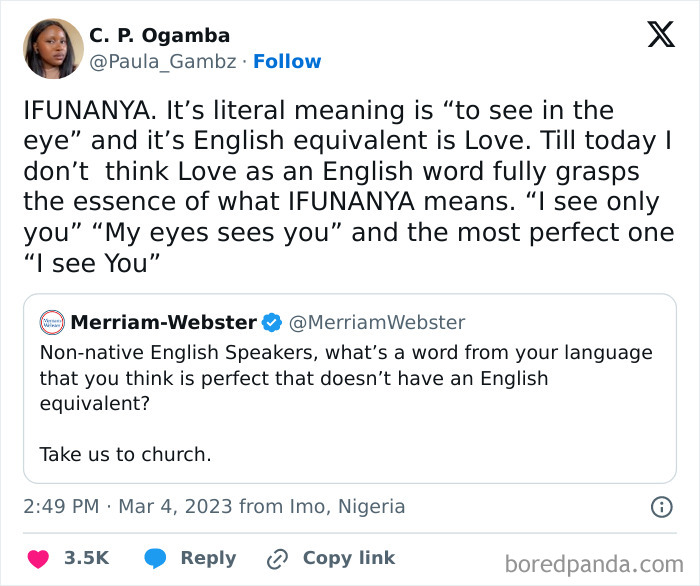
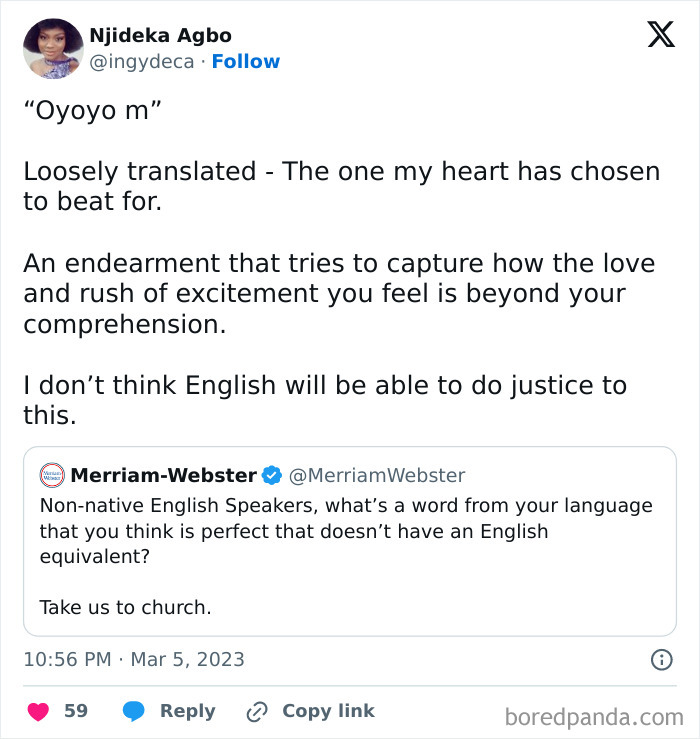
Google says it is Igbo, which is spoken in Southern Nigeria. It also specifies it is a "human language" which I guess is helpful?
Human language. Not a language spoken by bananas, I guess.
Load More Replies...In what language? I don't have ex-twitter so I was not able to se any, or maby there was non?
According to other comments the language is Igbo (from southern Nigeria)
Load More Replies...What does “Take us to church” refer to? I woulda thought Merriam-Webster woulda said “Take is to school,” as in “teach us something,” but I gather that’s not what they were going for. Does anyone know what they mean by that?
It's Igbo one of the tribal languages in Nigeria.
Load More Replies...Only American English- no one in my UK family knows who MacGuyver is. We say "jury rig" instead.
Load More Replies...It's an Urdu/hindi word. We in Pakistan use it a lot as well.
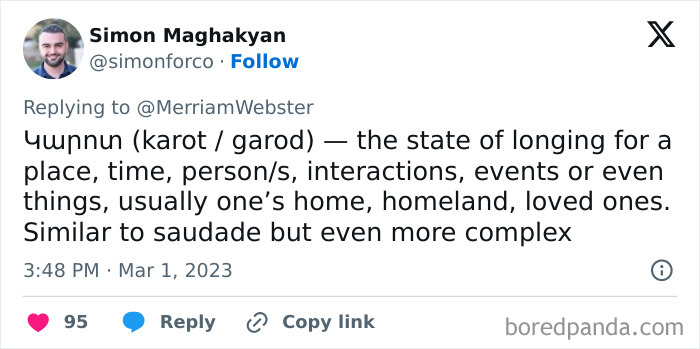
Load More Replies...And you feel nostalgia for things that actually happened. Saudade can apply to things that never were.
Load More Replies...happens to Brazilian football players after signing multi million contracts with European teams. All of a sudden they get saudade and start acting up.
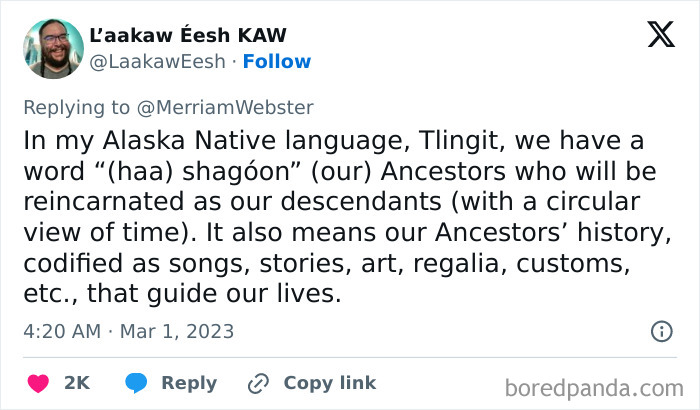
I like this. We become, at least partially, because of who our ancestors became. Without their environment, their skills, their culture, they wouldn't have been who they were, and neither would we be.
Another GREAT word from Igbo! In learning a language, you really find out what is important to the speakers of that language.
Except of course it's not "a" word so basically just like English in that it's a few words describing something!
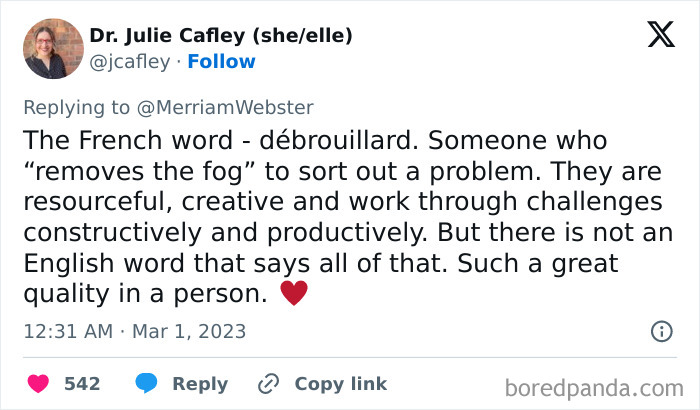
As a dual French-English native, this one has been bugging me for nearly 50 years!

Demystify would be quite equivalent in meaning, but obviously rooted in mystery, not in mist (aka light fog = brouillard). So we have a new English word: demistify!
Terry Pratchett was definitely a master of word play and language.
Load More Replies...I'm from Northern Ireland and we say "scundered". Same thing, just different word.
I use both as the whim takes me. The French wife and in laws still learning Ulster/Scots and other Irish dialects, for the past 12 years. I have naturally picked up the Ch'ti dialect, from her natal Nord-Pas-de-Calais, and confusing the hell out af the Bretons for the past three years wie me patois. Thirty seconds talking to my revered aged one on Msgr, who hates me speaking in dialect, I drop back into talking about cuddies, cuttier, scunnered, pishin, etc, etc. 5 mins max though I'm talking to the wife, Pascale, in Norn irish, and me da in a bizarre French Ch'ti/Breton patois. Its the meds probably.
Load More Replies...NI uses this too, often in the phrase "Take a scunner ' to someone - get to dislike them.
Next you'll be wantin tae knack he's melt in! Fun when I speak to the English speaking French beloved in Norn Irn, that leaves her pretty stumped. After I try to slow down and overcompensate by translating into the Ch'ti dialect, from her natal Nord-Pas-de-Calais, that she doesn't use much.
Load More Replies...I feel that as a sociaty, it is true we now need to distinguish between unhappy dislike and the dislike that seems to fuel most people these days. It makes me scunnert. (Did I use that correctly?)
I use this word almost daily - so much my non Scot's friends have picked it up
Bein from North Down, I can even unnerstan Weegie at times, though long time since heard it living in France!
Load More Replies..."feeling damned" means something a liiiitle bit different.
Load More Replies...Dara O'Briain did a standup tour titled "Craic dealer" in 2012.
Load More Replies...To describe the best night full of fun, lively chat, entertinment (usually music) probably some dancing and singing as well, we would say "The craic was ninety". Ninety being the Irish equivelent of Spinal Tap's turning the dial up to 11.
There's a movie called The Craic! It's about these two Irish guys getting into whacky adventures in the Australian outback. There's a running gag where people keep mistaking them for Scots, culminating in the only joke I remember: "So what part of Scotland are you from?" "Actually I'm Irish." "Pfft, same difference." "So, what part of New Zealand are YOU from?" "WHAT?! I'M AUSTRALIAN!" "Pfft. Same difference."
When someone starts giving me smart arsed comments, mainly due to my weird mangled accent, and patois (born and raised in Northern Ireland, passed 8 years in my wife's natal Nord-Pas-de-Calais, picking up the dialect and slight accent, and now into 4th year in Bretagne), I do the wind ups asking if they're belgian, Corsica, or the DOM TOMs.
Load More Replies...First time my American sister in law met my husband's family in Dublin, someone asked what the craic was like... They saw straight away she thought something different!
In north east England we called someone who’s good at talking and fun to be around “a canny crack”
Agreed. It appears that Igbo is poetic and German is very specific.
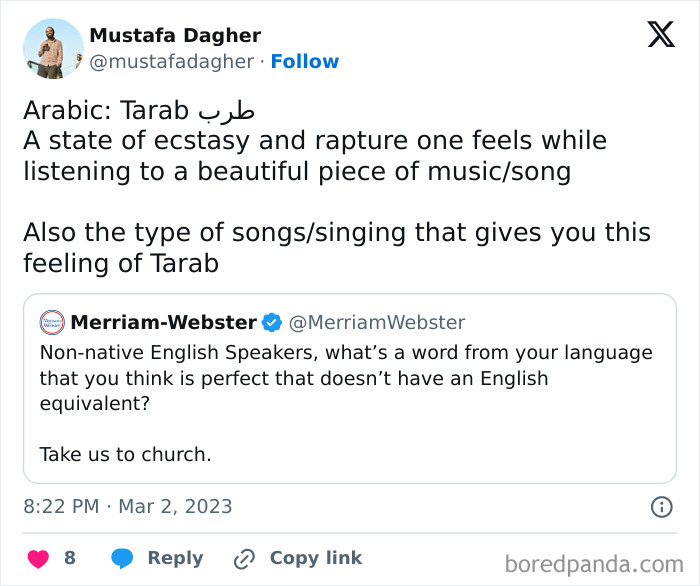
Load More Replies...This is a wonderful word! I would often use the word "transcendent" to describe a piece of music that makes me feel this way. I also get it when dancing.

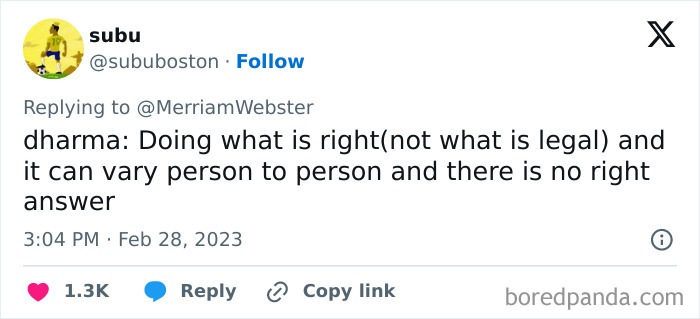
Dharma means to follow the right path... it means you might be conflicted but will have to do it because it is your dharma to do it

May I ask, because there are so many meanings that I find of Dharma: is it to follow the path of your* cast or is it to find the right path within your* cast? Or does Dharma trancends the castsystem? Im sorry if this is the wrong place to ask, and feel free to ignore the question as you pleace 💕 * Im not implying you are in a castsystem, i just couldnt find a better way to word it.
Load More Replies...Sandi Toqsvig has said on QI that it's also used as a noun and a verb. Related to English 'hug' I guess?
My favourite Sandi Toksvig fact is that as Apollo 11 was launching off the pad in Cape Kennedy (as it was then), she was holding the hand of Neil Armstrong’s Secretary to calm her down.
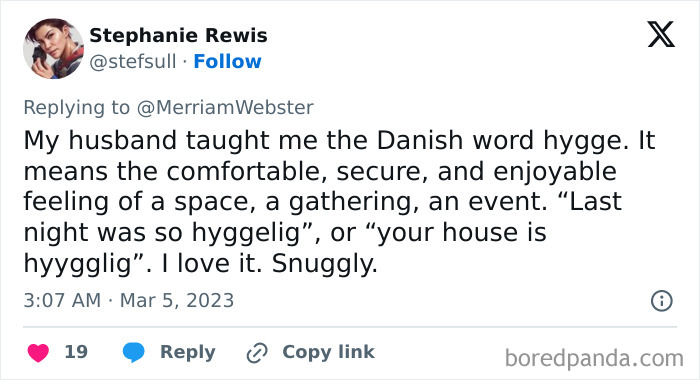
Load More Replies...OMG OMG OMG. My best friend was in a musical about the movie frozen and Oaken and his family sung a song where they talked about hygge lol
My little blue house is hyygglig. It is a hodge-podge, a clutter, a shambles (not literally, no blood), a mess, but it is mine. My precious.
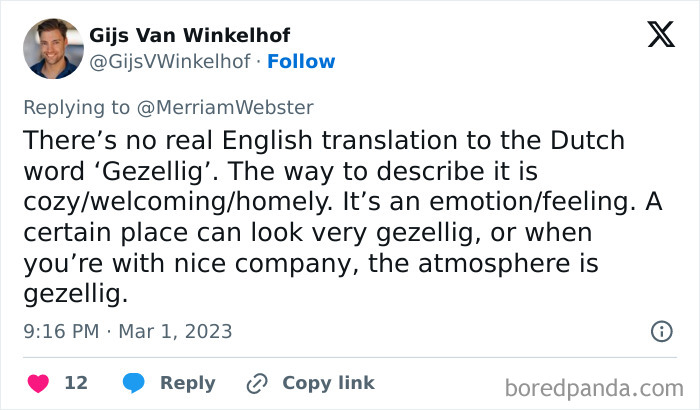
Ooooo we have a word for that in Dutch too: Gezellig. It means the same
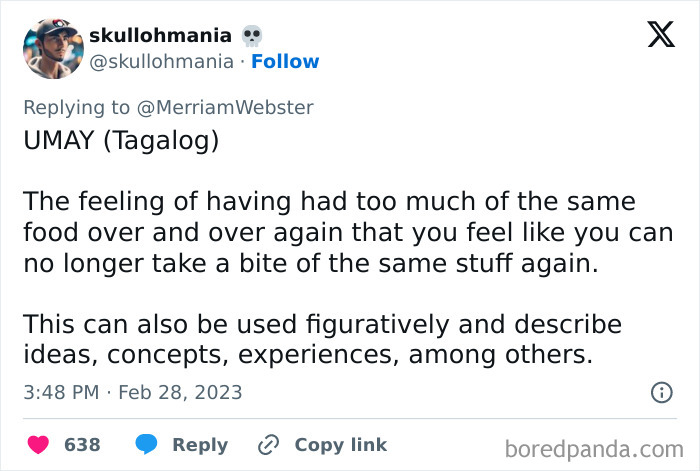
A woman in prison with me would say she foundered herself on a food.

I have used the word Beetroot like this: to beetroot - I ate so much of this food I like that now I don't like it.
"den inneren Schweinehund futtern" in German literally means "to feed your inner pig-dog" and it's the same thing!
Not quite. My "innerer Schweinehund" likes to play pranks in unsuspecting collegues ant that feeds him just fine. Same use of the expression: doing what you want top do, even If you know better
Load More Replies...The closest English word would probably be "ennui" which means boredom. To me, it gives the connotation of helplessness, as though the person cannot change the situation. Rather like Rose on Titanic, she was suffering from ennui, but there seemed no way out to her.
from "hither and yon" - here and there (but where there is, is "yonder" - anywhere else.
My father left West Virginia at 18 for Texas. He always used the word "yonder". I was born in Texas, so I learned the word y'all. People think it is really funny when I use both "y'all" and "yonder" in the same sentence.
What light through yonder window breaks? It is the east, and Tammy Sue is the sun.
This is the closest description of the norwegian word koselig/hyggelig i have heard. The feeling of being warm inside with good company, tiered body after being outside all day having fun, now sitting in the sofa with something eighter hot or alcoholic or both in a cup close by. Just talking and relaxing or playing cards. That is skikkelig koselig.
gezellig is sometimes used when there is a birthday in the Netherlands. Everybody is sitting around in a group. The majority of the Dutch do this but I think it's a little boring ;)
There likely is such a word in our massive, 2,000,000-word dictionaries, but it also was likely stolen from one of the others. As it is said, English mugs other languages in dark alleys and takes their words.
And it's a false friend in German. We have "gesellig" but it means sociable.
I thing "gemütlich" is closer to "gezellig". Although "gezellig" can refer to an active situation (like a walk or a drink with friends in a nice garden), and I think "gemütlich" is more for laid back context like around a warm fire in the winter. But then again, I'm neither a native Dutch or German speaker ^^
Load More Replies...You hear it in Israel all over the place too. Sorry to put the two countries in the same anecdote! My friend also said in Egypt (where he grew up) and Jordan (where he travelled a lot) too.
I'm not sure about Israel, but I know yalla is used across Arabic speaking cultures for a variety of reasons, with "hurry up" and "I'm coming" seeming to be common across them all.
Load More Replies...Also translates to Diarrhea, yalla yalla meaning explosive Diarrhea...
Je suis particulièrement partiale pour "ziguigui" ou encore "bitoniau" :)
Load More Replies...Oh, we use watchamacallit, thingamajig. I like the Scots version better.
In Ireland we say "yoke". It's not an Irish but an English word. However I think if I said to an English speaker "Pass me the yoke" they probably wouldn't understand what I was saying.
I would use describe someone as 'verbose', but I guess it's not quite the same.
In middle Germany too (Hessen, Rheinland-Pfalz, Saarland).
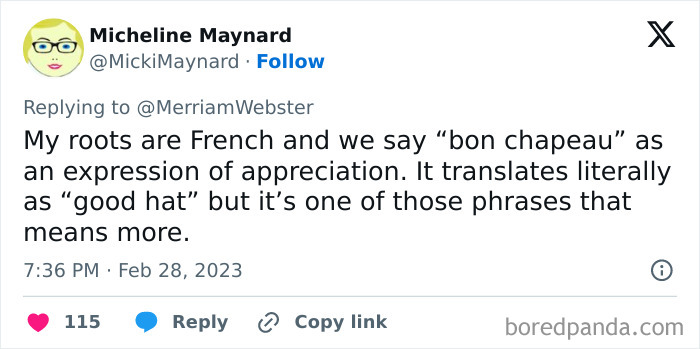
Load More Replies...In Germany we just say ›Chapeau‹. - There are a lot of French words in use. Some of them are difficult to recognise. E.g. ›Fisimatenten‹ which means ›to cut a caper‹; it probably derives from the french term ›visite ma tente‹ that actually means ›visit my tent‹:)
OP must be French Canadian because as a French speaker, I never heard that. And French Canadian have such lovely and funny expressions :D
In English, it’s been shortened to just “chapeau”. But it’s often used by those who went public schools.
Je ne sais pas où ont poussé vos racines. Je suis français, et je n'ai jamais entendu cette expression, dans les endroits où j'ai vécu, ni dans aucune province que j'ai visitée... I don't know where you put down your roots. I'm French, and I've never heard that expression in any place I've lived, or in any province I've visited...
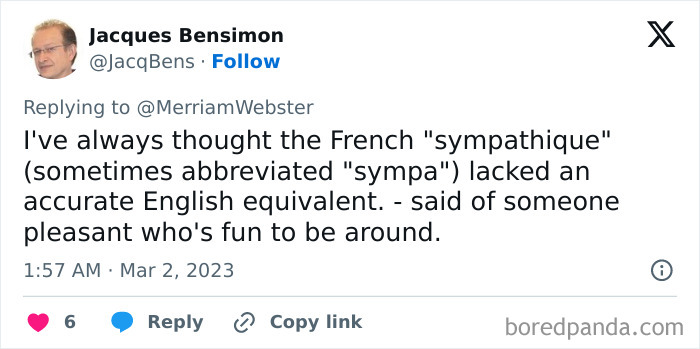
Not just a person, but a place or a situation. Sometimes mistranslated as sympathetic, but not the same thing at all.
Wow. Thaks Ace. I was on a date with a French woman and she closed out the evening with that I thought she meant sympathetic in the English sense. Just wow. I should text her with a TIL lol
Load More Replies...No, the word "sympathique" means pleasant, likeable as well as kind
Load More Replies..."Merenda" in Italian. And "merendina" is a snack, usually packed, like a Twinkie or a Kitkat.
Eh...that is perfectly translatable, you just did it yourself... It is a fun word - yes. But not one that does not have an English equivalent.

haven't seen "Weltschmerz" (german) on the list. It is a feeling of unease or melancholy emanating from the state of the world/your surroundings. The direct translation world-weariness doesn't really cover it.

Surprised that kummerspeck didn't make the list. Literally grief bacon in German, it is the excess weight or body fat gained due to emotional overeating.
I think my kuchisabishii resulted in a kummerspeck.
Load More Replies...I love words. I love learning. I love BP.. Got all three in one, so thanks for that. Good morning!
I like the English word "welp." Four simple letters to proclaim, "That was fun while it lasted, and I'm sad that it has come to an end, but I've got other things which demand my attention, so I suppose now is as good a time as any to maybe get on to addressing those things, rather than to continue wasting any more time on what we're currently doing. Have a good day."
The verb "to be" translates into two different verbs in Spanish ("ser" and "estar").with a complete different meaning and usage from one another. Explanation would be too long for here but there's that.
I really love the word 'defenestration' in english, it is 'the act of throwing something(or someone) out a window'. A word in my native language that I don't think has an equivalent in other languages(at least in english, anyways) is 'dor' which is a noun, but can only be translated to english as 'to miss' or 'to long for'. And last but not least, that word in french which I can't remember that literally means slapping someone's face with a penis💀
haven't seen "Weltschmerz" (german) on the list. It is a feeling of unease or melancholy emanating from the state of the world/your surroundings. The direct translation world-weariness doesn't really cover it.

Surprised that kummerspeck didn't make the list. Literally grief bacon in German, it is the excess weight or body fat gained due to emotional overeating.
I think my kuchisabishii resulted in a kummerspeck.
Load More Replies...I love words. I love learning. I love BP.. Got all three in one, so thanks for that. Good morning!


I like the English word "welp." Four simple letters to proclaim, "That was fun while it lasted, and I'm sad that it has come to an end, but I've got other things which demand my attention, so I suppose now is as good a time as any to maybe get on to addressing those things, rather than to continue wasting any more time on what we're currently doing. Have a good day."



The verb "to be" translates into two different verbs in Spanish ("ser" and "estar").with a complete different meaning and usage from one another. Explanation would be too long for here but there's that.
I really love the word 'defenestration' in english, it is 'the act of throwing something(or someone) out a window'. A word in my native language that I don't think has an equivalent in other languages(at least in english, anyways) is 'dor' which is a noun, but can only be translated to english as 'to miss' or 'to long for'. And last but not least, that word in french which I can't remember that literally means slapping someone's face with a penis💀