Get Premium
Dark mode theme is available exclusively for premium users. Learn more about the benefits of subscribing.
No fees, cancel anytime.

 Dark Mode Ad-Free Browsing Unlimited Content
 Ad-Free Browsing Unlimited Content Dark Mode
Join 1.2 million Panda readers who get the best art, memes, and fun stories every week!




So here’s the scenario: you’re scrolling through social media and stumble upon a post that reads, “The day after tomorrow is called ‘overmorrow.’” You think it’s another silly post, but it piques your curiosity nonetheless, so you do some digging. As it turns out, it is actually true.
This is just one of the seemingly questionable yet accurate facts that you’ll read about today. We’ve compiled many of them in this list to give you something that will enrich your knowledge in some way.
Scroll through and see which ones are interesting enough for you to use as your next dinner party conversation starter.
This post may include affiliate links.
Regardless of whether these facts are true, they likely made you curious enough to want to know more. And that alone is a win. According to experts, curiosity alone makes us value learning, which is always beneficial.
“If you feel positive after learning something, then you now understand the joy of learning, which motivates you to learn next time,” educational psychologist Dr. Kou Murayama told Scientific American.
But what drives our curiosity? What makes us want to dig deeper into pieces of information we come across and eventually ingest? According to astrophysicist and author Mario Livio, curiosity has “several flavors.”
As he explained in an interview with the Wharton School of the University of Pennsylvania, perpetual curiosity, for example, happens when something surprises us or when something isn’t in accordance with what we know or think we know.
So far the first one I didn't know, even as an Aussie, but then I have no interest in tennis.

“That is felt as an unpleasant state, as an adversity state. It’s a bit like an itch that we need to scratch,” Livio said of perpetual curiosity, noting that it’s why we try to find out more to scratch that itch and find relief.
Livio also discussed the concept of epistemic curiosity, which he described as a “pleasurable state associated with an anticipation of reward.” He says it’s the level of knowledge we possess that drives scientific research, many artworks, and education.
Livio also discussed the concept of specific curiosity, which the digital age brought about. It’s about wanting to know a particular detail, much like what many of you will likely experience after reading some of the facts on this list. And Livio says it is actually a good thing.
“The digital age allows you to find the answer very quickly. That’s actually good because you don’t want to spend all your time trying to answer a question like that,” he said.
Given the stimulus overload we often find ourselves in because of technology, it’s easier to be less fascinated by the world around us. To keep the curious mind going, here’s a piece of advice from Dr. Pierre-Yves Oudeyer, research director at the University of Bordeaux:
“Focus on learning activities that are neither too easy nor too difficult, the ones where you have maximum improvement in speed, which will progressively get you to more and more complicated and yet learnable activities.”

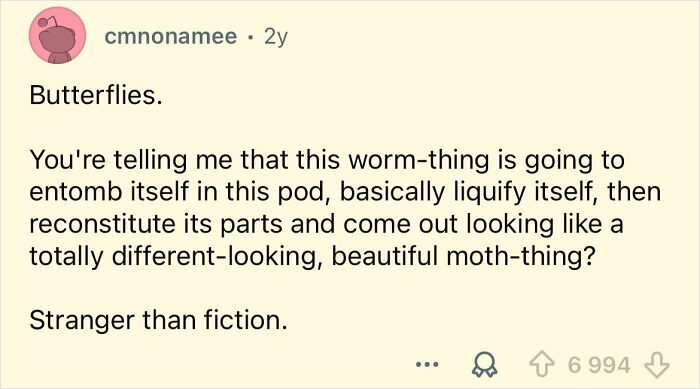
We used to catch caterpillars so the kiddos could watch them make a cocoon or chrysalis, and see what comes out. Last time we did this, a wasp emerged out the cocoon. Traumatized the kids somewhat, but still, um… educational.

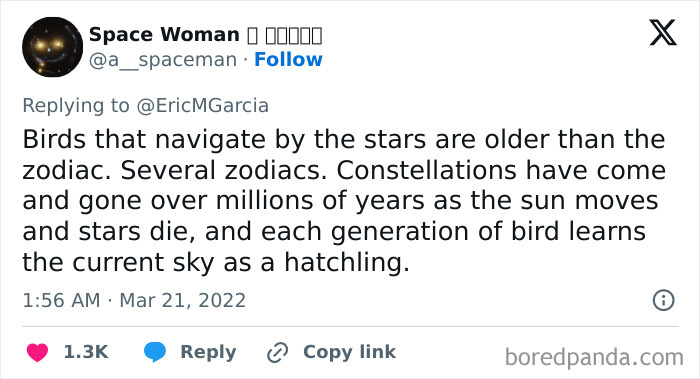
"Birds that navigate by the stars"? Most birds fly during the day or stay in the same geographic area at night.

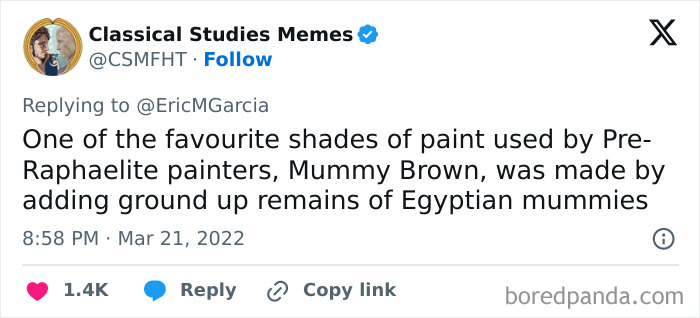
Oh yeah, because they're made using gelatine which is extracted from boiled bones. That one took me a moment.

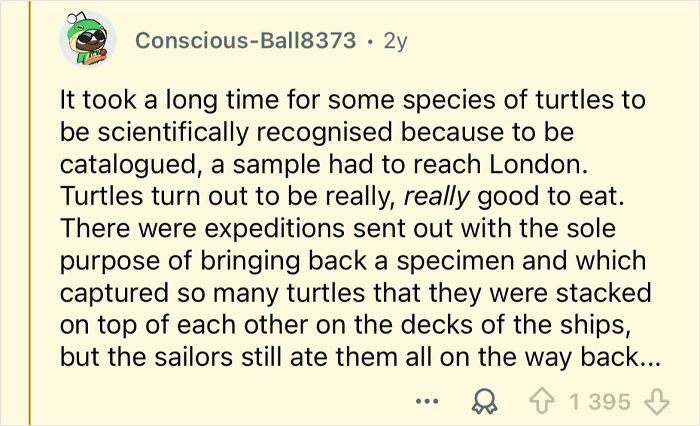
Tortoise. In this part of the world we say tortoise. Turtles swim in the sea.
I know where one of them is, at least. *strokes b0mb* Soon, my beauty. Soon...
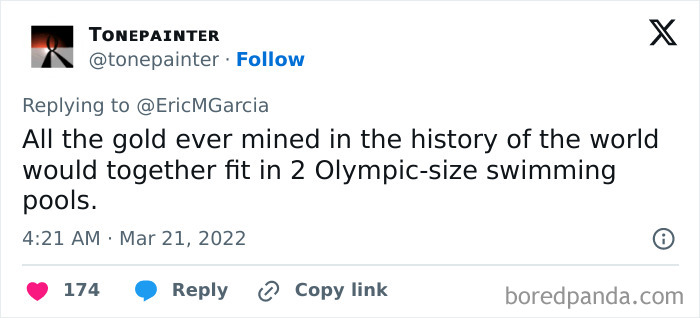
220,000 tons of gold will not fit in 2 Olympic sized swimming pools. Each swimming pool holds 2,500 tons of water and gold is 19.3 times the density of water.

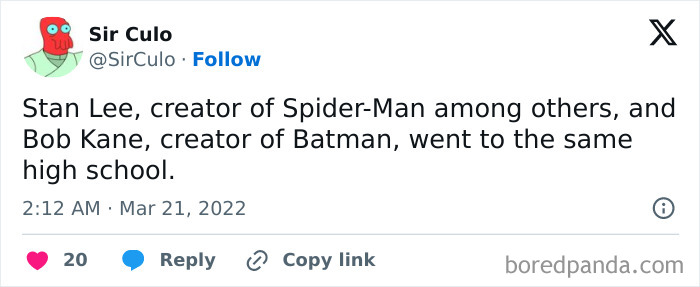
DeWitt Clinton High School in the Bronx. Bill Finger, Will Eisner and a few other comic legends went there, as did Actors Don Adams and Judd Hirsch. Back then it was a Jewish Immigrant neighborhood and a lot of Jews were involved in the early Comic Books Industry. Superman, Batman, etc, were all created by Jews. However Stan Lee and Bob Kane were 5 years apart there.
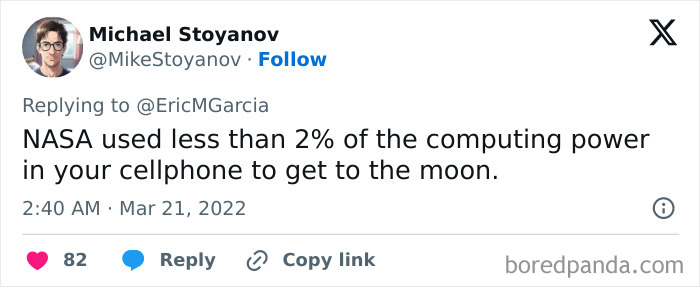
Why did they use my phone without asking? I don't really mind but it is nice to be asked

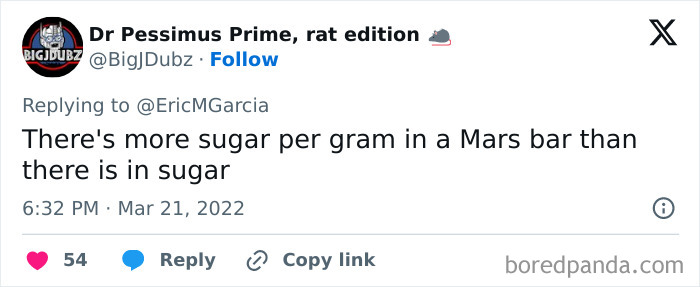
Seems to be a bit of dodgy math. 100 grams of sugar contains 100 grams of sugar, 100 grams of mars bars contains 61 grams of sugar.





































 No fees, cancel anytime