30 Old Colorized Photos That Might Change The Way You Perceive History By Sebastien De Oliveira (New Pics)
Interview With ArtistIt’s hard to imagine being limited to taking exclusively black and white photos. At the same time, B&W photography remains popular, and images without a full range of colors have their own unique character.
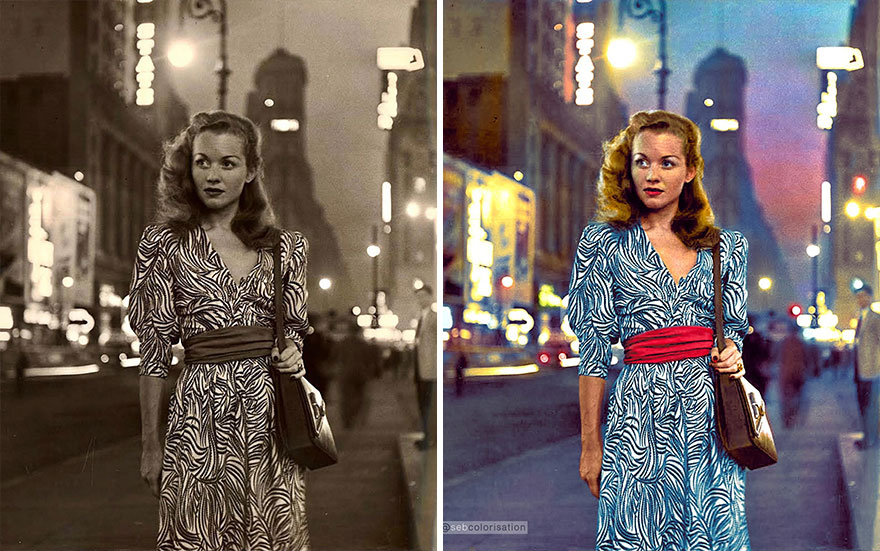
However, nothing is impossible nowadays, and even something like adding color to old photographs, if done properly, can completely change the look of the picture and our perception of what we’re looking at. The French artist Sebastien de Oliveira specializes in digitally colorizing vintage photos. We’ve already featured some of his earlier works as an illustrator and photographer, so check out our previous Bored Panda posts. Today, we've compiled the most recent selection of images Sebastien added some color to, so you can admire the before and after effects of his work.
More info: Instagram
This post may include affiliate links.
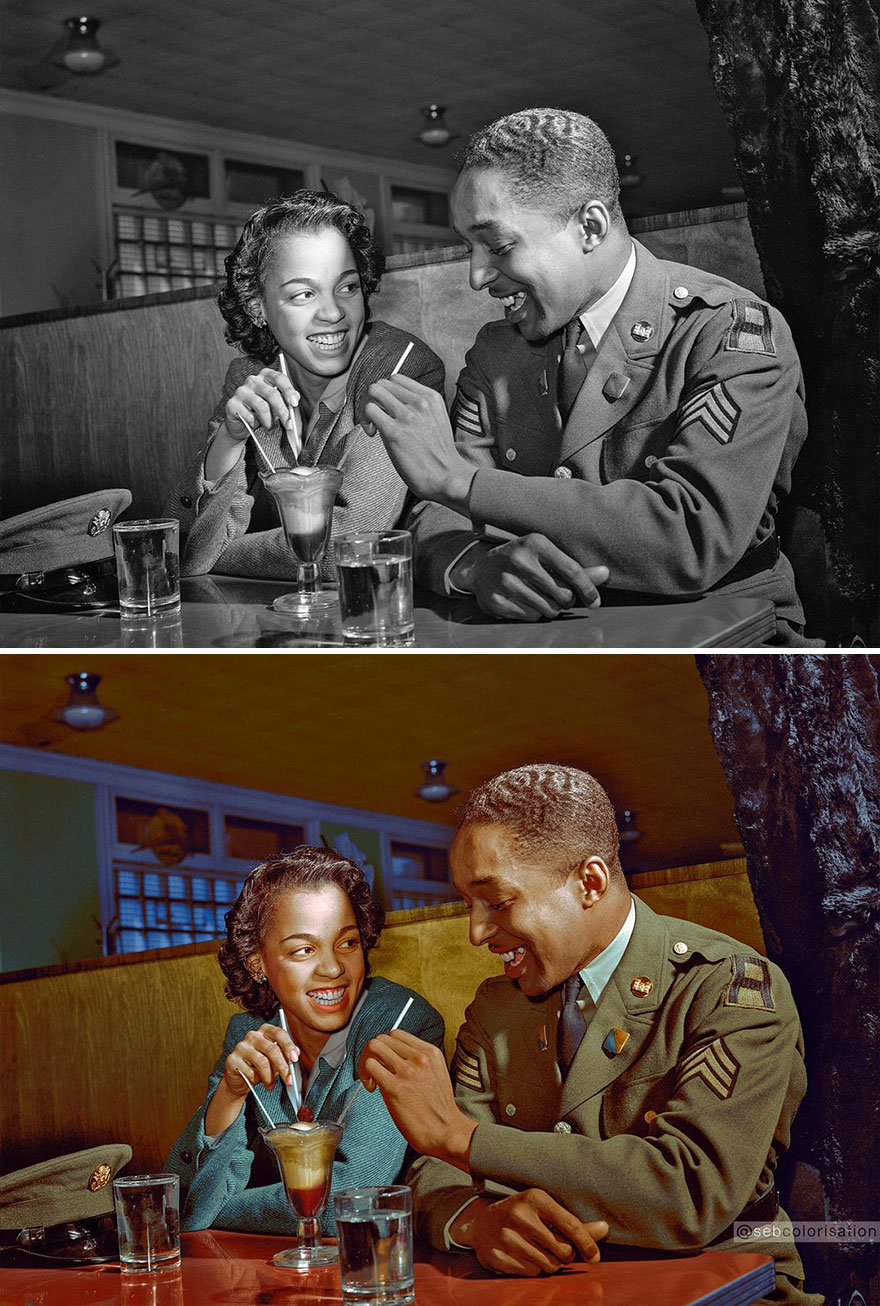
Sergeant Franklin Williams, Home On Leave From Army Duty, With His Girlfriend Ellen Hardin, Splitting An Ice Cream, Baltimore, Maryland, March 1942
Photo by Arthur Rothstein
The black and white foto seems to me better, i don´t know why.
Load More Replies...We reached out to Sebastien de Oliveira to ask him some questions about the old photographs and the fresh touch of color he adds to them. First, we were interested in the artist’s approach to AI and its ability to modify photographs in seconds. Sebastien told us: “For me, AI is still not satisfying for colorizing old photos. I don’t use it. I colorize like a painter, by hand, so I don’t need a machine to do it for me. It is a mistake to avoid thinking of colorization as a piece of art and not only a technical process. Give an image to ten different colorists, and they will give you ten different versions. I understand that it can be seen as a threat, but I think there will always be room for different techniques. The arrival of photography in the history of art didn’t make painting disappear; it made it evolve.”
Sebastien added: “I see my work as an adaptation of an original, so my choices are completely personal, a result of my references. My version and an AI version will always be two different things.”
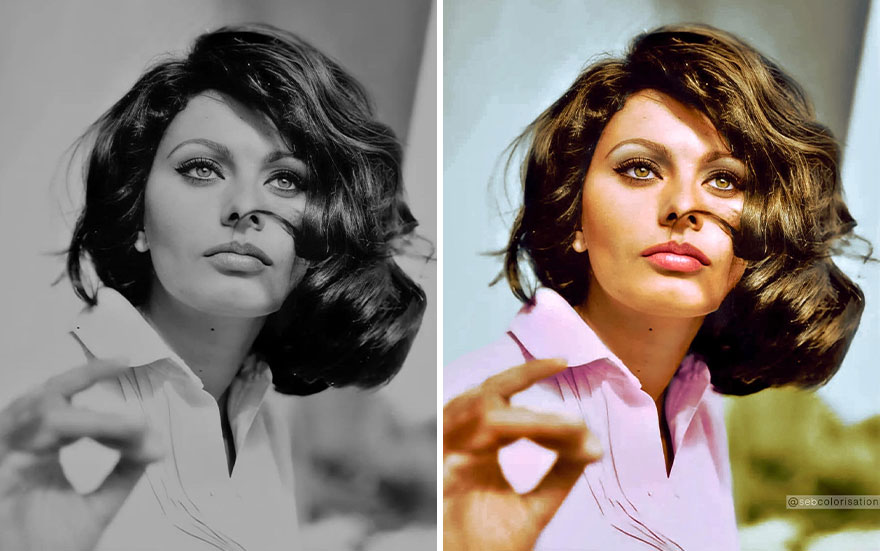
Actress Sophia Loren, Rome, 1963
Photo by Peter Basch
Activities At Camp Nathan Hale, Southfields, New York, August 1943
Photo by Gordon Parks
Segregation in the US used to be so bad that this would have been considered pretty advanced for its day!
If that was a little girl, he might have been killed
Load More Replies...Although I prefer the original (frankly, I don't think it enhances most of these black and white pictures by colouring them, but that's just me), the coloured version here ironically emphasizes the boys' different skin colours. Anyone interested in American civil rights and the African American experience itself MUST explore photographer Gordon Parks' work. He was the first really prominent black photographer and documentarian. His work is timeless. https://www.gordonparksfoundation.org/
Asked which photographs he likes editing the most, the artist answered: “I love old photos from the 1930s to the 1950s, with a soft spot for the 1940s. The designs, the clothes, the overall atmosphere—all evoke a strong sense of nostalgia for me. The best way I've found to travel back in time is through colorization. I'm particularly drawn to simple street views and urban photographs, capturing people walking around, busy streets filled with cars—these are simple yet powerful images from the past that I adore.”
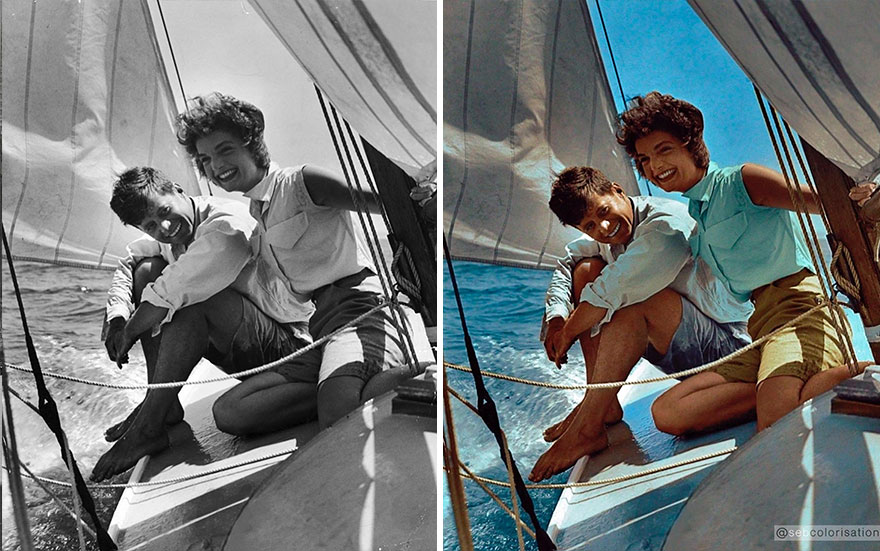
John Fitzgerald Kennedy And Jackie Kennedy In 1953
If I did my sums right, in this photo he is 36 and she is 24(!!). They were born in 1917 and 1929 respectively. Goes to show what the pressure of being POTUS and FLOTUS did to them.
Load More Replies...Marilyn Monroe Reading, Beverly Carlton Hotel Los Angeles, 1952
Photo by André De Dienes
We were wondering how long it usually takes for Sebastien to finalize one image. We learned that: “It can take me anywhere from two to ten hours, depending on the complexity of the image. I need to select every single object by hand for my process, so it can be time-consuming. On average, it will take two to three hours, which isn't too much. My work as a photo retoucher in the fashion industry has trained me to be fast.”
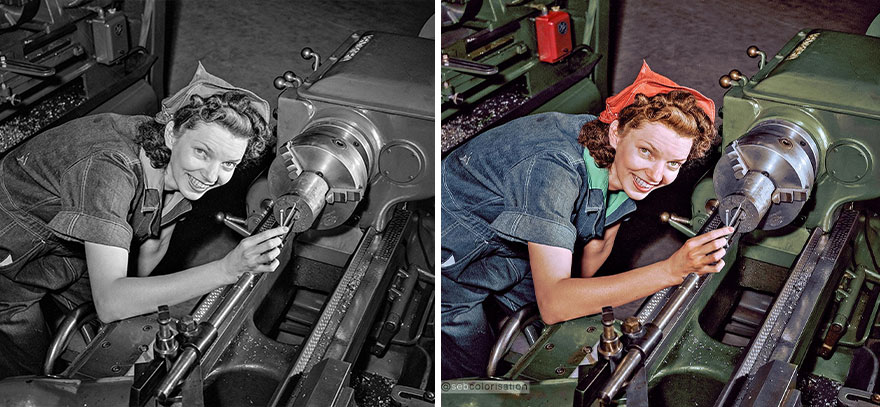
Teenage Girls And Boys Train For Defense Work Made Possible By TVA At A National Administration School. Knoxville, Tennessee, June 1942
Photo by Arthur Rothstein
I wonder if, after the service people came home, if the women were shunted back to their homes. Heard so much about women being ousted from work so the "soldier boys" could take their jobs. Another sad story from the "land of the free and home of the brave".
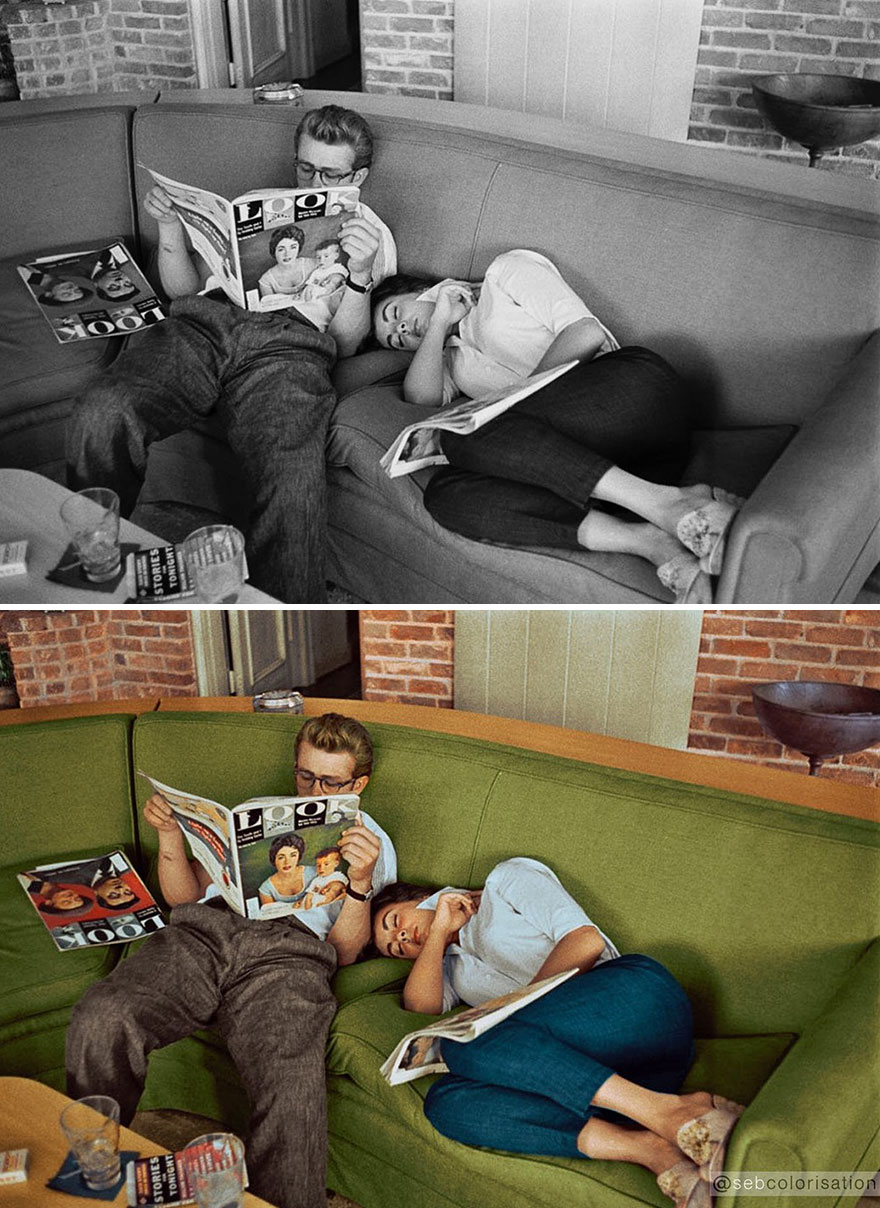
James Dean And Elizabeth Taylor Taking A Break From Filming "Giant" In June 1955
Photo by Richard Crump Miller
The images colorized by Sebastien look very realistic, and very often it’s very hard to say they weren't taken in color in the first place. We were curious what techniques the artist uses in order to create this seamless effect. We found out that: “My technique is not simple to explain in a few words. Let’s say that I observe a lot how the light works on objects—the reflections, the transparency, the temperature of the light—and all the different interactions between them, and I've found a technical way to reproduce them. The system involves colorizing not only each different object but also the different grays that compose each object. I also draw lessons from the impressionists and other painters who worked on the reproduction of light. Additionally, I take a lot of inspiration from old color photos from the past, such as the Autochromes of the Lumière brothers.”
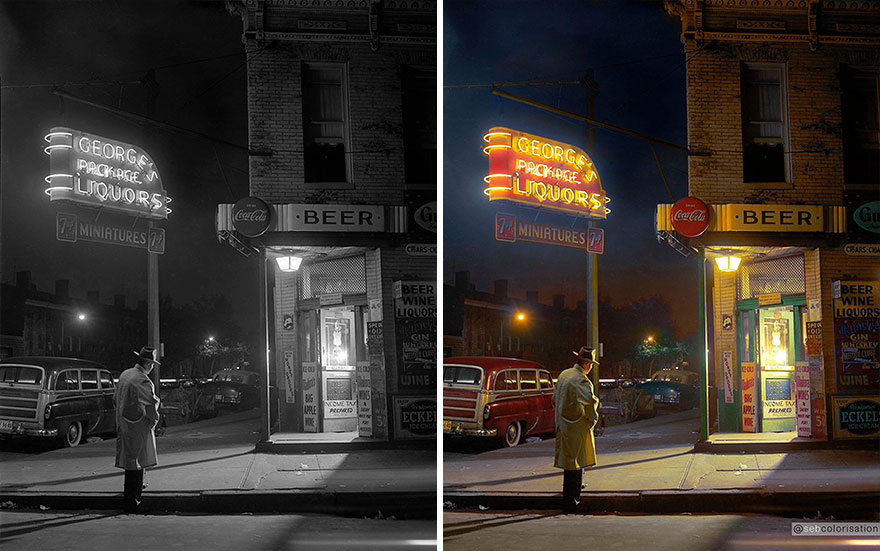
Street View, July 1958
Photo by Robert F. Kniesche
As an old codger, I think the black and white of just light and shadow is the better picture.
Now this, to me, is the right use of colouring, sweet! The original's very moody and looks like a Bogart movie, yes, and it's awesome. But the second one just comes ALIVE with the colours of the time.
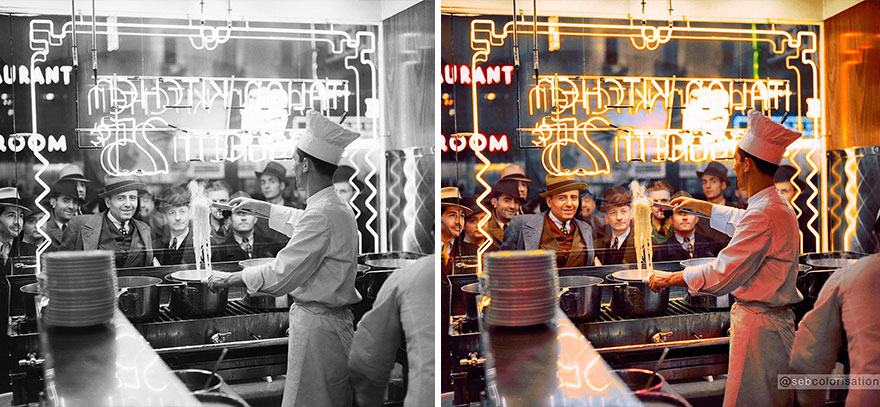
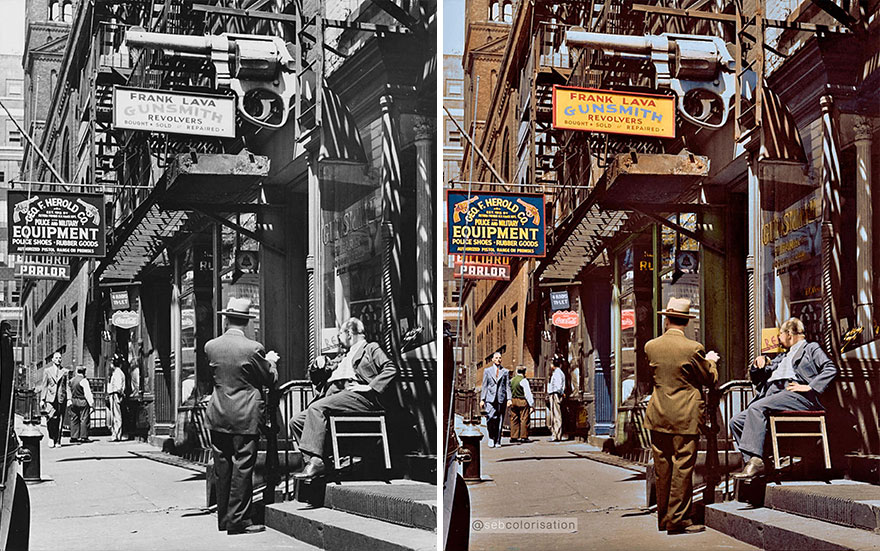
Pedestrians On Broadway Look Through A Restaurant Window To Watch A Cook Prepare A Pot Of Spaghetti. New York, 1937
I'm confused? You've never seen (even in a movie) people watching pizza dough get thrown in the air? What do you think they were doing? Making pizza for customers!
Load More Replies...As a former line cook I love this picture almost makes me want to go back to the kitchen
Asked if photo retouching is his full-time profession, Sebastien de Oliveira said: “I don’t make a living from it, but it is already a good part of my activities. I collaborated on some projects, such as the book 'Extraordinary Voyages' for Louis Vuitton, for example, or an article for France-Amérique magazine, and I also took some orders. I would love to work on more projects that involve colorization.”

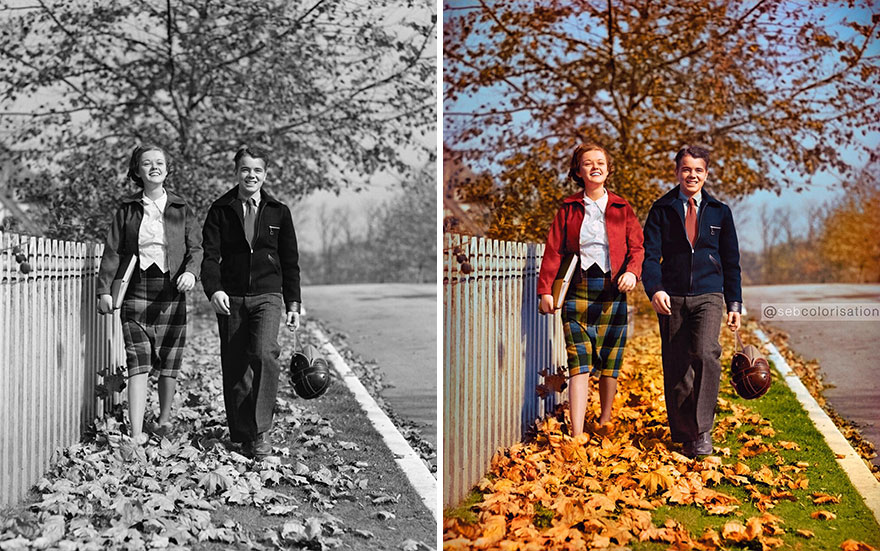
Teenagers Walking In The Fallen Leaves, 1940s
Is it me or those teenagers looks definitely like people in their 30s? It's not the first time i have this feeling watching old pics where people looked older that today's people.
It's definitely not you, it's a whole thing (don't know the right words lol). But in most cases if we photoshopped modern hair, clothes, makeup, etc, they'd look a lot closer to their actual age. Our brains see the whole picture and associate it all as older. If that doesn't make any sense, I may be able to re-word it.
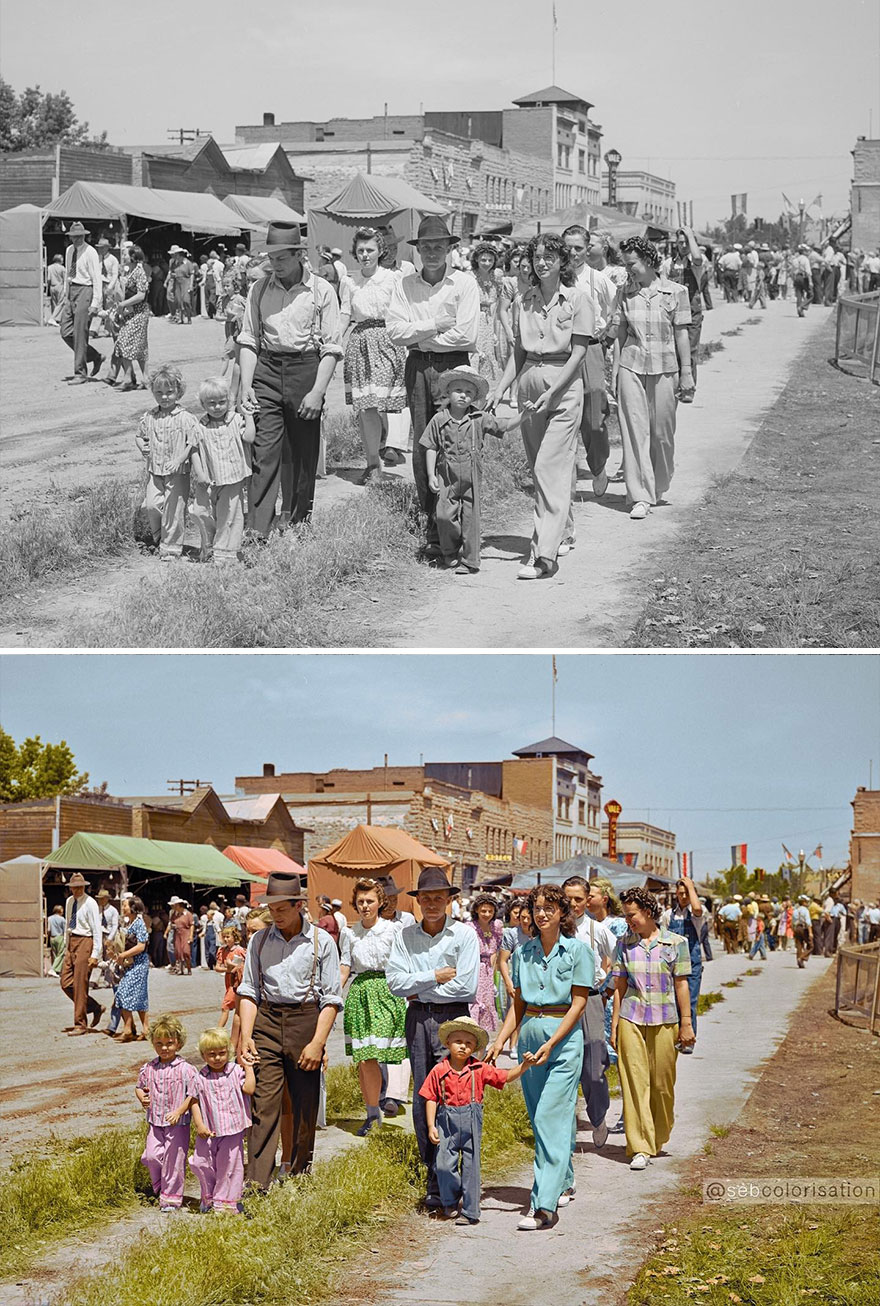
Load More Replies...People In Vale, Oregon, For The Fourth Of July Celebration
Photo by Russell Lee, in 1941
Professional colorists do use some information they gain from the shades of gray, but also they do a lot of research into colours of the period and place. It's really interesting!
Load More Replies...This one definitely looks more 'realistic' in colour. The black and white one looks more like a film set.
Lastly, we asked the artist to tell us something about his book that was released last year: “A publisher liked my work and proposed to publish a book. We worked for six months on it, and it was released in October 2022. 'Back to America' contains 174 colorizations from 1935 to 1943. It is a large selection of images from the Farm Security Administration, available at the American Library of Congress. I am really proud of it, and it has been well-received in France. It offers a genuine time travel experience in the U.S. during the '40s and serves as a tribute to American cinema. They have asked me for a second book, so I am working on this new project right now. It is scheduled for release in May 2024.”

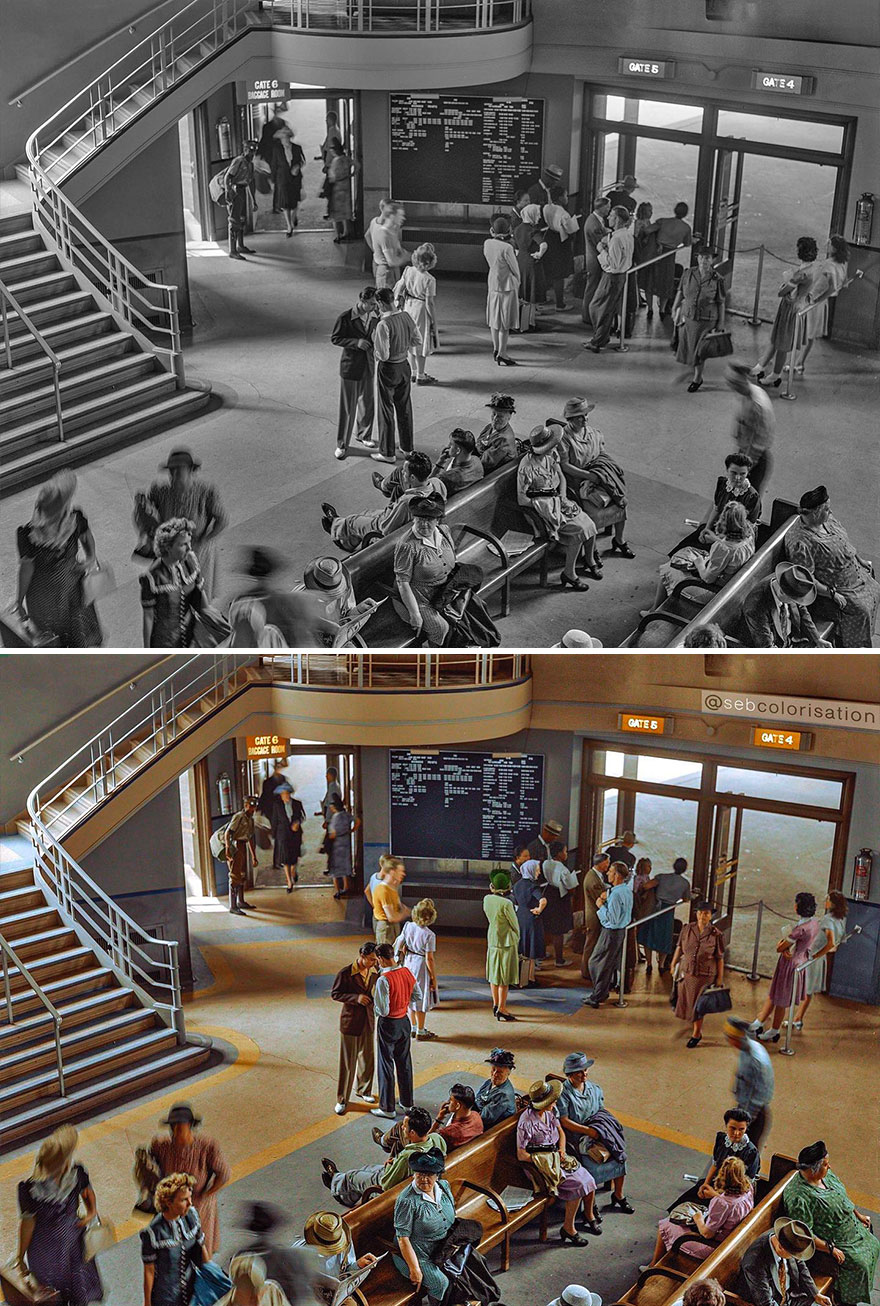
Waiting Room At Greyhound Bus Depot, Detroit, Michigan, Photographed By John Vachon In August 1942
Maybe not, at least for the sweat; cigarettes probably. I was struck by how clean the place was, so different from almost any transportation waiting room today and everyone is so well dressed.
Load More Replies...Nice. But to be truly authentic, the primary colers should be sky blue with chrome or grey trim. Greyhound Bus Company. colors
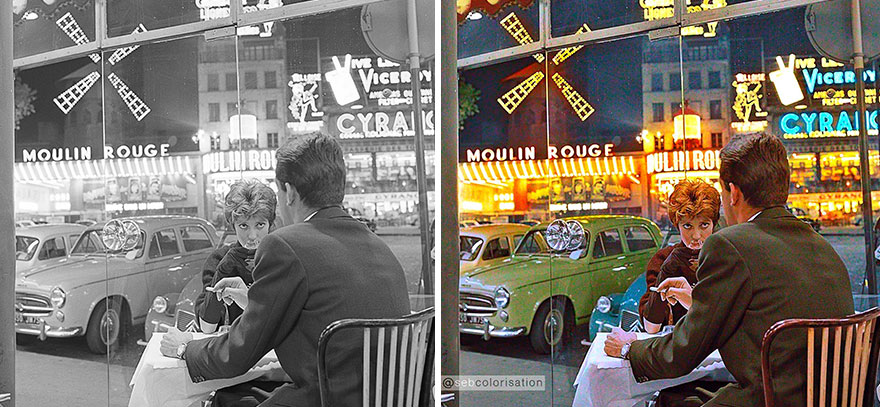
Having A Drink In A Bar In Front Of The Moulin Rouge, Paris, Photographed In 1960
How fun it would have been to go to Moulin Rouge! Definitely looks like a ad!
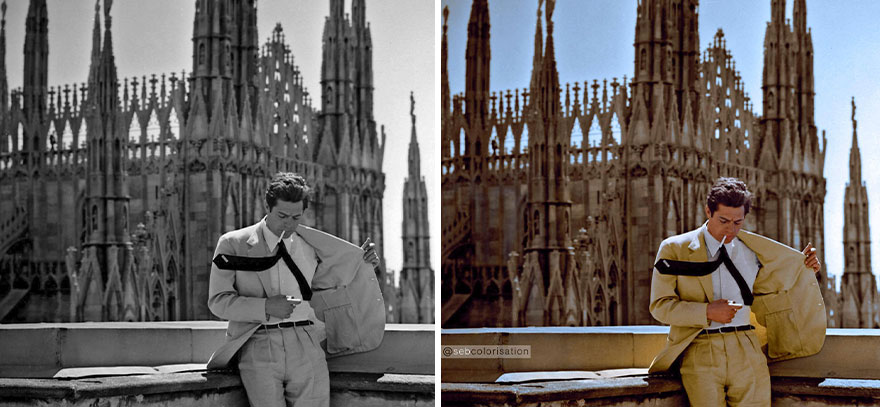
Marcello Mastroianni, Milan, 1960
No, no, my sweet summer child - these were directed by the great Federico Fellini.
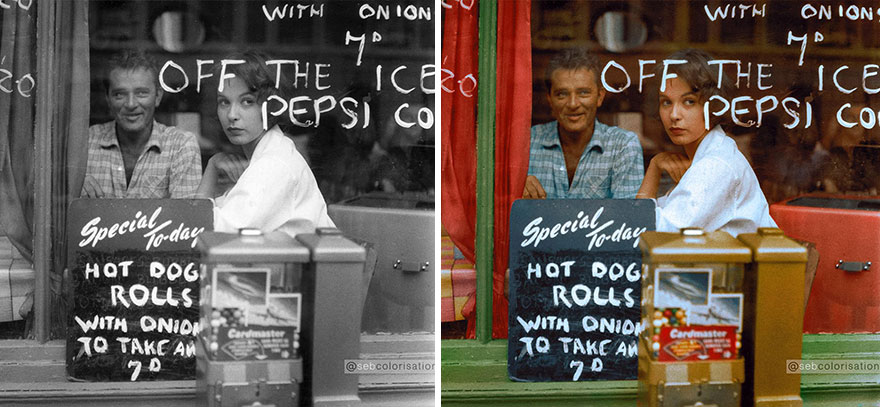
Load More Replies...Claire Bloom And Richard Burton, Stars Of The Film "Look Back In Anger", Taking A Break From The Filming To Grab A Bite To Eat In A Cafe In London, 20th September 1958
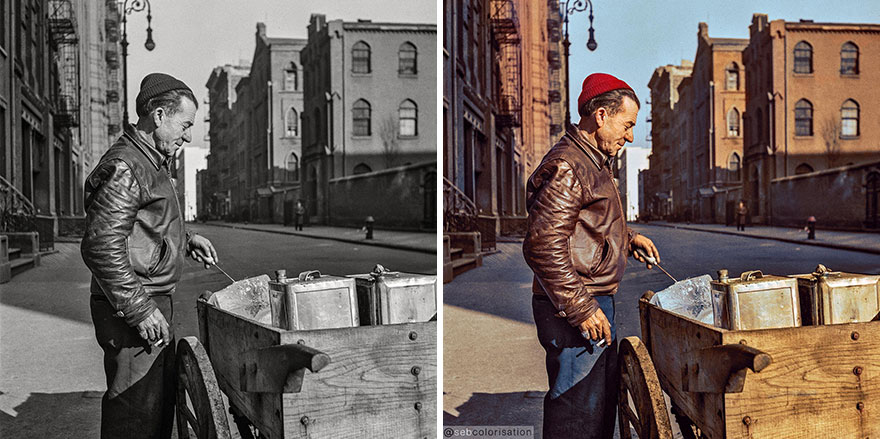
Italian Americans On The Lower Side Of Manhattan. Ice Vendor On Mulberry Street, January 1943
Photo by Marjory Collins
The brick building on the right is the Knights of Columbus. Beside it is a church yard. Amazing how little has changed!
Google Mulberry Street, NYC. It's still got a great deal of charm and ethnic appeal. Was this the street Dr. Seuss based his first children's book on? "To Think That I Saw It On Mulberry Street" was one of the first books Mom read to me.
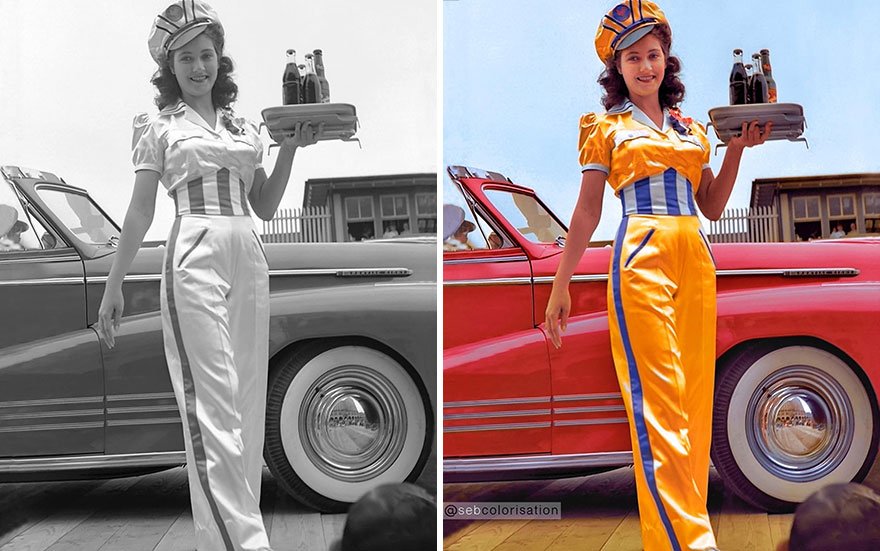
Iconic Carhop Girl, Circa 1945
I'm sure that the convertible wasn't pink in that era, unless it was a custom color.
I really want to like this one, but the colour seems garish for the era. And the car should be redder.
My brain just will not accept that such colors are entirely possible, that the past caught in these b&w photos was just as vibrant as today. Stupid brain.
Photographed By Russell Lee In May 1940
Wow, that's a really good one! Some of these look like paintings or animation.
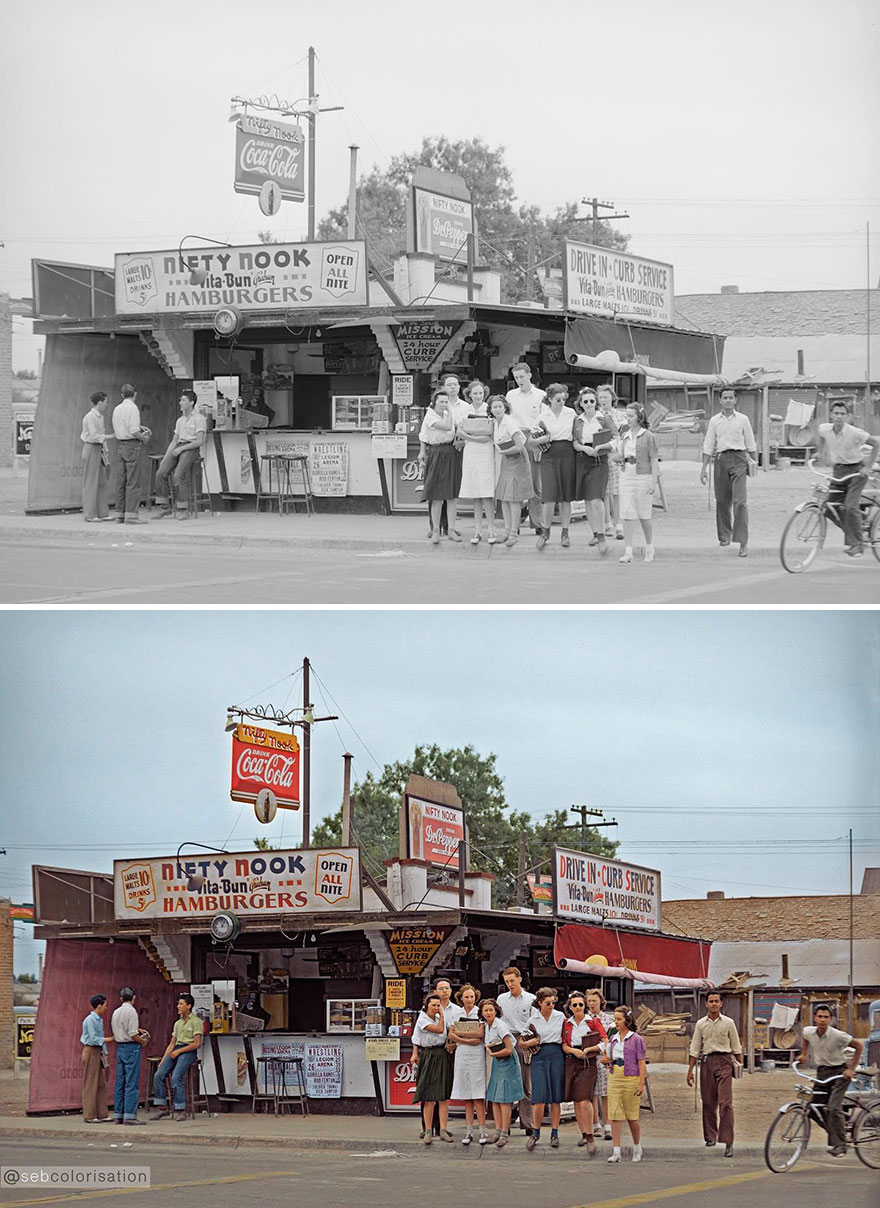
High School Students Crossing The Street, Phoenix, Arizona, May 1940
Photo by Russell Lee
Here's another angle of the same group of kids crossing the street: https://www.shorpy.com/node/23640

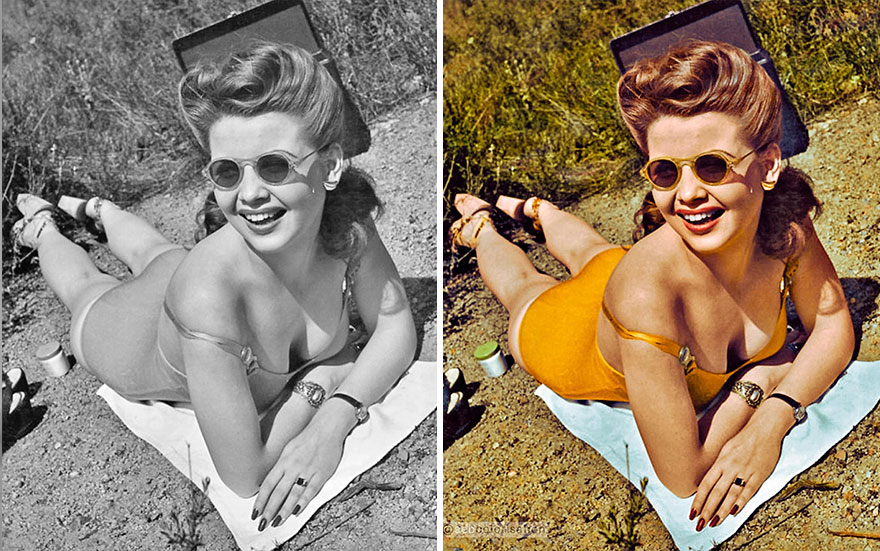
Actress Doris Houck, Photographed In Los Angeles In 1945
It's some kind of trunk or cooler in the background, just perfectly positioned to look like it's sitting on her head.
Load More Replies...Her legs are on the gravel and her feet are in the brush. None of this looks comfy!
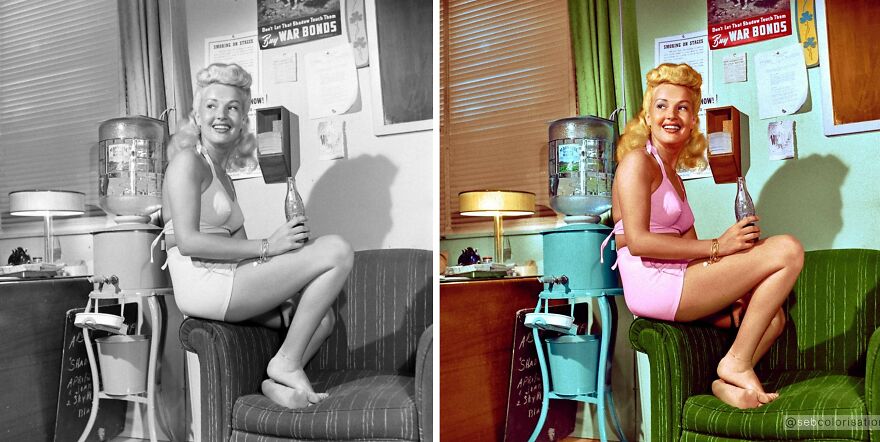
Betty Grable Photographed In 1943
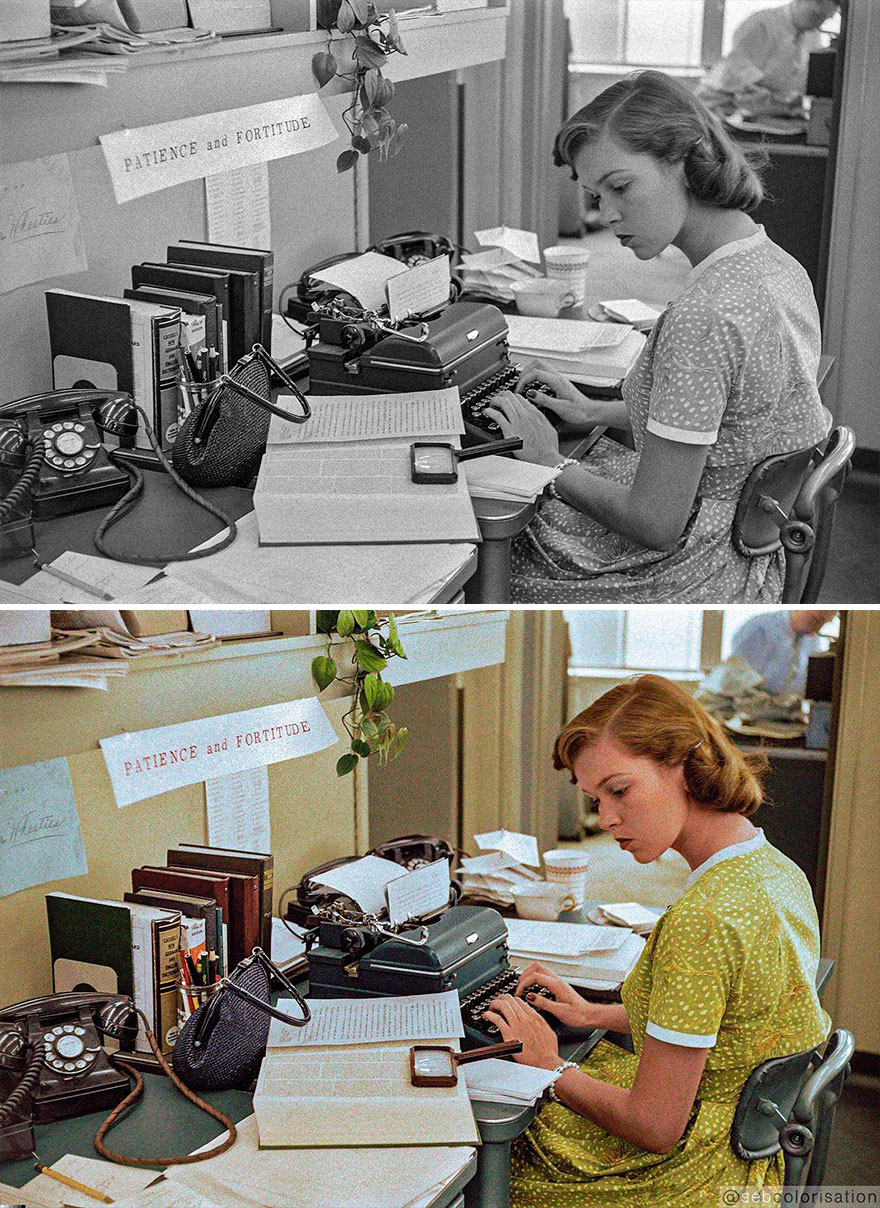
Mary Cumming, 21, Secretary In The Office Of Designer Raymond Loewy, New York, 1956
my gosh, I hope she didn’t have to copy the whole book in this position and with a magnifying glass !?! patience and fortitude, I bet you did !
Even back then we needed "Do it for her" motivators to keep us going through the grind.
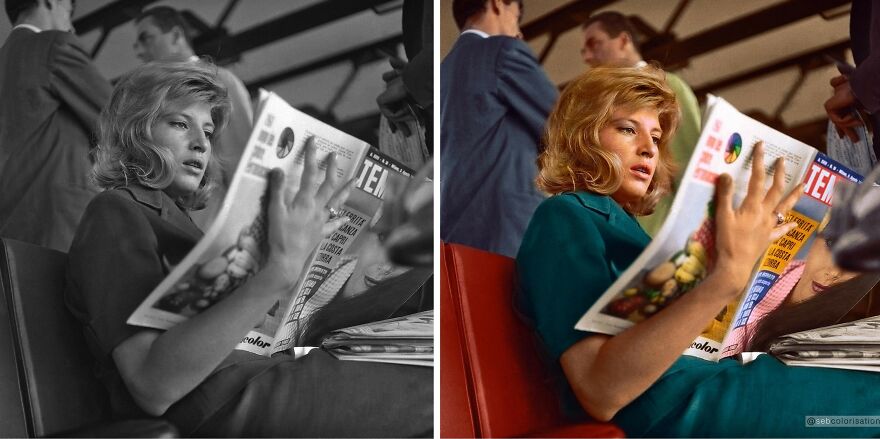
Actress Monica Vitti Reading Magazines At The Airport In Rome, July 1961
Is the paper so weak it'll fold over if she doesn't grip it so carefully with that right hand?
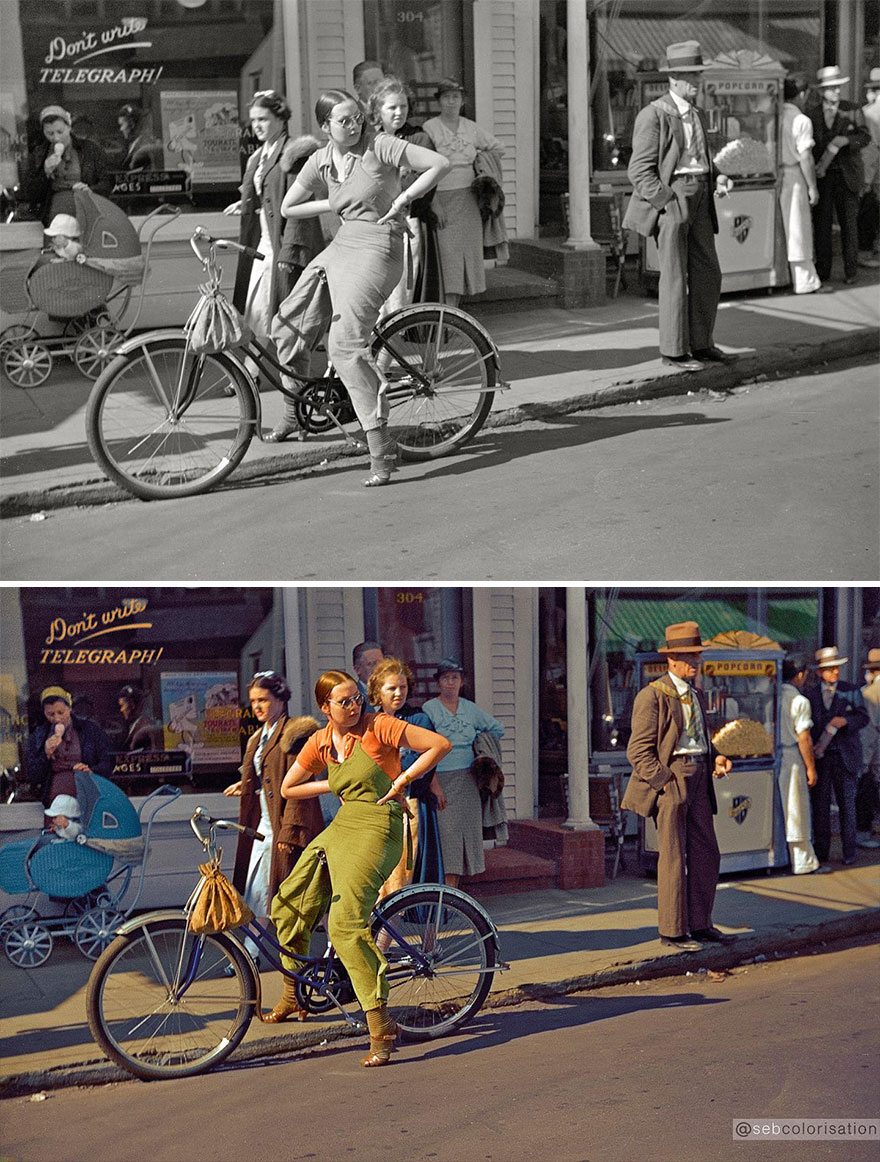
Street Scene, Provincetown, Massachusetts, Summer 1937
Photo by Edwin Rosskam
I was thinking the same thing because of the colors.
Load More Replies...Yeah I'm trying to figure out how the bottom half of that outfit works. It definitely looks like she is using bike clips.
Load More Replies...The gal on the bike has my complete attention. The awesome outfit! The I-don't-care hair! Those shoes!! And judgy Grandma in the doorway giving her the eye/side-eye makes it perfect. You know she wishes she was 20 years younger, lol.
I love the baby carriage! When I was a kid my nan and pop still had the pram my aunt used for her dolls when she was a girl in their shed, in a similar style.
A real baby carriage! They went out of style around the 1970's. But toy manufacturers still made them for dolls for a long time after. The modern stroller took a while to catch on among the small fry.
The classical ones are still sold, but are rather expensive https://silvercross.com.au/products/kensington-black
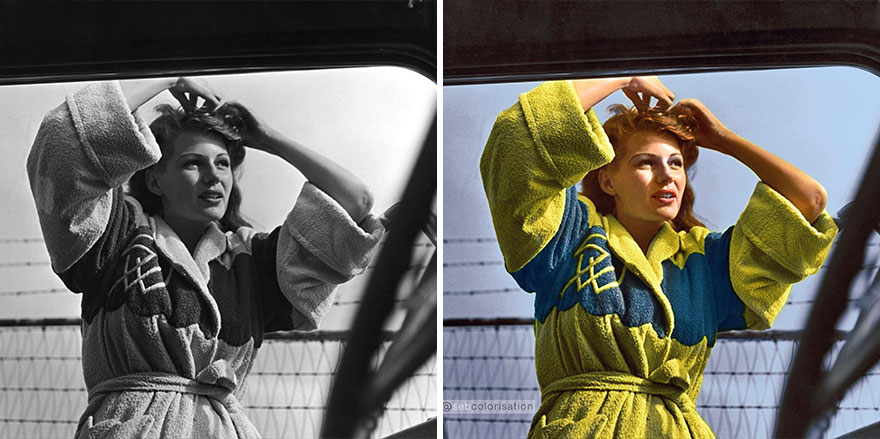
Load More Replies...Rita Hayworth 1941
Photo by Bob Landry
Great dancer, Fred Astaire's favorite partner. (It wasn't Ginger.)
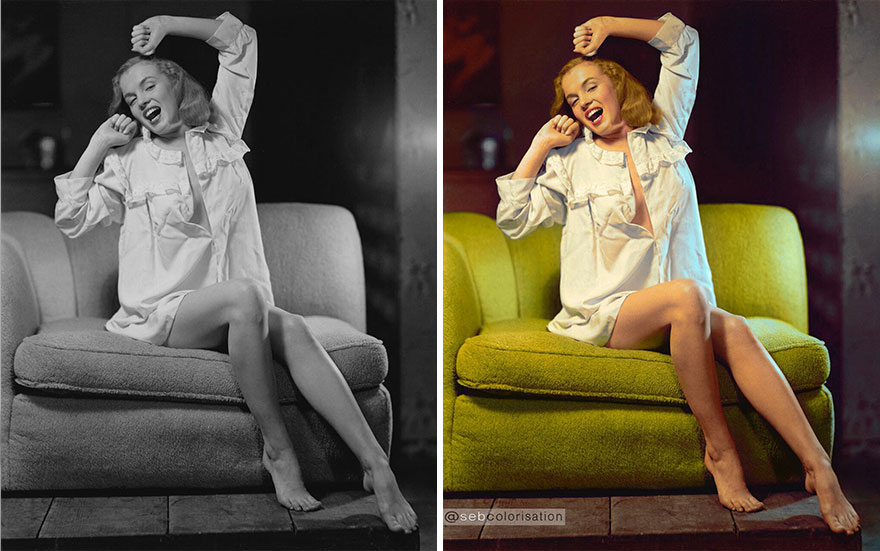
Young Pin Up Marilyn Monroe Posing For Earl Moran, 1947
Every part of her perfectly positioned.. from hands to feet perfectly posed
As Jeffrey Diehl pointed out, she was still Norma Jeane here, 9 years before "Marilyn" was born. Earl worked with her for four years, mostly cheesecake type pictures like this. Great collection here (Step lightly, a few contain nudity): http://www.marilynmonroe.ca/camera/galleries/moran/Marilyn_Monroe_and_Earl_Moran.html
Center Market Place, New York, 1940
Photo by Andreas Feininger
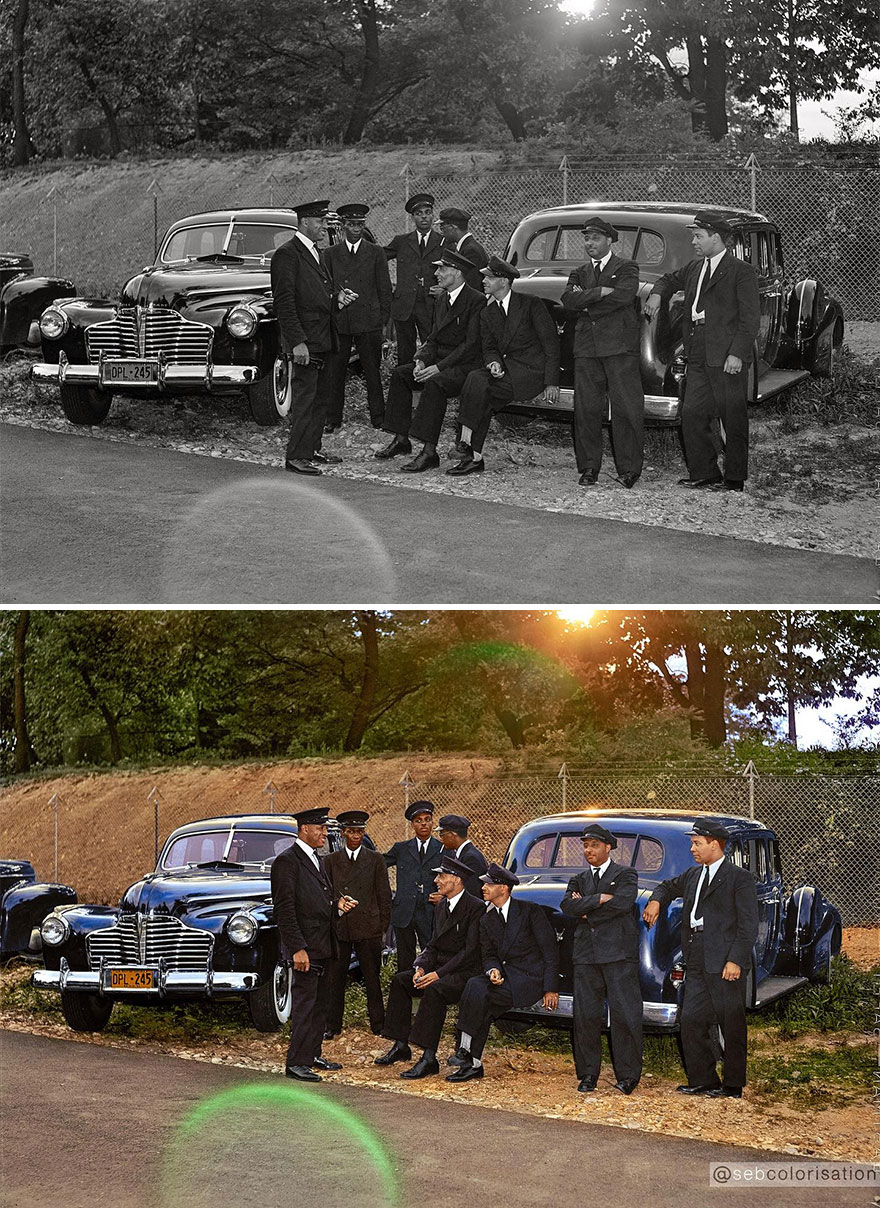
Chauffeurs And Limousines For The Garden Party At The New Zealand Legation, Washington, D.C., May 1942
Photo by Marjory Collins
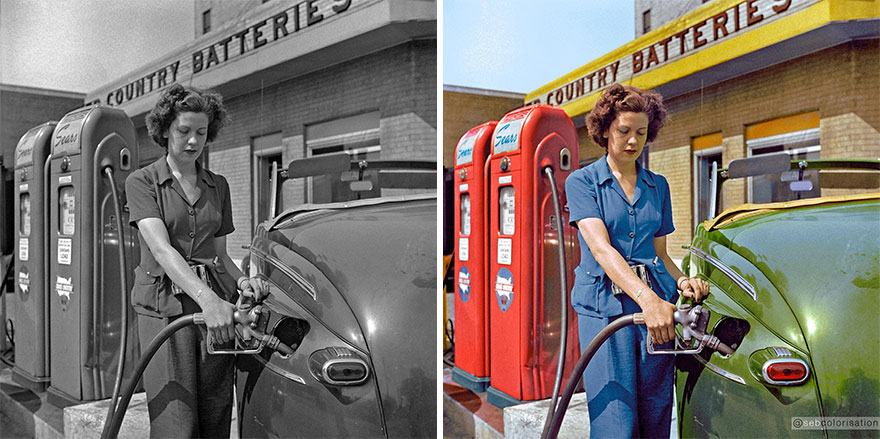
"Virginia Lively Used To Be A Beauty Operator. Today She Works At A Filling Station." Louisville, Kentucky, June 1943
Photo by Howard Hollem
We sadly had to sell my grandpa's after he died in '06 that car was all original and looked like it rolled out of the showroom after my uncle dusted it off a little
Load More Replies...For them wondering (I looked it up), a beauty operator is someone employed as a cosmetologist, hairdresser, esthetician, or nail technician. So, she used to work in the salon, now she's pumping gas 'cause the men are off fighting in The War.
Wonder what kind of gas sticker that car had? Stickers authorized how much gas the attendant was allowed to pump. Since it's 1942, maybe rationing hadn't hit yet.
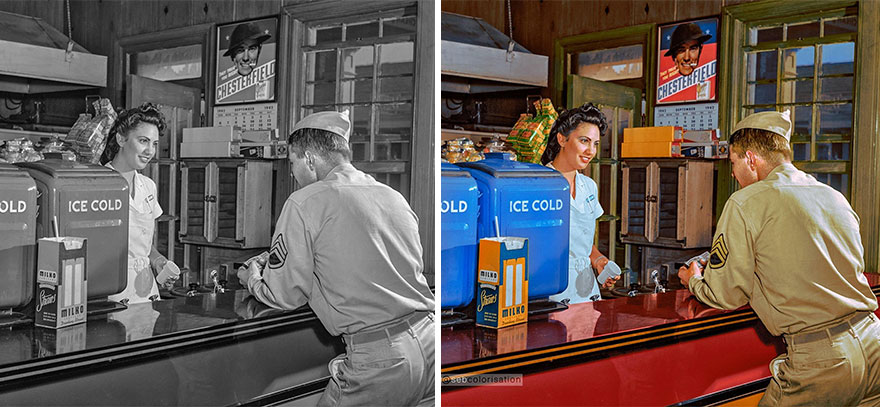
Sergeant George Camplair On One Of His Many Visits To The Post Exchange, Fort Belvoir, Virginia, September 1942
Photo by Jack Delano
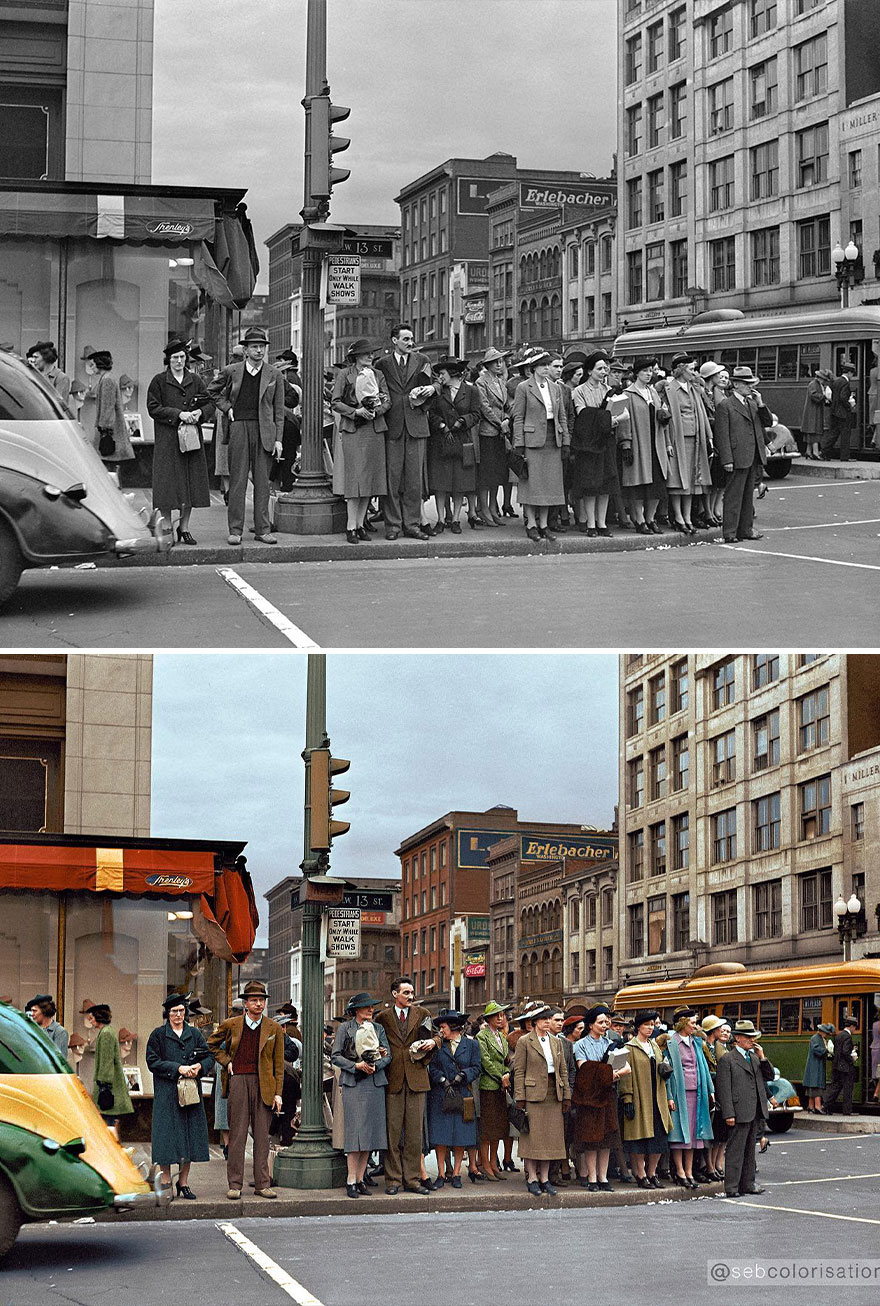
Waiting For A Stoplight In Washington, D.C., Spring 1939
Photo by David Moffat Myers
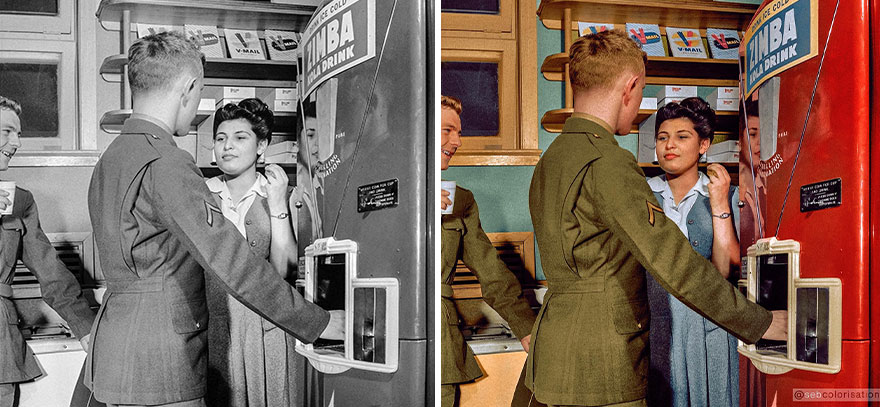
Soldier With His Girlfriend, Arlington, Virginia, June 1943
Photo by Esther Bubley
From the sign, Zimba was a cola drink. V-Mail was mail for the armed forces.
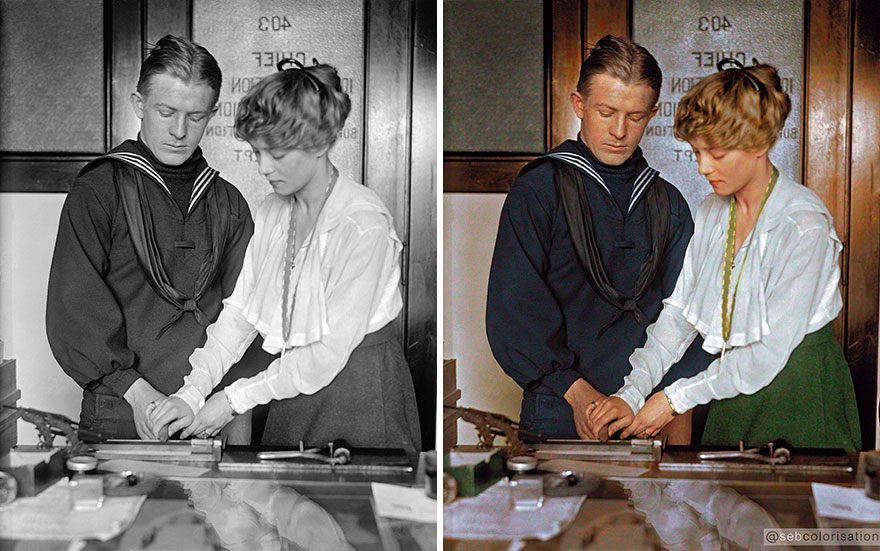
Load More Replies...U.S. Navy Intelligence Bureau. Fingerprint Department. Washington D.C., 1918
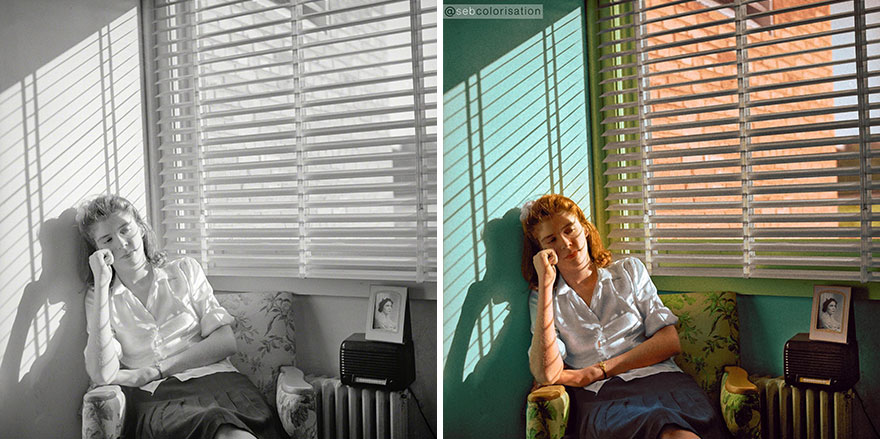
A Room At Idaho Hall, Arlington Farms, War Duration Residence Halls. Arlington County, June 1943
Photo by Esther Bubley
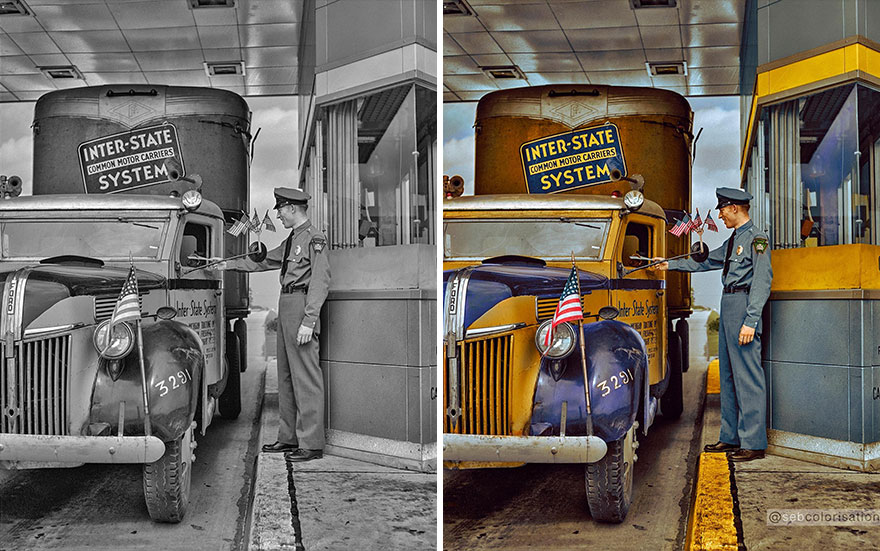
Pennsylvania Turnpike. Trucker Paying Toll, July 1942
Photo by Arthur Rothstein
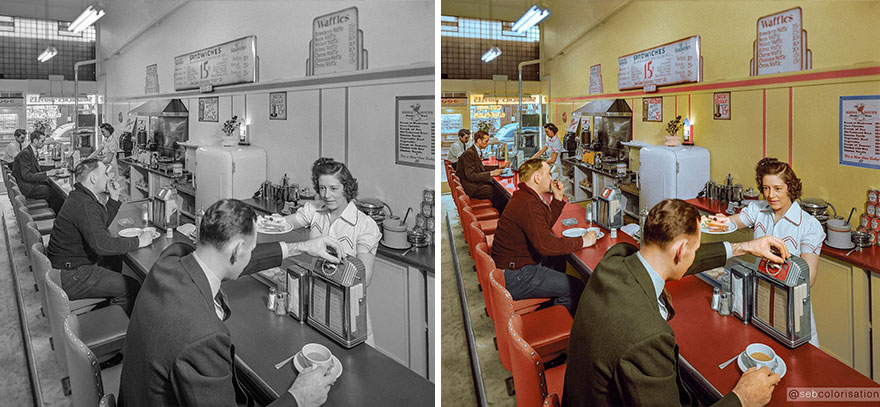
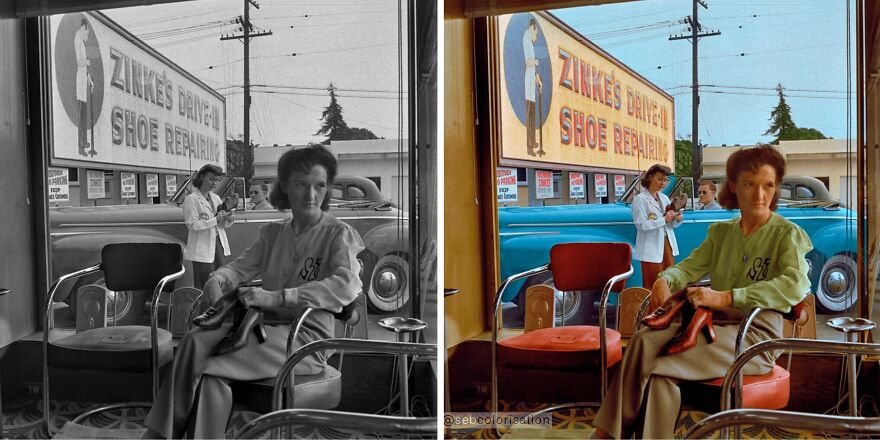
Restaurant Counter, San Francisco, 1941
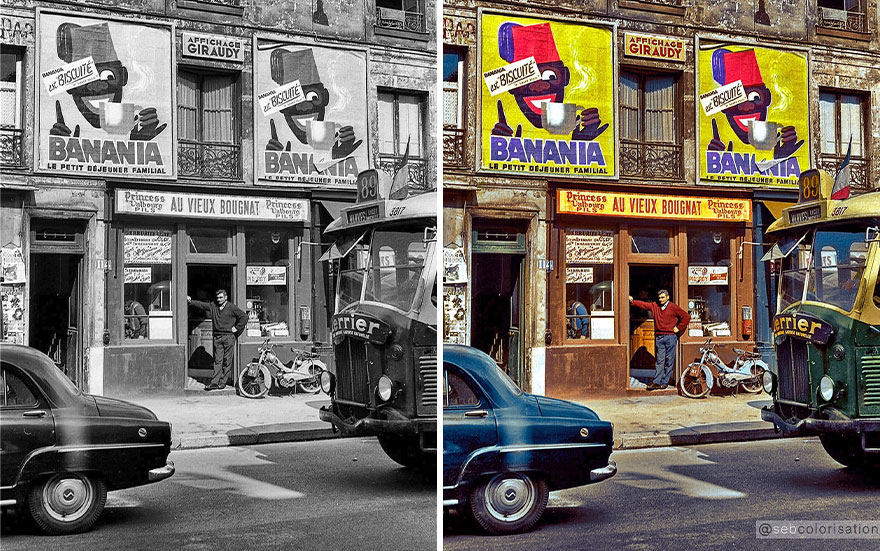
114 Rue De Sèvres, Paris Photographed In 1950
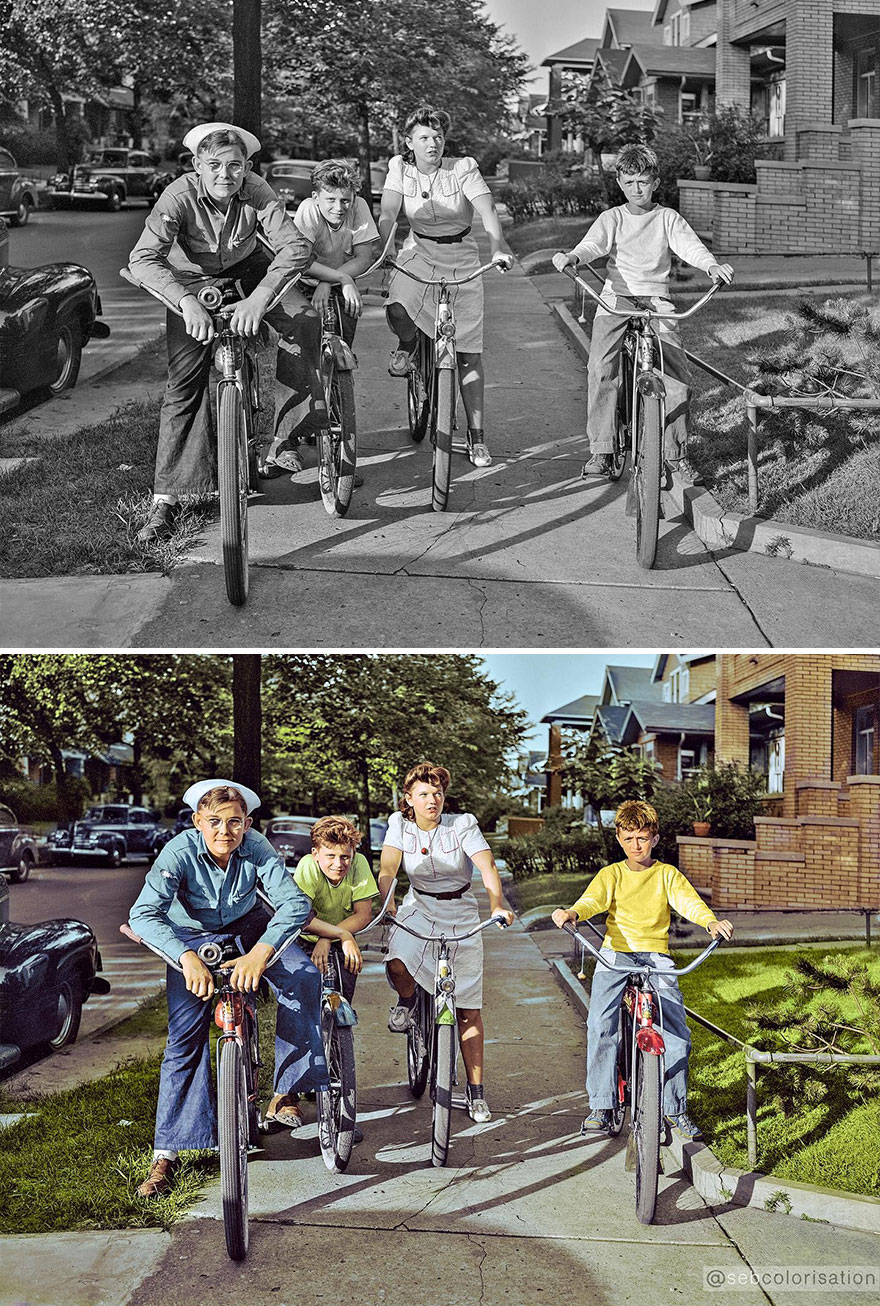
Boys And Girl On Bicycles, Detroit, Michigan, July 1942
Photo by Arthur Siegel
those are some serious bell-bottoms. Real easy to get caught in your bike chain
Kid on the left is wearing Navy dungarees and a Dixie cup (hat). I wonder if he was enlisted or just wearing it like a costume
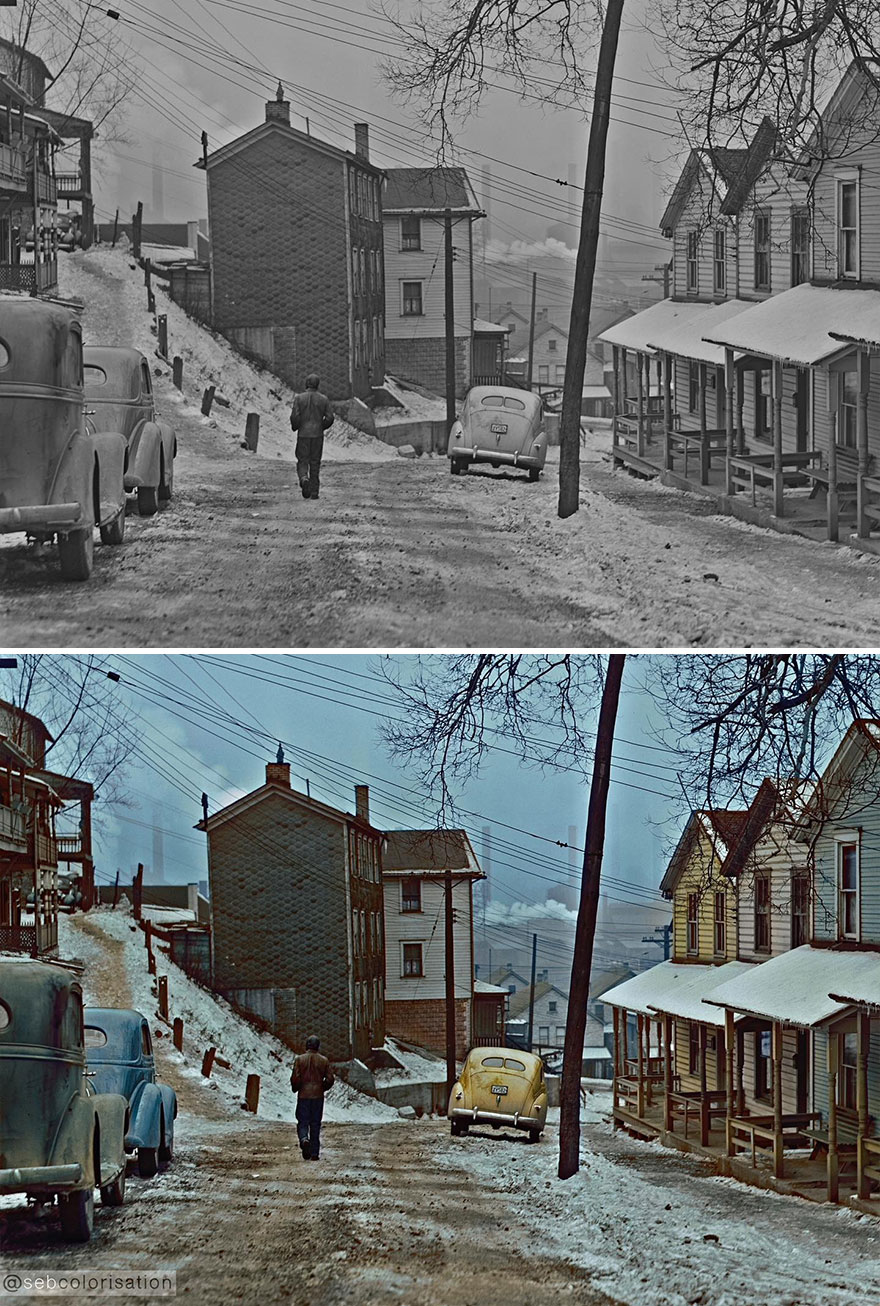
Street In Aliquippa, Pennsylvania, January 1941
Photo by Jack Delano
Unnamed
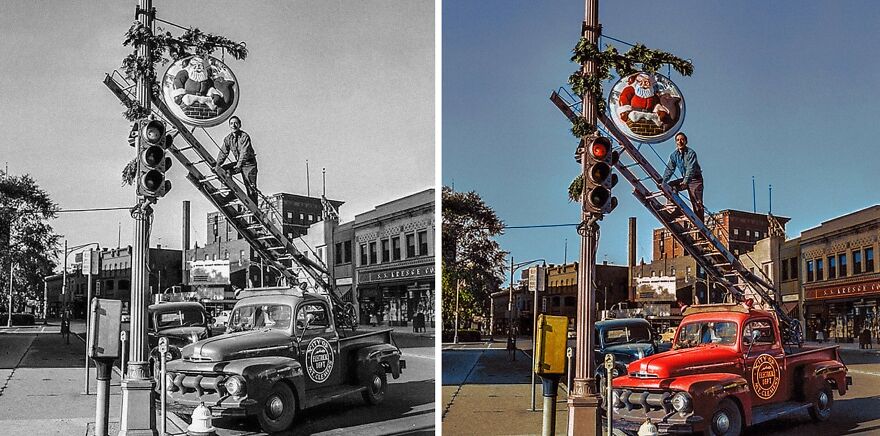
the sign on the truck says "City of Mt Clemens" or maybe it's "Mt Clemins" or "Mt Clements". The only town close to those I could find is Mt Clemens in Michigan, but the lack of snow in the picture close to Christmas kinda argues against it being in MI.
I found a picture of the Kresges in Mt Clemens in 1967. The building was white but appeared to be the same one. Yes, the lack of snow is very weird.
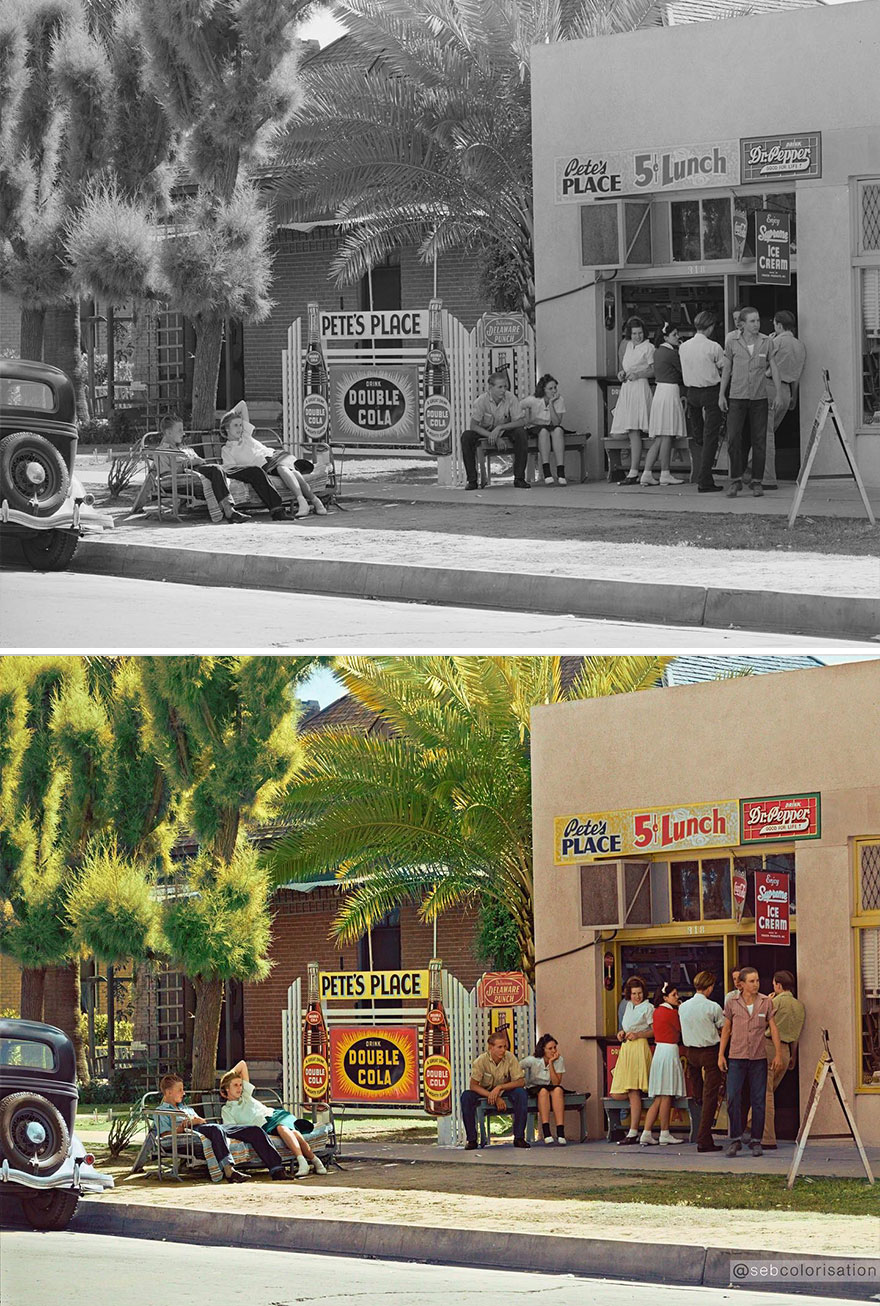
Load More Replies...Small Lunchroom Where Students Gather Near Phoenix Union High School. Phoenix, Arizona, May 1940
Photo by Russell Lee
Sadly the boys were off to war soon.Nice to see them innocent of the horror to come.
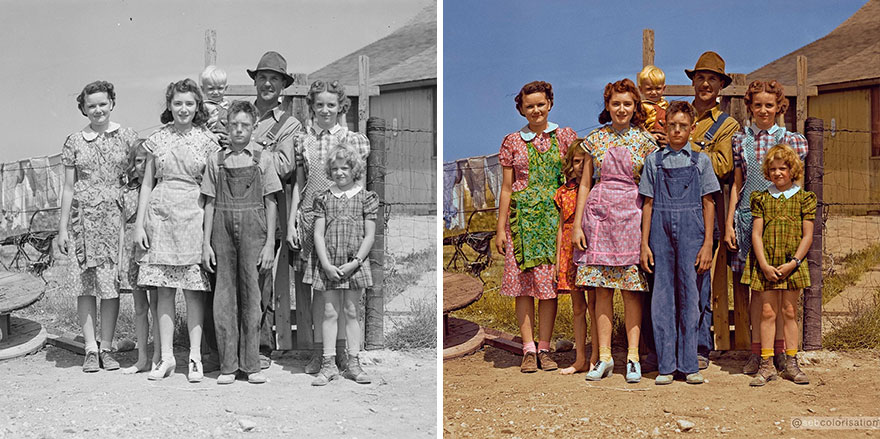
FSA Borrower And His Seven Children, Laredo, Montana, August 1941
Photo by Marion Post Wolcott
There's a little girl in a red dress hiding behind the girl with the pink apron. I missed her the first couple of times I counted.
Load More Replies...California, 1945
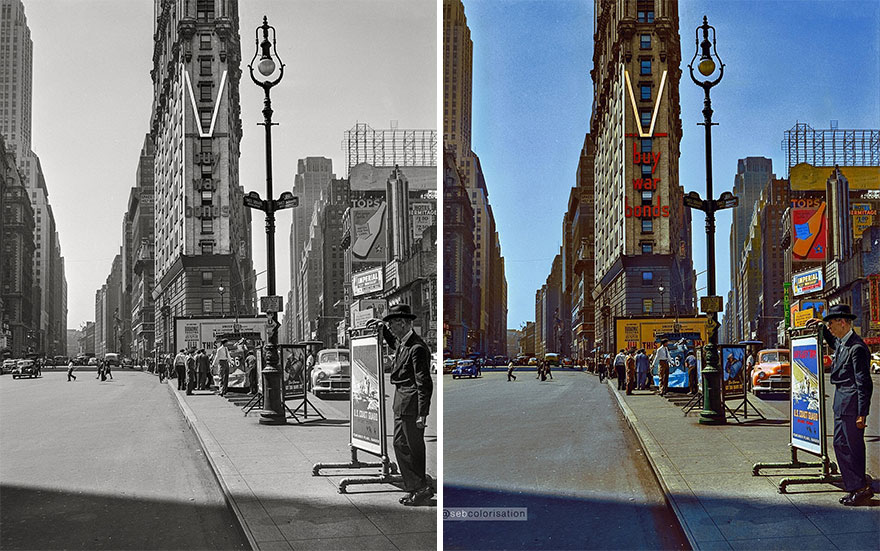
New York. Looking North On Broadway At Times Square, September 1942
Photo by Marjory Collins
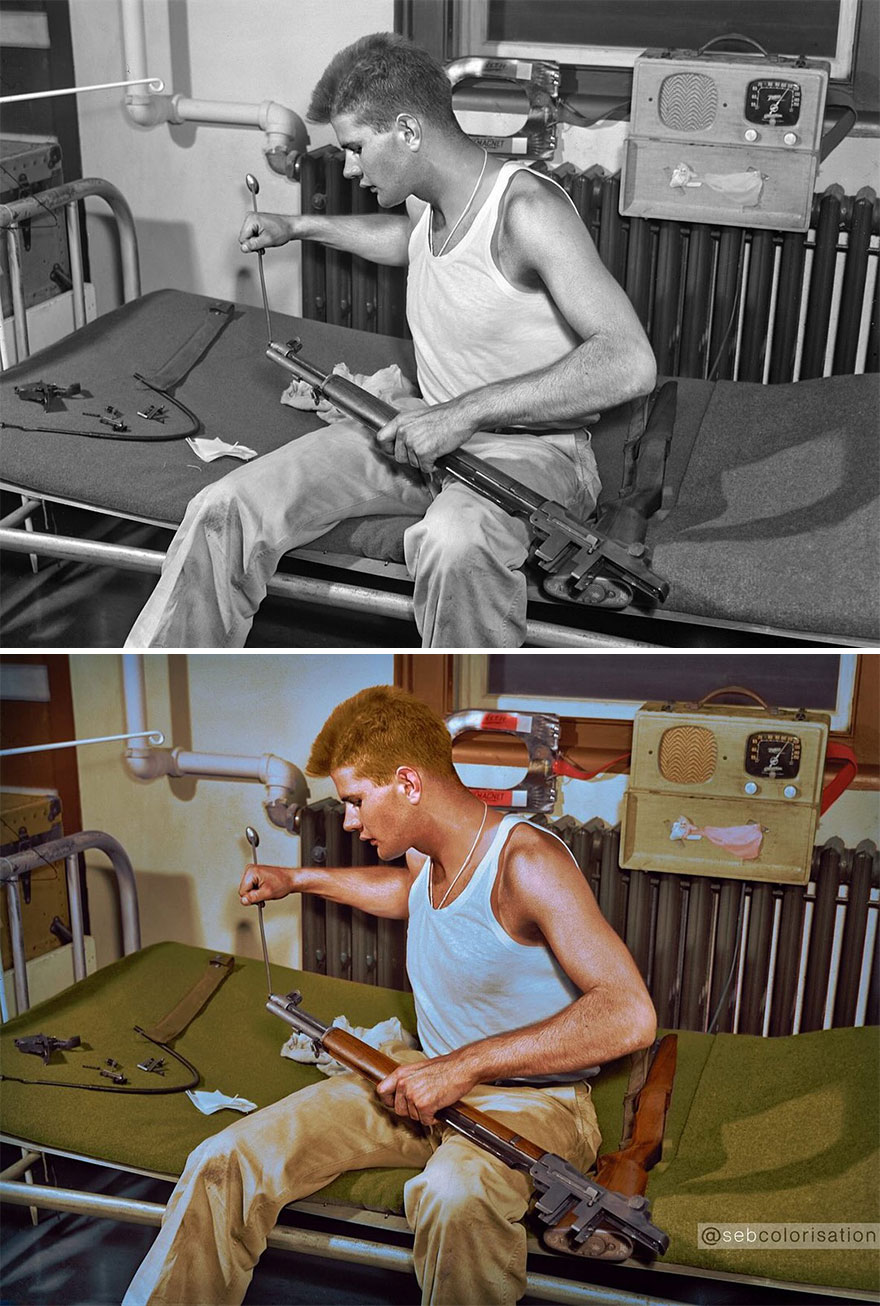
September 1942. "Fort Belvoir, Virginia. Sergeant George Camplair Cleans His Rifle Regularly"
Photo by Jack Delano
The title suggests that the colorized photos will, “Change The Way You Perceive History.” Uh, nope. Just because there’s color included doesn’t make the picture more or less interesting.

Yes and many historians and archivists hate when people, other than the photographer colorize photos because you change it and it's not a true representation like the photograph
Load More Replies...I can;t help but feel that some of these are much more evocative in their original monochrome form. Black & White photography remains an art form in itself to this day.


The colors were so saturated that many of these looked more like postcards.

Yeah, I thought a number of them were too saturated and the first one needed the red hue removed. But I suspect that if you're a photog, you're likely to be extra critical. Many are really well done and you can tell a lot of work went into all of them.
Load More Replies...I think some of the pictures look better in black/white . . . Just seem to convey so much more for me.


How are any of these supposed to change the way someone perceives history?
The title suggests that the colorized photos will, “Change The Way You Perceive History.” Uh, nope. Just because there’s color included doesn’t make the picture more or less interesting.
Yes and many historians and archivists hate when people, other than the photographer colorize photos because you change it and it's not a true representation like the photograph
Load More Replies...I can;t help but feel that some of these are much more evocative in their original monochrome form. Black & White photography remains an art form in itself to this day.
The colors were so saturated that many of these looked more like postcards.
Yeah, I thought a number of them were too saturated and the first one needed the red hue removed. But I suspect that if you're a photog, you're likely to be extra critical. Many are really well done and you can tell a lot of work went into all of them.
Load More Replies...I think some of the pictures look better in black/white . . . Just seem to convey so much more for me.
How are any of these supposed to change the way someone perceives history?