Get Premium
Dark mode theme is available exclusively for premium users. Learn more about the benefits of subscribing.
No fees, cancel anytime.

 Dark Mode Ad-Free Browsing Unlimited Content
 Ad-Free Browsing Unlimited Content Dark Mode
Join 1.2 million Panda readers who get the best art, memes, and fun stories every week!
Have you ever wondered what Europe looked like before or during the Second World War (WWII)? Take a look at our “before and after” or “then and now” images and see what the war did to the people, the monuments and the landscapes.
Head over to our site for an interactive version of each image and many, many more!
Let us know what you think about the images below in the comments
More info: re.photos
This post may include affiliate links.
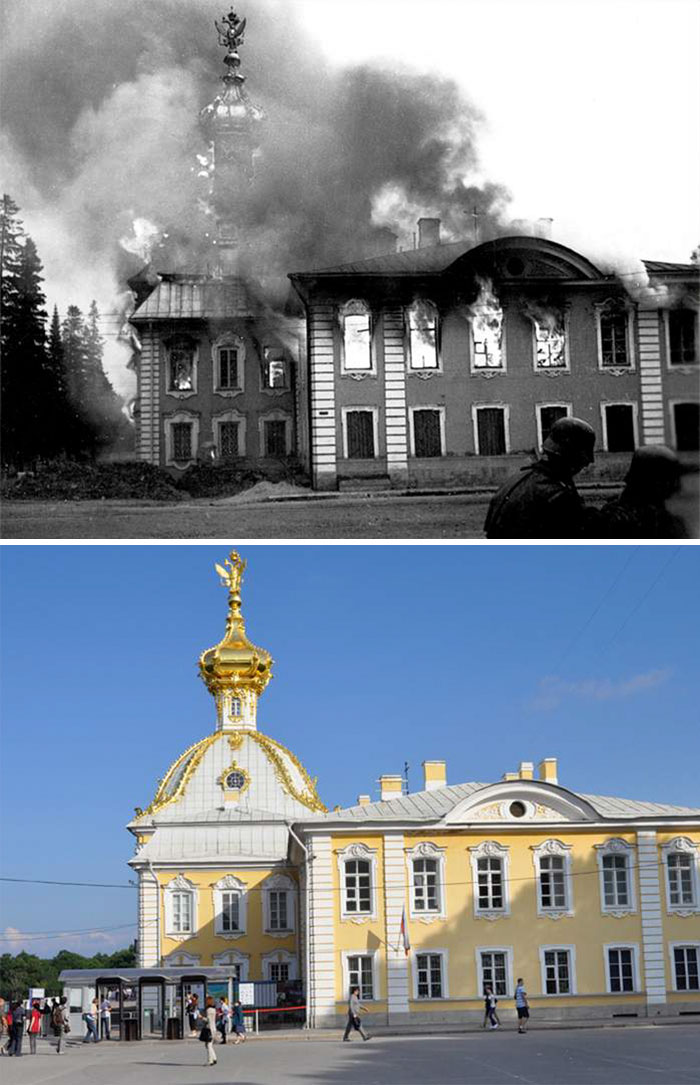
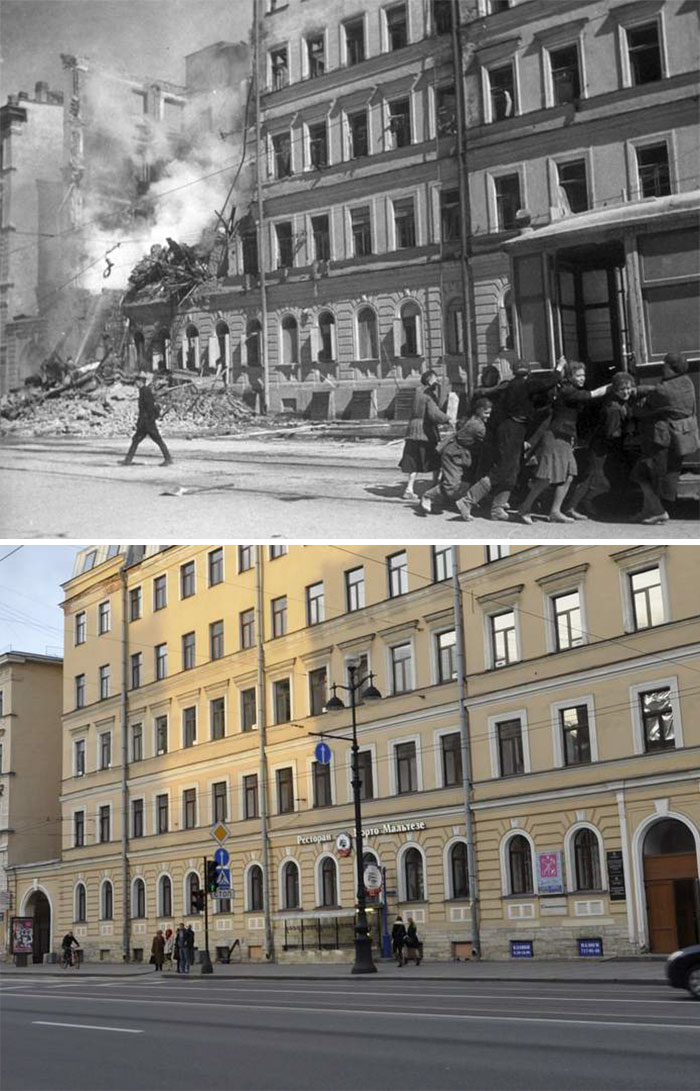
Burning Peterhof Palace after the Nazi invasion. 1941 September.
Before photo: Unknown author, after photo: Sergey Larenkov.
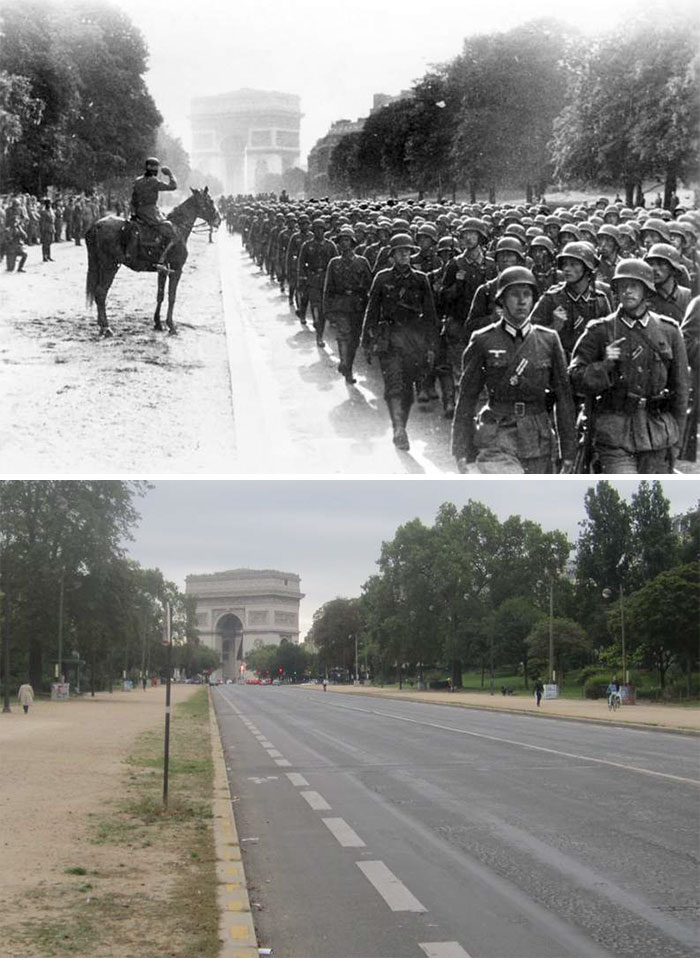
On June 14, 1940, troops of the German Wehrmacht occupy Paris. The picture shows the victory parade of the German 30th Infantry Division on the Avenue Foch in front of General Kurt von Briesen 1886-1941.
Before photo: Deutsches Bundesarchiv, after photo: Nicolai Wolpert.

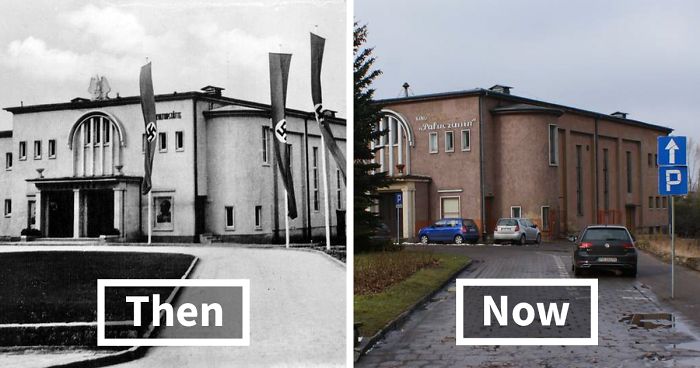
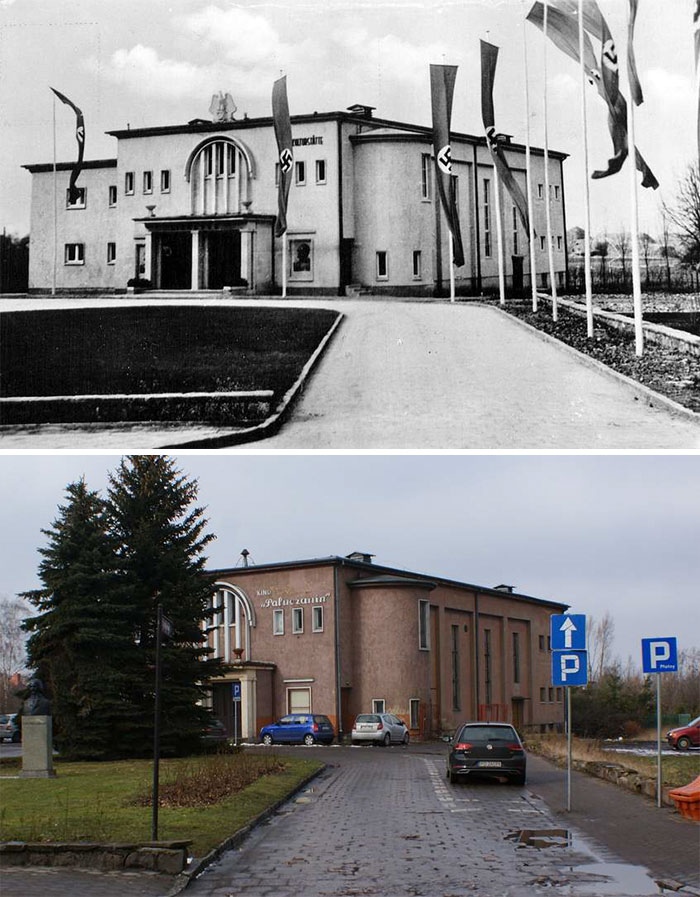
Catholic house transformed by the Germans into a cinema. 1941.
Before photo: Unknown author, after photo: Filip.
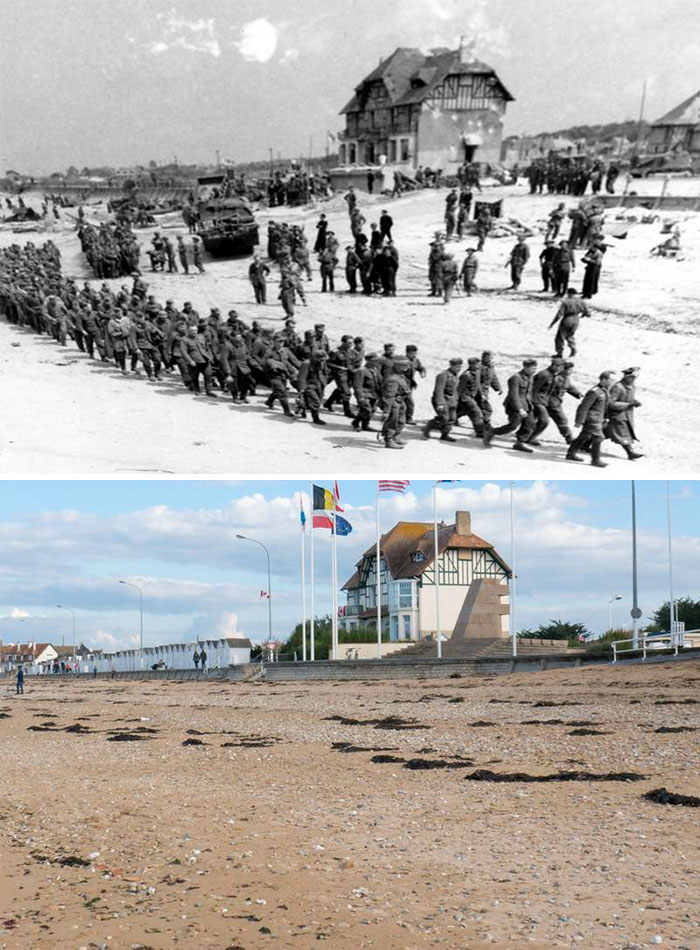
Captured German Soldiers at Juno Beach shortly before their deportation to England.
In the background, the villa "Denise et Roger" can be seen. It is one of the most famous places in the time of D-Day.
1994, June 6th.
Before photo: Ken Bell, after photo: Lena.
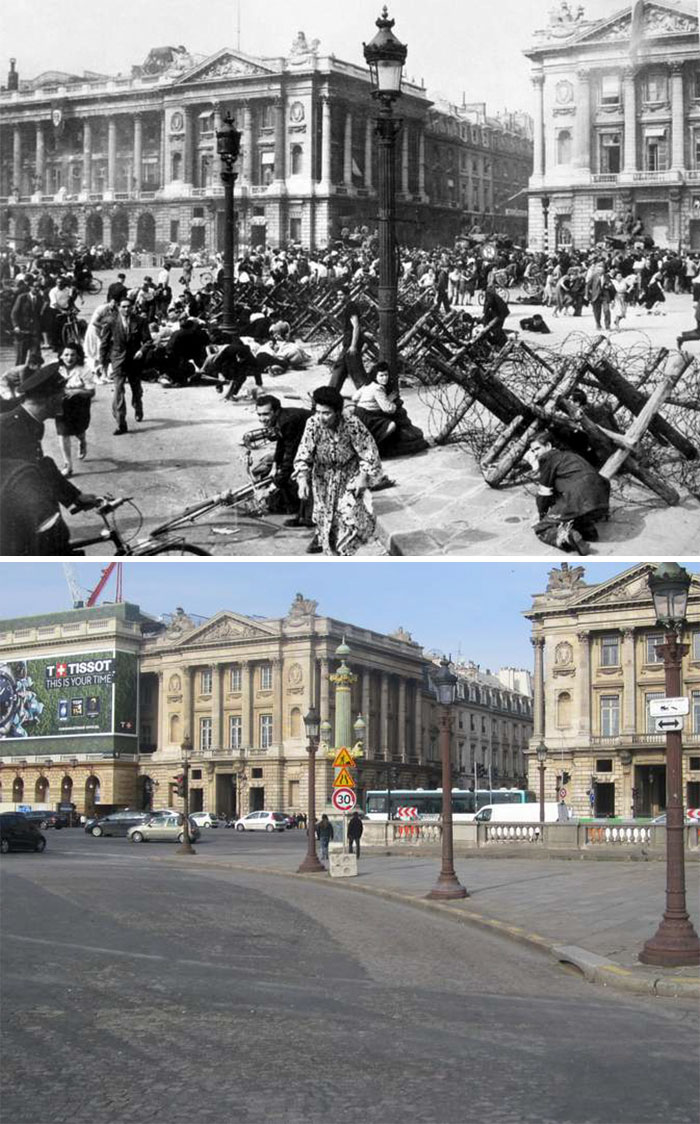
A crowd celebrates the arrival of Allied troops during a victory parade for the liberation of Paris, as suddenly shots from a sniper on one of the roofs are heard. Quickly the Parisians scatter for cover. Although the city was officially abandoned by the Germans, small bands of snipers remained active, which made the victory celebrations risky.
1944, August 29.
Before photo: National Archives and Records Administration, Washington, after photo: Nicolai Wolpert.
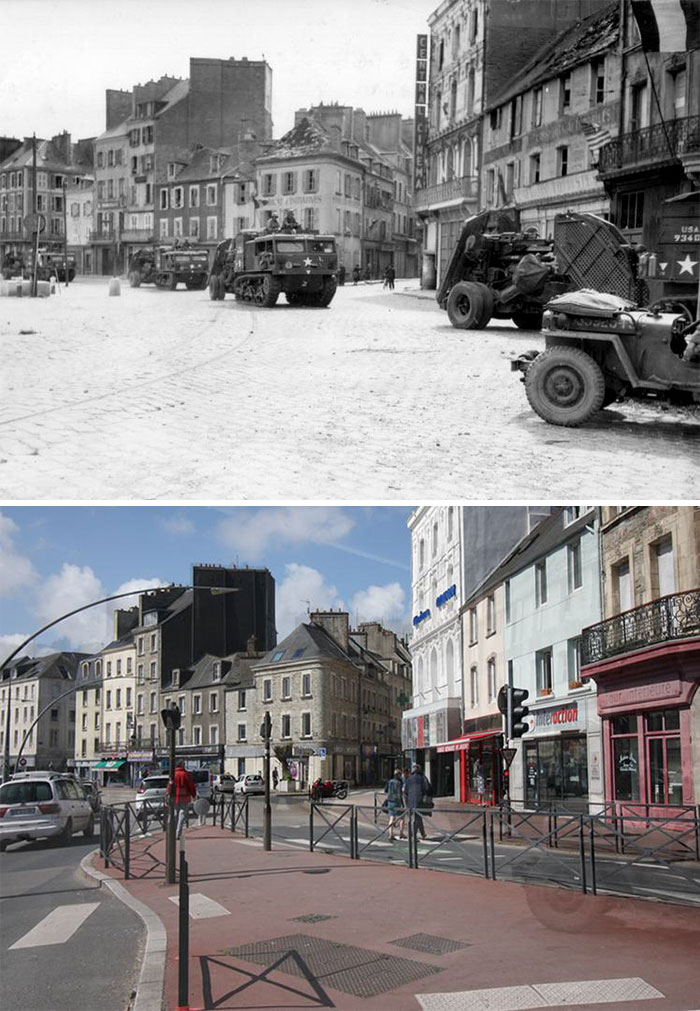
The city center and US troops in June 1944. Several US vehicles are parked on the Quai de Caligny west of the rotary bridge.
Before photo: Unknown author, after photo: Hegemonus.

After over 70 years the wrought iron balcony still looks great
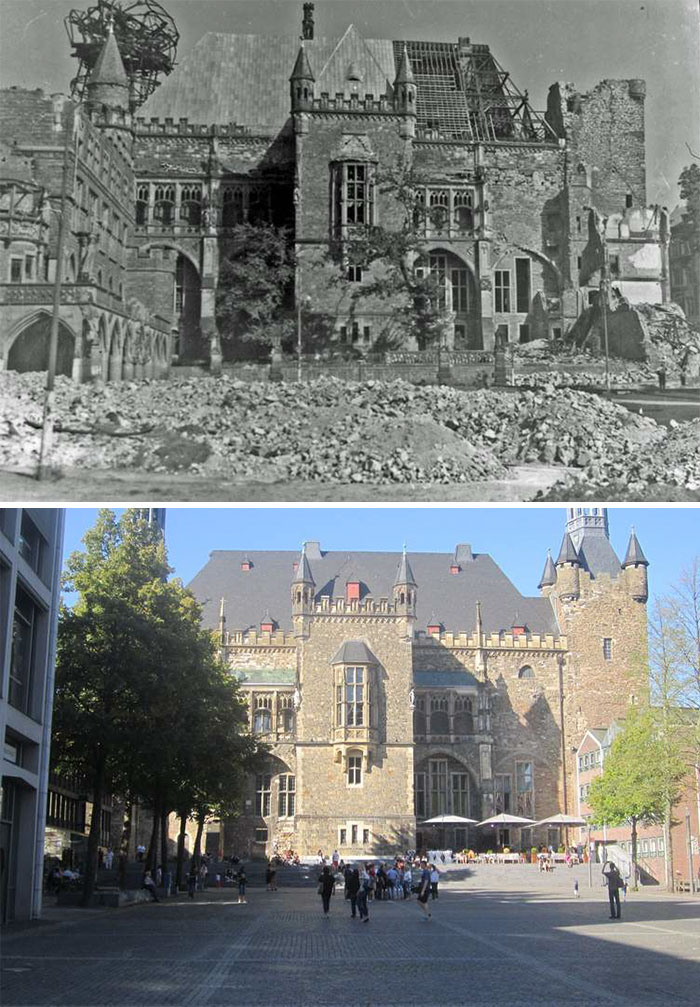
Southside of the Aachen Town Hall at Katschhof at the end of World War II.
The town hall is one of the most important buildings in the historic center of Aachen. It was repeatedly rebuilt and expanded over many centuries. The oldest part of the monument is the Granusturm from the time of Charlemagne.
During World War II, the town hall suffered badly from several bombing raids. On 14 July 1943, the roof and both City Hall towers burned out, the steel skeletons of the tower domes bent by the heat dominated the appearance of the town hall for a few years.
Rebuilding followed in the 50s; last, the two-tower caps were finished in 1978.
Before photo: Stadtarchiv Aachen / Stadtbildstelle, after photo: Nicolai Wolpert.

Oh, I just visited it. My girlfriend is living in Aachen. Back when France and Germany where one country, Aachen was our capital!
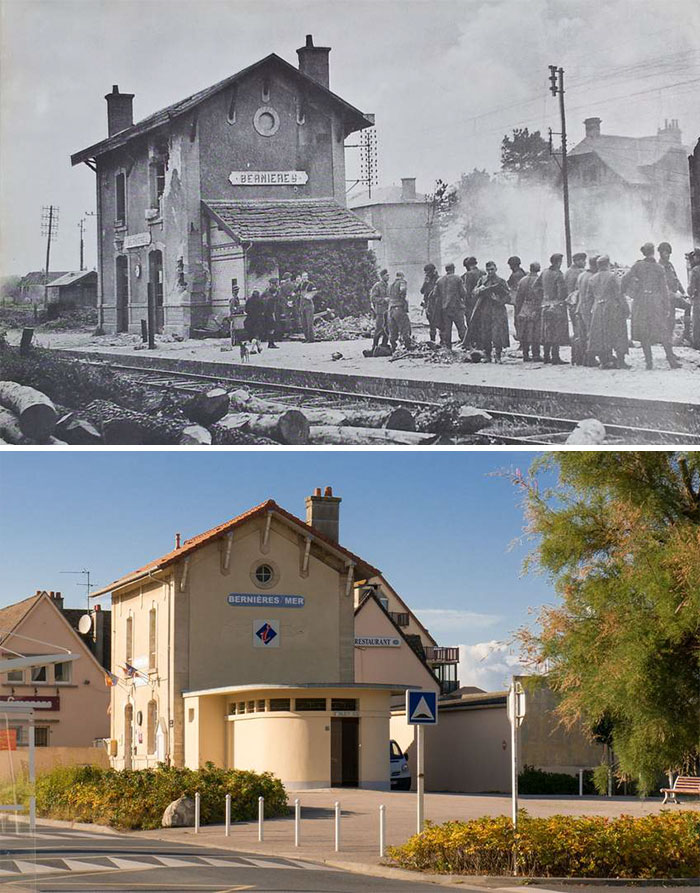
Captured German soldiers await their transport at the railway station in Bernières-Sur-Mer. Today, the old station building serves as the tourist office. 1944.
Before photo: Unknown author, after photo: Lena.
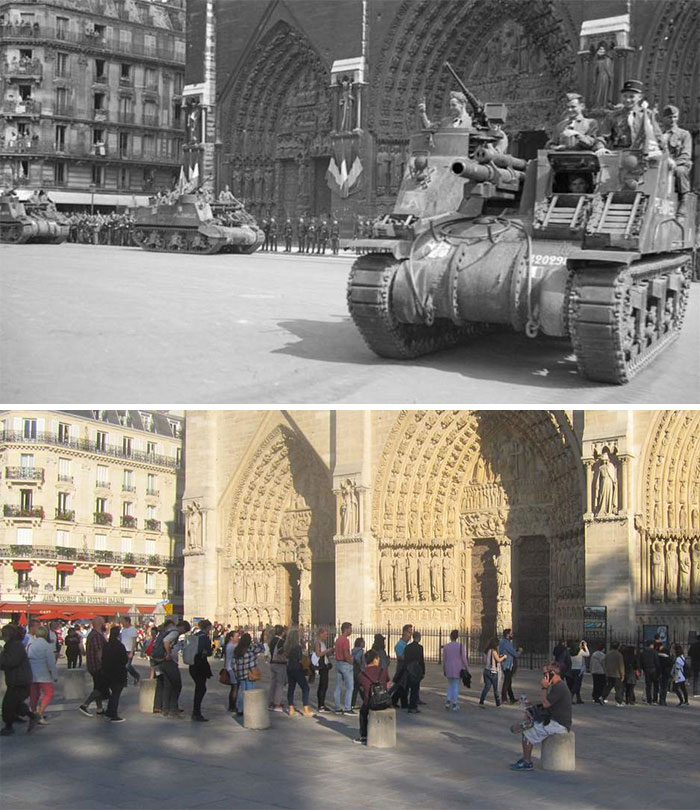
Priest 105mm self-propelled guns of the French 2nd Armoured Division in front of Notre Dame in Paris, 26 August 1944.
Photo of the Imperial War Museum (IWM).
Before photo: IWM (BU 127), after photo: Nicolai Wolpert.
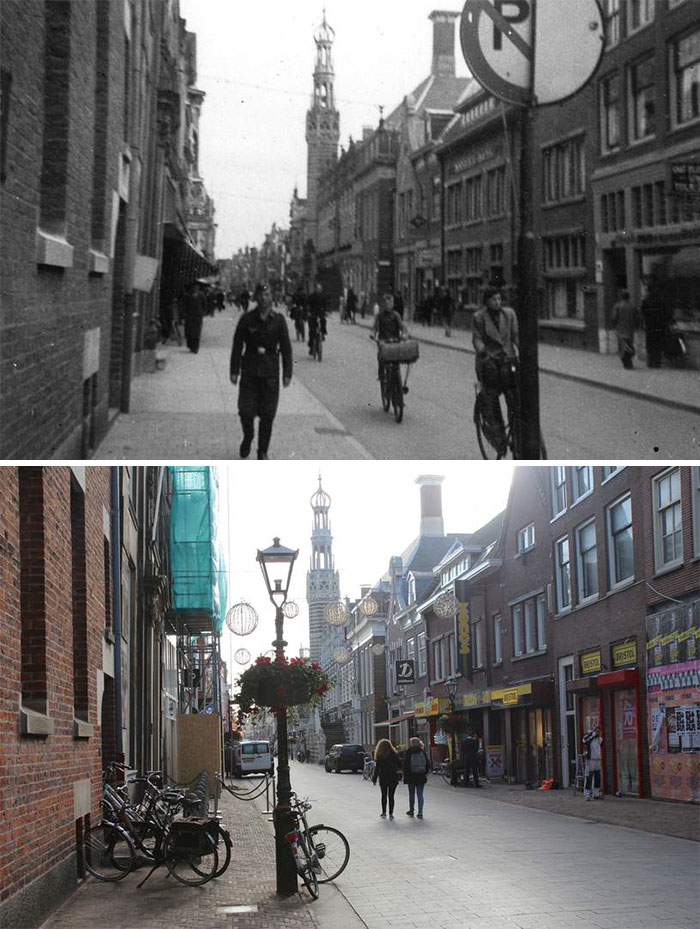
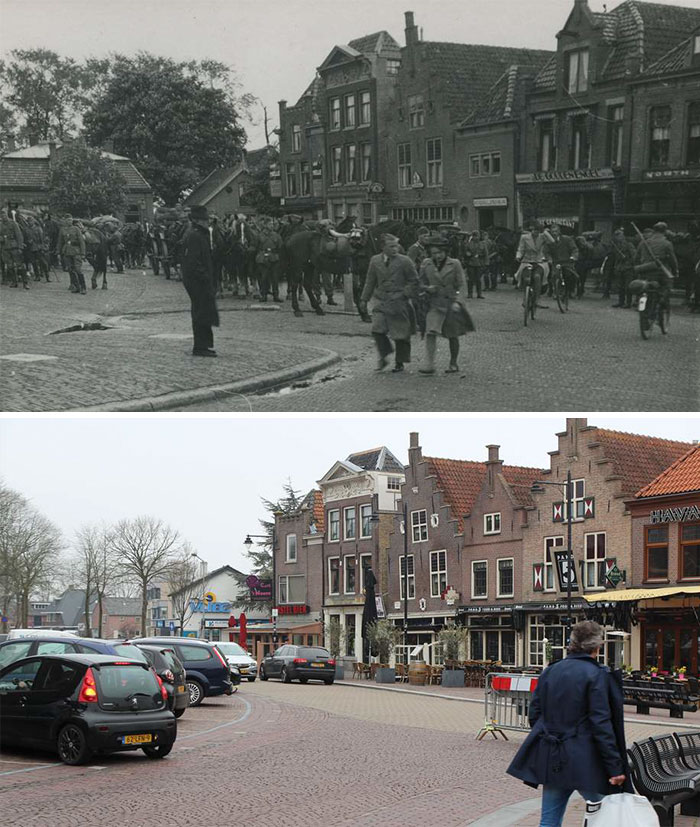
German soldier in Alkmaar at the Langestraat. 1941.
Before photo: Unknown author, after photo: Regionaal Archief Alkmaar.
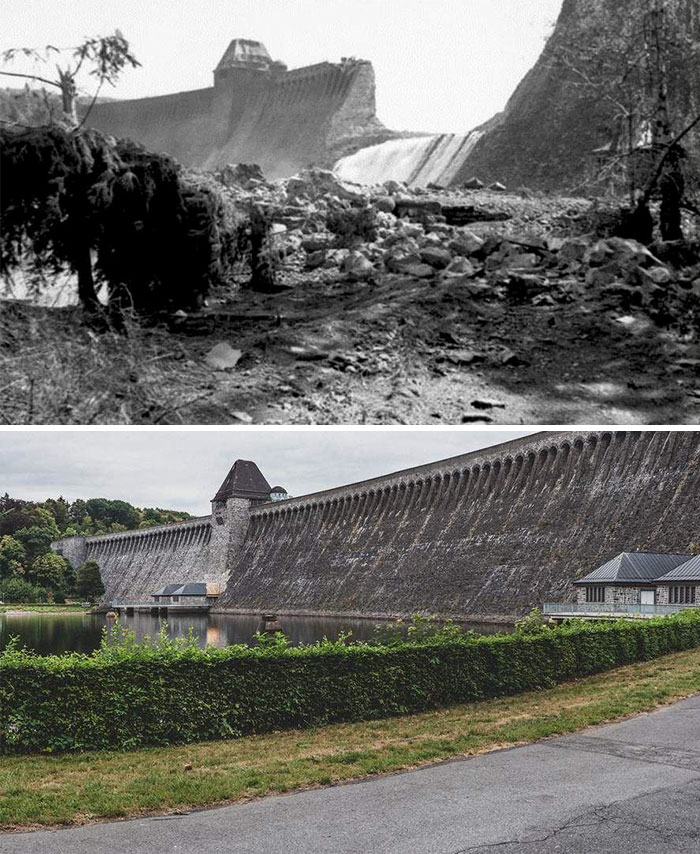
In May 1943, the Allies dropped specially developed "bouncing bombs" on select dams in Germany's industrial heartland. The Möhne dam was the hardest hit and 1600 civilians died in the flooding. The attack was dramatized by The Dam Busters (1955).
Before photo: Schalber, after photo: jamesvdm.

It was effective but also a war crime for killing so many Civillians in the process.
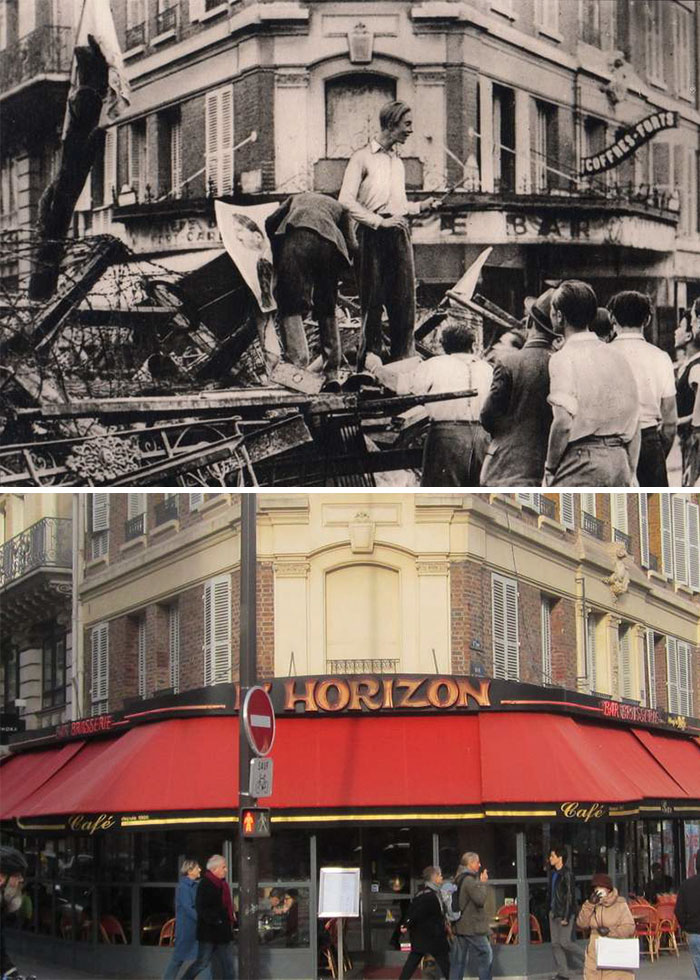
August 1944. Since 1940, Paris is occupied by German troops. As the Allied army approaches the capital, this encourages the Parisian population to resist. It comes to a general strike, followed by open revolts. Everywhere in the city (such as here in the rue St. Placide) barricades are erected, and around the 20th of August, the Resistance has taken control of the city. Although militarily inefficient, these barricades had a symbolic character for the Paris uprising.
Before photo: Jean-Jacques Lebel, after photo: Nicolai Wolpert.
Reminds me of that scene from Les Miserables, Enjolras and the boys on the barricade
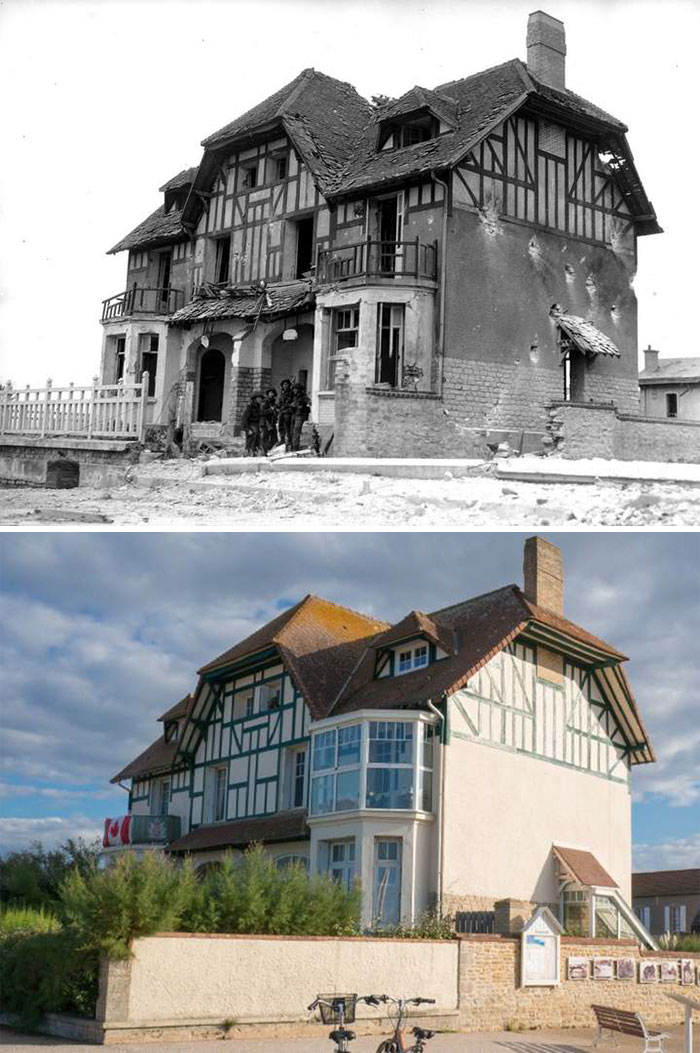
The villa "Denise et Roger" is one of the most famous places of the time of D-Day. The region around Bernières-Sur-Mer was liberated by Canadian soldiers on June 6. 1944.
Before photo: Archives Nationales du Canada, after photo: Lena.
I wonder if the strafing on the side of the building in the first photo was from aircraft fire. It looks like it came from the direction of the water.
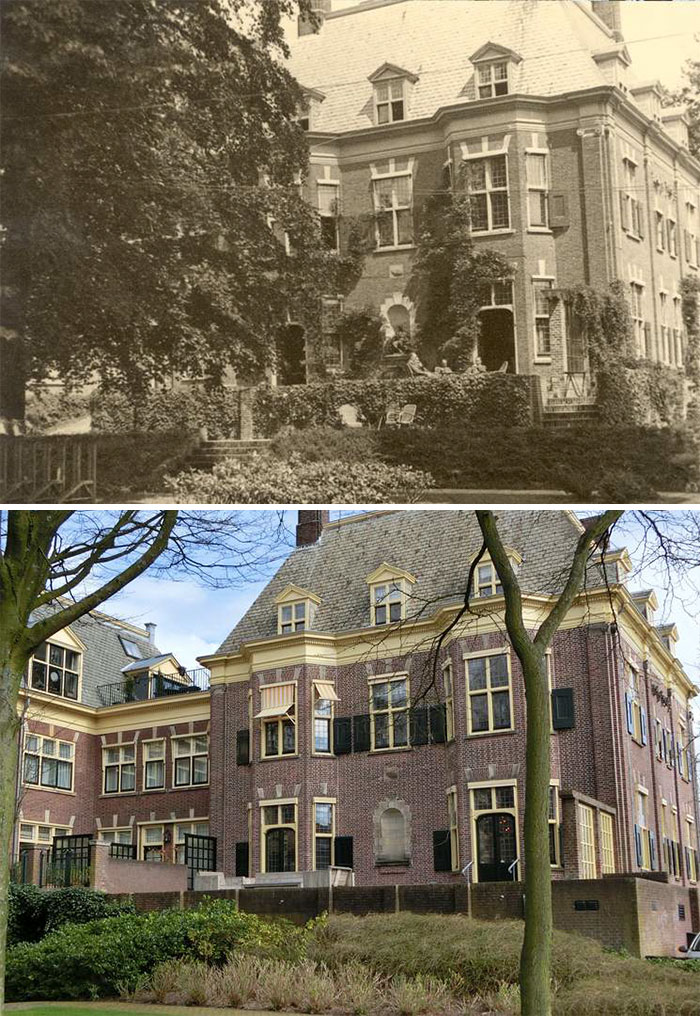
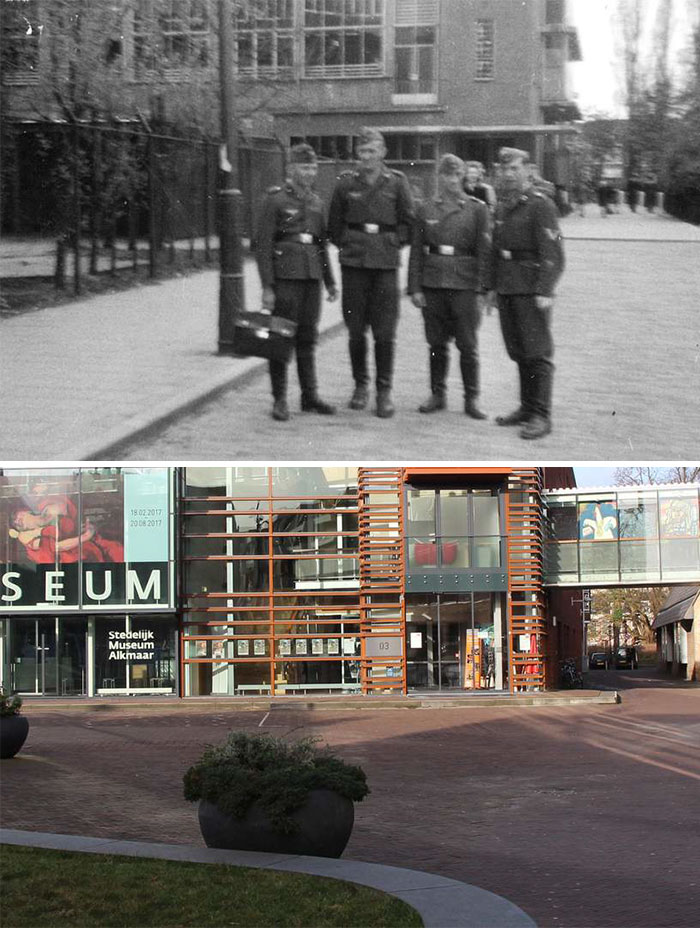
German officers in the headquarters of the Wehrmacht in Huize Voorhout in Alkmaar. 1942.
Before photo: Unknown author, after photo: Regionaal Archief Alkmaar
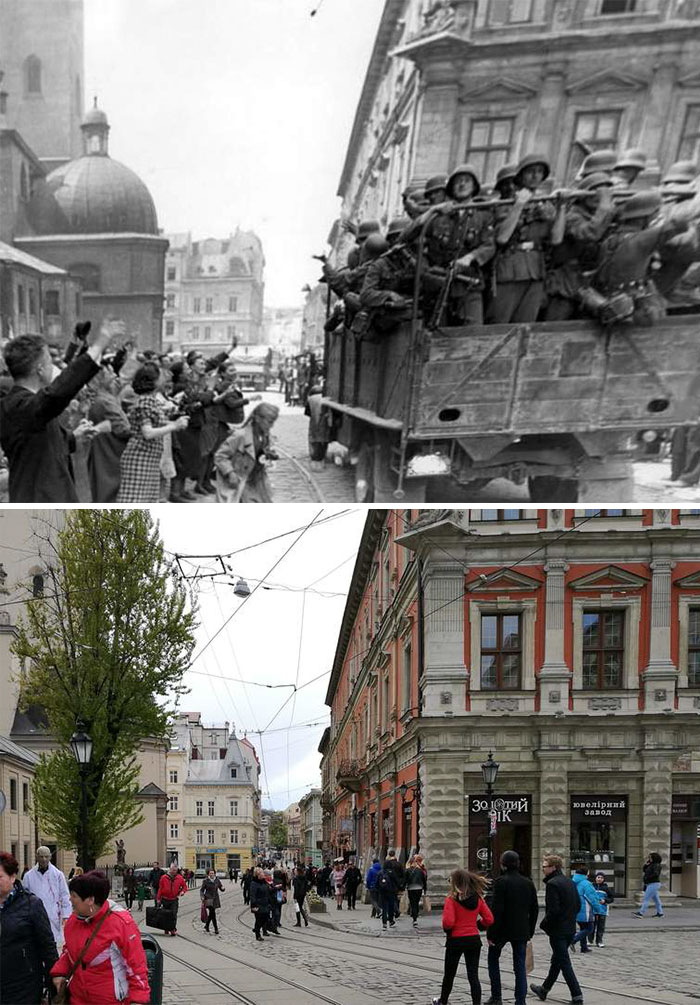
In the background is the Assumption Cathedral. 1941.
Before and after photo: Lena.

Well people forget that is some parts of Eastern Europe like Lithuania, Estonia, Ukraine, etc, the locals welcomed the Nazi's as liberators from Stalins rule, though within a few months most turned on the Nazi's (Outside of the Facists in those countries who joined the SS Auxilary and helped the occupation) when they realized the Nazi's were worse than Stalin.
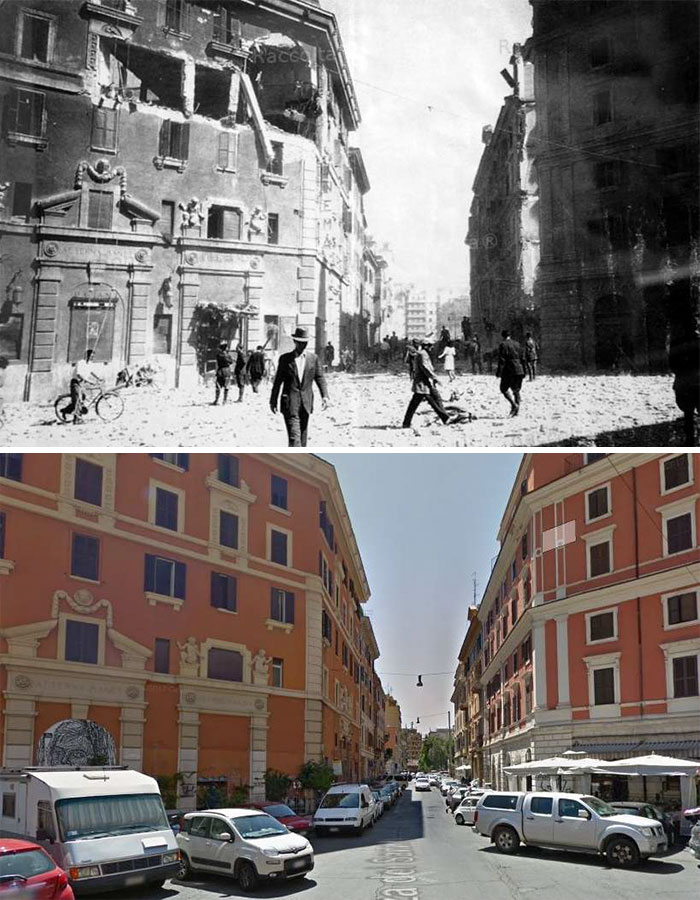
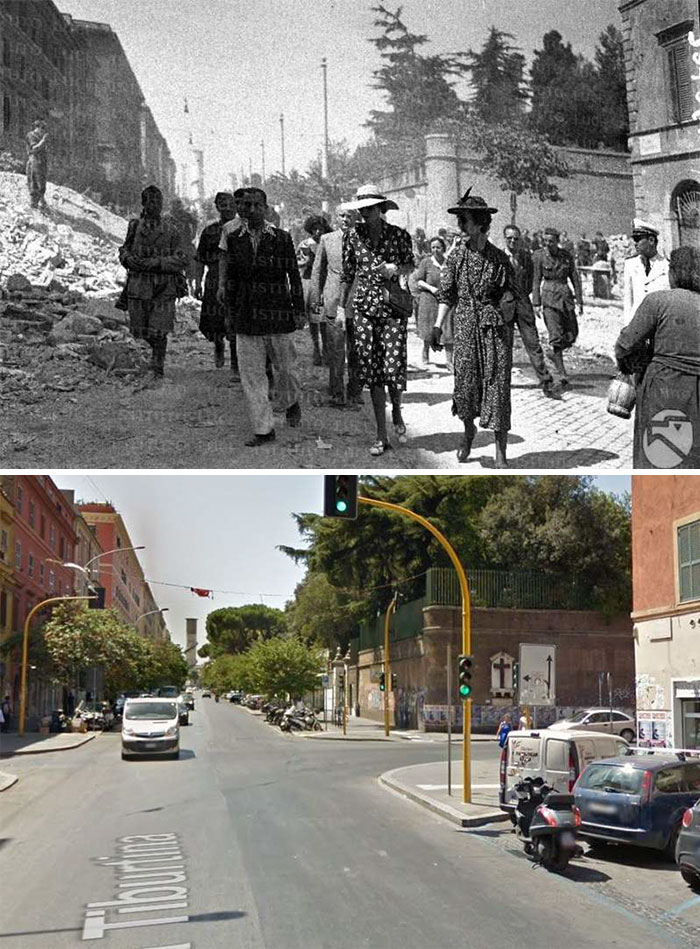
San Lorenzo, Rome after the allied bombing on 19 July 1943.
Before photo: LaRepubblica, after photo: GoogleMaps.
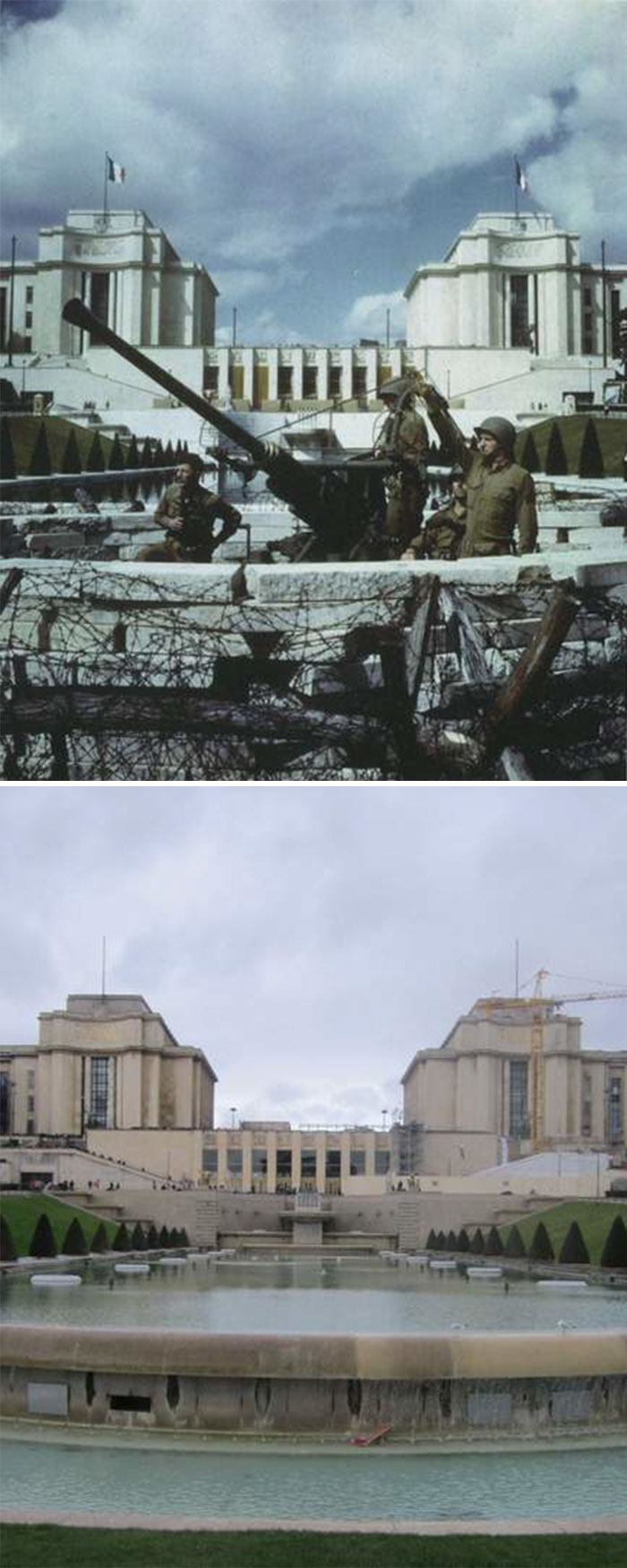
Paris in September 1944, shortly after the recapture. To protect against potential German counterattacks, an anti-aircraft gun is provisionally installed by American soldiers in the park of the Palais de Chaillot.
Before photo: anonym, Agence Gamma Rapho, after photo: Nicolai Wolpert.
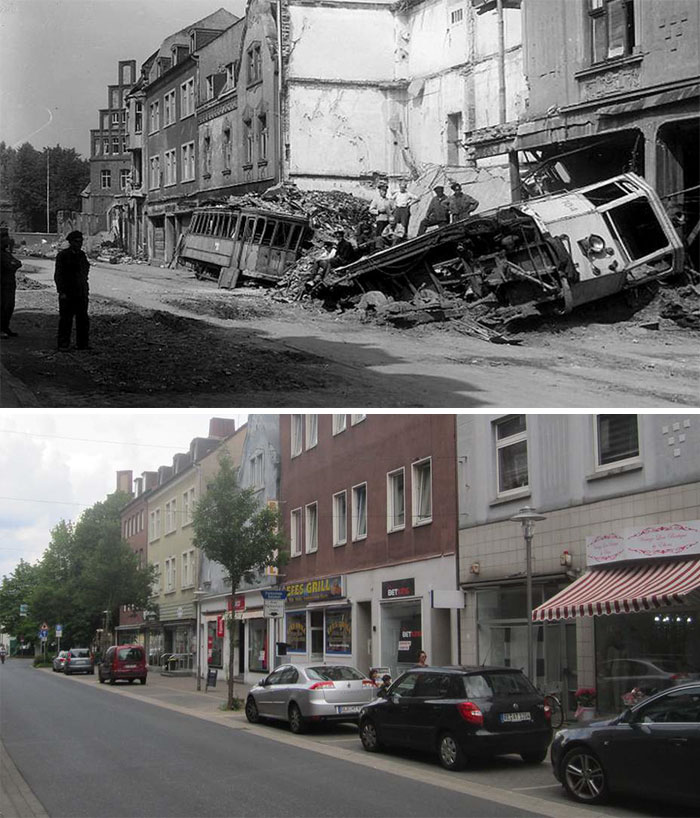
Destroyed tram and houses in the Rentforterstrasse in Gladbeck, end of the Second World War. The house with the gabled facade in the background is the main entrance of the St. Barbara hospital.
Today there are no more tramways in Gladbeck. 1945.
Before photo: Vestische Straßenbahnen GmbH, after photo: Nicolai Wolpert.
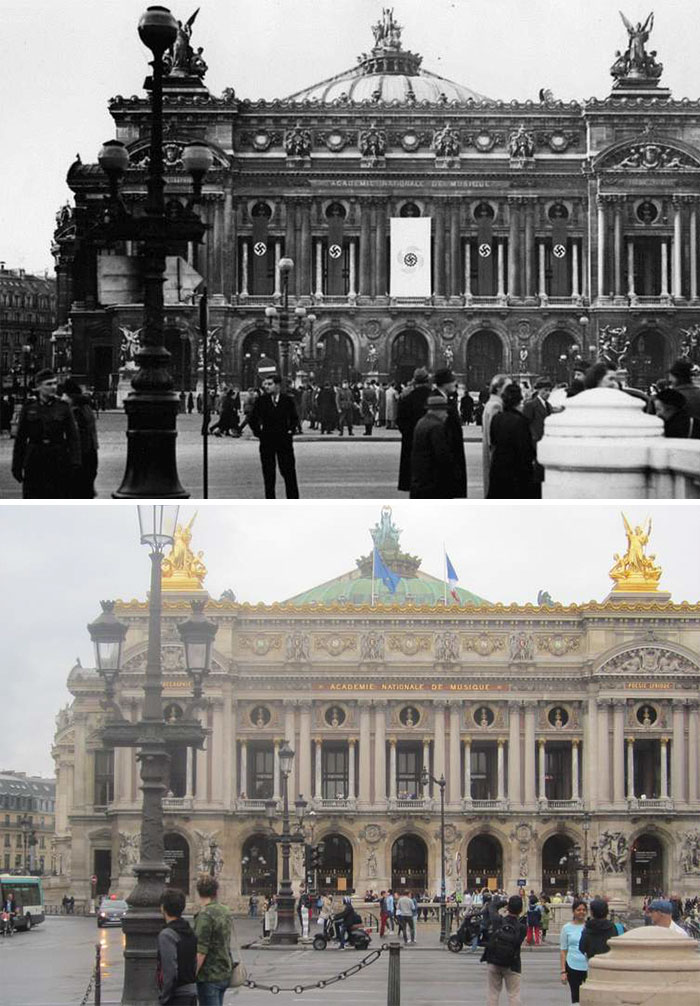
The Opera Garnier decorated with swastikas for a festival of German music during the Occupation of Paris. The Germans organized a series of concerts in the occupied city, including by the Berlin Philharmonic, conducted by Herbert von Karajan. 1941.
Before photo: Deutsches Bundesarchiv, after photo: Nicolai Wolpert.

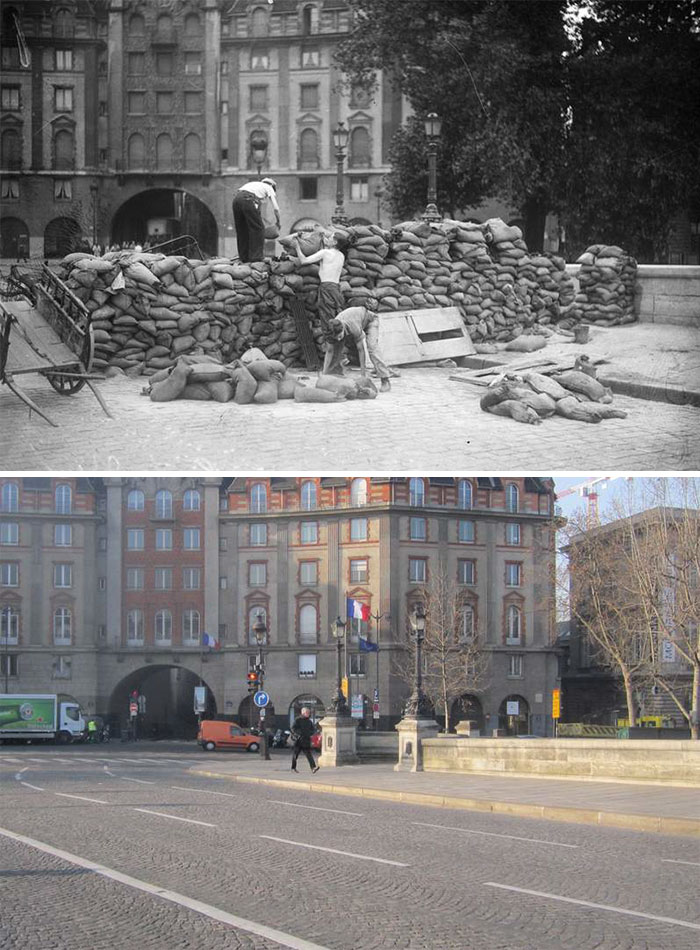
Barricade on the Pont Neuf at the intersection with the Quai de Conti, August 1944.
Since 1940, Paris had been occupied by German troops. As the Allied army approached the capital, this encouraged the Parisian population to resist. It came to a general strike, followed by open revolts. Everywhere in the city barricades were erected, and around the 20th of August, the Resistance took control of the city. Although militarily inefficient, these barricades had a symbolic character for the Paris uprising.
Before photo: Bibliothèque Nationale de France, after photo: Nicolai Wolpert.
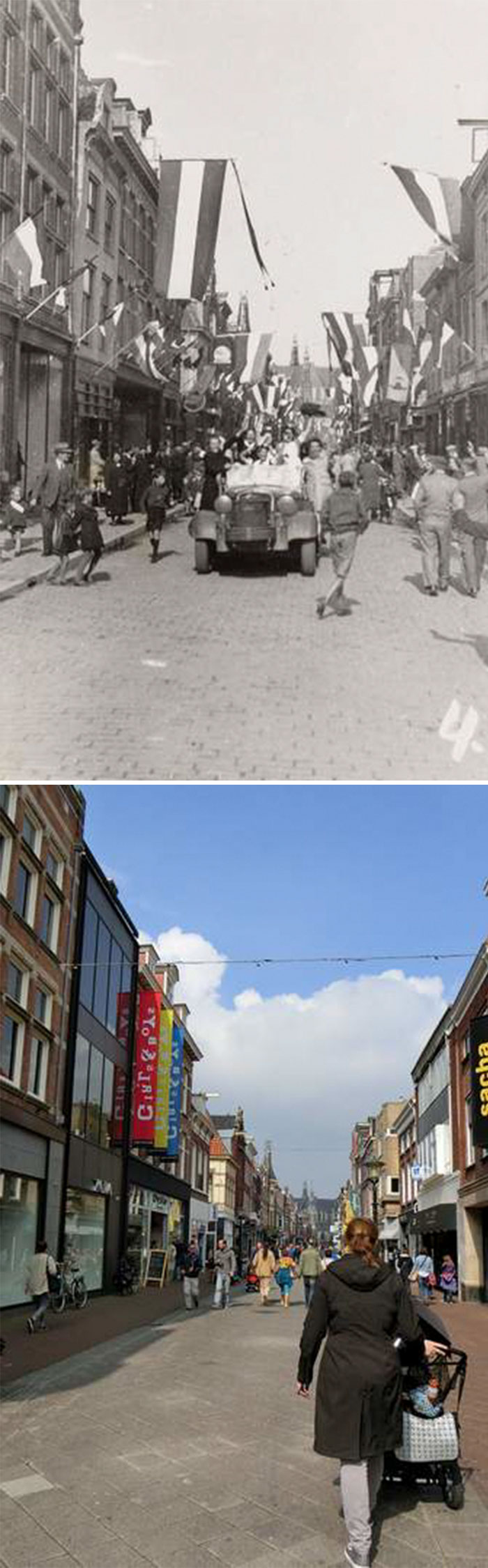
It amazes me how the lampposts are still standing and used some 80 years later!
June 1944.
Before photo: A. Grimm (Bundesarchiv), after photo: Lena.
The school building destroyed by the Nazi bombing. 1941.
Before photo: Unknown author, after photo: Sergey Larenkov.
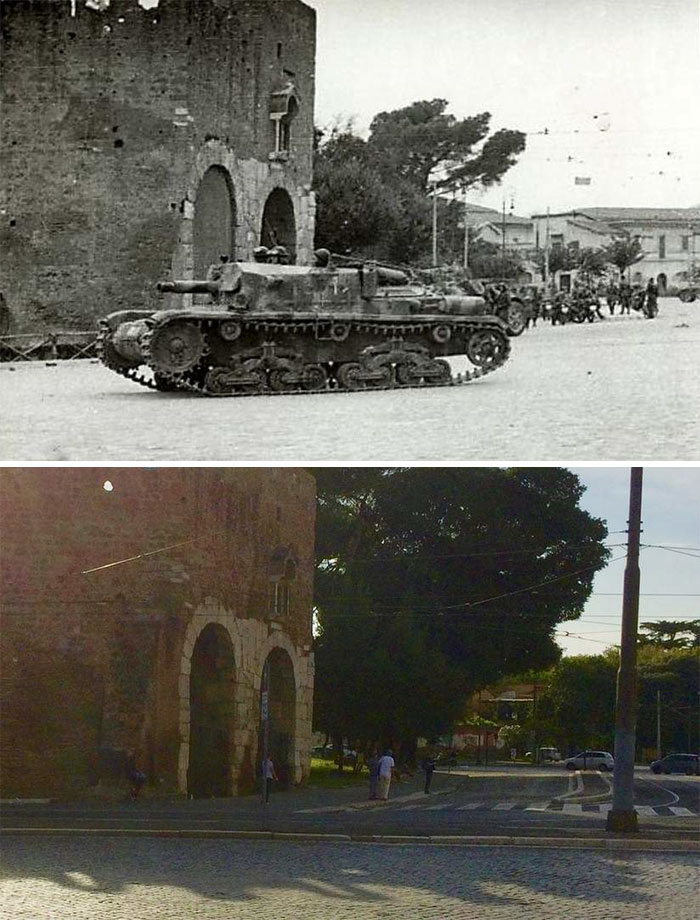
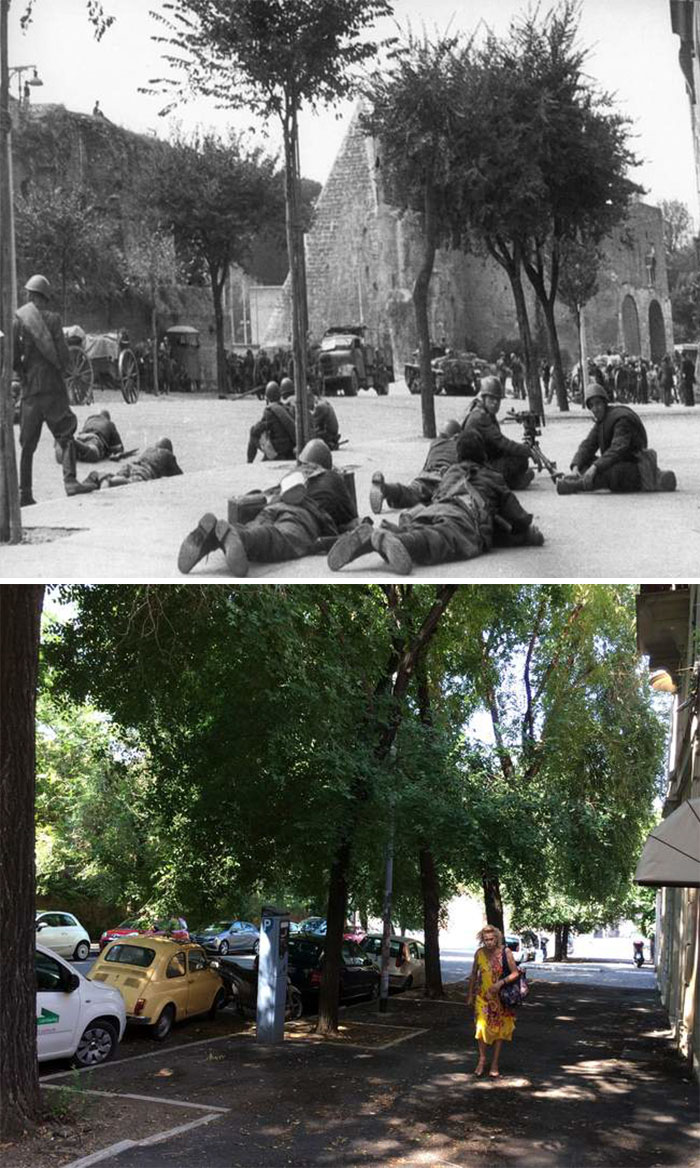
On 10 September 1943, Porta San Paolo was the scene of the last attempt by the Italian army to avoid the German occupation of Rome
On the evening of the 9th, the 21st Infantry Division "Granatieri di Sardegna" moved towards the center, engaging in fierce fighting on the Via Laurentina (Tre Fontane locality), around the Exposition Hill (current EUR district) and Forte Ostiense. The German troops marched on the Via Ostiense, towards the heart of Rome.
Despite the overwhelming numerical superiority and armament of the enemy, the walls of Porta San Paolo became a defensive bulwark of resistance, protected by barricades and vehicle carcasses. The grenadiers also fought here with courage, along with the numerous civilians.
Before photo: ComunediRoma, after photo: StuartSW6.
San Lorenzo after the bombing in 1943, Princess Marie-José inspecting the damage.
Before photo: Instituto Luce, after photo: GoogleMaps.
Wehrmacht Soldiers In the city of Schagen in The Netherlands. 1940.
Before photo: Foto Niestadt, after photo: Regionaal Archief Alkmaar.
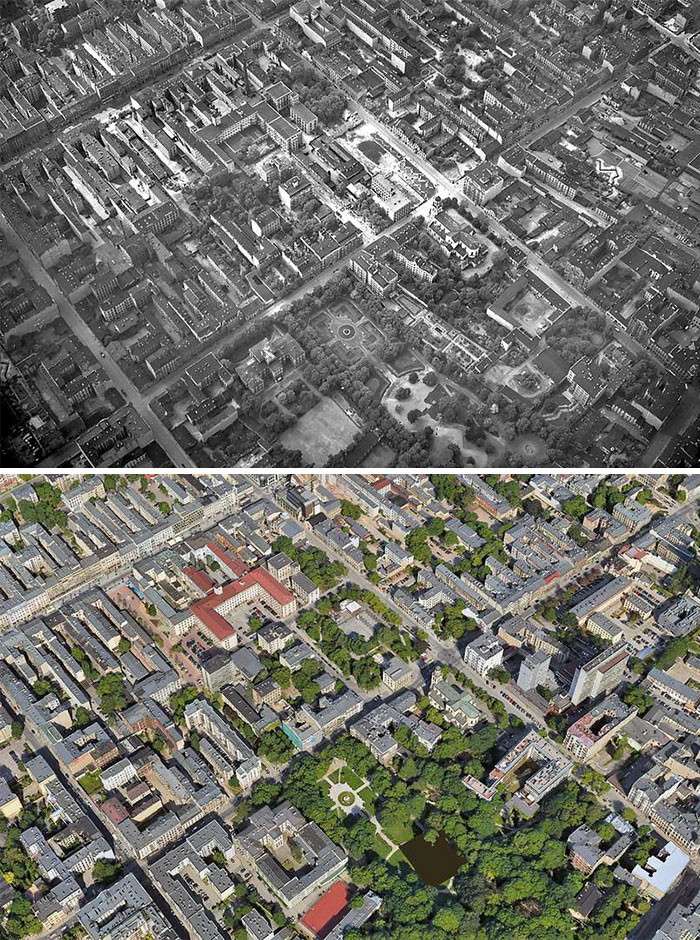
Aerial shot of Lodz made at the end of WW2 (1942) compared with Google Earth's view from 2017.
Before photo: Unknown author, after photo: Google Earth.
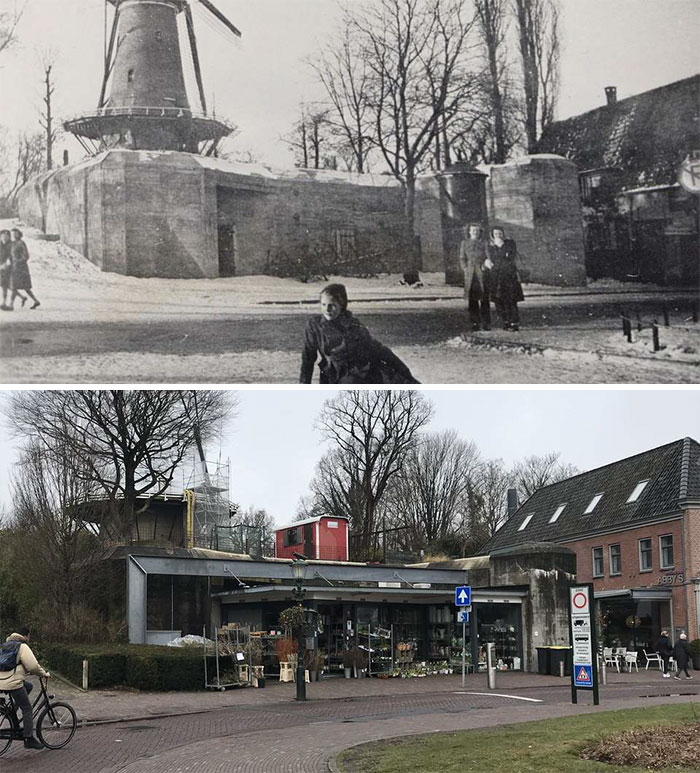
An old bunker is now used as a plant shop. Old Photo is taken in 1945, the new one in 2018.
Before photo: Unknown author, after photo: Regionaal Archief Alkmaar.

The scaffolding suggests they are preparing to reconstruct the windmill. I hope that's true.
September 9th, 1943.
Before photo: LaRepubblica, after photo: StuartSW6.
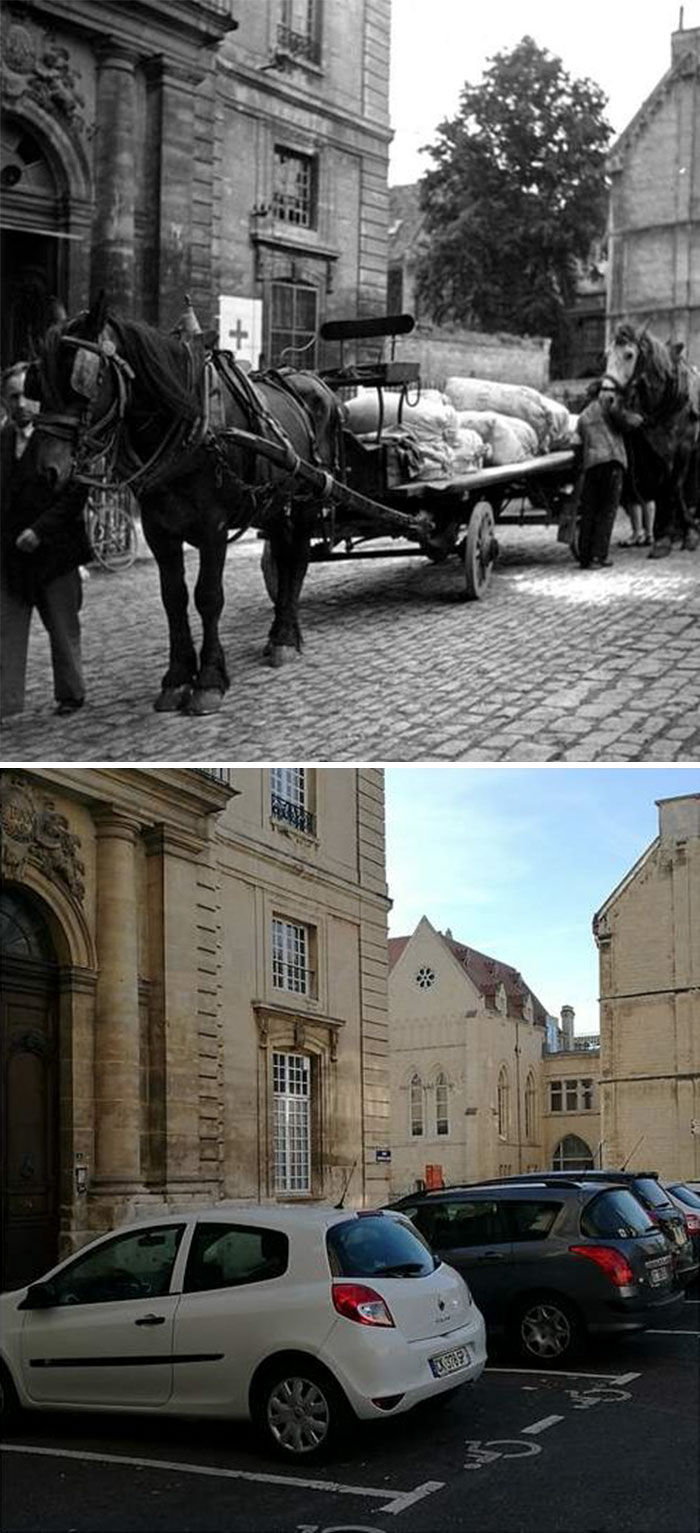
After parts of the city have been liberated by the Allies, horse carts bring food to those who took refuge in the Abbey of Saint-Étienne. 1944, July 10th.
Before photo: National Archives Canada, after photo: Lena.

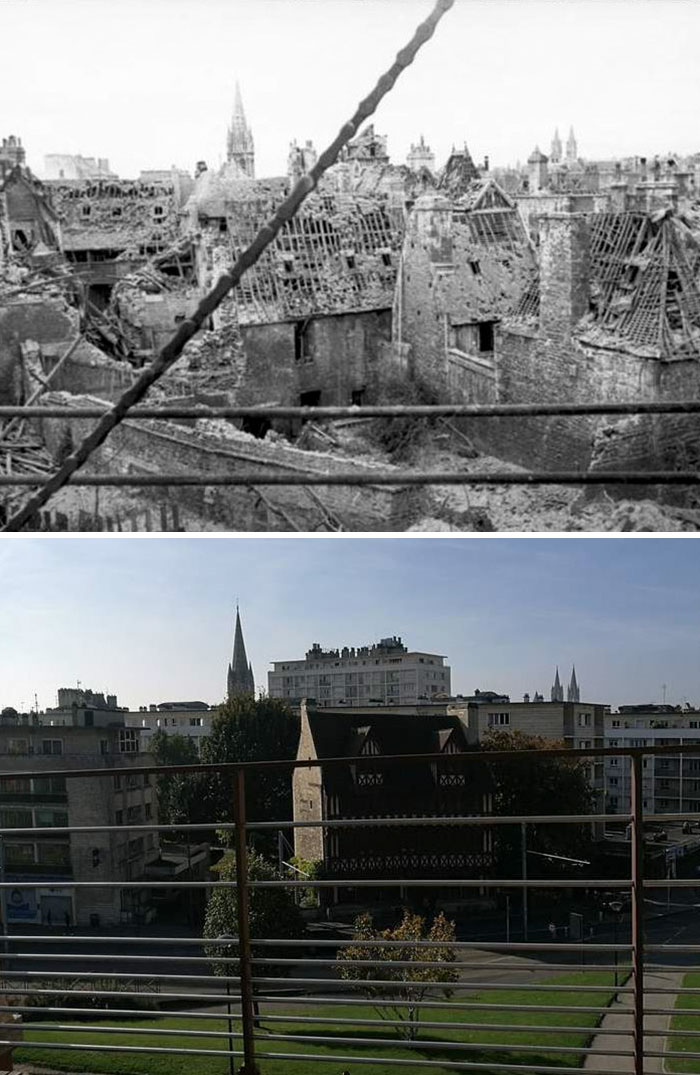
The "abbaye aux Hommes" (literally "men's abbey") in Caen ; the building on the left was part of the lycée Malherbe in 1944. It is now the town hall.
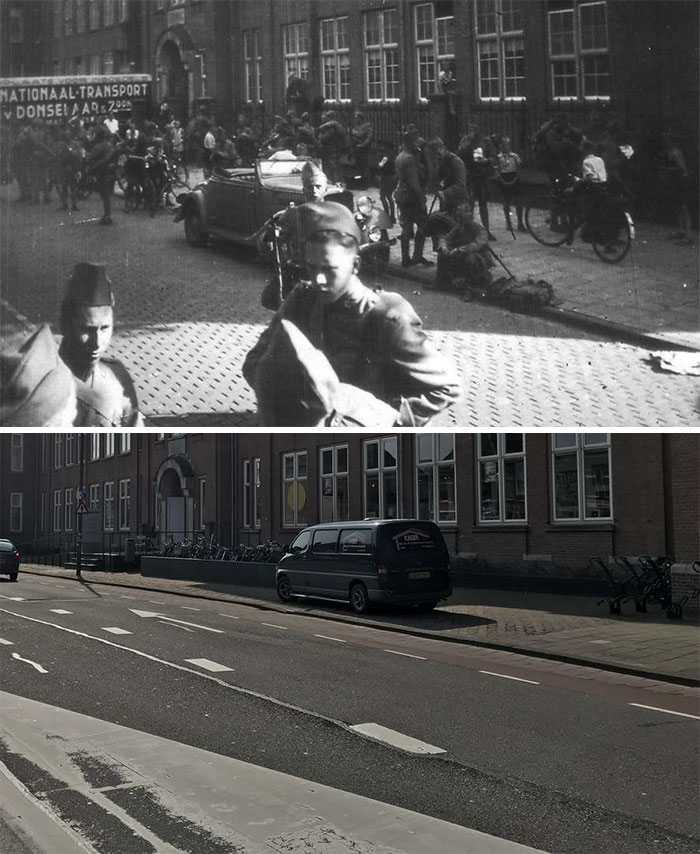
Mobilization Dutch soldiers before the "Ambachtsschool" in Alkmaar, The Netherlands. 1939.
Before photo: Unknown author, after photo: Regionaal Archief Alkmaar.
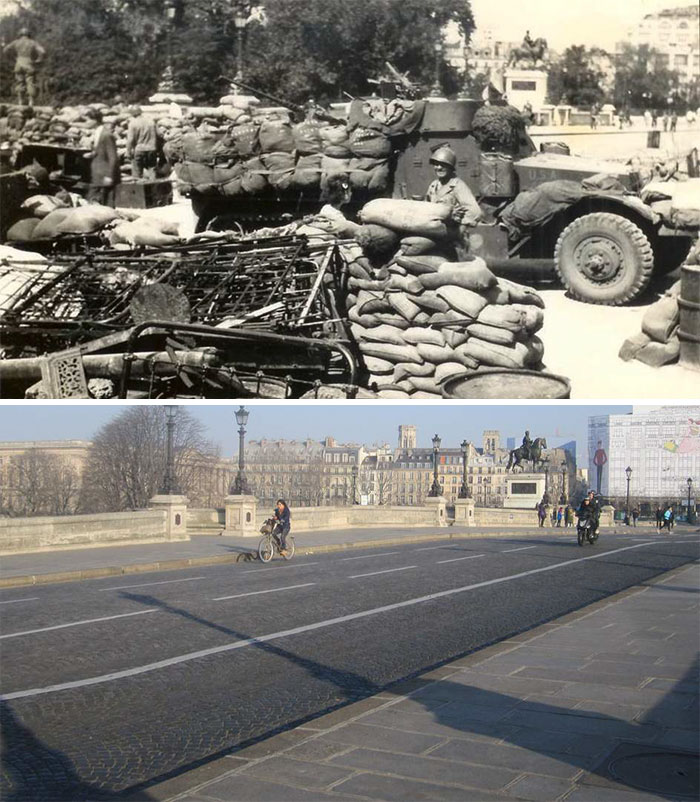
American soldiers on a barricade on Pont Neuf during the liberation of Paris from the German occupation, August 1944.
Before photo: anonym, after photo: Nicolai Wolpert.
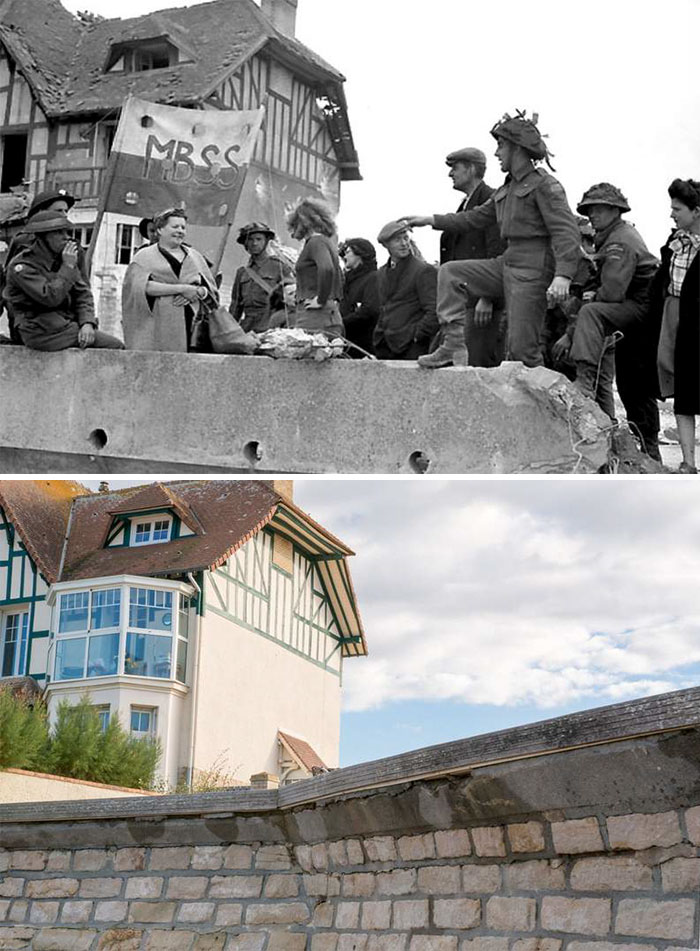
The villa "Denise et Roger" is one of the most famous places of the time of D-Day. The region around Bernières-Sur-Mer was liberated by Canadian soldiers on June 6. 1944.
Here, Canadian soldiers are talking with French civilians.
Before photo: Unknown author, after photo: Lena.
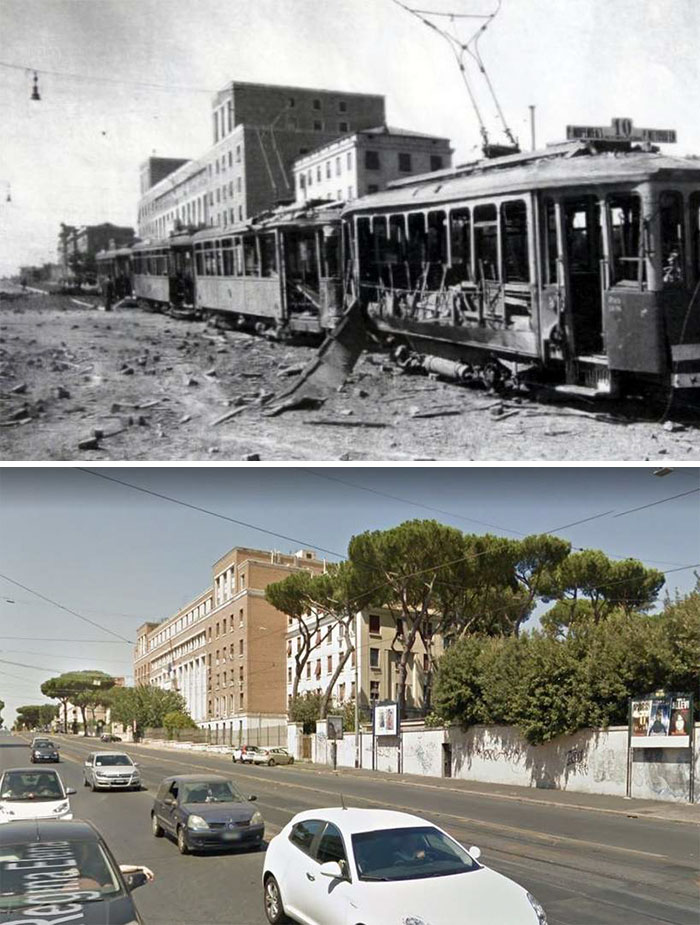
San Lorenzo, Rome, July 1943 Bombings, Viale Regina Elena Tram.
Before photo: LaRepubblica, after photo: GoogleMaps.
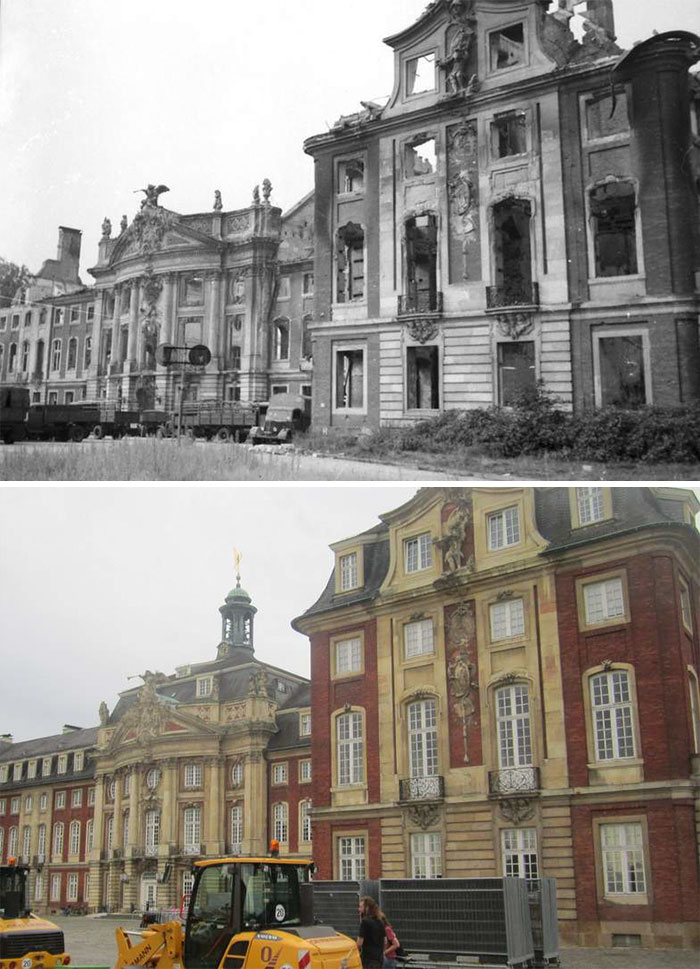
The Prince Bishop Castle in Münster is a 1767 to 1787 built baroque Residence Castle.
During World War II the castle became the victim of Allied bombing several times and suffered serious damage. Only the outer walls remained widely intact.
After the war, the British occupying forces first planned the complete demolition, but after protests by German officials, the castle was rebuilt in order to use it as an administrative and lecture building of State University. The building was completely gutted and only the outer walls reused.
Already in 1950, the first lectures took place. Today the castle is the symbol of the Westphalian Wilhelms University.
Before photo: ULB Münster, Sammlung Carl Pohlschmidt, after photo: Nicolai Wolpert.
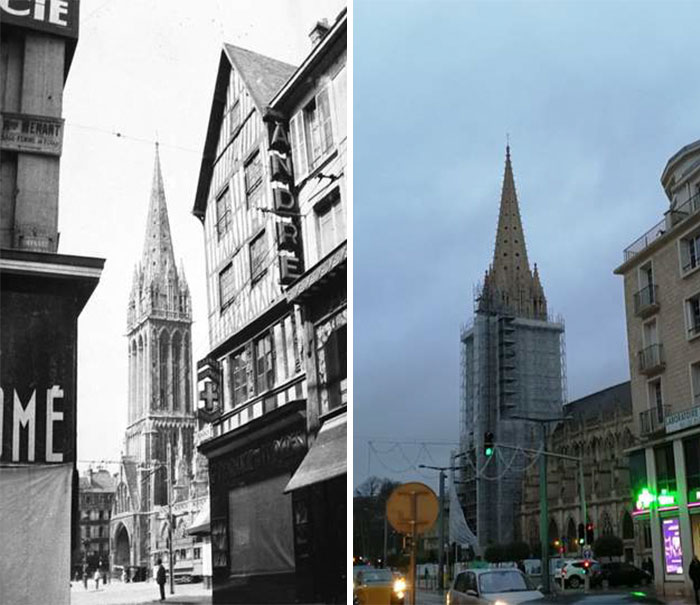
The entrance of Saint-Jean street before and after WWII. We can see in the background the tower of Saint Pierre's Church. 1925.
Before photo: Unknown author, after photo: jimmy144.
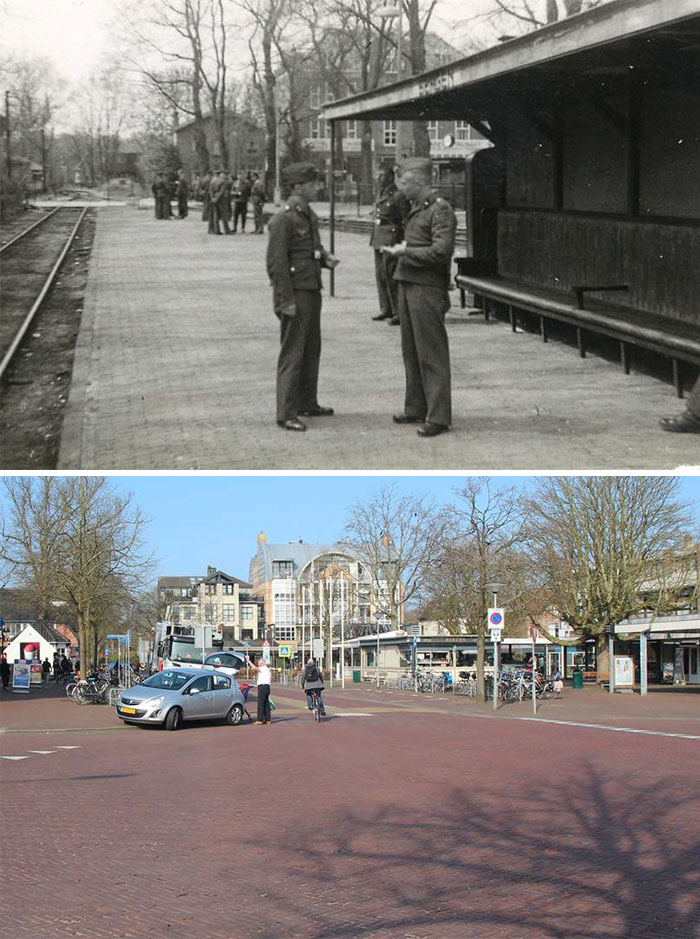
German soldiers waiting for the train to Alkmaar 1941.
Before photo: Unknown author, after photo: Regionaal Archief Alkmaar.
German soldiers in Alkmaar on the Canadaplein. 1941.
Before photo: Unknown author, after photo: Regionaal Archief Alkmaar.
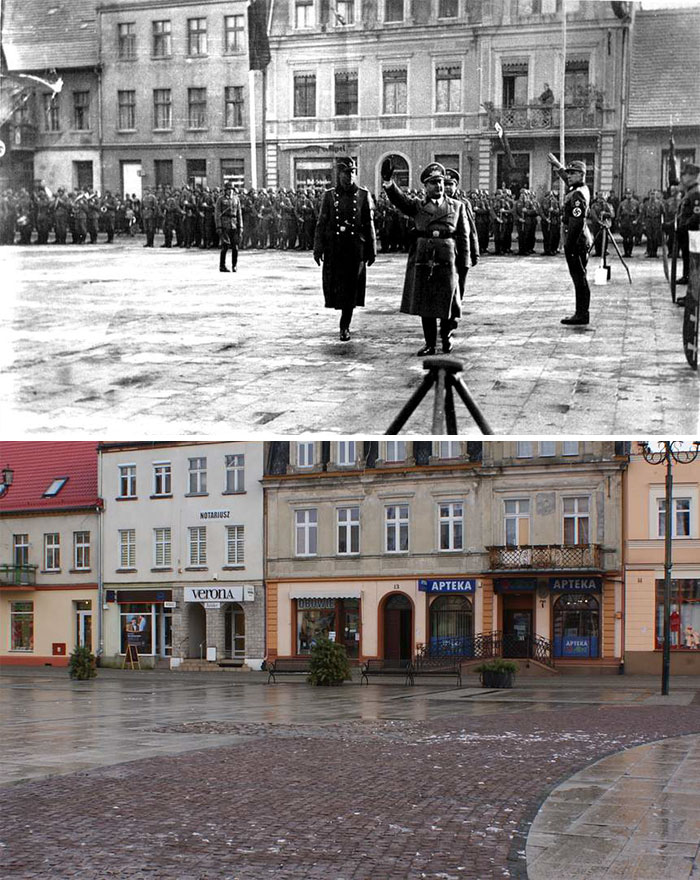
1941. German soldiers during the occupation of Żnin.
Before photo: Unknown author, after photo: Filip.

Żnin was not severly devastated during WWII. Maybe some before-after pics of Warsaw instead. Oh wait..they had to rebuild it all.
1945, May.
Before photo: Jonker, after photo: Regionaal Archief Alkmaar.

Is is interesting to a non-European like myself to note how LITTLE the architecture and landmarks changed in 80+ years, once the rubble was cleared up!
I thought the same thing. A lot of the windows, doorways, and other small details are unchanged.
Load More Replies...
When I used to travel for work, we used to frequent this one restaurant in Belgium, near SHAPE in Brussels. We were there late one night and the owner told use tales about his father. He told us to look outside and imaging German Half tracks parked just outside the place. He showed us some old photos on the walls, of the time. Very neat to see these photos. Gives you a real appreciation for the fact the Allies won the war.
Is is interesting to a non-European like myself to note how LITTLE the architecture and landmarks changed in 80+ years, once the rubble was cleared up!
I thought the same thing. A lot of the windows, doorways, and other small details are unchanged.
Load More Replies... When I used to travel for work, we used to frequent this one restaurant in Belgium, near SHAPE in Brussels. We were there late one night and the owner told use tales about his father. He told us to look outside and imaging German Half tracks parked just outside the place. He showed us some old photos on the walls, of the time. Very neat to see these photos. Gives you a real appreciation for the fact the Allies won the war.

























 No fees, cancel anytime