Get Premium
Dark mode theme is available exclusively for premium users. Learn more about the benefits of subscribing.
No fees, cancel anytime.

 Dark Mode Ad-Free Browsing Unlimited Content
 Ad-Free Browsing Unlimited Content Dark Mode
Join 1.2 million Panda readers who get the best art, memes, and fun stories every week!



Some people just glide through social situations like a hot knife through butter, while others seem like a stick in the mud. Thankfully, there are ways to fake it ‘til you make it, and many charmers are more than happy to share their tips and tricks when it comes to winning friends and influencing people.
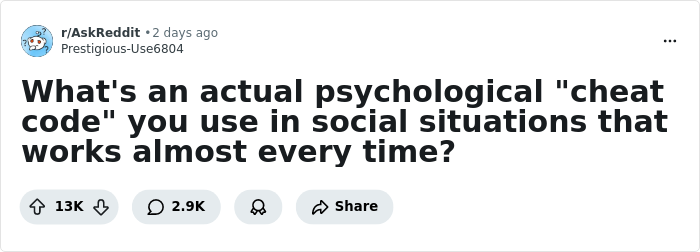
Someone asked, “What’s an actual psychological 'cheat code' you use in social situations that works almost every time?” and over 2,000 netizens said “no” to gatekeeping. They were happy to reveal the sneaky ways they get ahead in life. From muting yourself on a call to avoid interrupting someone, to complimenting an enemy to disarm them, some of the social life hacks may surprise you.
Bored Panda has put together a list of the best ones for you to scroll through during your next bout of social anxiety. Let us know your favorites by hitting the upvote button and feel free to share some of your own cheat codes in the comments section below.
This post may include affiliate links.
 When someone is angry-- like irrationally, psychotically angry-- get them to say "yes" to anything. (E.g. Are you mad? Do you want help? Do you want me to give you space?) It engages a different part of the brain, and after that's engaged, you can help them with problem solving.
Not everyone was front in the line when life handed out confidence. Fortunately, it's a trait that can be learned and improved, or even faked if necessary.
Life coaching site BetterUp defines social skills as the abilities that enable us to navigate social interactions effectively and authentically while building meaningful connections with others. They include things like engaging in conversation, small talk, and making eye contact, in order to better to understand and respect the emotions and perspectives of others.
Having good social skills benefits you in more ways than you might realize. Studies have found that isolating yourself, or lack of social connection, can be more harmful than obesity, smoking or high blood pressure. And that isolation is associated with a 50% increased risk of dementia as you age.
 This is probably quite specific, but as a Brit living in Berlin, I find channeling Hugh Grant is spectacularly effective.
This has worked with all sorts of German bureaucracy, government, work, doctors, personal, whatever.
In short, channel your very polite, self-effacing, mildly incompetent but apologetic about it Hugh Grant of the 90s. It helps if you can master a slightly shy look as well.
I should add that I look nothing like him - I'm a 190CM/105kg bearded bald bloke with full sleeve tattoos.
But there's something about this kind of behaviour which, as I've been told, conforms entirely to the German perception of the British and which they largely find irresistibly charming.
As proof, at my doctor's one of the nurses, who is just old enough to be my mother, insists on a hug and strokes my arm reassuringly when I have a blood test. I'm in my 40s and diabetic - blood tests are nothing special, but still her maternal instincts have locked on.
To all Germans. I apologise, but now I've found your weak spot I'll never stop it 🤗.



 Someone doesn't like you? Give them a genuine compliment. Keyword: *genuine* lol
I worked with this girl and we disliked each other. One day I just looked at her- she'd gotten her hair done- and I said "That looks really good on you!" and her usual stankface went to confused so fast lol. But you have to mean it- I did, it suited her. But your enemy will leave you alone for a while as they go ponder what chess game you're playing.

It's not always about making them question what game you're playing at... The positive interaction can stick with them and inspire them subconsciously to act more positively towards you in the future.
There are a number of ways to improve your social skills and one the best is to put yourself in someone else's shoes. "Imagine the other person's perspective and feelings," explains BetterUp. "This helps you practice empathy and respond appropriately during conversations or social events."
Equally important is introspection, or looking inwards. What are you feeling? What are you thinking? What emotions rule you? Why do you behave the way you do? What are your triggers?
"Developing self-awareness makes it easier to control them in social interactions, reducing feelings of being awkward or uncomfortable," notes the site.
 If someone says something rude or offensive to you, look them in the eye and ask them to repeat themselves as if you didn't hear them. 9 times out of 10 they will either back down or rephrase the rude/mean thing they said.
Or, I ask them to explain it as if I didn't understand what they meant - 10/10 works for me!



nah thats when you reply "huh, you really are as dumb as they said youd be. crazy" and walk away. doesnt matter if you know them or not, they will spend the next week trying to figure out who "they" is.
Load More Replies...
 When you want to learn something - facts, rumors, gossip, etc. State the fact but leave 1 detail intentionally wrong. The other person will love to correct you and give you ALL the information.
It feeds their ego, you learn what you wanted, everyone is happy with the result.
It works when I use it. I know it works on me as well.

 Speaking at a lower volume if someone is being unnecessarily loud.
One of my best friends has a LOUD voice she is completely unaware of, which can be incredibly annoying when we’re in public, so I will lower my speaking volume and she will subconsciously lower hers to match my volume.

Instead my family yells in public to humiliate me so that I shut up 🙃
You've probably heard of IQ, which deals with intelligence, and EQ, which measures emotional intelligence. But have you ever heard of SQ? SQ measures social intelligence (SI), and it's all about how we make sense of the people around us. SI also describes a person’s interpersonal abilities.
According to HealthHub, a socially intelligent person (someone with high SI) "displays strong social competencies and nourishing behaviours that make other people feel valued, trusted, and respected."
The site adds that high SI people are often "amiable and affable," and they generally interact well with others. In addition, they're often able to get others to cooperate with them.
 Acknowledge the queitist person in the group every now and then by linking the current conversation to something you remember about them.
The anti socials need some spotlight some times.
This is such good advice that I'll even forgive them labeling introverts as "the anti socials". For the record, we're not anti-social, just "differently social" 😁

And sometimes a mention of something they've said but nobody heard, too. They 're shy, not wrong.

As a differently social, I'm not sure I would want my name to be thrown in at regular intervals, possibly while I'm actively trying to be invisible. I'll come out of hiding if and when I feel comfortable with it
They're not *anti*social, they're most likely *a*social, not opposing everyone else's conversation but not sufficiently sure of themselves to join in

OMG as a truly painfully shy teenager who never spoke in social situations, I would have appreciated this SO MUCH!
If they're actually anti-social, there's a big chance they don't want the spotlight on them.
Not for me. I never said anything in my friend group because I was so shy, and indeed I hated there being a spotlight on me, but this led to a pervading paranoia that no-one wanted me there, or even noticed me at all. I would have appreciated an occasional acknowledgement so much! On the flip side, I firmly believe that, as a much more confident adult, I benefit hugely from being accustomed to assuming that no-one is ever thinking about me - other people seem to have so much anxiety around other people's opinions of them, which never affects me at all.
Load More Replies...  It's a small one, but it comes up often enough that it's been useful. People often repeat themselves and a knee-jerk response to someone bringing up something you'd already heard about is "**You've told me this already**", which incidentally has a somewhat negative connotation to it.
**Instead** of saying that, say "**I remember** you told me about this." It's more kindly affirming to the other person that you've listened when they told you the details/story in the past while also serving as a gentle reminder that they've already shared it. One response makes the person feel shut down whereas the other leaves them feeling heard. It's a small change, but it's come up a helluva lot and I like using it.
I'm using it. When I like the person, I say (enthusiast mode) "yes, I remember when you told me this, and X's reaction was priceless, right?" This gives good vibes, it highlights the interest of the repeated story without having to hear it again and the person is happy to see you remember and listened to them. Win-win.
 Always learn the names of the front office receptionists, custodians, maintenance crew at your place of work/volunteering/etc.
Always say hello to them and treat them like human beings. You would be surprised at how nice they treat you and help you out.
And it's the right thing to do anyway, since they are human beings who deserve to be treated with respect.

This is a life hack for everyone. Seriously, at your work, school, etc get to the know the behind-the-scenes people. They know EVERYTHING. The receptionists, admins, cleaners, maintenance and janitors. These are very valuable people to know and being on good terms with them can help you out in ways you don't even realize. Leadership is often there on late nights and end up chatting with the support staff a lot. So you p**s off the janitor? That might get back to the CEO the next time they're in the office late.


In Europe this could be thought of as weird; you'd generally only use someone's first name if you were on informal terms with them, such that you would use the informal 'you' (tu, du, etc.) and addressing them as Mr/Ms Surname would be inappropriate, although they may address you in that way. So you would need to have first established that informal relationship with them, which they may or may not be willing to do.
I am shocked at how the cleaning staff in our building are just completely ignored by everyone. I live in a culture where you acknowledge literally everyone you walk past in the hallways of your place of work, whether you know them or not, yet the cleaning staff are consistently ignored. I always make a point to acknowledge them like I would anyone else there, but to be honest, I don't know if they care. Maybe I'm the weird foreigner who smiles and says "good morning" when everyone else will just leave them alone.
Know your pharmacist, doctor's office, dentist office, insurance agent...the more personal contact with these people the better off you eventually are.
On the flipside, those with low social intelligence are often seen as unsociable, and leave others feeling frustrated, inadequate, and devalued.
However, these people aren't always intentionally unsociable. Instead, their behavior often stems from a lack of social awareness and not understanding or realizing how the way they interact affects other people.
 When someone is "stuck" -- they're surly, they're depressed, they're anxious, whatever and it's making it hard for them to engage and have fun -- hit them with something absurd.
Like when my kids can't seem to get past having a rough day at school: "anything I can do to help? Food? Water? Send a genetically engineered giant capybara to demolish the school?" The absurdity of the last one is kind of like giving the stuck brain a little shake. It doesn't immediately fix everything, but very often it gets them unstuck enough to stop obsessing and start on the path to a better mood.

I am sure that works for a lot of people, but for me it makes me feel unheard and like the person is making fun of me. Perhaps I am the only one who feels this way.

I think it often depends on the way it's said. A grin or a wink often helps too.
Load More Replies... I wouldn't do this unless you know this person REALLY well. It's far too easy for that absurd thing to come across as you mocking and demeaning them. It can very easily read as passive aggressive critique or dismissal. You think you're lightening the mood, but they think you're insulting them for having an issue in the first place. You should at least do this AFTER you've validated them.

When my kids were little, if they tripped or fell or bonked into an inanimate object I would "get mad" at the object for hurting my kid. Always made them giggle.
I remember one of the down points of my life - mid pandemic, lots of stress at home and at work. Things were really bad for me. Then I put on Middleditch and Schwartz on Netflix, and I was in absolute tears of laughter after 5 minutes. It's a ridiculous comedy, and helped me so much. As a result, I have never sunk as low as just before I watched that show, and life is a lot better now.

Humor is good and can help, and it's about how you say it. You can say it in a way that still shows you care and understand, but also that you want to cheer them up or take their mind of their worries. In sadness there can also be laughter. I've noticed I can get my teenage son out of a bad mood quite well with humor. My teenage daughter can get depressed easily, and takes things very personal, so after comforting I add some humor and that alleviates the "pressure", the energy in the room and seems to give breathing room again. It comes down to who you use it on and in what way.
 My hack has turned into a hobby. I look for people doing a good job. When I find someone that is pretty good at what they are doing I make sure to compliment them, tell their boss the good news, and, if applicable, I tell corporate.
It's surprising how much that helps the person, how much it confuses their boss since its not a complaint, and how long that its remembered. Later on, if I return to the same place I get better treatment and that can lead to others you are with to think better of you.
Inversely, when I see others treating people badly, particularly those in a service position, my opinion of them goes sharply down. I am far from the only one like this.

Deplaning at midnight, I left my new tablet on the plane. The flight crew called the mothership who called the cleaners, and 10 minutes later, somebody brought my tablet out. They just wanted to get to their hotel room but stayed to help. Captain Ben and the crew were so cool, I submitted a compliment to Alaska Air. About a month later, I got a response from Alaska - We apologize for the delay. We only get complaints on this webpage so it took a while to figure out how to let Captain Ben and the crew know."
Well your kindness worked, anyway - compliments oil the world's turning
Load More Replies...  When my social battery dips, I dip. It’s to no one’s benefit to be somewhere you don’t want to be.
Likewise for anything I "need" alcohol (or whatever your vice is) to enjoy! If I need alcohol to enjoy it, it's not really enjoyable and my time is better spent elsewhere.
If you want to hit Ctrl + Charm in life, experts suggest this: Master connecting with people and relationship management. In other words, make other people feel comfortable around you and like they are being seen, listened to and understood.
Show curiosity, suggests HealthHub. "Ask people questions that show interest in their lives but avoid being intrusive." The site explains that it's all in the way you ask a question. For example, "Tell me more about your weight-loss programme" is better than “How much do you weigh now?”
 Being comfortable in silence is power. Especially in any sort of negotiation, complaint, somebody asking for something or vice versa.
For some reason when you stay quiet people break.
 If you're talking to someone on the phone or online, mute yourself to avoid interrupting them. That way even if you do say something, they don't hear it and don't get interrupted. This is pretty much a must for me with adhd always wanting to jump in....Now if only I could find a similar solution for in person conversations. Covering my mouth with my hand tends to get weird looks and questions.
If anyone has found a similar solution for in person, please share! Inquiring minds want to know
When I would get worked up in meetings I always wrote замолчи ("shut up," in Russian, sounds sort of like "zamolchi") and that way I knew no one could see me telling myself to shut up since very few people in the US know any Russian. I did have a consultant come to work with us once who was curious what I was writing when the meeting was getting intense and who laughed when I told him. He later took my notes with him, so either he wanted to show others that I was crazy or maybe in some meeting far away in a distant galaxy someone is using the same technique.
Load More Replies... Introvert here. Please, please, lovely loud people, learn to listen. Don't try not to talk, but focus on active listening. If you really want to listen you can't talk at the same time. Active listening: try to hear the core of what someone is saying and repeat it back, then ask a follow-up question. I have a hard time getting in even one word during meetings. I'm 100% sure that if my colleagues would only give me a little space everybody would benefit from what I have to say. I just won't scream over the others or interrupt, because I'm genuinely listening.

It's too obvious to literally curl a lip into your mouth to bite, but, whatever you want to call just inside your mouth behind a lip (top or bottom, it doesn't matter): gently hold that between your teeth.
A professor told me once he had a student who talked too much, so he gave the kid a small number of bingo chips - 3 or 4. Each time the student said something, he had to put a chip away, and when they were all gone, he was not allowed to say anything anymore. Ever since then, I've been giving myself imaginary chips in meetings. Every time I have something to say, I now ask myself if it's worth a chip, and once I've used them all, I stay quiet unless someone asks me something. It totally works.
Press your tongue upwards onto the roof of your mouth - it's something to do and it reminds you that you're not talking , you're listening.
 Want someone to do something annoying or anxiety-producing? Don't try to reassure them with how easy it'll be: tell them it's hard but you believe in them.
Which sounds more reassuring to you?
* "Just take on the monthly report, it's not that hard, don't stress about it!"
* Or "hey, I'd like you to take on the monthly report. I know it's a big and challenging project, but I also have seen your work and I know you can do a great job.".
The praise and confidence built into this technique give it a good probability of succeeding, most of the time. Everyone wants to feel that they have reserve abilities
It's also important to listen actively without interrupting.
"People like to be heard," explains the site. "Allowing them to talk with minimal interruption lets others see you as caring, trustworthy, and likeable." And if you struggle to keep quiet, use one of the hacks on this list: mute yourself while on a call to allow the other person a chance to speak.
 It’s a meditation exercise. Before I go to an event, I imagine the room, the people in it, and the way I want to feel while I’m in the room. Sometimes I imagine a light sweeping over everyone like it’s sprinkling good vibes. I’ve noticed that it makes me feel more confident and easy going when I have some anxiety about going somewhere.

This is sort of a higher version of “I pretend everyone is naked.” Lol
 I tell myself "social mode: on" when going into social situations.
It works surprisingly well in getting me to talk more and be more of a part of conversations.
 This has worked for me in public setting when i get anxious people are watching me. Counting my steps. one two one two one two... all the sudden i'm not worried about being watched. idk worked for me.
Self-distraction - just avoid announcing the current number out loud ...
Finally, we said it before and we will say it again: Put yourself in the other person's shoes. Tune into their needs and feelings. If you can understand what others are thinking and how they’re feeling about things, you're already winning. Of course, this ties into empathy... "When people sense your empathy, they connect with you better," HealthHub explains.
Remember that social intelligence takes practice to master but that doesn't mean you can't fake it 'til you make it.
 Be overly nice to customer service representatives. Ask them how their day is going, calmly explain the situation and ask if they are the correct person to handle it, assure them you know they are not responsible and you'd appreciate their assistance in correcting the issue, say please and thank you. The old adage that you catch more flies with honey than with vinegar has proven astoundingly true. For the most part representatives will bend over backwards to help a kind person.

Treat them as if you were explaining to a family member and as if you feel assured that they will see your side of things. Complicit, rather than confrontational. We're going to find a solution together to this problem neither of us created. It really helps to see them as partners, not as opponents.
Everyone you meet is fighting a battle you know nothing about. Respect them for that.
Load More Replies... Start with: "I have a big problem, and I hope you can help me with it." It works, because people usually like to help, a big problem is a challenge and sounds interesting, and when they can solve it with relatively little effort, even if they have to work around some rules, they feel good about themselves.
Nah, not overly nice, that's too fake and would "itch" me. Just be polite, be normal. Overly nice sounds like taling with honey but seething rage underneath.
Exactly. Be genuinely nice and present in the moment. Overly nice feels like a con artist about to make me their next mark.
Load More Replies...  It's not really a "cheat code," but… Build up people who are part of the same social circle but aren't currently present. For example, if you're out at dinner with your normal circle of friends and one of them isn't there, talk them up and share something positive about them to the rest of the group. Without consciously thinking about it, we start to become aware of the kind of things people in our social circles say about us when we're not present. Sort of like the "if he cheats on his girlfriend to be with you, he's going to cheat on you at some point too," there's a real character-revealing element when someone is bad-mouthing someone who isn't there, where we recognize that we might be spoken negatively about by the same friend when we're not there.
If you tell your group, "man, I can't believe how good John is getting at guitar" when John isn't there, you're planting seeds of trust in the others in your circle that if they're ever the ones that are missing from the social situation, you're more likely to be building them up than tearing them down. If you tell them, "I can't believe John still has that stupid mustache" and try to get a laugh out of them (assuming you wouldn't say that to John if he were there), you might get some laughs, but you'll also be planting seeds of distrust instead.
More broadly, apply the same technique even if the person is present. If you're hanging out with two people you know who don't know each other well and the subject is about desserts, tell Jenny, "Sarah here is an incredible baker. She made the best chocolate chip cookies for our Christmas party."
None of this has to be obvious or overt. Don't force these sort of things. But if you can associate in people's heads a sense of "this person builds people up" instead of "this person tears people down," especially (but not exclusively) when the person they're building/tearing isn't there, you're going to build a sense of trust in others.
 I pretend everyone I meet is in love with me. I mean, not *literally*. I'm not a complete narcissist. But I'll start conversations with strangers who give me a smile or a knowing look. Assuming they like me makes me feel more likable. I've made friends more easily in my 30s than I did at any other time in my life.
Romanticizing my life is fun, and gets me to act more vivacious and charismatic. It's also just good practice for higher-stakes social interactions where I might lack confidence.
When you convince yourself you're interesting and most people would like if you talked to them, it works. I'm a shy weirdo with social interactions troubles but nobody could guess. And people often like when I talk to them (just read the room). So it's comforting me and it's making a virtuous cycle.
"Virtuous cycle" has entered my vocabulary. TY
Load More Replies...  I'm not a native speaker of English, and I live in the UK. I tend to ask native speakers what a 'cheeky Nando's with the lads' means, and ask them to explain why it is cheeky. For some reason this always fixes the situation when conversation is slow.
It's not a particularly-used phrase, but it is a good example of British slang. I'm guessing you know Nando's is a chicken joint. A "cheeky" something means an impromptu visit to somewhere that's either not good for you, or not condoned, by a partner, say. "With the lads" suggests this last, that you're a guy going out for chicken with your mates without telling your partner. You could equally be going for "a cheeky pint" or "a cheeky Maccy D's". Nandos is fairly irrelevant. The point is you're off with your buddies for an unplanned quick and indulgent jaunt of sorts. It's a good conversation booster largely because it doesn't have an easily defined explanation, but it is recognisably a Brit thing that a foreigner would need explaining. And most people love explaining things.
Load More Replies... This works well in France as well if you are learning the language. There is no one happier in the world than a French person that you have asked to help with your French.
 If you're in a group of 3+ and someone is talking to you and you don't want to participate / respond / lead the conversation, rather than looking at the speaker, look at the other person. The speaker won't be able to keep talking at you whilst you're looking at the third person, they'll have to quickly switch and address their speech to that third person. You're then free to slink away quietly. Works every time.
I use this when someone is left out of conversation. I try and visually include them and send the hint to the speaker to do the same.
Cool, so intentionally ignore or look disinterested when someone is speaking to you. Noted.
Not quite, you're redirecting the group's attention, not deflecting it.
Load More Replies...  An effective way to deal with passive-aggressive comments is "stupid and cheerful." Don't read into their comment, rise above it.
Ha, love this one. Works wonders when I encounter people with nonsensical road rage 😁 "Just smile and wave boys, smile and wave..."
Or profusely apologize for any inconvenience you made and k**l them with kindness.
 Tell the truth all of the time. Go out of your way to correct yourself when you've mispoken. Example: "I was talking to Fred last Tuesday. We were... wait, no, I'm sorry, it was Wednesday."
Along those lines, if you mess up, fess up to it without offering excuses and apoligize. If it's work-related, maybe throw in how you've ensured it won't happen again.
Do these things and people will rarely doubt you and if they do, others will stand up for you.
But don't be the person who corrects themself on the littlest detail every other sentence. I don't care if it was last Wednesday or last Tuesday - it usually doesn't add anything to the story, and after the 15th time that they have corrected themself on whether it was a rainy day or just an overcast day or if it was 3:15 or 3:30, I am ready to punch them in their little nose.

Or you could try to not obsess on trivial details, that don't really add to the story, but instead confuse your audience!
Load More Replies... Also something like "I may have remembered it wrong, but..." if you're not exactly sure of your memory. More common as you get older!
 If there is something going on that is important, mostly at work, and someone asks you "have you heard about (fill in the blank)?" ALWAYS answer no. That person can tell you what they understand of it and it gives you different perspectives on the issue, different points of view, and you might even get new pieces of information that you just saying "yes" to the question might not be told to you because they assume you know everything.
I have done this for years and it is very effective in gathering information.
I'd only say "no" if I actually haven't -- every time will give the impression that you're completely out of touch. People will still give their information if you say "I've heard bits about it... Probably not the full picture. What's your take?"
I don't say 'no' if I've heard something or if I'm supposed to know something. Instead I say "Go on, tell me". Then I can give my own insight.
 If you're a manager or just in general when asking people to do something you'll get way more out of them if you say something to the effect of "I know you're busy, but can you do X for me?"
The effect of this is threefold.
First, I've validated you. The work you're doing is being noticed and I know that what I'm about to ask is going to be an inconvenience. You can further emphasize this aspect by saying something like "but I can only trust you to do this"
Second, I've set the expectation that what I'm about to ask for is more important than your current work/tasks. I know you're busy, but I'm going to ask you to do this other task anyway. Therefore this must be more important. You can emphasize this by saying something about how this is needed ASAP or for a specific client or whatever.
Third, by phrasing it as a question, I've given you the option to tell me, "No." I've heavily encouraged you to say, "Yes," because of the two above points, but I have at least given you the option. This is important because it does legitimately give them the chance to confirm with you that their other tasks aren't more important.
Psychologically speaking, by giving them this option it has become their choice. They decided they would do this thing for you. It was not mandated to them. So they have a more vested personal interest in completing it.
Many people do this subconsciously.
 Have a hard time with eye to eye contact? don't do it! Talk to their nose, you need to be uncomfortably close for people to realize you aren't looking at them .
It wasn't until I was in my 40s that I realised you're supposed to look at people's eyes when you talked to them - I always looked at their mouths, because that is where the sound is coming from. I guess people thought I was really awkward for most of my life (true lol).
Nose is good, but not eyebrows - that might come across as an attempt to dominate.
 In emergencies, there's this old instinct in us to be less likely to act if there's more people around us. It worked wonders when we where hunter gatherers, don't stick out and all that.
So people aren't being mean, it's a really old survival mechanism that stops them from helping out. It's as fundamental to us as any other instinct, so it's difficult to break out of.
What's neat is that there is a super simple solution. Point a single person out and tell them what to do. It will almost always work and people are now not worried about doing the wrong thing. The entire group is now free to act.
I've had to use it once and it really worked.
This, bystanders not helping is like a group freeze, people think others are already on it or don't know what to do. Pointing to people: You! Call the emergencies. You! Go and alert traffic. You you you and you, form a barricade for nosy people. etc. Might help if you are in a situation like that to start with: Me! Tell people what to do!
Yes! But use names or identify them by their clothes. "You, STEVEN, call the emergencies. Blue dress, go deal with traffic, You three with the Nordstrom bags, form a barricade" Pointing is helpful, but if you use a name/identifying character it's harder for them to assume you meant someone else.
Load More Replies... Yep. I've done this. Also even if you don't have authority, if you're loud and commanding, people will listen to you. I've put my arms out as a barricade to hold people back from the emergency and they listened.
Keeping the scene clear is an important first move.
Load More Replies...  At a group dinner, after the bill is paid, I say “welp” slap my hands down in both knees and standup. So far everyone then stands up after me and the group heads out the door.
Take note of every single thing that gives you even the slightest bit of joy. My cat purred when I pet her today, it’s great sleeping temperature weather, my clothes are very comfortable, the flower I saw was pretty, I saw a dog, there was a rainbow reflection on the floor, my shower felt great, that joke was funny, things like that! Plus a constant gratitude list, I’m grateful I have access to good tasting food, I’m grateful for birds because look cool when they fly, I’m grateful for the cat tower I got because my cat loves it, I’m grateful for the McDonald’s free apple pie coupon I got because it was really good. It changed my perspective a lot.
I've got to the point where I say "thank you" to traffic lights that let me through without a stop. I'm hoping to train them ...
I like to thank the cars in front of me when they move during a traffic jam. It really helps!

I end every day by listing 3 things that I'm grateful for and 3 things that went well for me that day.
When someone is defensive or standoffish, I will ask for their advice on something small - even if I already know the answer.
People relax fast when they feel useful instead of judged. It flips the dynamic from tension to helpful / teamwork almost instantly.
Whenever something bad is happening in my life, I remind myself that one day I'll be gone and it won't matter then what is happening now.
When I can feel tension rising during an argument, I dramatically call out an invisible "distraction". I learned this from watching dog whisper.
When Caesar uses a sudden distraction method to break the dogs concentration and diffuse a potentially aggressive situation. He usually touches the dog quickly which in turn startles the dog and breaks their concentration.
For example: My bf and his brother are both hard headed and can get pretty tense in the simplest of situation. Once they start talking through clenched teeth, I know I need to step in. I usually break their concentration by pretending to fall/ trip over something or by loudly exclaiming something like "Oh s**t what was that?" or groaning loudly saying "oh no" to which my response to their "what's wrong" is me saying "nothing" and looking on the ground like I lost something.
This also works on my bfs infused ADHD issues and talking non-stop to someone who has lost interest.
 If you're about to cry in a situation where you really don't want to cry, immediately start doing difficult math problems in your head at a rapidfire pace. As soon as you solve one, jump into a new one and keep going until you notice the physical cues for crying have subsided, then for the love of all that is holy, avoid direct thoughts of whatever made you emotional to begin with lol
The key is the math problems need to be difficult enough that you have to stop and follow the operational steps in your head, but also still solvable for you personally. If they're too easy, your brain will give the answer without switching emotional/cognitive gears. If it's too hard, your brain will disregard the question & keep you in the emotional place.
This has been very effective for me when I needed to hold it together for just a little longer. Just be sure to circle back and feel those feels fully when it's safe to do-so so you can actually work through them. It's detrimental to your mental & physical health to constantly push them away, so...don't do that.
What if the thing that’s making me cry is staring me right in the face and if I don’t adress it then I get into even hotter soup?

The trick to stop me from crying is to scrunch up my nose for just a second. Stops tears 100%.
I don't think this will work if you're not a math person. The first equations that come to mind are simple addition/subtraction. Anything more complicated and I need a calculator or paper and pen, because I can't do complicated math in my head. Never could.
I am emphatically not a maths person, but I think something like 12x15 would work. I know what 12x12 is, but I'd have to think a minute to go to 15. Just enough to work out 12x12 plus 3x12, which is doable, just not instantly.
Load More Replies...It's tremendously hard to maintain high levels of anxiety / disassociation when eating really sour foods. I keep emergency sour candy on me / my bag / my car.... etc. to pop in when I'm feeling particularly stressed or anxious.

I'm going to try this one, too. Thank you BP - and OP !
Load More Replies...  Every time I feel insecure, I think of the dumbest person I can who has done what I'm trying to accomplish and think "well if that idiot can, so can I.".
My PE teacher managed to solve a couple of difficult physics questions in less than half the time it took me. That kind of made me feel even dumber
The only person you should ever compare yourself with, is you, a few minutes / days ago. The others have different life experiences and dis/advantages, so don't count.
Load More Replies...  Remember what they said to you the last time you saw them. If you last saw them a month ago, if you remember they were doing a thing , remember that thing and mention it.

Yes. Memory-ception. And don't you forget! …to remember to remember
Load More Replies... This shouldn't be too difficult. Our brains have a habit of helping us out. If you hang out at their house and the dog does a silly dance, the next time you're in that space your brain may have already pulled up the silly dog dance memory in a "this happened the last time you were here, maybe it's relevant now" . That's why, if you're in the kitchen and think "I need to go brush my hair" and then by the time you get to the bathroom, you forget -- if you go back to the kitchen, your brain might suddenly remember why you left the kitchen.
 I've seen people swear by "The Solid Snake Method" for conversation. Just repeat something about the other person's statement as a question.
"As a question?"
Yeah it keeps the conversation going.
"Keeps the conversation going?"
Yeah at the very least it shows that you're paying attention.
"Paying attention?"
At this point though you should probably stop. It doesn't work forever, and it doesn't work all the time. Probably shouldn't use it to respond to questions with another question either.
No, don't do this, this is highly annoying to the other person, and will make paint yourself dumb. I had a coworker who did this with every conversation, you needed to stop all the time explain things like you talk to someone who can't understand simple sentences, it makes feel like they are dumb because they can not understand simple statements and also doubt yourself if you speak the same language....
 Anytime someone brings up a political thing I don’t want to engage with I simply say “I don’t have enough information to have an opinion on this” it almost always shuts down these conversations.
Until they start imposing the 'information' that they have and insisting there is no other valid viewpoint.
Being slightly more polite than the norm (which isn't saying much) is very disarming. "Yes sir, no ma'am" is a gesture of respect, and everyone wants to feel respected.
So you know that 'counting sheep' trick thats supposed to help you fall asleep? That never really worked for me. Ive got ADHD so maybe its a case of not being able to keep focus because I'd find it boring and get distracted by other thoughts
My trick though is very similar - I just think of fun stuff and literally daydream about it, just with my eyes closed. As long as the theme/topic/story that I'm daydreaming about is consistent, and my eyes are shut, then I'll be asleep within minutes even if I'm not actually that tired. Works for if I'm trying to get to sleep on a sofa or on a flight or something too.
I don't know why this works, I assume it's similar to counting sheep but better suited for how my brain works, but my fiancee doesn't have ADHD and it works for her as well 🤷.
Same. I have a book I'm planning, and I go through all the good bits and embellish them (the central character is based loosely on me). It helps distract, and occasionally adds details to the story.
Nope doesn't work for me because then the story gets excited or I need to edit a detail back in the beginning so I can't fall asleep yet as I want to know how it ends. I swear I have created many great stories but also rebuild my house an garden a million times.
Load More Replies... Same. Last night I couldn't sleep, so I started trying to come up with famous names that started with the same letters (Ansel Adams, Barbara Bush, Charlie Chaplin, etc).

I tried and counted and counted and there was always 2 missing that I couldn't sleep all night long
From an early age, about 6 or 7, I used to tell myself stories to get to sleep. I would be the main character in the story and would make up different scenarios in the life of the character. Eventually honed it down to about 3 regular stories, but it got to the point that it became a Pavlovian reaction. If I started telling myself stories in my head at any other time, I would fall asleep, so I stopped. These days if I'm having trouble sleeping, I use a technique I call "internal thinking", which is derived from the storytelling. I imagine all my thoughts are contained in a box in my head, and I visualise closing the flaps. If I start thinking about things "outside the box", i.e. real world things that are going on, I can't get to sleep. I have to keep it to thoughts and situations that are contained in my head.
 If you act a mood, then your actual mood will follow.
Feeling bad but need to get it together for some event? Just smile, and your mood will follow. It doesn't cure depression, but it's a good way to get in the zone for something temporary,
Mostly useful if you're at a party and you want to be having fun but you're just not feeling it at the moment.
It doest work.I'm grumpy in the mornings and I'd prefer to walk around with a sour face and not be polite and not greet people. But other people have done nothing wrong so I suck if up and greet them and say goodmorning with a smile. They smile back with a greeting. Slowly that lovely grumpiness and stupidness of the world fades and it becomes ok to be awake.
Load More Replies...  If you and your partner are most likely going to get in a fight about something, you can negate any and all shouting by carrying a cat to deliver whatever news will cause shouting. No one will yell at you if you're holding a cat, and you'll just go right to the go for a drive/sit in room/smoke phase.
If I did that my partner would want to know whodafuck's cat I've stolen!
The effort needed to collect two cats at the same time will likely make you forget what the fight was about, anyway
Load More Replies...When speaking to a large crowd, speak to them as if youre speaking directly to one person.
Acknowledge, Align, Assure:
• I understand your concern,
• I’d feel the same way in your position,
• I assure you we’ll find a solution.
Raise my eyebrows when I smile hello. Usually we only do that for people we recognize so it makes people feel like they are already accepted.
If someone comes up to you and says hi, and you can't remember how you know that person, then say "how have you been" instead of "how are you". 99% of the time they'll start telling you about something that was going on the last time they saw you, and that will jog your memory about where you know them from.
I remember the faces but not the names so I can tell where and when I saw you but will take years for me to remember your name... I usually tell this when I am introduced (ok sounds weird if you've a nsfw mind) someone new so no offence if I ask 100 times what the f... is your name
Me too. I've given up pretending I know them. I just apologize, say "i've forgotten your name" and they usually laugh and tell me.
Load More Replies... Every year of college I would run into this girl and never remember where I met her, or even her name. She would mention all kinds of things about me, but nothing that would narrow down where/when I met her. I was a theatre major, so she even knew the shows I was in. She was very nice, never said or did anything creepy. To this day, no idea who she is or how we met.
When dealing with narcissistic people who are causing issues at work, don't look them in the eye, look at their forehead when addressing them. It disarms and belittles them. Only speak to them when absolutely necessary, and use a tactic called gray rocking otherwise.
They'll eventually leave or get out of your way because you don't feed their social battery.
Gray rocking, or the grey rock method, is a tactic some people use to deal with a*****e or manipulative behavior. It involves becoming as uninteresting and unengaged as possible so that the other person loses interest.
Load More Replies...  Eating and fear don't go together. So if you're scared or anxious, eat something. Doesn't really matter what as long as you're chewing.
A being that fights for survival wouldn't stop to eat mid-fight, which means the brain is conditioned by your ancestors spending centuries to fight for survival that if you're eating, you're safe.

Yes! Same muscles are activated which helps trigger the brain shift. I also learned in theater class that anxiety is just energy and I am in charge of how I use that energy. I would tell myself the butterflies I felt before a play wasn’t anxiety, it was excitement. Definitely helped. And speaking of butterflies in the stomach, I read about a gymnastics coach who would tell any nervous athletes to “get their butterflies flying in formation.” Another way to think about harnessing nervous energy for the better.
Load More Replies...Every time i enter the room i assume i’m the dumbest person in there. it’s the mindset that helps me read people better and prevents me from acting self centered. people just love to feel smarter and more experienced, and sometimes you can learn many things from them as well.
My dad told me once "Act like you've known someone their whole life".
If I can't remember someone's name I apologize and follow-up with something like "I used to be in the military so I'm used to everyone having their name on their shirt. I'm really sorry".
A lot of people are bad with names and I really don't know anyone who remembers them. Saying this takes all of the social pressure out of the situation when I can't remember someone's name and it gives everyone an out: I say why I don't remember a name and I also imply that it's okay if you forgot mine.
1.When someone directs anger in your direction that is either not meant for you or is an overreaction to what caused the anger, be overly apologetic and really "lay it on thick" they will usually realize they were irrational in their reaction and end up apologetic towards you.
2. If someone doesn't want to give you information and is actively gatekeeping info you need after asking. Instead of asking, act like you have it figured out and tell them you know the right answer and feed them the wrong answer. People are so quick wanting to correct you with the proper information they will forget they meant to gatekeep it in the first place.
If I’m at a family event and the person I’m talking to has adult kids, I always ask them for parenting advice since they’ve done such a good job. It instantly gets them talking and I can just chill.

Mine is my language and the words I choose. I don't just mean my self-talk like not telling myself I'm a bad person. I mean, literally, choosing specific words that mean specific things. For example: "plan" vs "goal." I use the word "plan" for events I have no control over. I always plan to pick my son up from school at 2:20 because that's when school gets out; I have no control over and cannot change the time school lets out. But I have a "goal" to finish my degree before 2030. A "goal" can be changed and altered as needed; I have a certain amount of control over it.
Mine is my language and the words I choose. I don't just mean my self-talk like not telling myself I'm a bad person. I mean, literally, choosing specific words that mean specific things. For example: "plan" vs "goal." I use the word "plan" for events I have no control over. I always plan to pick my son up from school at 2:20 because that's when school gets out; I have no control over and cannot change the time school lets out. But I have a "goal" to finish my degree before 2030. A "goal" can be changed and altered as needed; I have a certain amount of control over it.

















 No fees, cancel anytime
 then open in external browser

 and click "Open in External Browser"