Get Premium
Dark mode theme is available exclusively for premium users. Learn more about the benefits of subscribing.
No fees, cancel anytime.

 Dark Mode Ad-Free Browsing Unlimited Content
 Ad-Free Browsing Unlimited Content Dark Mode
Join 1.2 million Panda readers who get the best art, memes, and fun stories every week!
Paintings often blur the line between reality and imagination, depicting symbolic, allegorical, or entirely fictional scenes that exist only in the artist’s mind.
But it is highly unlikely that a century-old artwork would depict a smartphone, a technology not invented until 2007.
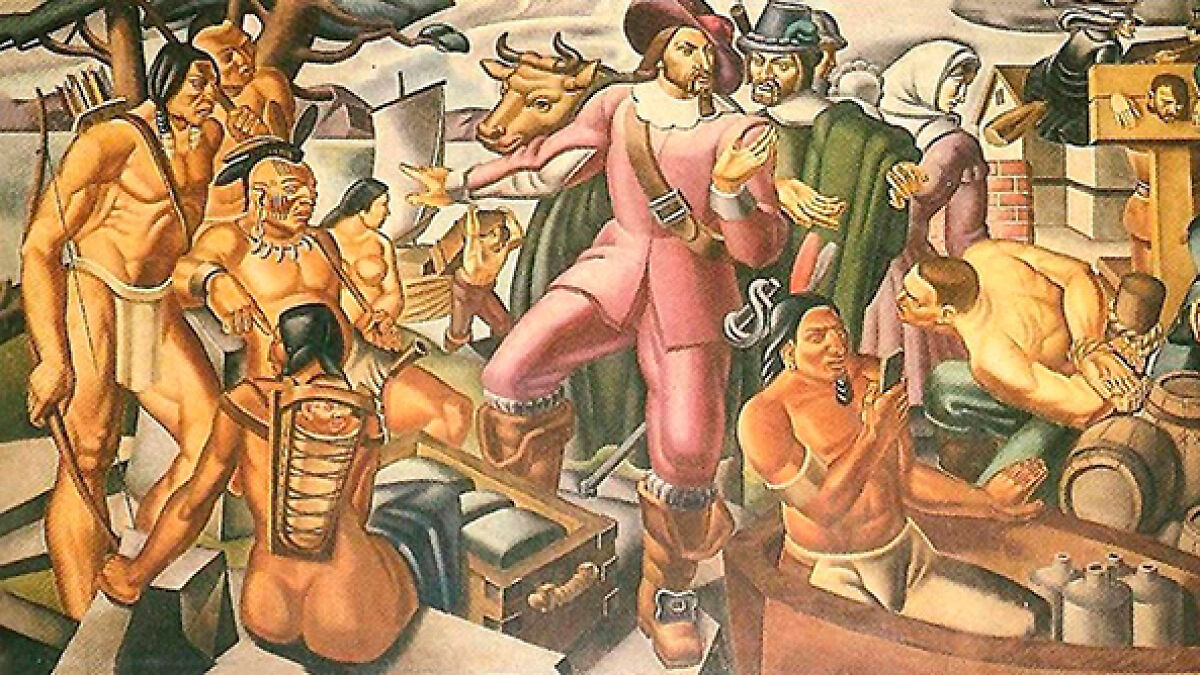
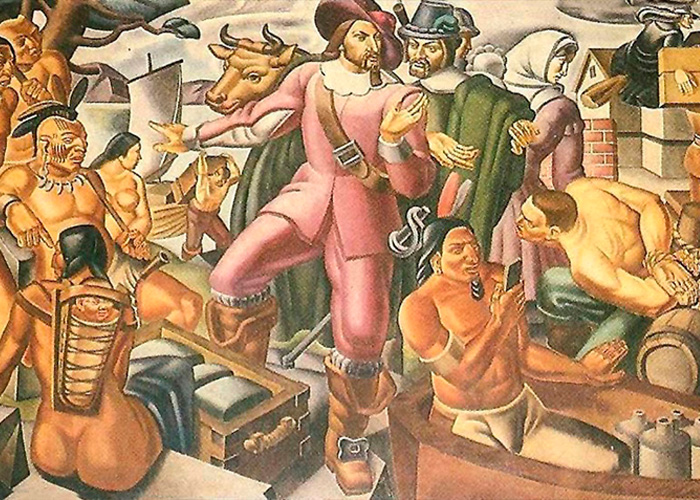
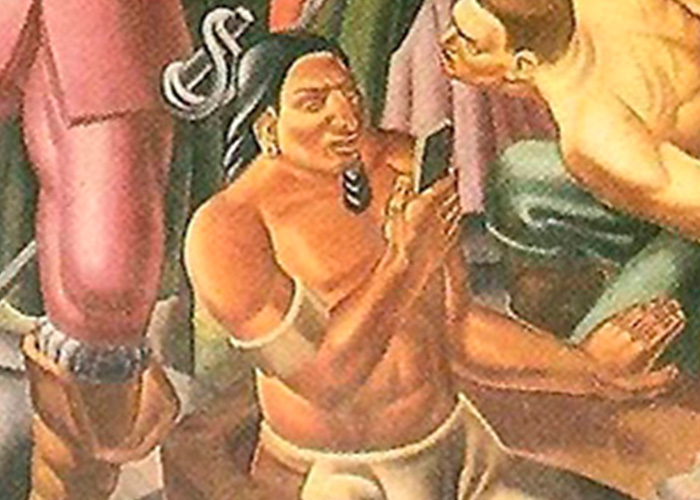
However, that is exactly what many believe about Italian artist Umberto Romano’s 1937 work, Mr. Pynchon and the Settling of Springfield, hanging on one wall of the Commonwealth of Massachusetts State Office Building.
Conspiracy theorists have long claimed that this detail proves time travel is real. The painting recently went viral again after scientific author and columnist Cliff Pickover shared it on his X account.
“I think the guy with the iPhone is sitting in a Hot Tub Time Machine,” one user said, referring to the 2010 time-travel comedy movie.
Image credits: MutualArt
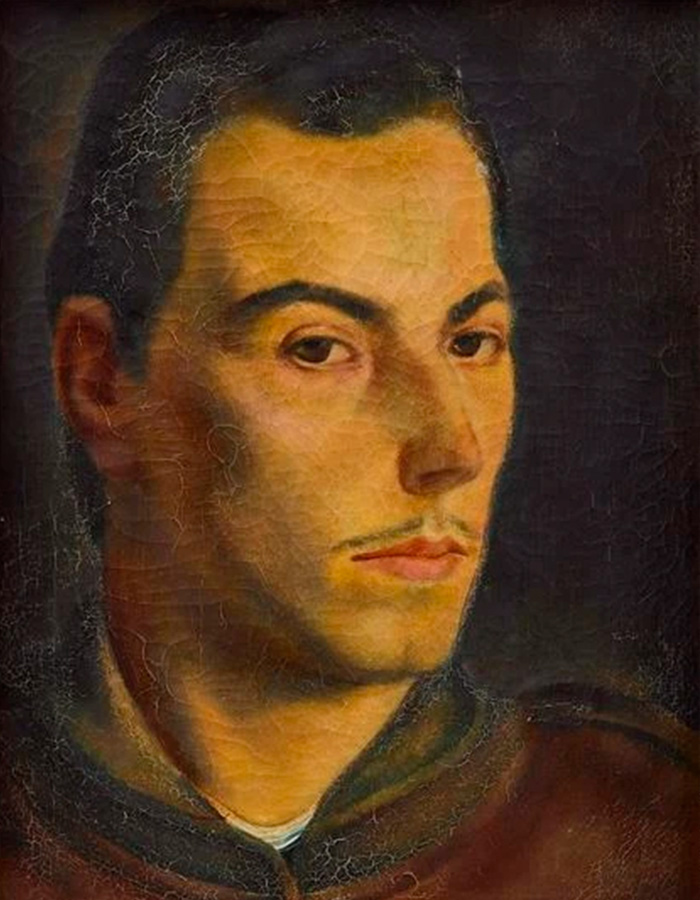
Born in 1906 in Bracigliano, Italy, Umberto Romano moved to the United States at the age of 9 and later pursued a career in art.
Romano was tasked with creating six mural panels for the Springfield Main Post Office in Massachusetts, USA (which later became the Commonwealth of Massachusetts State Office Building in 1984). He finished the project in 1937 with the help of his students.
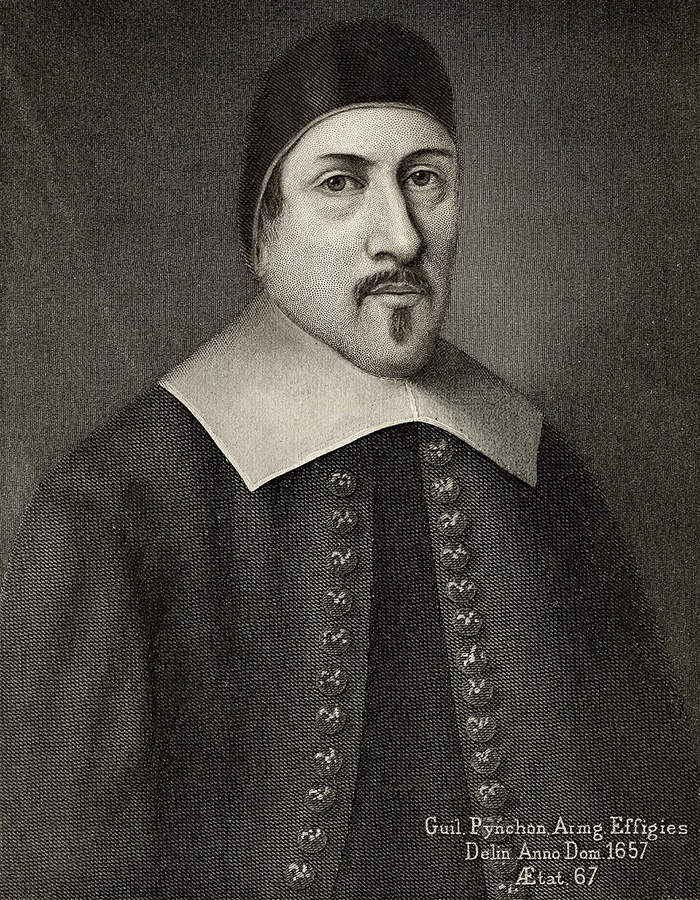
One of the murals was Mr. Pynchon and the Settling of Springfield, which depicted the 1636 settlement agreement between English colonist William Pynchon and the Pocomtuc indigenous peoples who lived in the Springfield area, then called Agawam.
Image credits: Smithsonian National Postal Museum
The painting features Pynchon in the center, dressed in a pink suit, accompanied by his entourage of English settlers and their cattle. Indigenous peoples surround him, some observing Pynchon and others looking at what seem to be Europe-made goods, such as textiles and ceramic vases.
The detail that sparked the time-travel conspiracy is in the bottom right corner, where an indigenous man sits in a crate of goods and holds a rectangular, grey-black bar close to his face.
Image credits: killahnola
Image credits: BrianRoemmele
Many have argued that the object is an “iPhone,” and that the man himself is a “time traveler.”
“Below [Pynchon] is a Native American looking as if he’s taking a selfie. Time travel?” one tweet read.
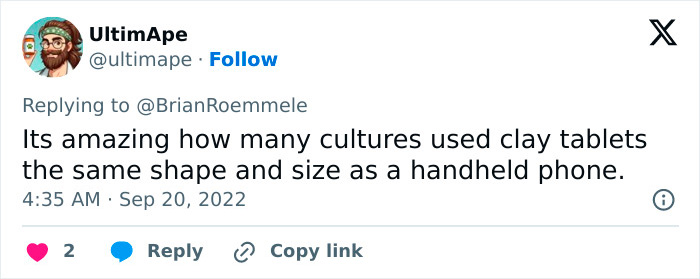
Counterarguments have said that it could be a stone or a clay tablet, a common household object of the time.
Image credits: Wikipedia
Science and technology journalist Brian Anderson wrote an article on VICE’s Motherboard in 2017, admitting that the detail was “uncanny” and he couldn’t stop looking at it.
“The longer I look, the closer his profile appears cut along what is perhaps the defining gesture of the digital age, a pose made all the more curious considering the obvious: that both the painting and what’s painted came many generations before the digital age,” he said.
Intrigued, he reached out to two historians to weigh in on the theory — Daniel Crown and Dr. Margaret Bruchac.
Image credits: Smithsonian National Postal Museum
“Given the scene’s focus on the founding of Springfield, Romano, in reductive fashion, was probably trying to capture the introduction of modernity into a curious but technologically stunted community, which was instantly bewitched by Pynchon’s treasure trove of shiny objects,” Crown told Anderson, suggesting that the smartphone-like object was possibly a mirror.
While the use of reflective objects to see one’s face dates back to the earliest civilizations worldwide, including Native American communities, the Romans allegedly created the first glass mirrors in the 1st century CE, which the Venetians later refined.
Crown also offered another theory that the rectangular object could be a religious text: “One of the gospels or maybe Psalms. These did exist at the time and were roughly the same rectangular shape.”
‘Mr. Pynchon and the Settling of Springfield’ was completed by Italian Umberto Romano in 1937 and shows a scene from the 17th century
The painting shows Pynchon in a pink suit and to his left, below him is a Native American looking as if he’s taking a selfie
Time travel?? pic.twitter.com/nAmv73ayS2
— Field Notes (@SocialLens360) November 19, 2017
Dr. Bruchac, Assistant Professor of Anthropology and Coordinator of the Native American & Indigenous Studies Initiative at the University of Pennsylvania, proposed a third possibility. She theorized that the object could be an iron blade, with the sharper edge resting against the man’s palm.
“It does bear a rather uncanny resemblance, both in the way it’s being held and the way it focuses his attention, to a smartphone,” she admitted, adding that the painting inaccurately depicted many details from that time.
Image credits: bubblegutz52
Image credits: kante303
Mr. Pynchon and the Settling of Springfield is not the only work of art to have sparked time-travel theories.
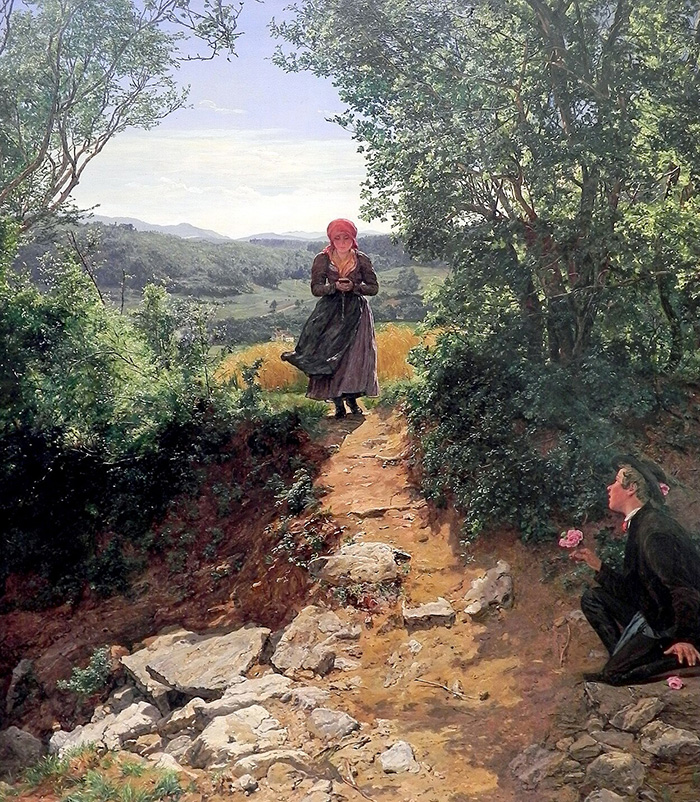
Austrian painter Ferdinand Georg Waldmüller’s 175-year-old artwork, The Expected One, is one such example. Painted in 1860, it is now displayed at the Neue Pinakothek museum in Munich, Germany.
The painting depicts a woman walking down a path lined with flowered shrubs, looking down at something rectangular in her hands, while a man at the turn of the road waits for her with a flower. Conspiracy theories have claimed that the object she is holding could be a phone.
Image credits: Wikipedia
“The girl in this Waldmüller painting is not playing with her new iPhone X, but is off to church holding a little prayer book in her hands,” Gerald Weinpolter, CEO of an Austrian art agency, clarified with Brian Anderson in 2017.
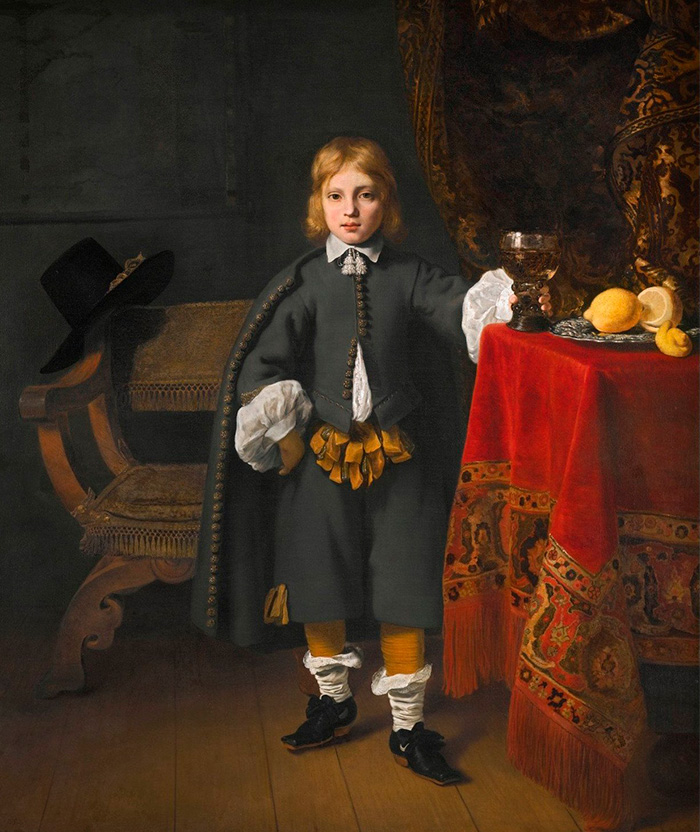
Another artwork that sparked similar arguments was PortraitofaBoy, painted by Dutch painter Ferdinand Bol in 1652, depicting a young boy by a red-clothed table, holding a goblet.
The intriguing factor, however, was in his black pointed shoes, one of which seemed to have the signature Nike tick in white.
Image credits: Wikipedia
“Looking at the age, he must have got his hands on the first pair of Nike trainers ever made. Or is he actually a time traveler?” British citizen Fiona Foskett told The Sun after spotting the detail during a visit to the National Gallery in London with her daughter in 2023.
However, in her defense, the National Gallery’s social media account shared a photo of the painting, asking followers to spot “a more ‘modern detail’” in the 400-year-old painting. Foskett and her daughter merely participated in the joke, but many took it seriously as well.
Image credits: Rakesh__Sharma
Image credits: kcuFsnacilbupeR
Image credits: benjaminjwhitby
Image credits: knotoon
Image credits: NZKyled
Image credits: sparuga
Image credits: yakir1972
Image credits: BrianRoemmele
Image credits: ultimape
Image credits: Philip252532537
Image credits: MysticAngel369
Image credits: pend73647

By entering your email and clicking Subscribe, you're agreeing to let us send you customized marketing messages about us and our advertising partners. You are also agreeing to our Privacy Policy.
Thank you! You've successfully subscribed to newsletters!


People are becoming dumb and dumber as tech advantages .... I mean your average-John-and Kathy. There was a question asked on Reddit, "What would happen, if there will be no internet from tomorrow?" And everybody was freaking out imagining zombie-apocalypse. Just a friendly reminder. 40 years ago internet was not a thing, and even 30 years ago wasn't a "big-thing" ...



Wishing I could respond to Jessie Pendse directly, "The Native worships idols and has never seen a tiny Bible". I'm sorry, no. The Indigenous man has quite possibly never seen a tiny Bible, or any Bible (which he has absolutely no use for), nor a glass mirror or whatever else the item might be. He and the other Pocumtuc people practice their own, non-Christian religion, which is perfectly valid and no more idolatrous than worshiping a Bible or a crucifix or a p*dophile President claiming to be a believer.
People are becoming dumb and dumber as tech advantages .... I mean your average-John-and Kathy. There was a question asked on Reddit, "What would happen, if there will be no internet from tomorrow?" And everybody was freaking out imagining zombie-apocalypse. Just a friendly reminder. 40 years ago internet was not a thing, and even 30 years ago wasn't a "big-thing" ...
Wishing I could respond to Jessie Pendse directly, "The Native worships idols and has never seen a tiny Bible". I'm sorry, no. The Indigenous man has quite possibly never seen a tiny Bible, or any Bible (which he has absolutely no use for), nor a glass mirror or whatever else the item might be. He and the other Pocumtuc people practice their own, non-Christian religion, which is perfectly valid and no more idolatrous than worshiping a Bible or a crucifix or a p*dophile President claiming to be a believer.





































 No fees, cancel anytime

















23
7