Get Premium
Dark mode theme is available exclusively for premium users. Learn more about the benefits of subscribing.
No fees, cancel anytime.

 Dark Mode Ad-Free Browsing Unlimited Content
 Ad-Free Browsing Unlimited Content Dark Mode
Join 1.2 million Panda readers who get the best art, memes, and fun stories every week!
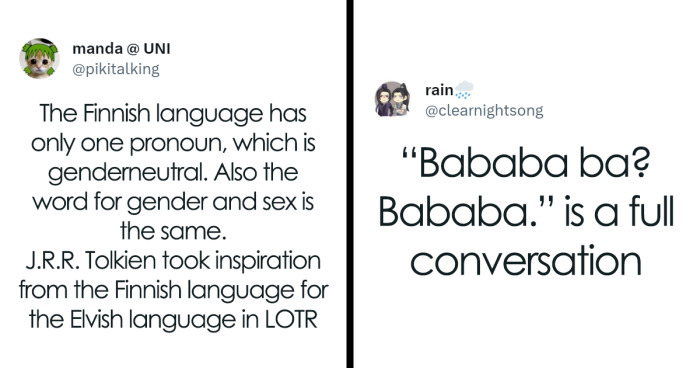


Learning a new language might be a massive challenge, but it’s an enjoyable one at that. It’s a wonderful workout for your brain. You end up making a ton of new friends. And you end up expanding your perspective by learning loads about new cultures. Many languages have a lot of subtle similarities, differences, and nuances that beginners aren’t (yet) aware of.
Luckily, the internet’s full of linguists—professional and amateur alike—who are happy to lift the veil and give a peek into the inner workings. Twitter user Liam, @LegoRacers2, started an interesting discussion after asking people to share interesting facts about the languages they speak. And, wow, did they deliver. Check out the coolest linguistic facts below! It might be the inspiration you need to start learning something new.
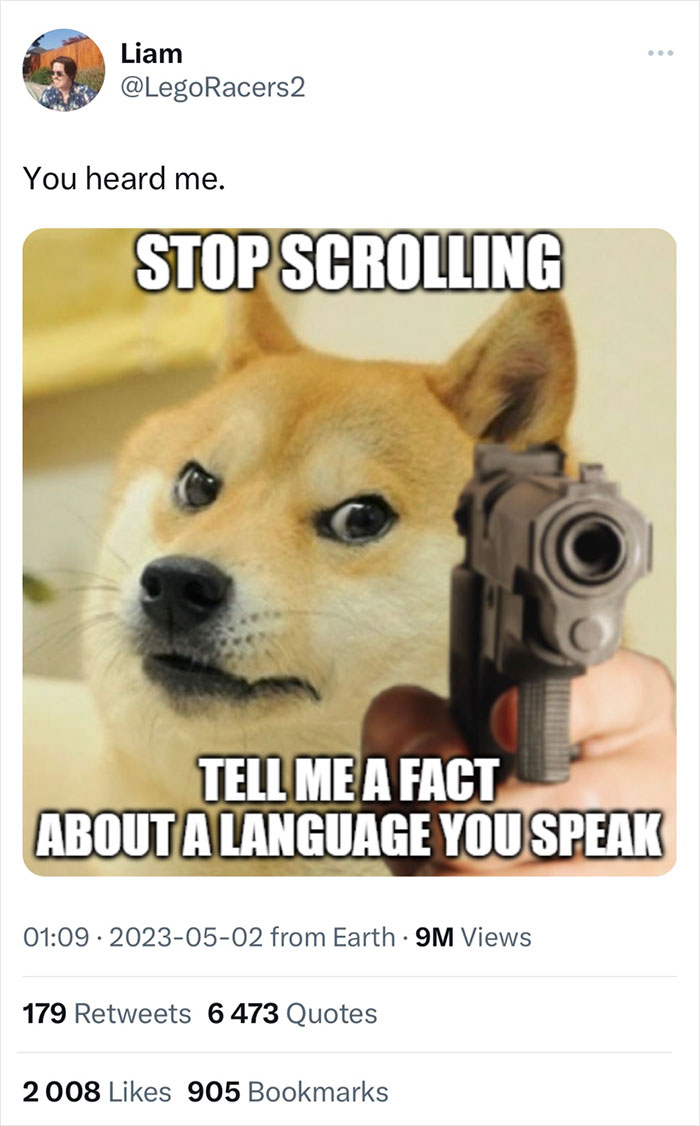
Image credits: LegoRacers2
This post may include affiliate links.

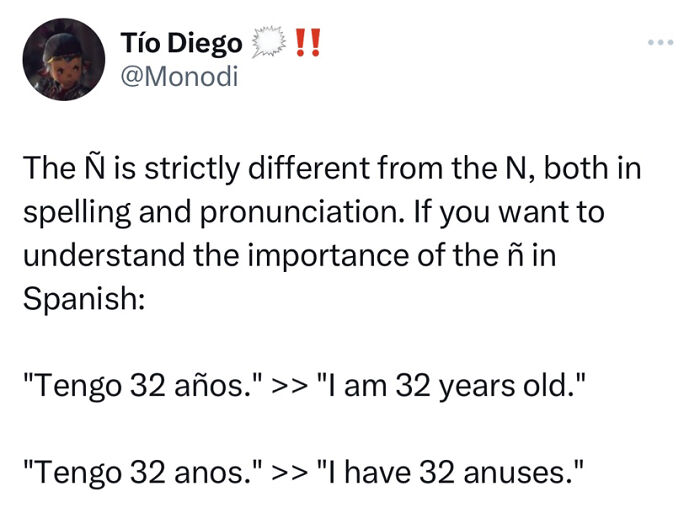
Similar to single and double n in Italian. If you don't pronounce it correctly, the aria 'una Donna a quindici anni' takes on a very different tone.
Bored Panda got in touch with Lisa McLendon, the William Allen White Professor of Journalism and Mass Communications and the Bremner Editing Center Coordinator at the University of Kansas. She speaks Russian and has also studied Czech, Bulgarian, Serbian, and Old Church Slavonic, plus the history of Slavic languages, as part of her Ph.D. coursework at the University of Texas in Austin. McLendon told us about what makes Slavic languages distinct from others in Europe, and what challenges they post to new students.
She explained to us that Slavic languages are a different language family. "Most people, when they think of European languages, think of Romance languages (French, Spanish, Italian, etc.) or Germanic languages (German, Dutch, and Scandinavian languages). But there are other language families in Europe, such as Baltic and Slavic, and a few languages that don’t really fit in at all—Basque and Hungarian, for example," she said.

Are there actual rules for this? Or is it just the instinctive way we speak the language?
"Then there’s the alphabet: Some Slavic languages, such as Russian, Ukrainian, and Bulgarian, use the Cyrillic alphabet, while others, such as Polish, Czech, and Croatian, use the Latin alphabet, with a few extra letters/diacritics to represent sounds that aren’t in, or aren’t represented by one single letter in, the Latin alphabet. And in terms of grammar, most grammatical features in Slavic aren’t completely foreign to Europe, though, as one example, the way the verb systems split tense and aspect is a bit different from the other European language families."
Bored Panda was curious about what challenges someone with a Slavic background might run into when learning English, as well as what would cause trouble for English speakers learning Slavic languages.
"Slavic doesn’t have articles (a, an, the) and that’s always a tricky part of English for learners whose native language lacks articles," Professor McLendon shared
"Verbs are trouble going both ways: English blends tense and aspect and uses a complicated system of auxiliary verbs. But Russian, for example, cleanly separates aspect from tense and then adds an extra layer of complexity with verbs of motion (going, coming, bringing, riding, etc.)."
The professor continued: "Pronunciation in Slavic languages tends to be much closer to spelled-like-it-sounds than in English (isn’t everything?), but Slavic languages have some sounds, such as certain palatalized consonants and the Czech ř, that are hard for native English speakers to master. Going the other way, Slavic languages lack both voiced and voiceless th (as in thin and thine), so those sounds are a bit harder to master for English learners."

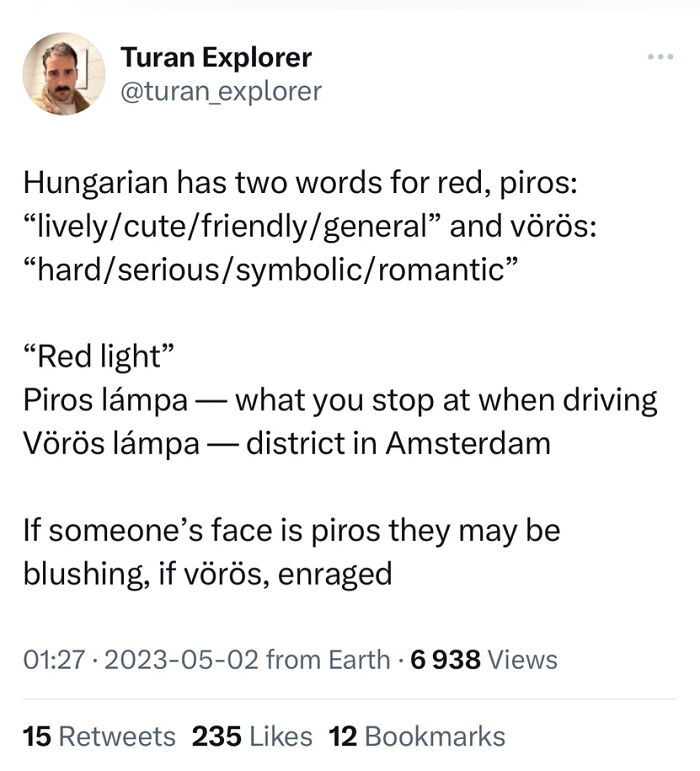
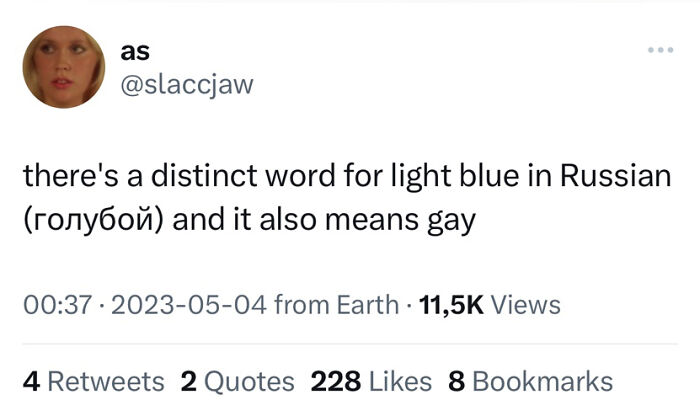
The Russian language treats light blue and dark blue as seperate colours.
Twitter user @LegoRacers2’s thread was a massive success. His post was viewed a jaw-dropping 9 million times. However, the real victory was proving that social media can be brimming with people who are happy to share their wisdom. All it takes is the right question to draw them out.
Liam, the author of the viral thread, has been a Twitter user since early 2013, and jokingly describes himself as a ‘Florida Swamp Ape.’
The reasons why people learn new languages can be as numerous as their motivations. For instance, yours truly loves French because it simply sounds awesome. But the reasons tend to fall into a few broad categories. For instance, someone might start delving into the basics of a new language because they’re moving abroad for work or an exchange program. Or they might have some new people from abroad in their social circle who they’d like to connect with on a deeper level.
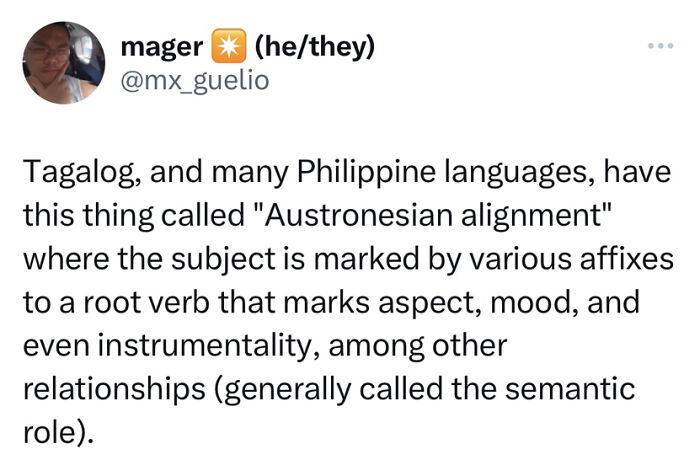
A Tagalog language joke.
- Bababa ba? (Is the elevator heading downwards?)
- Bababa. (Yes, it is.)

This implies that people don't already know this, and that they don't know the reason. I was taught this when I was around 8 or 9. The old Roman calendar started in March, therefor making September the seventh month. When the start of the year was switched to January, it bumped September along to 9th place.
Others might choose to learn a new language because they’re bored out of their minds, crave a new hobby, or want to dust off some of the cobwebs growing in their brains. Learning anything new is challenging at first, but once you get to grips with the basics, it can be incredibly rewarding. Especially if there are some larger factors at play. Like preparing for a fun trip to Japan. Or wanting to travel across South America without an interpreter. You can forge a lot of friendships if you show the locals that you respect them enough to at least try to speak to them in their tongue.
Meanwhile, some people might decide that they want to reconnect with their cultural heritage. Say, if their relatives migrated from elsewhere decades or even centuries ago. On the other hand, some folks take up their studies not primarily out of the desire to talk to others but to understand their literature and media. There’s a lot that can be lost in translation, after all.

Same with Icelandic - I think. (I'm not a native speaker of Icelandic.) This is what I remember reading in a guide book. The language is so old that they don't have words for modern inventions such as "atomic bomb", for instance. Looking for a name for it, Icelandic linguists dug through old scriptures and came up with a word that translates into "flaming spear falling to the earth" - or something like that.
English, while a wonderful language that is incredibly useful to know, won’t open every door for you. And you cannot expect everyone to speak it. The more languages you’re well-versed in, the more opportunities you’ll be able to take advantage of in life. Having that kind of flexibility is incredibly useful in one’s social life, on the internet, professionally, and at school. Being a human being is all about connecting with others because we’re social creatures. So it makes sense to develop as many social tools as possible to do so.

It was created to address illiteracy within the country. The elites who could afford schooling were learning Han Chi, which the written form of traditional Chinese characters. It is commonly known that Chinese characters are difficult to master especially since it does not translate well to spoken Korean. Hangul is an alphabetical writing system that better captures the spoken language in written form.

Sign language is many centuries old as well. The earliest concrete reference to sign language in Britain is from the wedding of a deaf man named Thomas Tillseye in 1575.
It’s important that you’re passionate about the language and culture. Otherwise, if you feel like someone’s forcing you to learn against your will, you might run out of motivation. However, some individuals pick these languages based mainly on how widespread they are, and how impactful they’re likely to be in the future.
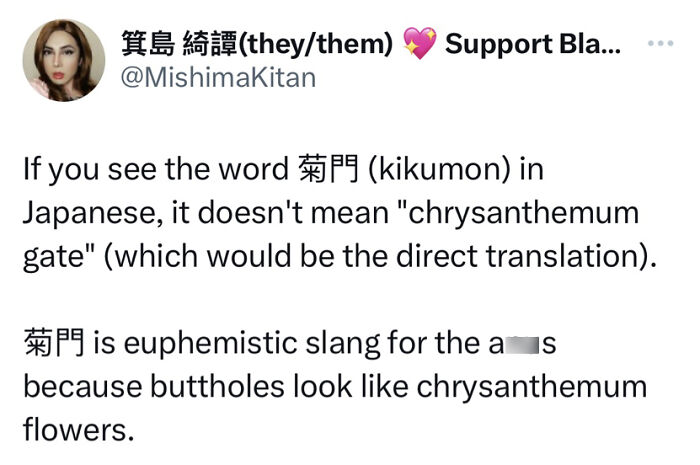
For fúck's sake BP, ANÙS is a medical term. STOP THIS STUPID CENSORISM!
For instance, Babbel points out that there are 1.3 billion Chinese native speakers on Earth. Meanwhile, around 485 million people speak Spanish as their first language. That’s far more than the (still impressive) 373 million native English speakers there are worldwide. The fourth most spoken language is Arabic (362 million native speakers), and in fifth place is Hindi (344 million speakers).

Going to go going still makes more sense than going to GET going to me. :p
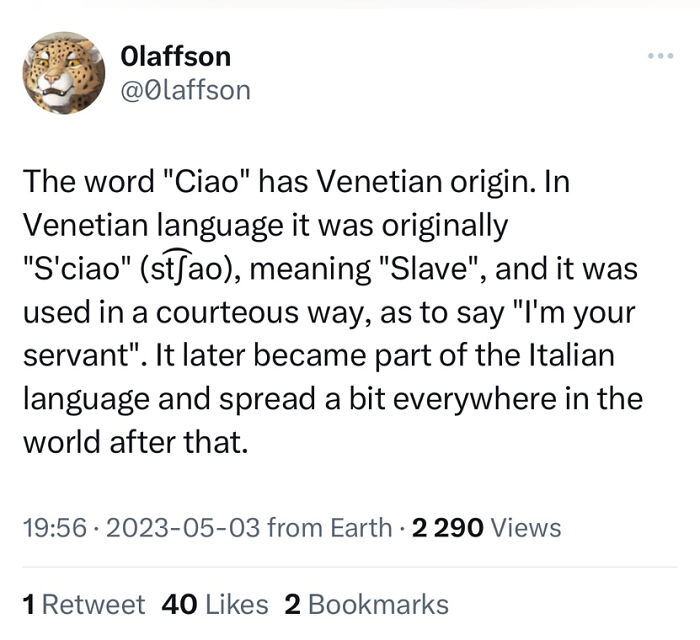
Kind of the same for southern Germany and Austria, "servus" (used for both "hello" and "goodbye") derived from the Latin word for "slave"

We have regional variants on counting in English dialects. Where I come from, they were mainly used for counting sheep, and it goes Yan, Tahn, Teddera (1,2,3). There are a huge number of variants, and it changed almost from valley to valley. See https://en.wikipedia.org/wiki/Yan_tan_tethera
However, Berlitz notes that the total number of English speakers, including native ones, is over 1.4 billion, making it the most popular language worldwide. In the meantime, there are over 602 million people who speak Hindi and 548 million who speak Spanish, whether as their native tongue or a second language.

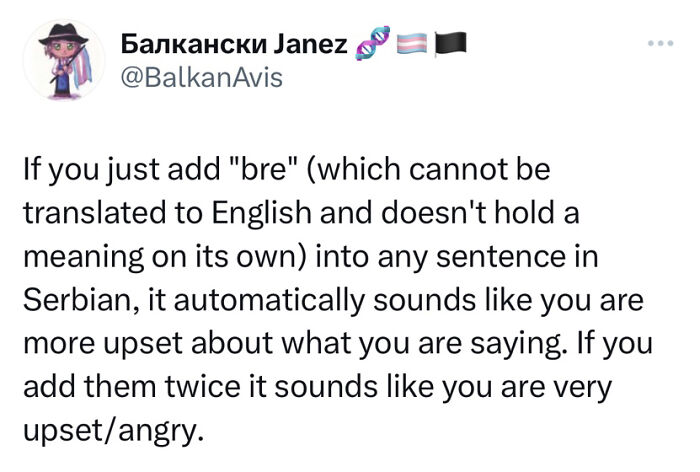
Adding "you utter" before any common noun does turn any word in an insult.
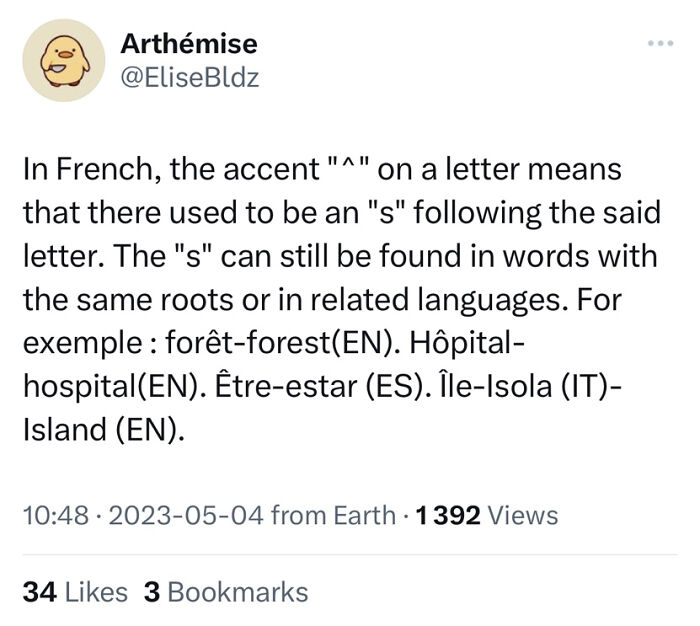
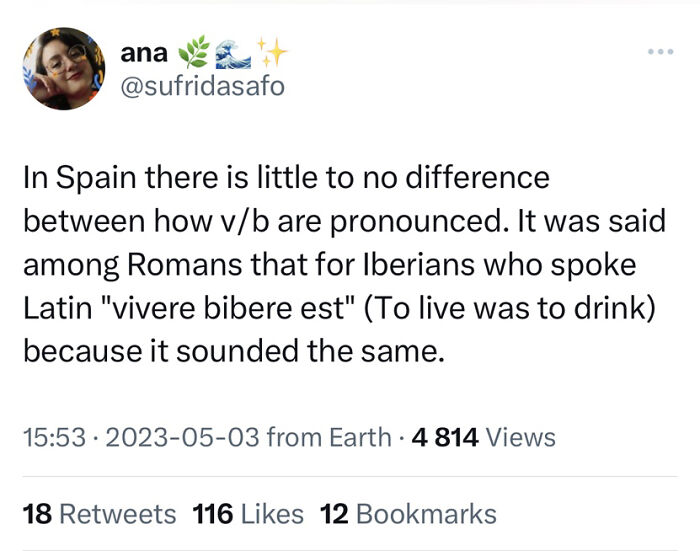
Actually, the 'est' part of that is the present tense form of the verb to be, so it should be translated as 'is'. The past tense form is 'erat'. Edit, imperfect past tense.
Learning a new language, like developing a new habit or skill, can be incredibly time and energy intensive. What matters the most, above everything else, is consistency. If you have the patience to focus on your studies every single day, you’ll see far more progress than if you do it only when you feel like it. Language learning apps like Duolingo reward their users for staying consistent.
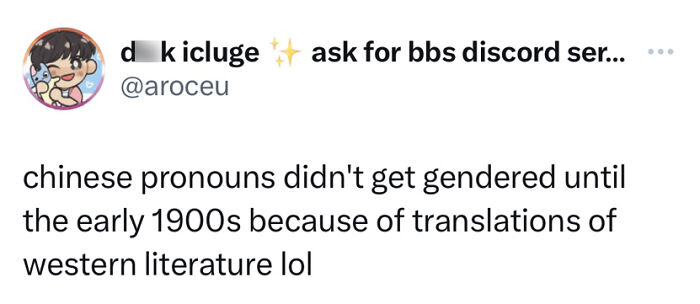
他(he) 她(she) 它(it) are pronounced exactly the same, 'ta'. It's quite funny because the 'it' form isn't well taught to foreign speakers, so you end up with people writing: I bought a table. He was hard and beautiful.
The more immersed you are in the language and culture, the better your results will be. It really helps if you have the courage to talk to native speakers even if your skills are still underdeveloped. In the meantime, try to consume as much media and literature in the language as you can. Your growth should skyrocket! Though remember to take proper breaks: your mind needs rest for all of that new knowledge to settle down.

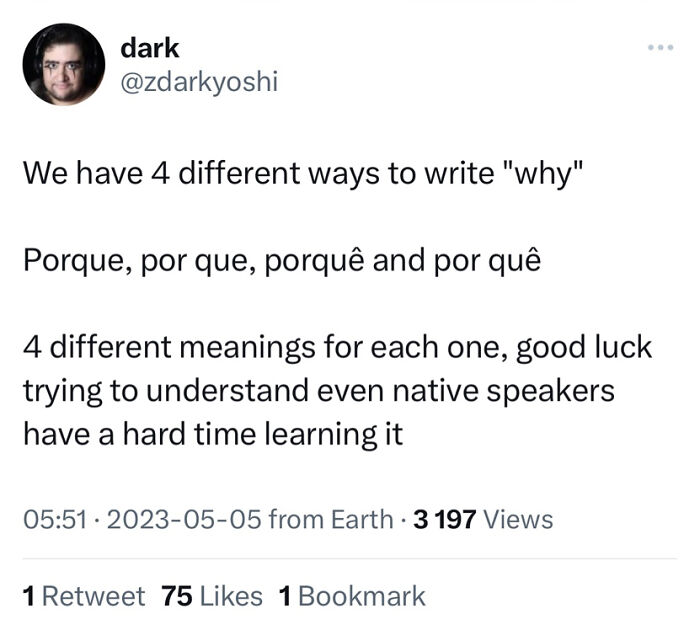
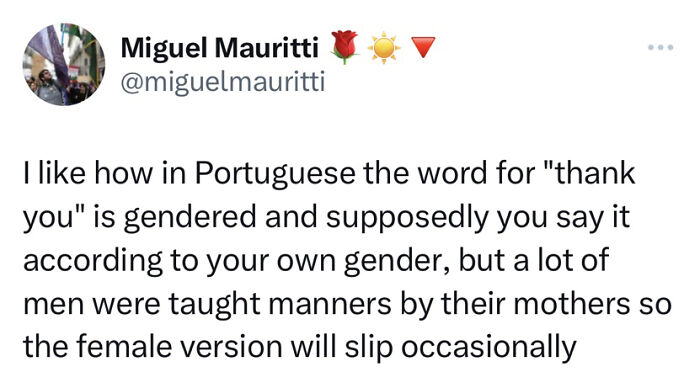
Nobody told me this and I spent six months in Brazil saying thank you like a man.
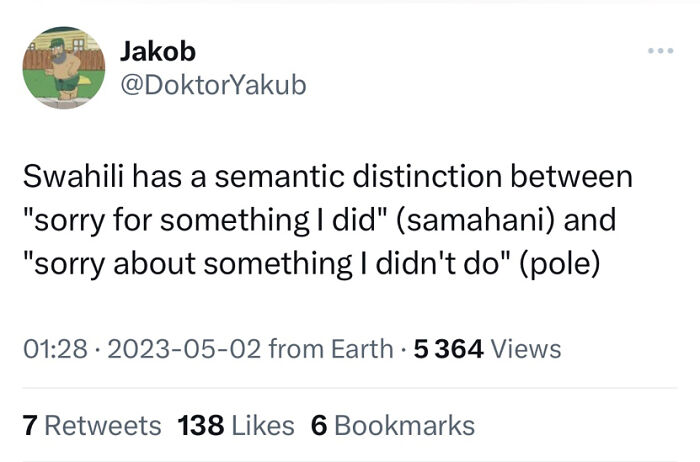
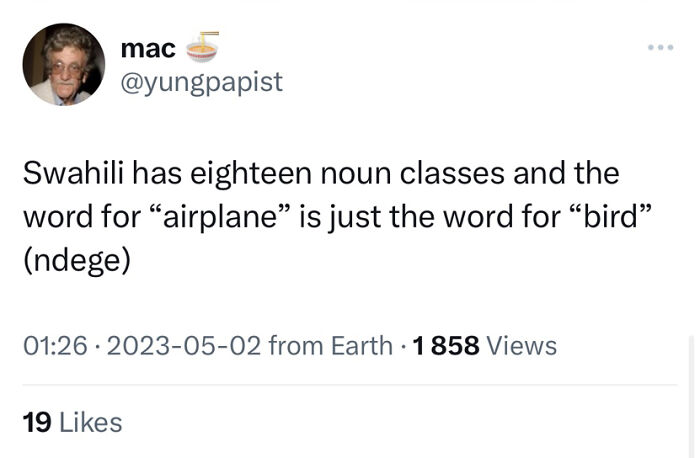
One of my favourite Swahili words is Kali -a Kali dog (fierce), a kali knife (sharp), a kali curry (hot), a Kali teacher (strict). I may be wrong of course, because my knowledge of Swahili is limited to what we called 'kitchen Swahili' -so very far from fluent.
Similar idea to American Midwestern English: "Yeah, no" vs. "yeah, no, yeah" and more!
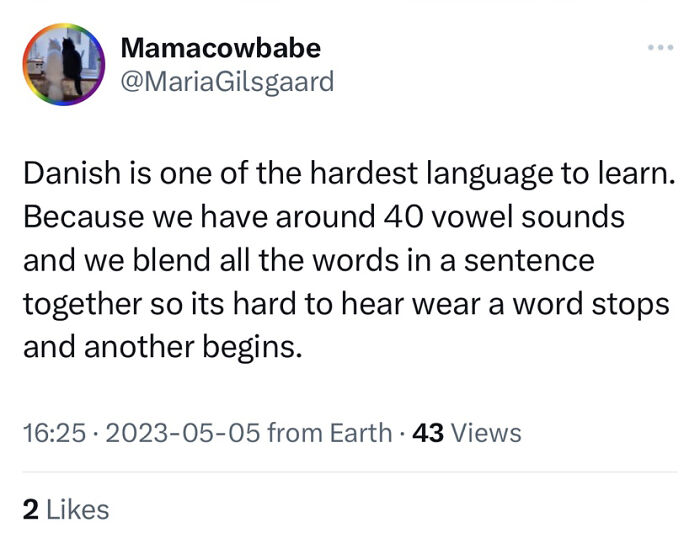
I've heard it's one of the hardest languages to lip read, I can lip read pretty fluently and in a deaf group I'm in that's global, we were discussing how easy/ hard it is to lip read in your native language and Danish was by far the one people said was hardest.

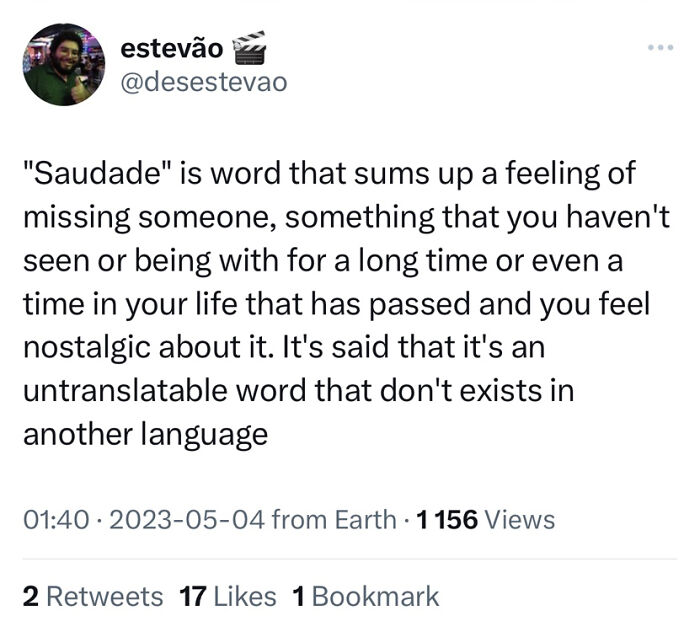
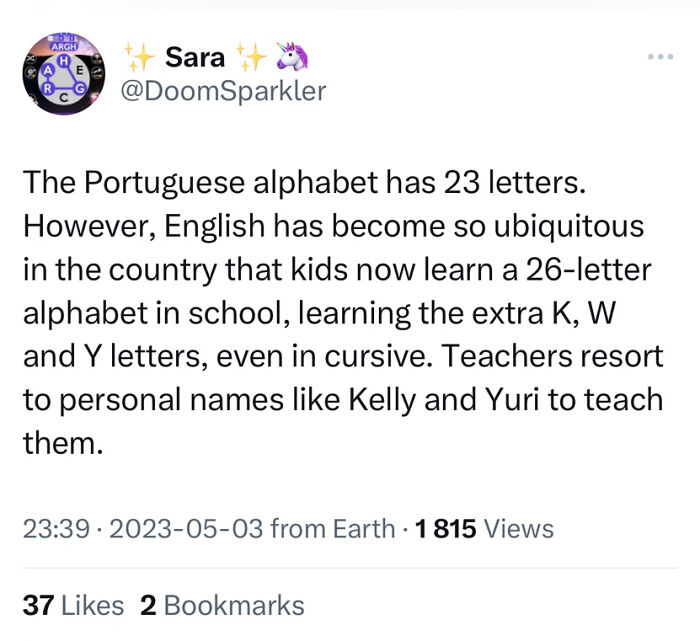
Portuguese word.
In the same way that the word nostalgia = a sentimental longing or wistful affection for a period or person in the past (different dictionaries will vary). Maybe it's not the best of explanations (and I've just woken up!) so can someone explain the difference a bit more clearly?
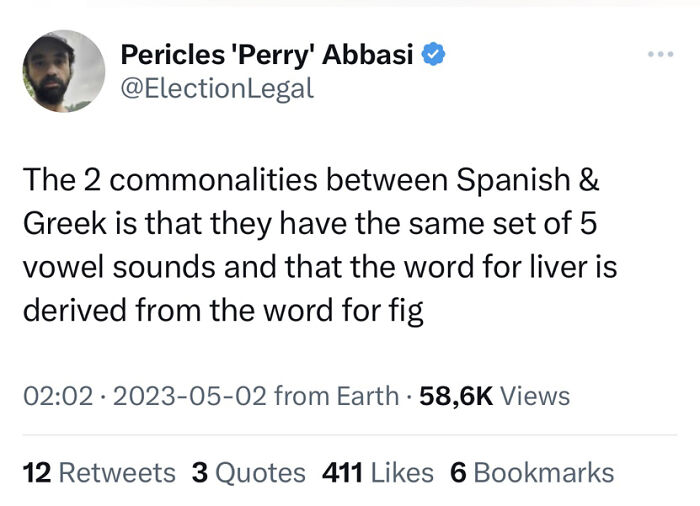
I need the reason because that is both ridiculously funny and really interesting at the same time. (The fig part, but vowels are still fun)

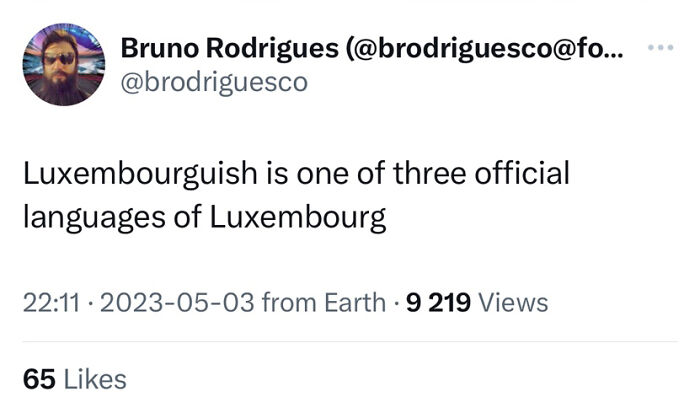
Luxembourguish drives me Crazy, as a German speaker it sounds almost but not quite entirely unlike German then it switches to French.
I would disagree with the tense part, as there are speech particles that dictate tense, such as '了' (le) for the past tense, and '会' (hui) meaning will. The pronoun/gender stuff is true because 1: we don't gender out nouns and 2: he, she and it are pronounced the same.

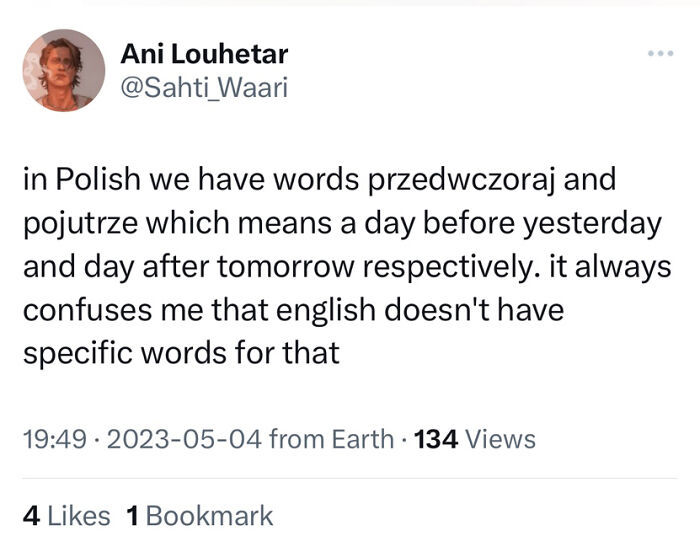
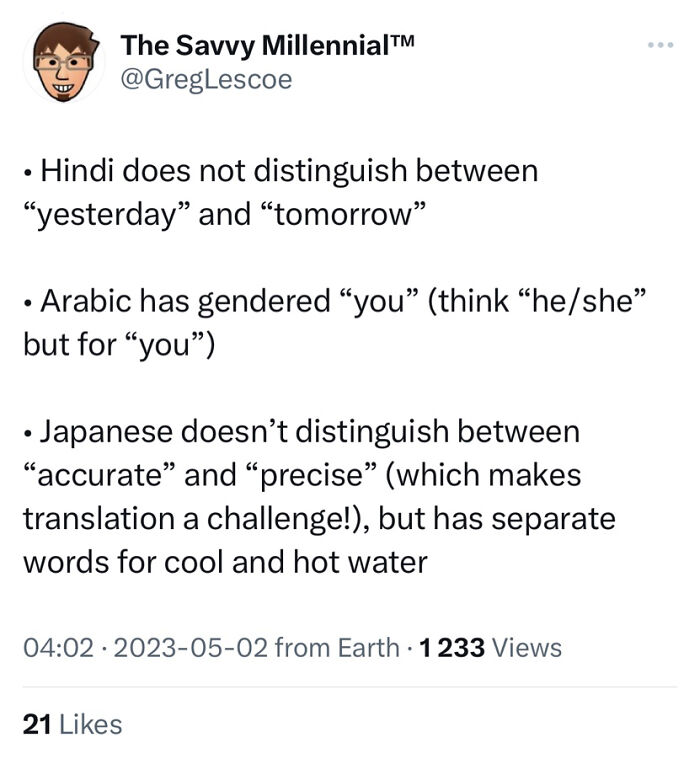
German does :D It's morgen (tomorrow), übermorgen (the day after tomorrow), or even überübermorgen (the day after the day after tomorrow XD). Same goes for gestern (yesterday), vorgestern (the day before yesterday) and vorvorgestern (the day before the day before yesterday)

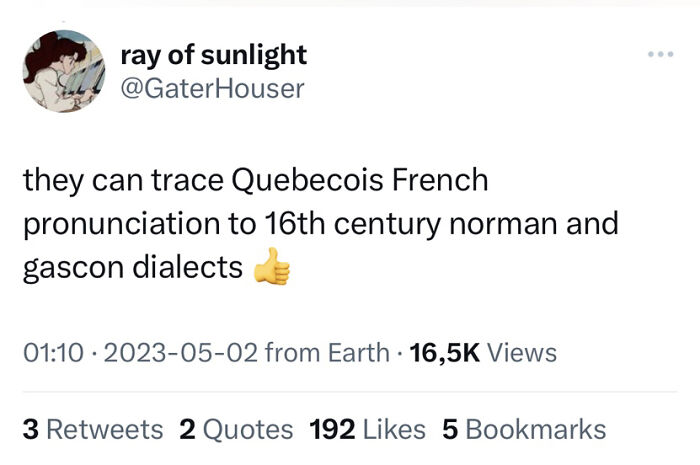
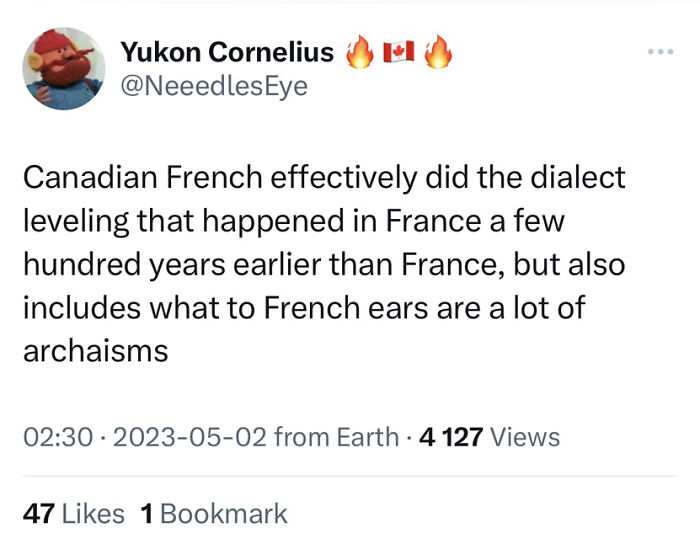
Growing up in Canada, I can only somewhat understand France French, but Quebecois/Acadian French I understand perfectly. The accents and even vocabulary are just so different.
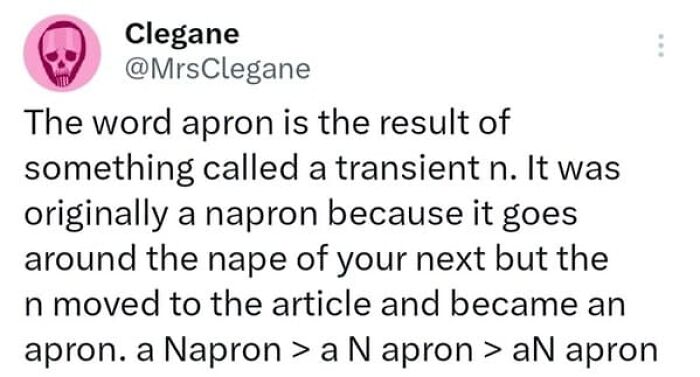
The etymology is a little wrong here. 'Napron' comes from Latin 'nappa' (napkin) via Old French 'naperon' (small table-cloth). But it is correct 'a napron' morphed into 'an apron'. The same thing happened with 'a naddar', (a snake/serpent) becoming 'an adder'. One that made the opposite journey was 'an ewt'. It became 'a newt'.
I read that it's adapted from French. It means "nail", figuratively speaking it talks about a linchpin.
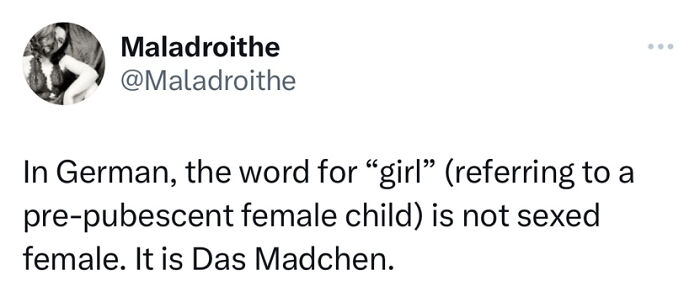
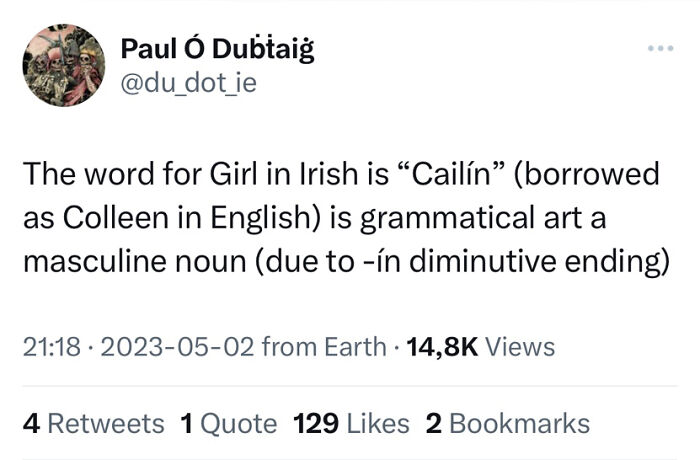
The same is true in Dutch (het meisje, although 'de' isn't actually gendered), I'm guessing it's because of the diminutive -chen. (As that is the case in Dutch.)

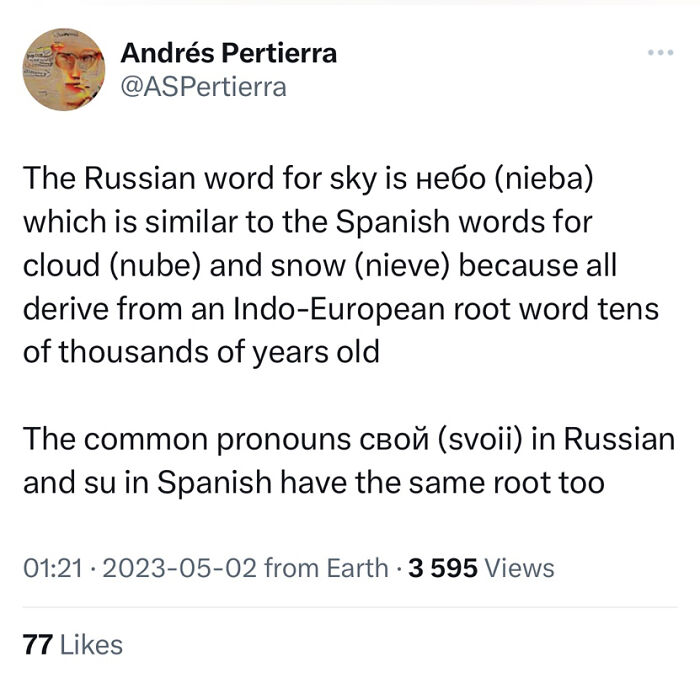
Same in Russian, by the way. I was really confused when English speaking people said that our language sounds rude, because I see all the caress forms for the words that don't have them in English. Our cats have "lapky" (a caress form of lapy, paws), while yours - only "little paws". Our little goats have "Rozhky" (a caress form of "roga", horns), while yours have only little horns, etc. There are caress forms for adjectives, too. You say "bluish" meaning "Blue, but not full-on blue", we say "Seenenkiy" meaning "blue, but also cute". You say daughter, and that's it. We say Doch (daughter), Dochka (a slightly more affectionate), Dochenka (very affectionate, used only for our relatives, we can't say that Mary is Boris's dochenka, it would sound weird).

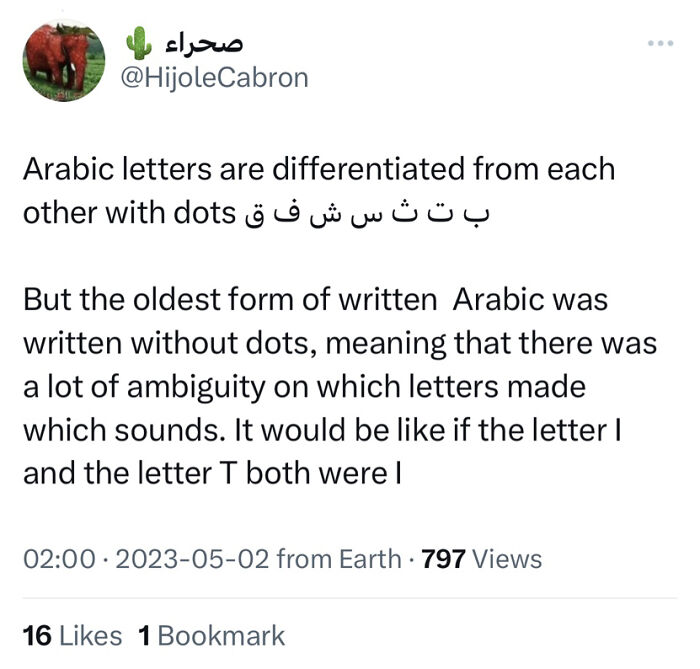
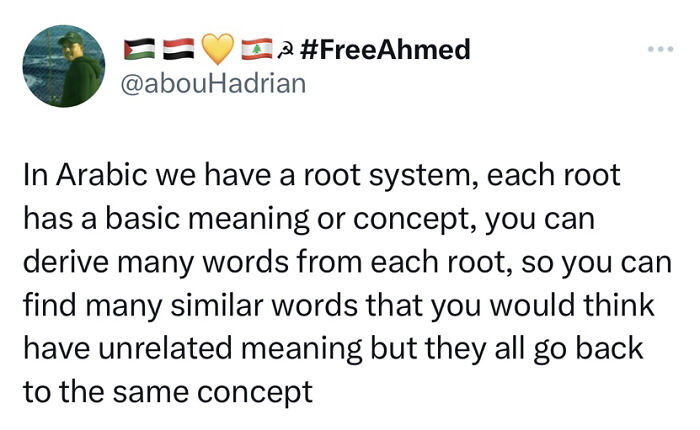
More interesting about Arabic is that each consonant is either 'solar' or 'lunar' which describes whether it is rolled into the definite article or not. The split is about half and half. The word for the sun is not pronounced 'al-shems' but 'ash-shems' despite that is still spelled الشمس. The word for 'the moon' -- 'al-qamr' is spoken as it is written. Basically, soft consonants are 'solar', hard consonants are 'lunar' and the pronunciations are so instinctive to native speakers that they don't rely on the idea anyway.

Yes, you have to emphasize the first or second syllable to change the meaning
Many languages do that. It's because the word for light blue used to be used to describe animal fur. Like people still cal cats and dogs of a certain colour "blue". the words for darker "blue" came very late to languages as the pigment is hard to obtain in nature- like in english people also use indigo or navy to describe blue colours.
it appears in afrikaans as koop and english as cheap and german as kaufen

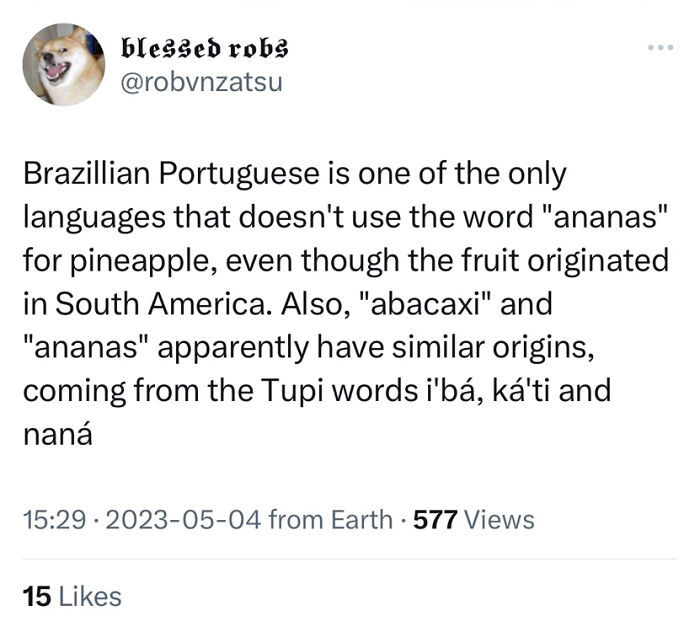
This is a litlle disoriented. Though "ananas" is the word for "pineapple" in many languages, in South America, which is mostly Spanish-speaking, the word is "piña."
In Italy during the fascist regime the use of foreign words was banned, so the government had to come up with alternative words. For example, "cocktail" became "bevanda arlecchina" (arlequin drink), "sandwich" became "tramezzino", "garage" rimessa, "gangster" malfattore, and so on. Even names of people and cities were "italianized": Buenos Aires became "Buonaria", Churchill was written as "Ciorcil" and my favorite: Louis Armstrong became "Luigi Braccioforte" (the literal translation of his surname). Another example of how stupid regimes can be.

Ciorcil and Louis Braccioforte gave me a good laugh, thank you!
Load More Replies...
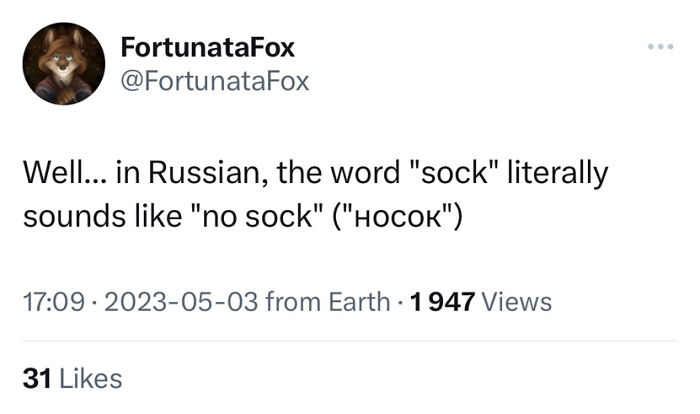
In Finnish there is multiple words inspired by Swedish words. My most favorite one is our word for "jealous". In Sweden it is called "svartsjuka", witch translates roughly into "feeling of black sickness inside" But because our ancestors thought the word "sjuka" - "sick" sounded like the Finnish word "sukka" - "sock" . So our term for jealousy is "mustasukkainen", wich translates to "having black socks on" :D

An ex GF mine is Hungarian and she taught me a ton of Hungarian words and phrases.One of the ones I still remember is the word for garlic: fokhagyma (phonetically as pho-g-had-yi-ma). In English, the literal translation is tooth onion. At one point, I had a vocabulary of about 100 words so one year at Christmas we did a demonstration of my skills for her parents. She pointed to various things, body parts, etc. and I spoke them in Hungarian (Magyar). The words that got the biggest enjoyment all the way around were for apple (or apple pie) and nipple: almacsutka and mellbimbó...surely the laughs were due to my accent, but those were a big hit for whatever reason. Good times. :-)
In Italy during the fascist regime the use of foreign words was banned, so the government had to come up with alternative words. For example, "cocktail" became "bevanda arlecchina" (arlequin drink), "sandwich" became "tramezzino", "garage" rimessa, "gangster" malfattore, and so on. Even names of people and cities were "italianized": Buenos Aires became "Buonaria", Churchill was written as "Ciorcil" and my favorite: Louis Armstrong became "Luigi Braccioforte" (the literal translation of his surname). Another example of how stupid regimes can be.
Ciorcil and Louis Braccioforte gave me a good laugh, thank you!
Load More Replies... In Finnish there is multiple words inspired by Swedish words. My most favorite one is our word for "jealous". In Sweden it is called "svartsjuka", witch translates roughly into "feeling of black sickness inside" But because our ancestors thought the word "sjuka" - "sick" sounded like the Finnish word "sukka" - "sock" . So our term for jealousy is "mustasukkainen", wich translates to "having black socks on" :D
An ex GF mine is Hungarian and she taught me a ton of Hungarian words and phrases.One of the ones I still remember is the word for garlic: fokhagyma (phonetically as pho-g-had-yi-ma). In English, the literal translation is tooth onion. At one point, I had a vocabulary of about 100 words so one year at Christmas we did a demonstration of my skills for her parents. She pointed to various things, body parts, etc. and I spoke them in Hungarian (Magyar). The words that got the biggest enjoyment all the way around were for apple (or apple pie) and nipple: almacsutka and mellbimbó...surely the laughs were due to my accent, but those were a big hit for whatever reason. Good times. :-)





































 No fees, cancel anytime
 then open in external browser


 and click "Open in External Browser"