“It Will Irritate You Very Slightly For The Rest Of Your Life”: 30 Cool Language Facts
Learning a new language might be a massive challenge, but it’s an enjoyable one at that. It’s a wonderful workout for your brain. You end up making a ton of new friends. And you end up expanding your perspective by learning loads about new cultures. Many languages have a lot of subtle similarities, differences, and nuances that beginners aren’t (yet) aware of.
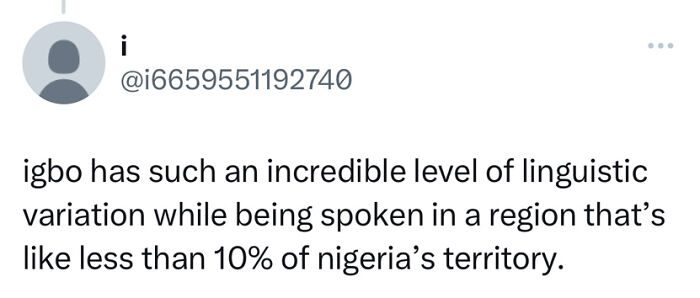
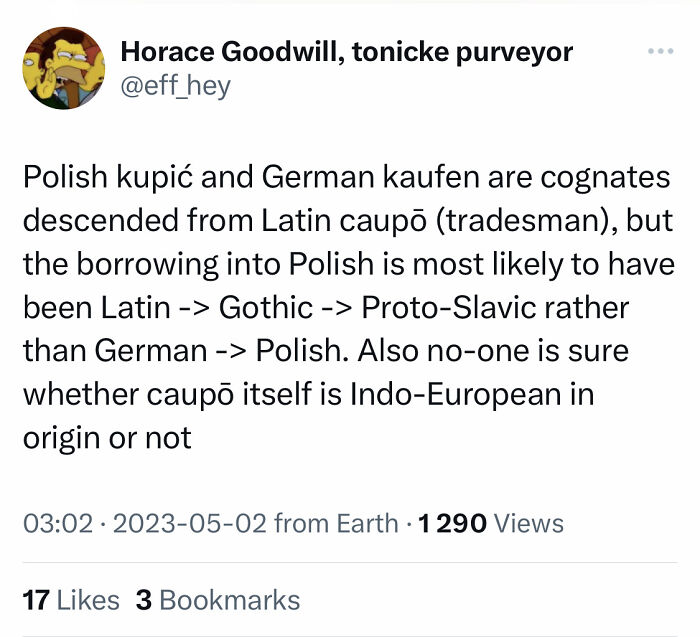
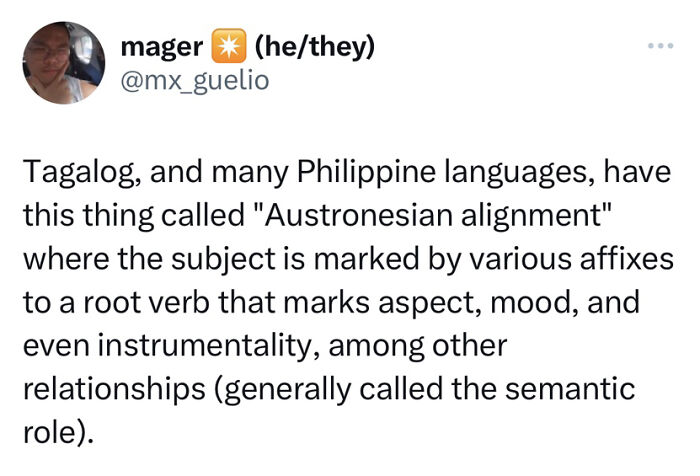
Luckily, the internet’s full of linguists—professional and amateur alike—who are happy to lift the veil and give a peek into the inner workings. Twitter user Liam, @LegoRacers2, started an interesting discussion after asking people to share interesting facts about the languages they speak. And, wow, did they deliver. Check out the coolest linguistic facts below! It might be the inspiration you need to start learning something new.
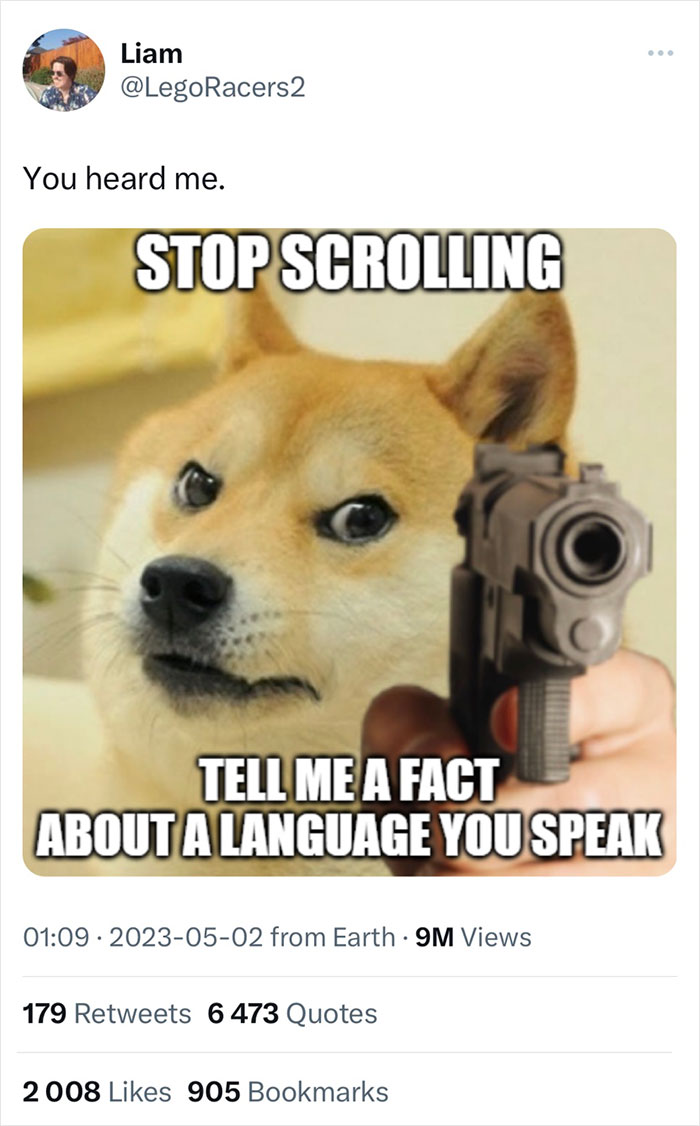
Image credits: LegoRacers2
This post may include affiliate links.

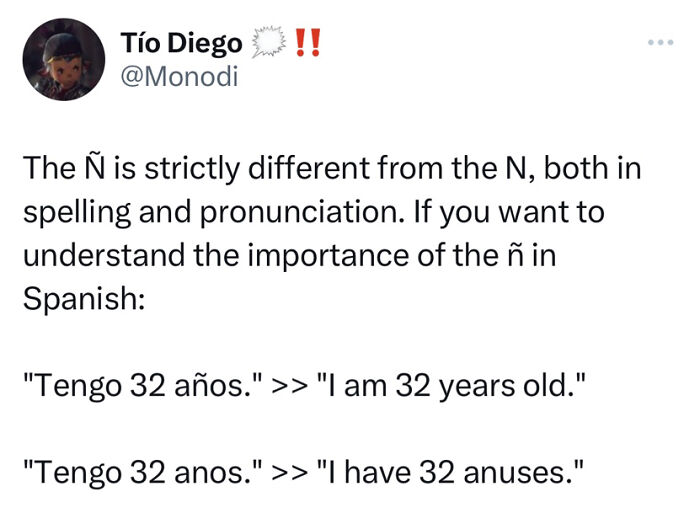
Similar to single and double n in Italian. If you don't pronounce it correctly, the aria 'una Donna a quindici anni' takes on a very different tone.
And penne means 'quills' or the type of pasta, whereas pene is a certain male appendage
Load More Replies...I had similar trouble with Danish. I came across the phrase "nogle nøgler på nøgleringen", which turned out to mean "some keys on a keyring". "nogle" means "some", but "nøgle" means "key". Pronunciation also matters. There is a big difference between kylling, killing and kælling, which mean chicken, kitten and b***h respectively. So what would you like on your sandwich?
Don't anyone even THINK about an Audi sandwich!
Load More Replies...Yup, tiny changes make all the difference. In German we have Granat = garnet but Granate = grenade XD fun
My favourite English and German "false friend" is Gift = poison :D
Load More Replies...In Chinese (I’m fluent in Chinese and English) you have to get the sounds right like you could be trying to say 4 but if you add a slight tone I the word yo you’re saying dead/death
Love Chinese culture, food, arts, films, Kung Fu, the geography (as seen on movies and documentaries), and though I love the sound of the languages, the whole intonation thing changing the meaning of a word freaks me out!
Load More Replies..."åh okej" (swedish) and "oh okay" mean the same thing and are pronounced the same
Well that makes things a whole lot easier
Load More Replies...Ah yes, one of my absolute favourites. This is a common error made by newer speakers and learners of Spanish-- heck, I did it when I was first learning. Still hilarious every time. That and "Estoy excitado/a" ( no it does not mean you are exicted....it means you are sexually aroused.)
Lol or when people will say "estoy embarazado" thinking they are saying they are embarrassed...nope, you're pregnant.
Load More Replies...Or, the difference between papá and papa, for example: te quiero, papá = I love you, dad. Te quiero papa = I love you, potato.
Bored Panda got in touch with Lisa McLendon, the William Allen White Professor of Journalism and Mass Communications and the Bremner Editing Center Coordinator at the University of Kansas. She speaks Russian and has also studied Czech, Bulgarian, Serbian, and Old Church Slavonic, plus the history of Slavic languages, as part of her Ph.D. coursework at the University of Texas in Austin. McLendon told us about what makes Slavic languages distinct from others in Europe, and what challenges they post to new students.
She explained to us that Slavic languages are a different language family. "Most people, when they think of European languages, think of Romance languages (French, Spanish, Italian, etc.) or Germanic languages (German, Dutch, and Scandinavian languages). But there are other language families in Europe, such as Baltic and Slavic, and a few languages that don’t really fit in at all—Basque and Hungarian, for example," she said.

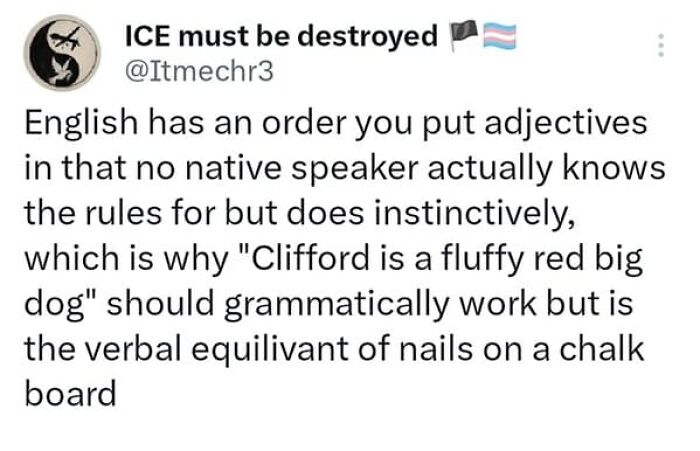
Are there actual rules for this? Or is it just the instinctive way we speak the language?
There are, in fact, rules. This article may help: https://www.theguardian.com/commentisfree/2016/sep/13/sentence-order-adjectives-rule-elements-of-eloquence-dictionary (in short: opinion, size, age, shape, colour, origin, material, purpose).
Load More Replies...I am an English teacher and we teach students the OSASCOMP rule; opinion, size, age, shape, colour, origin, material, purpose. That's a lovely, big, new, square, red, French, shopping bag, for example.
There are also rules for when you can insert an expletive mid-word (eg. "un-f***ing believable"), which few native speakers can articulate.
That's called tmesis which is a lovely word in itself. Tmesis is the splitting of parts of a word with another intervening - abso-f*cking-lutely
Load More Replies...This is the exact thing I was looking for and should be boosted to top reply. It would answer so many questions in the comments.
Load More Replies...The older I get, the less I care about grammar. As long as I understand what you mean, we're good. I feel lucky that I could hear your words.
If something in a system is “instinctive,” there is likely a rule (or set of rules) even if you don’t know it.
Oh there is a rule. I teach it at least twice a month.....but I didn't realize it was a rule until I had to teach it. That's how ingrained in our minds it is.
Load More Replies...I‘d say: Clifford is a big, fluffy, red dog. That would sound bettet to my ears… I Night stand alone, though. *better * might stand alone (sorry: automatic word correction)
Also in English there is a grammatical rule that I goes before E only 45 words follow this rule and over 900 don’t follow it 🤦♀️
It does make slightly more sense than people realise. The “i” before “e” except after “c” rule applies only to words where the “ie” makes the “ee” sound (e.g. “achieve,” “piece,” “belief,” “receive,” “ceiling,” “receipt,” etc.). Some English spelling textbooks even record this as part of the rhyme: I before E except after C, when the sound is “ee”. However, there do continue to be exceptions eg: proper names, such as “Keith” or “Sheila”; chemical names, such as “caffeine”; plural forms of words that end in “-cy,” such as “tendencies”. However, it is only meant to be helpful at a primary stage when words are at a simpler level and then, as we progress, we learn why there are exceptions.
Load More Replies...I think, in this case (the example), the order we want to put the adjectives in has more to do with how we English speaking people have heard it all our lives in the Clifford books. I believe the first book was called "Clifford, the Big Red Dog".
"Then there’s the alphabet: Some Slavic languages, such as Russian, Ukrainian, and Bulgarian, use the Cyrillic alphabet, while others, such as Polish, Czech, and Croatian, use the Latin alphabet, with a few extra letters/diacritics to represent sounds that aren’t in, or aren’t represented by one single letter in, the Latin alphabet. And in terms of grammar, most grammatical features in Slavic aren’t completely foreign to Europe, though, as one example, the way the verb systems split tense and aspect is a bit different from the other European language families."
Bored Panda was curious about what challenges someone with a Slavic background might run into when learning English, as well as what would cause trouble for English speakers learning Slavic languages.
"Slavic doesn’t have articles (a, an, the) and that’s always a tricky part of English for learners whose native language lacks articles," Professor McLendon shared
Oh come on, we all know the French added all the silent letters to their words to cheat at scrabble
Jût becaûe I want to be annoying, I may ûe thî with a few people I dîlike.
My brain wants to read this as a lipsth for some reason
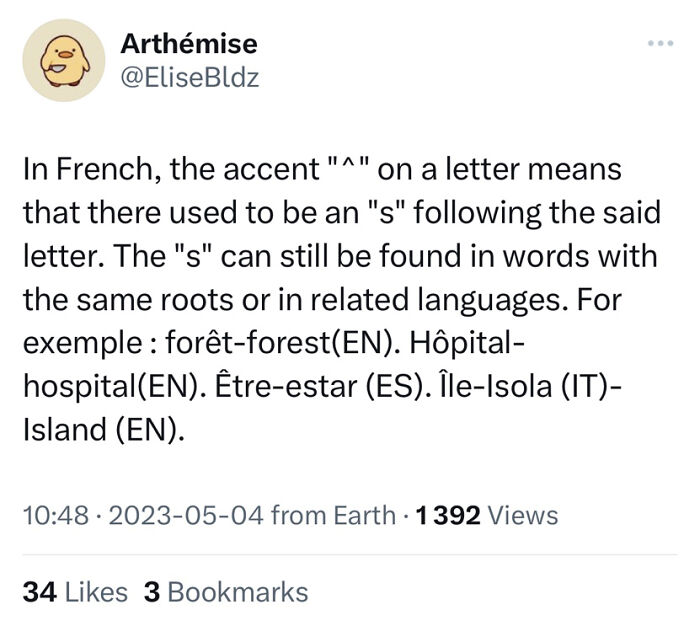
Load More Replies...Same root : Bâton (stick) / Bastonnade (beating). Château -> Chastel (old french) -> Castel (English)
Gâteau (cake) -> from old French Gasteau, same sort of roots as the word Gastronomy :) I learned that one in French cooking class!
Load More Replies...Learnt this in grade 6 from my french teacher who actually taught me stuff unlike highschool french teachers
Sounds similar to what I was taught about umlauts, when you add one to a vowel it's like putting an e after the existing vowel: lösen is pronounced loesen [laysin] instead of a plain [lohsen] or [lahsen] pronunciation (Note: native German speakers please correct my understanding of this if necessary, thank you)
the name France is (germanic) frankish, not latin. in german France is Frankreich : the empire/kingdom of the Franks.
Load More Replies..."Verbs are trouble going both ways: English blends tense and aspect and uses a complicated system of auxiliary verbs. But Russian, for example, cleanly separates aspect from tense and then adds an extra layer of complexity with verbs of motion (going, coming, bringing, riding, etc.)."
The professor continued: "Pronunciation in Slavic languages tends to be much closer to spelled-like-it-sounds than in English (isn’t everything?), but Slavic languages have some sounds, such as certain palatalized consonants and the Czech ř, that are hard for native English speakers to master. Going the other way, Slavic languages lack both voiced and voiceless th (as in thin and thine), so those sounds are a bit harder to master for English learners."

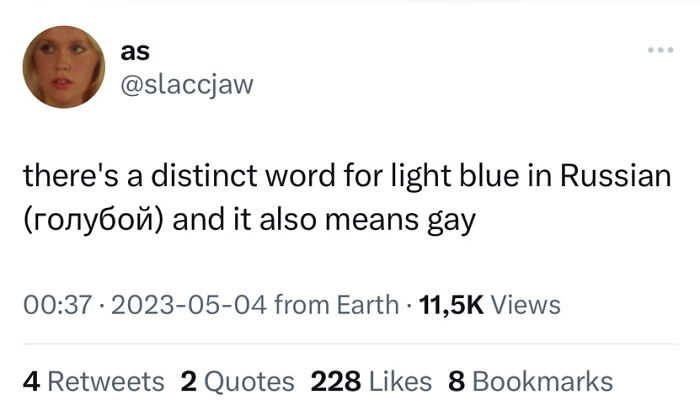
The Russian language treats light blue and dark blue as seperate colours.
Spanish too: celeste (light blue) and azul (darker blue).
Load More Replies...Irish has a specific word for red hair/ fur that's not used in other contexts.
Very interesting. My father was Hungarian, but didn't want to teach it me. I ended up learning 5 other languages instead....
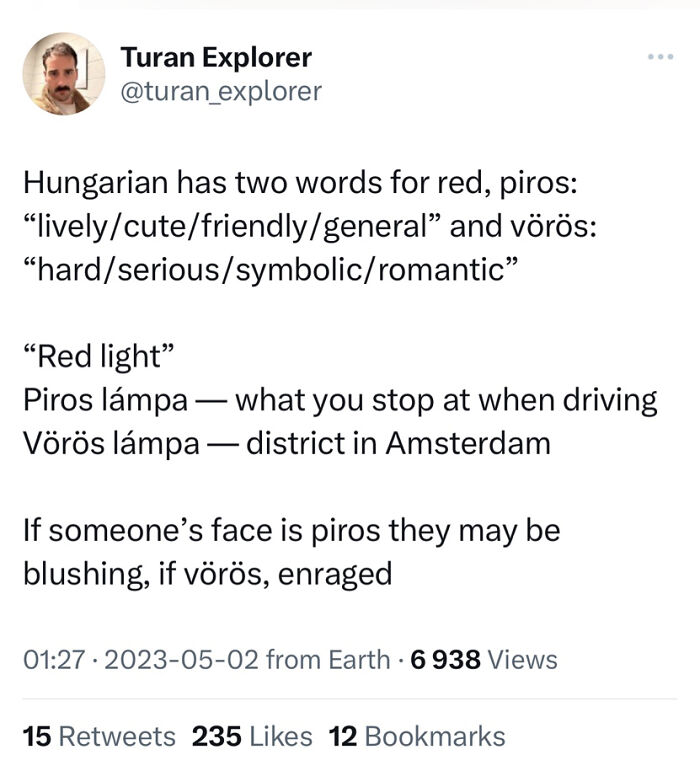
That example isn't even really internally consistent. I mean logically blushing would make sense and enraged does too. But what about aroused? Is it romantic - voros, or lively - piros? And the traffic light example - a red stop light sounds more hard/serious/symbolic than lively/cute/friendly. Not saying they're wrong, it's just kinda weird categorizations.
Shouldn't the lampa be vörös when you DON"T stop at the traffic light???
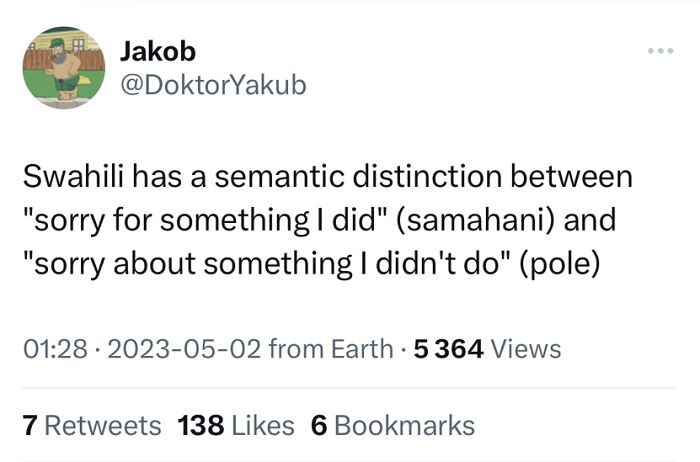
Is "pole" used for when someone tells you bad news (e.g., they are sick) and you say you're sorry (to hear that), or is it used when someone is demanding an apology for something that you're not responsible for (e.g., so sorry *you* bumped into *me*)?
I think that's just a weird English quirk. The two expressions are completely different. The fact we use the same word is confusing and inaccurate. "I have sorrow for your plight" is very different to "I apologise"
Load More Replies...We kind of do have it in English. "I'm sorry" can be used in both situations, but "I apologize" is only used in the first one.
Load More Replies...In Irish dialects (particularly Northern) the name Mary is frequently pronounced “Meery”
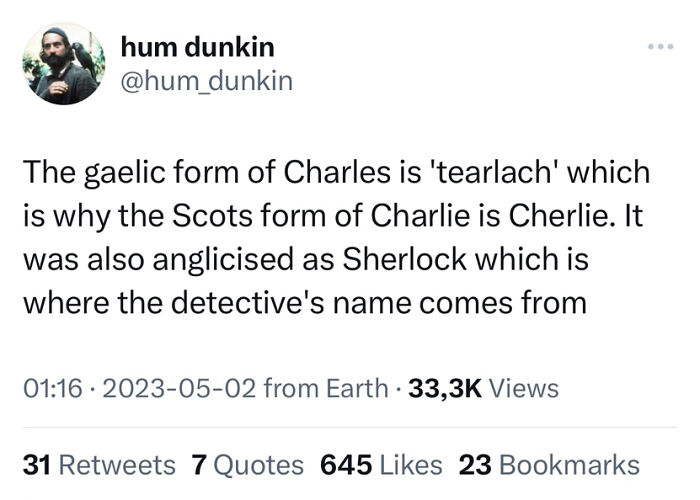
Load More Replies...Everything I found about this online disagrees and says it comes from old English scir (bright, light) and lock... aka Blondie for men
which is funny as im pretty sure according to the Sir Arthur Conan Doyle Encyclopedia, Sherlock canonically has dark hair. watson seems to be played throughout history as a mix of actors varying in light to dark shades of hair color
Load More Replies...Another fun fact: Sir Arthur Conan Doyle, a believer in the supernatural, and Harry Houdini, a skeptic were good friends until Doyle's wife attempted to speak to the ghost of Houdini's mother through a practice called ghost writing, where the medium would write down words, posessed by the ghost. However, given that the letter she had written was in English, and Houdini's mother spoke and wrote German, she was proven to be a fraud. Houdini was offended because he had been decieved, Doyle was offended because his wife had been called a fraud, and this ended their friendship.
Twitter user @LegoRacers2’s thread was a massive success. His post was viewed a jaw-dropping 9 million times. However, the real victory was proving that social media can be brimming with people who are happy to share their wisdom. All it takes is the right question to draw them out.
Liam, the author of the viral thread, has been a Twitter user since early 2013, and jokingly describes himself as a ‘Florida Swamp Ape.’
The reasons why people learn new languages can be as numerous as their motivations. For instance, yours truly loves French because it simply sounds awesome. But the reasons tend to fall into a few broad categories. For instance, someone might start delving into the basics of a new language because they’re moving abroad for work or an exchange program. Or they might have some new people from abroad in their social circle who they’d like to connect with on a deeper level.
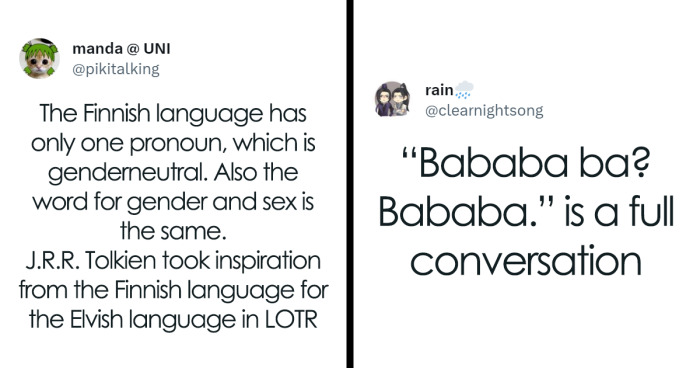
A Tagalog language joke.
- Bababa ba? (Is the elevator heading downwards?)
- Bababa. (Yes, it is.)

The Finnish equivalent: -Kokoo kokko. (Build a bonfire.) -Koko kokkoko? (An entire bonfire?) -Koko kokko. (An entire bonfire.)
Longer version: Kokko kokoo kokoon koko kokko. Koko kokkoko? Koko kokko.
Load More Replies...As a side note, the words in English that can be used in the most ways with the most meanings are Dude and Fùck
... and REALLY ... (surprise, disbelief, sarcasm, bordedom, confirmation, emphasis, etc.)
Load More Replies...Don‘t know if this counts: „wenn Fliegen hinter Fliegen fliegen, fliegen Fliegen Fliegen nach“ German (When flies fly after flies then flies fly behind flies)
The English equivalent - - Alright! (hi, I am fine, how are you?) - Alright (Hi, I am also fine.)
"Barbara Ann" must be a confusing song. ("Bababa Ba Barbara Ann...")
“Is is until it isn’t, then it was; was once was an is, back when it was.” - Trout Fishing in America
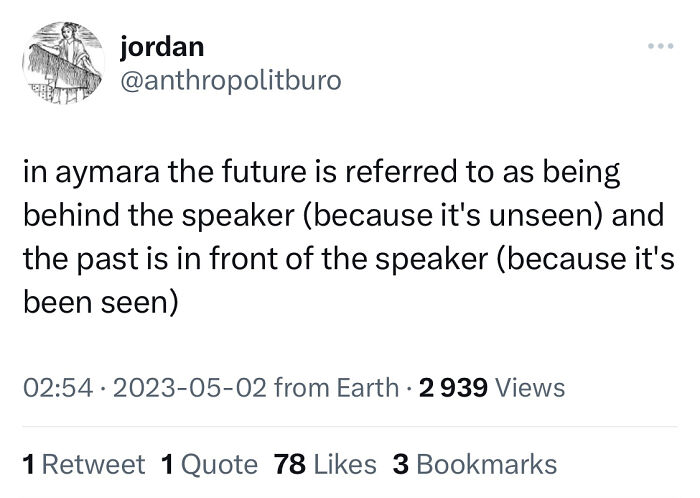
Load More Replies...This reminds me of the twin brothers Prometheus and Epimetheus as Prometheus means »the one looking ahead« and Epimetheus means as much as »the one looking back«...
That makes logical sense. We think of the future as being in front of us, ahead of us, but it's really only imagined, not actually seen.
It makes sense, but on the other hand, the opposite also makes sense: the future is the direction in which you're heading, and you're walking further and further away from the past.
Load More Replies...Interesting. Both approaches make sense just in different ways. For them it's about viewing, for English speakers it's about moving. Wonder if that is indicative of other cultural differences.
For those who are interested … language spoken in the Bolivian Andes https://en.wikipedia.org/wiki/Aymara_language
Thank you! I was just about to ask where Aymara is from.
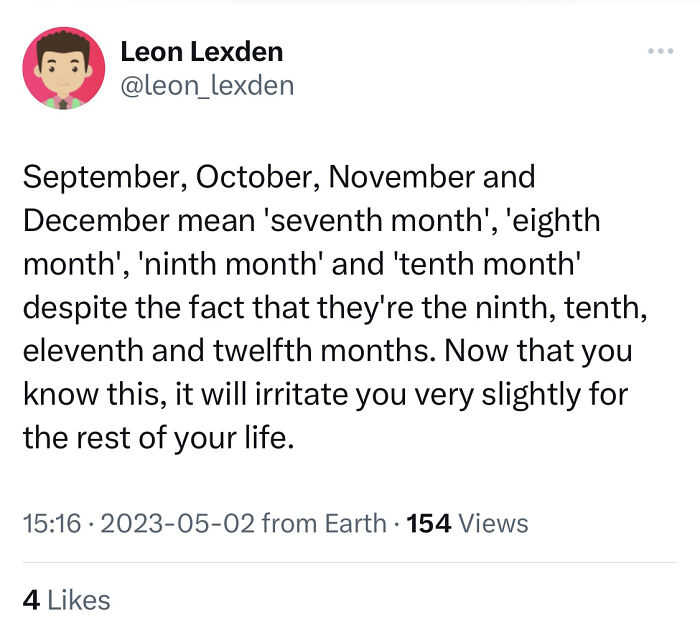
Load More Replies...This implies that people don't already know this, and that they don't know the reason. I was taught this when I was around 8 or 9. The old Roman calendar started in March, therefor making September the seventh month. When the start of the year was switched to January, it bumped September along to 9th place.
It was changed because Julius Caesar (July) and Augustus (August) each wanted their own months. Do we have 2 extra months that threw the names all off... Just because of men's egos. Thanks guys.
Load More Replies...That's because the terms were coined when the year ended in February (which is also why that is the shortest month)
Months used to match their prefixes until a couple of caesars stuck their noses in it.
Its all named after nature and activities done in certain months right? I find it fascinating
Load More Replies...Of course - Oct..... is 8 Octopus has 8 legs, an Octagon is 8 sided. Fits that the rest make sense too.
I LIKE having had this pointed out, and the very slight irritation is worth it
Others might choose to learn a new language because they’re bored out of their minds, crave a new hobby, or want to dust off some of the cobwebs growing in their brains. Learning anything new is challenging at first, but once you get to grips with the basics, it can be incredibly rewarding. Especially if there are some larger factors at play. Like preparing for a fun trip to Japan. Or wanting to travel across South America without an interpreter. You can forge a lot of friendships if you show the locals that you respect them enough to at least try to speak to them in their tongue.
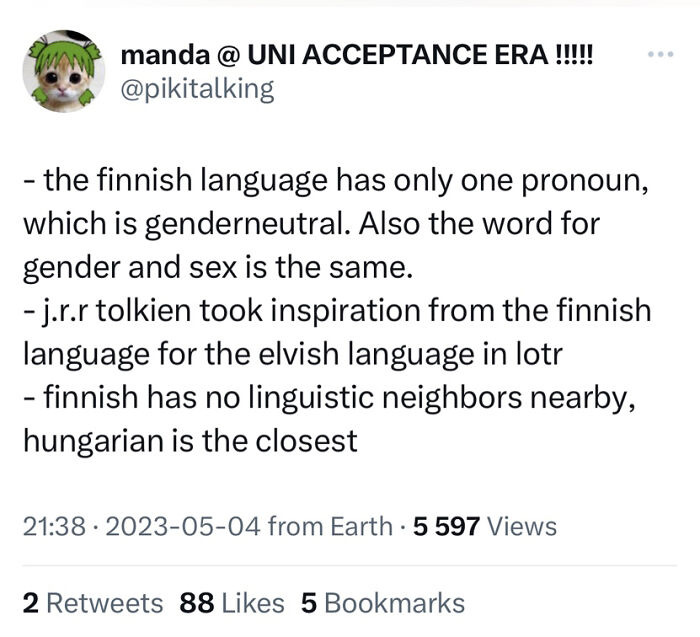
Well, Estonian is pretty close to Finnish, definitely closer than hungarian..
I don't know anything about estonian language or grammar, but I think, the OP was referring to grammar-rules in these languages. What is a fact. I'm hungarian, in no way I would understand a person speaking finnish, and it's true the other way round. But our grammar rules are sharing a lot, meaning, that for me, would be easier to learn finnish, than english was.
Load More Replies...Finnish has _multiple_ linguistic neighbors nearby. There's Estonian, Karelian, Livvi, Ludic, Sami, etc. Hungarian is actually one of the more distantly related langauges to Finnish within the Uralic language family. Finnish is on the Finno-Permic branch while Hungarian is on the Ugric branch. That's like saying Italian doesn't have linguistic neighbors nearby (ignoring French, Sicilan, Corsican, Spanish) and that English is the closest. The thing about gender neutral pronouns is true for the entire language family, but it's not just the pronoun, Uralic languages lack grammatical gender altogether.
This sort of bugs me because the word "pronouns" doesn't only mean stuff like she/he/they, it also refers to stuff like I, me, you, so I really doubt that Finnish only has one pronoun. However I understand that OP is talking about a term of address
Yep, there are other pronouns. We just don't have any words with genders.
Load More Replies...Spoken language "se" (=it) is perfectly fine for a pronoun
Load More Replies...As a nonbinary person, SEND ME TO FINLAND SO PPL WILL USE THE RIGHT PRONOUNS
What was the point of gendered pronouns in the first place.
Load More Replies...Neighbouring Estonia though...? Estonian shares a lot with Finnish. (example: counting to five in Finnish: yksi, kaksi, kolme, neljä, viisi , and counting to five in Estonian: üks, kaks, kolm, neli, viis ) but yet.. a lot is different. For example "Hallitus" means government in Finnish but in Estonian... mold. The languages share the same roots and are the same language family, though.
hungarian is exactly the same, except Tolkien did not used it as an inspiration
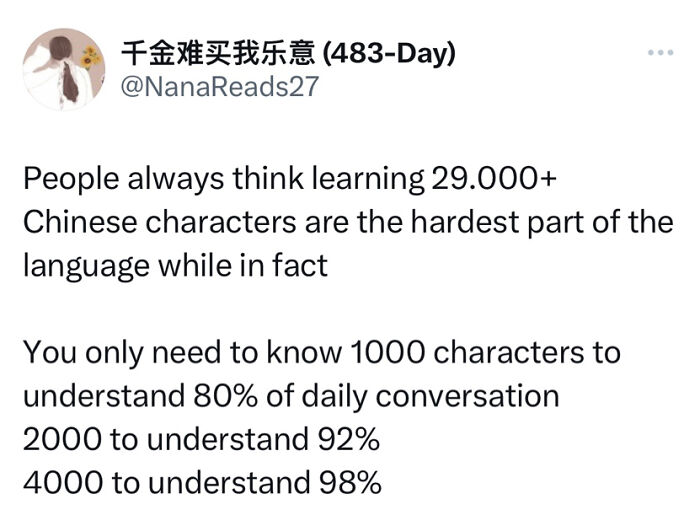
I'm learning Chinese, it's actually not that difficult. After a certain point you start seeing patterns, and you can always read more charecters than you can write.
Load More Replies...Conversations are normally spoken - you don't need to know ANY characters to understand them.
But Chinese conversation is even harder, as each 'word' has four different intonations with four different meanings, and western ears have great difficulty distinguishing them. Then you have the different pronunciations of the same thing in Mandarin, Cantonese, and Hokkien!
Load More Replies...Though, thought, trough, rough... sh, th, ch, pool, book... aisle, island, wrong, knight... There are far more idiosyncrasies in English that make it far more difficult, and many variations involving those characters that can only be learned by rote. None of the 'I before E, except after C, but only when the sound is ee, but not in words like seize' nonsense
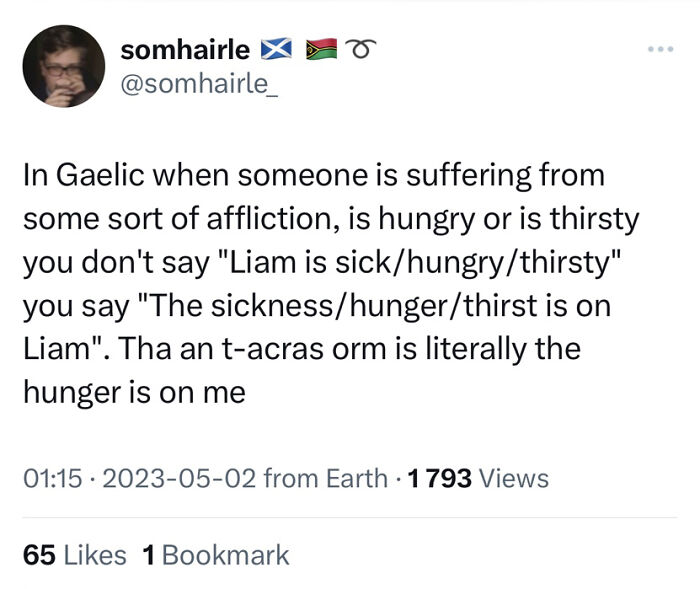
Load More Replies...It's similar in Spanish. You say, "Tengo hambre" ("I HAVE hunger"), instead of English's typical "I AM hungry." I think that this phrasing of seeing conditions as temporary, and not inherent to a person, just makes so much more sense intuitively
And in Spanish you "have hunger" or thirst/fear/tiredness, as opposed to "I am hungry". It's a temporary condition!
There's a pretty good chance that, after reading this thread, the whiskey is inside Liam, and more is being added.
Load More Replies...I’ve definitely heard Irish people do this when speaking English as well.
Load More Replies...Meanwhile, some people might decide that they want to reconnect with their cultural heritage. Say, if their relatives migrated from elsewhere decades or even centuries ago. On the other hand, some folks take up their studies not primarily out of the desire to talk to others but to understand their literature and media. There’s a lot that can be lost in translation, after all.

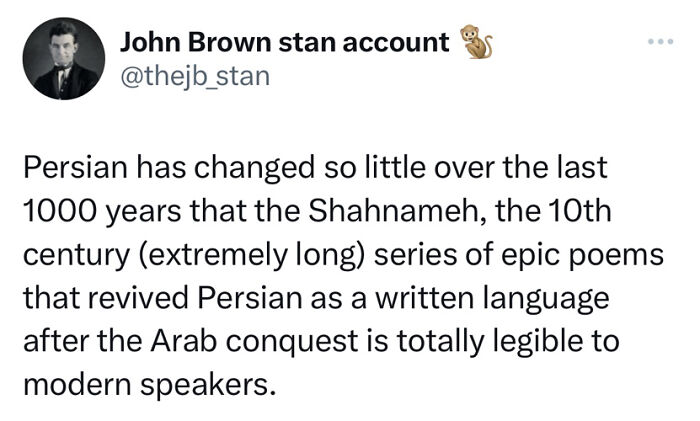
Same with Icelandic - I think. (I'm not a native speaker of Icelandic.) This is what I remember reading in a guide book. The language is so old that they don't have words for modern inventions such as "atomic bomb", for instance. Looking for a name for it, Icelandic linguists dug through old scriptures and came up with a word that translates into "flaming spear falling to the earth" - or something like that.
As an Icelander I can tell you, you are correct. Icelandic hasn't really changed since medieval times. Modern Icelandic is actually a dialect of Old Norse, as such most Icelanders can still read and understand 1000 year old texts! However, I have not heard about atomic bomb fact, so can’t confirm or deny it. But can confirm that we lack many modern words. 🙂
Load More Replies...Now that is super cool. The ‘Englisc’ spoken 1000 years ago would be 99% unintelligible to a modern speaker
Hwæt! Ic swefna cystsecgan wylle, hwæt me gemætteto midre nihte, syðþan reordberendreste wunedon! þuhte me þæt ic gesawesyllicre treow on lyft lædan,leohte bewunden, beama beorhtost. You know what I mean?
Load More Replies...Hebrew has a lot of this as well. Look at biblical Hebrew, antiquity Hebrew, Medieval Hebrew, Renaissance Hebrew, 18th Century Hebrew, and modern Hebrew, a modern speaker can understand all of the older dialects. The older versions have more grammar rules and can be confusing with some words at times, but is fully understandable
French was the official language of England between 1066-1362. I may understand it more than Shakespeare tbh!
Medieval Norman French was quite a bit different than what’s spoken on the streets of Paris today, though.
Load More Replies...Chinese, at least written Chinese must not change much. I found a coworker who was born in Hong King reading a novel from the tenth century. He said it did not need to be translated.
For some English speakers, reading Shakespeare is like reading a foreign language because the language has changed so drastically. And it continues to evolve a bit with every generation. Gay used to mean happy when I was younger, but it's rarely used in that context any longer.
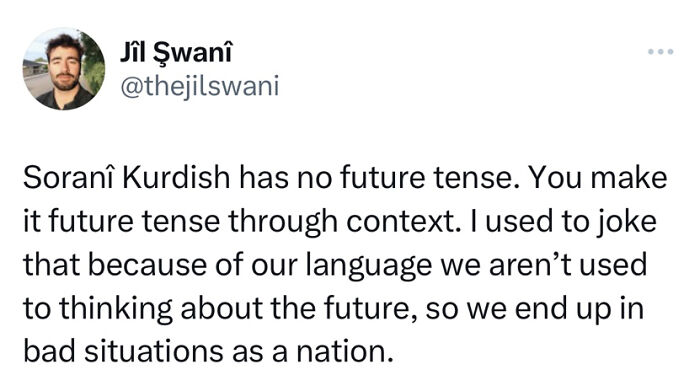
My language doesn't have any tenses. Time is expressed through time words like yesterday or tomorrow. The verbs never change. I guess we have no past, present, or future. (Edit to say that the language is Thai, as some might miss my later comment.)
I'm sure that's just because you are very kind people and have better things to do than make people struggle with grammar
Load More Replies...Same in most Germanic languages as well, English included. We need a modal verb or clause, like "I will do" or "I'm going to do" unlike Romance languages where there is a distinct different verb conjugation, although many of the also allow modal verbs, e.g. either "Je vais faire" pr "je ferai" are acceptable in French.
And Estonian. There is still a future case in Hungarian but it's not often used.
Load More Replies...I once actually read of a study (that I don't think I'll find again, so don't pressure me on this) that claimed to show that people with native languages that don't have a specific future tense on average take greater measures to prepare for the future. It was reasoned that this was due to the future seeming closer and more pressing when it's expressed in present tense. The example given were Spanish and some Scandinavian language, but I don't remember which one was an example for having a future tense and which one wasn't
I'm curious as to the psychological effect this has on the people whose language doesn't transgress into the future.
Of course only imagiNation. Lol, sorry to all kurdish people.
Load More Replies...There are few words with more than two tenses in my language. Tenses are indicated by helper words, typically with a second tense that is actually constructed as an adjective. Even in the case of the past tense, when a second tense is common, there is a helping verb construction which is virtually synonymous (He ate; he did eat) I'm talking about English. (He did go, he will do, he does go, he shall go, and the absurd, he is going to go. He has gone, he is gone, he had been gone, he will have been gone.) Occasionally, these is an actual irregular, past tense for verbs, especiallu when the verb is used as a helping verb (go/went, is/was, has/had, does/did, go/gone, shall/should, will/would)
Bruno, isn't most of this wrong? You say "tenses are indicated by helper verbs" - I thought tenses, strictly speaking, were indicated by modifying/conjugating the verb, using English as an example, the suffix -ed is used in regular verbs so walk-walked. You say "typically with a second tense that is actually constructed as an adjective" - what does this even mean? Do you have an example? Are you thinking of participles, which can also be used as adjectives? By "helper" verb, you mean "auxiliary verb" right? If so, "go" is not one. English main verb structure is essential two tenses (past and present), two aspects (continuous/progressive and perfect) and a number of modal verbs (should, could, will, etc.) and that's pretty much it, no?
Load More Replies...Neither does English - it’s the present tense with ‘will’ or ‘going to’ - it’s future aspect’
It's not an aspect, the two aspects in English are progressive/continuous and perfect. English uses verbs in present and/or modals to discuss realistic futures.
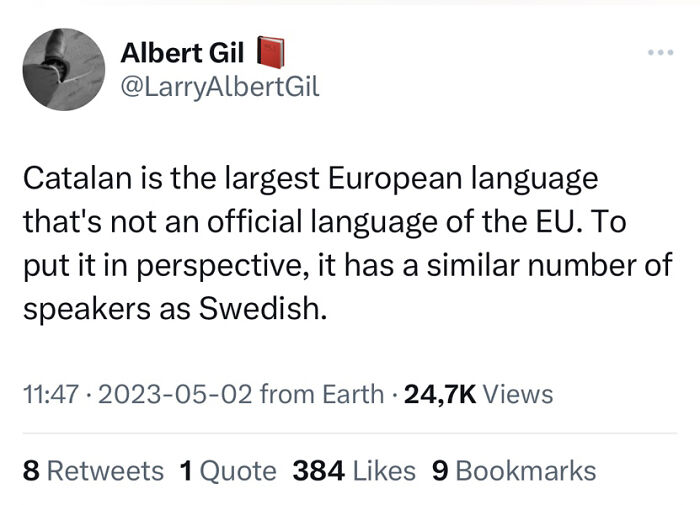
Load More Replies...We need more unity, not balkanization. The Catalan deserve to be recognized, respected, and protected for their uniqueness but we need to move towards larger states, not smaller ones. Things like the EU and UN encourage us to think as "I am a human and so are you." The larger the group you consider yourself a member of, the less people for you to consider "other".
Load More Replies...I’m half Catalan myself, and used to speak Catalan until I was about 10 years old. Never knew any Castille at all. Also, if Catalunya was able to be separate (which I hope one day) the rest of Spain would be extremely poor.
If Catalunya gets the independence, decades of struggle will arrive. International companies will move to Spain due to taxes and permission documents. You will be out of the UE so Barcelona port will not receive shipments and you will need a visa to cross any border. Just like UK but without industry.
Load More Replies...Disgusting behaviour, beating old ladies in the street for want independence. Barbaric.
Load More Replies...Surprised to find out that Catalan isn't mutually intelligible with Spanish.
Catalan is a romance language and you can find in it traces of spanish, french, italian, Portuguese ..
Load More Replies...If we're counting first language speakers, there are more than 10 million speakers of Swedish, as against 4.1 of Catalan. There are about 5.1 million people who have Catalan as a second language.
My friend speaks that, we were at the airport once and there was a woman who had left her phone on her plane, but she didn’t speak English, my friend heard her speaking Catalan and stopped to help!
English, while a wonderful language that is incredibly useful to know, won’t open every door for you. And you cannot expect everyone to speak it. The more languages you’re well-versed in, the more opportunities you’ll be able to take advantage of in life. Having that kind of flexibility is incredibly useful in one’s social life, on the internet, professionally, and at school. Being a human being is all about connecting with others because we’re social creatures. So it makes sense to develop as many social tools as possible to do so.

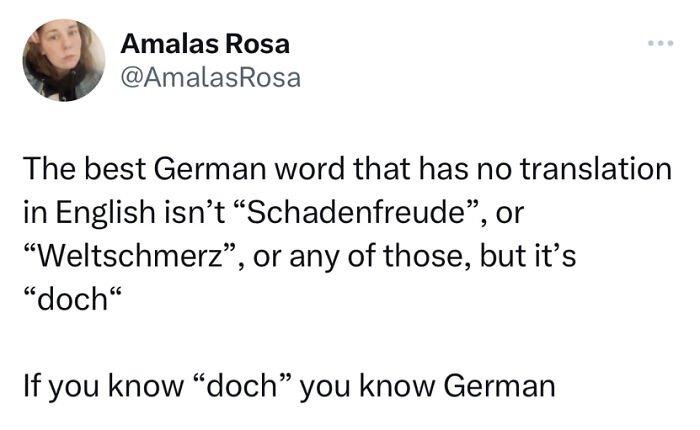
As a German, the only equivalent I can find in English is the well known "is too" after someone says "It's not." It's basically a forceful "YES" after someone told you no.
Reminds me of "eh" in Austrian german, meaning something like "I recognize what you say as being correct, but have not the slightest intention of acting accordingly."
I absolutely adore the sentence and sentiment that you shared for that. I am an avid reader and love that words strung together can be so vivid
Load More Replies...We have it in French, too. "Si" can mean "if" but it also means "Doch". "Non!" "Si!" "Non!" "Si!" ;-))
There is a very well-known scene in one Louis de Funès movie where the entire conversation is like the one above, and it is translated exactly like that into German: "Nein"! "Doch!" "NEIN!" DOCH!" "Oooohhh!!!" Me and my family often quote it.
Load More Replies...Etymologicallly doch is the same root as "though" in English. It may translate to "nevertheless". Also it translates to "Si" in French, and דווקא in Hebrew.
Doch has many meanings. It can be: yet, also, still, you know, anyway, but, however, after all, of course (ja doch), don't do that (nicht doch), move on (Lauf doch), Look (Guck doch), of only (wenn doch) , so... After all (also doch), think (denk doch nach), come on, hurry up (komm doch endlich), Slip it (lass es doch), .....
It was created to address illiteracy within the country. The elites who could afford schooling were learning Han Chi, which the written form of traditional Chinese characters. It is commonly known that Chinese characters are difficult to master especially since it does not translate well to spoken Korean. Hangul is an alphabetical writing system that better captures the spoken language in written form.

i still only know annyeong, hana dul set. The only words i know in korean
Load More Replies...Hangul was invented in the 15th century. There sure as hell weren't any "socialist sentiments" at this point in history. They probably mean "social welfare sentiments".
It opened up literacy to the working class -- note this was a time when most of Europe was illiterate and the Bible hadn't been translated into English.
Load More Replies...With the switch from Kanji to Hangul in Korea, literacy rates improved enormously. It really is, as said, incredibly easy to learn. It's mostly phonetic, and voiced and unvoiced consonants are combined Eg. t = d, k = g, etc.
Hangul was created in 1443. Seems funny to call the early Chosun rulers, "socialist." Perhaps OP meant that it was selected some 500 years later for education programs?
Invented by their King! Sejong, (born 1397—died 1450), monarch of the Chosŏn (Yi) dynasty during whose reign (1419–50) cultural achievements in Korea reached their highest point. Sejong is best known for his development of Hangul (Han'gŭl), the phonetic system for writing the Korean language that is still in use. (source: https://www.britannica.com/biography/Sejong-Kore)an-ruler
There's a website that claims that Hangul is an easy, logical system that should only take 20 minutes to learn. It certainly looks easier to learn than many other written languages, due to the simple characters.
Don't forget that Korean consonants are stylized represtations of the shape your tongue makes when making the sound.
Sign language is many centuries old as well. The earliest concrete reference to sign language in Britain is from the wedding of a deaf man named Thomas Tillseye in 1575.
And he was signing get me out of here! And the minister thought he signed I do.
Load More Replies...And that is all because Thomas Braidwood refused to teach a visiting American his sign language but the French were happy to teach them
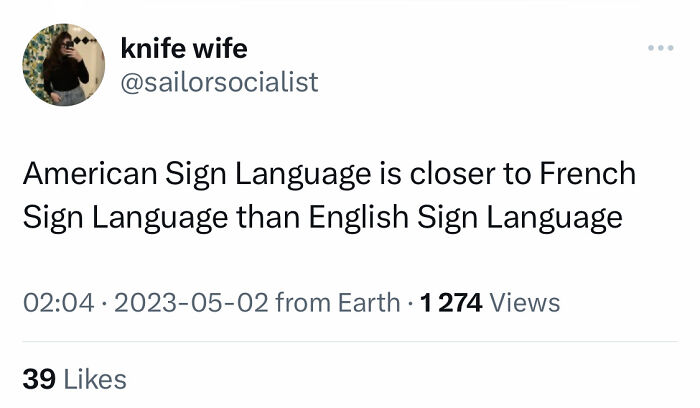
this is because a french man helped create asl! a man named thomas hopkins gallaudet wanted to help his neighbors deaf daughter, so he got laurent clerc, who taught french sign language, to help him, and then started schools (like gallaudet university, a deaf college) and developed asl
I wish there was only one sign language, then we could ALL learn it and be able to sign to each other.
When I was learning. Sign language (I live in Canada) it was explained that it was grammatically French because it was developed by a gentleman from France. Gallaudet, I believe. We asked our instructor why it couldn’t be a universal language and she signed that there are things that exist in one country, but not another. She gave an example of “baseball”. Also, sign language can be very regional. A sign for something in Southern Ontario can be entirely different for the same thing in Northern Ontario. It is a much more complex language than many people realize.
Yes - just like dialects, some people say soda, pop, sodapop, cold drink, or some places use Brandnames all depending on where you are.
Load More Replies...As someone who knows some asl and is trying to learn French I might use this to my advantage
Even in one form of sign language, there are regional accents and dialects.
Load More Replies...As far as I know BSL is the only sign language that uses both hands for each letter. Irish and American letter-signs are almost identical (there are a few differences but not many) but BSL is completely different
It’s important that you’re passionate about the language and culture. Otherwise, if you feel like someone’s forcing you to learn against your will, you might run out of motivation. However, some individuals pick these languages based mainly on how widespread they are, and how impactful they’re likely to be in the future.
Algebra means "reunion of broken parts" https://www.etymonline.com/search?q=algebra
The “father of algebra” was a Persian with the surname al-Khwarizmi, which is where “algorithm” comes from .
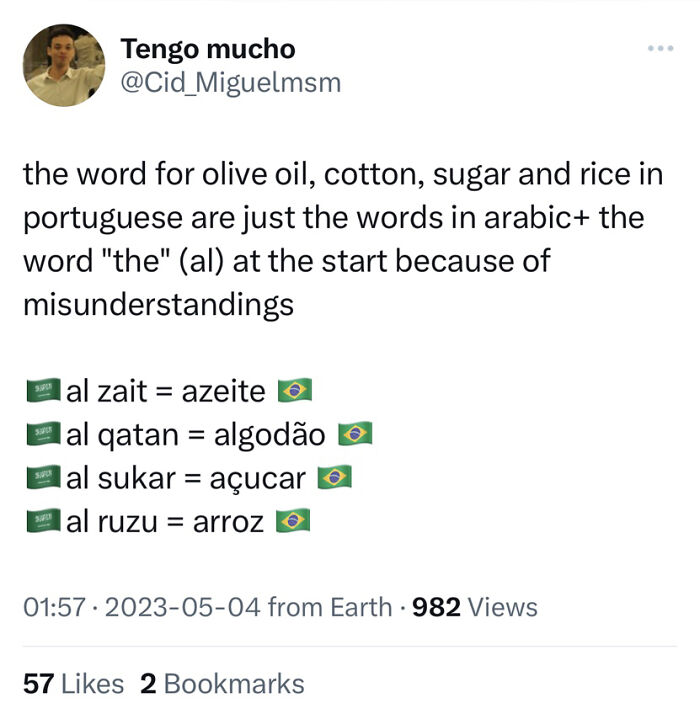
Load More Replies...Aceite, algodón, azúcar, arroz. Love to see how languages connect to each other.
If they are anything like Korean, they make up a lot of fusion words too. Like 'skinship'. Or the meanings totally change like "I went to a meeting yesterday" has TOTALLY different meanings
Load More Replies...The Spanish word adobe means mud in Egyptian Arabic. (probably all Arabic but I was in Egypt when I heard this.) Californians use it for a specific kind of clay and the associated structures.
Same in Spanish. There are a number of words of Arabic origin in the Spanish language. Alfombra (rug), aceite (oil),azúcar (sugar), jaqueca (migraine), etc.
I'm a fluent Spanish speaker and I've been able to talk about relatively simple things with Portuguese and Italians. It was handy working in the airlines
And there is that persistent "al" in Arabic that becomes "El" in Spanish, another left-over from the Arabic occupation of Spain...
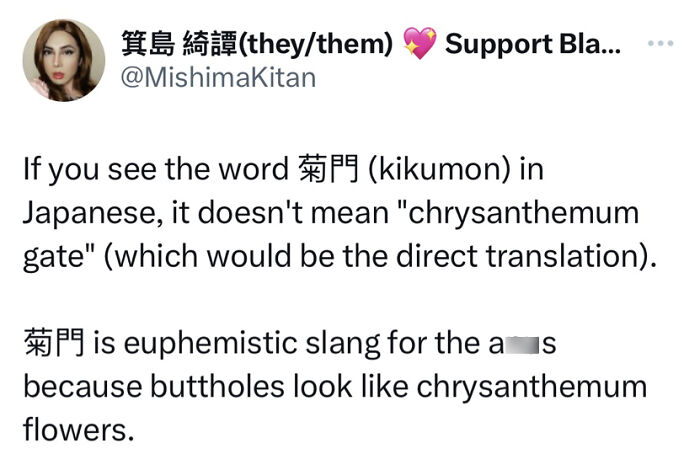
For fúck's sake BP, ANÙS is a medical term. STOP THIS STUPID CENSORISM!
A slang term for the @nus is ‘chocolate starfish’ and there’s a band in Australia called just that

I think this is the same in Chinese, but considering their shared characters, maybe this is not surprising.

This is also true of Chinese....because the Japanese used Han Chi which originated from China. It's rather funny how Japan is still using traditional Chinese characters while China due to the communism revolution and trying to make sure more ppl are literate decided to simplify the written language.
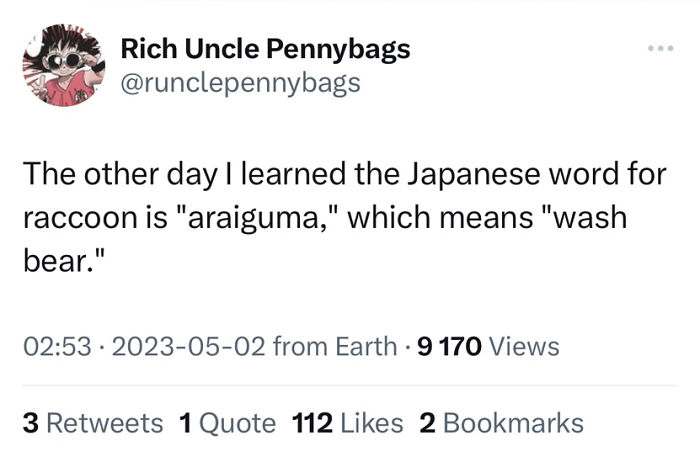
Same in Afrikaans, although for some reason I always thought it's "wax bear" 🤦🏻♀️
Load More Replies...That's just a slang. Because they feed on everything they can find in the trash.
Load More Replies...The English word "Racoon" is a bowdlerization of the Algonquian word "aroughcun" which means "animal that scratches with its hands"
For instance, Babbel points out that there are 1.3 billion Chinese native speakers on Earth. Meanwhile, around 485 million people speak Spanish as their first language. That’s far more than the (still impressive) 373 million native English speakers there are worldwide. The fourth most spoken language is Arabic (362 million native speakers), and in fifth place is Hindi (344 million speakers).

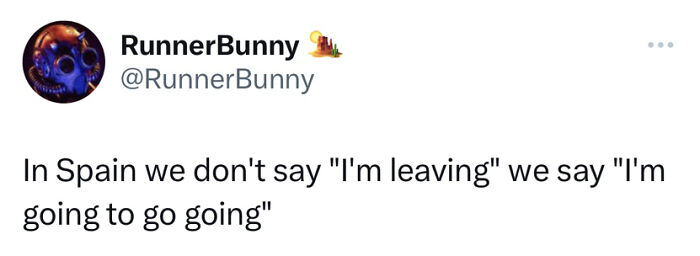
Going to go going still makes more sense than going to GET going to me. :p
I just say “well uh look at the time BYEEEEE”
Load More Replies...In the US Midwest we start the 45 minute process with a knee slap and a "Welp, It's about that time..."
"We should vamoose"? Yeah, that's from vamonos.
Load More Replies...I don't agree. Where I live in Spain they say 'me voy' but not' 'voy a ir yendo' as per your sentence. Unless I have misunderstood your English. In a hurry they might say 'Me voy pitando', but not an infinitive and then a gerund or present participle.
This is really cool. I've never really thought about it but in afrikaans we say "Ek gaan gaan", which means "I'm going to go", or if you want to be stupidly and simplistically literal, "I go go". (Because "going to" and "go" are both "gaan".) A lot of time in casual conversation you'd just say "Ek gaan" ("I go" or "I'm going") but technically that's not really grammatically correct.
In Marathi or at least in India, we also never say we are leaving. In Marathi, we say something - Yeto Aamhi or Bhetuya.. it means we will be coming or indirect goodbye without the negativity and Bhetuya means we will meet again
"Me voy a ir yendo". This is part of the "preparation for leaving", when you announce your will. You can just say "me voy" (I'm leaving) and there is no drama. I'm talking about Spain, there are differences in courtesy in other Spanish-speaking countries (we are the direct ones in the Spanish world).
But do they understand you when you speak spanish? ;)
Load More Replies...In Dutch we say 'ik ga'. We have al lot of long words, but 'ik ga' is 'lekker kort' (nice and short)
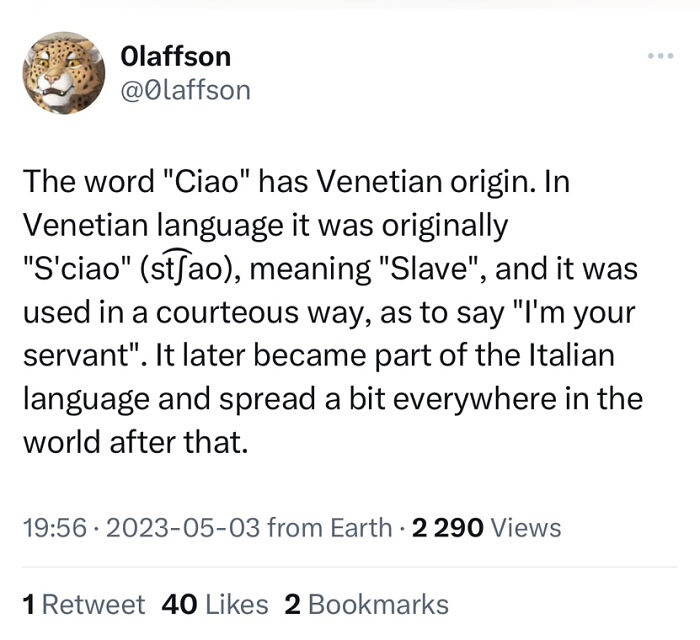
Kind of the same for southern Germany and Austria, "servus" (used for both "hello" and "goodbye") derived from the Latin word for "slave"

Servus is used in Hungary and Romania too (in some parts of Transylvania).
Load More Replies...And slave comes from Slavic: where Romans used to get their war slaves
Eh, not really. Romans didn't get their slaves from just one place, the Roman empire at its brightness went from Scotland to Iran so unfortunately slaves came from anywhere. The original term for slave was mancipium or servus. The term "slave" came much later in the 13th century and yes, it designated the Slavic people, as they were the "typical slave" by definition.
Load More Replies...And it's used both for greeting and parting: it means both "hello" and "bye".
"Salve" - (Sal veh), is very common greeting today in Italy, also from "slave" origin. Schiavo is the modern word for slave.
Slave itself is closely linked with Slav because during the Byzantine period so many slaves were Slavs.
We have regional variants on counting in English dialects. Where I come from, they were mainly used for counting sheep, and it goes Yan, Tahn, Teddera (1,2,3). There are a huge number of variants, and it changed almost from valley to valley. See https://en.wikipedia.org/wiki/Yan_tan_tethera
This is useful to know when trying to get to sleep
Load More Replies...S. https://voyapon.com/counting-in-japanese-numbers/ In Japan, the way of expressing numbers changes according to what’s being counted. Living things and objects are classified into categories, each with its classifier or numerical counter. This classification, found in several Asian languages, stems from Confucianism. As well as counters for people (-nin ; 人), there are counters for small objects (-ko ; 個), books (-satsu ; 冊), floors (-kai ; 階), the liquid contents of a container (such as a glass) (-hai ; 杯), items of technology (such as a television or a car) (-dai ; 台), long cylindrical objects (-hon ; 本), flat, thin objects (such as paper) (-mai ; 枚), houses (-ken ; 軒), small animals (-hiki ; 匹), large animals (-tō ; 頭) and so on. There are also counters for time, such as (-fun or –pun ; 分) for minutes, (-ka or –nichi ; 日) for days and (-gatsu or -getsu; 月) for months.
So, one way to insult people in Japanese is deliberately using a wrong counter, like you say "I saw 2 of your family yesterday" and then you don't use the counter for people (-nin ; 人) but the counter for large animals (-tō ; 頭) 😬
Load More Replies...Japanese has counting systems that differ depending on what you’re counting - one for flat things (eg paper), another for round things, another for people, another for animals etc
What about for stupid people who think a (mostly) round planet is flat?
Load More Replies...Japanese has distinct counting systems for many things: people, age, thin flat things, books small things, etc.
Irish is so fascinatingly irritating in the best way. I take such pride in my minute understanding. It's one of the oldest spoken languages in the world. Latin is 2700yrs old. Irish is 2500yrs old. And lots of people still speak Irish every day. It's so cool!!
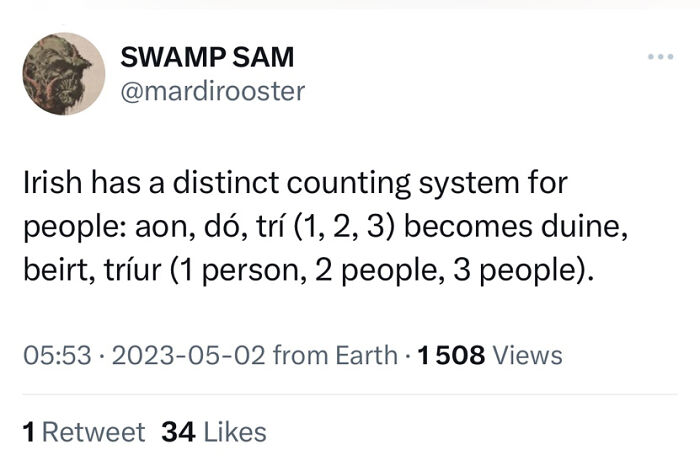
What's exactly the same? The gender of the numeral corresponds to that of the noun, that's it. No distinction between counting animate or inanimate objects.
Load More Replies...However, Berlitz notes that the total number of English speakers, including native ones, is over 1.4 billion, making it the most popular language worldwide. In the meantime, there are over 602 million people who speak Hindi and 548 million who speak Spanish, whether as their native tongue or a second language.

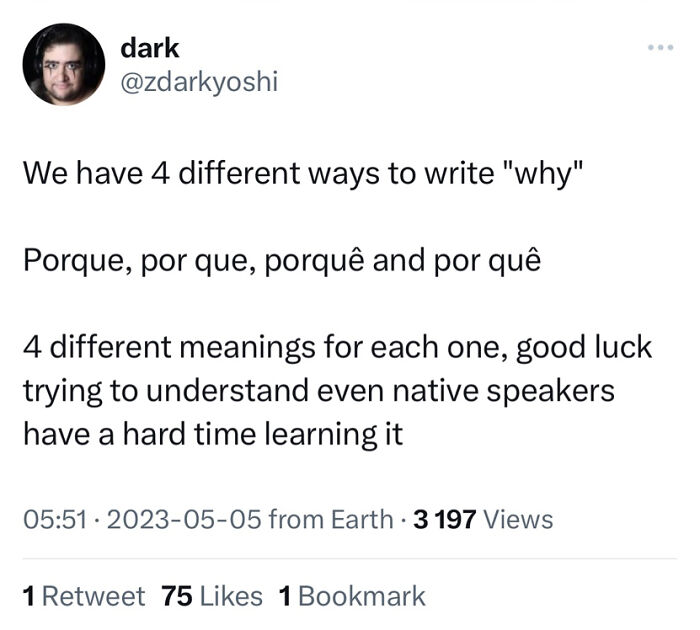
Not true. Those 4 “ways” don’t all mean why. They mean 1) “because”, 2) “why” when placed at the beginning of a question or “of which”, 3) “why” when placed at the end of a question, and 4) “why” again but as a noun (as in, the reason), respectively.
It goes like this: -POR QUE a casa é toda branca? (WHY is the house all white?) -PORQUE foi a cor que o dono escolheu (BECAUSE that was the color the owner chose.) -Mas precisava ser toda branca? POR QUÊ? (But did it need to be all white? WHY?/FOR WHAT REASON?) -O PORQUÊ eu não sei, só sei que foi assim (The REASON is unknown to me, I just know it was like that.)
Porque = because; por que = for which; porqué = reason; por qué = why
When you say "we", it would help if you said who "we" are. I assume you mean Spanish speakers, but I can't tell the difference between written Spanish and written Portuguese, even though they sound different when spoken.
I think that's Portuguese because of the symbol. If it were Spanish, it would be é, not ê. But of Portuguese, I know nothing.
Load More Replies...In Italian it's kinda the inverse of this. "why" and "because" are both translated to "perché"
I'd love to hear the pronunciations of the four. I can say that's I've heard "Why" used on TV but I have no idea which of the four it is, or if in fact I've heard them use more than one variation but haven't even realised.
Danish has a different word for his/hers depending on whether the object refered to belongs to a person ("sin") or whether that is not the case ("hans"). That can be rather practically, since it (if used correctly) removes the ambiguity of sentences as this one: "He took his hat and left". If "sin" is used his, then the man took his own hat, if "hans" is used, he is stealing a hat (or bringing back a hat someone forgot). Unfortunately this is a tad to complicated for a lot of Danish speakers, who messes this up badly.
In what language is this? Because in Spanish it's POR QUE, PORQUE, POR QUÉ, and PORQUÉ.
Also, in Spanish, only POR QUÉ and PORQUÉ mean "WHY". PORQUE and POR QUE mean "BECAUSE".
Load More Replies...Adding "you utter" before any common noun does turn any word in an insult.
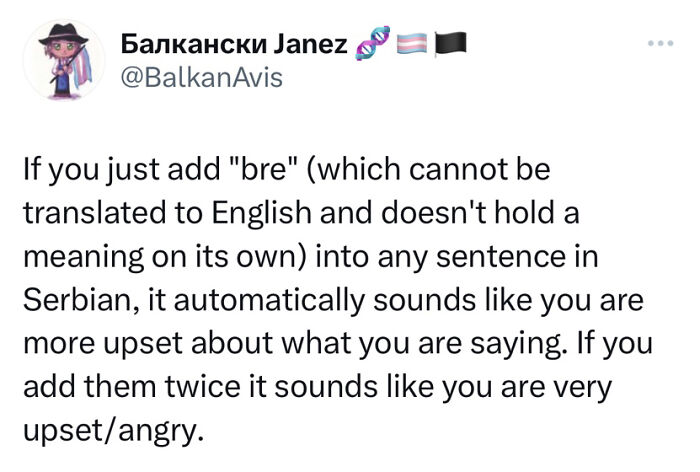
According to Nisanyan Dictionary: "It may have been taken from the Albanian word bre “brother”; but this is not certain. This word is borrowed from the Illyrcean word bra “brother (address)”. It is an addressing exclamation specific to Rumelian dialects of Turkish." The word is apparently still used in ex-Ottoman lands in Eastern Europe....Looking at the examples in the comments, and as per the definiton, I would say bre is today's "bro" in English.
Bonus - if you add "ajde" which is basically c'mon before the bre, it will resonate with the listener that you are indeed very agitated. I believe someone told me it originates from Hebrew "vre" or similar (someone correct me if I'm wrong) and Vre can be heard on Greek too - as in "vre malaka I told you so and so"
Interesting! I'm learning Serbian by myself, it's a tough language and anything I can learn helps!
You can use bre as a greeting in Romanian, as in Ce faci bre? What's up with you?
Vre ( βρε) in Greek . In old texts the form "bre" also appears. As mentioned hereunder "vre malaka" is an everyday greeting.
Actually, the 'est' part of that is the present tense form of the verb to be, so it should be translated as 'is'. The past tense form is 'erat'. Edit, imperfect past tense.
It looks more like there is a confusion between direct/reported speech in the original post.
Load More Replies...I deleted my original comments, because they were under the wrong post... anyway, I am trying to learn Spanish, which so far has been a rather kind and well-meaning language to learn for a native (Swiss) German speaker (looking at you mandatory French! Beautiful but cruel arch enemy in my school years...)
Frances es un poco difícil para mí también. No español demasiado especialmente para hablar con mi novio.
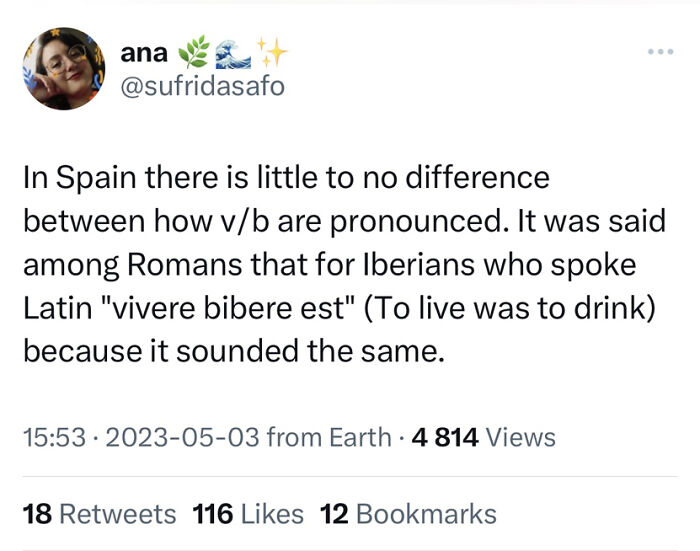
Load More Replies...This is not true, the pronunciation is different and that's why V is also know as "labio dental", which means that for its pronunciation you stick the teeth to the lips, which doesn't happen in the pronunciation of B, which is more like a pursing of lips.
Yes it's true. No one makes that difference speaking spanish daily.
Load More Replies...And the sound is kind of halfway between the two, rather than either B or V
To distinguish them in the Spanish alphabet, they are referred to as “be grande”(big B = B) and “be chica” (little B =V)
This was a problem for me when I moved from Puerto Rico to USA. My name being Vanessa (but I pronounce it as Banessa) and people would always misunderstand how I was saying and how to write it. Now when I'm speaking to a native English speaker, I make sure to enunciate the V sound so no confusion ensue.
Hence the joke about "he speaks French like a Spanish cow!". . . Il parle français comme une vache espagnole instead of "he speaks French like a Spanish Basque!" . . . . Il parle français comme un basque espagnol
My father related that he saw a sentence on the blackboard in a classroom in Baja Californis that read, "La vaca no bebe vino" (The cow doesn't drink wine). He assumed the teacher was teaching pronunciation that day.
I'm not very good at Spanish, that is I have very little vocabulary, but my pronunciation is excellent. I love the soft elision between v and b and it sunk into my pronunciation as though I'd grown up with it.
Learning a new language, like developing a new habit or skill, can be incredibly time and energy intensive. What matters the most, above everything else, is consistency. If you have the patience to focus on your studies every single day, you’ll see far more progress than if you do it only when you feel like it. Language learning apps like Duolingo reward their users for staying consistent.
You need to do something about that speech impediment Sonny
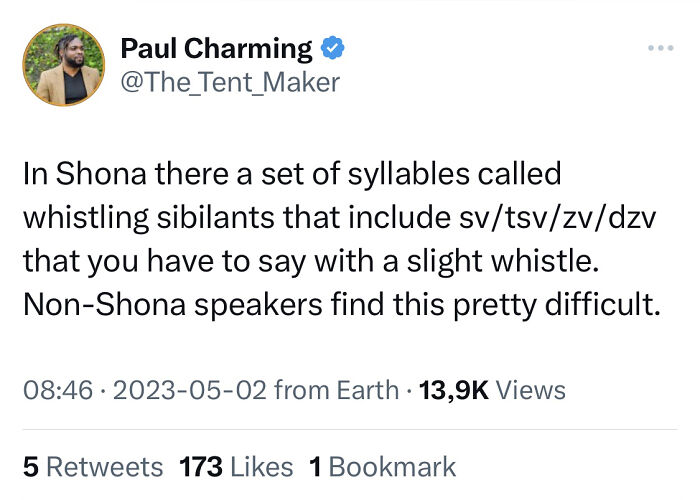
Load More Replies...I live in SA. Shona is common in our neighbouring country Zim. To give you an idea how it sounds, clamp your teeth together, open your lips, and try say "shwee". It's technically made more like by putting your tongue in the R position and breathing / whistling over that.
SA here too. If you can get the X and the C right, you can probably do anything.
Load More Replies...This sounds somewhat analogous to rolling r's and pronouncing ñ
Danish has three extra vowels, æ ø and å, which first of all can make it difficult to write Danish on a computer that does not have the corrosponding keyboard, but more importantly makes it difficult for foreginers to learn how to put their tounges correctly so they can prononce them correctly when learning to speak Danish. That people are usually pretty sloppy with their pronounciation, and that many words are not spelled like they are said, does not make it any less complicated.
I have a missing tooth for now. I don't lisp, but every once in a while, I make a loud whistle.
Well, my braces/slight lisp should make this easy for me i guess
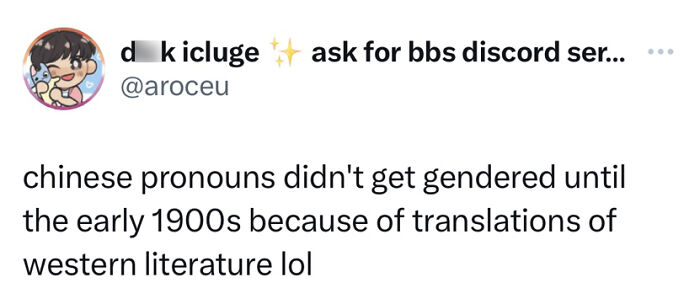
他(he) 她(she) 它(it) are pronounced exactly the same, 'ta'. It's quite funny because the 'it' form isn't well taught to foreign speakers, so you end up with people writing: I bought a table. He was hard and beautiful.
The last sentence is perfectly normal in Russian where every word is gendered and table is indeed a He.
Load More Replies...One of my best friends in college was a chinese student and she made me proofread her papers for pronouns because it was so hard for her to figure out in english.
It's one of the sticking points for most of my students too. I heard "My husband just came home, she's very tired today" so often I have to force myself to react to and correct it.
Load More Replies...One region of China (south-eastern Hunan province) once had a written language exclusively for women, Nushu. It lasted from around the 13th century till the 20th, with the last fully proficient woman dying 2004. Scholars and the Chinese gov't are working to revive it and keep it alive.
And the character for "she" is just the character for "woman" plus the character for "he"..."female he"
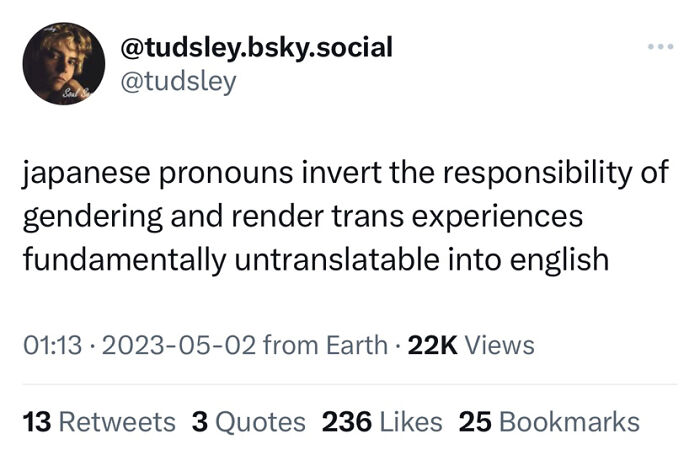
I think they mean that pronouns change based on what *you* are instead of what you’re referring to is. Like I (when speaking about yourself) could be uchi, watashi, ore, boku, atashi, jibun, … in Japanese, depending on your age, gender, social status etc. etc.
Load More Replies...Many SE Asian languages (Vietnamese, Cambodian…) have multiple pronouns depending on who is talking to who. Words are different whether you’re talking to a man, a woman, older or younger, from your family or not, casually or with extra respect, etc. There is absolutely no place in the common language for any gender identity change.
Finnic languages do not have genders for pronouns so we are just wondering WTF everybody is fussing about.
Hi! I'm studying Japanese and I'm happy to give some context for those still confused. There are a few different ways to say "I" in Japanese, and while most natives omit pronouns entirely and rely on context, they can use any of the following: - Watashi: gender neutral, used by any gender - Atashi: softer, mostly used by females - Boku: mostly used by males So basically the responsibility of gendering yourself is on you, not the listener. There are more pronouns as well other than the three I listed, but those three tend to be the most commonly used.
Not sure about this comment, but from what I know about Japanese (been studying it for 3 years, and living in Japan for a year now), you don't use pronouns for people. It's kinda rude. So you use names for everyone. Good luck figuring out if Tanaka San you have been emailing with is male or female, or non-binary. So, as there are no pronouns, you can't specify your pronouns to clarify what you identify as, gender wise. So, no way to clarify that you are trans either.
That reminds me of a Bones episode where a Japanese person was brought in as a consultant, though they said the non-binary culture was a sub-set of general Japanese. The other characters spent the episode trying to work out if they were male or female biologically. It makes more sense now.
Load More Replies...IIRC, American English is much closer to how British English was spoken in the Elizabethan era, so Shakespeare is more accurate spoken with an American accent.
Yeah, apparently the American accent is closer to the British English accent of a few hundred years ago, before British English stopped pronouncing all the Rs and moved to broad As in a lot of cases. Not sure you got your comment on the right post though? How Americans preserved British English - BBC Culture https://www.bbc.com/culture/article/20180207-how-americans-preserved-british-english
Load More Replies...In languages other than English, the word "the" changes and endings of words change based on "gender" or word. Ie in Spanish la casa (female) or El niño (male). But yo always means "I". They are saying that the word "I" changes based on who is speaking in Japanese so the word I would use as "I" would refer to myself as a young lady but an elderly man would have a different word for "I" and different gender endings. So not just based on Niño vs casa but yo would change as well
Load More Replies...The more immersed you are in the language and culture, the better your results will be. It really helps if you have the courage to talk to native speakers even if your skills are still underdeveloped. In the meantime, try to consume as much media and literature in the language as you can. Your growth should skyrocket! Though remember to take proper breaks: your mind needs rest for all of that new knowledge to settle down.
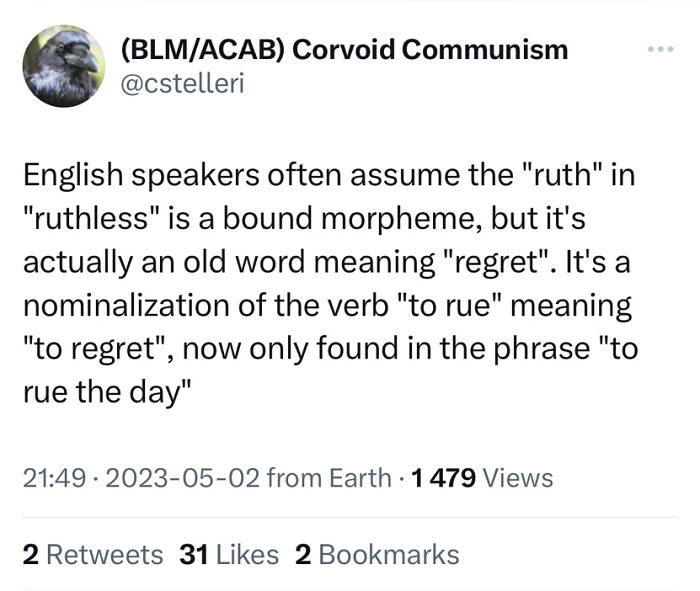
Although not a common verb 'rue' is used in more than one idiom, rue the day.
no? I always got what this meant. Heal/health; weal/wealth; steal/stealth; rue/ruth.
It's also used as an adjective - rueful, andan adverb - ruefully.
I thought it was from the Hebrew name Ruth which means compassionate/friend, so being ruthless would be to act without compassion or friendliness. As far as I know, that’s the meaning rather than without regret
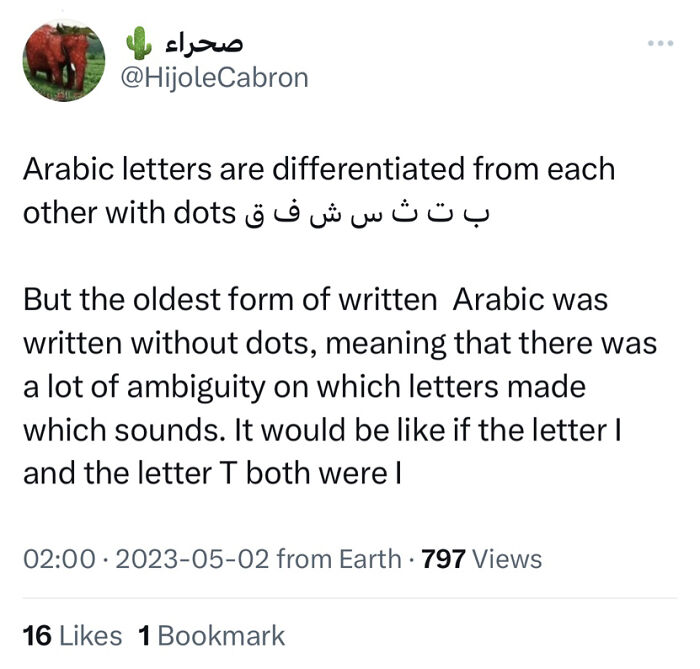
Hebrew also has this, and they not very often used because Hebrew speakers will know from the context what words are written.
Same above applies to Farsi/Persian, which is written with Arabic plus a few extra dots, and, is in fact indo-european, so closer to English than Arabic.
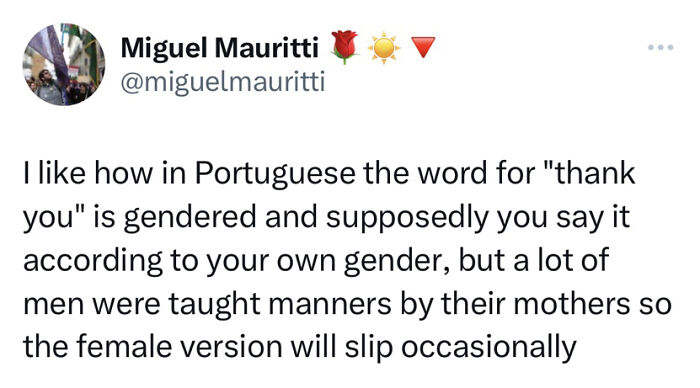
Nobody told me this and I spent six months in Brazil saying thank you like a man.
The male version is considered default so this is considered ok. Sincerely yours, the patriarchy. :€
Load More Replies...Or maybe good womanners? OK, OK, I'l see myself out...
Load More Replies...In polite Thai speech, women end their sentence with "ka", men end their sentence with "khrap". They do this even when speaking in English. Because male tourists spend about 98.6% of their time talking to women, many mistakenly adopt the female "ka" ending. I've never known a Thai person to correct them, perhaps because they think the tourist would be embarrassed by their mistake.
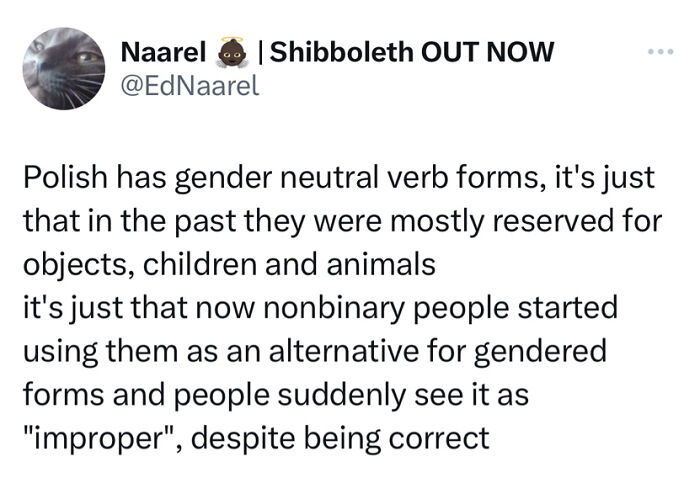
Load More Replies...Same as in German and could be similar in English.. calling someone "it" is neutral but "feels" off as it has been generally used for objects, children and animals
Using it in english to refer to a person is seen as incredibly disrespectful. It is definitely not used routinely to refer to children and most people are more likely to use he or she when referring to animals, particularly pets. To refer to a person as "IT" carries a strong implication that you view them as subhuman.
Load More Replies...I think that the endings for that gendered neutral form in Polish sound really awful as terms referring to human beings. I have heard over the years those forms being used as derogatory and offensive terms towards non-binary people. I find it odd that they would choose those forms and pronouns to designate their identity. Non-binary people are not ugly, but, to me, those words really really are.
Hot take: it's improper because it is. Downvote me all you want; your hate is amusing.
Almost got through this whole delightful compilation without seeing anything rude. At least I can still keep the thought that it was so nice to be able to learn things about all these different places without anyone being an a*s about anyone else's country. Enjoy any hate you get I guess.
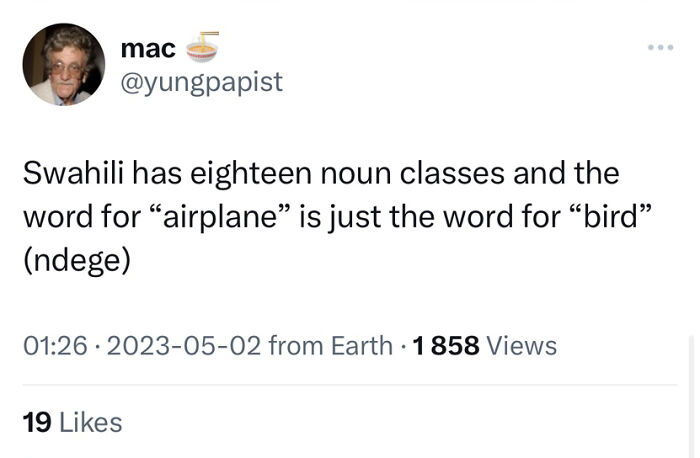
Load More Replies...One of my favourite Swahili words is Kali -a Kali dog (fierce), a kali knife (sharp), a kali curry (hot), a Kali teacher (strict). I may be wrong of course, because my knowledge of Swahili is limited to what we called 'kitchen Swahili' -so very far from fluent.
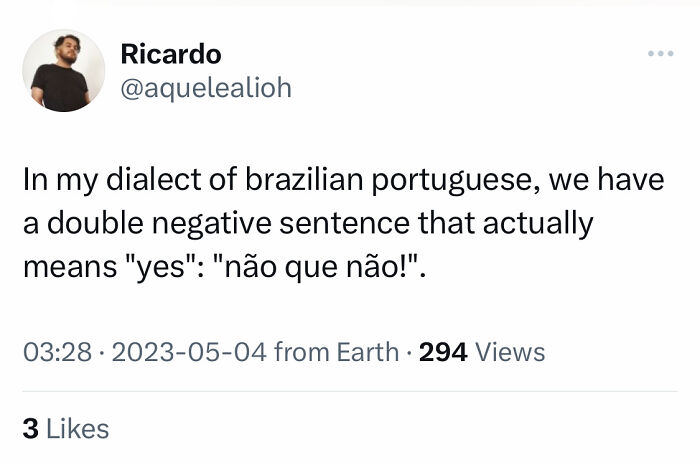
Similar idea to American Midwestern English: "Yeah, no" vs. "yeah, no, yeah" and more!
Ha, just like Australia! Yeah nah, or yeah nah yeah, meaning no and yes respectively.
Load More Replies...Like American slang Yeah, no means no No, yeah means yes Yeah no yeah means yes
And English has a two word phrase that both mean yes, but together mean no: Yeah, right.
In Canada we like this because we say; "no, yeah, no", "yeah, no, yeah", "yeah, no", and "no, yeah". And they all mean something different.
We do this in Midwestern US English (kind of) "I don't know why not"
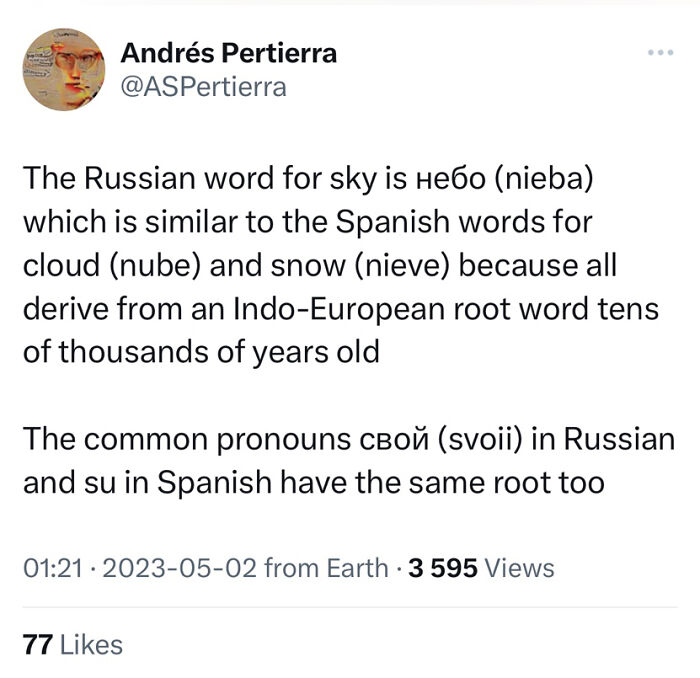
Indo-European languages initially diverged between 7800 and 9800 years ago, according to a science website.
Load More Replies...there are plenty of other russian examples. Brat = brother. Sestra = sister. Tiy = thou/thee. Viy = vous (you: french). Nash = nous / nostra / notre (your: plural). Voda = water. Dom = domicile. The above example "neba" compares to "nebulous" in English and "Niflur" in Old Norse (mist).
Where do the words sky, cloud and snow come from then? I think I can hear the Indo-European root in snow but not sky or cloud
Great question! Sky comes from Middle English, where in the plural it meant clouds. Middle English got it from Old Norse ský (cloud), from Proto-Germanic *skiwją (“cloud, cloud cover”), from Proto-Indo-European *(s)kewH- (“to cover, conceal”)
Load More Replies...Not exactly news... 'Nebel' is fog in German, and 'nifl' is fog in Old Norse. Compare them with Latin 'nebula'.
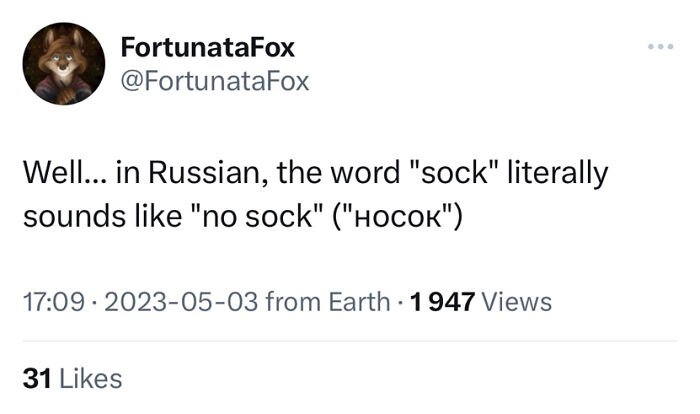
Is there a hole in the toe when it is on the foot?
Load More Replies...Ah I was just thinking about this! There's not really a word for 'foot' in Czech, it's all just leg, or specific bits like ankle, sole, toe, so sock is 'ponožka' - (po-noha)...i may not be completely etymologically accurate (po (alongside/along) vs pod) but I always think pod nožka, i.e. beneath the diminutive leg. There's also a German loanword 'fusekle' (German fuß - foot, supposedly the German original was fußsockel, per Wiktionary).
this reminds me of the ambiguity around "personne" in french; apparently it can mean "person" or "no-one"
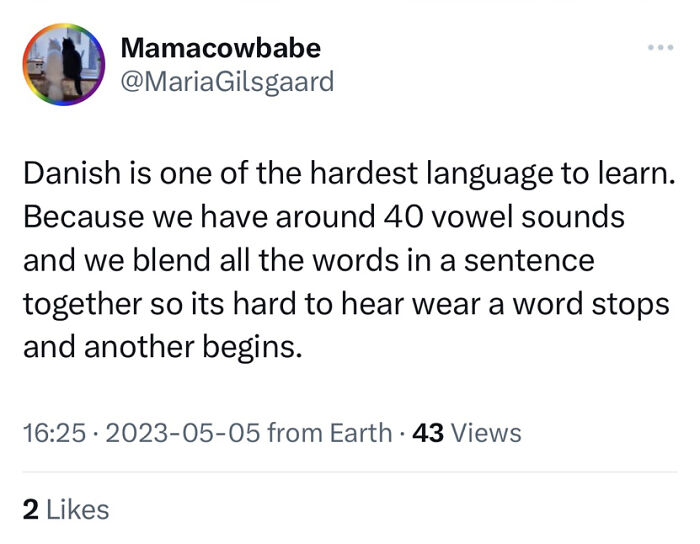
I've heard it's one of the hardest languages to lip read, I can lip read pretty fluently and in a deaf group I'm in that's global, we were discussing how easy/ hard it is to lip read in your native language and Danish was by far the one people said was hardest.

Dane here 🙋♀️ native Danish speakers tend to mumble a lot. And we have soooo many dialects. As a child I was told that Norwegians and Swedes understand Danish oooooh so well while it's more difficult for us to understand them. I have found that both Norwegians and Swedes laugh at us behind our backs saying we sound like we have a potato in our mouths when we speak. Haha! My point is: if we are hard to lip read it's because we mumble a lot and there are so many dialects that I don't doubt it must be difficult. Actually we have so many dialects here that in some areas you can hear what part of a village a person is from. And some dialects (those to the west coast of Jutland) have more or less English grammar but with dialect. I have a dictionary for basic words in the main dialect in the south of Jutland. And an entire book just touching the surface of the dialects of Funen. Dialects are AMAZING!
Load More Replies...When I was in Denmark I found reading it pretty easy. Kind of a mix of German, English, and Dutch. Didn’t understand a single word when they spoke though.
Someone once explained to me that Danish sounds like somebody is choking on a potato in their throat... Whatever that means. My grandpa was a Dane, he had to switch to German, otherwise I wouldn't have understand him...
There's a Norwegian joke I heard once: Scandinavia has just one language (Norwegian), but the Swede's can't write it and the Danes can't pronounce it.
I thought it is about every language you just start to learn. It's impossible to comprehend anything, because every sentence hears like one big word.
I've found that it sounds so close to English that my brain thinks I'm hearing English, and then all of a sudden, I realize it only "clicks" like English in my head, but I don't really know what the other person is trying to communicate.
It must be a mimic language, adapting to sound like the listener’s own language, I always think they’re speaking some dutch dialect when watching Danish movies, even understanding like 12% of what is being said.
Load More Replies...I worked in an office with danish speakers. And i am not too bad at languages. I could never ever tell where words ended.
Also we're not big fans of grammatical rules and the few we have always have a ton of exceptions.
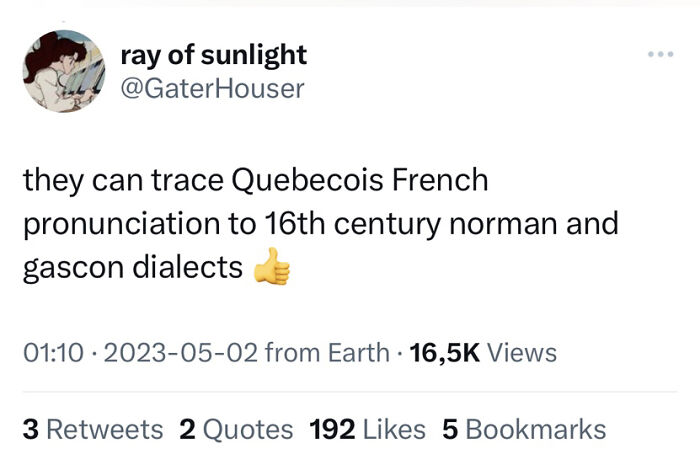
I lived in an area with a lot of Canadian French immigrants. Learned some Quebecois working for local newspaper. Went to college and thought I should take French... I did great on the written tests and failed every single verbal one. Sad part was the teacher new exactly why and was sympathetic lol
The Quebecois originated as sailors from those coastal provinces who got stuck behind a wall of English speakers from their homeland's greatest enemy. The French ports they traded with were in these provinces as well since that was where they had family. The first French people came to Quebec as fur traders in the 16th century. Then in 1608, Champlain brought Norman and Gascon sailors to form the first permanent settlements, including Quebec City. The Hugenots chased out of France who ended up in Canada were also mainly normans. My family was among them. The members of other provinces leaned towards the English colonies. Although New France spread south until it reached the Gulf of Mexico, there was always that wall of English speakers who were usually at war with France. Note - I don't count Acadia, Charlesbourg-Royal, or any other previous attempt as permanent since none of them could last even 10 years.
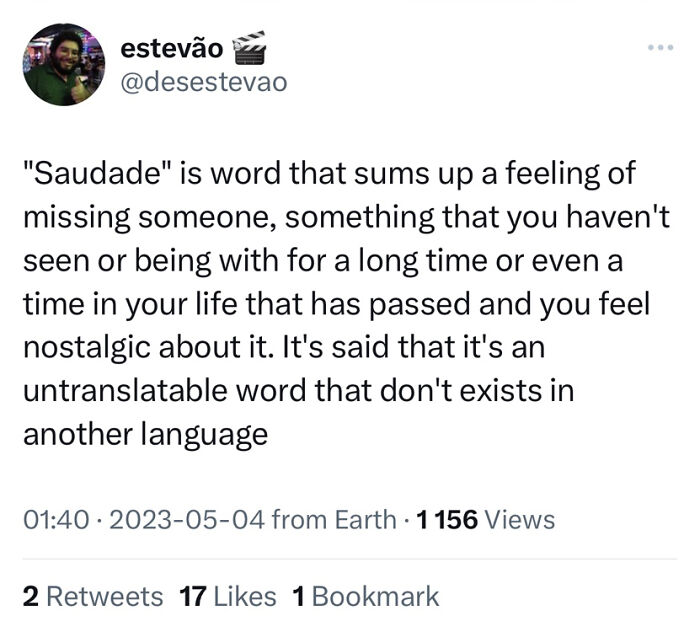
Portuguese word.
In the same way that the word nostalgia = a sentimental longing or wistful affection for a period or person in the past (different dictionaries will vary). Maybe it's not the best of explanations (and I've just woken up!) so can someone explain the difference a bit more clearly?
Actually nostalgia derives from the words pain (algos) and return (nostos) and means the pain you feel (or the feeling of bitterness) from the unsatisfied wish to go back home, so it's more or less the same as saudade
Load More Replies...I will preface this comment by saying that, although I speak some German, I am not fluent nor a native speaker. In one of my German classes, we learned about the word "Heima", which directly translates to English as "home" but also has a meaning like "the place where you belong". So "Heimastadt" can mean literal hometown or the place you feel most comfortable/a sense of belonging. (German speakers, please correct me if I'm wrong!)
You just forgot a "t" - it's "Heimat". Otherwise your explanation sums it up quite nicely.
Load More Replies...Yes it does. Romanian language. The word is "dor". I speak both languages and the meaning perfectly overlaps
Fado (the Portuguese traditional song style) is centered around saudade.
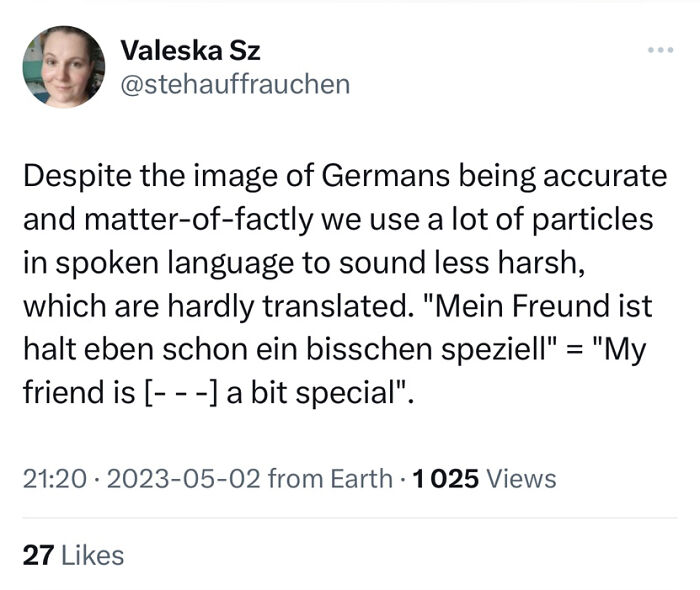
Is this regional? In English, the little interjections vary from region to region. Some say "like", some say "you know". We also have "um" and "ar". If you come from a region that doesn't use them, it can get somewhat irritating if they use them in every sentence.
Yeah, I think is highly regional. Okay, I'm not a native-german, but when my native-german Chef from South-Germany must stop in speaking my other native-german colleague from Brandenburg, with "Langsamer, und in hoch-deutsch", I assume, I'm not wrong saying, it's regional.
Load More Replies...We like "to talk around the hot porridge" a lot in Germany! ;)
Load More Replies...hhmmmm not sure... eben schon can probably be translated "even well..."
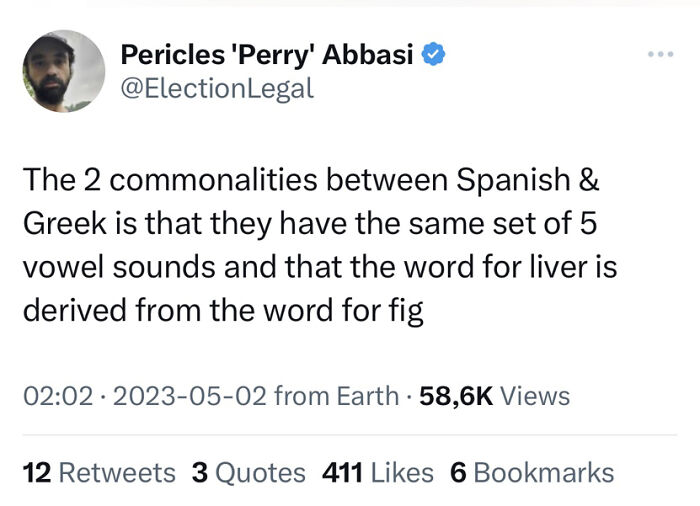
I need the reason because that is both ridiculously funny and really interesting at the same time. (The fig part, but vowels are still fun)

Don’t know Greek but in Spanish, fig is higo. Liver is higado. The same in Italian, fico, fegato. So I guess it comes from Greek.
Load More Replies...rubbish, there are tons of commonalities between greek and spanish. They're both indo-european so they have a lot of overlapping cognate vocab. So for example, words in Greek which start with ita and an accent, used to be h-ita in ancient greek. They survive in modern english. E.g. helios = sun (ilios in modern greek). All these BASIC words are s- words in latin-based languages. So, sol- is the latin stem for sun. (Solar, etc.) Spanish for sun: Sol. Same for the word for seven. Sept- is the latin stem; 'epta is modern greek, hepta in ancient greek. Spanish: sieta.
Wasn't it a breath mark and less of a pronounced h? I'm not sure for certain, I'm learning modern Greek, not ancient.
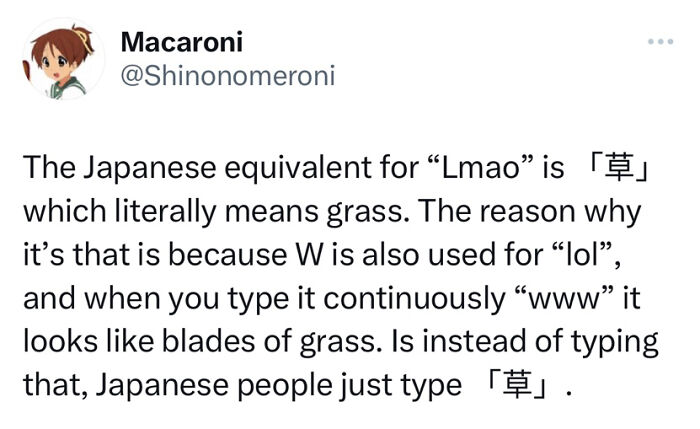
Load More Replies...It is the same in Chinese. Usually used for internet commenting, so you see something funny and you would write 草 (cao) but if we want to say “good morning “ we would use 早 (zao). They have similar pronunciation but completely different meanings.
I don't think that's true. In internet slang, "草" has a similar pronunciation to the "槽" in "卧槽“ (definition: f**k) , and since Chinese censors like doing their job well, people normally substitute saying "grass" for the f word. I've never seen anyone reply "grass" to something that's funny tho
Load More Replies...The highest point in Estonia is 317,4 m. We call it a mountain. We use our word for mountain quite a lot, the word for hill not so much.
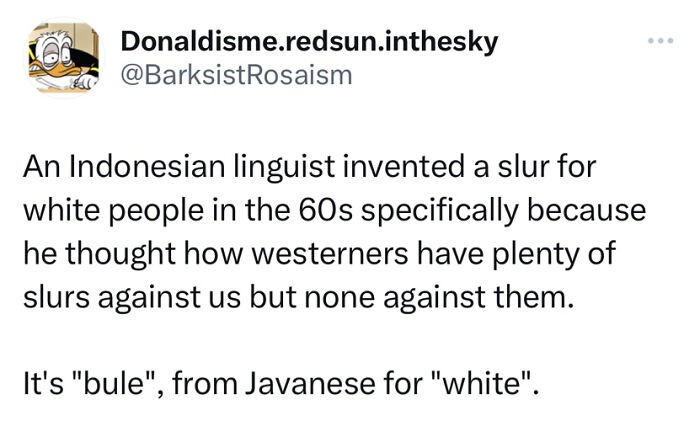
It depends on context/history/intent - the n-word comes from the French/Spanish for "black", but you wouldn't call *that* polite!
Load More Replies...The word for white people in Zulu is "umlungu", which just basically means "white person"; however there is a story that it means "the scum that gets left on the beach when the waves go out". Which is appropriate but I'm not sure how true it is.
Sorta salmon-colored. If I am pale I am more like ghost-colored. 😏
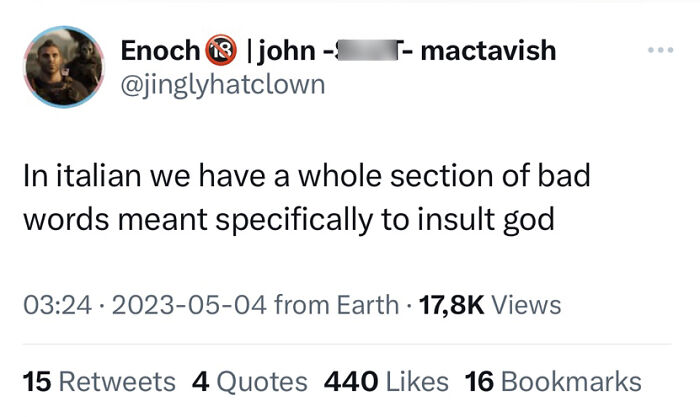
Load More Replies...They are called 'bestemmie' and they are usually a combination of the word "God", or "Christ", or "Madonna" paired with another word, usually the Italian equivalent of "swine", "dog" or something like that. And it's quite a big deal. For example, more than one TV shows contestants have been expelled from the show for saying a bestemmia on live TV. But the funny thing is that in some regions (like Veneto or Tuscany) this kind of swearing is quite common, it's almost cultural, and nobody bats an eye when they are profusely sprinkled in a conversation.
Load More Replies...In Russian the swear words' level of seriousness is heavily context related and the word "Khooynia" may mean "something of really bad quality" or "not a big deal" or "Something unknown", while "Pizdets" alone is definitely something overwhelmingly bad, but used in conjunction with other words may simply exaggerate their meaning, like "very" or "overwhelmingly".
Yup. Also, what bugs me about our profanities is the fact that with "khooyovo" and "okhooyenno" the former means "very bad", while the latter is for "awesome", though both of them are derivatives of "khooi" (penis).
Load More Replies...One of my first bosses was an italian owner of a cafe also selling ice cream. Until today I dont speak italian but I am able to swear in italian 15 minutes straight.
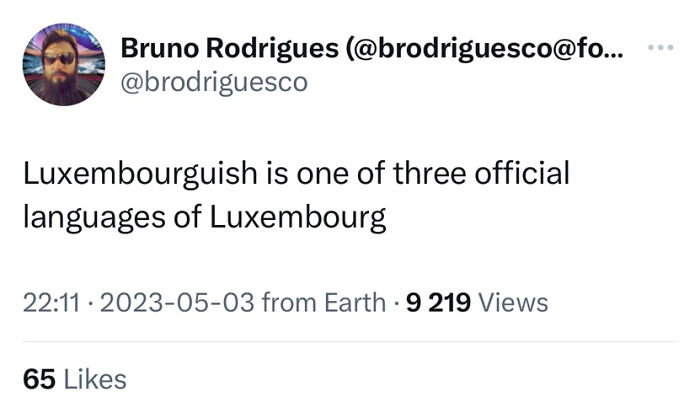
Luxembourguish drives me Crazy, as a German speaker it sounds almost but not quite entirely unlike German then it switches to French.
I would disagree with the tense part, as there are speech particles that dictate tense, such as '了' (le) for the past tense, and '会' (hui) meaning will. The pronoun/gender stuff is true because 1: we don't gender out nouns and 2: he, she and it are pronounced the same.

I think s/he meant individual characters don't have tense, only combined they will
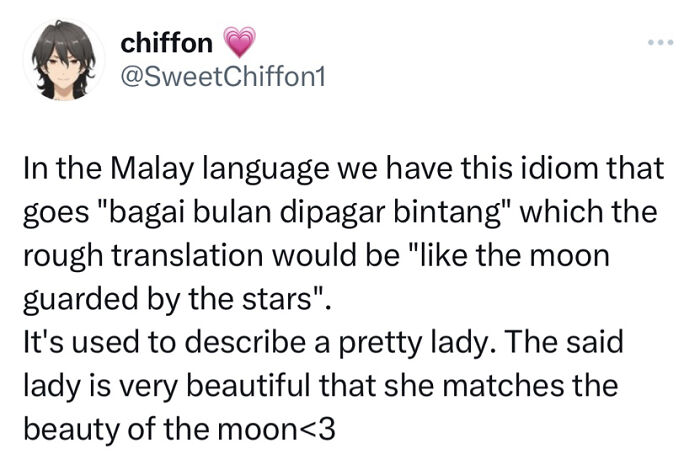
Load More Replies...In hindi sometimes we call the moon "mama". Mama in hindi means mother's brother(maternal uncle). Also moon is often used to describe someone as beautiful. Sun is also used( they shine like the sun).
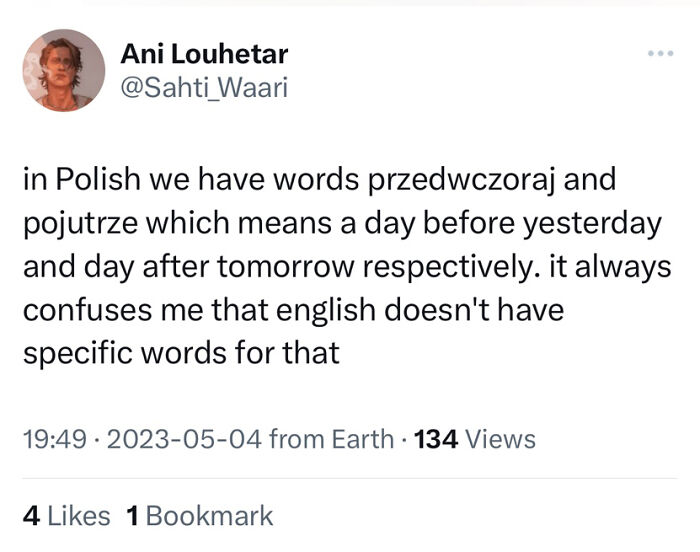
German does :D It's morgen (tomorrow), übermorgen (the day after tomorrow), or even überübermorgen (the day after the day after tomorrow XD). Same goes for gestern (yesterday), vorgestern (the day before yesterday) and vorvorgestern (the day before the day before yesterday)

Hungarian has words for those too! Tegnapelőtt (day before yesterday) and holnapután (day after tomorrow). They literally translate to yesterdaybefore and tomorrowafter.
German as well: vorgestern (beforeyesterday) and übermorgen (overtomorrow)
Load More Replies...The day after tomorrow is sometimes referred to by the somewhat obscure term overmorrow.
We don’t even have different words for different kinds of cousins, or for your aunts/uncles vs their spouses. Is that uncle my mother’s brother or my aunt’s husband? We’re vague on second-degree relatives
I always thought that it was odd that I consider my uncle my uncle even though we share no blood.
Load More Replies...We have them in Spanish too :) Pasado mañana (the day after tomorrow) and Anteayer ( the day before yesterday)
It always bugged me that Anteayer is one word but Pasado mañana are two words. I coined and used Postmañana for a while but didn't caught on :)
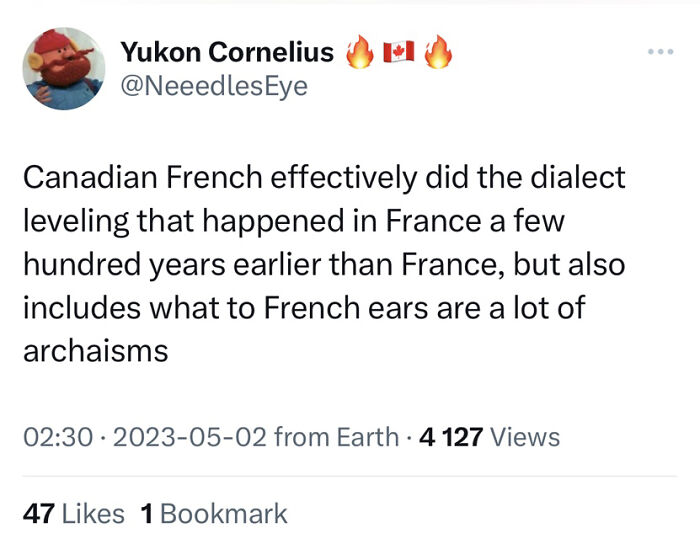
Load More Replies...Growing up in Canada, I can only somewhat understand France French, but Quebecois/Acadian French I understand perfectly. The accents and even vocabulary are just so different.
I was on a photo shoot with one person from Quebec and another from France and they both chatted away happily to each other - I have no idea if there were limits on what they were able to say to each other or not.
Load More Replies...when my french canadian friend speaks normally, i don't understand a word he says :D
When visiting Québec, we could understand the city people, but in the country in Gaspesie, the difference in pronunciation was so great that they could have been speaking another language. Once we stopped to ask for directions, listened smiling to the answer thanked the person à lot... and departed none the wiser ;-))
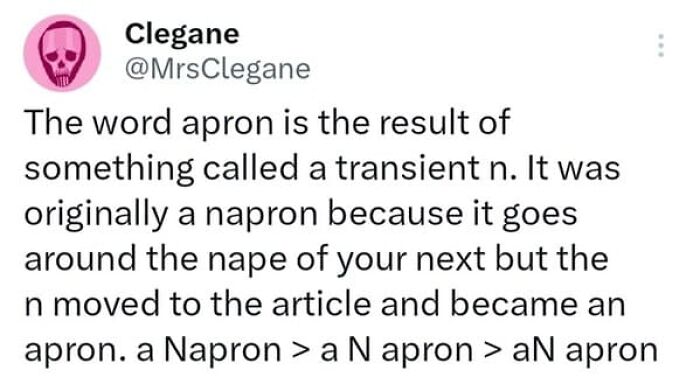
Load More Replies...The etymology is a little wrong here. 'Napron' comes from Latin 'nappa' (napkin) via Old French 'naperon' (small table-cloth). But it is correct 'a napron' morphed into 'an apron'. The same thing happened with 'a naddar', (a snake/serpent) becoming 'an adder'. One that made the opposite journey was 'an ewt'. It became 'a newt'.
And young newts are still called efts (not nefts)
Load More Replies...You’re right about the reanalysis of the n but wrong about the whole nape of the neck, sounds like what we call a folk etymology. It comes from napperon in French, which means tablecloth. The actual Latin word at the origin of napperon was mappa (with an m), which means napkin.
apron : " from Old French naperon "small table-cloth," diminutive of nappe "cloth," from Latin mappa "napkin."
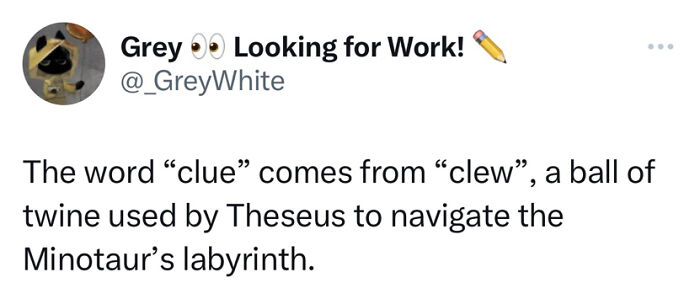
I read that it's adapted from French. It means "nail", figuratively speaking it talks about a linchpin.
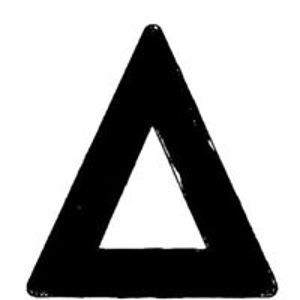
I can only find the 'clew' explanation. There is nothing about it being derived from 'clou'.
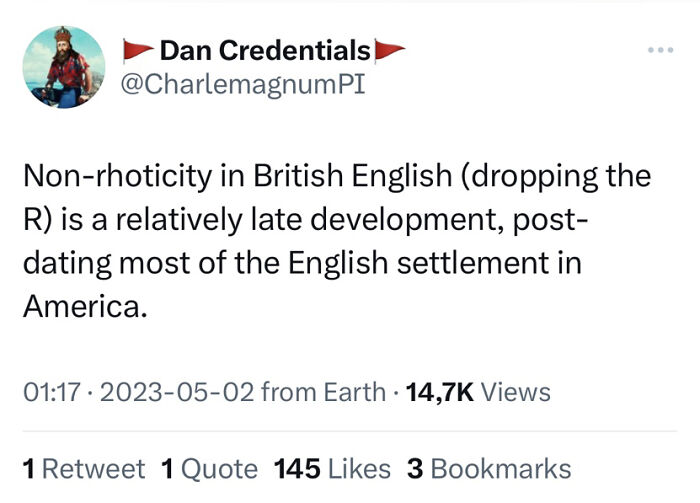
Load More Replies...When you read older crime novels (as recent as the 1940s), you may still see this spelling.
yep we know this because americans say their Rs and the british south of liverpool don't.
But not colonization of southern Africa. We all drop the R's very happily. An American would say the stuff that grows out of your head is your HAIRRRRRR. We say it's your HEH.
A southern American perhaps. New Englanders do the same r drop. Went to Ireland once and no one believed I was from US because I didn't have "American" (i.e. southern) accent.
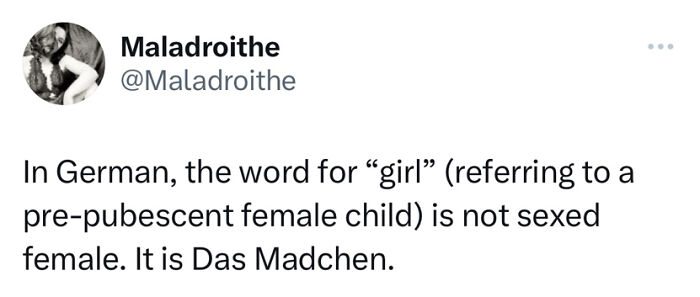
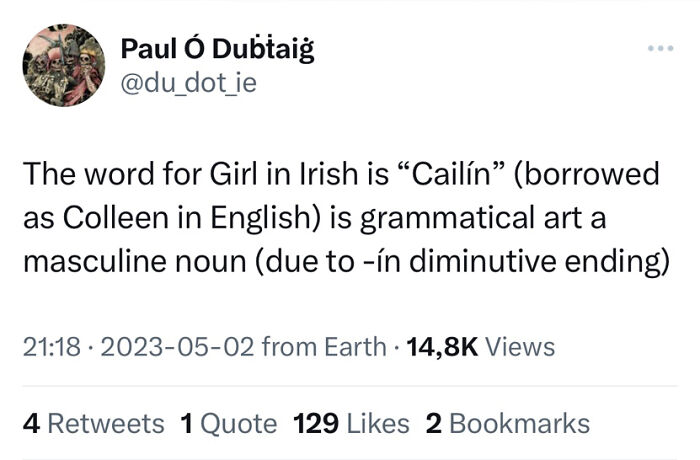
Load More Replies...The same is true in Dutch (het meisje, although 'de' isn't actually gendered), I'm guessing it's because of the diminutive -chen. (As that is the case in Dutch.)

You’re right, this is the reason. Die Magd - das Mädchen. Der Korb - das Körbchen. Der Schrank - das Schränkchen… and so on
Load More Replies...Most of the nouns ending in "chen" are neutral, so the Germans did not make an exception for Mädchen. The same applies for das Fräulein, which means "miss", but it is neutral. I learned this in my German classes, I am not a German native speaker.
Did you also learn that "Fräulein" is an olden times word no more in use by most? It fell out of favour in the 70's, because there is a word for unmarried women (even if they're old, like unmarried teachers) but not the same for men (if thry reach a certain age, a boy - Junge, becomes a Sir - Herr, in this context) Sorry for the lecture though, many old people use it still...
Load More Replies...Mädchen is a diminutive of the word "die Magd" which is feminine. Magd basically means a lower class woman / female peasant. Diminutive forms using -chen as an ending are almost always neuter. The g of Magd got lost somewhere in the centuries, and by the way, the dots on the vowels do serve a purpose and aren't optional.
"madchen" ends in "chen" and diminutive nouns ending in "chen" are neuter, that's why it's das madchen
And giving a woman flowers can sometimes change her into a man. „Ich gab die Blumen der Frau.
Ah, but that's just dativ case, in which the forms are dem (masculine) der (feminine) dem (neutral) and den (plural).
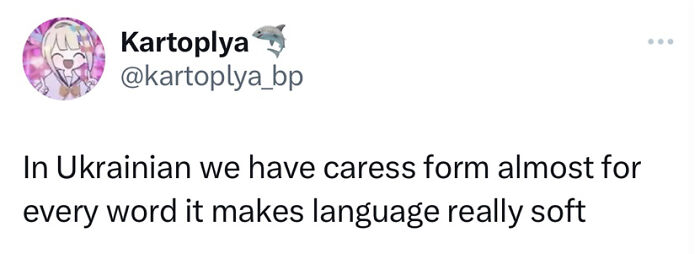
Load More Replies...Same in Russian, by the way. I was really confused when English speaking people said that our language sounds rude, because I see all the caress forms for the words that don't have them in English. Our cats have "lapky" (a caress form of lapy, paws), while yours - only "little paws". Our little goats have "Rozhky" (a caress form of "roga", horns), while yours have only little horns, etc. There are caress forms for adjectives, too. You say "bluish" meaning "Blue, but not full-on blue", we say "Seenenkiy" meaning "blue, but also cute". You say daughter, and that's it. We say Doch (daughter), Dochka (a slightly more affectionate), Dochenka (very affectionate, used only for our relatives, we can't say that Mary is Boris's dochenka, it would sound weird).

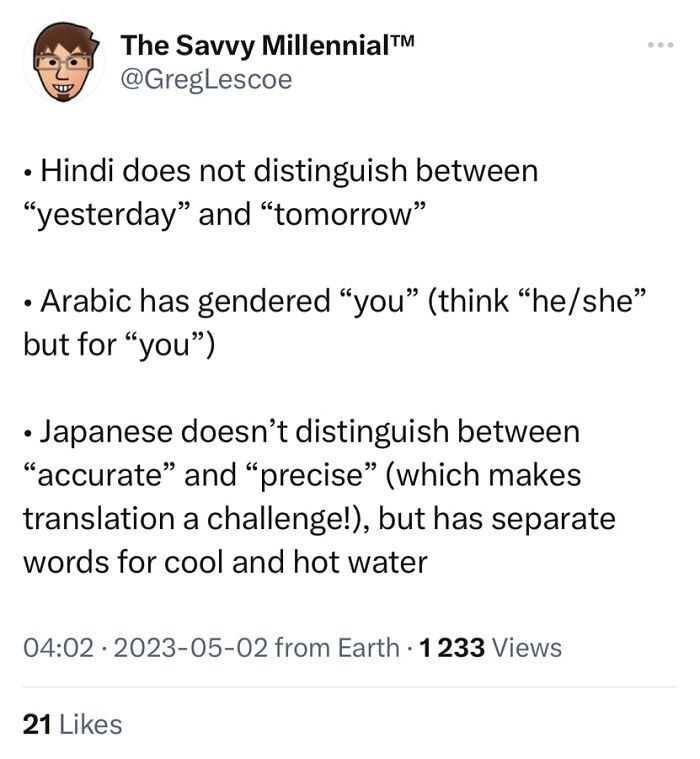
i am a math and stats instructor, with a background in mechanical engineering. when i help my students understand the two words, i say: "i am 40.5735 feet tall. is that precise? yes. is it accurate? hell no"
In English, particularly things that involve statistics and measurement, accuracy and precision are very different. Accuracy is how close you are to the true value. Precision is how close your results are to each other. If you fire 5 arrows at a target and 3 hit the bullseye but 2 completely miss the target, you are accurate without being precise. Medication studies that leave out women are often this since their results are often completely outside the range of men's. If all 5 arrows are bunched together but nowhere near the bullseye, you are precise without being accurate. The Mars rover that crashed into planet without opening the parachute because they used imperial instead of metric is an example of this. If you fire 5 arrows and all 5 hit the bullseye, you are both accurate and precise.
I'm a professional Japanese interpreter/translator, and for 15 years of my career I've never felt challenged by words for precision/accuracy. 正確, 的確, 精密, 緻密 are just some options to choose from depending on the context.
Now that you mention it, i´d say that French cannot distinguish accurate from precise.
Precise is translated by précis, it's a French word at the base but for accurate, it's not quite true, it depends on the context: This word can be translated by precise / just / exact / true / right for exemple.
Load More Replies...Hindi also has different words for "you" depending upon the person you're talking. It's different when the person is older/have a formal relationship/elder in relation but younger in age and different when the person is younger/informal relations like friends/ younger in relation but older in age.
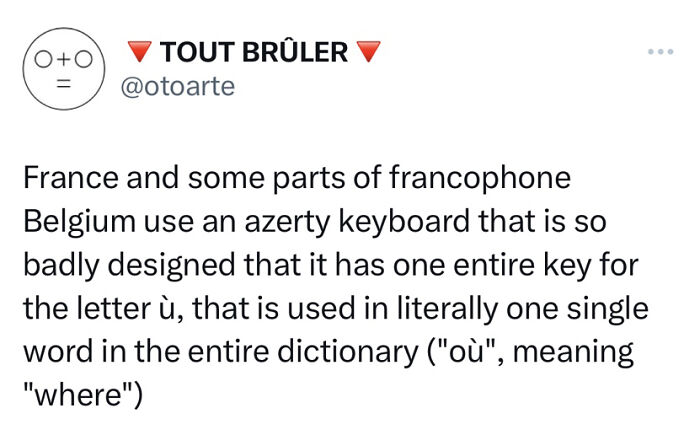
Où sont les toilettes? First French sentence I ever learned
I have a French Canadian keyboard on my laptop and it has that key, too! I reset the keyboard to Canadian English and now that works as the ~ key. It's very weird.
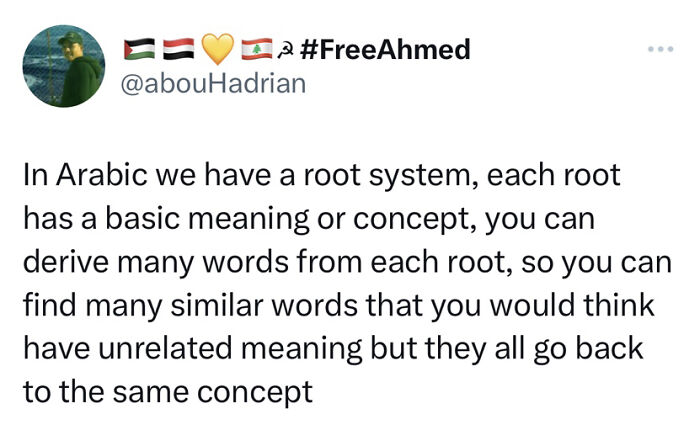
More interesting about Arabic is that each consonant is either 'solar' or 'lunar' which describes whether it is rolled into the definite article or not. The split is about half and half. The word for the sun is not pronounced 'al-shems' but 'ash-shems' despite that is still spelled الشمس. The word for 'the moon' -- 'al-qamr' is spoken as it is written. Basically, soft consonants are 'solar', hard consonants are 'lunar' and the pronunciations are so instinctive to native speakers that they don't rely on the idea anyway.

Yes, you have to emphasize the first or second syllable to change the meaning
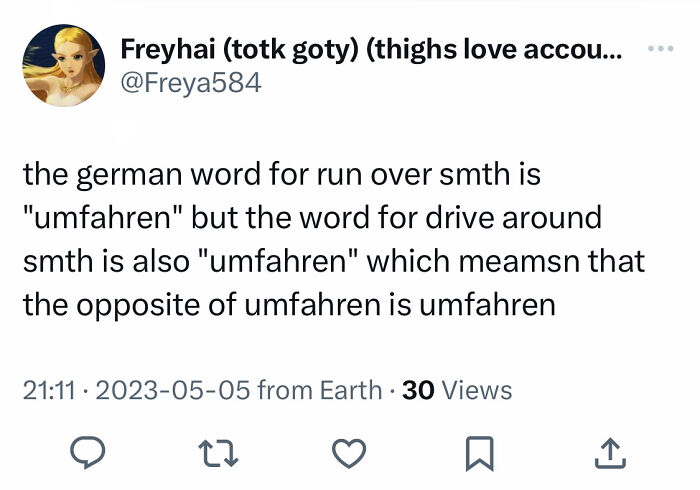
Hä? The commonly used German word for "run over" is "überfahren" (literally "drive over")
The french for renting an appartement is louer. But the french for letting an appartement is louer. Good luck finding who is the landlord : )
But accentuation is different. Run over sth... UMfahren Drive around sth... umFAHRen
In Russian there is "прослушать" (proslooshat') meaning both "to listen to smth to the end" and "to not listen to smth at all"
My first ever driving lesson, my instructor made me reverse out of the drive onto the road. There was a bin on the corner. She told me to "umfahren" the bin. So I ran over it. :P She then yelled at me that she'd told me "Ich sagte du sollst das umfaaahren!" (I told you to go around it) to which I replied "You said ummfahren. And I did." I am NOT kidding, that actually happened.
In German you just put words togehther what describes the actual thing, or emotion or happening or anything ... and then just you play a der-die-das Lotto It has no fúcking rules ...
Load More Replies...This is critically useful while studying Physics, Astrophysics, and Metaphysics
I know we're talking about Portuguese here, but having to pick a Spanish name for Spanish class in school always had me stumped because my name is Kelly. Very Irish, and no equivalent in Spanish. Lol, my teachers called me Kelly-sita instead.
Did they pronounce it kedgy? isn't LL a J in spanish?
Load More Replies...Bit like Irish - we had a much shorter alphabet because sounds like w or X were made using letter combinations.
Many languages do that. It's because the word for light blue used to be used to describe animal fur. Like people still cal cats and dogs of a certain colour "blue". the words for darker "blue" came very late to languages as the pigment is hard to obtain in nature- like in english people also use indigo or navy to describe blue colours.
Seems unusual until you realize that English has a distinction between red and light red (pink)
Pink is in-between red and purple. They're in different places on the colorwheel. Light red is generally more of a peachy color
Load More Replies...It's also less and less used to mean a gay in Russian nowadays. It was a common word for a gay in 90s and early 2000s, but not now. Now the most common words are either gay or its slur versions "Gomik", "Gomosek" or "Peedor"
that says a lot about how lgbtq rights are doing in Russia. 😕
Load More Replies...only recently. pink was boys for "soft blood".
Load More Replies...Cailín is a masculine noun (because of the -ín ending) even though it's the word for girl
Load More Replies...My real name is Seán. The accent over the a tells you to pronounce the letter before it as a h.
it appears in afrikaans as koop and english as cheap and german as kaufen

This is a litlle disoriented. Though "ananas" is the word for "pineapple" in many languages, in South America, which is mostly Spanish-speaking, the word is "piña."
In Colombia, the word for pineapple is PIÑA, which in El Salvador means GAY MAN.
In Italy during the fascist regime the use of foreign words was banned, so the government had to come up with alternative words. For example, "cocktail" became "bevanda arlecchina" (arlequin drink), "sandwich" became "tramezzino", "garage" rimessa, "gangster" malfattore, and so on. Even names of people and cities were "italianized": Buenos Aires became "Buonaria", Churchill was written as "Ciorcil" and my favorite: Louis Armstrong became "Luigi Braccioforte" (the literal translation of his surname). Another example of how stupid regimes can be.

Ciorcil and Louis Braccioforte gave me a good laugh, thank you!
Load More Replies...In Finnish there is multiple words inspired by Swedish words. My most favorite one is our word for "jealous". In Sweden it is called "svartsjuka", witch translates roughly into "feeling of black sickness inside" But because our ancestors thought the word "sjuka" - "sick" sounded like the Finnish word "sukka" - "sock" . So our term for jealousy is "mustasukkainen", wich translates to "having black socks on" :D


An ex GF mine is Hungarian and she taught me a ton of Hungarian words and phrases.One of the ones I still remember is the word for garlic: fokhagyma (phonetically as pho-g-had-yi-ma). In English, the literal translation is tooth onion. At one point, I had a vocabulary of about 100 words so one year at Christmas we did a demonstration of my skills for her parents. She pointed to various things, body parts, etc. and I spoke them in Hungarian (Magyar). The words that got the biggest enjoyment all the way around were for apple (or apple pie) and nipple: almacsutka and mellbimbó...surely the laughs were due to my accent, but those were a big hit for whatever reason. Good times. :-)
A Swedish friend once told me there is a word in Swedish that means “to make a mark with your penis” wish I could remember it as she is no longer around to ask and everytime I’ve asked other Swedish speakers they’ve looked at me like I’m crazy, she of course could have been joking as she was a great prankster. (Miss you Kim x)
Ha! We do indeed have a word for that, it's "olla"! Back in the day a popular comedy group made a sketch about it that was very well known.
Load More Replies...A quote that I have loved since I first set eyes upon it. "The problem with defending the purity of the English language is that English is about as pure as a cribhouse whore. We don’t just borrow words; on occasion, English has pursued other languages down alleyways to beat them unconscious and rifle their pockets for new vocabulary." --James D. Nicoll And we still think some of the examples here are peculiar?
Bearing in mind how many times England has been invaded, though maybe not known by James D Nicoll, it's a tad simplistic. By the Romans, by Germanic peoples, by Vikings, by the Normans, by the French, and by the Dutch. Old English, the earliest form of the English language, was spoken and written in Anglo-Saxon Britain from c 450 CE until c 1150 - it continued to be used for some decades after the Norman Conquest of 1066. By the time the Anglo-Saxons arrived in Britain, there had already been four centuries of linguistic interchange between Germanic and Roman people on the European mainland. Latin words might have arrived in English through any of several possible routes. To begin with, they must have entered the Celtic speech of the Britons during the Roman occupation. There are also still 14 different indigenous languages used across the UK.
Load More Replies...In dutch you can create the diminutive of pretty much any noun by adding "je" to the end. So if it's a version of a thing that's small or cute, like a duckling, you take the word for duck "eend" and add "je" to the end and you have a little duck; "eendje"! You can have a little dog, you can have a little building, you can have a little idea, you can have a little tank, just by adding "je" to the end. It works with *any noun*.


Lol in Afrikaans too – you just add "kie" or "tjie" to anything and it's little
Load More Replies...American English: rough, dough, bough, and cough. None of these words rhyme.


Plants and animals tend to have very descriptive names in Swedish, for example: racoon=wash bear, bat=flutter mouse, hippo=river horse, squid=ink fish, turtle=shield toad... And garlic is white onion, and chives=grass onion. To name just a few examples.
All this goes for Dutch and German as well. (Only the garlic thing is different, we use 'look' or 'lauch', similar to leek, and we describe the form. K**b (knof) for garlic and 'schnitt' or 'bies', meaning stalk for chives.)
Load More Replies...Maharashtrian here. We speak Marathi. We share the same alphabets with Hindi and few other related language. In fact you wont be able to distinguish between written Marathi and Hindi till you start reading. We have a few alphabets that others dont. So words can be pronounced differently. the surname Tilak is pronouced in Marathi and hindi. टिळक is in Marathi and Hindi will say तिलक


In Italy during the fascist regime the use of foreign words was banned, so the government had to come up with alternative words. For example, "cocktail" became "bevanda arlecchina" (arlequin drink), "sandwich" became "tramezzino", "garage" rimessa, "gangster" malfattore, and so on. Even names of people and cities were "italianized": Buenos Aires became "Buonaria", Churchill was written as "Ciorcil" and my favorite: Louis Armstrong became "Luigi Braccioforte" (the literal translation of his surname). Another example of how stupid regimes can be.
Ciorcil and Louis Braccioforte gave me a good laugh, thank you!
Load More Replies...In Finnish there is multiple words inspired by Swedish words. My most favorite one is our word for "jealous". In Sweden it is called "svartsjuka", witch translates roughly into "feeling of black sickness inside" But because our ancestors thought the word "sjuka" - "sick" sounded like the Finnish word "sukka" - "sock" . So our term for jealousy is "mustasukkainen", wich translates to "having black socks on" :D
An ex GF mine is Hungarian and she taught me a ton of Hungarian words and phrases.One of the ones I still remember is the word for garlic: fokhagyma (phonetically as pho-g-had-yi-ma). In English, the literal translation is tooth onion. At one point, I had a vocabulary of about 100 words so one year at Christmas we did a demonstration of my skills for her parents. She pointed to various things, body parts, etc. and I spoke them in Hungarian (Magyar). The words that got the biggest enjoyment all the way around were for apple (or apple pie) and nipple: almacsutka and mellbimbó...surely the laughs were due to my accent, but those were a big hit for whatever reason. Good times. :-)
A Swedish friend once told me there is a word in Swedish that means “to make a mark with your penis” wish I could remember it as she is no longer around to ask and everytime I’ve asked other Swedish speakers they’ve looked at me like I’m crazy, she of course could have been joking as she was a great prankster. (Miss you Kim x)
Ha! We do indeed have a word for that, it's "olla"! Back in the day a popular comedy group made a sketch about it that was very well known.
Load More Replies...A quote that I have loved since I first set eyes upon it. "The problem with defending the purity of the English language is that English is about as pure as a cribhouse whore. We don’t just borrow words; on occasion, English has pursued other languages down alleyways to beat them unconscious and rifle their pockets for new vocabulary." --James D. Nicoll And we still think some of the examples here are peculiar?
Bearing in mind how many times England has been invaded, though maybe not known by James D Nicoll, it's a tad simplistic. By the Romans, by Germanic peoples, by Vikings, by the Normans, by the French, and by the Dutch. Old English, the earliest form of the English language, was spoken and written in Anglo-Saxon Britain from c 450 CE until c 1150 - it continued to be used for some decades after the Norman Conquest of 1066. By the time the Anglo-Saxons arrived in Britain, there had already been four centuries of linguistic interchange between Germanic and Roman people on the European mainland. Latin words might have arrived in English through any of several possible routes. To begin with, they must have entered the Celtic speech of the Britons during the Roman occupation. There are also still 14 different indigenous languages used across the UK.
Load More Replies...In dutch you can create the diminutive of pretty much any noun by adding "je" to the end. So if it's a version of a thing that's small or cute, like a duckling, you take the word for duck "eend" and add "je" to the end and you have a little duck; "eendje"! You can have a little dog, you can have a little building, you can have a little idea, you can have a little tank, just by adding "je" to the end. It works with *any noun*.
Lol in Afrikaans too – you just add "kie" or "tjie" to anything and it's little
Load More Replies...American English: rough, dough, bough, and cough. None of these words rhyme.
Plants and animals tend to have very descriptive names in Swedish, for example: racoon=wash bear, bat=flutter mouse, hippo=river horse, squid=ink fish, turtle=shield toad... And garlic is white onion, and chives=grass onion. To name just a few examples.


All this goes for Dutch and German as well. (Only the garlic thing is different, we use 'look' or 'lauch', similar to leek, and we describe the form. K**b (knof) for garlic and 'schnitt' or 'bies', meaning stalk for chives.)

Load More Replies...Maharashtrian here. We speak Marathi. We share the same alphabets with Hindi and few other related language. In fact you wont be able to distinguish between written Marathi and Hindi till you start reading. We have a few alphabets that others dont. So words can be pronounced differently. the surname Tilak is pronouced in Marathi and hindi. टिळक is in Marathi and Hindi will say तिलक