Get Premium
Dark mode theme is available exclusively for premium users. Learn more about the benefits of subscribing.
No fees, cancel anytime.

 Dark Mode Ad-Free Browsing Unlimited Content
 Ad-Free Browsing Unlimited Content Dark Mode
Join 1.2 million Panda readers who get the best art, memes, and fun stories every week!
The ocean is still one of the biggest mysteries on Earth, and the deeper you go, the stranger it gets. Far below the surface, where sunlight can’t reach, lives a world full of creatures that look more like aliens than animals we know.
Researchers at MBARI, the Monterey Bay Aquarium Research Institute, have been exploring this hidden world for years. Using advanced technology and deep-sea robots, they’ve captured some of the most unusual and fascinating animals ever seen.
From see-through creatures that almost disappear in the dark to glowing animals that light up the abyss, these discoveries show just how little we know about life in the deep sea. Many of these animals are rarely seen, and some are still being studied to understand how they survive in such extreme conditions.
We’ve put together 30 amazing images shared by MBARI that show just how strange and beautiful the deep ocean can be. Get ready to meet creatures you won’t believe exist!
More info: Instagram | mbari.org | mbari.org | youtube.com | tiktok.com | Facebook
This post may include affiliate links.
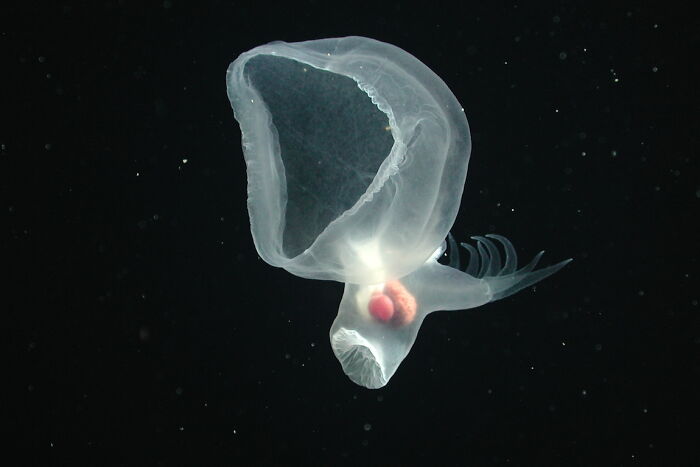
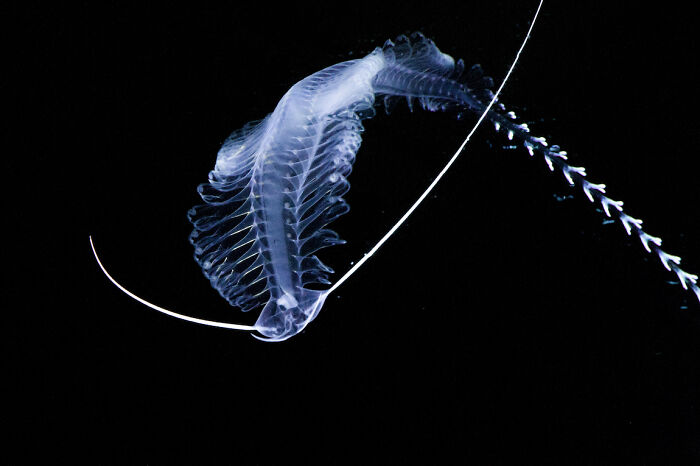
Our first sighting of this unique sea slug stumped our scientists.
In early 2000, we encountered a curious critter during a deep-sea dive offshore of Monterey Bay. With a voluminous hooded structure at one end, a flat tail fringed with numerous finger-like projections at the other, and colorful internal organs in between, we initially struggled to place this animal in a group. A muscular foot suggested this might be a swimming snail, so we nicknamed this the “mystery mollusc.”
By leveraging advanced underwater technology, we were able to gather extensive natural history information about this remarkable animal from more than 150 sightings in the wild and detailed investigations of anatomy and genetics in the lab.
Meet Bathydevius caudactylus, the first nudibranch, or sea slug, known to live in the deep water column.
Most nudibranchs live on the seafloor. They are common in coastal environments, including tide pools, kelp forests, and coral reefs. A small number of species are known to live on the abyssal seafloor. A few are pelagic and live in open waters near the surface. Bathydevius caudactylus swims slowly through the midnight zone, an expansive environment of open water 1,000 to 4,000 meters (3,300 to 13,100 feet) below the surface.
While most sea slugs use a raspy tongue to feed on prey attached to the seafloor, the mystery mollusc uses a cavernous hood to trap prey like a Venus fly trap plant. Crustaceans are on the menu for Bathydevius caudactylus, though we are still not quite sure how such a slow swimmer catches such speedy prey.
If threatened, Bathydevius caudactylus can light up with bioluminescence. On one occasion, we observed a mystery mollusc illuminate and then detach a glowing finger-like projection from the tail, much like a lizard dropping its tail as a decoy to distract predators.
Bathydevius caudactylus is typically spotted swimming or floating in the water column, but descends to the seafloor to reproduce. We have observed several spawning individuals attached to the muddy seafloor with their muscular foot.
The deep sea is the heart of our planet and our climate system. These inky depths teem with life. Human actions affect habitats and animals deep underwater—many that we have yet to explore and discover. MBARI science and technology are helping establish a baseline understanding of ocean health and deep-sea biodiversity so we can better understand the impacts of threats like climate change, pollution, and mining. Each new discovery is a new piece of the puzzle.
This regal resident of the midnight zone has unique adaptations to survive where food is scarce and predators are plentiful.
The deep-sea crown jelly (Atolla sp.) is one of the most common jellies in the ocean’s depths. Most have a distinctive elongated tentacle that can be up to six times the diameter of the jelly’s bell. Scientists suspect that characteristic trailing tentacle helps this jelly capture food. As a hungry Atolla pulses along, that long tentacle snags crustaceans or other prey.
But Atolla is not the only clever hunter in the deep sea. Predators lurk in the darkness, ready to pounce. The bright red bell helps keep Atolla hidden—in the deep sea, red appears black. If Atolla’s crimson camouflage does not work, this jelly sounds the alarm with pinwheels of brilliant blue bioluminescence. A burst of light in the dark water not only disorients predators but it also acts like a burglar alarm telling larger predators there is something interesting happening here. The threat of a bigger predator scares off any immediate danger, allowing the jelly to swim to safety.
Even one of the most common jellies in the deep sea still holds many secrets. Scientists currently recognize around 10 different species of Atolla. However, MBARI researchers recently discovered three varieties of crown jellies that look like Atolla, but lack the telltale trailing tentacle. They have named one of these new species Atolla reynoldsi, in honor of Jeff Reynolds, the first volunteer at MBARI’s education and conservation partner, the Monterey Bay Aquarium. Who knows what other discoveries still await us in the ocean’s mysterious midnight zone?
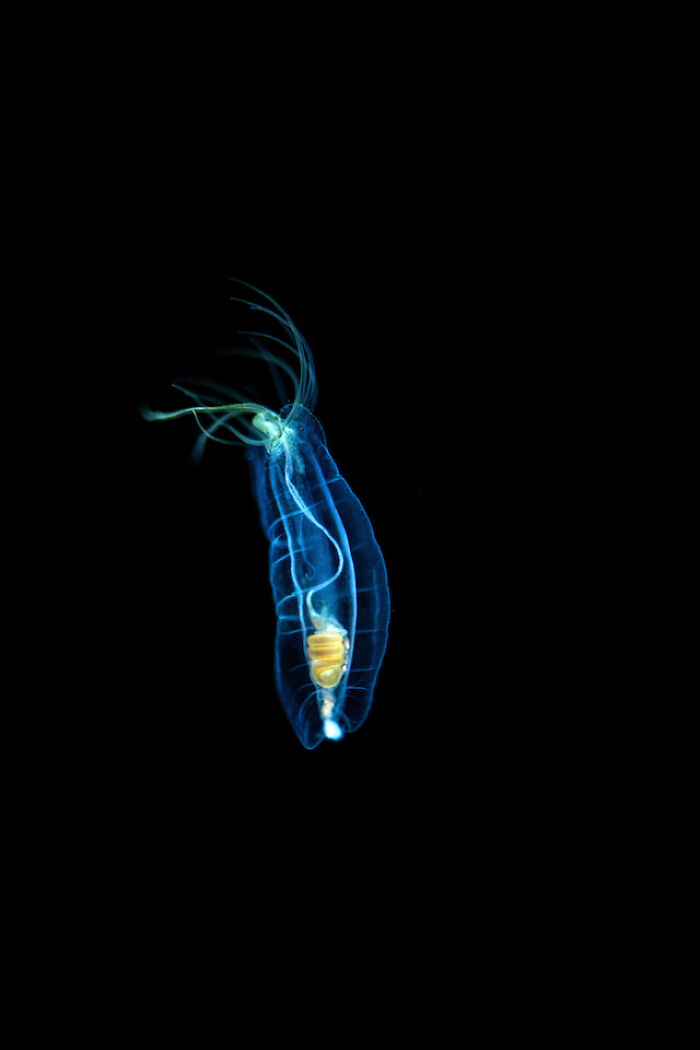
Bobbing along in ocean currents a half mile below the surface is a worm like no other.
Our team first spotted the unusual pigbutt worm (Chaetopterus pugaporcinus) in 2001 and had a tough time determining how to categorize such a curious critter. Working closely with our collaborators, we eventually confirmed we had encountered a new species of bristle worm that drifts through the midwater instead of living on the seafloor.
But studying the pigbutt worm was no trivial task.
This little worm is about the size of a hazelnut, and even using our high-resolution cameras, it took the eagle eyes of our expert biologists to spot these miniature orbs in the massive ocean. Our skilled submersible pilots were able to gently sample them and transport them back to the ship alive for detailed examination.
In the lab, we saw that Chaetopterus pugaporcinus is segmented like other bristle worms. However, the segments are highly compressed in the front and back ends, while the midsection is greatly inflated, probably to help keep the animal afloat. Sequencing the pigbutt’s DNA established that they fit into the family Chaetopteridae. Members of this group of worms typically live attached to the seafloor in parchment-like tubes, although they do have a free-swimming larval stage. The mix of both larval and adult features seen in the pigbutt worm is certainly unusual.
Observing these animals up close in the lab also revealed aspects of their natural history that we were unable to see in the wild. We learned that these incredible worms are bioluminescent. They produce blue light in their body tissues as well as green glowing mucous secretions, an adaptation that may be used to deter predators.
Chaetopterus pugaporcinus casts out a web of snot to capture bits of organic material called marine snow to eat. Mucus is a useful substance for snaring food in the deep sea where it may be sparse. Numerous other animals get their nutrition this way too. Animals of all shapes and sizes in the ocean perform an essential climate service by taking up excess carbon dioxide from the atmosphere and transporting it down deep in the ocean. These assorted midwater mucous-feeders help repackage carbon to sink more rapidly to hungry seafloor communities.
Since their discovery two decades ago, we have only seen this unique worm offshore of Central California, primarily around Monterey Bay and a few observations off of the Channel Islands. The deep sea teems with life, and many remarkable species are still awaiting discovery in the dark. We are working to catalog deep-sea animals and environments so we can predict how threats like climate change and mining will affect them. The pigbutt worm is just one of more than 200 new species named by our team and collaborators. Who knows what we will find next?

They couldn't think of a better name for this new found creature 2 decades ago?
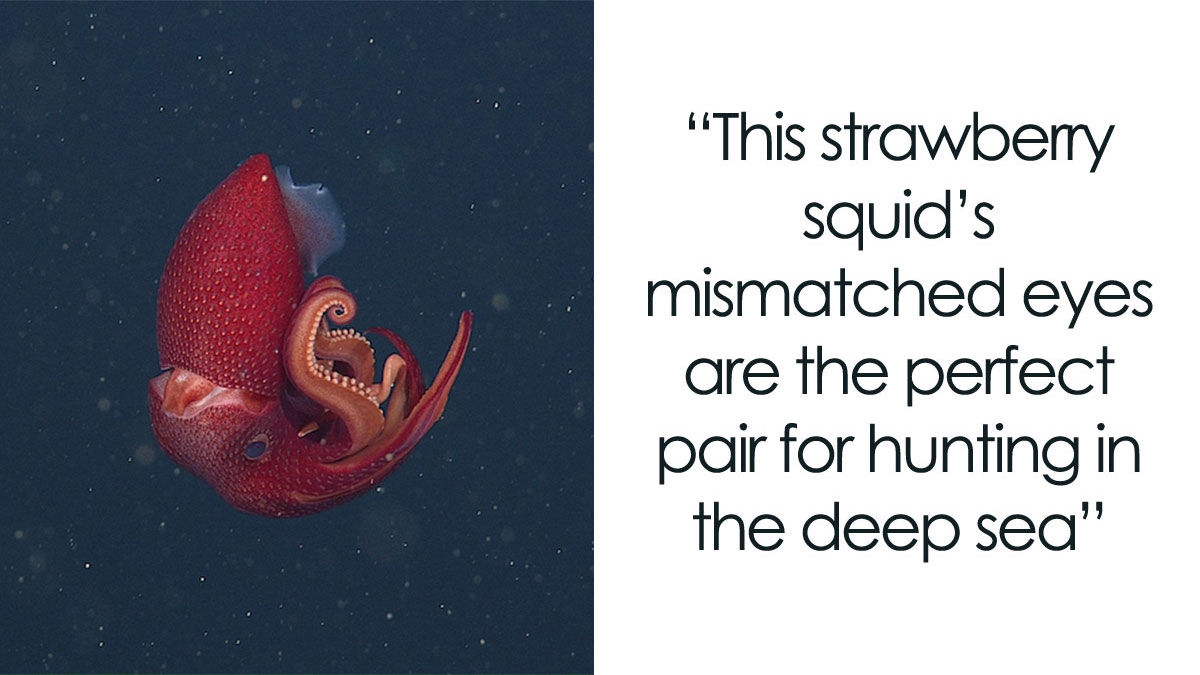
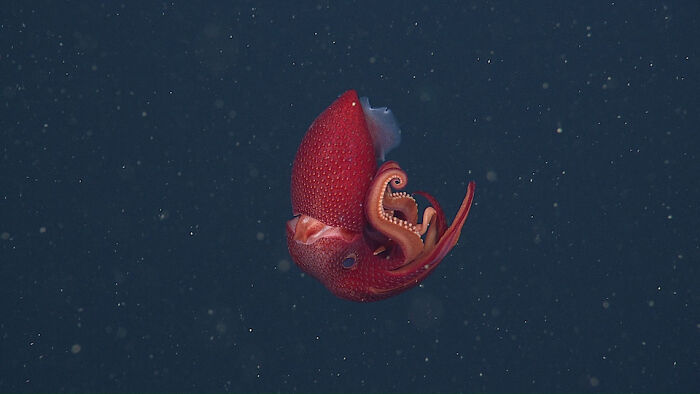
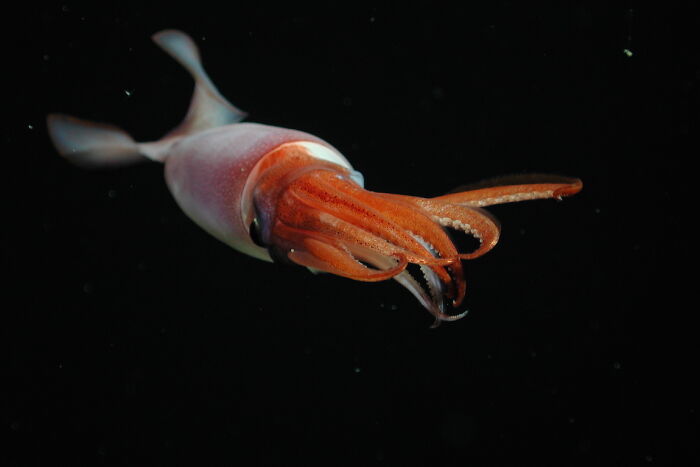
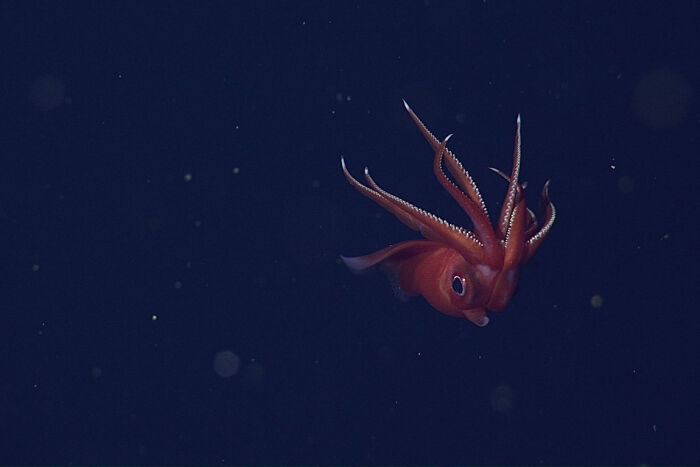
This squid’s mismatched eyes are actually the perfect pair.
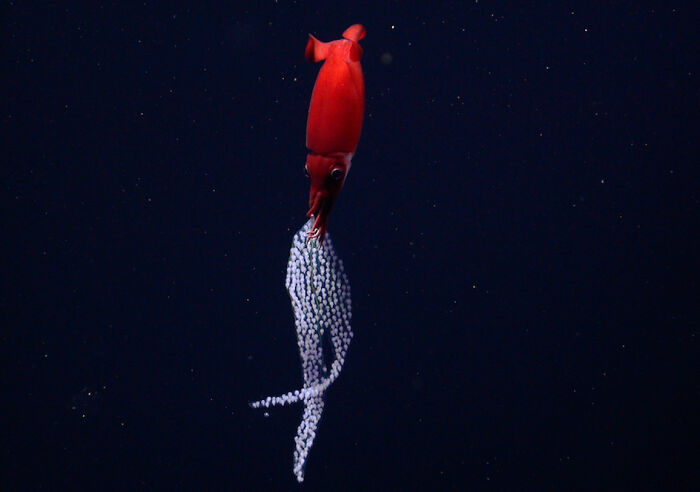
The strawberry squid (Histioteuthis heteropsis) has one big eye and one small eye. Together, this improbable pair helps the squid hunt for food in the ocean’s twilight zone. The big left eye looks upward to spot shadows cast by prey in the dimly lit waters above. The eye’s tubular shape helps collect as much downwelling light as possible. Often, this eye has a yellow lens to see through the luminescent camouflage of its prey. The squid’s right eye is small and looks downward. This eye searches for flashes of bioluminescence produced by prey or predators lurking in the darker waters below. This squid is sometimes called the cockeyed squid for the remarkable difference in size between the two eyes.
Food is scarce in the deep sea, so animals must evolve unique strategies to find food. They must also find ways to avoid becoming food. Like many deep-sea animals, the strawberry squid is bright red. Red light does not reach the deep sea. There, a crimson coloration actually appears black and helps the squid hide from the gaze of predators like sperm whales, dolphins, tunas, swordfish, and sharks. Small light organs called photophores also dot the squid’s body to help mask its silhouette from predators prowling the waters below.
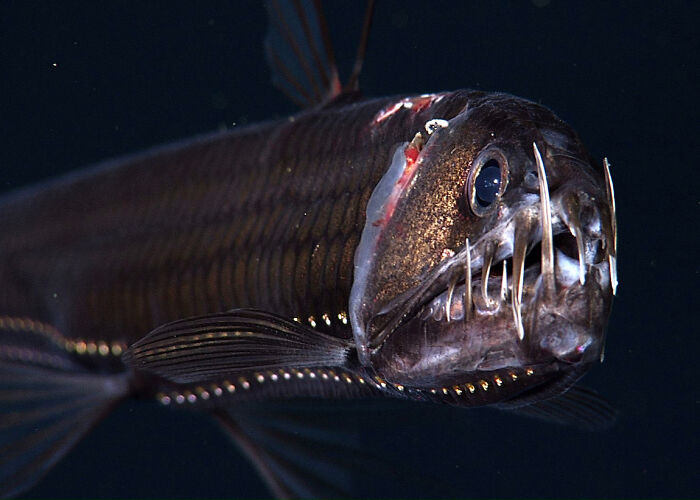
A big mouth isn’t an issue for this toothy predator.
Sleek, silvery, and adorned with modest bioluminescence along their bellies, Pacific viperfish (Chauliodus macouni) make fearsome predators for small fish and shrimp. They are among the countless marine animals that migrate each night from the ocean’s depths towards shallower surface waters to dine.
The Pacific viperfish’s needle-like teeth are the key to their hunting strategy. The two front fangs, which jut up from the fish’s bottom jaw past its own eyes, are especially dramatic. When viperfish unhinge their jaws, their mouths can open wide enough to engulf prey, while the teeth form a cage to prevent an escape.
I would hate to be eaten by something with a mouth full of razor sharp swords. ⚔️🗡️
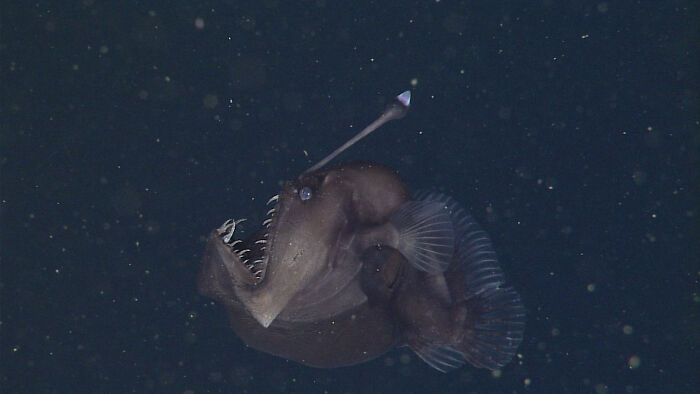
This is one alluring fish.
Food is scarce in the deep sea, so animals get creative to find a meal. Instead of chasing down prey, the deep-sea anglerfish (order Lophiiformes) goes fishing.
The first ray of an anglerfish’s dorsal fin is modified into a filament like a fishing pole. At the tip is a sac of glowing bacteria, called an esca. Each species has a unique rod and lure—some have simple lures, some have elaborate ones, and some even have multiple lures. Hungry anglerfishes set out bioluminescent bait and wait. Their dark skin absorbs light, an ultra-black camouflage that helps mask their presence. The luminous lure entices small fishes and crustaceans to come closer, then the anglerfish’s massive mouth and sharp teeth snap shut for a meal.
In the ocean’s midnight zone, food is not the only thing that can be scarce. Mates can be hard to find in this endless expanse too, so some anglerfishes have a unique strategy for reproduction. The blobby, softball-sized anglerfishes are females. The males are dwarfs, growing to just a few centimeters. The tiny males have a strong sense of smell and follow pheromones to find females. In some, but not all, species, the males are parasitic, so when they encounter a mate, they permanently attach themselves to her body.
Deep-sea anglers may be most recognizable, but there are more than 200 anglerfish species in the order Lophiiformes. They come in all sorts of shapes and sizes, and occupy a variety of habitats. Sea toads (family Chaunacidae) and batfishes (family Ogcocephalidae) live on the deep seafloor, but some anglerfishes live in shallow water. Frogfishes (family Antennariidae) have vibrant colors to camouflage among the corals on tropical reefs, while speckled coloration helps goosefishes (family Lophiidae) blend into the sandy seafloor on the continental shelf. Just like their deep-sea kin, these anglers are ambush predators. But seafloor anglers do not use luminescence to fish for food. Instead, they flick a frilly, decorative lure to draw in potential prey.
In nearly four decades of ocean exploration with advanced underwater robots, MBARI scientists have logged just a handful of encounters with these unique fishes. Each observation sheds new light on these mysterious residents of the midnight zone, but inevitably raises new questions too.
Deep-sea anglerfishes and other residents of the midnight zone face a fragile future from actions on the seafloor far below. Mining the abyssal plain for manganese and other rare minerals will release a sediment plume that will cloud the waters above. Anglerfishes depend on clear water for their bioluminescence to effectively lure prey. We urgently need to understand how mining will affect all deep-sea animals. MBARI’s research is answering fundamental questions about the deep sea that will help resource managers and policymakers make informed decisions about the future of marine life, environments, and resources.
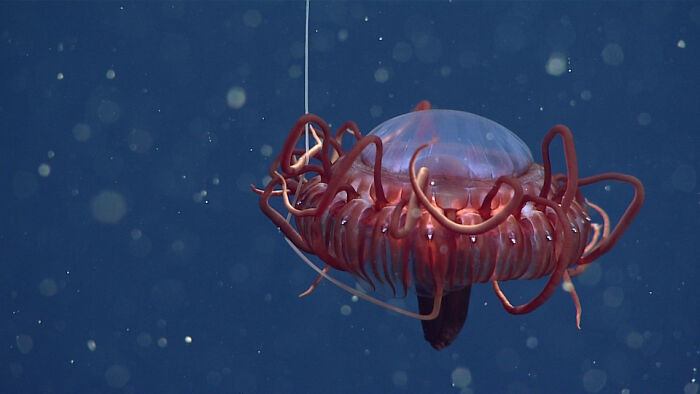
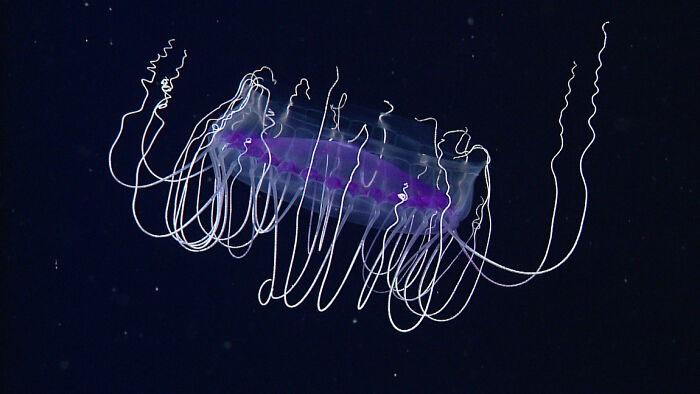
Don’t be fooled by the beauty and grace of this jelly.
The dinner plate jelly (Solmissus spp.) is one of the ocean’s top predators. This denizen of the deep has an appetite for other gelatinous animals. Jellies, comb jellies, siphonophores, salps—they are all on the menu for Solmissus. In fact, this jelly has one of the most diverse diets of all midwater animals—so far, we have seen Solmissus eating 21 different types of gelatinous prey.
A hungry dinner plate jelly swims with tentacles held forward. Most jellies are passive predators who drag wispy tentacles behind their bells to catch food that gets trapped in their wake. But the dinner plate jelly relies on stealth to capture food.
Swimming with those tentacles out in front allows Solmissus to catch their prey by surprise. Before prey can sense the pulses of the approaching predator, the jelly’s crown of tentacles snares a meal. Forward-pointing tentacles also help the dinner plate jelly catch animals with long tentacles or skinny bodies, like raking up twigs in the lawn.
Tiny stinging cells on the jelly’s tentacles fire microscopic harpoons that stick like Velcro to slippery prey. The tentacles curl under, bringing their catch to the mouth beneath the bell, then slowly unfurl to snatch their next meal.
Solmissus is one of the most common jellies that we encounter in the depths of Monterey Bay’s submarine canyon. Our researchers have revealed the abundance, and importance, of jellies in the deep sea.
Using underwater robots, we can observe delicate deep-sea drifters without damaging them or disrupting their behaviors. We now know that jellies are some of the dominant predators in the ocean’s inky depths. They are also a food source for many animals and offer shelter in an endless expanse of open water.
Human actions like fishing, pollution, mining, and climate change threaten to unravel the complex web of life that thrives below the ocean’s surface.
Our everyday actions impact the deep ocean. Choosing sustainable seafood, avoiding single-use plastic, and reducing your carbon footprint can all help our ocean. Together, we can grow a community of ocean champions committed to protecting the deep sea and its inhabitants.
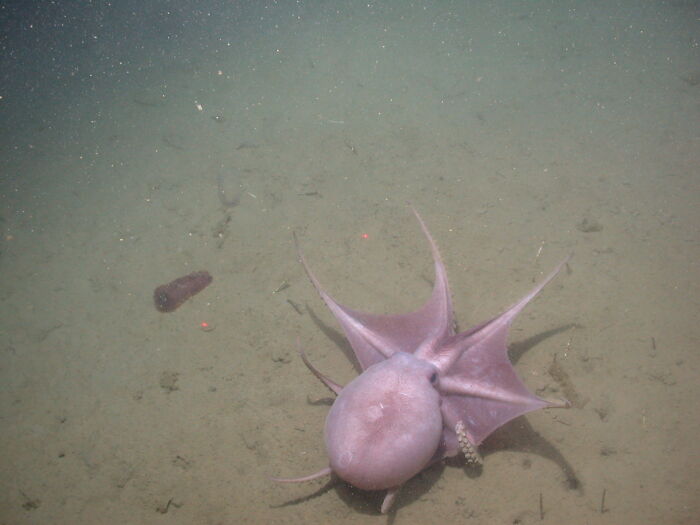
Meet a dedicated mother.
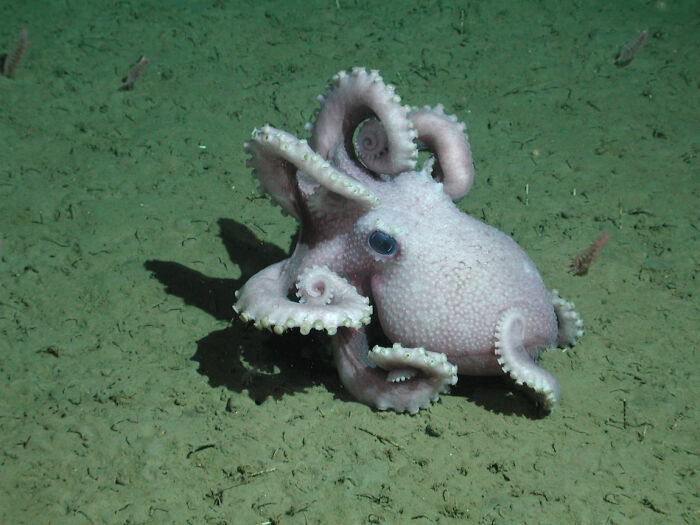
After mating, an octopus mom finds a suitable spot on the seafloor to lay her eggs. There, she deposits her eggs and meticulously tends to her nest. She shields her developing young from hungry predators and pesky neighbors. She uses her siphon to bathe her growing offspring with fresh seawater and cleans them with her arms. We call this behavior brooding.
Octopuses that live in shallow waters brood their embryos for a couple of months until the eggs hatch. But life moves more slowly in the frigid waters of the deep sea. We were stunned to learn just how long a deep-sea octopus mom broods her young.
The warty deep-sea octopus (Graneledone sp.) is one of the most common deep-water octopuses in the northeastern Pacific Ocean. In April 2007, we observed a female Graneledone pacifica investigating a rocky outcropping. When we returned a month later, we saw the same octopus—identified by distinctive scars on her body—clinging to the rocky ledge and brooding a clutch of approximately 160 teardrop-shaped eggs. We returned periodically to monitor this mother.
As the years passed, her translucent eggs grew larger and we could see young octopus developing inside. Over the same period, the female gradually lost weight, and her skin became loose and pale. Nevertheless, she remained vigilant in protecting her developing young. When we visited the brooding site in October 2011, she was gone. All that remained were the tattered remnants of empty egg capsules—her eggs had hatched, and her work was done.
As with most other cephalopods, a warty deep-sea octopus mom dies after she reproduces. She does not leave her nest while brooding her young, and lives off energy reserves in her body tissues. An octopus mother makes the ultimate sacrifice to ensure the survival of her young. Her babies emerge much larger and better developed than those of other octopuses and squids—Graneledone hatchlings are fully capable of surviving on their own and hunting for small prey.
At four and a half years, Graneledone pacifica holds the record for the longest incubation period of any animal on Earth. Deep-sea animals grow slowly, live a long time, reproduce later in life, and often brood their young for an extended period of time. That life history makes them especially sensitive to changes in their environment. They cannot bounce back from disturbances as quickly as their kin closer to the surface. We must speak up for protecting vulnerable deep-sea animals and environments. Share what you have learned, and help us grow our community of ocean champions.

Octopi are such amazing creatures. The more I learn, the more in awe I am
When danger approaches, it’s bombs away for this worm.
The midnight zone is a world of total darkness where predators lurk in the shadows ready to pounce on prey. The small bomber worm (Swima sp.) swims in the waters a few meters above the seafloor. A wriggling worm is exposed out in the open, but it has a secret weapon to avoid becoming a meal for a hungry predator.
A bomber worm has eight sacs of bioluminescent fluid just behind its head. When disturbed, it releases a “bomb” that bursts with a green glow. While this light show distracts the predator, the little worm makes a quick escape and paddles to safety. Safe from harm, it regenerates its lost bombs so it’s ready to face its next threat.
MBARI researchers and their colleagues first discovered the green bomber worm (Swima bombiviridis) in 2009 and described a second species—the shining bomber worm (Swima fulgida)—two years later. While they’re relatively recent discoveries, these bomber worms aren’t rare, they just live at extreme depths below 2,700 meters (8,900 feet). These remarkable, but elusive, worms underscore how much we have yet to learn about the midnight zone.
What an interesting defense system- defense by distraction through a bioluminescent "light show"
This living jewel hides in plain sight.
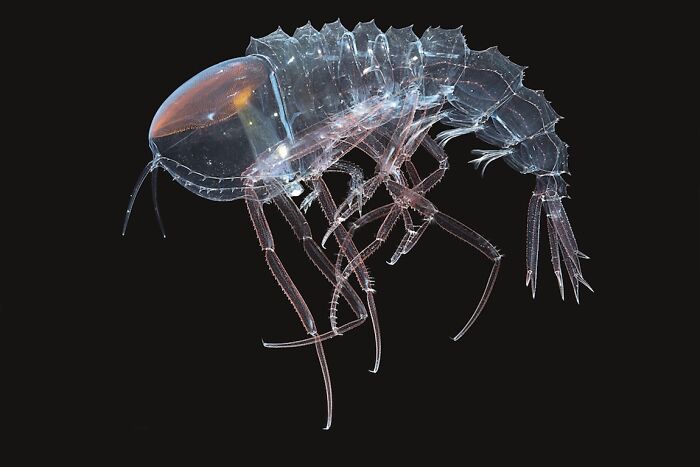
Life in the twilight zone is a constant game of hide and seek. The crystal amphipod (Cystisoma spp.) combines invisible armor and giant eyes for a winning strategy.
Amphipods are shrimp-like crustaceans. Cystisoma is a deep-sea hyperiid amphipod. Most of their cousins grow no bigger than your fingernail, but the crystal amphipod can fill your entire hand.
Cystisoma are also unusual because they swim freely in the open water. Many other hyperiids are hitchhikers, taking advantage of nearby jellies for food and shelter. Living out in the open requires the crystal amphipod to become almost completely transparent.
With the help of MBARI’s ships and deep-sea robots, our researchers and their collaborators revealed the secret to the crystal amphipod’s invisibility. Their exoskeleton is covered in microscopic shaggy structures or a fine coating of biofilm. Tiny spherical bacteria, only nanometers in diameter, work like the anti-reflective coating on eyeglasses to help Cystisoma camouflage in an environment that is sorely lacking in places to hide from hungry predators.
The crystal amphipod’s eyes are massive and cover up to a third of their body, helping them find transparent prey in the dim downwelling light. Their retinas are spread out into a thin sheet of tiny dots to reduce their shadow below.
Jellies are on the menu for the crystal amphipod. We have observed Cystisoma using those sharp pincers to tear bits of gelatinous tissue off a comb jelly.
Cystisoma mothers, like all amphipods, typically carry their babies within a special sac on their chest—even at the risk of blowing their invisible cover. Because her babies are reflective and visible to predators, mom does not brood her young for very long. She likely drops them off on a gelatinous host when they are quite small and leaves them to grow up on their own.
The crystal amphipod faces a fragile future. As industries look to the deep seafloor for mining precious metals, even animals living far above the bottom are at risk. Mining these metals will release plumes of dirty wastewater into the ocean’s twilight zone, clouding the crystal amphipod’s vision and interfering with their invisible superpower.
We urgently need to identify the impacts deep-sea mining will have on all ocean habitats, from the midwater to the seafloor. What we learn can help resource managers and policymakers guide decision-making about the ocean, its inhabitants, and its resources. Share what you have learned about the remarkable animals of the deep—together, we can be a powerful voice for the ocean.
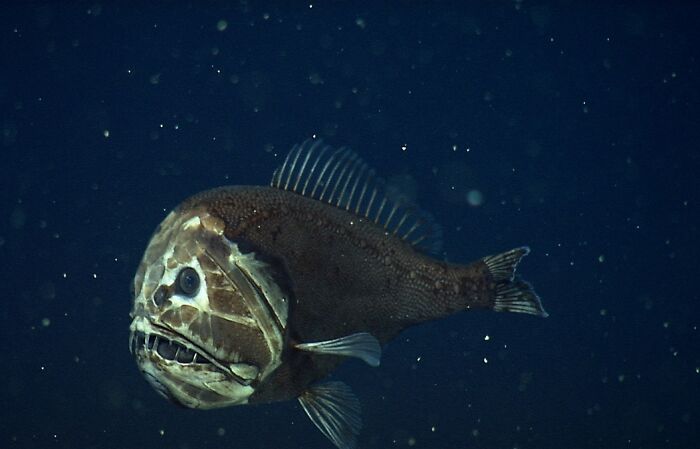
This rarely-sighted creature thrives in the deep sea worldwide.
Despite this fish’s fierce name and ferocious looks, fangtooth (Anoplogaster cornuta) is a rather small (and possibly lazy) predator. The gaping mouth, stubby fins, and mottled patterning suggest a fish that lurks and waits—until prey swims too close, that is.
Scientists believe fangtooth fish have bad eyesight, but an excellent sense of touch. The pronounced dark line down their sides is a lateral line that senses even small movements around them.
It’s easy to imagine why fangtooth’s face earned the species its other nickname—”ogrefish”—but that’s not the only similarity. MBARI research teams have spotted a fangtooth less than once every two years on average since we opened our doors, making this fish almost as elusive as it is astonishing.
This charming cephalopod made headlines for cuteness.
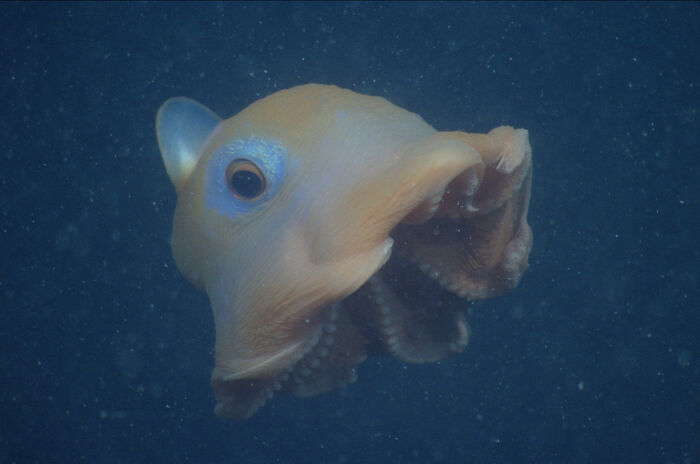
MBARI’s robotic submersibles often spot this little octopus resting on the mud, its orange body resembling a flat, fluffy pancake. When startled by a predator, a flapjack octopus perks up and swims to safety by flapping its stubby fins, pulsing its webbed arms, pushing water through its funnel for jet propulsion—or all three at once. When the coast is clear, it stretches its webbed arms and parachutes back to the seafloor.
Scientists think the flapjack octopus we see in Monterey Bay might be a new species. MBARI has teamed up with the Monterey Bay Aquarium to study and describe this “adorable” new species. MBARI scientists have collected detailed video observations of this octopus from the muddy floor of Monterey Canyon, and our colleagues at the Aquarium have kept some specimens alive in their Tentacles exhibition for closer study.
An “invisibility cloak” keeps these squids safe in the twilight zone.
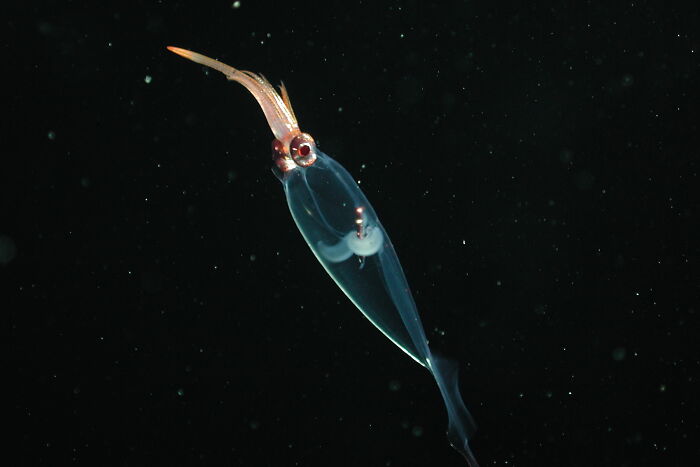
Glass squids (family Cranchiidae) live in the boundless waters of the twilight, or mesopelagic, zone. With no protective shell and nowhere to shelter, they need to get creative. Transparency is one way to thrive in a home with few places to hide.
Like other cephalopods, glass squids are covered in tiny pigment sacs called chromatophores. They often keep their chromatophores closed so their skin is basically see through. This invisibility cloak hides them from both predators and prey.
Glass squids have a large internal cavity they fill with ammonium, a chemical that is lighter than seawater. Building a more buoyant body means the squid does not have to swim as hard to stay afloat. They maneuver slowly through the midwater with their fins, constantly on the lookout for danger or a delicious meal.
Special light organs called photophores mask the shadow of their opaque body parts, like their eyeballs. These organs glow at the same intensity as the dim sunlight from above to hide the squid’s silhouette from predators hunting from below.
When the glass squid’s cover is blown, they expand their chromatophores to darken their appearance. Some may fill their body cavity with ink instead, presumably to blend into the darkness. And when danger still looms, a glass squid may squirt ink into the water and jet away. A ghostly shroud of ink creates a distraction so the squid can escape.
More than 60 species of glass squids live in deep twilight waters around the world. Some are little more than 10 centimeters (four inches) long, but others are giants. In fact, the largest of all squids—the colossal squid (Mesonychoteuthis hamiltoni), nearly 10 meters (33 feet) long and weighing up to 495 kilograms (1,091 pounds)—belongs to the family Cranchiidae. We typically see smaller glass squids about 30 centimeters (12 inches) long, likely because the larger ones are faster swimmers that can easily elude our slow-moving submersibles.
But the future of these fascinating midwater animals is in jeopardy.
The deep seafloor holds buried treasure: nodules of precious minerals critical to modern technologies. Mining these metals will release plumes of wastewater that will cloud the ocean’s twilight zone.
Most deep-sea habitats have very low concentrations of naturally suspended sediment, even near the seafloor. Glass squids and other midwater animals have extremely large eyes and keen eyesight. Many communicate with living light, or bioluminescence. Investigating how deep-sea animals sense their surroundings will help us predict how much harder mining will make their day-to-day lives. We urgently need to identify the impacts deep-sea mining will have across all ocean habitats, from the midwater to the seafloor.
Meet a deep-sea escape artist.
Between the surface and deep seafloor lies the midwater. This is a world with no boundaries, just open water as far as the eye can see. Imagine life in this big expanse. Predators patrol these waters. How would you survive if there is no place to hide? When danger approaches, the silky jelly (Colobonema sericeum) uses speed and clever tricks to avoid being eaten.
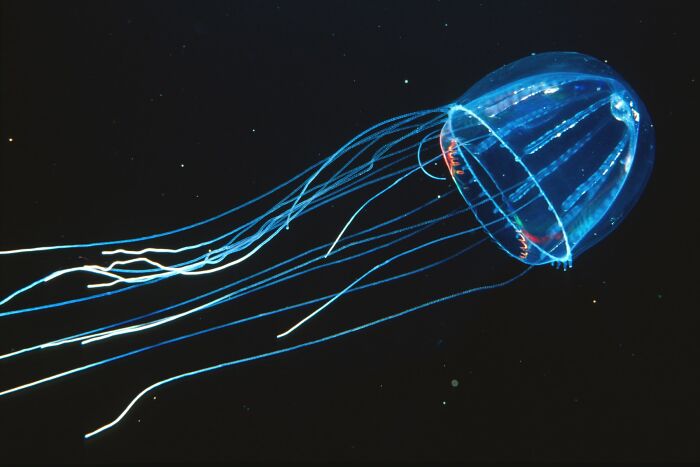
Stinging cells called nematocysts cover the tentacles that dangle from Colobonema’s bell. Those stinging cells do not just capture prey—they make the silky jelly an unappetizing meal too. Although the tentacles have a bright blue color when we shine our lights on them, they cannot actually make their own blue light. The bell of the jelly, however, can radiate brilliant blue flashes of light. This light show potentially startles visual predators. It may also be a burglar alarm that attracts unwanted attention to any threat.
The silky jelly is one of the fastest swimming jellies, using coordinated jet propulsion to flee danger. Our observations of Colobonema in the depths of the Monterey Canyon have helped visualize that escape in finer detail. While at rest, Colobonema spreads out curly tentacles to capture food. But when threatened, the jelly’s bell rapidly contracts and its shape quickly transforms. The rounded bell becomes almost tubular in appearance and Colobonema’s coiled tentacles straighten and elongate. Now, a mad dash to safety begins. A single swimming burst can propel the silky jelly more than five body lengths forward.
As they make a quick exit, they drop sticky tentacles to confuse potential predators. We have seen silky jellies with tentacles of varying, uneven lengths. This suggests that Colobonema can grow back their lost tentacles.
We have recorded an extensive archive of deep-sea video that offers insight into more than just animal behavior. Our researchers use this trove of data to understand long-term trends in populations of midwater animals. Comparing thousands of observations of deep-sea jellies reveals how their populations ebb and flow over time. Silky jellies are abundant in Monterey Bay, but only at specific depths. During warm El Niño events, they become scarce. As climate change alters the ocean, what will the future look like for Colobonema? We worry they will get squeezed into a smaller and smaller range.
Animals of the deep have built remarkable strategies to thrive in the ocean. But even an escape artist like Colobonema cannot outrun the impacts of climate change. We must act quickly to ensure the future of these denizens of the deep. Understanding how our actions affect the ocean and Earth’s climate is critical. Share what you have learned and help us grow our community of ocean champions.
This “vampire” is a harmless scavenger.
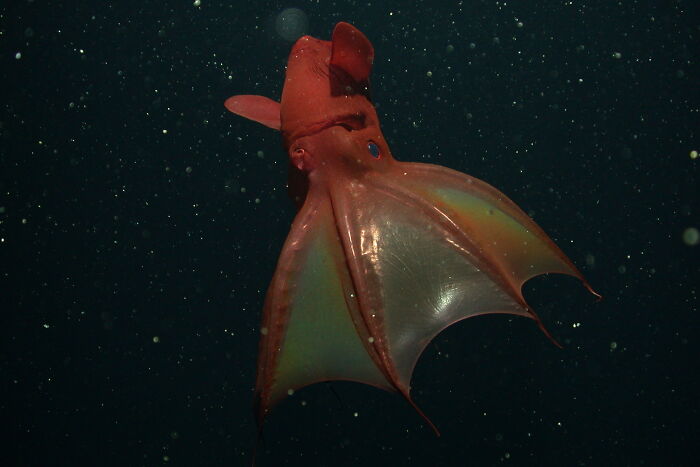
Marine snow is on the menu for this cephalopod. Two thin, sticky tentacles collect drifting bits of dead plankton, poop, mucus, and other organic material sinking from the waters above. By scavenging on the snow sinking from the surface, Vampyroteuthis and many other deep-sea animals help capture carbon and lock it away in the ocean’s depths. Known as the biological carbon pump, this process is integral to ocean health and helps regulate Earth’s climate.
The vampire squid is ironically neither a vampire nor a squid. Vampyroteuthis is the last surviving member of an ancient group of cephalopods. They thrive in the oxygen minimum zone, an environment with just a fraction of the oxygen of waters near the surface.
Few predators can hunt in the oxygen minimum zone, but the vampire squid does not take any chances. Red light does not reach the deep sea, so that rusty red color helps Vampyroteuthis hide from predators prowling these twilight depths. When threatened, the vampire squid turns inside out, exposing rows of spiky, finger-like “cirri.” If danger remains, the tips of the vampire squid’s right arms glow blue-green to confuse predators. Vampire squid do not have an ink sac like shallow-water cephalopods, but they can release bioluminescent fluid that distracts predators while they make a quick escape.
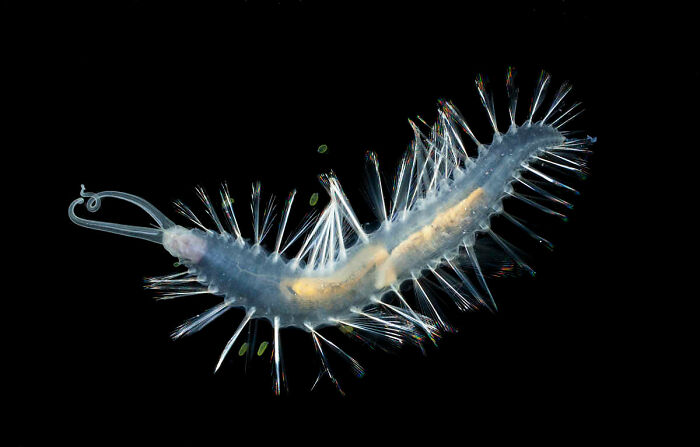
This worm is always on the go.
While most worms crawl on the seafloor or slither through the mud, the gossamer worm (Tomopteris spp.) swims in the waters far above the ocean floor. Tomopteris lives in the midwater—an expanse of water deep below the surface and far above the bottom—and never touches the rocks and sand below.
Living in the water column, most Tomopteris have a transparent body to elude the gaze of predators lurking in the dim depths of the ocean’s twilight zone. Some gossamer worms also have a scarlet stomach that masks the light produced as the worm digests bioluminescent prey. When danger approaches, some species roll into a barrel shape to mimic an unappetizing jelly while others spew luminescent fluid out the tips of their swimming appendages called parapodia.
Tomopteris is also a fast and efficient swimmer. Researchers in MBARI’s Bioinspiration Lab and our collaborators at the Smithsonian National Museum of Natural History have been studying the mechanics of the gossamer worm’s swimming. They used high-tech tools—from lasers that illuminate the flow of water around the animal to high-speed video that captures rapid movements in detail—to understand how these worms swim so well.
Like most worm-shaped animals that swim, Tomopteris moves by swishing their body side to side, but they also row their fleshy parapodia in sync with the body swishing. This effective technique provides speed and maneuverability for hunting prey and evading predators. Understanding how these worms swim could inspire new designs for underwater robots.
Scientists have described approximately 60 different species of gossamer worm. Most are just a few centimeters long, but the largest can reach 60 centimeters (24 inches) in length. Individual species can be challenging to distinguish. For more than 10 years, our team has worked with Smithsonian researchers to identify the Tomopteris worms that live in Monterey Bay. We have observed animals in the wild and collected specimens for close examination and genetic sequencing in the lab. We have learned that there are 18 different species of Tomopteris that live in our blue backyard—and several are actually species that are new to science.
The deep sea is the largest living space on Earth, but remains shrouded in mystery. This environment faces the same threats as other parts of the ocean, like overfishing, pollution, and climate change. Our work is helping us better understand the deep sea and its inhabitants. Our research findings will help us monitor how the amazing animals of the deep will navigate a changing ocean.
These squids are fierce predators, but caring mothers.
In the ocean’s twilight zone, squids are dominant predators. Two long tentacles with thick clubs at the tip grab a meal, then eight arms lined with suckers hold on tight. The armhook squids (family Gonatidae) have a secret weapon to keep especially slippery prey from escaping their grip: tiny claws line their arms to prevent prey from wiggling loose. The sharp hooks can pierce the scales of a fish or the squishy tissue of a squid. They also help immobilize prey bigger than the squid themselves.
We frequently encounter armhook squids during our explorations of the midwater in Monterey Canyon. The black-eyed squid (Gonatus onyx) is the most common. We have encountered other stunning armhook squids—the deep-red Gonatus berryi, the fiery-white Gonatus pyro, the eight-armed Gonatopsis, and the small-finned Berryteuthis.
Until recently, the diet of the armhook squids in the genus Gonatus remained unknown. Our archive of thousands of hours of underwater video contains valuable observations of feeding interactions of deep-sea animals, including squids. Taking a closer look revealed that fishes were a favorite food. But we also saw a surprising pattern: both Gonatus onyx and Gonatus berryi frequently feed on their own kind.
These squid have an active metabolism, which demands food for fuel. Food is scarce in the deep sea, so a hungry Gonatus cannot afford to be picky. Dining on their own kind also reduces competition for food and mates.
In the endless expanse of the ocean’s midwater, finding food is not the only challenge facing armhook squids. Most shallow-water squids leave clumps of eggs attached to the seafloor or release neutrally buoyant egg masses containing thousands of eggs that drift in the water column. Deep-dwelling armhook squids have a different strategy. With the seafloor far below and predators plentiful, female armhook squids cradle their eggs in their arms.
While brooding, a mother squid will not eat. Instead, she survives on fatty lipids stored in her digestive gland, an organ analogous to the liver in humans. She retreats to deeper waters of the midnight zone, beyond the reach of air-breathing predators like beaked whales and elephant seals and too far above the seafloor for bottom-dwelling fishes and sharks. In about nine months, her eggs will hatch, and then she will die. Her sacrifice gives her offspring a better chance of survival.
Deep-sea squids play a vital role in ocean food webs, eaten by large fishes, sharks, whales, dolphins, seals, and seabirds. They make up a large part of the diets of commercially important fishes like tunas, swordfish, and billfishes. Despite their ecological and economic importance, we still know very little about the lives of deep-sea squids. MBARI’s work is answering fundamental questions about the biology of deep-sea cephalopods and providing vital information that resource managers can use to inform decision-making about the ocean.
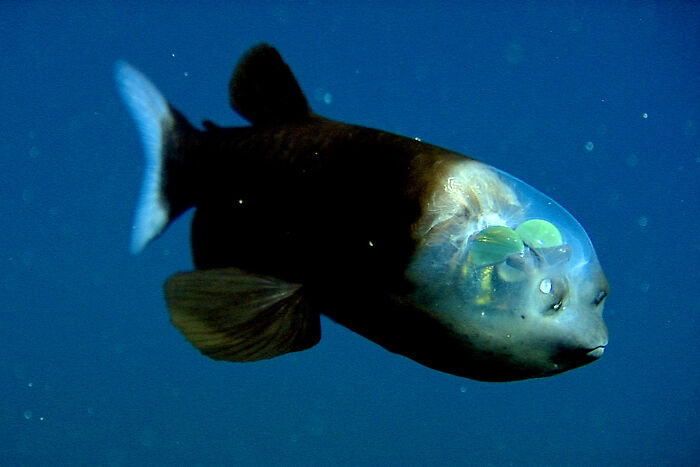
These deep-dwelling fish can see through their own foreheads.
Even in a world full of adaptations for seeing in near-total darkness, the barreleye fish (Macropinna microstoma) stands out as one of the most bizarre. Two small indentations where eyes might normally appear on a fish are actually the barreleye’s olfactory organs, and its eyes are two glowing green orbs behind its face that gaze up towards the top of its head.
In 2009, MBARI researchers showed that the fish can rotate its eyes towards the front to see its food when eating. Before that, scientists believed that the barreleye’s gaze was fixed looking straight up. Researchers think that the fish hovers below a siphonophore’s tentacles to steal food.
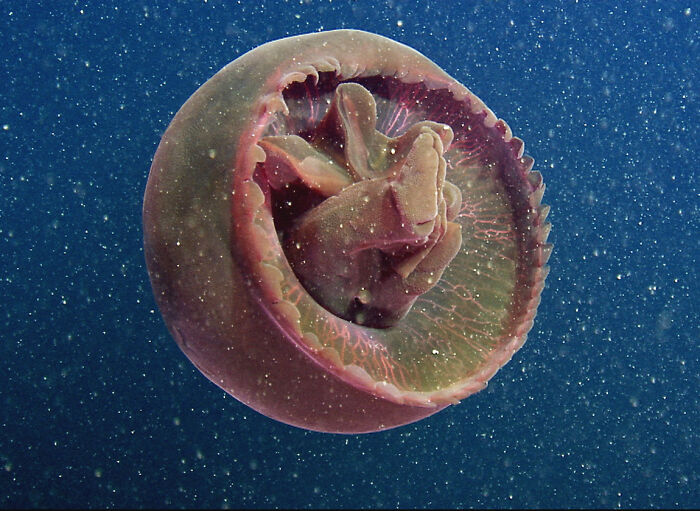
Giants lurk in the ocean’s mysterious midwaters.
While surveying the Gumdrop Seamount off the central California coast in 1998, MBARI staff spotted an unusual—and exceptionally large—jelly. This crimson creature was a full meter across. Unlike jellies that dwell near the ocean’s surface, this one didn’t have tentacles. Instead, a cluster of finger-like oral arms dangled beneath its bulky bell.
A closer look confirmed this was a new species—and one that had actually eluded our scientists five years earlier. Detailed video observations captured by our robotic submersibles helped MBARI researcher George Matsumoto and his colleagues in California and Japan formally describe this unusual jelly. They named it Tiburonia granrojo in honor of MBARI’s now-retired remotely operated vehicle (ROV) Tiburon, which was instrumental in documenting this delicate drifter in its natural environment.
Scientists have since spotted this jelly across the Pacific Ocean, from Baja California to Hawaii to Japan. That something so big remained undiscovered for so long shows how little we’ve explored the deep sea—and what more must be out there waiting to be found.
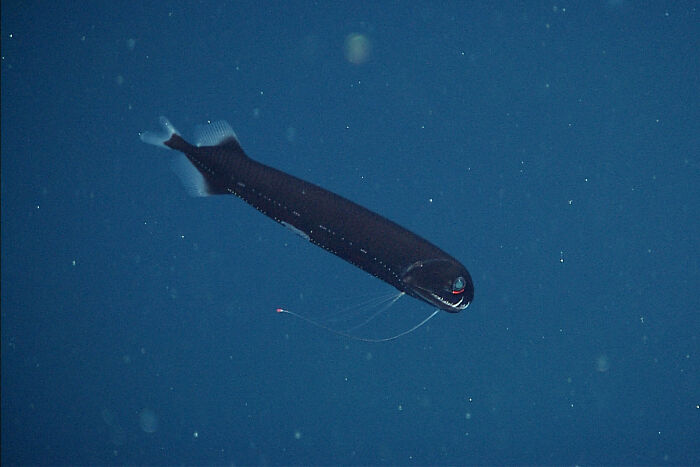
Dragons lurk in dark depths.
Dragonfishes (family Stomiidae) are cunning predators. Although they are strong swimmers, they prefer to lie in wait and ambush unsuspecting fishes and crustaceans. Most have dark skin—pigmented with some of the blackest blacks known in nature—to stay camouflaged from their prey. Some dragonfishes dangle a luminescent lure from their chins to entice prey. When a tasty morsel comes close, their big jaws open wide, and sharp teeth snap shut.
MBARI researchers have observed several different dragonfishes in the depths of Monterey Bay. The Pacific blackdragon (Idiacanthus antrostomus) and the longfin dragonfish (Tactostoma macropus) are the most commonly sighted species. Encounters with others are rare treats.
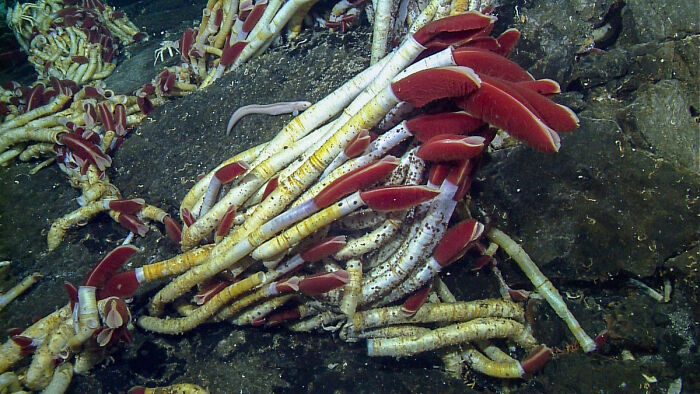
The world’s heaviest worms thrive in an extreme environment.
Towering colonies of giant tubeworms (Riftia pachyptila) grow where hot, mineral-laden water flows out of the deep seafloor. Unlike most animals, they don’t eat; instead, bacteria living in their guts transform sulfur into energy for them.
As harsh as their environment is, giant tubeworms live surrounded by a community of other animals—and their size doesn’t necessarily protect them. Their gills, which resemble foot-long red feathers, can be a vulnerable target for predators. The worms can quickly retract their gills into the tube if a hungry predator, like a vent crab, ventures too close.
When volcanic activity deep below the seafloor changes, the hot water sometimes stops flowing. In this case, the entire worm colony may die off. But when new hot springs pop up in other areas—often dozens or even hundreds of miles away—the tubeworm larvae quickly colonize them. Researchers are not sure how the larvae find the new vents, but deep-sea biologists are revealing new findings with every research expedition to these iconic deep-sea communities.
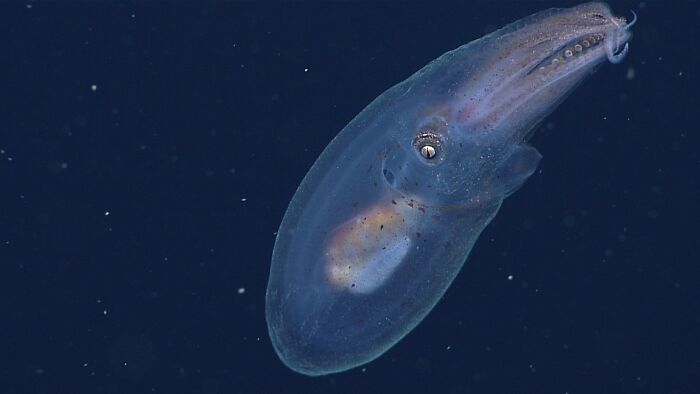
This little octopus is a master of survival in the deep sea.
The midwater octopus (Japetella diaphana) is one of just a handful of octopuses that live in open water. This species calls the expansive waters of the ocean’s twilight zone home. Here, there are no rocks or reefs for hiding or nesting. Instead, Japetella has evolved creative solutions to survive life’s everyday challenges.
Japetella cannot rest on the seafloor. A buoyant gelatinous body means this octopus can drift with the currents, and a low metabolism helps conserve energy while swimming.
A nearly transparent appearance helps Japetella blend into the dim, twilight waters. When the octopus sees the glow from a bioluminescent predator or senses movement nearby, a built-in defense mechanism gets to work. A network of tiny pigment-filled cells called chromatophores covers the octopus’s entire body. By rapidly expanding these cells, Japetella can shift from crystal clear to opaque orange. Since red and orange light do not reach the deep sea, this color change helps Japetella remain hidden from predators, an impressively nimble camouflage response to threats.
Life out in the open presents other challenges for Japetella too.
A mother midwater octopus does not attach her eggs to the seafloor. Instead, she carries them in her arms. To protect herself and her offspring, she descends to the deeper waters of the midnight zone, where there are fewer predators. Like other octopus moms, she makes the ultimate sacrifice to ensure the next generation’s survival. A mother Japetella lives just long enough for her babies to hatch and begin their journey back up to twilight waters.
Threats like climate change and pollution present new challenges for deep-sea animals.
The depth range of the midwater octopus overlaps with the oxygen minimum zone, a naturally occurring layer of low-oxygen water. Climate change is warming our ocean. Warmer surface waters do not easily mix with cooler waters, reducing replenishment of oxygen-rich waters. Scientists predict the oxygen minimum zone will expand with climate change. Japetella already live at the edge of their oxygen tolerance—will climate change push them over the edge?
MBARI’s advanced technology has provided vital insight into the secret lives of deep-sea animals. Our work will help us understand how Japetella and other denizens of the deep will navigate a changing ocean.
With eight arms instead of 10, this squid breaks the rules.
The octopus squid (Octopoteuthis deletron) is unusual among squids. Most squids have eight arms and two long tentacles, making a total of 10 appendages. As young Octopoteuthis mature into adults, their two feeding tentacles are reabsorbed into their bodies.
Eight arms are not the only thing that stands out about this species. While exploring the midwater, we often encounter octopus squid in a distinctive posture: large fins spread wide, and arms with twinkling tips curled above the head. Light-producing organs called photophores flash with bioluminescence at the end of each arm.
We have spent several decades studying Octopoteuthis. Cameras on our advanced underwater robots have revealed the mysterious lives of octopus squid, from their unique behaviors to their defensive strategies.
Octopoteuthis can change color, a behavior common in cephalopods that live in shallow waters but relatively rare among deep-dwelling species. We have documented an astonishing array of colorful and complex body patterns in octopus squid, including patches, stripes, and various postures. However, we have yet to decipher the code hidden within these markings.
By attaching a soft brush to the mechanical arm of our deep-sea robot, we were able to observe firsthand one of the octopus squid’s unique defense strategies. When danger approaches, Octopoteuthis drop a part of their arms. The arm’s twinkling tips flash and wiggle, serving as a decoy that distracts a predator, much like a lizard’s tail on land. While this strategy seems extreme, losing an arm tip is much better than becoming someone’s lunch!
During the day, octopus squid dwell in the dim waters of the twilight zone. Once the sun sets, they swim up to the ocean’s surface, using the cover of darkness to feast in these food-rich waters. Every evening, countless other animals join Octopoteuthis in this massive migration between the deep sea and the surface.
What the octopus squid eats is still largely a mystery, but we do know that Octopoteuthis is a tasty snack for many organisms. This squid is on the menu for a variety of predators, including sperm whales, blue sharks, rattail fishes, and even seabirds—no wonder they hide in dark, deep waters during the day! Like many fishes, squids, and other animals that live in the ocean’s twilight zone, Octopoteuthis provides a vital link between the surface and the deep sea.
The deep sea is closer than you think. What we do on land affects the ocean, even the animals and environments deep below the surface. By choosing sustainable seafood, refusing single-use plastic, and reducing our carbon footprint, we can help protect the amazing animals of the deep.
Warm springs make an ideal nursery for this octopus mom.
Life in the frigid waters of the deep sea moves at a slow pace. Animals that live in the ocean’s depths often grow more slowly than their counterparts near the surface. A female deep-sea octopus might wait several years for her eggs to hatch, increasing the risk that her offspring may not survive to hatching.
The pearl octopus (Muusoctopus robustus) has a clever strategy to beat the odds. Muusoctopus gather at deep-sea thermal springs to mate and nest. The warm water seeping from the seafloor accelerates the development of octopus embryos.
Scientists have discovered a handful of deep-sea octopus nurseries across the Eastern Pacific, including one in our own backyard. Davidson Seamount is an inactive underwater volcano off the coast of Central California, about 130 kilometers (80 miles) southwest of Monterey. Near the base of the seamount, cracks and crevices bathed in warm water from hydrothermal springs are filled with purple “pearls”—Muusoctopus moms. Welcome to the Octopus Garden, the largest known aggregation of octopus on Earth.
After a mother Muusoctopus attaches her eggs to a rocky ledge, she turns herself upside down, inverts her arms, and shields her developing offspring with her body. As with many other octopuses and squids, a Muusoctopus mom sacrifices herself for her offspring. For nearly two years, she lives off her food reserves, then dies once her eggs hatch.
The Octopus Garden teems with life. Cusk eels, rattail fishes, and other scavengers gather here to feed on the remains of nesting octopus. Sea anemones and snails feast on the remains of dead octopus parents too. Small invertebrates live alongside nesting females, undoubtedly benefiting from unhatched eggs.
Davidson Seamount and the Octopus Garden are protected as part of Monterey Bay National Marine Sanctuary. But other deep-sea oases—including those we have yet to discover—remain at risk from threats like overfishing, pollution, climate change, and mining.
We can be a powerful ally for the unique animals and environments that lie out of sight deep beneath the ocean’s surface. Help us spread the word about safeguarding the ocean’s pristine wilderness. The future of our big blue backyard depends on us.
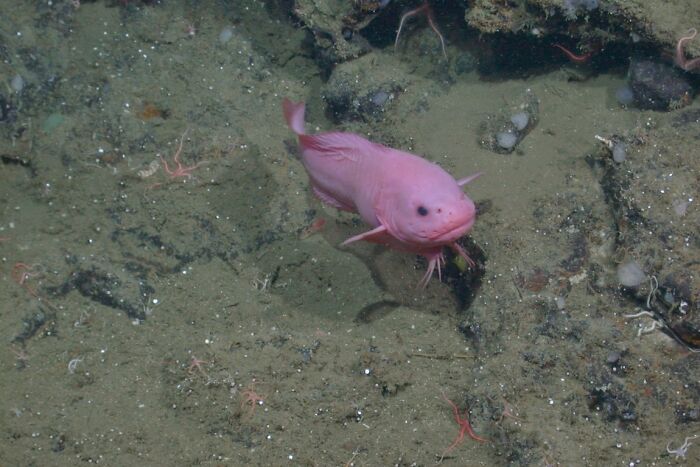
It’s stick or swim for these fishes.
Most snailfishes (family Liparidae) live near the seafloor, riding the currents that sweep along the bottom. A hungry snailfish may swim against the currents to hover above the seafloor while searching for snacks buried in the mud. In some species, frilled fins probe the seafloor for hidden morsels of food.
Snailfishes make their homes in a variety of ocean habitats, from shallow tide pools to deep-sea trenches. In fact, a snailfish holds the record for the deepest-dwelling fish. Remote cameras deployed by researchers studying the Izu-Ogasawara Trench off Japan filmed a white snailfish in the genus Pseudoliparis at the remarkable depth of 8,336 meters (27,349 feet)—more than five miles deep!
Scientists have described more than 450 different species of snailfish worldwide. Snailfishes have a large head, a jelly-like body covered in loose skin, and a narrow tail. Many have fins on their belly modified into a disk that can hold on tight to rocks, seaweed, or even larger animals like deep-sea crabs for shelter. Most are small and feed on tiny invertebrates.
MBARI has encountered more than a dozen snailfish species in our explorations of the deep waters of the Northeastern Pacific. We see the blacktail snailfish (Careproctus melanurus) most frequently. This pink species with a distinctive dusky tail is common on the muddy slopes around Monterey Canyon. In the canyon’s deepest stretches, the snowy-white abyssal snailfish (Careproctus ovigerus) is more abundant.
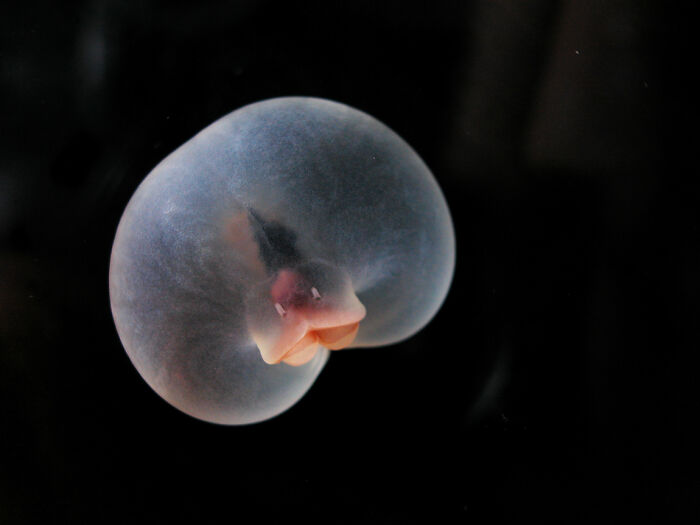
While most snailfishes live near the seafloor, the tadpole snailfish (Nectoliparis pelagicus) lives in the midwater, an expanse of open water deep below the surface, yet far above the seafloor. We occasionally come across this little snailfish drifting in the water column, curled into a doughnut shape.
Many deep-living snailfishes are rarely seen, so the footage filmed by our robotic submersibles provides valuable data about their appearance and behavior. MBARI’s advanced underwater technology has helped our collaborators describe two new species—the arbiter snailfish (Careproctus kamikawai) from local seamounts and the bumpy snailfish (Careproctus colliculi) from the abyssal seafloor offshore of Central California. Snailfishes are among the fish families with the most new species being described. We suspect there are dozens more out there waiting to be discovered.
Our observations have revealed the mysterious lives of deep-sea snailfishes. MBARI’s work helps resource managers and policymakers understand how threats like climate change, mining, and pollution affect deep-sea animals and ecosystems. What we learn can help guide their decision-making about the future of the ocean.
It’s a jelly. It’s an egg case. It’s a . . . worm?
The balloon worm (Poeobius meseres) hardly looks like a worm at all. It lives in the midwater—the vast expanse of open water deep below the surface and far above the seafloor. This worm has evolved unique ways of living suspended in the water column instead of crawling along the seafloor.
Most marine polychaete worms—the much more elaborate relatives of earthworms and leeches—have a body that is clearly segmented. Their bodies are divided into many nearly identical, repeated parts. Typically, each of those repeated parts is studded with several stiff bristles. Poeobius, however, has a bag-like body filled with fluid that, together with its thick gelatinous coat, provides buoyancy to help it float in the water column effortlessly. Its smooth body lacks the obvious segmentation and the bristles of its bottom-dwelling kin. But if you look carefully, there is evidence of segmentation: several repeated clusters of nerves spaced along the worm’s belly.
Poeobius is a common and very abundant resident of the midwater in Monterey Bay. It drifts through the water, collecting and eating bits of sinking organic matter in a mucous net. This little worm is actually an important part of cycling nutrients like carbon from the ocean’s surface to its depths.
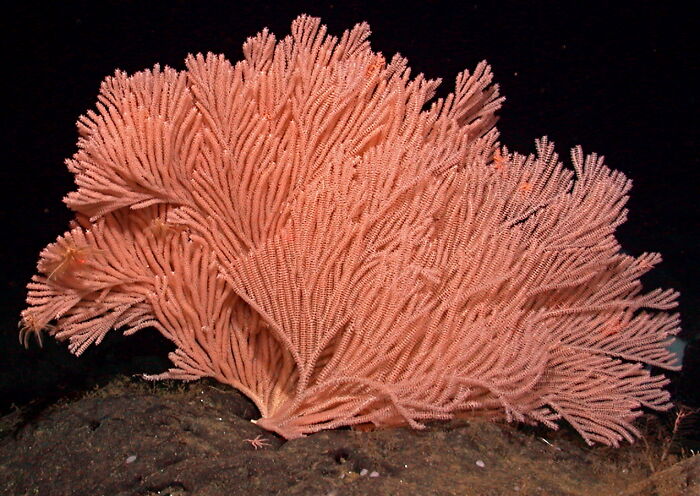
Ancient bamboo coral forests grow on seamount slopes, but these are animals, not plants.
A bamboo coral’s stony branches contain thousands of tiny polyps living and working together. The individual polyps stretch feathery tentacles into the currents to grasp plankton and other particles of food drifting in the currents. Bamboo corals come in many shapes—some species have harp-like branches, while the skeletons of others twist and turn. But despite their outward appearance, all have a knobby, stony skeleton inside.
Predators, including nudibranchs and some sea star species, may try to make a meal of a coral’s polyps, but the colony can put up a fight. Fleshy sweeper tentacles loaded with powerful stinging cells gently sway along the base of a shaggy bamboo coral (Isidella tentaculum) to keep predators from crawling up to eat those precious polyps, and a whip coral (Lepidisis sp.) flashes waves of blue bioluminescence as a burglar alarm that draws in nearby animals to scare away any unwanted intruders.
But there’s a more sinister threat a coral can’t defend against—humans. A bamboo coral grows slowly, just millimeters every year. The coral gardens that thrive on deep underwater mountains are the old-growth forests of the ocean. These corals may be hundreds, if not thousands, of years old, and now trawling, pollution, mining, and climate change threaten their future. MBARI scientists are monitoring deep-sea corals at Sur Ridge to better understand their ecology, growth, and longevity. We’re also testing to see if transplanting corals can help their populations recover. In the meantime, we must work to protect seamounts and other important deep-sea habitats so corals can grow undisturbed.
This mom is a pelagic parent.
Female squids of most species reproduce by depositing egg cases on the seafloor or releasing eggs in a gelatinous mass that drifts in open water. While exploring the depths of Monterey Bay in 2005, MBARI researchers encountered a female deep-sea squid (Bathyteuthis berryi) carrying a sheet of eggs in her arms.
Brooding is common among bottom-dwelling octopuses, but scientists have only observed this behavior in three squid species, all found in the deep sea. Scientists think this type of parental care helps a mother squid improve her hatchlings’ chances for survival. MBARI researchers suspect other deep-dwelling squids may also be brooders.
The deep sea is challenging to study, and we only get brief glimpses into the behaviors of deep-sea animals. MBARI’s archive of thousands of hours of underwater video has helped illuminate life in the largest living space on Earth. MBARI researchers can document remarkable new species and observe how deep-sea animals feed, escape predators, and reproduce. Each observation logged by our ROVs provides another piece to the puzzle and helps improve our understanding of life in the ocean’s mysterious depths.
Super senses help a rattail thrive in darkness.
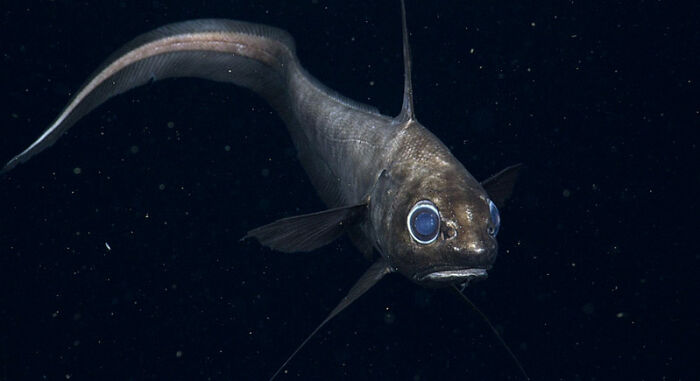
Food is scarce in the deep sea and, without sunlight, can be hard to find. But those big blue eyes give the rattail an edge. It can glimpse even the faintest flickers of bioluminescence—the “living light” produced by deep-sea animals. Keen eyesight reveals prey, like fishes and squid, darting in the waters above the seafloor.
A rattail relies on other senses, like smell and touch, to find a meal too. It has a nose for rotting carrion, and sensitive barbels on its chin detect small crustaceans or worms wiggling in the mud below.
Humans play a pivotal role in deep-sea food webs too. As fish stocks in the ocean’s sunlit shallows dwindle, fisheries cast their nets to deeper waters. You might see “grenadier” as the catch of the day in restaurants and seafood markets—that’s a deep-sea rattail fish sold under a more palatable market name. Rattails and other deep-sea fishes grow slowly and mature late in life, making them vulnerable to overfishing. The gear used to catch these fishes may harm seafloor habitats or unintentionally catch other species too. Thankfully, effective management for rattail fisheries on the West Coast has reduced the risk of overfishing and habitat damage. The Monterey Bay Aquarium’s Seafood Watch guide can help you make seafood selections that keep ocean health in mind.
This predator’s pretty pink color is clever camouflage.
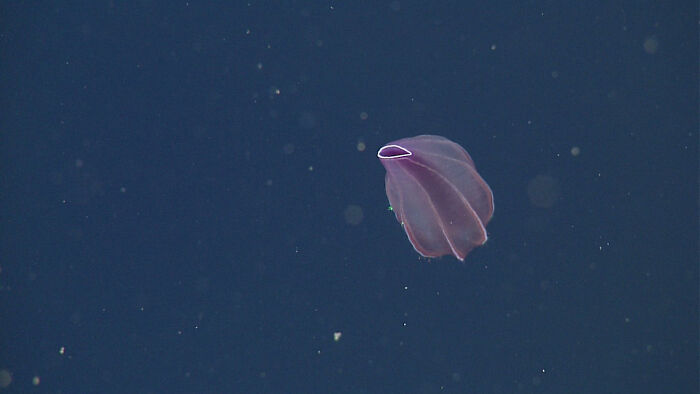
The abyssal comb jelly (Beroe abyssicola) patrols the midnight zone searching for its favorite food—other comb jellies. When Beroe finds another comb jelly, it opens its mouth wide. Rows of tiny hair-like cilia in its mouth act like teeth to help it take a bite of its prey, though sometimes a hungry Beroe will simply swallow its meal whole!
This predator prowls in dark depths where most animals can produce bioluminescence. A glowing gut would invite the attention of other predators. The crimson color of the abyssal comb jelly’s stomach absorbs the light produced by bioluminescent prey, keeping Beroe camouflaged.
MBARI researchers have learned that gelatinous animals like Beroe have a large impact on deep-sea food webs. Our archive of nearly 28,000 hours of deep-sea video contains hundreds of observations of deep-sea animals feeding. Examining these observations in detail revealed that jellies, comb jellies, and siphonophores are important as both predators and prey in the ocean’s midnight zone.







































 No fees, cancel anytime