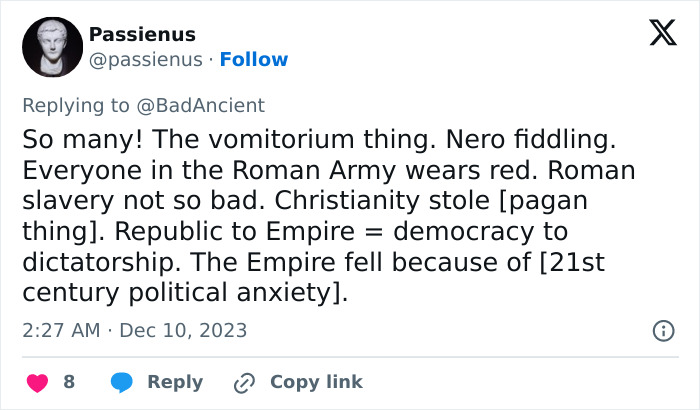
Even though there is only one true way of how historical events actually unfolded, there sure are many myths and legends that surround them. And while some seem way too far-fetched, others can be quite convincing, which is why they often become rather widely known.
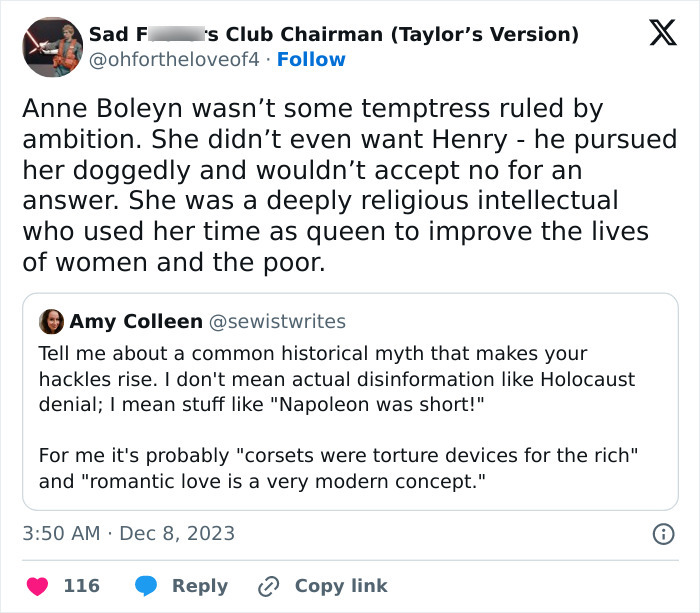
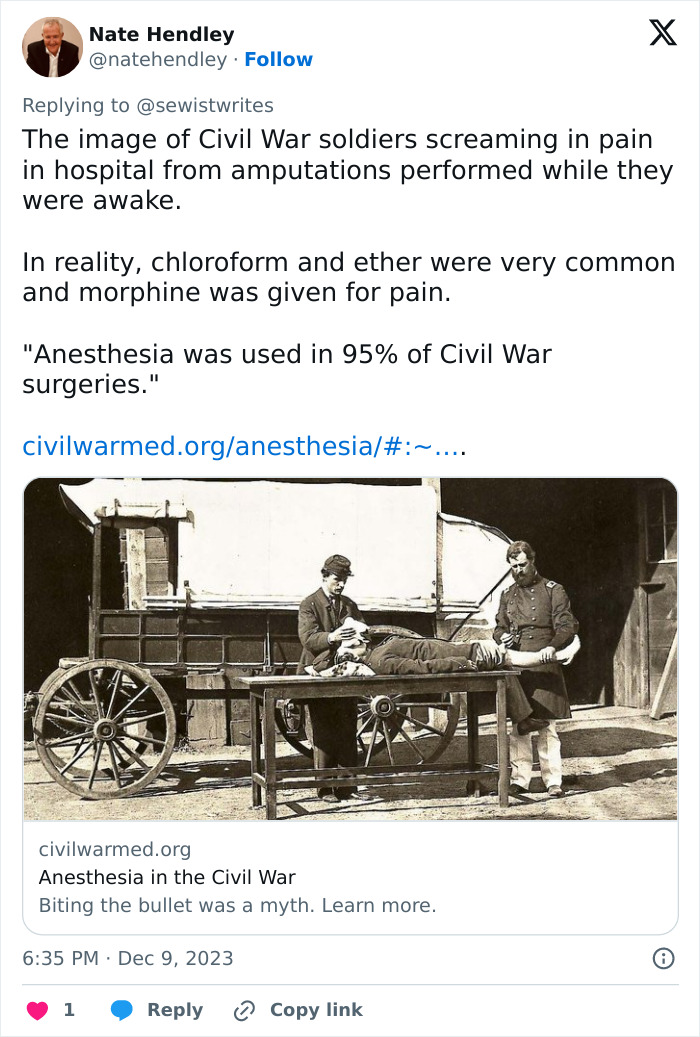
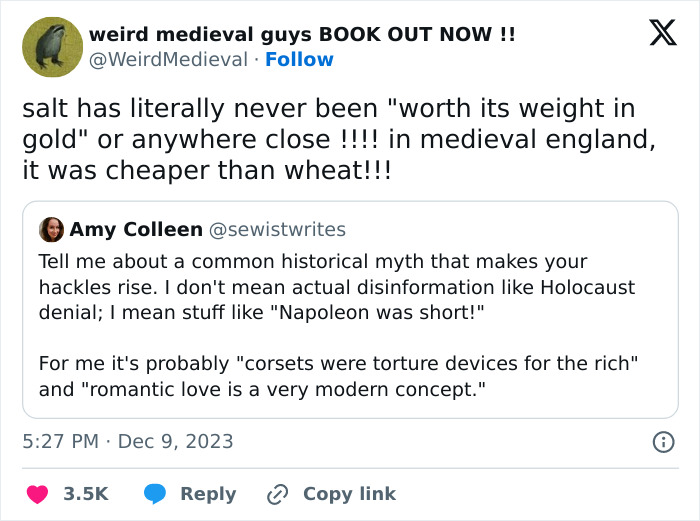
A netizen going by the moniker of ‘sewistwrites’ recently turned to X (formerly Twitter) to learn more about such convincing yet not necessarily accurate historical myths. She shared that the ones that make her hackles rise relate to corsets and romance, this way starting a thread, which covered everything from Columbus to salt, and beyond. Scroll down to find more historical myths shared by the netizens on X and see what other bits of historical information might not be entirely true.
In order to learn more about historical myths and how they can influence the way people view history itself, Bored Panda turned to associate professor of history at Southern Utah University, Dave Lunt, who was kind enough to answer a few of our questions. You will find his thoughts in the text below.

This post may include affiliate links.

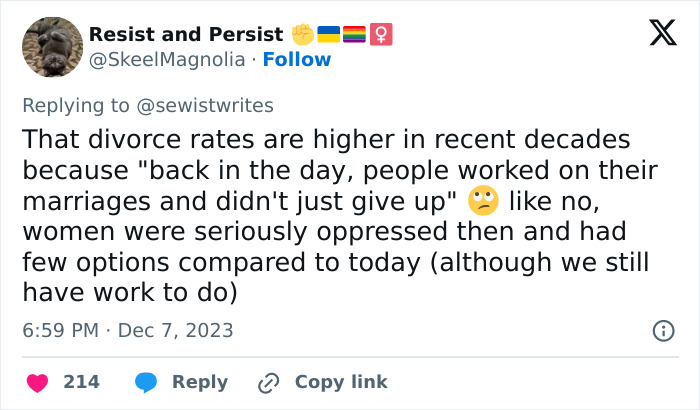
In some countries, it was practically impossible for a woman to divorce her husband. In New Zealand in the early 60s, proof of adultery in court would do it. Domestic abuse wouldn't, because behaviour in the home regarded as a 'domestic' issue.
I believe its still like this in some Catholic countries, like Philippines. There's no such things as being legally divorce. They simply do not have it. Please go google before arguing. Thanks.
Load More Replies...This! There's a difference between trying to work on things and staying in a relationship because of coercion. It's still a huge issue today with many partners controlled by threats of financial ruin and limited custody of children. Just two of the threats my abusive ex levelled at me over the years...
UK only signed into law in the Sexual Offences in Marriage Act (2003) that there was such a thing as rape in marriage. Still a long way to go.
And no-fault divorce only came into law LAST YEAR (2022) in the UK
Load More Replies...I remember when my mom divorced my abusive alcoholic father in '94. After she reverted to her maiden name, the local RCMP would pull her over and be like "Good afternoon Mrs. Husband's name, shame you've got a tail light (or some BS) out. You should take this thing home and get your husband to look at it for you." And that's the way it was. He was sadistic af and enjoyed strangling us like Homer Simpson and generally beating tf out of us and forcing himself on my mom. His punishment was the courts ALLOWING his wife to leave him and getting supervised visits for 1 year. That's how it was, and still is, in small towns with "good Christian values"
Men would just up and leave - no child support, no spousal support and go start new families. So no divorce on file and no one bothered to check if the man had been married before.
Maybe but most marriages were arranged and if she has a father or brother you could be in big trouble..
Load More Replies...In Australian aboriginal culture, women just had to wait until their husband sold them to another man. Or have an affair and risk being exiled or killed.
In the US, women couldn't open their own checking account until the 70s. Hard to pay your bills and have your own place without control over your own finances.
I get bored with correcting this. It wasn't Columbus who got the radius of the spherical Earth wrong, it was Ptolemy in 150 AD in his great geography book. Eratosthenes in 200 BC had earlier got it correct, but Ptolemy didn't. Columbus based his trip on Ptolemy's geography book.
iirc it was still pretty close to the actual number. I might be thinking of Eratosthenes though
Load More Replies...Exactly, too many people think Columbus was a good person. He was literally the worst.
Load More Replies...I've never understood flat Earthers. I mean, mountains exist. I grew up next to the Rockies. As you drive away, they go down in the rear view mirror...
Yeah, when I went to the top of Pikes Peak, I couldn't see the Eiffel Tower. And it was a clear day - hahaha!
Load More Replies...They knew earth was round in greek times. Atlas did not hold up the earth, He held up the sky.
He miscalculated the circumference of the earth. He believed that it was 19,000 miles when it actually is around 24,901 miles.
Because the Greeks had worked that one out a couple of thousand years before Columbus.
I grew up in the Caribbean. I remember this was never something we thought cause we learned this history - hence why he thought of going the other way for a spice route. I do remember though later when I was like 11 watching this US cartoon where Columbus proposed the globe idea-- AND him discovering the US 🤣 It was too ridiculous.
That really is what the myth is about, that he was "proving that the world is a sphere", but in fact I'm sure it just like today with the "flat Earth people". The "people in the know" (which had to include most sailors that left the coast) knew it wasn't flat, but not everyone knew/believed that (the flat Earthers of the time). Columbus' trip wasn't about "proving the Earth is round", it was all about money. "Shortcut equals less time, and more profits." What he way underestimated is the circumference of the Earth.
Load More Replies...The lie we were told in school was that Columbus was the one who thought the earth was round, but it took him so long to get funding for the trip because no one believed him.
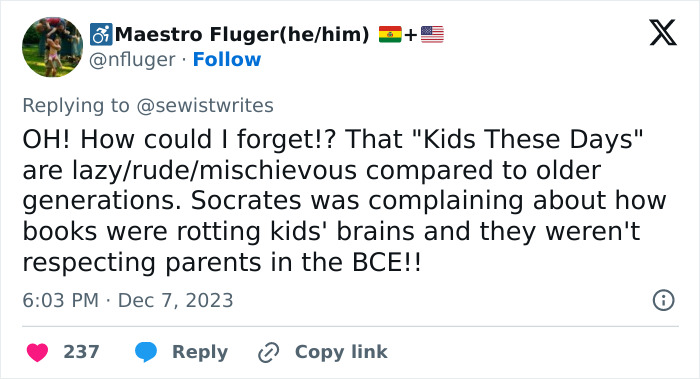
Back in my day, we read from clay tablets like normal human beings, not this fancy shmancy papyrus scrolls!
Load More Replies...One of Jane Austen's books was written to take the p**s out of the anti-book hysteria (specifically the hysteria that reading gothic thrillers would damage young women and rot their brains).
I guess it's a good thing that people keep getting progressive over time
Load More Replies...Me sitting, looking at BP on phone. Wondering what Socrates would think of me, an adult... at least I don't read the celeb or affiliate posts.. 🤭
Who cares? He was the “damn kids mah lawn” guy before they invented Jesus.
Load More Replies...They always complain about technology. Rocks! Sticks! Books! TV! xBox!
This has been going on since we first came down from the trees and our grandparents exclaimed, "Kids these days, look at them! Leaving our tree, trying to walk upright - what's the world coming to?!"
While for some, history is not much more than a bunch of names and dates, others could spend countless hours studying how certain events developed and how they changed the world we live in now.
“The decisions of people who came before us definitely impacted the world we live in today; just as our decisions will impact the people who come later,” associate professor of history at Southern Utah University, Dave Lunt, told Bored Panda, adding that history is more than just “the things that happened”.
“It’s more of the understanding and interpretation of what happened,” he explained. “Most of the time we can all agree on the basic facts, dates, and events. But history occurs in figuring out the bigger trends or effects of the events in the past. And the most interesting interpretations are usually complicated, nuanced, and firmly situated in ‘the gray areas’.”

There was a disease called the 'Green Sickness' that struck only young women. The cure was marriage. Yeah ... that would be rampant anaemia due to heavy periods. Marriage often meant repeat pregnancies, during which time the woman wouldn't bleed.
Not just the standard 9 months of pregnancy, but the time whilst breastfeeding too. One pregnancy can result in 1-2 years without periods. I found that breastfeeding stage to be most wonderful - no periods, and stable hormones. It was fantastic.
Load More Replies...And a whole lot more of them were infectoius diseases because there were no vaccines, no antibiotics, no antifungals, and no antivirals.
One person lives to 100, another dies at birth. "The average person lives to 50". "Average" can be a very misleading number (The median is what should be used). In 1900 infant mortality rate was 164 per 1000. In 2021 in the US it was 5.4. Let's imagine if ones that didn't die as an infant lived to 60. 1900: average (1000 - 164 * 60 / 1000) = 50.16. 2021: (1000 - 5.4 * 60 / 1000) = 59.676,
Or, for those of us that prefer less matching, carve out the infancy deaths and use those numbers
Load More Replies...Access to clean water, and even understanding why it is important added lot to the general health. People of today go around buying bottled water with the belief that their water is bad, which is mostly just the bottled water companies' ads, and don't realize all the work that has gone into getting clean for the modern societies.
If you lived past 30, then there were good chances for you to be old? Just really hazardous beeing younger back then?
Since child mortality was so high, the _average_ life span was maybe as low as the 30's or 40's. But if you survived your first five or so years, and didn't die in accidents or child birth, you could live a reasonably long life. Of course pneumonia or an infected wound could be mortal, and cancer was a death sentence, but still.
And on a related note, natural birth advocates who say "women gave birth for thousands of years just fine before modern medicine came along!". If they want minimal interventions for their birth plan then they can go for their lives, but that claim is just stunningly incorrect. Do they realise how insanely high the rates of death in childbirth were for millennia? You can quibble about whether there's overuse of certain childbirth interventions, there probably is in some cases, but you can't seriously claim that the average stone-age woman giving birth was better off than one in a modern Western hospital who has had current standard pregnancy monitoring. That's a ridiculous statement.
Oh, they know. That’s why every time someone promises to make schools teach it properly, the racists scramble to vote for the Racist Party.
You are using a 20th century understanding of the word "Discover" and the like, rather than the older 18th and 17th century meaning. If you look at older history books you see Samau, a chinese explorer during the Yuan Dynasty (contemporary of Marco Polo), being describes as discovering pathways to Europe, despite people already using them
We're not native americans, we're indigenous peoples. You can't be native to something that came after you!
I am very interested in this topic. Do you refer to yourselves as "first nations", or do you mind being called "aboriginal"? Where I grew up (a former British colony), indigenous communities used to just be called "the natives", but I thought that took away all of the nuance of the indigenous cultures, tribes and kingdoms.
Load More Replies...There were 40 million Native Americans alive when Europeans got here. After they killed most of us, I'm sure the land seemed empty
Ah the conquistadors killed a lot upon arrival too. Simply by bringing viruses that population had never dealt with before
Load More Replies...I think it is only Americans who think this. Just about everybody else in the world have a more rounded understanding.
It goes the "New World was DISCOVERED", not founded. First of all, it WAS a discovery from the perspective of Europeans and many other people from the Western Hemisphere who had never previously navigated the Atlantic Ocean so far. What was "founded" was the first democratic Republic. Get your terms straight and maybe things won't seem so illogical to you.
I don't want to bust your bubble. But there were democracies already in play before this period.
Load More Replies...First came The native Americans. If you want the first people who weren't native Americans, that would be Saint Brendan from Ireland. Or you could go with the Vikings who came shortly after. Christopher Columbus basically went where other people had been before and decided to claim it. And then Amerigo Vespucci pulled the same trick on him and named it after himself.
This society was created by Whites after displacing the original inhabitants, so yes, the New World was founded by them. That's the whole point. Otherwise the Americas would look very different.
The USA was founded - or rather stolen - by Europeans who just claimed the whole continent for themselves despite the fact that the place was already inhabited, then spent centuries committing genocide against the peoples who had been living there for tens of thousands of years. The "displacement" (aka theft and mass murder) went on for centuries afterwards and still hasn't quite stopped. I'm European. European history is nasty and bloody. So is American history.
Load More Replies...Assoc. Prof. Lunt suggested that practicing the skills of investigation and interpretation can help make sense of our world as the years go by. “Oftentimes, very small things end up having momentous consequences in our lives. The first time we meet ‘that special someone’, we rarely understand how momentous that meeting is. The same is true of history. Only later can we appreciate the true value and importance of certain events.”
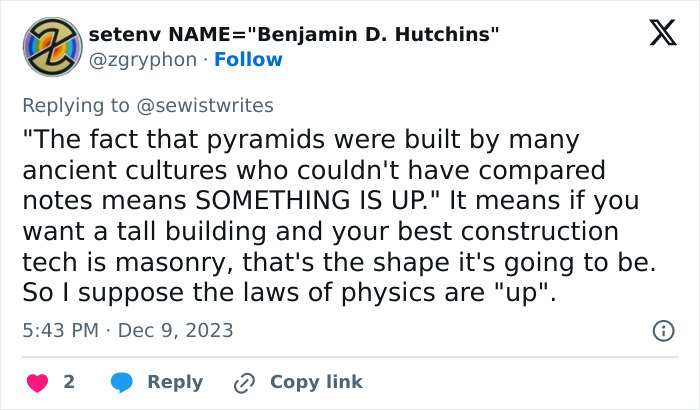
Guys no but isn't it weird how countless millions of babies/toddlers all around the world all, when you give them blocks, quickly learn to start stacking them in a pyramid shape? WHAT ARE THEY PLOTTING BABY CONSPIRACY
Yeah, generally speaking "more below, less on the top" is one of the best ways to pile up a lot of stones so that they do not fall down...
Meet a guy in a pub once who tried to convince me they were built by aliens. I told him they were just a big pile of stones. He wasn’t happy.
You should have tried to convince him that old castles were built by aliens. "There's no way Europeans could have done it!"
Load More Replies...I have never seen a reverse pyramid (of any size, free standing with the point holding up the rest of it). When you show me that, then I will believe that it was built by aliens.
Maybe a lot of cultures kept trying upside-down pyramids, but their architectors kept getting crushed as, you know, it’s not going to work with loose large stones… we just see the surviving ones.
Load More Replies...It's more than that. A stepped pyramid is the ideal shape for protection of a population against military attack. Fighting from the high ground gives a big advantage, and being stepped - even if the attackers gain a step, the defenders just move up a step. That way a defending army can beat an attacking force that is ten times as large. Which became obvious not just in Egypt and Mexico, but in at least six other countries as well.
Just because they lived millennia ago, that doesn't mean they weren't intelligent. Practical and intelligent people the world over will design and build structures that are similar-not because of ancient astronauts or lost technology, but because there are sensible and practical ways of building a bridge, digging wells, making roads and erecting buildings and sooner or later, most cultures will develop those skills.
Other than the basic pyramid shape they aren't all that similar anyhow.
Not necessarily. You don't think people in the same time periods have the same ideas even living on different continents?
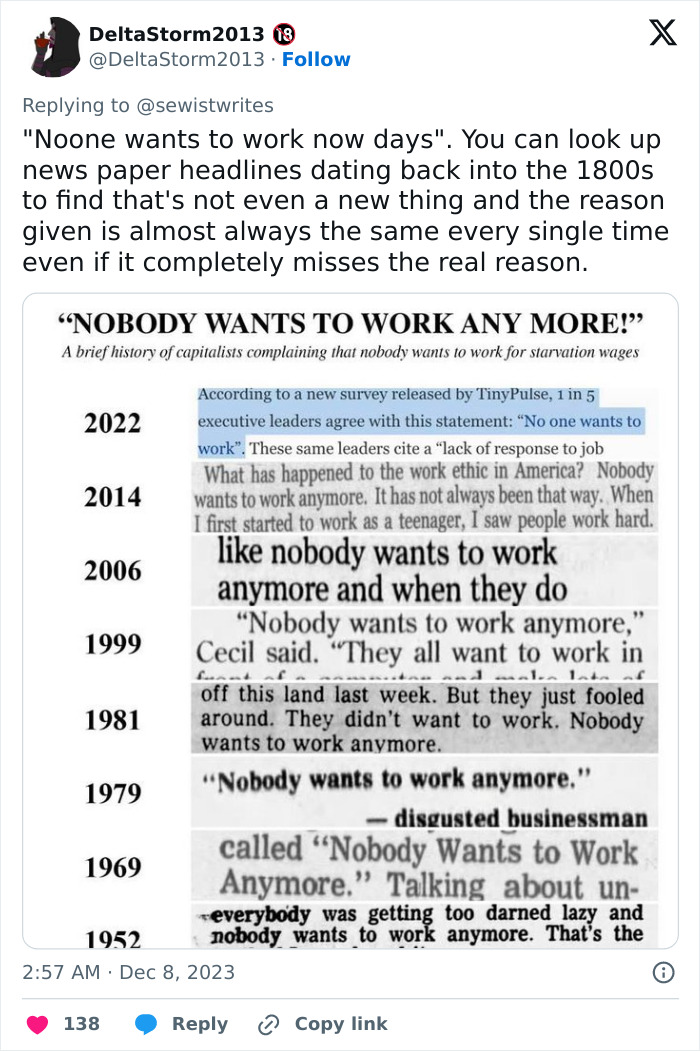
This is the cry of the bad employer, all of these are missing the "... for my company"
What about "nobody wants to pay wages anymore"? Most people don't mind working, but if it doesn't even allow to live decently, don't be surprised to hear about such behaviors.
Mm. I've read that the British empire in Africa had a problem: they mostly couldn't persuade the locals to work for money. Why bother, was the attitude, when we can live quite happily without working at bad jobs for money? We have our farms and our cattle (depending on lifestyle) and everything's fine. So the British invented a tax on houses - but a tax only on *native* houses, to be paid in cash, which mostly could only be earned by working for pay...
Load More Replies...Can we just agree that in every generation since Fred and Wilma there have always been people who don't want to work. But the majority are willing, they just want to work in an environment where they feel valued, safe and receive a worthwhile result for their effort.
Almost every adult ever has worked. It's hard to be an adult and not work - even officially unemployed people living off state benefits have to put in a surprising amount of work to survive. The problem is that since industrialization, "work" for the majority has meant "working for too many hours for too little money to enrich an employer" (hence Marxism and similar ideas). I've watched TV documentaries on how hunter-gatherer societies live - far fewer hours per week and much more life satisfaction on the whole. On the other hand, that lifestyle can only support a very low population density.
Load More Replies...It's true that no one wants to work. That's why you have to pay them.
It is not quite true. At least where I live a lot of old age pensioners work for free in second hand shops, in schools and in Repair Cafe's. We just don't want to work in order to enrich an employer who looks at us as machines, that don't need lubrication or anything.
Load More Replies...nobody wants to work for a crappy employer. if employers are saying that nobody wants to work for them anymore, that’s their problem.
No one WANTS to work. It's just that we have to, unfortunately. Would I rather be at home, doing nothing? Absolutely!
The quotation (which, incidentally, was more along the lines of "Let them eat brioche") had already been attributed to several different princesses and duchesses before Marie Antoinette was even born.
Yes, but I'm going with the old Irish expression " never ruin a good story with the truth. "
Load More Replies...marie antoinette was a scapegoat. she was married off as a young girl to a messed up government. her last words were her apologizing to a guard who’s feet she accidentally stumbled over
Well he and Jim Morrisson also threw fried chicken into the mix in their songs
Load More Replies...My favorite false attributed quotation of Marie Antoinette is "The situation is hopeless but not serious" ;)
IIRC the quote, whoever said it, was about the fact that there was no bread available or something similar. Happy to be educated on that though.
But this isn't taught, it's just a Hollywood adaptation, because it sounds better than bread.
The "cake" meant the scraps (crumbs) that was the end product of baking.
Dave Lunt shared that the idea of cause and effect is what fascinates him the most about history. “I think, in some ways, that history is similar to science in that historians develop theories and then test them against the evidence,” he said.
“But history isn’t science. Sometimes things happen that defy easy explanation. Some things don’t have a rational cause and effect; underdogs can win the big battle, or a freak weather event can alter plans, or an unexpected eclipse of the sun in August, 413 BCE can convince the Athenians to delay an attack on their enemies, allowing the enemies to regroup and defeat them. It is a desire to know more about these human factors in the events of the past that draws me to history.”
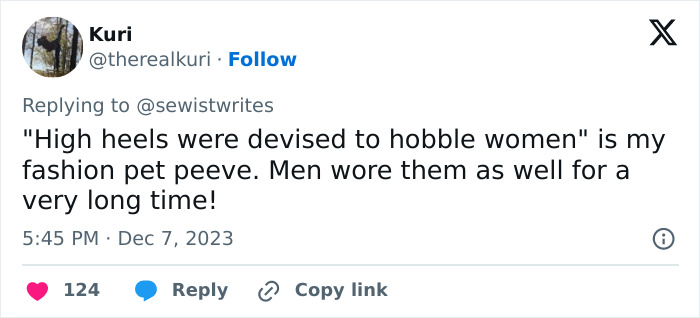
They were actually invented for men as it gave them better hold in stirrups.
I thought they were invented for governors of Florida.
Load More Replies...They may not have been INVENTED for that purpose, but Japanese women created an amazing hashtag (#KuToo, a portmanteau of “kutsu” (shoes), “kutsuu” (pain) and “MeToo”) to call out how company dress codes that require high heels are hobbling women today.
High heels were footwear exclusively for men for about the first century or so after they were invented (by Persians, ca. 15th century, to keep their feet in stirrups). Even when women began wearing heels, they more often took the form of chopins, stilt-like blocks completely covered by their skirts and often so tall, a maid was required to act as a crutch.
it was also used for butchers so they would not get blood on their feet
Platform shoes/clogs were originally to elevate you out of the muck and mud of unpaved paths and roads. Then men wanted to look taller. Then they wanted to look well hung by adding a 6 inch long pointy toe to their shoe tips.
They were invented to prevent rich women's dresses and cloaks from getting dirty when the streets were literally just dirt tracks covered in filth (including sewage, horse manure etc.) Men also wore them as they helped prevent their feet from slipping out of the stirrups while horseriding.
Butchers use to wear them to keep the blood out of their shoes.
I have three big heroes in computing - Ada Lovelace (who can be considered the first computer coder), Alan Turing (the enigma device and father of AI) and Margaret Hamilton (head of the team that wrote the Apollo 11 software which took "Men" to the moon and back on a computer less powerful than a modern fridge)

Having worked in IT since 1980 I think this is simply not true. Yes, there were always more men than women, but there certainly wasn't any noticeable shift such as described here. "Workplace Hostility" towards women actually reduced during this period, with more and more legislation towards equality being put in place.
It's absolutely great to read this. The whole post is very chauvinistic and even though this is massively reduced, it's those that are the minority that think it's ok to talk about women this way. Who's he????
Load More Replies...Major misconception here. Women were employed at the beginning because many had a background as "calculators", so were quite good at math and precise, but mostly because they were cheaper to hire for what was seen as a low skill, train-on-the-job position. Out of those, some went on to have notable careers, but it came to a point where a summary knowledge of math didn't do the cut anymore. Women in higher learning institutions were still rare (yup, sexism at his finest here), so the jobs started going to men who had more opportunities to reach the specialization required for the rapidly advancing technology. The whole "workplace hostility" angle is just gratuitous victimhood.
Unless you were a woman working in a STEM industry in the 1980s you have zero idea of how toxic and difficult it was. Sexual assualt up to and including being pinned against the wall with a sharpened screwdriver to the throat in full view of the entire workplace was let go by bosses in my workplace because "boys will be boys". Pornography was on full display and freely handed around.
Load More Replies...Don't forget Grace Hopper, the mother of COBOL. While generally considered obsolete CO(mmon) B(usiness) O(riented) L(anguage) was the pre-eminent language for coding business applications from the 50s thru the 90s. There are probably BILLIONS of lines of COBOL code still running in many enterprises. Rear Admiral Hopper is said to have originated the term "bug in the code/computer".
Women just don't understand tech was also a way to dissuade women from joining the workforce in that industry because it threatened the men, AND it was an excuse to pay women lower wages
Like my first math teacher who stated as if it were a certainty, that the girls shouldn't disturb by asking, because girls couldn't learn math anyway. Sadly we believed him, and only many years later realised, that the problem lay with him, not us.
Load More Replies...This is true of computer games too. People think women being involved in the gaming world is a new thing, but there were women like Mabel Addis who wrote a mainframe computer game called The Sumerian Game in 1964. 1964!! Carol Shaw who was creating video games in 1978. Roberta Williams (co-founder of Sierra) who created Mystery House in 1980 along with Kings Quest and other early graphical adventure games, Dona Bailey - co creator of Centipede in 1981, and Doris Self - who was playing video games competitively in 1983, at the age of 58! And there are so many more.
I worked in IT from 1988 to 2008. If I had a nickle for every time some dude wanted to explain how to fix, maintain, program, or set up, wealthy doesn't even cover it. And the dude was usually wrong.
I snickered at what you wrote because I suddenly realised why it is so often so. The dude wouldn't try to tell a man, unless he was certain, that he knew what he was talking about (most dudes that is). But a woman won't know better than him by definition!
Load More Replies...My daughter is related to Ada Lovelace (one of her dad's blood ancestors) and she is obsessed by her!!
There are so many great empires in African history, I just wish it was taught in school. Pretty much all the African history taught is about slavery and colonialism and that's such a disservice to Africans and people of African heritage.

I found learning about the University of Timbuktu very interesting. But I'm curious why it's referred to as the first university, since it was founded under Mansa Musa (1307-1322). The University of Balogna was founded in 1088. Is there some confusion with the university at Fez, Morocco, founded in 859? After all, Fez is in Africa, also. Or is the author dating the university back to the Sankore Mosque's founding in 989? Of course, Alexandria was also in Africa, more than 1,000 years older than Fez.

Makes you wish that somebody make movies and shows about African history, instead of blackwashing other countries history.
There is an awesome series on American PBS about ancient African kingdoms that is hosted by Dr. Henry Louis Gates Jr. It's amazing, and highlights a lot of these "lost" empires and just how advanced they were. It does a lot to disprove the idea of Africa as the "dark continent". That moniker itself is rather racist too, but so many people think the entire continent is, and always has been, primitive (Egypt notwithstanding). Africa has so much more history than we are ever taught.

People tend to underestimate the fact that many stereotypically "poor" settlements used to be technological and societal giants in the past. I live in Sri Lanka, and we've had working toilets thousands of years before Europeans even thought of them. We'd also mastered the art of irrigation and reservoir building at complex and efficient levels, also thousands of years ago.
No Ody cares about Africa or Africab history. Look at Congo, Sudan, Tigray... The DA trying to colonise Cape Town... Nobody cares

Unsurprisingly, the general public’s view of history is not exactly the same as those of the professionals in the field. A national survey in the US, conducted back in 2020, found that the majority of respondents—roughly two-thirds of them—consider it to be “an assemblage of names, dates, and events”. (While for practicing historians it’s more of a field that provides explanations for certain events in the past.)
The survey found that the vast majority of people (as many as nine out of ten of them) say that one can learn history everywhere, not just in school. Nearly three quarters believe that it’s easier to learn history when it’s presented like entertainment, which might be one of the reasons why the most popular sources of information for the general public are all in video format.
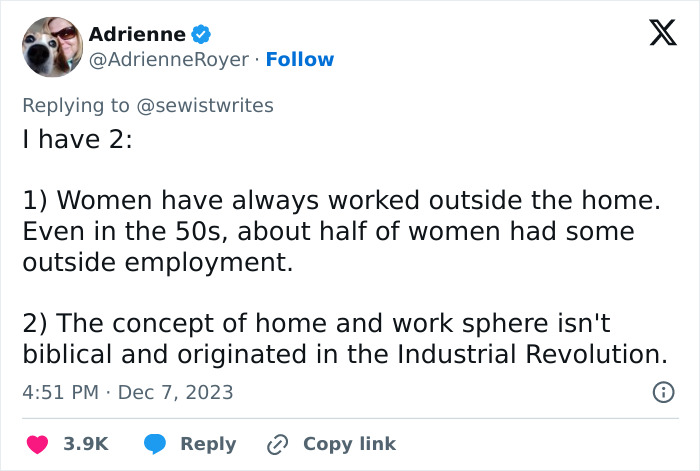
Poor women have worked since the invention of cities. They were the maids, the housekeepers, the scullery workers, the dairy maids, etc.; they even worked in the fields.
Indeed. The truth is, they did work all along but got a wage only recently. And for a while, a lesser wage than men for the very same work.
Load More Replies...And whether women should work or not was a largely middle class preoccupation. Poorer women have always worked, and the rich do as they like.
Mediaeval women were most often the owners of the pubs, because they were the brewers of the booze. Oh, and before this gets connected with witch hats and witchcraft - there is zero connection and is a myth.
Are you for real? Mediaeval woman were primarily pub owners. Seriously?How about farmers, prostitutes. weavers, millers, seamstresses. God, the list goes on.
Load More Replies...Hell, even Queen Elizabeth was a mechanic for a while. Admittedly during the war, but it was women that kept the country running while the men went out and shot each other up. And no, I'm not being frivolous about that either - my grandpa was RAF WW2 and would never speak about it - I understand now as an adult.
Valid point, only: that'll be Princess Elizabeth who became Queen Elizabeth II. Queen Elizabeth of England never changed a spark plug or a pneumatic tyre, at least in part because she lived centuries before they were invented. (Also: my grandparents all took part in WWII. The men in the armed forces, the women on the home front. One of my grandmothers got a medal for her air raid work.)
Load More Replies...Proverbs 31 in the Bible describes the ideal wife as a a very shrewd businesswoman
To say this originated in the Industrial Revolution is absolutely ridiculous. It seems like people are considering home versus work as though there was no work at home! Women often "worked" in the home but it was a lot of work. To try and separate work and home is ludicrous in and of itself.
Also, who do you think ran the knights' estates whilst they were at war or on Crusade?
IIRC it was pink for boys, blue for girls before but that might also be a myth!

It's true! Pink was considered associated with red, which was manly and powerful, and blue was dainty
Load More Replies...Soldier uniforms were red. After several years of fighting and campaigns, the red color fades. A faded, or 'pink' uniform was a sign of a true warrior who had been through a lot and survived.
In Dragon Quest 4, the only pink character is the royal soldier, Ragnar. This has nothing to do with anything real, but I thought of it when I read your comment, so you're stuck with it.
Load More Replies...Pink was highly virile in the Middle Ages and up to the XVII century. Back then, it was considered a shade of red and a manly color.
Also the entire idea was made up by children clothing/toy/product companies so that they could sell more stuff because if people thought it was inappropriate to give pink to boys or blue to girls then they would have to buy new things if they had another kid rather than just doing hand me downs
And all babies wore dresses. Boys didn’t wear trousers until they no longer used diapers. So families used the same outfits over & over.
Load More Replies...The way these colours are now is so ingrained in Western culture that its hard to believe that they were ever used differently.
Look at some well known women and girls, the Virgin Mary, Alice in Wonderland, and Snow White. All depicted wearing blue because it is a gentle, feminine colour.
Load More Replies...It all came down to marketing between two chains. One campaign won out over the other and thus pink for girls blue for boys became a thing. If the other had been better it would have been the other way around. I can't remember which chains they were.
I know my cradle (I'm from 1953) had sheets embroidered with strong blue figures, my mum told me. But at my solemn communion I had to wear a pink garment and I already hated to wear something of that colour
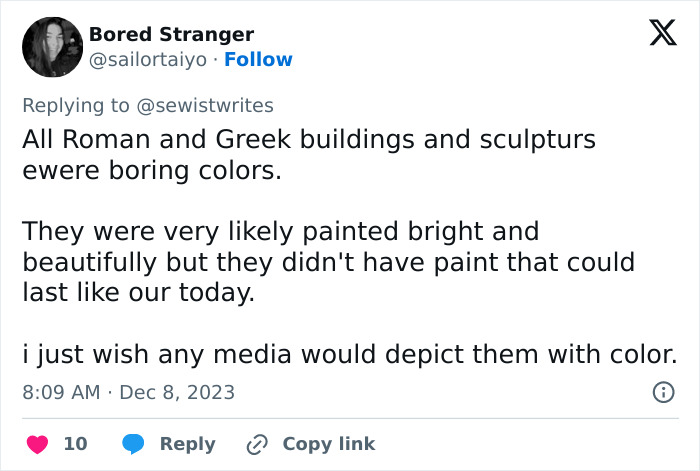
Greek building were mostly painted, but the origin of the painting style deserves a story by itself. The early stone temples were painted and shaped in a way that mimicked the older wooden temples and the older material used. The grey stone corniches and architraves were painted red to mimic the terracotta used to waterproof the timber roofs. The triglyphs were light blue because in the old days they were wood planks finished with beeswax on the cut face to prevent mold. The "guttae" decoration was green because it was a reminder for the oxidized bronze nails used in wooden framing, a detail that was maintained despite it had no other purpose than decoration. In Greek culture following the "natural order", i.e. what the ancient did, was of great value and architects kept some of these details going for centuries after they became effectively useless.
"Stone mimicked the older wood". Yes! It's got so ridiculous these days that we now have imitation Roman columns made of plastic - mimicking concrete - mimicking stone - mimicking wood. What's next? Wood mimicking plastic?
Load More Replies...A Roman history museum in Belgium recently had an exhibition with coloured statues. It was somewhat uneasy on the eyes because we are used to all the white marble...
The terracotta army found in China was painted with vivid colors. Unfortunately as soon as air hit it, it went bye bye as it couldn't stand up to the elements.
The 2020 survey found that the main sources of historical information for the general public are documentary and fictional movies and television, followed by various online and print sources, and museums, with history lessons and college courses lining up at the end of the list.
Despite being the most popular, though, movies and TV were not considered to be the most reliable sources for historical information. That might be because without certain embellishments or adjustments, some historical events would be too “dry” or too complicated to follow, which, according to Lunt, is one of the likely ways myths are born.
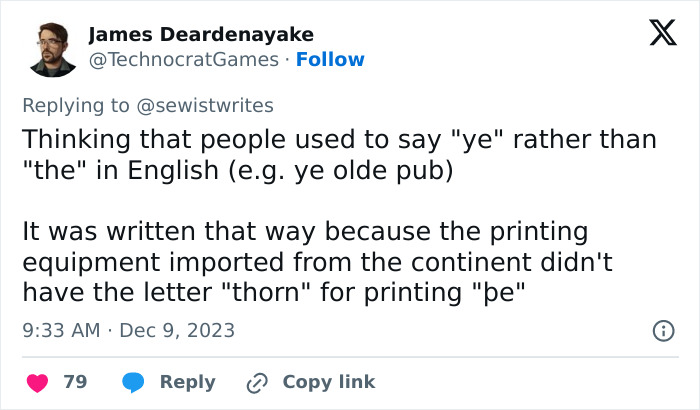
I wish we could have those old English letters back; thorn, wynn, ethel, eth, yogh, and ash. Some English words might actually make more sense.
https://qz.com/914372/we-used-to-have-six-more-letters-in-the-english-alphabet
Load More Replies...The problem is that printing was inventend/introduced to English before the English language had settled after one of these Great Shifts that happens in all languages from time to time. In English it was mainly the Great Vowel Shift, but a whole lot of other things happened too. First printer established in London in 1476, if they had waited another century or so English would have been a far easier language to spell ;)
Mine as well - I'm continually yelling at the TV when I see someone going all "Ye Olde England" and whatnot.
Load More Replies...Bonus fact: Americans (other than the ones with strong regional accents) today speak in an accent very close to what the colonists did than the English do. Both proper and Cockney English accents were created in the 1800s and 1900s, as they wanted to differentiate themselves. Therefore, Americans speak with a proper English accent...
Same with French in Québec. Regional accents and expressions are closer to the diversity of historical idioms that existed in France when the colonists emigrated, before the great reforms that standardized French into it's modern, largely Île-de-France centric version imposed by the King as the "noblest". So traveling through Québec is a way to hear accents and words that have been lost in France, a more authentic and diverse experience of how people spoke French outside of court. Unfortunately, modern politics have used this difference as evidence that Québec isn't a nation, and doesn't have a culture worth protecting or keeping because it speaks a "bastardized and degenerated" version of French. This perception is fallacious and erroneous, and used to discredit Québec and it's people's defense of their constitutional rights and pursuit of autonomy. Instead of celebrating our difference and unicity, it is used to denigrate. Hate based on ignorance of facts is annoying, because no amount of reasoning or evidence will change someone's mind if they're of bad faith. 🥲
Load More Replies...A few years back some people with nothing better to do tried to invent a letter to replace the “th” sound. First of all, shut up. Second, talk to someone who knows what they’re talking about you idiots. They’ll tell you about thorn (which I don’t have on my keyboard)
Henry the Eighth was an absolute sh.!t who achieved very little and would be a footnote in history if it wasn't for the women in his life. They were the making of him.
He broke with the Catholic Church and made England Anglican. This was big.
Load More Replies...As with most things, it's a lot more complicated than that. Boleyn's family desperately wanted to be closer to Henry VIII in order to gain power, prestige, and money. They exerted enormous pressure on her to accept the King's attentions. What they somehow failed to notice is that falling out of the King's graced tended to be a very, very, very long fall.
My absolute icon! I adore Anne Boleyn - very misunderstood lady who was centuries before her time! I went to the Tower of London a few years ago and was aghast to hear a (not Tower)tour guide refer to her as a witch with 6 fingers on one hand. I was incensed that a so called "professional" historical tour guide would continue to perpetuate the myth and slander laid against Anne 500 years ago, and that it was still being "taught" as fact!!!
He wouldn’t even have been king, if his older brother hadn’t died. Hence why a very spoilt Prince ended up succeeding his father.
I hate to break it to you but that is generally how succesion works.
Load More Replies...Yes, thank you! "Anne Boleyn was a power-hungry whore who desired to be queen above all else." Propaganda b******t.
Everything she was accused of did not happen, including her having a sexual relationship with her brother. After researching and watching a lot of documentaries, nothing that she was accused of was ever proved. He was a horrible king who demanded he could marry anyone else when he deemed fit. Demanding the strict Catholic Church be changed, just so he could behave like this. Although I'm not a Christian I am glad about the change into the Church of England.!! I'm absolutely fine that we in this country (England) aren't overly religious at all! I couldn't and wouldn't ever live my life by the bible. I just couldn't live by the writing's of a book. It's utter madness to me. But that's up to the individual/family. There's so many religious sects/cults that abuse our women and children! How is this living through someone you can't see, but behind the scenes they take your money and abuse their congregation. Absolutely baffling
I'm curious, via which of Henry's children? There are none by his legitimate children and he only acknowledged one illegitimate child, Henry FitzRoy and there were no children from this source. There are some that are said to possibly be his offspring - unacknowledged illegitimate children - but this isn't proven or has any degree of certainty. Claims that the comedian Josh Widdicombe is related to Henry VIII are only speculation, a belief held by some historians. The following are 'possible' children of Henry's: Thomas Stukeley, Richard Edwardes, Catherine (or Katherine) and Henry Carey, Ethelreda Malte and John Perrot. Catherine Carey (Mary Boleyn's daughter) may or may not be Henry's offspring (her children were acknowledged by William Carey, Mary's husband) but Elizabeth II is a direct descendent of Mary's via Catherine (on her mother's side, Elizabeth Bowes-Lyon). Mary's line is actually of great interest, and provable, where as Henry VIII is not. I upvoted to get rid of the downvote btw!
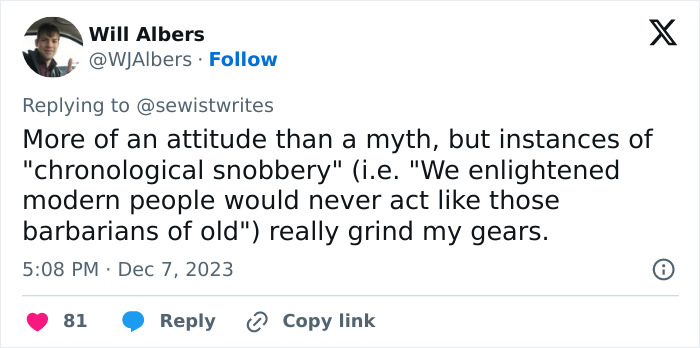
Load More Replies...Some “enlightened people” even celebrate the Russian invasion of Ukraine and the war between Israel and Gaza. If things like that aren’t barbaric, what is?
Not as barbaric as the Rwandan genocide or the civil wars in Sudan, Yemen, Syria, or not long ago in Cambodia or the cultural revolution in China. But I get what you're saying. Modern people could very easily descend into unspeakable barbarity very quickly. And some never left that state.
Load More Replies...I recently saw the film. I wasn't a bit surprised. May I also recommend The Wave (1981, directed by Alex Grasshoff). Based on a true story, a high school teacher inadvertently creates the Nazi party. It's just as disturbing.
Load More Replies...In 50 years the next generation will look down on us the way we sneer at 50 years ago.
Put live gladiatorial death matches on tv and it will be the highest rated show ever. We havent come very far at all we just got better at hiding it.
I can think of quite a few instances where we would probably act EXACTLY like those barbarians of old. If a sabretooth tiger attacked me, I'd probably s**t my pants too.
Temporocentrism : the (mistaken) belief that modern society has produced the most advanced aspects of human development.
People who claim to be civilized and welcome genocide, war on other countries, and okay with racism, are the barbarians we should watch out for. Money does not make you civilized. It just makes you a a-hole with money.
“I'm sure there are many factors in play, such as the unreliability of memory, differing eyewitness accounts, and the need to simplify complicated events into easy-to-follow narratives,” Assoc. Prof. Lunt told Bored Panda, discussing how false historical information becomes accepted as historical fact.
“But the one I think about the most is similar to how I approach myths—something about the non-factual version resonated with people, and that's why it stuck. In a way, it says more about the people who adopted and maintained that belief than it does about the historical (non-)event itself.”

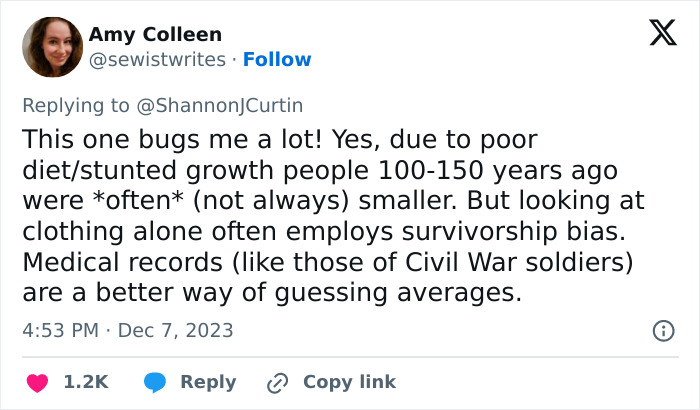
The clothes and shoes in Bath museum of costume are tiny. Dunno about survival bias, they were mostly owned by the better off.

Things that are too small to keep wearing or be handed down to the next person in your family are exactly the things that last, as they don't see enough use to wear out. That's what the survival bias is. Larger garments can be cut down into smaller ones, and frequently were, but tiny ones don't have the same flexibility. Look at how many families have antique/heirloom baptismal gowns for infants, as an example of how this can play out in modern times. They see very little actual use and are considered too precious to repurpose, so families are able to hold onto tiny infant sized clothing for generations.
Load More Replies...Timur was known as a big, imposing guy, was 1,70 (5 ft 7) in 14th century.
a lot of people look at doorways and say that people back then were short. if we built doorways today to fit the size of the average person, it would be pretty similar. the main reason we don’t is bc it’s easier now to build a larger doorway.
Also doorways let heat out and weather in, smaller ones made sense
Load More Replies...Most studies discussing the size of organisms are based on skeletal remains. They stick around while clothes (people are the only ones who did that) often rot.
I've seen samurai armors in old samurai families home's in Osaka and Shirakawa: they were short... like 1'5m or less short
I laid in a meroving medieval stone coffin (cut in the stone-soul) in France and I fitted from head to toe so 1.61m. And it was one of the bigger ones
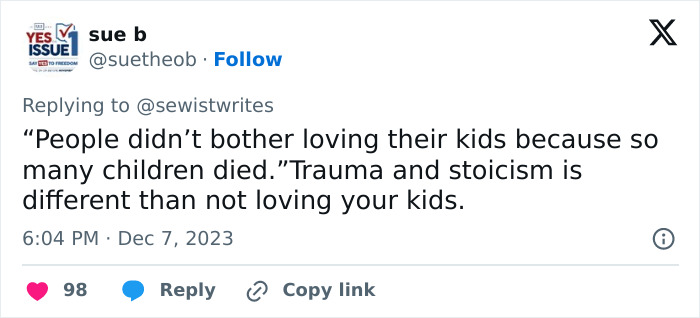
Ben Johnson (17th century dramatist/playwright) wrote a poem entitled "On my first son" in memory of his child who died of bubonic plague. Shakespeare lost his only son when the boy was 11, and although he didn't write directly about Hamnet (that was the boy's name), there are lots of passages in his subsequent works that people think were written in his honour-there's a passage in the play King John about grief after the death of a child. Sonnet 33 is thought to be about the love for a child. It's ridiculous to suggest people didn't love their children.
I remember reading a book by a missionary who lived for 20 years with Lakota people in what is now SW Minnesota, USA in the early 1800s. He talked about watching the funeral of a baby where the parents burned the cradle. And he asked, tactlessly, why they would burn it when someone else could have used it. The answer was the Mom couldn't bear to see it, as every time it would remind her of her lost baby. How anyone could think that a parent would not grieve a child in any time or place just doesn't see people as human. That missionary's book was good because it was filled with him admitting to learning about his stupid biases, and through that, we actually learned a lot about the Lakota. But he had a LOT of biases to work through, and it was aggravating to read.
It’s not weird at all. Trauma messes up how a lot of parents parent their kids; still happens today.
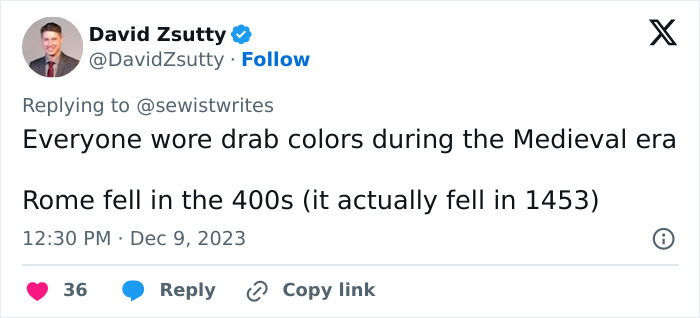
Load More Replies...The western roman empire fell around 496 (even though it was slow process, not happening suddenly on that year). 1453 is the fall of Constantinople of the byzantine empire.
Thanks for the correction on the correction. That one bugs me.
Load More Replies...Not everyone, but dye was expensive, so poor people mostly wore home-spun clothes in the natural colors wool, hemp, and linen came in, shades of brown, cream, and grey.
Don't forget the dyes from onions and beets, fairly commonly available.
Load More Replies...Found the meme about the fall of the Roman Empire! It's an attached image so I hope you can see it. 1wqc7vzja1...774f9f.jpg
They claimed legitimacy as a continuation of the Roman Empire, so even though this stated date is actually the fall of the Byzantine Empire, the fall of the Holy Roman Empire is still one of the contended dates.
Load More Replies...That is just Classical Rome. There was also Byzantine Rome, the Holy Roman Empire, even Mussolini declared a continuation of the Roman Empire. The date of "The Fall of Rome" is a very divisive subject.
Load More Replies...Movies about the Middle Ages that dress everyone up to and including kings and queens in shades of gray and brown drive me crazy. Just look at how people depicted themselves back then in paintings. You wore all the bright colors you could afford, unless you were a monk or nun.
Lunt expanded that the way historians approach myths is not whether they are “true” (as in factual) or not, but what they reveal about the people who told them and believed them. “So, with something like the Trojan War as told by Homer, it's clearly a myth but the values of its characters reveal the values of the ancient Greeks during the time it was composed,” he provided an example.
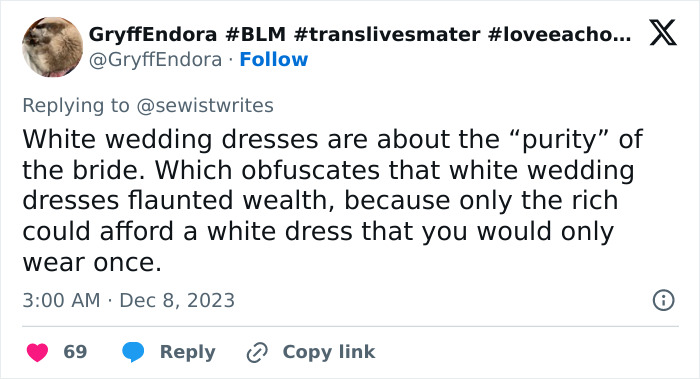
The white-wedding-dress business was started by Queen Victoria to support the Irish lace industry. It had nothing to do with virginity or a single-occasion dress.
Her use of a white dress almost certainly popularised the idea, but certainly did not start it. The increased demand for lace was not intentional but entirely incidental, although it was welcomed by the English lace making industry; not sure why you'd highlight the Irish.
Load More Replies...For much of history women got married in their best dress, few people could afford a dress that they would wear just once.
Yep, Laura Ingalls Wilder, or "Little House on the Prairie" books got married in a black dress. It was made new for her wedding, but was made purposely for being a "best dress," as then she would always have a good black dress, serviceable for every occasion.
Load More Replies...White dresses were worn by high-status women throughout history to demonstrate that they have the means to employ people specifically to care for such a dirt-attracting garment.
weddings as a whole had nothing to do with religion until recent times. It was just the equivalent of civil ceremonies for millenia. Eventually the church realised there was power to be had by control of marriages and suddenly marriages were important religious ceremonies and wedlock was ordained by god and a sacred act.
If I recall, sometimes the bride would wear their funeral dress because it was the nicest dress they owned. I remember reading that somewhere but I forget where.
We do? In China, white is the color of death.
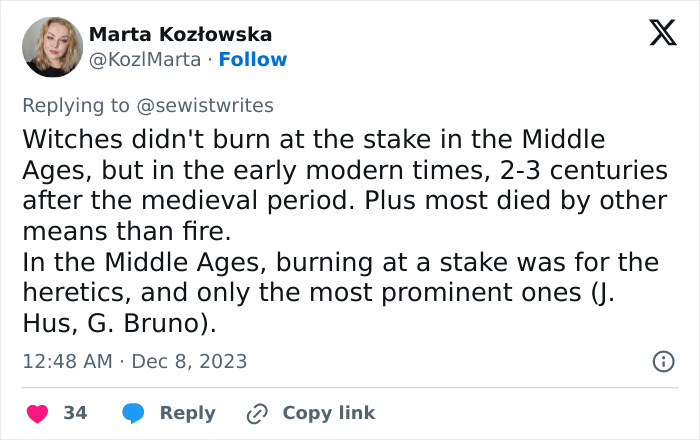
Load More Replies...Also, the Catholic Church and the Inquisition put very little effort in hunting witches, because that would have meant admitting existence of witchcraft and this was against the doctrine. They very much preferred burning heretics. Witch burning was mostly a Protestant and Puritan thing. That's why it was quite common in UK and America (also Germany and Denmark for a while).
In the US there was not a single witch burning. Hanging, yes.
Load More Replies...In England, witchcraft was considered a civil crime and punished as such - the penalty was hanging. The witch-craze was largely a consequence of the Reformation and the schism of the Western church - if the Church of God could be so corrupted (works whichever side you were on) then the power of the Devil must be great within Christendom - and witches were seen as his agents.
Exactly. That's why it annoys me every time I see a film set in England where a witch is burnt, because it just did not happen.
Load More Replies...The more I study the witches processes and the more I realize: - Most witches were punished for their crimes (real or perceived), like poisoning, than for being a witch "per se" - Often the inquisition had to intervene to give the accused a fair trial, because the neighbours or the local power had already decided their fate
The inquisition wasn’t much for actually fair trials. They intervened to hold a “trial” alright, but fair? Not so much.
Load More Replies...There's at least one study that consider up to 40,000 cases of burned 'witches' just in Germany... If most died by other means than fire, that would be a f*****g huge number of executed witches.
Likewise, those convicted during the Salem witch trials were not burned at the stake--they were mostly hanged and a few stoned or pressed to death.
No one was burned here in Salem, in spite of what a lot of our tourists think.
Also not in Europe, but in America...way after middle ages. They didn't burn women in Europe(not even that lot in America, there were different methods)
Official punishment for witches in England was to be hanged unto death. Burning was reserved for heretics, who, having embraced Christ, even in their heresy, were considered to be purified by the fire and allowed to enter Heaven.
Well, there were laws about what colors various ranks of people could wear (hence the phrase 'royal blue' - or maybe more accurately, purple), so there is that. More here: https://www.encyclopedia.com/social-sciences-and-law/law/law/sumptuary-laws#:~:text=SUMPTUARY%20LAWS.,cloths%2C%20garments%2C%20or%20ornamentation.
Certain shades. There was cheap wode blue and crapp red. The medievals were really colourful. Gaudy to our modern eyes! Clothes and decorations were the only intense colours except flowers. So they were very much cherished
Load More Replies...There was a common superstition that "having a good stink" would protect you from the plague--which, technically, it did, simply because people didn't want to come close--but that was only practiced in a small percentage of the population and generally during actual plagues, when people were desperate enough to try anything.
People washed. Yeah it was with a bowl and mainly "pits and bits," but people still washed. Even the rich thought that having an actual bath, as in a body sized tub filled with hot water, was extravagant.
No, not even there. There are plenty common plants around to colour your cloth in different shades of yellow, orange and green. Pink was also possible. And yes, a lot of different browns.
Load More Replies...Assoc. Prof. Lunt continued to share more examples of how myths work in the context of history. “One of the most prevalent myths about the Punic Wars between ancient Rome and ancient Carthage is that, after Rome conquered Carthage in the third war in 146 BCE, the Romans destroyed the North African city and sowed the land with salt, so that nothing would grow there. It's a powerful image that is repeated often enough, but really has no basis in the historical record.”
The expert pointed out that some authors suggest that the myth of sowing salt at Carthage possibly came from the Hebrew Bible/Old Testament, where the city of Shechem is destroyed and sown with salt.
“Perhaps that is the case; perhaps not; but it's easy to see modern narratives attempting to juxtapose the inevitable triumph of the Israelites with the inevitable triumph of Rome over their enemies,” he said, adding that “inevitable” in this case means that people in the future who write the histories know how the past turned out.
Google proper Old English and see if you can read it. It does help a lot if you know German though.
I find reading it out loud helps, weirdly the spellings seem to confuse my internal reading voice but it's understandable when I hear it out loud.
Load More Replies...I call Shakespearean speech “Elizabethan Slang”. Shakespeare wrote for the masses, not just the gentry. He wanted people filling the Globe Theatre and excited about watching his plays, not dropping off to sleep from sheer boredom—-which, oddly, is how the plays were presented for centuries afterward, and which badly affected their reputation. Shakespearean plays, properly produced, aren’t dull. They’re absolutely chock full of life and action and humor and drama. Just as much as modern plays are, because they’re the templates for modern playwriting. He wanted them to be relatable to everyone, so filled them with both the high and low language of his day. That includes slang. Which makes the elitism and snobbery of many past and present Shakespearean scholars and enthusiasts, as well as the old fashioned type of Shakespearean actor, extremely inappropriate. I think old William would’ve been appalled at how his works had been turned into such snoozefests for centuries, and would’ve been delighted when someone injected life and action into more updated versions of his works, and brought them back to what he intended them to be; relatable entertainment for everyone.
I swear there is nothing more entertaining than a perfectly produced Hamlet and Macbeth
Load More Replies...I remember reading Beowulf in class in Denmark. It actually made a kind of sense, when you ignored the spelling. 😂
For Americans it is old, but Shakespeare died in 1616, like that's not that long ago for Europe....but that is over 150 years before Americans.
Most Flemish people my age learned that the oldest Dutch sentence was found in an English library (as a test of a new quill) but it turned out to be old English. But as a speaker of Dutch, we can understand it, especially reading it alout, I doubt a speaker of English can and yes, I asked a few. (For the curious among you: "Hebban olla vogala nestas hinugan, hinase hic ende du" or in modern English: " Have all the birds started a nest, except for I and you".) Not really what you expect from a monk. :)
In the absence of detergents urine made quite an effective cleaning agent and was extensively used through the middle ages. Just like modern laundry products it was well rinsed out, so it's not really as 'eww' as it may first seem.
Urine was used in soap making, along with wood ash. The urine was processed to make ammonia. The ash was leached to provide sodium hydroxide (lye) and combined with fats to make soap.
Load More Replies...Urine was a handy fluid, its fermented form used in cleaning (to remove grease from cloth, rust from iron), textile dyeing, leather making, etc. Roman towns often had p**s pots on street corners to collect the "liquid gold" and due to a tax implemented on the urine industry by Emperor Nero and continued by his successor Vespasian, public urinals in France, Italy, and Romania have Vespasian's name attached to them (vespasiennes, vespasiani, and vespasiene, respectively). This doesn't include the history of medicine in ancient history up to the modern age, which relied heavily on the color, smell, and taste of a patient's urine. Alchemists worked with urine in their quest for the extraction of gold from the liquid and these experiments eventually led to developments in chemistry, one of which was the discovery of white phosphorus in 1669.
Detergents, or soaps, have been known since antiquity, but few people would have wasted good soap on washing clothes until the year 1884. But there were other methods, a lot of plants contain soap-like chemicals called saponins. I vaguely remember seeing a film showing a woman washing clothes in a river using leaves of a plant high in saponins.
Wild Sweet William (Saponaria officinalis) aka common soapwort, bouncing-bet, crow soap, and soapweed is the plant. It grows in a wide range throughout Europe and Asia, and there are about 20 species of soapwort in total.
Load More Replies...Urine was a source of urea, a good cleaning agent and is still used today
How about the story that furs were hung in the gardenrobe to keep out vermin?
Yeah, a lot of modern people don't realize how many layers of clothes people had. You wore at least one shift under your shirt, and then bodice or corset.
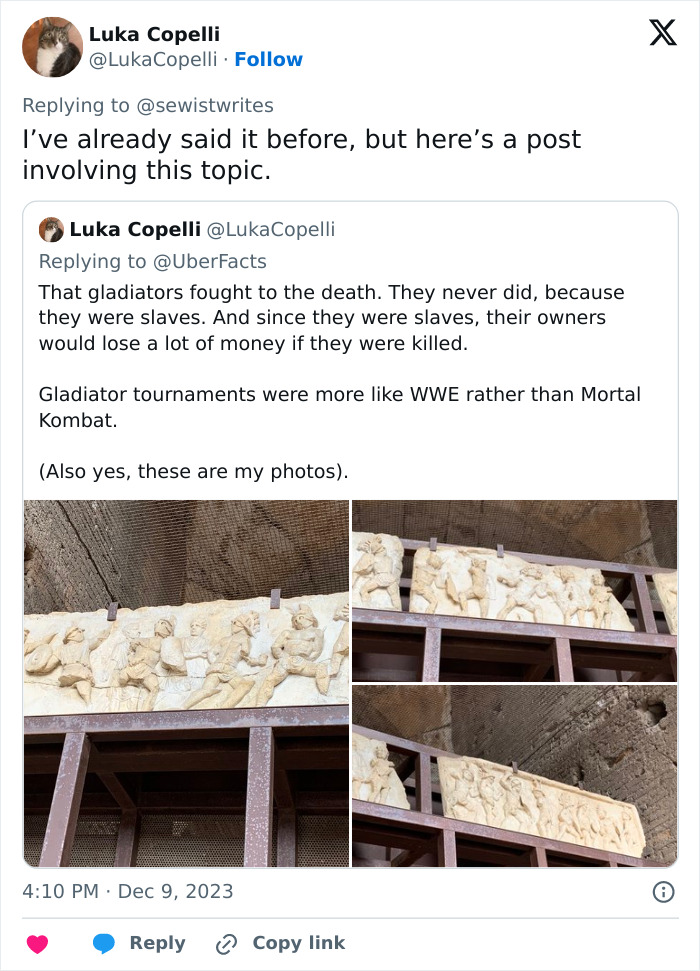
Gladiators weren't all slaves. Sure, a good number of them were prisoners and slaves sentenced to damnati, but there were Gladiator schools. People, free non-citizens and citizens, trained to become gladiators - the pay was good, there was housing, and the food was guaranteed. Thy might have even gotten fame and fortune - they kept all of their prize money and any gifts they were given, some famous gladiators even sponsored goods and bathouses.
Also, gladiators were not sculpted like in the movies, they were fat. That extra layer of padding helped protect against most of the blows that were exchanged, since most were non-lethal.
Load More Replies...Ehh.... not really, no. Gladiators fights sometimes involved death. Or some serious maiming. Most of the times they received some injury, permanent or not, and conceded the match. They were slaves, war prisoners, criminals or debtors, not prized possessions. Only some -due to physical characteristics or success in the arena- went on to be recognizable, prized and even famous as athletes. Becoming famous also meant that they were to fight in "safer" matches and the risk of dying was greatly reduced. Also, some of the matches were "venatia", where a fighter (the "bestiarius") was to fight against feral animals. Gladiators could fight as "Bestiarii" if an event called for it, and that was a no-holds barred fight. "Professional" gladiators were highly specialized in one or more styles, while some of them basically considered "throwaway" fighters ("Tertiarii"). A professional gladiator life expectancy was about 10-15 matches, with people reaching 30 becoming famous in the history books.
Just a note on slavery in ancient times. Slaves were upwardly mobile. A slave could become second in command of the army, for instance. Or marry into royalty.
This was extremely unusual though, especially in Roman times. It was slightly more common in Arabic caliphates in the middle ages, where slaves could hold charges while still being slaves. In Roman times, receiving a command, for instance, required at least two major challenges in advance. First, the slave had to become a "libertus", i.e. a freed slave, that was barely a step above and granted some civil rights. It usually happened after the death of a particularly generous or beloved master, or after some great service to the family. Then, he had to become "Cives", either through military service or for some other great accomplishment. Lastly, to have a shot at a public position, they would have to be adopted into one of the notable "gentes", the families that had some power.
Load More Replies...Not necessarily slaves, since gladiators could gain stature much like those same WWE stars, wealthy, feted, and famous, meaning even the freeborn could join a local gladiator school and train. This was an especially attractive option for the poor and homeless as by joining these schools they were taught a trade and given a stable source of food and shelter. That said, being a gladiator was seen as low class, so only the peasantry was encouraged to join. Those of the elite class or - gods forbid - an emperor who tried to become gladiators were scorned in both life and posterity. Also, yes, Virginia, there were women gladiatrixes, the most famous of which were the pair "Amazon" and "Achillia" (their stage names, the only ones known to history) in 2nd century CE Halicarnassus, whose match ended in a draw.
That's my pet peeve: Thumbs down did NOT mean kill the loser. Thumbs down was a denial of the death blow. Thumbs up meant go ahead, his life is yours.
Load More Replies...Lunt discussed another example of a prominent—now faded—myth from ancient history, which is the belief that ancient athletics were for "amateurs".
“As modern sport developed in Britain and Europe, and as the Olympic Games were revived in their current form in the 1890s, 19th-century British sporting ideals of ‘amateurism’ were transferred onto ancient Greeks in order to justify the British class-based system of sport and education. The notion came from the fact that Greek athletes who triumphed at Olympia received only a crown of olive leaves (although they received lucrative prizes in other venues).
“This reimagination of the ancient Greeks allowed British schools and sporting groups to systematically exclude anyone who labored for money, reserving their sporting endeavors for aristocrats,” Lunt explained.
“It's more complicated than this, of course, but the gist of it is that the modern Olympics clung to its notion of amateurism for a long time—the 1990s is when most Olympic competitions became open to professional athletes; the Dream Team of NBA players in Barcelona in 1992 was a watershed moment.”
The expert added that even now, in the US, we are watching the last vestiges of amateurism wash away on college campuses as various deals allow players to make money from their athletic endeavors.
“In the end, this says more about the people of the 19th, 20th, and 21st centuries than it does about the ancient Greeks. The intensely classist system of 19th-century Britain invented an ancient practice to justify its own exclusion of lower-class athletes. This transferred to the United States on college campuses, long a bastion of upper-class privilege in the USA. It wasn't until the 1980s that David Young published The Olympic Myth of Greek Amateur Athletics that the belief in ancient amateurism was torn down,” Lunt said.
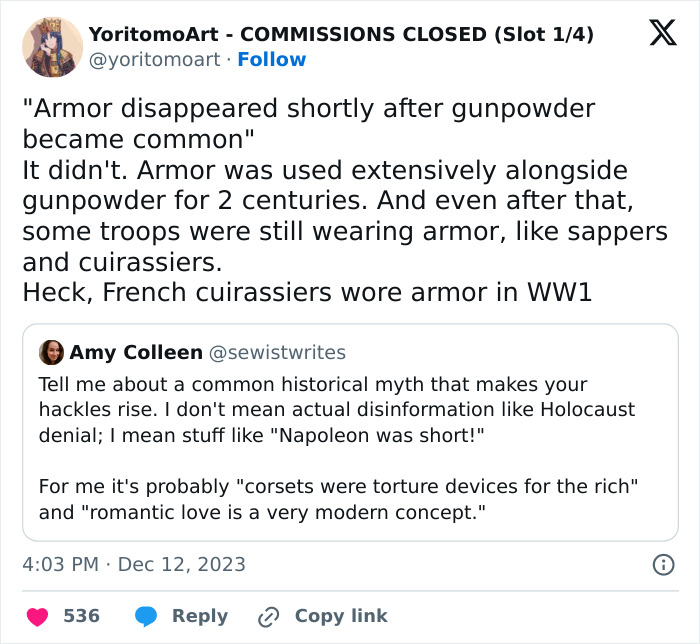
What is a bullet-proof vest if not body armor? It's just not plate metal anymore.

Exactly. And with modern army bullet proof armor, there is huge plate of metal in front of lungs and heart. A really thick one, so it cannot be used on whole body (the rest can more or less safe modern medicine, but gunshot in heart is still out of saving). We sometimes joked that "armor was invented about two days after first caveman hit another caveman with a stick and will be used until humans die", but it might not be far from truth.
Load More Replies...British Army had trained javelin thrower soldiers in World War I at Dardanelles.
Armor is part of every standard combat soldier's kit to this day, unless you're Russian and on your way to the Ukrainian meat grinder.
Armorers worked hard to improve armor for more resistance to heavy lead balls thrown by muskets. This was an extension of the effort to make armor more resistant to war arrows and bolts from crossbows.
Do you mind if I check that up? By "armour" here we obviously mean metal armour, not paper, leather, jade or aramid. And by "alongside gunpowder" we mean in Europe where metal armour was frequently worn. Not gunpowder in China. Or Ned Kelly's metal armour made of boiler plate. Full suits or armour worn by generals disappeared in the second decade of the 18th century. Hand cannons had made as appearance in France by 1338. The musket made an appearance in the early 1500s. So the post above is correct. Two centuries of overlap, from the early 16th to the early 18th centuries.
Metal armour is thousands of years old and has never fallen out of use, although it's obsolete for protecting individual human beings these days. Full suits of metal armour have always been rare, and pretty much never worn by generals on the battlefield. "Alongside gunpowder" surely means exactly that. Recall that gunpowder weapons originated in China, where metal armour was also widely used. Seriously, read up on some history. Linen armour was a thing; jade armour, never. Metal armour was widely used for individuals in WWI - tin hats for protection against shrapnel. German snipers could attach armour steel plates to their tin hats for protection against direct fire - its why some German helmets of that era appear to have horns.
Load More Replies...The samurai loved guns because they were literally mercenaries by our modern definitions... they loved anything that made their job easier...
And they banned any non-samurai from access to them to prevent people from fighting back
Load More Replies...Tldr: Samurai had guns but abandoned them. "A famous example involves Japan’s abandonment of guns. Firearms reached Japan in A.D. 1543, when two Portuguese adventurers armed with harquebuses (primitive guns) arrived on a Chinese cargo ship. The Japanese were so impressed by the new weapon that they commenced indigenous gun production, greatly improved gun technology, and by A.D. 1600 owned more and better guns than any other country in the world. But there were also factors working against the acceptance of firearms in Japan. The country had a numerous warrior class, the samurai, for whom swords rated as class symbols and works of art (and as means for subjugating the lower classes). Japanese warfare had previously involved single combats between samurai swordsmen, who stood in the open, made ritual speeches, and then took pride in fighting gracefully. Such behavior became lethal in the presence of peasant soldiers ungracefully blasting away with guns. -->
In addition, guns were a foreign invention and grew to be despised, as did other things foreign in Japan after 1600. The samurai-controlled government began by restricting gun production to a few cities, then introduced a requirement of a government license for producing a gun, then issued licenses only for guns produced for the government, and finally reduced government orders for guns, until Japan was almost without functional guns again." From Jared Diamond "Guns, Germs and Steel"
Load More Replies...Samurai did use guns. The ultra-samurai Miamoto Musashi even comment on their usefulness in his book "The book of five rings".
Just visited Himeji castle a few days ago. They have replica guns in gun racks.
Columbus couldn’t get funding in the places he tried because those governments couldn’t afford it; in the late 15th century, only Spain (and maybe Portugal) were rich enough to finance such a speculative mission.
Not only that, but most recognized his calculations as incorrect and wrote him off as a fanatical nutcase. It took another fanatical nutcase in Isabella of Spain, to jump in and fund Columbus.
Load More Replies...It was the age of exploration so it was bound to happen at some point and the result would likely have been the same.
Load More Replies...I won't call him finding America lucky. Colombus was so awful even the spanish inquisition was shocked by his cruelty.
He didn't find America, he found The West Indies.
Load More Replies...I don't think Columbus ever actually set foot on the American continent.
People NEVER thought the world was flat in the middle ages. This is a total fallacy. It was always thought of as a globe (as proved by ancient Greek scholars). In fact, the world is more of an oblate spheroid than a globe.
“I think we all today are well versed in notions of ‘fake news’ or ‘revisionist history’, or whatever skeptical approach we wish to employ when trying to comprehend and understand the events of the past,” Lunt said, discussing how myths around certain historical events affect the way people view the past.
“On the super-cynical side, some people would state that the past is ‘unknowable’ and we each have our ‘own truth’ as we saw it and see it. On the super-literal side, those who need their preferred version of history to be true, no matter what the evidence indicates, are just as guilty of being unwilling to engage with other viewpoints.
“Ultimately, in my opinion, both of these approaches reveal as much, maybe even more, about the people who wrote the history, or the people today who accept or reject it, than the recorded events themselves.”

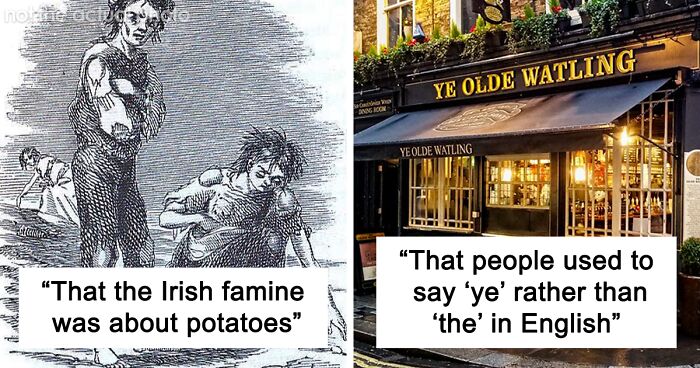
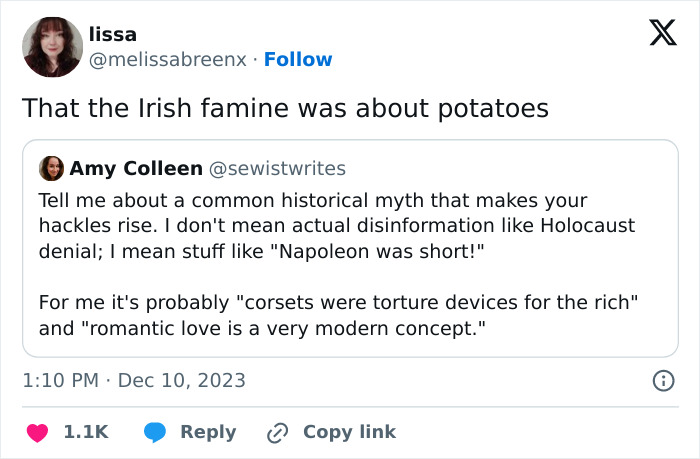
I thought it was potato blight, landlordship, food export to england that created an deficiency, and relying on one crop (potato)??

Ireland grew lots of other food, mostly grain, but that was exported while people starved. The poor grew potatos in their own small areas. Some landlords wlooked after their tenants during this time (mostly those that lived in the area) but a lot of the landlords lived in England and din't want to see a reduction in their grain profits.
Load More Replies...Five people got advances to write a series on elephants. The Russian wrote “ The anatomy of the elephant.” The Frenchman wrote “The mating habits of the elephant.” The Englishman wrote “How to collect elephants.” The American wrote “How to make money off elephants.” The Irishman wrote “Elephants and Irish political history.”
One of my pet peeves is that the famine was a terrible thing for sure, but not actually the fault of the English as such. It was caused by the rich families who owned land in Ireland, and an awful lot of them were Irish - admittedly descended from Plantation immigrants, a scheme created by James VI of Scotland/James I England to over-run Catholic Ireland with British Protestants, many of whom came from Scotland. It was those Scots (mostly) who were the anti-Catholic extremists, and they're the ones who started the deep divide that still exists in Ireland. The English settlers might have been Protestant, but they mostly weren't bothered about people being Catholic. They just wanted (stolen) land and (ill-gotten) money. Don't blame the Brits for the famine: blame the rich.
Load More Replies...The Irish famine was driven mostly by the British taking crops/animals, etc. to feed the population in England.
It was caused by the landowners in Ireland continuing to export Irish-produced food to sell to make them even richer while leaving their tenants to starve. Ireland had more than enough food. The English population wasn't short of food, nor was the overwhelmingly powerless and poor English population to blame for the actions of the rich who owned the land in Ireland. It wasn't a case of "British vs Irish" at all - it was "rich vs poor".
Load More Replies...You know these are usually accompanied by some kind of explanation why it's a myth. This one, nada.
It wasn't ONLY about potatoes, though that was how it started. There is a virus called PHYTOPHTHORA INFESTANS which causes potato blight, and the problem was exacerbated by the fact that the potato was a monocrop. But it was made much worse by the way the British government handled it.,,,,,,,refusing to help and claiming it was an 'act of Providence'. Apparently wheat was being cultivated in Ireland during this period, but was exported to England.
Also, corned beef is popular in the US for St. Patrick's Day, but Irish in Ireland almost never ate it before independence. They did make corned beef, for expert
Load More Replies...Well it was about a lack of potatoes. But not a lack of food. The ruling British kept exporting food from Ireland.
The rich landowners kept exporting food to get richer while their tenants starved to death. Plenty of the landowners were Irish - mind you, at that time, that made them British as well as Irish, and some of them got classed as "Anglo-Irish", meaning descendants of Plantation immigrants, many of whom were Scottish. So we have a situation where the English get blamed for actions by wealthy Irish landowners whose ancestors came from Scotland.
Load More Replies...“The Almighty, indeed, sent the potato blight, but the English created the Famine.” – John Mitchel: The Last Conquest of Ireland (Perhaps), (1861)
It's a bit unfair blaming the English for the famine. The famine was caused by the rich landowners continuing to exploit their tenants for money and continuing to export food for profit when their tenants and workers were starving. But the bosses were certainly not all English. Plenty were Irish and Scottish - and I expect a few were Welsh, too.
Load More Replies...Greed... British greed caused the great famine... And what I can only qualify as burning hatred for the Irish people... Why? Because the Ottoman empire sent emergency relief to Ireland and the Brit' FORBADE them from docking! It was literally free food who could have saved thousands of lives and they denied it to their dying people!
The division was not between British and Irish but between rich and poor. It's long been misrepresented as English oppression of the Irish, but that's not right. It was the rich and powerful who decided to continue to export food from Ireland to enrich themselves rather than stop the poor in Ireland dying from starvation. Ireland could have fed itself very comfortably if the landowners weren't so greedy for money. I'd say it wasn't hatred for the Irish people - how could it be, when so many of the landowners were Irish? - but heartless disdain for the poor. They had just as much disdain for the poor in England (and Scotland and Wales) as for the poor in Ireland. Back then, Ireland had no parliament of its own and throughout the UK (which included all Ireland from 1801-1922), few could vote who were not both rich and male. The rich men ruled and the poor suffered throughout the kingdom.
Load More Replies...This comment is on MY list. People who act sanctimonious like this but are in fact wrong
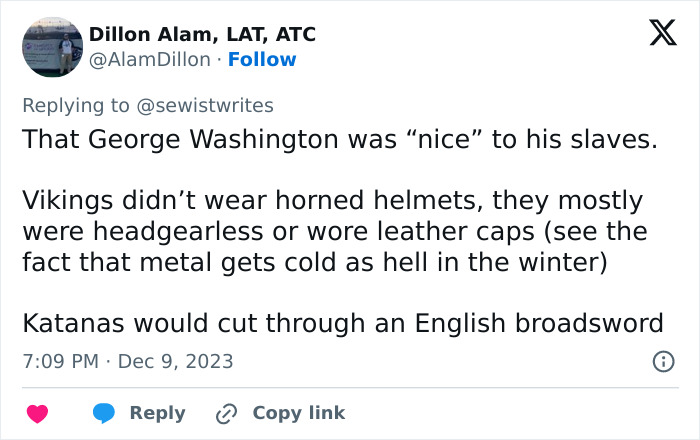
He "bought" teeth from slaves to make new sets of dentures. (We don't know if the slaves actually received the money, chances are they didn't.)
some were goat teeth. And under Virgina Slave Codes at the time, they slaves would have had to get the money, and been allowed to keep it independent of their master. Slaves were allowed to earn money outside of their duties and hours for the purpose of later purchasing their own freedom. This would be repealed in the 1800s
Load More Replies...You’re warm…now Google which people’s teeth they were. 😡
Load More Replies...Four sets, according to Wiki. He kept some of his own pulled teeth for further use in dentures (found this here: https://www.mountvernon.org/george-washington/health/washingtons-teeth/) Other materials used at the time were hippo ivory imported from Africa (strange what kinds of industries existed we don't know about), slaves' teeth, the teeth from fallen soldiers famously "harvested" in Waterloo, among other places, and poor people's teeth (which came with a dubious bonus: knowledge about hygiene being what it was the dentures held all kinds of germs, up to and including syphilis and tuberculosis, infecting the new owners).
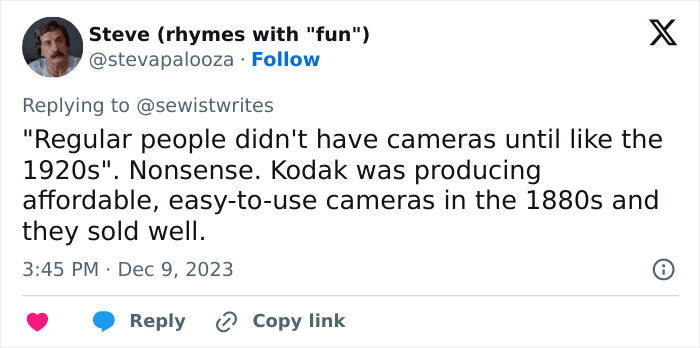
Load More Replies...The Kodak Brownie Box camera was the first that had mass sales. This was first made in the year 1900 and produced in volume from 1900 to 1966.
Depends a lot on your definitions of "affordable" and "regular people". It was an expensive hobby, but sufficiently popular for the successful Amateur Photographer magazine to begin publication in 1884.
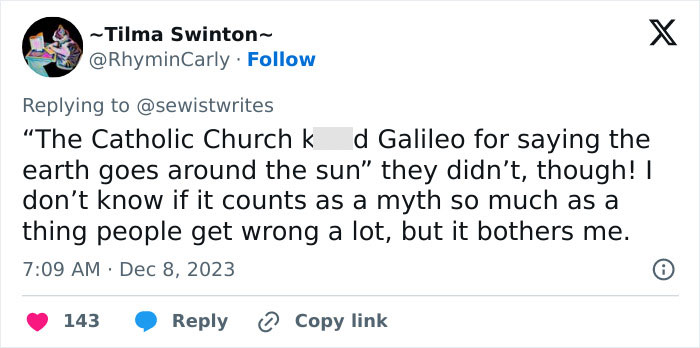
If someone is like me and believed the false version, the truth is Galileo was put under house arrest by the church until his death, not killed.
And his house arrest was also not really to do with heliocentrism. He wasn't allowed to speak of it publicly, true, that was under the previous Pope, Paul V. However what set stuff off is that he publicly ridiculed and alienated one of his major supporters - the new Pope Urban VIII. Not at all saying that Urban's reaction wasn't farfetched, it was, but it wasn't really to do with heliocentrism.
Load More Replies...The Catholic Church officially apologized to Galileo and reinstated him on October 31, 1992.
People forget he insulted the pope, insulting the church heirachy, etc. That is why he was arrested and charged. In fact there were catholic church official writings at the time that said the earth went around the sun. The making him renounce it, was part of humilating him, not because the church had an actual problem with that.
This one gets my goat major. The library never burned down at all, it eventually shut its doors around the mid third century AD due to falling footfall, with the building itself likely being destroyed when the Palmyrene Empire seized Alexandria around 270-290AD. A port storehouse was indeed accidentally lit on fire by Julius Caesar in 48AD while he was besieged at Alexandria - the law required that all books sent to the library were copied and multiple copies of all books were delivered to other libraries in the Roman Empire, so the knowledge absolutely still existed in spite of the storehouse fire.
Not my understanding. I had heard that there were many fires. Many books in the library were copied, but distributing them to smaller libraries did not ensure their survival. I like to think of the Library of Alexandria as like the internet. A lot of material is copied off the internet. But if the internet was permanently lost then the material copied off it would not suffice to keep the knowledge alive.
Load More Replies...They were certainly brilliant minds, but they were brilliant minds living among the general economic, demographic, social, political, and technological regress, striving to preserve the knowledge of the ancients, to make sense of the shreds of their knowledge and put it in the new Christian framework. Compare those to Hero, Ptolemy, Galen and others during the Roman times, people who actually did science, as in: expand the understanding of the world using the empirical method, because they lived in a world where this was possible and encouraged. The fact that there were some brilliant minds during the Dark Ages does not mean there were no Dark Ages.

"The fact that there were some brilliant minds during the Dark Ages does not mean there were no Dark Ages.". Totally agree. Population crashed to something less than 10% of the pre-Roman bronze age. Violence was everywhere and surviving was all that people could normally strive for. With very few exceptions.
Load More Replies...I've learnt very recently that most writings from the early middle ages in Europe were lost because people were still using papyrus at that time, and papyrus does not keep well in wet climate. Imagine all the knowledge that get lost! Litterature, letters, chronicles, legal documents...
look at the art documentary made by Waldemar Januszczak "The Dark Ages An Age Of Light" about this period, it's soooo good (the others too, he is funny and very interresting)
In the UK at least the **only** children that were married off early were the aristocracy and royalty, to seal those deals as soon as possible. Ordinary folk tending to marry at the same average age that people always have, from about 20 onwards.
And some Republicans here still think it should be legal for a man to marry a 14 year old girl.
Load More Replies...Once a girl starts menstruating, she has been considered to be of marriageable age. This was a fairly universal standard until modern times.
And most girls started mestruating at 16 or 17, so no early teen marriages.
Load More Replies...I know of one old Christian marriage of an 11 year old woman to "an old man with grey hair". The minister tried to talk them out of it but had no power to prevent it as the woman insisted. In pre-European Aboriginal society, the average age of a woman's first marriage was about 14 years old and the average age of a man's first marriage was about 28 years old. In societies with a horrifically high death rate, teen marriages were more common.
The fact that you are calling children women is a red flag.
Load More Replies...How about the myth that slavery is somehow an invention of white people in the western world, let alone the sole creation of American colonists, designed to "destroy black people and culture"? Slavery has existed for all of human history, every single shade of human skin has enslaved every other shade of human skin, including their own! White people bought and sold other white people, Africans bought and sold other Africans, Queen Nzinga had an alliance with the dutch, selling off 13,000 of her own people into slavery....per year, in the early 1600's. History is littered with ignorant, barbaric monsters, they were the rule, not the exception.

And slavery is still quite widespread today (unfortunately).
Load More Replies...I've heard it said that Viking warriors wore beanies. So knitted wool or leather caps. Some wore metal helmets, but I don't know of any Viking that wore horns on his helmet. There were horned helmets found in Scandinavia, but they have now been dated to 900 BC, nearly 2,000 years before the Vikings.
Yup! I saw some in the National Museum of Denmark in Copenhagen couple of years ago
Load More Replies...Katanas were made from iron sand and often, a grain of sand made the blade prone to break. Iron was scarce in Japan and the katana thin. Sure, they are sharp as hell, but any time you hit something, they risked breaking, despite being technically perfect.
The hisoric technique of forging and re-forging a katana blade was the best way of creating a passable blade from mediocre steel, but it would have been fairly brittle and no match for a typical European broadsword of the same period. I would imagine a present day katana made from good quality steel would be far superior to, say, a 16th centrry version.
Load More Replies...Well, yes and no. Toilets were added in 1768, 144 years after the construction. Before that, in 1715, they agreed to collect faeces from the corridors once every week.
So there were people actually walking around pooping in a castle?
Load More Replies...A piece of trivia that you may not know. The four earliest and best known anaesthetics, rum, nitrous oxide, ether and chloroform, were all common party drugs before they became used as anaesthetics.
Not to replace your relief with more horror, but during the Kosovo war I read an article about a teen there who had an amputation with no anaesthetic. :(
Never heard of ‘only photographed dead people’ but came across memento mori photography recently and it’s seriously creepy.
Victorians DID sometimes photograph the dead, particularly a beloved dead child.
My 'ideas' of the 50's are memories. No central heating, coal fires and smogs, chilblains, but massive Sunday roasts - beef, pork and lamb was cheaper than chicken by a long way.
I kinda wanna know what would happen if in future generations all people knew about the 90s was from Full House.
Yeah....roman solders were paid with salt, it's literally where the word "Salary" comes from. Prices varied GREATLY depending on region, and how far it needed to be transported. Making any blanket statement, that it was cheap or expensive is equally idiotic.
Roman soldiers being paid in salt is a Victorian myth.
Load More Replies...Yep. It was so worthless that Roman soldiers were willing to accept salt as part of their salary.
Salt was so valuable in ancient Rome that Roman soldiers were paid with it; doesn’t that make it “worth its weight in gold?”
No, it does not. Nor was it viewed as 'pay'. Roman soldiers were issued with it as part of their daily rations along with bread, cheese, meat etc.
Load More Replies...I don't think you are correct about this. But I also don't care enough to look into it. Have fun dying on your hill. I'm off to eat salted gold BWAHAHAHA
Here be dragons did in fact appear on a globe made in the 16th century. Irish people were absolutely slaves.....just centuries before Africa started selling off their own people (before anyone is "triggered" i'll again refer you to queen Nzinga) Hunter/gathering and farming weren't professions, they were just things people did to keep THEMSELVES and their families fed) Slavery, has existed for ALL OF HUMAN HISTORY, with the first recorded mention going back to 3500 BCE. That's 5500 years of slavery being the norm, and while it's certainly fallen out of widespread fashion over the past couple hundred years, there are MANY more slaves in the world today, (45 million) then existed throughout the entire 400 year Atlantic slave trade (12.5 million, of which only 388,000 were sent to the colonies/U.S)

Dublin was the biggest slave market in Europe for the Vikings , lots of Icelandic slaves were sent from Ireland and some are even mentioned in the sagas.
Load More Replies...It makes sense as a first profession. Hunter-gatherer and farmer don't inherently have to have goods/services exchanged. You can just be self sufficient or pool as a group. If you view a profession as something you are formally paid to do or given goods for, then it makes sense it could be the first true profession.
Not everyone was a farmer, and trading stuff for food when you've no luxury goods to trade but your body kinda limits the options. So I'd argue that prostitution is the oldest profession. And the fact that the whole of humanity exists when clearly some people can't be good at tilling the land/gathering berries/hunting mammoths/fishing shows some merit.
I'm OK with all of those. One thing I can tell you about slavery. There is a lot of talk about slaves dying horrifically young. Perfectly true. But what is also true and never said is that the families of the slave owners and overseers died just as horrifyingly young.
Maybe not stole but changed it and sold it as "theirs", so many Christian traditions have obvious pagan influences, that one is not a myth
Absolutely correct. Christianity adopted rituals from other religions to make it easier to convert people from their own religion into Christianity.
Load More Replies...I'ts not entirely true: emperor Constantine belived in Jesus Christ and in the Sun, so they celebrated both at the same time.
Load More Replies...I've got a great true story about Nero fiddling while Rome burns. That story was made up by his enemies after his death. Nero never played the fiddle. But he did play the bagpipes, he was the first known real historical figure to play the bagpipes. The image of Nero playing the bagpipes while Rome burned is ... well, different.
That's so silly of you Nero-my brain after reading this
Load More Replies...The Church conveniently positioned their celebrations on the same days as pagan ones. People *were* going to celebrate on those days, anyway, so just as well to give them a good, Christian reason to celebrate.
Christianity has many myth. Hell is not in the bible. The closest word that could be translated to meaning hell, Gehenna, refers to a garbage dump. The other word, Sheol, means the grave.
That American women were "given" the right to vote. No, they fought long and hard for 70 years.
I agree with the corsets thing. It is also a myth that the Wall Street Crash caused the Great Depression - it certainly contributed, but other factors were in play that would have resulted in a devastating recession anyway.
Yeah, saying the crash caused the Depression is like saying that tickle in your throat caused your cold. No, it's the first symptom, not the cause.
Load More Replies...That today's Democratic Party was the party of the KKK. I see this one all the time and it makes me so angry. The parties switched ideologies over time. See also: the party of Lincoln. Abraham Lincoln would be APPALLED by today's Republican party.
The stereotype of prehistoric peoples as animalistic and less than human. It’s weird how people need to believe those who came before us were stupid.
The idea that the Catholic Church was anti-science and anti- intellectual. The list of scientists & philosophers, who were also ranking members of the church is quite long.
Not exactly a "history myth", but it is historical. "Cerberus" does not mean "Spot." The theory for that etymology is contested, and so is every other theory for that matter. We just don't know what Ceberus' name means.
Yes but if it is true, that means ancient Greeks named a dog “spot” which is amazing
Load More Replies...That the Regency period in England was lavish and luxurious. Sure if you were a member of the Ton. But the Prince took food from the mouths of families, goods from the retailers and work from the poor to fund his lifestyle. The rich were fine, but a lot of others lived in filth, hunger and poverty.
That American women were "given" the right to vote. No, they fought long and hard for 70 years.

I agree with the corsets thing. It is also a myth that the Wall Street Crash caused the Great Depression - it certainly contributed, but other factors were in play that would have resulted in a devastating recession anyway.
Yeah, saying the crash caused the Depression is like saying that tickle in your throat caused your cold. No, it's the first symptom, not the cause.
Load More Replies...That today's Democratic Party was the party of the KKK. I see this one all the time and it makes me so angry. The parties switched ideologies over time. See also: the party of Lincoln. Abraham Lincoln would be APPALLED by today's Republican party.


The stereotype of prehistoric peoples as animalistic and less than human. It’s weird how people need to believe those who came before us were stupid.
The idea that the Catholic Church was anti-science and anti- intellectual. The list of scientists & philosophers, who were also ranking members of the church is quite long.

Not exactly a "history myth", but it is historical. "Cerberus" does not mean "Spot." The theory for that etymology is contested, and so is every other theory for that matter. We just don't know what Ceberus' name means.

Yes but if it is true, that means ancient Greeks named a dog “spot” which is amazing
Load More Replies...That the Regency period in England was lavish and luxurious. Sure if you were a member of the Ton. But the Prince took food from the mouths of families, goods from the retailers and work from the poor to fund his lifestyle. The rich were fine, but a lot of others lived in filth, hunger and poverty.