Get Premium
Dark mode theme is available exclusively for premium users. Learn more about the benefits of subscribing.
No fees, cancel anytime.

 Dark Mode Ad-Free Browsing Unlimited Content
 Ad-Free Browsing Unlimited Content Dark Mode
Join 1.2 million Panda readers who get the best art, memes, and fun stories every week!



Former US President Calvin Coolidge was famous for his laconic language - they say that once some eccentric lady made a bet with her friend that she could get the President to talk for more than two words. All Coolidge responded to her with was allegedly: "You lost."
Most likely, Coolidge would feel extremely uncomfortable in today's corporate world, with its streamlined diplomatic wordings, weasel words, and that indescribable feeling that you've just been slung with mud, but done so incredibly elegantly. And it's precisely these features of corporate language that this selection of ours is dedicated to.
More info: Reddit
This post may include affiliate links.
 Big boss where I used to work used to start emails with "help me understand..."
I use the same technique now.
 "please see the attached email"
Attached email is one they sent 2 weeks ago saying the exact opposite s**t, in their own words.

I got into trouble multiple times over the years for sending “please see attached” emails. Apparently, it’s passive aggressive to prove the statement, “You didn’t send the information I requested” as patently false by replying to all with the original email I sent attached. Eventually, I got annoyed enough to reply to the person who was telling me off, “Have you had this conversation with X? Because if my reply to all was passive aggressive, their assertion to all the same people that I didn’t do my job is actually aggressive. X threw me under the bus publicly.” “Uh, no, it was just an oversight; X missed your email.” “So, what you’re saying is X failed to do their job, which was to read the information I sent them. They told all of these people that I had failed to do my job but I’m not allowed to set the record straight. Instead, I’m supposed to quietly accept the sneers and snide comments from everyone who was told, while protecting X’s reputation because they ‘made a mistake’. This doesn’t work for me. You either talk to X about checking their email first and not sending a communication to the entire project team or you accept that if they start something, I will end it by proving they’re either a liar or incompetent.” Fighting words for sure, but the person I was talking to was trying to put me on a Personal Improvement Plan for bullying X, who went whining to a Director when I proved she was wrong. As an interesting side note, X was let go a few weeks later because she was incompetent but continually tried to disguise it by claiming she hadn’t received the information she needed to do her job.
 "I don't believe that's accurate based on the information I have".
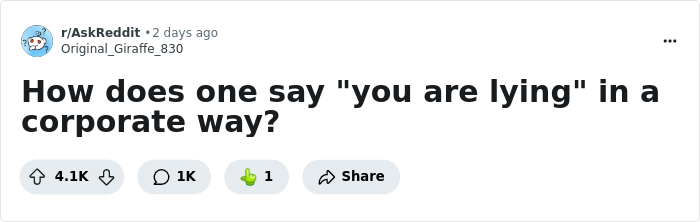
Just a couple of days ago, a thread appeared in the AskReddit community, the author of which, the user u/Original_Giraffe_830, asked netizens the question: "How does one say 'you are lying' in a corporate way?"
To be honest, we don't know whether the topic starter really wanted to elegantly catch someone out for being untruthful, or just wanted to expand their vocabulary - but they definitely achieved their goals!
The result was over 4.2K upvotes and around a thousand comments with the best examples of corporate language of our time. So, please read and enjoy everything in our new list, carefully made for you by Bored Panda!
 “Don’t f*****g lie to me you weasel!”.
 Do we have evidence / data to confirm that fact?

I'd suggest " ... to confirm that suggestion?" If you're disputing it, it may not be a fact.
 "that doesn't align with my understanding based on our SOT".
SOT ? Habitual d******d? Special operations team? I'm struggling with this one ...
No, humanity has always tried to clothe its thoughts in the most effective images, and, for example, the ancient Vikings are an excellent example of this. It's enough to remember the so-called "kennings" - conditional formulations used by them to replace this or that word. For example, "boar of waves" was "ship", "flame of the sea" stood for "gold", and "storm of swords" was actually "battle".
However, that was a thousand years ago, when any careless word could lead to a challenge to a duel - so it was way better to be fluent in your tongue than in your sword. Today, we are much less likely to run into a skilled swordsman in the office, so why do we resort to various euphemisms to point out a lie to a colleague?
 Group setting - “Hmm, I’m not confident that we’re aligned here. Let’s discuss offline.”
Private but friendly - “Hey why aren’t we on the same page?”
Private but not friendly - “I’m 100% confident that we’re not on the same page. Let’s figure out where the lapse is before this progresses.”
Private with another coworker - “I know that F*****G SKUNK is a lying piece of s**t. I’m gonna let them take this lie too far and then make them look like an a*****e.”.

Oh no, no no... we discuss that online so there's an email chain to reference. HR pulls me into a questionable in-person meeting in response to a question I ask over email, and I always send an email after summarizing exactly what they said and asking them to confirm if my summary was correct.
 Everyone here is wrong. The answer is:
"Yeah. Um. I'm going to sort of have to go ahead and disagree with you there...".
Over the past decades, a special corporate jargon has developed in our business environment, also known as 'corpo lingo' or even 'corporatese,' which is characterized by extremely vague formulations, intentionally complicated phrases and words, and numerous euphemisms.
The thing is that even the most difficult and unpleasant situations are usually presented in a much more positive form than they actually are when reporting to management. So, this excessive office diplomacy has grown into a separate jargon over time.
As the British journalist Steven Poole characterizes it, "engineered to deflect blame, complicate simple ideas, obscure problems, and perpetuate power relations."
 "Hmm. My records/this article/this email thread indicate(s) that [another thing] happened. Is there something I'm overlooking here?"
That shows that you took the time to find proof, and gives the other party an opportunity to course-correct without getting defensive.
 The information you provided does not coincide with the facts...
Or, the British Civil Service comment, "Would that it were so ! " (meaning, ofc, that it really isn't...)
Among the examples given in this collection, there are both indisputable masterpieces of corpo lingo, which even a highly experienced linguist will not be able to understand, and wordings designed to transfer the discussion of the problem to a private meeting - and then, if you are the boss, to express everything in much simpler and more direct words.
By the way, one of the best, in my opinion, techniques from this collection is to begin accusing subordinates of lying with the words: "help me understand..." At least now, if your boss ever addresses you with such a phrase, you know what to expect. As the saying goes, "forewarned is forearmed."
 In a group setting: "I'm not clear/onboard with your premise or conclusions. Let's break out when its mutually convenient and see if we can get on the same page and move forward."
In a private setting with a peer or subordinate: "I call b******t but you can convince me I'm wrong".
With a superior: "If that's your call we can run with it but I'm not following the merits". (If the relationship is healthy).
 "i’m struggling to reconcile that with the data we have".
Nice one - you're doing all you can to keep the peace "but... data ..."
In any case, I believe that even if you don't work in an office but are simply interested in all the rich possibilities of the English language when it comes to expressing your noble indignation at the fact that your deeply respected interlocutor was deliberately distorting information, this selection will be very interesting and useful for you.
And now I will go incredibly laconic - please feel free to read this list to the very end, and maybe add your own beautiful examples of such corpo lingo wordings in the comments below.
 That’s not how I understood what happened.
 Based on what was reported, that doesn’t seem to be the case.
 "Here is what I am seeing, am I missing something?".
Any sentence that begins with "We" that you didn't agree to be part of.
 "I believe there may be a discrepancy in the information provided."
"Could you please clarify or verify the accuracy of that statement?"
"It seems there might be a misunderstanding or misstatement here."
"I have concerns about the accuracy of that information.".
By the time you've received all four of these, it's probably time to sharpen up your resumé
 "I'm not sure that's the case".

Or, "That turns out not to be the case" per Larry Niven or Jerry Pournell in Lucifer's Hammer.
 Or possibly:
“I don’t believe that’s accurate based on the information WE BOTH have”.
Takes away the wiggle room they might have to say that their view was different to yours because they had different information to you.
 You don't.
You start the email with "I'm a little confused..."
And just attach evidence.
If you don't have evidence to attach, you don't send the email.
Good advice - especially that last part. Never open fire unless success is inevitable.
 Actually lying? Like not just being wrong about something or understating a negative to be polite?
In such a situation, the polite and professional (i.e. "corporate") thing to do would be to allow for the possibility of error on your own part and indicate a willingness to be persuaded otherwise.
"I don't see how that could possibly be true. But I'm willing to listen to your explanation.".
 "let's circle back"
"we can take this offline".
 That doesn't align with the understanding shared by the team.
 I don’t believe your data adequately reflects our present situation.
“I smell b******t” this is probably why I don’t work in a corporate environment but it’s gotten me this far.
B******t!

Ugh. I am so glad I’m past all this horseshit now. My husband and I own our own business, he’s the talent and I run the office. I regularly tell him to get the f**k out of here when he’s in the wrong about something, especially if it’s something that’s office-related. But he generally stays in his lane and I stay in mine, so that doesn’t happen often. We encourage our employees to be honest with us if they don’t like or just have doubts about a customer or procedure, or anything. We pay well and have good benefits, so we can attract good people. Making them feel appreciated, heard, and listened to is important to creating loyalty and getting employees nearly as enthusiastic about growing the company as we, the owners, are. We don’t want anyone thinking they have to walk on eggshells around us, because we promised ourselves we would never become like the a*****e bosses/owners we always hated. Now, I won’t say there haven’t been tough days when one or both of us were on our last nerve and about to blow up, but we didn’t take it out on our people. We’ve got a good thing going here, so why f**k it up by being an a*****e?

Ugh. I am so glad I’m past all this horseshit now. My husband and I own our own business, he’s the talent and I run the office. I regularly tell him to get the f**k out of here when he’s in the wrong about something, especially if it’s something that’s office-related. But he generally stays in his lane and I stay in mine, so that doesn’t happen often. We encourage our employees to be honest with us if they don’t like or just have doubts about a customer or procedure, or anything. We pay well and have good benefits, so we can attract good people. Making them feel appreciated, heard, and listened to is important to creating loyalty and getting employees nearly as enthusiastic about growing the company as we, the owners, are. We don’t want anyone thinking they have to walk on eggshells around us, because we promised ourselves we would never become like the a*****e bosses/owners we always hated. Now, I won’t say there haven’t been tough days when one or both of us were on our last nerve and about to blow up, but we didn’t take it out on our people. We’ve got a good thing going here, so why f**k it up by being an a*****e?































 No fees, cancel anytime