Get Premium
Dark mode theme is available exclusively for premium users. Learn more about the benefits of subscribing.
No fees, cancel anytime.

 Dark Mode Ad-Free Browsing Unlimited Content
 Ad-Free Browsing Unlimited Content Dark Mode
Join 1.2 million Panda readers who get the best art, memes, and fun stories every week!
The sea covers roughly 70% of our planet, yet we know surprisingly little about its depths. Vast, mysterious, and often unfathomable, it hides countless shipwrecks, scary creatures, and other secrets that we might not be able to uncover for years to come.
However, even the facts that we have learned about the ocean can feel bizarre or unsettling when you stop to think about them. And this is precisely what the Instagram account 'The Weird Unknown' specializes in! Scientific discoveries, chance encounters, it's all there.
More info: Instagram
This post may include affiliate links.
Nikolai the walrus received a fish cake for his birthday from a zookeeper. This was his reaction.


Friends don't keep friends locked up in a watery cage where they have to perform tricks for hundreds of very loud people, where they aren't able to swim long distances or behave in their natural way. This seems to be in Dolfinarium Harderwijk, a place notorious for keeping animals under bad conditions, their purpose is entertainment for humans, not taking care of animals.
Load More Replies... 




Can't find any proof of it being photoshopped although there is a suggestion that the walrus is actually called Edrik.
Load More Replies... 
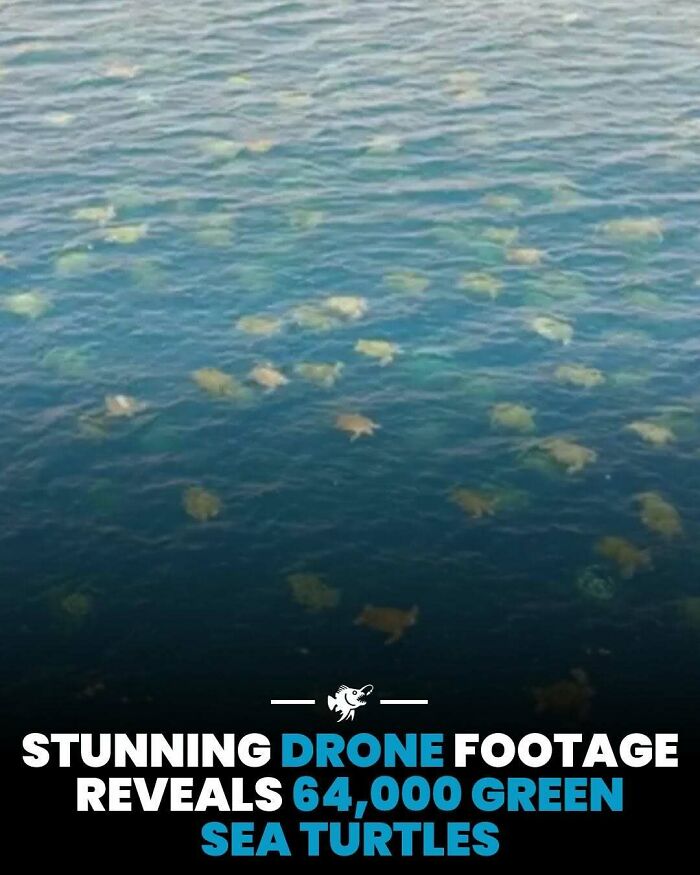
An incredible natural spectacle! 64,000 green sea turtles gather near Raine Island, Australia’s largest nesting site, in a breathtaking display of marine life. Nature at its finest.
531 turtles, 532 turtles, 533 turtles... Wow this job is easy... Wait where was I? Damnit! 1 turtle, 2 turtles, 3 turtles, 4 turtles...

I'm trying to put your math to the tune of "99 bottles of beer on the wall" but I'm not having any luck. 😁
Load More Replies...

Where else do you find turtles? They don't live in trees, nor can they fly. They don't roam the Savannah, or work in shops. All turtles live in water, the sea. What other kind of turtles are there? You never see Land Cheetahs, or Air Birds..... Ok, rant over.

But not all turtles live in water.... there are terrestrial turtles, aka tortoises, that live on land. There are also semi-aquatic turtles called terrapins that live in both environments. Turtle is just the general term for all the species in the order Testudines. So calling them "sea turtles" is a specific term for turtles that live in the sea. If you want to get more specific, there are Green sea turtles, (or Chelonia mydas), Loggerhead sea turtles, (or Caretta caretta). I could go on, I think there are 7 types of sea turtles. I like turtles. lol My favorite is the Honu, or Green Sea turtle.
Load More Replies...

What started as a routine cleaning job turned into a once-in-a-lifetime discovery for Jennifer Dowker, a boat captain and scuba instructor in Cheboygan, Michigan. While cleaning the hull of her glass-bottom tour boat, she spotted a small green bottle resting on the riverbed. Curious, she dove down and retrieved it—only to find a delicate, handwritten note inside. To her surprise, the message dated back to November 1926 and read: “Will the person who finds this bottle return this paper to George Morrow, Cheboygan, Michigan, and tell where it was found?”
Moved by the century-old message in a bottle, Dowker posted photos of it on her company’s Facebook page, hoping to find George Morrow’s family. The story quickly went viral, and soon, Morrow’s daughter saw the post and confirmed it was her father’s handwriting. She shared that he had a habit of leaving little notes and surprises—making this discovery all the more personal. For Dowker, it wasn’t just about finding an old letter—it was about connecting the past with the present in a way that brought joy to people across generations.
"Should you find this message please pass it on to Sting. "

Why the down vote? "Should you find this message please pass it on to Rob Zombie."
Load More Replies...
I also got a message asking to send it to Morrow. I kept waiting but tomorrow never came.


"We've been trying to reach you about your vehicle's extended warranty. "
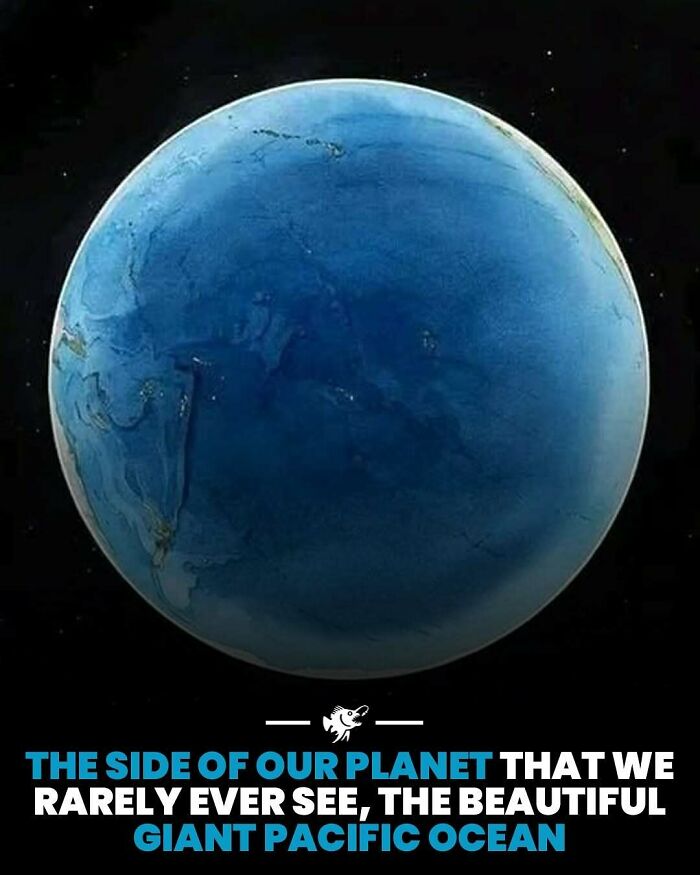
The Pacific Ocean is the biggest and deepest body of water on the planet, spanning more than 63 million square miles—roughly one-third of Earth’s surface. Its immense size makes it larger than all of Earth’s land combined. Yet, it’s often underrepresented in satellite images of Earth. Most widely shared photos focus on the Atlantic side, where major continents and population centers are located. Because of this, the Pacific—an ocean so vast it stretches almost uninterrupted by land—is frequently overlooked, despite dominating our planet’s geography.

Over 5 million of us live in the South Pacific, some of us on the edge of the Antarctic Ocean.

While 5 million is a large number, it is equal to only about 0.0625% of the world population.
Load More Replies...


Just recently, 3 nutters from Edinburgh crossed it on a rowing boat 😦 took them around 190 days!!!!!!

Funny thing, that perspective is often the default view of Earth as seen in a *lot* of Japanese Anime. 'Space Battleship Yamato' is one example that comes to mind.

I live in the North Pacific part of this image. I see it on maps regularly.

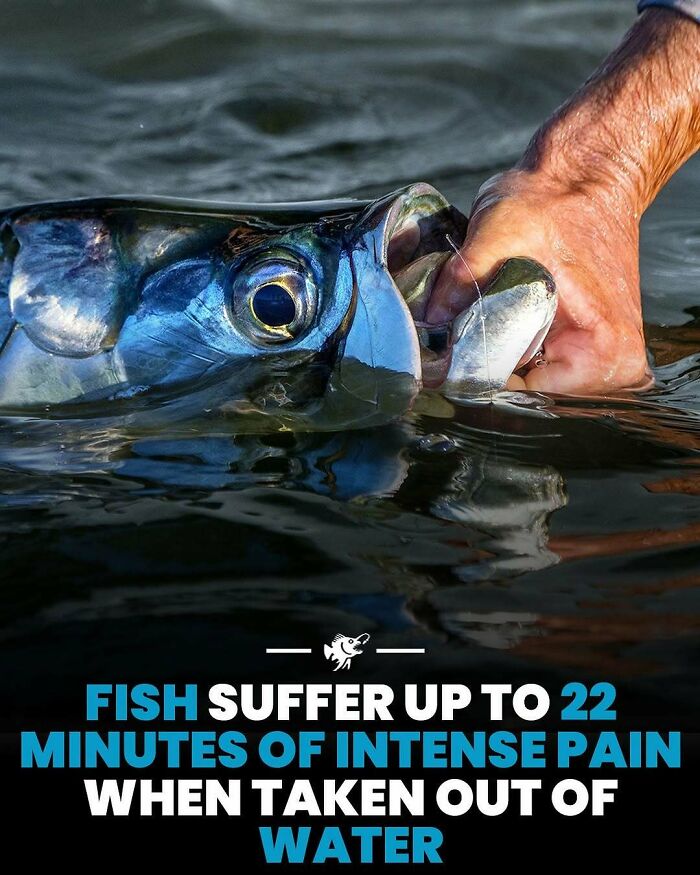
New research is reshaping how we understand fish—and how we treat them. Studies show that fish can endure up to 22 minutes of intense pain after being removed from water. Once exposed to air, they experience suffocation-like trauma, with their gills damaged and oxygen supply cut off. During this time, fish display clear signs of distress: gasping, erratic thrashing, and neurological responses that closely mirror pain in other animals. These findings challenge long-standing assumptions that fish don’t feel pain and raise ethical questions about fishing and handling practices. As the science deepens, it pushes for a reevaluation of how we interact with marine life, both in commercial and recreational settings.

Surgeons used to believe that babies didn't feel pain and would operate on them without anaesthesia. If we were wrong about babies, we can be wrong about fish. Really though, is anyone surprised?

that is a myth, long debunked. They knew babies felt pain, they just didnt know how t give anesthesia without killing the babies (it's a very precise science and the doctors with the most training for a reason), once they figures out how to do it on babies, they began to. They never ever thought that, and it is a lie and myth that people keep pushing
Load More Replies...
Fish suffocate when removed from water. No one should be surprised that that hurts. If you're killing something, k**l it quickly, FFS.


Fish - the only animal that humanity generally doesn't care about. Hunting in national parks? Don't be ridiculous. Fishing? Sure, go right ahead. Put a hook in their mouth, drag hem out of the water, and yank the hook out. It's not barbaric if you throw them back, right?

Not my fish. As soon as i catch it is killed right away or released if it is to small or a fish o dont like

This is why Humane fishing, they kills the fish right away. When I have been fishing, fish for immediate consumption you use a knife to quickly end it, those for later (bc you dont want to leave them open for more than a few hours) you use a mallet to the brain step, killing it instantly.
I've never liked the "catch and release" type of fishing. Causing a living creature to suffer for your sport is wrong.

I read about a study done where they would inject fish with ACID, and then had one regular tank and one that had morphine or something in the water(the 2 being interconnected). To the surprise of no one, except maybe the AH scientists, the poor tortured fish hung out in the morphine tank.
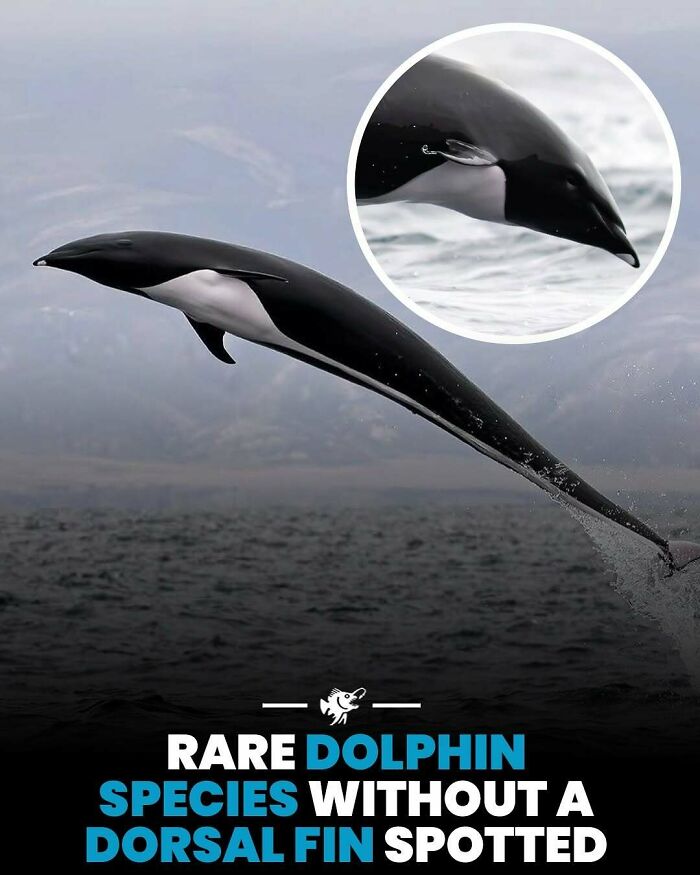
Meet the northern right whale dolphin, a rare species instantly recognizable for its lack of a dorsal fin—one of only two dolphins in the world without one. Its smooth, torpedo-like body helps it slice through the water with minimal resistance, giving it a sleek, almost whale-like profile. These dolphins are famous for their aerial displays, often leaping, spinning, and performing synchronized maneuvers in massive groups called superpods that can number up to 3,000. They frequently travel with Pacific white-sided dolphins, diving deep to chase schools of squid and small fish. Agile, social, and acrobatic, they remain one of the most fascinating and elusive marine mammals of the Pacific.

Who decided on "Northern Right Whale Dolphin", and did they consider Pengui-phin?




Wow. What a shot. There are so many dolphin, porpoise and whale species that largely get unnoticed we forget they exist, or don't realize they're around.


this is the northern rightwhale dolphin. There is also the southern rightwhale dolphin, also without a dorsal fin

this sounds like an evolutionary advantage, if it makes them faster. why are they endangered? whaling?

Seals have a unique way of resting in the ocean, often using kelp forests as their natural hammocks. The swaying fronds provide a secure and sheltered spot, helping them stay anchored while they enter a light sleep state. Unlike humans, seals can hold their breath for extended periods, allowing them to nap underwater without surfacing frequently. This behavior highlights the adaptability of marine mammals and the crucial role kelp forests play in ocean ecosystems. These underwater forests not only offer protection from currents and predators but also serve as essential habitats for a wide variety of marine life.


It's not just seals. Even if you can spend your whole life underwater you don't want to be at the mercy of the currents while you're sleeping. DSCN2845-6...53a82e.jpg 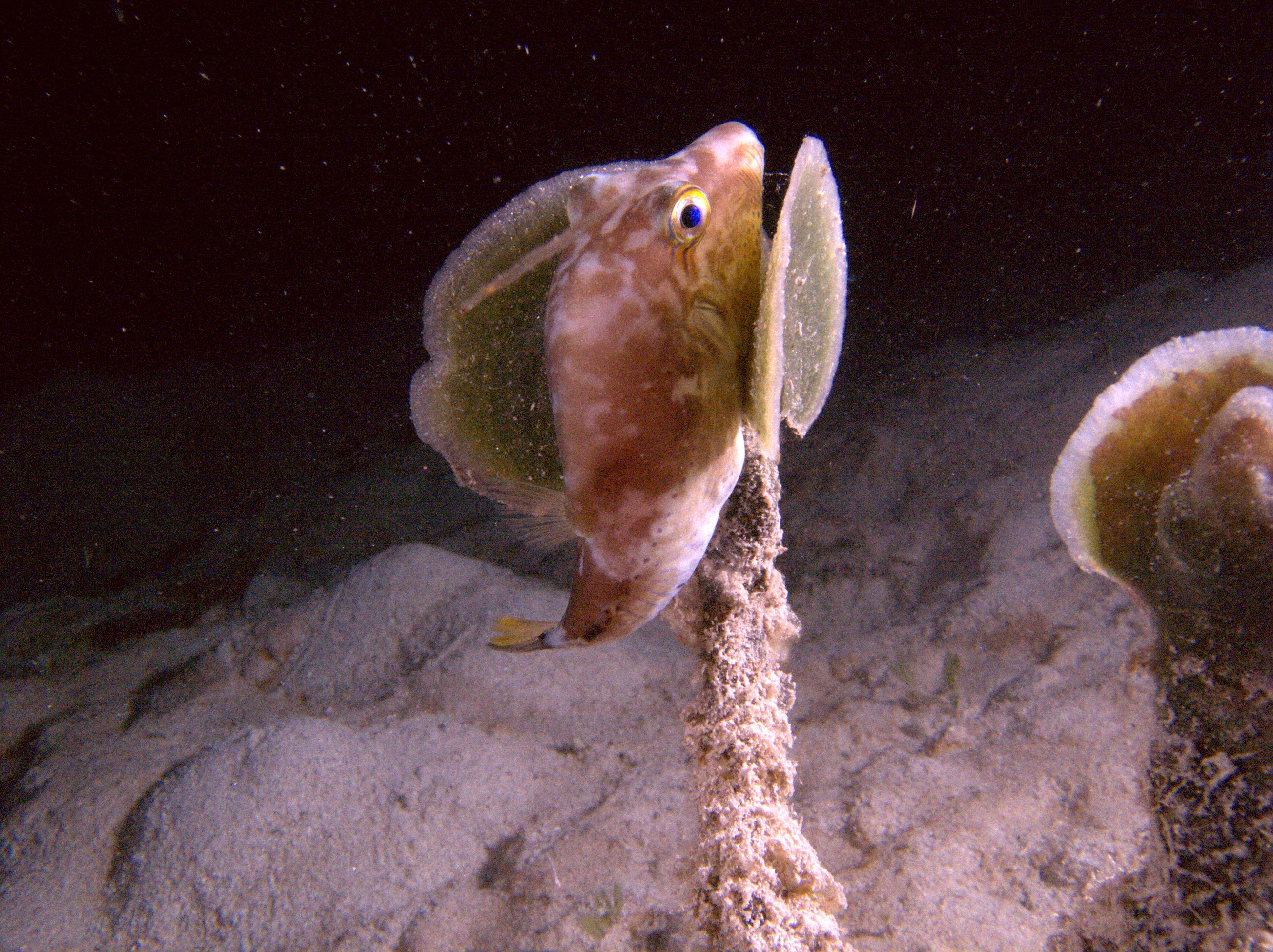
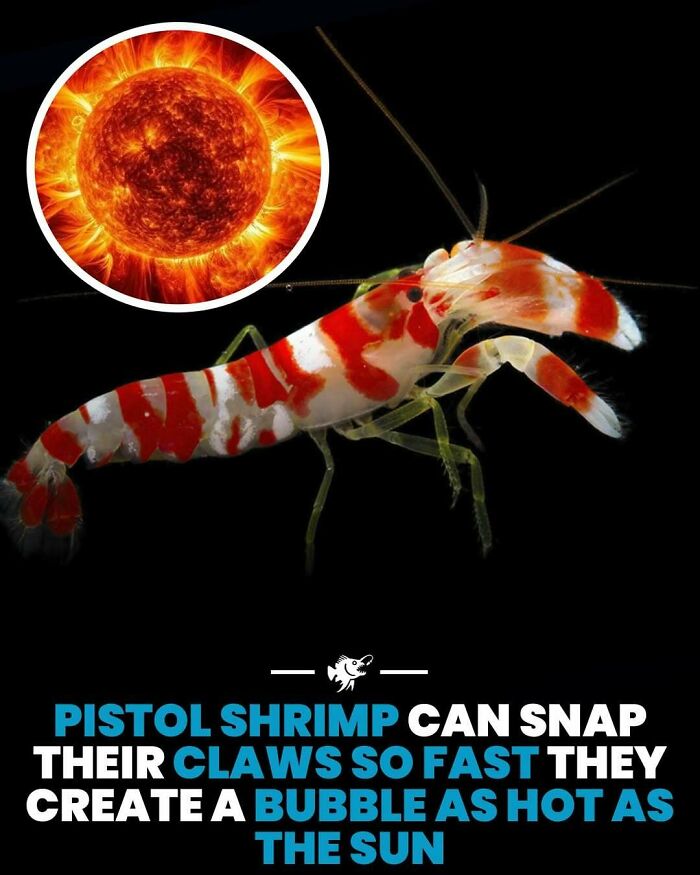
The pistol shrimp snaps its claw with such speed that it creates a bubble reaching temperatures around 4,700°C—as hot as the surface of the sun. This rapid snap generates a shockwave powerful enough to stun or k**l prey instantly. As the bubble collapses, it produces a tiny flash of light, making the pistol shrimp one of the few creatures capable of creating plasma underwater.

I agree! I'm trying to think through the compression ratio to generate that much heat, and how quickly the heat disapates
Load More Replies...
Those too. They generate the cavitation differently though. With the pistol shrimp, the cavitation is the intent, but with the mantis shrimp it's just a byproduct. Mantis shrimp wins in a fight though! They're much larger.
Load More Replies... 
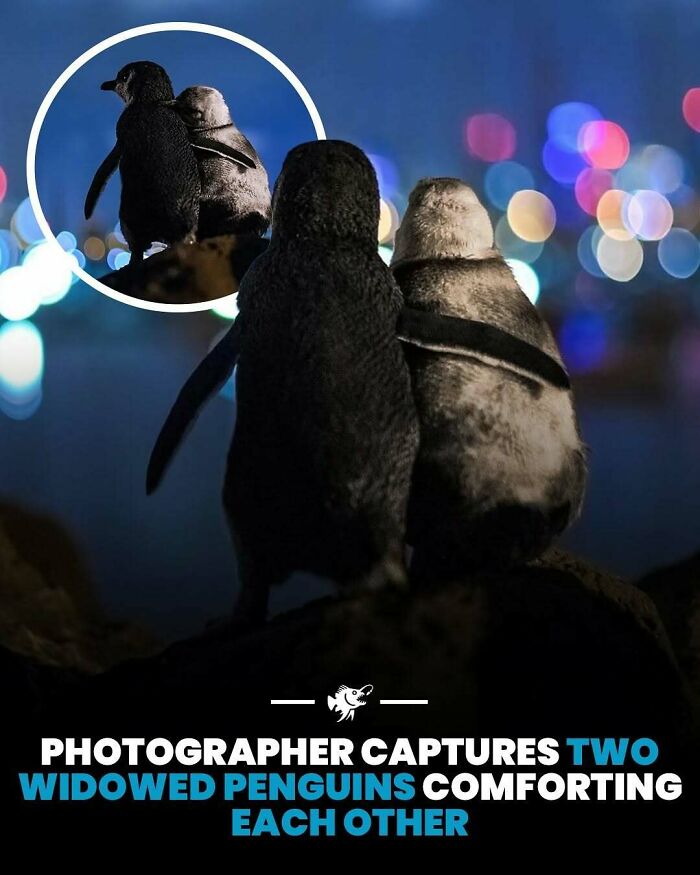
Tobias Baumgaertner (@tobiasvisuals), a German photographer, captured a poignant image of two fairy penguins embracing on a rock with Melbourne’s skyline in the background. The photograph, taken after three nights spent with the penguin colony, shows an elderly female and a younger male comforting each other after both lost their respective partners. This touching moment has garnered international acclaim as a symbol of love and companionship during challenging times.


Wasn't there a multi-year penguin non-couple couple that did this same thing? Is this them?

Why does it amaze people that other species are also sentient beings? They feel joy and loss just like we do.

Aha, and how do you know that? Have you studied the behavior of penguins? If not, you should be more cautious with such claims.🙄
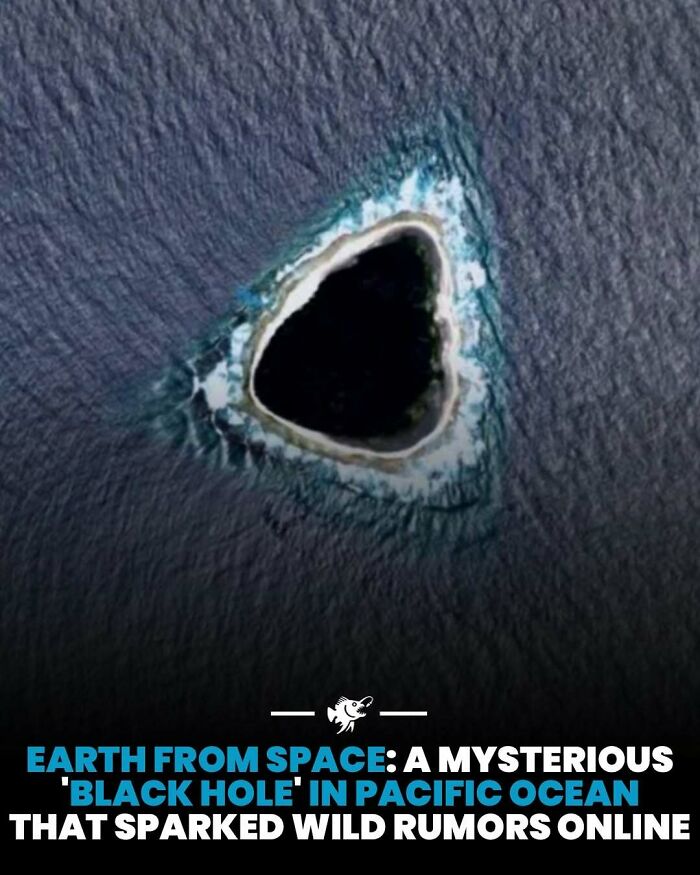
Load More Replies...In 2021, a Google Maps satellite image revealed a mysterious, jet-black triangular shape in the middle of the Pacific Ocean, sparking wild online speculation about its origin. Some theories ranged from secret military bases to underwater caverns. However, it was soon identified as Vostok Island, an uninhabited coral atoll in the Republic of Kiribati, located about 4,000 miles east of Australia.   The island’s dark appearance in satellite imagery is due to its dense coverage of Pisonia trees, which grow so closely together that they create an almost impenetrable canopy, absorbing most of the sunlight and giving the island its black-hole-like look from above. Vostok Island spans approximately 0.1 square miles and remains largely untouched, with no freshwater sources and limited fauna, making it an intriguing yet isolated landmass in the vast Pacific Ocean. 

What is wrong with people? I take one glance at this photo and I see it is obviously an island; surrounding ocean, waves breaking on the shore...
That's the hole everyone is talking about when they say the world is fu.cked
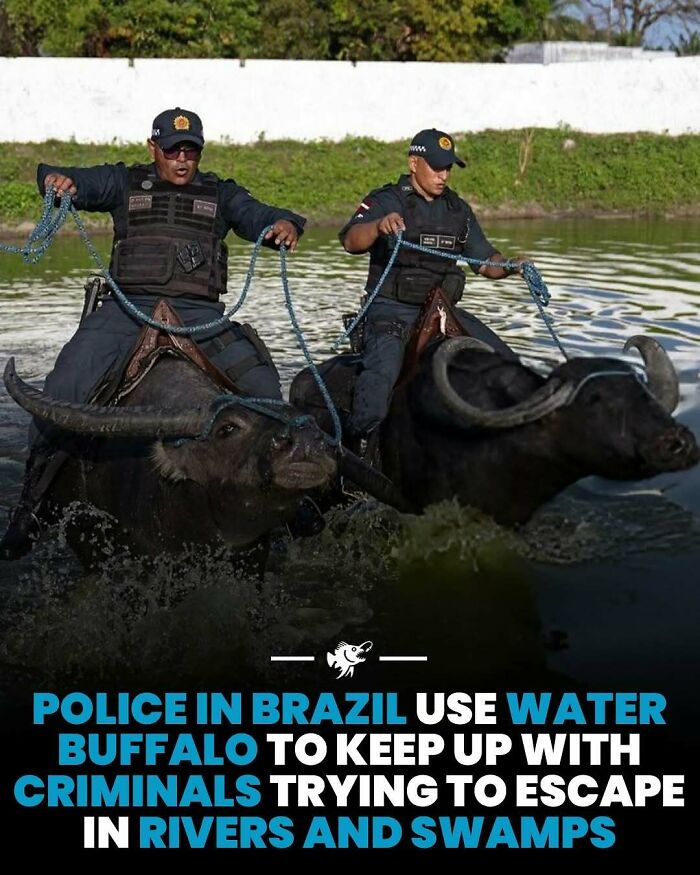
On Brazil’s Marajó Island, military police have been using water buffaloes for patrols since the early 1990s, adapting to the region’s difficult terrain. These powerful animals can traverse swamps, rivers, and dense mangroves where traditional vehicles struggle, making them an invaluable asset for law enforcement. Their strength and endurance allow officers to efficiently pursue suspects and maintain security in remote areas, especially during the rainy season. This unconventional policing method has become a unique symbol of Marajó’s law enforcement strategy, blending tradition with practicality.

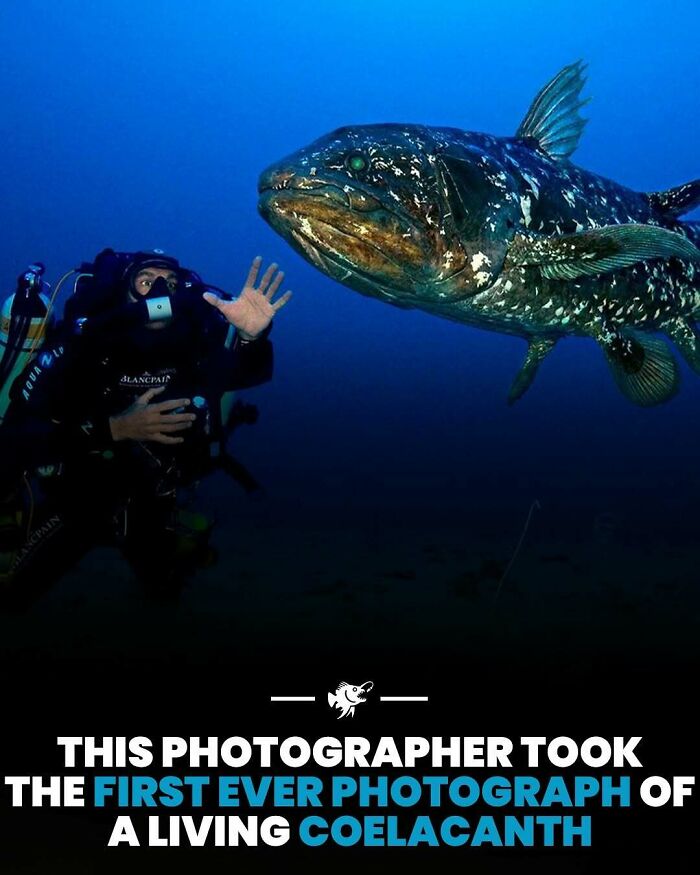
In 2010, photographer Laurent Ballesta and his team made history by capturing the first images of a living coelacanth in its natural habitat off South Africa’s Sodwana Bay. Armed with 32kg (71lb) of camera equipment, Ballesta described the coelacanth as “a masterpiece in the history of evolution.” These ancient fish, abundant 410 million years ago during the Triassic Period, belong to the “lobe-finned” group, the evolutionary ancestors of land-dwelling vertebrates like amphibians, reptiles, and mammals. Long thought extinct, the coelacanth was rediscovered in 1938 when one was caught off South Africa’s coast, and later filmed alive in 1987 by ethologist Hans Fricke. Living in the benthic zone at depths of up to 300m (984ft), coelacanths inhabit underwater caves during the day and hunt at night. Inspired by diver Peter Timm’s sighting in 2000, Ballesta trained with advanced rebreather diving technology, enabling him to reach depths of 120m (393ft) and encounter these elusive “living fossils” firsthand.

Watched a programme on the BBC yesterday about scientists looking for and finding coelacanths. They used a deep sea submersible and found at least 20 clustered under a rock shelf.

410 Mya? Try again, dude. That was a lot further back than the Triassic.
So this claim is utterly misleading. It's a photo of a photographer, to start with....and I've seen footage of live coelocanths that pre-date this event.

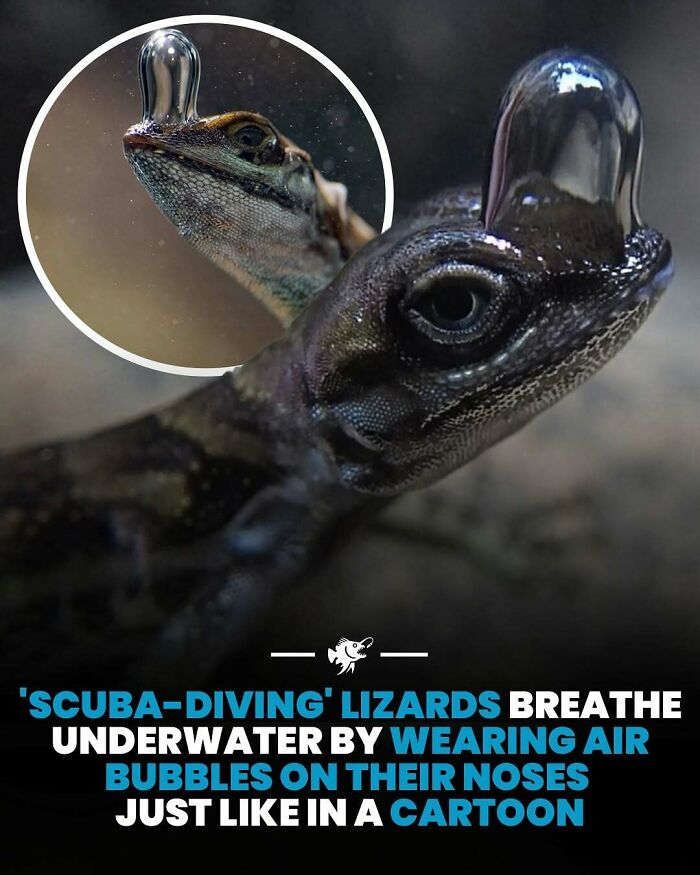
Scuba-diving lizards have a unique survival trick: they can form air bubbles on their foreheads to breathe underwater, allowing them to remain submerged for extended periods and evade predators. In 2018, scientists captured the first footage of a semi-aquatic lizard, the stream anole (Anolis oxylophus), using a bubble of stored oxygen around its snout to breathe underwater — a behavior never before observed in lizards. Since then, researchers have discovered at least 18 other species of anoles, including water anoles (Anolis aquaticus), that share this ability. Previously, it was unclear whether this bubble allowed the lizards to remain underwater longer or if it was just a byproduct of their water-repellent skin.

Fun fact: SCUBA is an acronym for "Self-Contained Underwater Breathing Apparatus"
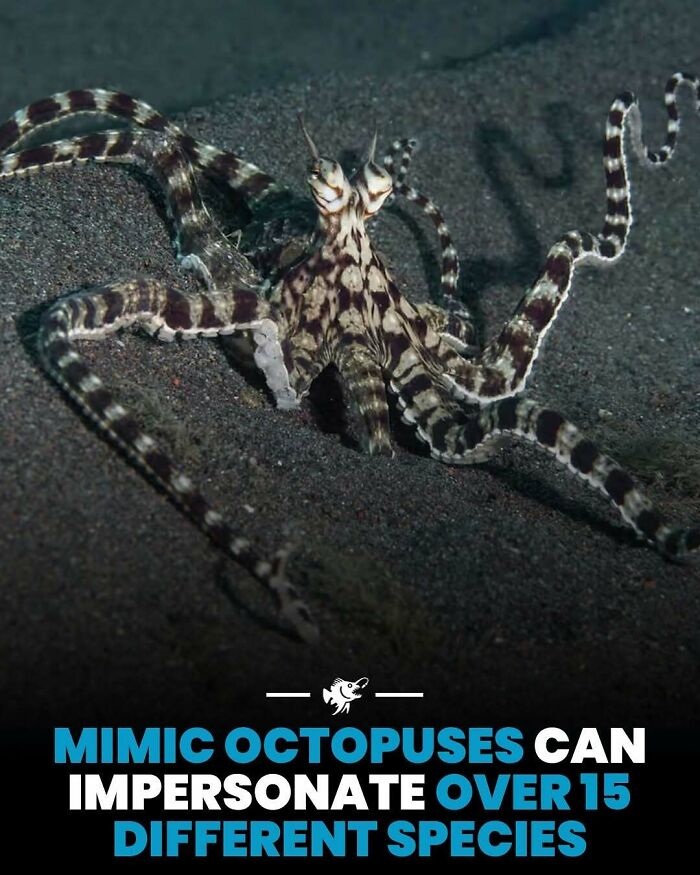
The mimic octopus is one of the ocean’s most skilled illusionists, with the remarkable ability to impersonate over 15 different marine species. Its talent goes far beyond simple camouflage—it actively changes its shape, color, and movement to mimic dangerous animals like lionfish, jellyfish, and sea snakes to avoid predators. What makes its disguises especially impressive is how it mimics behavior, not just appearance. For example, when pretending to be a sea snake, it hides most of its body in the sand and waves two arms to create a convincing snake-like motion. This strategic flexibility allows the mimic octopus to tailor its disguise to the threat it faces, making it one of the most adaptable and deceptive creatures in the sea.
Can it turn orange and pretend to run a country? If so, we might have some answers
It displays FAR too much intelligence for that to be the case.
Load More Replies...
This puts me in mind of the troll that comes on here to harass Nathaniel and anyone who defends him. He takes different shapes and different colours, but in the end his hatred, bitterness, and bigotry make him stand out.


Look up some videos of them. I saw a documentary and what they can do is incredible!

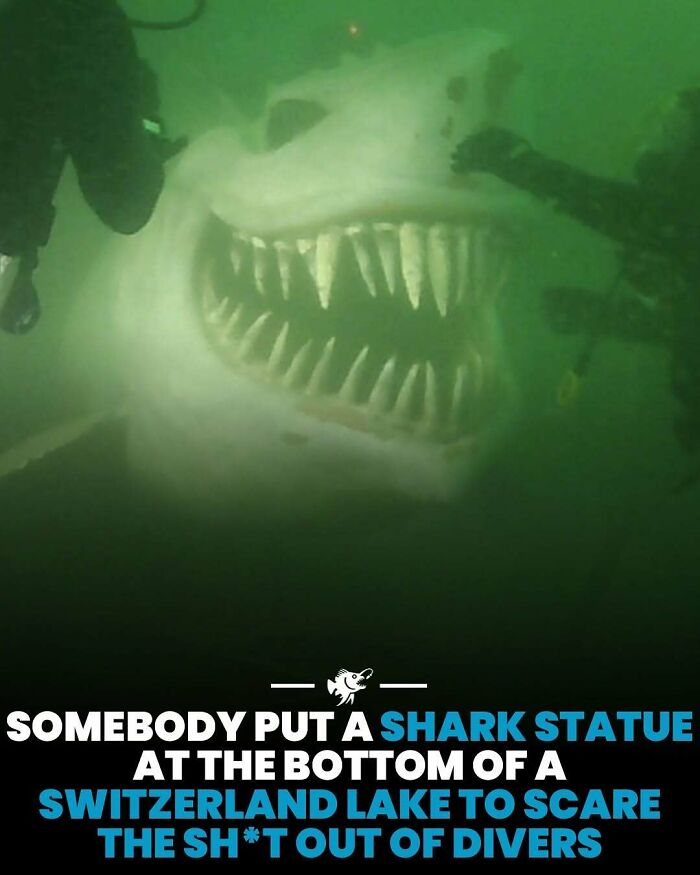
A massive fiberglass shark statue lurks at the bottom of Lake Neuchâtel in Switzerland, drawing adventurous divers to its eerie depths. Estimated to be around 20 feet long, the figure features a menacing grin and was first discovered in 2002. Investigators believe the statue was originally a prop for Choc au Lac!, a production by the association La Jeunesse de la Côte. Now a popular underwater attraction, it continues to fascinate those equipped with the gear—and courage—to visit the lake’s hidden “predator.”

So... How do the lifeguards respond to an underwater heart attack? Just askin'...

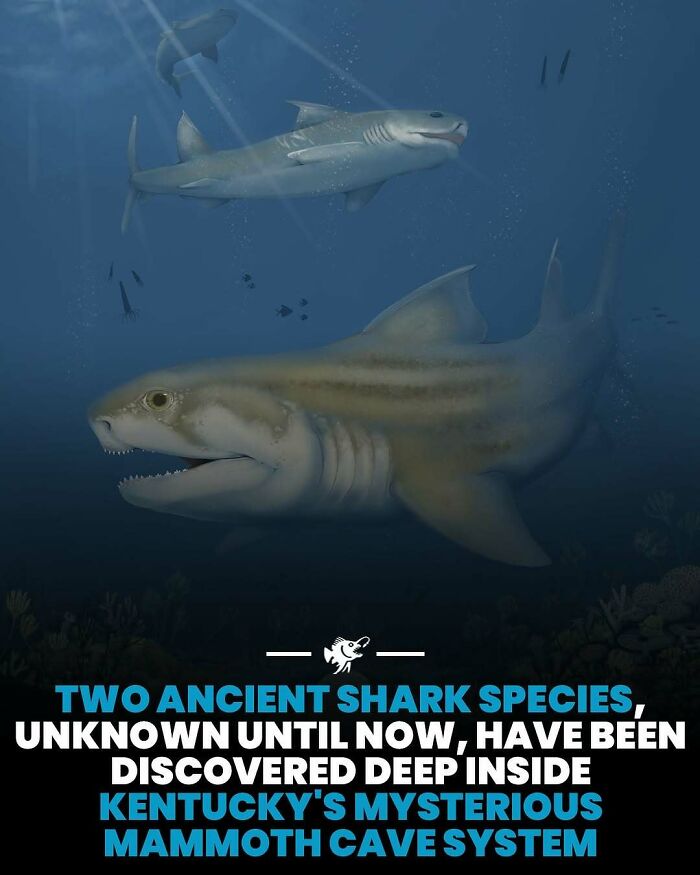
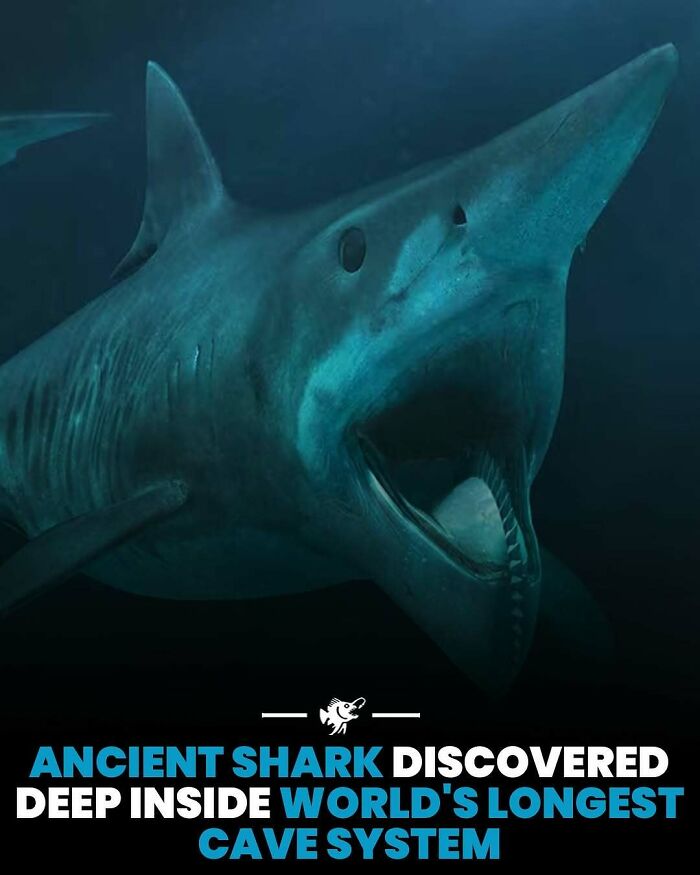
Two ancient sharks hidden for over 325 million years have been uncovered inside Kentucky’s Mammoth Cave—the world’s longest known cave system. The prehistoric giants, Troglocladodus trimblei and Glikmanius careforum, measured around 12 feet long and once roamed shallow tropical seas long before the age of dinosaurs. Their discovery, part of a fossil-rich site that includes over 70 species of ancient fish, sheds new light on shark evolution and marine life during the Carboniferous period as Pangaea began to form. These findings offer a rare glimpse into a time when much of present-day North America was submerged beneath a vast inland sea.
Normally I would make a joke here posting the Baby Shark lyrics slightly amended to fit the entry. But I have decided that we no longer need reminding of Baby Shark. Just to be clear, I am not going to reference Baby Shark and I will not make you sing the Baby Shark lyrics in your head. So do not bother thinking about Baby Shark.
Spelunking shark do do do do spelunking shark do do do do
Load More Replies... I was confused at first, since cave fish are a thing. They found fossils (mostly teeth) of those two sharks.
Same here. I thought at first they found actual living sharks of a very ancient species.
Load More Replies... I don’t understand how people get attacked by sharks. Can’t they hear the music?
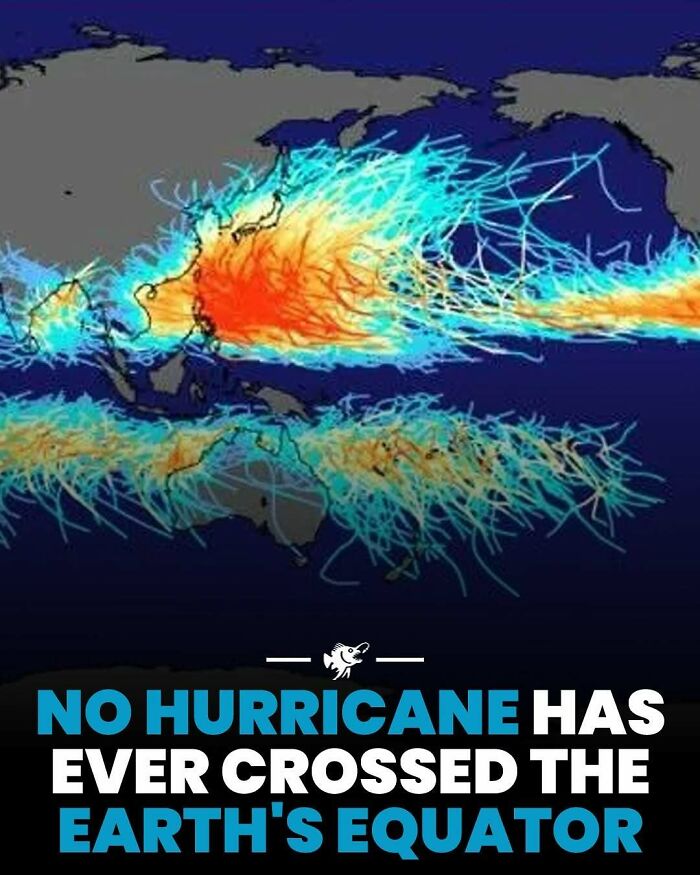
Hurricanes are unable to cross the equator due to the absence of the Coriolis effect at that latitude—a force critical to their formation and rotation. Without it, the spinning motion needed to organize and maintain a storm system simply can’t take shape. Adding to this, prevailing wind patterns near the equator typically move east to west and don’t support the north-south movement required for a hurricane to shift into the opposite hemisphere. As a result, storms stay confined to the side of the equator where they originated.


TIL... I am always learning new things. Learning really is a life-long phenomenon.

And it is fascinating! I like to learn even more and better now in my 60s than in my youth.
Load More Replies...
The equator was the most common place sailors got trapped for weeks in the "doldrums" in pre motorized times because of the dead winds.
I read this as “ in pre-moisturized times”. I guess the ocean didn’t want the flaky-skinned sailors to make it to land!
Load More Replies...
The way the weather has been these last few years, I wonder if there's going to be a "Hold my beer" moment soon?
In a word, no. It's physics (or physical geography) as well as meteorology. A cyclonic storm, regardless of the name, gets energy from the (increasingly warm) ocean, but the rotation is driven by the Coriolis force. Without the Coriolis force the rotational energy would stop fairly quickly, and the Coriolis force gets increasingly weak* as you approach the equator. Cyclones also rotate in opposite directions in the northern and southern hemisphere, so the rotation would have to stop and reverse itself. Even if it's the same mass of warm, humid air it would be a new and separate storm. *The Coriolis force is proportional to the sine of the latitude. At the poles it's a full 360° rotation every 24 hours. At 45° it's still .7071 as strong as at the poles. At 30° it's still .50 as strong. By the time you get down to 5° it drops to a piddling .0872 as strong as at the poles.
Load More Replies...
If those 'spaghetti' tracks are storms, odd that southern storms are calmer.

Due to less land or different temperatures? Not sure.
Load More Replies... 
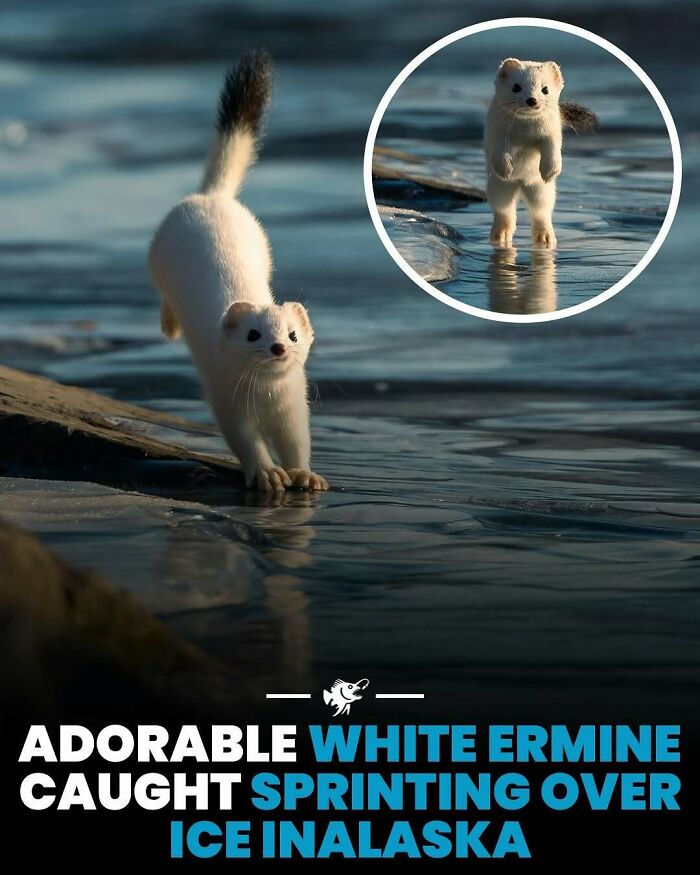
An adorable white ermine—also known as a stoat in its winter coat—was caught on camera dashing across an icy stretch in Alaska. 🧊 These tiny predators may look cute, but they’re skilled hunters. Their snowy fur helps them blend into frozen landscapes as they go after rodents, birds, and insects with lightning speed.
What's the difference between a weasel and a stoat? A weasel's weasily recognisable, but a stoat's stoatally different. I'll show myself out
some people, when they see this animal think this : " lets k**l a dozen of them and make me a fur-coat with them ". ^^

They're really elusive critters, but in the spring when the snow is half melted with dark patches of ground showing through, their fur is still white and gives them away. In the nearly 12 years I've lived here, I've only had two sightings on my property.
Caught? Is sprinting across the ice not allowed in Alaska?
The ice weasels come at night, after your snowmobile has flipped over and trapped you underneath it.
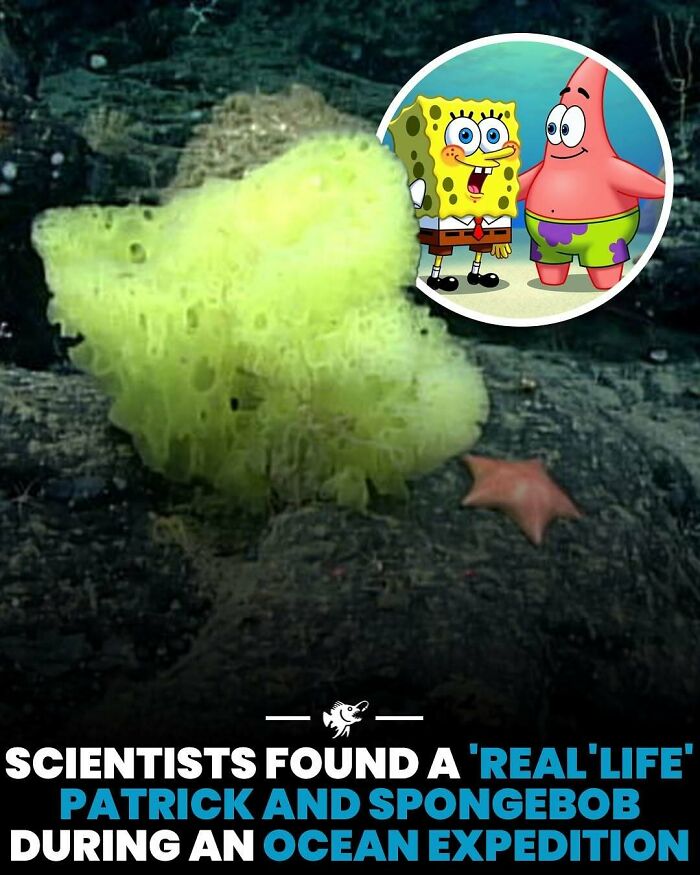
Load More Replies...During a NOAA dive on July 27, 2021, at Retriever Seamount, the team aboard the Okeanos Explorer captured an amusing deep-sea scene that immediately reminded viewers of SpongeBob and Patrick from the Nickelodeon classic. Using a remotely operated vehicle (ROV), they photographed a bright yellow sponge and a pinkish starfish sitting side by side on the ocean floor. Scientifically speaking, the sponge is a glass sponge from the genus Hertwigia, and the starfish is likely Chondraster grandis, both common in Atlantic seamount ecosystems. But unlike the cheerful cartoon duo, real-life Chondraster sea stars are predators—and this “Patrick” might have been sizing up the sponge for its next meal.


Wow, I must be old. A show that didn't exist when I was young is now a 'classic' 😱
*You're* old? That show didn't exist when I was moving on past middle-aged.
Load More Replies...
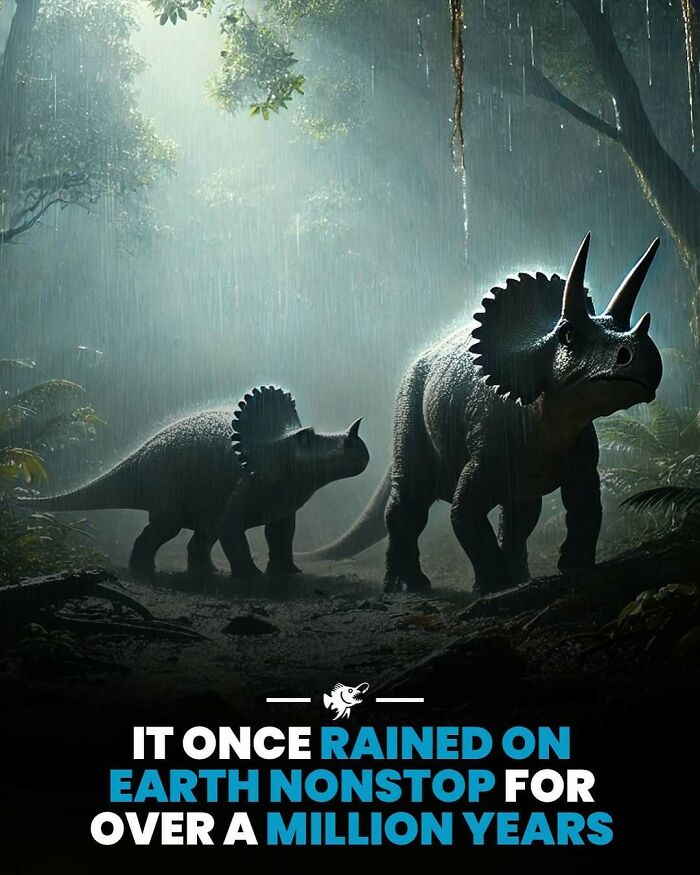
The Carnian Pluvial Event, occurring 232-234 million years ago, brought nonstop rainfall for up to two million years. This extreme climate shift was triggered by massive volcanic eruptions in present-day Alaska and British Columbia, which released greenhouse gases, warming the planet and intensifying monsoon conditions. While the event caused widespread extinctions, it also played a crucial role in shaping Earth’s ecosystems. The drastic environmental changes paved the way for the rise of dinosaurs and other modern terrestrial species, marking a pivotal moment in evolutionary history.
Technically isn't it always raining non stop around the world? Be weird if it is not raining somewhere? Like on your parade?





but not during the dinosaur era. one million years of rain is where the oceans came from.
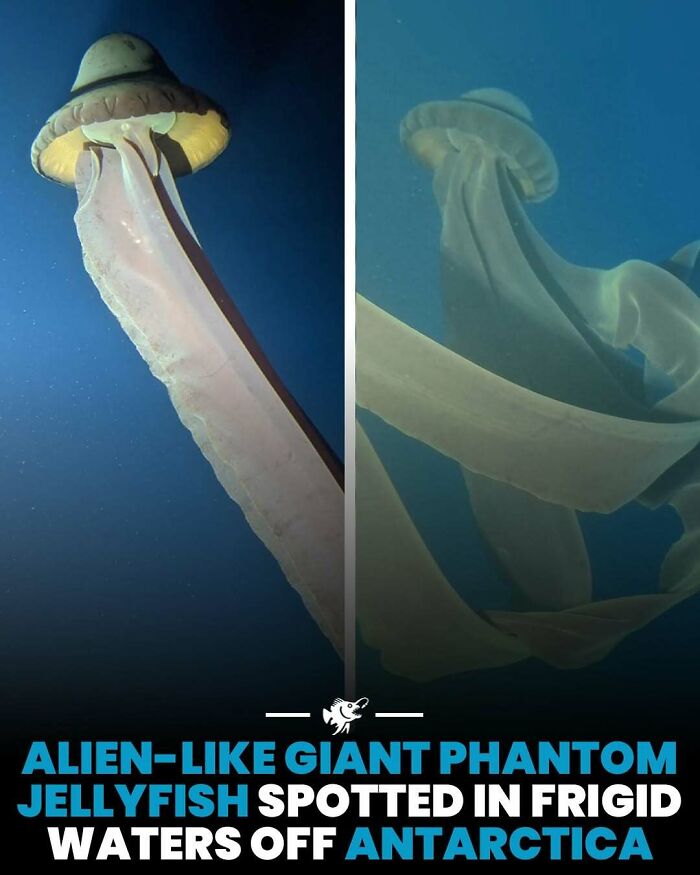
In early 2022, passengers aboard a Viking cruise ship near the Antarctic Peninsula experienced a rare encounter with the elusive giant phantom jellyfish (Stygiomedusa gigantea). These deep-sea creatures, characterized by their umbrella-like bells and long, ribbon-like arms, were observed at depths ranging from 260 to 920 feet. Typically residing in much deeper waters, their presence in relatively shallow Antarctic regions remains a subject of scientific curiosity. The sightings, facilitated by submersible dives from the cruise ship, provided valuable insights into the behavior and habitat of this seldom-seen species. Researchers hypothesize that factors such as upwelling currents or the jellyfish’s own movements might bring them closer to the surface in these regions. These observations underscore the importance of continued exploration and study to deepen our understanding of deep-sea life.



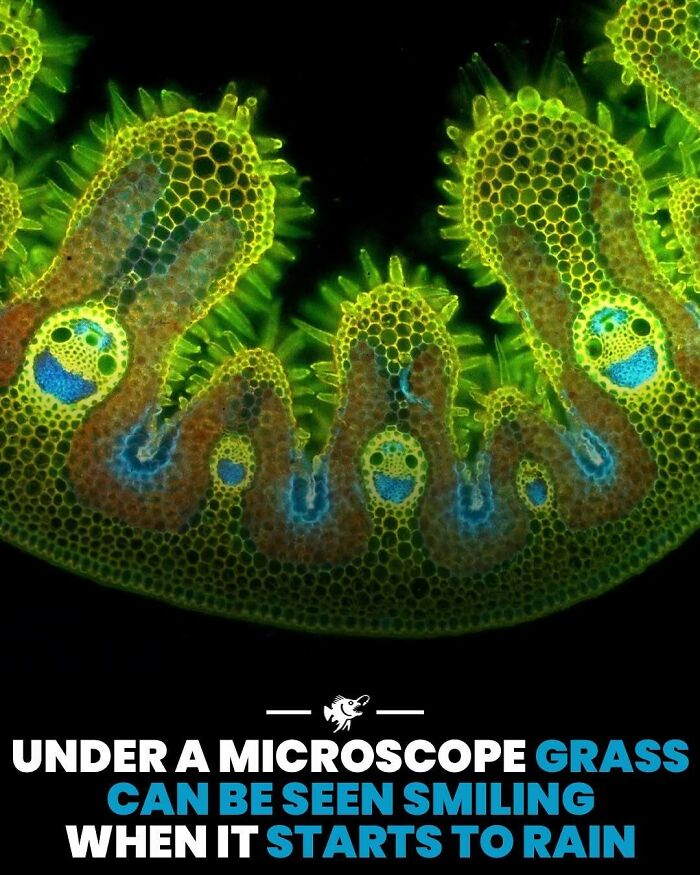
What you’re seeing are the vascular bundles, the structures responsible for transporting water and nutrients throughout the plant. These bundles function like tiny pipelines, arranged vertically to form the stalk of the grass, ensuring the plant gets the resources it needs to thrive.
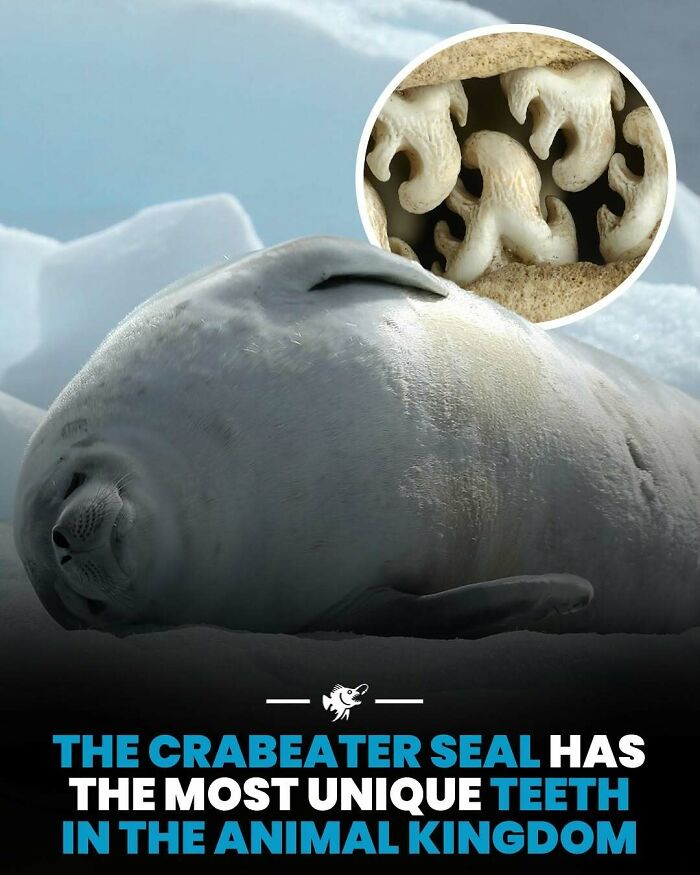
Crabeater seals, despite their misleading name, feed almost exclusively on Antarctic krill—not crabs. What sets them apart is their incredibly specialized teeth, which have evolved to suit this specific diet. Their multi-lobed teeth interlock to create a natural filter, allowing them to strain krill from seawater much like baleen whales do. This built-in filtration system makes crabeater seals some of the most efficient krill hunters in the Southern Ocean.

They can’t be most unique. C’mon now. They are either unique or they are not. There’s no hierarchy of uniqueness.
Grammatically, this is an example of most being used as an intensifier, rather than its literal definition. That is easily extrapolated from the context.
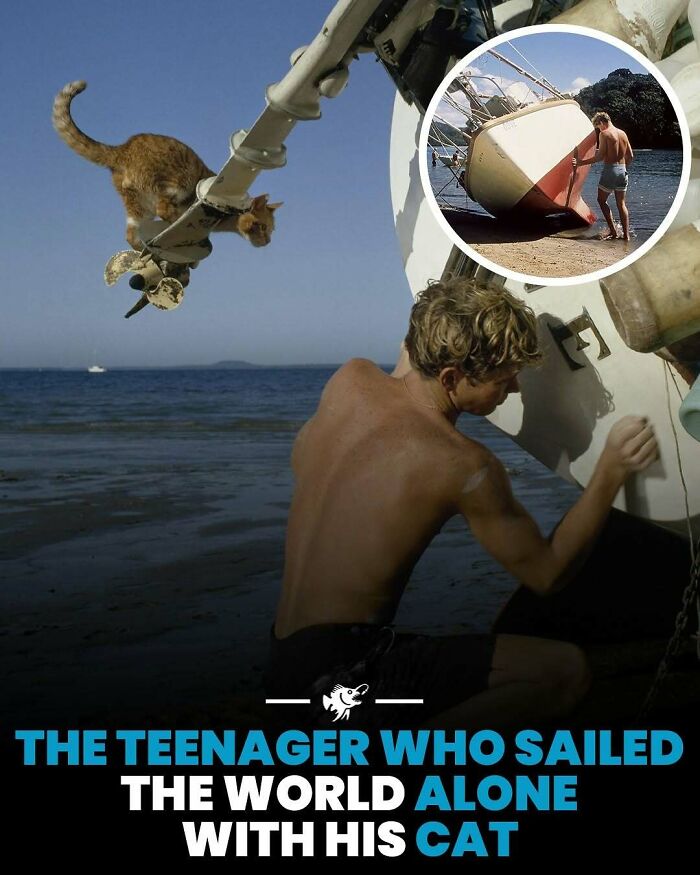
Load More Replies... At just 16 years old, Robin Lee Graham left California on a solo mission to sail around the world—a journey that would stretch over five years and test his endurance through storms, isolation, and countless unpredictable challenges. Along the way, he brought his cat for companionship and eventually met his future wife during a stop in South Africa. Graham completed his voyage in 1970 and documented the entire experience in his memoir Dove, which became a bestseller. After the adventure of a lifetime, he traded life at sea for a quieter one in Montana, where he settled down and started a new chapter.


There is no greater "alone" than the company of some cats.
Load More Replies... 

Actually he had several cats (https://www.vintag.es/2025/05/robin-lee-graham.html). One was sleeping in the luff of the sail when a sudden shift of wind caused the sail to gybe, tossing the kitty overboard. He was not able to turn around swiftly enough to locate the cat. (This was recounted in his book.)
Sorry, I don't appreciate that. The cats had no choice, and I don't think any of them felt comfortable. And a 16 year old should not spend years alone in a sailing boat on the seas. Luckily he survived. But what when not? My opinion. Wikipedia about the cats: He was originally given two kittens for company (Joliette and Suzette), and kept two or three cats throughout the entire journey (ending his travels with Kili, Pooh, and Piglet).

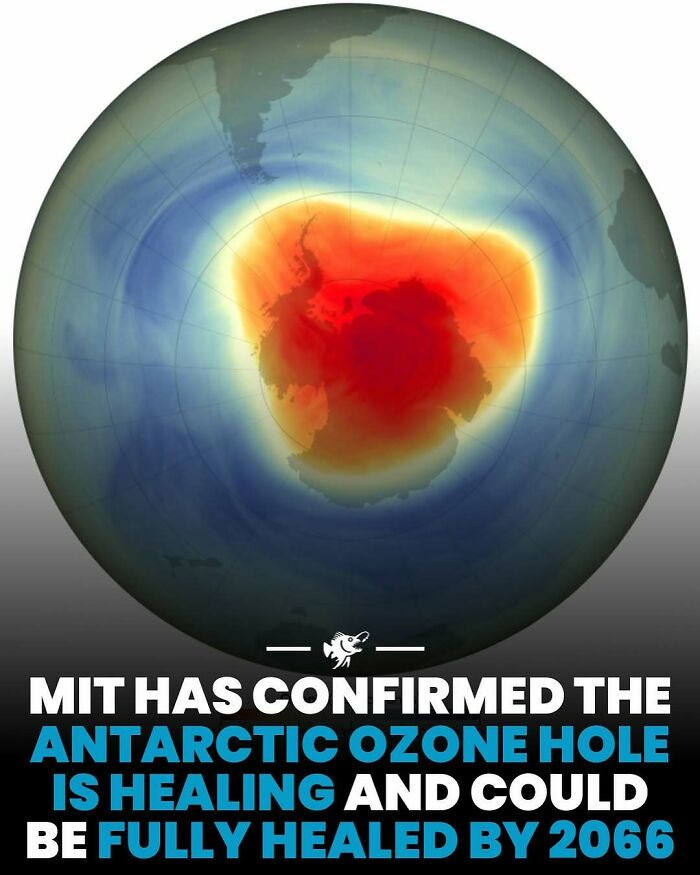
The ozone hole over Antarctica is on track to recover to 1980 levels by around 2066, thanks to decades of international action targeting harmful chemicals. The key driver of this progress is the 1987 Montreal Protocol, a landmark treaty that led to a global phaseout of ozone-depleting substances like CFCs. Since then, levels of these substances have dropped, and scientists have seen clear signs of healing in the ozone layer. According to NASA and NOAA, if current policies hold, the Antarctic ozone hole will continue to shrink—leading to full recovery by 2066.
'IF' current policies hold. That's a big ask when there's someone out there who is not known for his scientific accuracy...

Norm Gilmore, a global economy really helps in this regard. If the countries the USA is importing from follow the no-CFCs rules, then there will be no imported goods going into the USA that have CFCs in them. Similarly, if the USA is exporting items to countries who signed up to the Montreal Protocol, they won't be able to use CFCs in the items leaving. This would only leave the domestic market. Often it's just an economic hassle and logistical headache having one form of product for domestic, and another for international.
Load More Replies... 
He's probably working on a statement right now claiming that he is singlehandedly responsible for it healing!
Load More Replies... Thank gods all those ''ban CFCs'' posters we had to make in primary school in the 80s are paying off.
Yeh. I'd always heard it spoken of as healed but reading the last couple of paragraphs of this article explains it well. More of a stopping things from getting worse before it could get better. https://earthobservatory.nasa.gov/world-of-change/Ozone
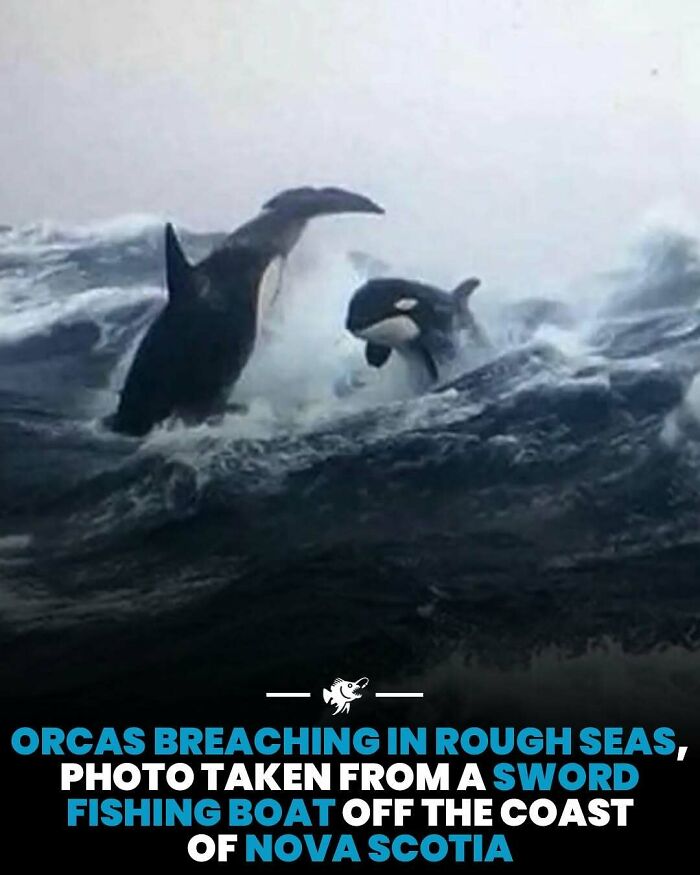
Load More Replies...Orcas breaching in rough seas, photo taken from a sword fishing boat off the coast of Nova Scotia
Did they do this on porpoise? They look to be having a whale of a time!

I'm just spitballing here, but I wonder if they have to breach to take a good breath in rough seas?


It's in the same league as duck hunting with a ball peen hammer.
Load More Replies...
They are part of the same families that include the regular whale and yes the porpoise.
Orcas are mean SOBs. They may be going after the boat for poaching "their" swordfish.
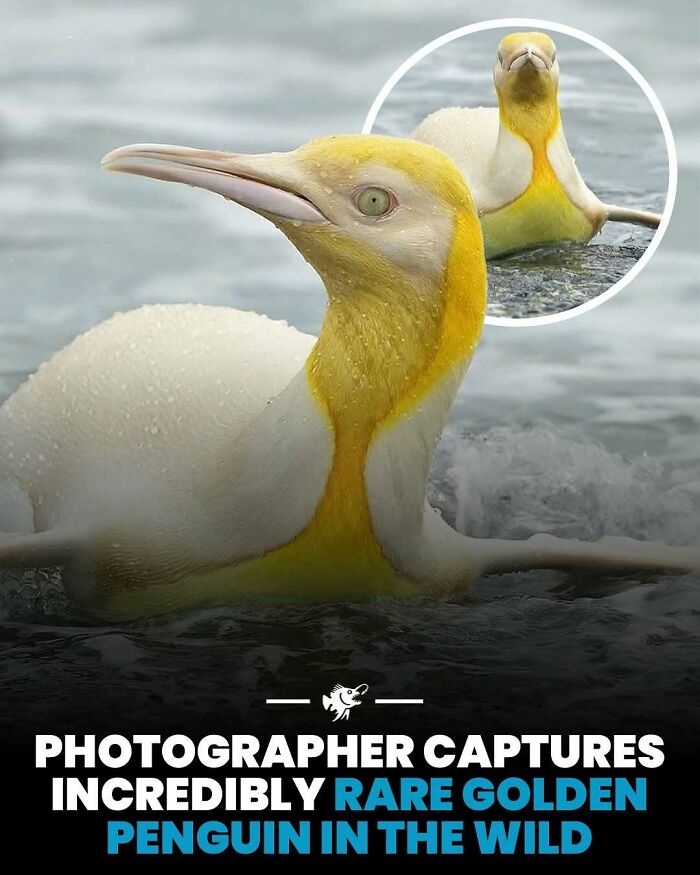
In 2019, wildlife photographer Yves Adams captured a once-in-a-lifetime image of a golden penguin while on an expedition to South Georgia. The bird stood out strikingly among a colony of thousands, thanks to its unusual bright yellow feathers. The penguin’s distinctive coloration is likely caused by leucism, a rare genetic condition that results in reduced melanin, affecting only parts of the plumage. Unlike albinism, leucism doesn’t affect the eyes, allowing the bird to thrive in the wild. This rare find quickly drew global attention for its beauty and scientific curiosity.
The last sentence is poorly written. I seriously doubt the penguin has much scientific curiosity.
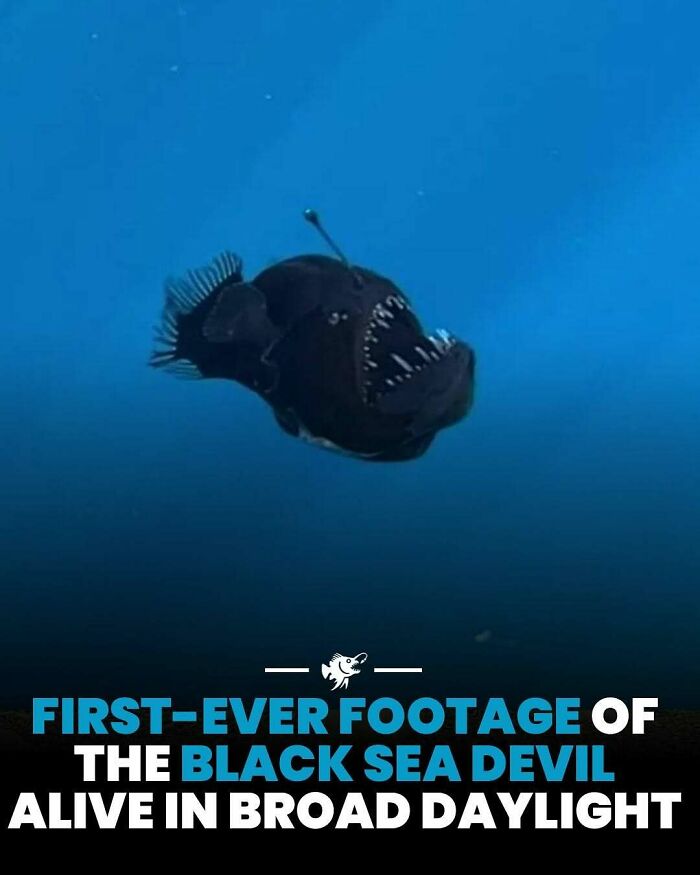
Rare Footage: The Black Sea Devil (Melanocetus johnsonii) caught on Camera in Broad Daylight This elusive deep-sea anglerfish, usually confined to the ocean’s abyss, has been recorded near the surface—a nearly unprecedented event. Renowned for its bioluminescent lure, the Black Sea Devil uses light to attract prey in complete darkness. Scientists suggest that shifting ocean currents or environmental changes may have brought it into shallower waters, offering a rare glimpse into the mysteries of the deep sea.

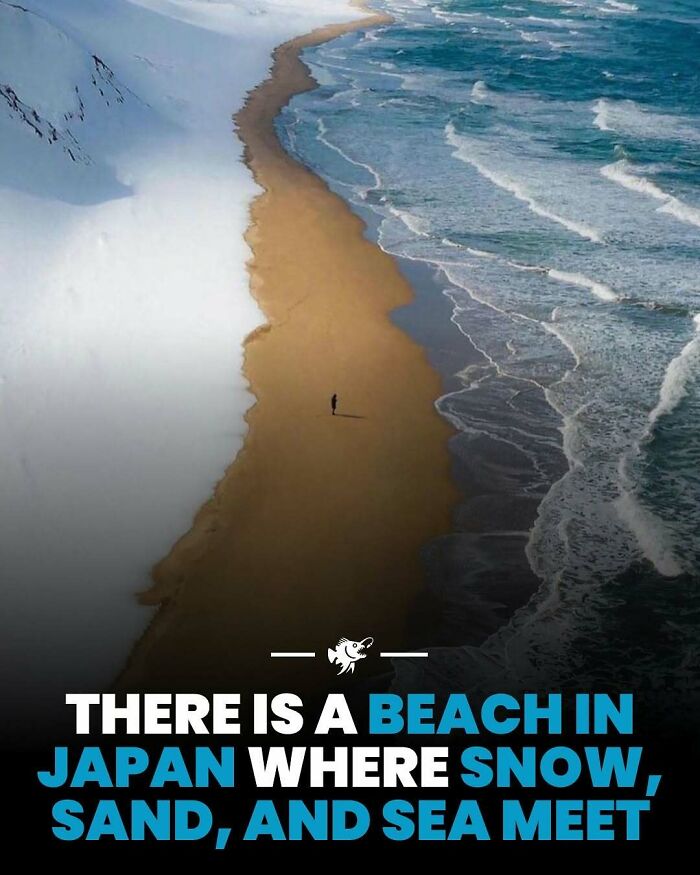
A stunning natural phenomenon can be witnessed at Japan’s San’in Kaigan Geopark, where snow meets sand to create a breathtaking coastal landscape. This rare blend of snow-covered shores offers a surreal and unforgettable view.
Located on Hokkaido Island, the geopark was designated a Japanese Geopark in 2008 and a UNESCO Global Geopark in 2010. Stretching from Kyogamisaki Cape in Kyoto to Hakuto Kaigan Coast in Tottori, it showcases Japan’s diverse and captivating natural beauty.
Huh? Beaches like this are all over the planet, in more northern latitudes

Yes, but this is in Japan, so it's automatically 100x better. /s
Load More Replies...
There's some of those in Norway too. Some people I know have done combined sail and ski holidays there. Sail to your chosen spot, get off boat, hike up mountain, ski down mountain, quick paddle on the beach if you're brave, or an icy dip if you're stupid, then back on the boat for dinner.
I don't see anything that special about it. It doesn't happen very often but sometimes it shows at the beaches here in NC.

must be a bugger packing for a holiday,flippers,snow shoes,sand bucket.........
I think this place is notable because it’s always like that. Can’t imagine that Hokkaido gets very warm.

A study from Norwich Research Park reveals that humans can detect geosmin, the earthy scent released before rain, with greater sensitivity than sharks can detect blood. This surprising finding highlights the human nose’s acute ability to pick up geosmin at concentrations as low as 100 parts per trillion. While sharks are renowned for sensing blood in water at one part per million, humans far exceed this ability when it comes to geosmin. This compound, produced by soil-dwelling bacteria, is what gives rainfall its distinct, recognizable aroma.

Geosmin is also responsible for the earthy taste of beetroots and a contributor to the strong scent, known as petrichor, that occurs when rain falls after a spell of dry weather or when soil is disturbed. Wikipedia
This is my favorite word and my favorite smell!
Load More Replies... It's not been debunked, however uninformed people have repeatedly "debunked" it using human blood in replicated tests whereas the reality is sharks are equipped to sense fish blood in water instead.
Load More Replies...Scientists have identified a bizarre new species lurking in the depths off Antarctica: the Antarctic strawberry feather star (Promachocrinus fragarius). This deep-sea crinoid features up to 20 arms—some long and feathery, others short and stiff—sprouting from a central body that oddly resembles a strawberry. Found nearly 4,000 feet below the surface, its unique look and vivid hues of red and purple have drawn comparisons to alien lifeforms, though it’s firmly rooted in Earth’s marine lineage alongside starfish and sea urchins. The discovery adds to a growing list of strange creatures adapted to survive in extreme ocean environments. Its unusual form isn’t just for show—it helps the feather star drift and feed in the frigid, dark waters. As scientists continue to explore these remote regions, findings like this reinforce how much of our planet’s biodiversity remains hidden, waiting to be revealed.

Pretty sure Lovecraft reported this as what made Sherman and Peabody disappear on that whacky expedition.
Were they in the Wayback machine?
Load More Replies...
I had to read that heading three times before I realized there wasn't an "and" between "arms" and "3,840".🤔

The feathery bits hid the central body from this angle. A google search shows that the central body does indeed look like a strawberry.
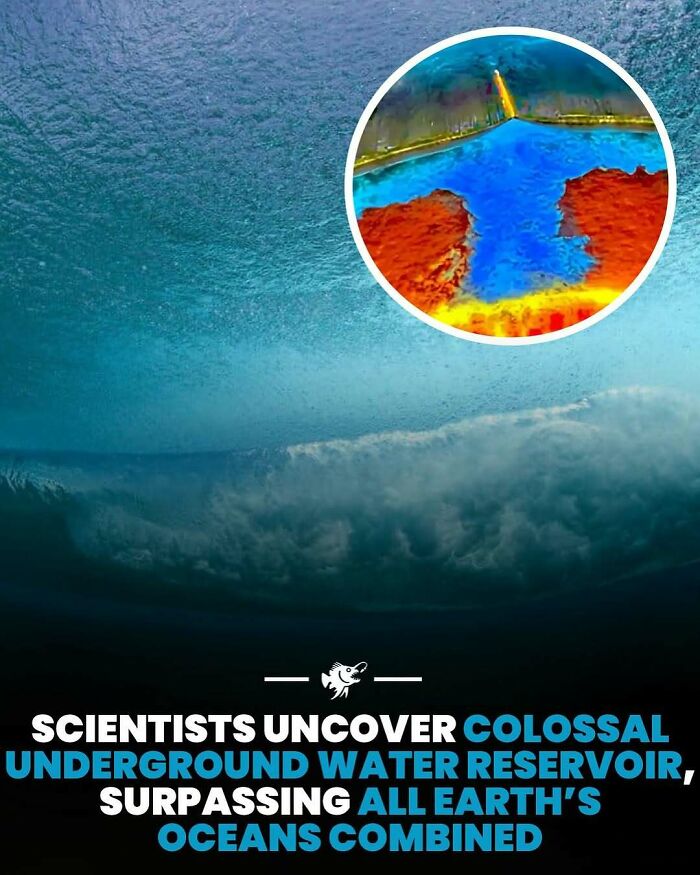
Load More Replies... In a groundbreaking discovery, scientists have identified a vast underground water reservoir located approximately 400 miles beneath Earth’s surface. This subterranean ocean is estimated to contain three times more water than all of Earth’s surface oceans combined. The water is not in liquid form but is trapped within a h**h-pressure mineral called ringwoodite, which acts like a sponge, absorbing water under extreme conditions.  The presence of such a significant amount of water deep within the Earth’s mantle challenges existing theories about the planet’s water cycle and geological processes. This discovery suggests that Earth’s interior may play a more active role in the global water cycle than previously understood, potentially influencing phenomena such as volcanism, plate tectonics, and the long-term stability of surface oceans. 
Who wants to bet that if we were to get far enough down there to see it, we would find a plastic bag floating in it?
Old news! I watched "Journey to the Center of the Earth" decades ago, and there was a big ocean down there.

"Where Alph, the sacred river, ran through caverns measureless to man down to a sunless sea."

The local subterranean council is still enforcing a hosepipe ban though.
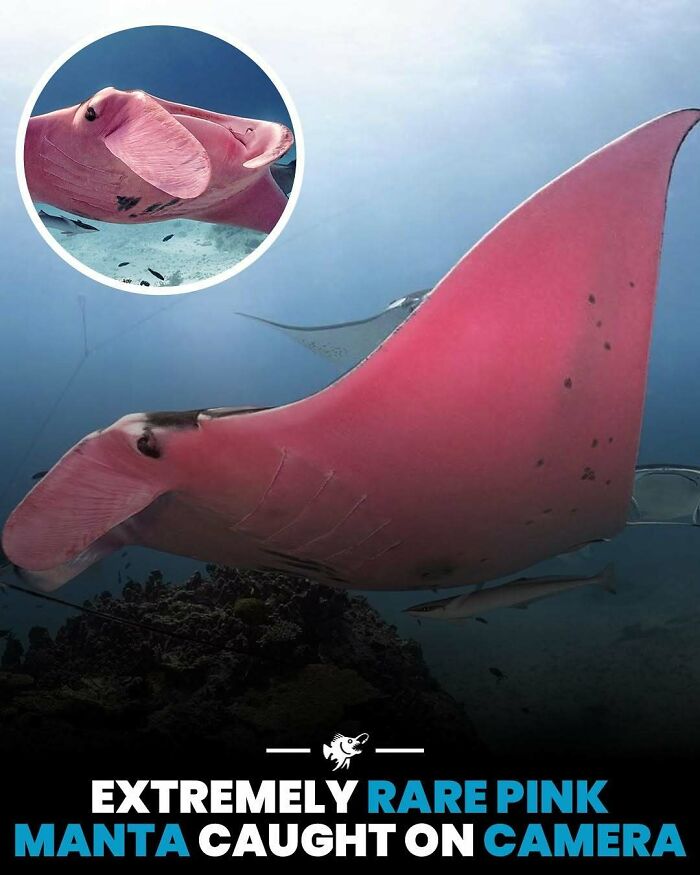
Meet the Pink Panther of the ocean—the world’s only known pink manta ray. First spotted near Lady Elliot Island off the coast of Australia, this extraordinary creature has captivated scientists and ocean lovers alike with its rare and vivid coloring. The manta’s unique pink hue is caused by a genetic mutation known as erythrism, which reduces black pigment and gives it a rosy appearance unlike anything else in the sea. Most manta rays come in shades of black, white, or a combination of both, making this individual a true standout in the marine world. Its rare appearance is not only a visual marvel but also a reminder of how much wonder still exists beneath the waves.
Meanwhile in a parallel universe where Elle Woods is a marine biologist...

The Pink Manta was the original concept before they decided to change the animal to panther for alliterative purposes.

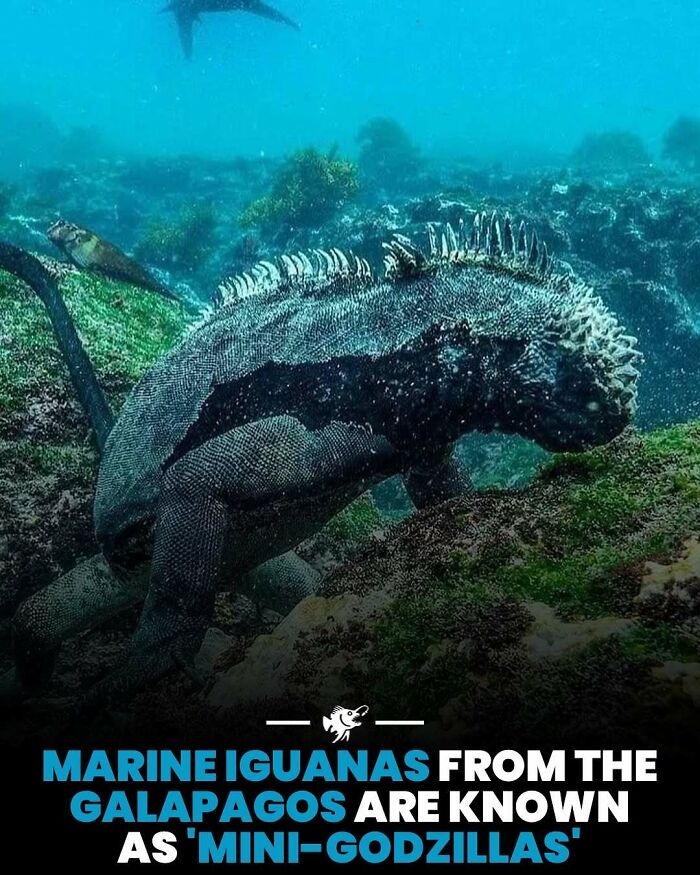
Galápagos marine iguanas—nicknamed “mini-Godzillas”—are the world’s only ocean-diving lizards, and they’re found nowhere else but Ecuador’s famed islands. With powerful claws, flattened tails, and an appetite for underwater algae, these reptiles can dive 30 meters and hold their breath for up to half an hour. Their prehistoric look—complete with spiny backs and salt-sneezing noses—once unnerved Darwin and now captivates wildlife lovers. Despite their dramatic appearance and large colonies, they’re officially listed as Vulnerable.

Not so much seawater itself, but the salt of the seawater.
Load More Replies... 
History shows again and again How nature points up the folly of man Godzilla!
I love how it's EXACTLY what you would expect
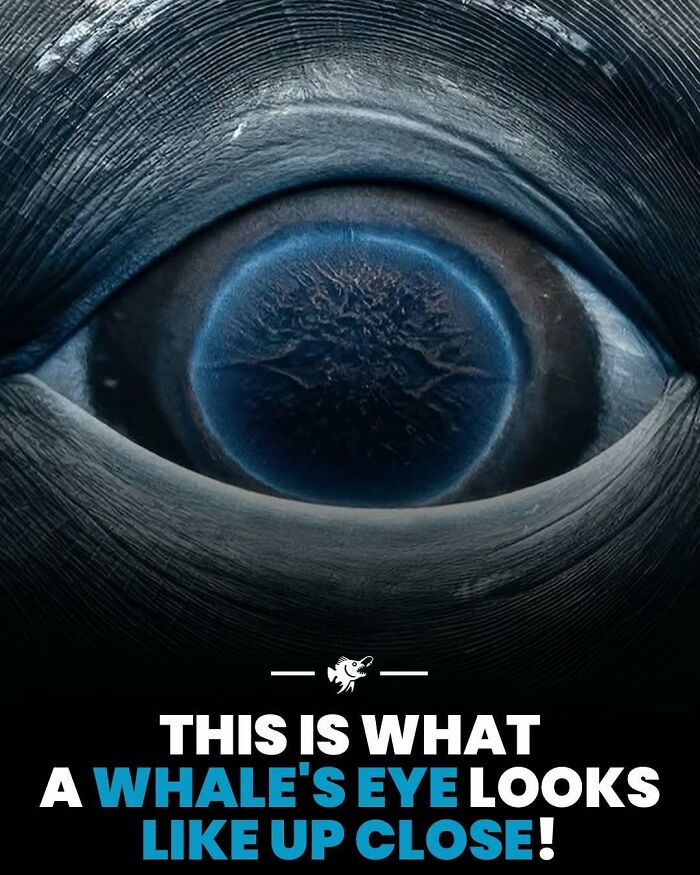
Depending on the species, whales can weigh between 30 and 200 tons, with blue whales reaching lengths of up to 100 feet—the largest animals to have ever lived. They also have impressive lifespans, with some, like the bowhead whale, living over 200 years. Beyond their size and longevity, whales play a vital role in ocean ecosystems by redistributing nutrients from deep waters to the surface, supporting marine life. This rare eye-to-eye moment serves as a reminder of their significance in our shared world.
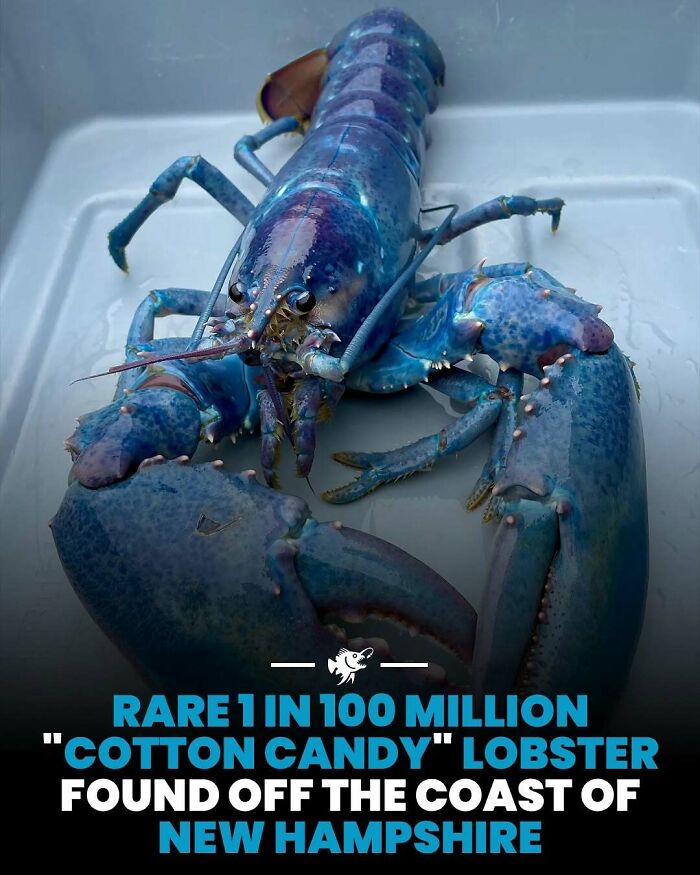
In late July, 25-year-old Joseph Kramer, owner of Atlantic Lobster Company, discovered a rare “cotton candy” lobster in the final trap of his day off the coast of New Castle, New Hampshire. The lobster’s stunning lavender, purple, and pink hues make it an extraordinary find, with odds of catching such a specimen estimated at 1 in 100 million. Kramer brought the lobster to the Seacoast Science Center in Rye, where aquarist Sam Rutka confirmed it was a healthy male. Rutka, with over a decade of experience, has only worked with 15 cotton candy lobsters. “It’s definitely the only one I’ll ever catch, and maybe even the only one I’ll see again,” Kramer told Seacoastonline, expressing joy that the rare creature is now on display for others to admire.
He should have been put back where he was found so he can breed and live his life in peace.


I now have three mutually contradictory stories about lobsters this colour.
It is not the only one ever found. They are just incredibly rare.
Load More Replies... 
Sad ending for the lobster, spending the rest of its life in captivity.
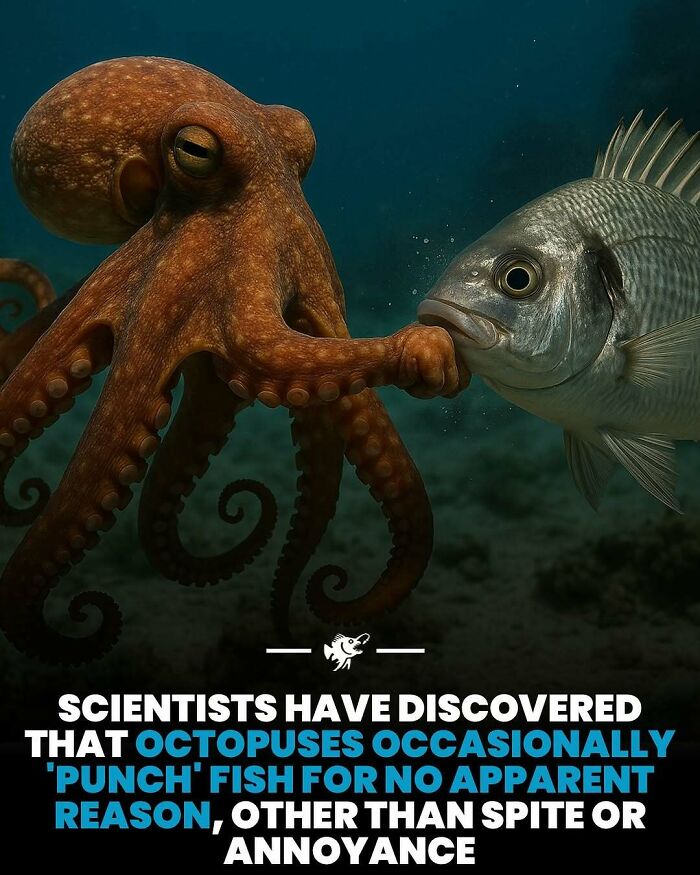
Scientists have witnessed octopuses teaming up with fish to hunt—only for the octopus to occasionally s****r-punch its partner mid-mission. These underwater alliances are usually efficient: octopuses flush prey from reef crevices, while fish catch whatever darts out. But every so often, without warning, the octopus lashes out with a punch. While some jabs are strategic—maybe to redirect an overeager fish or stake claim to food—others seem totally unprovoked. In a 2020 study published in Ecology, marine biologists noted punches delivered when no food was present and no interference occurred. The behavior, dubbed “active displacement,” might be a way for octopuses to assert dominance or even express something surprisingly close to frustration or spite.
I've seen a video of this. WTF is going on in the pic? The octopus has knuckles! 🤣 Yes, I know it's AI.
lol I was also about to comment on the actual “fist” of the octopus
Load More Replies...

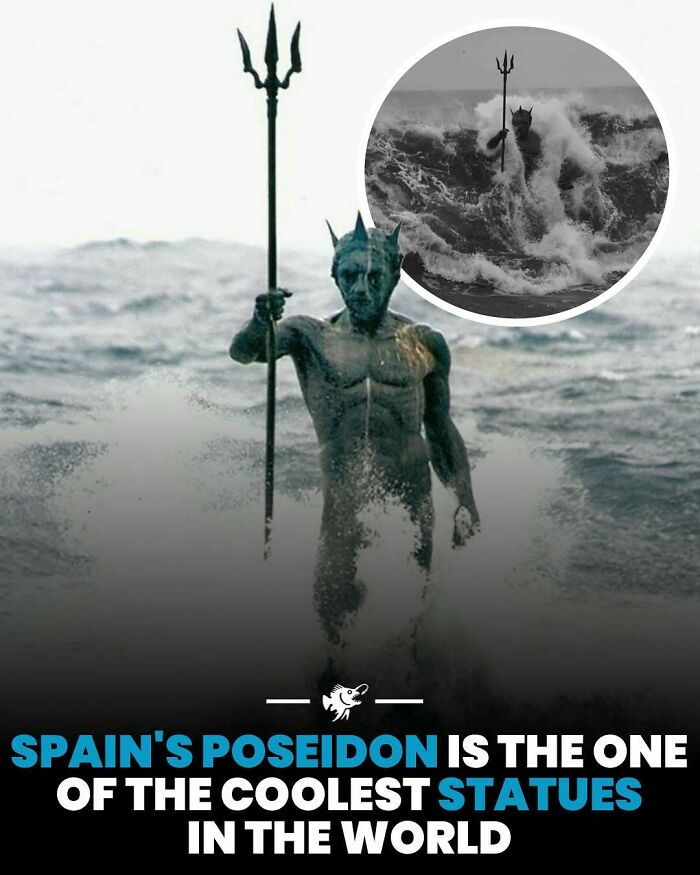
The Neptuno de Melenara is a striking bronze sculpture of the sea god Neptune, also known as Poseidon, found along the shores of Melenara Beach in Gran Canaria, Spain. Designed by artist Luis Arencibia, the statue towers at about four meters and features Neptune gripping his iconic trident—representing the island’s strong ties to the ocean. Positioned atop a rugged sea rock, the figure seems to rise straight from the water, serving as a powerful symbol of Gran Canaria’s enduring relationship with the sea and the people who have long lived in harmony with it.
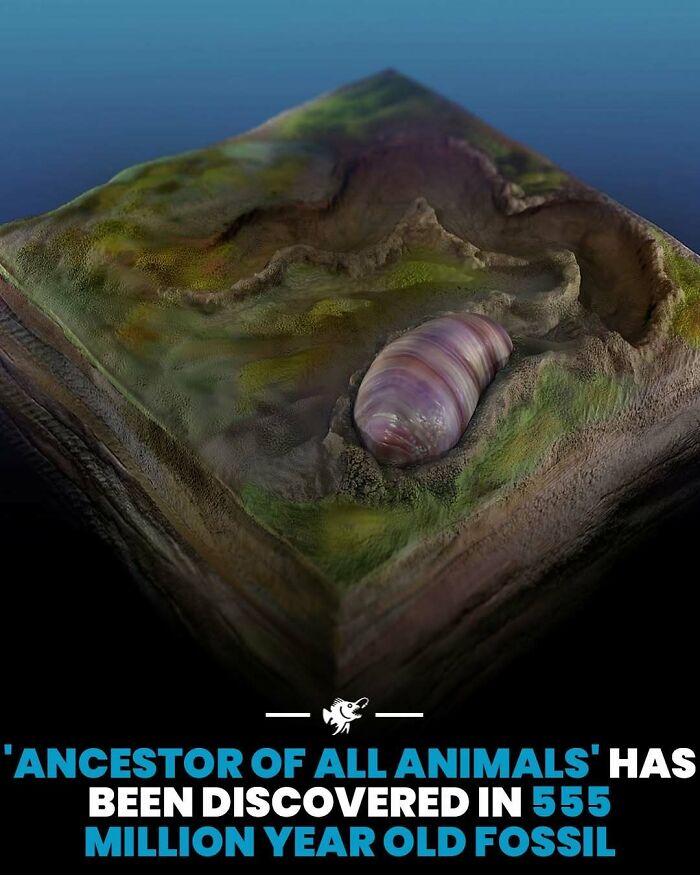
A team of geologists from UC Riverside has identified what could be the earliest known ancestor to most animals alive today—including us. Named Ikaria wariootia, this tiny, wormlike creature marks the beginning of the bilaterian lineage: animals with a front and back, two symmetrical sides, and a through-gut with openings at both ends. The discovery, published in Proceedings of the National Academy of Sciences, sheds light on a crucial step in evolutionary history. Before Ikaria, the Ediacaran Biota dominated—an ancient group of multicellular life forms like sponges and mat-like algae that came in a variety of shapes but lacked features seen in most modern animals. Even well-known fossils like Dickinsonia didn’t have key traits like a mouth or digestive system. That’s what makes Ikaria such a breakthrough—it’s the first confirmed link to the anatomical blueprint shared by most animals today.

I cannot be the only one to recognise a Zerg cerebrate in that picture, come on.


I lean towards the multiple origins for evolutionary animals theory (living organisms formed in mutiple locations along underwater volcanos or other sources so a crab would not have the same ancestor as a mammal), so it might be related or not even close, but it is old.
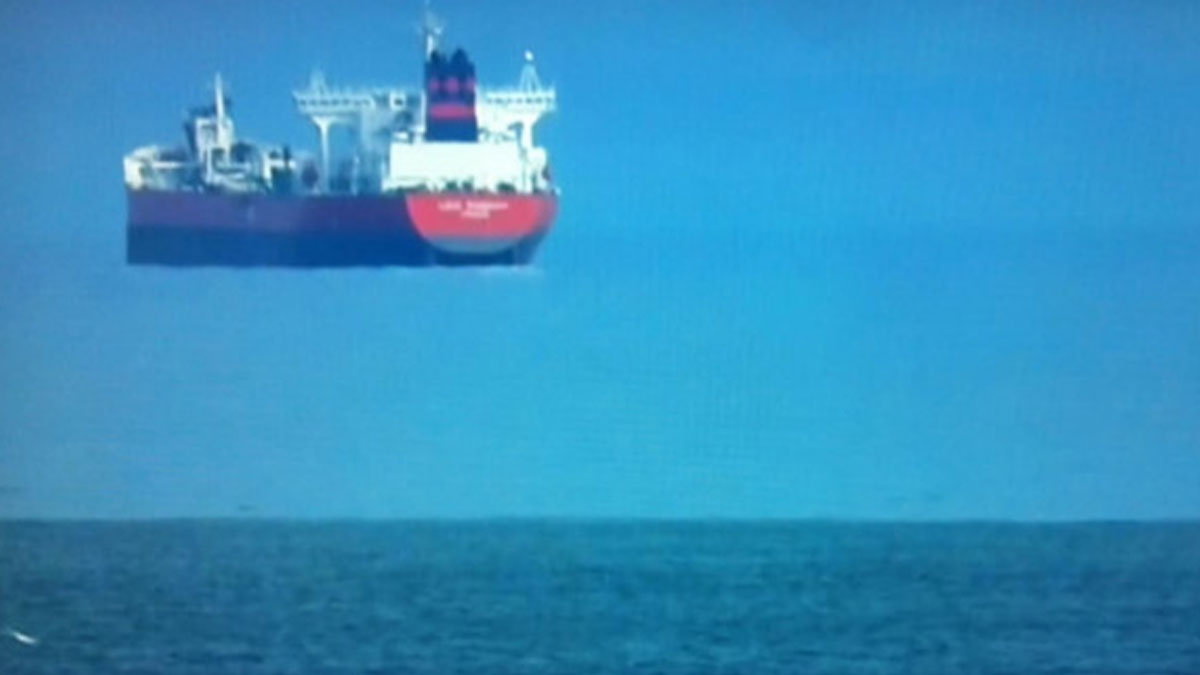
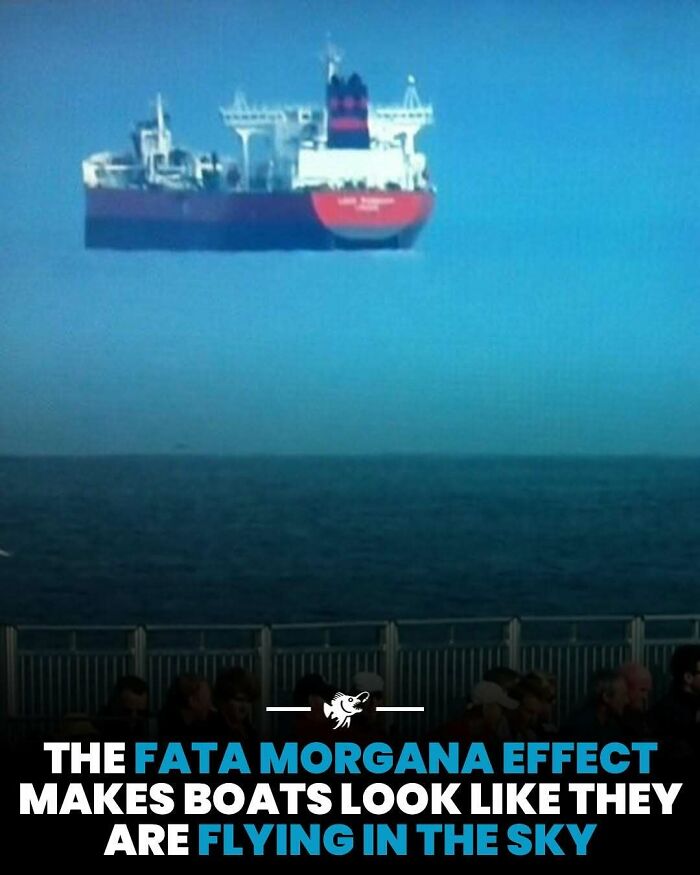
Check out this mind-bending optical illusion where ships seem to float above the ocean or twist into ghostly shapes. It’s called a Fata Morgana—a rare type of mirage caused by layers of air at different temperatures bending light in strange ways. Often spotted over calm seas or in polar regions during a temperature inversion, this natural trick can make distant boats look like they’re hovering, stretched, or even stacked on top of each other.
This is what happens when you hit the turbo boost button.
I took a pic at the beach that made my nephew look like he was floating too. 😁 mirage-68d...4eb95e.jpg 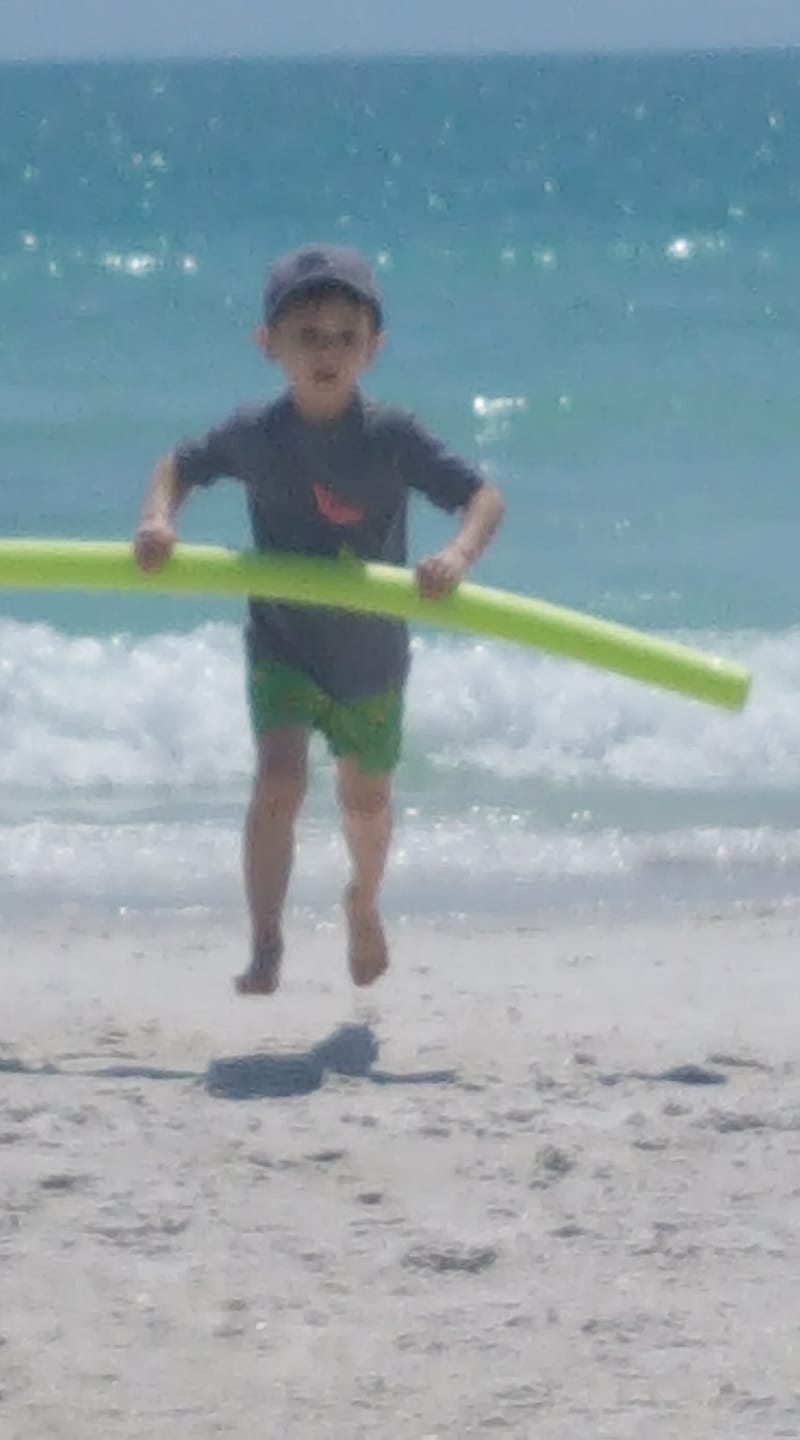
In parts of SW Lake Michigan near Holland Michigan in spring, this effect reflects the Chicago skyline 50 miles away as if it's just on the horizon.
Oh, I would *love* to have a photo of that with the IJN Yamato! (I know, I know. Curse you, reality!)

Is well known to be seen in the "Strait of Messina" (the Tyrrhenian Sea between Sicily and Calabria- where I was born ;-).
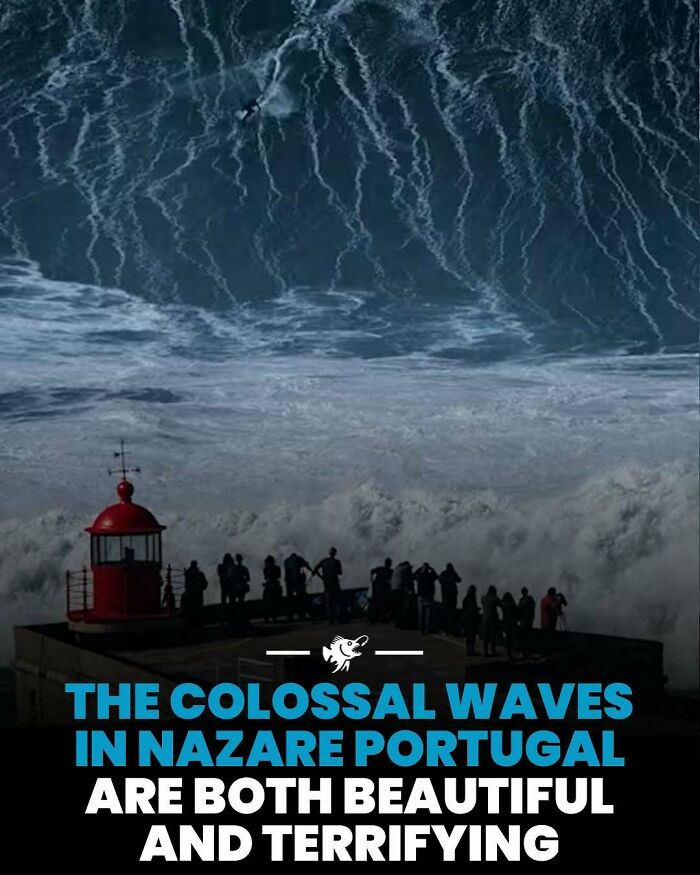
Nazaré, Portugal, has earned global fame as a hotspot for record-breaking waves, drawing elite surfers from around the world. These towering walls of water—some of the biggest ever surfed—are made possible by the Nazaré Canyon, a massive underwater trench just off the coast. This natural formation plunges to depths of around 5,000 meters and stretches roughly 230 kilometers, funneling and amplifying ocean swells as they approach shore. The result? Some of the most powerful and awe-inspiring surf conditions on the planet.
There’s a great documentary about the first big wave surfers to go there called 100ftvwave
It's fiction, of course, but Alan Dean Foster wrote a short story, called "Surfeit", about surfing a monster wave on an alien planet. IIRC, I found it in an anthology, and it's not until the end that you find out the monster being ridden is a wave.
Load More Replies... I always wondered why when i was young, my parents and i never went to Nazaré beach, always Figueira da Foz. I've seen the beach in Nazaré, was really empty. Now I know its almost just for surfers
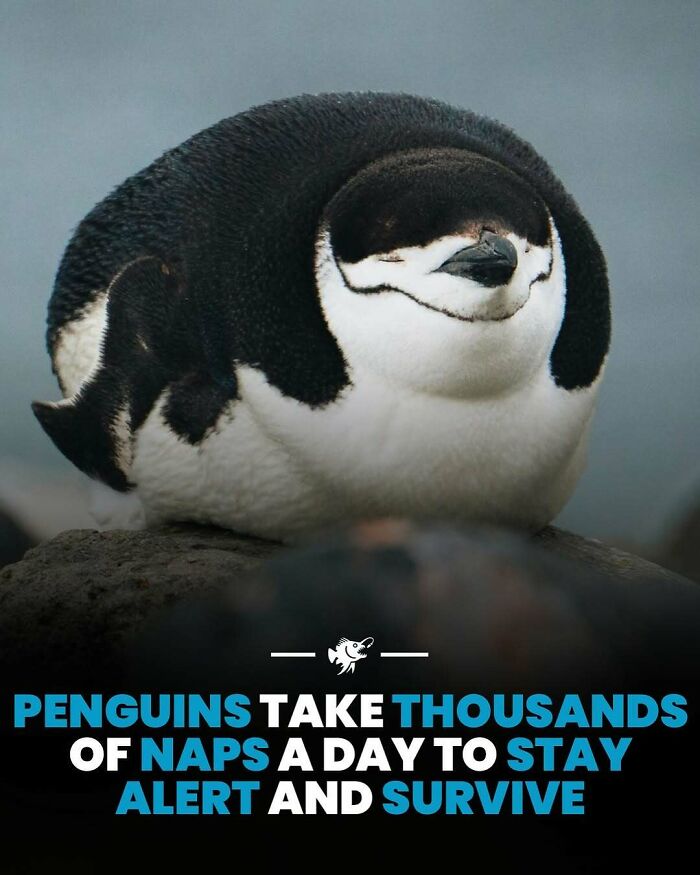
Chinstrap penguins (Pygoscelis antarcticus) have developed a unique sleep pattern, taking over 10,000 brief naps daily, each lasting approximately four seconds. This behavior allows them to accumulate about 11 hours of sleep per day while remaining vigilant against predators and aggressive neighbors in their noisy and crowded breeding colonies.  Researchers studied 14 nesting chinstrap penguins on Antarctica’s King George Island by attaching data loggers with electrodes to monitor brain activity. The findings revealed that these microsleeps often involve unihemispheric sleep, where one brain hemisphere rests while the other remains alert. This adaptation enables the penguins to protect their offspring and maintain awareness of potential threats in their environment. 

How many seconds are there in a day? - 86.400. 4 seconds x 10.000 =40.000. So the math checks out. Confidently wrong is a funny thing StrangeOne
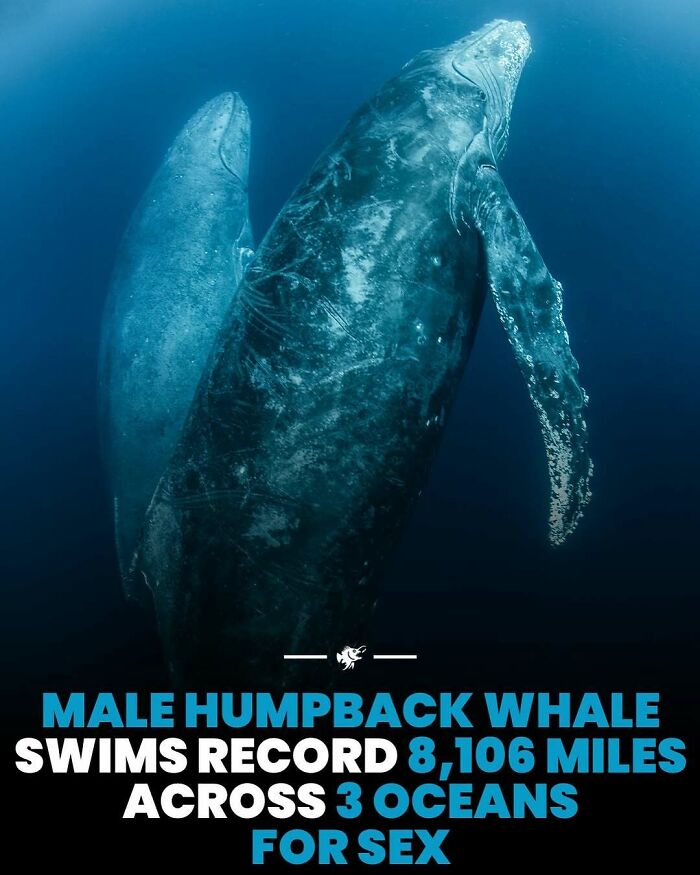
Load More Replies... Migration is a test of endurance, but one male humpback whale set a record-breaking journey for love. This whale traveled across three oceans, from the eastern Pacific to the Indian Ocean, eventually reaching the coast of Zanzibar. This remarkable voyage is the longest great-circle distance ever recorded for a humpback whale, linking breeding grounds in the eastern Pacific with those in the southwest Indian Ocean. Scientists believe the whale made the journey to expand its chances of finding a mate, navigating ocean currents and interacting with other humpback groups along the way. Ted Cheeseman, a study co-author, described the discovery as “exciting” and initially difficult to believe.

And I would swim 4,053 miles and I would swim 4,053 more just to be the humpback who swam 8,106 miles to knock boots on the ocean floor...do doot do
Load More Replies... "Hey baby! I just swam three oceans just to be with you, so why not let me show you why I am called a spērm whale!"
I wish someone could just walk a few 100 metres to see me ... for whatever.

almost every man I know would be ready to behave like Male Humpback Whales do, just for free snuggles and free h*****g.
Did they censor hugging or húmping? Apparently, the latter, based on this test.
Load More Replies...
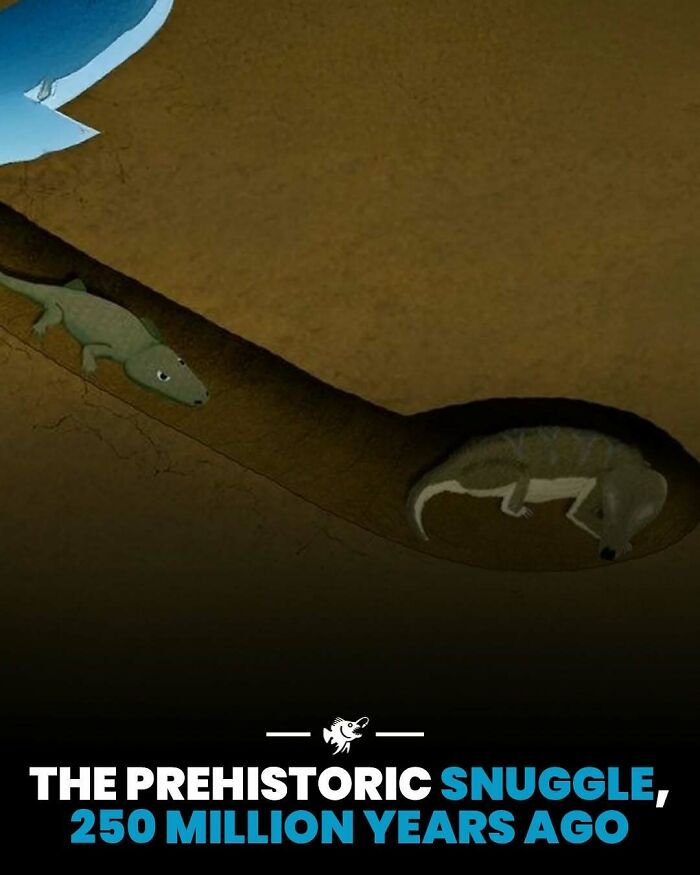
Roughly 250 million years ago, in the wake of Earth’s deadliest mass extinction event, a wounded amphibian called Broomistega sought refuge—finding an unlikely companion in the process. As volcanic eruptions released massive amounts of carbon dioxide, the planet’s temperatures soared, oceans turned acidic, and life on Pangea was devastated. Around 70% of land species vanished, and marine life was nearly erased. Desperate for shelter, the injured Broomistega wriggled into a snug underground burrow already occupied by a snoozing Thrinaxodon—a small, fox-sized reptile that would eventually evolve into mammals. Scientists examining their fossilized remains noticed two small punctures on the Broomistega but confirmed they didn’t match the Thrinaxodon’s bite. The amphibian’s broken ribs were already starting to heal, which hinted it wasn’t attacked by its burrow-mate. Experts also dismissed the idea that Broomistega had been swept in by water—its route into the den was too narrow for that. Instead, this odd duo shared a quiet, if temporary, peace. Their story ended when a surge of mud flooded the burrow, burying both creatures side by side as they rested.
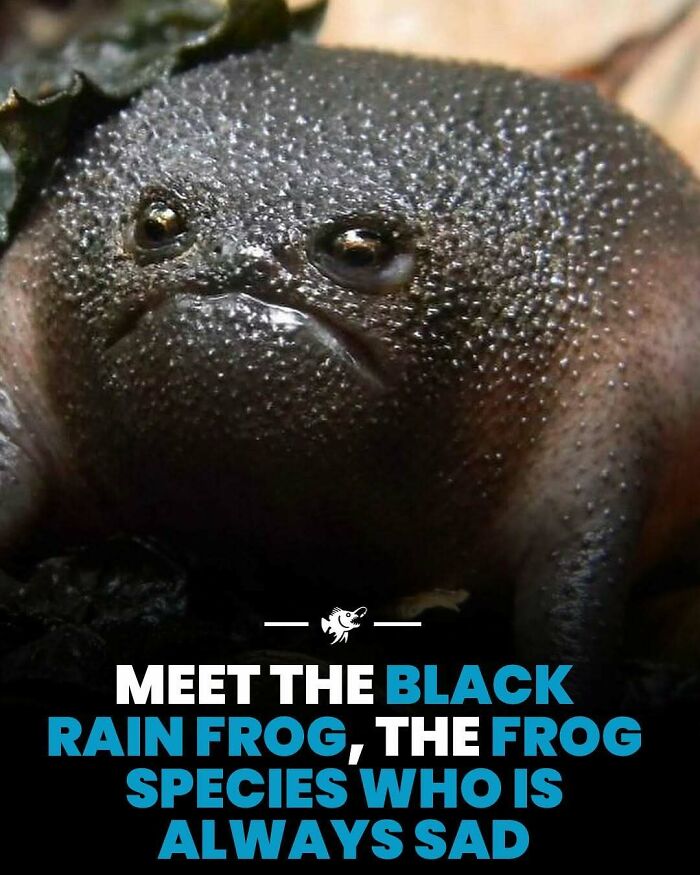
The black rain frog, a small amphibian native to South Africa’s southern coast, is known for its permanently grumpy expression. Found at elevations above 3,300 feet, this burrowing species thrives in dry environments by digging tunnels up to six inches deep, which help it retain moisture and stay protected from predators. Unlike many frogs, the black rain frog does not depend on open water to survive. Instead, it remains underground for much of its life, emerging mainly during rainy conditions. Its distinctive frown and solitary nature have made it a favorite among animal enthusiasts, adding to its unique charm.

It reminds me of the Alpha dragon in the second How to Train your Dragon film.

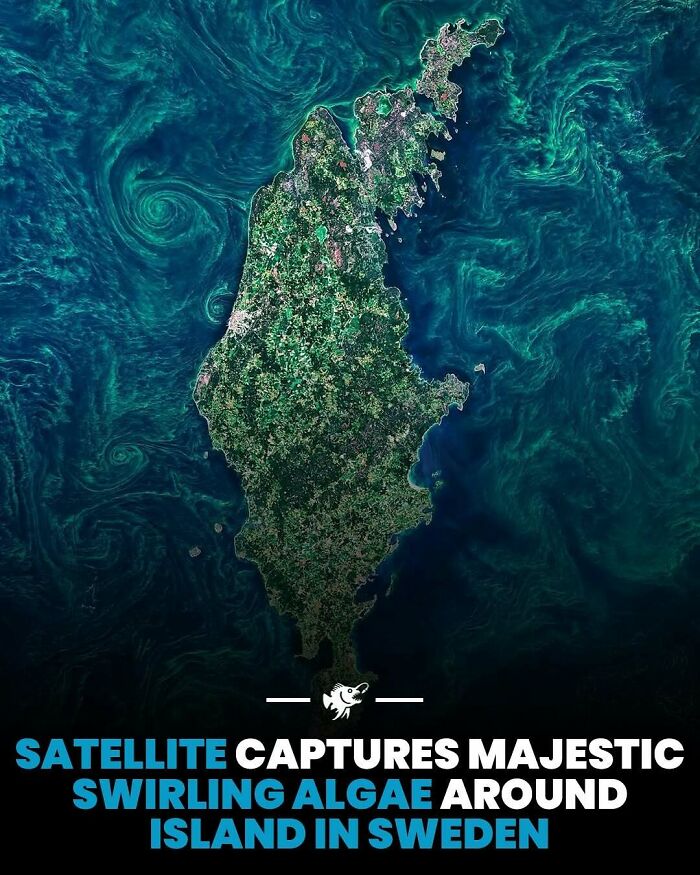
Each summer, the Baltic Sea—especially near Sweden’s largest island, Gotland—transforms with vibrant, swirling green patterns caused by algal blooms. These stunning formations are made up mostly of cyanobacteria, often referred to as blue-green algae. While visually captivating from above, these blooms are also a reminder of changing environmental conditions, as they’re often fueled by rising temperatures and nutrient runoff. Still, their otherworldly appearance offers a unique view of nature’s patterns in motion.
River Monsters, one of Animal Planet’s most popular shows, concluded after nine seasons because host Jeremy Wade had reportedly caught nearly every exceptionally large or dangerous fish. With no more “monsters” to uncover, the show ran out of new challenges to pursue.
Now Cyril Chauquet catches all the river and sea monsters. His show is similar to Jeremy Wade's.
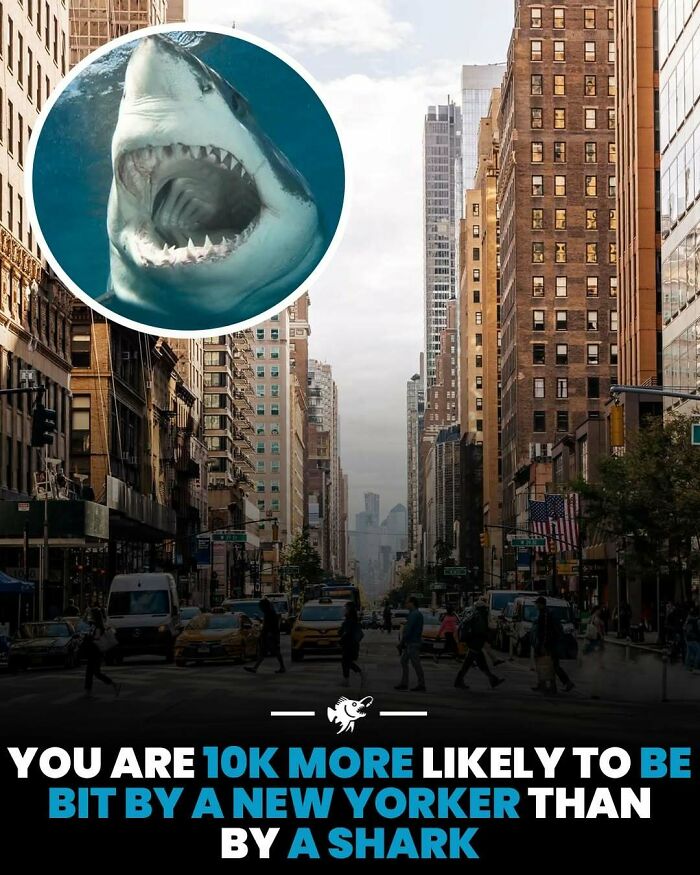
10x*** In 2024, there were 47 confirmed cases of unprovoked shark bites worldwide. For perspective, when the New York City Department of Health tracked human bite incidents in 1977, they recorded a staggering 892 cases in a single year. That means you’re more than 10 times more likely to get bitten by a New Yorker than by a shark. Stay alert out there!
Good thing I'm not planning on swimming in shark-infested waters or visiting NYC ever again. I figure my odds at never being bitten by either have vastly increased in my favour.

You could run into a swimming New Yorker in the wild.
Load More Replies... 
Ive been bitten by several sharks. Of course only two drew blood, but they have teeth and I wanted my hook back. This statistic doesn't take small sharks (3-4ft) into account most of the time.
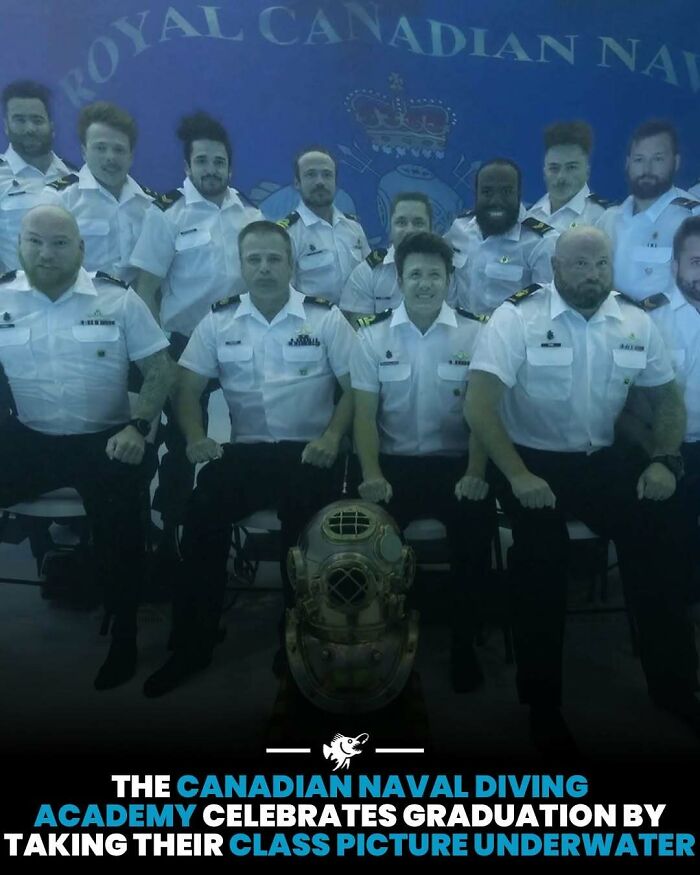
To capture a truly unforgettable underwater photo, a group of sailors went all in—suiting up in full uniform, setting up a giant flag and an antique diving helmet as props, and attempting to pose in neat, military-style rows. The plan was to get everyone seated and still long enough to snap the perfect shot beneath the surface. But staying down was easier said than done. The buoyancy kept pushing them up, and balancing in the chairs proved nearly impossible. In some outtakes, you can even spot participants holding each other down, trying to stay in formation. Eventually, they found a solution: filling their pockets with eight pounds of weights each to anchor themselves long enough to nail the shot. The result? A one-of-a-kind image made possible by teamwork, determination, and a whole lot of creative problem-solving.
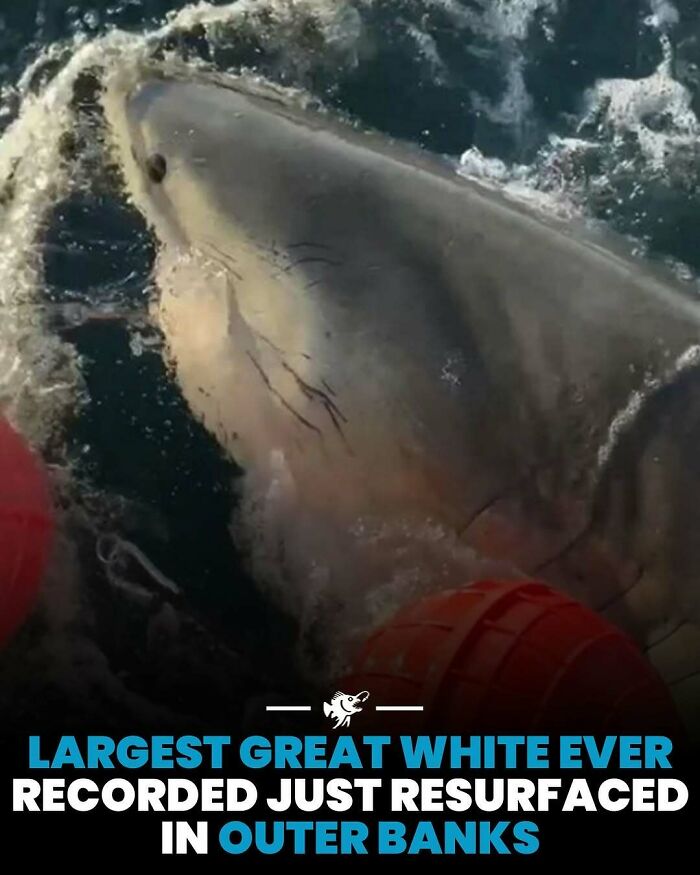
The largest great white shark ever documented in the Atlantic is drawing attention off North Carolina’s coast. Named Contender, this 14-foot, 1,653-pound apex predator was originally tagged in January near Florida before vanishing from trackers for several weeks. He has since reappeared, offering scientists a rare opportunity to monitor his movements. At roughly 30 years old, Contender is contributing critical data to marine research. Scientists hope tracking his migration patterns will help protect vital shark habitats and shed light on the species’ behavior and range. For the curious, his journey can be followed in real-time via OCEARCH’s shark tracker.
Another load of poppycock. Great White Sharks grow FAR bigger than this, and often the females.
There are definitely longer Great Whites, but this one is exceptionally heavy for its length.
Load More Replies...

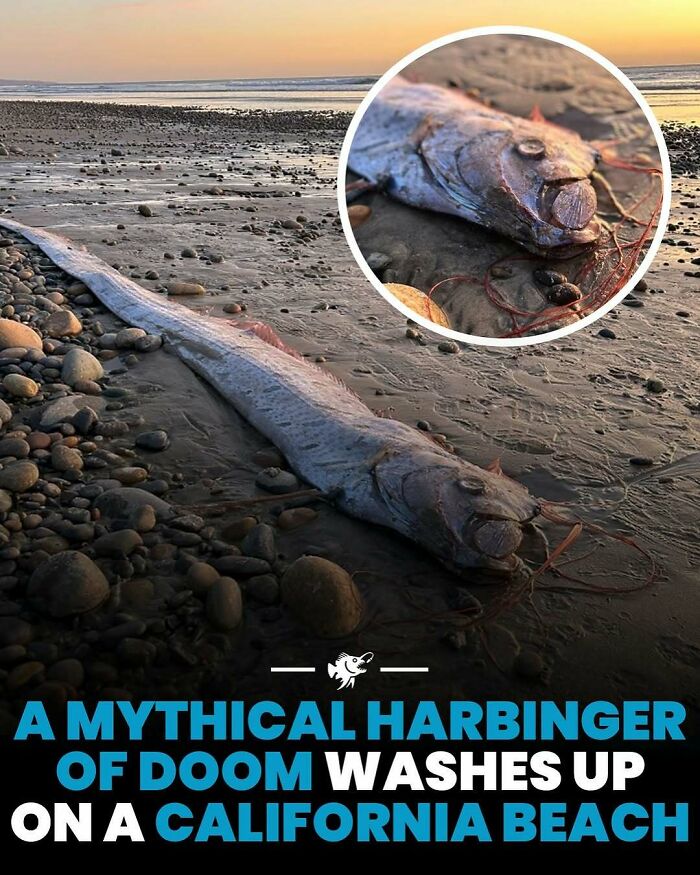
The legendary “doom fish,” a rare deep-sea oarfish, has resurfaced in California, fueling fascination and mythological intrigue. Last week, a nearly 10-foot-long oarfish was discovered on a beach in Encinitas by Alison Laferriere, a PhD candidate at the Scripps Institution of Oceanography at UC San Diego. This marks the second sighting of the elusive creature in California this year. Oarfish, capable of growing up to 20 feet long, usually reside in the mesopelagic zone, up to 3,300 feet below the ocean’s surface. Their immense size and peculiar appearance have inspired centuries of legends, earning them the nickname “doomsday fish” due to their association with natural disasters or earthquakes. Rarely seen alive, these deep-sea giants remain a source of mystery for both scientists and storytellers.

The most recent oarfish to wash ashore near California was November 2024; edit: not last week.
Nothing on Bored Panda is ever current, darling! Surely you must know this. 😉
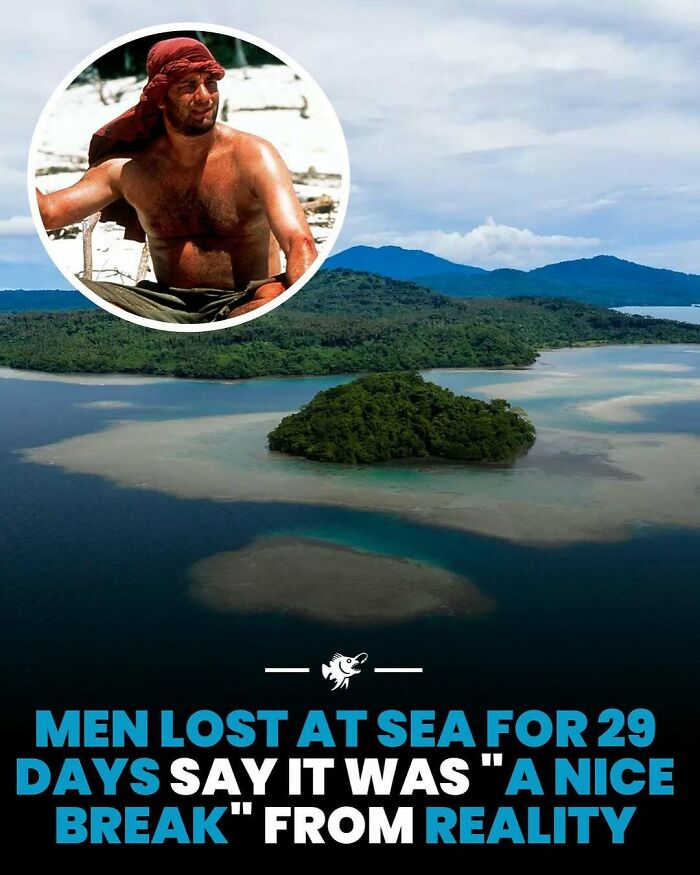
Load More Replies...In 2021, two men found themselves lost at sea for 29 days after their small boat was blown off course by a storm. Initially planning to travel 200km south to Niro on New Georgia Island, they turned off their engine to conserve fuel when bad weather struck. However, strong winds and heavy rain pushed them 400km northwest, leaving them stranded far from home. Surviving on a small sack of oranges, coconuts they found floating in the sea, and rainwater collected on their boat, the men managed to endure the ordeal until they were eventually rescued. Reflecting on the experience, one of them remarked, “We didn’t know where we were, but we didn’t expect to be in another country,” before adding, “I look forward to going back home, but I guess it was a nice break from everything.”
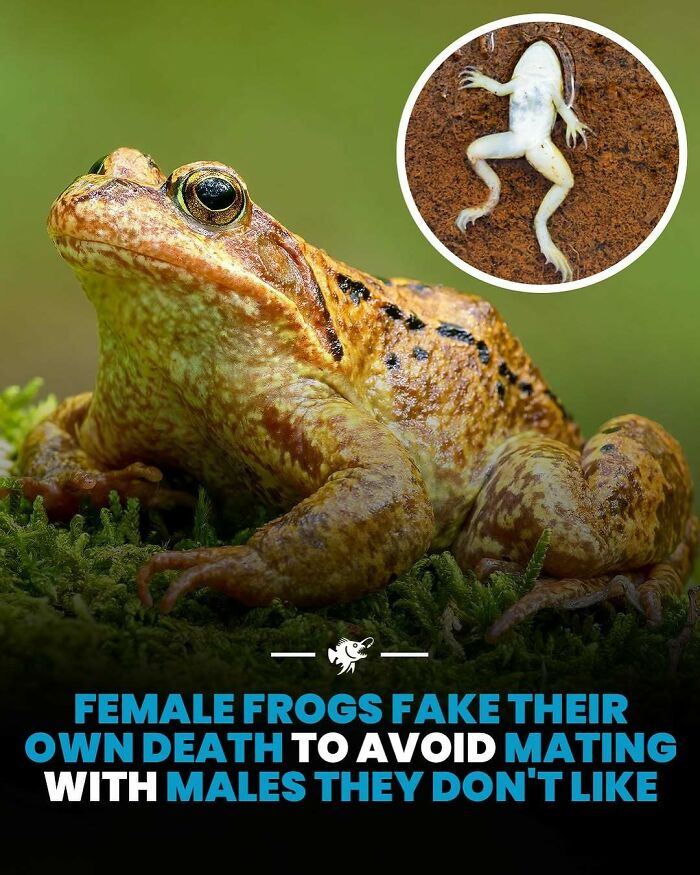
Female frogs have been observed using a range of strategies to avoid unwanted mating, including rolling away, emitting distinctive grunting sounds, and even feigning death. These behaviors help them fend off persistent males and maintain control over their mating choices. Scientists believe these tactics are crucial for female frogs to ensure mating occurs only when they are ready or with suitable partners, highlighting the evolutionary adaptations in their reproductive behavior.
Mavis? You okay? Oh no! Mavis has died just as I was about to mount her!
So your detachable penis found its way home?
Load More Replies...
This strategy would not be effective for human females, because far too many males would not consider her being dead to be a deterrent to mating.
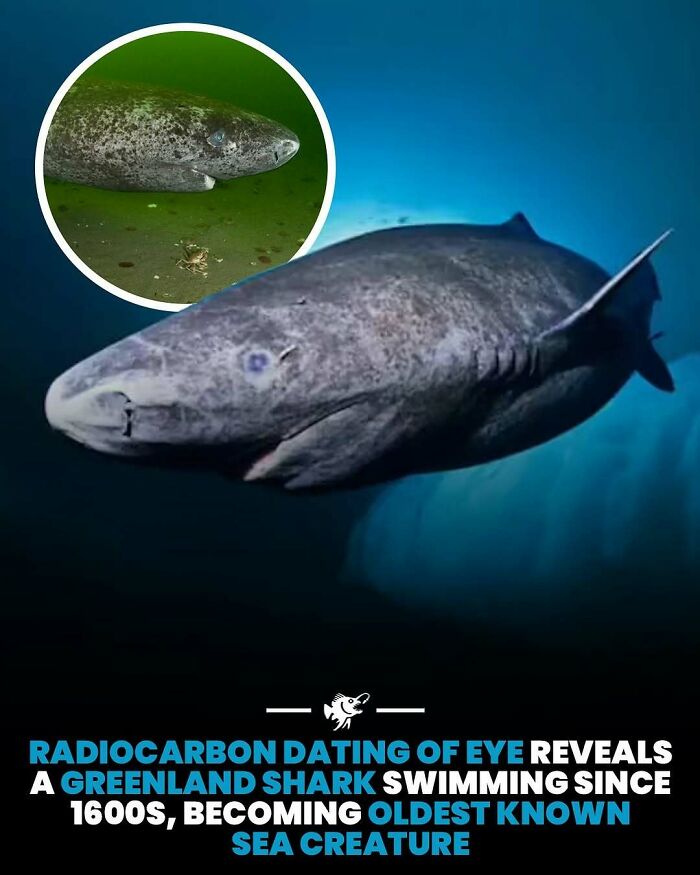
Radiocarbon dating has revealed that a female Greenland shark has been alive since the 1620s, making her the oldest known vertebrate on Earth. These slow-moving Arctic giants grow just 1 centimeter per year and don’t reach sexual maturity until around 150 years old. The finding, published in Science, has stunned researchers and reshaped our understanding of vertebrate lifespans. It also highlights how little we truly know about deep-sea ecosystems—especially as climate change continues to disrupt life in our oceans.
Not exactly: "The team looked at 28 sharks, most of which had died after being caught in fishing nets as by-catch. Using this technique, they established that the largest shark - a 5m-long female - was extremely ancient. Because radiocarbon dating does not produce exact dates, they believe that she could have been as "young" as 272 or as old as 512. But she was most likely somewhere in the middle, so about 400 years old. It means she was born between the years of 1501 and 1744, but her most likely date of birth was in the 17th century."
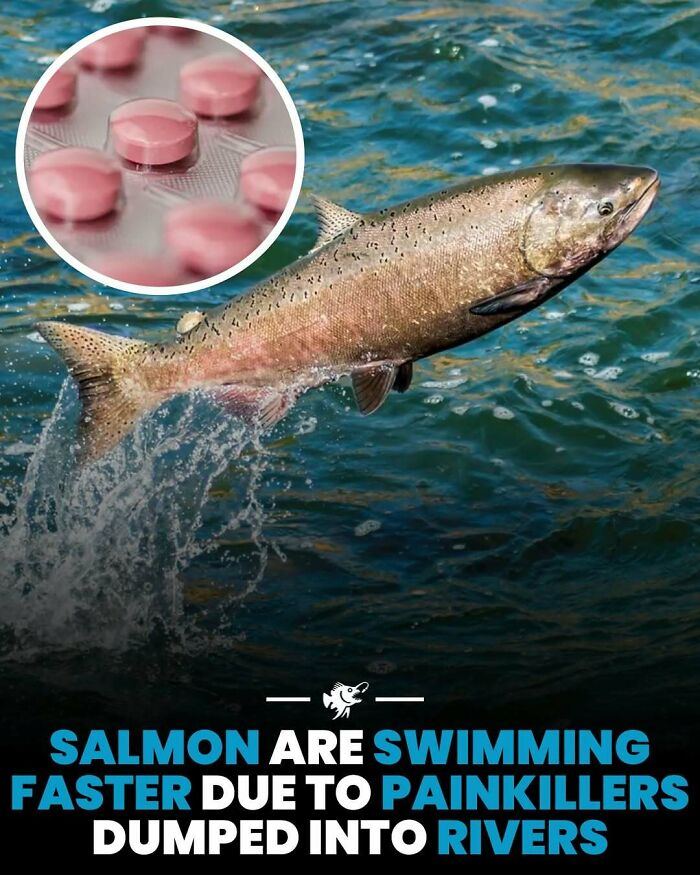
Load More Replies...A recent study led by the Swedish University of Agricultural Sciences has revealed that pharmaceutical pollutants, particularly psychoactive drugs like clobazam and tramadol, are altering the behavior of juvenile Atlantic salmon. These substances, commonly found in waterways due to inadequate wastewater treatment, have been shown to increase the swimming speed and migration success of salmon by influencing their brain function and behavior. The research, conducted in Sweden’s River Dal, demonstrated that clobazam exposure shortened the time it took for salmon to navigate through hydropower dams and increased their likelihood of reaching the sea. However, scientists caution that such changes to natural behavior could have broader ecological consequences, potentially disrupting predator-prey dynamics and the overall health of aquatic ecosystems.  Experts emphasize the need for improved wastewater treatment and the development of environmentally friendly pharmaceuticals to mitigate the impact of such pollutants on wildlife. Dr. Marcus Michelangeli from Australia’s Griffith University highlighted the growing threat of pharmaceutical pollution, noting that over 900 different substances have been detected in waterways globally. The study underscores the importance of addressing this invisible yet significant form of pollution to protect aquatic life and maintain ecological balance.
I worked on a sampling project that was commissioned by the EU that tested the level of a swathe of chemicals and hormones across influents, effluents and river waters around water treatment plants. Some of our medicines pass through us, then through treatment plants and then onwards into watercourses, obviously they end up in the animals that live in and around those areas. The impact of thousands of medicines, HRT and the likes is something that we don’t consider anywhere near enough.
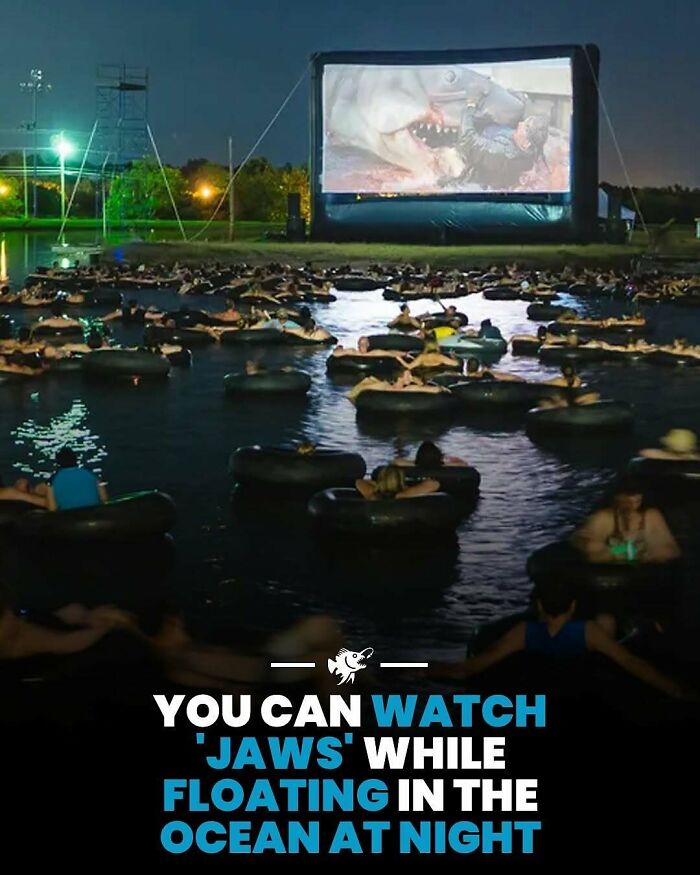
The Volente Beach Resort and Beachside Billy’s in Texas offers a unique thrill for adventurous moviegoers by screening Jaws on the water at night! Would you dare to watch this classic shark film while floating on the water—and who would you bring along?
That looks lovely but me, my thalassophobia and my anxiety already have something planned, sorry !


I'd rather do this than lie around in Central Park at night, if the post above with the number of human bites in New York is true.
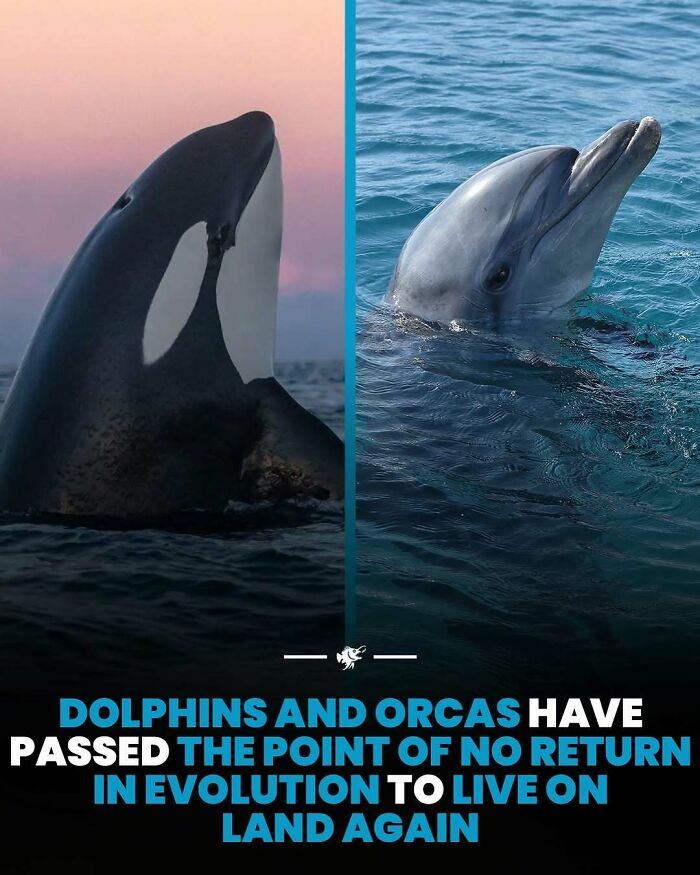
A study published in Proceedings of the Royal Society B in July 2023 reveals that marine mammals such as dolphins and orcas have reached an evolutionary point where returning to terrestrial life is no longer feasible. These species, whose ancestors once lived on land, have developed specialized adaptations for aquatic environments, including increased body size for thermal regulation, carnivorous diets to support high metabolism, and anatomical modifications enhancing swimming and diving capabilities. These irreversible changes align with Dollo’s law, which posits that evolution is unidirectional and organisms cannot revert to ancestral forms.  The study, led by Bruna Farina from the University of Fribourg, analyzed over 5,600 mammal species, categorizing them based on their dependence on aquatic habitats. Findings indicate a critical threshold between semi-aquatic and fully aquatic mammals; once species become fully aquatic, their evolutionary adaptations prevent a return to land. This specialization renders cetaceans particularly vulnerable to environmental changes such as climate change and ocean pollution, as their survival is intricately linked to the health of marine ecosystems. 

"These irreversible changes align with Dollo’s law, which posits that evolution is unidirectional and organisms cannot revert to ancestral forms." Which is true, but they wouldn't need to 'devolve' to their ancestral form, they'd just have to evolve along a line that takes them from fully-aquatic to amphibious to land-living.
They constantly try, but people keep pushing them back into the sea 😁😉
this is dubious. fish continued to evolve, and became land animals. evolution can go in any direction, even for whales.
Scientists exploring Kentucky’s Mammoth Cave—the world’s longest cave system—have discovered the fossilized remains of a previously unknown ancient shark species, Macadens olsoni. Smaller than a foot in length, this 340-million‑year‑old predator possessed a distinctive curved “tooth whorl,” ideal for crushing mollusks and worms. Found within the Mississippian-era Ste. Genevieve Formation, the shark’s discovery highlights the rich paleontological treasures hidden beneath our feet and underscores the importance of preserving such sites for scientific discovery and education.
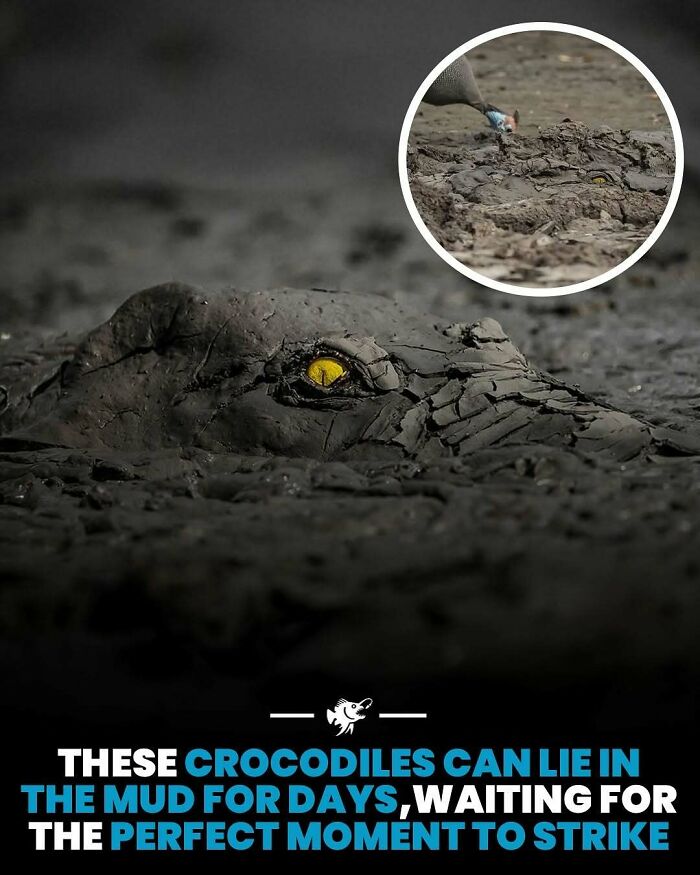
In the wild, danger often hides in plain sight—or just beneath it. 👁️🐊 Crocodiles can remain buried in cracked, dry mud for days, blending seamlessly into their surroundings. They don’t move, don’t flinch—just wait. Their patience is a weapon. Their stillness, a tactic. In nature, it’s not always the fastest or loudest that survives—it’s the one you never saw coming.
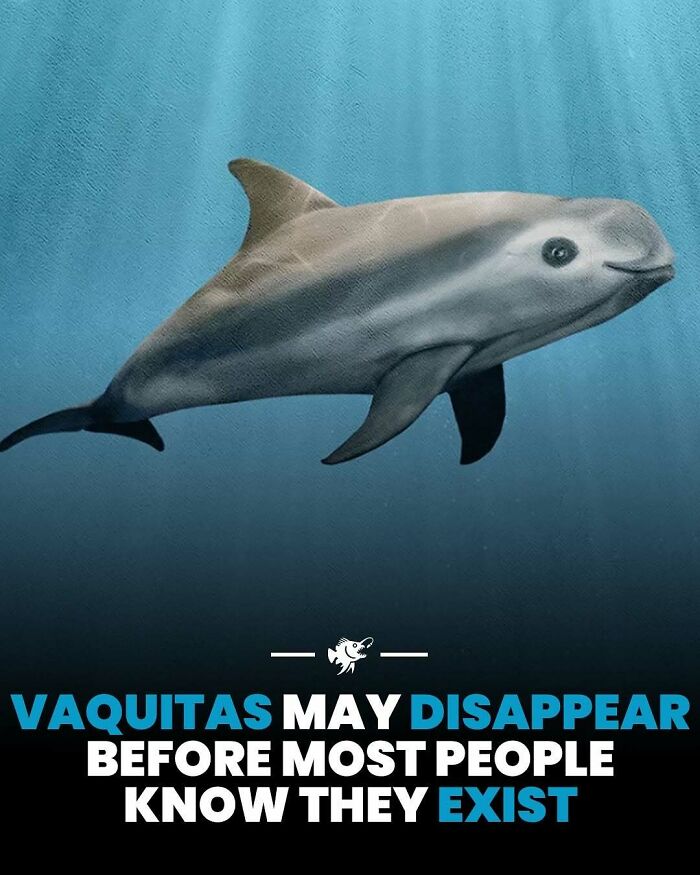
The vaquita, a small porpoise species endemic to the northern Gulf of California in Mexico, is the smallest living cetacean, with females reaching up to 150 cm (4.9 ft) and males up to 140 cm (4.6 ft) in length. Listed as Critically Endangered by the IUCN Red List, the vaquita is on the brink of extinction. Its sharp population decline is mainly attributed to bycatch in gillnets used for the illegal Totoaba fishery, which targets the swim bladders of Totoaba fish for high-value markets.
"Traditional" medicine has a lot to answer for. Now, if people using it lived to 200 plus years old I might be a little less sceptical...
So few left they are pretty much past the po int of no return. This is a rare occasion where captive breeding might actually help save a species.

They refuse to mate in captivity and die if you try to keep them.
Load More Replies... full size dolpins pursue eat vaquitas. we still need to ban gill nets anyway, though
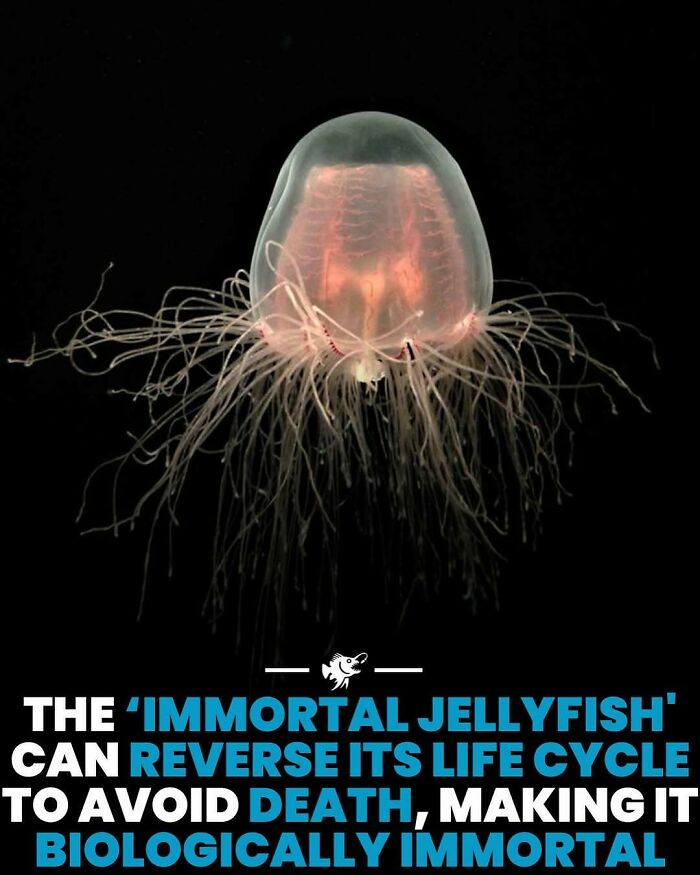
The Turritopsis dohrnii, commonly known as the “immortal jellyfish,” is the only species scientifically recognized as biologically immortal. Unlike most creatures, it can revert to its juvenile polyp stage after reaching adulthood, essentially restarting its life cycle instead of dying. This unique process, known as transdifferentiation, allows its cells to transform into different types, enabling continuous renewal. While this remarkable ability suggests theoretical immortality, in nature, the jellyfish still faces threats from predators and disease. Interestingly, its life cycle reversal has been extensively documented in laboratory conditions but remains unconfirmed in wild populations. Scientists continue to study this species for insights into cellular regeneration and aging.
Are you being chased by large men whose surnames start with K who have swords?
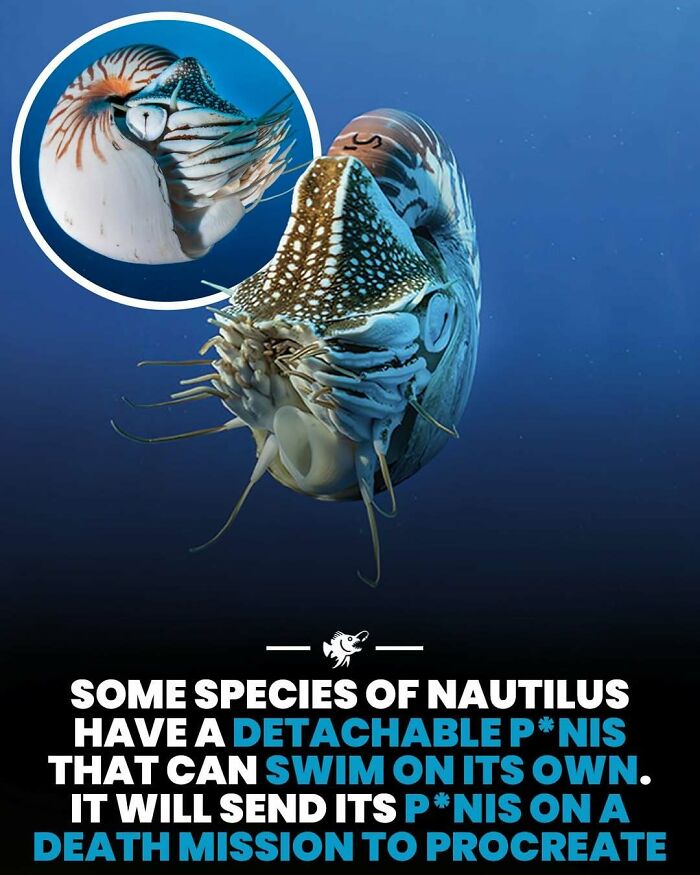
Load More Replies...In some deep-sea cephalopods, such as the Argonauta, males use a highly unusual method to reproduce—a detachable, sperm-filled arm known as a hectocotylus. During mating, the male releases this specialized arm, which swims independently toward the female using muscle movements and possibly small, fin-like motions. Guided by instinct or chemical cues, it reaches the female, delivers the sperm, and in some cases, even embeds itself in her body. This unique adaptation likely evolved as a solution to the challenges of locating a mate in the vast, sparsely populated depths of the ocean.
Hello ladies, have any of you received my detached p***s? It has gone astray.

Sorry, the cats thought it was a new toy, and now it's stuck under the fridge.
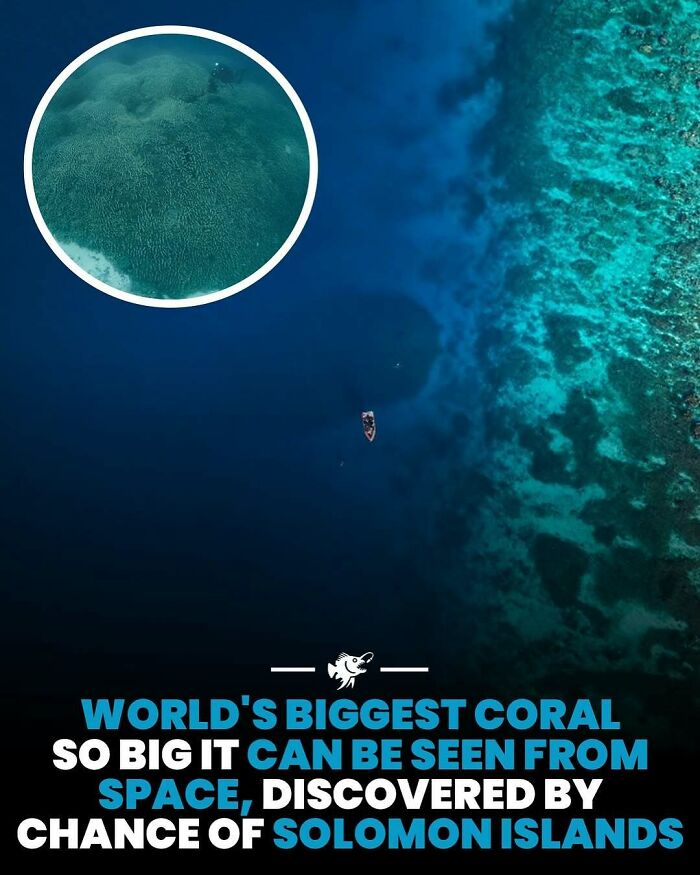
Load More Replies... In the southwest Pacific Ocean near the Solomon Islands, researchers have identified the largest coral ever documented, measuring 111 feet (34 meters) wide, 105 feet (32 meters) long, and 18 feet (5.5 meters) tall. Known as Pavona clavus, this massive, standalone coral is distinct from typical reef-forming systems and is so vast it can be seen from space. Estimated to be 300 years old, it offers a unique record of centuries of oceanic conditions. The coral was first discovered by San Félix, an underwater cinematographer with National Geographic’s Pristine Seas program, during a research expedition aboard the Argo vessel. Initially mistaken for a shipwreck, closer examination revealed a thriving ecosystem of shrimp, crabs, and reef fish living among its colorful surface. Scientists describe it as a “natural monument,” highlighting its ecological significance and emphasizing the importance of marine exploration and conservation.


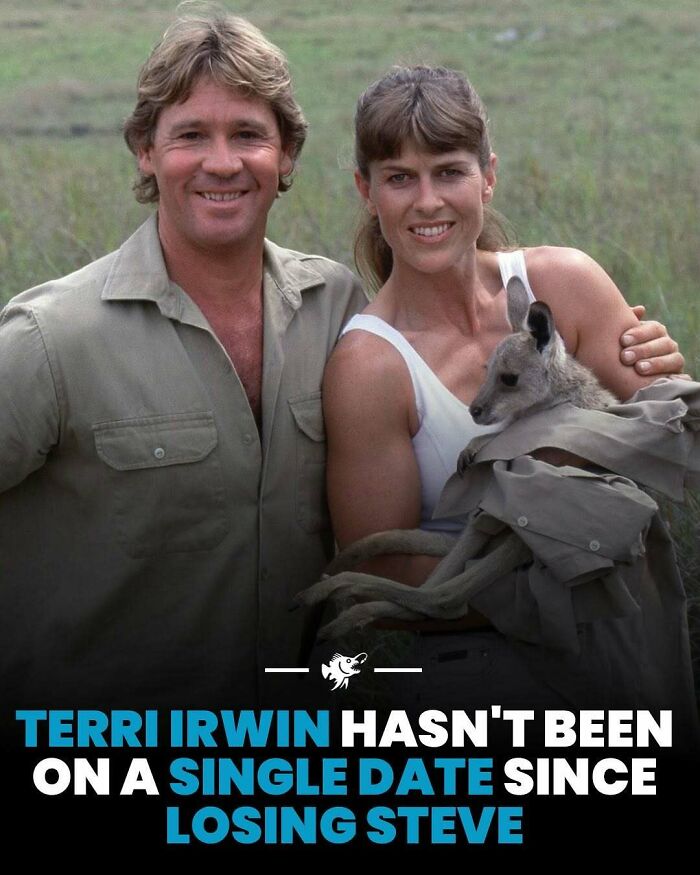
Terri Irwin, widow of Crocodile Hunter Steve Irwin, has remained single since his tragic death in 2006, stating she’s not interested in dating and already had her 'happily ever after'.
My gf and I started dating the day he passed. We have been together for 19 years. Married for 10 amd just had our first little baby 4 months ago
She's been seen out with several men since Steve's death, she just doesn't brag about it.
And is both terrifying and fascinating according to the BP heading.
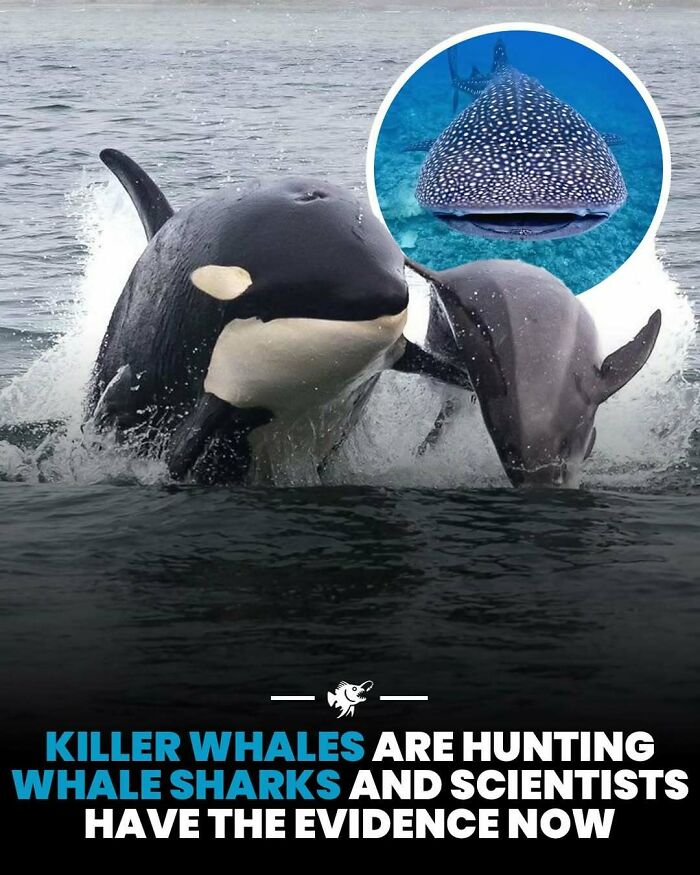
Load More Replies... Orcas have been observed hunting whale sharks—the world’s largest shark species—off the coast of Mexico, surprising scientists with their apex predator behavior. While anecdotal reports existed, this is the first documented evidence of orcas actively preying on whale sharks. According to a study in Frontiers in Marine Science, orcas target young whale sharks measuring 3 to 7 meters in the Gulf of California, using strategic hunting techniques to overpower them.
killer whales will hunt ANYTHING. they are now decimating salmon returning to spawn.


What a wonderful embarrassing example of incorrectly correcting someone. Whale sharks are absolutely sharks and sharks are absolutely fish. Human fail.
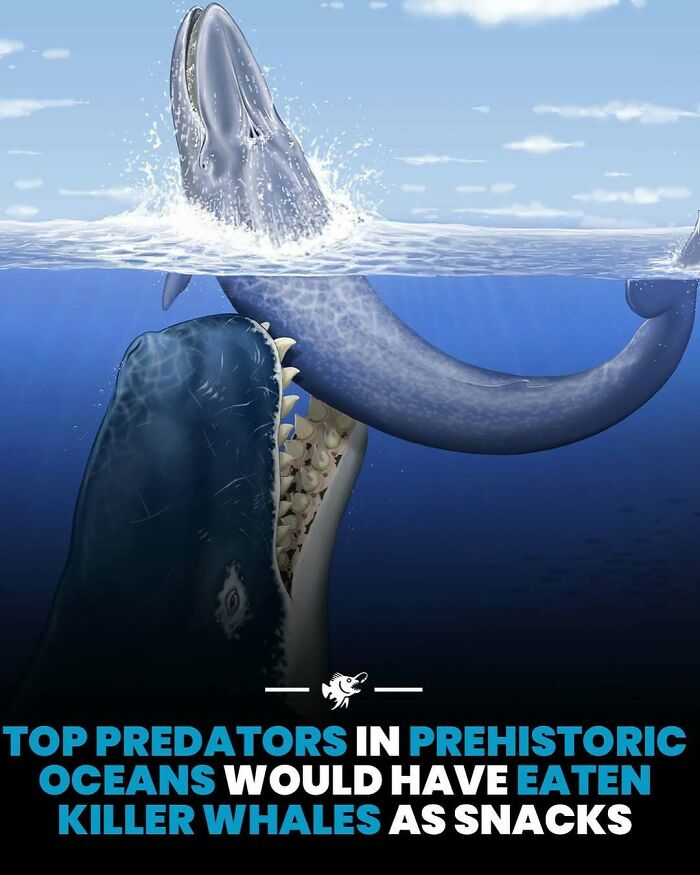
Load More Replies...Scientists have uncovered evidence that ancient marine reptiles once dominated what is now central Colombia, suggesting they were even more formidable predators than modern killer whales. Fossil discoveries indicate these massive creatures occupied an unexpectedly high position in the prehistoric food chain, challenging current understandings of ocean ecosystem evolution. Their size and hunting capabilities suggest they played a critical role in shaping marine life during the Early Cretaceous period. Paleontologists reconstructed the lives of these giant reptiles and the invertebrates that thrived alongside them in a lush, ancient ocean environment roughly 130 million years ago. The findings reveal an ecosystem that operated outside the norms of today’s seas, raising new questions about how marine predators evolved over time. This research provides a rare glimpse into a lost world where prehistoric seas were ruled by creatures far larger and more dominant than previously imagined.
The blue whale is still considered the largest animal ever to exist, so no, this giant reptile, if it ever existed - cos it's only been theorised that it might, would certainly not have preyed on them. The illustration looks more like a humpback though, certainly not an orca.
Load More Replies... That pic is so wrong it's laughable. It shows the prey animal as a Blue Whale, the largest animal that lived, being eaten by an extinct predatory whale, possibly liviatitan, NOT a prehistoric marine reptile either, none of which was large enough to swallow a Blue Whale, as they didn't reach half their length.
mega predators always lose out to more agile, efficient sized relatives.
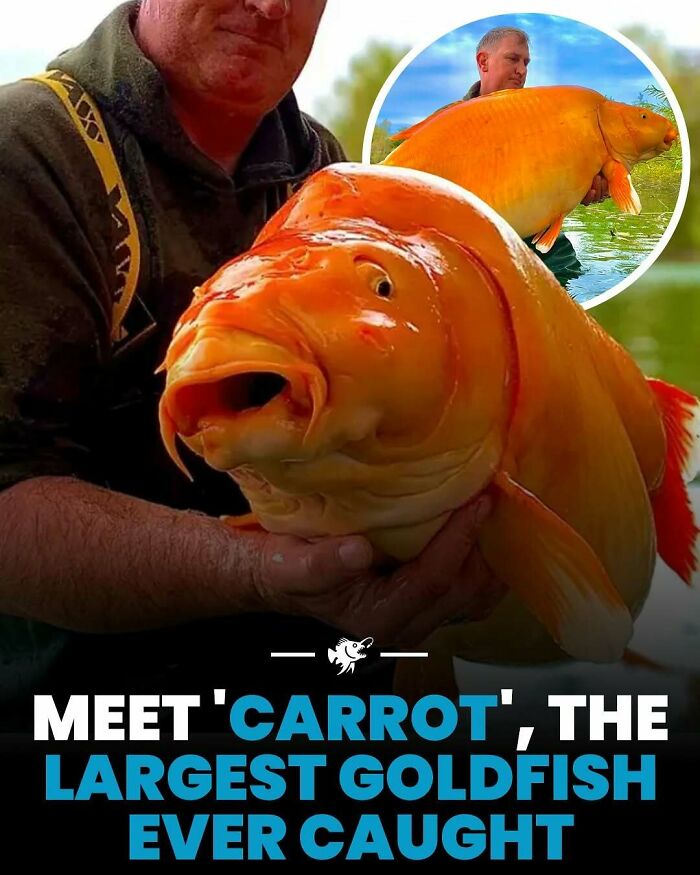
UK angler Andy Hackett made headlines after reeling in a colossal carp named “The Carrot,” weighing 67 pounds, 4 ounces (30 kilograms), at BlueWater Lakes in France’s Champagne region. Believed to be the second-largest of her type ever caught, The Carrot had been a resident of the private fishery for about 20 years, growing into a favorite challenge for anglers. After being weighed and photographed, The Carrot was promptly released back into the lake in accordance with the fishery’s “no retention” rule, which ensures fish are never carried onto land and are treated for any injuries before release. Sadly, in 2024, the legendary fish passed away in the same lake, marking the end of her remarkable story.
Scientists have uncovered signs of a massive underground ocean buried about 700 kilometers (430 miles) beneath Earth’s surface—one so vast, it could rival the size of the oceans we know today. Trapped inside a mineral called ringwoodite, this hidden reservoir is shaking up long-standing theories about where Earth’s water came from. Instead of arriving via icy comets, this discovery supports the idea that ocean water may have gradually emerged from deep within the planet itself. Researchers used data from 2,000 seismographs and over 500 earthquakes, noting how seismic waves slowed down as they passed through water-rich rock. That shift led scientists to conclude there’s likely an enormous ocean hidden far below our feet.
I am lucky enough to have invested in a time share beach front property on this ocean.
Be careful walking the beach as I'm sure Mike Huckabee has a unit there too and will call the cops.
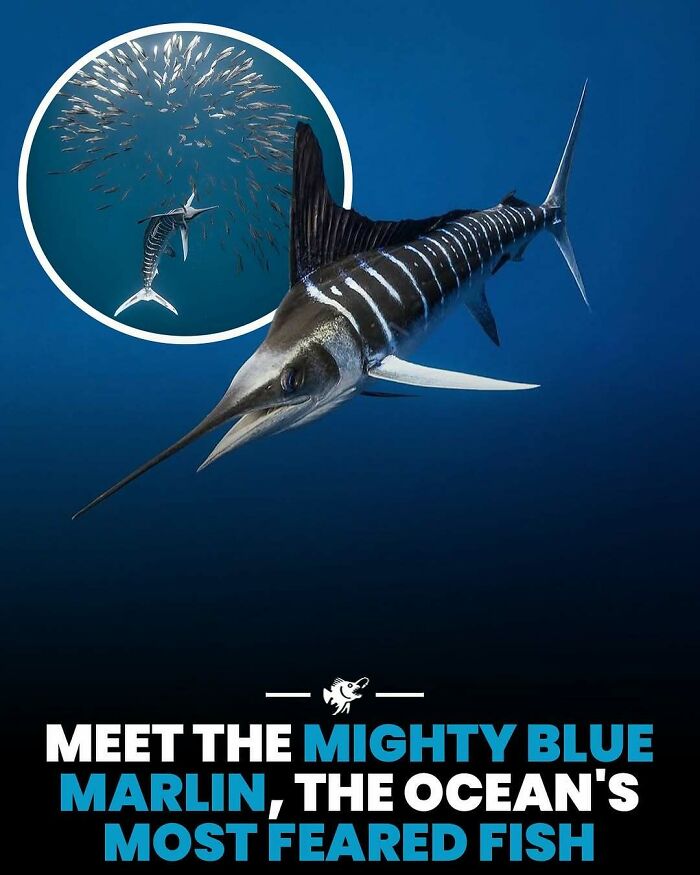
Load More Replies... The Blue Marlin cuts through tropical seas like a missile—sleek, fast, and fearsome. With its sword-like bill and dazzling cobalt-blue back, it’s one of the ocean’s most iconic apex predators, built for speed and raw power. Capable of leaping from the water and hitting speeds over 60 mph, it’s a prized catch and a symbol of the untamed deep. But this majestic giant is under threat. Decades of commercial overfishing and declining habitats have landed the Blue Marlin on the vulnerable species list. Its survival isn’t just about preserving a single fish—it’s about keeping the ocean’s delicate food web intact.
marlin fry (juveniles) are being killed by the thousands in gill nets.
Google image check says it's a striped marlin.
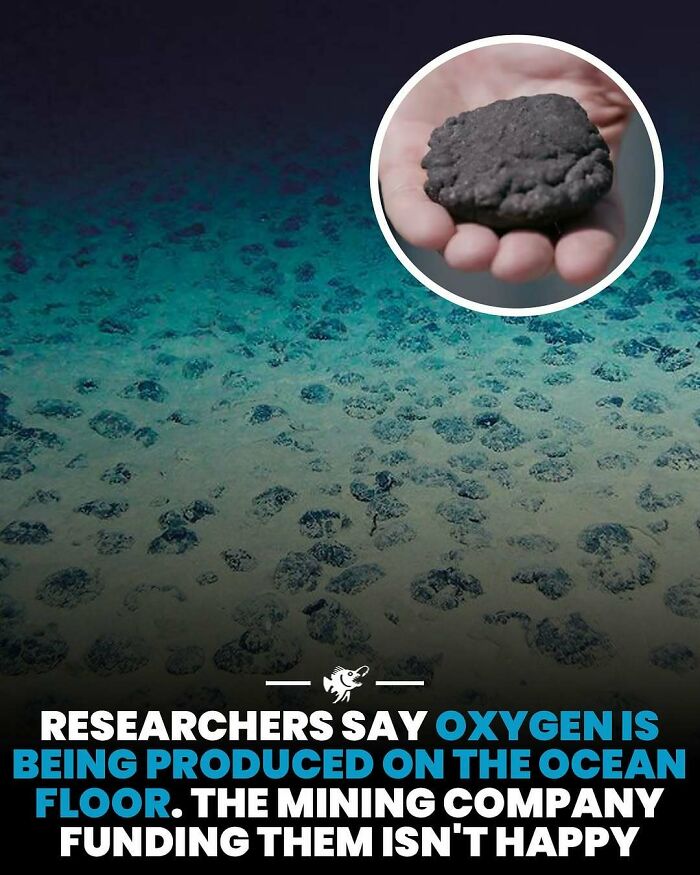
Load More Replies...A recent study has revealed that oxygen is being produced on the ocean floor by ancient metal nodules, a finding that has caused tension between the researchers and the mining company that funded them. Led by Andrew Sweetman of the Scottish Association for Marine Science, the study initially faced skepticism from its own team, who spent eight years dismissing the data as faulty. However, after thorough attempts to disprove the results, the researchers concluded that the phenomenon is genuine. The study, published in Nature Geoscience, was partially funded by The Metals Company (TMC), a Vancouver-based mining firm that advocates for deep ocean mining as a low-impact method to extract minerals essential for green energy technologies. TMC is now disputing the study's findings, which could complicate its mining plans. TMC has labeled the research as "flawed," questioning the methodology used to collect the nodules and referencing a conflicting study conducted in the same area. The company plans to publish a detailed rebuttal, involving its own scientists and independent experts, in the coming weeks.
What? From Manganese nodules? That tells me they are good for something after all.
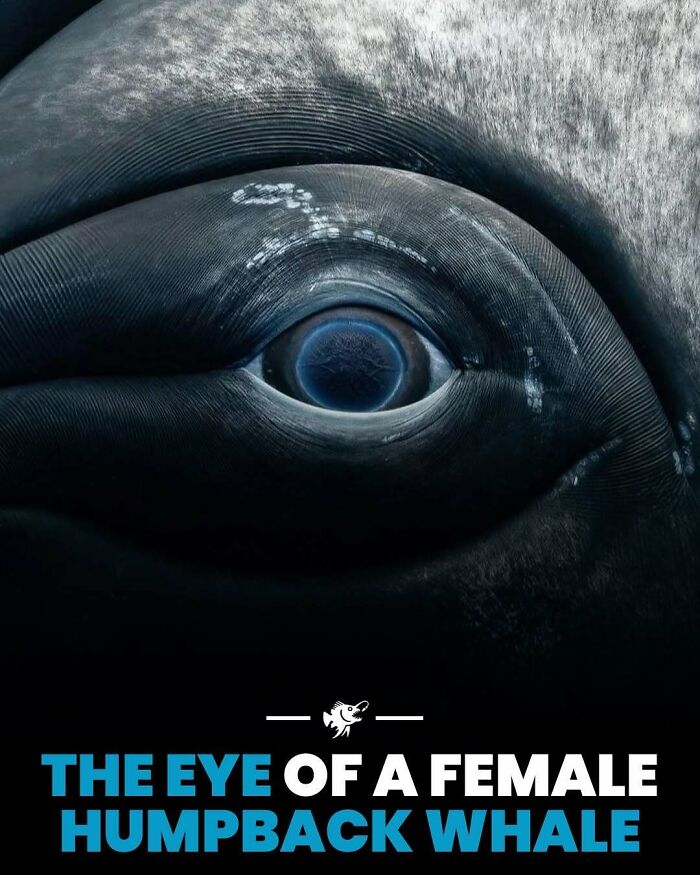
Renowned ocean advocate and photographer Rachel Moore captured breathtaking close-up images of a female humpback whale’s eye near Tahiti. Shared on Instagram on October 8, 2024, and later on her website, the striking photographs reveal an intimate perspective of the gentle giant, offering a rare glimpse into the soul of these majestic marine mammals. Moore affectionately referred to the whale as “Sweet Girl,” emphasizing the deep connection felt through their eye contact. Her work continues to highlight the beauty of marine life while advocating for ocean conservation.
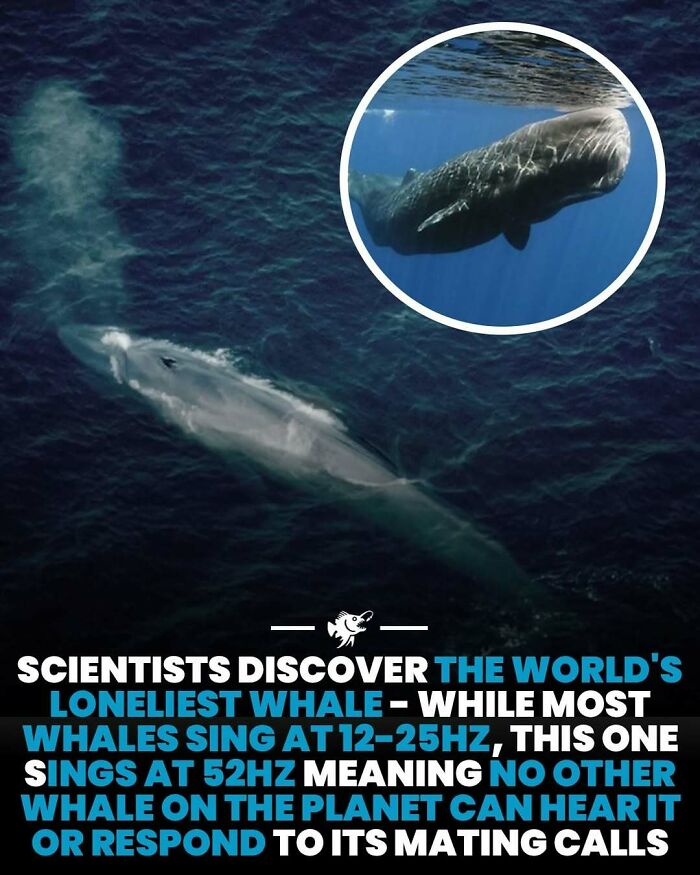
The “world’s loneliest whale” is a mysterious creature that calls at 52 hertz—a frequency much higher than typical blue or fin whale vocalizations. First detected by the U.S. Navy in 1989, its unique sound led to speculation that it might be unable to communicate with other whales. However, scientists remain uncertain if it is truly isolated, as it could belong to a species with unknown vocal variations. Despite multiple tracking attempts, the whale has never been conclusively identified, adding to its enigmatic status.
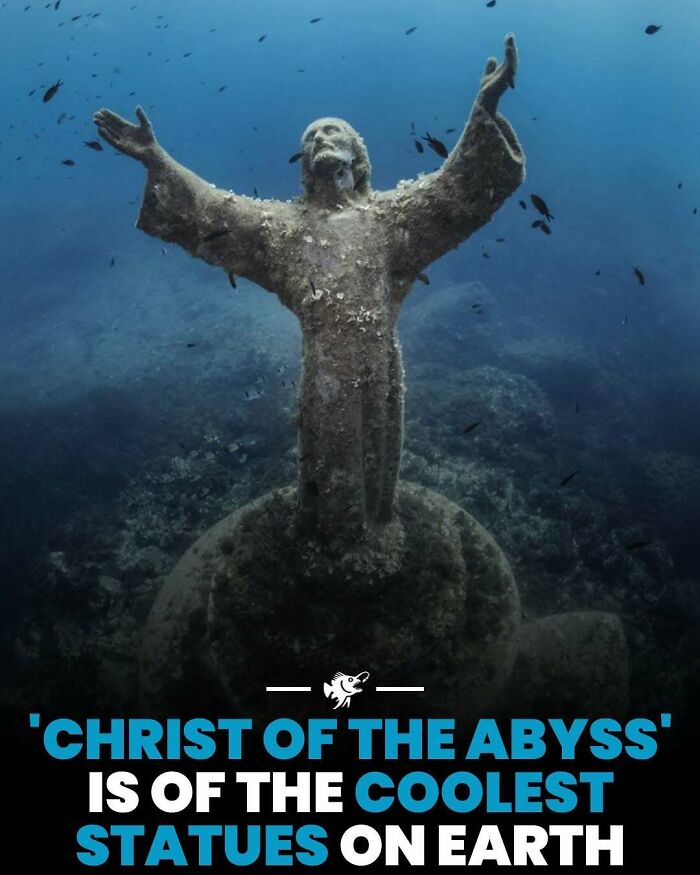
The Christ of the Abyss is a striking underwater bronze statue of Jesus Christ resting beneath the waves off Key Largo, Florida. Installed on August 25, 1965, the 9-foot-tall figure sits in about 25 feet of water at the Key Largo Dry Rocks reef, part of the Florida Keys National Marine Sanctuary. It’s the third cast of the original Il Cristo degli Abissi—created by Italian sculptor Guido Galletti in 1954 and first submerged near Genoa, Italy. This version was commissioned by diving gear pioneer Egidio Cressi and gifted to the Underwater Society of America. With help from Senator Spessard Holland and the Cothon Construction Company, it found its home in the Florida Keys. With arms raised and eyes turned to the surface, the statue represents peace and honors those lost at sea. Years underwater have covered it in coral and marine growth, adding to its haunting beauty. Today, it’s a must-see for snorkelers and divers, blending art, remembrance, and ocean conservation in a one-of-a-kind setting.
It resides at John Pennekamp Coral Reef State Park. The first underwater park in the US, established in 1963, is also the home of the only living barrier coral reef in the continental US.
A woman in a bikini foud out the statue has fire coral on it when she gave the statue a hug.
Back in 2013, scuba diver Curtis Lahr created one of the creepiest underwater Easter eggs around—a life-size statue of Jason Voorhees, the infamous slasher from Friday the 13th. Inspired by the ending of Part VI: Jason Lives, where Jason is chained beneath a lake, Lahr submerged the statue 120 feet down in Minnesota’s Louise Mine Pit. Complete with hockey mask, machete, and chain, the eerie tribute quietly lurks in the depths, giving divers a serious jump scare.
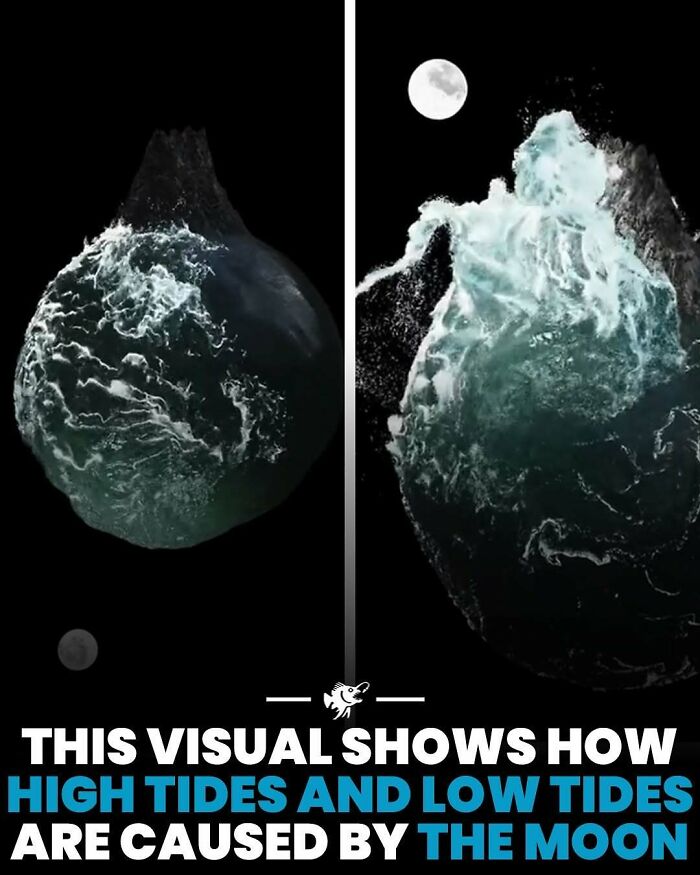
The Moon does more than light up the night sky — its gravitational pull is what creates the tides, orchestrating the rhythmic rise and fall of Earth’s oceans. But its influence goes deeper. By steadying Earth’s axial tilt, the Moon helps prevent wild climate swings, keeping conditions relatively stable over millennia. So in many ways, our satellite doesn’t just shape the seas — it quietly holds the planet’s balance.
I do not understand this visual. Is it suggesting that the moon causes a monster wave half the size of the planet that siphons off into space? Because that's what I'm seeing
The AI is strong with this whole article.
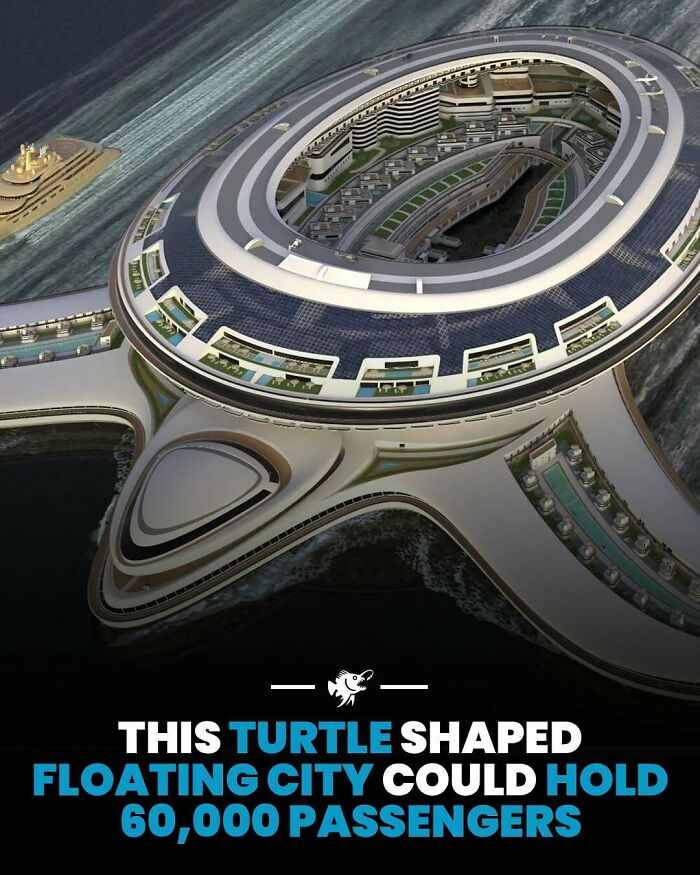
Load More Replies... Saudi Arabia has unveiled plans for a $5 billion turtle-shaped terayacht called Pangeos, designed to house up to 60,000 people. Created by Italian design studio Lazzarini, this “floating city” will be the largest floating structure ever built, spanning 550 meters in length and 610 meters in width, including its extended wings. The name Pangeos draws inspiration from Pangea, the ancient supercontinent. The terayacht will feature luxurious amenities such as villas, apartments, a mall, a rooftop garden, a beach club, and even a landing zone for flying vehicles. It will also have a “Terashipyard” with direct sea access. Powered by nine HTS engines producing 16,000 HP each, the vessel is fully electric, with energy derived from solar panels and ocean waves. With a maximum cruising speed of five knots (5.7 mph/9.2 kph), Pangeos combines sustainability with opulence, making it a marvel of engineering and design.

well, the budget is up to 8B now. No one is committing to funding the beastie ether
Load More Replies... Hmmm..I wonder where the waste of those 60,00 passengers will go. I'm sure it will be treated and rendered benign...right?..RIGHT?


Who's the down voting troll? 😠🧌 The comments are the best part of bored panda 🐼
Some frustrated person having a bad day. Ignore it, i do not care for people who are to stupid to to write what they think in a comment and rather downvote people because they disagree, do not like a fact or have some digestion problem that they need to take out on other people
Load More Replies...

Congrats, you found something to complain about in a great post!
Load More Replies... Who's the down voting troll? 😠🧌 The comments are the best part of bored panda 🐼
Some frustrated person having a bad day. Ignore it, i do not care for people who are to stupid to to write what they think in a comment and rather downvote people because they disagree, do not like a fact or have some digestion problem that they need to take out on other people
Load More Replies... Congrats, you found something to complain about in a great post!
Load More Replies...




























 No fees, cancel anytime
 then open in external browser


 and click "Open in External Browser"