Get Premium
Dark mode theme is available exclusively for premium users. Learn more about the benefits of subscribing.
No fees, cancel anytime.

 Dark Mode Ad-Free Browsing Unlimited Content
 Ad-Free Browsing Unlimited Content Dark Mode
Join 1.2 million Panda readers who get the best art, memes, and fun stories every week!



Who are we but a collection of stories? People, cities, countries—all carry memories. 'History Uncovered' is not just about dates and army sizes; this Instagram account aims to show you the world in a way you haven't seen, and it does this by digging up the small details that make the big picture clearer. From ancient civilizations to the recent past, continue scrolling to check out the footprints left behind by those who came before us.
This post may include affiliate links.
American servicemen at the Hỏa Lò prison camp in Vietnam made a pact that any prisoner who accepted an early release and left without the rest of them would be considered a traitor. However, they made an exception for Doug Hegdahl. When Hegdahl had arrived at the "Hanoi Hilton" in April 1967, he'd pretended to be illiterate, and the guards thought he was so harmless that they essentially gave him free rein of the camp. Soon, he'd memorized the names and personal information of 256 of his fellow POWs, so when he was offered early release in August 1969, his superiors urged him to go so he could share valuable information about the camp with U.S. military officials. Hegdahl agreed, and the intelligence that he supplied allowed 63 servicemembers to be reclassified from MIA status to POW status and put pressure on the North Vietnamese to stop torturing captured American troops, potentially saving countless lives.
In 1922, at the University of Toronto, scientists went to a hospital ward with children who were comatose and dying from diabetic keto-acidosis. Imagine a room full of parents sitting at the bedside waiting for the inevitable death of their child. The scientists went from bed to bed and injected the children with the new purified extract - insulin. As they began to inject the last comatose child, the first child injected began to awaken. One by one, all of the children awoke from their diabetic comas. A room of death and gloom, became a place of joy and hope.

And the inventor did not patent it, wanting to be sure it was affordable to everyone who needed it. Current d**g companies have certainly changed that!
A computer and business teacher at Columbine High School, Dave Sanders leaped into action as soon as he realized students were in danger on April 20, 1999. He warned dozens of kids in the cafeteria, "Get out! Get out! They're shooting!" and guided them to safety via the kitchen and the auditorium. He continued trying to help people even after getting shot himself, and he was later credited with saving as many as 200 lives during the massacre. Tragically, Sanders met an agonizing fate, bleeding to death over the course of about four hours in a classroom as students desperately tried to save him, at one point posting a sign on a window that read, "1 BLEEDING TO DEATH." And while police officers and ambulances were just a couple hundred yards away, authorities ultimately failed to reach him in time.
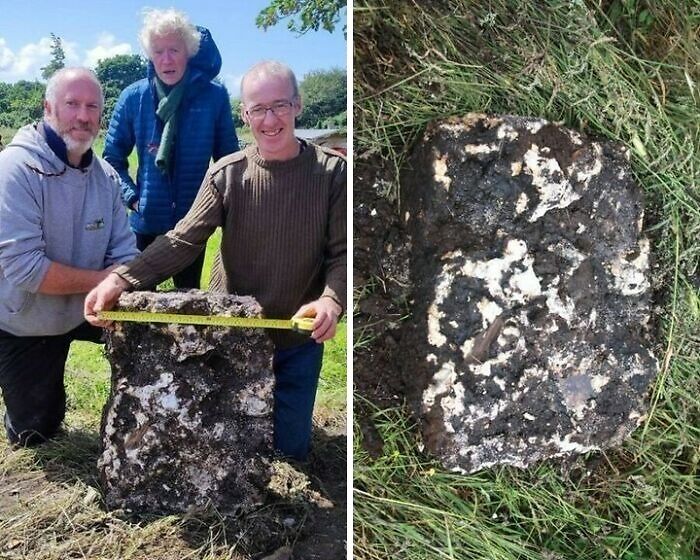
Irish farmer Micheál Boyle was digging a drain in a bog on his property when he noticed something that "didn't look natural" in the peat. When he pulled it out, he caught the scent of butter — and that's exactly what it was. As early as the Iron Age, ancient populations in Ireland used peat bogs, which were cold and low in oxygen, to preserve butter and animal fat. When Boyle called experts about his discovery, they confirmed that he had indeed found a 50-pound chunk of "bog butter." They found a small piece of wood within the slab, suggesting that it was once stored in a box that had since decomposed. One archaeologist actually tasted this centuries-old discovery, noting that it was similar to plain old unsalted butter even after all these years.
Charles Lightoller survived the sinking of the Titanic by clinging to an overturned lifeboat, but that didn't stop him from returning to the sea. In the following years during World War I, Lightoller served in the Royal Navy and was decorated twice for his actions in combat.
Following the war, Lightoller retired and bought his boat, "Sundowner," to cruise around northern Europe with his wife. However, as World War II commenced, the British government called for civilian boat owners to help rescue Allied soldiers in what is now known as the Dunkirk Evacuation. Lightroller demanded to captain his boat and was able to rescue 260 men.
A nine-year-old boy named Ben Witten was recently studying the Stone Age exhibit at the Worthing Museum in southern England when he spotted a prehistoric ax that looked remarkably similar to a rock he kept in his bedroom. He found the stone at Shoreham Beach three years ago and picked it up because he "just thought it looked different." When Ben got home, he and his mom emailed photos of the shiny piece of flint to the museum's curator of archaeology — who informed them that it was actually a Neanderthal hand ax. The artifact is between 40,000 and 60,000 years old and is "so rare that most qualified archaeologists would never find one themselves."

Roughly 700 years ago, a French-language sequel to the legend of King Arthur known as the Suite Vulgate du Merlin became a "medieval best seller." Its first half tells the story of how Sir Gawain, equipped with Excalibur, defeated the invading Saxons alongside Arthur. The story's second half is an unusual tale of a shapeshifting Merlin who appears to Arthur as a blind harpist and then as a balding child with no underwear, before finally joining the king in battle and turning his flag into a dragon that breathes fire upon their enemies.
Though this tale was popular in the medieval era, it eventually fell out of favor — so much so that a wealthy family in southern England used their 13th-century copy for scrap paper in the early 1500s, tearing and folding it to use as bookbinding material for property records. These records languished in archives and libraries for the next 500 years, during which time the number of surviving copies of the Suite Vulgate du Merlin dwindled to less than 40. But in 2019, researchers at the University of Cambridge happened upon this scrapped copy of the legends. Now, after years of painstaking imaging and digital unfurling, they've finally revealed this legend in full.
In the words of his mother, Rowan Brannan of Bognor, England has "always been into finding all sorts of bits and pieces." So when the two were out for a walk with their dog and 12-year-old Rowan found a shiny piece of metal, his mom didn't think it was anything special. "He kept holding this bit of metal, convinced that it was actual real gold," she recalled. "I thought it was just some strapping from a fence or something."
But Rowan remained convinced and began researching how to identify real gold, encouraged by the fact that his find seemed to meet all of the criteria. Then a metal detectorist acquaintance of theirs saw the piece and showed it to her expedition group's leader, who recommended they bring it to a government specialist. Finally, Rowan was delighted to learn that his discovery was a Roman bracelet dating back 2,000 years. A gold band of the armilla type, this bracelet would have been given to a Roman soldier as a show of respect for valor and service.

That's a Scout. He's in uniform in the d**n picture. "Expedition Leader". Yeah, SCOUTMASTER. Thank you.
Built on Egypt's Mediterranean coast during the third century B.C.E., the Lighthouse of Alexandria has long been known as one of the Seven Wonders of the Ancient World. Standing more than 330 feet high, it was one of the tallest structures in the world for centuries and it stood for 1600 years before finally succumbing to an earthquake in 1303. Its sunken ruins, at least 3,300 pieces in all, weren't rediscovered until 1968 and weren't explored until 1994. Now, archaeologists have just pulled 22 of the lighthouse's largest pieces out of the Mediterranean, with some weighing as much as 80 tons. These colossal stone blocks include parts of everything from its threshold to its base to its door.
A three-year-old girl named Ziv Nitzan was recently on a family trip to the ancient Israeli city of Tel Azekah — the place where the Bible says David defeated Goliath — when she made a stunning discovery. She was walking along a path at the base of the site with her sisters and bent down to pick up a small stone scattered among countless identical rocks. She rubbed the sand off of it to reveal an engraving of scarabs, beetles that were sacred in ancient Egypt. Ziv's family realized the artifact's importance and reported the discovery to the Israel Antiquities Authority — and experts soon identified the object as a 3,800-year-old Canaanite amulet.

All the time there people randomly find things from all the eras there, Canaanite, Israelite/Judah states, Persian rule, Greek rule, Kingdom of Judea, Roman Rule, Arab conquest, Crusader, Mamluk, and Ottoman periods. It is an area rich with history, hundreds of wars, etc, while being on a major trade land route that connected North Africa with Europe, Central Asia, and Arabia, and contolled the costal trade routs on the Med. So much has happened there bc of its ancient strategic location, and as a result, many random ancient stuff are found, on top of over 7000 official dig sites
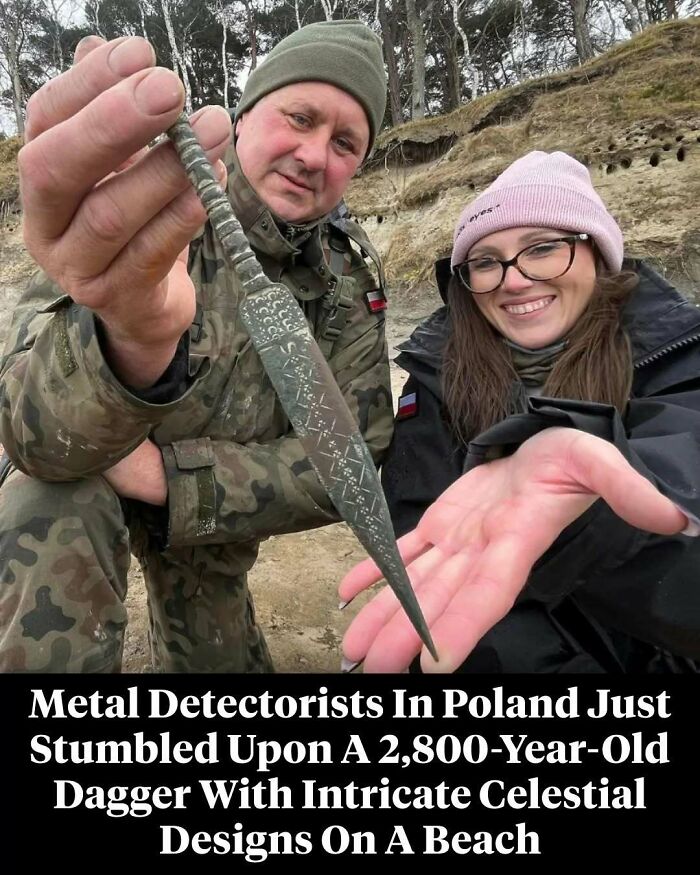
Two metal detectorists were recently searching a beach along the Baltic Sea in northern Poland when they came across an unexpected find. A storm had knocked off pieces of the cliff along the shore, and embedded in one of these chunks was a nine-inch-long dagger. The "richly ornate" artifact was engraved with crescent moons and stars, and a design running down the center of the blade may have been meant to represent a constellation. The metal detectorists quickly notified The Museum of the History of Kamień Land, where experts determined that the dagger was roughly 2,800 years old.
Now, the weapon is undergoing additional analysis that researchers hope will reveal whether it belonged to a wealthy warrior — or if it was used by an ancient "solar cult" for rituals.

It sure seems like folks back then crafted tools and weapons with a lot more care than we do today. Heck, this 2,800 year old dagger still looks sharp. Also why don't we get cool fancy designs on our tools today? :( The level of craftsmanship way before the Industrial Revolution is something to admire
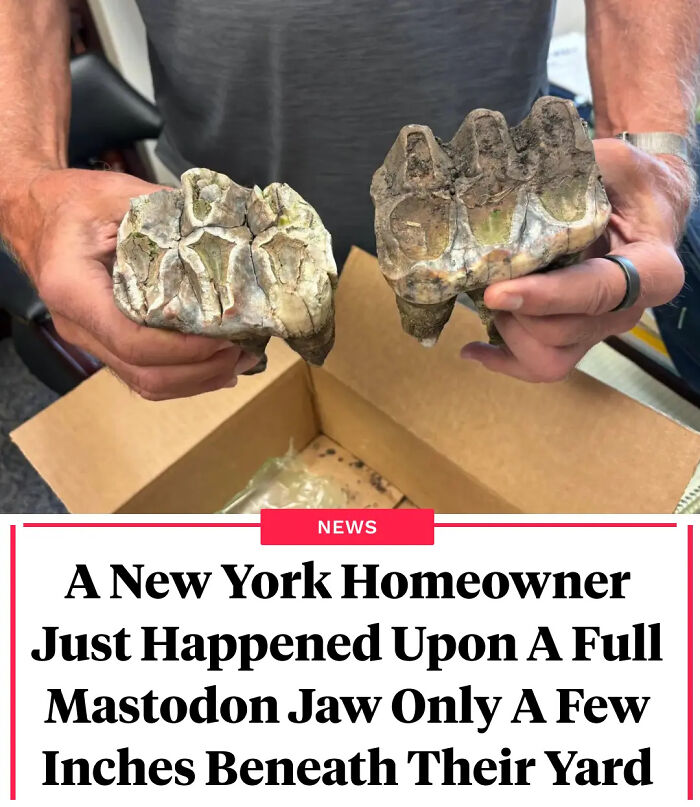
When a homeowner in New York was recently doing yardwork and stumbled upon something in the dirt, they initially thought it was just an old baseball — but it turned out to be part of a mastodon jaw. After further digging, the homeowner unearthed the entire jaw of an adult mastodon dating back at least 13,000 years. Local archaeologist Cory Harris confirmed their discovery and said he was "crazy excited," adding that, "It was the same old-school excitement I felt when I got into this field in the first place." Now, Harris is hoping that the homeowners will let him keep digging to see if the complete remains of this prehistoric behemoth are sitting just below this suburban home
"I opened the package, removed the bubble wrap, and staggered back in awe. My hands were shaking as I held it up to the light… I knew that only one person could've produced something like this."
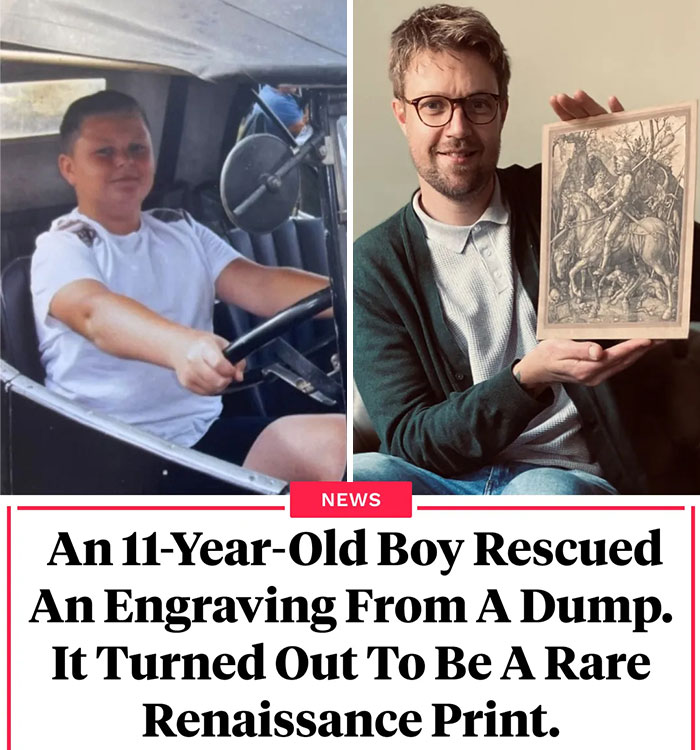
About 13 years ago, 11-year-old Mat Winter was exploring a dump in England when he discovered an ornate engraving hidden in a heap of trash in the back of a woman's car. The woman said Winter could keep it, and he took it home, storing it in a cupboard for over a decade. Recently, Winter decided to get the artwork appraised "to see if it was as special as it looked" — and found out that it was a 500-year-old print of a woodcut engraving by the legendary German Renaissance artist Albrecht Dürer. Now, the piece is headed to auction, where it could fetch tens of thousands of dollars
Archaeologists excavating the remains of Rome's "Golden House," the opulent palace that Emperor Nero built for himself right across the street from the Colosseum, recently uncovered a rare chunk of the prized pigment "Egyptian Blue." Known for its striking cerulean hue, this dye was first created circa 3250 B.C.E. and was soon used throughout the ancient world in everything from Egyptian mummy portraits to Roman frescoes to Greek statues. And while archaeologists usually only uncover mere scraps or powdery remnants of this pigment today, the newly-found chunk is an astonishingly large artifact measuring six inches across and weighing more than five pounds. Researchers found it near a pool once used to mix dyes and they believe it was going to be used to paint frescoes on Nero's walls.

This, too, is being produced again: https://www.smithsonianmag.com/smart-news/researchers-are-recreating-the-long-lost-recipe-for-egyptian-blue-the-worlds-oldest-known-synthetic-pigment-180986778/
The movie "Indiana Jones and the Last Crusade" features an ancient tomb in Jordan known as "The Treasury" that was carved into the desert stone by the Nabataean people around the first century C.E. The wealthy Nabataeans were known for their luxury trade network of goods such as gold, ivory, and perfumes that extended as far west as Italy. Since the 18th century, artifacts found off the coast of Pozzuoli, a coastal city near Naples, have pointed to the presence of a Nabataean temple in the area — and now archaeologists have finally found it.
While mapping the seafloor, researchers discovered two large rooms submerged in the port of Pozzuoli, which was dry land 2,000 years ago, before volcanic activity changed the coastline. Each room contained a marble slab with the Latin inscription "Dusari sacrum," or "consecrated to Dushara," the main god of the Nabataeans. One of the rooms also held two marble altars that would have once displayed stones sacred to the religion. Archaeologists now believe that the temple was intentionally buried with a mix of concrete and broken pottery around 100 C.E., potentially because the Nabataeans were leaving the region.

In 106 CE the Nabataeans were annexed by Rome (what a polite way to put that) so that might have had something to do with it.
In the early 1700s, wealthy British trader Joseph Fernley-Maisters and his wife Sarah grew distrustful of the recently-formed Bank of England and its new paper currency. Eventually, they decided to take a portion of their vast riches and simply stash it under the kitchen floor of their Yorkshire home. And after they both died and the family line dwindled in the 1740s, their trove of gold coins simply sat there, forgotten and untouched for the next 280 years.
Finally, in 2019, the couple who'd bought the house 10 years prior decided to redo the kitchen floor. And sure enough, just six inches below the surface, they stumbled upon an earthenware container holding the Fernley-Maisters cache of gold. Experts have now valued the find at $288,000, and once its sale at auction is complete, the lucky couple will get to keep most of the proceeds.
Divers off the coast of Sicily have begun salvaging the wreck of an ancient Greek ship known as Gela II. Dating to the 5th century B.C.E., the ship measures approximately 50 feet long and 16 feet wide, which enabled it to carry large amounts of cargo between Mediterranean ports.
Its most precious cargo was the legendary metal orichalcum, a substance so mythic that many researchers long believed it wasn't actually real. Described in ancient texts as being the color of fire and second in value only to gold, orichalcum remains most famous for its connection to Atlantis, where Plato claimed the metal was mined and used to build glowing temples and citadels. So when orichalcum was found near the wreck of Gela II, not only did the discovery confirm that this storied substance existed, it also gave believers hope that the Lost City of Atlantis is still out there, waiting to be found.
When Constantin Fried was exploring a field near Petershagen-Frille, Germany, he came across a tiny object in the dirt that turned out to be a miniature lock dating back to the Roman era. Made of lustrous gold and measuring in at just over one centimeter across, this lock was likely made during the third or fourth century C.E. Once experts discovered the intricacies of its mechanisms, which remain intact to this day, they were left baffled as to how an ancient artisan was able to create it without modern tools like lights and magnifying glasses. And while researchers believe the lock may have been brought from Rome to Germany by a soldier returning home, then used to secure a chest of keepsakes or a jewelry box, its true origins and purpose remain shrouded in mystery.

And he's still looking for the key... if that's the actual picture, it's beautiful! Imagine what must have been kept in a box secured by a lock made of gold!
Said to produce a sound like the screams of the damned or the "wail of a thousand souls," the Aztec death whistle is widely believed to have made one of the most terrifying noises in human history. While historians theorize that it may have been used in battle or during human sacrifices, its exact purpose remains mysterious to this day. But now, researchers have used brain scans to unlock the scientific secrets of the whistle's horrifying sound.
When scientists played the death whistle for their subjects, fMRI results showed that it triggered the brain's low-order auditory cortical regions, like those activated by screams or crying babies. However, the whistle also activated higher-order regions like the inferior frontal cortex, which handles complex classification processing. This tells researchers that the Aztec death whistle's true horror lies in the way it falls into a kind of auditory uncanny valley in which listeners hear its sound as not quite human, while also not quite nonhuman.
In 1980, 19-year-old Jean Hilliard was found "frozen solid" in Minnesota on a -22-degree day. After encountering car troubles, she tried to get help from her friend Wally Nelson but accidentally tripped, fell, and lost consciousness on the way to his home. Nelson, who had no idea that Hilliard needed assistance until he discovered her frozen body near his home six hours later, was sure that she had died — until he saw "bubbles" coming out of her nose.
Luckily, Nelson acted quickly and took her to the hospital, where doctors were horrified by the extent of her hypothermia. In fact, her skin was reportedly so hard that it couldn't be punctured with a hypodermic needle. But thanks to heating pads — and, her family says, "a lot of prayer" — Hilliard was awake and talking in just a matter of hours. And her only problem when she left the hospital was her blistered toes.

Pretty convenient that prayer gets part of the credit in situations where hospital treatment completely explains the recovery
In the 1920s, the United States Radium Corporation encouraged its young female workers to use their lips to sharpen the points on the brushes they used to paint watch dials. Little did these women know that this paint was so toxic that it would soon cause them to lose their jaws — and their lives.
The hundreds of young women who worked in these factories were exposed to so much radioactive radium that they used to come home glowing in the dark. Then they found that the exposure caused their vertebrae to collapse, their jaws to fall off, and their lives to end slowly after agonizing battles with cancer.
And while the men who worked in these factories wore lead aprons to protect themselves from radiation, the women were given nothing. By 1924, after dozens of young women were sick or dead, the United States Radium Corporation fought off lawsuits and bad press by saying the fatalities were from STDs.
Archaeologists excavating the Porta Sarno necropolis, right beneath the main entrance gate to Pompeii, just uncovered a life-size relief featuring a pair of statues carved into the underground walls. The relief depicts a woman and a man standing side by side, but without an inscription of any kind, experts remain unsure about their relationship. The woman's jewelry and laurel leaves lead researchers to suspect that she was a priestess of Ceres, goddess of agriculture, fertility, and motherly relationships. And while nothing is known about the man, he's flanked by the preserved root of an ancient tree that once grew up out of the tomb.
In 1944, Army dentist Benjamin Lewis Salomon found himself 50 yards from the front lines in Saipan, with Japanese soldiers quickly approaching. Salomon ordered the aid tent he was in with over 30 wounded soldiers to be evacuated while he held off the attackers. When his infantry would later return, they found Salomon surrounded by 98 dead Japanese soldiers Salomon had been shot 76 different times, 24 of them while he was potentially still alive.
His infantrymen immediately began preparing a recommendation for the Medal of Honor, which was initially denied. The rules at the time stated that medical professionals aren't supposed to bear arms against the enemy. Ultimately, in 2002, President George W. Bush posthumously awarded the Medal of Honor to Benjamin Salomon.
Between 1550 and 1350 B.C.E., the powerful Mitanni Empire controlled a vast territory spanning from present-day Turkey to Iraq before the Assyrians took over. One of their primary seats of power was the fabled city of Zakhiku, an administrative and industrial hub that sat on the eastern bank of the Tigris River near what's now Mosul, Iraq. Though little is known about the city or even the Mitanni Empire itself, tales of Zakhiku have fascinated scholars ever since.
Now, archaeologists believe they've finally found the lost city of Zakhiku — after it emerged from the Tigris due to extreme drought. Archaeologists were stunned at the relatively intact state of the city's mud brick walls, especially after being submerged in the Tigris for so long. Some experts believe that the earthquake that destroyed the city 3,400 years ago buried the small pieces of the city that did survive under rubble, thus preserving them since the Bronze Age.
Mitani lasted longer than that, that was its peak. Its capital was Damascus and when they say Turkey to Iraq, its from a little in modern Turkey, all the way to Mosul and most of modern Syria. But it still existed as late 1100BCE, and several Egyptian Pharoah's married Mitani princesses, as did Hittite Kings.
"I really loved it. I thought if you have to die you have to die sometime, that was my attitude. I just thought I want to put everything I've got into serving the army to bring the enemy down, and we did shoot them down."
Annie Ferguson was just 19 years old when she joined the British war efforts in 1942. Just two weeks after she enlisted, Ferguson was already going through rigorous gun training to learn how to shoot down German planes.

NA.ZI! Say it and don't forget it FFS... don't censor it! Also F.UCK all N.AZIS!
A marble statue sold at a Texas Goodwill for $34.99 has turned out to be a priceless Roman artifact once owned by King Ludwig I of Germany. The bust was part of Ludwig I's collection at a museum in Bavaria, but it vanished after the Allies bombed the building in 1944. Experts suspect that it was likely looted by an American soldier and then brought illegally to the United States. Then, nearly 80 years later, a woman shopping for secondhand items to resell found it "on the floor, under a table" and decided to buy it because, "It looked pretty dirty, pretty old" — and then she discovered the statue's astounding story.
Ronald Clucas has been using his metal detector for 50 years and has found some incredible treasures along the way — but he just made his greatest discovery yet. While searching the Isle of Man, located in the Irish Sea, Clucas recently uncovered a section of a 1,000-year-old Viking armband made of gold. Made of eight gold rods braided together into an intricate pattern, this piece was undoubtedly the work of a master goldsmith. The other sections of the band had been purposefully cut off long ago, likely as currency in a trade of some kind, before the newly-uncovered section was carefully buried in what's believed to be a sacrifice to the gods.
For decades, archaeologists working throughout the Middle East had been finding peculiar conico-spherical containers dating to between the 9th and 15th centuries. Experts long believed that these "jars" were simply used to hold oils and medicines, act as smoking pipes, or even serve as vessels for drinking beer. To this day, they're housed in museums all over the world, many of them sitting largely untouched as experts could only guess at their true purpose and significance.
But now, astonishing research has discovered what these "jars" really were: hand grenades used during the Crusades. Medieval texts dating back to the Crusades had long described incendiary devices akin to hand grenades being used in battles like the pivotal 1187 siege of Jerusalem, but archaeologists simply didn't think that this kind of technology was possible so long ago — until now.
John Nash excelled in math from an early age, and after graduating from Carnegie Mellon with two degrees in the subject in 1948, he decided to pursue his doctorate at Princeton. One reference letter he submitted with his application to the program simply read, "This man is a genius." In 1951, he accepted a position as a math professor at the Massachusetts Institute of Technology, where he solved a classical unsolved problem and published research papers on differential geometry and economic game theory. However, Nash's promising academic career came to an end in 1959 when he was diagnosed with schizophrenia. Despite spending the better part of a decade involuntarily hospitalized, he went on to publish several more renowned papers — and even won a Nobel Prize in economics in 1994.
The subject of the movie A Beautiful Mind, starring Russell Crow
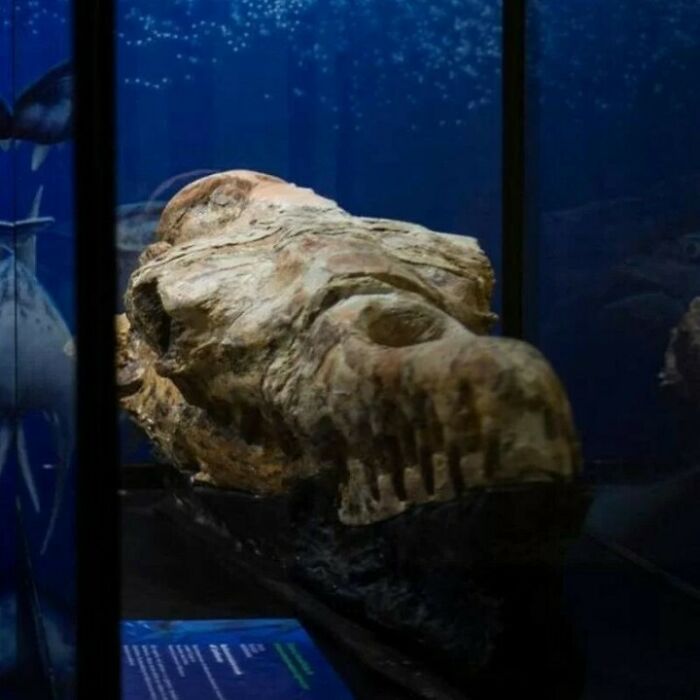
Paleontologists in Peru recently unearthed an incredibly well-preserved skull that they believe belongs to a previously undiscovered species of basilosaurus. More than 36 million years ago, the basilosaurus ruled the seas that covered what is now the Peruvian desert. These eel-like mammals grew to more than 55 feet in length and used their sharp teeth to eat penguins, tuna, and even sharks. This particular specimen was likely 39 feet long, about the size of a city transit bus.
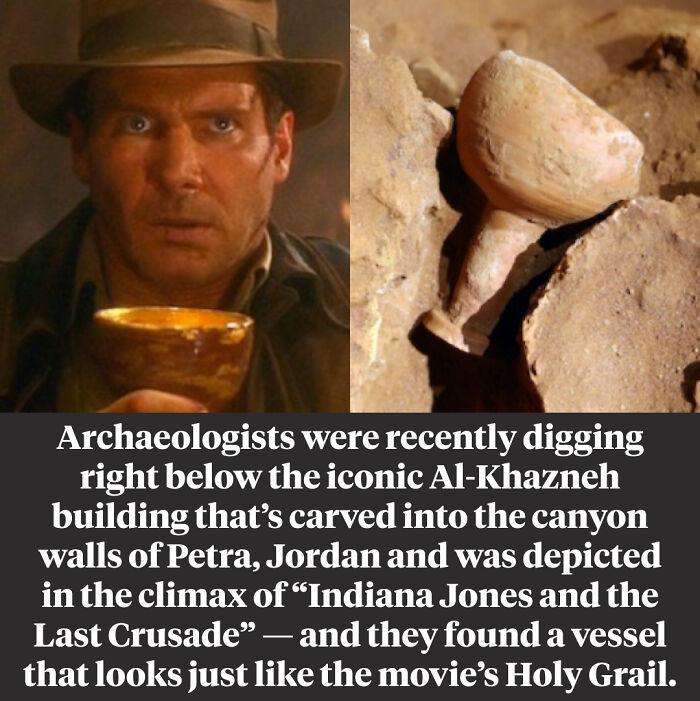
Approximately 2,000 years ago, the Nabateans carved an entire city into the canyon walls in the desert of Petra, Jordan. The city's largest and most striking building is known as Al-Khazneh, which may have served as a treasury or temple, and was famously featured in the 1989 film "Indiana Jones and the Last Crusade," where it served as the resting place of the Holy Grail.
Now, archaeologists digging right beneath Al-Khazneh have uncovered an ancient tomb filled with 12 skeletons — and one of them was clutching a vessel that looks remarkably like the film's Holy Grail. "When we spotted what looked like a chalice, all of us just froze," said archaeologist Josh Gates. "It looked nearly identical to the Holy Grail featured in 'Indiana Jones and the Last Crusade,' set in the ancient building directly above the tomb. It was the ultimate moment of life imitating art."
When the eruption of Mount Vesuvius obliterated the Roman city of Pompeii in 79 C.E., victims endured unimaginable terror in their final moments before being buried in ash, pumice, and debris. And because archaeologists later made plaster casts of the imprints that victims left behind, we can see near-perfect replicas of the people of Pompeii, frozen in the last instant before death. These "bodies of Pompeii" paint tragic scenes of victims cowering and embracing as a 20-foot layer of ash suffocated the city — but it turns out that some of experts' assumptions about these moments were wrong.
Researchers recently took DNA samples from five victims, including an embracing pair known as the "Two Maidens" and a presumed family of four found at the "House of the Golden Bracelet." But the new analysis shows that the so-called maidens, previously thought to be a mother and daughter or a pair of sisters, actually consisted of one woman and one man who weren't related at all. Meanwhile, researchers found that the "family" likewise weren't related and that the supposed mother of the group was actually a man. In addition, that man was found to have black hair and dark skin, suggesting that he may have been an enslaved person from North Africa or an immigrant from the eastern Mediterranean, further complicating historians' understanding of Pompeii's demographics at the time of the tragedy.
Visiting Pompeii is almost like a religious experience. It’s the most awe inspiring place I’ve ever been.
Legend holds that when Spanish conquistador Francisco Pizarro asked the Inca chiefs of modern-day Peru how they selected their shamans, they replied that candidates had to be tested by making a pilgrimage to a magical realm in the north known as "the land of the spheres." And while this may sound like mere myth, archaeologists keep finding massive stone spheres buried just below the surface of the Earth in Costa Rica — which some experts believe is proof of Pizarro's tale.
For centuries, fantastical myths have surrounded these stones, including that they were created using magic potions or that they originally came from the sunken city of Atlantis. Meanwhile, scientists have remained baffled for decades. What we do know is that these spheres were created by hammering away at large boulders of limestone, sandstone, or gabbro that were then polished with sand — and that they can tip the scales at a whopping 15 tons. However, their true purpose remains unknown to this day.
Recently, archaeologists digging in the Puntarenas Province unearthed six more of these stones, the largest measuring more than six feet in diameter. Nevertheless, experts still don't know how exactly the country's ancient inhabitants carved these spheres with primitive tools or why they made them in the first place.
As the Vietnam War drew to a close and U.S. forces began pulling out, the American government initiated a daring, last-ditch effort called Operation Babylift. But this was no military offensive. Instead, the plan was to evacuate as many orphaned children as possible and find them safe haven in homes across America and abroad.
In just three weeks between April 3 and April 26, 1975, Operation Babylift rescued a whopping 3,300 orphans, loading them onto whatever planes could be spared. In all, some 30 flights left Vietnam carrying virtually nothing but young children and infants, some of them nestled into padded cardboard boxes and placed on the seats. And when planes were running short, American civilians pitched in. One Connecticut businessman named Robert Macauley personally saved 300 kids after mortgaging his house in order to charter a Boeing 747.
...some of them weren't orphans, but US soldiers' kids who had a mother. Not sure if they told the mothers they'd be brought to the US next. Not all of them were babies. Remember your mother telling you to go with these strangers to a place both of you don't know. So heart-breaking.
Henry Darby of the Swansea Building Society in Wales was recently sorting through the mail when a postcard fell out of the stack. Adorned with a print by English artist Edwin Henry Landseer on one side and inscribed with a short message on the other, there was nothing particularly remarkable about it — until Darby saw that it had been sent in 1903.
On August 23rd of that year, a man named Ewart mailed this postcard to Miss Lydia Davies at 11 Cradock Street, offering a brief apology for not being able to acquire a pair of something, which is not explicitly identified in the text. Records indeed show that Davies lived at that address at that time, but no one knows who exactly Ewart was, what he was writing about, or, most of all, why this postcard simply showed up in the mail 121 years after it was sent.
In 1922, the silent film "Nosferatu" was released in Germany, featuring the terrifying vampire Count Orlok. This blood-sucking villain quickly attracted attention, especially since he was clearly based on Bram Stoker's Dracula. In fact, promotional materials for the movie openly stated that the film was "freely adapted" from Stoker's famous horror novel. But there was one problem: The filmmakers had failed to contact Stoker's widow Florence.
When the news about "Nosferatu" reached Florence in London, she was furious, especially since her main source of income was her late husband's book. She attempted to sue, only to find out that the film company behind "Nosferatu" had gone bankrupt. After a three-year legal battle, a German judge ruled that all copies of "Nosferatu" should be destroyed. But by that point, copies of the movie had already made their way to the United States, where they were considered to be in the public domain. These copies quietly spread elsewhere, gradually turning the film into a somewhat taboo cult classic. And after the copyright on "Dracula" expired across the world in the 1960s, the once-controversial film could legally be shown anywhere.

The movie Shadow of the Vampire is about this. Great double feature when watched after Nosferatu
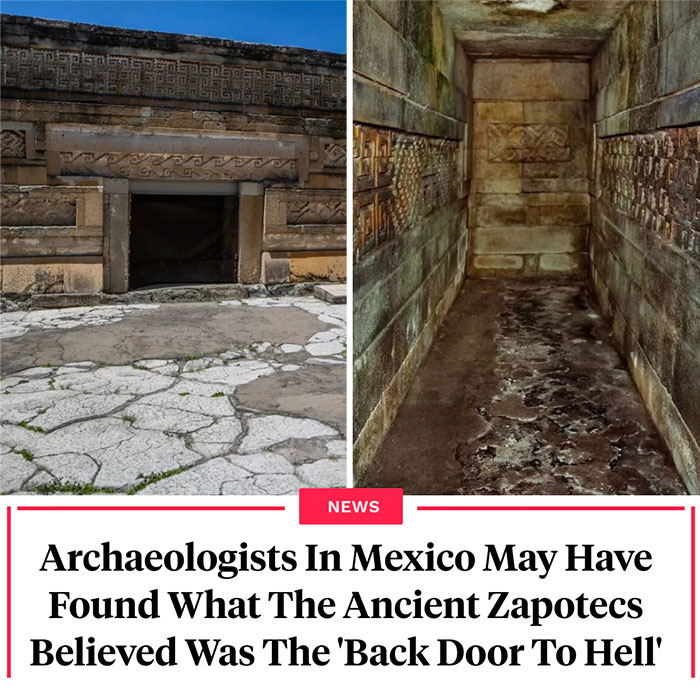
More than 1,000 years ago, the Zapotec people of Mexico founded Mitla, which became a religious and ceremonial center. (more facts about Mexico)
They called it "the place of the dead" because they believed the caves beneath the ancient city were an entrance to the underworld. In the 17th century, a visiting friar named Francisco de Burgoa even described Mitla as "the back door of Hell" and wrote of burial chambers for kings, high priests, and fallen warriors.
However, because the Spanish had destroyed the Zapotec temples and erected their own churches atop them, archaeologists could never find any evidence of these chambers — until now.
Recently, researchers discovered what appears to be a labyrinth of caverns, tunnels, and rooms beneath Mitla. Their most significant find was a large void beneath the altar of the Church of San Pablo Apostol, which was built on the ruins of the most sacred Zapotec temple.
Experts say this is "no coincidence" — and it may even be the chamber where Burgoa claimed ancient kings were buried with "feathers, jewels, golden necklaces, and precious stones."
On this day in 1997, thieves stole $17.3 million from an armored car company's vault in Charlotte, North Carolina, in what was the second-largest cash robbery in U.S. history to date — but it quickly turned into a comedy of errors that ended with their capture. One thief walked into a bank and tried to deposit a large stack of bills that still had the company's band wrapped around it, while another thief asked a bank teller, "How much can I deposit before you have to report it to the feds?"
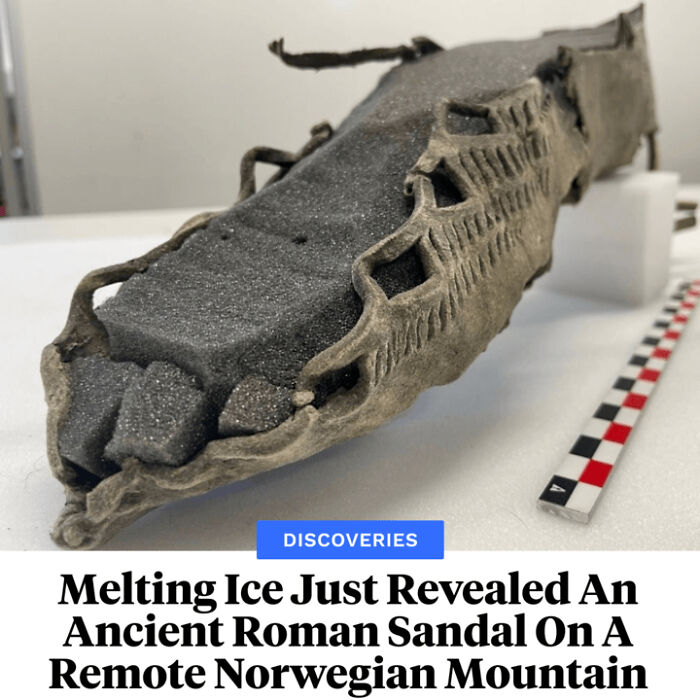
When archaeologists in Norway recently received a message from a hiker about a possible ancient artifact that had emerged from the melting ice in the Jotunheim Mountains, they rushed into action. The weather forecast called for snow later that day, and they knew that if they waited too long, an invaluable piece of history could be lost forever. And when they arrived at the site, they were astonished to find an ancient leather sandal. They dated it to 300 C.E. and noted that it followed the fashion of sandals worn in the Roman Empire during that same time period. Researchers believe that it would have been worn with scraps of fabric or animal hide that were fashioned as primitive socks.
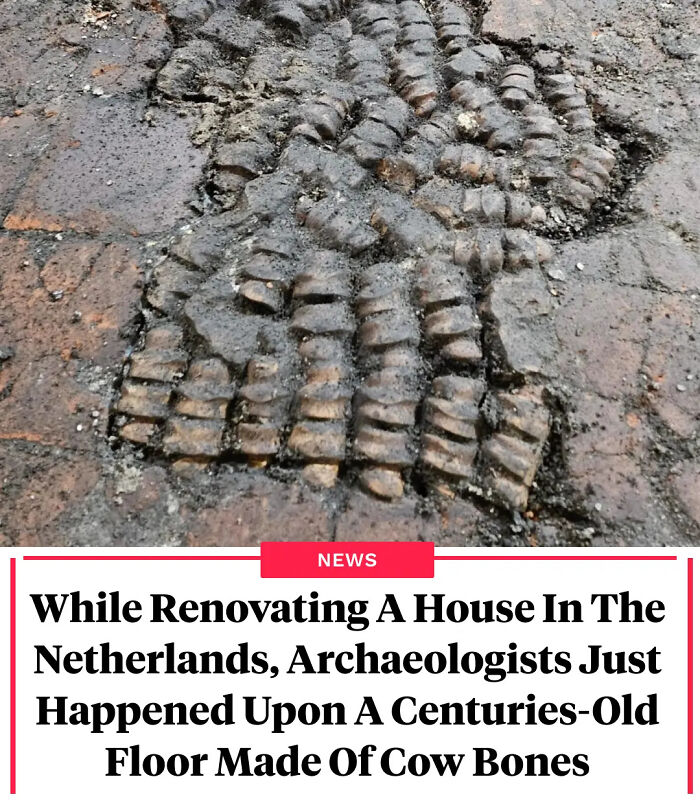
While renovating a house from the early 1600s in Alkmaar, Netherlands, archaeologists happened upon a floor made of cow bones. Crafted with stunning precision, the floor exclusively features metacarpal and metatarsal bones, each carved to the exact same height and arranged in a decorative pattern with some facing up and others facing down. What remains mysterious is why bones were used at all, given that the tile surrounding this portion of the floor was inexpensive and commonplace at the time. Meanwhile, researchers are also baffled as to why these types of bone floors have only ever been uncovered in the province of North Holland and why they feature eerily similar patterns across different cities.


That's not the thousand yard stare. https://en.wikipedia.org/wiki/Thousand-yard_stare
Load More Replies...
While preparing for construction near the town of Pacé in the Brittany region of northern France, archaeologists recently unearthed an 1,800-year-old ring along the remains of a Roman road. Discovered in an "exceptional state of preservation," this gold ring is adorned with a type of blue onyx known as nicolo that's inscribed with a depiction of the goddess Venus. Right nearby, archaeologists also uncovered a layer of medieval remains including food silos, cooking pots, and even remnants of 1,300-year-old grains and legumes.

"A goddess on a mountain top Was burning like a silver flame The summit of beauty and love And Venus was her name"
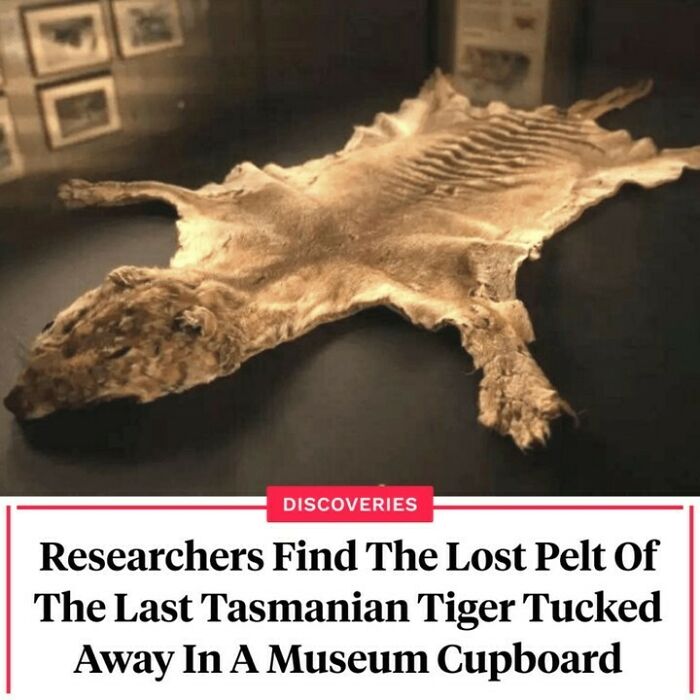
Researchers just stumbled across the pelt and skeleton of the last known Tasmanian tiger in a cupboard at the Tasmanian Museum and Art Gallery, where it had been sitting forgotten since the 1980s. The remains had been used for educational demonstrations for years, and the pelt even had flat spots where students had been allowed to pet the fur. Now, the creature is on display in the museum once more.
This just breaks my heart, and I'm still hoping these amazing creatures are somehow, somewhere alive in their native habitat.
In 1983, a Seattle band called Bam Bam recorded their first single. Founded and fronted by a 26-year-old woman named Tina Bell, the band pioneered a signature combination of punk, sludge, and hard rock that would come to define the Seattle grunge sound — nearly a decade before Nirvana's "Nevermind." Although Bell and Bam Bam only released two singles and one EP, they were a decade-long staple of the Seattle club scene, where future members of bands like Soundgarden, Pearl Jam, and even Guns N' Roses watched them for inspiration.
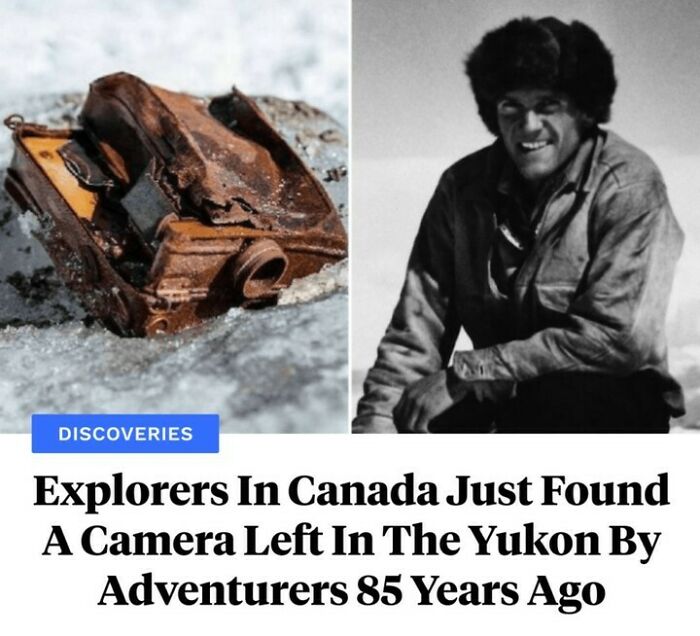
An expedition recovered several cameras abandoned on a Yukon glacier 85 years ago. In 1937, famed mountaineers Bradford Washburn and Robert Bates were forced to abandon the supplies during a treacherous trek on Canada's Mount Lucania. By mapping out how the glacier had moved over the past eight decades, a team of scientists and mountaineers was able to pinpoint where the explorers had abandoned their equipment.
The expedition came across a number of Washburn's cameras, including a Fairchild F-8 aerial shutter camera, two motion picture cameras with film, a DeVry "Lunchbox" camera model, and a Bell & Howell Eyemo 71. They also found climbing gear, tents, and cooking items, including part of a T-bone steak. But the most enticing finds are certainly the cameras, many of which contain film that the recovery team is hopeful can be developed.
In 1986, an enormous gas cloud erupted from Lake Nyos in Cameroon — and k**led more than 1,700 people and 3,500 animals. The region was long plagued by volcanic activity, and scientists believe that carbon dioxide had been steadily leaking into Lake Nyos for years, creating an explosive time bomb that was eventually triggered by a disturbance, perhaps a landslide or a small earthquake. This resulted in the deadly cloud of carbon dioxide, which was so dense that it displaced the oxygen in the air and created an unbearably suffocating environment for humans and animals who were unfortunate enough to be in its path. Most victims' deaths were so quick that they showed no signs of visible harm or struggle, and hauntingly, many had simply dropped dead wherever they were in their final moments.
Thing about limnic eruptions, it could happen again, at any of the three lakes that can build CO2 or methane in this manner. Those three lakes - Nyos, Kivu, and Monoun - now all have degassing systems in place to prevent a repeat of this tragedy and the one at Monoun that happened in 1984.

"Low-Pressure Environment"? What kind of pressure? Atmospheric? Physical? Psychological? Financial? What does pressure have to do with the formation of rust on iron?
Archaeologists just made an "incredible" find on the surface of glacial ice in Norway: a remarkably well-preserved arrow dating back 1,300 years.
This pre-Viking artifact was discovered on the Lendbreen ice patch by a team of researchers from the group Secrets of the Ice, a specialized archaeological program focused on glaciers and ice patches. Archaeologists from the team say they have made a number of exciting discoveries from the melting glaciers.
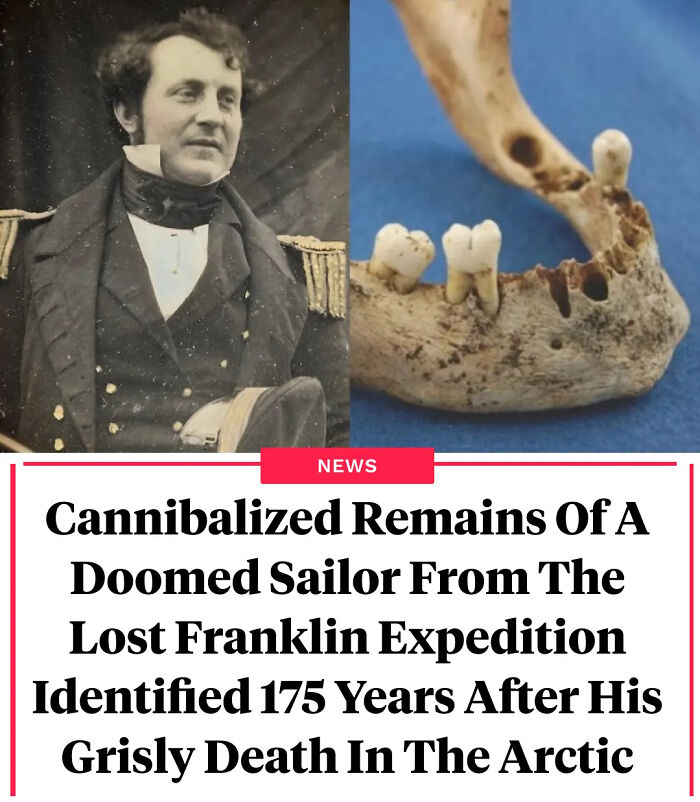
On May 19, 1845, two ships carrying 129 men set off from England under the command of Sir John Franklin in search of the Northwest Passage through the Arctic — and were never seen again. Ever since, historians have slowly been piecing together what happened to the doomed sailors aboard the HMS Terror and the HMS Erebus in what's known as the "Lost Franklin Expedition." Researchers working in the frigid islands of northern Canada have unearthed frozen corpses often called "ice mummies," collected chilling eyewitness accounts from local Inuits describing mass cannibalism, and discovered dozens of bones with cut marks showing that the bodies were butchered.
Now, for just the second time, some of those bones have been identified, as researchers have concluded that a mandible uncovered on King William Island belonged to Erebus captain James Fitzjames. He survived the expedition's initial stranding in the Arctic ice and tried to lead the 105 survivors toward safety before succumbing to starvation and the elements in June 1848. Evidence shows that the survivors then butchered his remains and ate them.
About a quarter of the Northern hemisphere is underlain with permafrost, or permanently frozen ground. For millennia, ancient and prehistoric viruses have lurked beneath the permafrost, leading many to wonder what might happen if the permafrost should melt. A group of scientists just extracted seven samples of ancient permafrost in Siberia to find out. From these samples, they isolated 13 viruses and "awakened" them — including one "zombie virus" from 48,500 years ago. The researchers say that this is powerful evidence that viruses trapped in permafrost are not as "rare" as previously thought, and warned that such viruses may pose a "disastrous" public health threat as climate change warms the Earth and melts the planet's frozen regions like Siberia.
For nine harrowing months starting in March 1898, a pair of lions now known as the "Tsavo Man-Eaters" terrorized the workers who were building a railway bridge across Kenya's Tsavo River. Stalking the campsite and snatching victims right out of their tents night after night, the lions ultimately k**led anywhere from 28 to 135 people before Colonel John Henry Patterson was finally able to shoot them dead that December. Now, scientists have analyzed the teeth of history's deadliest man-eaters and uncovered the 126-year-old remains of their prey. Researchers found hair belonging to giraffe, zebra, wildebeest, and several humans. Though DNA has been extracted from the human hair, scientists will not publicly identify any specific victims until they can coordinate with local communities and hopefully honor the wishes of any living descendants.

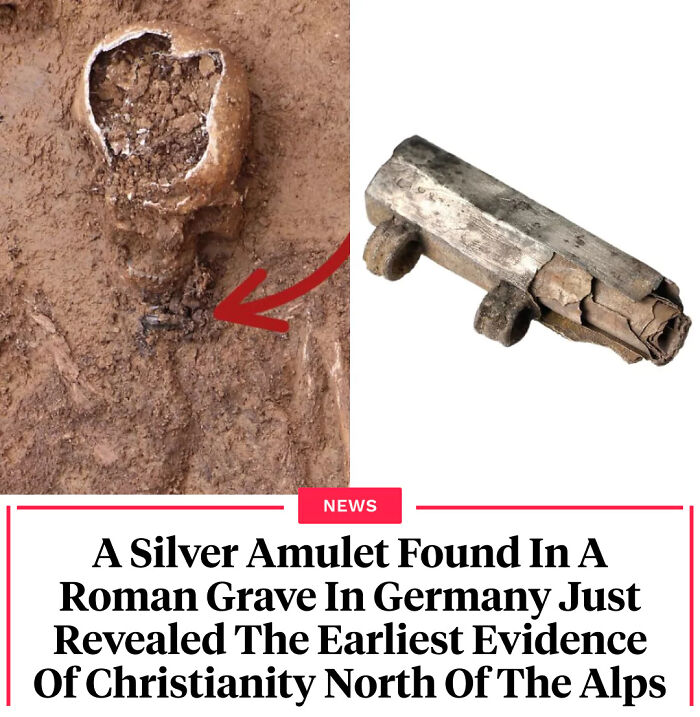
In 2018, archaeologists uncovered a Roman cemetery in Frankfurt, Germany. In a grave dating to the third century C.E., they found the skeleton of a man buried with an incense bowl, a clay jug, and a tiny silver amulet that he wore around his neck. Inside the amulet was a thin piece of foil with a mysterious inscription, but because it was just an inch long and incredibly brittle, researchers couldn't unroll it. For the past six years, they've been trying to determine what was written on the foil, and now they've finally succeeded thanks to advanced CT scanning technology.
The inscription was 18 lines long and written entirely in Latin with explicit references to Christianity, including phrases like "holy, holy, holy," "every knee bows... and every tongue confesses," and "in the name of Jesus Christ, Son of God!" This discovery predates all other evidence of Christianity north of the Alps by 50 to 100 years — and it's completely rewriting the timeline of the religion's spread throughout Europe.
On February 1, 2021, a snow-shoveling dispute between neighbors escalated beyond belief — and led to the deaths of three people. James and Lisa Goy of Plains Township, Pennsylvania were clearing snow from their driveway and dumping it on the property of Jeffrey Spaide, who lived across the street from them. Spaide, a decorated Navy veteran who usually kept to himself, asked the couple to stop. But when they didn't, the dispute became violent.
After the Goys and Spaide shouted numerous obscenities at each other, Spaide retreated into his home — and emerged with a pistol. He then began firing shots at the Goys as they continued to scream expletives at him. Lisa Goy collapsed on the snowy street, while her husband unsuccessfully tried to crawl toward the couple's home. Spaide went back inside his house, but he wasn't done yet. He returned with an AR-style rifle, which he used to "execute" the Goys at point-blank range before taking his own life.
I had a piece of s**t roommate who showed the video of this to me in kind of a "hey check out this funny thing" kind of way. I was disturbed but thought there would be a joke or something, but no, it was a video of people being m******d and he thought we could laugh about it together. I'm really glad I never saw that guy again after I moved out.
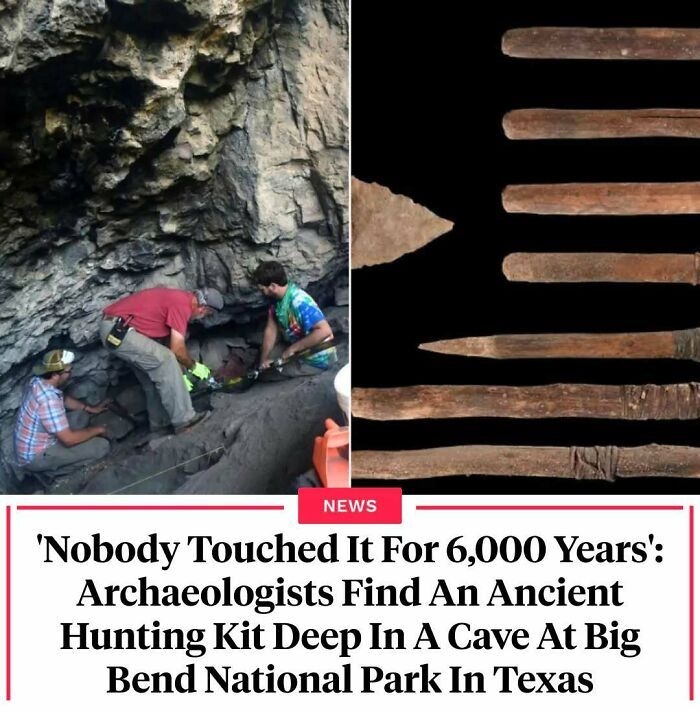
While searching San Esteban Rockshelter outside Big Bend National Park in southwest Texas, archaeologists came across a 6,000-year-old hunting kit that may be the oldest intact weapon set ever discovered in North America. The cache included part of a spear-throwing tool known as an atlatl, 10 shafts that connected stone points to the weapon, and the ends of four darts. Researchers also uncovered a straight-flying boomerang that ancient hunters would have used to k**l or incapacitate small game. What's more, archaeologists found a tanned pronghorn hide that still contained hair neatly folded atop a rock beside the kit as if whoever left it there "had every intention in the world of coming back."
For years, historians have assumed that c*****e wasn't widely used in Europe until the 19th century, after a German chemist figured out how to isolate the d**g from coca leaves in 1859. However, new evidence could push European c*****e use back almost two centuries. A team of researchers recently analyzed the brains and skulls of nine people buried in a 17th-century crypt in Milan, Italy. They were astonished to find components of the coca plant within the mummified brains of two individuals — which researchers believe is the earliest evidence of c*****e use on the European continent.
So? "Coca leaves have been traditionally used across Andean cultures for medicinal, nutritional, religious, and social purposes—serving as a stimulant, remedy for ailments, spiritual tool, and source of sustenance—especially through chewing and tea" (Wikipedia) for thousands of years. I bet you'll find components of the coca plant in mummified brains there too.
In 2018, urban explorer Luke McPherson crept onto the grounds of the long-abandoned Wildlife Wonderland park in Southern Australia. Its empty, darkened hallways were eerie enough on their own, but then his camera captured something truly unexpected: a two-ton great white shark floating in a tank of formaldehyde. His video of this eerie encounter soon racked up millions of views on YouTube and sparked renewed interest in Rosie the Shark, a minor wildlife celebrity in Australia that was forgotten when Wildlife Wonderland was forced to shut its doors. McPherson's video also caught the attention of a wildlife rescue organization in Australia — and now Rosie is undergoing restoration at Crystal World Exhibition Centre in Victoria.
On the night before her murder, fitness instructor Missy Bevers wrote to her students on Facebook to tell them that, despite a heavy storm, she'd still be teaching her class at the Creekside Church of Christ in Midlothian, Texas, the next morning, on April 18, 2016. But when her students showed up for the class, they found the 45-year-old gruesomely k**led.
Tragically, it seems that Bevers' post on Facebook let her murderer know exactly where she'd be that morning, as the unknown assailant apparently arrived at the church before Bevers did. The chilling video surveillance footage later showed the mysterious suspect walking the hallways of the church, unidentifiable in head-to-toe police tactical gear. And to this day, authorities have been unable to identify the person behind the brutal k**ling.
Beginning in the fall of 1985, the Miami-Dade region was plagued by a series of violent bank robberies and armored car robberies. The two perpetrators were heavily armed and had no qualms about using their weapons — and for months, authorities struggled to identify them. Finally, one of the robbers' would-be victims managed to escape with his life and led police straight to the perpetrators, Michael Lee Platt and William Russell Matix. The duo had moved to Miami in 1984 to start a landscaping business before embarking on their brutal crime spree. Curiously, neither had a prior criminal record, though both of them were former military and had been trained in combat — and both of their wives had died under suspicious circumstances.
On April 11, 1986, the FBI finally tracked the bandits down on a Miami side street. But when they tried to apprehend the men, Platt and Matix opened fire. The subsequent shootout left both robbers and two FBI agents dead and injured five others in what is considered one of the bloodiest days in FBI history.

I think this is when they decided to start moving LEOs away from revolvers
Researchers have created a digital reconstruction of the face of a 19th-century 'vampire,' thanks to forensic technology. After exhuming a coffin labeled "JB55" in a 19th-century cemetery in the 1990s, researchers saw that the bones of the corpse inside had been arranged in a skull and crossbones manner. They say this suggests that the man likely died of tuberculosis, a disease that at the time was associated with vampirism. "Of course, J.B. was not a vampire, but he was believed to be undead in his grave, capable of leaving the housing of his grave, and [feeding] on living family members spreading consumption/tuberculosis," one researcher said.
Though old bones can be difficult to study, forensic scientists succeeded in extracting a DNA sample that offered clues about both JB55's name and what he may have looked like. Using DNA technology and historical records, they've now put together an image of his face
In 1841, Vice President John Tyler became the 10th president of the United States when William Henry Harrison died of pneumonia a month after his inauguration. He fathered 15 children, including a son named Lyon Gardiner Tyler, who was born in 1853, when John Tyler was 63 years old. Lyon went on to have six children of his own, and his son Harrison Ruffin Tyler was born in 1928, when Lyon was 75. Now, Harrison, the last living grandchild of President John Tyler, has died at the age of 96, bringing an end to three generations that spanned nearly the entirety of U.S. history.
Jada Pinkett and Tupac Shakur met on the first day of high school at the Baltimore School of the Arts in 1984. While Tupac studied ballet, poetry, and jazz, Pinkett Smith specialized in dance and theater, and the two remained lifelong friends. "As soon as he approached me, he was like a magnet," Pinkett said after his death. "And we hit it off from that moment on… I don't think either one of us thought we would have made it in the way that we did, but we knew we were gonna do something."
On September 8, 2002, Marco Siffredi looked down at the slopes of Mount Everest. Clouds gathered below him as the sherpas warned Siffredi of a storm approaching, but this would not stop the young daredevil from achieving his goal: descending the Hornbein Couloir of Mount Everest on a snowboard.
Siffredi had snowboarded the Norton Couloir the previous spring, making him the first person to snowboard down Mount Everest. However, his second attempt would prove to be his last, as he was never seen again. Theories of his disappearance range from an avalanche to the hope that he made it down and is now living with yak herders in Tibet.
Ok, sorry but he's not living with yak herders in Tibet. Where do people come up with this nonsense?
Susan Wright first met her husband Jeff in 1997 while working as a waitress in a Galveston, Texas restaurant. They got married when she became pregnant with their first child, and according to Susan, Jeff became physically abusive once their son was born. And after four years of dealing with his d**g- and alcohol-fueled rages, Susan said that she snapped — and stabbed Jeff 193 times in their home, ultimately k**ling him. Once she was sure that he was dead, Susan loaded Jeff's body onto a dolly and dragged him into the backyard, where she buried him beneath potting soil in a hole he'd recently dug in preparation for a fountain. She then got to work on her blood-splattered bedroom, attempting to bleach the walls to cover the carnage. Just days after the murder, however, Susan called an attorney and turned herself in — when she noticed the family dog was digging up her husband's body.
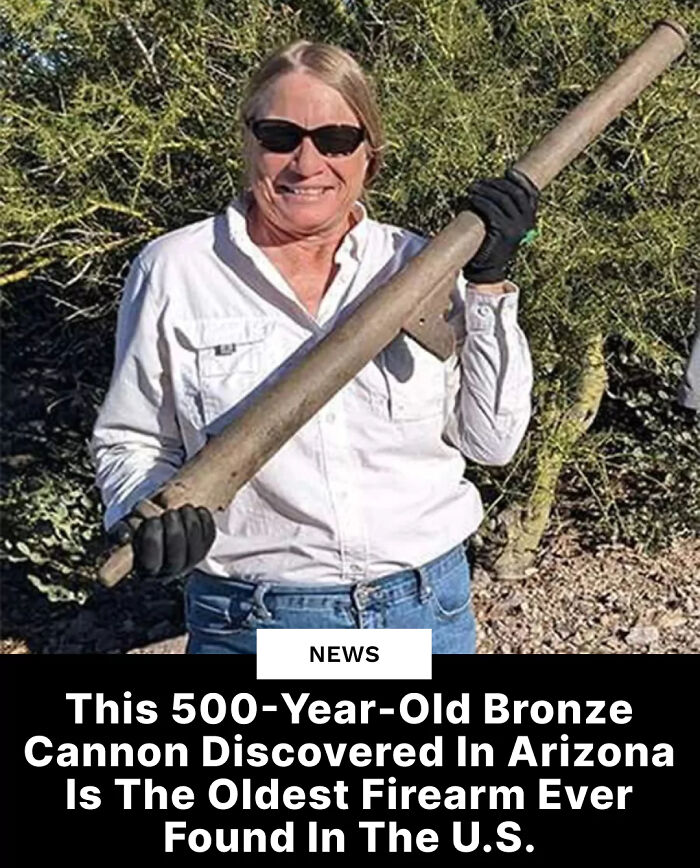
Between 1540 and 1542, Spanish conquistador Francisco Vázquez de Coronado led an expedition from Mexico to Kansas in search of the fabled "Seven Cities of Gold." Instead, he found only small Indigenous settlements, and his men k**led hundreds of Native Americans during the ensuing Tiguex War. In 1541, Vázquez de Coronado established San Geronimo III in present-day Arizona, the first European settlement in the American southwest. Now, archaeologists searching the site have unearthed the oldest firearm ever found in the continental United States and the first confirmed to be from the Coronado expedition.
The 40-pound bronze cannon was likely cast in Mexico or the Caribbean for use as a defensive wall gun to protect Spanish fortifications, but it could also be placed on a wooden stand and blast through adobe walls from a distance of 700 yards. However, the 42-inch-long weapon shows no evidence that it was ever fired — and it was likely left behind when the Sobaipuri people attacked San Geronimo and forced the Spanish to abandon the town.
In 1986, Omaima Nelson moved from her home country of Egypt to the United States, where she settled in California and found work as a nanny and model. It was there, in 1991, that she met Bill Nelson while at a bar playing pool. At 56, Bill was 33 years her senior, but that didn't stop the pair from marrying just a few days later. Unfortunately, the honeymoon phase didn't last long.
Omaima later claimed that once they were married, Bill started showing his violent side, physically and sexually abusing her, and a psychological evaluation later revealed that Omaima was indeed suffering from post-traumatic stress disorder. Then, on Thanksgiving Day in 1991, Bill allegedly sexually assaulted her — so she hit him with a lamp before stabbing him with a pair of scissors and bludgeoning him to death with a clothes iron. But she didn't stop there. Omaima proceeded to dismember her husband's body before cooking parts of it — and reportedly eating them.
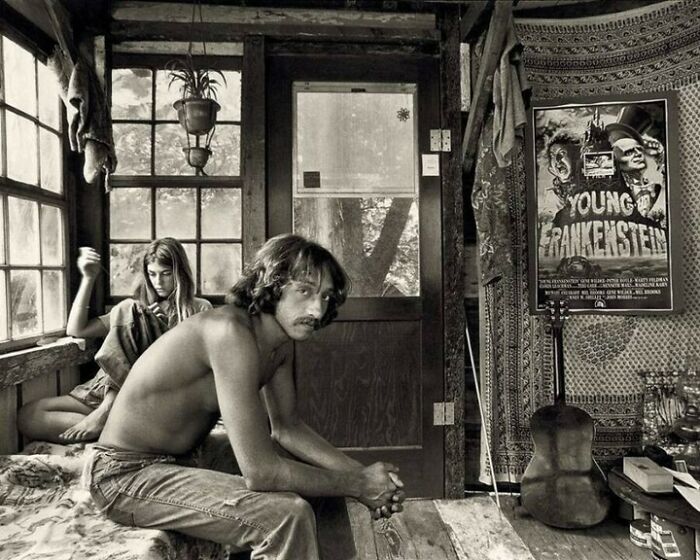
In the early 1970s, Taylor Camp on the Hawaiian island of Kauai was the ultimate hippie paradise. At its peak, 120 people lived in makeshift treehouses on the seven-acre beachfront property owned by Howard Taylor, the brother of Hollywood icon Elizabeth Taylor. But by 1977, the government had condemned the land to expand a state park, forcing out the residents who remained.
Born on November 30, 1939, in Independence, Missouri, Sharon Kinne was desperate to escape her hometown. At age 16, she married a Mormon college student six years her senior, begging him to take her away from Independence. But after converting to Mormonism and giving birth to the couple's only child, Kinne found herself still stuck in Missouri and turned to extramarital affairs and shopping to distract herself from her failing marriage. Before long, both she and her husband were seriously considering divorce. But then, Kinne apparently decided to turn to violence instead.
On March 19, 1960, Kinne allegedly shot her husband in the back of the head and blamed their two-year-old daughter for accidentally firing the gun. Then, she k**led her extramarital lover's pregnant wife soon afterward. Though she avoided being convicted of either of these murders, Kinne decided to take off for Mexico, where she was charged with murder a third time. Then, she somehow managed to escape the prison where she was being held. And for over half a century, this murderer has evaded justice, making her one of the longest-missing felons in American history.

Sharon Kinne was identified after her 2022 death in Taber, Alberta, where she had been living under the alias of Dee Glabus. While appearing a 'typical suburban wife' known for her needlepoint and banana bread, she also left a path of murder, manipulation and abuse behind her, leading her own family to describe her as causing 'great harm without thought or remorse'.
On November 2, a hiker was walking near Splügen Pass on the border of Switzerland and Italy when he spotted a bizarre object at the end of a melting glacier. Upon closer inspection, he saw that it appeared to be a wagon with two wheels made up of bamboo rods and cords. Bamboo is not native to the area, and it wasn't introduced to Europe until the 16th or 17th century, so archaeologists believe the cart-like object dates to the 1900s — but they have no idea what it was used for or how it got to the Swiss Alps.
Upon her death in 1992, a German countess named Karlotta Leibenstein allegedly left her $80 million fortune to Gunther III — her German shepherd. The trustees in charge of that money have reportedly spent the past 30 years investing in real estate and other ventures that have allowed Gunther III's descendants to enjoy some of the finest luxuries in the world. Now, Gunther VI is said to have inherited the family fortune — which has grown to a staggering $500 million. But is the whole story an elaborate hoax that was invented to help an Italian real estate tycoon sell more properties?

This is the type of content I've come to love from BP, not rehashed Reddit posts or celebrity garbage.
Erm. This is rehashed Instagram content. Jeez learn how this site works would you?
Load More Replies...
Something worth reading for a change from the recent drivel offered.
The frequent and gratuitous use of the word "just" in the article titles is really annoying. I don't think any of these interesting facts (and many are interesting) qualify as "breaking news".🙄

Probably a mix of Google translate and AI rewriting to change tone.
Load More Replies... This was so fun, thank you for sharing it! I really appreciate it, I end up learning new things, looking up others, there are spirited Monty Python quote fests and I always learn something in the comments, it’s awesome!
This is the type of content I've come to love from BP, not rehashed Reddit posts or celebrity garbage.
Erm. This is rehashed Instagram content. Jeez learn how this site works would you?
Load More Replies... Something worth reading for a change from the recent drivel offered.
The frequent and gratuitous use of the word "just" in the article titles is really annoying. I don't think any of these interesting facts (and many are interesting) qualify as "breaking news".🙄
Probably a mix of Google translate and AI rewriting to change tone.
Load More Replies... This was so fun, thank you for sharing it! I really appreciate it, I end up learning new things, looking up others, there are spirited Monty Python quote fests and I always learn something in the comments, it’s awesome!





































 No fees, cancel anytime