If You’re Feeling Confused By The English Language, These 30 Tips By The “Pronunciation Mistake” Twitter Account May Clear Things Up
The English language is a tricky matter of business. Whether you came into this world speaking your native tongue from day one or just got on board, many aspects of English are confusing and even ridiculous. The spelling, the grammar, the pronunciations, the meanings that contradict one another, and — obviously — the exceptions to every rule. Even when you memorize everything to a T, you somehow manage to mess something up in the most mortifying way.
I mean, I still lapse into cons-cienc-ious when I'm distracted. And let’s face it, the word necessary is so unnecessarily hard to spell. I mean, how many Cs and Ss do you really need?! But while these blunders may bruise my confidence, they also spark an interest to know more. So allow me to introduce you to one enlightening corner of Twitter called 'Pronunciation Mistake'. With a huge community of more than 212k followers, this social media project is dedicated to the most informative and useful tips for anyone trying to improve their English.
So grab a pen and a notebook because our linguistics-loving team here at Bored Panda has gathered some of their best posts to take your skills to the next level. Scroll down to have a read, upvote your favorite posts, and be sure to share your own experience with the wild ride that is the English language in the comments below.
This post may include affiliate links.
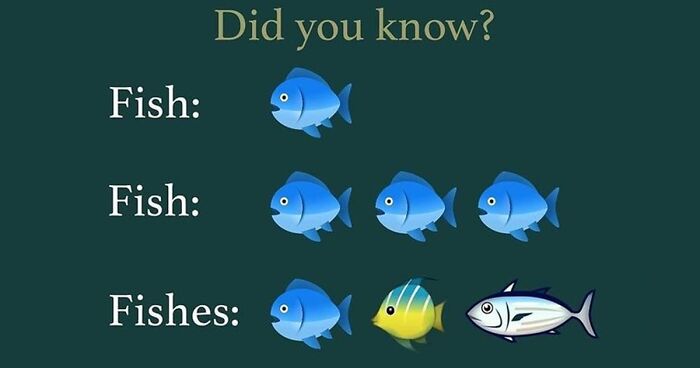
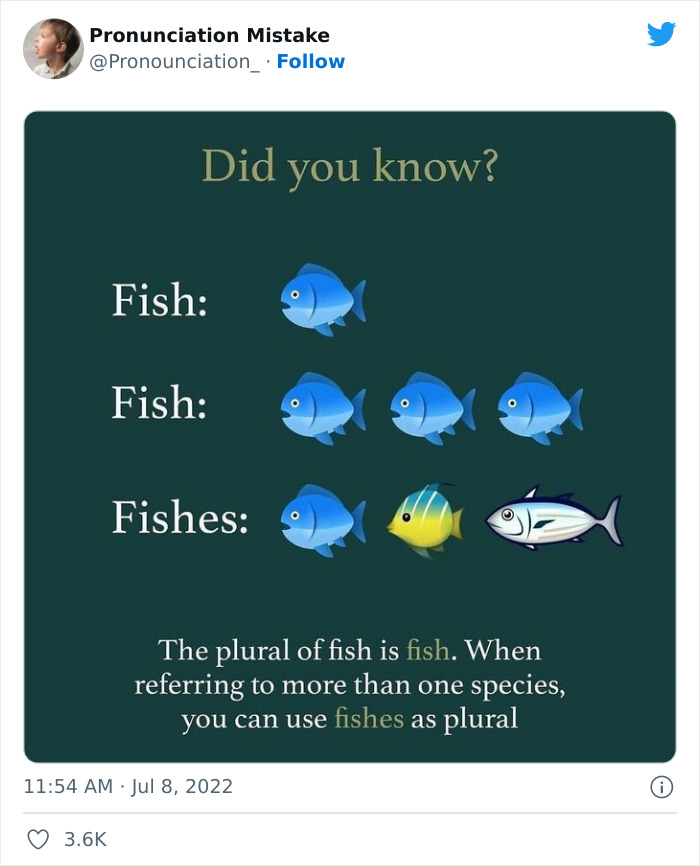
I'm floundering. Honest to cod I feel out of plaice.
Load More Replies...If you set out to fish more than one species, would that be fishesing? 🤭
Load More Replies...Would be weird if a mobster were to utter "he's sleeping with the fish" people might get the totally wrong idea!
Even with the 3rd scenario, you still don't need the es but you can. And the 2nd one could still use the es or not
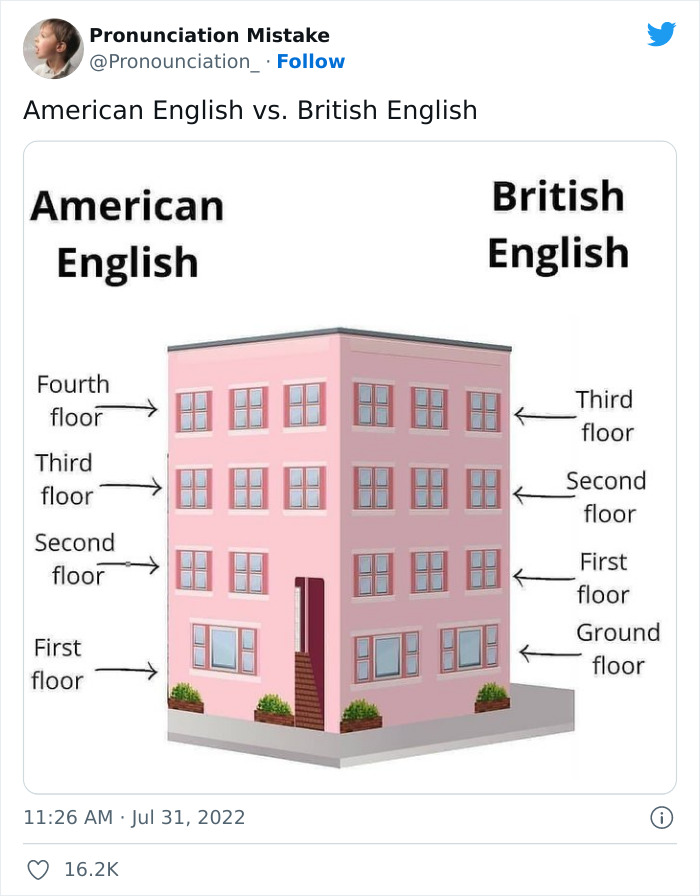
Especially given the fact that other languages around here also tend to have some sort of zero level which is ground level.
Load More Replies...Incorrect. Many countries use the American scheme, many more use the (most of) European scheme, and some countries use both. https://en.wikipedia.org/wiki/Storey#/media/File:Countries_numbering_floors.svg Countries_...1b-png.jpg
It just depends on the true meaning of "floor". In many languages there is a specific word for a story/floor above the ground, and often a specific word for the ground floor. In french "rezde-chaussée" and "étage", in German "Erdgeschoss" and "Stock" for example. In that case the british way is the only correct and natural one. But in English "floor" or "story/storey" means "a complete horizontal section of a building" with no difference for ground level or above ground level(s). Therefore it is far more logical to name the floors the american way, the british way in english is technically incorrect.
The British is correct. 1st floor means the first floor above ground level
Load More Replies...What would be "ground floor" in american english? Laying on the pavement?
First floor is ground level, just like noon is midday. I didn't know the British version separated them.
Load More Replies...Living in America. The hospital I work at starts at "ground" floor, not the "first" - that is, unless you enter at the other side of the hospital... in which case you come in on the "first" floor, due to the other side being at a higher elevation. All a matter of perspective (or entrance selection), I suppose.
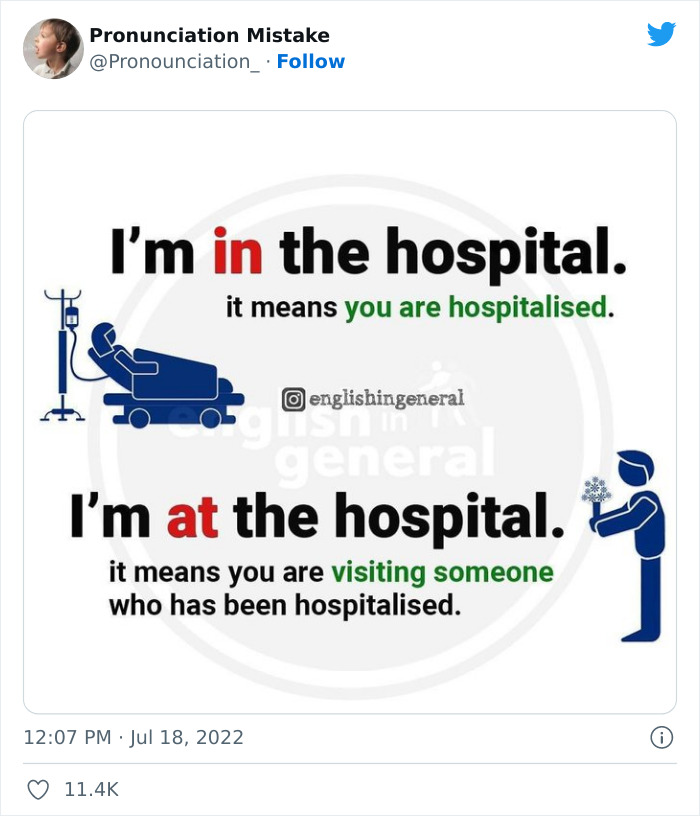
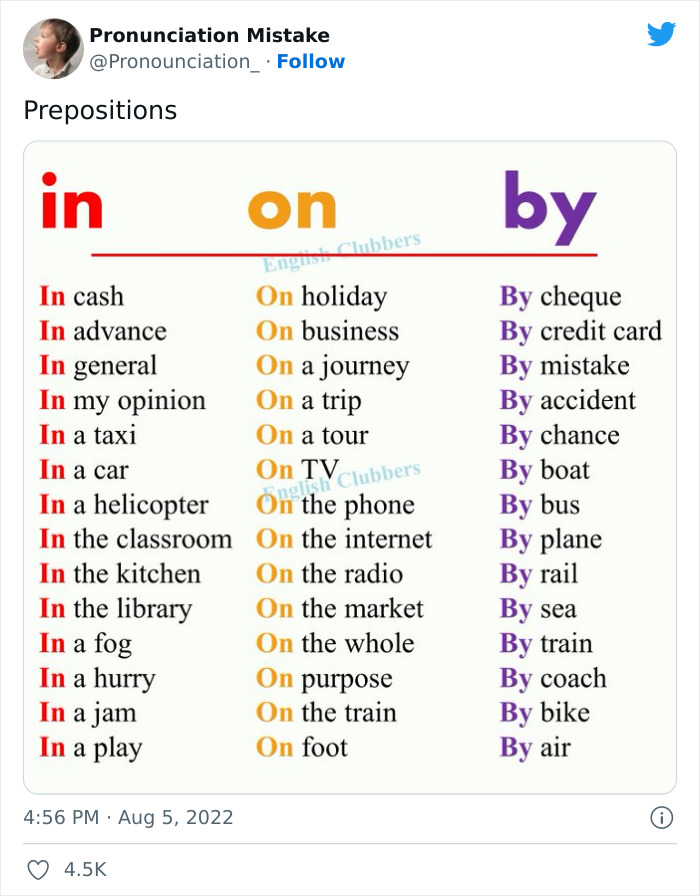
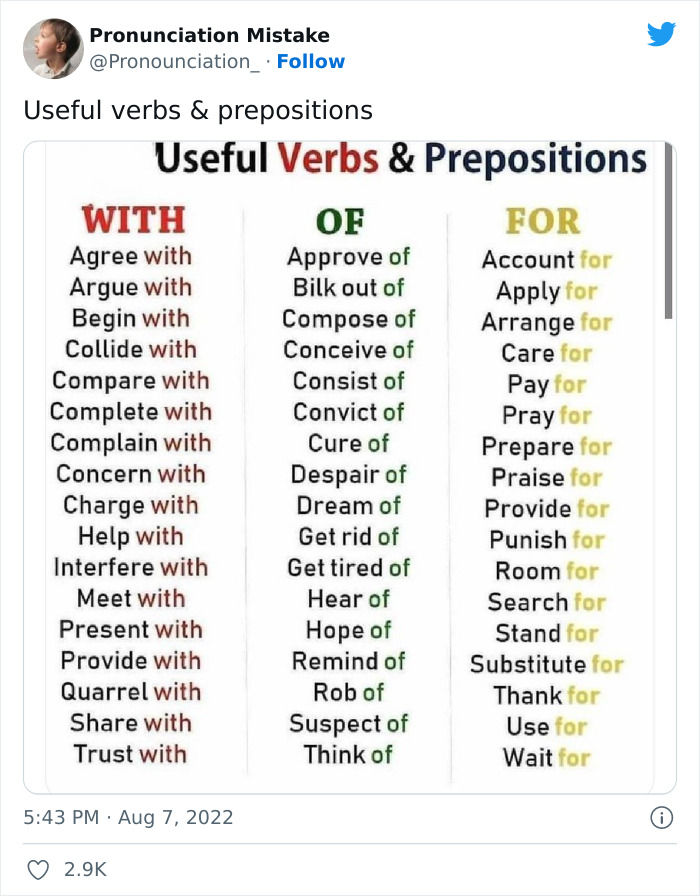
Prepositions are difficult for students of English as a foreign language.
this one I guess I already did subconsciously .... it just seems right (but that's as a born american english speaker)
"They're in hospital" is how British people describe having murdered an annoying spouse by having them poured into the foundation of the building.
Although the 'Pronunciation Mistake' project was founded only in May, it has already gained a strong foothold on Twitter. In just a few months, it has grown into a popular outlet that focuses on sharing helpful language advice for anyone willing to learn. At the time of writing, the account has amassed more than 212k devoted fans trying to elevate their English skills to another level.
As the creator plainly states in the bio, "Pronunciation is the way in which a word or a language is spoken." While this is absolutely true, a brief scroll through this list will show you pronunciation blunders are not the only thing they’re after. The account has been branching out to feature an array of different tips and tricks, from spelling and grammar to the many exceptions this beautiful language has to offer.

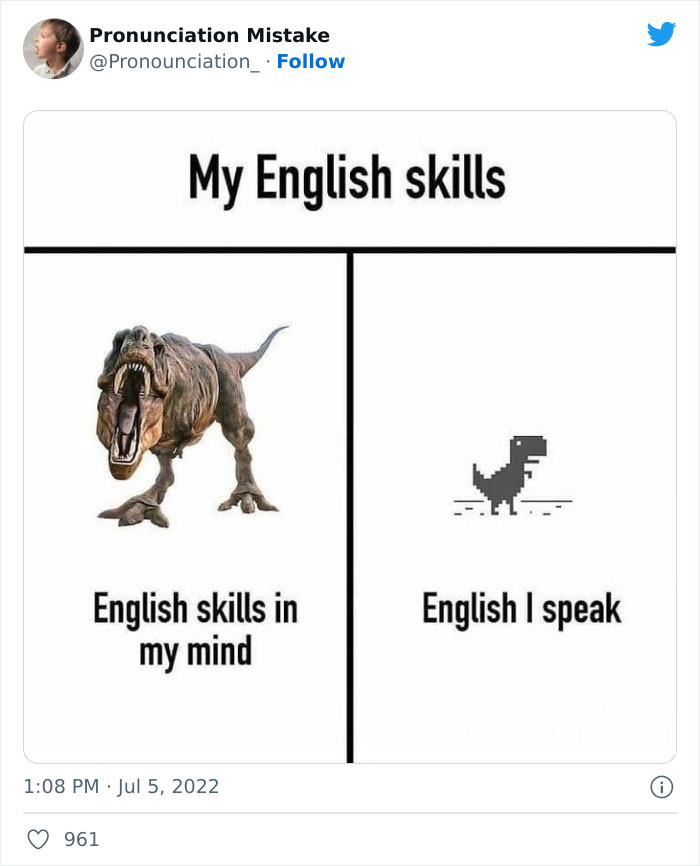
Pretty much this :D I understand almost everything, but when I have to open my mouth to speak english, no words come out.

Same :)) it's because different areas in the brain control speach and understanding
Load More Replies...It's the same for everyone. We understand far more than we are able to speak. It doesn't matter the person, nor the language.
This. Quickly realised this when I tried to start writing my ‘novel’
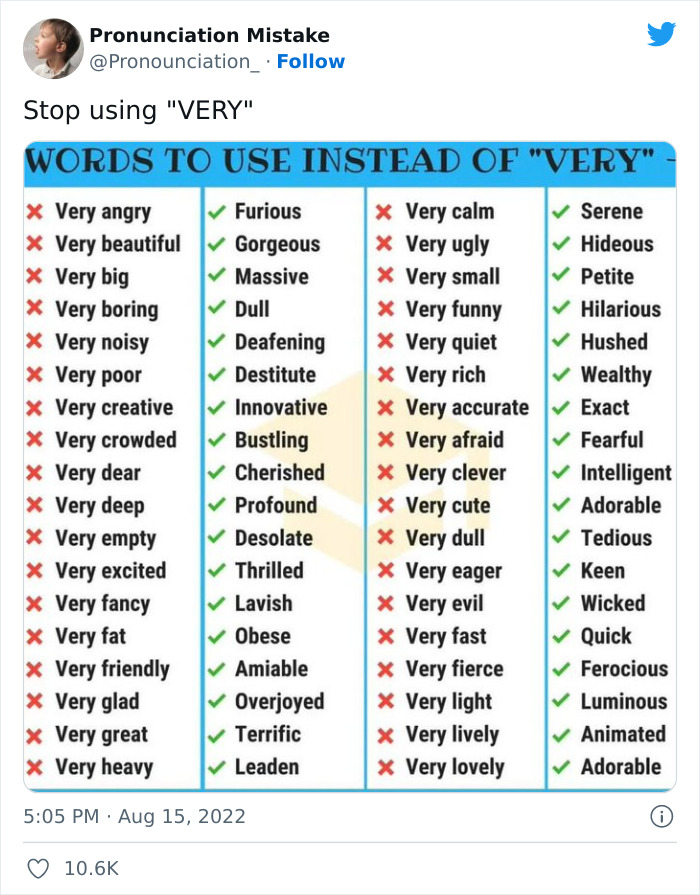
Some of these don't work. A very friendly dog is not the same as an amiable dog - overly friendly might be a better description, particularly when it is humping your leg. ;-)

Ugh, I hate the word "obese". I will continue to refer to myself as very fat, thank you.

Re: very rich. What alternative should one use when referring to food? To say, “This cake is wealthy,” sounds — um — silly.

I absolutely love how this list is bringing out the pedant in all of us!

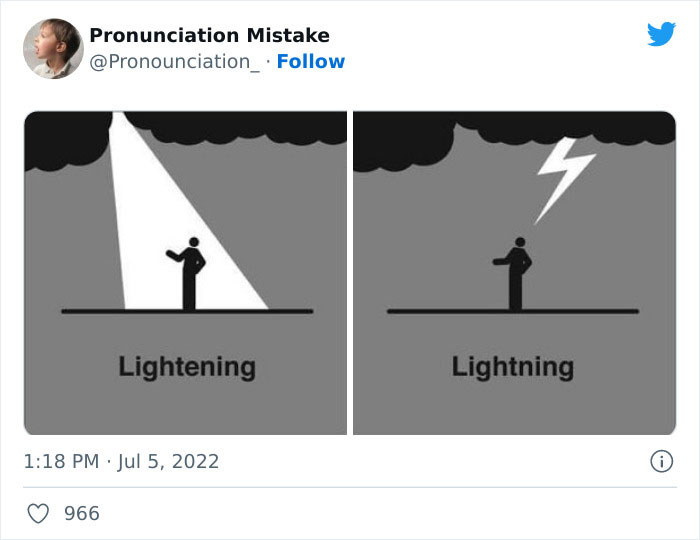
Unless you are struck by it, in which case, do not walk towards the light.
Load More Replies...Lightening is making something lighter. Enlightening is making something brighter. ;-)
And "lighting" is a source of light or lights assembly.
Load More Replies...Actually the word for the picture on left should be Lighting. Lightening means lessening the load of something.
This is incorrect. This is 'Lighting' and 'Lightning'. 'Lightening' something is to decrease it's weight, not illuminate it.
My name is emiily Lightning and its amazing g how many people don't know how to spell Lightning!
No, this is incorrect. The left-hand one is "lighting." "Lightening" means to make something weigh less.
And lighting. As a verb. But also adjective, as in lighting design
English is the most widely spoken language across the globe. According to Statista, there were a mind-bending total of around 1.5 billion people worldwide who spoke English either natively or as a second language. This is slightly more than the 1.1 billion Mandarin Chinese speakers, while Hindi and Spanish accounted for the third and fourth most widespread languages this year.
The reason behind this is that our world has become hyper-connected, and English has gained a position as the dominant language of global communication. Thanks to the internet, the spread of English has almost certainly accelerated.
No other language has ever been used so widely or stretched across a greater portion of the planet. It has become synonymous with opportunity, a means to reach the realms of education and global business. It has become the language of international commerce, science, diplomacy, and so much more.
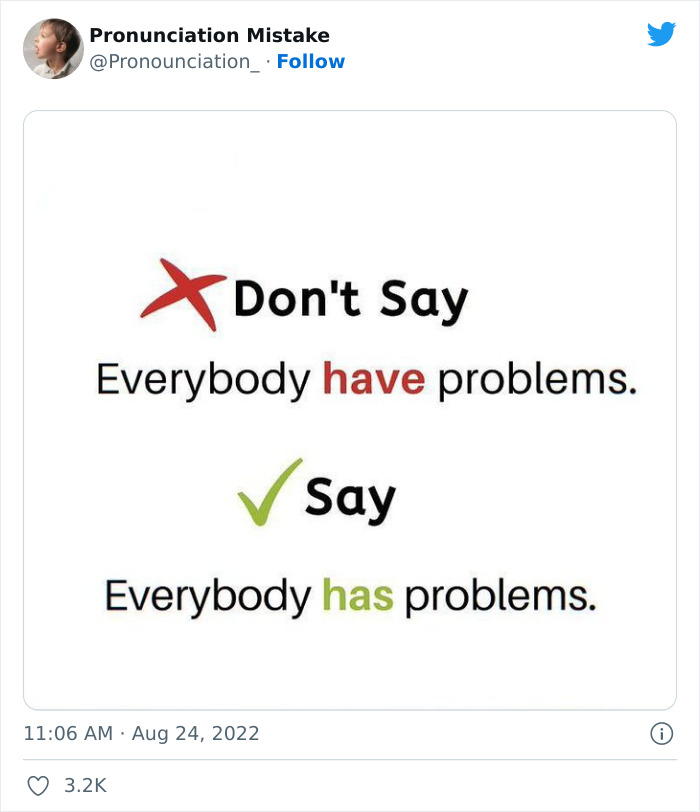
But the word is not "body", the word is "everybody". If it was "Every body" has problems, that would be for the coroner to decide.
Load More Replies...Which would still mean they are using 'has'. In this case, the apostrophe is not a possessive. It is eliding letters in either 'is' or 'has'. Everybody has got problems.
Load More Replies...Everybody, have problems. Is a right sentence though? I'm Dutch. Genuine question
No. I/we/you/they have problems. Everybody has problems.
Load More Replies...Upvote with the hope of it being a Leonard Cohen reference. That's how it goes.
Load More Replies...But totally reversed if you make it a question: does everybody have problems.
AND a common mistake, the H in Hotel is silent, it's pronounced Otel. And is 'an Otel,' not a Hotel.
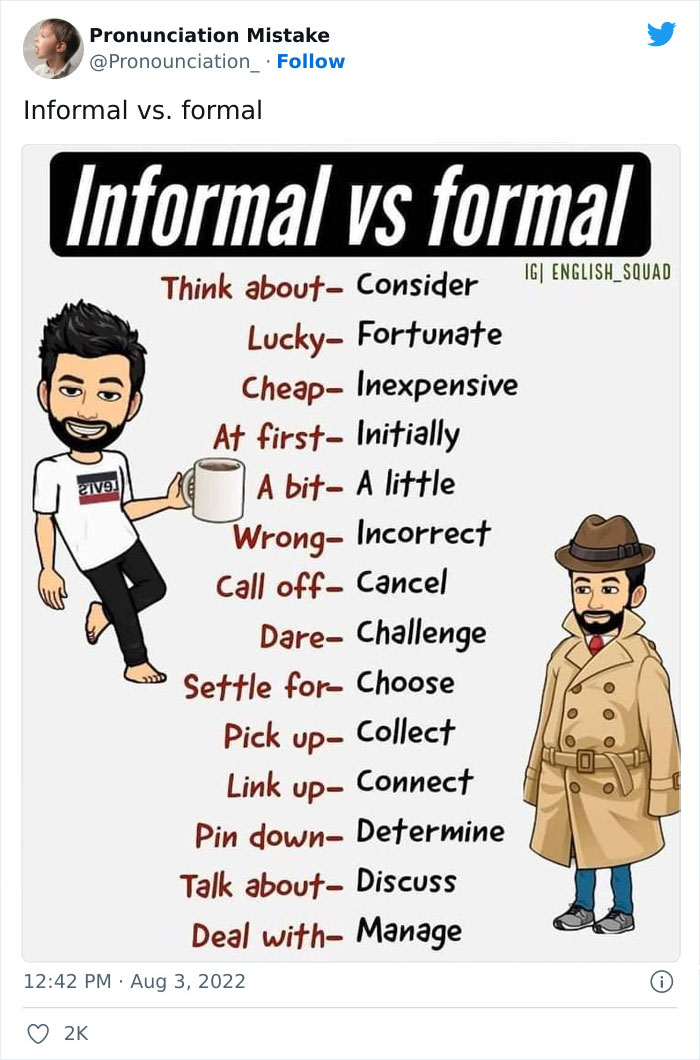
Cheap and inexpensive do not mean exactly the same thing. Cheap can mean "of poor quality" whereas inexpensive means "doesn't cost much".
As a marketer who works for a store that sells cheap used cars (cheap as in $), I call them “inexpensive pre-owned vehicles” :) sounds way better because you’re right, people associate the word cheap with poor quality.
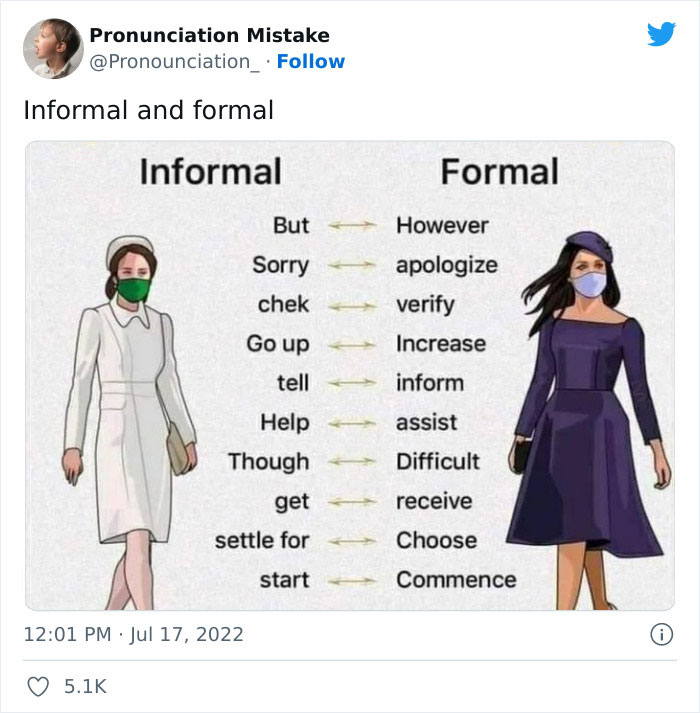
Load More Replies...'Settle for' can be the informal version of 'choose.' But when you settle for something, is does not necessarily mean there was an available choice.
Agreed. I think ‘Settle On’ would be a better informal version of ‘Choose’.
Load More Replies...I mean my first problem with (US) english is the f-ing "I could of" instead of "I could have". What the motherhelling poop is that? And don't get me started on the whole "their they're there". My CPE-(Cambridge Proficiency English) -teacher in High school once said that the our english friends would probably laugh at us for being better at their laguage than them (I kind of hope that my severe drunkenness made me some spell things wrong. I love irony)
Hmm, I promise you, "could of" is rife in Brit-land
Load More Replies...Think about yourself lucky. Consider yourself lucky. Only one of these work.
A dare is either a fun game, a dangerous fun game, or a raid. It's Kids picking on each other. And doing things like going right around the swings. Or it's an extremely dangerous mission. Do you dare to do it? Is the same question, but utterly different responsibilities. But serious. I love your energy. This stuff does need to be talked about.
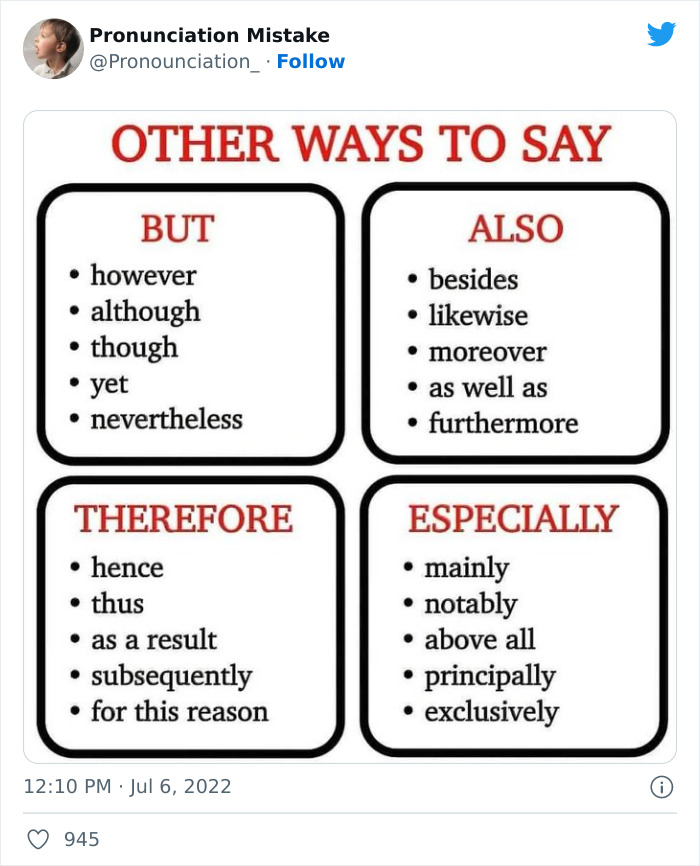
Use a thesaurus and you could find a bunch of words or word combos for each of these.
Especially can also be substituted with Particularly.....or for those people who prefer to be "unique", Especialleigh can be substituted with Particularleigh.
Educational studies have demonstrated over and over again that the most efficient and effective way to learn such things is by reading. Given that humans think in words, we cannot entertain concepts for which we lack sufficiently accurate language. One consequence of the shameful failure of America's K-12 system is a nation of functional illiterates who do not read and therefore cannot think. ¶ The end result is an entire culture that has largely abandoned objective reality in favor of emotional manipulation by images.
Is there anyone else who reads the normal words with an American accent and words like furthermore, notably w a British accent automatically?
I'm British, I read them all with a British accent. Which ones do you think are 'normal'? They all seem normal to me.
Load More Replies...And all these words are hated by lexicologists as conjunctions too far. Lazy English as opposed to elegant sentence formation. Grammar - I shouldn't bother if I were you. Invitation to scholarly hate awaits. It can get ghastly.
But everywhere it goes, it tends to leave a trail. Its mark can be easily traced in the way its vocabulary has infiltrated so many other languages. As Jacob Mikanowski explained in a piece in the Guardian, English has become an exporter of words. For example, researchers at the IULM University in Milan have noticed that, in the past 50 years, Italian syntax has shifted towards patterns that mimic English models. Moreover, both German and Swedish languages are increasingly adopting English grammatical forms and changing the rules governing word formation and phonology.
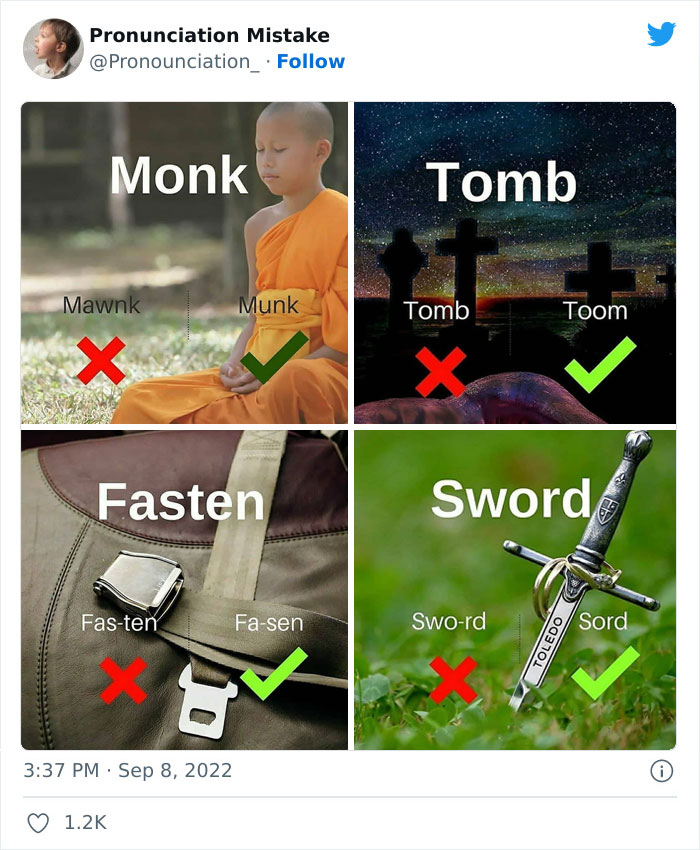
Some of our mute letters came from the words stolen from French.
Load More Replies...Sorry, but I like to pronounce the T is words like "fasten". It annoys people :)
I say every letter in Connecticut for the same reason 😎
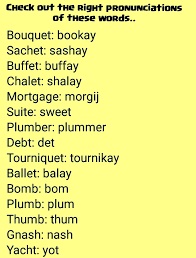
Load More Replies...Well, when you're from Philadelphia, PA.... Munk, Toom, Fasen and Sord are pretty much right! As are Wooder, Loyer, Menyew, our beloved football team, the "Iggles" etc.
Weird that a "pronunciation" account doesn't make an effort to use IPA or even at least synthetic phonics
I don't understand why they say "sord" when it is clearly "Toledo"?
I thought this was about spelling for a second and I was confused as heck.
How about we eliminate the useless characters in words, I refuse to order Samon at a restaurant. Blackened Sal-mon always tastes better.
English words are a huge mush-mash conglomeration of borrowed languages and pronunciations. Sure, it would be nice to just "eliminate the useless characters in words" as we see fit, but it's not that easy. It's very difficult to tell people: "you know that word you've been spelling this way your whole life and taught to do so in schools and literature? Well, we're changing it, so get used to it". That leads to confusion and then change-over and word misspelling everywhere. The old English-Saxon word for salmon was always "samoun", but "salmon" in Latin, and after we adopted Latin spellings, the pronounciations stayed (because people don't like change--go figure). Therefore, to say "sal-mon" sounds ignorant
Load More Replies...I’m sorry Lisa we might hate me :( It’s been by mistake this whole time!
Load More Replies...I think it's mistaken parallel structure. You can do something "on purpose"; otherwise it's "on accident" to some people.
Load More Replies...One of my Japanese colleagues said that when we say "I'm on the plane" she pictures us standing on the roof of the plane, and asks why don't we say "I'm in the plane"
You get on a vehicle if you can then walk to.your seat, I'm on the bus, I'm on the plane, if not it's in, I'm in the car, I'm in the canoe.
Load More Replies...I know this list, but every language has their own. When I speak Swedish, I just through out all of the prepositions and let the listener choose the correct one.
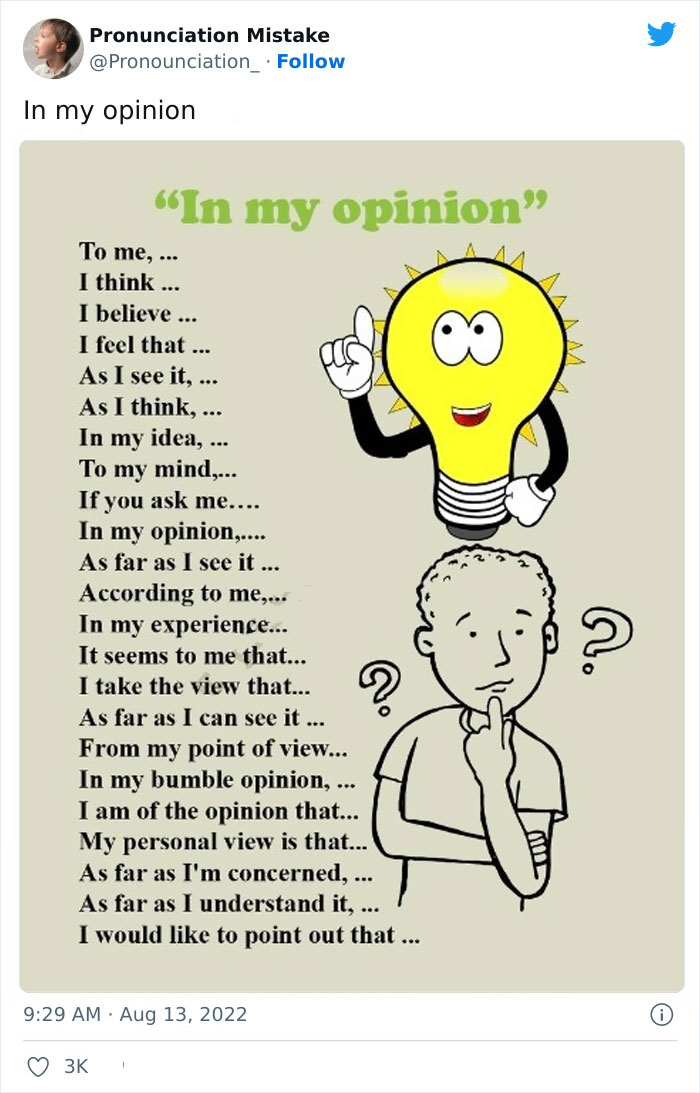
I'm sure they meant "In my humble opinion”, but I think I like "In my bumble opinion" better.
Although maybe if you were having a very specific conversation about bees maybe you could get away with it?! Lol
The influence of the English language is undeniable. But as every second language speaker knows, it is also full of weird oddities that are sometimes incredibly difficult to comprehend. Some words are spelled the same but pronounced differently, others sound alike yet have completely separate meanings, and these are just a few examples that make this tongue seem so challenging.
Sure, we absolutely adore the English language with all its twists and turns and quirky in-betweens, even when they are hard to grasp. To improve your level, you must dedicate time and effort and be comfortable with failing. You will mess up sentence structures, passive voice, genders, and even forget the simplest words. It’s a fact. But while it's easy to feel discouraged, it won’t take long to realize that it's the only efficient way to master a foreign language.

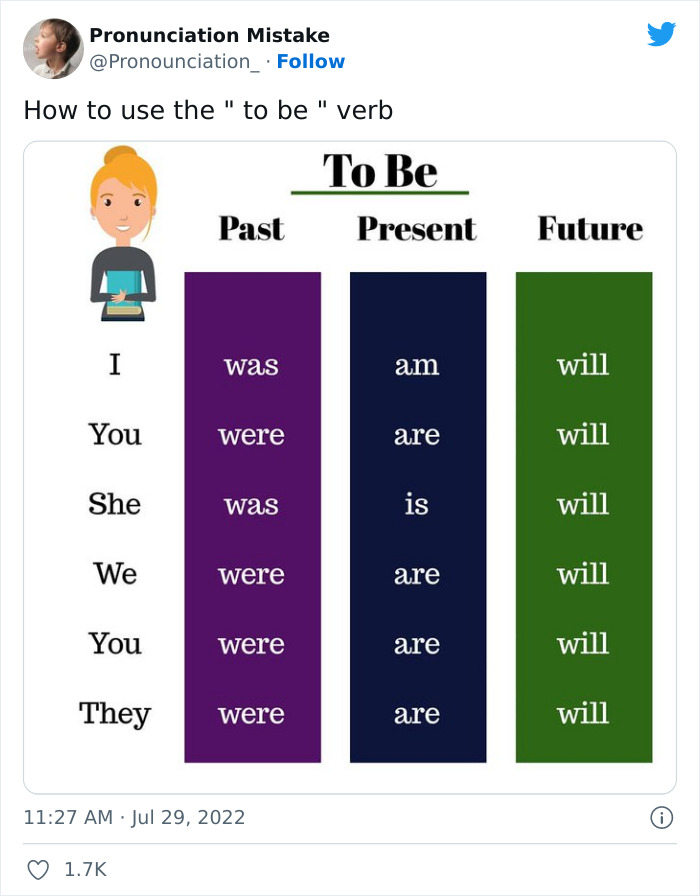
Is the first You the singular you, and the second You the plural you, referred to in the South as y'all?
yes.. In our local version of dutch (Afrikaans) it's "Julle" (pronounced yerler)
Load More Replies...What? This isn't about passive voice - it's about be as a main verb. Also the passive-like construction that uses have is the causative, isn't it? And you'd be hard pushed to get through life avoiding 'be' and 'have'... So, again, what?
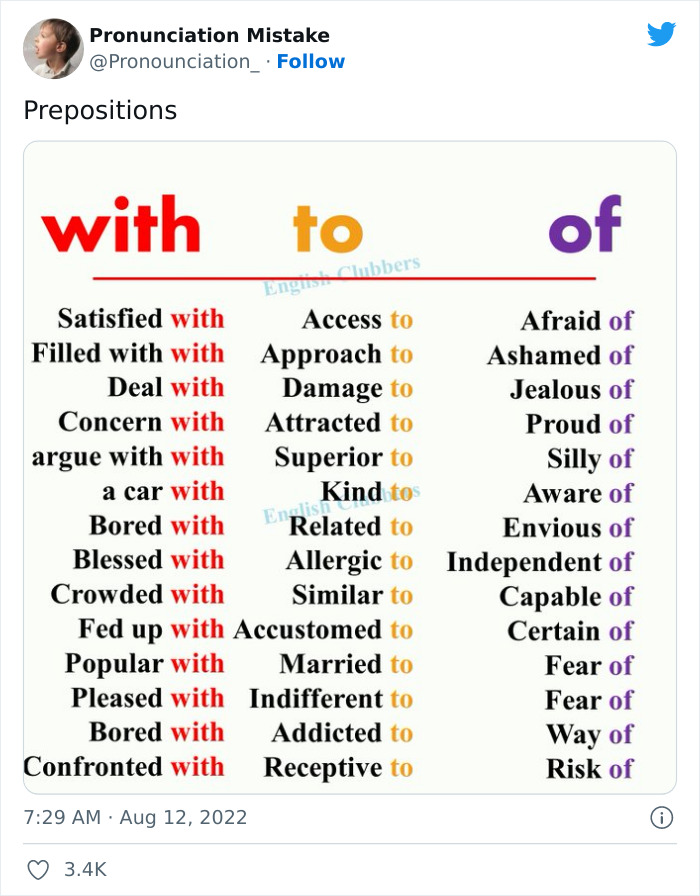
Load More Replies..."Bored of" - anyone who says this in my presence is begging to be called out and humiliated in front of the entire room, wherever that room is. Say it in an interview and you will NEVER get the job. No one wants to hire someone who can't be bothered to learn their own language.
Sorry, but you can be afraid to step in a room full of spiders, rather than afraid of stepping into a room full of spiders.
Approach to? We just say "approach the..car..bench.." I never say "approach to".
I can think of where this does work, eg whole new approach to the job or make an approach to a colleague about something. Even an approach to a house/drive/road.
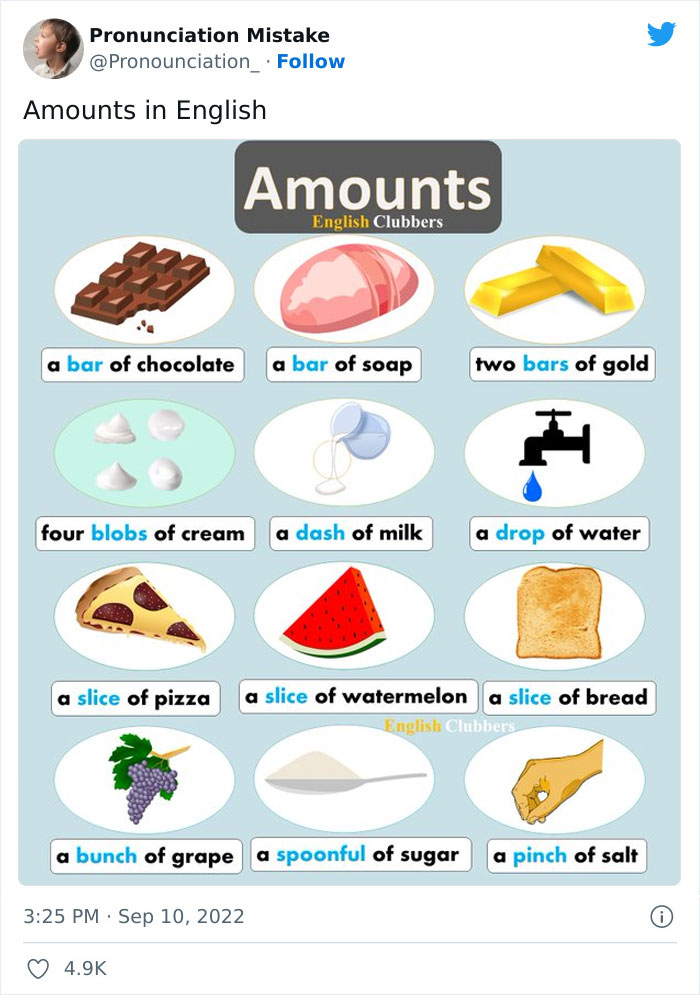
Load More Replies...It's dollops not blobs... Sure blobs works fine and I like blobs but if you're teaching you're gonna stick to dollops.
Who uses dash of milk? Why wouldn't it be splash? I feel dash is for dry ingredients and splash is for wet.
Previously, Bored Panda reached out to Dr. Lisa McLendon to learn more about the pitfalls of learning English, how to keep our linguistic skills sharp, and how social media affects our grammar. As the News and Information Track Chair at the University of Kansas School of Journalism and Coordinator at the Bremner Editing Center, she happily shared her insights.
According to her, some parts of the English language can be hard to learn for foreign students. But the difficulty often depends on the languages they already speak. For example, learning English as a native speaker of another Indo-European language (think Italian) might be easier than being a native speaker of a tonal language (think Vietnamese).
"For students whose native language lacks articles (a, an, the), articles are by far the hardest category of words to master. Verb tense/aspect is also really hard — the difference between 'I read,' 'I am reading,' and 'I do read' is nonexistent in many other languages," the professor explained.

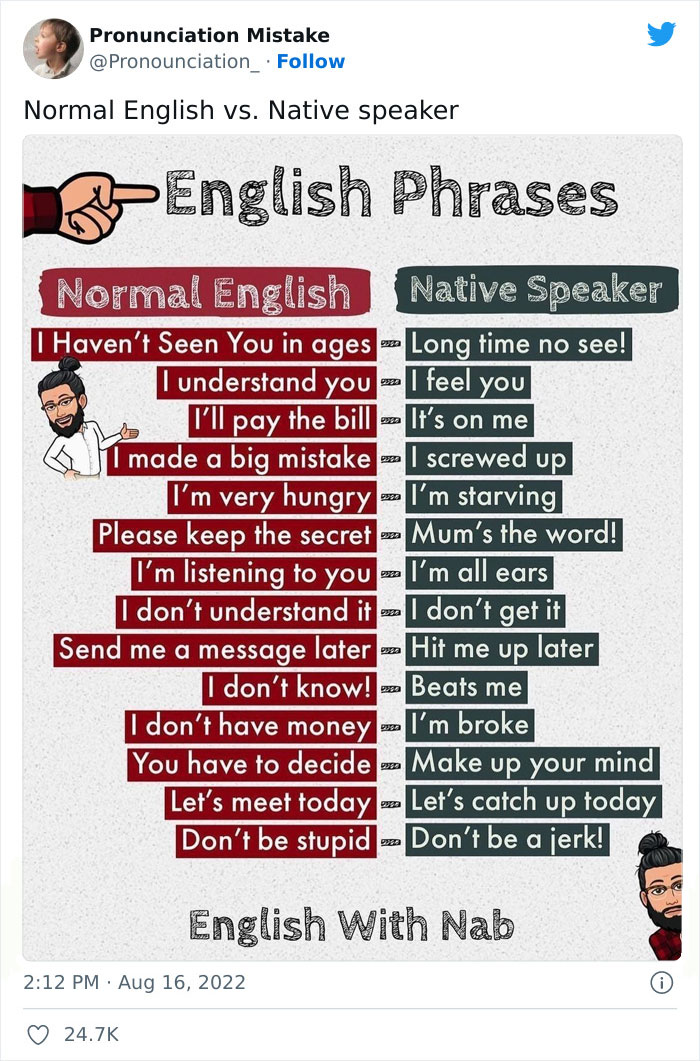
There's a big difference between meeting and catching up....just like there's a big difference between being stupid and being a jerk. Who the hell made these?
Someone who isn't as good at English as they think they are
Load More Replies...You wouldn’t use several of these in British English. This list feels very American.
if this is British, you KNOW the phrase "Don't be a jerk!" is actually "Don't be a t**t!"
Do native speakers really say "Long time no see!" ? It sounds like broken English to me.
I don't but yes it's used regularly, it's sort of because it's broken that it is used. Wiki: "It's origins in American English appear to stem from pidgin English,[1] and is widely accepted as a fixed expression. The phrase is a multiword expression that stands against most varieties of Standard English .[2] It may, thus, derive ultimately from an English pidgin such as that spoken by Native Americans or Chinese, or an imitation of such.[3] The lexicographer Eric Partridge notes that the phrase is akin to "no can do" and "chop chop""
Load More Replies...I am a native speaker of English, and only use 'Make up your mind', 'I'm starving' and 'I screwed up'. AND it's only 'Make up your mind' I would use in preference for the alternative.
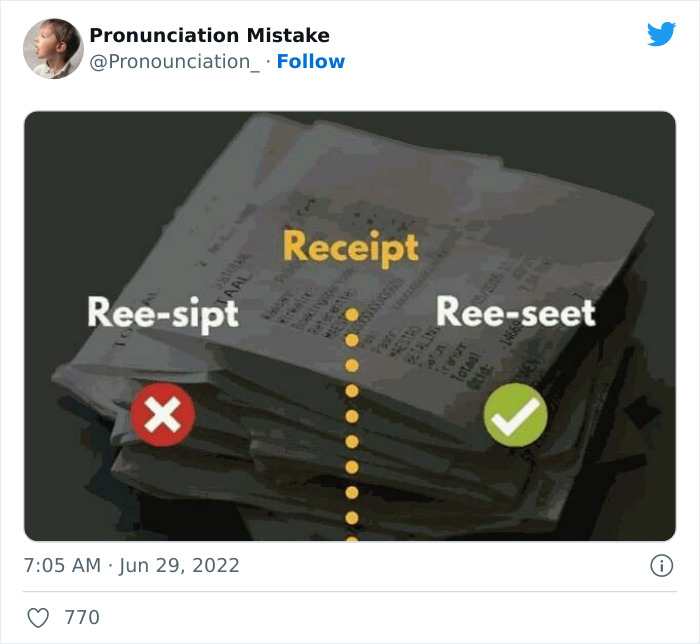
We sometimes say ri-sipe for recipe. Actually come to think of it, there are a lot of words we mispronounce as a joke.
Load More Replies...It is now. Receipt for recipe has been obsolete for some time.
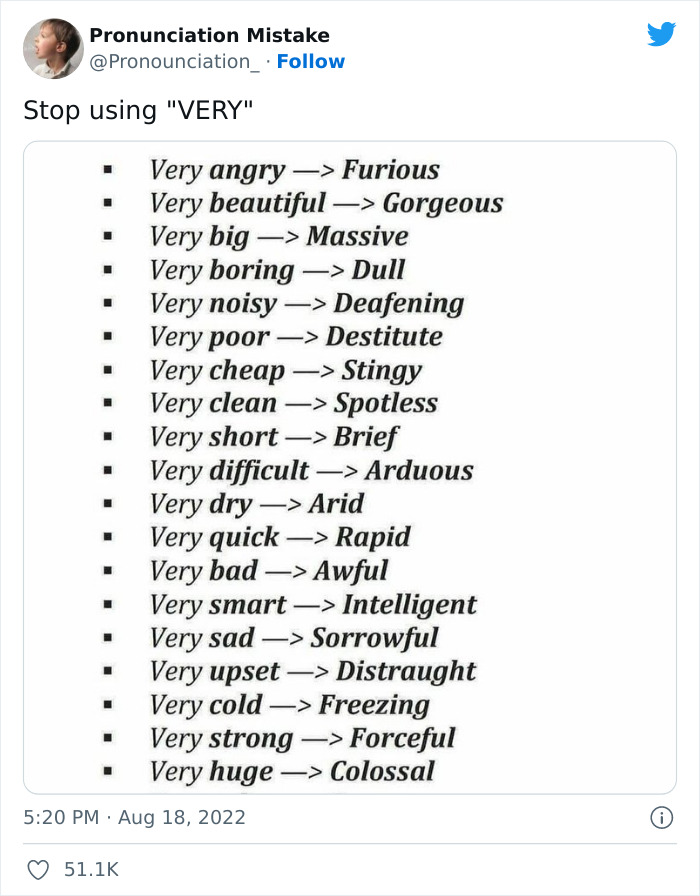
Load More Replies...I am sorrowful and distraught. For a brief period I shall be destitute and only able to buy stingy food. This is due to a colossal bank error, about which I am furious! No one speaks like that...
Maybe not but we don't say "I'm very sad, for a very short time I will be very poor and only able to buy very cheap food. This is due to a very big bank error, which I'm very angry about. Hell I'd probably say "I'm upset. For a while I can only eat bloody ramen cause the bank f****d up! I'm so pissed!".
Load More Replies...Nothing as such. Just there are so many fabulous words. A broader vocabulary usually gives a good impression.
Load More Replies...Memorizing common words, however, won’t help overcome these difficulties. To truly elevate your skills, try to change your mindset and practice, practice, practice — repeat everything until it becomes second nature. "These don’t pose any difficulties for native speakers who use them correctly without even thinking about it," Dr. McLendon said.
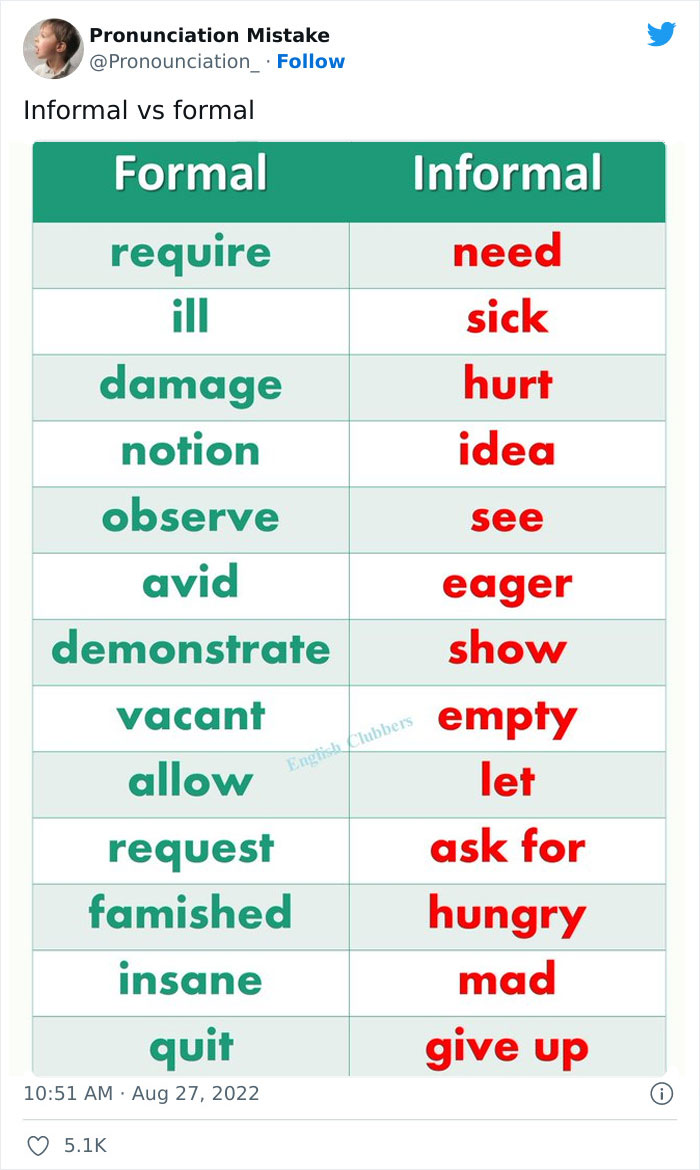
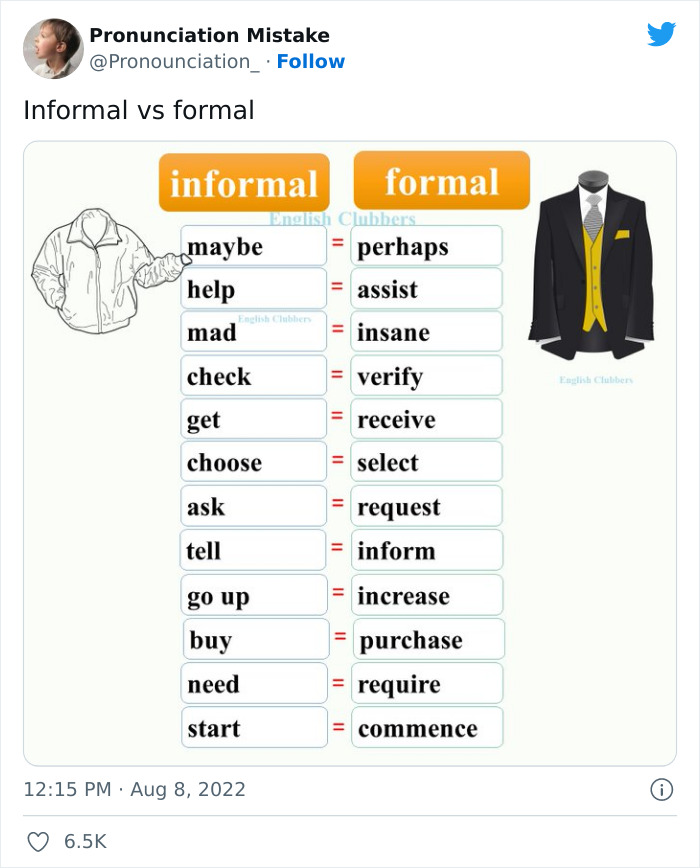
"Mad" in British English is short for insane, but in American English it's short for angry.
"My stomach hurts" "My stomach is damaged" hmm yeah not the best example, honey
Eh, a lot of these also have shades of meaning. If an apartment is "vacant", it probably means that no one is renting it. If it's "empty", maybe the furniture is moved out, or maybe it just means no one's in the room. "Observe" might also be closer to "watch" than "see". A lot of the other examples have differences beyond formal/informal. You'd damage a table, but hurt your knee. You'd inspect the damage, but feel hurt. Someone could be an avid reader, but be eager to read. Someone might demonstrate if they are bragging or teaching, but show something might also mean to reveal it.
Damage = Hurt?? I'd love to see the context they think this works in. I damaged my car does not equate to I hurt my car
We say crazy, bat s**t, insane, crazy as hell, nuts, lunatic, and a whole lot more. Mad as a hatter sometimes. But they also aren't adding that a lot of things are said regionally in the US.
You can give thanks for something, or punish for doing something wrong.
Load More Replies...Argue is variable. You can argue WITH, to be at odds with a thing, idea or person. And argue FOR, to be in favour of a thing, idea or person.
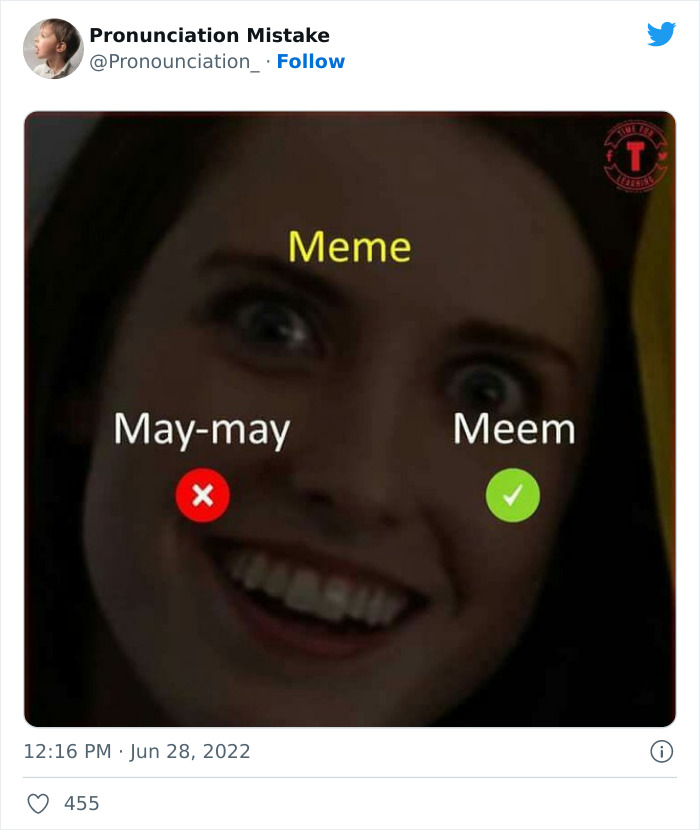
Why would anyone think it's "may-may"? Me-Me seems like a more common mistake.
"me-me" might be a mistake for native speakers, but non natives pronouncing phonetically are more likely to say "meh-meh" (not sure about this "may-may" though! For native English speakers, "e" is often taken to be the long sound like in "me" or "see" - and the letter itself is pronounced like that. In other languages, though, the "e" is often seen as shorter, like an "eh" sound, like in the English word "bed". When I was first learning English, it took a while to get my head around "e" as that long sound, because in my other languages the letter "I" is used. I'd write the English "me" as "mi" phonetically
Load More Replies...Just the other day my daughter laughed at me hysterically for pronouncing it “mehm”!! I’ve never heard anyone say it nor have I ever looked it up…I just assumed that’s how it was pronounced (my 1st language is English and we actually call my grandmother “Memere”).
May-may? :'''-D hahah... really? There are people saying May-may? :''-D sorry.... hahaha
I have never heard anyone pronounce meme as 'may-may';' me-me' maybe but may-may, not so much
I call it maymay as a humourous deliberate mispronunciation. Similar to nukular.
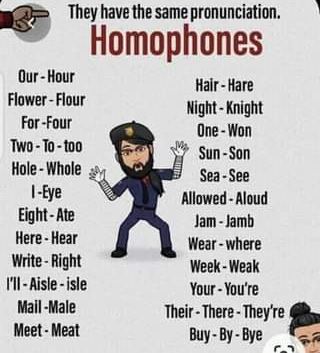
But second language speakers are not the only ones messing up when it comes to English. An astonishing number of native speakers often make spelling and grammar mistakes such as mixing up 'there', 'their', and 'they’re' or 'your' and 'you're'. Dr. McLendon stated that they have other problems with English, too.
In her experience as an editor and a teacher, she has found that native speakers face issues with past passive participles in speech (e.g. saying 'I had went'). Meanwhile, in writing, they have problems with punctuation, homophones (peek vs. peak, etc.), and misplaced modifiers.
Dinnae worry yerself hen (I'm not Scottish that's my best effort 😆)
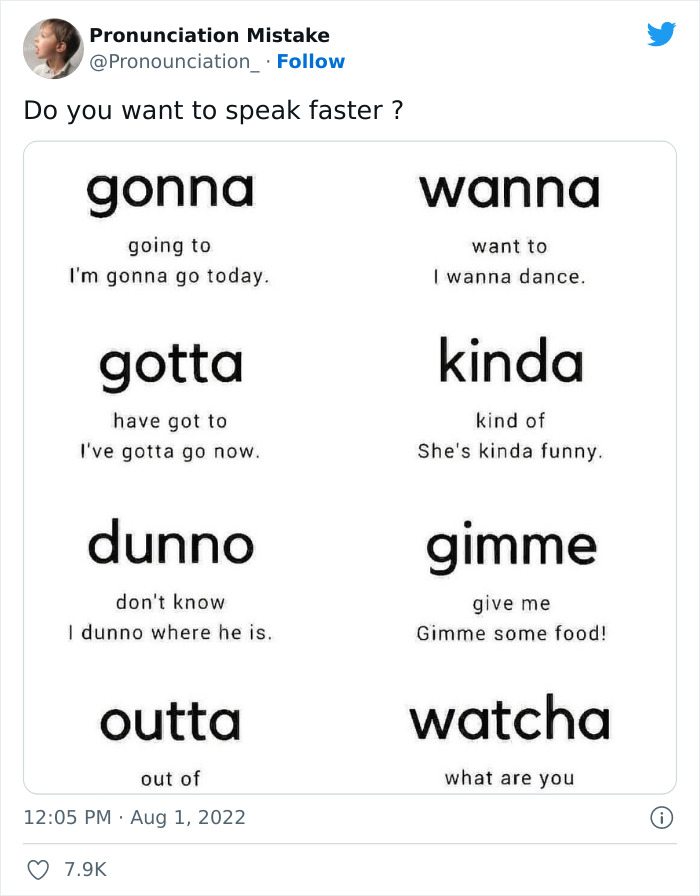
Load More Replies..."Wotcha" is also hello, often responded to with "aight?" but that is only useful to know if you live in very particular areas or are watching certain tv dramas!
Philadelphian: Yo! How you doin? Aight!, Jeet yet? No... Jew? No! K, lessgo getta slicea pizza! Cool!
Load More Replies...These are such lazy words. I even see journalists and writers sliding into usage. So sad to see professionals communicate with elementary school slang.
I have no objection if it's for an effect. But sometimes I can't help feeling it's because they know no different
Load More Replies...Every time I go up the stairs, I feel like someone has increased them
Load More Replies...But even if you feel confident in your English, Dr. McLendon explained your journey isn’t over. "Read! Read widely and frequently. Read magazines, newspapers, novels, even cereal boxes."
"But be careful when scrolling through social media, which, although it can give you a good idea of current slang and shorthand, is often not a great model of clarity, accuracy, or good grammar," the professor concluded.
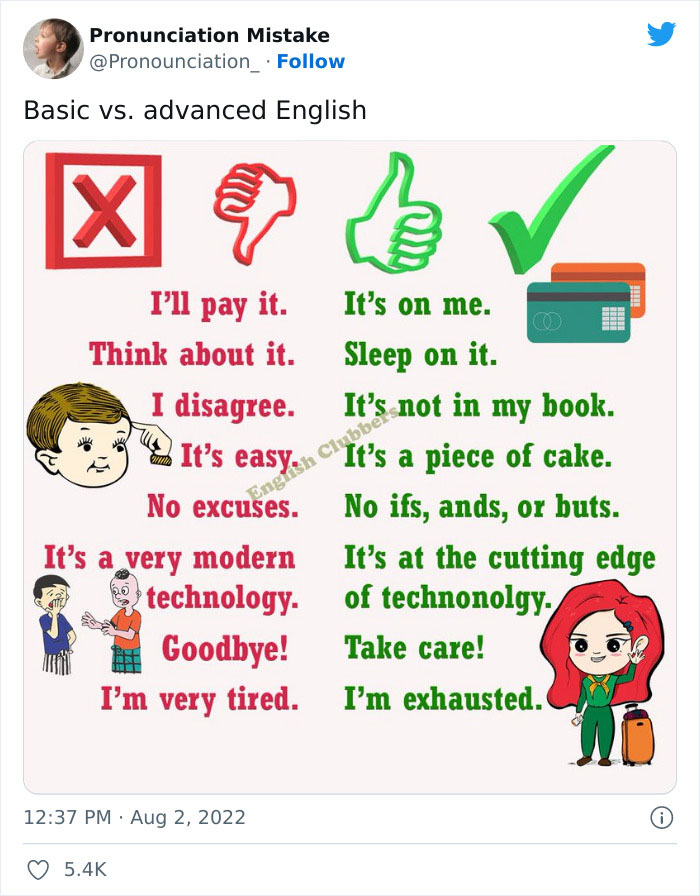
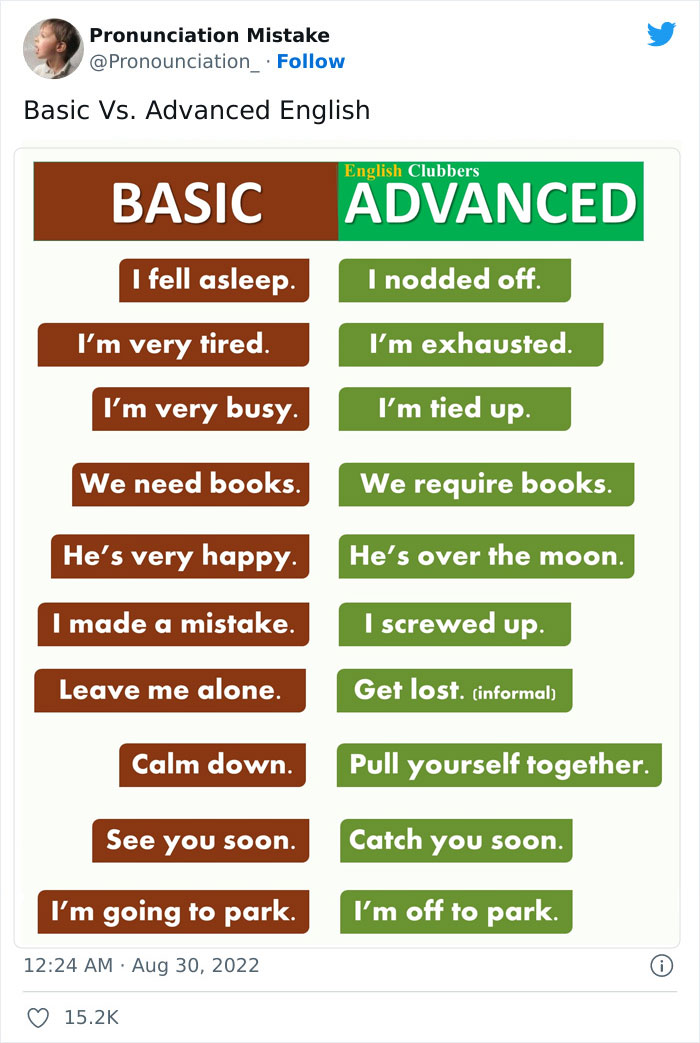
these are not advanced, these are idioms. In particular, american idioms.

As a native speaker of English and someone working in the linguistic field, I have never heard the idiom "it's not in my book" used.
I think giving the thumbs down on this one is kinda not the right message for a non english speaker. If they said the first column, people would understand and it'd be perfectly normal. The second is just more casual, but the first column isnt BAD
There is a plethora of advanced ways to say I'm tired, although most of them are slang.
I’m going to park — my car, my bicycle, my tuche. I’m going to A park or THE park, a place for recreation. Same for I’m off to park.
What does "I'm off to park" mean anyway? That's not English of any sort.
Basic: I'm leaving work for the day Advanced: Whelp, I'm off like a prom dress. Later!
We require books. We require books. WE REQUIRE BOOKS! *rumbling in the distance*
Dear English Clubbers, please explain the "require books" one and the "off to park" one. Also why is "get lost" the only one marked "informal"?
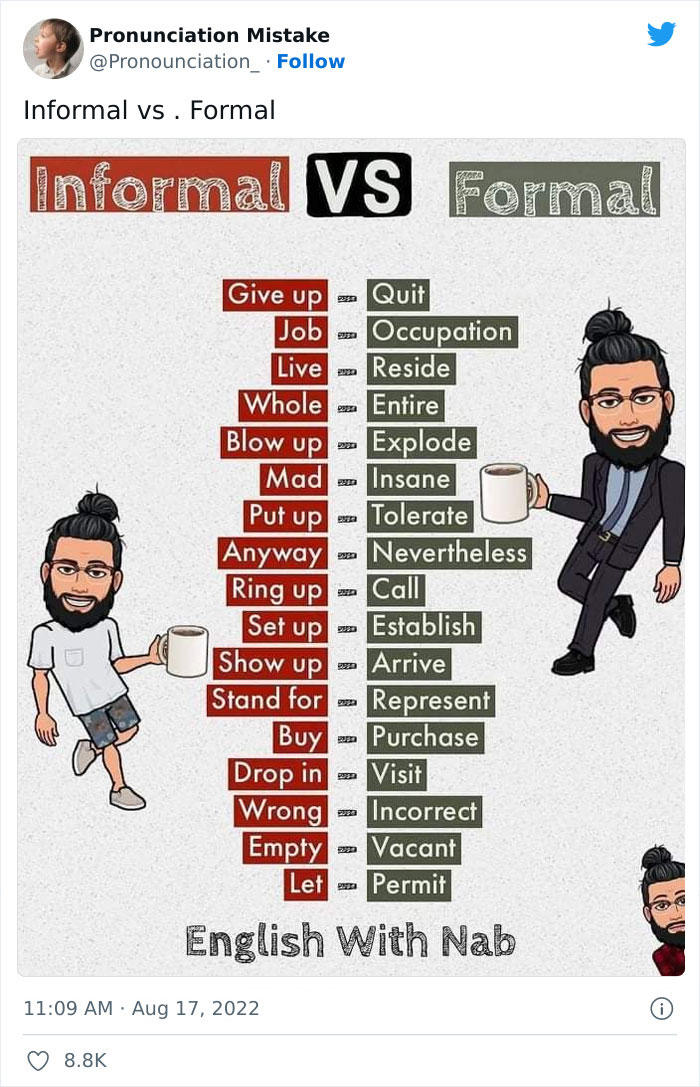
What’s up with the third man bun sneaking a peek from the bottom corner. It’s like he’s judging our opinion of this post. It’s creepy… no wait I mean it’s disturbing, eerie, harrowing, alarming, ominous… hey guess what? It’s called a thesaurus!
Load More Replies...Man Bun Hipster doesn't get out and talk with real people much, does he.
If you let as in rent out, that "permit" will get you in a world of trouble.
job isn't equivalent to occupation. In response to another comment: If he/she used "revert back" to mean reply or respond, then he/she is from India possibly. Revert means change back...nothing to do with responding. I see revert used by most Indian recruiters to mean respond. sigh.
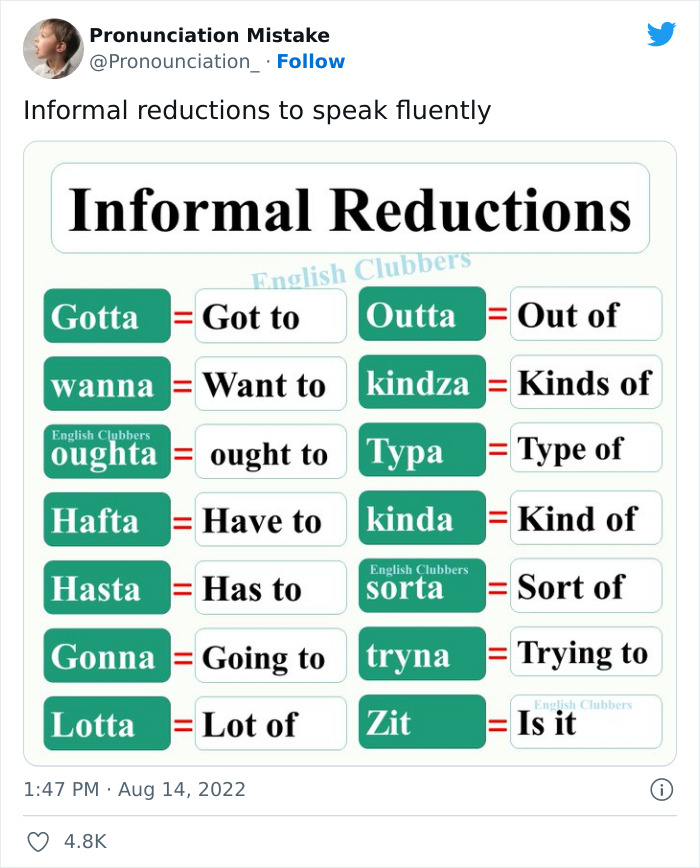
“We have 200 kindza cheese here!” The spelling looks weird but makes sense when you say it out loud!
Load More Replies...Nobody says kindza. Nobody. Or zit. Switch those. Tis? Sit? What's it?
Mum recounted the shortest conversation she ever heard. Father: Sup Son: Nowt
Once again, choose is not always settle for. Settle for means something you end up having. "I settled for the vanilla ice cream since they did not have my favorites chocolate ice cream." But choose just means pick. Settle for has more of a negative connotation. And I think they mean "tough" not "though." This whole thing is making me VERY MAD (angry)😞🤣
Shouldn't the "formal" be the british woman (Kate I assume) and the "informal" the american (Meghan)?. One is very proper and posh and the other one is rather uncouth.
Apologize may seem to be a synonym of sorry. But don't treat it as such at a funeral (especially if the deceased was killed by an unknown person).
True, and in such a circumstance you would offer your sympathies and condolences in order to say I am sorry for your loss; apologising at the funeral of a murder victim might get you taken away in a police car. Tables like the one above need context for the words, given so many have multiple meanings.
Load More Replies...Another one that I varies by region. Don't know why you were downvoted, but that's how I say it.
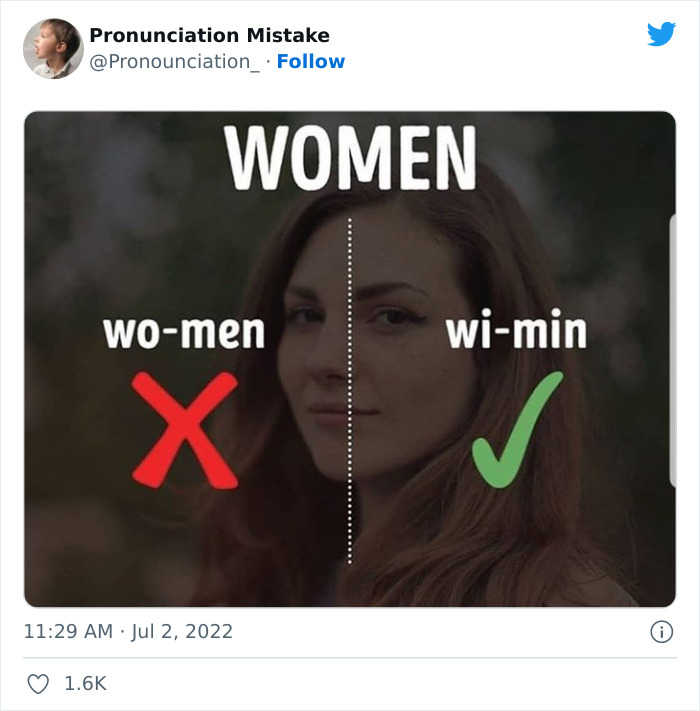
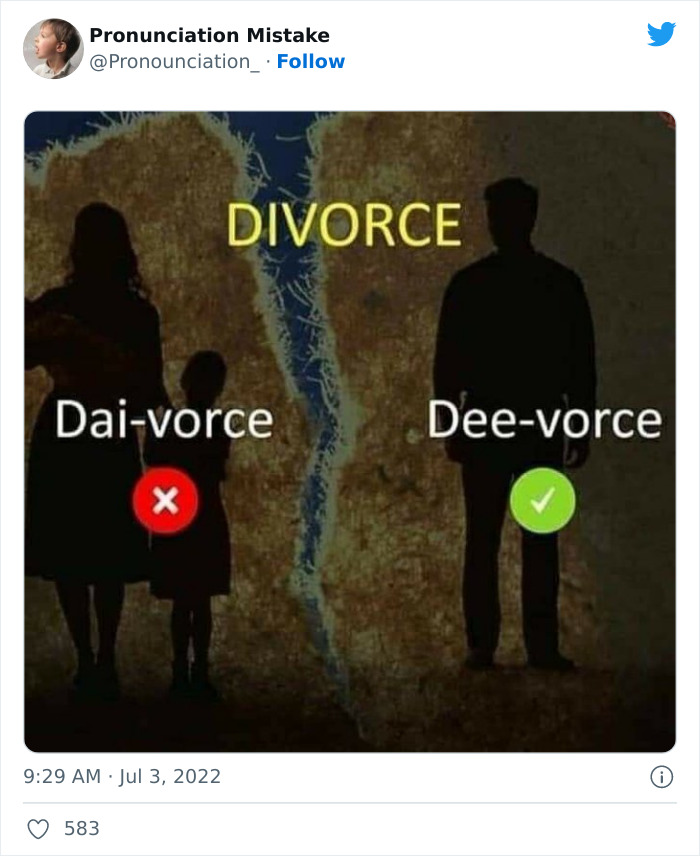
Load More Replies...I assume they mean the same sound as in Gaia, where the ai ultimately sounds like "I". Although I don't know why they wouldn't just put a capital letter I, or an s instead of a c for that matter
Load More Replies...It is not "dee", any more than it is "dee-fence" (dee-fense, for you Americans). To "de-fence" something means to remove a fence. Same with research, it's "ri-search", not "ree-search"...
Divorced = Di vorce. The act of separating a marriage. Divorce= Deevorseh. = A divorced person
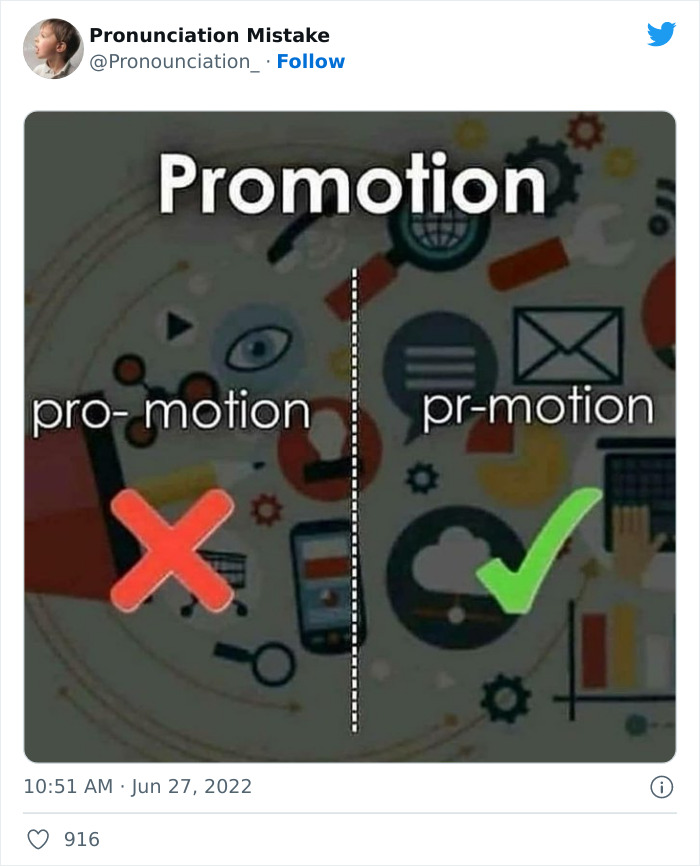
Simply keep in mind that non-stressed syllables in English (in this example, anything except "mo") are always pronounced with a neutral vowel ə (called "schwa" by linguists in case you want to google). Edit: the last thing I wanted was to cause an argument!! 😬 To clarify, I'm speaking from a non-native speaker's perspective. For German (or Spanish, Russian,...) speakers, one way of making their English pronunciation more fluid is to have them exaggeratedly "not-pronounce" the unstressed syllables, that is to stictly say a schwa. That's because we're used to pronouncing vowels ve-ry dis-tinct-ly even in unstressed syllables ... and that's really a huge difference to English. Exaggerating will often make it sound just about right.

Just asked a group of people (12 in total) to say the word. All pronounced it with the neutral vowel and yet 5 claimed they didn't. Was interesting to see how they didn't recognise that. Language is fascinating.
Load More Replies...Ok I know how most of these are pronounced I just enjoy saying things the way they look ! It makes me happy
I do say Pro-motion. Because it's not nice to slur your speech. Enunciate. It helps non-native speakers understand you. (child of a multi-lingual parent)
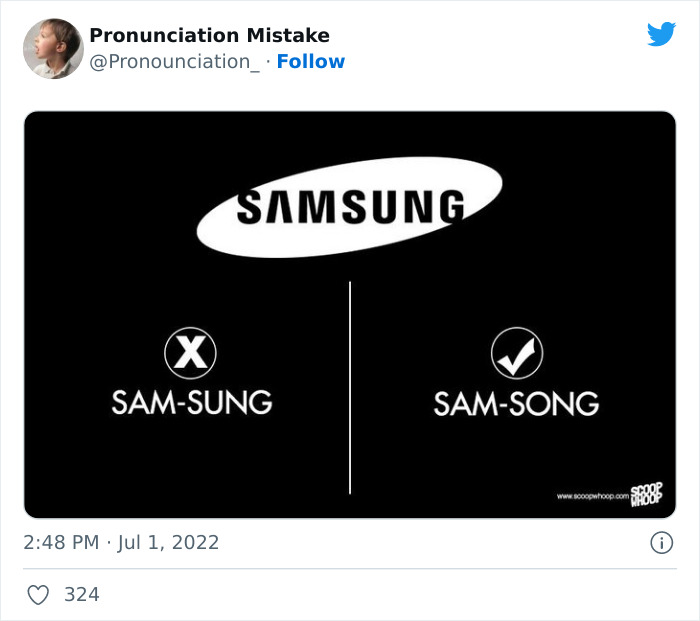
I've been pronouncing this incorrectly this whole time. Good to know.

So have the English language ads...you learn something new every day.
Load More Replies...This may be the correct pronunciation, but (and it is a very big but) you need to listen to how they choose to pronounce it in their own adverts, as frequently they use the local default pronunciation. Ikea used to use the English default pronunciation and have only recently started to use the Scandinavian pronunciation.
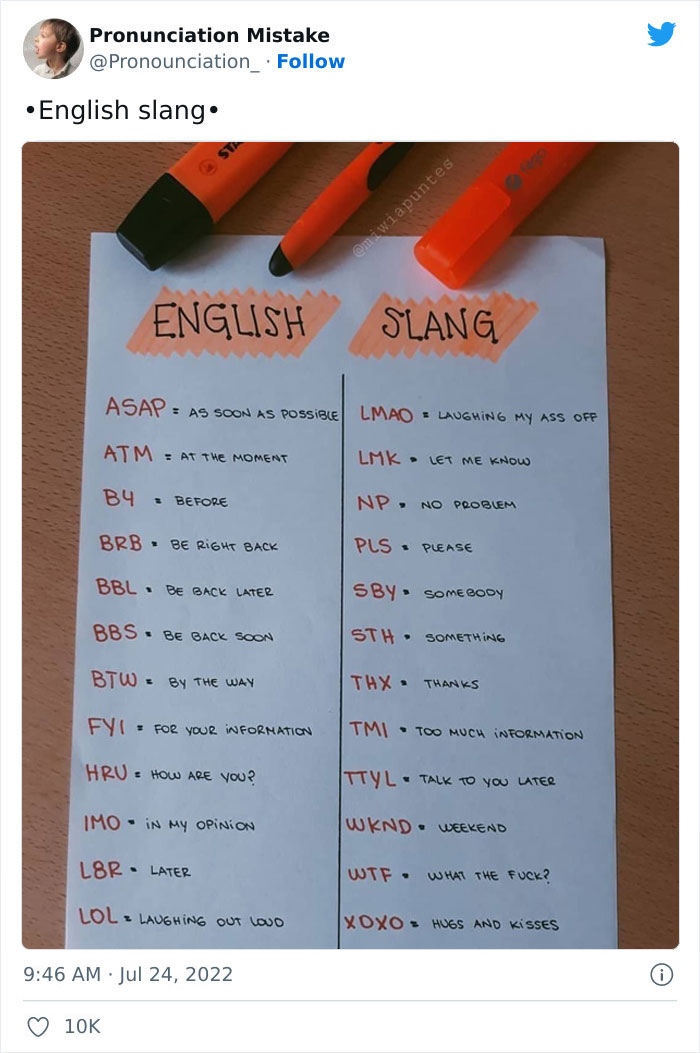
A pastor on a christian forum wrote QFT. I was like: what is he saying? Quite f ing true? A pastor says that? Quoted for truth.
An ATM in that sense is referred to as a "Cash Machine" in the UK
Load More Replies...Normally I don't harp on spelling since this is social media but if you're going to present "useful tips" on a language then bloody check your spelling!
Does it count as "irony" that so many of these are so wrong??😆
Load More Replies...There are so many of these that are completely incorrect or just miss the subtleties of English


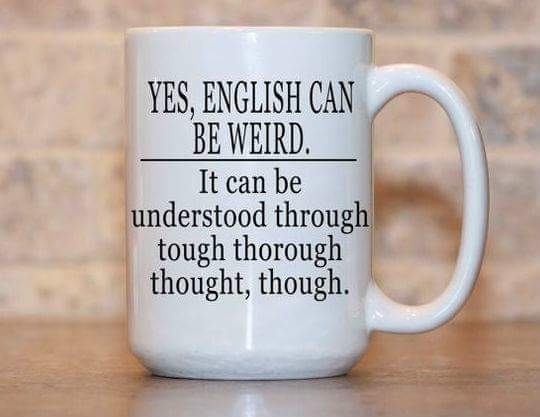
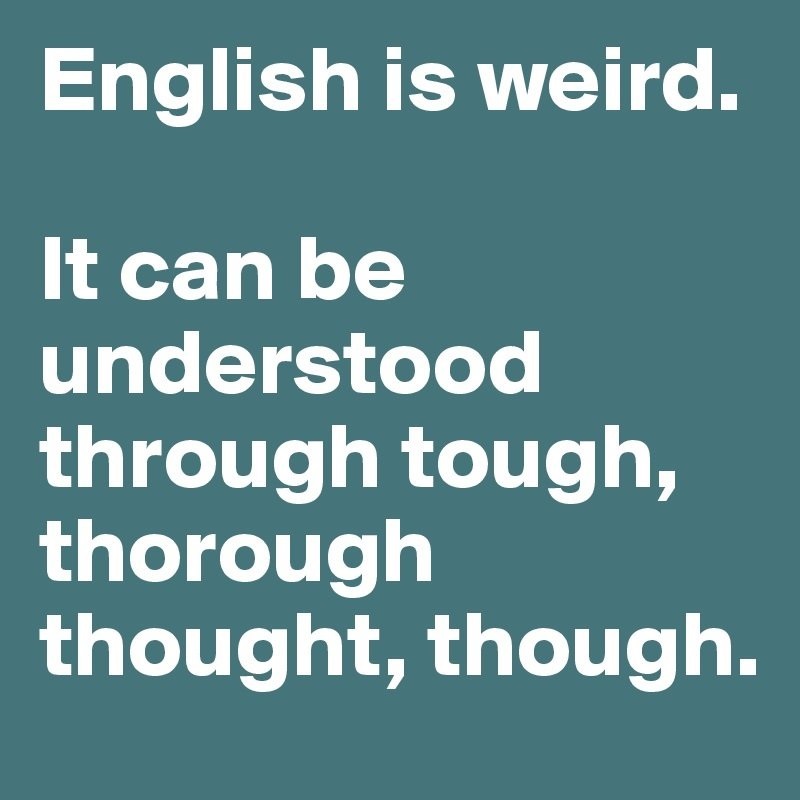
English is a difficult language. It can be understood through tough thorough thought though.

Please proofread your work. There are many mistakes here (typos, duplications, etc.).
I know I'll get a few negative responses for this. Language is for communication, so if we're communicating we're not doing too badly, even if the Grammer isn't spotless.
Most of these have nothing to do with pronunciation. (Nothing wrong with that, but the group is called "pronunciation mistake"...?) Also, tips on actual pronunciation are more useful when taking into account the learners' native language. German natives, Spanish natives etc. all tend to make very specific mistakes respectively.

To be fair it says (currently, let's not forget BP change their headings) useful tips from the pronunciation mistakes twitter page. They are branching out!
Load More Replies...They totally missed the issue of people saying supposably instead of the correct supposedly. Also, artic vs. arctic, excetera vs etcetera, probly vs probably and my newest fave (not), Chipoltay vs Chipotle.


May I suggest "Would of" instead of "would have" as your new favorite (not)?
Load More Replies...Normally I don't harp on spelling since this is social media but if you're going to present "useful tips" on a language then bloody check your spelling!
Does it count as "irony" that so many of these are so wrong??😆
Load More Replies...There are so many of these that are completely incorrect or just miss the subtleties of English
English is a difficult language. It can be understood through tough thorough thought though.
Please proofread your work. There are many mistakes here (typos, duplications, etc.).
I know I'll get a few negative responses for this. Language is for communication, so if we're communicating we're not doing too badly, even if the Grammer isn't spotless.
Most of these have nothing to do with pronunciation. (Nothing wrong with that, but the group is called "pronunciation mistake"...?) Also, tips on actual pronunciation are more useful when taking into account the learners' native language. German natives, Spanish natives etc. all tend to make very specific mistakes respectively.
To be fair it says (currently, let's not forget BP change their headings) useful tips from the pronunciation mistakes twitter page. They are branching out!
Load More Replies...They totally missed the issue of people saying supposably instead of the correct supposedly. Also, artic vs. arctic, excetera vs etcetera, probly vs probably and my newest fave (not), Chipoltay vs Chipotle.
May I suggest "Would of" instead of "would have" as your new favorite (not)?
Load More Replies...