Get Premium
Dark mode theme is available exclusively for premium users. Learn more about the benefits of subscribing.
No fees, cancel anytime.

 Dark Mode Ad-Free Browsing Unlimited Content
 Ad-Free Browsing Unlimited Content Dark Mode
Join 1.2 million Panda readers who get the best art, memes, and fun stories every week!
Not being afraid of saying “I don’t know”, asking really good questions, being able to admit mistakes—these are just a few examples of what people think is characteristic of an intelligent person. And while signs that indicate that someone is highly intelligent might differ from person to person, you’ll know one when you meet them by the way they carry themselves.
Members of the ‘Ask Reddit’ community have recently discussed such signs after the user ‘Occyz’ started a thread about it. If you’re curious about what kind of person might make you feel like Pinky next to The Brain, scroll down to find the redditors' thoughts on the list below and feel free to upvote the signs you believe are indicative of intelligence as well.
Below you will also find Bored Panda’s interview with a professor of psychology in the College of Human Ecology at Cornell University, author of Adaptive Intelligence, Dr. Robert J. Sternberg, who was kind enough to answer a few of our questions about perception of intelligence.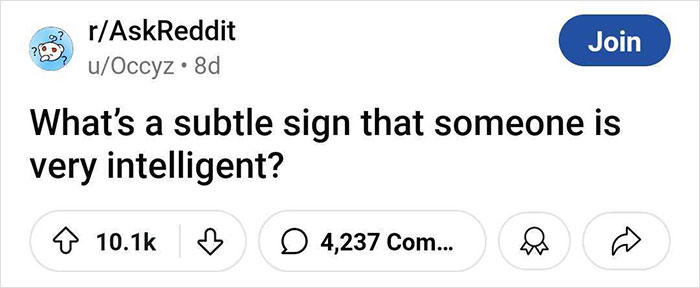
This post may include affiliate links.
 I have met several off the charts intelligent people. One thing I noticed that they have in common was low self esteem. They had an actual low self esteem club at the science fiction club I belonged to. The guy who did a lot of the calculations that allowed the Voyager probes to make the Grand Tour of our solar system was a member of the club. All he could think about were what he didn’t know or what he physically couldn’t do. The common issue I observed from these bright folks was relentless school bullying. We lose so many of these geniuses to depression, suicide, self medication, or just flat out self inflicted mediocrity—society in the US does a s****y job of nurturing intelligence, it makes me incredibly angry how many of these people’s potential were wasted. (I don’t include myself in that club—My intelligence is dead average.) Frank Zappa said it best when he said that intelligence is treated like a hideous deformity by American society.

My wife is so damn smart and has lived and amazing life and yet insists she's nothing special.
 Someone who can understand someone’s opposing view without having to agree with it or get angry over it.
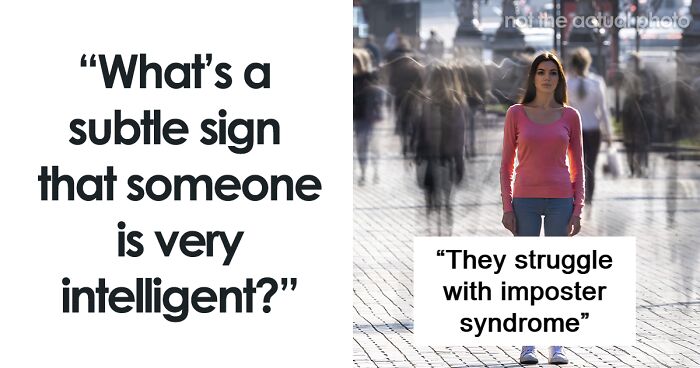
 They struggle with imposter syndrome. Dumb people always think they’re the tits.
Discussing the signs that indicate that a person is of high intelligence, Dr. Robert J. Sternberg noted that for him, intelligence is not about people’s score on a test or how much they impress others with their erudition. “It is about what you do in your life that makes a positive difference to the world at some level.”
 I consider someone intelligent if they're able to explain something incredibly complicated in simpler and more readily understood terms.

The KISS Principle, "Keep It Simple Stupid." (https://en.wikipedia.org/wiki/KISS_principle)
In an interview with Bored Panda, Prof. Sternberg emphasized that “Intelligent people don’t have to talk about how smart they are, or try to use subtle signs to broadcast their superiority. Rather, they are out there making life better not just for themselves, but for others as well.”
 Choosing not to argue with someone who's wrong and choosing their own peace of mind over being right.

Mark Twain said something along the lines of "Never argue publicly with a fool; onlookers may not be able to tell the difference.". (I'm too lazy to put down my phone and look up the exact quote.)
 They mispronounce less common words.
It means they probably haven’t heard those words spoken much, and they learned the words by reading. They’re curious and self-educated.
 When being taught to do something new, they care just as much, if not more, about why it should be done a certain way as they do about what needs to be done.
“There are a lot of high-IQ people whose main claim to fame is their high IQ or their impressive educational credentials, but they do little with their IQ,” Dr. Sternberg said. “High-IQ societies compete with each other to be more selective in allowing in people whose claim to membership is spending a lot of time solving meaningless puzzles irrelevant to real-world adaptation. It can become a test of narcissism, not intelligence – for bragging rights rather than the ability to adapt.”
 They ask really good questions and listen more than they talk.

A guy I grew up with is a rocket scientist for JPL/NASA, and he always asks really good questions and listens more than he talks.
 My freshman college roommate was a mechanical engineer. One of the first nights we were in the dorms, we had pizza delivered. We didn't eat it all, but the pizza box didn't fit inside the dorm fridge. He went all out origami and transformed the box into a smaller, perfectly square box that did fit inside the fridge...in about 12 seconds.
I'm pretty good at math, but not necessarily geometry. My mind was blown.
I spent 35 years in academia between my student/teacher years and he's still one of the three smartest people I've ever met. His ability to "just do it" is dumbfounding to me. His retirement project is transforming his father's 1963 Mercedes convertible into a "hybrid" that has a small diesel engine that runs on vegetable oil along with a totaled Tesla Model S battery pack.

Nothing is more satisfying than watching someone who is really, really good at what they do.
The expert continued to point out that our society’s notion of intelligence seems to be somewhat twisted. “Just look at the stupidities uttered by some of our leaders who have degrees from the most prestigious universities in the world and choose to use their intelligence to show they are bozos, pretending to serve others while caring only about how their position leads them to power, resources, fame, or infamy. Unfortunately, many people fall for the show.”
 They can adapt their communication style — vocabulary, tone, content, etc — to fit the situation and people they’re talking to, and it seems completely natural.
 They're very good at problem solving. Even if it's something they have no experience with they always approach the problem from the right angle.
 Dry humor. Pulling it off requires an observant, quick wit with a nonchalant delivery that almost downplays its own cleverness.
Like it means their immediate passing thoughts are often profound enough to be very funny without any real effort.
It seems that people say that actions speak louder than words for a reason, and this list is great proof of that. But the same seems to be true of people who, contrary to the ones described here, don’t possess the qualities characteristic of bright minds. For proof of that, move on to browse the times people at work showed just how stupid some individuals can be or check out the dumbest things these netizens have posted online next.
 Understanding/appreciating nuance.
Curiosity.

YES! I would much rather read a science magazine than "People" mazagine or other nonsense having to do with celebrities. But I also read Bored Panda, so there's that.
 They are ok with being perceived as "stupid" by asking questions - if we hold back in fear, we'll never truly learn. Plus it's a good way to show others it's ok to question things if you don't understand - better off if we're on the same page instead of hoping things work out without being informed.

Most "problems" that arise are due to someone intimidated into not asking questions/methods and doing it incorrectly.
 They feel challenged rather than threatened by new things, problems, ideas...
 If someone is actually intelligent, they don’t put down the intelligence of others or make others’ accomplishments seem small. I’ve never met a genuinely intelligent person who feels the need to directly (or even indirectly) hint that someone else is “not so smart.”.

Upvote because Cheetolini just became my new term for him.
Load More Replies...
I don't know about that one. Intelligence is just a metric, a number. For some people that number is higher, for some it is lower. Does not mean a less intelligent person is worth less, but you can acknowledge that their IQ is lower.

IQ is a measure of some sorts of intelligence, not a catch- all for how bright someone is
Load More Replies...
When I was an honours math major I took classes with people that were frighteningly smart. If they did or saw something that was absolutely genius they referred to it as "clever" as if genius wasn't involved. I went to a lecture by Kip Thorne (won the Nobel for LIGO) where he explained what their plan was to detect gravity waves (35 years ago). One of the smartest men on the planet, as important as Galileo, and he described their idea as clever.

I was born different. I often forget how different until something that's simple for me confounds others. When that happens, I help them if I can, and silently wish that I could grant others the abilities I was born with so that they would never have to feel inferior. You aren't inferior just because you're not exceptional! Please remember that.

They are so aware of their own limitations; that there are always others who are smarter than them,




VERY quick wit.
Not at all interested in proving how smart they are.
 They talk only when they have something to say.

No. One of the smartest guys i know is talking the second he opens his eyes. Also he is jumping from topic to topic and it gets even worse when he is drunk because then he is talking even faster. It is mostly entertaining to listen to him because he has sometimes quite a strange approach on things but he anything else then quiet 🤣
 Honestly, after reading their work, debates, talks, podcasts, discussions, arguing, etc, I noticed they often use conditions in their sentences that's not absolute. There's also this saying "only a fool talks in absolute".
Tgey use: I think, many times, often times, usually, it's possible, it could be IF ...
So it appears they talk as if "I can be wrong" or "based on what we know".
If you compare sentences so known unintelligent people they lack these conditions and voices absolutes only.
Might also be a level of education thing. When I was at uni they taught us that we shouldn't use absolutes because new scientific facts might always be found that contradicts what we think we know.
One thing I’ve noticed is that really intelligent people tend to be empathetic. They’ve quietly analyzed many situations and have thought critically about them.
They pause to think about a novel question instead of instantly blurting out an answer. Sometimes people think it means they've been "stumped" and claim victory. No, they're thinking, analyzing, and formulating a reply.

Sigh... yes... the claiming of victory: "Oh, you have nothing to say? That means I WON! I'm SUPERIOR!" - Not necessarily ... it could really mean... the other person has realized you refuse to entertain/comprehend any other POV/narrative than the one you've already crafted, so they've given up on you. They're just tired, and find you exhausting."
 Really funny and depressed.
 When they take the time to filter through any possible misunderstandings in an argument by asking questions to help them better understand the idea that’s being presented, instead of immediately assuming their first interpretation of the argument is the correct one.
Something that’s always bugged me is when my argument gets misunderstood, and then attacked from angles where supposed “errors” exist, when those errors rose out of the listeners own misinterpretation.
 They're storytellers. They craft narratives for themselves and for others that are compelling, that make the world make sense, that invigorate and install a goal, a mission.
Mmm, storytelling... Every night I tell myself a new tale to go to sleep to. I've done that for so long, and I never really thought that was strange growing up.
 They don’t argue with stupid people.

An intelligent person will generally recognize stupid, which has little to do with an individuals IQ. Stupid is a state of mind and people that are habitually stupid can rarely be reasoned with. A closed mind is like a closed fist, it makes it hard, if not impossible, to catch anything
 I usually find that creativity, humor, and verbal acuity are good signs of intelligence
I generally see lack of empathy, low open-ness, and seeing the world in absolutes as signs of low intelligence
Also, I notice many socially inept people tend to consider themselves intelligent almost just because they're socially inept and/or not good at sports. It's as if their ego needs something to value themselves on so they assume they must be smart
It's entirely possible that the "other" guy in your life who makes you insecure is taller, stronger, more charismatic, AND smarter. Such is life
Lastly, people (especially tech people) will often conflate technical/domain knowledge with intelligence which is absolutely not always the case. Yes there is a bare minimum intelligence required to be an engineer etc, but being an awkward senior engineer doesn't mean you're just too smart for normies to understand and lack of a specific domain knowledge has f**k all to do with intelligence.
The ability to ask questions. They know what they know and are aware of what they don't. But they are not threatened by knowledge they don't have but rather excited about learning the new thing.
They have a nuanced perspective and are able to articulate it well. They understand that things tend not to be black-and-white, but shades of gray, and they listen intently to others during a conversation.
 They get excited sharing their knowledge and talk to people instead of at them.
This probably isn't a 100% guarantee that someone is intelligent but it's something I've noticed more often in intelligent people than in people who are just knowledgeable.
I was sharing something I was excited about, a show on Public Television from the evening before. It was on Fractals and the Mandelbrot set. I was called a nerd, which I did not take as an insult.
They understand that as you begin to learn more about a subject, you enter in to this situation where you believe you know far more than you really do. You realize that you know so much more than those who know nothing about that subject, but not that everything you are learning probably has 100 types of nuance and requires deeper understanding.
It's kind of related to the Dunning-Kruger effect - the less you know about a subject, the more you THINK you know, because you don't realize *how much there is to know that you don't.*
It's how you can get people who spend a few minutes on youtube or google, spout a bit of lingo they just learned, and don't realize that *there's a reason it takes 4 years just to get a bachelors in most topics, and many more to become a specialist*.
It's infuriating to those who actually HAVE put in the time of study and experience.
So yeah, a person who can show that they have *some* knowledge of a topic, yet remain humble because they realize that there is always more to know. The more you learn about a topic, eventually you realize just *how much MORE there is to know* and it's important to get through that initial arrogance.
I fell into this myself when I was in my late teens. I became fairly well read on sustainable horticulture and botany in general. I got a job that was pretty advanced, and I was pretty good at it. Yet after a while I realized that my boss... he was like a f*****g *plant wizard*. He could tell you what the weather was like - at night - a week ago - by looking at the way the flowers presented on the tomatoes we grew.
I learned some amazing s**t from him once I got over my ego.

I've worked in my field for 24years, and learn something new every day. When I don't know the answer to a question, I work hard to find it.
Humility in their knowledge.
And when I say that I really mean three key things, first a willingness to not be right, second a lack of judgment when someone else is wrong, and third a willingness to sound dumb.
You'll very often see people get something wrong (or something that isn't wrong but other people think it is) or say something that sounds dumb and then get s**t on by other people for being wrong and then something like fight or flight kicks in and they either double down or just leave. Social media is the worst for this cause it's so easy to nit pick the smallest detail of something or invoke one of the scary logical fallacies on some rando, but the proper response when talking to someone should never be to put them down, and genuinely intelligent people are like this. Instead, they'll hand you the information you're missing so you can get to the right answer.
 I have a friend who is a genius.
One thing where it is very clear is when we were learning automation software. (Siemens stuff. Tia Portal, etc.)
Dude taught himself pretty much the entire program in three days just by using the inbuild wiki.
Half of intelligence is critical/lateral thinking and the other half is comprehension. You need to identify what you already know, determine what you need to know, and then how to get there. Identifying the path to knowledge requires you to be attentive and ask the important questions. There is a desired outcome, whether or not you get there, you have intention which focuses your efforts.
With this in mind, I find a subtle sign someone's is very intelligent is when they ask questions and either specify why they are asking or word the question in a way that shows intent. You can clearly tell where they are going with their questions, or if they happen to be asking irrelevant questions, you both figure it out much faster. It helps them get the information they want, but also helps the person answering understand their train of thought and focus their answers.
... and then when you get impatiently cut-off when you're trying to explain the WHY you're asking... sigh.
I find that highly intelligent people have the ability to think in complex hypotheticals while being nuanced.
I find that Wise people have enough patience and forethought to consider longer term things and be considerate in ways that are hard to take into account.
 Being able to read people very well. Adjust communication style to communicate most effectively. Also be able to read the room. Sense of humor is in there too.

Isn't that more social skills? A lot of intelligent people suffer from mental conditions like ocd and depression, which make them more introverted or even isolated. You also have those people who are very skilled at hiding their true natures. What you think you see, what you think you know, may be just a reflection on the surface of dark and deep waters.
I worked with a lad who was very like this. He could make any conversation really intriguing and thought provoking, often causing people to reconsider their perspective and position. He was a HR manager that could defuse any situation, helping people mend bridges and resolving issues because he could get both parties to compromise and put aside resentment.
He had IQ and EQ to go a lot further than the role he was in but he was happy and maybe that is another little tid bit of intelligence.
Efficiency and elegance in tasks. Other people are walking and the genius is doing ballet.
They are funny and can talk about a range of topics.

Yes they can talk about a lot of topics, but not all intelligent people are funny. We can have that dry sense of humor, but more often than not our humor can be taken as insulting or just not funny by others.
They ask good questions. .
I was going to use my vast vast intelligence to form the perfect answer but forgot what we’re talking about.
I’m scrolling through here to see how many of these I match with lol .

I've noticed that intelligent people have minds like working dogs or herding dogs: they have to have a job to do. If their mind doesn't have enough stimulation and structure, or if it lacks a creative outlet, it gets into all kinds of trouble. Some of the smartest people I've known have also been the most prone to anxiety, depression, OCD, etc. It's like the mind turns in on itself, like when a bored dog starts chewing its own fur out.

If I don't have something to do I start to obsessively watch TV shows or movies in foreign languages. I don't know why.
Load More Replies...
The most common trait amongst the intelligent is curiosity. The ignorant say, "I don't need to know about this," so they never read. The intelligent want to know about things, even when it has no value and no use for their life or their job.

Sometimes they can learn things for the transferrable skills that they can use in other parts of their life, but again it's understanding that these skills can be used elsewhere which proves their intelligence
Load More Replies...
In most cases people just understood the main point of education: How to solve problems one is unfamiliar with. They trained their brains in collecting and filtering information and connecting the dots. This is why education is always of value, even if the topic at hand is "booooorrrriiiiiiinnnngggg".
Yes we do like our non-fiction, but can totally enjoy thought provoking sci-fi and fantasy as well. I love crime stories both true and fictional (Anne Rule, Kathy Reichs). Love fantasy and grew up with many authors works. My favorites are Piers Anthony, Mercedes Lackey, Ann McCaffrey, Kristin Brittain, Marion Zimmer-Bradley and many others.
Load More Replies... And an example from by brother - he was never good at school, struggled in about every subject, a teacher even questioned his mental abilities, and he called himself dumb. But he excelled in just about every strategy-based board game or computer game, and in everyday life, found quick solutions to so many problems etc. He was almost an adult when his dyslexia and adhd got recognised or even considered... (Now, years later, he is an extremely successful entrepreneur!)
A while back, there was a list here on bp about what happened to the smartest kids in people's classes. In so many of the answers, the kid is being described very sweet/nice to everyone. That got me thinking, I've never met an intelligent person that would be the "class bully". It's always the "kind" or "socially awkward" type. Secondly, sense of humour. Well yeah, people like to laugh no matter if smart or not, but I believe if you take a bunch of the most successful comedians, the average IQ among them would be very high. Everyone laughs, but not everyone can make an art form out of it.

Knowing that "being educated" and "being intelligent" are not the same thing.

In my opinion, intelligence means never being stuck in one place or state of opinion, so to speak. Being able to change and evolve alongside the world accompanied by an unquenchable thirst for knowledge is all that’s really required. Processing of information can be taught by parents, education centres etc.

Yeah, but, like, how can we know for sure these are true? Like… do we know if the people who wrote these have any valid way to recognise intelligence? Who was the first person to figure out someone else was more intelligent than them AND how do we know if they were right? And if all the intelligent people think they’re stupid, who the f are *we* to tell them they’re wrong? :p
Your comment with all those good thought provoking questions is a good sign of intelligence in an of itself.
Load More Replies...
I have a super bright brother, an iq off the chart. He is incredibly arrogant and small minded. So remember intelligence doesn't always translate into book smarts. An intelligent person is more than the sum of the their parts; they are smart, but they slso know how to communicate those ideas, the are empathetic, they a fluent, they seek knowledge in areas outside their expertise. And they can have their minds changed by informed , clear argument that is based on facts. Also they will double check the information they get from more than one source based in facts not opinions or misinformation

A lot of these are indicators of social, communication, or emotional skills, rather than of intelligence.

Not a single one of those struck me as accurate or useful. I am a teacher, and so I think a lot about what "smart" means, and how to be on the lookout for intelligence-related signs. This list was an aggregate of having good manners, fitting a stereotype, and wish fulfillment.


When my kid was young I was active in advocacy for gifted kids. I got to know a very large number of gifted, highly gifted, and profoundly gifted kids and adults. I can say categorically, that the at least half of the most popular posts here are simply not true. Super smart people can be as delusional and closed minded as morons. Smart people are extremely good at using their intelligence to explain away any inconsistencies in their beliefs and ideas. While they can be taught to explain and simplify, they are very often extremely bad at this. There are many cosmologists who are actually smarter and more knowledgeable than Carl Sagan and Neil deGrasse Tyson, but if you only have ever heard these two, you'll think that all really good astrophysicists are like them. Spoiler - they're not.
I feel so seen in this. Above average, and book smart. Curious, and able to adapt to situations, able to understand other points of view and learn from them. I accept that things, people, and situations can be other than what I believe them to be. I love learning new things, mostly crafts and history.

I've noticed that intelligent people have minds like working dogs or herding dogs: they have to have a job to do. If their mind doesn't have enough stimulation and structure, or if it lacks a creative outlet, it gets into all kinds of trouble. Some of the smartest people I've known have also been the most prone to anxiety, depression, OCD, etc. It's like the mind turns in on itself, like when a bored dog starts chewing its own fur out.
If I don't have something to do I start to obsessively watch TV shows or movies in foreign languages. I don't know why.
Load More Replies... The most common trait amongst the intelligent is curiosity. The ignorant say, "I don't need to know about this," so they never read. The intelligent want to know about things, even when it has no value and no use for their life or their job.
Sometimes they can learn things for the transferrable skills that they can use in other parts of their life, but again it's understanding that these skills can be used elsewhere which proves their intelligence
Load More Replies... In most cases people just understood the main point of education: How to solve problems one is unfamiliar with. They trained their brains in collecting and filtering information and connecting the dots. This is why education is always of value, even if the topic at hand is "booooorrrriiiiiiinnnngggg".
Yes we do like our non-fiction, but can totally enjoy thought provoking sci-fi and fantasy as well. I love crime stories both true and fictional (Anne Rule, Kathy Reichs). Love fantasy and grew up with many authors works. My favorites are Piers Anthony, Mercedes Lackey, Ann McCaffrey, Kristin Brittain, Marion Zimmer-Bradley and many others.
Load More Replies... And an example from by brother - he was never good at school, struggled in about every subject, a teacher even questioned his mental abilities, and he called himself dumb. But he excelled in just about every strategy-based board game or computer game, and in everyday life, found quick solutions to so many problems etc. He was almost an adult when his dyslexia and adhd got recognised or even considered... (Now, years later, he is an extremely successful entrepreneur!)
A while back, there was a list here on bp about what happened to the smartest kids in people's classes. In so many of the answers, the kid is being described very sweet/nice to everyone. That got me thinking, I've never met an intelligent person that would be the "class bully". It's always the "kind" or "socially awkward" type. Secondly, sense of humour. Well yeah, people like to laugh no matter if smart or not, but I believe if you take a bunch of the most successful comedians, the average IQ among them would be very high. Everyone laughs, but not everyone can make an art form out of it.
Knowing that "being educated" and "being intelligent" are not the same thing.
In my opinion, intelligence means never being stuck in one place or state of opinion, so to speak. Being able to change and evolve alongside the world accompanied by an unquenchable thirst for knowledge is all that’s really required. Processing of information can be taught by parents, education centres etc.
Yeah, but, like, how can we know for sure these are true? Like… do we know if the people who wrote these have any valid way to recognise intelligence? Who was the first person to figure out someone else was more intelligent than them AND how do we know if they were right? And if all the intelligent people think they’re stupid, who the f are *we* to tell them they’re wrong? :p
Your comment with all those good thought provoking questions is a good sign of intelligence in an of itself.
Load More Replies... I have a super bright brother, an iq off the chart. He is incredibly arrogant and small minded. So remember intelligence doesn't always translate into book smarts. An intelligent person is more than the sum of the their parts; they are smart, but they slso know how to communicate those ideas, the are empathetic, they a fluent, they seek knowledge in areas outside their expertise. And they can have their minds changed by informed , clear argument that is based on facts. Also they will double check the information they get from more than one source based in facts not opinions or misinformation
A lot of these are indicators of social, communication, or emotional skills, rather than of intelligence.
Not a single one of those struck me as accurate or useful. I am a teacher, and so I think a lot about what "smart" means, and how to be on the lookout for intelligence-related signs. This list was an aggregate of having good manners, fitting a stereotype, and wish fulfillment.
When my kid was young I was active in advocacy for gifted kids. I got to know a very large number of gifted, highly gifted, and profoundly gifted kids and adults. I can say categorically, that the at least half of the most popular posts here are simply not true. Super smart people can be as delusional and closed minded as morons. Smart people are extremely good at using their intelligence to explain away any inconsistencies in their beliefs and ideas. While they can be taught to explain and simplify, they are very often extremely bad at this. There are many cosmologists who are actually smarter and more knowledgeable than Carl Sagan and Neil deGrasse Tyson, but if you only have ever heard these two, you'll think that all really good astrophysicists are like them. Spoiler - they're not.
I feel so seen in this. Above average, and book smart. Curious, and able to adapt to situations, able to understand other points of view and learn from them. I accept that things, people, and situations can be other than what I believe them to be. I love learning new things, mostly crafts and history.





























 No fees, cancel anytime