I absolutely adore the English language with all of its ups and downs, twists and turns, astounding hyperboles and alliterative inclinations. And let's not forget the puns! However, it's no secret that the language can be a tad… discombobulating for new students, anyone who's learning English as a second language, and native speakers alike.
To show you what we mean, the literature-loving philology fans here at Bored Panda have collected the most hilarious and honest examples of people showing how frustrating the English language can be for them. Have a read below, upvote your fave posts, and remember to share your own experience with the exciting journey that is learning English.
This post may include affiliate links.
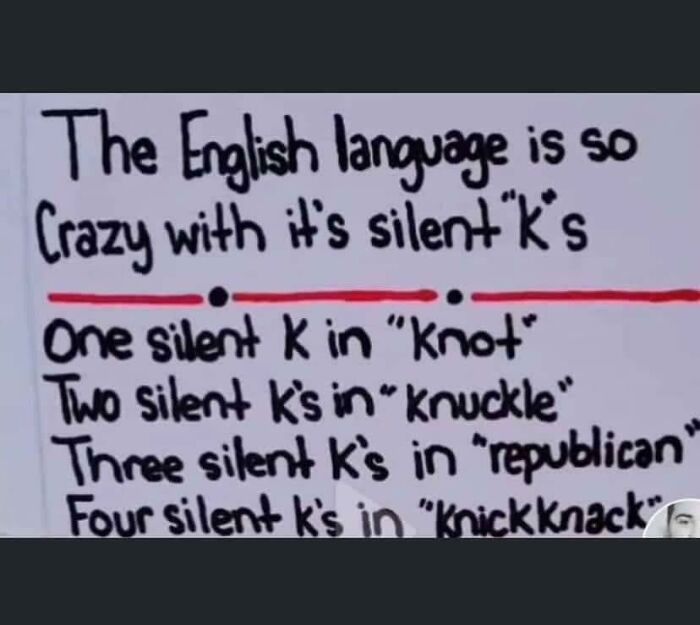
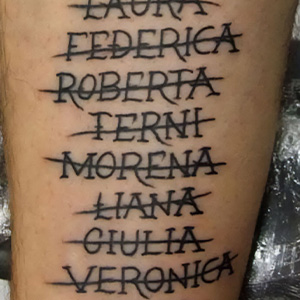
That's a joke on the KKK (Ku Klux Klan) and its too frequent ties with the Republican Party, particularly under Trump.
Load More Replies...And Knuckle has 1 silent K. "ck" is a K sound, so it's not silent, if anything the c is silent
Load More Replies...There is a large difference between the KKK and an average Republican, though the joke is still hilarious.
Certainly a difference between the average citizen Republican and the KKK. The difference nearly disappears in elected a republicans however.
Load More Replies...I love english and its probably my favourite language for its grammal simplicity and plasticity. But the random pronunciation drives me insane.
It's rarely random; English draws from multiple other languages so what seems like inconsistent pronunciation is because words go back to different roots. But yes, it can be frustrating and few people want to learn all those origins (which is understandable).
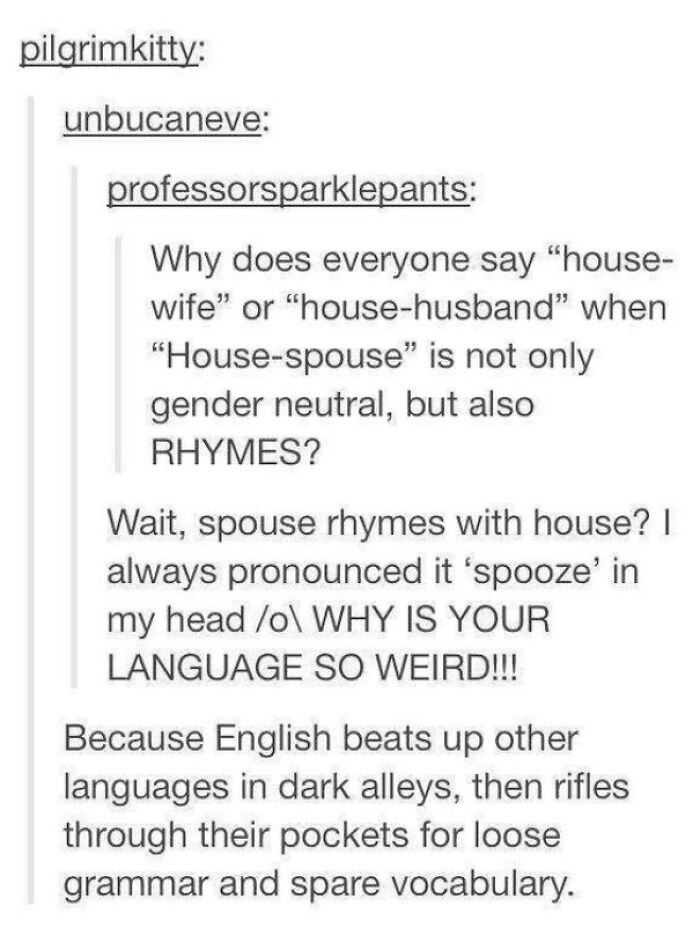
Load More Replies...Clearly a reference to this famous quote: “The problem with defending the purity of the English language is that English is about as pure as a cribhouse whore. We don't just borrow words; on occasion, English has pursued other languages down alleyways to beat them unconscious and rifle their pockets for new vocabulary.”
The quote is from W.E.B. Du Bois, and it was something closer to "English doesn't loan word from other languages. It stalks them down dark allies, assaults them, and rifles through their pockets for change."
Now I am stuck in rhymes. House mouse, house mouse.house douse, house grouse, .....
Why are they confused about spouse and house matching? That's one of the few things that does make sense, they're spelled the same!
I'm trying to think of a word spelled "ouse" and pronounced "ooze" that could have confused them...
Load More Replies...Never gave house wife/husband a thought...but house spouse sounds really good. Think I'll use it from now on
The real reason is that "wife", or "wif" in Old English, originally meant simply "woman". It was only later that it got replaced by "wifman" ("woman person"), from which the modern English "woman" is derived, and the word "wife" came to indicate specifically a female spouse. So a huswif was simply a woman who looked after a house, just as a midwif originally meant a woman who accompanied another (mid = with, cognate with modern Dutch met and German mit).
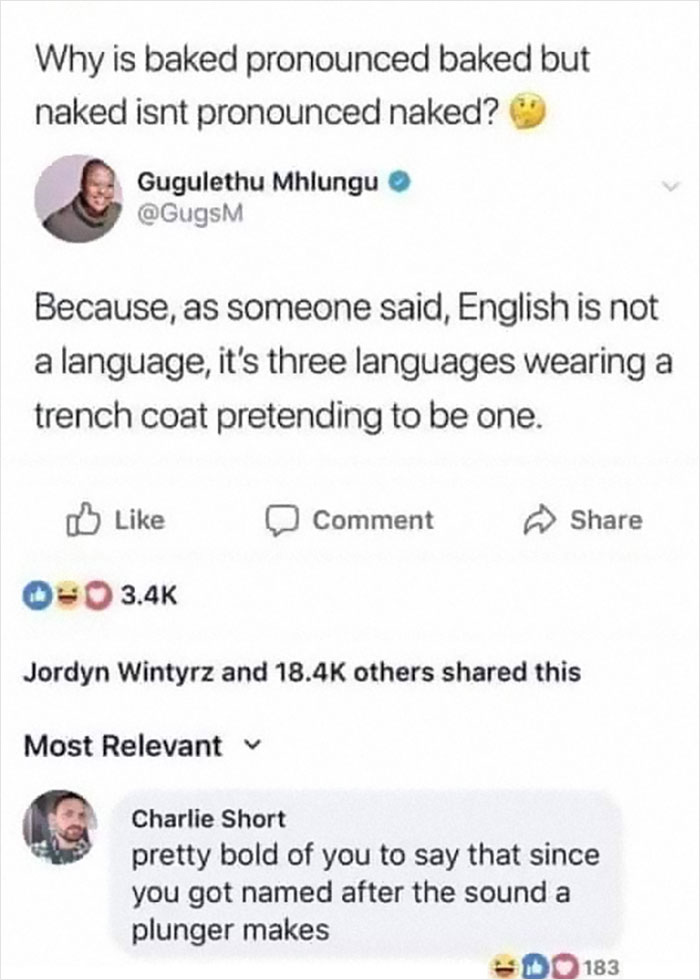
Needs more upvotes. "the sound a plunger makes" outstanding and 100% hilarious
Really? IMO, it was an unnecessarily harsh, mean and personal insult as a response to an mild joke about English.
Load More Replies...Gugulethu explained it really well, and Charlie Short is a rude and uncouth warm toilet seat of a man. Gugulethu is a South Africa name probably of Zulu origin.
I thought it was a rude remark as well. Uncalled for. GugsM wasn't dissing English.
Load More Replies...Her name is African, Xhosa origin. It means "God's Gift" or "Our Pride. Don't make fun if you don't understand the culture.
Okay. now you are being rude. Just because they have a foreign name doesn't mean you can be roasting them
Pretty bold of you to say that because your name sounds like a little annoying kid character in a movie...
Not racist, xenophobic but still bad (sorry if I’m wrong about xenophobia, I think my head has had a mix up)
Load More Replies...“The problem with defending the purity of the English language is that English is about as pure as a cribhouse whore. We don't just borrow words; on occasion, English has pursued other languages down alleyways to beat them unconscious and rifle their pockets for new vocabulary.” My favorite quote about the English language.
During an earlier interview, I spoke to Dr. Lisa McLendon about the difficulties that foreign students face when learning English, as well as how to keep our linguistic skills sharp. Dr. McLendon is the News and Information Track Chair at the University of Kansas School of Journalism and Coordinator at the Bremner Editing Center.
According to Dr. McLendon, a lot of the difficulties that foreign students face depend on the languages that they already know. Those who know languages similar to English in their structure and logic will have an easier time.

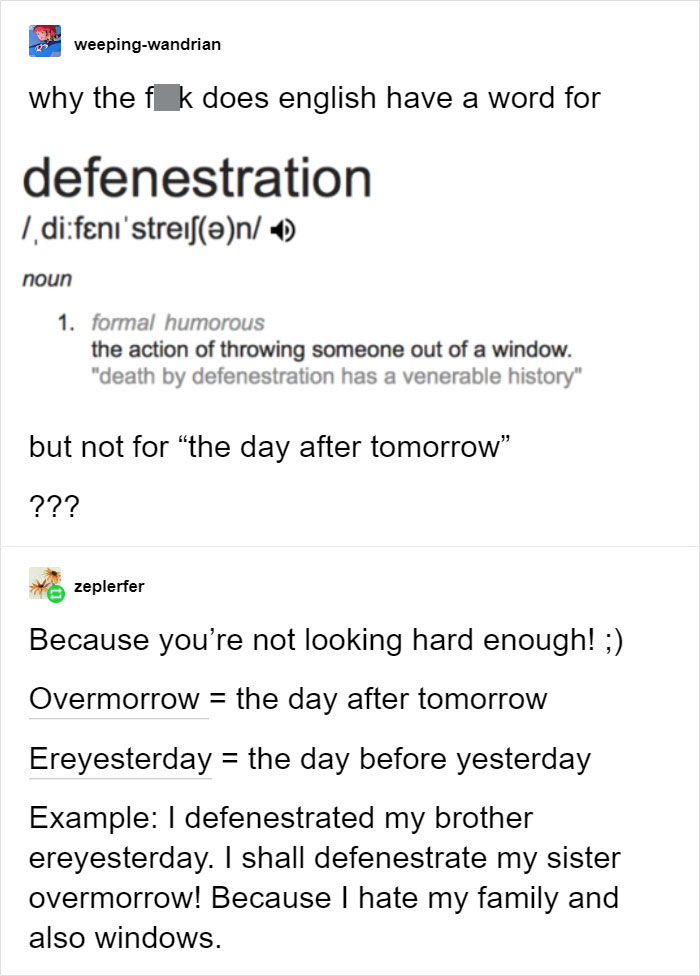
It's a french word. It comes from the latin 'fenestre' which became fenêtre, window
Of course defenestration is a french word, like guillotine and torture... The english stole all our violence related words or what?
Load More Replies...What about throwing someone down the stairs of a train station? Destairtrainstationation?
Load More Replies...Defenestration of politicians was actually a thing, but not in England. In Prague's history it happened not less than 3 times.
I came here to say this. "The Defenestrations of Prague" sounds so much better than "Throwing people out the town hall tower windows of Prague"
Load More Replies...You can do this in German too: defenestrieren, übermorgen, vorgestern
When Apple fans go too far, and start damaging family as well as Microsoft products.
I love in English, at least in Ireland, how I found out there's a word for, eg Thursday next week, Thursday-week. For a Saturday, Saturday-week!
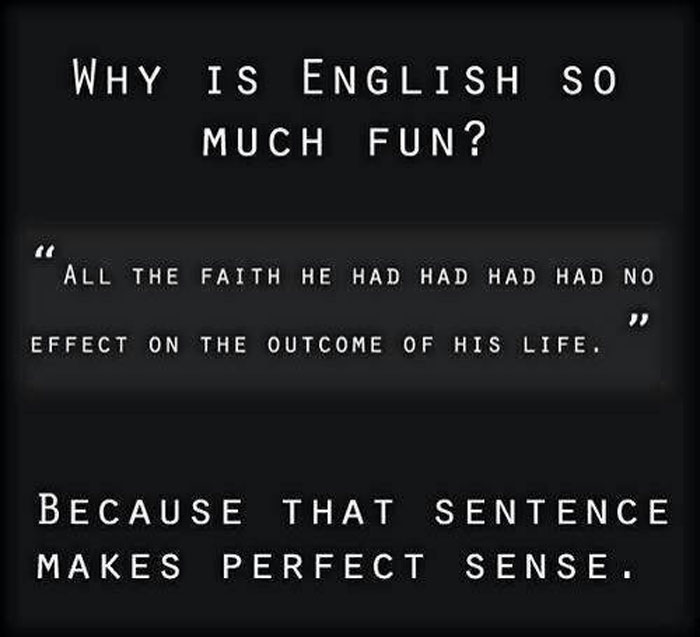
A comma would help . All the faith he had had, had had no effect on the outcome of his life.
Thanks! I don't know why everyone hasn't upvoted this, its really helpful.
Load More Replies...German: Wenn Fliegen hinter Fliegen fliegen fliegen Fliegen Fliegen hinterher. (When flies fly behind flies, flies fly after flies. Yeah it's not an astonishing insight.)
Unfortunatly, our capital letters destroy the real fun :-D
Load More Replies...Smith whereas Jones had had, had had had had. Had had had had the examiner's approval. This might make it easier; it about an exam that had been marked. Smith, where as Jones, had 'had', had had 'had had'. 'Had had' had had the examiner's approval.
"Buffalo buffalo Buffalo buffalo buffalo buffalo Buffalo buffalo" is a grammatically correct sentence in English as well :)
Load More Replies...Yes exactly much better. All the faith he had, had no effect on his life.
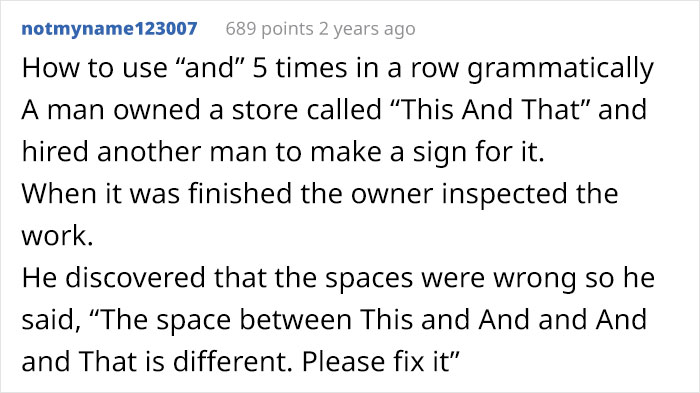
Load More Replies...I HAVE ONE!! so there was a guy who ran a spare parts store called "this and that." his neighbor who ran a store next door stood outside the door looking puzzled. the first guy walked out and asked him what was wrong. the second guy said, "your sign is uneven." the first guy asked, "how do?" the second guy said, "well for starters the space between this and and and and and that is completely different." that sentence made perfect sense.
NO I MESSED UP!!! it's supposed to be "this and and and and and that."
Load More Replies...I had to read it out loud, but it still took 3 tries, even though English is my first language.
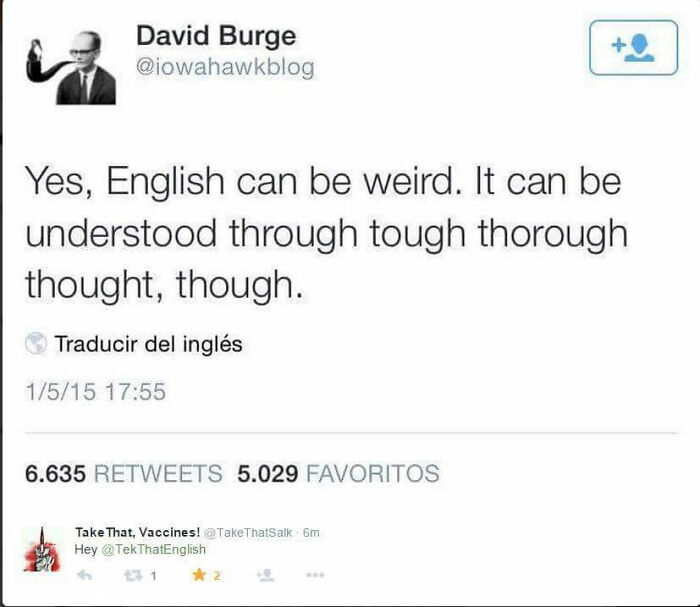
Let’s see. “It can be understood through tough thorough thought though.” Nope, no problems here.
Load More Replies...“For students whose native language lacks articles (a, an, the), articles are by far the hardest category of words to master. Verb tense/aspect is also really hard—the difference between ‘I read,' ‘I am reading,' and ‘I do read' is nonexistent in many other languages,” the language expert explained.
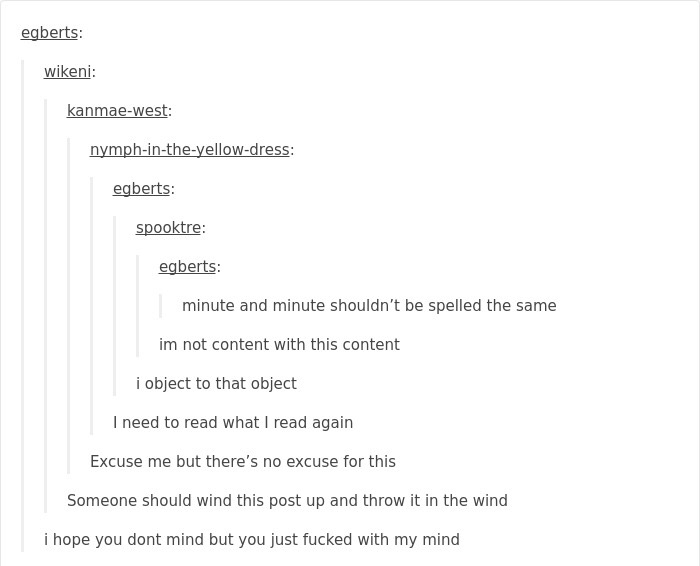
Yeah but that's true for every language. You rarely have "full" synonyms that are completely interchangeable in every context (non-native speakers are generally detectable by breaking unspoken context rules) . Apart from minute differences in meaning, most words also have meanings beyond the thing they describe, such as opinion.
Bless me father, for I have sinned. Forgive me daddy, I've been naughty.
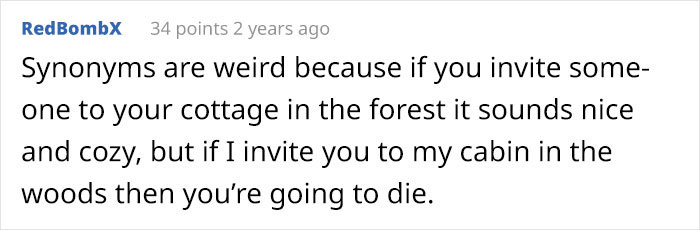
Well...I don't know. To be honest - my first thought to the inviting someone to the cottage in the forest, was a witch trying to cook and eat innocent children.
The cabin in the woods is American, and the cottage in the forest is English, that's why.
There is a difference between a forest and a woods, and between a cottage and a cabin. While the differences between cabins and cottages don't matter very much in this situation, woods and forests do. A forest is overall lighter and lusher (often seen as friendlier) than the woods, which is thicker and seen as scarier. Sorry, I'm an author person, these are things that I'm always on the lookout for XD
In the UK the modern day understanding of the term ‘forest’ refers to an area of wooded land, but this has not always been the case. The original medieval meaning was similar to a ‘preserve’, for example land that is legally kept for specific purposes such as royal hunting. So ‘forests’ were areas large enough to support species such as wolves and deer for game hunting and they encompassed other habitats such as heaths, open grassland and farmland. Now the terms woodland and forest are commonly used interchangeably, and if there is any differentiation, most people see a forest as a remote, dark, forbidding place with a closed, dense canopy, while a woodland is smaller and more open.
Load More Replies...Yeah, that’s why you have to choose your words carefully. Otherwise it could sound rude or not what you meant.
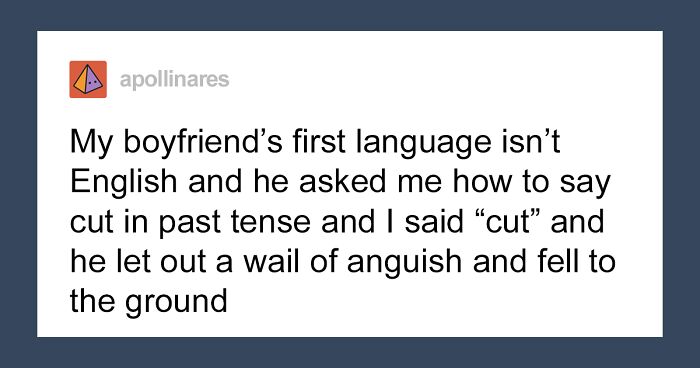
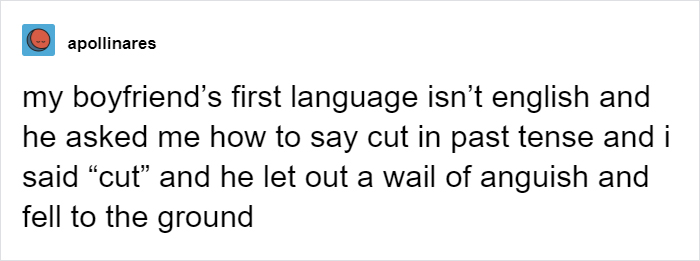
I'm starting to see "cutted", "putted", etc. for past tense now, and it makes me cry.
Like how I felt when people started using addicting. Addictive is the same word. You use both in the same sentence structure, therefore "addicting" isn't needed to be a word.
Load More Replies...If someone asks me what cut means, i will say it's spelled with a k and is the female reproduction part. Yes I'm from the Netherlands.
By contrast, to pet is actually 'petted' and to knit is 'knitted'. There's your free grammar lesson, Americans. 😉
I sympathize with your boyfriend. If it made sense, we could say "cat". Cutted is out of the question, but acceptable for non-native speakers. If it makes anyone feel better, i have these same problems when i try to speak Spanish.
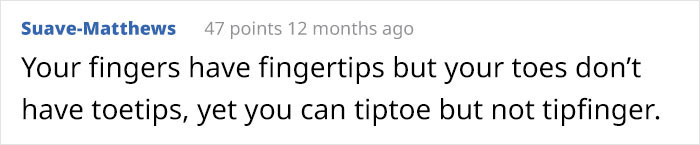
In my native language, "toes" are simply called "foot fingers". Works fine :P
"When is the next train?" "Two to two, to two-two." "and THAT train?" "Two to two to two-two, too."
Does the pinkie finger go wee wee wee all the way home? And those toes can do that tip toe thing through tulips. Not to be confused with two lips. Unless of course you're into that kind of thing. You may be too old to suck your thumb, and too young to suck someone's toes. It's all too confusing to ever understand. There's another too, to, two. Three of them. Jeez.
The English language is full of illogical and crazy rules. Trying to explain it requires a great imagination and the confidence of the guys who sell gadgets and gizmos at county fairs. TThe tip of the iceberg.
As I was saying above....English are very hard. "Wind up that story, you wind bag," I'm still not convinced there is any explanation for ordinary and extraordinar
Load More Replies...Just memorizing common words doesn't help overcome these linguistic barriers. What needs to happen is for the student in question to completely shift their mindset. That and practice things until the quirks of the English language become second nature to them.
“These don't pose any difficulties for native speakers who use them correctly without even thinking about it,” Dr. McLendon said about the linguistic nuances.
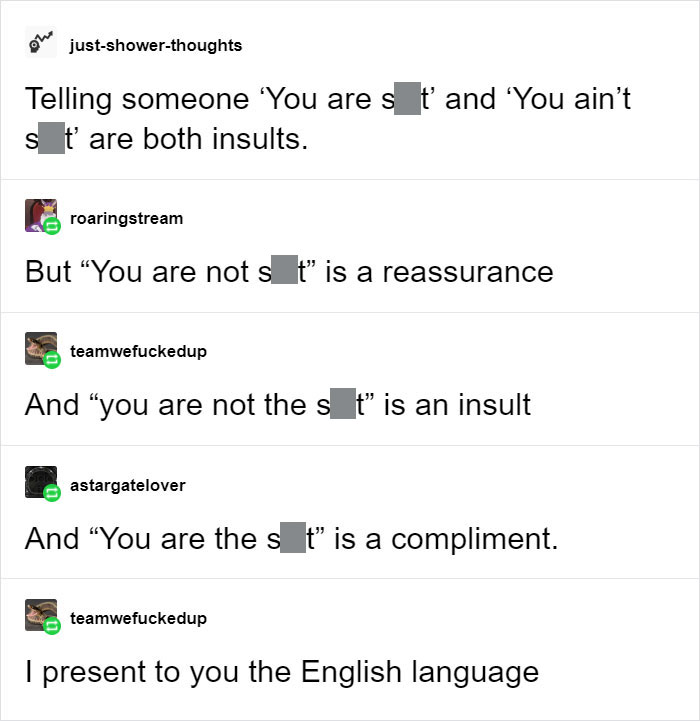
Probably don't talk to someone when shitting either. Or it might start some s**t.
Load More Replies...In British English we say 'bollocks' which is negative but 'the dog's bollocks' is something excellent.
Is the dog bollocks thing kind of like saying "The cat's pajamas"?
Load More Replies...Punctuation is the difference between 'knowing your s**t'...and 'knowing you're s**t'...
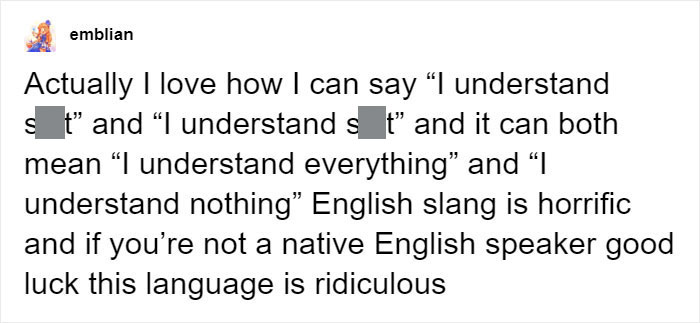
Not to mention "get your sh*t together", because you know, "you lost your sh*t". If you read it literally it sounds really weird.
I still can't understand how a word that is originally used to describe something unhygienic and smelly can also be used to describe something positive or compliment someone, for example saying someone is the s**t. It sounds like an insult. I would never want to called poop. It's messed up...
I met a centurion in a bar once. He held up two fingers and said "5 beers please".
Lol thanks for making me feel smart. I understood thanks to high school French! (that I took ... 18 years ago)
Load More Replies...I always wondered if Liv Tyler gets tired of being called 54, or if she's ever even been called that before.
Yes and no because I can be the Roman numeral 1 and also the word I (as in not we or you, but I)
Load More Replies...It also works for other languages... well, almost all of them, I suppose.
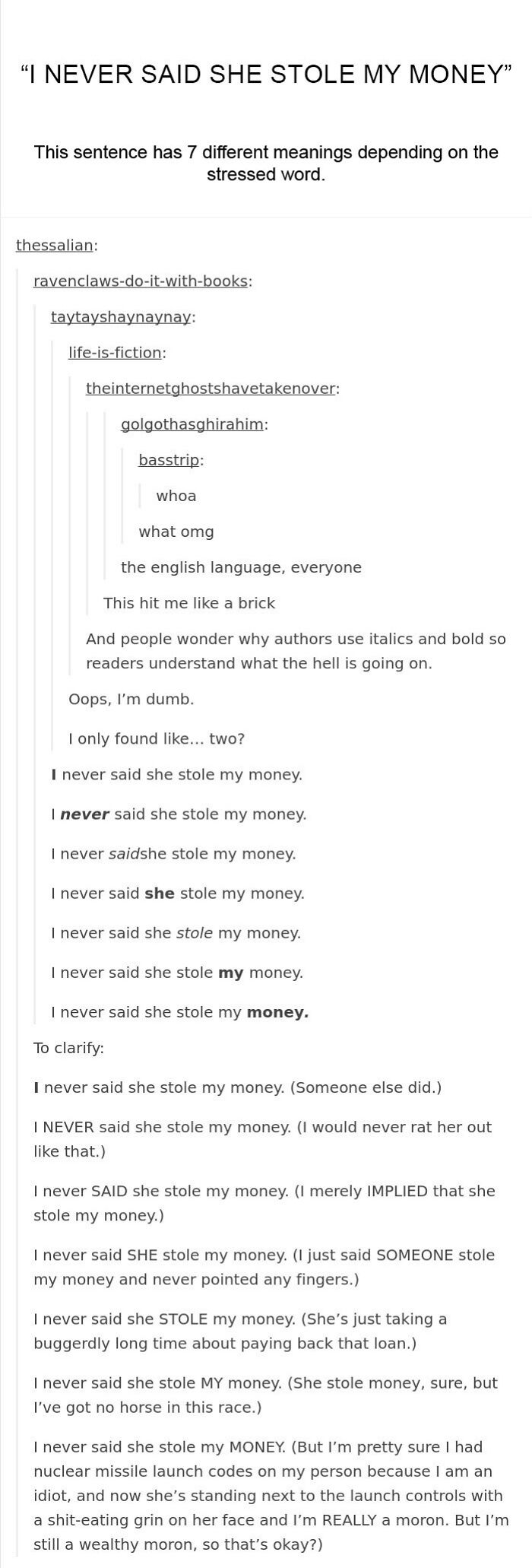
S Discretionary to Slavic languages.... minus Bulgarian the rest of y'all have 6 variations on 'John saw Paul' depending on emphasis... so...
The rest of these so far have been pretty specific to English, but is this one? I speak a little Spanish and the same would be true in that language if you shifted the emphasis in the sentence
It's not just foreign speakers that have issues with the language, though. The professor highlighted that in her experience as an editor and an educator, she found that native speakers have trouble with past passive participles in speech (e.g. saying ‘I had went').
What's more, when it comes to writing, native speakers have issues with punctuation, homophones (e.g. peek vs. peak), and misplaced modifiers.
Perhaps the bomb is correcting the pronunciation when it gets agitated enough?
in the tomb is a womb that holds a great big bomb and it makes a great big boom...
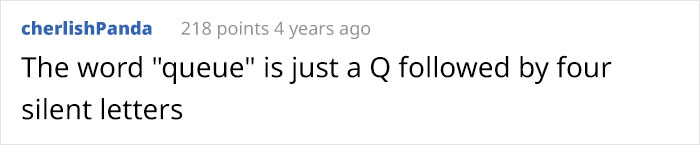
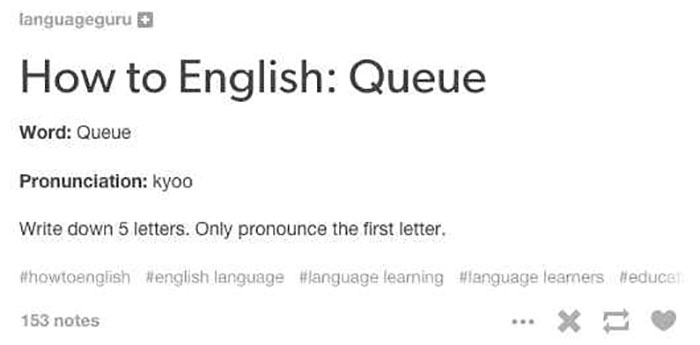
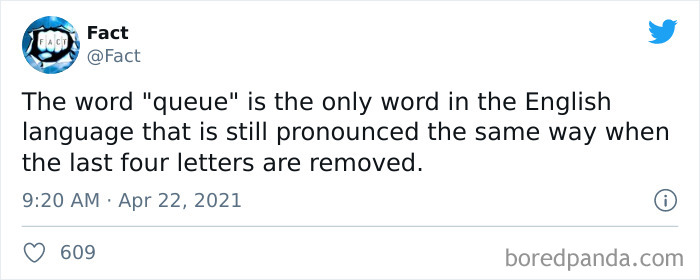
Well, single consonants aren't used as stand-alone words, so it would need a vowel. But q is always coupled with "u" anyway, so "qu" still doesn't look complete. So you'd have to add another vowel... but "quu" looks weird and "que" looks like it might be pronounced "keh". So another vowel is needed... "queu" and it still looks wrong, how many English words end with a "u"? If there's a "u" in the end, it needs an accompanying "e"... so, "queue" it is.
In German by the way a Queue is the stick you’re playing billards with. It’s pronounced "kø"
And again a french word, but this one have several meanings in French. At least 4 and one of them is a synonym of Richards nickname...
Interesting... does it sound like the english pronounciation?
Load More Replies...Even as an English person, who loves language, this one annoys me. Why in the love of God is it not just Que? There is also the word "cue" as in pool cue, that's your cue to go on stage - which is pronounced exactly the same. It already has a few meanings, let's make it's day and give it one more!
When I was young I always said Quweeuwee. Like a siren. I was young and did not speak English
Any other trekkies hoping this Q is not the one played by John de Lance? :)
the English language sounds like Q wrote it
Load More Replies...Sarcasm, I guess. Use the word in a sarcastic context too often and it changes the meaning to the opposite. Happens frequently.
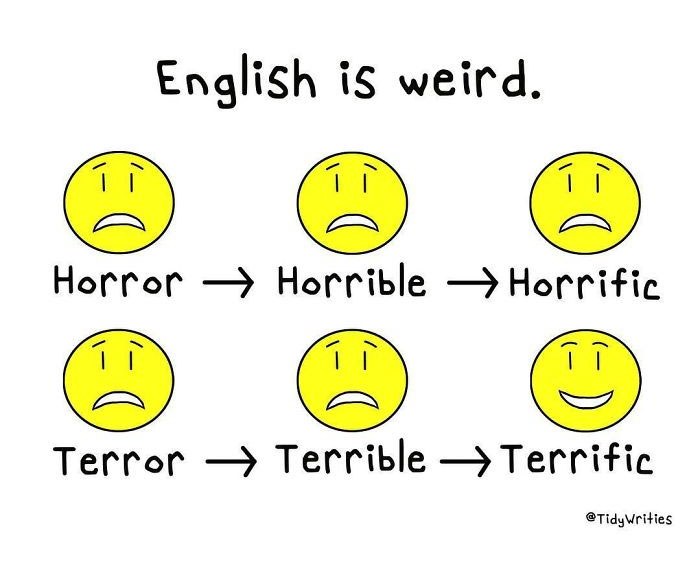
“Elves are wonderful. They provoke wonder. Elves are marvellous. They cause marvels. Elves are fantastic. They create fantasies. Elves are glamorous. They project glamour. Elves are enchanting. They weave enchantment. Elves are terrific. They beget terror. The thing about words is that meanings can twist just like a snake, and if you want to find snakes look for them behind words that have changed their meaning. No one ever said elves are nice. Elves are bad.” Terry Pratchett
"Terrific" still has both meanings (terrifying and amazing), just to make things confusing. Then you realize that awesome, amazing, and adore (for a start) originally had religious meanings, and your head starts pounding. Ecstatically.
I bought a cheap tape recorder once - prob from China. The slogan on the box was 'small but terrible'.
Dutch too. Geweld = violence. Gewelddagig = violent. Geweldig = terrific.
This is an example of a meaning shift: "terrific" used to mean something terrifying. Kind of like "awesome".
Dr. McLendon suggested that nobody rest on their laurels. Learning's a lifelong mission and improving our English skills is no exception. And if we want to keep our minds well-honed and our quills sharp, then we're going to have to get some good habits under our belts.
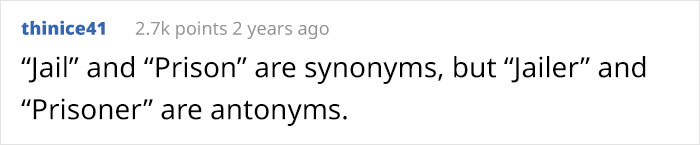
They are not synonyms. Jail is where you are awaiting trial, or in the case of les serious crimes, whereas Jail is where you go to serve longer sentences. The former is usually governed by another body than the latter. In the US Jails are a local government issuer, while prisons are state or federally driven.
In the UK they're synonyms... but I also like the fact you accidentally wrote Jail again instead of Prison.
Load More Replies...A slim chance and a fat chance are the same thing but a wise man and a wise guy are opposites.
Couldn’t a wise guy also be a wise man? I thought wise guys were smartasses. Some smartasses are actually smart
Load More Replies...Here in the States, "jail" is the place you stay while awaiting trial, and "prison" is where you go once convicted.
To be pedantic, "jail" and "prison" are not the same. A "jail" is a place where you hold people who are awaiting trial (and who haven't paid bail), or someone serving a short term for a minor offense. A "prison" is where you send someone convicted of a felony to serve out his sentence.
Actually, they aren't: jail is where you go before you are sentenced to prison.
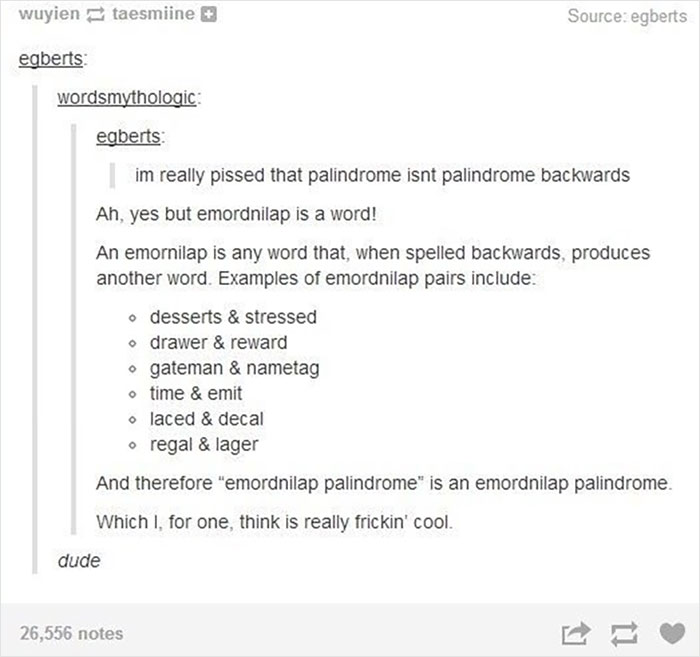
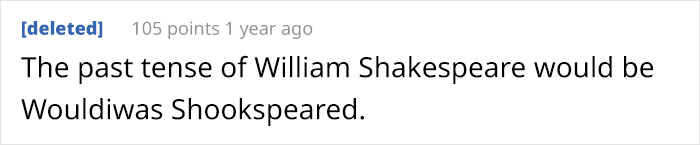
It is a palindrome consisting of an emordlinap pair.
Load More Replies...This is untrue. It is not an actual word in the English language. Just a fancy invention.
A lot words in the English language began in the same way. The real test I guess is whether it sticks around or not.
Load More Replies...im stupid so can somebody tell me if desserts are sweets or a place with no weather :| i was going to pun but i have to ask if it works first lol
English is my first language and I didn't even know "emordnilap" was a word that existed, nevermind had this meaning.
I warn bored panda to remove this one. This could cause various murders by the readers here.
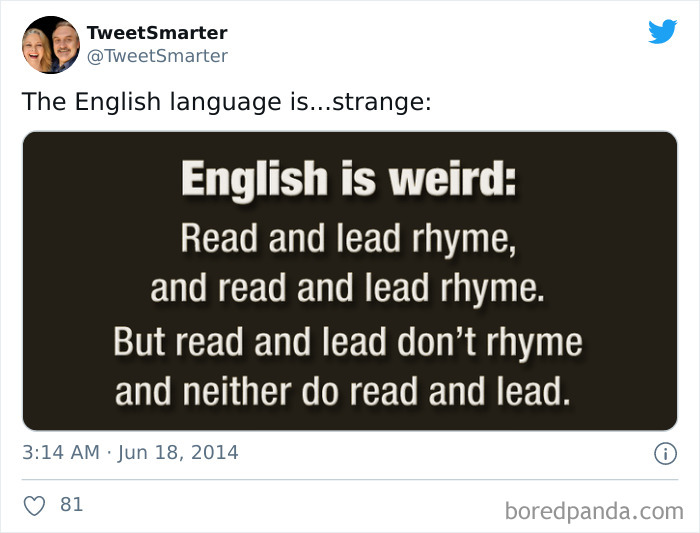
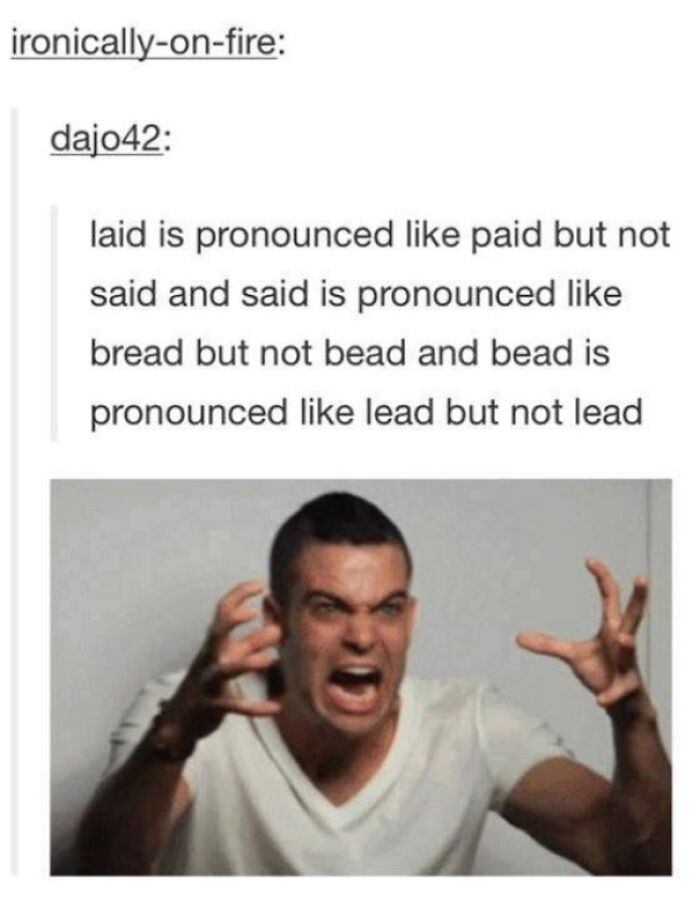
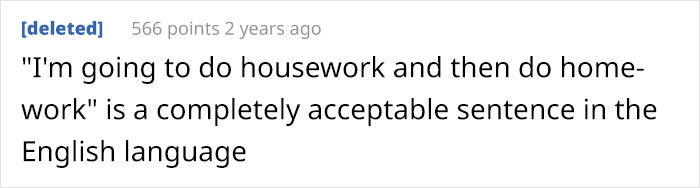
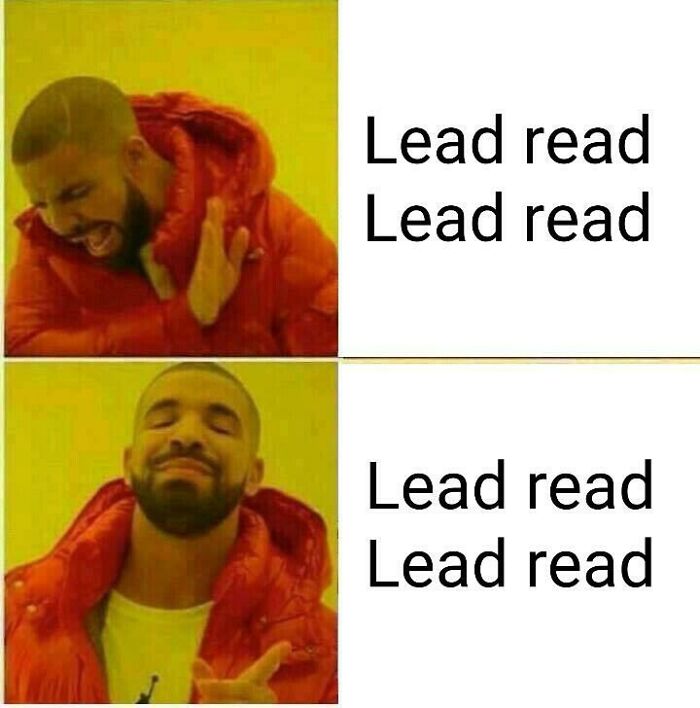
Read has a past tense version spelled the same. It pronounced like the color red. Read (past tense) and red are homophones. Lead is take charge and lead is a metal. The first one is a verb " to lead". The second one is a noun.
Laughter and dafter rhyme, but not spelled the same. Daughter and slaughter rhyme, but different from laughter and slaughter. Lots of memorization in correct pronunciation.
Load More Replies...Thats why most other languages mostly write the way you hear things. The order can be argued but with Estonian way of writing by ear this sentence would look like this: Ingliš is uiird: Riid änd liid raim änd red änd led raim. Bat riid änd led dõunt raim änd naizer du red änd liid.
“Read! Read widely and frequently. Read magazines, newspapers, novels, even cereal boxes,” the language expert told Bored Panda. “But be careful when scrolling through social media, which although it can give you a good idea of current slang and shorthand, it's often not a great model of clarity, accuracy, or good grammar.”
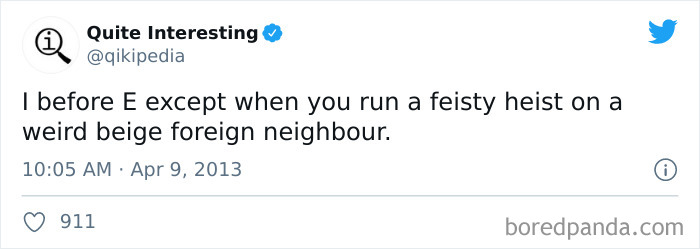
Wasn't it QI that found out that there are actually more exceptions to this than there are that abides to the rule?
That's such a funny clip, none of them except Daniel Radcliffe understood what was going on
Load More Replies..."I before E except when your foreign neighbor Keith purchases eight counterfeit beige sleighs from feisty caffeinated weightlifters. Weird." -A coffee mug I've seen.
this was in the simpsons! "I before E except after C, except when pronounced like 'ay' as in 'neighbor' and 'weigh."
Science also breaks the rule of i before e except after c. The English language is crazy wild.
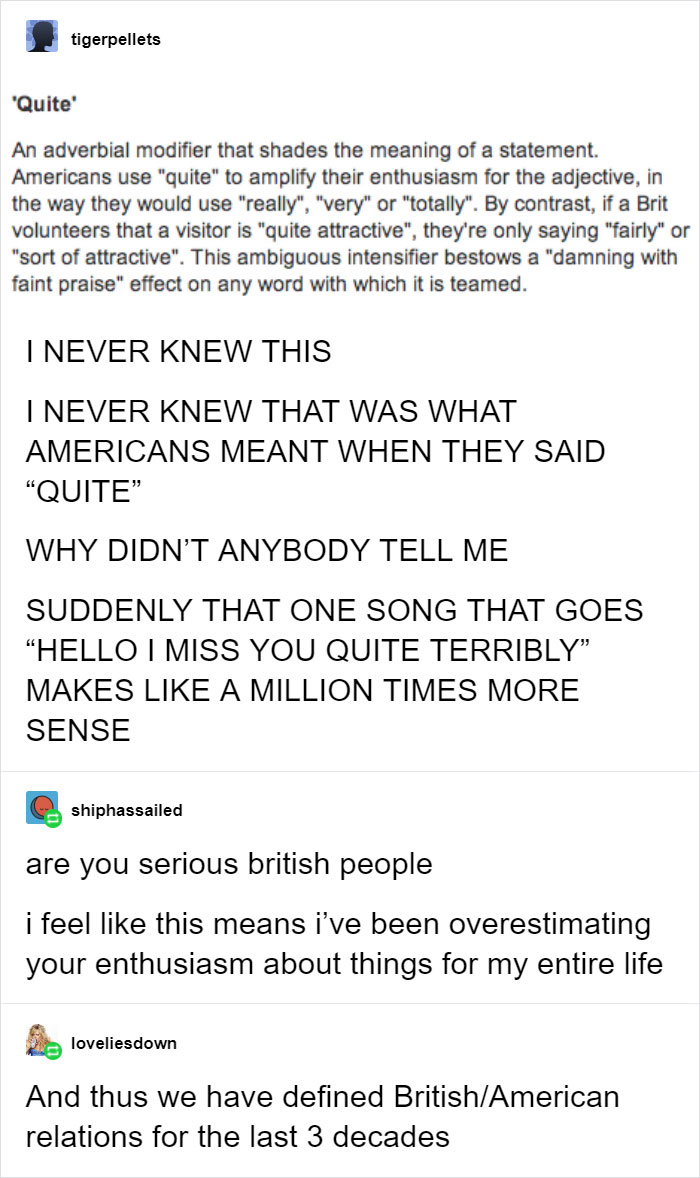
But if a British person adds "really" before quiet then it changes it back. For example "quite impressive" means "not actually very impressive" but "really quite impressive" means "genuinely very impressive."
Brits are well known for understating things. Where Americans would go "Oh my God this is amazing!!!", the Brits will say something to the tune of "it's not too shabby".
This. Exactly this. Americans overstate and Brits understate. Which people just state?
Load More Replies...Hello...Canada here...quietly observing this how this is just a US and Brit thing.
And yet the opposite language misunderstanding between the US and British language occurred during the Korean War. The British commander told the US commander that ‘things are a bit sticky sir’. From the British side the meaning was ‘we are in serious trouble’. However, the Americans took this to mean that the British were under a little bit of strain but nothing too serious, and so decided that there was no need for reinforcement or withdrawal.
That's not good. Reminds me of that old German Coast Guard joke. https://www.youtube.com/watch?v=VSdxqIBfEAw
Load More Replies...And yet in England, 'Hmm, quite!' is ultimate disapproval. Americans, put on your best British accent to really get the feel of 'Hmmm, Quite'
Actually, as an English person, I can confirm that we DO use the word Quite as a modifier to mean very, as well as meaning fairly or sort of. Which way it, is meant is implied by pronunciation.
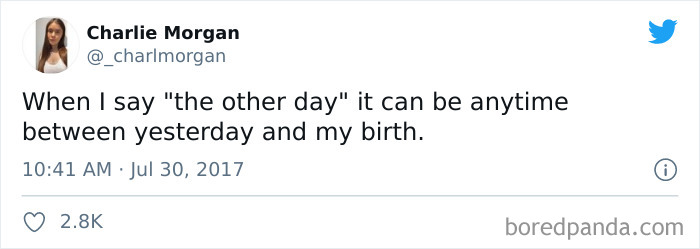
A common expression in Ireland is 'In a minute', The amount of time is relative only to the subject matter. Eg, 'Isn't it your birthday in a minute?', 'Aye, 3 months tomorrow!'.
Not true. There's no rule, but we imply that it means probably within the last week.
Yes and other languages. Like Portuguese "No outro dia...".
Load More Replies...Is this the actual rule? I think within the past few months is okay.
Load More Replies...In my mind the time span when I reference this term is within a week, usually the person I’m talking to( spouse) doesn’t remember things beyond that
You need to go to the Scottish Highlands, when 'down the road' can mean anything from a 100 yards to 300 miles.
When it comes to pronunciation, though, Dr. McLendon pointed out that both native speakers and foreign students alike have problems with it. Especially when we're talking about less common words like ‘epitome.'
“I've known lots of people who learned words by reading, not by hearing, and so had no idea how they were pronounced. But for people learning English, pronunciation can be a real nightmare,” the professor said.

I was taking a TEFL (Teaching English as a foreign Language) qualification in Japan, and one of the exercises I had to do was read to a class of students. The one word that stuck in my mind was black bird versus blackbird. The difference is so subtle, but I hadn't given it any thought until you had to explain the difference.

I feel like the first year or two of teaching ESL as a native speaker is a lot of that.
Load More Replies...Japanese has that too sort of. There's THREE words called かみ(Kami), with one meaning hair, the other, paper, and the other meaning God. Hair and Paper have pronounciations like kaMI, while God has KAmi. You could say "I cut my hair" in Japanese as "かみを切った"(Kami o Kitta" but without saying it correctly it could mean "I cut my God"
Gah, I didn't know kami also meant hair. I don't know much Kanji but I assume each have different Kanji to make that distinction, right?
Load More Replies...Can we tell true crime podcasters about frequent and frequent please?
I do it automatically, but that explanation makes sense. Learnt something for the day :)
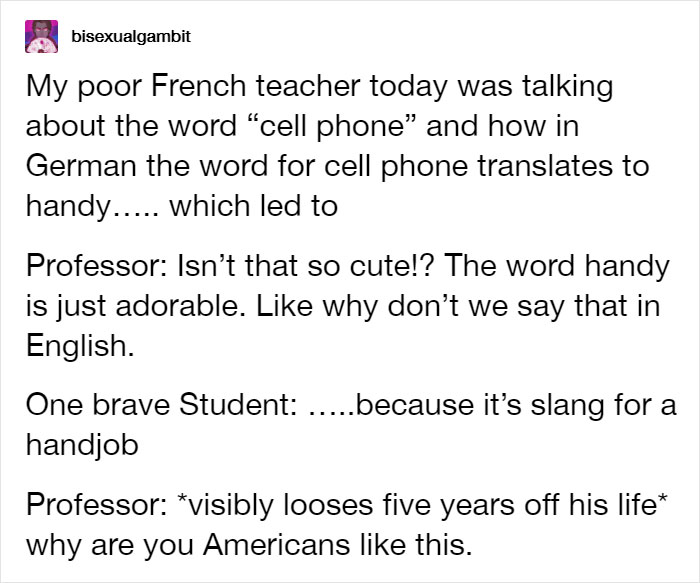
My English teacher taught me not to use "handy" in English because it would be a derogatory term for handicapped people. Is that true?
English; only definition of 'handy' that I know is 'useful'
Load More Replies...I was taught that 'handy' meant 'useful'.... It appears that my life has been a lie 😓
I am a native US English speaker and I have never heard 'handy' used that way. It means either that something is convenient ("Do you have a pen handy?") or someone is good at home repairs etc. ("Janet is very handy.").
In England, handy mean good or useful. He's handy with his fists, which could come in handy.
But a 'handyman' is a fellow who can do a variety of home and garden repair and maintenance jobs.
That is because 'handy' means useful, therefore 'useful man'.
Load More Replies...I've never seen it used that way. Handy can mean close (the store is handy to my apartment); it can mean useful (that was handy little gadget to have); a person can be handy, (she's quite handy and was able to fix my shutters and my computer); and handy is slang for a sexual act.
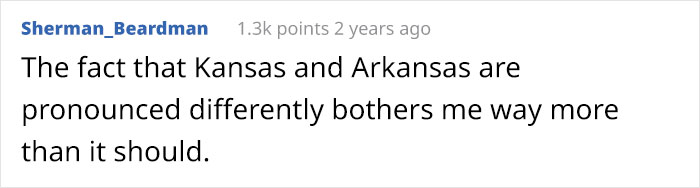
Because they are two bastardizations of two parts of a tribe located in the lower midwest. One is a Spanish to English bastardization and one is a French to English bastardization.
Just wait until you get to England... Gloucester (pronounced Gloster), Leicester (pronounced Lester) and many more!
To be fair, these aren't English words any more than is Illinois.
From what I understand this is the short of thing that happens when you try to phonetically spell Native American names/ words in other languages.
Arkansas was named for the French plural of a Native American tribe, while Kansas is the English spelling of a similar one. Since the letter "s" at the end of French words is usually silent, we pronounce Bill Clinton's home state "Arkansaw." ... Kansas is named for the Kansas River, which is named for the Kansa tribe
“We have words that are spelled similarly but pronounced differently (bomb/comb/tomb) and words that are spelled differently but sound the same (peek/peak/pique). Plus, English has a lot of words that have silent letters, which can be confusing.”
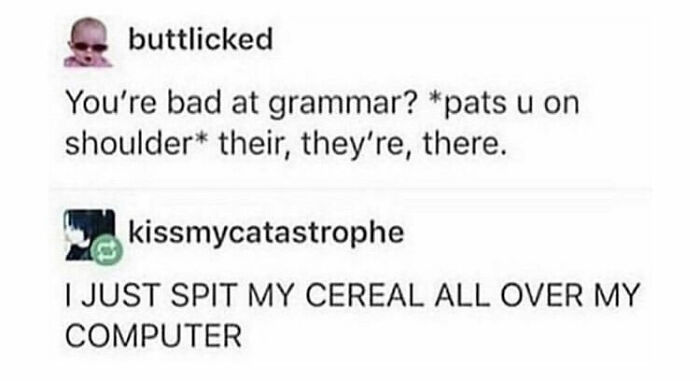
And here is another strange "Americdnism" I spit my cereal, I would say I spat my cereal...

Probably because you are not a native speaker. Stuff like this is always easier for foreigners.
Load More Replies...I think knowing the difference between their/they're/ there or your/you're is much easier for second language learners than for natives. Because we learn the word together with the grammar and not by listening to it.
Absolutely. I'm always shocked when they point out this as a common mistake in English. Like, this is the only grammar thing that I have no doubt about.
Load More Replies...Ah, there's another one that Americans consistently get wrong. Spat.
Not sure that's an American thing. Everyone I've heard in America has said spat.
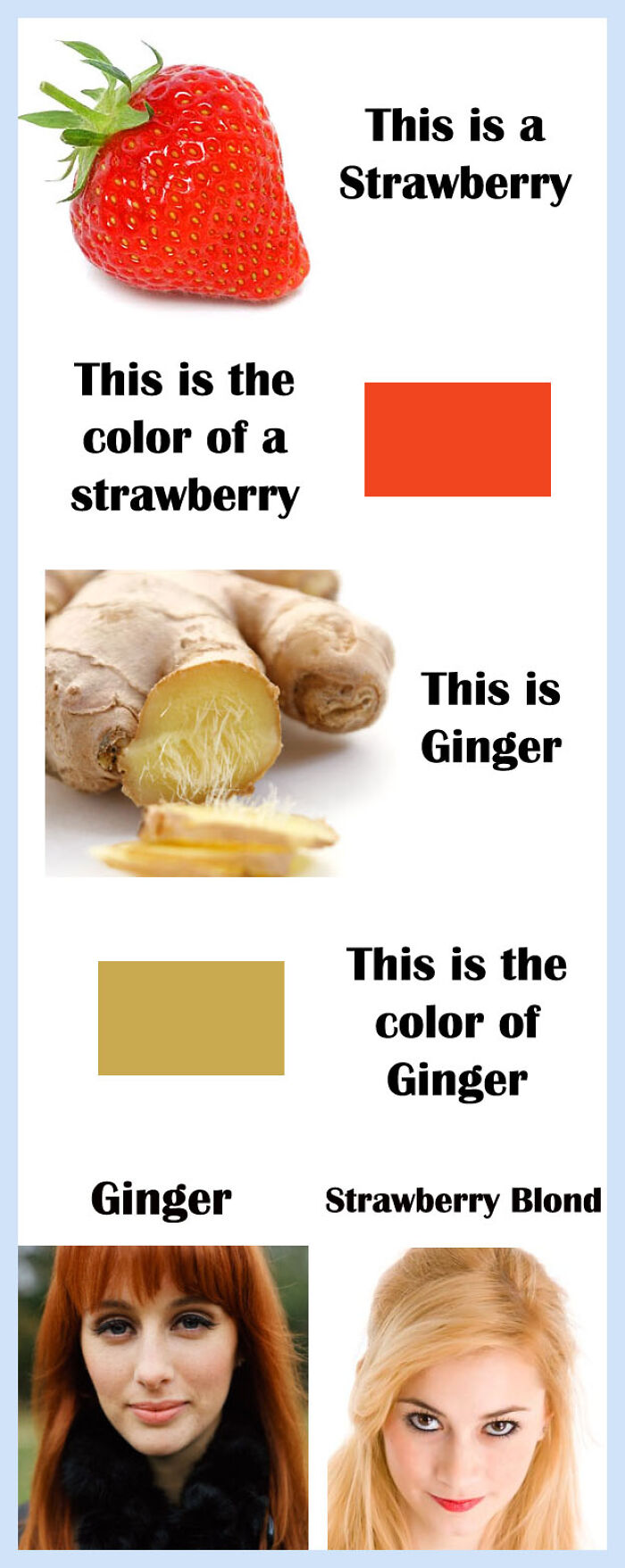
Load More Replies...Whoever came up with those names for the hair colors were color blind
Yes, that's why we have continued to use those descriptions for thousands of years.
Load More Replies...It's not like the English are famously good with food, so... If they'd stayed with foods they knew, these would be called "treacle" and "fish n chips blond" (or possibly "fishfinger").
Way better then what we call brownish blond. Straßenköterblond - street mutt blond
In Dutch there is melkboerenhondenharen. Literally means hairs of a milkman's dog.
Load More Replies...I get Strawberry blond. Its blond with a modifier that suggests it is also somewhat red. Ginger never made any sense to me. Although in the US we are mite likely to call someone a redhead anyway.
There is a red flowering plant called "red ginger."
Load More Replies...I've heard many people call that colour strawberry blonde, even though it is actually blonde with a tiny hint of orange.
Load More Replies...Then there's "Auburn" ... which derives from "Albus" or "Albumus" meaning white... which them somehow became "brown" which then became "reddish brown" :D
Yes, it is usually orange but nobody calles it that for some reason. Red hair can also be auburn, meaning redish brown.
Load More Replies...I’ve lurked on this site for a long time. Finally found the perfect account name :)
Now i regret i wrote that and didn't use it myself!! Damn!!
Load More Replies...Dr. McLendon was candid that English is much more chaotic than other languages in terms of how spelling reflects pronunciation and vice versa. “English is a Gallic overlay on a Germanic base, plus it has borrowed liberally from languages all around the world throughout its development,” she told Bored Panda.

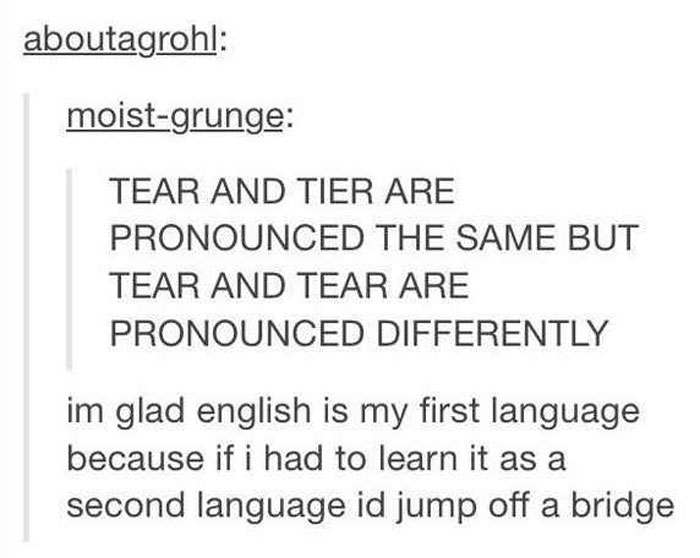
I have a medical condition which resulting in tearing of the cornea. When I write that, people sometime get confused. My cornea doesn't produce liquid, it rips apart and is excruciatingly painful, but tearing can make it feel a little better because the liquid lubricates and protects the tear.

tear( tare) is to rip up something, tier is a level (say, in a job) and tear (teer) is what your eyes do trying to learn English. Tare is a fee you pay. Just sayin'
I thought the same at first. Then realized it meant water from tear duct. So look again. :)
I still don't know but I've heard that it's as in no more tearing the hair as in ripping and not tears crying!
Load More Replies...It's my second language, I don't see the problem. It's an easy language compared to German or French.
You would think that English is a difficult language to learn, I had no hope of ever learning German because of all the different Nuances in the language, but other cultures say that German is easier to learn than English. i still say NO. (nope)
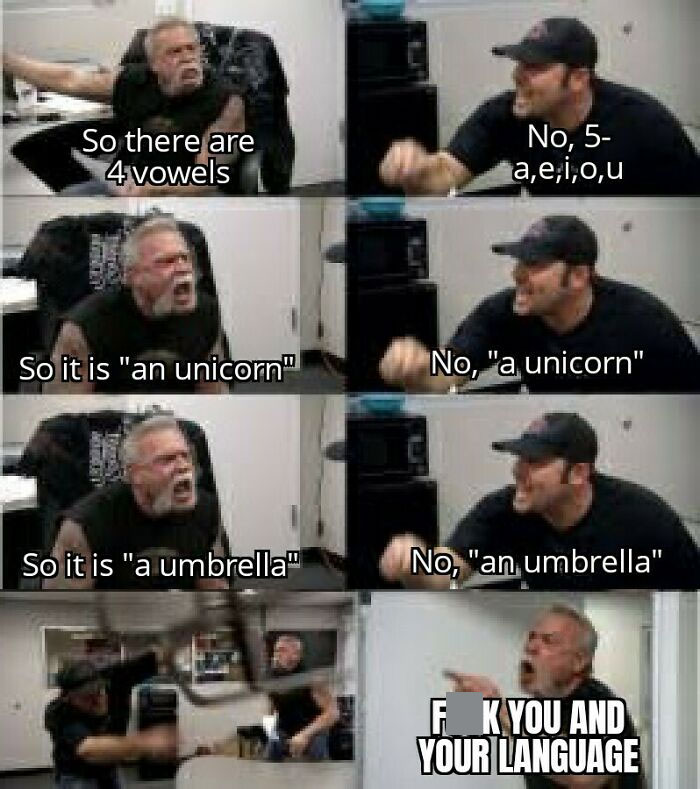
A/an is governed by the first sound, not the first letter of the word that goes after.
But I can't rectify "an historian." I know it is correct, but it bothers me.
Load More Replies...When a word beginning with "u" has a "y" sound, it's "a" as in "a unique idea". When a word beginning with "u" has a "u" sound, it's "an" as in "an ugly sweater party".
Also The Y at the end of words that end in LY the Y is considered a phonetical vowel as is it pronounced like an E.
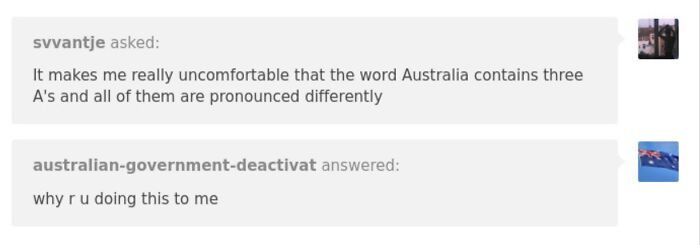
Load More Replies...Speaking of vowels, tomorrow has three o's, all of which are pronounced differently.
Told this to my friend and they straight up stopped and asked me what I am doing with my life
Wait till he learns how it works with H, which isn't even a vowel. Pretty much if it starts with a silent H you say an (an honour), if you say the H its a (a horror).
It goes by the initial sound, not the initial letter.
Load More Replies...And the B in tomb is silent, and the E in time is silent, and the T in often is silent, and the H in honor is silent, how do you pronounce BETH? It's all silent letters!
Actually, the 'e' in time isn't silent. It's a split digraph, meaning that it's paired with the 'i' to make an 'ie' sound but it separated by a letter that is pronounced afterwards. When you teach kids to read it, you teach them to read it as 't' 'i-e' 'm'.
Load More Replies...But those pronunciations only happen in specific configurations so the above wouldn't work.
This is exactly what my husband explained to me when I was learning English and I really was having a lot of trouble pronouncing it! So, now if I make mistakes and sombedy corrects me, I say! Well! Houston in Texas is pronounced hewston (whe the h is not silent (?) ) and in New York is House-ton, like pronouncing House (the building). Soo.... It is OK. It is really a language you have to memorize... and sometimes it is a nonsense one. Why the alarm goes off? it should go on! right????
The latter might have come about because you set off an alarm, rather than it goes off.
Load More Replies...How do you spell your name Paul? "Yes, it's P as in pterodactyl..."
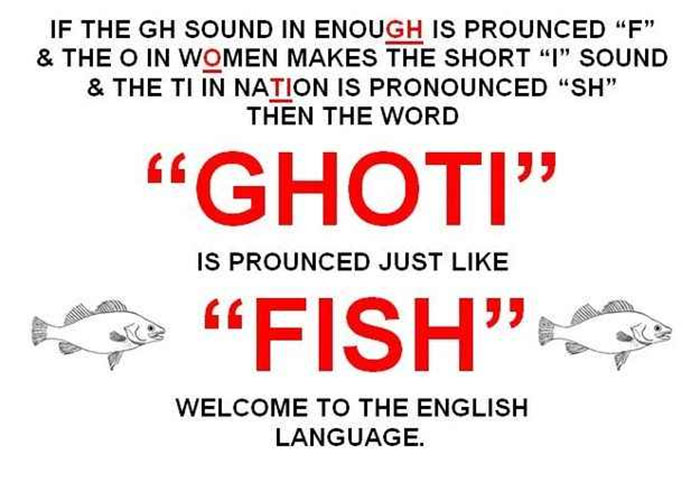
It took me about 2 minutes to stop laughing enough to type this. I LOVE the English language now, more that I did when I was at school.
#29 is the wrong way around. There is no such word as 'ghoti'. The meme should read 'then the word FISH should be spelled GHOTI'.
this actively is hurting my understanding and connection to reality and also my head
“When a word comes into English, where it comes from, and when a spelling gets standardized all affect how a word is written in relation to how it sounds. Other languages may not be exactly ‘spelled like it sounds' but have set patterns of how pronunciation does not correspond with spelling.”

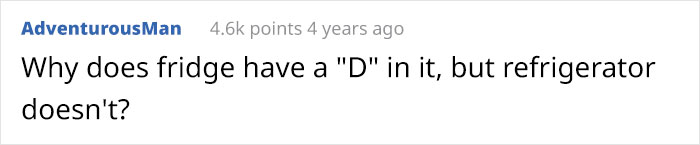
Because the Frigidaire brand became so popular that “fridge” was used as the term for all refrigerators.
If this is true, why wasn't refrigerator genericised to frigid?
Load More Replies...And what does it mean to refrigerate something? If I only put it in the fridge once, am I just frigerating it?
It’s from the Latin word refrigerat, which means to make cool. But I like your joke. :)
Load More Replies...The "d" in "fridge" is just there because english wouldn't pronounce "frige" the same way on its own, which i guess would be like /freeg/ or /fryg/ depending on the person
Pronounce refrigerator in Spanish! Rref-re-hair-uh-dor. Roll the first r's.
But, if I remember rightly, refridgerator does have a d in it in English, just not in American - they really are two different languages.
People used to use the full trade product name of Frigidaire. Somehow the D got moved when the abbreviation happened. Fridge was never really the short version of refrigerator.
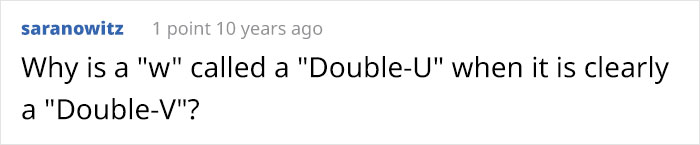
Yup. There is no U in latin, only V. (No J, just I, for that matter)
Load More Replies...Why do Americans say dove instead of dived? He dived into the pool, not he dove into the pool. That is what I was taught at school anyway. Also hanged and hung He was hanged from the tree, not he was hung from the tree. Is this a specifically American thing. No offence, just genuinely would like to know.
Dove is typically American, a change that occurred in the 19th century, probably by analogy to drive/drove. I serisouly doubt however that British speakers scrupulously distinguish hung/hanged, whereas Americans do not. It's the same verb, the past form "hung" emerged in England in the 16th century and hanged is generally used in legal contexts. SInce it's a same verb, it's an artificial dichotomy. I don't know of any other verb that has the same etymon but two different past forms as a function of the object being manipulated. I set aside cases like shaven/shaved, where shaven is only adjectival (and actually comes from the verb "shear", whereas as shaved comes from shave). Btw, I am a professor of English linguistics.
Load More Replies...Everyone talking about the crazy English language, which is true, but NOBODY sees that shadow???
It’s funny because I understood all of this without even having to think. I’m glad I know English because learning it would be painful
https://saqibwaseem1234.blogspot.com/2022/08/how-to-communicate-fluently-in-english.html
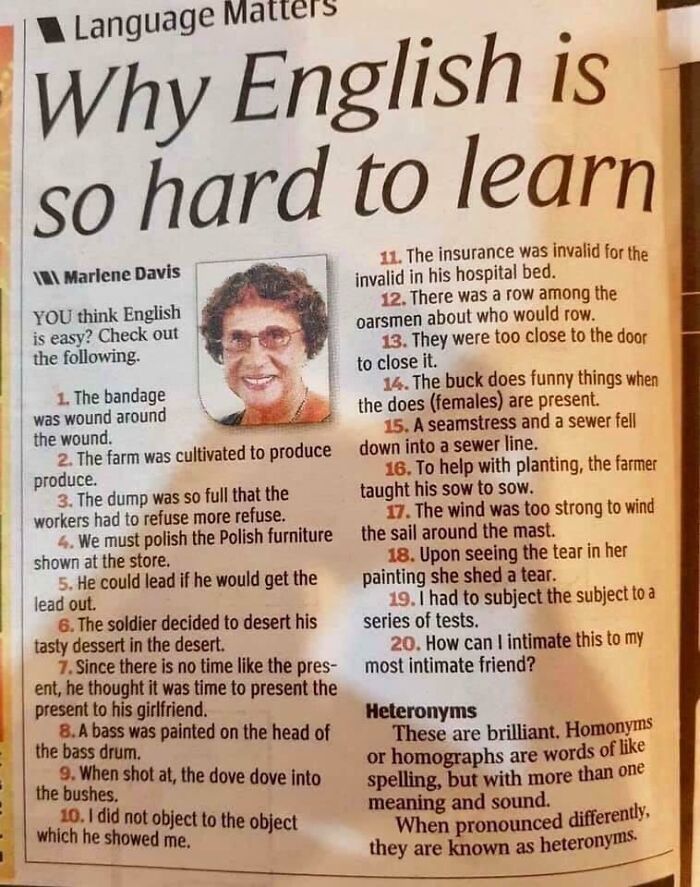
I'll try to think of a sentence for these... one of them kind of doesn't really count ...but how about desert....desert.....and dessert....
I had this list printed out poster size to display outside of an elementary school library. The kids loved trying to read them. Eventually we'd go through them during class but it was fun to hear them in the hall realizing each word meant something different and were pronounced differently. The conversations were great.
How can I intimidate his intimate's intimates while I intimate mine?
no welcome to the English language where words like wear and where sound the same and could possibly make you jump off bridge
Load More Replies...I have always felt that English could use a system of accents like the French and Spanish and other languages use, to inform a learner where emphasis is placed on a syllable and how a syllable is pronounced in different ways. There are native English-speakers everywhere who do not know the correct pronunciation of many words. The line from "My Fair Lady" where professor Higgins says "Why can't the English teach their children how to speak properly like the French do? " and the follows with "Actually the French don't care what you say as long as you pronounce it properly!" So true.....
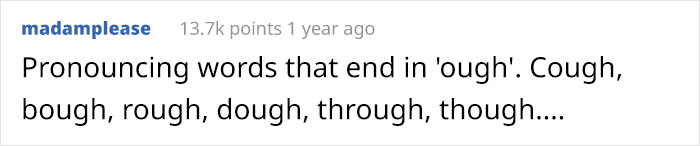
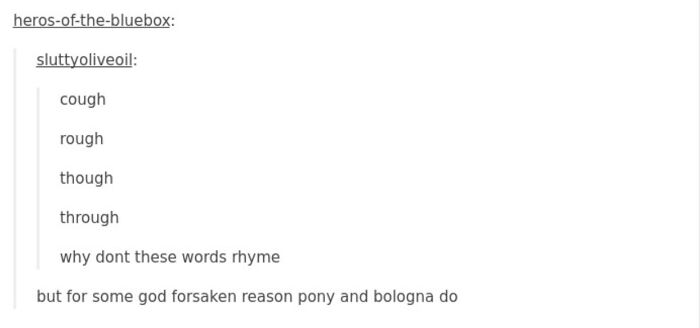
Cough = Coff, bough = bow. rough - ruff, dough = doe, through = throo, though = thow
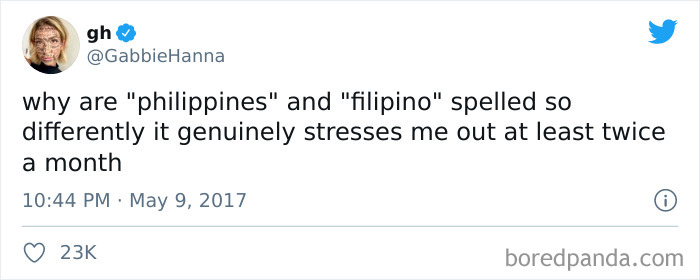
The country’s starting letter(s) switched from ‘f’ to ‘ph’ when Spanish rule was replaced by American rule. No idea why the same did not happen to the demonym, however.
The whole country has remained this weird mix of English-speaking Hispanics ever since, I guess.
Load More Replies...I do think that if you stress out about something like this twice a month, you probably do not have a lot to stress about. The good life! 😉
As an added bonus attraction, there are several sets of letters that are often switched: b/v, p/f, and m/n being most common. While there in the military, I once heard Dracula described as a bonfire :-)
The word “Filipino” is spelled with an “f” because it’s derived from the Spanish name for the Philippine Islands: las Islas Filipinas. Originally, after Magellan’s expedition in 1521, the Spanish called the islands San Lázaro, according to the Oxford English Dictionary. But in 1543 the Spanish renamed them las Islas Filipinas, after King Philip II. (“Philip” is Felipe in Spanish.) In English, however, the name was translated from the Spanish as “the Philippine islands” or “the Philippines.” The earliest published reference in the OED is from Samuel Purchas’s Pilgrimage (1613): “Those Islands, which more properly beare the Philippine title.” And here’s another early citation, from Nathaniel Crouch’s The English Empire in America (1685): “A great Ship called the St. Anna expected from the Philippine Islands.” The country is now known as the Republic of the Philippines, but the Spanish spelling was retained for “Filipino.” The word is an adjective as well as a noun.
I also REALLY hate that in my native language (Dutch) we write the name of the country with 1 P (Filipijnen) and the name of the capital with 2 Ls (Manilla) amd then I switch to English and for whatever reason the country name has double P but the name of the capital only has one L in it. And of course I can't keep them apart so I need to look it up every single time. This comment was no exception to that.
Never mind ‘Netherlands’ and ‘Dutch’. I’ve been asked so many times why they’re so different as if I’ve created the language 😄
Dutch has the same root as Deutsch (German). Dutch language developed separately from Low German after their independence but they've kept the word :)
Load More Replies...As a Filipino...I really didn't know. Then there's the Filipino vs Pilipino xD
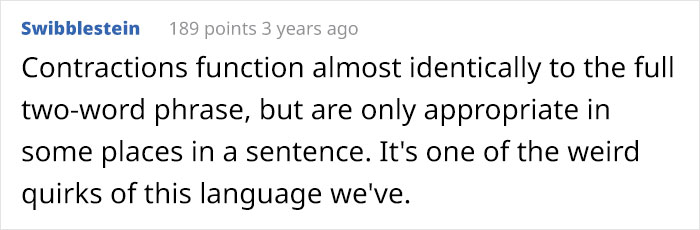
No, it's not. Contractions are short language. Slang is a convenient replacement.
No, it's just an Old Norse version of sling from an expression that translates as "sling the jaw" meaning useless talk.
It's actually a Portmanteau. A portmanteau is a coming together of two words, the first letter of the first word and the second and all or some or all of the letters in the first word, as in Motel being the M from Motorway and otel from Hotel, anklet, from ankle and bracelet, and sitcom, from situational and comedy.
but boring is boring, depending how deep you need to go.
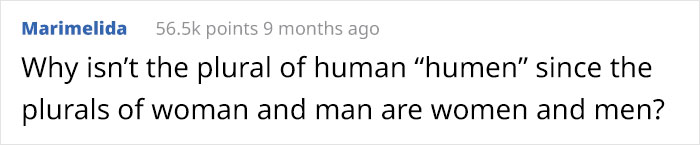
Load More Replies...Human was first recorded in the mid 13th century, and owes its existence to the Middle French humain “of or belonging to man.” That word, in turn, comes from the Latin humanus, thought to be a hybrid relative of homo, meaning “man,” and humus, meaning “earth.” Thus, a human, unlike birds, planes, or even divine spirits up above, is a man firmly rooted to the earth
Etymology. Human has a French origin and takes the usual Latin languages mark of plural "-s" while man and woman come from germanic languages and get a declension instead. (and somehow there was no adaptation of one to match the other along the way...)
Look man, the English language is basically a collection of other language scraps that are held together with duct tape
Load More Replies...The resemblance of these three words is kind of accidental. Go back a few hundred years and the resemblance kind of disappears. Woman was "wifman", man was "ver", and human was "mann". Clears that right up, don't it?
it bothered me so much when i was younger, i genuinely started writing w like two u's
I've always used humen as plural when speaking, I think it depends on your area. it's spoken differently practially everywhere, that's one of the reasons why it's so difficult. around here, we say moun-ins instead of mountians, and drop a lot of gs from 'ing'
"If the plural of mouse is mice then the plural of spouse should be spice. Which, when you think about, it is." ~my Mom
I’m thinking because looking at it makes me think of semen.
Because it sounds too much like hymen, which is something else entirely
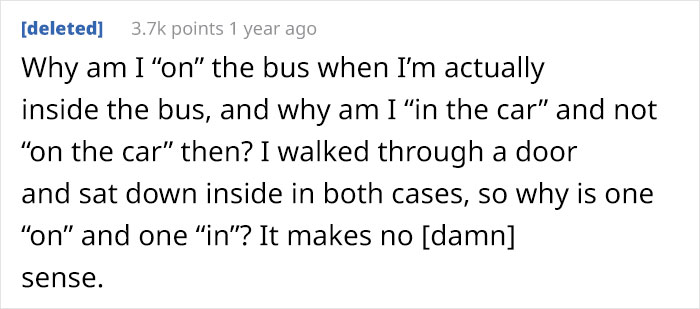
You used to be able to just step on the bus and remain standing (back when there were conductors and the entrance/exit was at the back). Time moves on and language doesn't. Do you still hang up the phone?
I actually DO still hang up the phone. I have a real rotary dial phone like your grandparents had lol!
Load More Replies...The actual rule is as follows - if you can stand up whilst inside, it is 'on' (bus, train, plane, etc.) whereas it you can't stand up, it is in (car, taxi, truck, etc.) The exception is BOAT which can be both in and on. Might be a couple of other exceptions...
1. Thank your that. I teach esl. Good to have a new answer. 2. Now... why are we IN elevators / lifts and not ON them? Oh English.
Load More Replies...This one goes back to horse-drawn carriages and you travelled 'on' them, not 'in them'. The famous London black cab is also called 'hackney carriage' for exactly the same reason.
In most languages, in and on are the same word. The English differences in usage are arbitrary.
On is for vehicles you can stand up in. In is for vehicles you can't. I used to fly small two seater aeroplanes and we would always say you get in the plane, not on it.
And if the computer has a desktop, why is the picture in screen a wallpaper, not a tablecloth?
I’m pleased they capitalised it. I would still be trying to make sense of it otherwise.
Load More Replies...Beeb, not beebs. That would be plural to a would be plural.
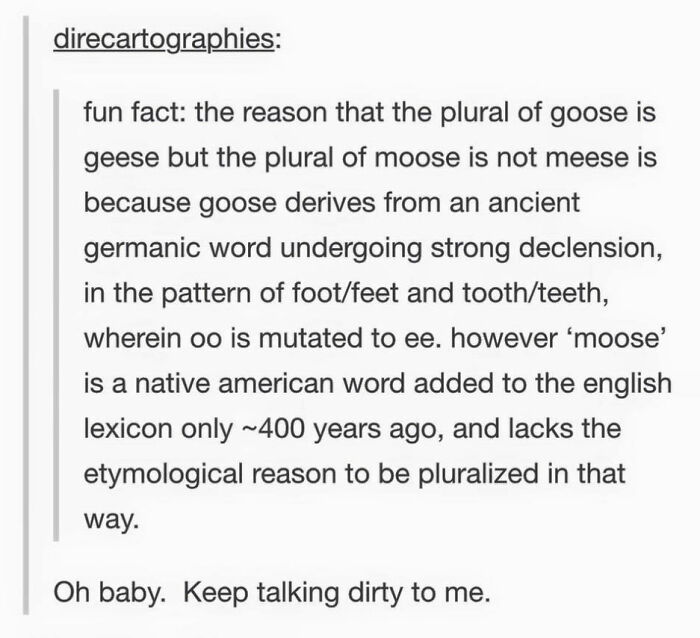
Load More Replies...When I was little I asked my parents if the plural of moose was meese and they still laugh about it to this day.
sorry i only commented this to do text to speech cause i want to know how it's pronounced
Load More Replies...look up the comedian Brian Regan His Stupid in school bit covers this hilariously.
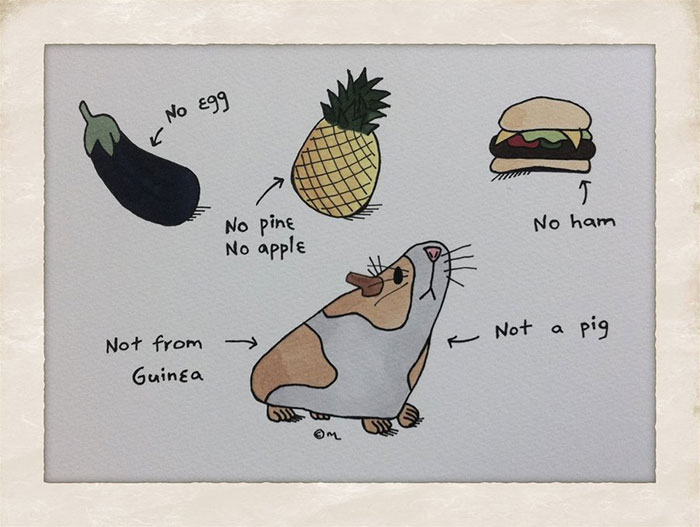
I can explain the egg plant one. It was on a post here earlier - a different European breed looks exactly like eggs hanging from a branch. Incidentally, it's also known as aubergine (no idea the etymology on that one, it's probably French)
The French word "Aubergine" comes from the Arab word, which itself comes from the Persian word which itself most likely comes from Sanskrit.
Load More Replies...But eggplant looks literally like an egg growing from a stem in its early stages. Hamburger got it’s name from Hamburg, Germany. Nothing to do with ham.
The word "guinea" came from the English gold coin of the same name that was said to be the cost of a guinea pig. And the "pig" portion of the name comes from their squeaking noise that reminded people of baby piglets.
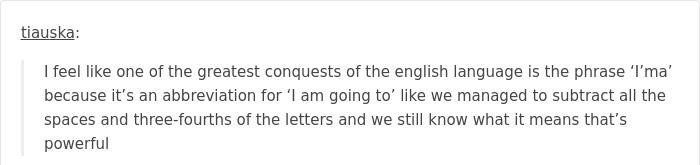
Not quite right. You can't contract we have if have is the verb to have, only with the aux have in the present perfect :)
This is so hard to teach. We start with using 's to show possession, such as Robert's book, then we move on to contractions, such as he's (he is) and then we have to explain its (possession) and it's (it is). Not to mention haven't wouldn't shouldn't couldn't we've they've...
That thought is going to rattle around in my head for the next few days, now. Huh....
When I push two finger tips together which one is feeling the other?
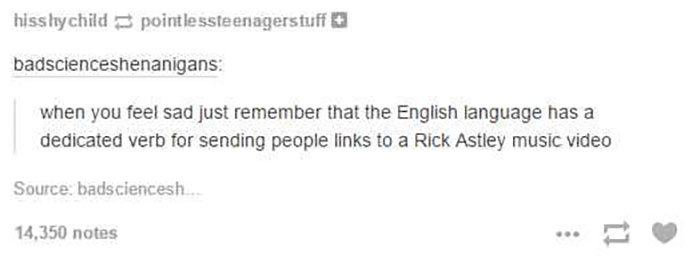
NEVER GONNA GIVE YOU UP NEVER GONNA LET YOU DOWN
Load More Replies...I was talking to my co-worker the other day and she had no idea what rickrolling was. I felt so old :(
Languages are living things that evolve over time. A hundred years ago, no one had a word for "microwave."
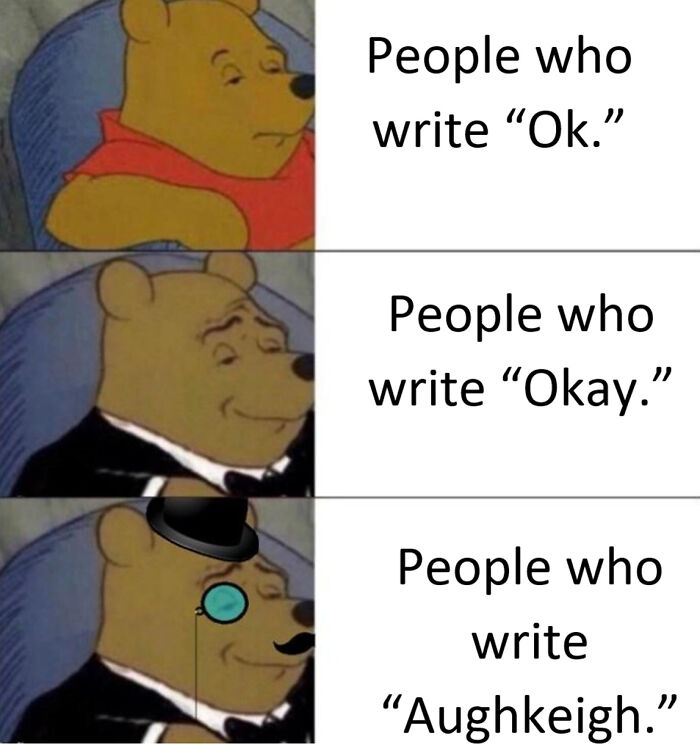
I have never before seen someone write Aughkeigh, But Aughkeigh.

According to your name, you’re the ok type
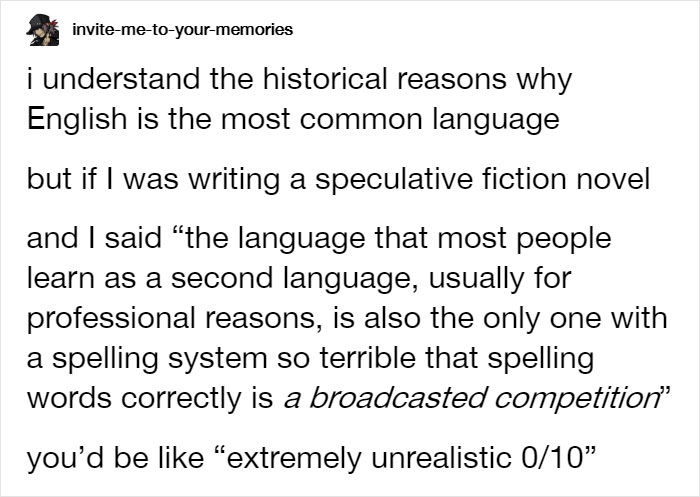
Load More Replies...Oh, BTW, the past tense of "broadcast" is "broadcast", since it's derived from the irregular verb "cast" :P
Except with a helping verb in front of it, like it has been broadcasted. Or if it is being broadcasted. I'll let you google what a helping verb is.
Load More Replies...I like English spelling. It contains the history of the language. Some people want to standardize it, but I think that that would be a crime. Go etymology!
Dare I say that with French being my first language, learning English pronunciation and spelling rather seemed like an easy and pleasant game to me ?
This does not use of the word broadcast in the past tense. So broadcasted competition is fine.
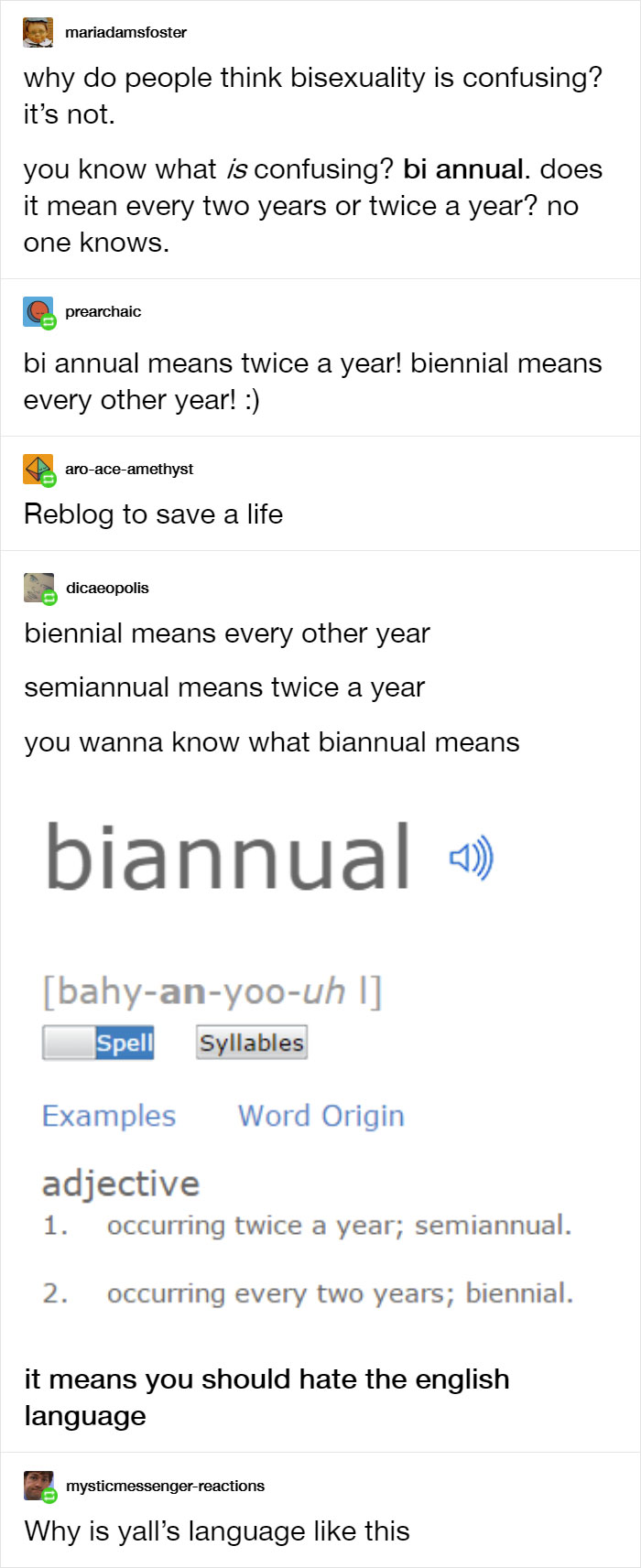
Twice a years or every other year: it still describes a lot of our sex lives.

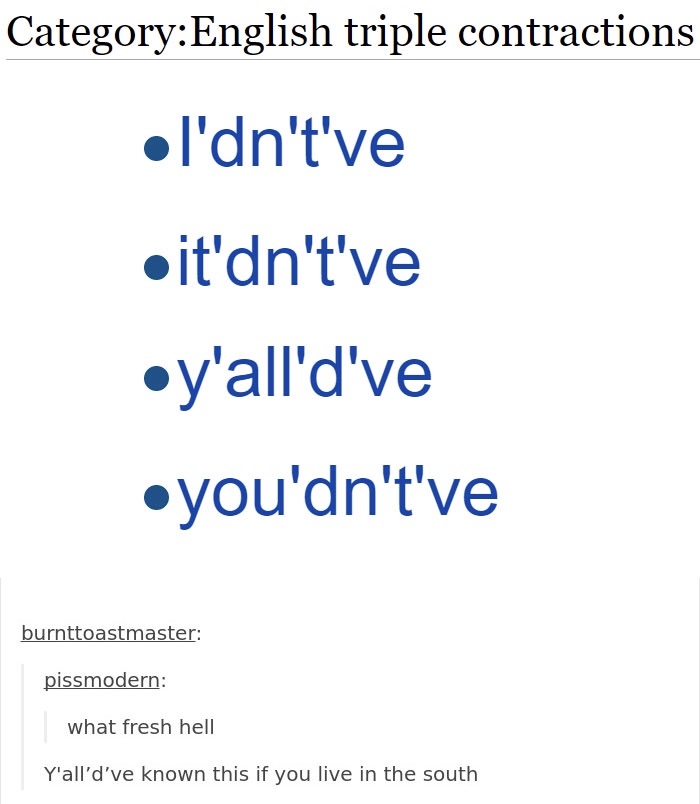
I think: “I would not have said that it would not have happened like that. You all would have disbelieved me if you had not have seen it for yourselves.”
OH shite! I'm laughing because I've said them, but never written them! I shan't say them ever again.
1. I don't have 2. it don't have 3. y'all don't have 4. you don't have. If anyone was wondering what they said
😎 Yup, I’ll definitely spend too much time trying to learn it.

liam neeson, liam neeson's knees son, liam neeson's knees on his niece on e's on a nissan
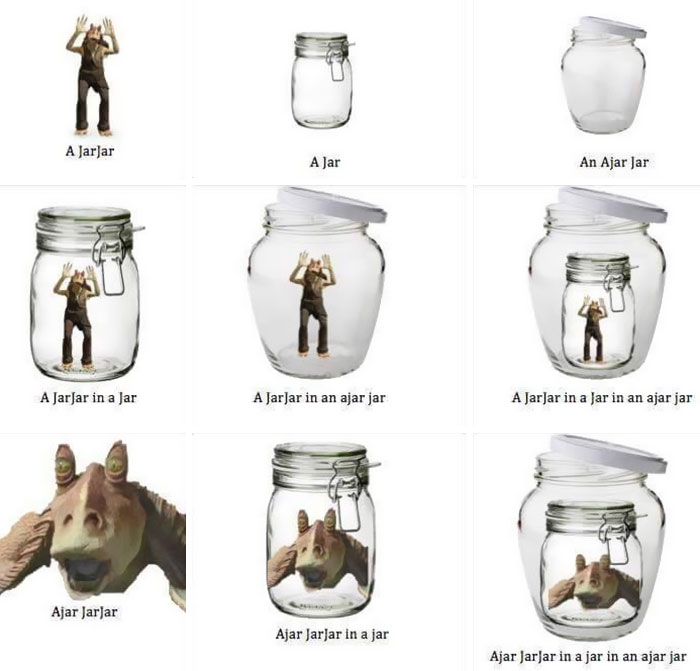
I'm not sure why, but I think the correct English for the third picture would be 'A jar ajar'
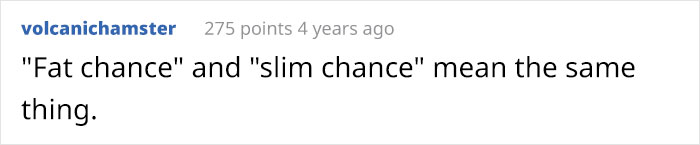
Very different imo. Fat chance is mocking or ridiculing an idea's possibility for success using sarcasm. Slim chance lacks the mocking but looks at margins for error honestly.
So since I used to be slim but I'm now fat, I haven't actually changed? Mind blown.
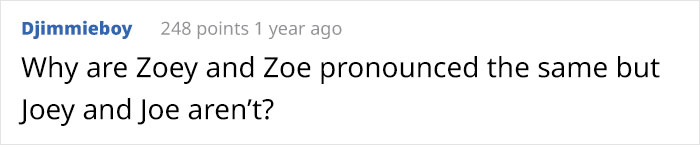
Zoe is sometimes pronounced like Joe. It's the individual's preference.
TIL Zoey could be spelt with a y, and Zoe could be pronounced like toe.
Load More Replies...Because Zoe originally had an umlaut over the o (Zöe), indicating that the two vowels were to be pronounced separately. Originally, cooperate was spelled cöoperate for the same reason.
Not in American English because we really aren't great fans of extra diacritical marks.
Load More Replies...Zoe is a French name that originally used to have an accent on the 'e' - see Zoë Kravitz.
Zoë is french and should have a diurnal (¨) over the e to separate the 'zoh' syllable from the 'ee'
Zoe really ought to have an umlaut on the e to indicate that it's pronounced, but people don't bother
It is from French, but it has been incorporated into English.
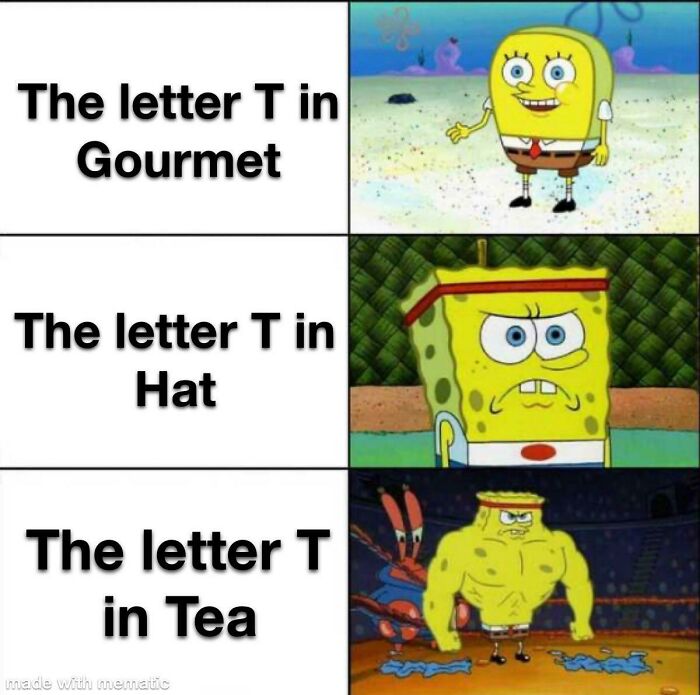
Load More Replies...Trying to claim that t is pronounced differently in words. The silent t being from a loanword, second being an English word, the third being a completely different loanword so of course they aren't going to be the same.
Load More Replies...T is a heartless betrayer if you've grown up in an area where the "t" at the end of words are pronounced as an non-vocalized "eh." Or "t" in "water" is pronounced "wadder." Then you go to college or the city and people look at you like the bumpkin you are. It's not only African Americans who are forced to code-switch in order to conform.
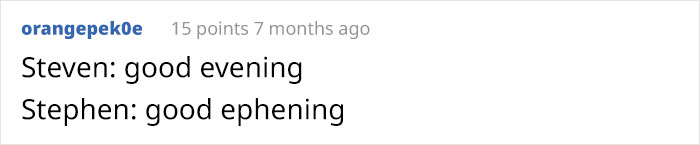
There's a whole story in the amazing diversity of forms for some proper names. Did you ever realize that John, Jean, Ian, Yann, Ivan, Juan are the same name ? Steven / Stephen is even more surprising. In French you have the name Étienne which is actually the same as Stéphane. Because Étienne = Estienne = Esteban = Estefan = Stefan = Steven = Stephen = Stéphane. These are all people's real names in several Christian cultures (Saint Stephen is nicknamed "protomartyr" because he was the first to be tortured for claiming his Christian faith).
Even more useless facts : many people in non-english-speaking countries have always been saying "Stay fun King".
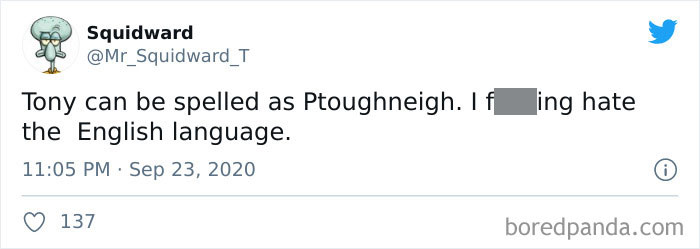
This day and age, I'm surprised there aren't more Ptoughneighs and Ptearees (Terry) considering we have kids named Le-a pronounced as Ledasha: DAT DASH DON'T BE SILENT

I know a young woman who named her daughter Paisleigh (paisley). Honestly, I'm surprised it wasn't Paysleigh.
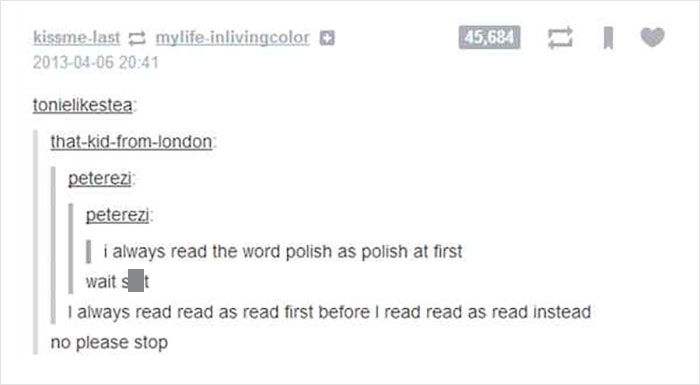
Load More Replies...I read "I always read the word polish (nail polish) as polish (Polish)
If you use chemicals to remove the polish, that's fine. But if you use chemicals to remove the Polish, you're Hitler.
Ok. I know I said mic drop,however I must share. My daughter is getting married soon to a very nice gentleman who received his english degree from a local state university famed for it's agricultural programs of study. In a text , I gently teased him about getting an English degree from the "Ag," and asked what was that about? He shut me down and I love him for it. He replied, " Someone has to teach the country boys how to spell 'plough a furrow' when they are sexting!'" I love it....

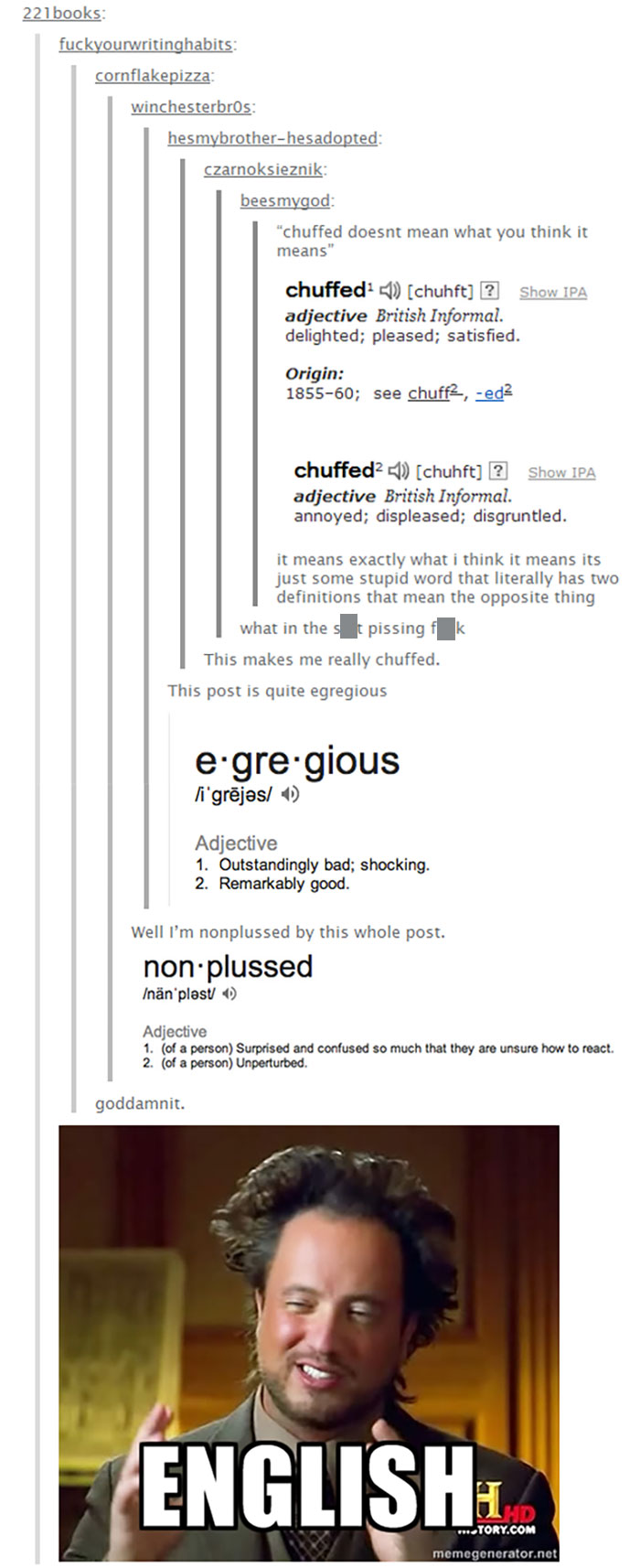
Chuffed1 is actual meaning, chuffed2 is sarcastic. Egregious1 is current meanng, egreious2 is the original meaning that is no longer used. Nonplussed1 is the actual meaning, nonplussed2 is American English believed to originate from a word some thought to exist and prescribed a meaning to but it never existed.
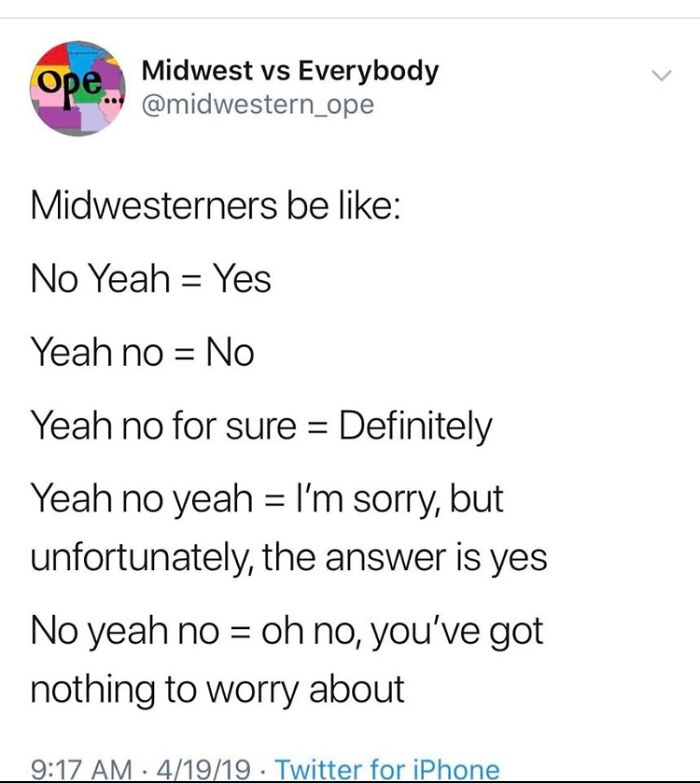
Also: “Yeah but nah but yeah”, and “Yeah nah, eh?”
Load More Replies...Mid-westerners pronounce bagel bah-gull ... they are there own special species that we like to ignore. Lol
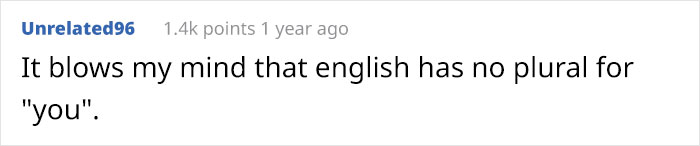
That one is wrong. You is the old plural second person pronoun. The singular second person pronoun used to be thou. Under the influence of French, which use the plural second person pronoun as a respectful way to address others, English lost thou. Causing centuries of grammatical confusion.
The American South: You = one person. Y'all = a few people. All y'all = a lot of people. - New York/New Jersey: You = one person. Youse = a few people. Youse guys = a lot of people.
I would love to bring back thee and thou as the singular forms, plus thy and thine. They're still used in Yorkshire and I love them for this.
There are whole other words that can be used such as everyone, and those present. You lot is a nice colloquialism to bring out at parties.
A drink is the generic version of potable liquid from the verb to drink. Food is a noun. But you can eat eats (rare).
Aughkeigh im sorry but slutty-olive-oil..? im not sure whether to laugh, cry, or die inside..
We blame the French for a lot of our spellings and other people for others!
four-twenties-ten-nine! I'm glad we didn't get our counting from the French
Load More Replies...If you listen to which word is emphasized, it explains the focus of the sentence.
Is your name pronounced Jo Johannsen, Jo Yohannsen, or Yo Yojannsen?
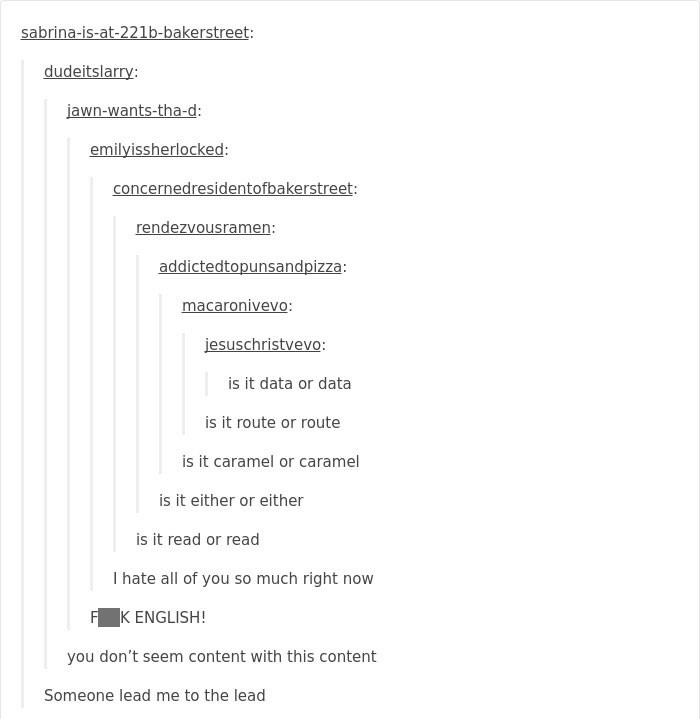
Load More Replies...Depends whether you use British or American English. I would say 'deita', 'root', 'care-a-mel', 'eether', etc.

American English is so f****d up, no one knows the correct pronunciation and most of these are either based on personal preference or based on the context of the word.
Load More Replies...The first 4 are the same thing in British English and I struggled to think of what the issue was. Data is pronounced 'Day-ta' and some countries pronounce it 'Dar-ta' I don't know of any other pronunciation but both mean the same thing. We have Route and the other is both spelt and pronounced Rout, Firm 'R' followed by 'out'. Caramel is pronounced like 'Carousel'. The rest have different pronunciations.
With either and neither and caramel, I go back and forth. Always have, no idea why.
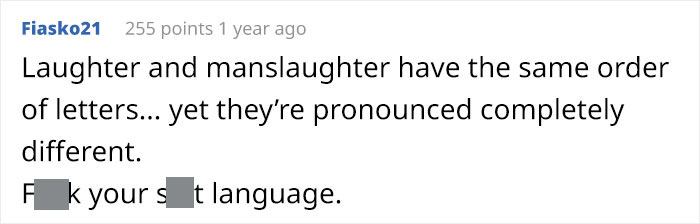
She'd let out a laughter. After watching him manslaughter them.
As far as I'm aware they only sound similar, not the same. At least, that difference is clear to me as a German. We call it pronouncing the vowels "short" and "long". Basically, a "short" vowel is more a filler sound between two consonants, whereas a "long" vowel is properly enunciated as its "ideal" pronunciation .
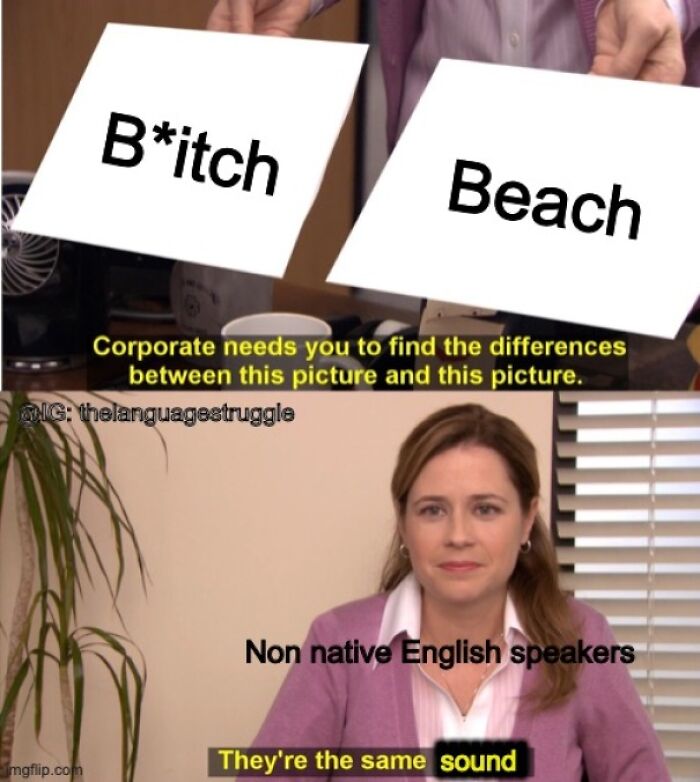
As an experienced teacher of English as a second language, I strenuously avoid the word "beach" in class. I don't need to make grief for myself. They'll find out.
they censored the wrong nonexistent letter, its supposed to censor the 'i' but censored the ' '
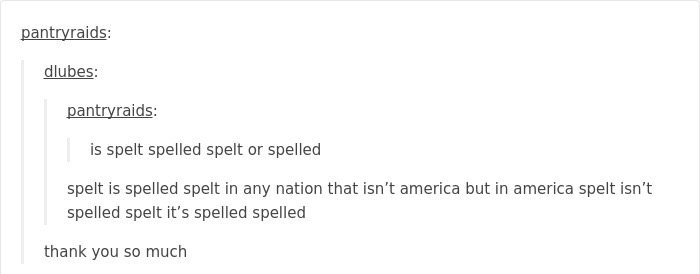
What is Spelt, and is it Good For You? - Healthline https://www.healthline.com › nutrition › what-is-spelt Mar 15, 2016 — Spelt is a type of grain that is strongly related to wheat. Its scientific name is Triticum spelta (1). In fact, spelt is considered a distinct type of wheat. Other types of wheat include einkorn wheat, khorasan wheat and modern semi-dwarf wheat.
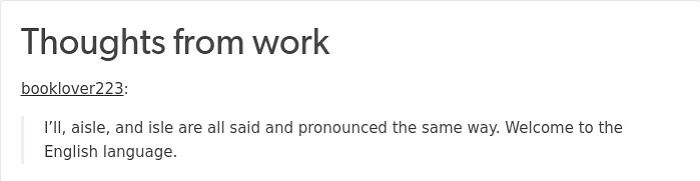
Because English is a hybrid language of Old German, Latin (via French), some Greek, and a smattering of others, there are a few words that have different meanings, but sound the same. We call these words “homophones” and they can be very confusing for people learning English and native speakers alike. Here are some examples;- He'll, Heal, Heel. By, Bye, Buy. You're Your, Yore. Raise, Rays, Raze. Right, Rite, Write. Meet, Meat, Mete.
When my daughter was growing up the repetition of do was hilarious. Do do is slang for dog poo, but for the life of me I can't think of an example!
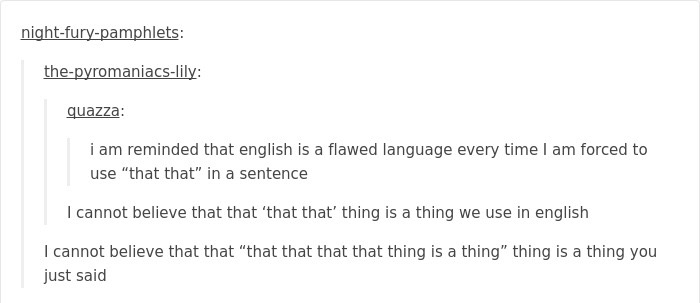
I avoid "that that" in a sentence. I will rearrange the whole paragraph if I have to.
Why do you park on the driveway and drive on the parkway? Why is a boxing ring square?
Similar to 'quite', but I have a feeling this one is the other way round. Americans confirm?
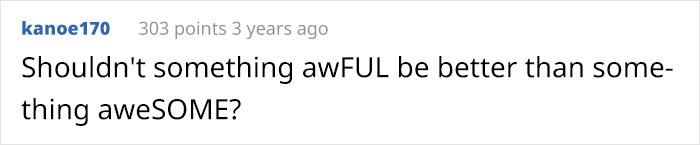
"Awful" was the original meaning of something filling us with awe, not dread. It shifted.

Awe however is not strictly positive. It can be either wonder, admiration, dread, or fear - and can be both wonder and fear at the same time. Awful does mean to fill with awe, but awe is both positive and negative, and so awful's original meaning was "to inspire with wonder or fear". It's shifted to hard negative yes, but not from positive to negative. (also something awesome is a thing that produces awe, so that also had a neutral meaning that shifted to positive)
Load More Replies...In the same vein, we commonly use "fantastic" to mean "really good" when it actually means "fanciful."
Awe means super impressive like ones feeling before a god which is like being before a tornado ... both impressive and terrifying at the same time. It got used as a description for kings who were God's representatives on Earth. So filling one with awe is both negative and positive feelings at once. Sublime!
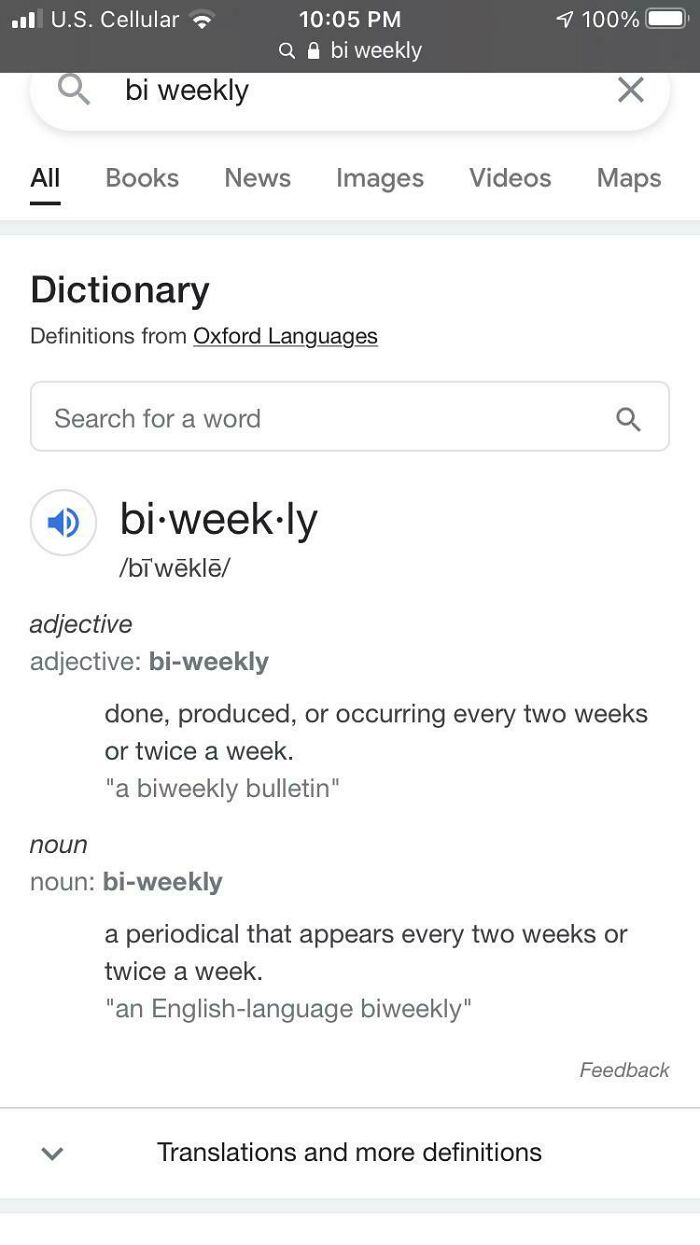
There was something that was supposed to be bi-monthly and i though they had cancelled it after the first episode because two weeks after the first episode, there wasn't another one. Turns out that what they meant was once every two months.
Most people in the US would say either "twice a week" or "every other week" just to avoid confusion.
Okay you know the meme it is what it is well to shorten it is we say it's so this person shortened the it is in it is what it is to it's what it's
Load More Replies...I am constantly amazed by native speakers of English who are complaining how complicated other languages are.

I'm a native German speaker and currently trying to learn French, and honestly, English is a lot easier. The basic grammar rules aren't difficult, and you can pick everything else up from reading and listening.
Load More Replies...To me, "next Monday" means the very next Monday on the calendar. To my wife that is "this Monday" and "next Monday" is the Monday after "this Monday." But if you ask her when the "Monday after next" is, she'll tell you the same date as "next Monday".


How about "lets move that appointment forward one week". Does it get moved to a later date or an earlier date? Depends on who you ask.
Load More Replies...Honestly, English is the easiest and most practical language I've studied. No morphological declination. Try Latin, Arabic, or even German. Even French was more difficult to me, and I'm native in Italian so they're quite close.

A comedian (I forget which one) claimed that English started as a practical joke that got taken too seriously.
I'm a non-native speaker who learned English mostly via reading. Every time I read one of these "isn't it odd how X and X are spelled the same but pronounced different" my reaction is "wait, they're not?" and then I google it and then I question reality as a whole.
I have mentioned it before and I will mention it again but I urge anyone interested to try and read "The Chaos" https://pages.hep.wisc.edu/~jnb/charivarius.html
I am a native English speaker and this really puts things into perspective. And when I mean "puts it into perspective," then I mean just how stupid the language really sounds. I really wish I could help you guys a little more on this because I know some tricks.
Something that always bothered me is the pronounciation of danger and anger.. why is it pronounced so differently with "d" being the only difference?!
Danger - from Old French dangier into Middle English. Anger - from Old Norse angr/angra into Middle English. Them being spelled similar in Modern English is pretty much an accident of evolving language, simiar to laughter/slaughter.
Load More Replies...I am constantly amazed by native speakers of English who are complaining how complicated other languages are.
I'm a native German speaker and currently trying to learn French, and honestly, English is a lot easier. The basic grammar rules aren't difficult, and you can pick everything else up from reading and listening.
Load More Replies...To me, "next Monday" means the very next Monday on the calendar. To my wife that is "this Monday" and "next Monday" is the Monday after "this Monday." But if you ask her when the "Monday after next" is, she'll tell you the same date as "next Monday".
How about "lets move that appointment forward one week". Does it get moved to a later date or an earlier date? Depends on who you ask.
Load More Replies...Honestly, English is the easiest and most practical language I've studied. No morphological declination. Try Latin, Arabic, or even German. Even French was more difficult to me, and I'm native in Italian so they're quite close.
A comedian (I forget which one) claimed that English started as a practical joke that got taken too seriously.
I'm a non-native speaker who learned English mostly via reading. Every time I read one of these "isn't it odd how X and X are spelled the same but pronounced different" my reaction is "wait, they're not?" and then I google it and then I question reality as a whole.
I have mentioned it before and I will mention it again but I urge anyone interested to try and read "The Chaos" https://pages.hep.wisc.edu/~jnb/charivarius.html
I am a native English speaker and this really puts things into perspective. And when I mean "puts it into perspective," then I mean just how stupid the language really sounds. I really wish I could help you guys a little more on this because I know some tricks.
Something that always bothered me is the pronounciation of danger and anger.. why is it pronounced so differently with "d" being the only difference?!
Danger - from Old French dangier into Middle English. Anger - from Old Norse angr/angra into Middle English. Them being spelled similar in Modern English is pretty much an accident of evolving language, simiar to laughter/slaughter.
Load More Replies...