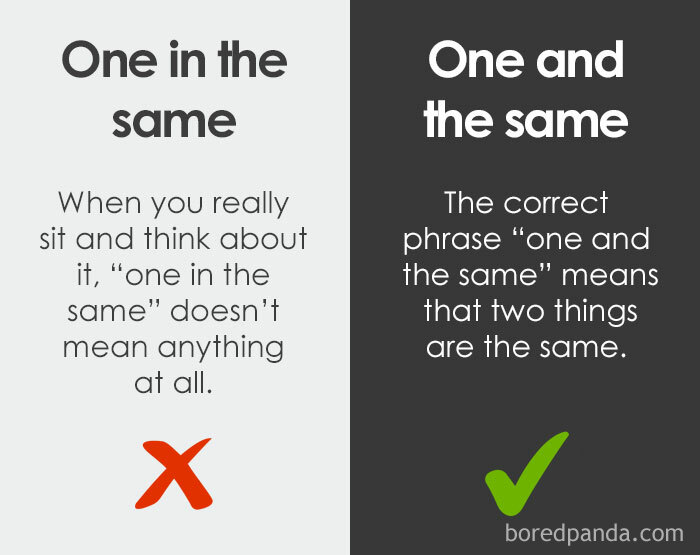
No one was born perfect when it comes to language. We say one thing when we mean entirely another. We mix up words, add endings, and pretend it’s all fine. Well, not quite.
You see, even though some phrases roll off the tip of the tongue as if they were almost identical, it doesn’t mean they are. From hunger pains to hunger pangs and sleight of hand to slight of hand, there are too many common phrases that are way more confusing than they really should be.
So this time, we’re gonna look at the most common mistakes we make when using these phrases, and hopefully, learn something that would have made our English teachers proud.
This post may include affiliate links.

This is an Americanism. I've literally never heard anyone say it here in the UK.
I have found the same thing - I only hear it on US TV shows.
Load More Replies...Drives me nuts - but in my experience it's mostly Americans who get it wrong
Omg, I knew it!! Gosh, wait till I show everyone that I was RIGHT!
This is the kind of error that does bother me because it literally makes no sense.
TBF, in my experience this one is often said sarcastically, with an exaggerated eye-roll.
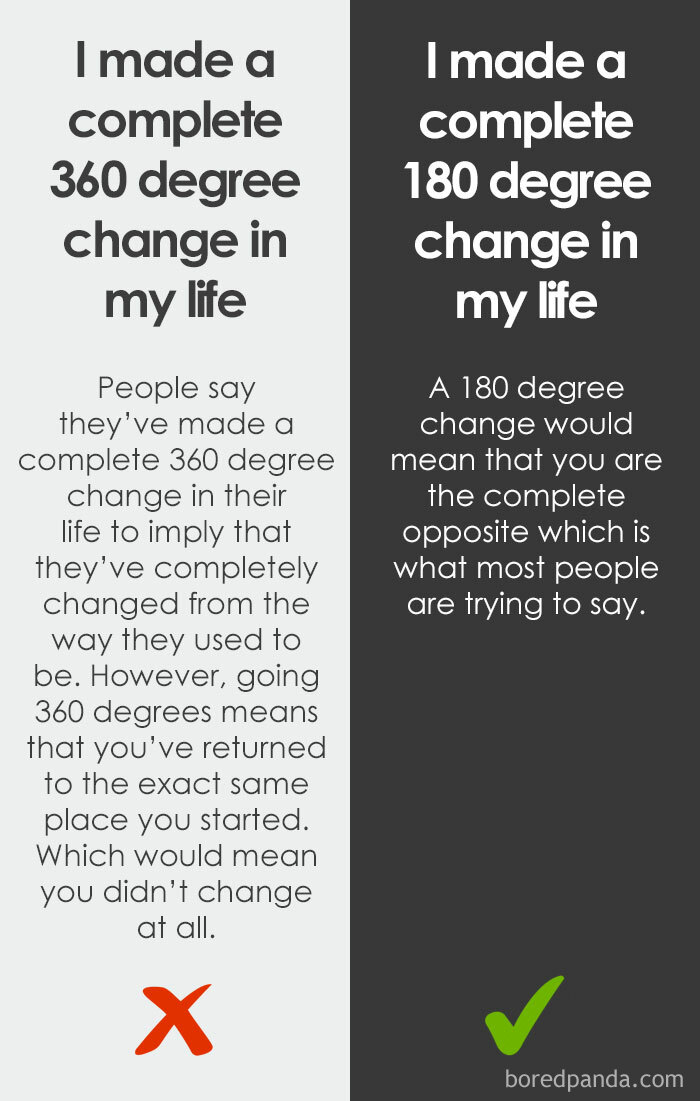
Well, this is no surprise. The evidence of math and science failures is abundant these days.
I always return to my Folly - she's a darling little pup!
Load More Replies...Ooh!Ooh! Dua Lipa is using the correct one! She said it in her song ‘Don’t Start Now!” “Did a full 180-crazy thinkin’ bout the way I was’
This was explained in "last action hero" back in 1993. I thought everyone knew this by now.
OMG. I hear it ALL THE TIME! And it drives me NUTS!!!
Load More Replies...I once corrected a doctor's dictation when he used the incorrect one, and he "corrected" it back. DOH!
Oops - that must have been especially annoying!
Load More Replies...I'm afraid I used to be guilty of this. I "learned" the phrase when I was too young to realize my version made no sense. It to me years until I actually heard what I was saying, at which point I obviously realized it was wrong.
Hey, kudos for admitting it and for realising. A lot of people seem to want to cling on to saying it how they've always known it - whether or not it makes sense.
Load More Replies...Is this an American thing? I have never heard anybody say that wrong EVER
Never seen this mistake. Now that I've expressed that, I'll hear and see it, because that's how life is.
THIS is the one that makes me the most crazy when it gets used wrong...
We all have that one phrase or two (or too many) that pop into the conversations we have with people. These go-to expressions surely add some style to whatever we’re saying unless they’re used the wrong way.
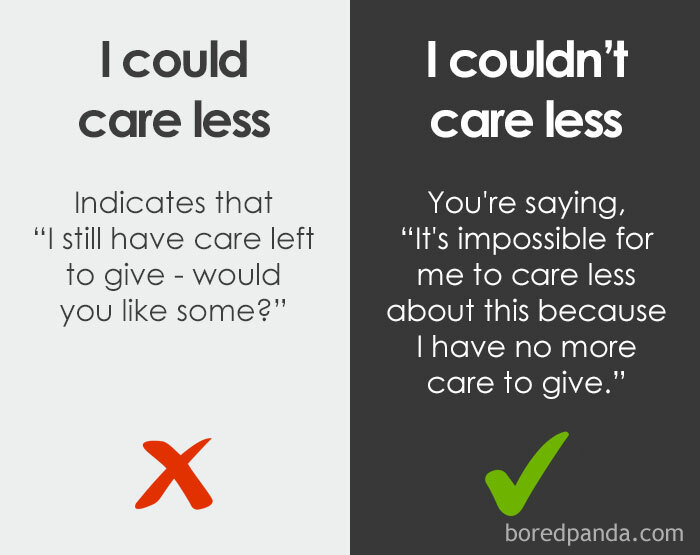
But the more we use them, the more unaware we become of these repetitive language slip-ups. And honestly, our interlocutors are often unaware of the fact as well. Think of how many times you've heard someone say “I could care less.” In fact, this means the exact opposite as meant by the right usage “I couldn’t care less.”
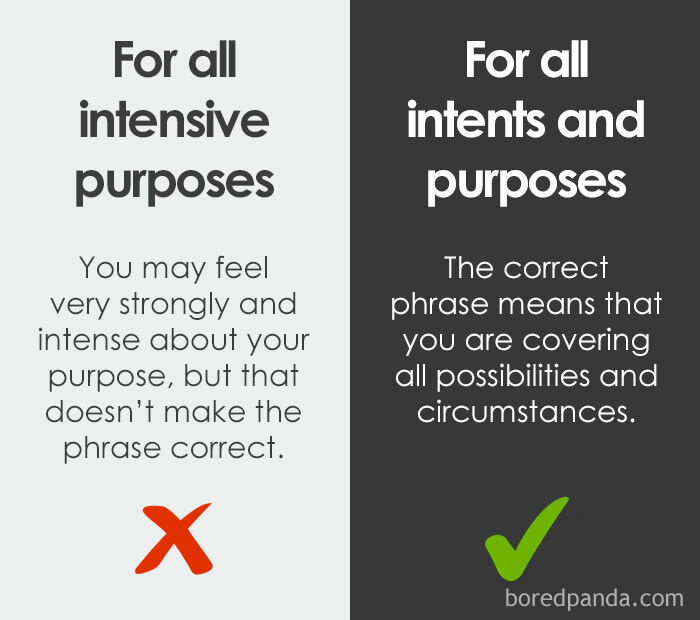
Other common phrases people confuse very often are “tongue and cheek” (should be tongue in cheek), “for all intensive purposes” (should be “for all intents and purposes”), “another thing coming” (the right way is “another think coming.”)
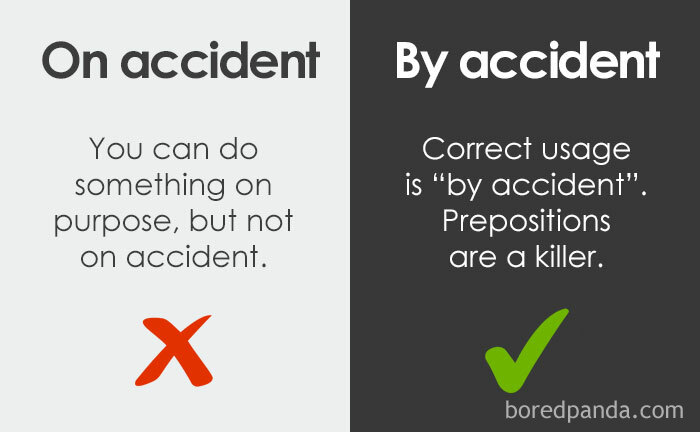
This one annoys me, seems like a typically American issue. I think it probably comes from mishearing 'it was AN accident'
It's almost as annoying as "oftentimes". What is wrong with the word "often". Why in the hell do you need to draw it out and stick "times" on the end. Sounds like you're speaking as a Dickens character. I mean, what the Dickens!
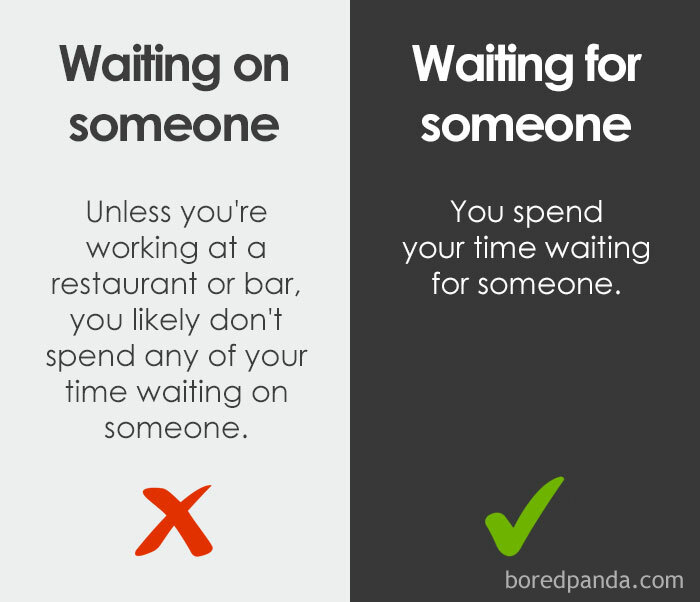
Load More Replies...And while we're are it, one waits IN line. And only servants, servers, etc. wait ON people. If you are waiting for someone to arrive, be ready, etc., you are waiting FOR someone.
When I was a kid, my brothers, sisters, and I would say on accident. If my father heard it, his eyes would bug out and he would say loudly "On accident? on accident?, Is that what you're learning in school?". I so know now it's by accident.
Language evolves. If everyone says it and the use of "by" or "on" really don't objectively mean anything, then it can't be incorrect to say, "on accident". WE decide what is correct through mass usage. And then books describe that usage. Books don't tell us what is correct. That is different from something actually not translating into anything meaningful or something being actually incorrect like "I could care less".
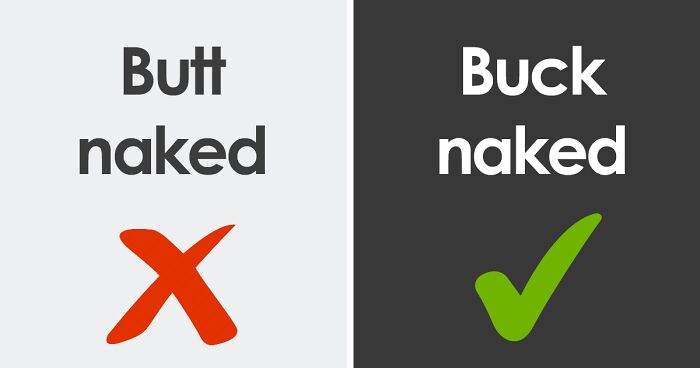
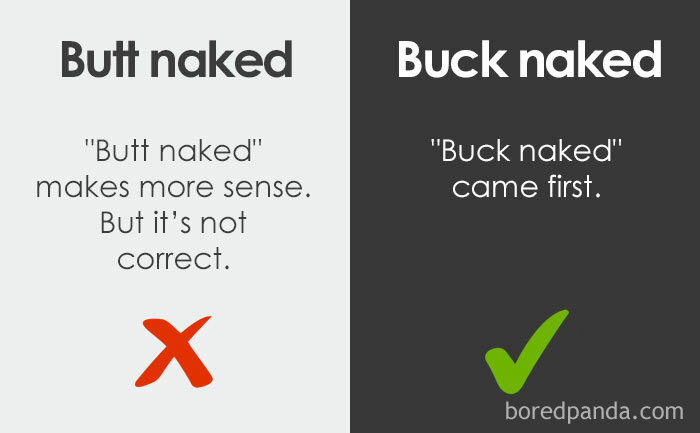
The word "buck" refers to a male native american indian. The phrase "buck naked" comes from the fact that back in the early days (pre 1900) male indians would be seen riding their horses to a river or stream to bathe or do what ever, and would be totally naked on the horse. White people would see them and thus the phrase "Buck naked" was born.

@ Dennis, I'm an English teacher, and I'm so glad someone else knows the back story for this phrase.
Load More Replies...I don't see this as being incorrect, since neither one has any concrete meaning and neither one actually means something different from the intent (like "I could care less" does). The two words together are understood to mean something. Language changes over time. "Butt naked" is perfectly valid in casual conversation.
Buck refers to aa word commonly used for an Indian brave - the y wore little clothing in the summers - hence the term buck naked - but since it can be seen as racist let's just change it to butt naked
Buck is a racist term for native american and the term buck naked should be avoided.
I'd first heard "butt naked" by some girl friends to refer to how Dean and Jessie met in the movie "Youngblood", where he was literally"butt" naked out in the hallway. And so they recommended the movie LOL. I don't know "buck naked". I always thought the braves wore some kind of loincloths or something.
I've been using the wrong one since a child in London UK in the 50s. Never heard of Buck Naked in the UK ever.
How about just saying "naked"? Buck naked sounds racist and butt naked is kind of redundant. Naked is naked.
Finally. Thank you. AMEN. English isn't my family's first language on one side, and I've spent a lifetime explaining these things. I feel so happy I'm not alone....
I give people who learn English a lot of credit - it not as easy as some people say it is to learn once you take into account grammatical structure, the insane number of loan words from other languages, homophones, pronunciation, colloquial phrases, regional dialects, etc., etc. I have met a number of non-native speakers who had a better grasp of English grammar than many native speakers. I work in the linguistics field and I still make grammatical blunder in my native language.
Load More Replies...Even though the misused phrases may be annoying to some sharp-eared listeners, they are never harmful or intentional.
But there are some common phrases that can never work in any conversation and they can definitely turn your encounter sour. For example, saying “you look good for your age,” “this might sound stupid, but…” or “you’re so…” this and that, can be interpreted in a bad way.
So in the end, it’s never really about language and grammar, but rather the content and the way you say it that really matters in a fruitful and pleasant conversation.
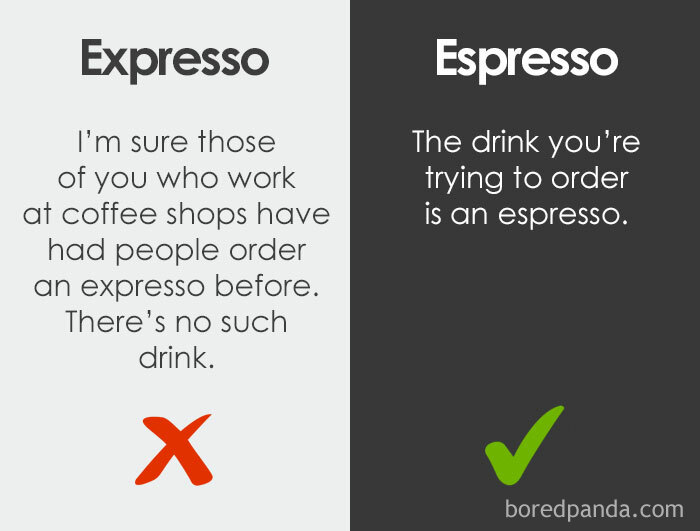
Ever see my mom after an espresso? EXpresso ain't a bad description...
This is kinda like when people say “can I AX you a question” instead of pronouncing it the correct way, ask. Maybe just a Kentucky thing. Idk but I hear it a lot around here.
When my Australian friend was younger, she pronounced it like that. Not any more though.
Load More Replies...This bothers me the same way a customer would order a “coolers light” instead of a coors light, and “schmirnovs ice” instead of a Smirnoff ice 😖
I cringe when people say less depresso more expresso. I resist the urge to scream.
Expressing is what breast feeding mums do to have a little extra in the fridge for baby. So an expresso is surely a coffee with breastmilk in it.
Don't know why you're getting down votes, Its obv a joke and I thought that was funny, lol
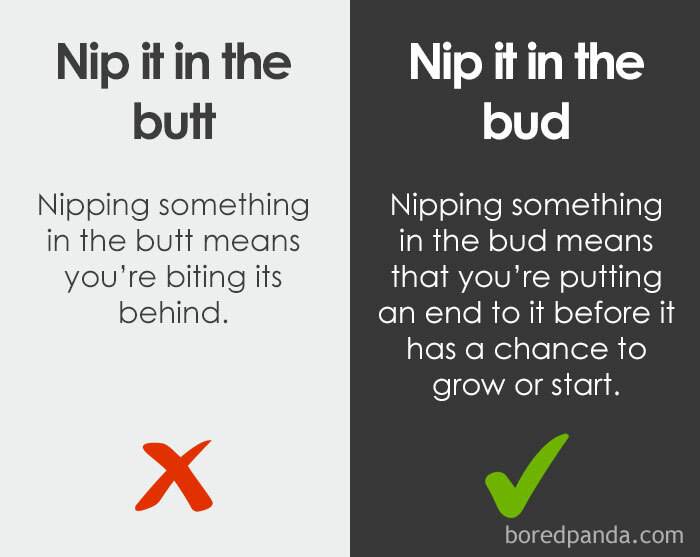
Load More Replies...Nip it in the butt? What? I’m- I’m- I’m just really confused of why a person would say that.
One of the contestants in an earlier cycle of America’s Next Top Model said it. I thought it was quite funny, but then I have a pretty immature sense of humour.
Load More Replies...Not disputing that the phrase is wrong but 'nipping' can also be with the fingers, not just the teeth. 'Goosing' a person could be called 'nipping them on the butt'. My wife was one bitten by a canada goose on her butt when we were at a lake side. She assumed it was me.
Really? I've never heard that one. I suppose people think it means 'nip it in the butt so it runs off'?
'Nip it in the bud], alluding to a spring frost that kills flower buds, was first recorded in a Beaumont and Fletcher play of 1606–1607. (dictionary.com)
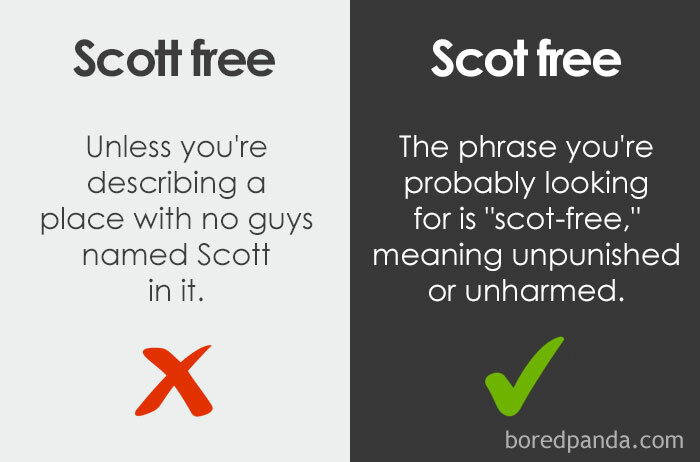
The term has nothing to do with the Scotts. It comes from old Scandinavian 'skatt fri', which means 'tax free'.

True, true. The Scots are pretty bad news too, though.
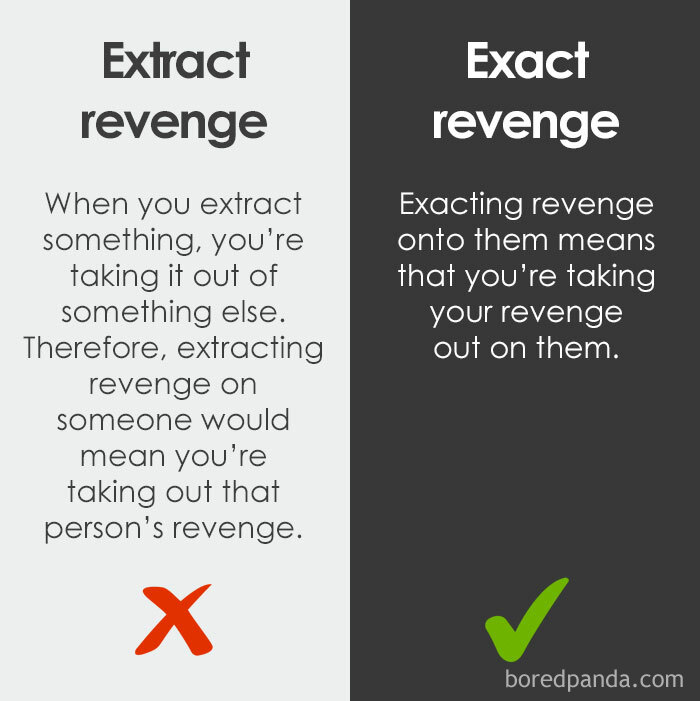
Load More Replies...Maybe you're extracting poison to exact revenge. Since it's Halloween, you know.
I believe I could "extract" my "revenge" all it would require would be a pound of you're flesh. I could extract it liposuction style and return it to you Carrie style, there by exacting my revenge
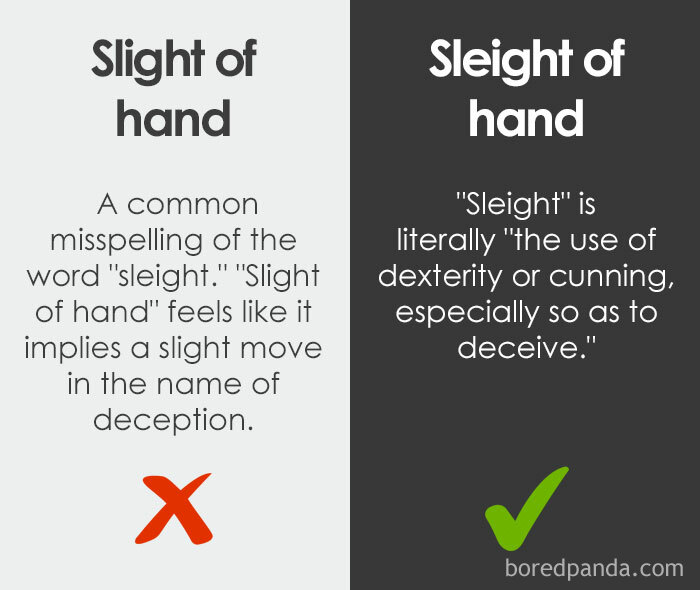
I've always seen it spelled correctly. I can see where someone might get that wrong, though.
https://www.merriam-webster.com/words-at-play/sleight-vs-slight-usage-legerdemain
They have explained it badly. They wrote that it 'feels like it implies a slight move in the name of deception' and not that it actually does. This is only because the person writing the explanation knows what the phrase is meant to mean. If you were to come across it fresh, no hint of the meaning, it wouldn't suggest that at all. it would mean small of hand. You can, of course, continue to use it the wrong way.
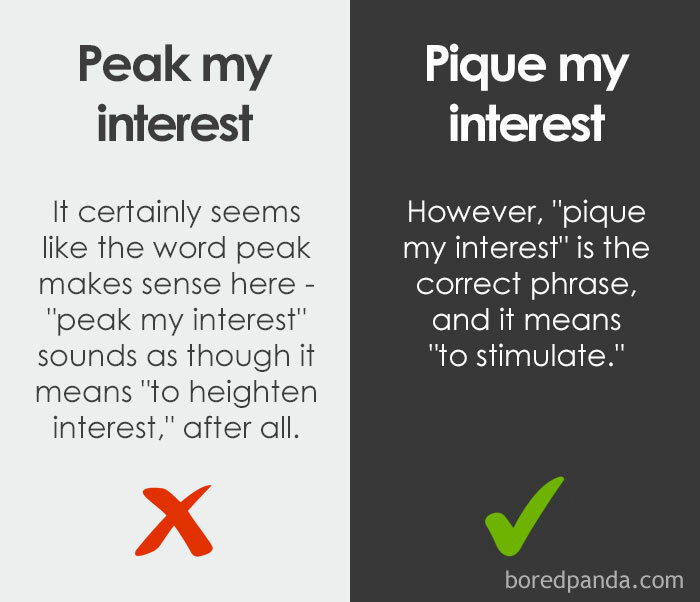
Load More Replies...Comes from French , Pique = sting, but a more correct literal translation would be: Poke my Interest.
Load More Replies...Saw that in a book once. So many errors I gave up and never finished.
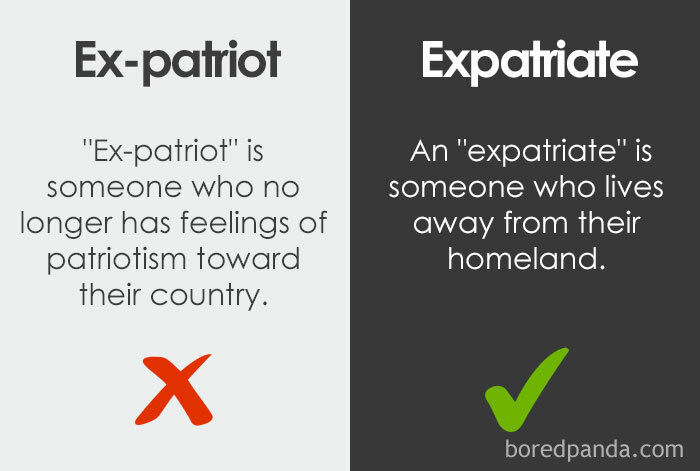
We tend to refer to people as Expats, as expatriate sounds more like the action of doing it, as in repatriate, meaning to take someone back to their homeland.

What if they used to play for the New England Patriots. That would make them an ex-patriot
Oops, I've made almost the same joke before reading your comment... Sorry for the redundancy...
Load More Replies...An ex-Patriot is somebody who used to play football for New England but got traded. :D
Evidently, looking it up, ex-patriot isn't a word - expatriate has a transitive verb and intransitive verb - one means forced from one's country and the other leaves one's country to live elsewhere. The noun and adjective, in modern speech, mean living away from one's homeland.
So you can still be a patriot and an expatriate living in BoraBora
This one is misleading though because they are pronounced the same way. If you're saying them at least.
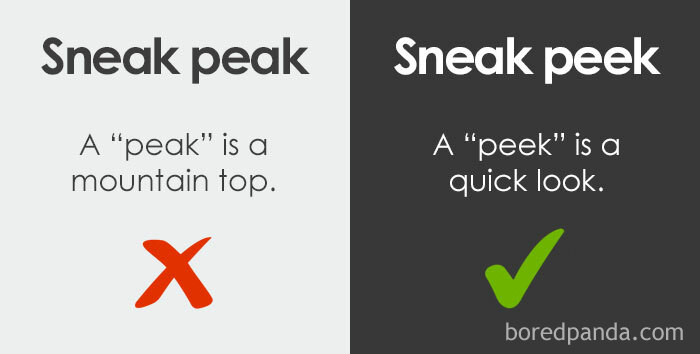
Unless you're climbing to the summit of a mountain to sneak a peek over the peak, at which point your location becomes a "sneak peak" for the duration.
There's an adorable cartoon to illustrate this: https://twitter.com/The_YUNiversity/status/577846917557694466/photo/1
I always thought it described an easy penning. Say of sheep. No need to herd them into the pen, just give them a shoo and they go in by themselves.
As someone that worked Sheep on ranches for a couple of decades, I can assure you penning Sheep is NEVER that easy. LOL
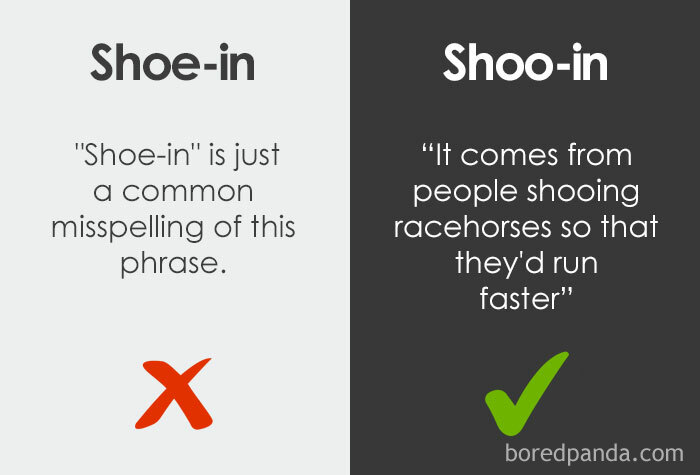
Load More Replies...While I don't doubt that "shoo-in" is correct, I have never heard of it in the context of horses or horse racing for getting horses to go faster...I'd think the idiom would be a "whip-in" if that were the case, because horses get whipped, not shooed...lol. I did a bit of Googling, it seems like "shoo-in" originated as a horse racing term for a rigged race, but I couldn't really find much on why it's called that in horse racing. This is the best I could find: https://www.worldwidewords.org/qa/qa-sho1.htm
THIS IN NOT TRUE! It means that the race is rigged: "Etymology. From a sense of the verb shoo, where racehorses would fall back and allow a chosen rider to win a fixed race." https://en.wiktionary.org/wiki/shoo-in . . . "Definition of shoo-in: : one that is a certain and easy winner. Synonyms for shoo-in: cinch, lock, slam dunk, sure thing" https://www.merriam-webster.com/dictionary/shoo-in
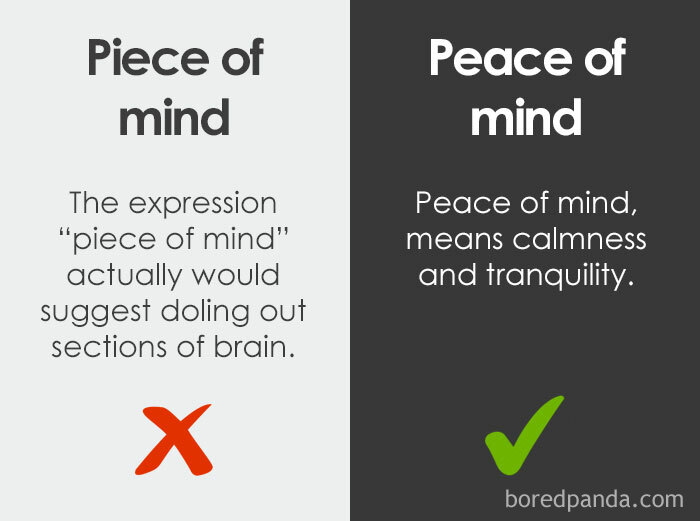
Although you CAN say "give someone a piece of your mind," meaning chew them out.
When ppl say I gave him a piece of my mind, that's correct,right? As in, what you thought about a situation and you told them off.
But piece of mind is correct as in “I’m for sure giving him a piece of my mind!”
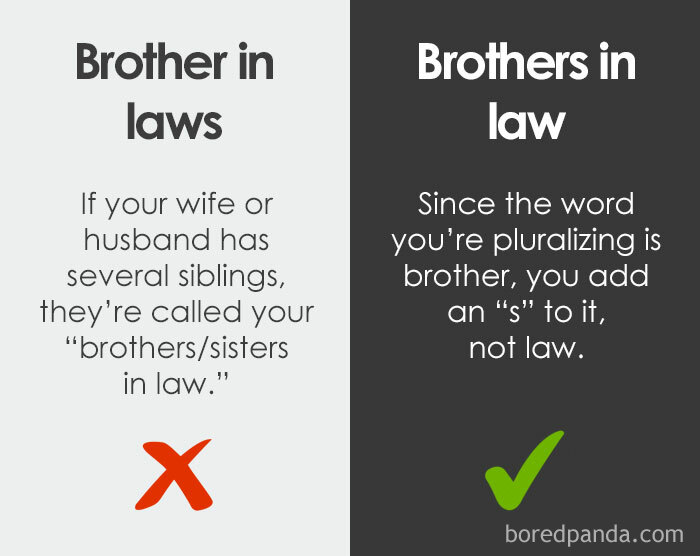
Gets confusing when you get possessive. My brother-in-law's car is the car belonging to my brother-in-law, but what would you say for all the cars belonging to multiple brothers-in-law? My brothers-in-law's cars?
As in the famous" confrontation between the Pirates and the Major-General in the Pirates of Penzance SAMUEL: Permit me, I'll explain in two words: we propose to marry your daughters. GENERAL: But wait a bit. I object to pirates as sons-in-law. KING: We object to major-generals as fathers-in-law. But we waive that point. We do not press it. We look over it
So... English is stupid and I think this is an exception to the rule. In the same way that saying that you're putting on "a pant" because it's singular should be correct, but "pair of pants" is correct even though it's describing a singular item.
It comes to putting the s on the noun: an example I've seen is here you need to get warrants of fitness for your car regularly by law, but i often see signs or ads offering warrant of fitnesses
I don’t think anyone has said that..... all rain is free— for now
Load More Replies...This is a VERY VERY common error, to be found even in some of the most scholarly, well-constructed written pieces. Annoying to see!
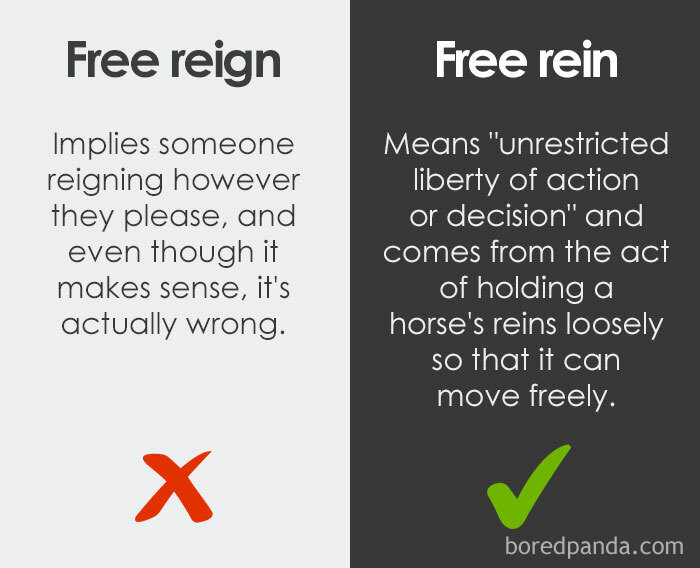
If it makes sense why is wrong? Most people now will never hold a rein in their life So the old version seems like a bit of an anachronism
It might make sense but it doesn't make it accurate. Most people who reign over others do so with many rules and protocols they have to follow. They do not do so 'however they please'. It also refers to one individual ruling over others where the free rein is talking about doing something unhindered. You don't need to ride for it to be true and it isn't an anachronism when the activity is still current. People still ride.
Load More Replies...No one has free reign though, not even The Queen. Comes with lots of rules.
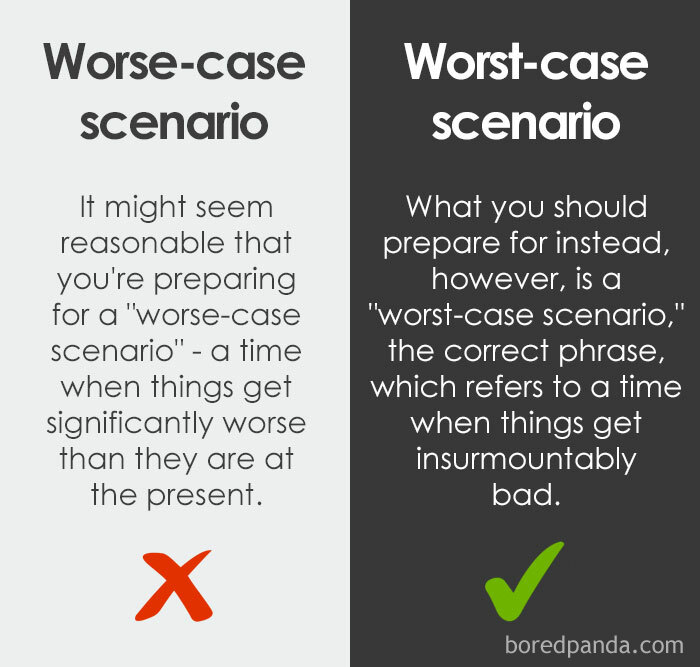
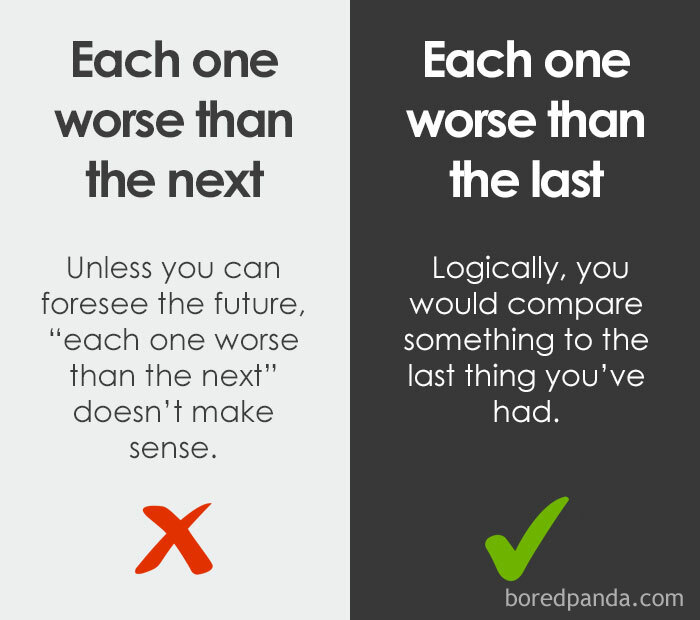
Load More Replies...A lot of people online seem to be unable to correctly use superlatives.
I've even seen people write "when worse comes to worse" LMAO! That would be the exact same!
Load More Replies...Or that annoying time you forget the sausage for the potluck so you buy a big box at the store on the way. Also known as the Wurst-case scenario.
I think certain American accents - Midwestern like mine especially - would make the T at the end of "worst" practically silent. In other words people are saying it correctly but with an accent that makes it hard to tell.
I think this one in particular is mostly addressing internet grammar rather than speaking grammar.
Load More Replies...I've seen this one a lot in comments sections, and even where the poster has made a well-constructed and intelligent argument, it stands out like a blemish.
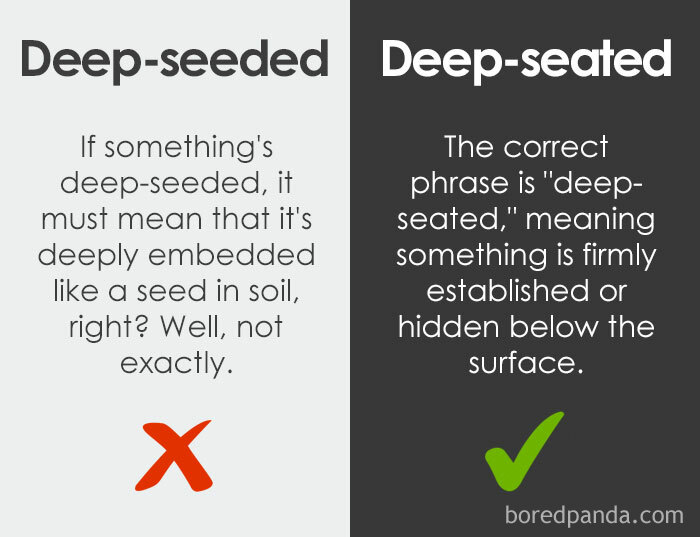
"Deep-seated means "firmly established," as in "deep-seated resentment," but it also has an earlier literal meaning of "situated far below the surface," as in "a deep-seated inflammation." It is from that meaning the figurative use of the word developed." https://www.merriam-webster.com/words-at-play/deep-seated-deep-seeded-usage
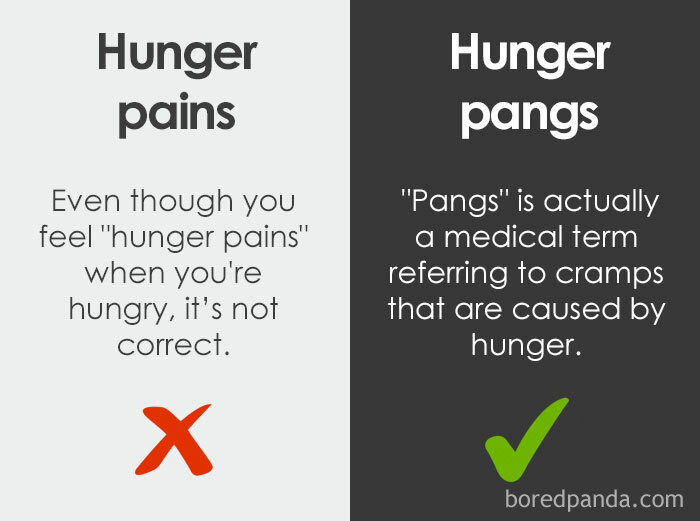
Pangs is archaic, but yes, that's the conventional usage. Frankly, I've been hungry enough to hurt. It is not a pang. It was pain.
If you're at hunger pains, you already passed the point of hunger pangs.
Load More Replies..."Medical Definition of hunger pangs: pains in the abdominal region which occur in the early stages of hunger or fasting and are correlated with contractions of the empty stomach or intestines" https://www.merriam-webster.com/medical/hunger%20pangs
Ask the lot who appeared in the Hunger Games... I think they definitely suffered pain caused by hunger!
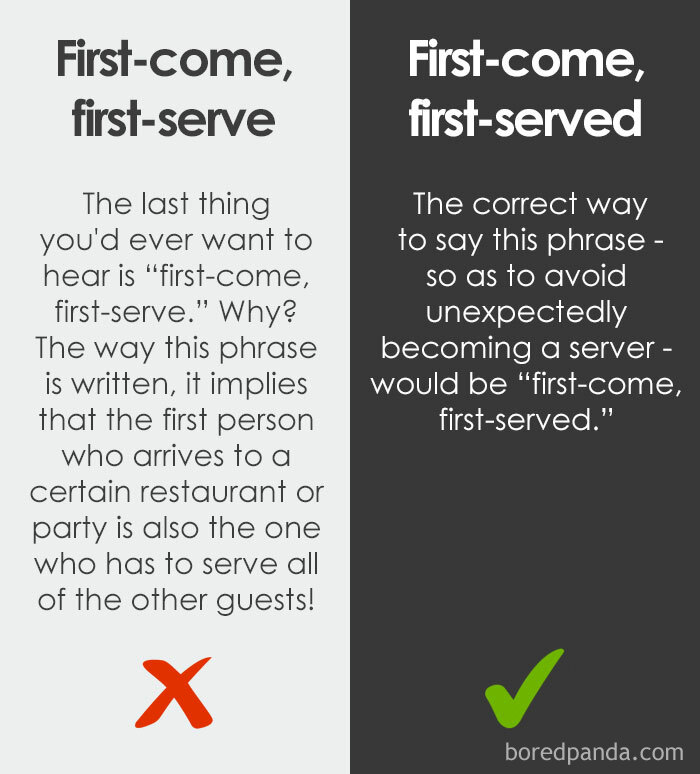
Hmmm. If the first one was true, I would always be late. Oh wait, I’m late anyways!
This happens, though. Back when I used to throw parties, and it was say, for 7:00 pm, lonely people and/or desperate nerds would ACTUALLY arrive AT 7 or earlier (cool people would arrive fashionably late, usually on their way to or from another party). These nerds would be put to work putting the bottles in the ice tub, dumping chips in bowls, etc. So it really WAS first-come, first serve.
Helping with set up is not serving. There is a VERY BIG DIFFERENCE between the two, so no it wasn’t that the first to arrive were serving anyone; they were just being enlisted as help in some of the set up.
Load More Replies...ive only heard the first one weird. maybe its just how people in the west say it idk
When the fish ain't biting and you're hungry
Load More Replies...English: sounds alike, doesn't look alike. In speech, context gives us what we need. In writing, we need to be precise. Why? To prevent the spread of misuse of the language. (My English teachers would be so proud of me...)
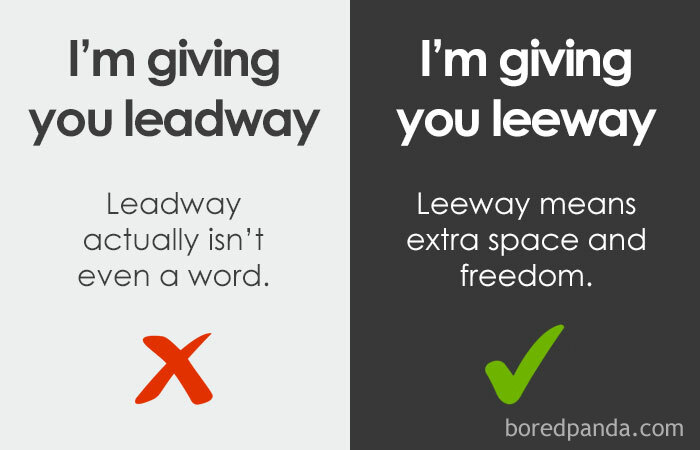
Actually the Lee side of a sailboat is the downwind side. Opposite of windward. Depending on the boat and its keel and the exact angle of the wind, it will crab or be pushed sideways a bit, especially when close-hauled. So you need to aim a bit to windward to allow for leeway in order to go straight. Especially important when going toward another boat or around a headland that is on a lee shore. Even more important if your boat doesn't tack well or sail to windward, eg. A square rigger caught between 2 headlands. Extra leeway is required to prevent being wrecked.
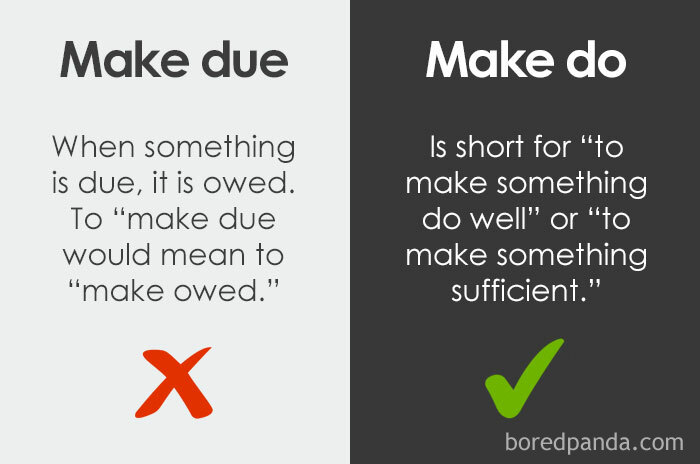
Add to this category: "make due," when you actually mean "make do."
lastly............. much adieu about nothing/much ado about nothing.
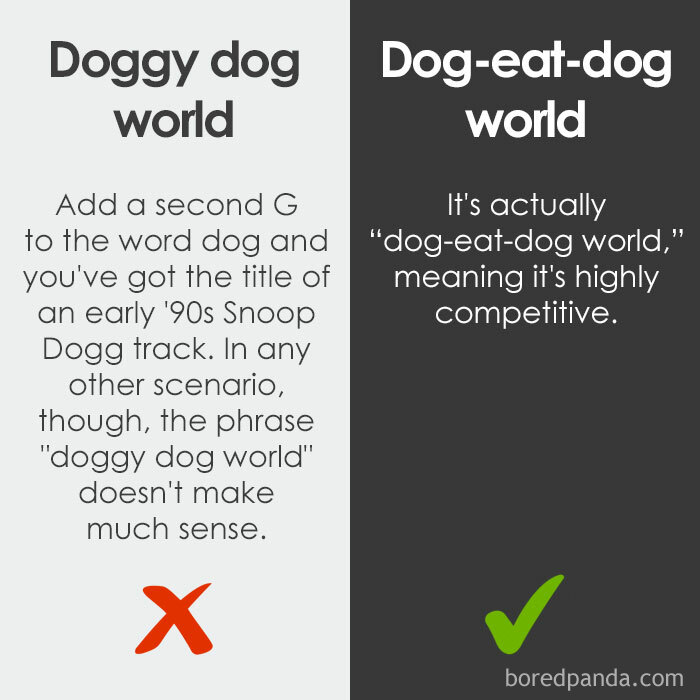
My favorite ones to not make the list:. Dog EAT dog, not doggy dog. And me NEITHER not me either.
You can't tell the difference when you're speaking... it's in the writing where the errors lie.
This entire post makes me angry, I have never heard ANY of the wrong ones ever!
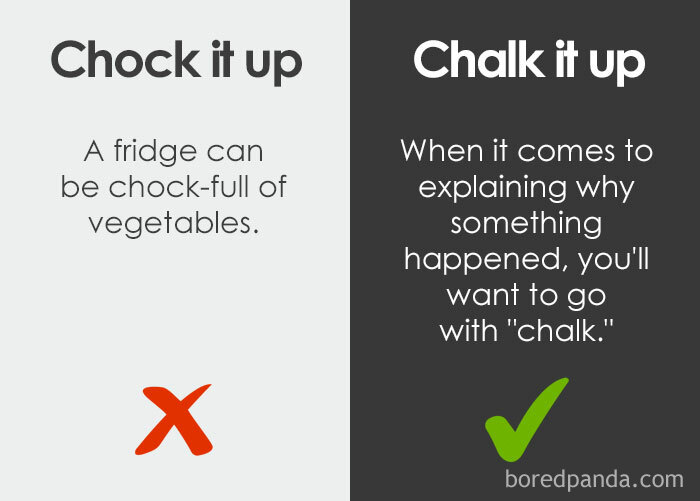
I would chalk it up to you having had some car problems resulting in you having to chock it up. I'm having fun with puns today, you might even say my posts are chock-a-block puns.
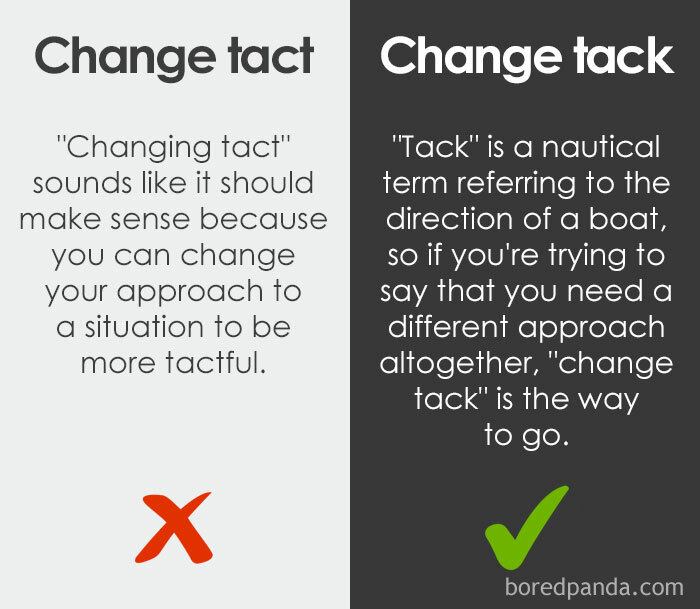
Load More Replies...I always though it was "change tactic"
Load More Replies...You can change tack (as in sailing) or tactics (as in approach to a situation), but tact? Not so much...
Though Wouldn't it be good if some people learned tact?
Load More Replies...I think I've heard change tactics....Now I'm questioning everything I've ever heard or said.
No "change tactics" is fine, the speaker probably just wasn't using the phrase in question... I'm not sure how to explain it because they overlap a lot but you might change tactic when you change between two detailed plan for how to approach a problem, you changing tack is like deciding to throw out your plans completely and wing it. One is more about actions the other is more about state of mind... and none of this is right can someone else explain it.
Load More Replies...(nautical) The act of tacking, turning into the wind so the sail moves to the opposite side
In Greece we say "one is worse than the other" when everything is bad and you can't tell which is worse
One you have not included that drive me crazy: I rarely hear anyone use "begs the question" correctly.
so no lines of sourdough bread cooked, by a novice baker, during quarantine, where you start at the most recently cooked semi passable loaf and work you way back in order of when baked, ending with the blackened lump you can clearly see from the start of the line and know that you will surely break a tooth if you tried to bite into it.
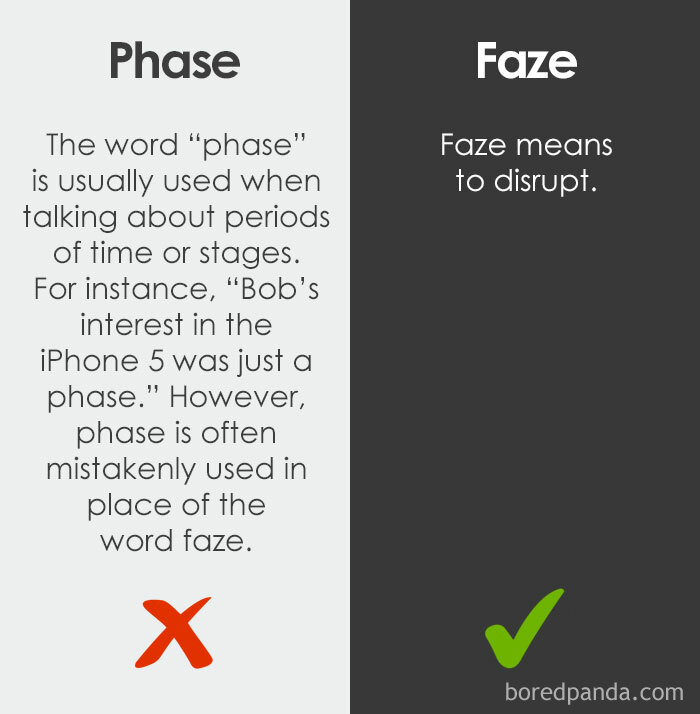
I once got a book out the library where the editor hadn’t caught this mistake and one of the people who had the book before me crossed out “phase” and wrote “faze”.
Faze, as in 'I wasn't fazed' meaning disconcerted or disturbed rather than disrupt. I often see phase used incorrectly instead of faze.
Load More Replies...to faze - disturb or disconcert (someone). As in "she was not fazed by his show of anger" Etymology: mid 19th century (originally US): variant of dialect feeze ‘drive or frighten off’, from Old English fēsian, of unknown origin.
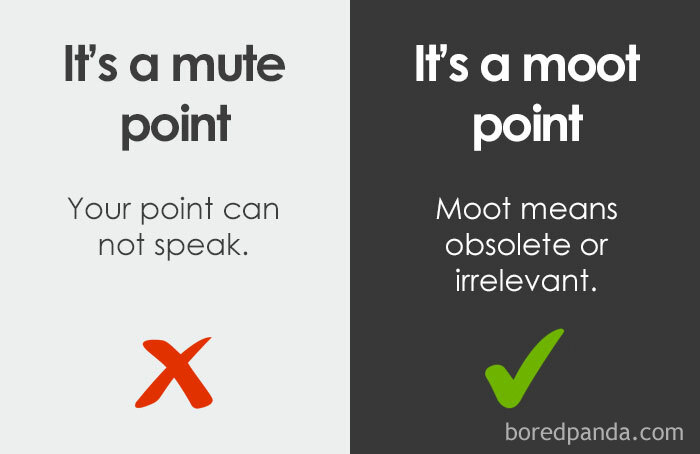
No it doesn't. The OED says: 1. Originally in Law, of a case, issue, etc.: proposed for discussion at a moot (moot n.1 4). Later also gen.: open to argument, debatable; uncertain, doubtful; unable to be firmly resolved. Frequently in moot case, moot point.
Yeah, they have the correct phrases but the explanations are a bit creaky at times!
Load More Replies...This is part of the phrase "make do and mend", meaning things are used in their current state or you mend them only sufficiently to make them work, nothing is replaced by new - usually used in reference to being poor.
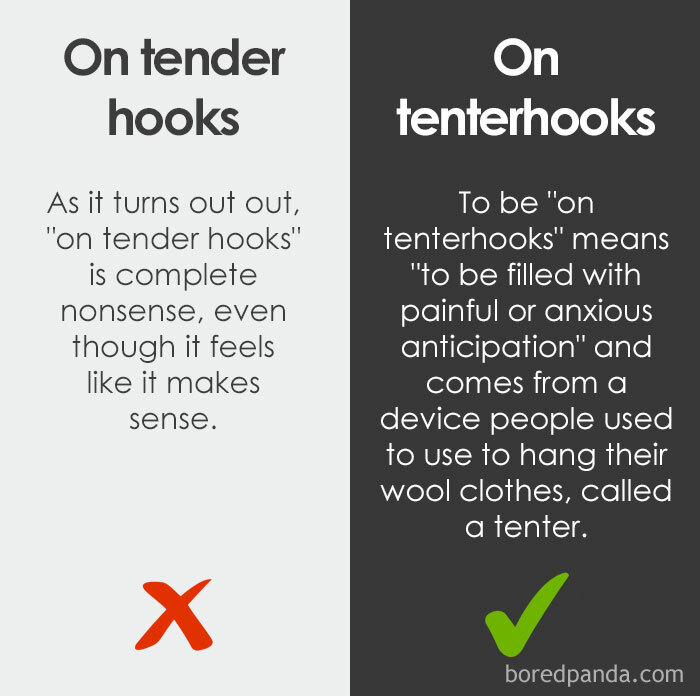
And the hooks on a tenter are literally tenterhooks. There don't seem to be any phrases for teasels, but they are the seedheads of plant that were used to tease the wool. Together they form the coat of arms for Kendal, which is a town in Northern England which once had a thriving wool trade.
And sells delicious Kendal Mint Cake. Which isn't cake.
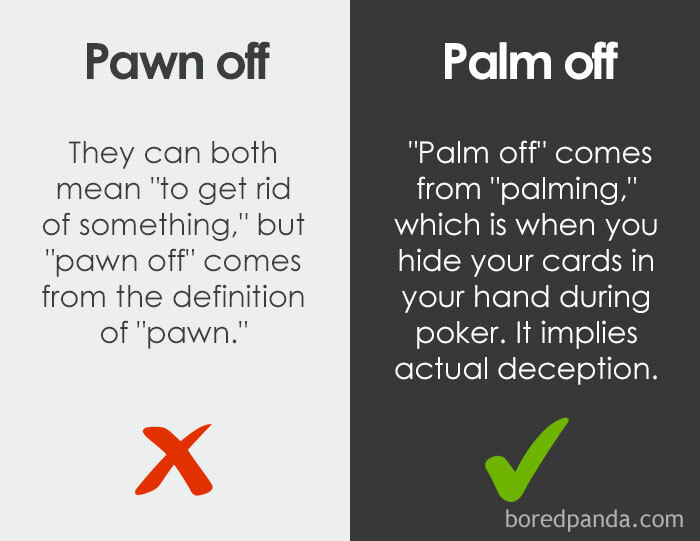
Load More Replies...Unless you are literally going to the p**n shop and have "pawned off your stuff".
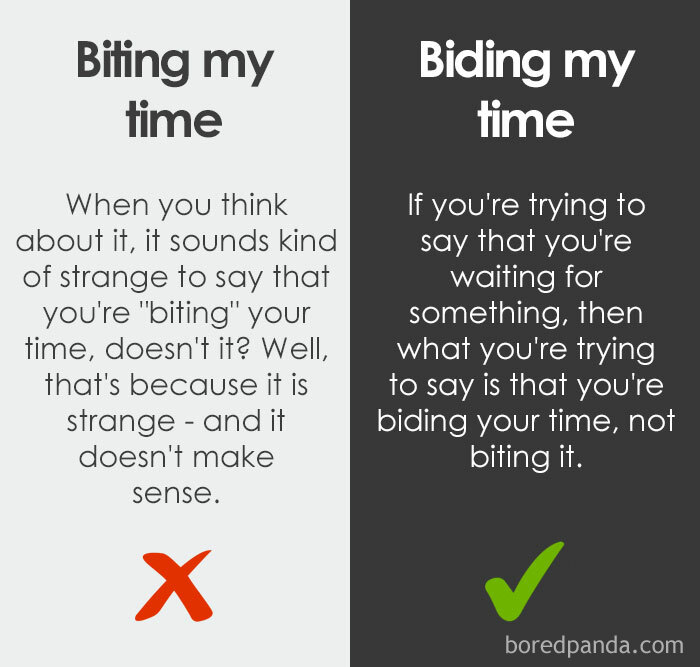
They say I’m Stalin, but I’m really just Biden my time
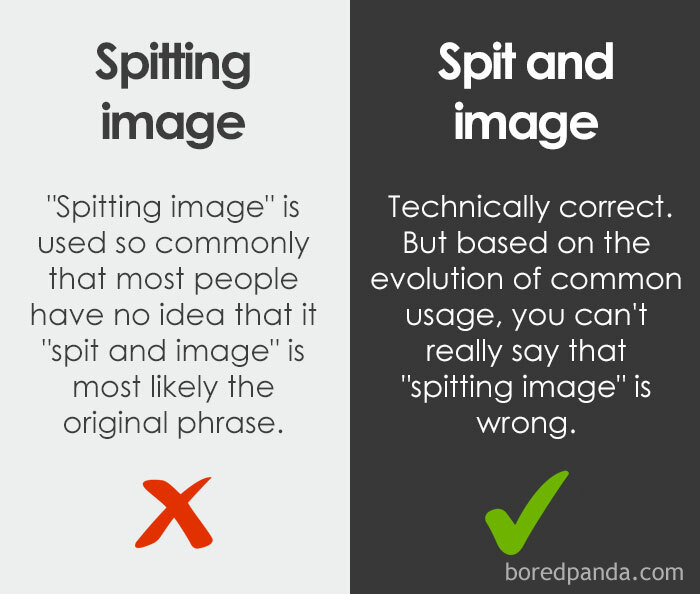
Load More Replies...'Spitting image' is in the Oxford Dictionary. It's correct even if 'spit and image' is the original usage.
Exactly. Once it's in the dictionary, it's correct, n'est ce pas?
Load More Replies..."Spitting Image" is a satirical television programme in the UK.
"Spitting image" actually has made it into the Cambridge English Dictionary and the OED. The OED includes a "note" saying that "spitting image" is a variation of the older and more archaic "spitten image."
This is really a stretch. Unless they're around two hundred years old, absolutely no-one is saying "spit and image".
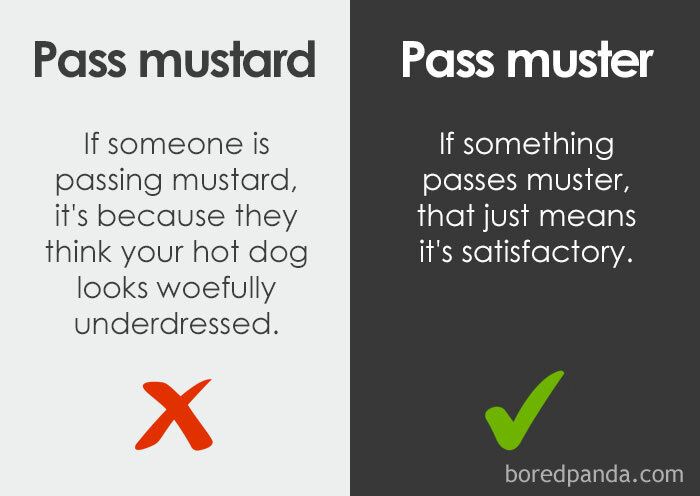
Who in the name of all that's holy ever said "Pass mustard" except at a cookout?
This is dialect/region. In English, some say "different to" and some say "different from" and others say "different than", and it's all okay.
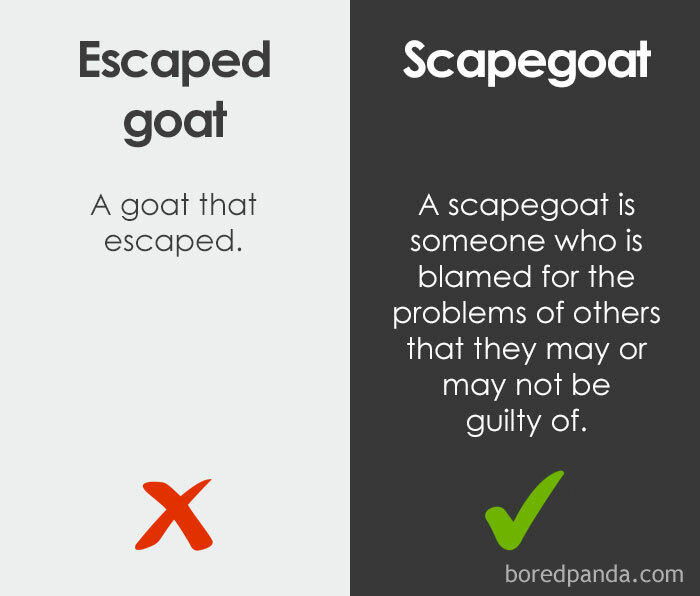
Load More Replies...People I would like to introduce you to the google ngram search for "escape goat" https://books.google.com/ngrams/graph?content=escape+goat&year_start=1800&year_end=2019&corpus=26&smoothing=3&direct_url=t1%3B%2Cescape%20goat%3B%2Cc0#t1%3B%2Cescape%20goat%3B%2Cc1 proving that "escape goat" appears in a disturbingly high number of published works particularly around the 2013-2014 mark the implication being that it is used a lot more widely than you might think
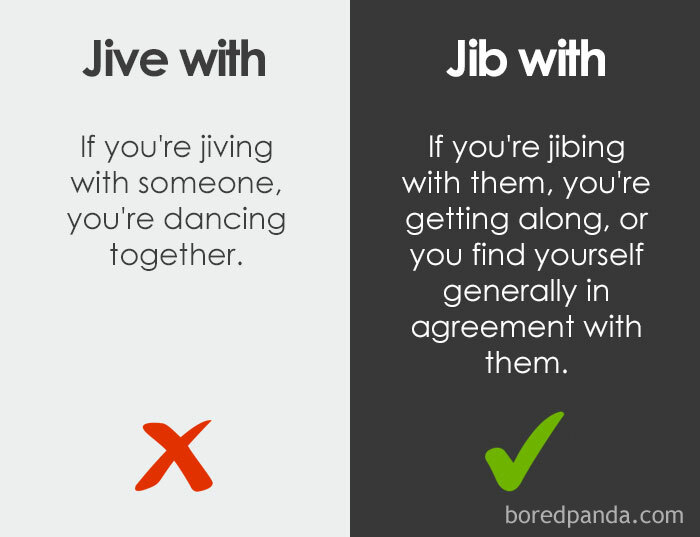
Jibing derives from the word "jibe", not "jib". A jib is a triangular sail on a boat. At least try to get it right!
I've never heard either of these... I though it was vibing with someone haha
Thats the word I was trying to think of, vibe! That's what I'd say too, not either of the examples
Load More Replies...These are both wrong, because the word is jibe. A jib is a particular type of sail. There are too many errors in these examples.
It being used instead of sympathy when people don't understand but are sorry for the person's plight.
Load More Replies...'Fine-toothed comb' is often used incorrectly as a 'fine tooth comb' or even as 'tooth comb'

Oh, yes. That one is irritating. I see it in published novels and wonder who the hell was editing. Grrrr 🤬
Load More Replies...I love good grammar. Can’t help but cringe when words are used incorrectly.

I completely agree. https://photos.app.goo.gl/brzaVqwtnhEohecb6
Load More Replies...Somewhere, my English teachers are rejoicing. And scolding. And rejoicing.
A more subtle one that drives me nuts: when talking about someone facing a dilemma, people will say "He had to choose between (good thing) and (bad thing)." Um, that's not a dilemma - just choose the good thing!! For it to be a dilemma, the choice has to be between two good things (only one of which you can have) or two BAD things (only one of which you can avoid). For instance, some program I watched said "...he was forced to choose between defending his life's work and betraying his protege." That'd be an easy one - defend your life's work INSTEAD OF betraying your protege. What they MEANT was "he was forced to choose between defending his life's work and being loyal to his protege."
Another classic from {mostly} americans is 'voila', so many spell it like they try to pronounce it, Wa La, So wrong !
I used to Beta read fanfiction so I think I've seen all the incorrect versions of these at some point.
It being used instead of sympathy when people don't understand but are sorry for the person's plight.
Load More Replies...'Fine-toothed comb' is often used incorrectly as a 'fine tooth comb' or even as 'tooth comb'
Oh, yes. That one is irritating. I see it in published novels and wonder who the hell was editing. Grrrr 🤬
Load More Replies...I love good grammar. Can’t help but cringe when words are used incorrectly.

I completely agree. https://photos.app.goo.gl/brzaVqwtnhEohecb6

Load More Replies...Somewhere, my English teachers are rejoicing. And scolding. And rejoicing.
A more subtle one that drives me nuts: when talking about someone facing a dilemma, people will say "He had to choose between (good thing) and (bad thing)." Um, that's not a dilemma - just choose the good thing!! For it to be a dilemma, the choice has to be between two good things (only one of which you can have) or two BAD things (only one of which you can avoid). For instance, some program I watched said "...he was forced to choose between defending his life's work and betraying his protege." That'd be an easy one - defend your life's work INSTEAD OF betraying your protege. What they MEANT was "he was forced to choose between defending his life's work and being loyal to his protege."
Another classic from {mostly} americans is 'voila', so many spell it like they try to pronounce it, Wa La, So wrong !
I used to Beta read fanfiction so I think I've seen all the incorrect versions of these at some point.