Get Premium
Dark mode theme is available exclusively for premium users. Learn more about the benefits of subscribing.
No fees, cancel anytime.

 Dark Mode Ad-Free Browsing Unlimited Content
 Ad-Free Browsing Unlimited Content Dark Mode
Join 1.2 million Panda readers who get the best art, memes, and fun stories every week!
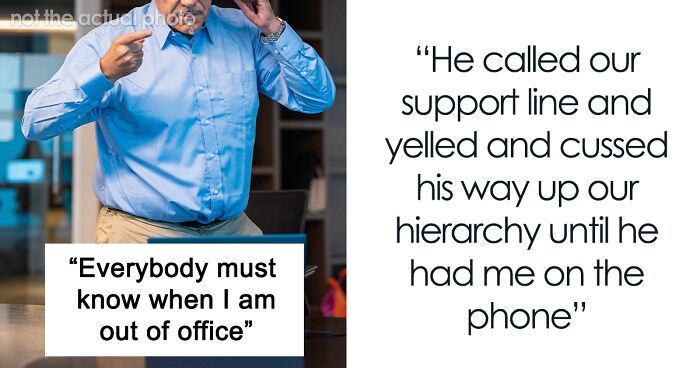
We’ve all been there before, some higher-up has a great idea without the technical ability to know that it’s a disaster-in-waiting. No matter how much people protest, they just have to have their way. So all that’s left to do is comply and hope that if they can’t learn from advice, they can at least learn from their mistakes.
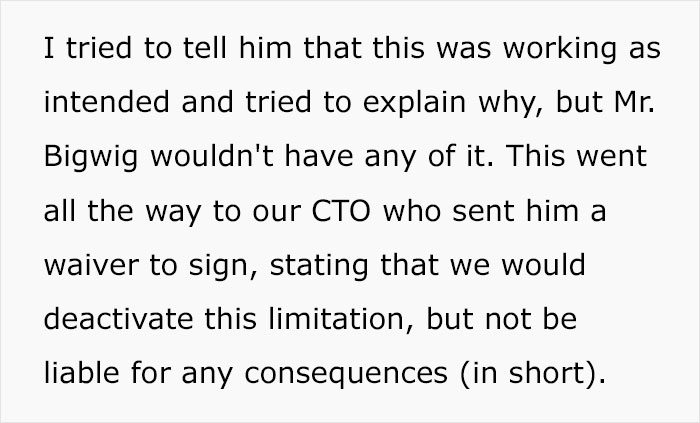
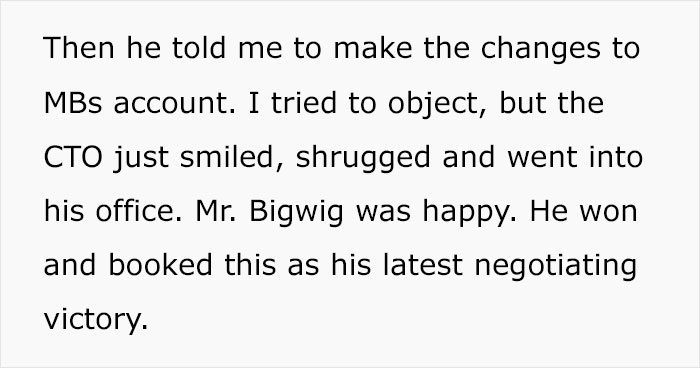
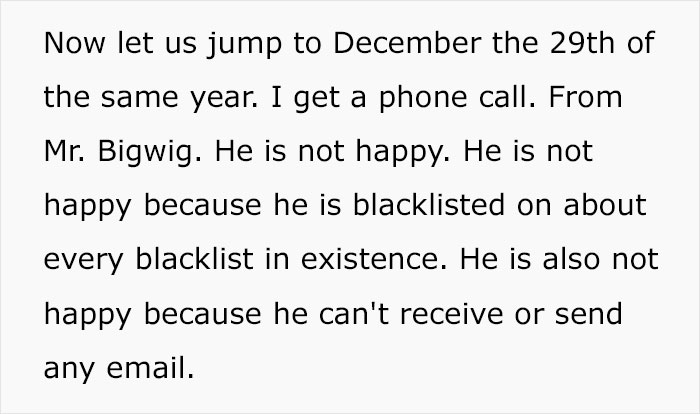
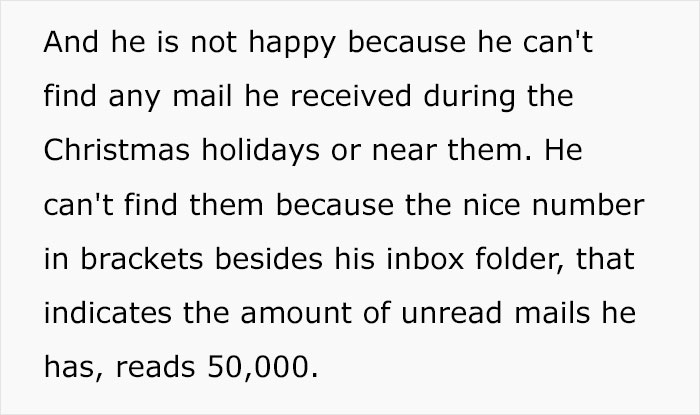
An internet user shared one such situation where no amount of protest could dissuade a CEO from making some changes to an email system. So they did as instructed, then detailed the almost apocalyptic fallout of the CEO’s demands.
Image credits: amazingmikael (not the actual photo)
Image credits: Iakobchuk (not the actual photo)
Image credits: nd3000 (not the actual photo)
Image credits: rawf8 (not the actual photo)
Image credits: LightFieldStudios (not the actual photo)
Image credits: Dingdongdelongwong
We reached out to the OP to learn a bit more about the story and they were gracious enough to answer our questions. How does one actually go about solving this mess? “I had to make sure all the other companies affected were not crippled as well. Sometimes those did not even have server admins, just guys who knew the password. This also meant we had to subcontract people around the globe to help. Between Christmas and New Year’s eve…
Then there was getting the company domain removed from all the blacklists within a few days. And checking if any of our IP addresses had been blacklisted too. And then changing IP addresses. Also, there was some investigation work trying to find out if important mails with legal deadlines had been sent and received and so on… all during the holiday season on minimal staff.”
What this CEO had implemented by accident bears some similarities to what is referred to as an email bomb. If that sounds particularly war-like, just wait, email terminology gets wild. Back to the point, an email bomb is either a program or other method that sends so many emails to a particular address, that it simply stops functioning. Normally, this is part of a DoS, or denial-of-service, attack, which is aimed to shut down its target. Normally, professional IT teams have measures in place to prevent an email bomb from detonating.
Now, technically, this CEO created an email storm or a ‘reply allpocalypse’. Even tech experts are not immune, for example, a Microsoft employee in 1997 emailed a list containing 13,000 email addresses. Others in the list started to reply, causing a cascading wave of emails, which was later estimated to cap at 15 million emails and 195GB of traffic, which was pretty significant back in the day. In 2016, the UK National Health Service NHSmail system experienced over 500 million emails in roughly one hour after an IT worker sent a “test mail.” Goes to show that even professionals make mistakes.
Image credits: rawf8 (not the actual photo)
If an email bomb sounded aggressive, then let’s take a look at the protocol wars. This is not something out of the Matrix or TRON, rather, it’s a really mundane debate from the 1970s and 1980s over which communications protocols would be best for this emerging technology called the internet. It was followed by the Internet–OSI Standards War in the late 1980s. The military terminology does at least have a somewhat logical origin, as the internet came about from a United States Department of Defense project in the 1960s. Now it’s so commonplace, even household appliances might be connected, leading to humorous situations where Google server outages prevent smart home users from turning off the lights.
Email has slowly become a default communication method both privately and between businesses. While messaging apps have replaced emails for communicating shorter bits of information, globally we still send around 350 billion, with a b, emails daily. Some experts predicted the death of email before 2020, but working from home and the general force of habit has kept it alive and well. After all, it’s a lot easier to ignore an email than a phone call.
Image credits: Rawpixel (not the actual photo)

Things like this still happen for some reason (it's called an email storm). Someone will reply to a person with a whole host of CC's. Then someone will start the chain reaction of "why am I getting this, please remove me"....and just hit reply all. Then a smart @$$ chastizes that guy for replying to all....by replying to all. Then another @$$hat will reply to all, telling everyone to stop replying to all....by replying to all, and on and on. Meanwhile you have people seeing 50 emails with the same subject in their inbox, who don't bother to read what's going on and.....you guessed it, reply to all saying take me off the email list..... I think I got two hundred emails with this (a couple of times), until it peters out. Too many self important people out there, in a certain North American gov't....

Haha this happened at the college I worked at as an admin. Oh I had a very entertaining afternoon of 20 professor's and 15 department heads loosing their minds while all of them were replying all to a campus wide email. Why was it entertaining? Cause every student was also ccd into the campus wide email

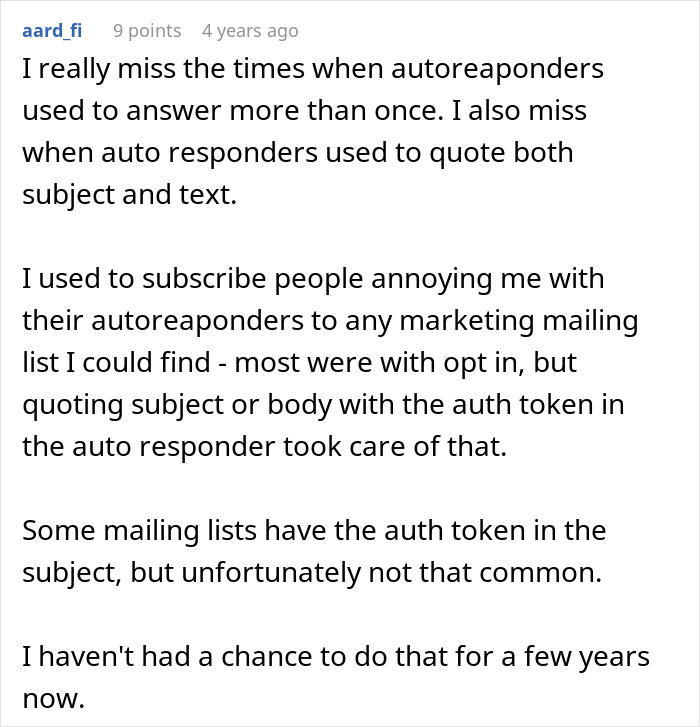
Even without end user intervention it's way too easy to create autoresponder loops or even worse, auto forwarding loops (these are worse because each forward usually adds an extra user signature to the email increasing the size each time) The case of the NHS "test email" near the end of this article is understated, it had every single staff member CC'd, the amount of traffic created by just 1 or 2 people clicking reply to all was enough to bring down the entire NHS computer system for several hours and even once it was brought back online it was severely crippled for several days.
Things like this still happen for some reason (it's called an email storm). Someone will reply to a person with a whole host of CC's. Then someone will start the chain reaction of "why am I getting this, please remove me"....and just hit reply all. Then a smart @$$ chastizes that guy for replying to all....by replying to all. Then another @$$hat will reply to all, telling everyone to stop replying to all....by replying to all, and on and on. Meanwhile you have people seeing 50 emails with the same subject in their inbox, who don't bother to read what's going on and.....you guessed it, reply to all saying take me off the email list..... I think I got two hundred emails with this (a couple of times), until it peters out. Too many self important people out there, in a certain North American gov't....
Haha this happened at the college I worked at as an admin. Oh I had a very entertaining afternoon of 20 professor's and 15 department heads loosing their minds while all of them were replying all to a campus wide email. Why was it entertaining? Cause every student was also ccd into the campus wide email
Even without end user intervention it's way too easy to create autoresponder loops or even worse, auto forwarding loops (these are worse because each forward usually adds an extra user signature to the email increasing the size each time) The case of the NHS "test email" near the end of this article is understated, it had every single staff member CC'd, the amount of traffic created by just 1 or 2 people clicking reply to all was enough to bring down the entire NHS computer system for several hours and even once it was brought back online it was severely crippled for several days.

































 No fees, cancel anytime














88
12