Get Premium
Dark mode theme is available exclusively for premium users. Learn more about the benefits of subscribing.
No fees, cancel anytime.

 Dark Mode Ad-Free Browsing Unlimited Content
 Ad-Free Browsing Unlimited Content Dark Mode
Join 1.2 million Panda readers who get the best art, memes, and fun stories every week!
There's a certain logic to how human civilization operates. Some say it's predetermined by physics, others point to evolutionary biology, but if you take a step back and look at things out of context, they might appear to defy all known "rules."
There's an account on X (formerly Twitter) called RARE.jpg. It shares random images from the internet that seem to belong to a parallel universe. Optical illusions, technological malfunctions, art installations, strange natural phenomena — everything goes, basically.
It's like a pair of sunglasses that allows you to see the world a little differently.
More info: X
This post may include affiliate links.
A familiar but different world is something we love to wonder about. The multiverse has been the subject of much science fiction. And it’s not just social media pages and artists, either — some scientists are also investigating the possibility.
For example, in his book The Allure of the Multiverse: Extra Dimensions, Other Worlds, and Parallel Universes, physicist Paul Halpern of Saint Joseph's University in Philadelphia explores these potential parallel realities, along with their histories and evolutions, and the insights they offer into the nature of science.
"There are different ideas about the multiverse: cultural ideas and scientific ideas. Those notions tend to be very different," Halpern told Scientific American.
"The cultural ideas apply to human life. People wonder what would have happened if they had moved to a different city, taken a different job, decided to pursue different hobbies or had a different relationship. They imagine paths they didn’t take and try to picture what would happen."

I see ads for this type of shirt, but I always thought they were bogus. Guess not!
In science, Halpern said the idea can be split into the quantum multiverse and the cosmological multiverse.
"The quantum multiverse is a possible answer to the questions of what happens when measurements are taken in quantum physics and how human life is connected to the quantum world," he explained.
That was addressed as early as 1957 by a young graduate student, Hugh Everett III, with the many-worlds interpretation. "He speculated that different possibilities split into different universes—and that humans experience multiple realities but don’t really know about their doppelgängers," Halpern said.
The cosmological multiverse, on the other hand, is the idea that a process called inflation (the rapid expansion believed to be an early stage of the universe) is relatively easy to achieve in the early universe and elsewhere and happens all the time. This results in other "bubble" universes that expand, and since our universe has also expanded, they are currently beyond our scope.
According to Halpern, the fact that the parameters of our universe seem to be within the right range for galaxies, stars, planets, and life to form makes physicists think a multiverse might be a correct interpretation of reality.
"If these constants—the strength of gravitation, the strength of the electromagnetic interactions, and so forth—were adjusted just a bit, then planets and life as we know it never would have formed. This is sometimes called the fine-tuning problem."
If we think about all the other possibilities and consider why we're in this branch of the universe rather than another, that might have something to do with the fact that there's an array of possible universes, and we happen to be one of the few that could support structure formation and eventually lead to life as we know it. But in most of the other versions, we would not be here.

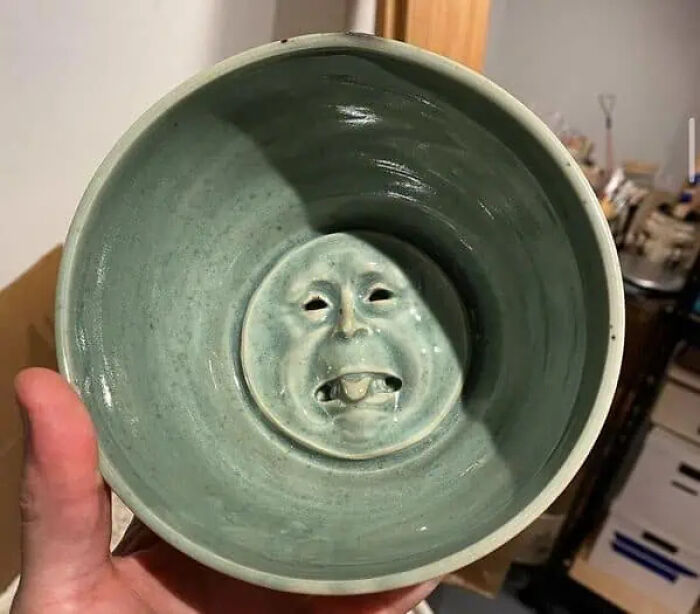
I would hate to try to clean it. All the food trhat would get caught in bottom of the bowl.
Physics has evolved to a point where it considers many things that are not directly measurable. And some say that if we are dealing with something that cannot be tested, it's just pseudoscience.
But Halpern believes this criticism goes too far. He highlighted that humanity has an ambition to try to understand everything not just in this world, but in the universe as well. "We're a very bold group of people living on a planet that's a relatively tiny part of everything. We use our instruments to try to understand it as much as we can."
"We use different tools, and one of those tools is theoretical physics; another tool is direct observation. We hope that those methods match up, but sometimes there's a lag," he said. "Sometimes there are experimental results that theory does not explain. Sometimes there are theoretical models—such as general relativity—that seem so compelling that there's some degree of acceptance without observation, and only later does science produce experimental results."

I appreciate the level of effort here. He's even straining, making that vein on his temple bulge.
"Even if you're a trained physicist and are basing everything on laws of physics and things like general relativity and quantum physics, there's always some room for philosophical preferences," Halpern said, explaining that there are some physicists who really like to think that time is an illusion, and others who like to think that time is real.
Exciting ideas can take a (little) while to test, so we just have to be patient. And until that happens with the multiverse theory, I guess there's not much else to do but scroll through such lists and entertain our imaginations.


Oh, it's a hair clip! Took me a minute to figure out what was going on.. 😅

Just 2 days ago, I discovered that wiki has merch available. I didn't see any with quite this much detail, but still pretty cool stuff.

Actually a great idea if you wanna lay down while still looking at your monitors. I would use this. Just gotta get used to it
Note: this post originally had 68 images. It’s been shortened to the top 60 images based on user votes.




































 No fees, cancel anytime
 then open in external browser


 and click "Open in External Browser"