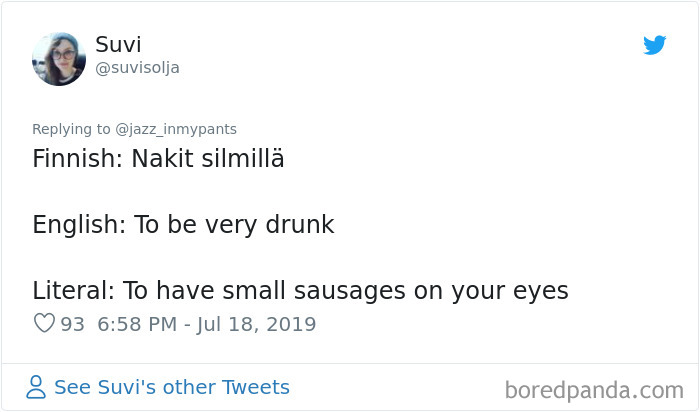
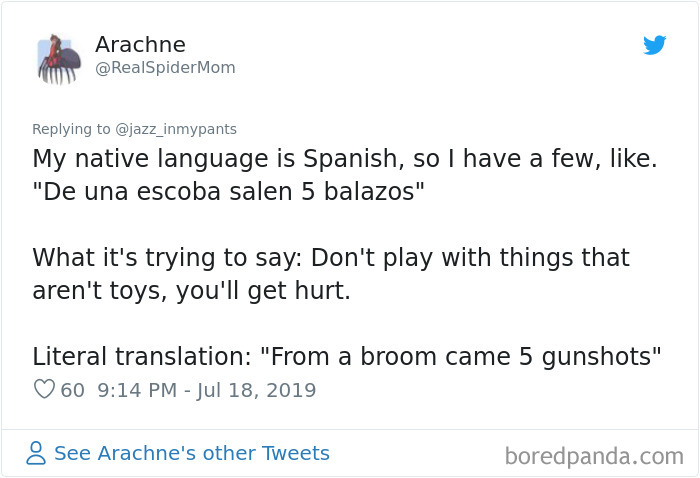
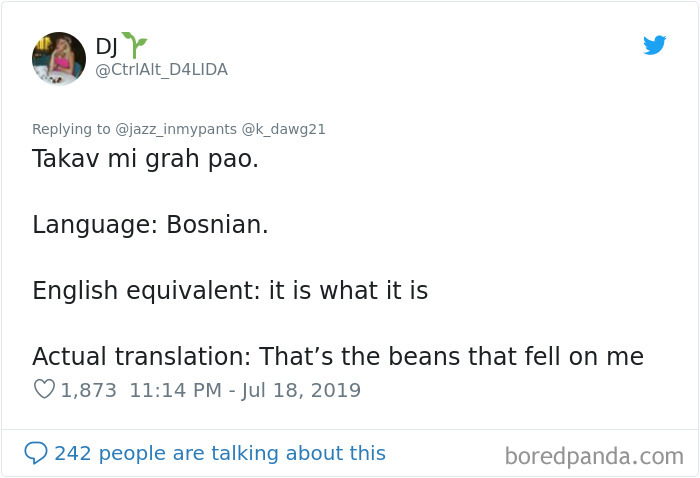
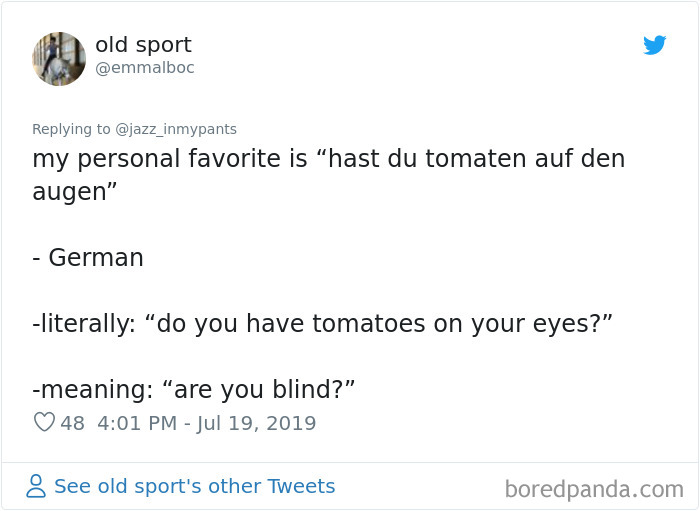
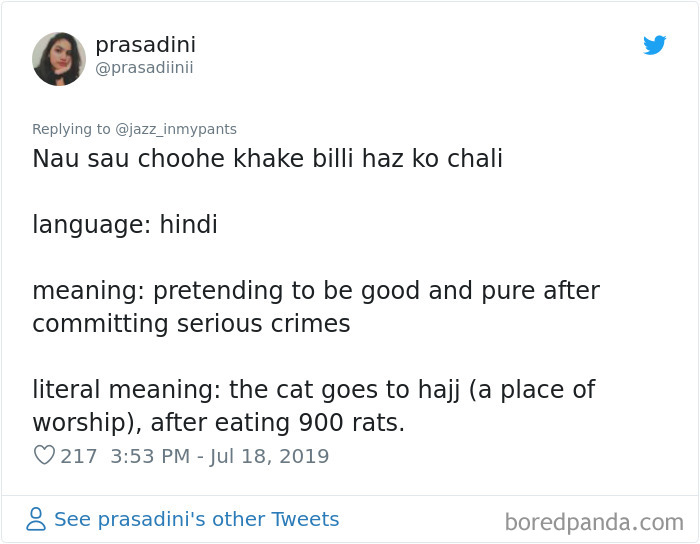
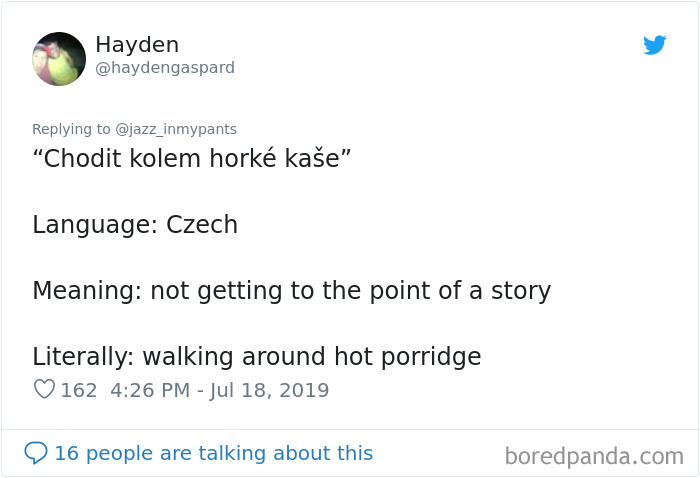
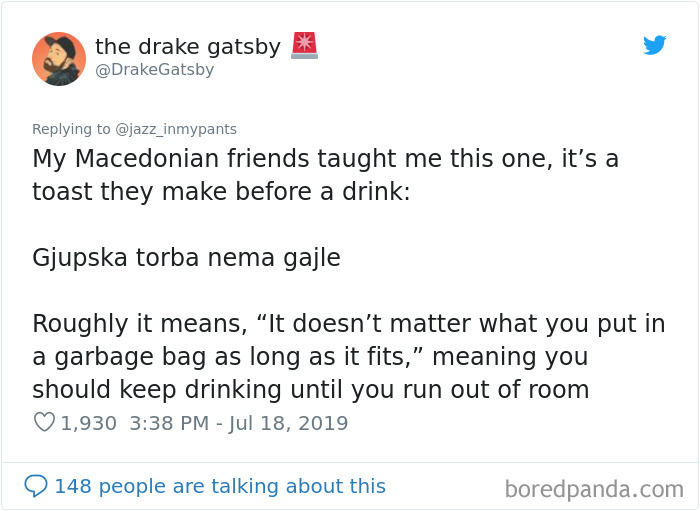
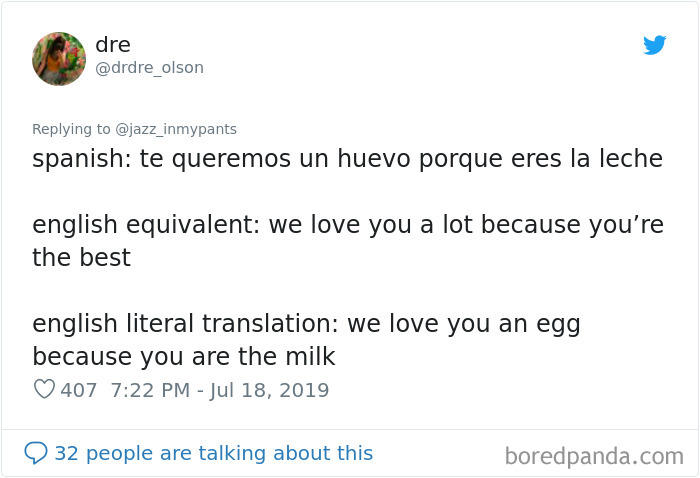
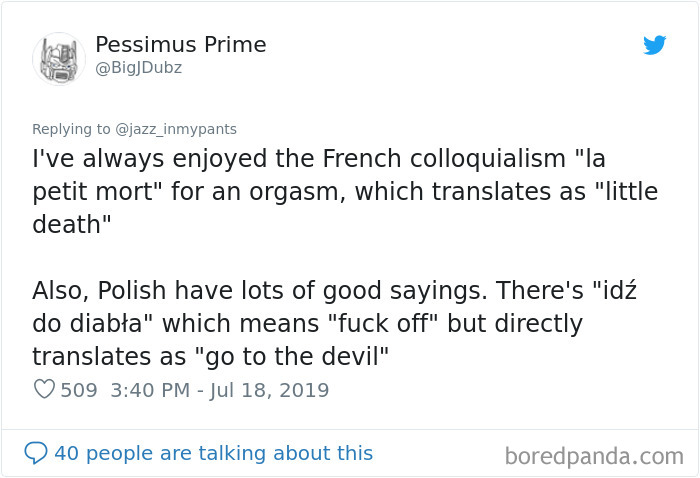
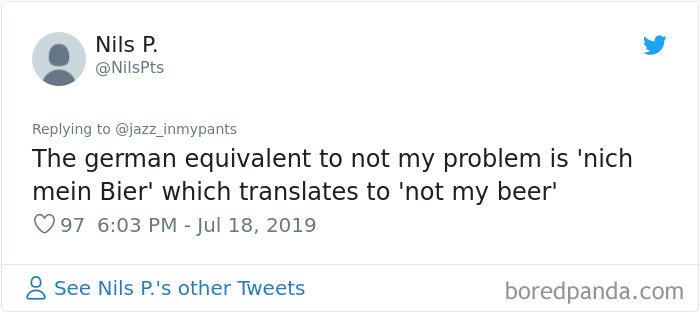
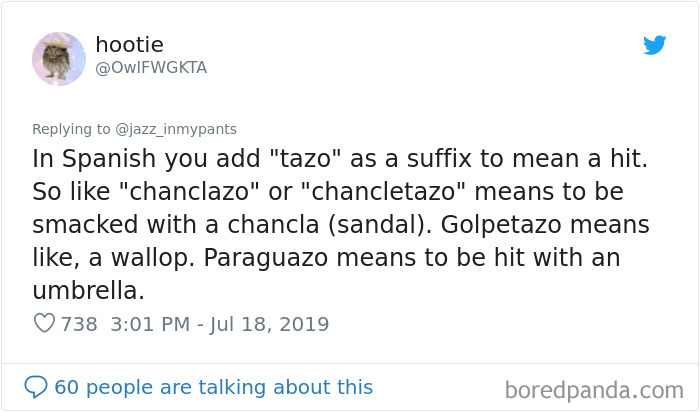
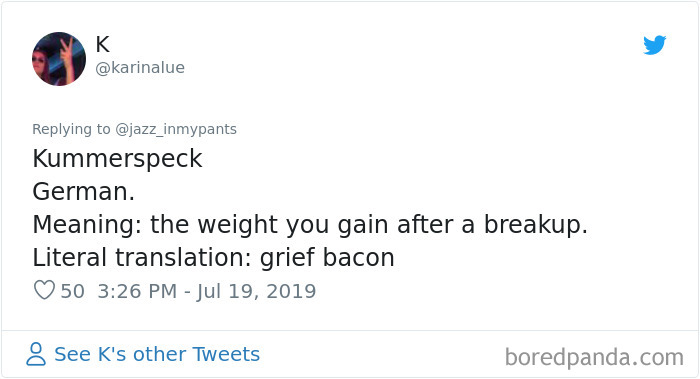
Everyone can agree, especially non-native speakers, that the English language can get very tricky. Most of us know the feeling of being puzzled by the strange spelling rules and grammar of this language, but the truth is, every native language has its own peculiarities. So if you think that the funny idioms in English are bad enough, check out this hilarious Twitter thread of the weirdest phrases and their literal meanings.
Started by the Twitter user @jazz_inmypants who asked people to share their favorite non-English funny sayings, the thread was quickly filled with unexpected responses, most of them reminding us how strange some mother tongues are. Scroll below to read the idioms and their meanings.

More info: twitter.com
This post may include affiliate links.
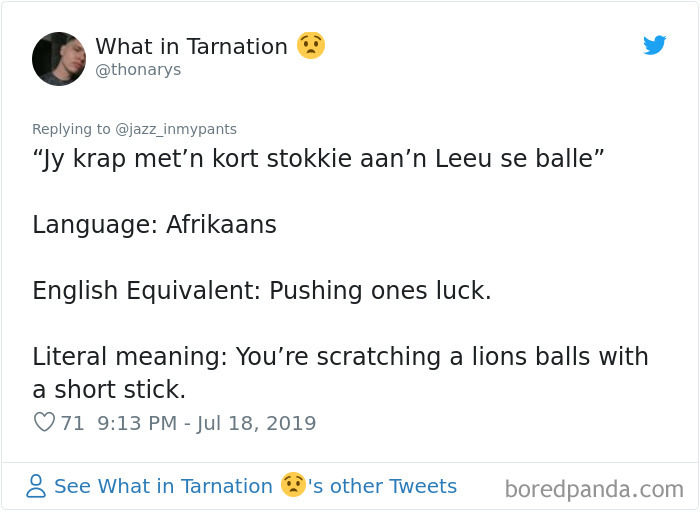
More fun ones (yes I am fully fluent in Afrikaans, being a Bil-lingual South African): "Jy is besig om 'n kort stok in die hol van 'n groot leeu te druk" Means: Back off/ Watch out/ Watch your step "You're busy poking the A-hole of a big lion with a short stick" "Jy gaan kak" You're literally in huge trouble/You're going to get hurt. Usually as a warning to anther person "Your going to poop (yourself)" "So Skeef soos 'n sewe-rand noot" They're gay. "Skeef" = skew = slang for gay "as skew as a 7 Rand note" there are no 7 Rand banknotes" usually only used in a social environment when someone is asking, and you're actually friends with the person that is gay. "So skeef soos pienk gras" They're gay. "As skew as pink grass"
Load More Replies...Funny thing, in Portuguese we have a similar expression: "cutucar onca com vara curta" - it literally translates to poking a jaguar with a short stick!
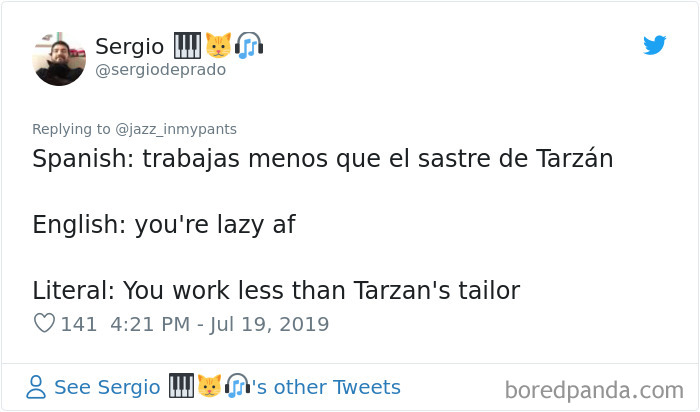
Tarzan only wears a loin cloth (a piece of leather protecting the dangly bits, more like a skirt than underwear). So Tarzans tailor is really taking its time to make something for Tarzan to wear...
Load More Replies...Of course he did it must have been Kala who else would I mean she raised him
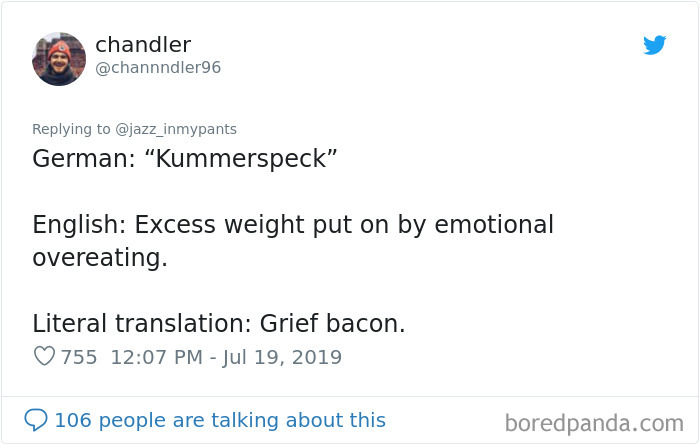
Load More Replies..."Bacon" is not really correct. "Speck" is the fatty part of bacon, therefore you can also refer to you belly fat as "Speck" instead of "Fett" (fat). Literal translation: grief fat

@Mira Maier: dict.cc says Speck translates to bacon. BUT! When talking about a living being, not just a piece of meat, Speck (bacon) and Fett (fat) are equivalent. So in this context, calling it grief fat is indeed a better translation - it's the non-muscle weight you gain from overeating.
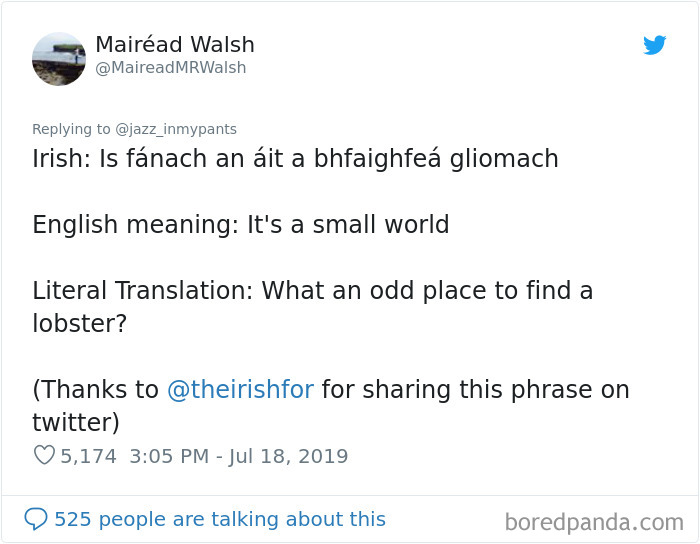
Load More Replies..."What an odd place to find a lobster" is going to be my next tee shirt.
Being Irish, and living here all my life, I can't even say that lol pity I can't speak my own language though but this is gas. Rofl
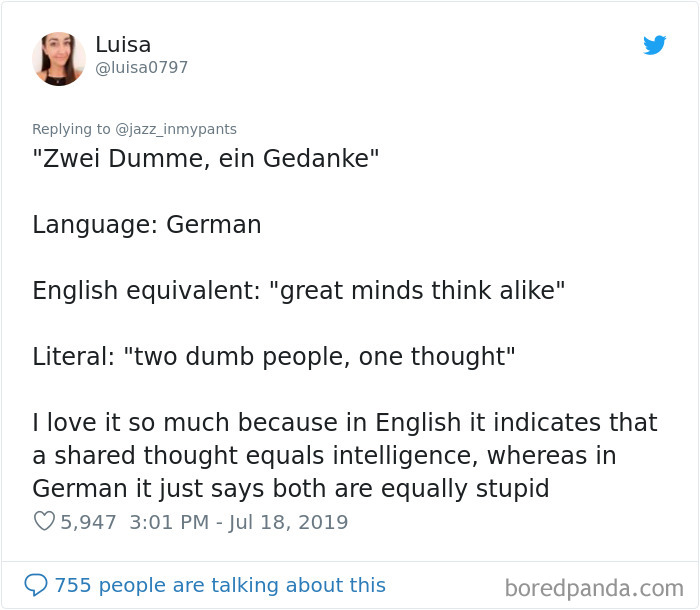
The real quote actually is "great minds think alike, though fools seldom differ"

"“Great minds think alike.” The extended phrase: “Great minds think alike, though fools seldom differ.” When two friends have the same idea, one (or both) of them is likely to pipe up with the common version of the phrase. Next time, you can retort with this extended version — the etymology of which is mostly unknown — to put them back into their place: It’s foolish people, not great minds, that are more likely to have the same banal thoughts all the time." from: https://www.apartmenttherapy.com/7-common-sayings-that-dont-mean-what-you-think-they-mean-245885
Load More Replies...It is a rather typical sarcastic statement, as you find several others in German. What about "Die dümmsten Bauern haben die dicksten Kartoffeln". It might be similar to "fortune favors fools" and literally means "The most stupid farmers harvest the biggest potatoes".
It is not really meant to indicate that you are actually dumb. It is more are shared sentiment, like saying "ah the two of us again", with some affection in it, especially if you just said something in unison.
we ceretainly prefer the difference too . In portuguese we say : cada cabeça sua sentença / each mind, different thought (or two heads , two ideas)
In Dutch we say 'anderhalve man en een paardenkop', which means 'one and a half man and a horse's head'.
Funny, we say 'twee man en een paardenkop', meaning 'two men and a horse's head'
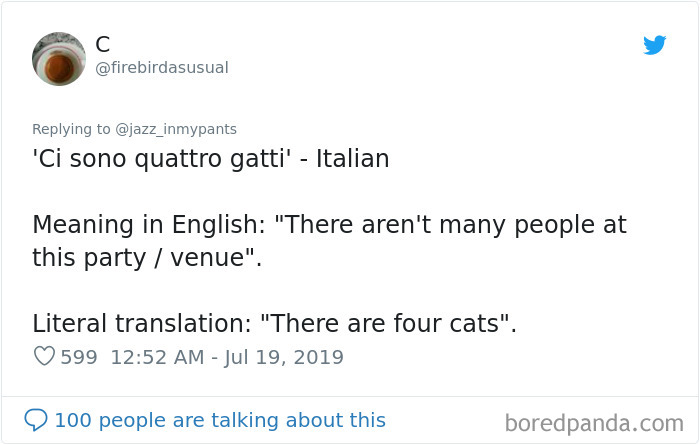
Load More Replies...In Portuguese: só tem uns gatos pingados. Translation = there are only some dropped cats.
In Argentinian Spanish they say this, too! Probably a direct translation from Italian.
In Danish we would say: To ludere og en lommetyv which means two hookers and a pickpocket.
In Portugal we say "meia dúzia de gatos pingados" / "half a dozen of droped cats" BUT do you know what is a gato pingado ? It means the undertaken (refers to the outfit of an undertaken) so... the expression means a little more : this is not a party ... it is a funeral and with no family or friends
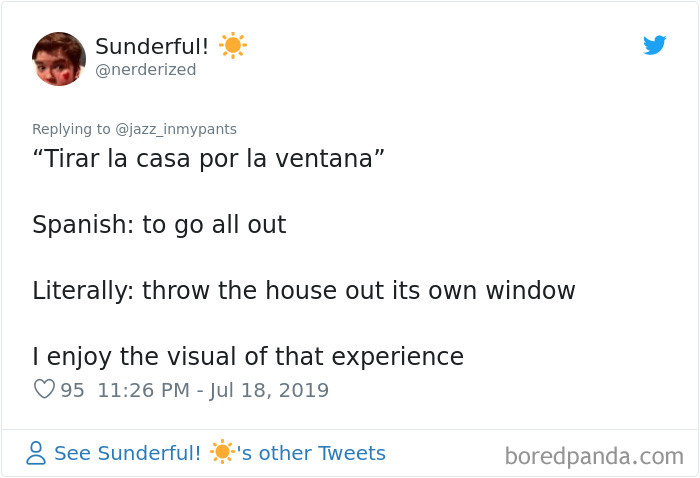
The image for the average spanish speaking portraits the person throwing the contents of the house out the window...
In reality it comes from the image on a potential lottery winner throwing all his (old) belongings out of the window in exchange for the new ones in an going all out buying spree
In Argentina its means that you spent lots of money in something, especially in a big party!
May I add: "Mit dem ist nicht gut Kirschen essen", literally "With this guy you cannot easily eat cherries", means that you will encouter a crumpy person.
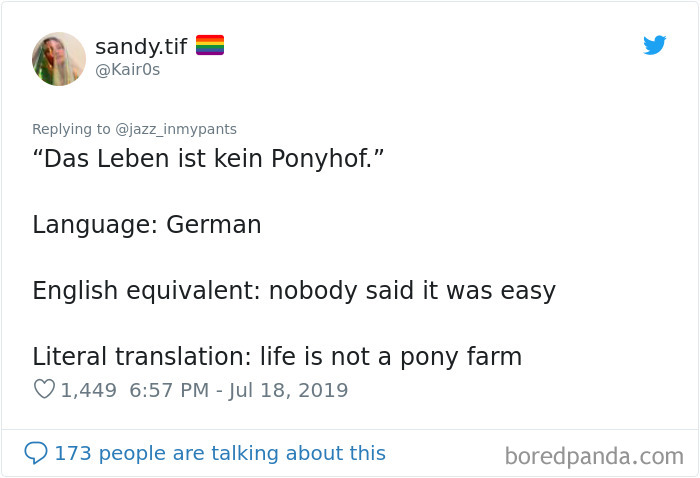
Althougj a Pony Farm isn't exactly what I would consider easy either have you ever tried to take care of a pony it's not a dog lol
Pony farms are not easy. You try having to get up early EVERY MORNING including Christmas morning to clean out the stables.
Maybe it's meant to evoke memories from childhood when visiting and riding ponies i.e. having fun without a care (obviously it's not fun when you are the one looking after them).
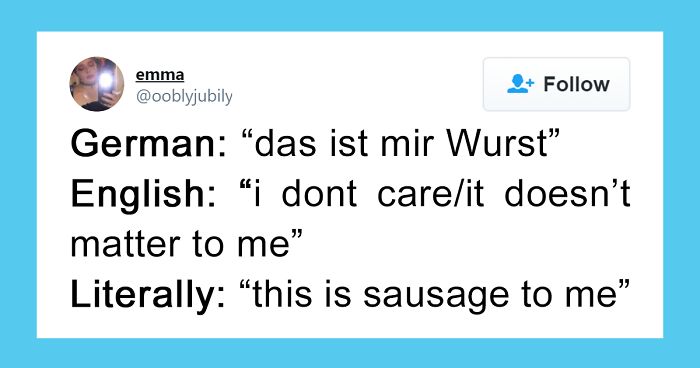
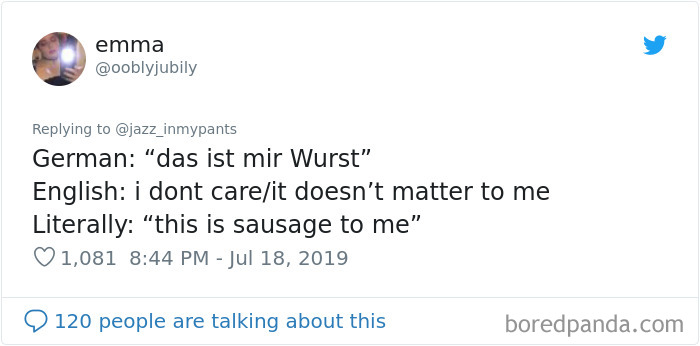
Load More Replies...It should be written "wurst" instead of "Wurst". The noun Wurst means Sausage but the adjective wurst means it doesn't matter. (In German all nouns start with an uppercase letter.)
"The saying "das ist mir wurscht", which probably says: It does not matter, just as it does not matter with what a sausage is filled. Another interpretation refers to the two equal ends of the sausage (all has an end, only the sausage has two). It is therefore indifferent at which end they are cut first. The style of speech comes from the student language at the beginning of the 19th century. Important note: Despite its origin from sausage (Wurst). The wurst in das ist mir wurst/wursch is written in small letters." from: https://german.stackexchange.com/questions/34797/das-ist-mir-wurst-etymologie-bedeutung/34800
Load More Replies...Funny, German's cousin Dutch has an almost identical say to express disinterest: Het zal me worst wezen.
I also love the expression Leck mich am Ärmel, which means in essence kiss my a*s. Literal meaning is lick my sleeve
Pretty sure that is just the version for when small children are around. Similar to "Scheibenkleister" (pane paste), when little ears are not to hear "s**t". :)
Load More Replies...One popular German saying is "Alles hat ein Ende, nur die Wurst hat zwei", which I think is just a longer version of saying "everything ends at some point". Literal meaning: Everything has one/an end, only (the) sausage has two. (works better in German because "one end" and "an end" both translate to "ein Ende" )
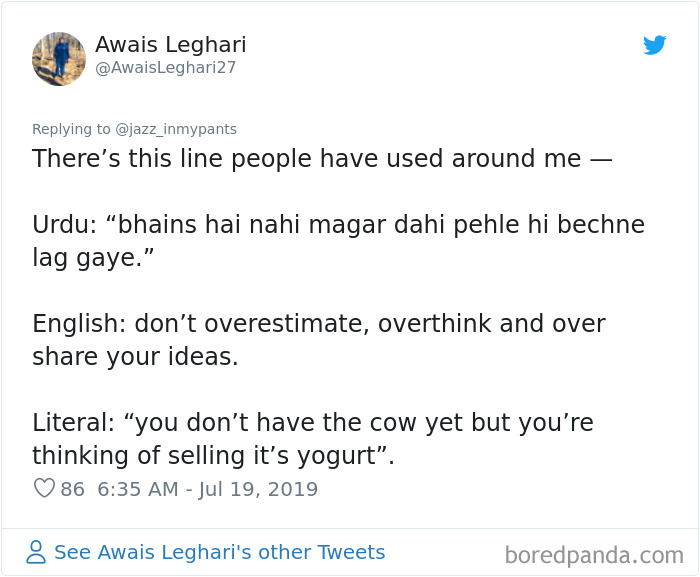
Germanversion: Milchmädchenrechnung; lit. "milk maid's calculation". It's based on a small folk tale of a milk maid thinking about what she'll buy with the money she'll get for the milk, and what she'll buy for the money when selling THAT etc - and then she spills the milk.
Polish: Myślał indor o niedzieli a w sobotę łeb mu ścięli. Literal: The turkey thought about Sunday and they cut their head on Saturday. English: Today's peacock is tomorrow's feather duster. It's an old idiome, my Grandma used it.
Load More Replies...Don't count your chickens before their hatched would be a closer English saying.
Or as we say in Brazil, don't count the egg in the chicken's a*s.
Load More Replies...Brazilian portuguese version: "Contar com os ovos na bunda da galinha". Literal: To take for granted the eggs still in the chicken's butt.
Polish: ,Nie łów ryb przed siecią’ - same meaning which literally translates to ‘don’t fish before you get the fishing net’
In French : "Vendre la peau de l'ours avant de l'avoir tué". Means : Sell the bear fur before having killed it.
Dutch: "Je moet de huid van de beer niet verkopen voor je hem geschoten hebt." Means exactly the same.
Load More Replies...In spanish "you are counting the chickens before they hatch"
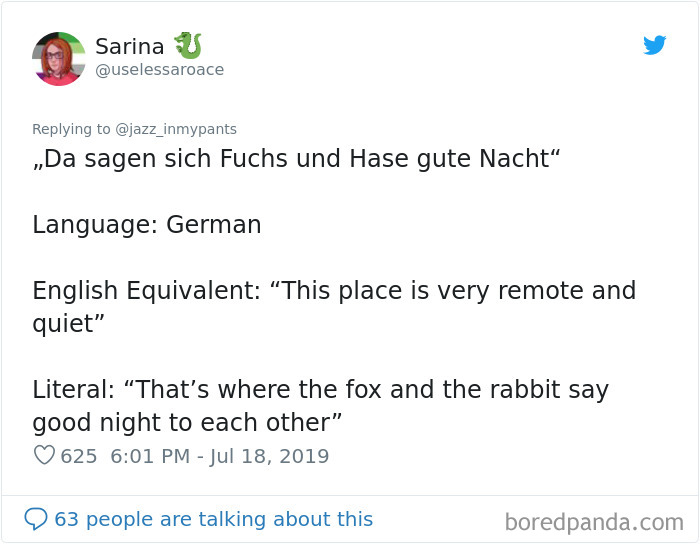
There are a lot of funny descriptions for remote or unattractive places in germany. Such as "Da liegt der Hund begraben" (This is where the dog has been buried) or "Da willst du nicht tot überm Zaun hängen" (You don't want to hang dead over the fence)
Don't forget "Am Arsch der Welt". At the butt of the world.
Load More Replies...Indonesian: Where the genies abandon their own children
Load More Replies...in Polish, if want to put it in funny way, we say "tam gdzie psy dupami szczekają", literal transcription is "where dogs barks with their asses" 😅
We have similar phrase in czech: Kde lišky dávají dobrou noc Literal: Place, where foxes bid you good night.
In German a really remote place would also be referred to as "der Arsch der Welt" - "the a**e of the world". And in some Eastern European language (probably Romanian, but I'm not quite sure) they have that wonderful expression "Where bears f**k"
In Polish we also have a version of a saying that mean a very remote place: Gdzie bocian zawracają a psy dupami szczekają which translates into Where storks turn back and dogs bark with their asses
I suppose tho some makes since, as it is referring to love handles- making the comparison of sagging fat to dropping gold, gold no doubt used for a heavy substance
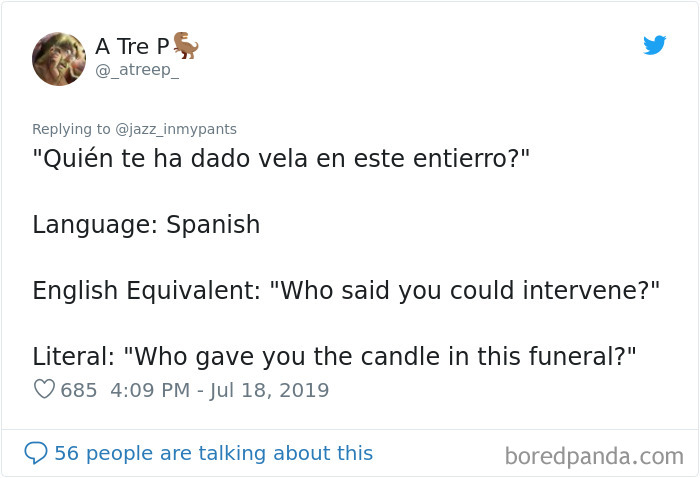
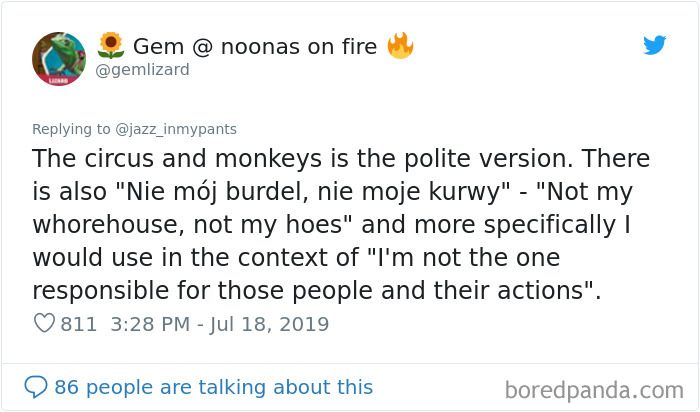
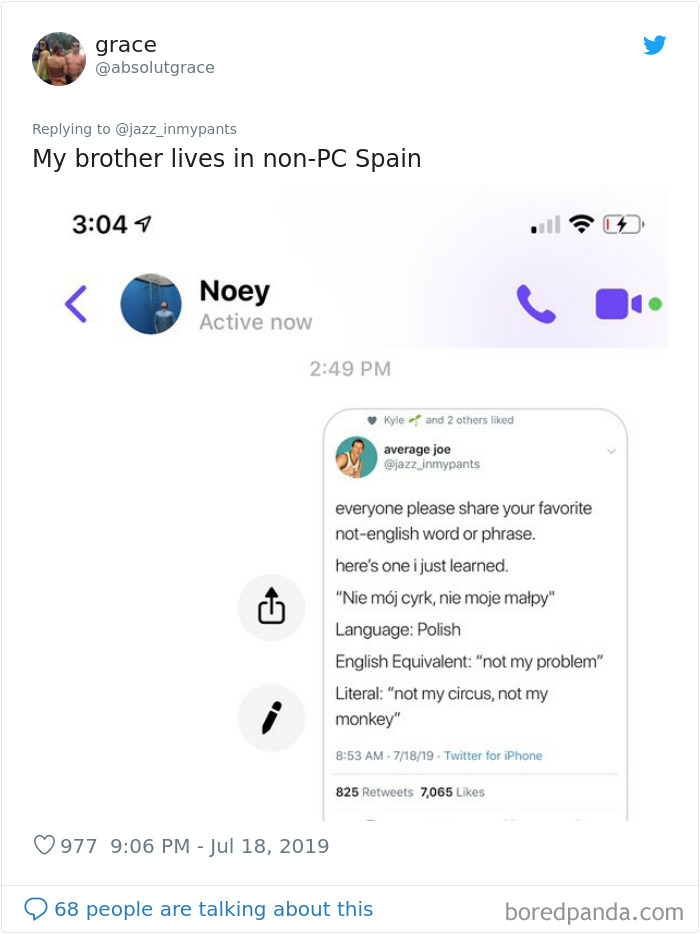
I would add "Estoy hablando con el dueño del circo, no con los monos" which translates to "I'm speaking to the circus owner, not the monkeys", meaning the same thing
Ok, we should use this in ALL other languages, it's hilarious.
Load More Replies...you can also says: pousser du vieux avec du neuf (pushing old stuff with new stuff) :-)
(pushing old stuff with new stuff) would be ours "I already sit on the first one" :D
Load More Replies...Quite an old saying... In French, we have a lot of slang to say 'to poop'... ;)
I'm Franch and I never heard that one haha Btw it's "Le" cigare not "la". :)
Never heard it either but I'm in Quebec so it may be a "regional" thing.
Load More Replies...La taupe au guichet. Meaning :I have to poop. Literally : the mole is at the desk.
For me, it's more "j'ai la taupe qui frappe à la porte" ; literal : "i have the mole who knocks on the door".
Load More Replies...not sure of this is universal, but in my south african english circle we call this "turtle necking"
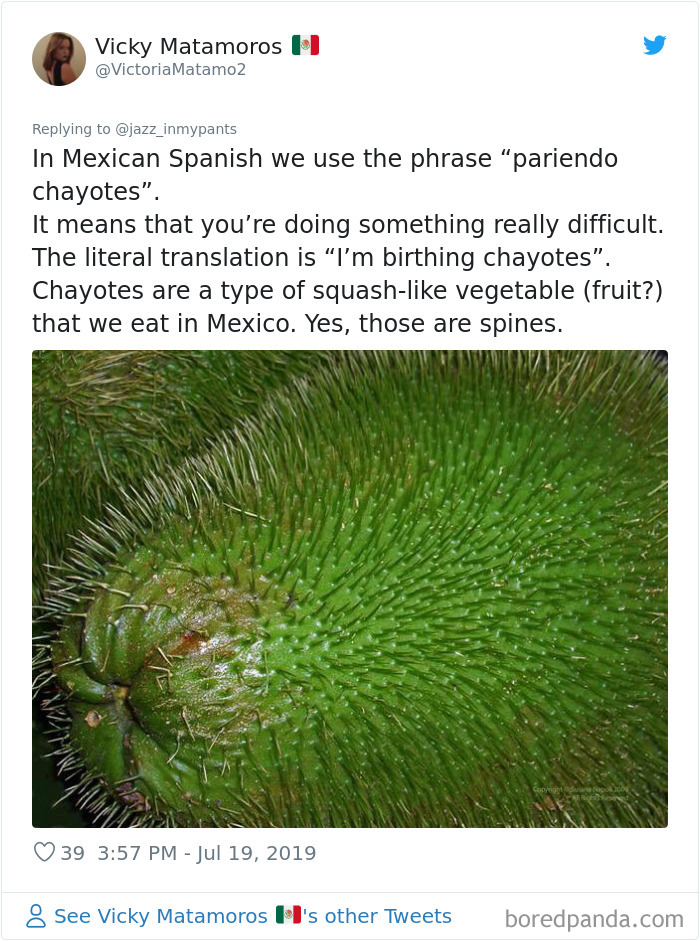
They're squash. And they have a numbing chemical in them (toxic until cooked). It's a really weird experience cutting them up, and weirder eating them. They have an apple-like flavor though.
Ha ha ha! When someone is stressing, I say they're pooping pineapples (in English) - same idea!
The Mexicans I know say "dar luz" (give light to) for giving birth. That's interesting
Yep, it's a very interesting term!, Also, the act of "dar a luz" it's know as "Alumbramiento" (enlightenment).
Load More Replies...Here in Czech republic we have something similar. We say "rodit ježky" what literally means "to birth hedgehogs" but the meaning is slightly different. For examle if the person I talk with is not very intelectually skilled I say to it "budu z tebe rodit ježky" what literally means "you are so stupid I'll got a heartattack".
Exactly, it actually means that something is boring (more than disappointing) as dancing with your own sister.
Load More Replies...I going to go ahead and say it. Literal meaning is pretty useless in Alabama. Down vote away.
In French a similr expression is "ça ne casse pas trois pattes à un canard" (it doesn't brel three legs to a duck).
Being Mexican I heard this a lot as a child. Trying to explain this to my non-Spanish speaking friends was really funny.
I would say the literal translation is more like "Heal, heal little frog's tail.
Just ‘cause it rhymes. Its similar to: “?Que pasa calibasa? Nada, nada limonada” - Spanish. Meaning: “Wazzup? Nuthin’.” Literal: “What’s happening pumpkin? Nothing lemonade.”
My mum up to the date tell me that "¿Qué pasa, calabaza?", But not the lemonades part :p
Load More Replies...That's cute, it has butts, butts make little ones giggle -> part of the healing already done!
Oml the fact that i didnt get this before then is mind blowing
When I was a kid and hurt myself my nan used to say (to make me feel better) "It'll be a pig's foot in the morning". I'm from Liverpool, no idea if this is a Scouse thing...
Reminds me of my grandmother... (Dutch). When I got some small injury while playing, she'd always (jokingly) say "Als je dáármee onder een trein komt..." (loosely translated: "Imagine being run over by a train with thát injury"), or "dat is wel over voordat je een jongetje [of meisje] bent" ("it will be over before you turn into a boy [or girl]"). XD
I usually say "Febo asoma", which would translate to something like "morning has broken" or something (febo is another name for the sun).

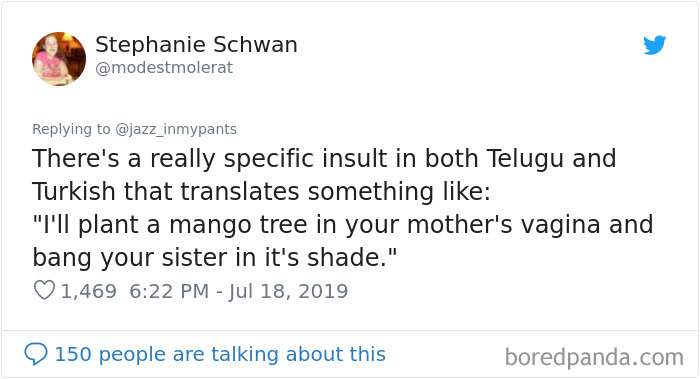
This is little bit wrong in the original mango tree was a flag pole and not sister , your wife
I like the creativity of this one. I'm gonna remember it in case I'm ever invited to the White House.
No there is not. Mango is not common in Turkey's geography. Could it be pine tree? There is an insult saying I planted a pine tree in your mother's vagina and you can go and collect the cones though.
The one who ever even came up with this phrase... :-O, so many questions!
LOL Something in punjab like this as well! I'll make a bed in your mothers vagina and f your sister in it. It's the worst thing you can ever say to someone in that language apparently!
That might be problematic to say these days, but I love it. Very succinct and rather self-explanatory.
Even not being appropiate, I assure you it's still a common saying.
Load More Replies...But I think it only got popular/introduced in the recent years, after "not my monkey, not my circus" gained popularity, too. I had never heard about it before until recently. We rather used "Man muss sich nicht jede Hose anziehen" = You don't need to wear (put on) every pair of trousers.
Load More Replies...Lithuanian: ne mano kiaulės, ne mano pupos. Literally: not my pigs, not my beans
Norwegian: Å parkere tøflene English meaning: To pass away Literal: To park one's slippers Norwegian: Å tråkke i salaten English meaning: Really made a mess of the situation Literal: To step in the salad
There's a somehow related one: "Éramos pocos y parió la abuela" English: on top of everything, we now have more problems Literal: we were few of us and grandma gave birth
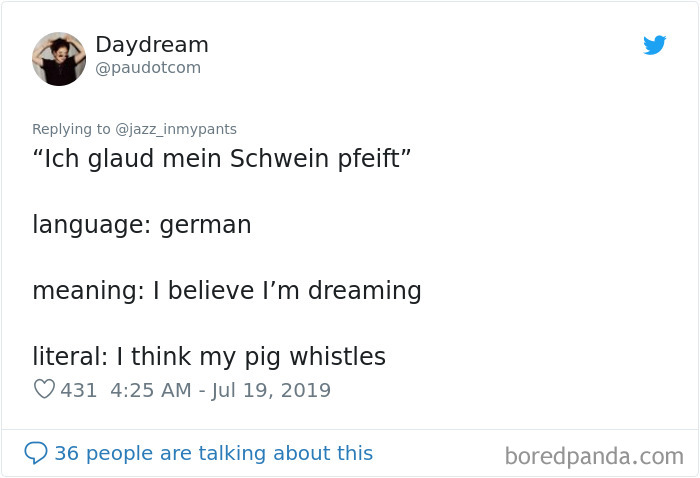
Midget is an old term for humans who never grow to be a normal size, and in the old days, it was common for circuses to have "weird" people (midgets, bearded women, siamese twins, people missing limbs performing everyday tasks, etc) as part of the program. Their weirdness was the core of their performance, so a midget growing normal size would likely leave the circus.
Load More Replies...Not on the point. Only when surprised in a negative sense. "I belief I'm dreaming" also is just a literal translation of "Ich glaub ich träume", which is in German either positive or negative surprise (intonation becomes important here :-D)
In Românian we say "te învârți că un coi într-o căldare" literally means "you are going round like a testicle in a pot "
Similar one in Romanian for when you're lost, shuffling around not knowing what to do. "Te invarti ca un coi intr-o galeata". Which literally translates to: You're spinning around like a testicle in a bucket.
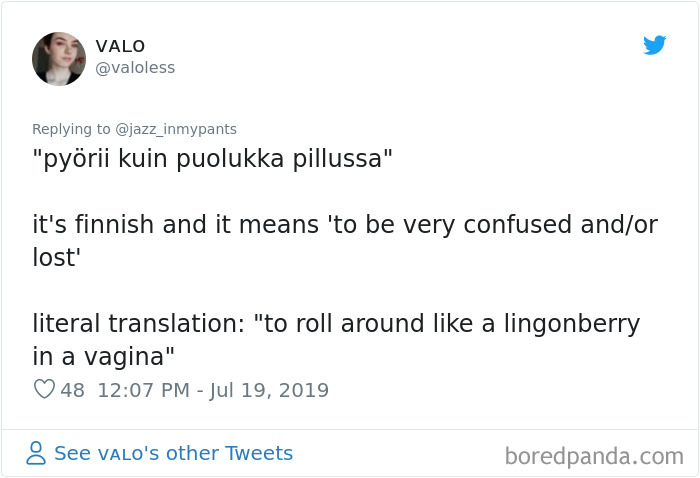
The story behind this phrase: "Pillu" was actually in 1600s a tool that was used to separate lingonberries out of all the other trash. Nowadays "Pillu" is a casual term for a vagina, just like pussy in English.
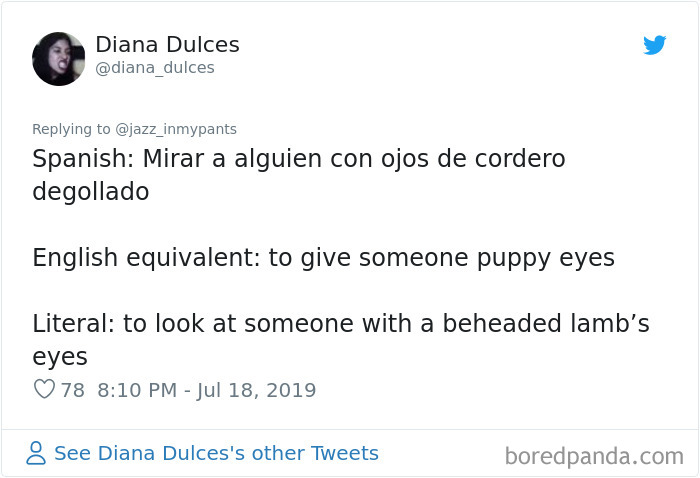
"Ölü koyun gibi bakmak" is a phrase we use in Turkish, which means "looking at someone or something stupidly, blankly because you didn't get what's going on". It's literal translation is "looking like a dead sheep"
Ahah in Portugal we say "Não olhes para mim com olhos de carneiro mal morto!" And the meaning is quite similar. "Don't look at me with your half dead lamb eyes". XD
in Portugal we say something alike : look someone with the eyes of a lamb not tottally killed :( (cordeiro mal morto)
No. It's kind of look as someone trying to make him/her feel pity for you, usually to get something, or because you did something wrong and you want to be forgiven. It usually implies the "beheaded lamb" is a little insincere and manipulative.
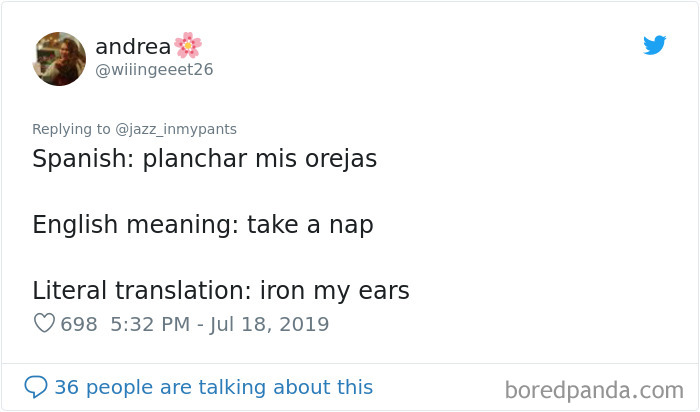
Load More Replies...German: "Sich auf's Ohr hauen" - "To pound oneself on the ear" probably indicating a rather vehement motion of jumping into one's bed
In mexican Spanish we also say "echarse un coyotito" (to kill a little coyote) for taking a quick nap
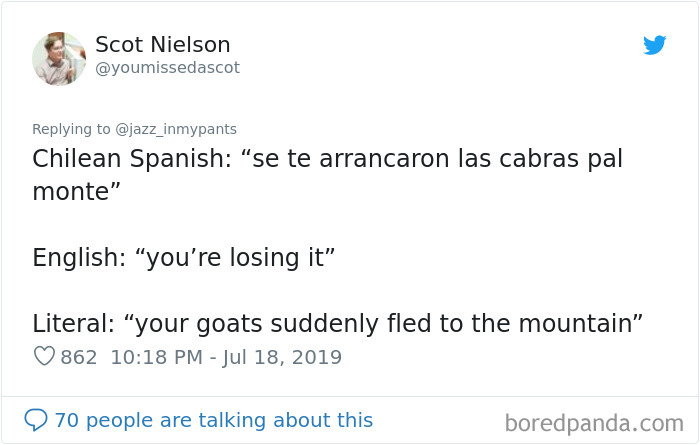
I'm just going to say "your goats have run to the mountain!"

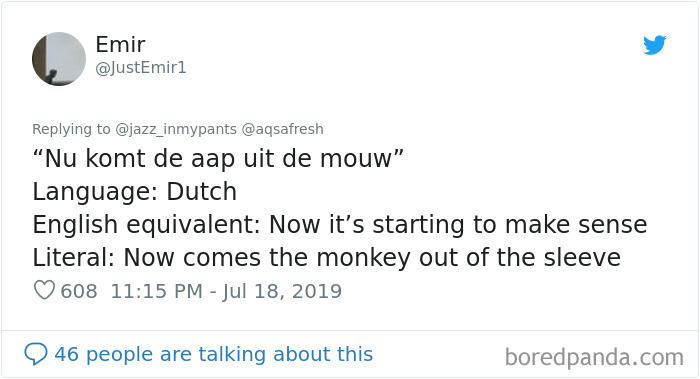
In Afrikaans "Die aap uit die mou laat" is also to reveal a secret.
Load More Replies...I couldn’t understand it before, but now come the monkey out of the sleeve
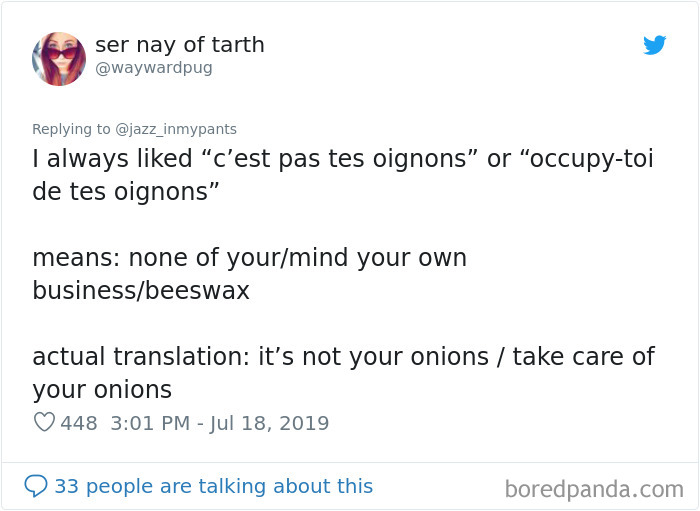
We have "Er soll vor seiner eigenen Tür kehren" - he should sweep in front of his own door.
We have something similar in Romanian: "Vezi-ti de ciorba ta" means: mind your own business actual translation: mind your own soup
Perkele, the legendary Finnish way of drinking! https://youtu.be/NAl9OyGYxOg

After drinking to much an having a hangover germans say '... sieht weise Mäuse' - 'seeing white mice' because a hangover is called 'einen Kater haben' - 'having a male cat'. Also used when your muscles are sore - 'Muskelkater'.
Isn't Katzenjammer headache? As in cats jammering in your head.
Load More Replies...Passer du coq à l'ane This is French Used to say that someone is hoping from one topic to another without logic The English can be translated as - Go from the rooster to the donkey .... or another way to say it would be - From to c**k to a*s.
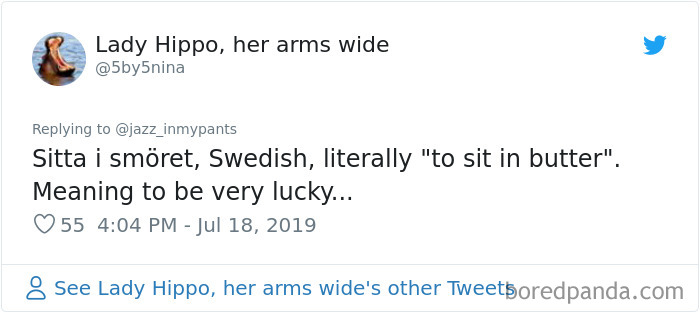
German "alles in Butter" means "everything is alright". Back in the days, fragile things were transported in butter (as in, you poured molten butter over it and then transported the whole hardened block).
We say this in Belgium as well (the Flemish part) 'Met uw gat in de boter gevallen' meaning: 'You felt with your buthole in the butter' - basicly meaning: you're very lucky!
In Dutch we have: "Met je neus in de boter vallen." Which literally translates to "To fall in butter with your nose." and also means to be lucky.
Polish: ‘jak pączki w maśle’ which means ‚alike the donuts (dipped) in the butter’
more or less the same in Dutch, but "fall into the butter with your a*s"
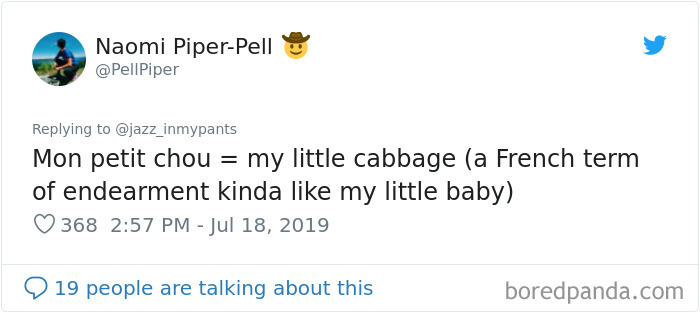
Endearment terms in French are pretty weird when you think about it. \1 mon petit chou /chouchou = my little cabbage /cabbage-cabbage (for both genders) 2\ ma puce = my flee (parents to their daughter or boyfriend to their girlfriend) \3 * mon lapin = my rabbit (I mostly hear older people call their grandchild like this) >> That's for the most common ones!
I'm a native French speaker and I always saw it as the pastry (chou à la crème) not the vegetable. But that's an interesting interpretation.
Load More Replies...French : "ça casse pas trois pattes a un canard" English: Nothing to write home about Litteral trasnlation: This does not break 3 legs to a duck
My 99-year-old mother still calls me "ma biche" (my doe). I'm 68, LOL
So the children's song "Savez-vouz planter les choux" (Do you know how to plant cabbages) is actually about making babies?
ah, sigh, my mom used to switch it up and call me 'mon petit chou-fleur' my little cauliflower :)
in Portugal too : repolho / little cabbage, the heart of the cabbage
Du hast nicht alle Tassen im Schrank.-German -equal to the English "you are not right in the head"- literally... you don't have all your cups in the cupboard.
I had a French teacher in high school mention "my fat rat" was another term of endearment. Unfortunately I don't remember it in French.
A certain children's rhyme that I almost forgot contains "Tomaten auf den Augen und Bohnen in den Ohren" (tomatoes on the eyes and beans in the ears, meaning blind and deaf)
"Tomaten auf den Augen und Bohnen in den Ohren" refers to people who can hear and see but are too ignorant or stupid to realize what they hear and see. It doesn't mean blind and deaf.
Load More Replies...But a cat is _supposed_ to eat rats! What about the cat goes the harsh after knocking 900 glasses off of shelves?

That one just goes to hold training courses for the other cats.
Load More Replies...Same in German! Well, almost. Germans "talk" around "the" hot porridge (um den heißen Brei herumreden)
In Sweden it´s "gå som katten kring gröten" - Walk like the cat around the porridge
In Swedish you say "Gå som katten kring het gröt", direct translation: "Walk like the cat around hot porridge"
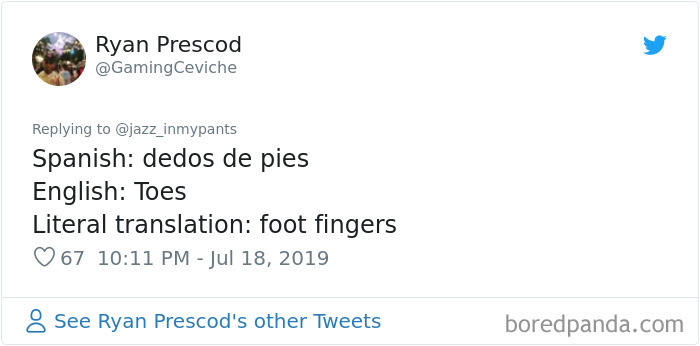
In italian they're just "fingers" without the "foot" specification (so you have 20fingers in Italian, where in English you have 8 as thumbs don't count; occasionally some don't count pinkies as their name doesn't end in "... finger").
Very similar thing in Hungarian, we use "ennivaló" which means it is meant to be eaten, for cute things like puppies or babies
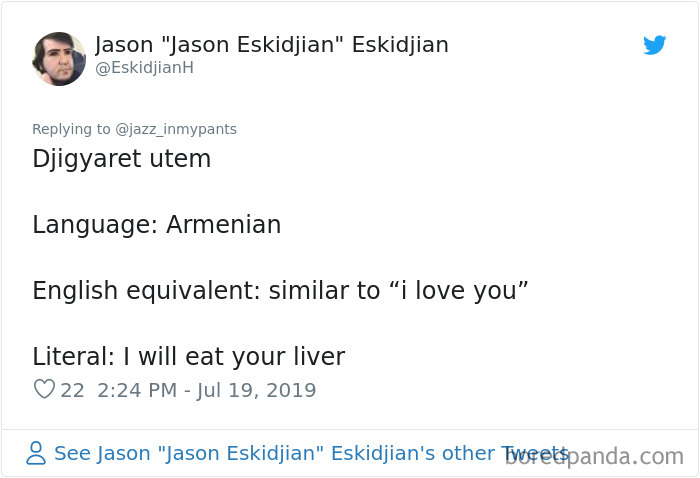
Maybe Zeus really loved Prometheus. I read that Prometheus may have been bound in the Caucasus somewhere, and Armenia is near there.
That's so cuuuute! ❤ If I'm not mistaken, in Mandarin Chinese you call someone who is dear to you "your heart and liver"
Turkish : Keçileri Kaçırdı Meaning : he/she lost his/her mind Literaly : his/her goats has escaped
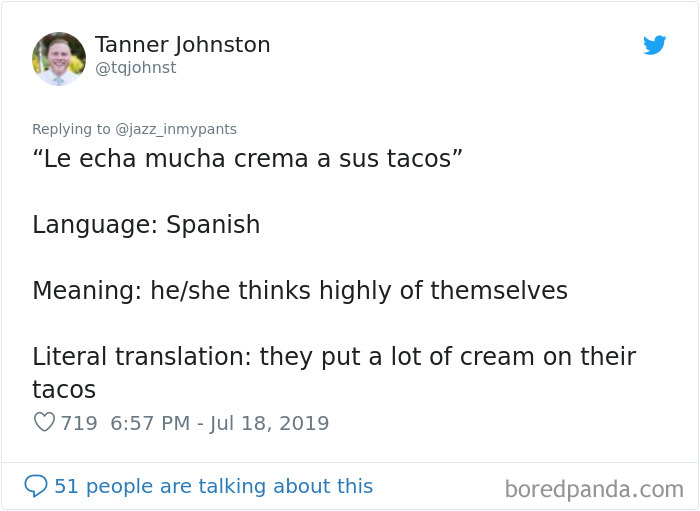
most likely sour cream. It tastes nice on tacos.
Load More Replies...It amazes me how many English words can fit in a small phrase in another language
I really like the word "roughly" as opposed to "literal" translations to most of these sayings...
Brazilian portuguese: "Vá para o diabo que te carregue". Literal: Go to the devil willing to carry you.

Hahaha we've got that in Romanian. "Du-te dracului'" which literally translates to "go to the devil". Never new it's in other languages because it's so specific, unlike "go to hell".
We also have "du-te dracu" wich means f**k off and translates as go to the devil
‚Diabli nadali...’ which means an unexpected bad luck and simply says ‘the devils have sent so’
"Nicht mein Bier/not my beer" is more used like "I'm not interested". Not my problem equals "Nicht meine Baustelle/Not my construction site"

My favorite foreign expression is the German "Tu ein Affenzahn darauf", which means "hurry up" but is literally "Put a monkey's tooth on it". I love it because it makes ZERO SENSE.

in italy, instead of healthy as a horse, they say healthy as a fish. an american once mocked my paesana, saying that it was stupid to change it to a fish, and she looked dead at him and said "I don't know, there's an awful lot of sick/dying horse movies, but i've never seen a fish sneeze"

It's the same in Norwegian, because both words for "healthy" and "fish", rhymes: Frisk som en fisk.
Load More Replies...Two of my favorite German idioms are missing, both of which have no short English equivalent. One is "innerer Schweinehund" (lit. inner pig-dog), roughly meaning "the lazy part of oneself". Procrastinating, staying inside when it's raining, taking he car instead of walking... that's all the doing of your "inner pig-dog" :) The other one is "eierlegende Wollmilchsau" (lit. egg-laying wool milk sow), meaning something that a) does and has everything you want and b) doesn't exist (not sure if "unicorn" refers to quite the same).
I really like "Das ist ja zum Mäuse melken." - "That's as if you are trying to get milk from mice." meaning something is very difficult and frustrating.
Load More Replies...Phrase: "Som na vážkach." Language: Slovak English phrase: "I am unable to decide for myself." Literal: "I am on dragonflies."
Im Italian so we have plenty of expressions that roughly translated means something different, however my favourite is french : "Les chiens aboient, la caravane passe" which is a sentence used to mean when an individual stick with his opinion, lead on uncaring of comments. But it means "The dog barked, but the caravan proceeded"
It's so interesting to see that many popular sayings are similiar in very different cultures and languages! Loved it.
In my part of Norway, well atleast my family, when we dont understand someones tast or what other likes we say "Smaken er som baken, den har to sider." which roughly translates to "the taste is like the butt, it has two sides."
What a wonderful place to add something. @BP: bring pack those series where we can add stuff!
I actually tried to make a post like this! But I never made a post here and couldn't find a way to make an ask-the-readers post, and figured that maybe such a function is only available for a select group of people... I would love, love, love to read more of these idioms.
Load More Replies...Few from Czech: Ospalý jako kotě which translates to Sleepy as kitten. Ožralý jako doga = drunk as Great Dane.
My boss taught me the phrase "Tā shìgè huāpíng". In Mandarin, it means "She's a vase." Basically, "She's pretty to look at but offers nothing inside."
In Germany we say: You can't eat from an empty plate.
Load More Replies...in italy, instead of healthy as a horse, they say healthy as a fish. an american once mocked my paesana, saying that it was stupid to change it to a fish, and she looked dead at him and said "I don't know, there's an awful lot of sick/dying horse movies, but i've never seen a fish sneeze"
It's the same in Norwegian, because both words for "healthy" and "fish", rhymes: Frisk som en fisk.
Load More Replies...Two of my favorite German idioms are missing, both of which have no short English equivalent. One is "innerer Schweinehund" (lit. inner pig-dog), roughly meaning "the lazy part of oneself". Procrastinating, staying inside when it's raining, taking he car instead of walking... that's all the doing of your "inner pig-dog" :) The other one is "eierlegende Wollmilchsau" (lit. egg-laying wool milk sow), meaning something that a) does and has everything you want and b) doesn't exist (not sure if "unicorn" refers to quite the same).
I really like "Das ist ja zum Mäuse melken." - "That's as if you are trying to get milk from mice." meaning something is very difficult and frustrating.
Load More Replies...Phrase: "Som na vážkach." Language: Slovak English phrase: "I am unable to decide for myself." Literal: "I am on dragonflies."
Im Italian so we have plenty of expressions that roughly translated means something different, however my favourite is french : "Les chiens aboient, la caravane passe" which is a sentence used to mean when an individual stick with his opinion, lead on uncaring of comments. But it means "The dog barked, but the caravan proceeded"
It's so interesting to see that many popular sayings are similiar in very different cultures and languages! Loved it.
In my part of Norway, well atleast my family, when we dont understand someones tast or what other likes we say "Smaken er som baken, den har to sider." which roughly translates to "the taste is like the butt, it has two sides."

What a wonderful place to add something. @BP: bring pack those series where we can add stuff!
I actually tried to make a post like this! But I never made a post here and couldn't find a way to make an ask-the-readers post, and figured that maybe such a function is only available for a select group of people... I would love, love, love to read more of these idioms.
Load More Replies...Few from Czech: Ospalý jako kotě which translates to Sleepy as kitten. Ožralý jako doga = drunk as Great Dane.
My boss taught me the phrase "Tā shìgè huāpíng". In Mandarin, it means "She's a vase." Basically, "She's pretty to look at but offers nothing inside."
In Germany we say: You can't eat from an empty plate.

Load More Replies...