Get Premium
Dark mode theme is available exclusively for premium users. Learn more about the benefits of subscribing.
No fees, cancel anytime.

 Dark Mode Ad-Free Browsing Unlimited Content
 Ad-Free Browsing Unlimited Content Dark Mode
Join 1.2 million Panda readers who get the best art, memes, and fun stories every week!

Neil deGrasse Tyson found himself at the center of another internet debate after a Christmas-themed science post reignited long-running arguments about fiction and whether anyone really wants biology lessons on Christmas Eve.
The astrophysicist’s comment, which featured an old observation about reindeer antlers, quickly spread across X and prompted thousands of reactions ranging from sarcastic jokes to outright annoyance.
Image credits: StarTalk
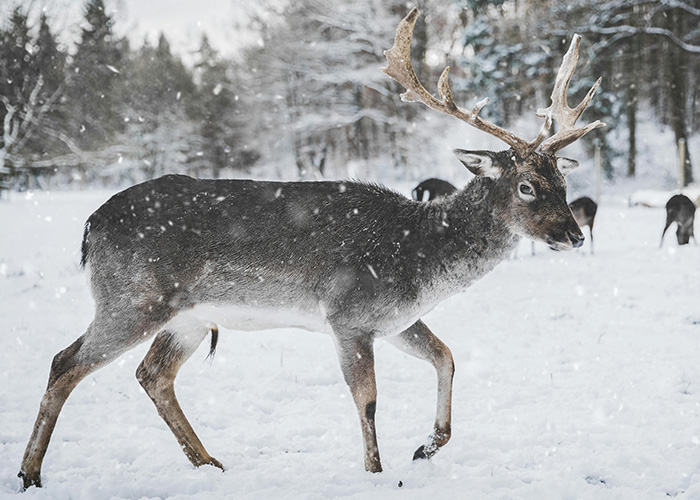
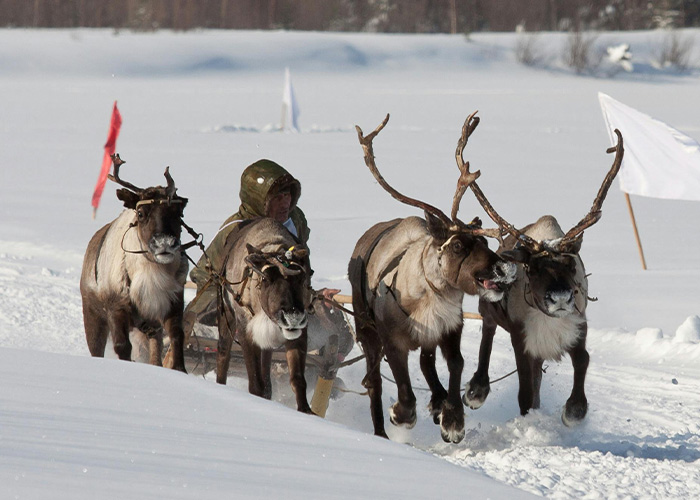
The controversy began when Tyson shared a post explaining that both male and female reindeer grow antlers, but males typically lose them by late autumn.
Based on that biological detail, he concluded that Santa’s reindeer, including Rudolph, would therefore be female.
Image credits: StarTalk
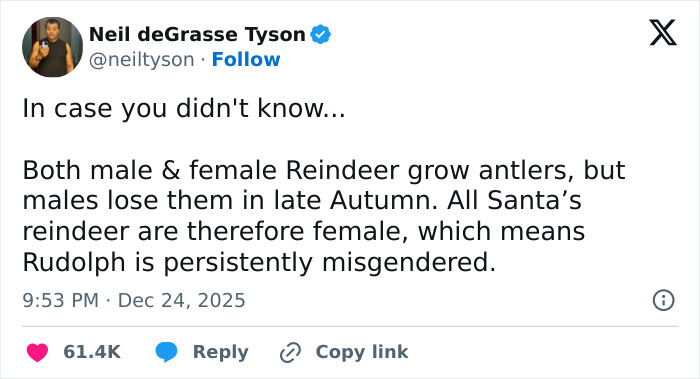
“In case you didn’t know… Both male & female Reindeer grow antlers, but males lose them in late Autumn,” Tyson wrote. “All Santa’s reindeer are therefore female, which means Rudolph is persistently misgendered.”
The post rapidly went viral with 3.1 million views and thousands of replies, many of whom were not appreciative of the astronomer’s comments.
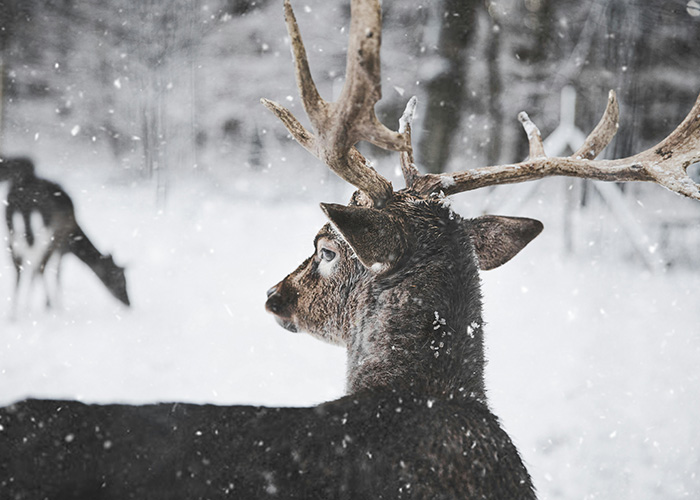
Image credits: Annika Thierfeld
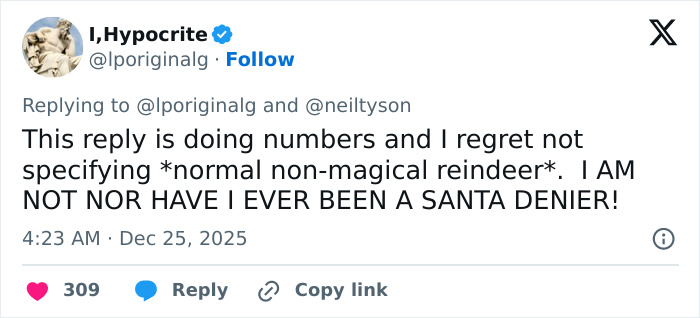
The replies quickly turned blunt and comedic. One user wrote, “You’re never gonna believe this, but Reindeer can’t fly around the world either.”
Another added, “Rudolph also has a red nose and can fly, because he’s a fictional character. Anything goes in fiction. Quit taking everything so seriously.”
Image credits: neiltyson
Image credits: lporiginalg
Others leaned into sharper humor. “Why are you over there thinking about reindeer genitals on Christmas Eve?” one comment read, while another simply declared, “You must be fun at parties.”
The tone of the backlash suggested that many readers were less offended by the science itself and more exasperated by what they saw as an unnecessarily petty post during the year’s biggest holiday.
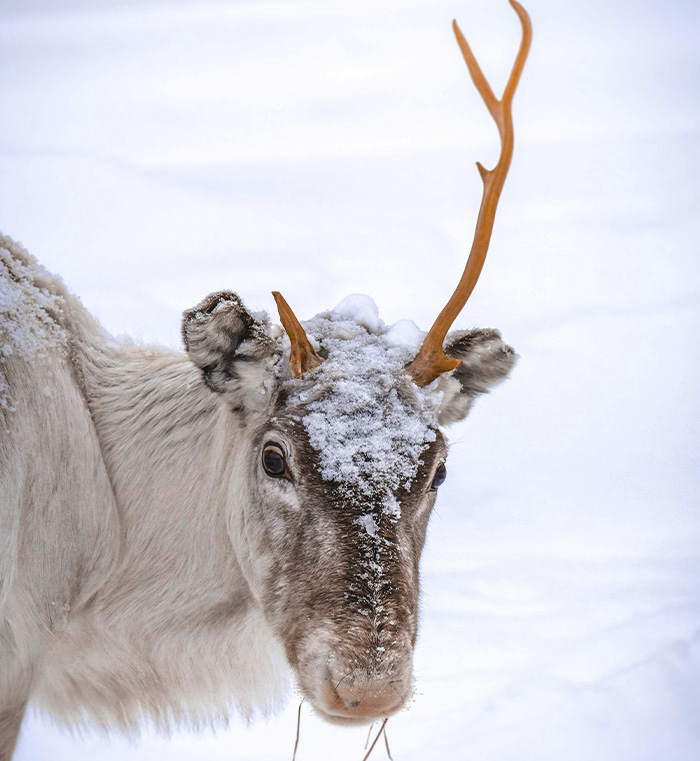
Image credits: Annika Thierfeld
For some, the post also represented a broader frustration with some people’s tendency to nitpick beloved traditions.
Image credits: StarTalk
Longtime followers were quick to point out that Tyson had made the exact same argument years earlier. On December 25, 2015, he posted: “Male & female Reindeer grow antlers, but males lose them in winter. All Santa’s reindeer, Rudolph too, are therefore female.”
That earlier post triggered a similar wave of reactions, with some commenters stating that Tyson was trying to “ruin Christmas.”
Image credits: Walt_T_Evans
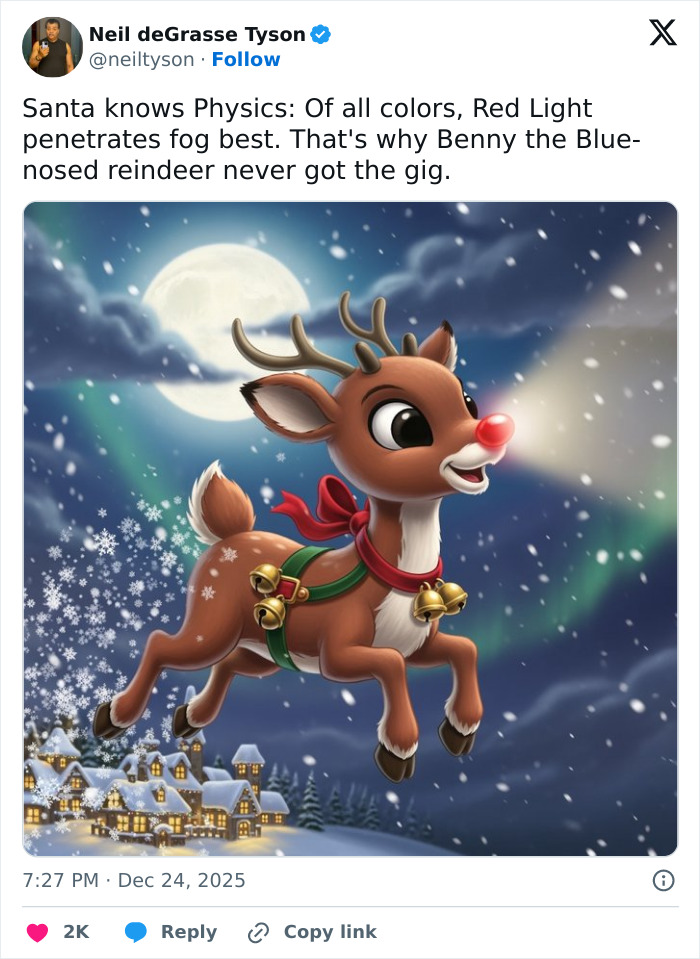
Tyson’s interest in Rudolph’s biology and physics has also extended beyond antlers. In December 2011, he shared another analysis, writing: “According to the song, Rudolph’s nose is shiny, which means it reflects rather than emits light. Useless for navigating fog.”
On the same day, he followed up with a correction: “Red light cuts thru fog better than white. So if Rudolph’s nose did glow, he’d indeed prevent Santa from flying into mountains.”
Image credits: Francesco Ungaro
Rudolph the Red-Nosed Reindeer did not originate from ancient folklore or traditional Christmas mythology. The character was actually created in 1939 by copywriter Robert L. May for a Montgomery Ward holiday promotion.
May wrote the story to give away as a free booklet to customers, and it featured Rudolph as an underdog whose glowing red nose set him apart. The story also framed Rudolph as a target of ridicule before ultimately saving Christmas.
Image credits: neiltyson
Image credits: Aleksandr Unikovskiy
The character’s popularity exploded a decade later when May’s brother-in-law, Johnny Marks, adapted the story into the song Rudolph the Red-Nosed Reindeer.
Recorded by Gene Autry in 1949, the song became one of the best-selling Christmas singles of all time and permanently cemented Rudolph in holiday culture.
You must be fun at parties
— Conscious Philosopher (@consciousphilos) December 25, 2025
Over the years, Rudolph has appeared in countless books, TV specials, and films, most notably the 1964 stop-motion classic.
Image credits: DamonBruce
Image credits: lporiginalg
Image credits: JimmyVielkind
Image credits: francip
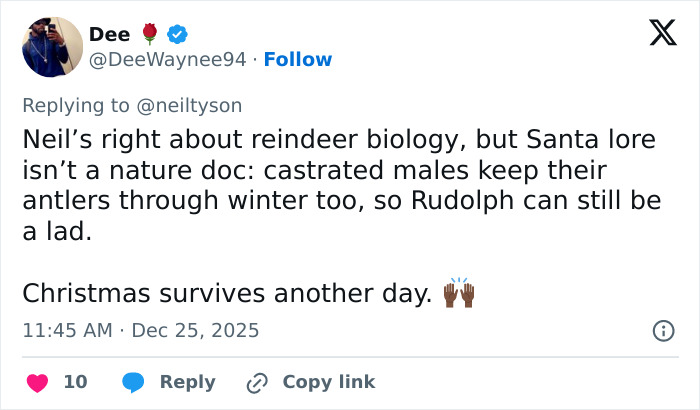
Image credits: DeeWaynee94
Image credits: TheEntropyPilot
Image credits: dracosrevenge
Image credits: fr1joler0_97
Image credits: Sigilfish
Image credits: cangpanjaaang
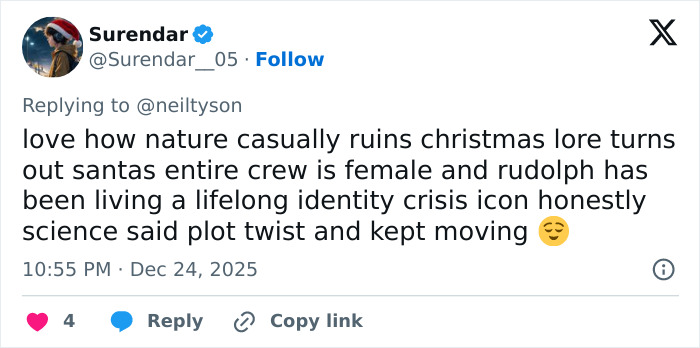
Image credits: Surendar__05

By entering your email and clicking Subscribe, you're agreeing to let us send you customized marketing messages about us and our advertising partners. You are also agreeing to our Privacy Policy.
Thank you! You've successfully subscribed to newsletters!




And there are no reindeer at the North Pole. They are native to Nothern Eurasia (Norway, Sweden, Finland and Russia) plus caribou in Canada, Alaska and Western Greenland.
There are actually around the same number of reindeer at the North Pole as there are elves.
Load More Replies... And there are no reindeer at the North Pole. They are native to Nothern Eurasia (Norway, Sweden, Finland and Russia) plus caribou in Canada, Alaska and Western Greenland.
There are actually around the same number of reindeer at the North Pole as there are elves.
Load More Replies...

































 No fees, cancel anytime






















12
20