Get Premium
Dark mode theme is available exclusively for premium users. Learn more about the benefits of subscribing.
No fees, cancel anytime.

 Dark Mode Ad-Free Browsing Unlimited Content
 Ad-Free Browsing Unlimited Content Dark Mode
Join 1.2 million Panda readers who get the best art, memes, and fun stories every week!

Group projects are the bane of the educational system. Sure, in theory, they are supposed to teach collaboration, communication, and problem-solving skills, but in practice, that rarely happens. Without fail, someone always slacks off, and the others are left to cover for them. Not only is it unfair, but it also shows students that they can get away with being lazy and sometimes even be awarded with a good grade for it — the complete opposite of what group projects are trying to achieve.
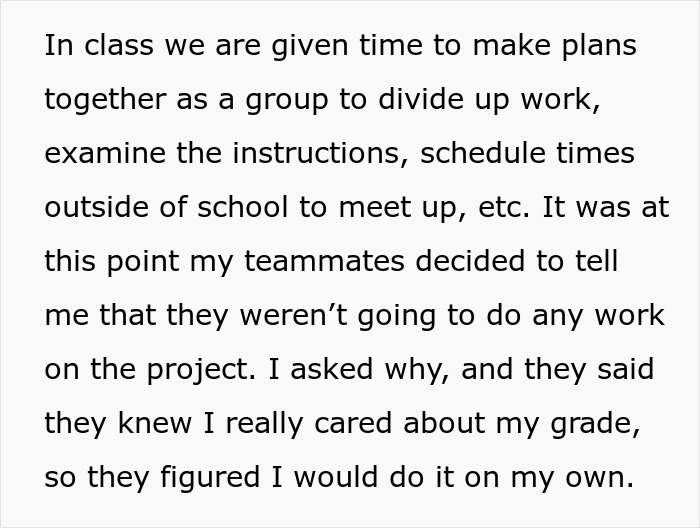
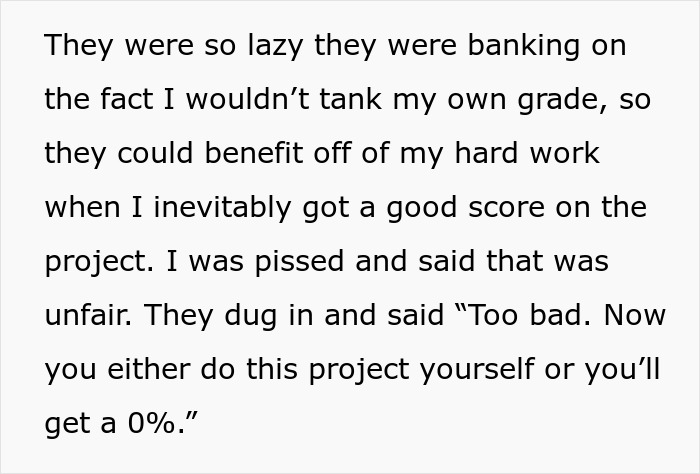
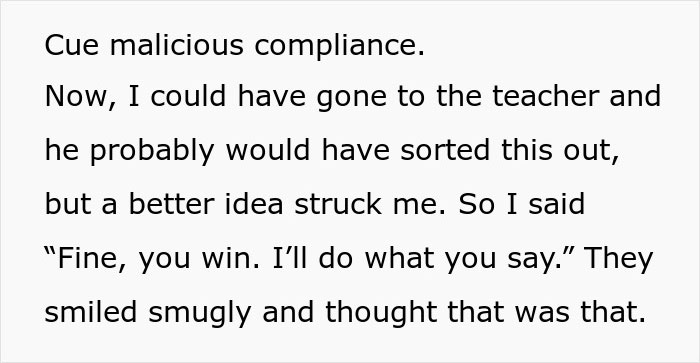
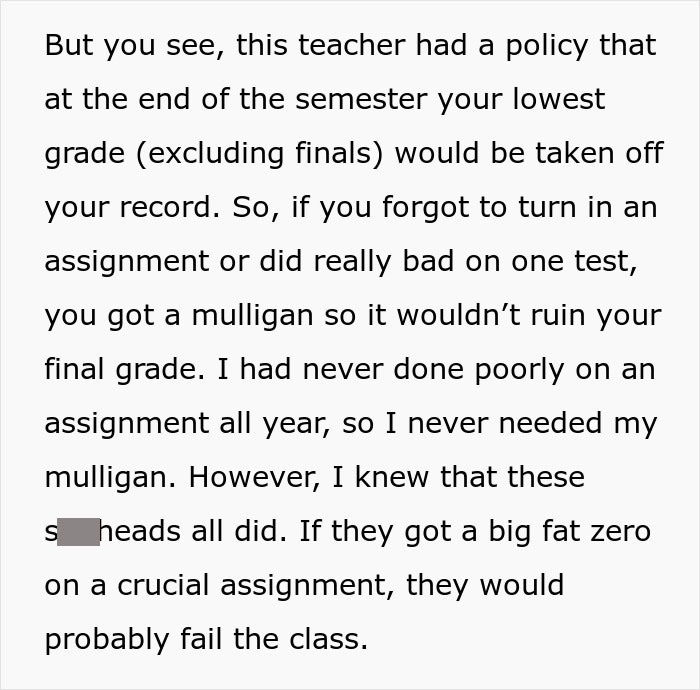
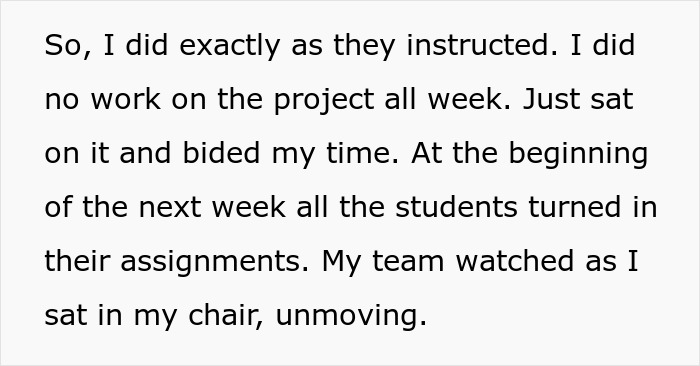
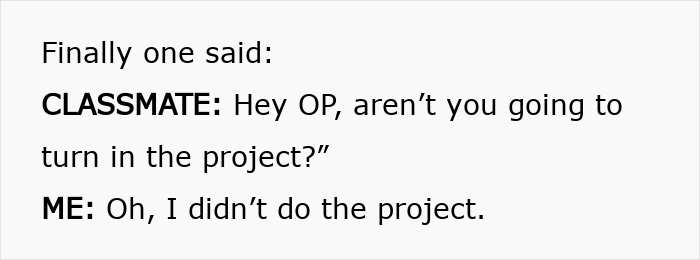
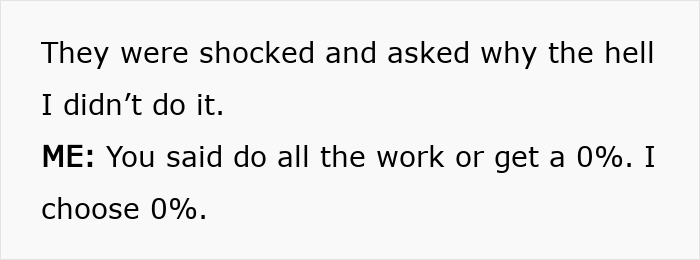
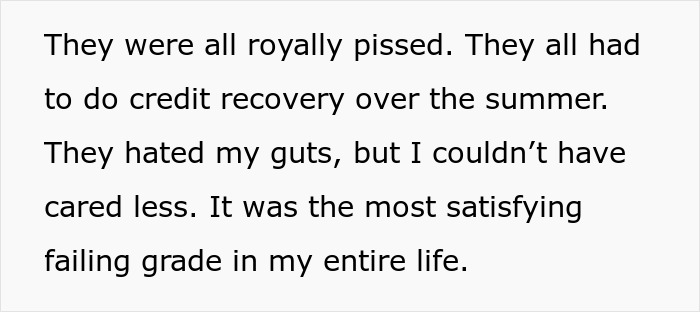
A similar thing almost happened to this student (now an adult), whose teammates expected him to do all the work alone because he cared too much about his grades. But instead of complying with them, he outsmarted them, which they very much didn’t appreciate.
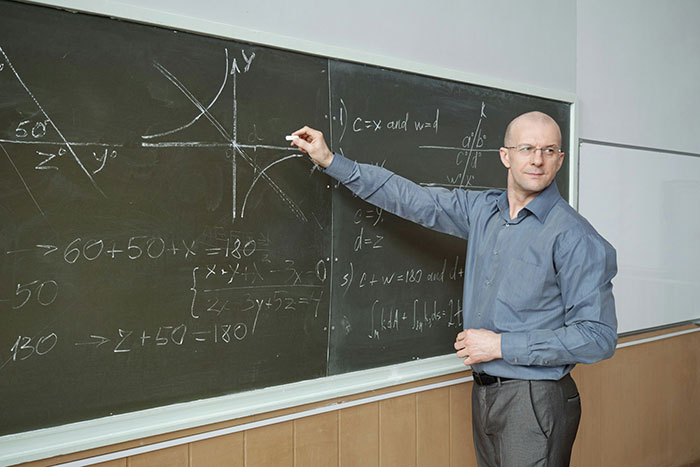
Image credits: Wavebreakmedia / Envato (not the actual photo)
Image credits: YuriArcursPeopleimages / Envato (not the actual photo)
Image credits: wheresmychin
Image credits: Curated Lifestyle / Unsplash (not the actual photo)
In theory, group work in school sounds nice, but we all know that reality often doesn’t match the theory. What should be a collaborative effort commonly ends up being an unfair freeloading exercise. In 2024, a study done by the National Library of Medicine found that group projects might not work for everyone due to a few reasons:
But educators still feel it’s important to have a project that allows collaboration in the classroom.
“I think this is a learning opportunity for students to prepare for their ‘real world’ careers outside of academia,” Stephanie Gomez, an associate professor of critical media studies at Western. “It’s going to happen everywhere they go, so it’s important to learn how to deal with it in the classroom where, frankly, the stakes are lower.”
“The cooperation and ability to put together a diverse set of ideas into an end product is very meaningful and really important,” agreed Rory Peterson, a Western alumnus with a degree in recreation management leadership. That said, “Professors really have to determine whether or not it makes sense in their courses,” Peterson added.
Image credits: Getty Images / Unsplash (not the actual photo)
It seems that group work isn’t going anywhere any time soon, so educators as well as students might benefit from some tips on how to make joint projects less of a hassle. We understand that in already high-stress environments that are educational institutions, team projects can significantly add to it, so learning how to navigate them can be really useful. If you can’t beat them, join them, am I right?
The first thing to do when a team receives a joint project is to carefully read through it and analyze it. Then try to divide it into tasks that should be assigned to everyone, taking into account their qualities and strengths. The roles should be very clear so that every teammate knows their responsibilities. Putting a deadline on every task that should be completed can also be a useful guideline that each member can follow.
During this process, the team should have mandatory group meetings to assess the progress and see if everyone is on the same page. Organizing the shared work on the right software can help to see how everyone is doing. If someone is slacking and refuses to listen, try talking to the teacher about it and documenting everyone’s contribution, which should be put down on the assignment paper.
What professors can do to make students more fond of group projects is to teach them the group work skills, as not everyone is equipped with them. Educators may run through some issues teammates might face while working together and how they can overcome them. They should stress the importance of communication and regular check-ins so the team remains on track.
Lastly, educators might consider having collaborative assignments in class and leaving more individual tasks for homework. This way, students can still have team projects but don’t have to worry about meeting up with teammates after class, which gets harder and harder in higher education.

By entering your email and clicking Subscribe, you're agreeing to let us send you customized marketing messages about us and our advertising partners. You are also agreeing to our Privacy Policy.
Thank you! You've successfully subscribed to newsletters!


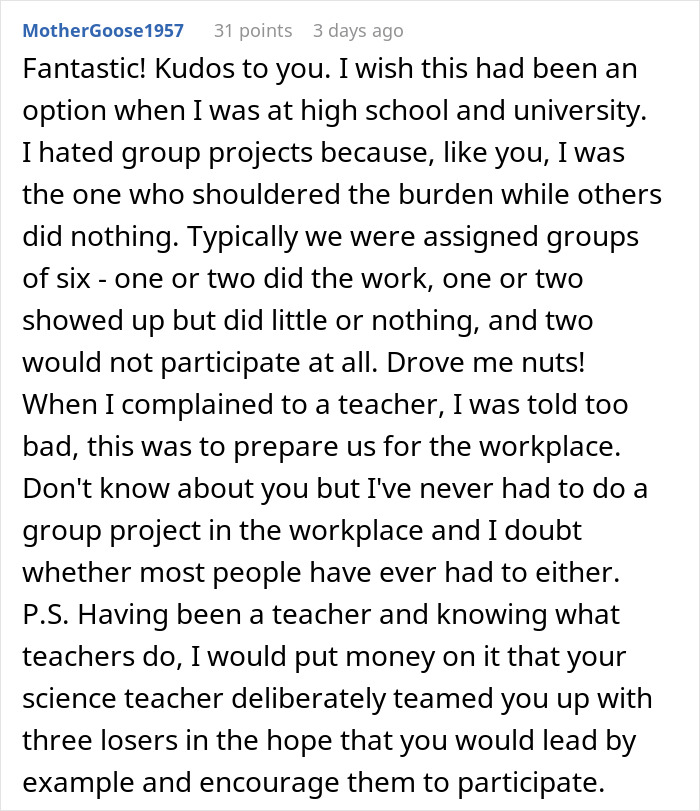
Group projects do not work with anybody under university age due to kids and teens being lazy. I'm a teacher and I never give those. There will always be complaints about who's in the group, can we have extra people, can I work alone, blah blah. No thanks.

In college, in the 70s, I was paired with someone I didn't know for an audio-visual presentation. Slides and a cassette tape. I did 99% of the work. When my "partner" didn't show up for the setup until I was partway through the presentation, and couldn't answer questions about any of the slides, the professor gave her a D and me an A. B***h. I tried to engage her in the work, provide source material and information.
Load More Replies...
Ironically, the OP did his homework on doing his homework, and found out that for this instance, he didn't need to do his homework!

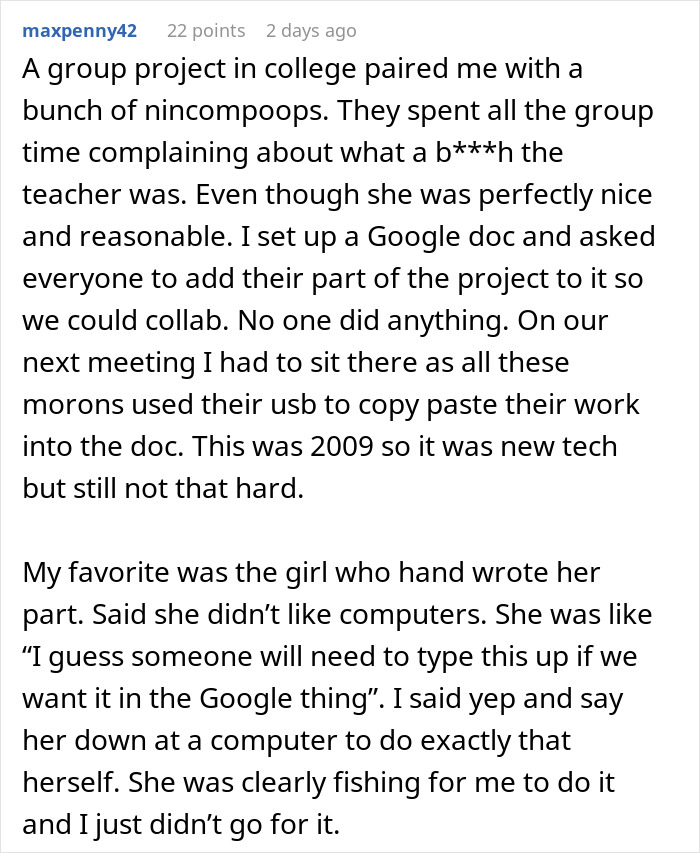
Group stuff sucked. In Uni, we got paired to do a series of experiments in a physics lab, write repots on it and such. My partner ... was a handful. He refused to give me his phone number, or take mine, and didn't show up to meet to get our stuff straight three times within two weeks. Next experiment, he didn't come, but called the institute. I did it alone. I tracked him down, and when I tried to talk to him, standing in his way, he just walked basically through me, and turned around a few steps on to greet me with "Huh?". Next experiment - already two in I did the report alone - I went to the emergency dentist instead, called the institute, but not him, because he never gave me his number. He was furious. I had enough, signed up for next semester, got a new partner from the Ivory Coast, who was fluent in French, but not in physics. He openly admitted to not expecting to be of much use for the reports, nor oral examination that follows each written one being handed in. I don't speak French. The institution-guy neither ... we got nearly 100 % - "May I resort to French, I'm not that fluent in german yet?" - "Sure so, if somebody can translate..." - yeah, of course I could. I'm almost a native speaker, but only for this one institute.
Group projects do not work with anybody under university age due to kids and teens being lazy. I'm a teacher and I never give those. There will always be complaints about who's in the group, can we have extra people, can I work alone, blah blah. No thanks.
In college, in the 70s, I was paired with someone I didn't know for an audio-visual presentation. Slides and a cassette tape. I did 99% of the work. When my "partner" didn't show up for the setup until I was partway through the presentation, and couldn't answer questions about any of the slides, the professor gave her a D and me an A. B***h. I tried to engage her in the work, provide source material and information.
Load More Replies... Ironically, the OP did his homework on doing his homework, and found out that for this instance, he didn't need to do his homework!
Group stuff sucked. In Uni, we got paired to do a series of experiments in a physics lab, write repots on it and such. My partner ... was a handful. He refused to give me his phone number, or take mine, and didn't show up to meet to get our stuff straight three times within two weeks. Next experiment, he didn't come, but called the institute. I did it alone. I tracked him down, and when I tried to talk to him, standing in his way, he just walked basically through me, and turned around a few steps on to greet me with "Huh?". Next experiment - already two in I did the report alone - I went to the emergency dentist instead, called the institute, but not him, because he never gave me his number. He was furious. I had enough, signed up for next semester, got a new partner from the Ivory Coast, who was fluent in French, but not in physics. He openly admitted to not expecting to be of much use for the reports, nor oral examination that follows each written one being handed in. I don't speak French. The institution-guy neither ... we got nearly 100 % - "May I resort to French, I'm not that fluent in german yet?" - "Sure so, if somebody can translate..." - yeah, of course I could. I'm almost a native speaker, but only for this one institute.






























 No fees, cancel anytime

















54
31