Get Premium
Dark mode theme is available exclusively for premium users. Learn more about the benefits of subscribing.
No fees, cancel anytime.

 Dark Mode Ad-Free Browsing Unlimited Content
 Ad-Free Browsing Unlimited Content Dark Mode
Join 1.2 million Panda readers who get the best art, memes, and fun stories every week!
Teenage rebellion is a natural part of growing up. However, for parents, it’s often a difficult and stressful time. Reddit user u/HelpIHateTexas shared a story on the subreddit r/pettyrevenge about her 16-year-old son that perfectly illustrates this.
The boy started skipping school. It got to a point that no matter what the mom did, he found a way to get out of classes. Worried that he was putting his future at risk, she turned to a police officer she knew for help.
Image credits: cottonbro studio (not the actual photo)
Image credits: Martin Jernberg (not the actual photo)
Image source: HelpIHateTexas
We got in touch with u/HelpIHateTexas and she was kind enough to give more information on her son’s troublesome time.
“My relationship with my son was very good,” the mom told Bored Panda. “As long as he made good grades, communicated his whereabouts, stayed out of trouble with the law, did not do hard drugs and/or alcohol, and practiced safe sex, I let him make his own decisions. This particular instance broke the ‘stay out of trouble with the law’ rule, so I had to act, for both of our benefits!”
When asked about her son’s academic performance, u/HelpIHateTexas said, “In general I had to ‘chase’ J to make him keep up with his academic responsibilities. He made it to graduation but not without a fair amount of nagging. School just wasn’t a priority for him.”
u/HelpIHateTexas also added that “college and university are not for everyone, and I knew pretty early he was not an academic-oriented child. That was OK, but I at least wanted him to finish high school so he had options.”
Image credits: Dids (not the actual photo)
Schools take truancy seriously, as excessive absences negatively impact a child’s ability to be a successful student. Data from The Department of Education shows that kids who miss a lot of classes are more likely to fall behind in reading skills, and have a higher drop-out rate than their peers who attend them.
Additionally, public schools in some states like California and Texas receive state and federal funding based on their daily attendance, so they’re heavily motivated in getting students to come in every single day.
Under the “compulsory education” laws in Texas, all children must attend school from the time they’re 6 (or are enrolled in first grade) until they turn 19. There are exceptions, and some students may leave school early if they meet the Texas requirements for dropping out at age 17 or 18.
Although the state has decriminalized its treatment of truants, some parents could still face criminal penalties for not making their children go to school.
Image credits: EKATERINA BOLOVTSOVA (not the actual photo)
In 2015, Texas changed the way it deals with truant students. Instead of sending them to juvenile court, the state now has a multistage process focused on addressing the underlying causes of attendance programs. When a student has three or more unexcused absences in a six-month period during the same school year, the district will either:
If those prevention measures fail and students rack up 10 or more absences in 6 months, schools will refer them to truancy court unless those absences resulted from pregnancy, homelessness, being in foster care, or being the main bread-earners in their families. Although truancy isn’t a crime, this civil court may order the truants to take “remedial” steps, such as:
Truancy courts may order the parents of frequently absent students to do certain things too, including participate in counseling, take special classes, or perform community service.
If parents disobey those orders, they could be charged with contempt and face fines, up to 3 years in jail, and/or community service. Parents could also face misdemeanor charges if they were criminally negligent by not forcing their kids to go to school.
Although her methods were unusual, it sounds like this mom successfully managed to get her teen to change his ways, and they both avoided any further trouble.
“There were a lot of replies suggesting I failed as a parent because I did not include information on the many discussions my son and I had about why he didn’t want to go to school,” u/HelpIHateTexas added. “Of course, we had those discussions! There was no bullying and no trauma. It basically boiled down to him having a bad sleep schedule. He was a ‘night owl’ and even when I grounded him from games and TV, he stayed up all night. This made him want to stay home and sleep all day!”
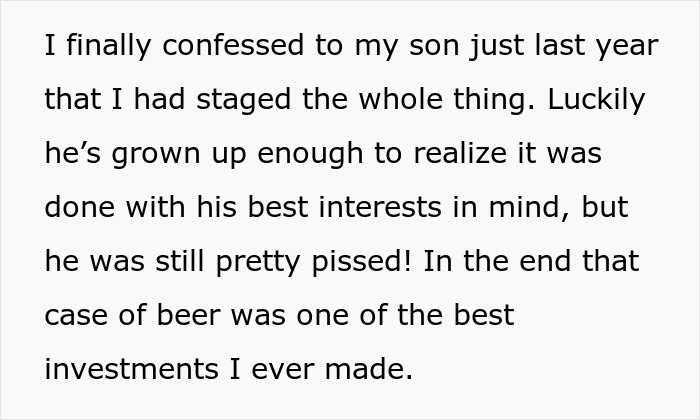
Despite some negative responses on Reddit, she stands by the decision to stage the arrest, saying, “No other ‘battle plan’ would have worked as quickly and thoroughly as the arrest I staged. The change in his attendance was immediate and we had way less angst in our morning routine. I don’t regret handling it how I did at all.”

Or you could, you know, actually talk to your son find out just what he hates about school. Has something changed? Is he being bullied by his teachers? My younger brother started skipping school several times a week, and when my mom talked to him about it, she learned that he couldn't stand being made fun of for his terrible acne. She taught him that he wouldn't have to return to school if he could pass the

Does any 16 year old really like school? Not very many, I'd guess.
Load More Replies...
I feel like if he hated school that much, something was going on at school and mom should have talked to him about it.

Could be the way it was for me and how it is for my older kids -- way too smart for the school, enough that, had we been given a Waldorf/Steiner or Montessori education we could have aced a high school equivalency exam by 12. School was frickin boring, forced us to be around toxic a-holes that we couldn't do anything about, bored us to death and punished us for being bored.
Load More Replies...
I recently had a similar letter about my daughter in middle school. Except, the school is upset about her _excused_ absences. One day was a doctor appointment, but all the rest have been because she was sick. First she had COVID and was out for a week, and then she had an unspecified fever/nausea/vomiting for a week. The letter said that any more absences would have consequences, but what am I supposed to do? Send her to school when she's sick? I just pray she's not sick again before the end of the year. /vent
Next time she's sick make sure to get a doctors note. If they still complain go to school with her and make sure she throws up in whoever is responsible for that letter's office. That’ll deal with it for sure. Some school are just absurd.
Load More Replies... Or you could, you know, actually talk to your son find out just what he hates about school. Has something changed? Is he being bullied by his teachers? My younger brother started skipping school several times a week, and when my mom talked to him about it, she learned that he couldn't stand being made fun of for his terrible acne. She taught him that he wouldn't have to return to school if he could pass the
Does any 16 year old really like school? Not very many, I'd guess.
Load More Replies... I feel like if he hated school that much, something was going on at school and mom should have talked to him about it.
Could be the way it was for me and how it is for my older kids -- way too smart for the school, enough that, had we been given a Waldorf/Steiner or Montessori education we could have aced a high school equivalency exam by 12. School was frickin boring, forced us to be around toxic a-holes that we couldn't do anything about, bored us to death and punished us for being bored.
Load More Replies... I recently had a similar letter about my daughter in middle school. Except, the school is upset about her _excused_ absences. One day was a doctor appointment, but all the rest have been because she was sick. First she had COVID and was out for a week, and then she had an unspecified fever/nausea/vomiting for a week. The letter said that any more absences would have consequences, but what am I supposed to do? Send her to school when she's sick? I just pray she's not sick again before the end of the year. /vent
Next time she's sick make sure to get a doctors note. If they still complain go to school with her and make sure she throws up in whoever is responsible for that letter's office. That’ll deal with it for sure. Some school are just absurd.
Load More Replies...































 No fees, cancel anytime





























78
68