Get Premium
Dark mode theme is available exclusively for premium users. Learn more about the benefits of subscribing.
No fees, cancel anytime.

 Dark Mode Ad-Free Browsing Unlimited Content
 Ad-Free Browsing Unlimited Content Dark Mode
Join 1.2 million Panda readers who get the best art, memes, and fun stories every week!
Price can be a significant barrier to our mental well-being. For example, according to Verywell Mind's 2022 Cost of Therapy Survey, 40% of Americans require financial support to afford professional care.
The researchers also found the average cost of a therapy session to be $178 per month. Considering that working on ourselves usually takes a fair amount of time, that figure can quickly add up.
The good news is that people are also increasingly open to discussing their mental health and sharing their experiences. This is also illustrated in a recent Reddit thread started by platform user AnonyMiss0018 asking, "What is a little bombshell your therapist dropped in one of your sessions that completely changed your outlook?" Here are some of the most popular answers.
This post may include affiliate links.
 "stop trying to get everyone to agree - when you need everyone to agree the least agreeable person has all the power"
Really changed my outlook on planning family events.
"stop trying to get everyone to agree - when you need everyone to agree the least agreeable person has all the power"
Really changed my outlook on planning family events.
 “You always talk about not wanting to do to your daughters what your mom did to you. You worry about it so much in every interaction you have ever had with them. But your children are 19 and 21 now. They are happy and healthy and they trust you because you’ve never abused them in any way. So I just want to validate for you that you really have broken that cycle of violence. You did that. And you should be proud of it. I’m proud of you for it.”
We managed to get in touch with the author of the post, and the Redditor agreed to have a little chat with us about it.
"I was making plans with my difficult family for the holidays but had just been looking at another post on Reddit when the idea for the post came to me," Anonymiss0018 told Bored Panda. "I was thinking about my own therapy and how it has improved my life dramatically."
After going through the discussion, they said that "a lot of [the recurring] themes I noted were that people want love and acceptance, and they're trying to take responsibility for their own mental health."
"There's a lot of generational trauma, and people have a lot of heartbreaking stories. But they're putting in a lot of hard work to better themselves and heal."
If you literally laid down and let people walk all over you, someone would complain that you're not flat enough.
I don't work as a therapist. I'm an ESL (English as a Second Language) teacher in Japan. But my classes are one-on-one, so I do spend a lot of time on consultation and personal conversations. Something I said to a client once seemed to really change his outlook. A lot of my company's clients are focused on learning English for international business, and this man, as many of them are, was concerned about making mistakes and looking like a fool. I asked him if the English-speakers he works with sometimes try to speak Japanese, and he said that they do. I asked him if they ever make mistakes, and he said that they do. I asked him to name one, and he couldn't. And I told him that his mistakes will be forgotten, too.
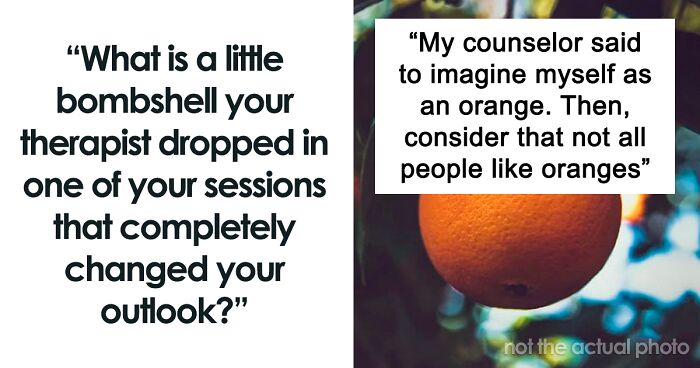
 My counselor said to imagine myself as an orange. Then, consider that not all people like oranges. That doesn't mean that the orange is flawed in any way, not rotten, just that everyone has preferences. That helped ease my insecurities and need for people pleasing dramatically.
In 2021, 42 million American adults sought mental health care of one form or another, up from 27 million in 2002.
Increasingly, people have been buying into the idea that therapy is one way they can significantly better their lives.
That conviction gained momentum in 1977, when the psychologists Mary Lee Smith and Gene V. Glass published the most statistically sophisticated analysis on the subject until that time. In their meta-analysis, they looked at some 400 studies and found that among the "neurotics" and "psychotics" who had undergone various kinds of talk therapy, the typical patient fared better than 75 percent of those with similar diagnoses who went untreated.
Since then, the notion that therapy has real benefits has been replicated numerous times in analyses applied to patients with anxiety, depression, and other prevalent disorders.
 “Don’t think of the relationship as over. Think of it as complete.”
Fundamentally changed how I was processing a tough breakup. So helpful.
“Don’t think of the relationship as over. Think of it as complete.”
Fundamentally changed how I was processing a tough breakup. So helpful.

Also: some friendships have an experation date. Maybe just just matched while you were in a certain phase in your life. That's ok. They don't have to be forever to have worth.
 "Your mom is never going to be the parent you want or need, so stop expecting her to be and being mad that she isn't."
Also:
"People who are addicts tend to get frozen at the time they started abusing drugs or alcohol, because their focus is their addiction and not developing as a person. So a person who started drinking heavily at 13 and quit at 30 would behave a lot like a 13-year old."
"Your mom is never going to be the parent you want or need, so stop expecting her to be and being mad that she isn't."
Also:
"People who are addicts tend to get frozen at the time they started abusing drugs or alcohol, because their focus is their addiction and not developing as a person. So a person who started drinking heavily at 13 and quit at 30 would behave a lot like a 13-year old."
You can't control other people's crazy, but you can control your proximity to their circus.
“I think the evidence is fairly clear that psychotherapy is remarkably effective,” said Bruce Wampold, a prominent researcher in the field who is an emeritus professor of counseling psychology at the University of Wisconsin-Madison.
To him, the power of such a low-tech treatment is nothing short of a miracle, especially given that studies typically follow patients for 20 sessions or fewer. "The fact that you can just go talk to another human being — I mean, it’s more than just talking — and get effect sizes that are measurable, and remarkably large?"
 He said, “Claim the right to your space in the world.”
My self-esteem and self-worth was nonexistent. I didn’t believe I deserved the oxygen I was breathing. He was saying that being a person, being born, gives you the right to exist. You don’t have to earn it. You’re here; claim your space.
He said, “Claim the right to your space in the world.”
My self-esteem and self-worth was nonexistent. I didn’t believe I deserved the oxygen I was breathing. He was saying that being a person, being born, gives you the right to exist. You don’t have to earn it. You’re here; claim your space.
 "You are not special"
I was having some very strong anxiety at the time, specially in regards to other people, I felt like I was judged everywhere, like, I couldn't go to the store, take the bus or even go to a walk because I felt people were judging my every move, how I dressed, how was my hair, how I talked, even how I walked.
Every stranger was thinking bad of me. It was scary as hell.
I was telling her about this, and how I started avoiding going out, which was a problem because I had to go to college soon. And she looked me straight in the eyes and told me "(name), I'm telling you this with all the care of the world, but you are not special, there is nothing that would make me think twice if we crossed in the street"
Is harsh, and is exactly what I needed, all the anxiety didn’t let me see that until she said it, ofc she helped me some other ways but this really really changed my life when she said it, I could go to college and be out because of it.
"You are not special"
I was having some very strong anxiety at the time, specially in regards to other people, I felt like I was judged everywhere, like, I couldn't go to the store, take the bus or even go to a walk because I felt people were judging my every move, how I dressed, how was my hair, how I talked, even how I walked.
Every stranger was thinking bad of me. It was scary as hell.
I was telling her about this, and how I started avoiding going out, which was a problem because I had to go to college soon. And she looked me straight in the eyes and told me "(name), I'm telling you this with all the care of the world, but you are not special, there is nothing that would make me think twice if we crossed in the street"
Is harsh, and is exactly what I needed, all the anxiety didn’t let me see that until she said it, ofc she helped me some other ways but this really really changed my life when she said it, I could go to college and be out because of it.

As a struggler with social anxiety and all these exact fears--THIS. When you spend so much time being nitpicked and judged and berated for your appearance or mannerisms, etc, at home, it conditions you to think this is how everyone sees you, not just your home. It took years actively reminding myself I didn't think twice about people at the store or on the street and therefore they likely didn't think of me to re-condition that part of my brain. Still have social anxiety, but it's so much more manageable now.
“You know too much to go back, you’re too scared to go forward, and you’re in too much pain to stand still”
Chris Blattman, a professor of economics and political science at the University of Chicago, agrees.
"I think of [cognitive behavioral therapy] as one of the greatest inventions of the 20th century,” Blattman, who's tested CBT as a therapy for young men in Liberia with criminal backgrounds, said.
"A lot of CBT is just habits for overcoming automatic thoughts and behaviors that we all would love to avoid, everyday anxiety or anger or stress. We can all learn something from that."
 “Will worrying about it change the outcome? If the answer is yes, go ahead and worry about it.” I suddenly realized that I couldn’t think of a situation where the answer to that question was ever yes. Really short circuited the worry cycle for me.
 For context I had a major TBI, seizures, strokes, and all around not a fun brain time when I was 28. "you have to grieve the loss of yourself" Most people wanted me to go back to how I was. The f***ed up truth is that part of my brain is dead. The person everyone (including myself) knew died. I needed to grieve the loss of myself.

I was talking about the day I fell ill, it was very dramatic, one day I was out running twice a day, the next day my life changed. Usually when people ask me about it, I say, “the day I got sick/ill etc” but yesterday for some reason I said “the day I died” and I guess part of me did die that day, I just didn’t know it. But the only thing that keeps me going is that I might be able to get back to that?
 Also, “Your partner should enhance what you like most about yourself”.
It made dating so much easier! No need to settle for less than that.
Also, “Your partner should enhance what you like most about yourself”.
It made dating so much easier! No need to settle for less than that.
AnonyMiss0018 too thinks that therapy can be amazing. "I'm in awe of what some therapists can accomplish ... I'm thankful for my therapist so often!"
"However, it is really traumatic to read ... stories of therapists who said really insensitive things [to their patients]," the Redditor added.
True, while anywhere from 50 to 75 percent of people who go to therapy report some benefit, around 5 to 15 percent of clients get worse as a result of treatment, and for members of marginalized groups, harmful outcomes may be even more common. Plenty of would-be clients go once and, feeling alienated, never return.
So finding the right therapist is crucial.
 We judge ourselves by our intentions, and everyone else by their actions.
 “Is it your anxiety, or hers?” 🎤 drop!
Background: I have an overbearing mother who needs to know as much as she can about what I’m doing on my own time to sleep well at night (according to her). She basically treats me like a rebellious kid in a teen movie from the 90s, when I’m an independent, grown ass woman approaching my mid-30s.
At the time my therapist said this, I was 28ish and panicking about an upcoming business trip. Not the trip itself, but her reaction to me leaving the state for a few days. As I was going down the list of texts I knew she’d bombard me with, my therapist dropped this 💎 .
She gave me permission to opt-out of managing her fears like I had been doing for years.
End result: I went on the trip without telling her a thing and have established a few more sanity-preserving boundaries since : )
“Is it your anxiety, or hers?” 🎤 drop!
Background: I have an overbearing mother who needs to know as much as she can about what I’m doing on my own time to sleep well at night (according to her). She basically treats me like a rebellious kid in a teen movie from the 90s, when I’m an independent, grown ass woman approaching my mid-30s.
At the time my therapist said this, I was 28ish and panicking about an upcoming business trip. Not the trip itself, but her reaction to me leaving the state for a few days. As I was going down the list of texts I knew she’d bombard me with, my therapist dropped this 💎 .
She gave me permission to opt-out of managing her fears like I had been doing for years.
End result: I went on the trip without telling her a thing and have established a few more sanity-preserving boundaries since : )

This is what helicopter parents are doing to their children. They ruin not only their children's childhood and teen years they even keep this up into adulthood.
 You are not responsible for your parents' emotional wellbeing. They are independent adults who have been on this earth for many more years than you.
Some people take this to mean: "Don't give a s**t for how your parents feel" which is also wrong.
After I beat up my middle school bully, my therapist congratulated me for standing up for myself. I thought she would chastise me like every other adult in my life, but she was encouraging. Obviously, she told me that violence like that wasn't the best way to handle it, but that making a stand was important either way. No one had ever told me that it was okay. I always got a lecture about not acknowledging bullies and telling the teacher instead, but we all know that never works. Having an adult validate me, even if I wasn't entirely right, was a huge boost.
 “How was anger expressed in your household growing up? Were you allowed to show anger?” At which point I realized I wasn’t allowed to show any negative emotions whatsoever, especially not in reaction to negative emotions from my parents.

My narcissistic father would get VERY angry anytime I had the audacity to have a reasonable response to his abuse. He told me in no uncertain terms that I wasn't ALLOWED to be hurt/angry at him.
I've never really had friends. I've had colleagues and classmates and housemates and people who have hung out with me, but I never really felt close to any of them. And I did that thing you see on here sometimes - I stopped reaching out to see if I would be reached out to, and I wasn't, which I took as confirmation that they didn't really want me around, or at the very least, that they wouldn't mind my absence. I was talking to my therapist about people I'd been close to in college, and she told me to pick one and talk about him. So I did. And after I shared some basic stuff like his name and his major etc., and a couple anecdotes, she asked me what else I knew about him. And I couldn't answer. It wasn't really a broadly-applicable bombshell, but she said "what else" and I started crying because I realized that for as simple as the question was, my inability to answer spoke volumes. I've never had good friends because I've never been a good friend. I'm withdrawn and reserved and I always made others do the work to drag me out, without ever extending my own friendship in a meaningful way in return. If I wanted to have meaningful relationships with other people, I would have to build them. I'm still working on this, but I'm trying to make more offers and extend more friendliness to others in my daily life.
Being curious about people is the best way to make friends. Sincere curiousity. Not as a tool to make friends but just to discover the many interesting things that other people are.
My therapist traced me on a big piece of paper, so I could see how big/small I was. I thought him and I were about the same size. I got him to lay on top of the paper, and “I” disappeared. Seeing my size that way made my brain begin to think differently. It helped me realize I was not fat. At 5’2 and 110 pds…I needed to realize that! Years of bullying f***s with ones brain!
"Your urge to self harm is perhaps a desire to tell those around you something that you don't know how to articulate."
Your mother was an absentee mother, so why would you think she would be anything other than an absentee grandmother to your child? It made me lower expectations of the type of relationship my child would have with my mom. So now she’s the fun grandma on FaceTime who sends presents but never shows up, and I’m perfectly okay with that.
“I don’t want to take meds because I don’t want to rely on drugs to feel ok.” “Don’t you already do that?” My therapist in the session before I finally saw a psychiatrist and got officially diagnosed with bipolar 2. I was heavily self medicating at the time but of course didn’t see it that way because it wasn’t a prescription.

"I don't want to rely on medication for the rest of my life" is a common one. Change the word "medication" to "food" and see how ridiculous it looks.
Emotions are not bad, even the unpleasant ones. They all have an appropriate place.
Good! I had one therapist who couldn't handle the emotion "anger". Not at all. I'd been suppressing it for many decades and needed to release it safely in order to move on. Changed therapists.
 It was so simple, yet something I hadn't heard before.
"You didn't deserve that."
It was so simple, yet something I hadn't heard before.
"You didn't deserve that."
I had a golden childhood, was talking to a friend who had a neglected/abusive childhood. She suddenly yelled at me, what did you do to deserve that! I said, nothing, and you didn't do anything to deserve yours either.
That my job/career is just a way to make money, it's not my life or identity. Took a lot of pressure off me.
 “Why do you make people more comfortable when you are uncomfortable”
When talking about people pleasing and fawning
“Why do you make people more comfortable when you are uncomfortable”
When talking about people pleasing and fawning
 “There’s nothing wrong with you, you are just picking the wrong people to be friends with” I got some new friends and my life changed pretty dramatically after that.
I have a few! "If one of your loved-ones had this problem, what would you tell them?" Boom! Self-compassion unlocked! Another one is regarding buried traumatic memories. "If you buried some s**t in the yard, then later thought 'oh I wonder what that was' and dig it up, all you're going to find is some s**t."
"they literally do not give a s**t about you, so why do you care about them". Letting me know it was time to move forward from some hurt that I held onto for a long time. And understand vindication and atonement doesn't always come.
At the time I was into getting tarot card readings and seeing psychics. My therapist told me he has psychic clients who come to him ashamed about the excessive amount of lying they do every day. Haven’t been to a psychic or tarot card reader since.

Sounds like a white lie to me. Why would a psychic go see a psychologist. Either they can quit if they have a problem beeing a scammer or they decide actively to scam people. Or are they looking for some kind of absolution?
 When you use the words “I should…”, you’re silently finishing the sentence with “…in order to be worthy of love and respect.”
“Should” is a much smaller part of my vocabulary now.
When you use the words “I should…”, you’re silently finishing the sentence with “…in order to be worthy of love and respect.”
“Should” is a much smaller part of my vocabulary now.
"Wow." I was talking about my mother's behaviour through my life and my upbringing in general. I often use it as a joke that I made my therapist say this. However she followed it up by telling me that, considering all that had happened and the stuff I had been through, I was doing really well in life. I shouldn't be so hard on myself and needed to focus more on my positive achievements rather than letting my remaining flaws hold my focus. It's a moment I keep coming back to. It was also very cathartic to have a professional pretty much agree that my past life was nuts.
Every patient should see a therapist lose their cool, just once. As for "my life was nuts". I knew a woman who was being treated for paranoia. Suddenly she was no longer being treated for paranoia and asked why. The psychiatrist replied "In a (family) situation like yours, a little paranoia is perfectly normal". Her life was nuts.
“If you don’t have these problems with any other person in your life, why do you think you’re the problematic person in this one?”
I was constantly bringing up how I felt like a completely different person after my mom died...like there was a a marked difference between before and after her death. But once, she was asking about my hobbies, I got really into describing all the things I loved to do or at least used to do before I got into a deep depression. She was like "Wow, you seem very passionate". And I just sat there like, well I mean I can't change what I like to do, they're still fun to do. And its like she knew when to take a step back, cause it was like, wow, I may be super depressed about my mom passing, but I'm still me. I'm still my passions and those don't go away. IDK, maybe it only makes sense to be, but it really started getting me back on track.

I get this OP. My therapist has to remind me on occasion what I'm passionate about to get myself out of the depression hole. I really hope you are doing better now. I'm sorry to hear about your mom.
I was having nonstop panic attacks and derealization that lasted a month. It was like my brain was stuck in panic mode. I decided to find a therapist. In our first session she said “You know you don’t HAVE to suffer, right?” Meaning I should schedule an appointment with a psychiatrist and get on medication. I scheduled one ASAP and it truly saved my life. I don’t know what I had been waiting for or delaying.
I used to say a lot of things I wanted to do and then follow up with "but it's hard." My therapist asked me one time how it would feel to say what I wanted to do and then say, "And it's hard." I can't believe I hadn't considered that myself in four decades, but man, did it change my mindset on certain things.
"It's sounds to me like you are trying to convince yourself to stay with your girlfriend. I'm not so sure it should be so difficult." At the time he said this, I remember it was like he said "the earth is flat." I thought he was crazy when he suggested relationships don't need to be difficult. But eventually I started to realize I was trying to change myself in order to stay with this person rather than just being who I am. It took me 3 more months to finally break up with her but from that day on, I vowed to never again abandon myself just to be with someone I had convinced myself was better than me.
“Anxiety lives really well in the past and in the future. But has no place in the present. Bring yourself back to the present.”
 Anger is the brain reacting to fear. If you’re feeling anger, take a quick pause to ask what you’re afraid of.
“You may just be graduating highschool and you’re going to be a legal ‘adult’, but you’re just a kid. It’s not your responsibility to take care of everyone. It was never your responsibility. Because at the end of the day, you were just a kid wondering why you had to be the marriage councillor and shielding your brother from everything.” I didn’t know how much I needed to be reminded how I was a kid until that moment. It made sense though on why I often feel like time went by too fast and i didn’t get to enjoy being a teen in highschool, because I was too busy being an adult when it was never my responsibility.
First session, going over history, talking about how sad I am and how it affects my marriage and after describing our relationship the counselor said "wow, you're really going through a lot of mental and emotional abuse." w a t ??? Honestly I didn't know it was a thing. She was right. It took me a few years but I was able to get out.
"You don't feel your feelings, you intellectualize them." I now try to feel stuff in real time which makes me much lighter.
"Why do you think you're lazy?" Then she listed off all the things she knows I'm doing for my family, my job, and my life. It kind of blew my mind when I struggled to come up with an example. She also described family dysfunction as water. Some families are messed up in a way that everyone can see the huge waves across the surface. Others are better at hiding it, but there's still a riptide that you can't see unless you're also in the water. Made me realize that trying to keep the surface from ever rippling doesn't erase what is happening underneath.
When I started to realize I was transgender, I was really afraid of taking hormones. A lot of people had tried to scare me into not medically transitioning, claiming it was "dangerous" or would "ruin my body." My therapist asked me to make a pros and cons list about taking hormones, and also do the pros and cons of not taking hormones "because not medically transitioning is also a choice that will affect you." It helped me realize that all the things I was afraid of were fear mongering and not actual side effects. I started HRT a few months later and it literally saved my life.

Anyone reading this who does not understand or believe “it literally saved my life” does not know or care enough about the trans experience. Please, meet a trans person. Listen to their story. Try to understand that it is a life-or-death struggle, and try to see how that person may at last feel whole and happy.
I was at a high-stress time and I asked her how people live like this. She replied “often times they have cardiac events.” She said it as an urging to care for myself as much as possible.
That being selfish is ok, but being self centered isn't. Being selfish is recognizing your needs and taking care of yourself, but being self centered is ignoring everyone else. Oh another one that a commenter reminded me about. Most men only know two emotions happy and angry because we're told that's all we can feel. That sometimes your body and mind are reacting with anger, but that's not what you're feeling. In those moments you need to take a break and ask what emotion you're feeling. I still struggle with this one.
"What emotion are you feeling?". That was how my fortnightly self-help mens group session always started. Everyone got a turn at answering it.
I had been getting tans, my nails done, and shopping regularly, and I told my therapist that it felt really good, but it’s weird because I’ve never been high maintenance. He said You’ve always been high maintenance, you’ve just never been in a healthy enough position to maintain yourself. Kinda crushed me and completely changed my perspective of myself.
"Anger is a blocked wish." Whenever you're angry, try to find the wish that you can't reach and then try to come up with a plan to reach it.
She asked how I viewed men, and I said untrustworthy and protectors. And she goes, So men should protect you, but you don't trust them.

That's how I felt although, I've come to believe almost all men eventually become untrustworthy abusers.
How we deal with difficult situations is deeply rooted in our first social relationships which are usually with our parents. Anger has become my default mode that I switch to when reasoning becomes difficult. I think realising that and accepting who I am and being conscious of the progress I've made has helped me a lot in terms of becoming comfortable in my own skin for once.
I've had to problem solve my whole life, starting with how to avoid being bullied by my older sister or abused by my parents. There were also bullies at school and work. I'm always on alert, watching for signs of an 'attack'. Even my two husbands eventually became abusers. I feel I can never relax and be myself.
He helped me understand grief in others better. That it was my own anxiety that made me want to fix and improve things for them. Instead I should just follow them on that ride and listen.
Once in college, I was talking about a friend of mine, and the therapist asked me if I thought he would live to adulthood. It completely took me aback. He did not.
I wanted to reach out to my ex. My therapist said, “you’re feeling a loss of security because your family is moving away from your city. Don’t reach out!” Soooooo insightful, I didn’t reach out and I’m better for it

I have one! Read it on a random Insta post. Instead of saying "sorry", say "thank you". For example when you're late, don't say sorry but say "thank you for waiting". This turns a negative into a positive for both involved. Of course this doesn't apply to all situations but I'm trying it out and it seems to work.

Oooh yeah we use this in my household & it's great. "Thank you for listening" instead of "sorry for talking so much." Things like that
Load More Replies...
Wow! As a clinical psychologist myself, I thought most of these were absolutely great! It is always wonderful to hear what people actually take out of their therapy sessions.

One thing my therapist told me that changed my relationships, "If someone apologizes, you should thank them. Apologies, even insincere ones, take effort." Now, when someone says, "I am sorry this got messed up." I say, "thank you for that, and let's fix it together."
I have one! Read it on a random Insta post. Instead of saying "sorry", say "thank you". For example when you're late, don't say sorry but say "thank you for waiting". This turns a negative into a positive for both involved. Of course this doesn't apply to all situations but I'm trying it out and it seems to work.
Oooh yeah we use this in my household & it's great. "Thank you for listening" instead of "sorry for talking so much." Things like that
Load More Replies... Wow! As a clinical psychologist myself, I thought most of these were absolutely great! It is always wonderful to hear what people actually take out of their therapy sessions.
One thing my therapist told me that changed my relationships, "If someone apologizes, you should thank them. Apologies, even insincere ones, take effort." Now, when someone says, "I am sorry this got messed up." I say, "thank you for that, and let's fix it together."


















 No fees, cancel anytime