Get Premium
Dark mode theme is available exclusively for premium users. Learn more about the benefits of subscribing.
No fees, cancel anytime.

 Dark Mode Ad-Free Browsing Unlimited Content
 Ad-Free Browsing Unlimited Content Dark Mode
Join 1.2 million Panda readers who get the best art, memes, and fun stories every week!
Have you ever messed up so badly that you don’t want to show your face there ever again? Cringing at our biggest fails might hurt, but it’s also something we have in common with everyone on Earth. And getting embarrassed might be one of the most quintessentially ‘human’ behaviors out there.
Some mistakes are so painfully funny that people share them online in the hope that they will stop haunting them. Bored Panda has compiled this list of people’s hilarious and relatable stories about their biggest mistakes to give you your daily dose of secondhand embarrassment. The cringe is real! And it’s contagious.
This post may include affiliate links.

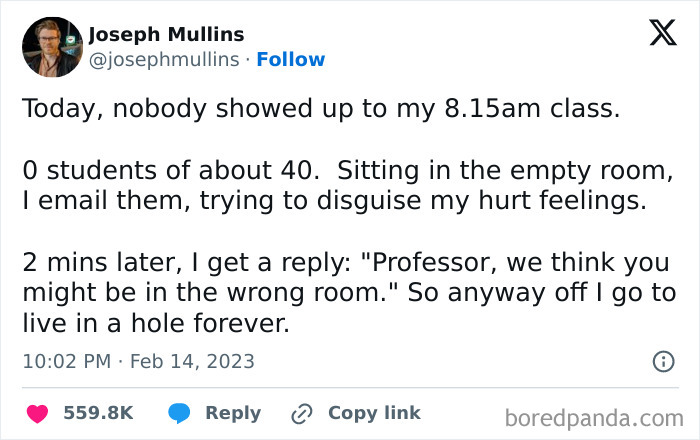
At least he's humble enough to accept he's wrong, and isn't one of those academics who'll try to convince all 40 students they were in the wrong room...!
It’s important to remember that nobody is perfect, we all make mistakes, failure is just another opportunity for growth, yadda, yadda, yadda. However, all of that is easier said than applied. Being embarrassed, in the moment, feels awful! You perceive it as a social threat.
Human beings are social animals, so watching your reputation (supposedly) crumble before your eyes hurts. Luckily, things are rarely as bad as you think.
Paradoxically, embracing that embarrassment rather than running from it is the healthy (though hard) thing to do. And it can be quite beneficial, too. For one, you seem much more, well, human: approachable, down-to-earth, and trustworthy.

I once accidently bumped into a co-worker and randomly started hugging him.
The Conversation stressed the fact that embarrassment is a “universal, visceral, and oddly contagious emotion.” It is what’s known as a self-conscious emotion because it focuses on our awareness of ourselves through the eyes of other people. We generally tend to feel more embarrassed in front of powerful people or individuals whose opinions we value.
Embarrassment usually hinges on looking awkward or inept, and doesn’t have the moral quality that shame or guilt do.
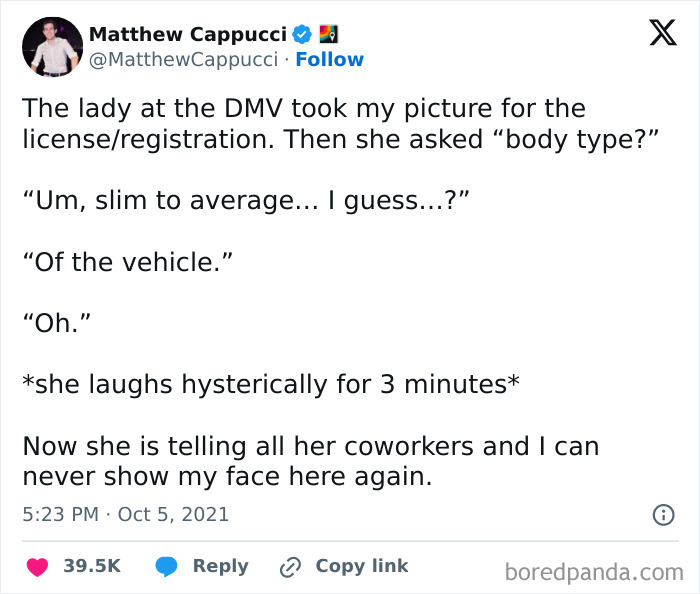
I'm thinking the DMV would be a great place to try out my new stand-up routine.
He asked for my hand in marriage, my cat was the ring bearer and we lived happily ever after.
It is theorized that embarrassment developed as a social corrective. In a nutshell, the purpose of embarrassment may be to reduce conflict in groups by acknowledging that one has made a mistake and to signal one's remorse. In other words, our ancestors, for whom staying in a group was vital for survival, likely saw embarrassed people as more trustworthy and cooperative.
When you show visible signs of embarrassment, like blushing or tripping over your own words, you are perceived as honest, generous, and more sociable.

For months I wondered wth this box in my office was that had "MONS" written on it. It was snow for the xmas decorations -.-
“In this way, embarrassment can invite empathy and forgiveness, strengthening relationships. It signals that we care what others think, promoting approachability and emotional closeness. So, while it’s uncomfortable in the moment, embarrassment probably evolved to keep communities cohesive,” The Conversation explains.
If you’re cringing while reading the embarrassing stories that Bored Panda has featured here, you’re definitely not alone.
Embarrassment is highly contagious because of how social our brains are. Human beings are hardwired for connection, so we empathize with other people’s awkwardness and want to reassure them.
It is this empathy that allows us to build connections with other individuals and helps preserve the harmony of the group.
Broadly speaking, when you embarrass yourself, your mind sees the events as potential social threats. You are, essentially, realizing that you’ve made a social mistake. Internally, you are pushing yourself to conform to the expectations of your social circle.
However, if you want to move away from the perception of embarrassment as a threat, you can try to employ humor. Laughing at yourself can help you reframe the situation into something more amusing than ‘dangerous.’
“Embarrassment is uncomfortable, yes – but it’s also a reminder that we care about others and want to belong. It’s part of what makes us human. So the next time you experience an embarrassing moment, try to laugh it off and remember that the moment is helping us to learn and connect.”
However, while a bit of embarrassment can be healthy and even constructive, excessive amounts of it can be quite harmful. It can then morph into social anxiety.
Socially anxious people tend to have an underactive prefrontal cortex, so they are less able to rationalize other people’s perspectives. What’s more, they have an overactive amygdala, meaning that they get excessive fear signals.
The consequences are that these individuals aren’t good at accurately gauging social situations. They perceive them as far more threatening and embarrassing than in actuality.
In the meantime, Psychology Today explains that while many people quickly bounce back from embarrassing incidents, others are more sensitive. The latter, who are more prone to rumination (hey!), can develop feelings of anxiety or panic when they think about their social failures.
In fact, these individuals might even avoid some social interactions because they’re scared of being humiliated again. Chronic embarrassment can lead to lower confidence, a worse sense of self-worth, anxiety, and even depression.
Again, humor and laughter are the best antidotes to embarrassment. Others are more likely to see you as likable, sociable, and trustworthy if you’re able to shrug off or laugh about embarrassing yourself.
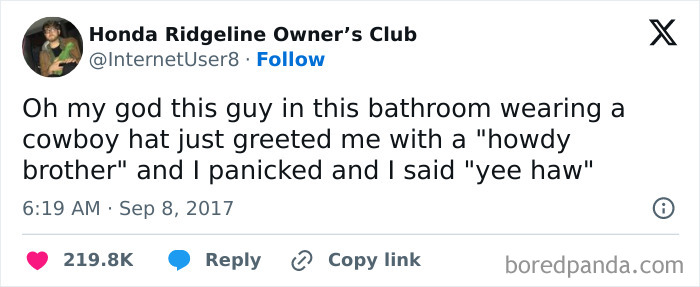
I was watching a show jumping competition and one of the riders came in on his horse. The announcers are usually very businesslike and the riders are usually very serious. But this horse came into the ring bucking and the announcer just said "YEEHAH" then introduced the two of them like nothing had happened.

I managed to reverse a concerning number and the doctor asked me how. "I did what you told me to do." He sat there stunned. "Because someone followed your directions?" ... ... ... "yeah."
You can also try to focus more on other people than on yourself and what others think of you. That sort of humility can give you a different perspective so that you worry less about how you are perceived.
If laughter is the healthy reaction to embarrassment, lashing out at other people or trying to hide from what happened is detrimental.
Furthermore, Psychology Today advises that you try to frame humiliating incidents as opportunities to build resilience. It helps to remember that, no matter how much you (think you) messed up, others have been in your shoes. And it’s likely that what happened to some of them is even worse than what you experienced, even if you feel like the world (well, your social life) is ending.

Believe me; that is *so* much better than them discovering a body there instead.
Once you’ve read through these stories and upvoted your favorite ones, we’d like to turn the discussion over to you, Pandas.
What are the most hilariously embarrassing things that have ever happened to you? Did you come to terms with the cringe, or do you still feel shame at totally random moments? Let us know!

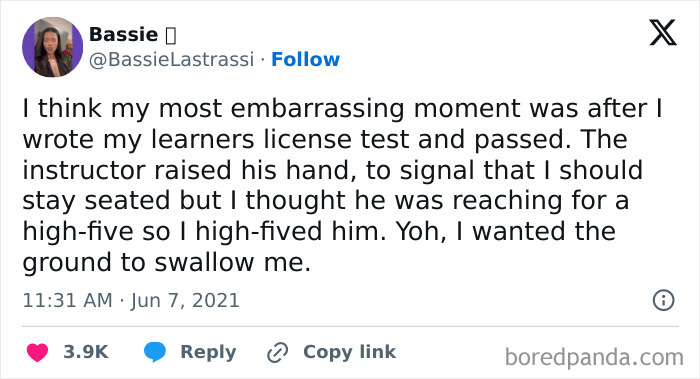
Les, no idea why people are downvoting you so much - if it was a joke it doesn't deserve that, and if you are asking a real question I think OP meant 'finished writing the theory portion of my learner's permit test'.

I worked with an ex copper who one day came in and started giving out Comic Relief Celebrity Recipe books. He had about ten. I said wow that's good of you paying out £50 for charity. The look of horror on his face when he realised he had scooped up, £5 a pop, recipe books from the counter and just waltzed out of the shop, was priceless.

Orthopeadic bowling shoes? That is a HUGE expense to make for bowling. Anyone that goes up to the lanes not wearing bowling shoes would have been immediately snagged by staff. Not sure I believe this one....

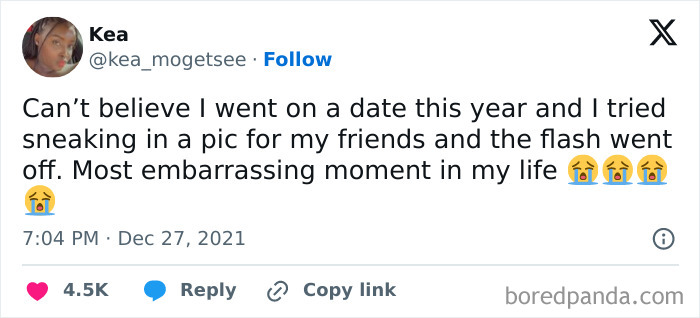
Haha. I tired to sneaky take a pic of the hot plumber and it made the stupid camera noise and he turned round to see me scuttling off down the stairs.
Didn't took me that long but I was definitely a teenager when I got it.

"You know, it takes two to tango." "But only one to break dance."


Mine would be: my same-floor neighbor was friendly and coming in to chat sometimes, we'd have quiet evenings, talking, sometimes playing a game. Once I had just come in from work and kicked my shoes off when he rang and I opened the door. He came in, said hi etc, but when I told him to sit down instead of doing so he said "uh..." and pointed at something. My cat, then a kitty, used to like digging through my laundry and playing with dirty underwear. This time, she'd carefully set dirty period panties just where we usually sat. I thought I was about to cry with embarrassment. If I'd had the choice at this exact moment I'd have chosen to d*e. Thankfully he was super chill about that and just started playing with the cat as I took care of the situation. He must not have been too fazed because this happened almost 3 years ago and we've been dating for 2.5 years.
The cat was testing him out to see if you were compatible :)
Load More Replies...
I used to go to a football class when I was about 6 or 7 years old. My mom dropped me and was walking around the apartment complex. That day, the coach left us early for some reason. I had no idea where my mother was as she could be anywhere at that moment so I was clueless about what to do. Another kid lived in the same building as I did and I thought, from our resulting discussion, that he would drop me so I followed him into the building, into the elevator. Then he got off at his floor and looked at me incredulously when I asked him what would happen to me. I felt betrayed. I wandered around a bit and was on the verge of tears when a friend of my mom found me and took me to her home. I think I did burst into tears at her home. I was a very emotional child. From there I found my way home just fine.

Aww, that's not embarrassing🫂 you were just a scared kid ❤️
Load More Replies...
When I was little, I went to my mom and dads friends' house for a house warming party. On the way there, my parents kept telling me "Do NOT say it's a mc.mansion" and then lo and behold, I had to say, when we got there, "I love your mc mansion!" and I got grounded for the weekend because of it. I don't think I would have said anything if I didn't know what a mc mansion was. (Mc mansion is "A McMansion is a derogatory term for large (typically 3,000–5,000+ sq ft), mass-produced suburban homes built from the 1980s–2000s that lack architectural integrity. They are characterized by poor design, mismatched styles, low-quality materials, and oversized, chaotic rooflines on small lots, often appearing "stuck together" rather than designed." if you don't know)

Mine would be: my same-floor neighbor was friendly and coming in to chat sometimes, we'd have quiet evenings, talking, sometimes playing a game. Once I had just come in from work and kicked my shoes off when he rang and I opened the door. He came in, said hi etc, but when I told him to sit down instead of doing so he said "uh..." and pointed at something. My cat, then a kitty, used to like digging through my laundry and playing with dirty underwear. This time, she'd carefully set dirty period panties just where we usually sat. I thought I was about to cry with embarrassment. If I'd had the choice at this exact moment I'd have chosen to d*e. Thankfully he was super chill about that and just started playing with the cat as I took care of the situation. He must not have been too fazed because this happened almost 3 years ago and we've been dating for 2.5 years.
The cat was testing him out to see if you were compatible :)
Load More Replies... I used to go to a football class when I was about 6 or 7 years old. My mom dropped me and was walking around the apartment complex. That day, the coach left us early for some reason. I had no idea where my mother was as she could be anywhere at that moment so I was clueless about what to do. Another kid lived in the same building as I did and I thought, from our resulting discussion, that he would drop me so I followed him into the building, into the elevator. Then he got off at his floor and looked at me incredulously when I asked him what would happen to me. I felt betrayed. I wandered around a bit and was on the verge of tears when a friend of my mom found me and took me to her home. I think I did burst into tears at her home. I was a very emotional child. From there I found my way home just fine.
Aww, that's not embarrassing🫂 you were just a scared kid ❤️
Load More Replies... When I was little, I went to my mom and dads friends' house for a house warming party. On the way there, my parents kept telling me "Do NOT say it's a mc.mansion" and then lo and behold, I had to say, when we got there, "I love your mc mansion!" and I got grounded for the weekend because of it. I don't think I would have said anything if I didn't know what a mc mansion was. (Mc mansion is "A McMansion is a derogatory term for large (typically 3,000–5,000+ sq ft), mass-produced suburban homes built from the 1980s–2000s that lack architectural integrity. They are characterized by poor design, mismatched styles, low-quality materials, and oversized, chaotic rooflines on small lots, often appearing "stuck together" rather than designed." if you don't know)






















 No fees, cancel anytime