Get Premium
Dark mode theme is available exclusively for premium users. Learn more about the benefits of subscribing.
No fees, cancel anytime.

 Dark Mode Ad-Free Browsing Unlimited Content
 Ad-Free Browsing Unlimited Content Dark Mode
Join 1.2 million Panda readers who get the best art, memes, and fun stories every week!
13submissions
Finished

It's been almost a year since I started Veinity Fair—a webcomic about the bizarre and gruesome parts of Victorian life with a dash of dark humor. During that time, I've drawn over 40 comics (you can check out the first 20 comics in my first Bored Panda article), started a Patreon mini-series on Victorian slang, and met many wonderful people who also love to discuss history and unusual trivia.
Enjoy the new set of comics and follow me on Veinity Fair's social media for the upcoming Halloween-themed comics, resources, and a great community!
More info: Instagram | Facebook | twitter.com | veinityfair.com | patreon.com
This post may include affiliate links.
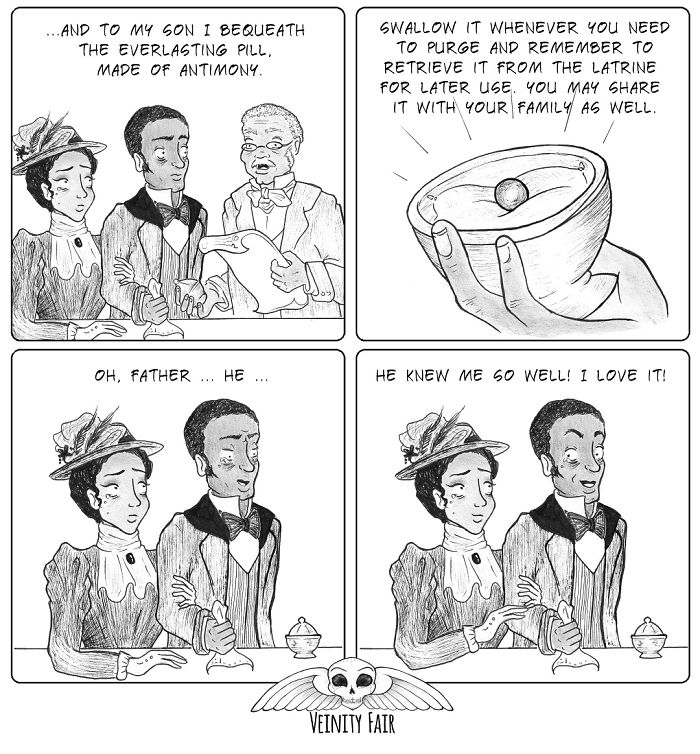
The everlasting pill, also known as a perpetual pill, was a popular 19th-century medicine that was supposed to bring balance to the body's humors by inducing purging. The pills were made of metallic antimony, a highly poisonous substance that causes health effects similar to arsenic poisoning. Why was it called an "everlasting" pill? An antimony pill would pass through the gastric system practically intact, so people would retrieve it, clean it, and put away for later use. Antimony was also a valuable metal at the time, so it was quite common to keep it the family and hand it down from generation to generation.

"Clyster, bleed, purge, repeat" could be a motto for many doctors throughout the ages who believed that bad blood, humor imbalance, or miasma were causing all illnesses known to humanity. Such treatments were used as universal cure-alls since ancient times up to the late nineteenth century.
Got the morbs (Soc., 1880)
Temporary melancholia. Abstract noun coined from adjective morbid.
Fashionistas of the late Victorian and Edwardian eras were obsessed with hats. Particularly with feather hats, adorned with bird feathers, heads, wings, and even whole animals. The demand for birds was so high that the millinery industry decimated dozens of species and even drove one of them – the passenger pigeon – into extinction. The last passenger pigeon died in captivity in 1914.
As taxidermy was a popular Victorian pastime, it is said that not only birds, but also other animals such as squirrels, mice, and even cats fell victim to the over-the-top hat fashion. In 1883, The New York Times published an article on French fashion stating that "The demand for kittens' heads has become so important that cat breeding has become a regular business." To be fair, it seems to be exaggerated as there isn't much evidence of cats being popular hat accessories.
Scheele’s Green, also known as copper arsenite, was the name of a green coloring that was used in everything from wallpaper through dresses to toys and candies.
Thanks to the unique, vibrant look it quickly became a very fashionable color. As you can imagine, the arsenic-loaded dye was very dangerous to people’s health, especially if digested or breathed in. The latter could occur as a result of, e.g., molding wallpaper which would release arsine gas.
The Egyptomania that took over Europe in the 19th century caused a few disturbing trends in society. One of them were so-called unwrapping parties, during which people would observe or even take part in unwrapping ancient mummies, stealing the valuables they could find, or even dissect what was left of the body for "souvenirs" or magic-like medicine. Such parties were supposedly happening in London.
While some scholars today question whether such parties really happened, we can be quite sure that at least one person — surgeon Thomas Pettigrew — was fond of such gatherings, turning them into bizarre shows.
Many Victorians wanted to have a very pale complexion which was supposed to give them a more "aristocratic" look. Because of that, companies started to add arsenic to various cosmetics, including soaps, lotions, and powders. Arsenic was also advised to be ingested, either in the form of wafers (e.g. Dr. Rose’s Arsenic Complexion Wafers) or fluids (e.g. Fowler’s Solution).
Interestingly, prolonged use of arsenic actually darkens the skin, which suggests that the producers might have skimped on the arsenic quantity in their products, thus making them a little bit less deadly.
The summer of 1858 was exceptionally hot for Londoners—the temperatures averaged 34–36 °C (93–97 °F) in the shade, reaching even 48 °C (118 °F) in the sun. This unbearable weather was however overshadowed by something even more unbearable: the Great Stink.
The source of this unbelievable stink was the Thames, which served as a sewer for all human, factory, and slaughterhouse waste in the area. As the London population doubled in the first half of the 19th century, so did the problems surrounding the river that served as the main source of "fresh" water. Apart from the offensive smells, Thames was also the source of cholera outbreaks and other diseases. The situation was dire and a prominent engineer called Joseph Bazalgette created plans for a new sewerage system. His plans weren't accepted by the government, which even suggested that cleaning up the river wasn't really their problem, even though they had to use scented handkerchiefs, tobacco, and curtains covered with chloride of lime to protect themselves from the putrid smells in the Palace of Westminster.
When the Great Stink of 1858 knocked at the House of Commons' doors, there was no excuse to postpone dealing with it any longer. As the level of the river dropped because of the heatwave, "a huge pile of human waste was left piled up right next to Parliament." Benjamin Disraeli described it as a “Stygian pool, reeking with ineffable and intolerable horrors” and proposed a bill supporting the modernization of the sewer system based on the Bazalgette's plans.
In mid-19th-century England three things became quite common: the five o'clock tea, sugar consumption, and the use of food coloring. This mix could become quite deadly when an afternoon tea hostess would buy ready-made sugar cake decorations. Why? At the time the most vibrant and thus the most eye-pleasing food colors were achieved by adding some pretty dangerous stuff, e.g., copper sulfate for blue, copper arsenite for green, or mercury sulfide for red. Also, lead was added to achieve different shades depending on the formula. Many people got seriously sick and some even died because of the coloring in their sweets. In 1851 nearly 200 people were poisoned by colored lozenges, 17 of whom fatally. This and other fatal events finally led to the passing the Adulteration of Food and Drink Act of 1860, one of the first focused on food safety.
Doctor Thomas Dent Mütter was an exceptional surgeon who pioneered many techniques that helped burn victims and people with extreme deformities, labeled by others as lost causes and "monsters" (it was a medical term at the time!).
Mütter himself suffered from several illnesses throughout his life, which made him very sympathetic to patients' lot. He used to explain the procedures to patients and prepare them for surgeries both physically and mentally. He boasted to be one of the fasted surgeons in the U.S., an important feature in the pre-anesthesia times, and wrote a book on special techniques used during such surgeries. This didn’t prevent him from becoming the first surgeon to administer ether anesthesia in Philadelphia and adapt his methods over time according to the newest discoveries.
Mütter was also a colorful figure known for extravagant style and expression, something that Europeans loved about him and many Americans… not so much. Today he's best known for an enormous collection of medical specimen and oddities you can visit in Philadelphia.
Victorian mourning veils were popular accessories worn by grieving women. The veils could be as long as six feet and were traditionally made out of black crape, a scratchy fabric believed to be the most appropriate for mourning.
Unfortunately, some of the black dyes (like logwood dye) used in the production were quite poisonous, causing a variety of ailments from light rashes to serious respiratory problems. Widows were especially affected by these dangers as the Victorian society expected them to wear crape veils for at least a year and a day during the so-called deep mourning stage.
In the summer of 1858, Victoria and Albert took a leisurely cruise down the Thames, unprepared for the severity of the Great Stink. It is said that they lasted on board only a few minutes, despite bringing scented handkerchieves with them.
The Great Book Scare was a period between 1880 and 1920 when the general public was obsessed with the idea that library books were a major source of epidemics. Even though the evidence for this was small, especially compared to other potential disease sources, many in the U.S and the U.K. believed that library books could spread everything from tuberculosis to smallpox. The authorities and doctors alike started to come up with ideas on how to limit the risk such as treating books with vapors from heated carbolic acid crystals, using formaldehyde, and… just completely destructing books if they had come into contact with a sick person.


































 No fees, cancel anytime
 then open in external browser


 and click "Open in External Browser"