Get Premium
Dark mode theme is available exclusively for premium users. Learn more about the benefits of subscribing.
No fees, cancel anytime.

 Dark Mode Ad-Free Browsing Unlimited Content
 Ad-Free Browsing Unlimited Content Dark Mode
Join 1.2 million Panda readers who get the best art, memes, and fun stories every week!

Every year, the ZWO Astronomy Photographer of the Year competition brings together stunning views of the night sky from around the world. Organized by the Royal Observatory Greenwich and supported by ZWO in partnership with BBC Sky at Night Magazine, the competition showcases the incredible talent of both amateur and professional photographers. In 2025, a record-breaking 5,880 entries were submitted from 68 countries, capturing everything from distant galaxies to rare celestial events.
Now in its 17th year, the competition continues to reveal the beauty and mystery of space through breathtaking images. From glowing nebulae and star-studded skies to planetary portraits and lunar close-ups, this year’s shortlist is full of awe-inspiring moments. Here’s a sneak peek at some of the standout photographs ahead of the winners being announced on 11 September.
More info: rmg.co.uk | Instagram | x.com | Facebook | youtube.com
This post may include affiliate links.
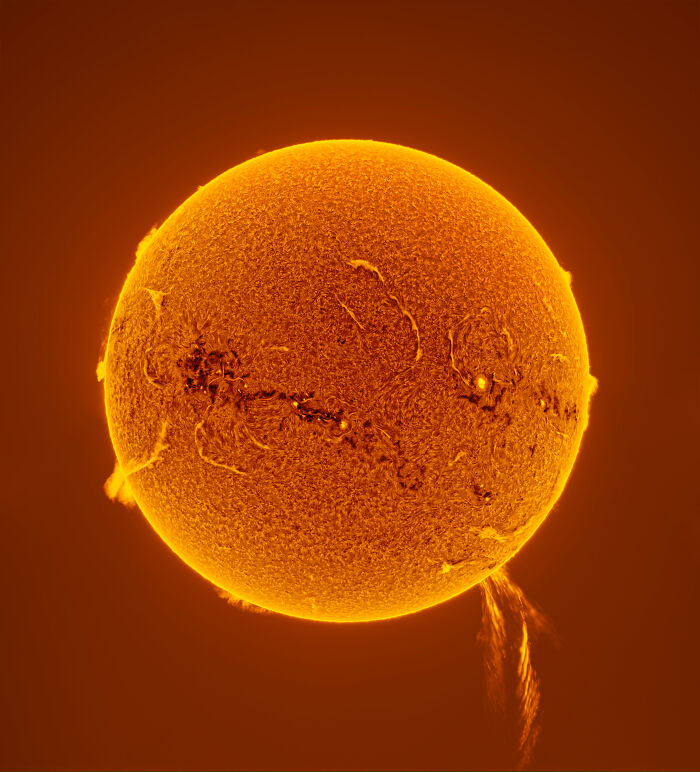
"On 7 November 2024, the Sun experienced a massive solar prominence eruption, with a length exceeding 500,000 km (311,000 miles). The eruption lasted approximately one hour from its initial outburst to its conclusion. The eruption phase of the prominence is composed of more than 20 stacked data sets highlighting the entire process of this spectacular event."
Taken with a Lunt LS60T telescope, Lunt B1200 filter, Proxisky UMI17R mount, ToupTek ATR428M camera, 500 mm f/7, ISO 100, 5-millisecond exposure.
Location: Eastern New District, Xinxing County, Guangdong province, China, 7 November 2024
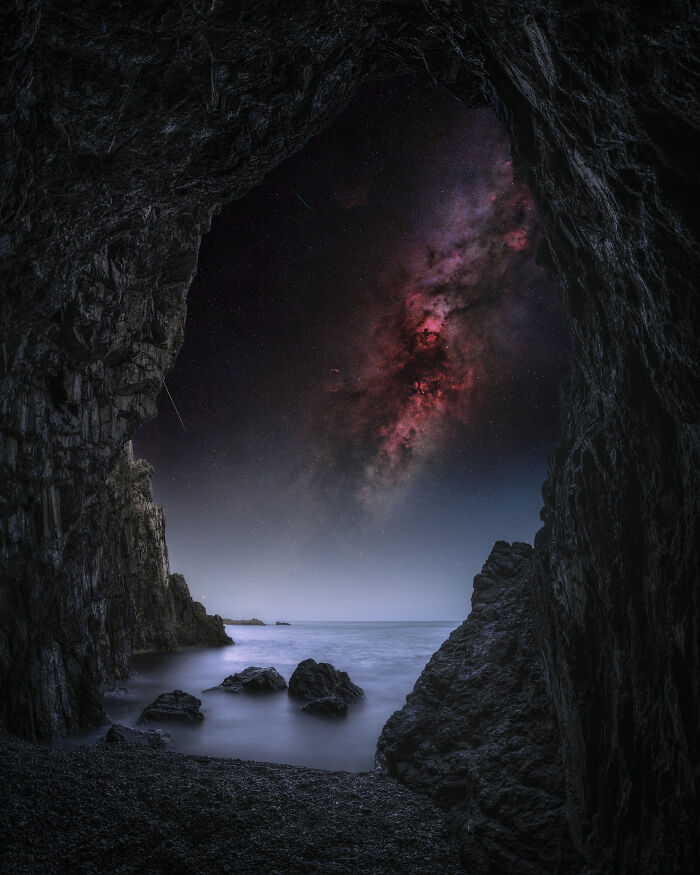
"Realising that it was possible to photograph the Milky Way from this remote cave, Yoshiki Abe waited for the perfect conditions to take the image. This is a composite photograph. Both parts were taken on the same night and at the same location, but the foreground was shot during the blue hour then the tripod was shifted to capture the Milky Way."
Taken with a Sony ILCE-7RM5 camera, 20 mm. Foreground: f/16, ISO 200, 30-second exposure, 3-frame panorama; Sky: f/1.4, ISO 800, 60-second exposure (stack of 51 frames); H-alpha: ISO 3,200, 90-second exposure (stack of 64 frames).
Location: Nagato, Yamaguchi, Japan, 12 October 2024
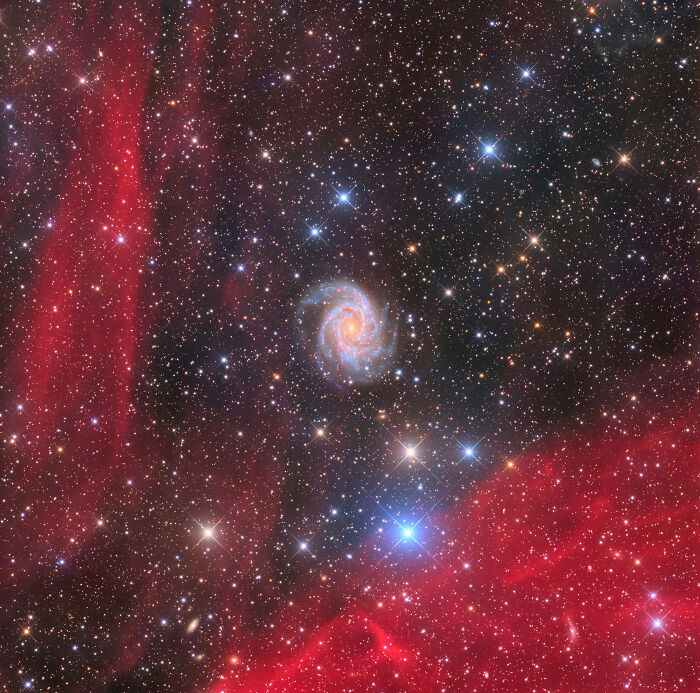
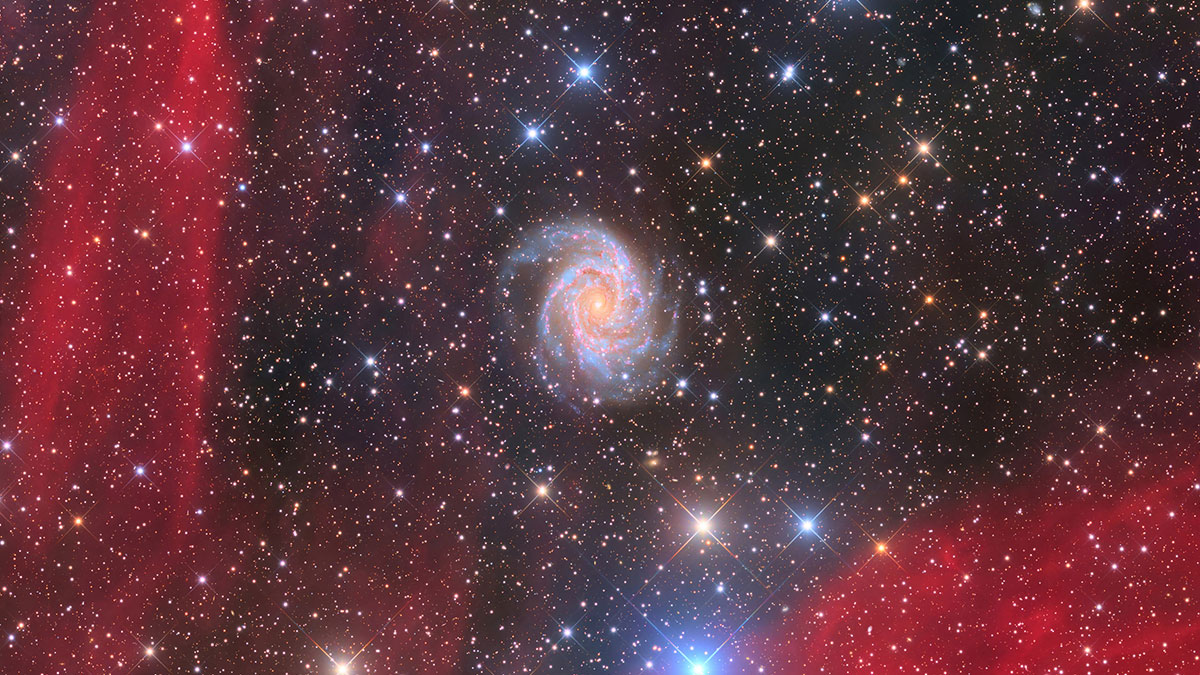
"NGC 2997 is a barred spiral galaxy (type SBc) in the constellation of Antlia. At 35 million light years distance, it has a visual magnitude of about 9.5, making it visible with binoculars in dark sites. The region is full of background H-alpha emissions, giving wonderful colour to the image."
Taken with a ASA 500N telescope, Astrodon LRGB and H-alpha filters, ASA DDM85 mount, FLI ProLine 16803 camera, 1900 mm f/3.8, 600 seconds per frame for LRGB, 1,200 seconds per frame for H-alpha, 10 hours total exposure.
Location: El Sauce Observatory, Río Hurtado, Chile, 23 January, 4–5 February 2025
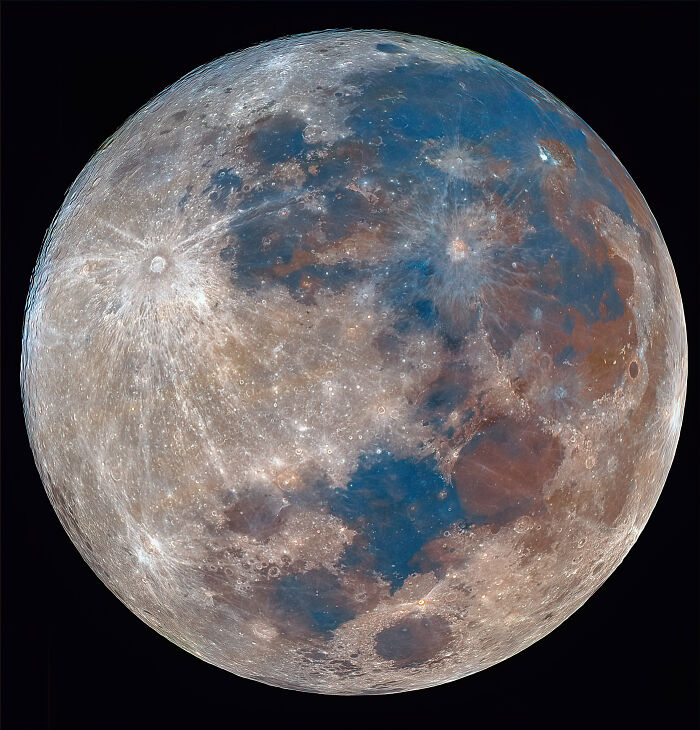
"The Beaver Moon was the last supermoon of 2024. This photograph was taken from the hazy, Bortle 9 skies of Delhi. The full-disc mosaic is composed of 24 images then stitched together to create a seamless mosaic. "
Taken with a GSO RC 6" telescope, ZWO IR/UV cut filter, Explore Scientific EXOS-2 PMC-Eight mount, ZWO ASI662MC camera, 1,370 mm f/9, 24 x 30-second videos, 50% of frames stacked per video.
Location: Laxmi Nagar, Delhi, India, 15 November 2024
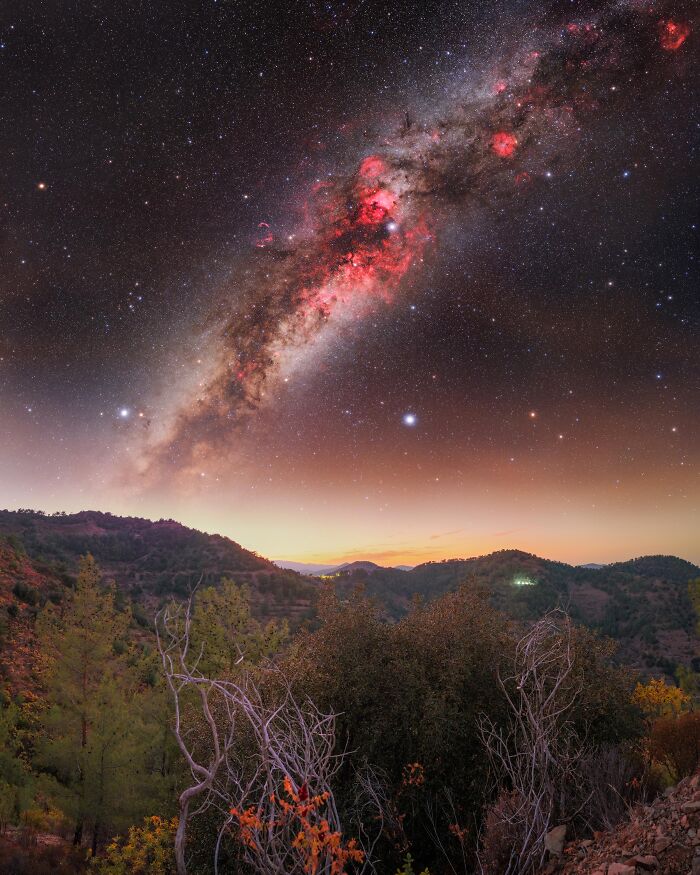
A panorama of the Cygnus region of the "Milky Way from Gerakies, Cyprus. The foreground was captured during blue hour to achieve more detail on the distant mountains and trees directly in front of the camera."
Taken with a Sony ILCE7M4 camera, Move Shoot Move Nomad, 35 mm f/2, ISO 400, multiple 30– and 120-second exposures.
Location: Gerakies, Nicosia District, Cyprus, 30 October 2024
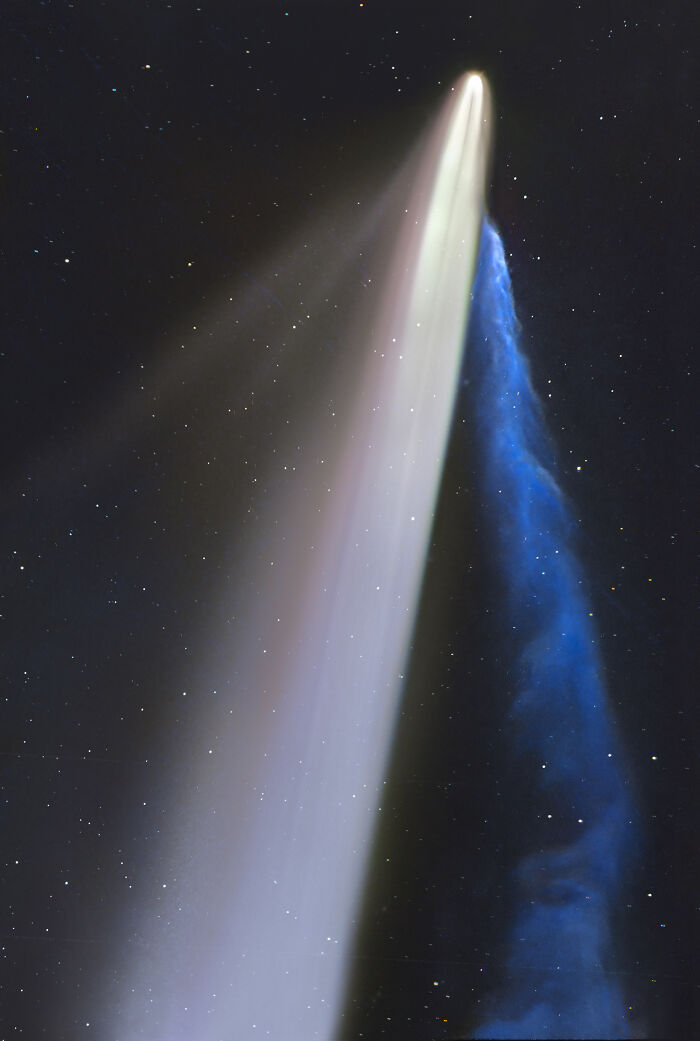
"The photographers travelled to Namibia to view Comet C/2023 A3 (Tsuchinshan-ATLAS) in the southern hemisphere. Due to the angle of the observation, the dust and ion tails seem to have overlapped, but the impact of solar winds on the day caused noticeable kinks in the ion tail."
Taken with a ASA 12-inch Astrograph, ASA DDM85 mount, ZWO ASI6200MM Pro camera, 1,097 mm f/3.6,L 200-second exposure, R 100-second exposure, G 100-second exposure, B 100-second exposure.
Location: Tivoli Astrofarm, Windhoek Rural, Namibia, 30 September 2024
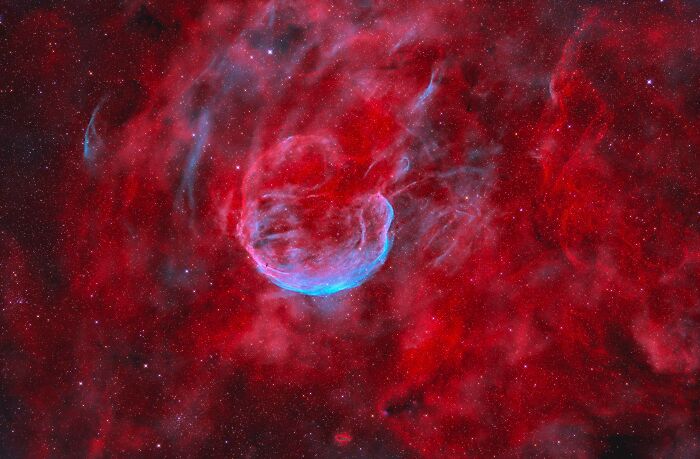
"Abell 85 is a supernova remnant situated in the Milky Way galaxy that appears to some to be shaped like a pomegranate. This target is faint. The OIII signal in particular is exceedingly weak. To fully capture the signal, Deqian Li spent six days camping in Hongyuan County."
Taken with a Takahashi Epsilon-160ED telescope, Sky-Watcher EQ6-R mount, ZWO ASI2600MM Pro camera, 530 mm f/3.3, ISO 100, 23.4 hours total exposure.
Location: Hongyuan County, Ngawa Tibetan and Qiang Autonomous Prefecture, Sichuan, China and Yingshan County, Nanchong, Sichuan, China, 30, 31 August, 1 and 3–5 September 2024
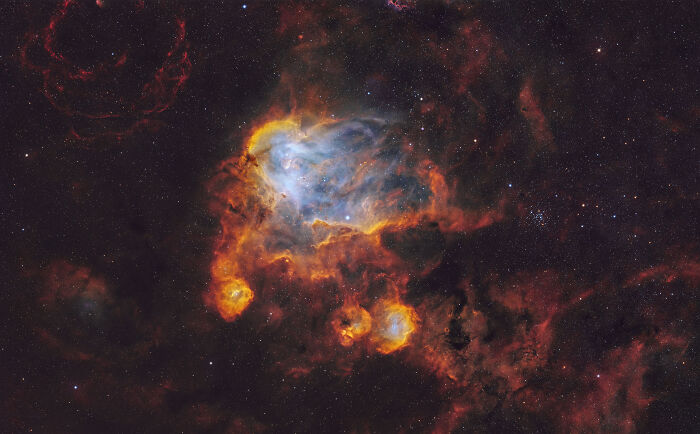
"IC 2944, the Running Chicken Nebula is known for its unique avian shape. NGC 3766, an open star cluster, appears as a sparkling jewel box that contrasts with the diffuse nebulosity. In the top left, filamentary shell G296.2-2.8, displays delicate, thread-like structures that weave through the cosmic backdrop."
Taken with a William Optics RedCat 51 II telescope, Antlia 3 nm SHO 36mm and Baader CMOS Optimized RGB 36 mm filters, Sky-Watcher NEQ6–Pro mount, ZWO ASI2600MM Pro camera, 250 mm f/4, 42 hours 15 minutes total exposure.
Location: Hillcrest, Queensland, Australia, 29 and 30 March, 2, 3, 8– 15 April 2024
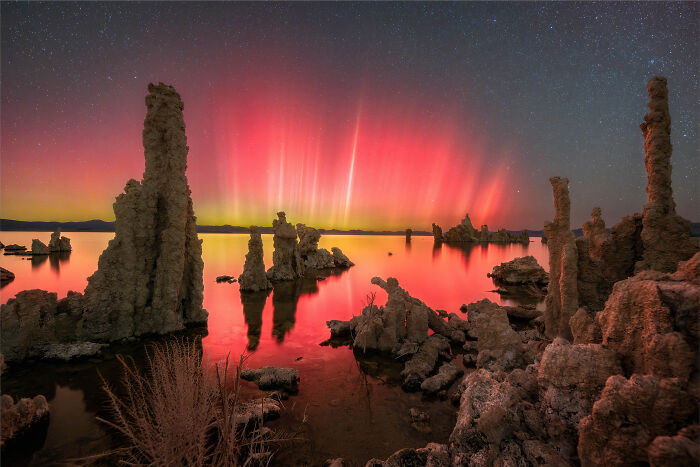
"This photograph captures the rare occurrence of Northern Lights in California. Vibrant ribbons of magenta and green light up the sky, reflecting in the still waters among the rock formations."
Taken with a Sony ILCE-7III camera, 14 mm f/1.8, ISO 8,000, 5-second exposure.
Location: US 395, Mono Lake, Mono County, USA, 10 October 2024
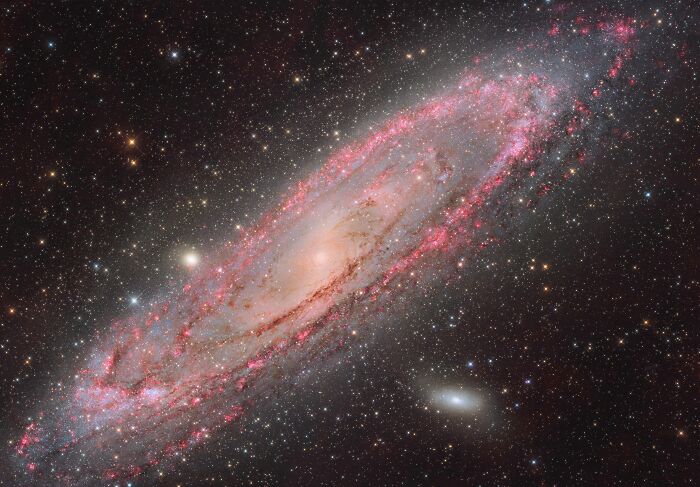
"This image shows countless resolved stars, emission nebula and a mysterious central bulge. The photo is incredibly detailed, the mist surrounding the galaxy is actually tens of thousands of yellowish tiny stars.
PixInsight and AstroPixelProcessor were used for pre-processing and the mosaic. Defects were corrected using a technique called Multi-Scale Gradient Removal, using wide-field data. During the process, BlurXTerminator, StarXTerminator and NoiseXTerminator were used and the final adjustment was done in Photoshop."
Taken with a William Optics 12" f/8 Ritchey-Chretien Truss Tube, GSO 14" f/8 Ritchey-Chretien Truss Tube and Takahashi Epsilon 160 telescopes, iOptron CEM120EC and Sky-Watcher EQ8-R Pro mounts, ZWO ASI6200MM Pro camera, 2,272 mm f/6.4, Gain 100, 216 hours total exposure time.
Location: Daocheng County, Garzê Tibetan Autonomous Prefecture, Sichuan, China, 30–31 October, 1–6, 20–30 November, 1–10 and 20–31 December 2024

216 hours total exposure time.Unbelievable committment. My last relationship did not last that long.
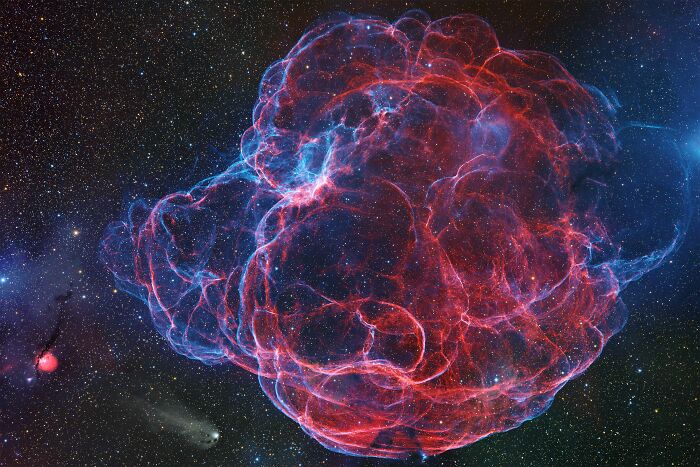
"This full-spectrum image of the Spaghetti Nebula unveils the faint and elusive nature of this supernova remnant (SNR), hidden behind a vast cloud of dust that obstructs its emission light. To enhance its visual appeal, Shaoyu Zhang dedicated considerable time to capturing OIII data, intensifying the blue and green hues, while allowing SII and H-alpha to support high dynamic range stretching for added depth."
Taken with a Takahashi FSQ-106EDXIII telescope, Astrodon LRGBHSO filters and Chroma LRGBHSO filters, 10Micron GM 2000 HPS and Sky-Watcher AZ-EQ6 mounts, Canon EF 400 mm f/2.8 II IS USM lens, Moravian Instruments G4-16803 and ZWO ASI6200 cameras, 382 mm and 391 mm, f/3.6 and f/2.8, 148.33 hours total exposure.
Location: Deep Sky Chile Observatory, Camino del Observatorio, Río Hurtado, Chile and Xiangcheng, Garzê Tibetan Autonomous Prefecture, Sichuan, China, 21, 24 and 25 December 2024, 3–5, 15, 16, 19–31 January, 1–6, 10–19 February 2025
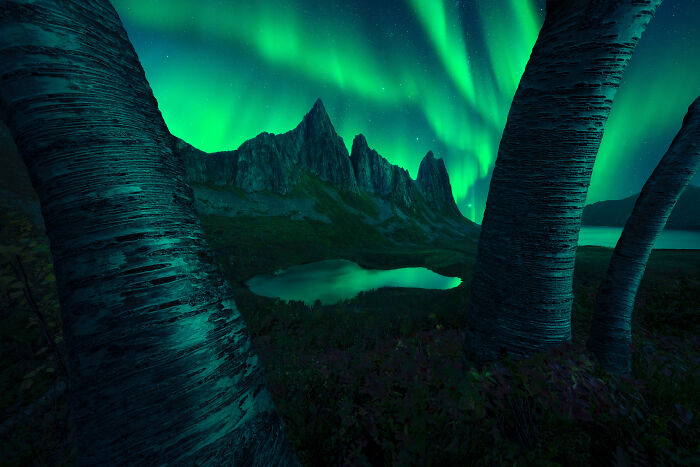
"The photograph captures a remote location on the Senja Peninsula in northern Norway. In the foreground, birch trees beautifully reflect the colors of the dancing aurora in the sky."
Taken with a Sony Alpha 7R V camera, 12 mm f/2.8 (with focus stacking for foreground), ISO 4,000, 2-second exposure.
Location: Stavelitippen, Fjordgård, Norway, 12 September 2024
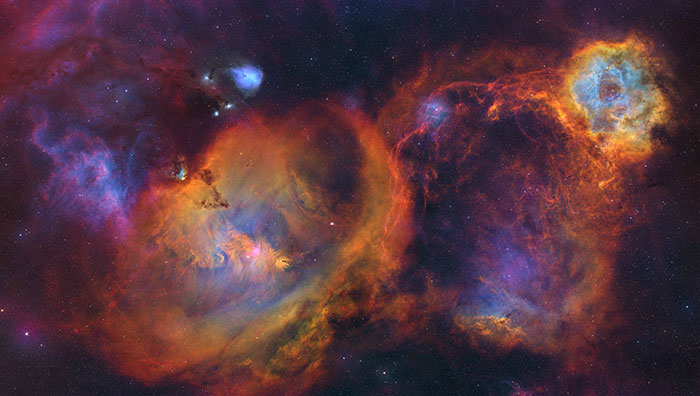
"This work consists of two mosaics, each panel exposed for 75 hours, capturing numerous popular targets. It highlights the Rosette Nebula and Christmas Tree Nebula, both symbols of beauty. The image supports multiple viewing angles, offering fresh experiences with clockwise, anticlockwise and vertical flips."
Taken with a Takahashi FSQ-106EDXIII telescope, Astrodon LRGBHSO filters, 10Micron GM 2000 HPS mount, Moravian Instruments G4-16803 camera, 382 mm f/3.6,150 hours total exposure.
Location: Deep Sky Chile Observatory, Camino del Observatorio, Río Hurtado, Chile, 6– 13, 22– 29 November, 1– 9, 12, 13, 18– 24 December 2024
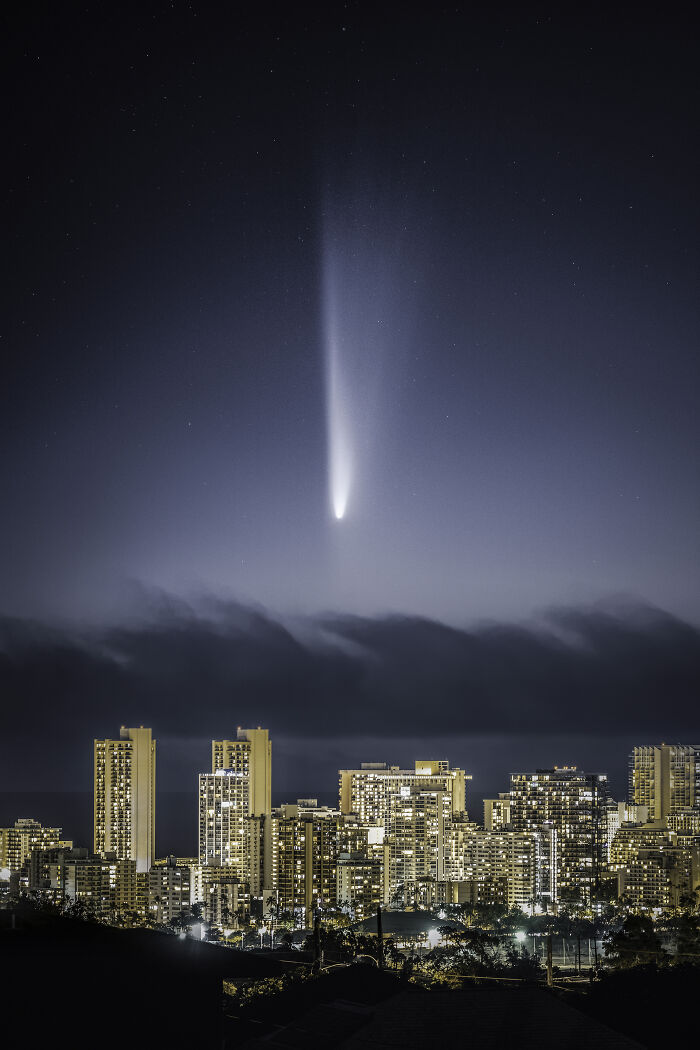
"Taken on the evening of 12 October 2024 at Pu'u O Kaimukī Park, Ran Shen joined many residents and astrophotographers in Honolulu, Hawaii, to witness the passage of Comet C/2023 A3 (Tsuchinshan-ATLAS), one of the most anticipated astronomical events of the year."
Taken with a Nikon Z 8 camera, 110 mm f/4.5, ISO 2,500, 2.5-second exposure.
Location: Honolulu, Hawaii, USA, 12 October 2024
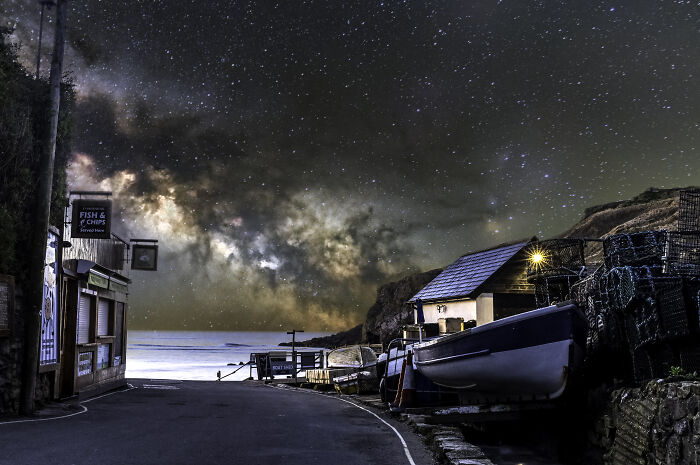
"The Milky Way arcs over Lulworth Cove, where just a short walk from the water’s edge, there’s a fish and chip shop, boathouse, and a little boat that sit quietly at night."
Taken with a CanonR6 Mark II camera, Benro Polaris mount, Foreground: Tamron 24-70 mm lens, 38 mm f/22, ISO 800, 3.2-second exposure, Sky: Samyang 14 mm lens,14 mm f/2.8, ISO 3,200.
Location: Lulworth Cove, West Lulworth, Dorset, UK, 16 March 2024
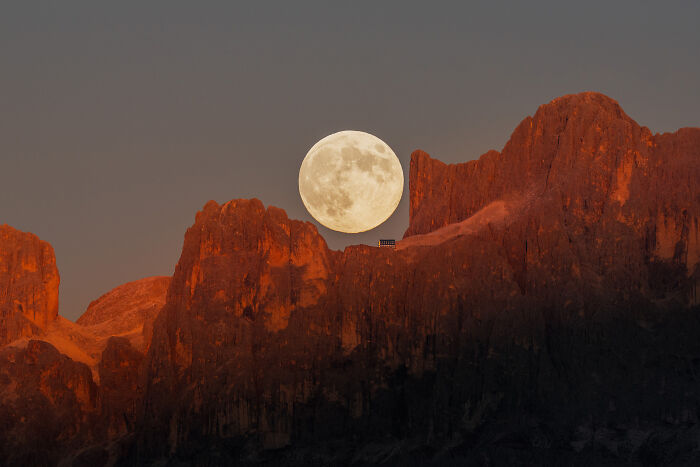
"The full Moon rising above the rugged peaks of the Dolomites. With no clouds in sight and in flawless conditions, the golden light of sunset bathes the mountains, creating harmony between Earth and sky."
Taken with a Sony Alpha 7R V camera, 400 mm f/9, ISO 320, 1/200-second exposure.
Location: Santuario di Pietralba, Deutschnofen, South Tyrol, Italy, 15 November 2024
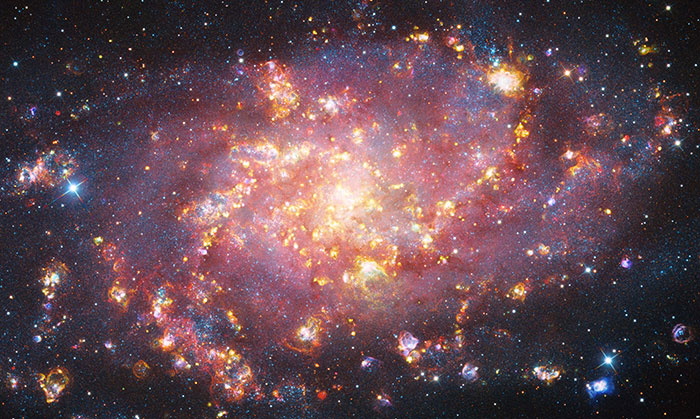
"The image shows M33, the Triangulum Galaxy from a new perspective. Due to tidal interaction with M31, there is very prominent star-forming activity in M33, which results in a spectacular structure of emission nebulae. During processing, a separate SHO picture was created with a strong SII/H-alpha presence, the glowing red structures in the picture, and blended with a high-resolution LRGB processing of the continuum data, representing the ‘background’ light."
Taken with a custom-built 250/1000 Newtonian astrograph and Lacerta 300/1200 Photo Newtonian telescope, Antlia V-Pro LRGB and 3 nm H-alpha, OIII and SII filters, Astronomik LRGB and 6 nm H-alpha, OIII and SII filters, Sky-Watcher EQ8-R Pro mount, ZWO ASI2600MM Pro and ASI294MM Pro cameras,1,000 and 1,200 mm f/4, 8.4-hour L exposures, 6.8-hour R exposures, 6.7-hour G exposures and 6.3-hour B exposures, 39.3-hour H-alpha exposures, 15.3-hour OIII exposures, 28.3-hour SII exposures.
Location: Sződliget, Pest and Törökkoppány, Somogy, Hungary, 2–4, 9, 23,30 November, 1, 27 and 28 December 2024
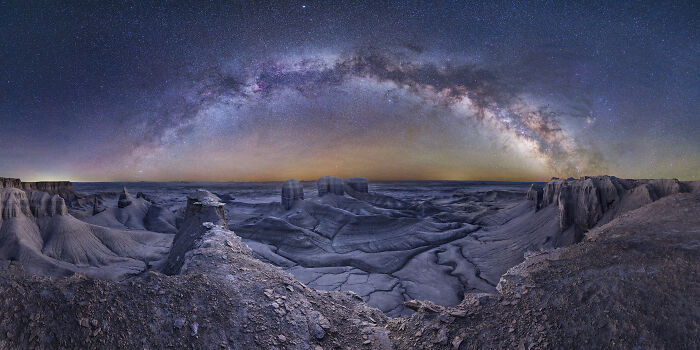
"This impressive panorama is a view from the Utah desert. 23,000 pixels wide, the photograph shows the desolate, character rich landscape, below a starry Milky Way."
Taken with an astro-modified Canon EOS R and EOS R5 cameras, 28mm f/2.8 and f/8, ISO 800 and 100, Sky: 59-second exposure, Land: 3-second exposure.
Location: Moonscape Overlook, Wayne County, Utah, USA, 11 April 2024
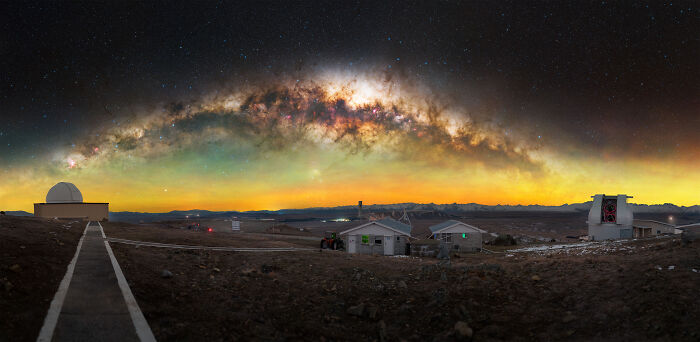
This image shows the western view from "Mount John Observatory, New Zealand’s premier optical observatory. To the right is the MOA-II telescope, the largest telescope in the country. Due to the southern hemisphere location of the observatory, the Milky Way sets in parallel to the horizon, which allows for striking compositions."
Taken with a Nikon Z 6 camera, Sky-Watcher Star Adventurer mount, 35 mm f/1.4, ISO 1,600, 25-panel mosaic.
Location: Mount John Observatory, Mount John, Lake Tekapo, New Zealand, 21 July 2024
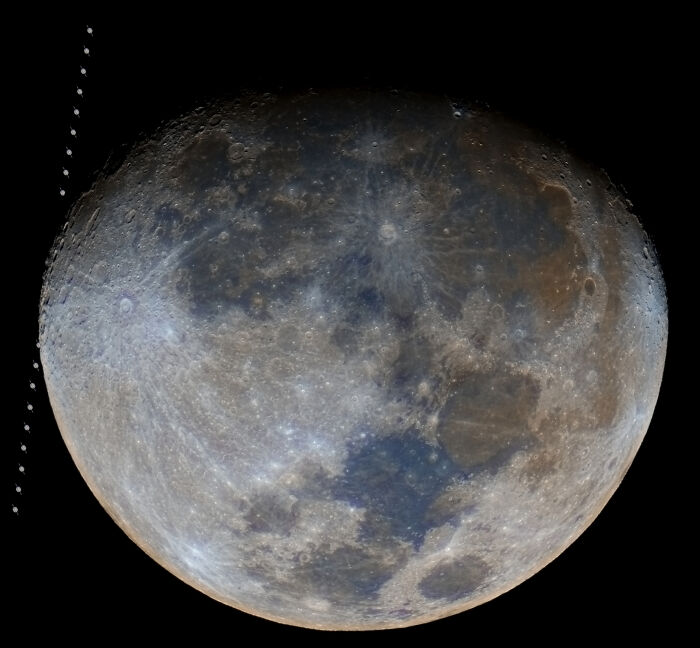
"This is a composite image that brings images of both the Moon and Saturn together to show the lunar occultation of Saturn. A lunar occultation of Saturn occurs when the Moon passes in front of Saturn, temporarily blocking its light from Earth. This event is brief and can be observed as the Moon obscures the planet."
Taken with a Svbony SV503 80ED telescope, Svbony 2x Barlow lens, iOptron CEM70 mount, QHYCCD QHY485C camera, 560 mm f/7, Moon: 0.23-millisecond exposure, Saturn: 4-millisecond exposure.
Location: Bua Yai, Bua Yai District, Nakhon Ratchasima, Thailand, 15 October 2024
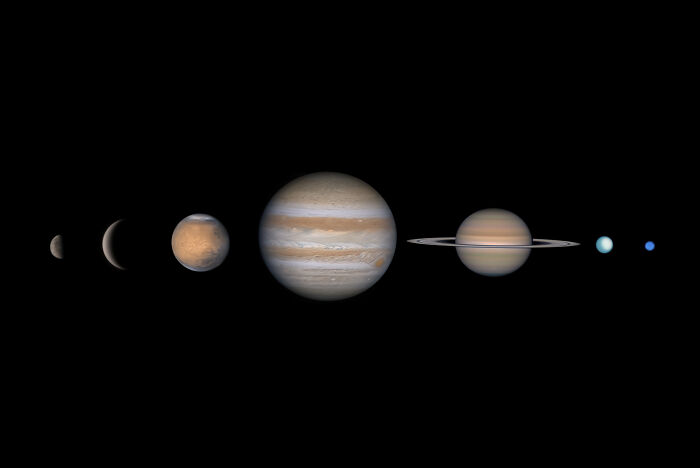
"This image presents all the planets of our Solar System, excluding Earth, showcasing their unique characteristics. Mercury, the closest to the Sun, is a barren, cratered world, while Venus is shrouded in thick clouds. Mars, the Red Planet, has vast deserts and the largest volcano in the Solar System. The gas giants, Jupiter and Saturn, dominate with their immense size and swirling storms, while Saturn’s rings make it especially striking. Uranus and Neptune, the ice giants, are rich in methane, giving them their blue hue."
Taken with a Spacewalk Telescopes Horizon 20" f/3.2 Dobsonian, Tele Vue 5x 1.25" Powermate, Spacewalk Telescopes EQ-Platform ‘Trackie’, Player One Astronomy Uranus-C camera, thousands of <10-millisecond exposures.
Location: Bobingen, Bavaria, Germany, 11 September 2023, 7 September, 29 August and 28 December 2024

Yes plenty of people were talking about the planetary alignments and saying you can see the planets "except earth". but taking photos where mountains were clearly seen in the background. I wonder which planet those mountains were on. If they just look down at their feet, they could quite easily see earth.
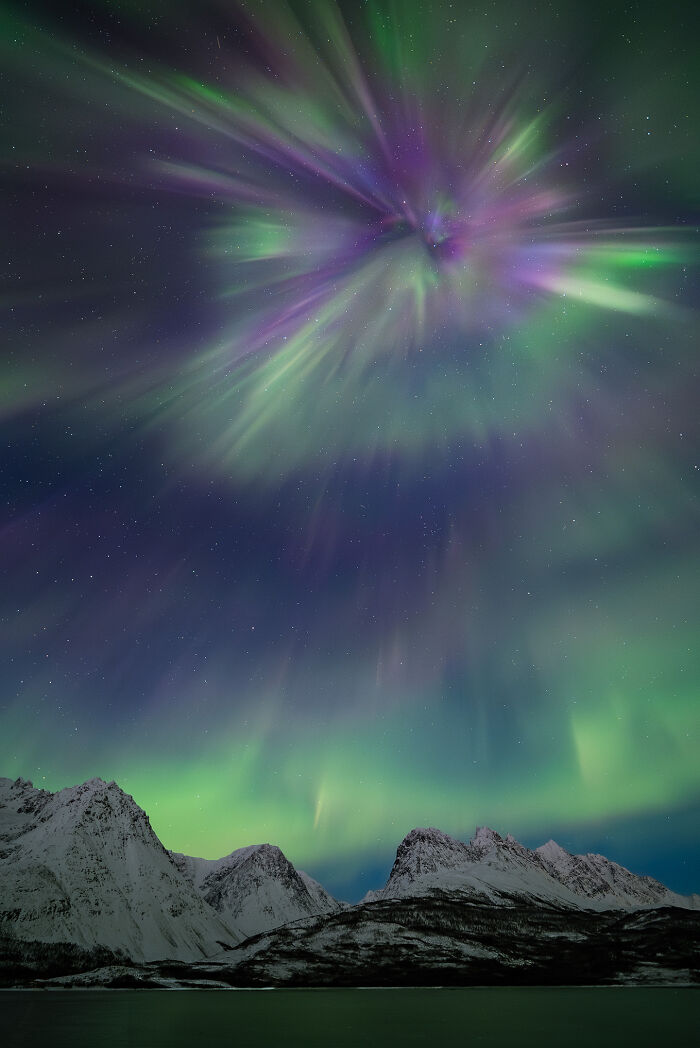
"In April, there is no ‘true’ night in northern Norway. This is why the Northern Lights look much more blue than usual. Vincent Beudez captured the visually pleasing aurora shape above the Norwegian background."
Taken with a Sony Alpha 7S III camera, 14 mm f/1.8, ISO 4,000, 1.3-second exposure.
Location: Sjursnes, Tromsø, Troms, Norway, 4 April 2024
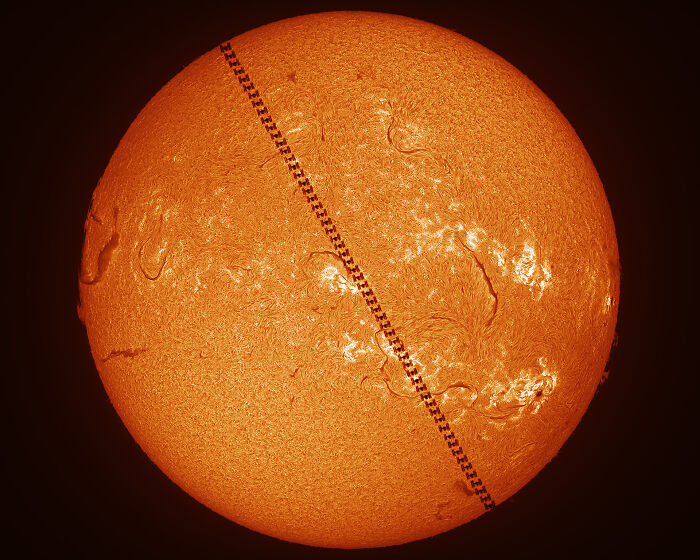
"This image captures the International Space Station (ISS) transiting across the solar disc. The solar background was captured separately with double-stacked etalon[an optical filter that isolates specific wavelengths, used to observe solar details], and reveals high-contrast chromospheric details. The imaging sequences were strategically combined during post-processing to preserve both the spacecraft’s crisp silhouette and the Sun’s intricate surface features."
Taken with a Takahashi Teegul 60 telescope, Coronado SolarMax 60 double stacked, Vixen polaris mount, Player One Astronomy Neptune-M camera, 500 mm f/8.3, 0.3-millisecond exposure.
Location: Xiamen, Fujian, China, 24 January 2025
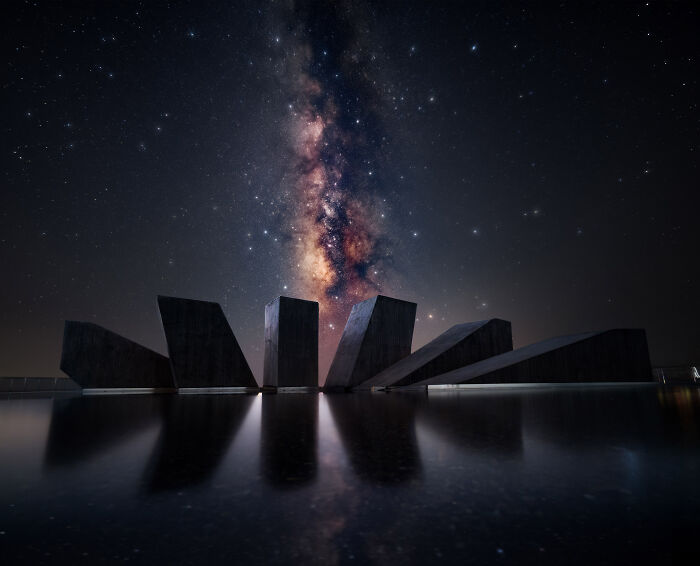
"Under the night sky, several black geometric buildings appear to stand on the water’s surface, resembling gateways to the galaxy. The bright Milky Way stretches across the sky behind them, with stars twinkling. The reflections of the buildings shimmer in the water, blending reality and illusion, as if opening a passage to the mysteries of the Universe, inspiring endless reverie and a longing to explore the vast starry sky."
Taken with a Nikon Z 8 camera, 15 mm f/4, ISO 2,000, multiple 480-second exposures.
Location: Songyang County, China, 10 August 2024
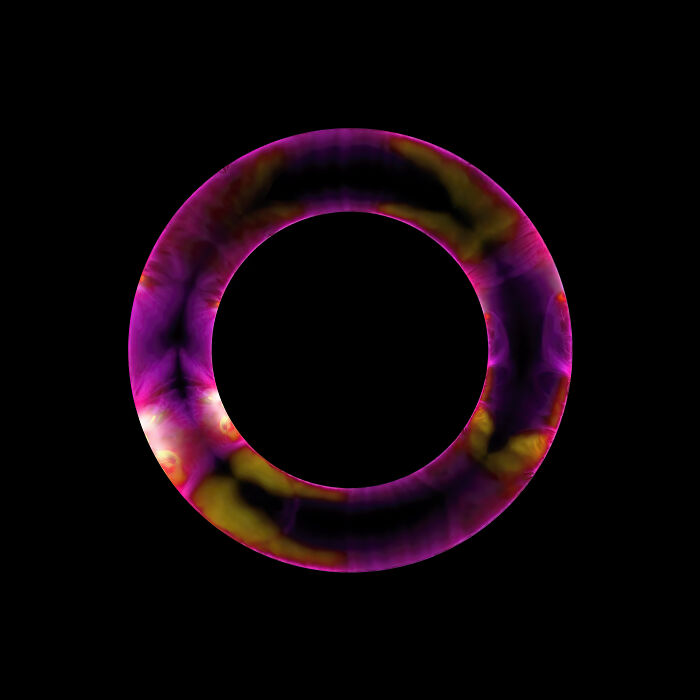
"The data from NASA’s Solar Dynamics Observer (SDO) probe was used here to show the Sun’s inner corona in a way that hints at a process that is similar to that which energises colourful neon lights on Earth.
Images taken by the SDO in the ultraviolet spectrum (at 171, 193 and 304 nm) were re-mapped to a more vibrant palette, with the same coronal data turned ‘inside out’ to surround the Sun, creating the illusion of it being enclosed in a neon tube.
While neon tubes use electrical current to cause the low-pressure gas within them to glow, it is the heat from nuclear fusion that ionises the gas of the Sun’s atmosphere. While this ultraviolet light is undetectable to human eyes, it can easily cause sunburn on unprotected human skin within just few minutes of exposure.
Remapped in Photoshop, the data was then polar inversed to mirror the inner coronal image. Colour saturation was increased by around 30 per cent and given one pass of a noise reduction filter."
Original data from NASA SDO 171, 193, 304 nanometre from 1 June 2024
Data credit: NASA
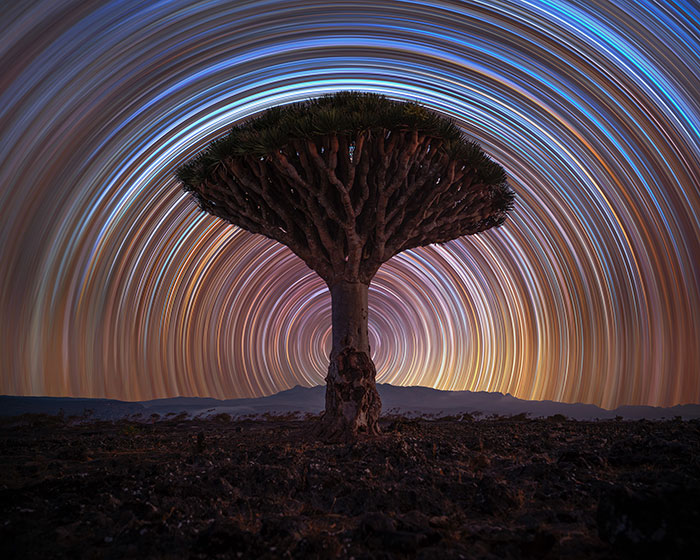
"A solitary dragon tree stands tall in the heart of Socotra’s Dragon Blood Tree forest – an otherworldly landscape unlike anywhere else on Earth. The final image is composed of 300 individual exposures."
Taken with a Sony Alpha 7 IV camera, 24 mm f/2.8, ISO 400, 30-second exposure.
Location: Firmihin Forest, Hidaybu District, Yemen, 13 March 2024
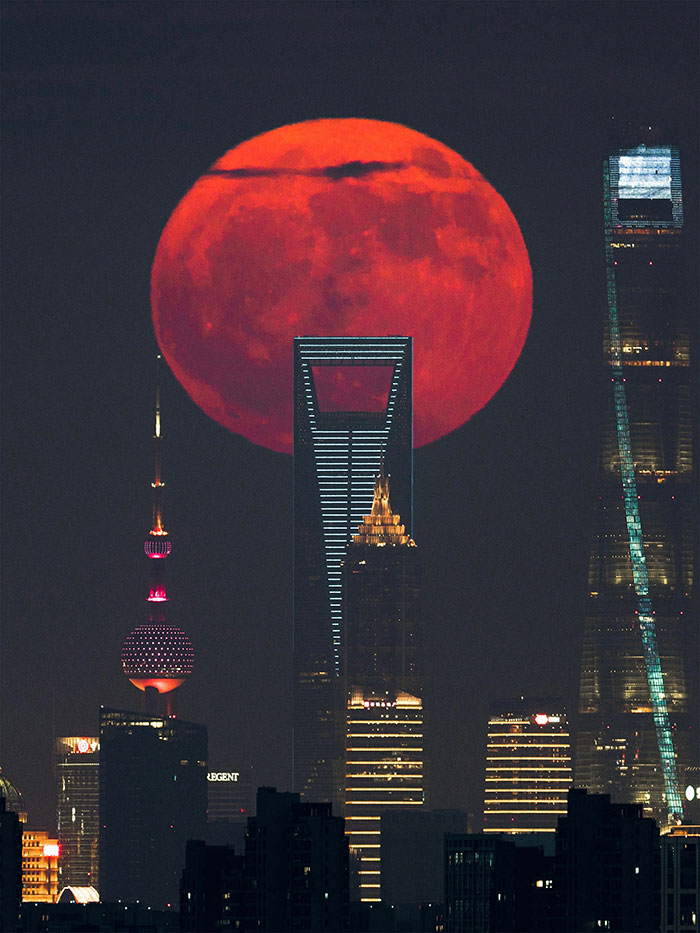
"This photograph captures a red Full Moon rising beside Shanghai’s tallest skyscrapers in Lujiazui. Taken from a distance of 26.5 km (16.5 miles) from the skyscrapers in a single exposure, this image’s alignment took five years of planning. The Full Moon appears perfectly positioned next to the illuminated skyline, creating a striking contrast."
Taken with a Sony ILCE-7RM4 camera, 600 mm f/4, ISO 250, 1/10-second exposure .
Location: Jiading District, Shanghai, China, 21 July 2024
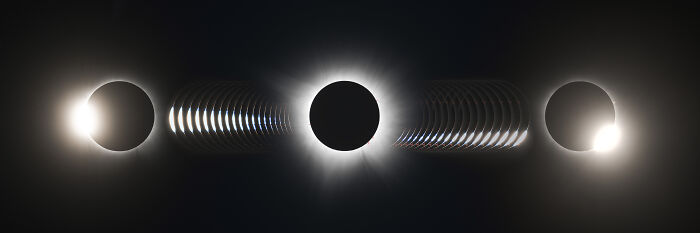
"This 22-megapixel panorama shows the different stages of the full solar eclipse, with a high dynamic range (HDR) image of totality in the middle. This reveals both the bright corona and finer details otherwise lost in standard exposures. The final image uses approximately 200 images with varying exposure times to create a HDR totality, before combining everything together."
Taken with a Canon EOS 60D camera, SWSA 2I mount, Sigma 70-300 DG lens, Baader solar filter, 300 mm f/6.3, ISO 100, approximately 1,200 x 1/200-second exposures and 200 x 1/25-second exposures.
Location: Coaticook, Quebec, Canada, 8 April 2024
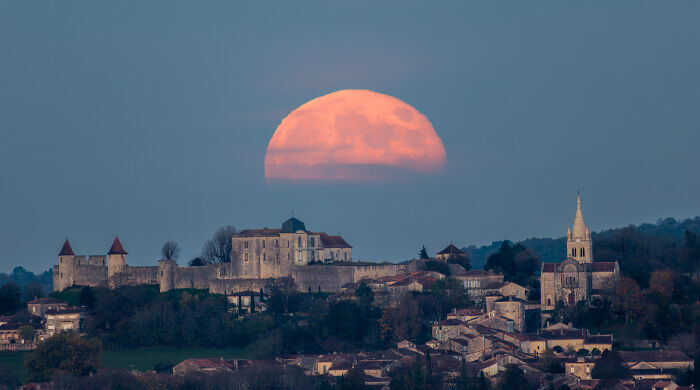
"This unique photograph was taken 6.4 km (4 miles) from the château of Villebois-Lavalette, just north of Bordeaux. The distortions are related to the distance between the imaged Moon and the foreground but also with respect to the atmospheric disturbance, hence the curves on the surface of the Moon."
Taken with a Canon EOS R7 camera, Sigma 150-600 mm lens at 600 mm f/6.3, ISO 2,500, 1/50-second exposure.
Location: La Font Aride, Saint-Amant-de-Montmoreau, France, 16 November 2024
"Baily’s Beads are bright spots around the Moon during a solar eclipse that are caused by sunlight passing through lunar valleys. This composite shows the progression, from left to right, from the first ‘diamond ring’ – a moment when one last bright point of sunlight shines beside the faint corona, resembling a diamond on a ring – fading through Baily's Beads into totality and beyond until a 'diamond ring' occurs again as the Sun starts to reappear. "
Taken with a Sky-Watcher Evolux 62 ED telescope, Celestron NexStar Evolution mount, ZWO ASI2600MC Pro camera, 360 mm f/5.8, Gain 100, Diamond Rings: 200 x 1/ 3-second exposures Baily's Beads: 400 x 1/ 6-second exposures, Totality: stack of 7 x 1/400-second exposure.
Location: Dexter, Missouri, USA, 8 April 2024

Wow, just wow. Awesome, awe-inspiring. I'm mad keen into astronomy. If I ever won the lotto, I wouldn't tell a soul. But there would be signs. A backyard observatory with the largest amateur telescope money could buy. Astrophotograpy equipment. *drools*

How can anyone look at a picture of a different galaxy and still actually think we're alone!?

Wow, just wow. Awesome, awe-inspiring. I'm mad keen into astronomy. If I ever won the lotto, I wouldn't tell a soul. But there would be signs. A backyard observatory with the largest amateur telescope money could buy. Astrophotograpy equipment. *drools*
How can anyone look at a picture of a different galaxy and still actually think we're alone!?





































 No fees, cancel anytime