Get Premium
Dark mode theme is available exclusively for premium users. Learn more about the benefits of subscribing.
No fees, cancel anytime.

 Dark Mode Ad-Free Browsing Unlimited Content

 Ad-Free Browsing Unlimited Content Dark Mode

Join 1.2 million Panda readers who get the best art, memes, and fun stories every week!
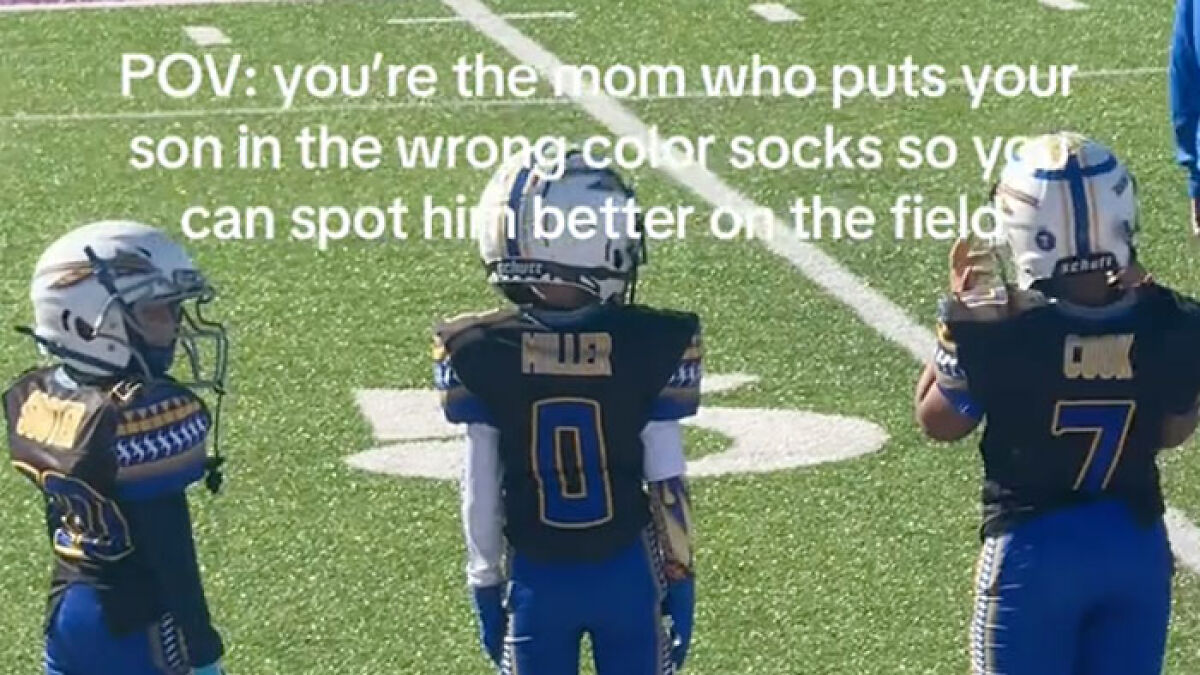
A mother’s seemingly harmless trick for keeping track of her son during football games has caused a surprisingly fierce debate online, with viewers arguing that her solution could leave the young player embarrassed or even benched.
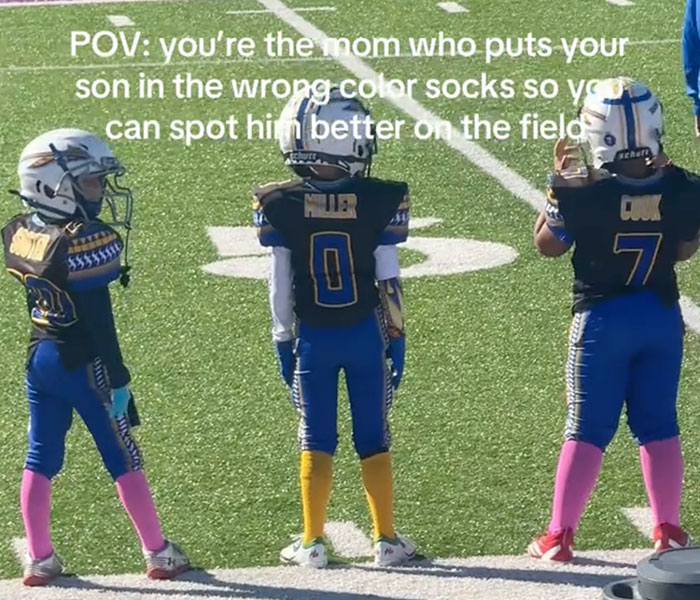
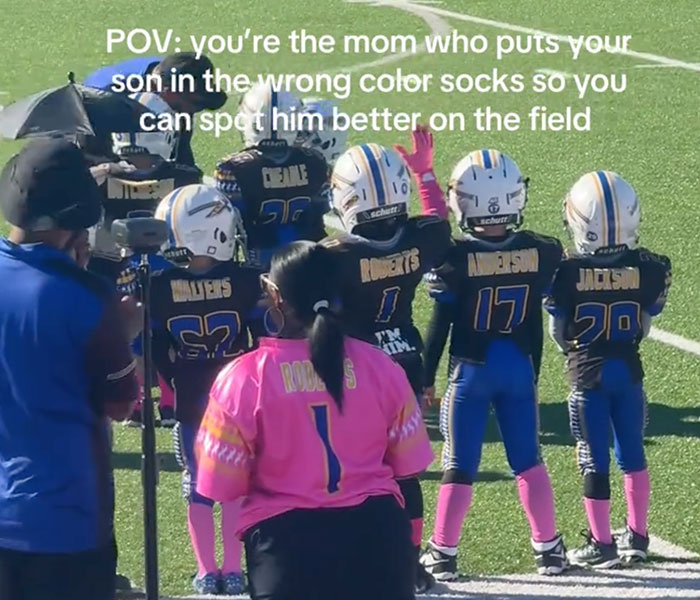
The controversy began with a viral video showing three young football players standing on the sidelines in matching blue uniforms.
Two of them were wearing bright pink socks. The third, identified by his jersey as Miller, was instead wearing a conspicuous pair of yellow ones.
“POV: you’re the mom who puts your son in the wrong color socks so you can spot him better on the field,” read the text over the video, which was uploaded on October 17.
The simple “mom hack” quickly attracted attention, but not necessarily for the reasons its creator might have expected.
As the clip spread online, viewers pointed out that Miller’s yellow socks made him immediately distinguishable from his teammates for reasons that had nothing to do with his jersey number.
The other players were dressed uniformly, right down to their pink socks, while the boy stood directly between two teammates wearing his mismatched pair.
For some viewers, the image alone was enough to make them imagine how the youngster might feel.
“Your kid is sitting there thinking ‘I’m the only one wearing yellow socks, I look like a f**kin idiot!’ good job mama bear,” one person wrote.
“Boy moms are irritating,” another added.
Others were less concerned about embarrassment and more confused about why the trick was necessary in the first place.
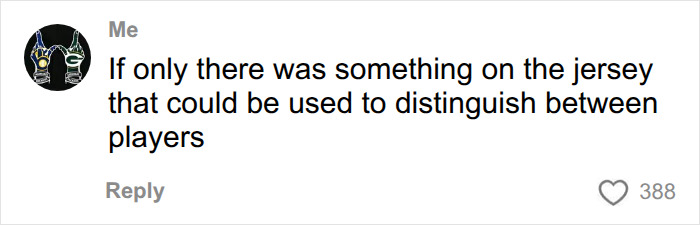
“If only there was some obvious difference on the jerseys like a number,” one person joked.
“That’s what the numbers on the jersey are for,” another agreed.
“Hey love if you look slightly above the socks you will see these large numbers on their backs!” a third wrote. “They are all different, memorize your son’s number and you won’t lose him!”
@xoxomckenziemiller♬ stay fly –
The clip soon pushed the conversation beyond whether the trick was useful and toward how seemingly insignificant parental decisions could affect a child socially.
Critics argued that intentionally making one player look different could draw unwanted attention from teammates and opponents, particularly at an age when fitting in can carry enormous importance.
One commenter imagined an even more immediate consequence.
“If I were his coach he would be easy to spot because he would be on the bench,” they wrote.
Others argued that the mother was effectively deciding that the team’s uniform rules did not need to apply to her child.
“Yes. Let’s teach him that the rules are for some but not for all,” one person wrote. “Back in my day, wrong/missing parts of uniform meant you were benched.”
Another viewer described the decision as “weirdly controlling,” and argued the practice could lead to the kid being bullied and ostracized.
Not everyone objected to the underlying problem the mother was trying to solve.
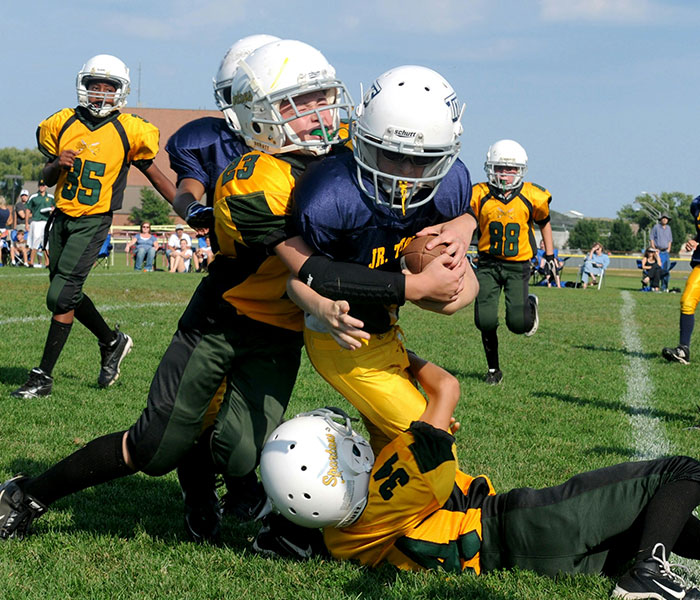
Youth football fields can be visually chaotic, particularly from the stands. Players move quickly, helmets obscure their faces, uniforms look nearly identical, and parents trying to follow one child through a crowd can easily lose track of them.
One viewer offered an alternative based on their own childhood experience.
“My mom always got me different colored gloves if she wanted to see where I was,” they wrote. “Hell of a lot better than me not wearing proper uniform.”
Another suggested the mother could accomplish exactly the same thing without making her son the only player wearing the wrong socks.
“Neon cleats mom,” the commenter wrote. “He’ll be in uniform with his teammates and he’ll still stand out so you can spot him easily.”
Other possible versions of the same idea could include a bright wristband worn over the uniform or a distinctive piece of tape on the helmet, provided the item complied with the team’s safety and uniform rules.
The unusually intense response ultimately appeared to have less to do with the socks themselves than with what they represented to viewers.
Children participating in team sports are already navigating the pressure to fit into a group. Deliberately making one child visually different for a parent’s convenience struck some viewers as adding another potential source of embarrassment.
And bullying has remained remarkably common among American children in recent years.
Data from the CDC’s National Health Interview Survey found that 34% of US teenagers between the ages of 12 and 17 reported being bullied at least once during the previous 12 months between July 2021 and December 2023.
Of those surveyed, 6.5% said they were bullied once or twice a month, 4.4% experienced it once or twice a week, while 1.7% said it happened almost every day.
The same CDC study found that teenagers who had been bullied were nearly twice as likely to report symptoms of anxiety or depression. While 15.4% of teenagers who had not been bullied reported recent anxiety symptoms, that figure rose to 29.8% among those who had.
And judging by the reaction to the viral clip, many viewers remembered exactly how much something as trivial as the wrong pair of socks could matter at that age.

By entering your email and clicking Subscribe, you're agreeing to let us send you customized marketing messages about us and our advertising partners. You are also agreeing to our Privacy Policy.
Thank you! You've successfully subscribed to newsletters!



































 No fees, cancel anytime





















31
0