Get Premium
Dark mode theme is available exclusively for premium users. Learn more about the benefits of subscribing.
No fees, cancel anytime.

 Dark Mode Ad-Free Browsing Unlimited Content
 Ad-Free Browsing Unlimited Content Dark Mode
Join 1.2 million Panda readers who get the best art, memes, and fun stories every week!
“Body advertising is strictly prohibited,” Paralympic athlete Josef Craig was told after he was disqualified from the men’s swimming S8 100m final at the 2016 European Paralympic Championships.
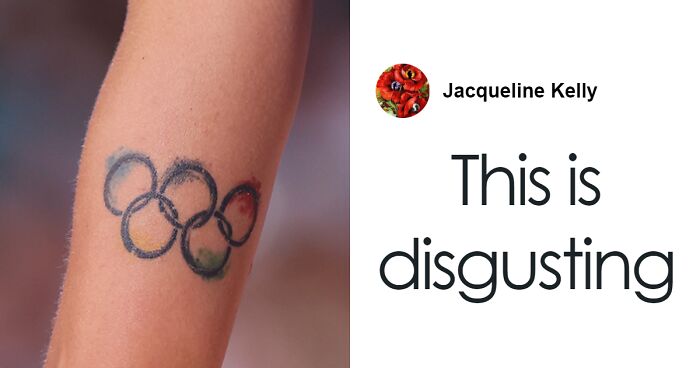
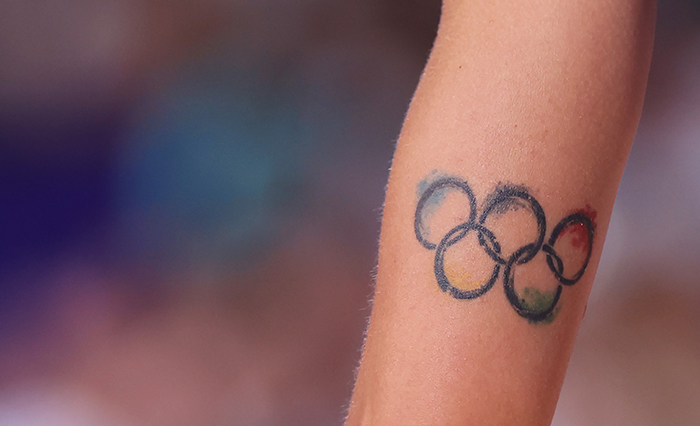
The now-retired winner of two Olympic medals has a tattoo of the Olympic rings on his left chest, which under International Paralympic Committee (IPC) rules is considered advertising, meaning all participants are under the obligation of covering them.
“The athlete did not cover his tattoo and was therefore disqualified,” explained a spokesperson for the organization at the time.
The ruling is strict, as despite delivering a flawless performance and winning his heat, Craig was unable to continue.
Now, with the 2024 edition of the Paralympics set to take place next Wednesday (August 28), participants could once again have all of their efforts nullified if they are unable to cover their ink properly.
Image credits: Ezra Shaw/Getty
The incident was a peculiar example of the odd differences between the IPC and the International Olympic Committee (IOC), with each organization following its own distinct set of rules.
It’s important to distinguish between the European Championships and the Olympics. Craig’s career demonstrates this, as he was disqualified from the former while being able to participate, and even win the bronze medal, in the 2016 Rio Olympics.
This difference explains why the swimmer was caught off guard, as the Olympics had no issue with his particular tattoo, whereas the IPC event considered it a form of advertising.
“We apply a common-sense approach to tattoos, regardless of their nature,” the spokesperson added.
The measure might seem extreme at a glance, but it’s intended to discourage athletes from selling advertising space on their skin, as was the case of American middle-distance runner Nick Symmonds.
The athlete famously auctioned off nearly 23 cm of skin on his arm to T-Mobile for a hefty $21,800 before the 2016 Rio Olympics, causing problems with the official Team USA sponsors at the time, like AT&T.
Image credits: Israel Torres
The IPC’s tattoo-specific regulation was introduced before London 2012, but it wasn’t strictly enforced until after the Games when athletes like American Paralympian Rudy Garcia-Tolson competed with visible Olympic rings tattoos.
“I don’t particularly agree with it, but it’s the rule, so we have to accept it,” Garcia-Tolson said. “I don’t want to put in all this hard work only to be disqualified for something on my body.”
In most sports, a simple long sleeve or elasticated cloth might suffice to cover up any ink that could be considered advertising.
For swimmers, waterproof patches or paint can serve as a temporary solution.
Regardless of the measures taken by Paralympic athletes to circumvent the ruling, it remains a point of contention, seeing that the Olympic rings tattoo has been a mainstay of the competition for more than 20 years, and it can be regularly seen on many non-Paralympic competitors.
Image credits: rudygarciatolson
The ruling may become a problem for many athletes, as over the last 20 years, tattooing the Olympic rings has become a time-honored tradition for many, appearing on athletes’ arms, necks, torsos, ankles, and even feet across various sports.
Some participants go all out with large, colorful, and elaborate versions that are hard to miss on TV, while others choose something more discreet. For most, the tattoo is a constant reminder of the effort they’ve invested and the success they’ve achieved in each version of the Olympics.
“It’s almost like a rite of passage,” said Chris Jacobs, a swimmer who earned three medals at the 1988 Seoul Olympics, in an interview with USA Today. “It’s like a membership card to an exclusive club.”
Jacobs, now 59, is credited with starting the trend over 30 years ago. After noticing that some Canadian swimmers, including the late Victor Davis, had small flag tattoos on their chests, Jacobs thought of another iconic symbol: the Olympic rings.
Image credits: Men’s Health
During a stop in Hawaii on his way back from the Seoul Olympics, Jacobs got a small Olympic rings tattoo on his hip, low enough to be hidden under his swimsuit during competitions. A few years later, he added another, a bit higher up on his hip. Eventually, he went all out with a colorful, more prominent version on the inside of his right bicep.
“They represent a lot to many people,” Jacobs said. “I wanted to commemorate that period in my life.”
Before long, top swimming stars like Ryan Lochte and Michael Phelps were showing off their rings tattoos, and the trend quickly spread to other sports, with stars like Simone Biles and Noah Lyles having added their own versions to their skin.
Image credits: rudygarciatolson
“So now they are subtly saying paralympians are not olympians. I thought the whole point of the Paralympics was inclusiveness,” said one reader.
“What if it was an olympian (who had the tattoo) and who now has a disability, so needs to be in the Paralympics?” pondered another.
“Well it didn’t get the able Olympians banned so let’s talk equality,” wrote one viewer.
“How can the Olympic rings be considered advertising?” wondered another.
“Jesus Christ! Hard enough being a disabled in this day and age, what a signal to send!” one reader stated.
“This seems more like discrimination than anything else,” argued another.


So they are going to treatment disabled people as less than able people? Nothing new there. I have been disabled over 1/2 my life and 80% to 90% of the world population already does this on daily basis. It doesn’t where we live or what we want to do, there is always some “well meaning” a*****e to tell we can’t live there, bring our service there, complete an active, have enough room to shop in a store, have a grocery cart you use with a wheelchair, etc, etc, etc. Do I sound angry? Good then maybe at least on idiot might learn from this.

As much as the ADA is designed to help, I found England, Iceland, and France to be far more interested in our equality than acting like having the ability to do things were a privilege or bonus.
Load More Replies...
So the olympic rings are an ad? I'm confused, what service or product do the sell? Fair play? Victory for the best? Sports values and respect? Indeed, these are so bad to promote... s/


Can someone explain to me why the olympics are banning tattoos of.... the olympics? Genuinely don't understand. "Advertising" - surely that's a good thing?
So they are going to treatment disabled people as less than able people? Nothing new there. I have been disabled over 1/2 my life and 80% to 90% of the world population already does this on daily basis. It doesn’t where we live or what we want to do, there is always some “well meaning” a*****e to tell we can’t live there, bring our service there, complete an active, have enough room to shop in a store, have a grocery cart you use with a wheelchair, etc, etc, etc. Do I sound angry? Good then maybe at least on idiot might learn from this.
As much as the ADA is designed to help, I found England, Iceland, and France to be far more interested in our equality than acting like having the ability to do things were a privilege or bonus.
Load More Replies... So the olympic rings are an ad? I'm confused, what service or product do the sell? Fair play? Victory for the best? Sports values and respect? Indeed, these are so bad to promote... s/
Can someone explain to me why the olympics are banning tattoos of.... the olympics? Genuinely don't understand. "Advertising" - surely that's a good thing?

































 No fees, cancel anytime


















32
16