Get Premium
Dark mode theme is available exclusively for premium users. Learn more about the benefits of subscribing.
No fees, cancel anytime.

 Dark Mode Ad-Free Browsing Unlimited Content
 Ad-Free Browsing Unlimited Content Dark Mode
Join 1.2 million Panda readers who get the best art, memes, and fun stories every week!
In history class, we learn the broad strokes of the past. Big wars, fallen civilizations, and darkest periods of history are all part of the textbooks we read and learn from. However, there are many stories that history books often fail to include. And it’s not because they’re trying to hide something: there are just so many moments and personal stories that get lost in the intricate web of time, memory, and record-keeping.
The Facebook page “People of the Past: History, Science and Forgotten Stories” shares the lesser-known stories that might’ve fallen through the cracks but are still noteworthy. For example, did you know that windshield wipers were actually invented by a 27-year-old New Yorker, Mary Anderson? And have you ever heard about the story of a bear in the Polish army during WWII? You’ll find these and many more interesting historical moments below, so don’t dally and satisfy your curiosity for captivating history, and start scrolling!
This post may include affiliate links.
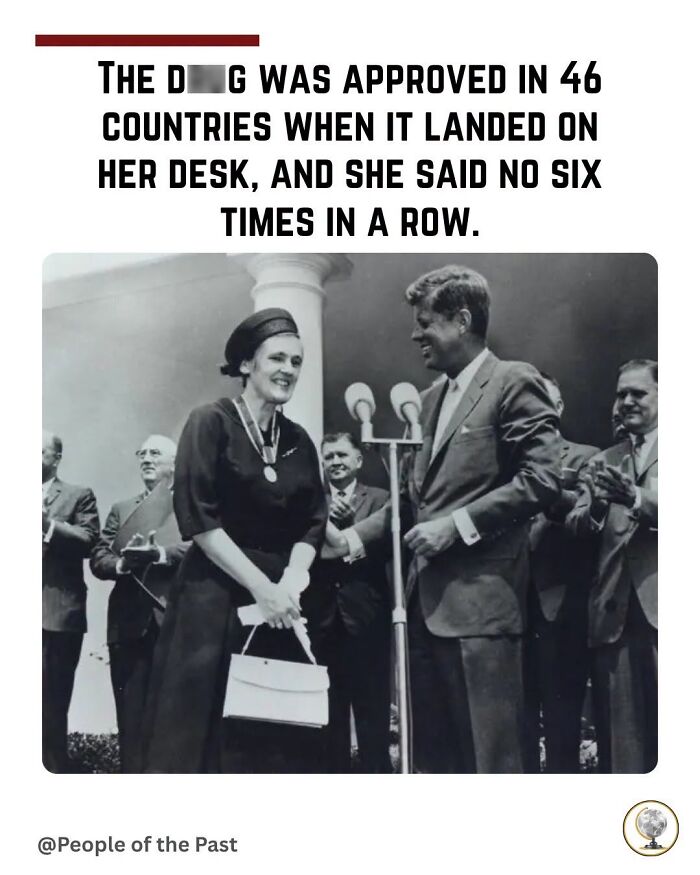
Six weeks into her new job at the FDA, Frances Oldham Kelsey was already a problem.
It was September 1960. The application on her desk was for a sedative called Kevadon, the American brand name for thalidomide. The drug was already being sold in 46 countries. Pregnant women took it for morning sickness. Doctors handed it out for anxiety and insomnia. The German manufacturer called it safe enough to give to a child.
Richardson-Merrell, the US licensee, expected a rubber stamp. Most reviewers gave one. Kelsey didn't.
She read the application and found the safety data thin. The studies were short. The animal trials hadn't tested what the drug did to a developing fetus. She sent it back and asked for more.
The company sent the same data with a new cover letter. She sent it back again. They tried a third time. A fourth. A fifth. By the sixth rejection, Richardson-Merrell was calling her superiors, complaining that she was difficult, obstructive, a bureaucrat holding up a miracle drug. They wanted her removed.
Kelsey held the line.
She had a doctorate in pharmacology and a medical degree from the University of Chicago. During the war she'd worked on antimalarials and seen how a drug that looked safe in adults could devastate something smaller. A 1960 letter in a British medical journal mentioned nerve damage in patients taking thalidomide. She asked Richardson-Merrell about it. They had no good answer.
Then the reports started coming in from Europe. Babies born without arms. Without legs. With flipper-like limbs attached directly to the torso. The condition was called phocomelia, and it was almost unheard of before thalidomide. By the time the drug was pulled from world markets in 1961, more than 10,000 children had been affected. Roughly half didn't survive infancy.
In the United States, the count was 17. Most of those came from samples distributed by Richardson-Merrell during the application process, before Kelsey had even finished blocking it.
In August 1962, President Kennedy stood in the Rose Garden and pinned the President's Award for Distinguished Federal Civilian Service on her lapel. She was the second woman ever to receive it.
Congress passed the Kefauver Harris Amendment two months later. From then on, drug companies had to prove a medicine worked and was safe before it could be sold in America. The standard Kelsey had insisted on alone, against pressure that would have broken most people, became the law.
She kept working at the FDA until she was 90.

The what was approved? Dong? Dang? Ding? “D*r*u*g” is not an offensive word. Doctors prescribe them all the time. Stop catering to imaginary pearl-clutchers, please.
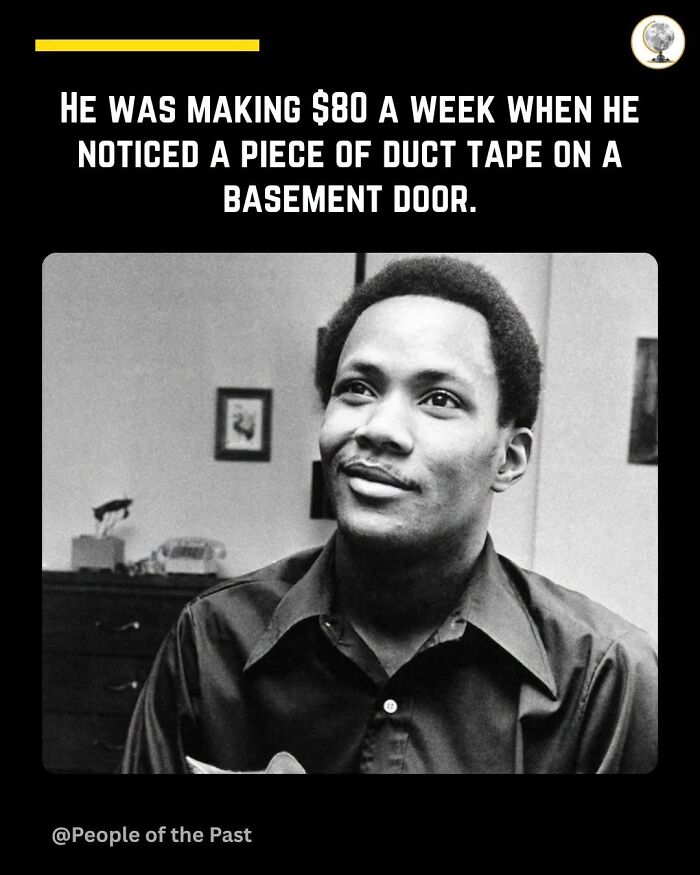
At 1 a.m. on June 17, 1972, a 24-year-old security guard named Frank Wills was making his rounds at the Watergate complex in Washington.
He was earning $80 a week.
On the basement level, he noticed a strip of duct tape across a door latch, holding the bolt back so the door wouldn't lock. He peeled it off and kept walking. When he came back later and saw fresh tape on the same latch, he picked up a phone and called the police.
Five men were arrested inside the offices of the Democratic National Committee that night, carrying cameras, bugging equipment, and thousands of dollars in sequential hundred dollar bills. The break-in led back to the Committee to Re-elect the President. Two years later, Richard Nixon resigned.
Frank Wills had done his job. He testified before the grand jury. He played himself in the film All the President's Men. For a moment, he was the man who started it all.
Then the work dried up.
He asked for a raise at the Watergate and was refused, so he quit. Other security jobs wouldn't hire him. He believed he'd been blacklisted, and the pattern suggests he was right. He drifted between low-paying gigs and stretches of unemployment.
In 1983 he was convicted of shoplifting a pair of sneakers for his nephew. He moved to North Augusta, South Carolina, to care for his mother after she had a stroke, and lived with her in a house with no phone. When she died in 1993, he couldn't afford the funeral.
He spent his last years in poverty, mostly forgotten by the country whose history he'd bent. Reporters who tracked him down found a soft-spoken man who didn't seem bitter, just tired.
Frank Wills died of a brain tumor in September 2000. He was 52.
The presidents he helped unseat and the journalists who chased the story became household names. The night watchman who noticed a piece of tape on a door went into the ground with almost nothing to his name.
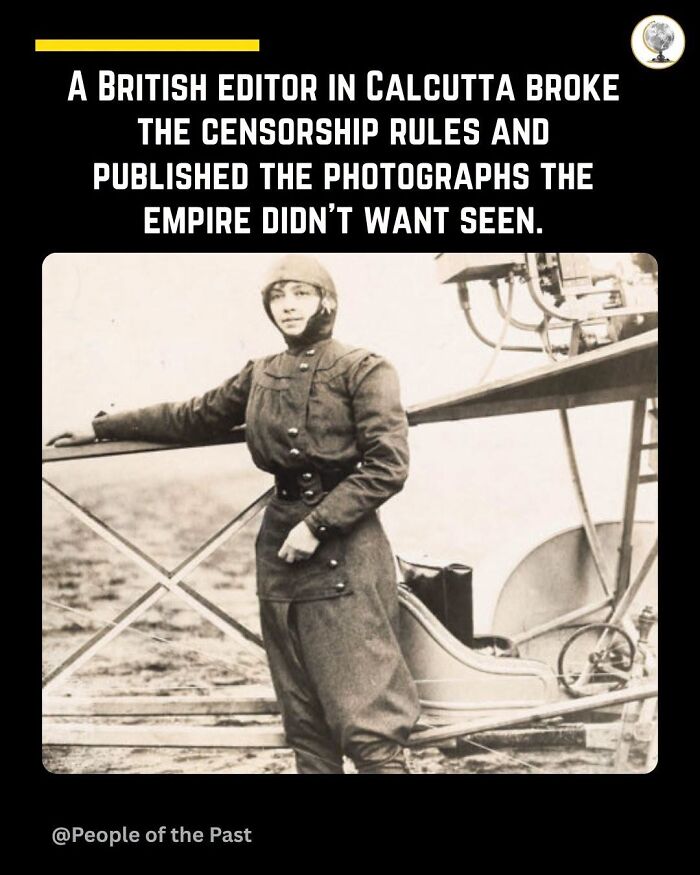
In 1914, Marie Marvingt walked into a French army recruiting office and was turned away for being a woman.
So she cut her hair, borrowed a uniform, and tried again.
By then she already held world records in skiing, cycling, swimming, ballooning, and shooting. She'd crossed the English Channel in a hot air balloon in 1909, the first woman to do it. She'd flown solo across the Alps. The French press called her the Fiancée of Danger, and she'd earned every syllable.
When war broke out, she wanted in.
The infantry didn't agree. She enlisted under a false name and served with the 42nd Battalion of Chasseurs à Pied on the Italian front before her identity was discovered and she was sent home. That should have been the end of it.
It wasn't.
Marvingt talked her way into the French air service and flew bombing missions over German-held territory in 1915, one of the first women in history to fly combat sorties. She bombed a base at Metz and was awarded the Croix de Guerre for it.
Then she turned to the wounded.
She'd been pushing the idea since 1910: aircraft fitted out to carry injured soldiers off the battlefield and into proper medical care. The military brushed her off for years. She kept designing, kept lobbying, kept refusing to let the idea die. By the 1930s she was training nurses for aerial evacuation in North Africa, and the air ambulance she'd imagined before the war became standard practice.
She never married. She lived simply in Nancy, taught herself metalwork, learned to fly jets in her seventies, and kept moving.
In 1961, at 83, she cycled from Nancy to Paris. The following year she hitchhiked a ride in an American F-101 Voodoo fighter jet over the skies of France. She was 84.
She died in 1963, holding 34 medals and honors that almost no one outside France remembered.
The air ambulance is still flying.
They were buried in the sand for 4,000 years, and when archaeologists pulled them out, nothing about them made sense.
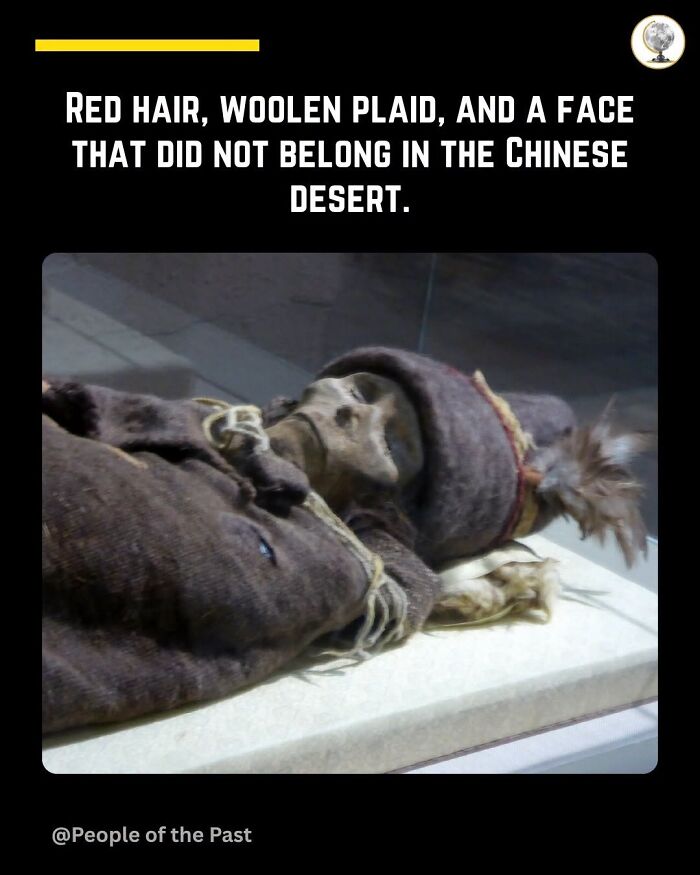
The Tarim Basin sits in the far west of China, a stretch of desert so dry that bodies laid in its sand don't rot. They mummify. Skin holds. Hair keeps its color. Clothing survives in a way that almost never happens anywhere else on earth.
Starting in the 1990s, excavations in the Xiaohe and Gumugou cemeteries turned up hundreds of these bodies. The oldest dated back to around 2000 BCE. They had long noses, deep-set eyes, and hair in shades of red and light brown. Some were wrapped in woolen cloth woven in plaid patterns that looked uncannily like Celtic tartan.
In the middle of the Taklamakan Desert, thousands of miles from Europe, they did not look like anyone who was supposed to be there.
The theories piled up fast. Maybe they were Indo-European migrants who had pushed east from the steppe. Maybe they were related to the Tocharians, speakers of a lost Indo-European language attested in the region centuries later. Maybe they were Bronze Age herders from the Afanasievo culture of southern Siberia. The plaid weaving, the wheat in their graves, the cattle and sheep buried with them, all of it seemed to point west.
For 30 years, the question hung over the field. Where did they come from, and what were they doing out there.
In 2021, a team led by Chinese, European, and American geneticists finally got a clean read on the DNA of 13 of the earliest mummies. The answer was not on anyone's list.
They were not migrants. They were not Indo-Europeans. They were the direct descendants of a population called the Ancient North Eurasians, an Ice Age group that had largely vanished from the genetic record by the end of the last glacial period. The Tarim people were a relic. A pocket of deep ancestry that had survived in isolation in the desert for thousands of years.
They had not brought their wheat and their wool and their dairy from a homeland. They had picked those things up from neighbors, traded ideas across the steppe, and built a culture out of the contact while keeping their bloodline almost entirely to themselves.
The plaid was borrowed. The faces were their own.
They buried their dead in boat-shaped coffins, planted wooden oars upright in the sand as grave markers, and laid sprigs of ephedra beside the bodies. The desert did the rest.
Four thousand years later, the wind uncovered them, and the question they raised took three decades to answer.
On July 13, 1985, a BBC engineer named Kevin Hudson sat inside a cramped outside broadcast truck behind Wembley Stadium with a screwdriver in his hand and the largest television audience in history depending on him.
Live Aid was about to go to air. Two stadiums, Wembley in London and JFK in Philadelphia, would be linked by satellite to roughly 1.9 billion viewers in 150 countries. Nothing like it had ever been attempted. The equipment had never been tested at that scale, and the schedule allowed no rehearsal.
The whole point of the broadcast was to raise money for famine relief in Ethiopia. If the satellite feed dropped, the donations stopped. Bob Geldof had spent months pulling the show together. The technical side came down to a handful of engineers in trucks, working with cabling and switching gear that had been improvised in weeks.
Hudson was one of them.
The Wembley truck was the central routing point for the UK end. Audio and video feeds from the stage came in, got mixed, and went out to the BBC, to the satellite uplink, and onward to the world. The patch bays were a tangle of cables. The cooling was poor. The margin for error was zero.
For 16 hours, Hudson stayed at his post. When connectors worked loose from the heat and vibration, he tightened them by hand. When signals threatened to drop, he rerouted them on the fly. Queen took the stage. The Who reunited. Bowie played four songs and gave up his fourth so a CBC news film of starving children in Ethiopia could be shown instead. Phil Collins flew Concorde to play both stadiums in one day.
The feed held.
By the time the broadcast ended in the early hours of July 14, Live Aid had raised an initial 40 million pounds for famine relief, a figure that would climb much higher in the months that followed. Geldof took the credit, deservedly. The musicians took the applause. The engineers went home.
Hudson kept working at the BBC for decades. He rarely talked about that day. The viewers who watched Mercury command the Wembley crowd never saw the man in the truck behind them, screwdriver in hand, holding the signal together one connector at a time.
In a Birmingham warehouse in early 1945, the mail was stacked to the rafters.
Christmas packages had been sitting there for months. Some had burst open. Rats had gotten into the food parcels. Many of the letters were addressed to soldiers who were already dead, and nobody had told the families writing to them. The backlog had grown to 17 million pieces of undelivered mail, and morale on the front lines was sinking with every letter that never arrived.
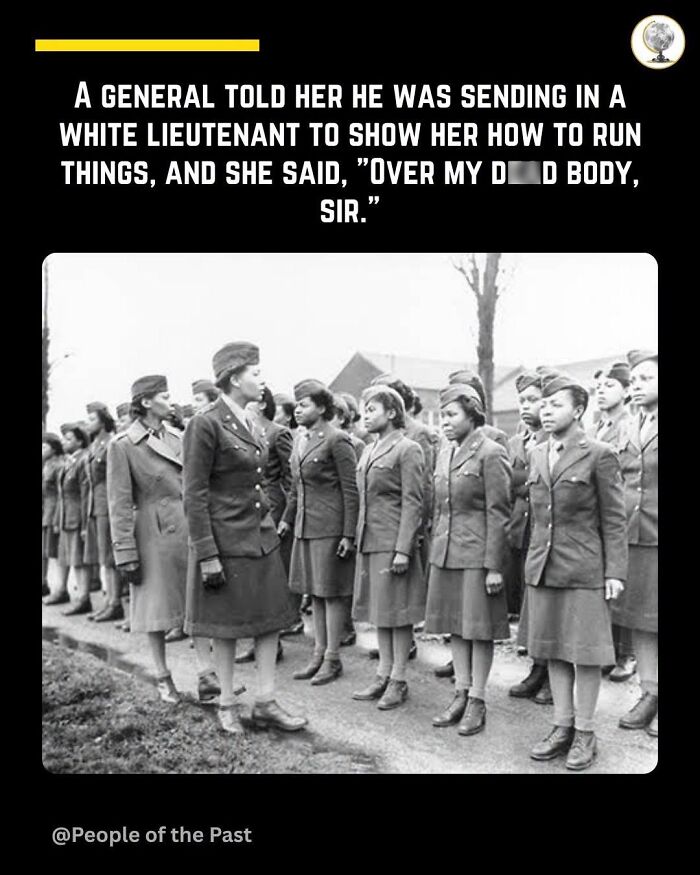
The Army's solution was the 6888th Central Postal Directory Battalion, the only all-Black, all-female unit sent overseas during the war. 855 women. Their commanding officer was Major Charity Adams, a 26-year-old former math teacher from South Carolina who had been one of the first Black women commissioned into the Women's Army Corps.
They were given six months to clear the backlog.
The warehouse had no heat. The windows were blacked out against air raids. The women worked three eight-hour shifts around the clock, sorting by serial number because thousands of GIs shared the same name. There were 7,500 Robert Smiths alone. They built locator cards for every soldier in the European Theater, around seven million of them, cross-referenced by unit and number.
They cleared the 17 million piece backlog in three months. Then they were sent to Rouen to do it again. Then Paris.
Adams ran the battalion under conditions that would have broken most officers. A white general inspected the unit and told her he was going to send in a white lieutenant to show her how to run things. She looked at him and said, "Over my dead body, sir." He tried to court-martial her. She filed charges against him for using racist language. Both complaints were dropped.
The women lived with s*********n inside their own army. Separate quarters. Separate recreation. A Red Cross hotel in London that tried to turn them away. Adams refused to let her battalion use any facility that would not serve all of them, so they built their own, a beauty salon, a mess hall, social spaces, inside their barracks.
They came home in 1946 without a parade. No ceremony. No public thanks. Adams left the Army as a lieutenant colonel, the highest-ranking Black woman in the service, and went on to earn a master's degree and run community organizations in Ohio for the rest of her life.
In 2022, almost 80 years after the warehouse in Birmingham, Congress awarded the 6888th the Congressional Gold Medal. Six of the women were still alive to receive it.
On April 15, 1945, British troops entered Bergen Belsen.
BBC war correspondent Richard Dimbleby went in with them.
He had covered the war for years. He had seen b**b damage, death, fear and exhaustion. He knew what battle could do to cities and soldiers.
But Bergen Belsen was different.
The camp was filled with starvation, disease and bodies.
Thousands of prisoners were sick. Typhus had spread through the camp. Many people were too weak to move. Bodies lay in the open because the N**i guards had left the camp in collapse.
The British Army arrived as liberators.
Within hours, they also became doctors, nurses, stretcher bearers and gravediggers.
Dimbleby drove through the camp with the chief doctor of the Second Army.
What he saw shook him.
He recorded a report for the BBC, describing the camp in direct and brutal detail. The words were so shocking that editors in London hesitated to broadcast it.
They could hardly believe what he had described.
According to later accounts, Dimbleby threatened to resign if the BBC refused to air the report.
So it went out.
Millions of people heard what had been found at Bergen Belsen.
Not a neat victory story.
Not flags.
Not speeches.
Not a clean ending to the war.
They heard about bodies, sickness, hunger and people who had been left to die behind barbed wire.
That broadcast helped change how Britain understood N**i crimes.
Dimbleby did not liberate the prisoners himself.
But he made sure people at home heard the truth before anyone could turn it into something smaller, softer or easier to ignore.
Bergen Belsen became one of the clearest images of N**i cruelty in British memory.
And one reporter made sure the silence did not last.
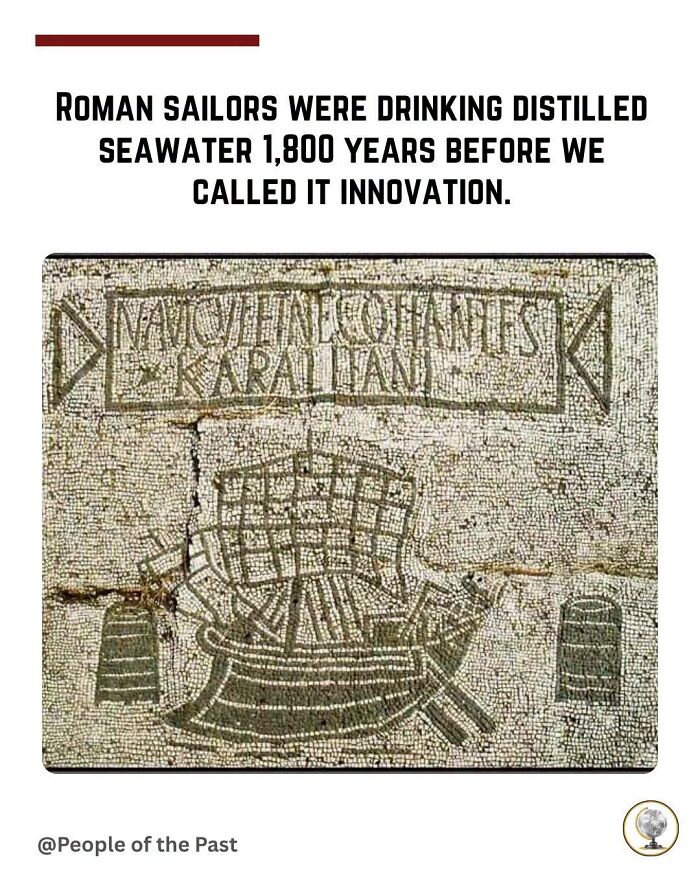
A Roman warship could carry 200 men across open sea for weeks. Fresh water ran out long before the voyage did.
So the crews built their own.
Roman sailors on long Mediterranean routes faced a problem every navy has faced since: salt water k**ls you faster than thirst. The amphorae they carried for drinking water were heavy, fragile, and never enough for a crossing to Egypt or the Black Sea. Running dry meant mutiny or death.
The answer sat in the bottom of the ship.
Crews packed wooden barrels and ceramic vessels with layered filtration columns. Coarse sand at the top, then finer sand, then charcoal made from burned wood, then clay. Seawater poured in at one end came out at the other stripped of much of its sediment, organic matter, and some of its salinity. It wasn't pure, but it was drinkable in a pinch.
For the harder work, they used the sun.
Lead-lined basins were set on deck, filled with seawater, and covered with sloped surfaces that caught the condensation as the water evaporated. The salt stayed behind. The pure water ran down the slope and collected in a separate vessel. Solar distillation, on a wooden ship, 2,000 years ago.
Pliny the Elder wrote about sailors hanging fleeces over the sides of ships at night, then wringing the dew-soaked wool into jars at dawn. Aristotle had described the principle of evaporation centuries earlier, noting that seawater, when turned to vapor, came back fresh.
None of it was magic. It was patient observation, repeated across generations of crews who knew that the difference between a successful voyage and a floating tomb was the water in the hold.
The knowledge faded with the empire. Medieval and early modern sailors died of thirst on ships surrounded by ocean, the old techniques lost or ignored.
In 1791, Thomas Jefferson, then Secretary of State, issued a report to Congress on a new method for converting seawater into fresh. He called it a discovery. The principles were the same ones a Roman quartermaster would have recognized at a glance.
We rediscovered solar desalination in the 20th century and built it into emergency life rafts and off-grid water systems. Engineers wrote papers. Patents were filed.
The Romans had done it with sand, charcoal, clay, lead, and sunlight, and they had done it while making dinner
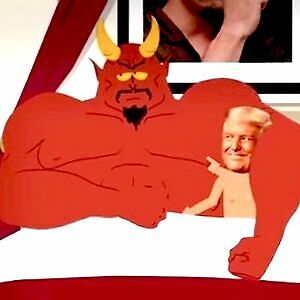
All right, but apart from the sanitation, medicine, education, wine, public order, irrigation, roads, the fresh water system and public health, what have the Romans ever done for us?
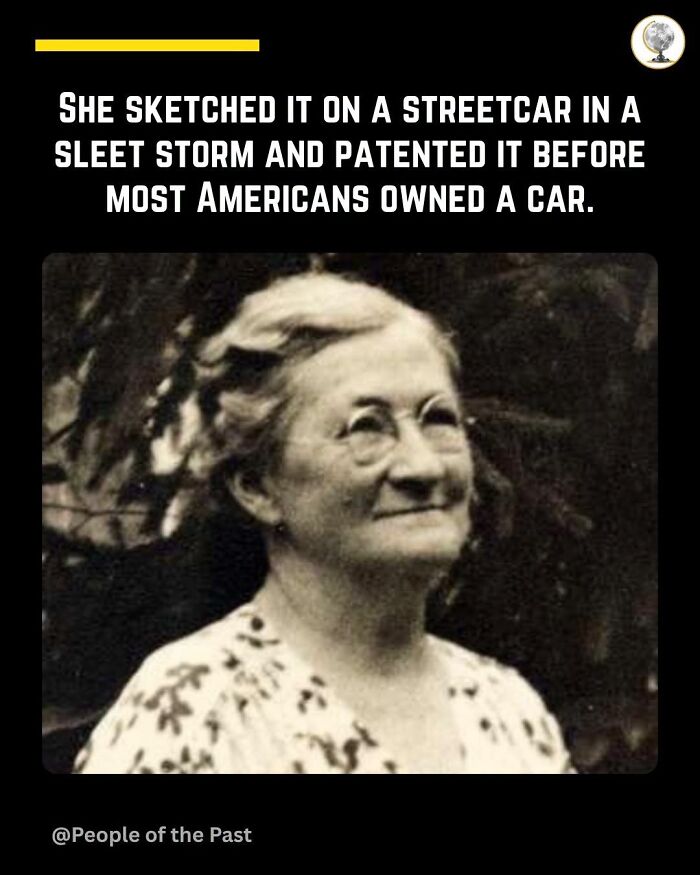
Mary Anderson was riding a New York streetcar in the winter of 1902 when she noticed the driver had a problem.
Sleet was hammering the windshield. To see the road, he had to lean out of the open side window, face exposed to the storm, or stop the car entirely and climb out to wipe the glass by hand. Every few blocks, the same routine. Passengers froze in the draft. The car crawled.
Anderson was a 36 year old real estate developer from Alabama, in the city on a visit. She pulled out a notebook and started sketching.
What she drew was a lever, mounted inside the cab, connected to a rubber blade on the outside of the windshield. The driver could pull the lever and sweep the glass clean without opening a window or leaving his seat. A counterweight returned the blade to its resting position. Simple. Obvious, once someone had thought of it.
No one had.
Anderson filed for a patent in 1903 and was granted US Patent 743,801 that November. She was thirty seven. She owned the rights to the first functional windshield wiper in the country.
Then she tried to sell it.
In 1905 she approached a Canadian firm, hoping they would manufacture and market the device. They turned her down flat. The reply, preserved in her family papers, said the wiper had no commercial value. Drivers, the company reasoned, would find the motion distracting. Other manufacturers said much the same. A woman inventor with a strange little lever for a vehicle most Americans didn't yet own was not a serious proposition in 1905.
She kept the patent. She paid the fees. She waited.
By the 1910s, cars were everywhere, and closed cabs were becoming standard. The wiper went from oddity to necessity. In 1922, Cadillac made them standard equipment on every car it built. Other manufacturers followed.
Anderson's patent had expired in 1920.
She never received a cent from the industry that adopted her design. By the time the wiper was on every windshield in America, the rights were public domain and the credit had drifted to other inventors who refined later versions.
Anderson went back to Alabama and ran an apartment building in Birmingham called the Fairmont. She lived there for the rest of her life. She died in 1953, at 87, in her summer cottage in the mountains.
The wiper on the car outside her funeral worked the way she had drawn it in a notebook half a century earlier.
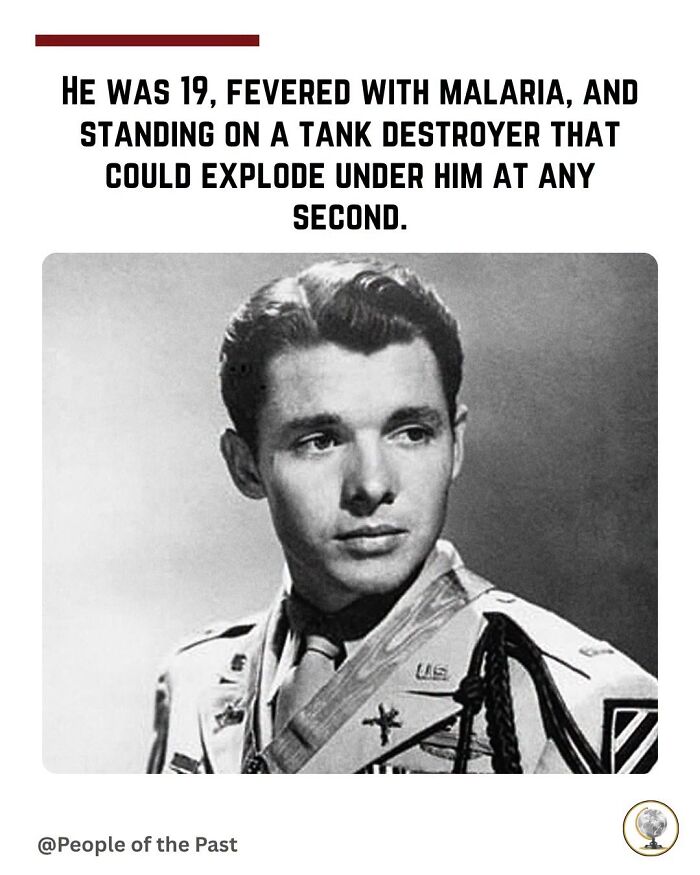
Audie Murphy weighed about 150 pounds and stood five foot five. On January 26, 1945, he was the smallest man in his company, burning with malaria, and in command of what was left of Company B near the village of Holtzwihr in eastern France.
Six German tanks were grinding toward his position through the snow. Behind them came around 250 infantry in white camouflage.
He ordered his men back into the woods. He stayed at the edge of the clearing with a field telephone, calling in artillery.
A nearby American tank destroyer took a direct hit and started to burn. Its crew was dead or wounded. The vehicle was loaded with fuel and ammunition and could go up at any second.
Murphy climbed onto it.
He got behind the .50 caliber machine gun mounted on top and started firing at the German infantry. The phone cord trailed down from his hand. He kept calling corrections to the artillery while bullets cracked off the hull around him.
At one point the fire direction officer asked how close the Germans were. Murphy told him to hold the line, then said, "Just hold the phone and I'll let you talk to one of the bastards."
He held that position for nearly an hour. The tank destroyer never exploded. The German infantry, cut off from their armor, broke and pulled back. The tanks, without infantry support and taking artillery, withdrew with them.
Murphy climbed down, refused medical attention for a leg wound, and walked back to organize a counterattack.
He was 19 years old.
The action at Holtzwihr earned him the Medal of Honor. By the end of the war he was the most decorated American combat soldier of World War II, with 33 awards and decorations, including every army combat medal for valor the United States gave out.
He came home and became a movie star. He played himself in the 1955 film of his memoir, To H**l and Back, and it was Universal's biggest hit until Jaws.
The rest of his life was harder than the publicity allowed.
He couldn't sleep. He had what doctors would later call post-traumatic stress disorder, though at the time it had no name and no treatment. He became addicted to sleeping pills and locked himself in a motel room to break the habit cold.
He kept a loaded .45 under his pillow until the night he died in a plane crash in 1971, at the age of 45.
The boy from a Texas sharecropping family who had lied about his age to enlist was buried at Arlington. His grave is the second most visited there, after John F. Kennedy's
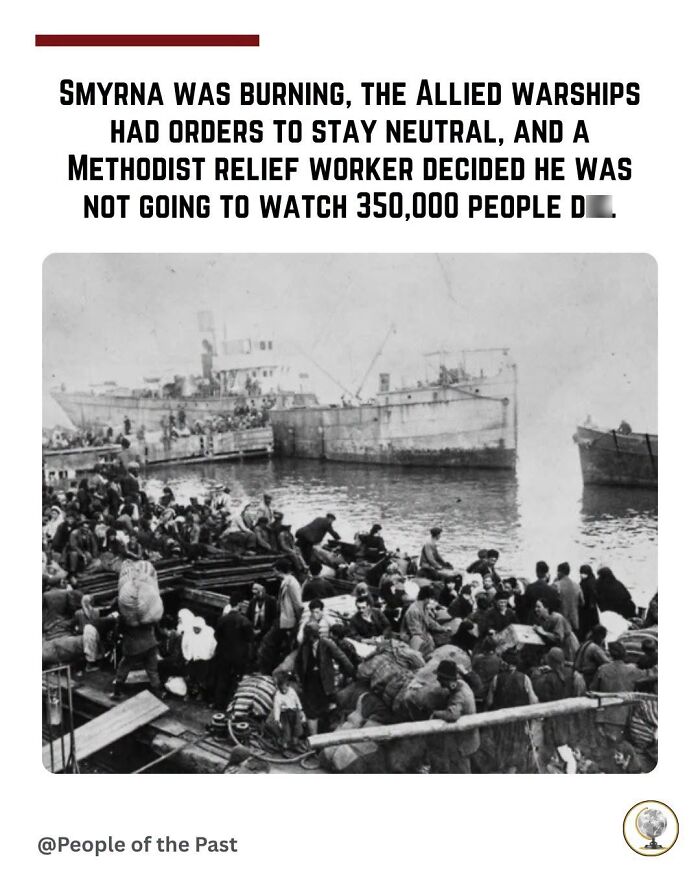
Smyrna was burning. The harbor was packed with hundreds of thousands of Greek and Armenian refugees, pressed against the water with Turkish forces closing in behind them. Allied warships sat offshore and watched. Their orders were to stay neutral.
Asa Jennings was 45 years old, five feet tall, and walked with a curved spine from childhood tuberculosis. He'd come to Smyrna in 1922 to run a YMCA program. He had no military rank, no diplomatic authority, and no business doing what he did next.
He started by renting an Italian freighter with money scraped together from relief funds and got 2,000 people out. Then he saw the Greek ships.
A fleet of empty Greek vessels was anchored at Mytilene, just across the water on the island of Lesbos. They had carried defeated Greek soldiers home and were sitting idle while the docks at Smyrna filled with people who would not survive the week.
Jennings asked the Greek captains to sail back for the refugees. They refused without orders from Athens.
So he sent a telegram to the Greek prime minister.
He gave him until six o'clock that evening to release the fleet. If the ships did not move, Jennings wrote, he would broadcast to the world that the prime minister of Greece had refused to save his own people, and he would do it using the prime minister's name.
The ships moved.
Jennings was put in command of the fleet, a Methodist relief worker suddenly running a naval evacuation. For nine days the ships ran back and forth across the Aegean, loaded past any reasonable capacity, while the city burned behind them. Refugees climbed aboard over the rails. Babies were passed hand to hand.
When it was over, an estimated 350,000 people had been pulled off the quay at Smyrna and carried to Greek islands and the mainland.
Jennings stayed in the region for years afterward, working on refugee resettlement. He rarely spoke about what he'd done. When he died in 1933, most of the people he'd saved never knew his name.
The man who organized one of the largest civilian sea evacuations in history did it with a telegram and a bluff.
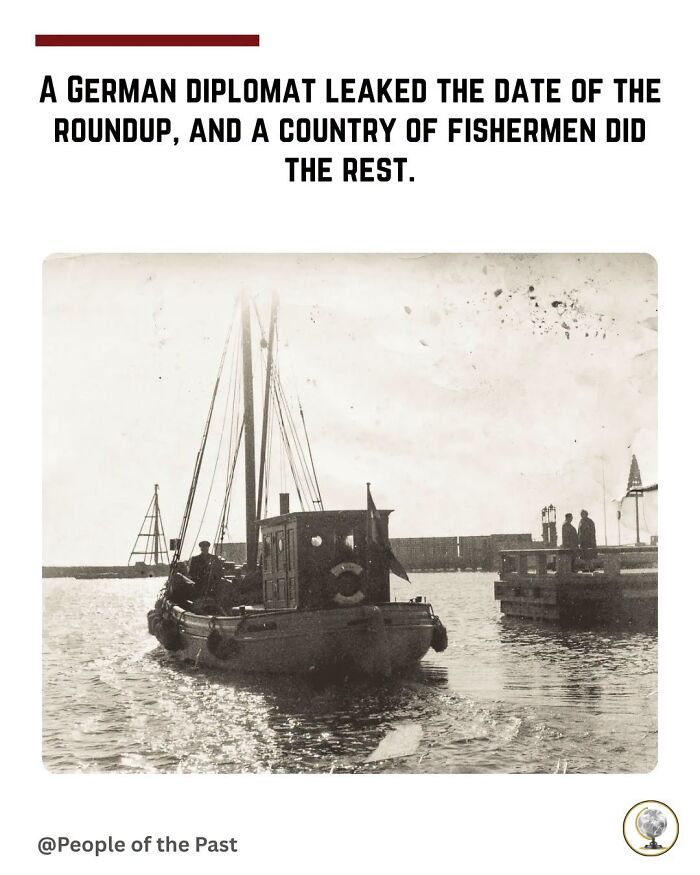
On the night of October 1, 1943, the Gestapo knocked on doors across Copenhagen expecting to find Denmark's Jews waiting to be arrested.
The houses were empty.
Three days earlier, a German diplomat named Georg Ferdinand Duckwitz had done something that could have gotten him hanged. He leaked the date of the planned roundup to Danish politicians, who passed the warning to the Jewish community during Rosh Hashanah services. The rabbi told his congregation to go home, pack, and disappear.
What happened next had no real precedent in occupied Europe.
Ordinary Danes hid their Jewish neighbors in apartments, summer houses, churches, and farms. Doctors at Bispebjerg Hospital admitted hundreds under invented names, listing them as patients with illnesses they did not have. Ambulances carried families to the coast. Taxi drivers refused payment. Police looked the other way.
The coast was the bottleneck. Sweden was neutral and only a few miles across the Øresund strait, but getting there meant crossing open water patrolled by German boats.
Danish fishermen took the job.
They packed people into cargo holds, under fish, beneath tarps, in engine compartments. Some charged steep fares because the risk was real and the boats were their livelihoods. Others took nothing. Wealthy Danes set up funds to cover the cost for families who could not pay, so no one was turned away at the dock.
Over roughly three weeks in October 1943, about 7,220 Jews and close to 700 non-Jewish family members were ferried to Sweden. Around 99 percent of Denmark's Jewish population escaped.
The Gestapo caught 470. They were sent to Theresienstadt, not Auschwitz, partly because Danish officials would not stop asking about them. Red Cross inspectors were allowed in. Care packages were sent. Of those deported, more than 50 died in the camp, mostly elderly people who could not survive the conditions. The rest came home.
Duckwitz survived the war and later served as West Germany's ambassador to Denmark. Yad Vashem named him Righteous Among the Nations in 1971.
When the Danish Jews returned in 1945, many found their homes had been looked after by neighbors. Plants watered. Mail stacked on tables. Cats fed.
The country had decided, without ever holding a vote, that this was not going to happen here.
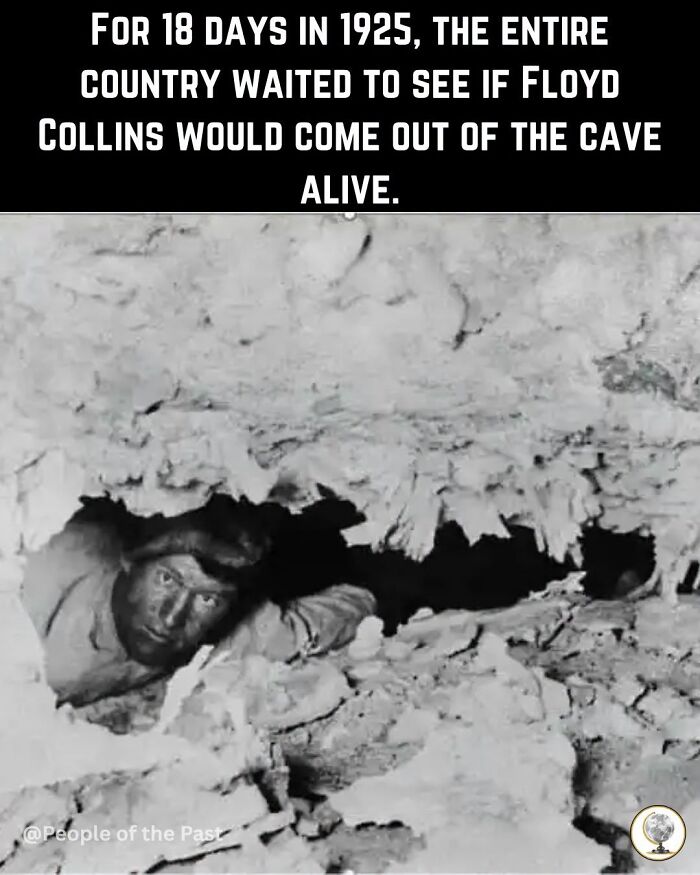
On January 30, 1925, Floyd Collins crawled into Sand Cave in central Kentucky looking for a new tourist attraction.
He was 37, a self-taught caver who'd already discovered Crystal Cave a few miles away. Crystal Cave sat too far off the main road to draw real crowds, so Collins was scouting closer to the highway, hoping to find a passage that would put his family in the money.
On his way out, a 26 pound limestone rock slipped and pinned his left foot. He was 55 feet underground, wedged in a passage so narrow he couldn't bend to reach the rock himself.
Word got out fast. By the second day, neighbors were taking turns crawling down to bring him food and talk to him. By the fourth day, the Louisville Courier-Journal had sent a 21 year old reporter named William Burke Miller, known as Skeets because he was small enough to slip through tight places.
Miller weighed about 117 pounds. He squeezed down the passage four separate times, lying flat on his stomach, inching forward in the cold water that ran along the floor. He fed Collins soup. He rigged a lightbulb near his head. He held interviews by lantern light and crawled back out to file them.
His dispatches ran on front pages from New York to Los Angeles. Radio broadcasters set up at the cave mouth and went live with hourly updates. An estimated 50,000 people drove to the site. Vendors sold hot dogs and balloons. A small carnival took shape in the field above a man slowly dying in the dark.
Rescue crews tried to dig a shaft alongside the passage. The walls kept collapsing. A second rockfall sealed the original route entirely, c*****g Collins off from anyone who might reach him by hand.
He died of exposure and hunger on February 13, day 14 of his entrapment. The shaft crews didn't reach his body until day 18, on February 17.
Getting him out through the unstable rock was judged too dangerous. The passage was sealed with Collins still inside.
Two months later his family had the body recovered and buried on the farm. It was later exhumed, displayed in a glass coffin inside Crystal Cave, stolen once, recovered missing a leg, and finally reburied in a Baptist cemetery in 1989.
Skeets Miller won the Pulitzer Prize for his reporting. He was 21 years old.
He lived until 1983 and rarely spoke about the days he'd spent on his belly in the dark, talking to a man he couldn't save.
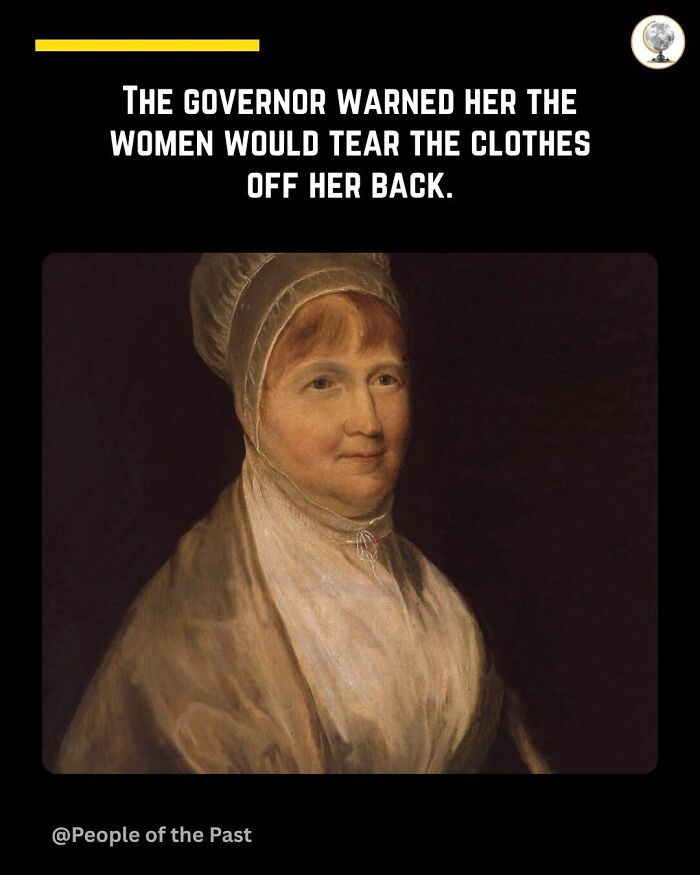
In 1813, Elizabeth Fry stepped through the gates of Newgate Prison and into a room that smelled of gin, sweat, and human waste.
The women's ward held around 300 prisoners and their children, packed into space meant for a fraction of that number. They cooked, washed, slept, and fought on the same stone floor. Some were awaiting trial. Some were awaiting e*******n. Most had no idea which.
Fry was 33, a Quaker, the wife of a London banker, and the mother of a growing brood of her own children. She had been warned not to go in. The governor told her the women would tear the clothes off her back.
She went in anyway.
What stopped her was a corner of the ward. Two women were stripping the clothes from a dead baby to dress a living one. The mother sat beside them, watching.
Fry left and came back. She kept coming back.
She started with the children. In 1817 she founded the Association for the Reformation of the Female Prisoners in Newgate, and inside the prison walls she opened a school. She brought in materials so the women could sew and earn a few pennies. She pushed for paid female matrons to supervise female prisoners, instead of the male guards who had been free to do as they pleased. She read scripture aloud to women who had never been read to in their lives.
The results were visible enough that politicians came to look. Sheriffs brought visitors. Foreign dignitaries asked for tours.
In 1818 she was called to testify before a House of Commons committee on prison conditions. It was the first time a woman had given evidence to Parliament on a matter of public policy.
She spent the rest of her life on it. She visited prisons across Britain and Europe, lobbied for the women transported to Australia, set up a training school for nurses, and opened a night shelter for the homeless in London after seeing the body of a boy in the street one winter. She died in 1845, worn out at 65.
In 2002, the Bank of England put her face on the 5 pound note. She stood next to a key, a book, and a group of women prisoners listening as she read.
188 years after she walked into Newgate, the country she had argued with for decades was carrying her in its pockets.
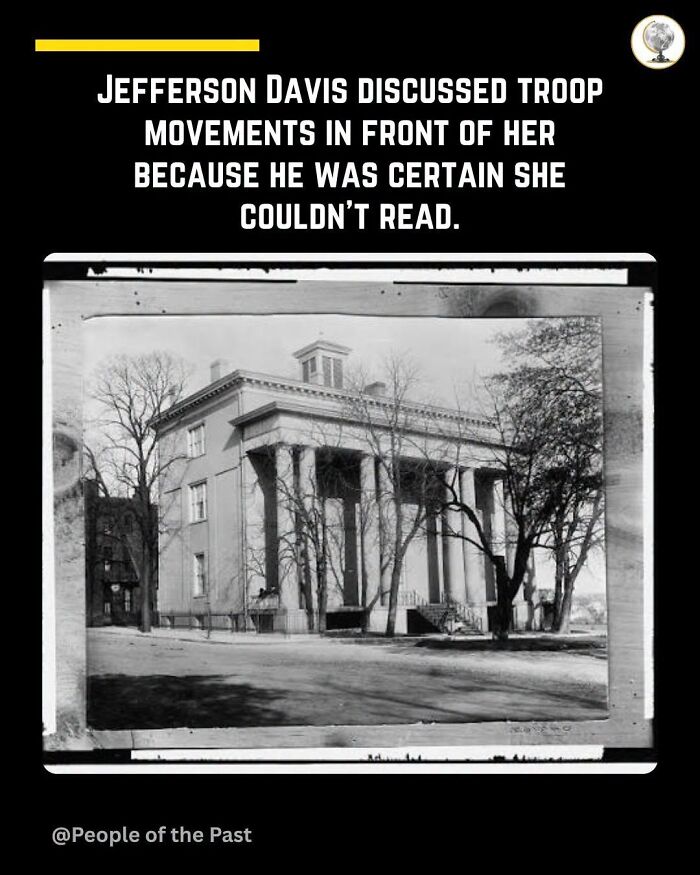
Mary Bowser walked through the Confederate White House in Richmond carrying trays, dusting shelves, and emptying chamber pots. Jefferson Davis barely noticed her. That was the point.
Bowser had been born into slavery on the Van Lew plantation in Virginia. When the family's matriarch died, her daughter Elizabeth freed the enslaved people on the estate and, according to family accounts, sent Mary north to be educated. By the time the war began, Bowser could read, write, and recall in detail almost everything she saw.
Elizabeth Van Lew was already running a Union spy ring out of Richmond. She needed someone inside the Davis household. Bowser agreed to go.
She took a position as a household servant under the name Ellen Bond, playing the part of a slow, incurious woman who couldn't read. Davis and his staff spoke openly in front of her. They left documents on desks and maps on tables. Bowser stood close enough to memorize them.
Troop movements, supply routes, strategy discussed over dinner. She held it all in her head until she could pass it on.
The intelligence moved through Thomas McNiven, a Richmond baker whose wagon made deliveries around the city, including to the Confederate White House. Bowser would step out to the wagon, recite what she had seen, and go back to her work. McNiven later said she had a photographic memory and that nothing she saw or heard was forgotten.
Ulysses S. Grant credited the Richmond ring with some of the best intelligence the Union received during the war.
After the surrender, Bowser disappeared from the public record almost completely. She kept a diary of her time in the Davis house. In the 1950s, her family destroyed it. They were afraid of what might happen if anyone knew what she had done.
The Confederate government's own files on its household staff were burned when Richmond fell. The Union, protecting its agents, kept her name out of its records too.
What survives is fragments. A few letters. McNiven's account, dictated to his daughter. Van Lew's coded notes. An induction into the Military Intelligence Hall of Fame in 1995, more than a century after the war ended.
She stood in the room while the president of the Confederacy planned his war, and he never once thought to wonder what she remembered.
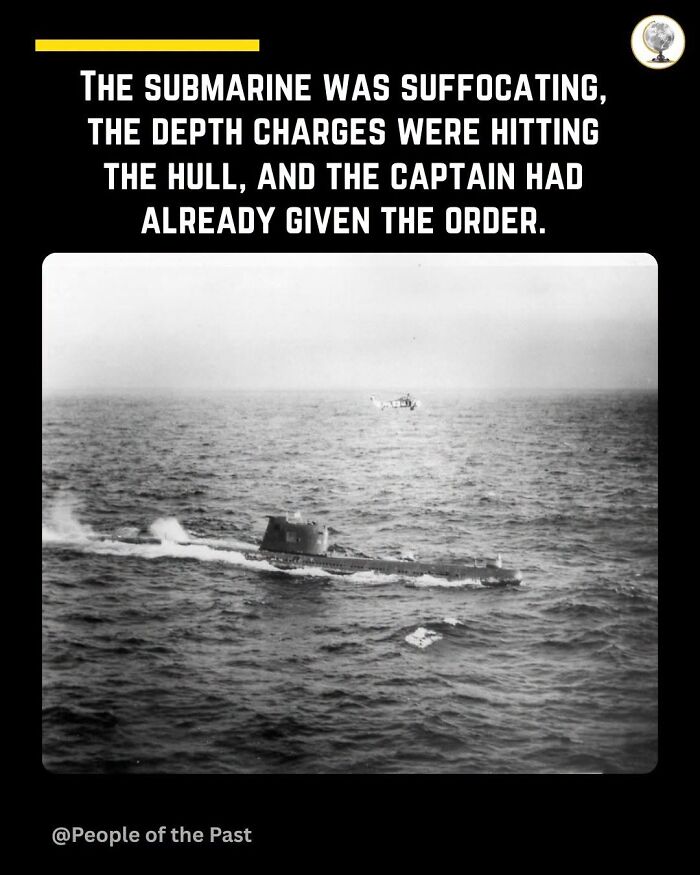
On October 27, 1962, the air inside Soviet submarine B-59 was already failing.
The boat had been submerged for days in the Sargasso Sea, hiding from the US Navy. Temperatures inside the hull had climbed past 100 degrees. Carbon dioxide levels were rising. Men were fainting at their stations. The diesel-powered sub had not surfaced to recharge its batteries in so long that the lights were dimming.
Then the depth charges started.
US destroyers had located B-59 and were dropping practice charges to force it up. The Soviet crew had no way to know they were practice. To the men below, it sounded like the opening salvos of World War III.
What the Americans also did not know was that B-59 carried a nuclear torpedo. A single 10-kiloton warhead, roughly two thirds the power of the Hiroshima b**b, sitting in the forward tube.
The captain, Valentin Savitsky, had lost radio contact with Moscow for days. He could only guess what was happening on the surface. With the hull ringing from explosions and his crew suffocating, he gave the order to prepare the torpedo for launch.
"We're going to blast them now," he reportedly shouted. "We will die, but we will sink them all."
Soviet protocol required three officers to agree before a nuclear weapon could be fired from B-59. The captain said yes. The political officer, Ivan Maslennikov, said yes.
The third man was Vasili Arkhipov, second in command of the submarine and chief of staff of the entire flotilla. He was 34 years old. The year before, he had survived a reactor accident on the submarine K-19 that k****d several of his shipmates from radiation poisoning. He knew exactly what nuclear catastrophe looked like up close.
He said no.
Arkhipov argued the depth charges were not what they sounded like. He pushed Savitsky to surface and wait for orders from Moscow instead of firing. The argument went on inside that hot, dim, oxygen-starved control room until the captain backed down.
B-59 came up. The Americans let it withdraw. No torpedo was launched. No retaliation came.
Arkhipov went home to a Soviet Navy that quietly resented him for the surrender and never promoted him to the rank his record deserved. He died in 1998 of kidney cancer, likely connected to the radiation he absorbed on K-19.
The story of what happened aboard B-59 did not reach the wider public until decades later, when a National Security Archive conference in 2002 finally pieced it together from Soviet and American sources.
Three men in a dying submarine. Two votes for launch. One quiet refusal.
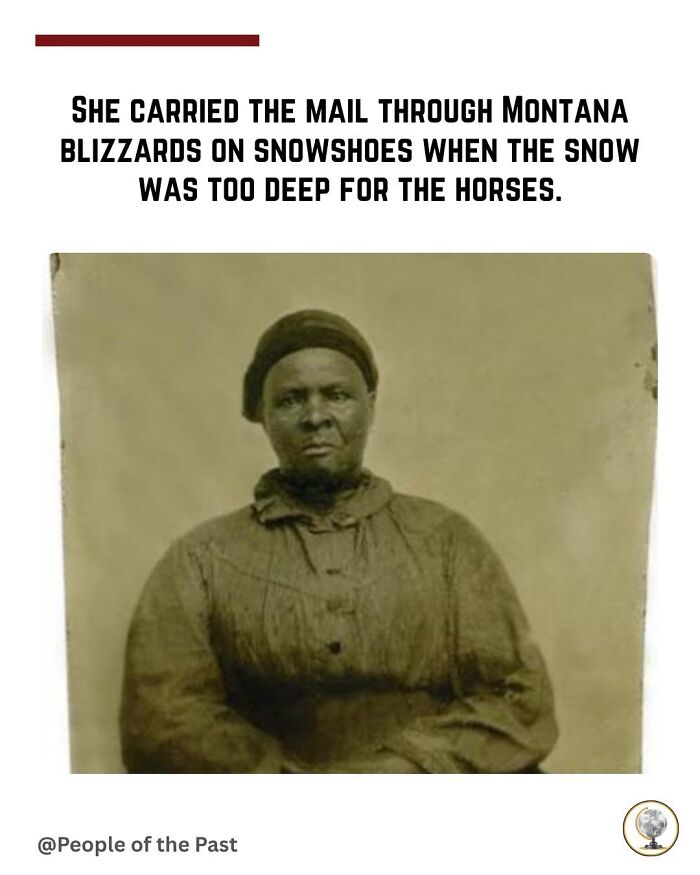
She was six feet tall, built like a barrel, and she drove a mail wagon through Montana blizzards with a revolver on her hip and a cigar clenched in her teeth.
Mary Fields was born into slavery in Tennessee around 1832. The records of her early life are thin, which was true for most enslaved people. What's documented is what came after.
By the 1880s she was working at an Ursuline convent in Toledo, Ohio, where she'd become close to Mother Amadeus Dunne. When Amadeus was sent to Montana Territory to run a mission school for Native American girls and fell dangerously ill, Mary traveled west to nurse her back to health. She stayed.
She hauled freight, chopped wood, did stone work, and ran the laundry at the St. Peter's Mission near Cascade. The nuns adored her. The local bishop did not. He objected to her drinking in saloons, smoking cigars with the men, and settling arguments with her fists. After a shootout with a male coworker (no one was k****d, but the bullets put a hole in the bishop's laundry), he ordered her off the mission grounds.
Mary moved into Cascade and opened a restaurant. It went bankrupt twice because she fed anyone who showed up hungry, money or no money.
In 1895, in her early sixties, she took a contract with the United States Post Office to carry mail between Cascade and the mission. She was the second woman and the first African American woman to hold a Star Route contract. She drove a stagecoach pulled by six horses and a mule named Moses.
She never missed a delivery. When snow buried the road, she walked the route on snowshoes with the sack on her shoulders. Locals set their clocks by her arrival. They called her Stagecoach Mary.
When she retired, she ran a laundry out of her home in Cascade. The story goes that a customer skipped out on his bill, Mary spotted him on the street in her seventies, walked up, and knocked him flat with one punch. She told a friend his laundry was paid in full.
The town gave her free meals at the hotel for the rest of her life. The schools closed on her birthday. When the laundry burned down in 1912, the townspeople rebuilt it for her.
She died in 1914 and was buried in Hillside Cemetery in Cascade. Gary Cooper, who grew up in the area, later wrote about her for Ebony magazine. He remembered a woman who could outshoot, outdrink, and outwork most of the men in the territory.
The mule's name was Moses. The cigars were cheap. The mail always arrived.
THESE are the people we should have learned about in our American history classes.
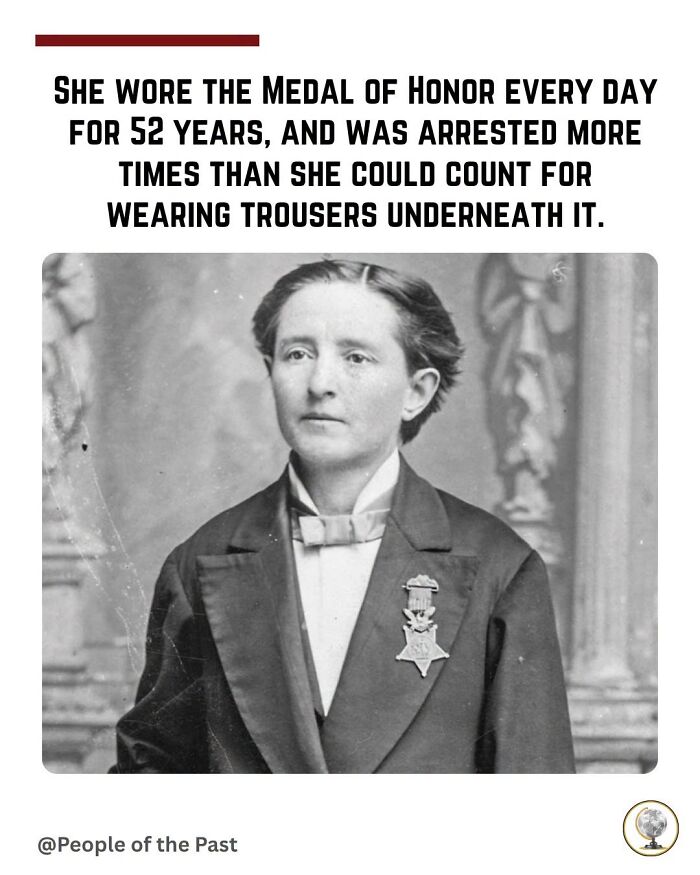
In 1865, the United States government pinned the Medal of Honor on a 32 year old woman in trousers.
Mary Edwards Walker had spent the Civil War trying to get the army to take her seriously. She'd graduated from Syracuse Medical College in 1855, one of the only women in the country with a medical degree, and when the war broke out she traveled to Washington and offered her services as a surgeon. The army said no. She could volunteer as a nurse.
She refused. She worked unpaid as a surgeon instead, first at the Patent Office hospital, then in the field at Fredericksburg and Chattanooga. By 1863 the army had run out of reasons to keep saying no. She was commissioned as a contract surgeon with the 52nd Ohio Infantry, the first woman to hold that role.
She didn't stay behind the lines.
Walker crossed into Confederate territory to treat civilians who had no other doctor. In April 1864, a Confederate sentry caught her and sent her to Castle Thunder prison in Richmond on suspicion of spying. She spent four months there, lost weight she couldn't afford to lose, and damaged her eyesight permanently. She was eventually exchanged for a Confederate surgeon, a swap she noted with satisfaction: man for man.
After the war, President Andrew Johnson signed the order awarding her the Medal of Honor in November 1865. She was the only woman to ever receive it.
She wore it every day for the rest of her life.
She also kept wearing trousers, which she'd adopted as a young woman for reasons of health, hygiene, and basic practicality. The arrests piled up. New Orleans, 1870, for impersonating a man. New York, more than once. She'd show the officers her medal, lecture them on dress reform, and walk out unbothered.
In 1917, a federal review board decided she shouldn't have the medal after all. The criteria had been tightened, and her civilian surgeon status no longer qualified. They asked her to return it.
She told them to come and take it.
She died two years later, at 86, after falling on the steps of the Capitol where she'd gone to argue, again, for women's suffrage. The medal was pinned to her chest in the coffin.
In 1977, the army restored it.
I get so angry when I read about this and then see how much further we still have to go.
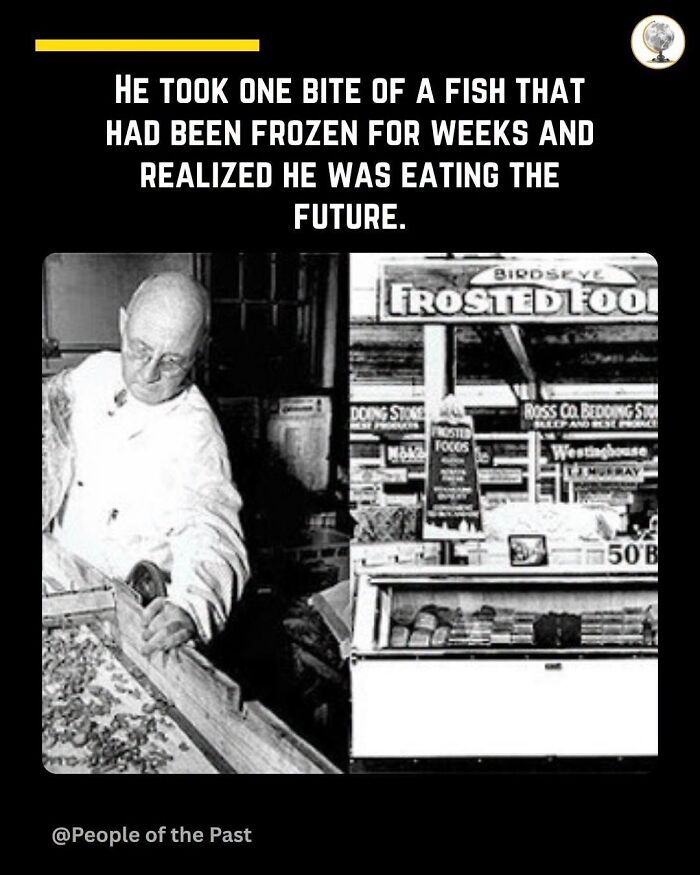
In 1912, Clarence Birdseye was working as a fur trader in Labrador, hundreds of miles from anything resembling a grocery store.
He was a Brooklyn-born naturalist with a knack for surviving where most people couldn't. The Arctic winter didn't faze him. The isolation didn't either. What caught his attention was a fish.
He watched Inuit fishermen pull trout through holes cut in the ice. The temperature was so far below zero that the fish froze solid the instant they hit the air, stiff as boards before they could flop twice.
Weeks later, those same fish were thawed and cooked. Birdseye took a bite and stopped.
It tasted as if it had been pulled from the water that morning.
He started asking questions. The commercially frozen fish sold in New York at the time was mushy, gray, and barely edible. Slow freezing let large ice crystals form inside the flesh, rupturing the cell walls. When it thawed, the texture collapsed and the flavor went with it.
The Labrador fish froze in seconds. The crystals stayed small. The cells stayed intact. That was the whole secret.
Birdseye spent the next decade chasing it. He went home, ran out of money, tried again. He froze rabbits in his kitchen. He used buckets of brine and cakes of ice. He borrowed an electric fan and seven dollars' worth of salt and built his first prototype out of equipment most people would've thrown away.
In 1925 he patented the double belt freezer, a machine that pressed packaged food between two refrigerated metal surfaces and locked it in flash-frozen stillness in minutes.
Three years later he sold the company to Postum (later General Foods) for 22 million dollars. The Birds Eye brand kept his name, split in two for the label.
Grocery stores had to be rebuilt around him. Freezer cases didn't exist yet. Refrigerated trucks didn't exist yet. Home freezers were a curiosity. Birdseye lobbied, leased equipment to retailers, and pushed the whole supply chain into existence behind his product.
He held nearly 300 patents by the time he died in 1956. Harpoons for whaling. A recoilless rifle. A method for dehydrating food. A heat lamp. A way to make paper from sugarcane waste.
But the one that changed the world started with a piece of trout, pulled stiff from a hole in the ice, eaten weeks later in a cabin in Labrador.
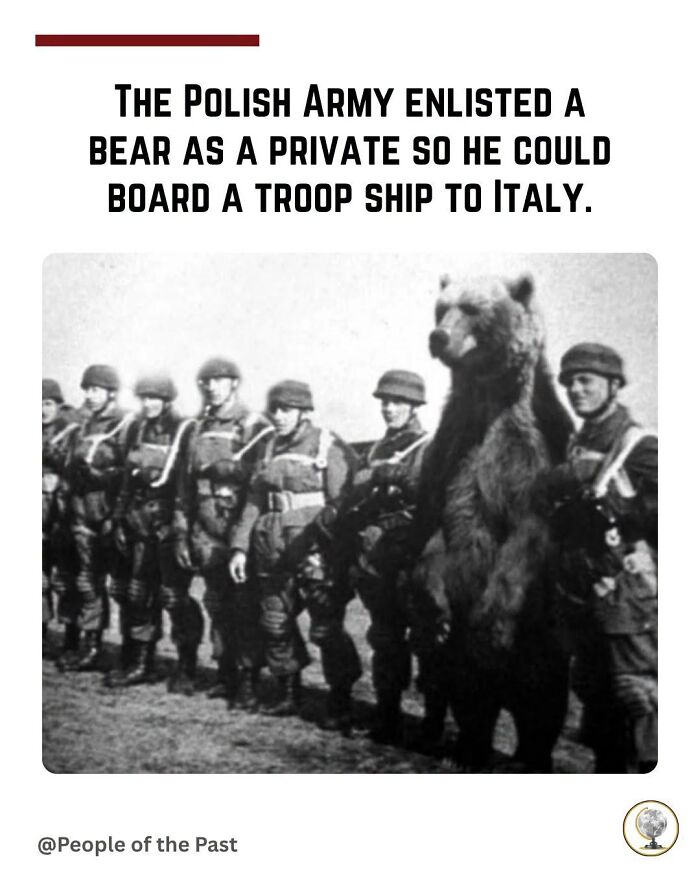
In 1942, a group of Polish soldiers in Iran bought a bear cub from a boy on the roadside for a few cans of food and a Swiss army knife.
They named him Wojtek, which means "happy warrior."
The soldiers belonged to the 22nd Artillery Supply Company of the Polish II Corps, a unit pulled together from men who'd survived Soviet labor camps and were now making their way west to fight alongside the British. The cub was tiny, underfed, and had to be bottle-fed condensed milk through a vodka bottle with a rag stuffed in the neck.
He grew up in the camp. He wrestled with the soldiers, slept beside them, and learned to drink beer from a bottle held in his paws. He smoked cigarettes too, though usually he ate them. He'd salute when greeted and march on his hind legs alongside the men.
By 1943, Wojtek weighed over 400 pounds and stood six feet tall.
The problem came when the unit was ordered to Italy. The British transport ship out of Egypt would not allow pets or mascots on board. So the Polish command did the only thing that solved it. They enlisted him.
Wojtek was given the rank of private, assigned a serial number, and listed on the company roster. His paybook recorded his rations. He boarded the ship as a soldier of the Polish Army.
In May 1944, the unit reached Monte Cassino.
The battle there was one of the worst of the Italian campaign. The Allies had been trying to break the German line for months, and the Polish II Corps was thrown into the final a*****t on the monastery hill. The 22nd Company was hauling artillery shells up steep ground under heavy fire, crate after crate, day after day.
Wojtek watched the men work. Then he started carrying the crates himself.
Soldiers who were there reported that he picked up boxes of 100-pound shells and walked them to the guns, never dropping one. The company adopted a new emblem after the battle: a bear carrying an artillery shell. It was painted on their vehicles for the rest of the war.
After Germany surrendered, the unit was demobilized in Scotland. Wojtek went with them. He lived out his last years at Edinburgh Zoo, where former Polish soldiers visited him often. He recognized their voices and would stand up against the enclosure wall when they spoke to him in Polish.
He died in 1963, aged 21.
His enlistment papers are still in the Polish military archive.
I hope the zoo he lived in didn't give him one of those tiny metal cells most zoos used to have. That would have been a tragic ending.
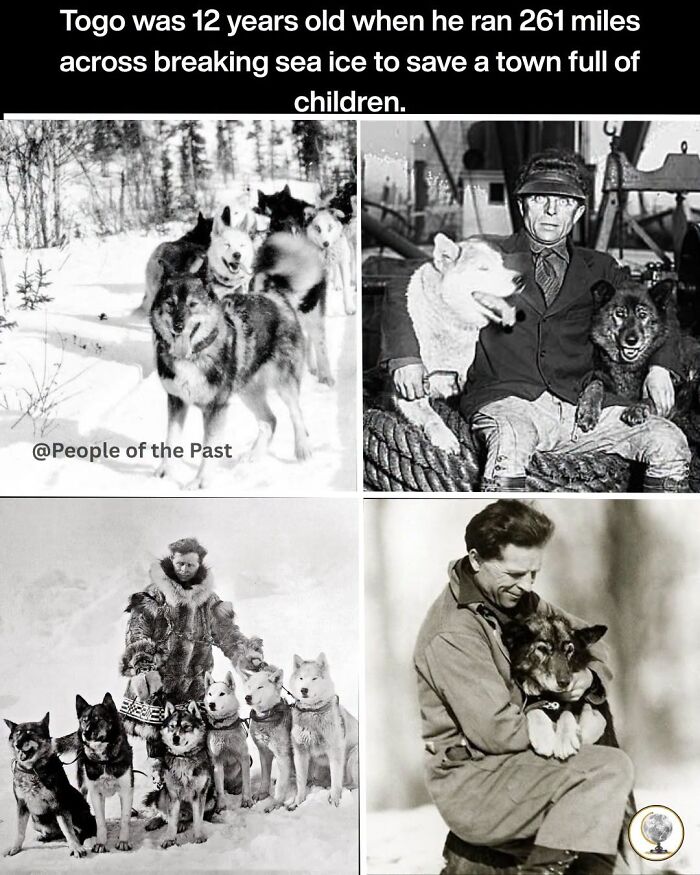
Leonhard Seppala was reading the newspaper when he found out a statue of his second-string dog had been unveiled in Central Park.
The dog was Balto. The musher who got the credit was Gunnar Kaasen. And Seppala, the Norwegian who had done the hardest, longest, most dangerous leg of the 1925 serum run, was sitting in Alaska with the dog who'd actually pulled it off curled up by the fire.
That dog was Togo. He was 12 years old during the run.
In January 1925, diphtheria broke out in Nome. The only serum was 674 miles away in Nenana, and a single plane attempt had already failed in the cold. So the territory organized a relay of dog teams to move the serum across Alaska in temperatures that dropped to 50 below.
Seppala drew the longest and most brutal stretch. He left Nome heading east to meet the serum, then turned around and ran it back west. To save time, he took his team straight across the frozen surface of Norton Sound, a shortcut over sea ice that could break apart under a team without warning.
Togo led through whiteout blizzards and shifting ice. At one point the floe they were on cracked off and drifted out to sea before Togo pulled them back onto solid ice. Seppala covered roughly 261 miles, more than any other musher in the relay, in conditions that k****d dogs on other teams.
He handed the serum off exhausted. The final 55 miles fell to Gunnar Kaasen and a scratch team led by Balto, a freight dog Seppala had left behind because he didn't think much of him.
Kaasen rolled into Nome at 5:30 in the morning. The reporters were waiting. Balto became the face of the run, got a Hollywood short film, and was immortalized in bronze in Central Park later that year.
Seppala was polite about it in public and bitter about it in private. He took Togo on a tour of the lower 48, where crowds turned out to see the real lead dog. Togo was given a gold medal by the explorer Roald Amundsen.
Then Seppala brought him home and kept him by the fire.
Togo lived to 16. Seppala had him put down himself, because he couldn't stand for anyone else to do it. He had the body preserved, and Togo's mounted skin is still on display at a museum in Wasilla, Alaska.
The statue in Central Park is still there too. The plaque reads Balto.
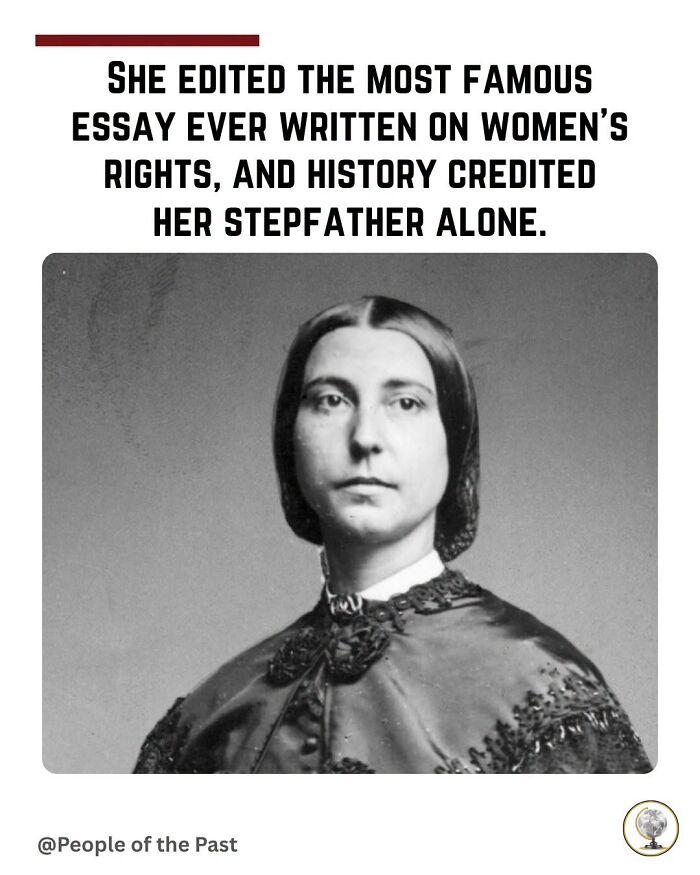
John Stuart Mill is remembered as the great liberal voice for women's rights. The woman who edited his manuscripts, ran his campaigns, and kept his career alive was his stepdaughter, Helen Taylor.
She was 27 when her mother Harriet died in 1858. Mill was wrecked by the loss, and Helen stepped into the gap. For the next 15 years she worked beside him as researcher, editor, secretary, and political strategist.
She shaped The Subjection of Women, the 1869 essay that became the foundational liberal text on female equality. She helped draft his speeches when he sat as MP for Westminster. She handled correspondence with suffragists, organized his 1865 campaign, and managed the household that made his writing possible.
Mill said so himself. He credited her openly in letters and in print, calling her contribution to his later work indispensable. The public preferred to ignore that part.
When Mill died in 1873, Helen did not retreat into a quiet widowhood as his literary executor. She edited and published his Autobiography and Three Essays on Religion. Then she went into politics on her own.
She sat on the London School Board from 1876, fighting for free school meals, an end to corporal punishment, and decent pay for teachers. She campaigned for Irish land reform, for the rights of agricultural laborers, and for women's suffrage at every level she could reach.
In 1885, she tried to stand for Parliament in North Camberwell.
Women could not vote. Women could not sit as MPs. Helen knew this. She offered herself anyway, arguing there was no law that explicitly barred a woman from being nominated. The returning officer refused her nomination papers. She had made the point regardless.
That was 33 years before the Representation of the People Act gave some women the vote, and 33 years before Constance Markievicz became the first woman elected to the Commons.
Helen spent her final years in Torquay, living with her niece Mary. She died in 1907, a year before the suffragette movement reached its loudest pitch. Her name slid out of the histories that kept Mill's.
The great liberal thinker on women's equality had a co-author. She lived long enough to run for the Parliament that would not have her, and quiet enough afterward that most people forgot she had tried.
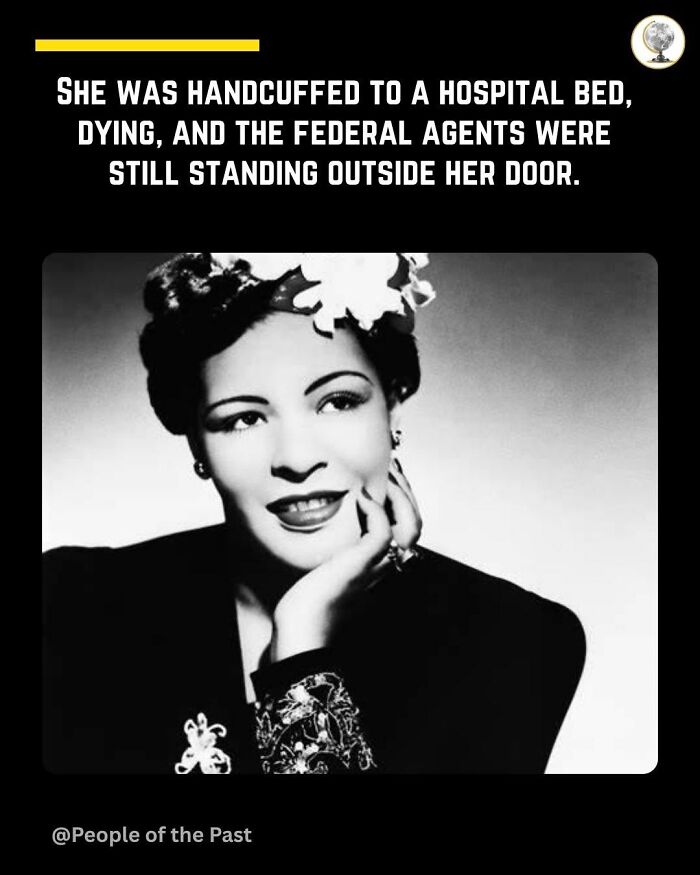
By 1959, Billie Holiday was dying in a New York hospital bed, and there were federal narcotics agents stationed outside her door.
She was 44 years old. Her liver was failing. She had been handcuffed to the bed frame, her fingerprints taken, her room searched, her flowers and radio and chocolates confiscated. The methadone that had been helping her was cut off.
The man who put them there had been hunting her for two decades.
Harry Anslinger ran the Federal Bureau of Narcotics, and he had built his career on a particular kind of cruelty. He believed jazz was a threat to America. He believed Black performers were corrupting white audiences. And he believed Billie Holiday, more than anyone else, had to be silenced.
The song that set him off was Strange Fruit.
She had been performing it since 1939. Written by a Jewish schoolteacher from the Bronx, it was a plain description of a lynching. Black bodies hanging from poplar trees. Blood on the leaves and blood at the root. Holiday closed every set with it. The lights went down. The waiters stopped serving. She sang it once, walked off, and did not return for an encore.
Anslinger ordered her to stop. She refused.
So he sent agents to her shows. He pressured club owners. He had one of his men, Jimmy Fletcher, follow her for months. Fletcher later said he felt sick about what he had been asked to do. He had come to like her. He said she was the kind of woman who could make you cry.
In 1947, Anslinger's agents arrested her on narcotics charges. She served a year and a day at a federal prison in West Virginia. When she came out, her cabaret card was revoked, which meant she could no longer perform in any New York venue that served alcohol. The city that had made her took her stages away.
She kept singing Strange Fruit anywhere she could.
By the spring of 1959, she was skeletal, weighing under a hundred pounds, and admitted to Metropolitan Hospital with cirrhosis and heart failure. Anslinger's men came for her there. They claimed they had found h****n in her room. They cuffed her to the bed.
Friends fought to get the cuffs removed. A nurse smuggled in a small amount of money she had earned from an interview, taped to her leg.
She died on July 17, 1959, with seventy cents in the bank and a federal agent still posted at her door.
The song outlived all of them.
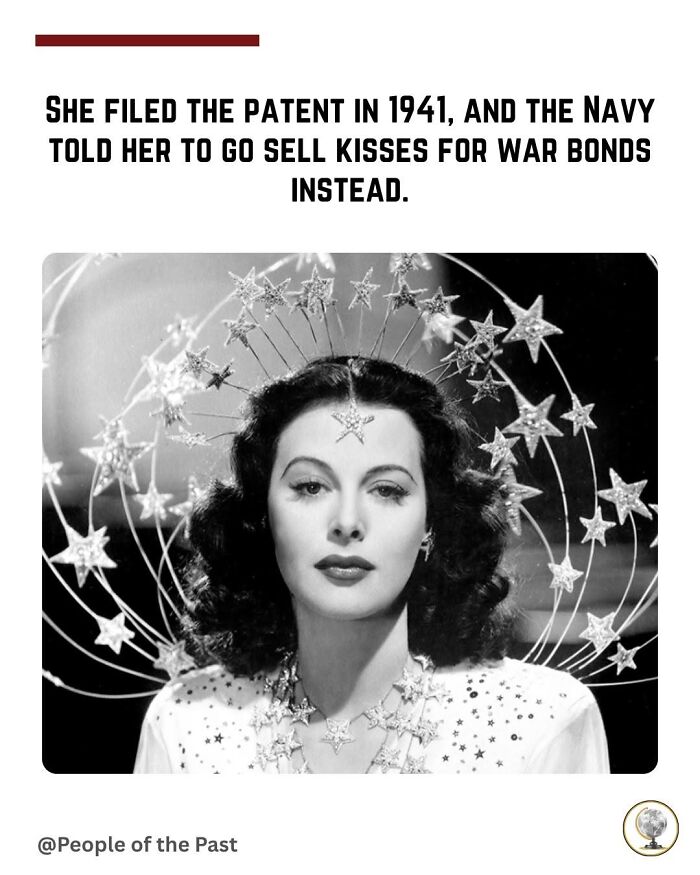
In 1942, the most photographed face in Hollywood was sketching circuit diagrams on her living room floor.
Hedy Lamarr was thirty-eight years old and tired of being told to smile. MGM had built her career on a single idea: that she was the most beautiful woman in the world. Louis B. Mayer marketed the line, the studios repeated it, and the public bought it. What none of them wanted to hear was that she could think.
She had been thinking since Vienna. Her first husband, an Austrian arms d****r named Friedrich Mandl, had dragged her to dinners with engineers and military officers who talked openly about weapons systems in front of her, assuming she didn't understand. She understood. She remembered.
When she escaped Mandl and made it to America, she carried that knowledge with her.
By 1940, German U-boats were sinking Allied ships, including civilian vessels carrying children. Radio-controlled torpedoes existed, but the Germans could jam the signals and send them off course. Lamarr started sketching a solution between film shoots, working at a drafting table she kept at home.
The idea was elegant. If the transmitter and receiver hopped rapidly between radio frequencies in a synchronized pattern, no enemy could jam the signal without knowing the sequence. She partnered with composer George Antheil, who had once synchronized sixteen player pianos for a concert piece, and together they built a working design using a perforated paper roll borrowed from that same player piano mechanism.
They filed the patent in June 1941. It was granted in August 1942 under her married name, Hedy Kiesler Markey.
Then they handed it to the US Navy.
The Navy filed it away. An actress and a composer, they decided, could not have invented anything useful. Lamarr was told her real contribution to the war effort would be selling bonds, and she did, raising twenty five million dollars by letting men buy a kiss.
The patent expired in 1959 without ever being used.
The Navy quietly dusted off the concept during the Cuban Missile Crisis in 1962, after the patent had run out and they owed her nothing. Frequency hopping went on to become a foundation of secure military communication, and later, of Wi-Fi, GPS, and Bluetooth.
Lamarr received no money and almost no recognition during her lifetime. In 1997, three years before her death, the Electronic Frontier Foundation gave her a Pioneer Award. She was eighty two. When they called to tell her, she said, "It's about time."
She died in Florida in 2000. Her ashes were scattered in the Vienna Woods, near the city she'd fled sixty three years earlier.
In 1783, Thomas Peters stood on a dock in New York with his wife, his children, and a piece of paper that said he was free.
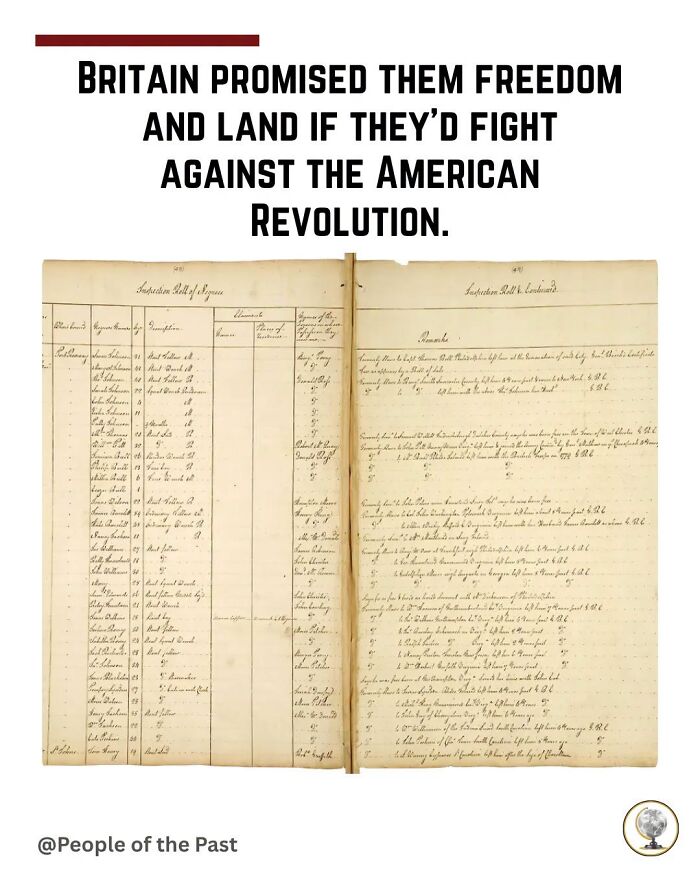
He'd been born in West Africa, sold into slavery in Louisiana, and shipped to North Carolina. When the British offered freedom to any enslaved person who would fight against the American rebels, he ran. He served in the Black Pioneers, a Loyalist regiment that built fortifications and carried supplies through the war.
When the British evacuated New York, around 3,000 Black Loyalists went with them. Their names were entered in a ledger called the Book of Negroes. Peters and his family were among them.
They were promised land in Nova Scotia.
What they got was scattered plots of rocky ground, often the worst available, often delayed for years. White Loyalists were settled first. Black Loyalists were pushed to places like Birchtown and Brindley Town, where they cleared forest for wages that rarely came and watched their neighbors get the farmland they'd been promised. Some were re-enslaved by Loyalists who claimed them as property. Riots broke out in Shelburne in 1784 when white settlers attacked Black families for taking work at lower wages.
Peters spent years petitioning local officials. Nothing moved.
So in 1790 he sailed to London. He carried a list of grievances signed by hundreds of Black Loyalists in Nova Scotia and New Brunswick and walked it into the offices of the Sierra Leone Company and the British government. He met with William Wilberforce and Granville Sharp. He told them the Crown's promises had been broken.
The answer was Sierra Leone. The Company offered passage to West Africa and land in a new settlement at Freetown for any Black Loyalist who wanted to go. Peters sailed back to Nova Scotia and recruited.
In January 1792, fifteen ships left Halifax carrying 1,196 people. Peters was on board. After 35 years, he was returning to the continent he'd been stolen from.
They landed in Freetown in March. The rainy season came. Malaria came with it. Peters quarreled with the white Company officials over land allocation and governance, the same fight he'd been having for nine years. He didn't get to finish it.
He died of fever on June 25, 1792, weeks after stepping ashore.
The settlement survived. Their descendants, the Sierra Leone Creoles, are still there. In Nova Scotia, the graves of the Black Loyalists who stayed behind are mostly unmarked. The Book of Negroes sits in archives in London and Washington, 3,000 names long.
Thomas Peters crossed the Atlantic three times chasing a promise written on a piece of paper.
In 1938, Mussolini signed the Italian Racial Laws and Rita Levi-Montalcini lost everything.
She was a Jewish medical graduate from Turin, trained as a neurologist, barred from her university post and forbidden to practice medicine on non-Jewish patients. The lab she'd worked in was closed to her. The career she'd built was gone.
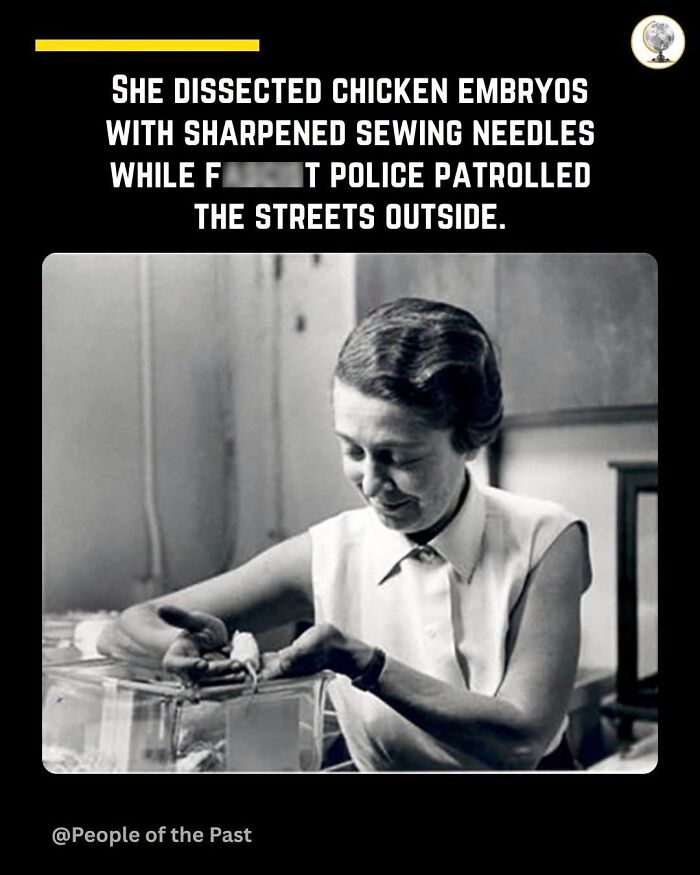
So she built a new lab in her bedroom.
Her brother Gino, an architect, helped her set it up. She used a microscope salvaged from her old workplace, sewing needles sharpened on a whetstone for scalpels, and watchmaker's forceps. Fertilized chicken eggs came from local farmers, who thought she wanted them for her family to eat. She wanted the embryos.
The work she chose was nerve cell development. She'd read a paper by the German embryologist Viktor Hamburger, who had removed limb buds from chick embryos and watched the corresponding nerve cells die. Levi-Montalcini repeated his experiments on her dresser, using a technique called silver staining to see the nerves under her microscope.
She came to a different conclusion than Hamburger. The nerve cells weren't failing to form. They were forming and then dying, starved of some signal coming from the tissue they were meant to connect to.
Then Allied bombs started falling on Turin.
The family fled to a farmhouse in the Piedmont countryside in 1942. She rebuilt her bedroom lab in a corner of the cottage and kept working. When the Germans occupied northern Italy in 1943, the family ran again, this time to Florence, living under false names. She kept notes throughout.
After the war, Viktor Hamburger read her published papers and invited her to Washington University in St. Louis for a semester. She stayed 30 years.
In the 1950s, working with biochemist Stanley Cohen, she identified the signal she'd first suspected in her bedroom in Turin. They called it nerve growth factor. It was the first of a whole family of molecules that govern how cells grow, survive, and die, foundational to modern understanding of cancer, Alzheimer's, and developmental biology.
In 1986, she and Cohen shared the Nobel Prize in Physiology or Medicine.
She lived to 103. When asked late in life what had kept her going through the racial laws, the bombs, and the hiding, she said her body had aged but her mind had not. She kept a small office in Rome and went in most days until the end.
The sewing needles are in a museum now.
Ah yes - the "faucet" police! Drippy lot, they were. Incredible woman, however.
The walking stick was the first thing they found.
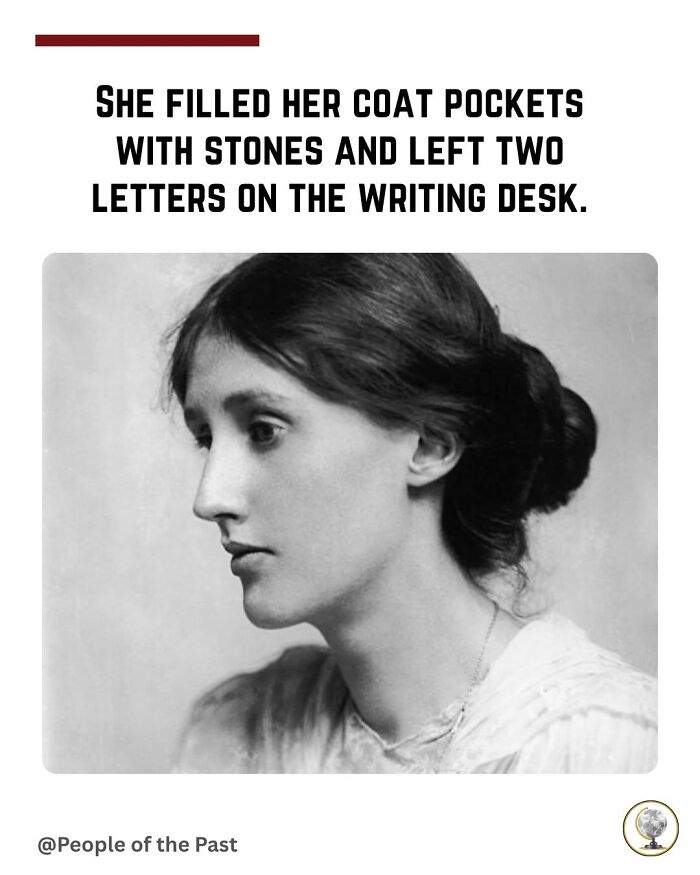
It was lying on the bank of the River Ouse on March 28, 1941, near the village of Rodmell in Sussex. Virginia Woolf had left the house that morning, walked across the water meadows, and put it down before she stepped into the river. Her coat pockets were heavy with stones.
She was 59. She'd just finished writing 'Between the Acts' and could not bear to revise it. The voices had come back. She had survived breakdowns before, in 1895 after her mother died, in 1904 after her father, again in 1913 when she swallowed a bottle of veronal and nearly died. Each time she had climbed out. This time she didn't believe she could.
She left two letters for her husband Leonard. One of them is among the clearest accounts of depression ever written by someone inside it.
'Dearest,' she wrote, 'I feel certain I am going mad again. I feel we can't go through another of those terrible times. And I shan't recover this time. I begin to hear voices, and I can't concentrate. So I am doing what seems the best thing to do.'
She thanked him. She told him no two people could have been happier. She told him she owed all the happiness of her life to him. 'I can't go on spoiling your life any longer,' she wrote. 'I don't think two people could have been happier than we have been.'
Then she walked out of the house.
Her body was not found for three weeks. A group of teenagers spotted it in the river on April 18. Leonard identified her by the wedding ring on her finger and the engraved watch in her pocket.
He had her cremated at Brighton. He brought the ashes back to Monk's House, the cottage where they'd lived and worked together for two decades, and buried them under one of the two great elms in the garden. They had called the trees Leonard and Virginia.
The elm came down in a storm years later. Leonard placed a stone bust of her there instead, with a line from 'The Waves' carved into the base.
'Against you I will fling myself, unvanquished and unyielding, O Death.'
He lived another 28 years. He never moved out of the house.
So sad. 😢 So many people take their mental health for granted. If they only knew the struggle many people have every day just to get out of bed and try for another day.
In the summer of 1978, a Soviet geologist flying low over the Siberian taiga spotted something that shouldn't have been there.
A clearing. Furrows in the dirt. A garden, 150 miles from the nearest settlement, in a part of Khakassia where no human being was supposed to live.
The pilot circled. The geologists landed six miles away and hiked through the forest until they reached a blackened hut sunk into the hillside.
An old man came out. His clothes were patched sackcloth. His feet were bare. He hadn't seen another human being outside his family in over 40 years.
His name was Karp Lykov. He was an Old Believer, a member of a Russian Orthodox sect persecuted since the 1600s. In 1936, after a Communist patrol shot his brother on the edge of their village, Karp grabbed his wife Akulina, their 9 year old son and 2 year old daughter, and walked into the forest. They kept walking until the forest swallowed them.
Two more children were born in the taiga. Dmitry and Agafia had never seen a road, a stranger, or a building larger than their hut. They spoke a slow, lilting Russian their parents had taught them from memory and from a single battered Bible.
The family ate what they could grow and what Dmitry could run down on foot. He could chase game for days through the snow in bark shoes. They had no salt. No matches. They struck fire from flint. They wore clothes patched from hemp they grew themselves.
In 1961, snow fell in June and k****d everything in the garden. The family ate their leather shoes and the bark off the trees. Akulina refused her share. She gave her food to the children and starved to death so they could live.
A single grain of rye sprouted in the pea patch that year. They guarded it day and night against birds and mice. From that one grain, they slowly rebuilt their seed stock.
The geologists brought them salt and bread. Karp called salt true t*****e to have lived without. They were told about the war, the moon landing, satellites passing over their hut at night. Karp listened politely. The children stared.
Within three years of contact, three of the four Lykov children were dead. Two from kidney failure, one from pneumonia, their immune systems unprepared for a world full of strangers.
Karp died in his sleep in 1988. The geologists offered to take Agafia to her relatives. She refused.
She is still there.
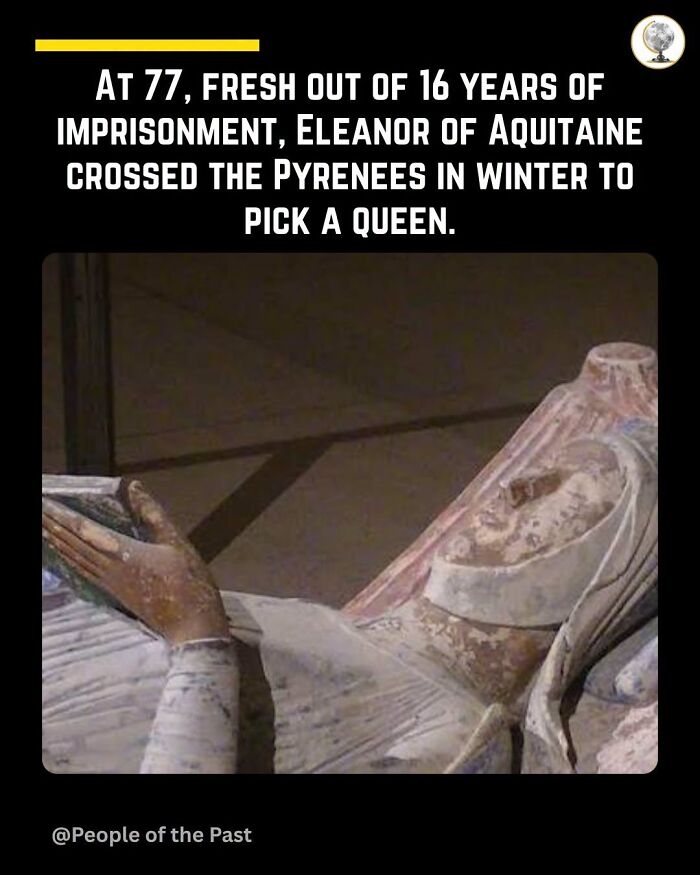
She was 77 years old, just out of prison, and about to cross the Pyrenees in winter.
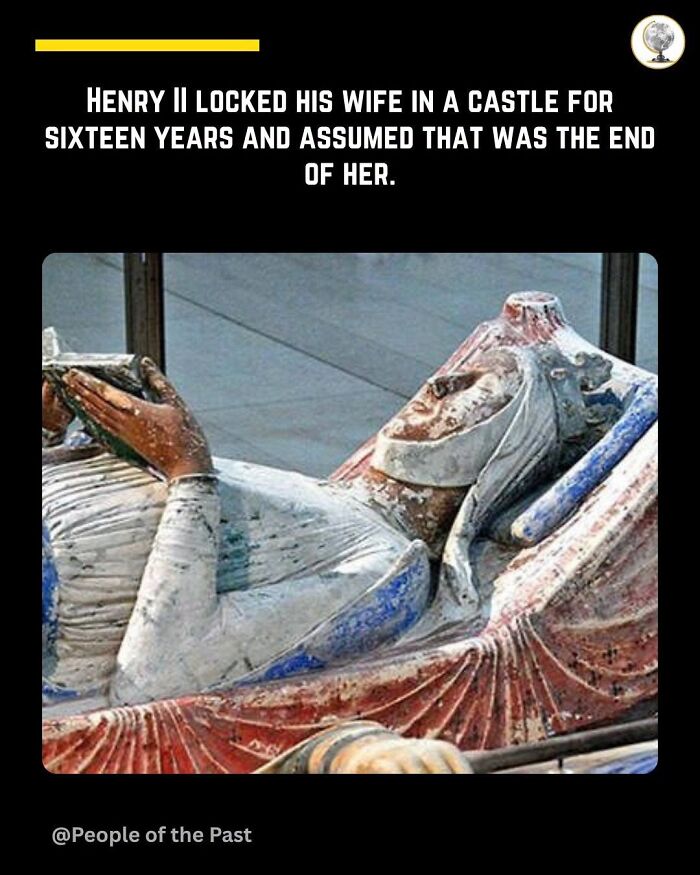
Eleanor of Aquitaine had spent 16 years locked away by her husband, Henry II of England, for backing her sons in rebellion. By 1200, she had outlived him, outlived her son Richard the Lionheart, and watched her youngest, John, take the English throne. Most women her age, if they survived that long, were quietly preparing to die.
Eleanor saddled up instead.
The Treaty of Le Goulet had just been signed between John and Philip II of France. To seal the peace, Philip's heir, the future Louis VIII, would marry one of Eleanor's Castilian granddaughters. The girls lived at the court of her daughter, Queen Leonor of Castile, on the other side of the mountains. Someone had to go and fetch the bride.
Eleanor went herself.
She rode south through Aquitaine in the dead of winter, over passes thick with snow, and was briefly captured by a lord named Hugh de Lusignan along the way. She negotiated her own release and kept moving. By early 1200 she was in Castile, looking at her two granddaughters: Urraca, the elder, and Blanca, the younger.
Protocol said Urraca. Eleanor disagreed.
The chroniclers say she judged the name Urraca too foreign for French ears, and that Blanca had the temperament for the role. Whatever her real reasoning, she chose the younger girl. Blanca became Blanche, the future queen of France.
Then Eleanor turned around and rode back over the mountains with the 12 year old in tow. They reached Bordeaux by Easter. Eleanor, exhausted, handed Blanche off to the Archbishop and went no further. The marriage took place that May in Normandy.
Eleanor retired to the abbey at Fontevraud and died there in 1204.
The granddaughter she chose grew up to rule France as regent for her son, Louis IX, the king later canonized as Saint Louis. Blanche held the kingdom together through his minority and again while he was on c*****e. The line Eleanor picked out in a Castilian court at the age of 77 shaped the next century of French history.
She made one last journey, and she got it right.

Alienor. She was French and named Alienor. I proudly claim her as my favorite ancestor.
He walked into the clearing expecting smoke, voices, children, the smell of cooking fires. He found silence.
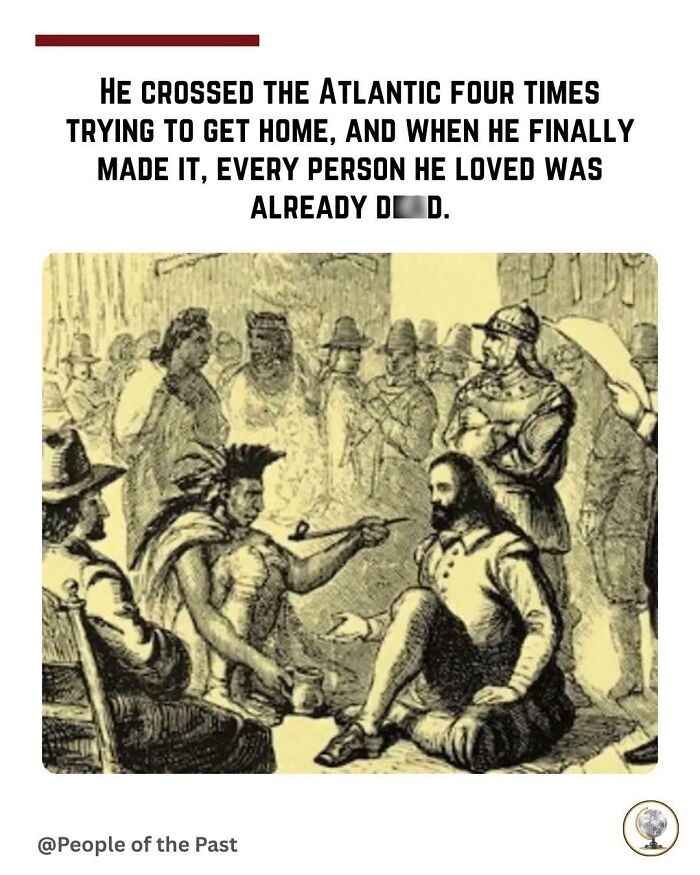
Tisquantum had been gone for four years. He came back to Patuxet in 1619 and walked through longhouses that held bones instead of people.
His story had started in 1614, when an English captain named Thomas Hunt lured him and around two dozen other Wampanoag men onto a ship under the pretense of trade. Hunt sailed them across the Atlantic and sold them in Málaga, Spain. Tisquantum was bought, by some accounts, by Spanish friars who took him in and eventually let him go.
He made his way to London. He learned English. He lived for a time with a shipbuilder named John Slany. He crossed the Atlantic again to Newfoundland, then back to England, then back across once more in 1619 with an expedition heading for New England.
Four crossings. Years of trying to get home.
What he didn't know, what no one had told him, was that a plague had swept the coast between 1616 and 1619. Historians still debate what it was. Leptospirosis, smallpox, viral hepatitis. Whatever it was, it k****d up to 90 percent of the Native population in the region. Whole villages emptied out. Patuxet was one of them.
He was the last of his people.
In the spring of 1621, a small group of English settlers were starving on the same ground where his village had stood. They called the place Plymouth. Tisquantum, whom they called Squanto, walked into their settlement speaking their language. He showed them how to plant corn using fish as fertilizer. He showed them which plants to eat and where to fish. He negotiated between them and the Wampanoag sachem Massasoit.
He did all of it as a man with no village to return to at night.
The Thanksgiving story flattens him into a helpful guide. The truth is heavier. He translated between two worlds because he no longer belonged fully to either one. His own world had been buried while he was in Spain learning a foreign tongue.
In November 1622, he fell ill with a fever during a trip to Cape Cod with William Bradford. He bled from the nose, which the Wampanoag took as a sign of death. He asked Bradford to pray for him, so that he might go to the Englishmen's God in heaven.
He died within a few days. Bradford wrote that it was a great loss.
He was buried somewhere on the Cape. The grave has never been found.
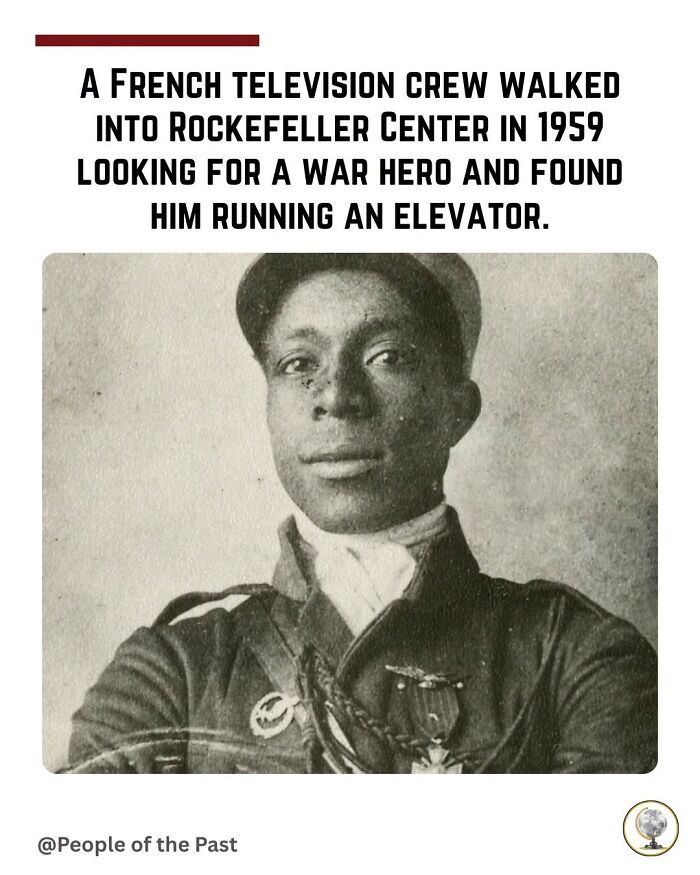
In 1959, a French television crew walked into Rockefeller Center looking for a man they had been told was a national hero of France.
They found him running an elevator.
Eugene Bullard was 64 years old by then, in a uniform with brass buttons, ferrying executives between floors. None of them knew the man pressing the buttons had flown combat missions over the Western Front 40 years earlier.
He was born in Columbus, Georgia in 1895, the son of a former s***e. As a boy he watched a white mob try to l***h his father. He ran away at 11, worked his way through the South with traveling Romani families, and stowed away on a German freighter bound for Scotland. He never lived in America again as a free man, not really.
By 1914 he was in Paris, boxing for money. When the war came he joined the French Foreign Legion. He fought at Artois, at Champagne, at Verdun, where shrapnel tore into his thigh badly enough to end his life as an infantryman.
So he learned to fly.
The French air service took him in 1917. He flew with Escadrille N.93 and Escadrille SPA.85, ran around 20 combat sorties, and became the first Black combat pilot in history. He kept a pet monkey named Jimmy in the cockpit. France gave him the Croix de Guerre.
When the United States entered the war, the American air service was recruiting experienced pilots from the French ranks. Bullard applied. Every white American flyer who applied was accepted. He was not.
He stayed in Paris. He ran a nightclub called Le Grand Duc in Montmartre, where Josephine Baker sang and Langston Hughes washed dishes. He spied on German officers for French intelligence in the late 1930s, using his fluent German and the fact that no one suspected the Black bar owner of listening.
When the Nazis came in 1940, he fought again, was wounded again, and escaped through Spain to New York with almost nothing.
America had not changed. In 1949 he was beaten bloody by white police and a mob at the Peekskill riots in New York after attending a Paul Robeson concert. Photographs of the attack survive. No one was charged.
He took the job at Rockefeller Center because he needed the money.
In 1959, French President Charles de Gaulle visited New York and asked to meet him. The press finally noticed. Bullard was made a Knight of the Legion of Honor, the highest decoration France can give.
He died of stomach cancer in a Harlem apartment in 1961. He was buried in the French War Veterans' section of Flushing Cemetery in Queens, in the uniform of the Free French Forces.
The elevator he had operated kept running without him.
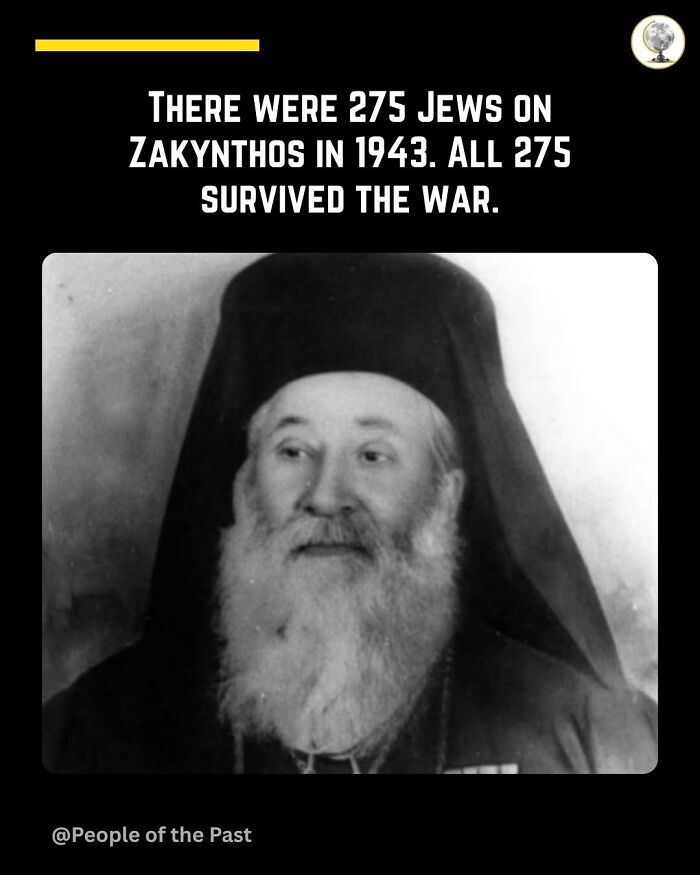
In the autumn of 1943, the German commander on Zakynthos handed Bishop Chrysostomos and Mayor Loukas Karrer an order. Produce a list of every Jew on the island. He wanted it within hours.
There were 275 Jewish residents on Zakynthos. Families who'd lived in the Ionian Sea community for generations, with Greek neighbors, Greek names, Greek kitchens.
The bishop and the mayor went away to think.
What they did next has been told in slightly different versions over the years, but the core of it holds. They warned the Jewish community to leave their homes and scatter. Christian families in the villages took them in, hid them in cellars, in attics, in farmhouses up in the hills. Others fled to the mountains and waited.
Then the bishop and the mayor sat down and wrote their list.
It had two names on it. Bishop Chrysostomos. Mayor Karrer.
Chrysostomos is said to have written a letter to the German authorities along with it, taking personal responsibility for the island's Jews and asking that he be deported in their place. Whether the letter survived in its exact form is debated by historians. What isn't debated is what happened next.
The deportation never came. The Germans on Zakynthos didn't round up the island's Jewish population. Some accounts credit intervention from Berlin, others point to the chaos of a collapsing occupation, others to the simple fact that the Jews were no longer where the Germans could find them.
In September 1944, the Germans pulled out. Every one of the 275 Jews of Zakynthos came down from the hills and out of the cellars. Every one of them had survived.
In 1953, an earthquake leveled most of the island. Among the first aid shipments to arrive was one from the State of Israel, sent in memory of what the people of Zakynthos had done.
In 1978, Yad Vashem recognized Chrysostomos and Karrer as Righteous Among the Nations.
The list with two names on it has never been found. It may have been destroyed, or it may never have existed in the exact form the story remembers. What's certain is the outcome. On an island of 275 Jews, the bishop and the mayor were asked to give them up, and not one was taken.
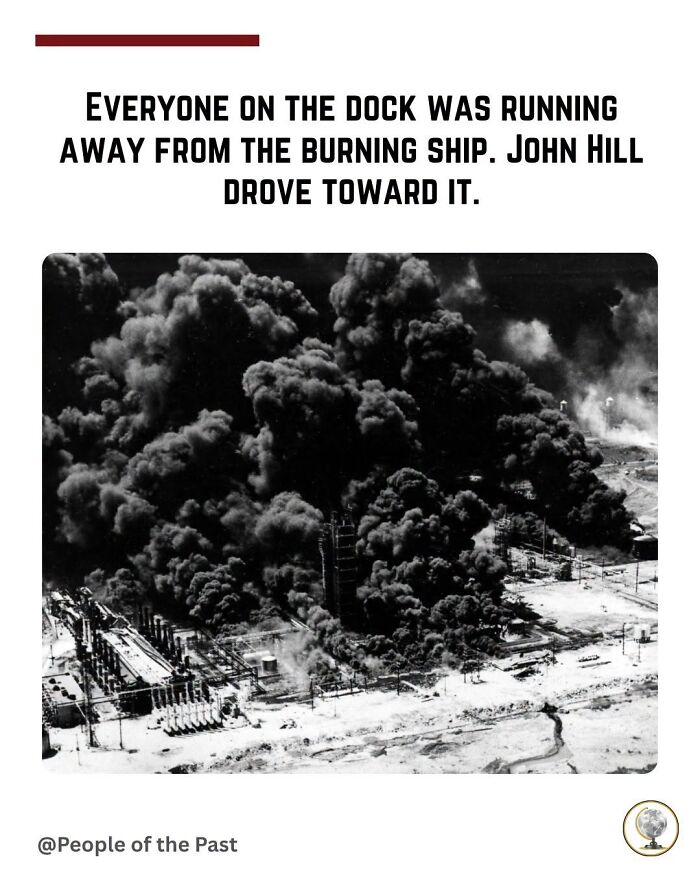
On the morning of April 16, 1947, a column of orange smoke was rising from the SS Grandcamp in Texas City harbor.
The French freighter was loaded with 2,300 tons of ammonium nitrate fertilizer bound for European farms still recovering from the war. A small fire had started in the hold overnight. By 8 a.m. the smoke had turned a strange, beautiful color and people along the docks stopped to watch.
John Hill was a Monsanto plant worker on the waterfront that morning. The Monsanto styrene plant sat 700 feet from the Grandcamp's berth. When the alarms went up, most workers started moving away from the ship. Hill got in his truck and drove toward it.
He was not a firefighter. He was a plant employee who understood, better than the crowd of onlookers, what ammonium nitrate could do when it cooked. He wanted to warn the volunteer fire crew already on the dock that the cargo was unstable.
He never reached them.
At 9:12 a.m. the Grandcamp exploded.
The blast was heard 150 miles away in Louisiana. Two small planes flying overhead were knocked out of the sky. A 15-foot wave surged across the harbor and lifted a steel barge onto dry land. The Monsanto plant vanished in a single concussive instant, k*****g 145 of its workers. The ship's two-ton anchor was hurled nearly two miles inland and buried itself ten feet deep in a field.
John Hill was never found. Neither was most of the volunteer fire department. Of the 28 men on the Texas City fire crew, 27 died at the dock.
The fires spread to a second freighter, the High Flyer, also loaded with ammonium nitrate and sulfur. It burned through the day and detonated just after 1 a.m. the next morning. More dead. More wreckage.
When the count was finished, at least 581 people were dead and more than 5,000 injured. Entire families were gone. Some bodies were never identified. A mass grave at Memorial Park holds 63 of them under a single marker.
The disaster led to the first ever class action lawsuit against the United States government, and eventually to the federal regulations that govern how ammonium nitrate is shipped and stored today.
The anchor still sits in that field, mounted now as a memorial. It weighs 3,200 pounds. It traveled 1.62 miles through the air in a few seconds.
John Hill drove the other way.
In August 1823, Hugh Glass was scouting ahead of a fur trapping party along the Grand River in present day South Dakota when he stumbled between a grizzly sow and her cubs.
She was on him before he could raise his rifle.
The bear opened his scalp, tore through his back, broke his leg, and punctured his throat. His companions shot her off him, but by the time she lay dead across his body, Glass was a wreck of torn muscle and exposed bone. Nobody expected him to survive the night.
The expedition's leader, Andrew Henry, needed to keep moving. Arikara war parties were close. He offered a bounty to any two men who would stay behind, bury Glass when he died, and catch up after.
John Fitzgerald volunteered. So did a young Jim Bridger, still in his teens.
They waited. Glass kept breathing. After a few days, Fitzgerald spooked at signs of Arikara nearby and told Bridger they had to leave. They took his rifle, his knife, his flint, and his powder horn. They scraped a shallow grave, laid him in it, and rode off.
Glass woke up alone, unarmed, on the edge of a hole meant to hold his body.
He set his own broken leg. He let maggots eat the rotting flesh on his back to keep gangrene from k*****g him. He drank from creeks and chewed wild berries and raw bison left behind by wolves. When he couldn't walk, he crawled.
The distance to Fort Kiowa was roughly 200 miles.
It took him about 6 weeks. He floated part of the way down the Cheyenne River on a makeshift raft. He was helped at one point by friendly Lakota who stitched the wound on his back. By the time he reached the fort, the men inside didn't recognize the figure dragging itself through the gate.
He rested only as long as he had to. Then he went looking for Fitzgerald and Bridger.
He found Bridger first, at a post on the Bighorn. The boy was 19 and terrified. Glass looked at him, saw the age and the fear, and let him live.
Fitzgerald took longer to track down. By the time Glass caught up with him, Fitzgerald had enlisted in the US Army, and k*****g a soldier would have meant the noose. Glass took back his stolen rifle and walked away.
He spent another decade in the fur trade. In the winter of 1833, on the frozen Yellowstone, he was finally k****d by an Arikara raiding party.
The grave that had been dug for him ten years earlier was 600 miles east, and empty.

I am so tired of this AI cadence. Every entry here has the exact same flow.
In August 1908, a man named William Donnegan was dragged from his home in Springfield, Illinois, and hanged from a tree two blocks from Abraham Lincoln's tomb.
He was 84 years old. He had cobbled shoes for Lincoln himself. His wife was white, and that was reason enough for the mob.
Springfield in 1908 was a city of contradictions. A Lincoln statue stood every few blocks. A sundown sign stood at the city limits warning Black residents to be out by dark. The capital of the Land of Lincoln ran on the same rules as any town in Mississippi.
The riot began over two Black men held in the city jail, one accused of m****r, one of a*****t. When the sheriff moved them out of town for their safety, the white crowd that had gathered to l***h them turned on the Black neighborhoods instead. They burned homes. They destroyed businesses. They k****d Scott Burton, a barber who tried to defend his shop, and strung him up too.
It took 3,700 state militia to stop it. By then, much of the Black district was ash.
In New York, a journalist named William English Walling read the reports and traveled to Springfield with his wife to see it for himself. What he found became an article called "Race War in the North," published in The Independent that September. He wrote that the spirit of the Southern lyncher had moved north, and that unless white Americans were willing to treat Black Americans as equals, Lincoln's work would be undone.
The article landed on the breakfast table of Mary White Ovington, a white settlement worker in Brooklyn who had spent years studying Black life in New York. She wrote to Walling. So did Henry Moskowitz, a social worker on the Lower East Side. The three of them met in Walling's apartment in early January 1909.
They decided the country needed a new organization. Something national. Something that would fight lynching, s*********n, and disenfranchisement in court and in print.
They issued a call on February 12, 1909, the 100th anniversary of Lincoln's birth. Sixty signatures came back, including W.E.B. Du Bois, Ida B. Wells, Jane Addams, and Lincoln's own grand-nephew.
The National Association for the Advancement of Colored People was born from a riot in Lincoln's hometown.
Donnegan's tree stood for years afterward. The sundown sign came down eventually. The organization founded in response to what happened under both of them is still here.
Isabelle Romée was nearly 70 years old when she walked into Notre Dame de Paris in November 1455.
She was a peasant woman from Domrémy. Her knees were bad. She had buried a daughter 24 years earlier, burned alive at Rouen as a heretic by an English-backed church court. Now she stood inside the most important cathedral in France, facing papal commissioners, and she was about to make them listen.
Her daughter was Joan of Arc.
Isabelle had spent more than two decades pushing for this hearing. She wrote letters. She petitioned. She traveled when traveling was hard on a body her age. Pope Callixtus III finally agreed to reopen the case, and the commissioners convened at Notre Dame to hear from the family first.
The clerks recorded her words.
She spoke of a daughter "born of lawful marriage," raised in the faith, taught to fear God. She said Joan had frequented the sacraments and lived honestly. Then she turned on the men who had k****d her. The judges at Rouen, she said, had condemned her daughter "fraudulently, deceitfully and wickedly," without any rights of defense, against all reason.
She asked the church to restore Joan's name.
Witnesses said she wept as she spoke. So did some of the men listening. She was supported on either side by her surviving sons, Jean and Pierre, who had ridden with their sister to Orléans and watched her crowned in glory before watching her burn.
The trial that followed lasted months. More than 100 witnesses testified, including villagers from Domrémy who had known Joan as a child, soldiers who had fought beside her, and clergy who had examined her. On July 7, 1456, the verdict came down. The 1431 trial was declared null. Joan was formally rehabilitated. Her conviction was annulled and her name cleared.
Isabelle did not live many more years. She died in Orléans, where the city had granted her a pension and a home after her daughter's death.
She never saw Joan canonized. That came in 1920, almost five centuries later.
But the saint exists in the church's official memory because a grieving mother in her 70s stood inside Notre Dame and refused to leave until they admitted what they had done.
The cast-iron pillars holding up the Pemberton Mill were too thin. The manufacturer knew it. The engineer who inspected them knew it. The building went up anyway.
Lawrence, Massachusetts, January 10, 1860. Just before five in the afternoon, around 800 workers were finishing their shift inside the five-story textile mill on the bank of the Merrimack River. Most were women and children, immigrants from Ireland and beyond, paid by the hour to run the looms and spinning frames.
The collapse took less than a minute.
Witnesses said the upper floors seemed to lean, then drop straight down. Brick walls folded inward. Heavy machinery crashed through floor after floor, dragging workers with it. When the dust settled, the mill was a heap of brick, timber, and iron roughly 30 feet high, with hundreds of people buried inside.
The pillars had been cast by a foundry in South Boston years earlier. Tests at the time had shown they couldn't carry the load the architect specified. The engineer who signed off knew the columns were undersized. The mill went into production regardless, and more machinery was added over the years. The iron finally gave.
Rescuers came from every direction. Neighbors, off-duty workers, doctors, clergy. They dug through the rubble with bare hands and crowbars, pulling out survivors one by one through the freezing night. Fires were lit nearby for warmth and light. Lanterns were passed down into the wreckage to reach the trapped.
Around nine-thirty that evening, a lantern broke. The oil spilled across cotton, splintered wood, and machine grease. The pile caught instantly.
The people still pinned in the ruins couldn't be moved. Rescuers tried to reach them and were driven back by the heat. Some of the trapped called out to the crowd as the flames spread. A few asked to be shot. At least one priest stayed at the edge of the fire giving last rites until he had to be pulled away.
By morning, 145 workers were dead. Around 165 more were injured, many permanently.
A coroner's jury found the pillars defective and the inspection inadequate, but no one was ever prosecuted. The mill was rebuilt on the same site within two years, this time with wrought iron supports. Production resumed.
In Lawrence, the dead were buried in a common lot at Bellevue Cemetery. A small stone marks it. Most of the names underneath belonged to women who had come to America to work.
The door to the President's bedroom stayed closed.
On the other side of it, Woodrow Wilson lay paralyzed down his left side, half blind, and unable to speak above a whisper. On this side of it, his wife Edith decided which papers were worth disturbing him for.
It was October 1919. Wilson had collapsed after a cross country tour pushing the League of Nations. A massive stroke had left him incapacitated, and his doctor, Cary Grayson, agreed with Edith that the country could not be told how bad it was.
So they didn't tell anyone.
For 17 months, Edith Wilson sat between the President and the United States government. Cabinet officers sent memos. Senators sent urgent requests. Foreign ambassadors asked for audiences. Everything went to her first. She read it, decided what mattered, and carried a chosen few items into the darkened room. What came back out was often a note in her handwriting, claiming to relay his wishes.
She had two years of formal schooling as a girl in Virginia.
Bills piled up unsigned. Ambassadorships sat vacant. When Secretary of State Robert Lansing called cabinet meetings to keep the government functioning, Wilson eventually fired him for it. The order came through Edith. Vice President Thomas Marshall was kept entirely in the dark and refused to assume the office, terrified of being accused of a coup.
The League of Nations fight was lost during this period. The Treaty of Versailles failed in the Senate. Senator Gilbert Hitchcock was one of the few outsiders allowed near the sickroom, and even he saw only what Edith permitted.
She later wrote a memoir about it. My Memoir, published in 1939, is remarkably direct. She described her role as a stewardship. She insisted she never made a single decision on a public matter. She only decided, she said, what was important enough to bring to her husband.
Historians have spent a century working out what that distinction actually meant in practice. The answer keeps coming back the same. For a year and a half, the person reading the President's mail, controlling access to him, and signing his name on documents was Edith Bolling Wilson.
Woodrow lived until 1924. He never fully recovered. Edith outlived him by nearly four decades and attended John F. Kennedy's inauguration in 1961.
She took the secret of those 17 months as close to the grave as she could.
The pastor stood in his pulpit and told his congregation that the strangers knocking on their doors were people of the Book. That was all the instruction Le Chambon needed.
Le Chambon-sur-Lignon sat high in the mountains of south-central France, a Protestant village in a Catholic country. Its people were Huguenots, descendants of a religious minority that had been hunted, burned, and driven into the hills for centuries. They knew what persecution looked like from the inside.
When the Nazis occupied France and the Vichy regime began rounding up Jews, Andre Trocme and his wife Magda did not hold a meeting or take a vote. They opened their parsonage. Then the rest of the village followed.
Farmers took in children whose parents had been deported. Schoolteachers added fake names to class rolls. The Hotel May ran as a boarding house for Jewish students. Forged papers came out of a back room run by a young schoolteacher named Edouard Theis. False ration cards moved through a network of pastors and farmers across the plateau.
When Vichy police came looking, the village had already moved. Children were hidden in barns and root cellars. The local police chief, Leopold Praly, sometimes tipped families off before the raids. When officials demanded the names of Jews being sheltered, Trocme refused. He told them the people were under his care and they would not be handed over.
He was arrested in 1943 and held in an internment camp. He was released after a few weeks, partly because his captors could not break him and partly because the network kept running without him. His cousin Daniel Trocme, who ran one of the children's homes, was less fortunate. He was arrested with his students and died at Majdanek.
By the time the war ended, the village and the farms around it had hidden roughly 3,500 Jews. Some estimates run higher. No one in Le Chambon kept a list, which was the point.
When Trocme was asked after the war how the village had done it, he gave a flat answer. They were following the Gospel. There was nothing remarkable about it.
In 1990, the village itself was recognized by Yad Vashem as Righteous Among the Nations. It remains one of the only entire communities ever given that honor.
The people of Le Chambon never called themselves heroes. They called themselves Christians, and Huguenots, and neighbors. They opened their doors and they kept their mouths shut.
In the spring of 1989, a student in Beijing held up a sheet of paper with nothing written on it.
The square was full of slogans. Banners demanded democracy. Hunger strikers lay on the stones of Tiananmen. Among all that noise, a few protesters chose silence on paper. Nothing to read. Nothing to quote. Nothing the censors could point to as a crime.
The blank page said what the state had already made unsayable.
On the night of June 3rd and into the morning of June 4th, the People's Liberation Army moved into central Beijing with tanks and live ammunition. The death toll has never been officially confirmed. Estimates range from several hundred to several thousand. The Chinese government has spent more than three decades scrubbing the events of that night from textbooks, search engines, and public memory. Even the date itself, written as 6/4, became a flagged term online.
The blank page went with it. Filed away. Forgotten by most of the world.
Then, in November 2022, it came back.
A fire in an apartment block in Urumqi k****d at least 10 people during one of the strictest COVID lockdowns in the country. Residents said barriers and sealed doors had slowed the escape. Within days, protests broke out in Shanghai, Beijing, Nanjing, Wuhan, and on university campuses from Chengdu to Hong Kong. Students gathered in courtyards and on street corners holding up sheets of blank A4 paper.
No slogans. No names. No demands written down.
The police could arrest them, but they could not say what the paper said. To name the message was to admit the message existed. The silence did the work.
It became known as the White Paper Movement, or the A4 Revolution. Within a few weeks, the government announced the end of its zero COVID policy. Officials never linked the decision to the protests. They did not have to.
The students who held those pages in 2022 were born long after 1989. Most had never been taught what happened in Tiananmen Square. They had reached for the same symbol anyway, across 33 years of enforced forgetting, and held it up to the same kind of night.
A blank page. Still the loudest thing in the room.
The tanks rolling toward the front line were made of rubber.
Four men could lift one. A stiff wind could knock it over. From a German reconnaissance plane at altitude, it looked exactly like a Sherman.
This was the 23rd Headquarters Special Troops, the unit history would come to call the Ghost Army. Around 1,100 American soldiers, many of them recruited from art schools, advertising agencies, and design studios in New York and Philadelphia. Bill Blass was one of them. So was the painter Ellsworth Kelly. So was the photographer Art Kane.
Their job was to lie to the German Army, and to be believed.
They staged more than 20 deceptions across Europe between 1944 and 1945. Inflatable tanks, jeeps, and artillery pieces arranged in convincing formations. Sound trucks loaded with massive speakers that could broadcast the noise of an armored division moving at night, audible from 15 miles away. Fake radio traffic mimicking real units, complete with the personal quirks of specific operators. Shoulder patches swapped, insignia repainted, soldiers sent into French cafes to drop misleading gossip where German spies might hear it.
They impersonated entire divisions. They drew German fire away from real American positions. At the Rhine in March 1945, they helped convince the Germans that the Ninth Army would cross at one point while it actually crossed at another. The deception likely saved thousands of lives.
Three of them were k****d. Dozens were wounded. The unit operated within range of German artillery for most of the war, holding ground they had no real ability to defend if the bluff failed.
When the war ended, they were ordered not to speak about any of it. The files stayed classified until 1996. By then, most of the men had spent 50 years carrying a story they could not tell, watching other units get the parades and the histories and the documentaries.
In March 2024, the surviving veterans were awarded the Congressional Gold Medal. Seven were still alive. The youngest was 99.
They sat in the Capitol in wheelchairs, in uniforms that no longer fit the way they once had, while the country finally said out loud what they had done.
One of them, Bernard Bluestein, was 100 years old. He had spent the war painting fake insignia onto trucks. He lived long enough to hear his name read into the record.

The british troops used a similiar tactic near El Alamein, with the stage magician Jasper Maskelyne organising a convincing mock up of troop movements to deceive german air reconnaissance. It wasn't as specialized and artful as the US unit mentioned above but it worked
She was twelve years old when she pulled a sea monster out of a cliff.
Mary Anning lived in Lyme Regis on the south coast of England, where the cliffs crumble into the sea and spit out the bones of creatures that died 200 million years ago. Her family was poor. Her father, a cabinetmaker, supplemented their income by selling fossils to tourists, and he taught Mary how to find them before he died in 1810, leaving the family in debt.
Mary was eleven when he died. She kept hunting.
In 1811, her brother Joseph spotted a strange skull jutting from the cliffs at Black Ven. Mary, then twelve, spent months chipping away at the rock until she'd uncovered a seventeen-foot skeleton with a long snout and enormous eye sockets. It was the first complete ichthyosaur ever identified. Scientists in London were stunned.
They bought it. They studied it. They wrote papers about it. They did not credit her.
This became the pattern of her life. In 1823 she found the first complete plesiosaur, a creature so bizarre that the famous anatomist Georges Cuvier initially accused her of faking it. He had to retract. In 1828 she found the first pterosaur skeleton discovered outside Germany. She identified coprolites as fossilized feces, which gave geologists a window into prehistoric diets.
The men who bought her finds built careers on them. William Buckland, Henry De la Beche, Richard Owen. They published, they lectured, they collected honors. Mary stayed in Lyme Regis, scraping by, selling specimens out of a small shop on the seafront.
The Geological Society of London, founded in 1807, was the gatekeeper of the field she was helping to invent. It would not admit her. Women were barred from membership. She wasn't even allowed to attend meetings as a guest.
A friend recorded her bitterness late in life. "The world has used me so unkindly," she said, "I fear it has made me suspicious of everyone."
She died of breast cancer in 1847, aged forty seven. The Geological Society published an obituary, an honor usually reserved for fellows. It was the closest they came to acknowledging what she had done.
They admitted their first women members in 1904. Fifty seven years after Mary Anning was buried in a Lyme Regis churchyard, with the cliffs that had made her name still giving up their dead behind her.
This has always pained me since I first read about it.
The cellar at Mila 18 was dark, hot, and crowded with the dying.
By early May 1943, the bunker beneath a ruined apartment block had become the command post of the Jewish Combat Organization. The fighters were starving. Their pistols were nearly out of ammunition. Above them, German soldiers were burning the Warsaw Ghetto block by block, flushing out anyone still breathing.
Marek Edelman was 23 years old. He was one of the last commanders left alive.
The uprising had started on April 19, when SS troops entered the ghetto to deport the remaining 50,000 Jews to Treblinka. They expected three days of work. They got 28. A few hundred young fighters with smuggled pistols, homemade grenades, and a handful of rifles held off a force armed with tanks, flamethrowers, and artillery.
They knew they couldn't win. That wasn't the point. The point was to choose how they died.
On May 8, the Germans found Mila 18. They pumped gas into the bunker. Mordechai Anielewicz, the 24-year-old commander, died there with most of his staff. Some shot themselves. Some suffocated.
Edelman wasn't in the bunker that night. Two days later, on May 10, he led a group of survivors into the sewers beneath the ghetto. They crawled through human waste in pitch darkness for hours, listening for German patrols above the manhole covers. When they finally surfaced on the A***n side of Warsaw, a truck was waiting. Some of the fighters didn't make it out in time and were left behind. Edelman never stopped thinking about them.
He fought again in the 1944 Warsaw Uprising. He survived that too.
After the war, Edelman stayed in Poland when most of the surviving Jewish community left. He trained as a cardiologist in Lodz and became one of the country's leading heart surgeons, specializing in the cases nobody else would take. The patients deemed too sick. The ones already written off.
He once said he treated every patient like he was still pulling people out of the rubble. You went in for the ones who looked gone. You didn't stop just because the odds were bad.
He spoke about the uprising rarely, and when he did, he refused to make it heroic. He called the fighters ordinary people who had run out of other options. He kept a small photograph of Anielewicz in his apartment.
Marek Edelman died in Warsaw in 2009, at the age of 90. He had outlived the ghetto by 66 years.
At his funeral, mourners laid yellow daffodils on the coffin. Every April 19, he had walked to the monument where the ghetto once stood and placed the same flowers at its base.
The "A***n side of Warsaw"?!?!?!?! BP, PLEASE stop making us guess what the hell you are trying to tell us. 😖 "Acorn"? "Asian"? "Alien"?
In December 1944, a young intelligence officer named Hiroo Onoda was sent to Lubang Island in the Philippines with a single order. Gather intelligence, conduct guerrilla warfare, and do not surrender under any circumstances.
He obeyed for 29 years.
Onoda was 22 when he arrived. By February 1945, American and Filipino forces had taken the island and most of the Japanese garrison was dead or captured. Onoda slipped into the jungle with three other soldiers: Corporal Shoichi Shimada, Private Kinshichi Kozuka, and Private Yuichi Akatsu.
They lived on bananas, coconuts, and stolen rice. They wore uniforms stitched back together from scraps. They raided villages for food and shot at farmers they believed were enemy scouts. By their own later count, they k****d around 30 islanders over the years.
The war ended in August 1945. Onoda did not believe it.
Leaflets dropped into the jungle announcing Japan's surrender were dismissed as Allied propaganda. Newspapers left in clearings were studied for inconsistencies and judged to be fakes. Even letters from their own families, dropped by search parties in the 1950s, were read as clever forgeries designed to draw them out.
Akatsu walked out and surrendered in 1950. Shimada was shot dead by a search party in 1954. Kozuka was k****d by Filipino police in 1972, almost 27 years after the war he was still fighting had ended.
That left Onoda alone in the jungle.
In February 1974, a Japanese university dropout named Norio Suzuki traveled to Lubang with a stated goal of finding Onoda, a panda, and the Abominable Snowman, in that order. He found Onoda in four days. They talked. They took photographs together. But Onoda would not come out without orders from a superior officer.
So the Japanese government found one.
Major Yoshimi Taniguchi, Onoda's former commanding officer, was by then working in a bookshop. He was flown to Lubang, put on his old uniform, and on March 9, 1974, stood in a clearing and formally relieved Onoda of his duties.
Onoda handed over his rifle, 500 rounds of ammunition, several hand grenades, and the samurai sword his brother had given him in 1944. He was 52 years old. He saluted.
The war he had been fighting had ended before most of his countrymen were born.
The trash pit told the story before anyone wanted to hear it.
In the winter of 1609, Jamestown was dying. The colony had swelled to around 300 people that summer. By spring, only about 60 were left alive. The survivors called it the Starving Time, and the bones in the ground showed exactly what that meant.
Archaeologists working at the James Fort site pulled butchered remains from refuse pits filled during that winter. Horses. Dogs. Rats. A young girl whose skull bore cut marks consistent with cannibalism. And donkeys, their bones broken open for marrow, the same way you'd process any other meat animal when there was nothing else left.
Donkeys were not supposed to be there.
The Virginia Company records make no mention of shipping them. England barely used donkeys as draft animals in this period. Yet here they were, eaten down to the bone inside an English fort on the Chesapeake.
Recent isotope analysis on the teeth pointed somewhere unexpected. The strontium and oxygen signatures locked into the enamel while the animals were young didn't match England. They didn't match Virginia either. They matched West Africa.
That single finding cracks open a story the official records never told.
The most likely route runs through the Cape Verde Islands and the Canaries, where Portuguese and Spanish traders kept donkeys as pack animals and resupplied passing ships. English vessels heading for Virginia stopped in these waters regularly, picking up water, salt, livestock, and whatever else could be bought or taken. Some of those stops were sanctioned. Many were not. Captains ran private trades on the side, and the Virginia Company in London had only the faintest idea what was actually being loaded onto its ships.
The donkeys were almost certainly meant for hauling. Building timber, dragging plows, moving barrels of grain from the landing to the storehouse. They were infrastructure on four legs, brought in quietly to keep the colony functioning.
Then the siege came. Powhatan's warriors cut off the fort from the surrounding country through the fall and winter of 1609. No hunting parties could leave. No trade could come in. The supply ship from England had wrecked in Bermuda. The colonists ate their horses first, then their dogs, then the donkeys that had crossed an ocean to plow Virginia soil.
When the survivors were finally relieved in May 1610, they were ready to abandon the colony entirely. They got as far as the mouth of the river before another fleet turned them back.
The bones stayed in the pit for 400 years, waiting for someone to ask where they came from.
Chicago police had a file on Lucy Parsons that ran for decades. When she spoke in public, they showed up in numbers. One officer reportedly called her more dangerous than a thousand rioters.
She was in her sixties when she led the hunger marches through Chicago in the winter of 1915.
The city was choking on unemployment. Breadlines stretched around blocks. Lucy walked at the front of crowds of jobless workers, demanding food, shelter, and work from a city government that wanted her gone.
She'd been doing this since the 1870s.
Born around 1851, likely into slavery in Virginia or Texas, she'd married Albert Parsons, a former Confederate soldier turned radical labor organizer. They moved to Chicago and built a life around the eight-hour workday movement, mixed-race marriage laws be damned.
Then came Haymarket.
In 1886, a b**b went off at a labor rally in Chicago. Albert was one of four anarchists hanged for it, despite no evidence he'd thrown anything. Lucy was 35 and had two small children. She buried her husband and kept organizing.
She wrote for radical papers. She co-founded the Industrial Workers of the World in 1905, sharing a stage with Eugene Debs and Mother Jones. She organized garment workers, many of them immigrant women working 14 hour days in firetrap factories. She told them to arm themselves against the bosses who beat them.
The police followed her everywhere. They arrested her for speaking, for handing out leaflets, for walking down the wrong street. They tried to stop her from buying a meeting hall. They surveilled her into her eighties.
She outlived almost everyone she'd organized with.
In March 1942, at around 91 years old, Lucy died in a house fire in Chicago. She was nearly blind by then and lived in poverty. The fire took her, her partner George Markstall, and most of what she owned.
Before the ashes had cooled, FBI agents and Chicago police arrived at the house. They seized her library. Thousands of books, pamphlets, letters, and personal papers built over 60 years of labor organizing. The material was never returned to her family or to any archive.
Most of what Lucy Parsons wrote and read in her lifetime is gone.
What survives is the memory of an old woman walking at the front of a hunger march in 1915, with the Chicago police walking behind her, counting heads.
Yuri Yudin stepped off the trail on January 28, 1959. His leg was aching, the cold was making it worse, and he turned back toward the settlement of Vizhay while his nine friends kept walking north.
He was the only one who lived.
The group was led by Igor Dyatlov, a 23-year-old radio engineering student from the Ural Polytechnic Institute. They were experienced hikers, headed for Otorten mountain in the northern Urals, a route rated at the highest difficulty level the Soviet system recognized. Yudin had wanted to go. His sciatica decided otherwise.
He hugged each of them before he left. Photographs from that morning show him smiling with Lyudmila Dubinina, her arms wrapped around his shoulders.
The other nine pitched their tent on the slope of Kholat Syakhl on the night of February 1st. Something happened in the hours that followed. The tent was cut open from the inside. They ran into temperatures around minus 25 Celsius, most of them barefoot or in socks, some in only their underwear.
Searchers found the first bodies weeks later, scattered down the mountainside. Two were under a cedar tree where someone had tried to light a fire. Others were strung out along the path back to the tent, frozen mid crawl. The last four were found in May, buried in a ravine under several meters of snow. Dubinina was missing her tongue and eyes. Two others had crushed chests with no external wounds, the kind of injuries investigators compared to a car crash.
The Soviet inquiry closed the case that summer with a phrase that explained nothing: a compelling natural force.
Yudin was called in to identify their belongings. He sat with the recovered gear, item by item, naming whose boot, whose camera, whose diary. He kept doing it for decades as investigators reopened the file and theories piled up. Avalanche. Infrasound. Military weapons testing. A katabatic wind. A 2021 study pointed to a slab avalanche triggered by the slope cut they made for the tent. Others still aren't convinced.
Yudin lived another 54 years. He became an economist, then a town official in Solikamsk. He spoke to anyone who asked about his friends, and he never stopped trying to find out what k****d them.
He died in 2013 at 75. His ashes were buried in Yekaterinburg, in the same cemetery as the nine hikers he hugged goodbye on a winter morning in 1959.
He said, more than once, that if he could ask God a single question, it would be what really happened to them on that slope.
One part of this, the fact that some of them were undressed, is explained through the phenomenon known as paradoxical undressing, when hypothermia victims, near deâth, suddenly feel like they're too hot and remove their own clothing. (The exact physiological mechanism is unclear).
The rec room at 1520 Sedgwick Avenue was nothing special. Linoleum floor, folding chairs, a low ceiling, the kind of space a Bronx apartment building set aside for birthday parties and tenant meetings.
On August 11, 1973, Cindy Campbell rented it out for a back-to-school party.
She was 16 and wanted new clothes for the fall semester. The plan was simple. Charge a quarter at the door for girls, 50 cents for boys, sell sodas, and let her older brother handle the music. Her brother went by DJ Kool Herc. His real name was Clive.
Clive had been experimenting. He'd noticed that the part of a record people actually wanted to dance to was the instrumental break, the few seconds where the vocals dropped out and the drums took over. Most DJs played the whole song. Clive wanted just the break.
So he bought two copies of the same record, put them on two turntables, and figured out how to cue the second one up while the first was playing. When the break ended on one, he'd switch to the other and play the break again. Then back. Then back again. He called it the merry-go-round.
That night in the rec room, he stretched a 10 second drum break into minutes.
The dancers went off. People who had been bobbing along started doing something different on the floor, moving in the break itself, working the rhythm in ways nobody had names for yet. They'd be called b-boys and b-girls. The break gave them their name.
Herc's friend Coke La Rock grabbed the mic and started talking over the records, calling out names of people in the room, riffing on the rhythm. He wasn't singing. He was doing something else.
By the time the party ended, the four pieces were in the room. The DJ working the breaks. The MC on the mic. The dancers in the cypher. The crowd that knew it was watching something it had never seen.
Cindy made enough for her school clothes.
Clive kept doing parties, first in the rec room, then in the park across the street, then everywhere. Within a few years the South Bronx had a whole movement. Within a decade it had reached the rest of the country. Within 20 years it was the dominant sound on the planet.
1520 Sedgwick Avenue is still standing. In 2007 New York State recognized it as the birthplace of hip-hop.
A quarter at the door. Two turntables. A teenager trying to help his sister buy jeans.
"Chuck! Chuck, it's Marvin. Your cousin, Marvin Berry. You know that new sound you're looking for? Well, listen to this!"
Mileva Maric walked into Zurich Polytechnic in 1896 as the only woman in her physics section, and the fifth woman ever admitted to the program.
She was Serbian, brilliant, and walked with a limp from a congenital hip dislocation. Her father had fought to get her the kind of education that women in the Austro-Hungarian Empire were not supposed to receive. She had already topped her class in Zagreb after special permission was granted for her to attend physics lectures with the boys.
At the Polytechnic, she met Albert Einstein. They studied together, argued together, shared books and notes and long evenings of equations. He wrote her letters that referred to "our work" and "our theory of relative motion." Whether that phrasing meant intellectual partnership or simply a young man in love writing tenderly to the woman he wanted is something historians still argue about.
In 1900, Einstein passed his final exams. Mileva failed hers. She tried again in 1901 and failed a second time. She was pregnant by then, carrying Einstein's child. The baby, a girl named Lieserl, was born in Serbia in 1902 and then disappears from the historical record entirely. No one knows what happened to her.
Mileva and Einstein married in 1903. The 1905 papers followed, the ones that rewrote physics: special relativity, the photoelectric effect, Brownian motion, mass-energy equivalence. Some of Einstein's letters from this period mention her involvement. The original manuscripts have not survived. Claims that she co-authored the work are not supported by documentary evidence. Claims that she had nothing to do with it ignore the letters in which Einstein himself suggests otherwise.
The truth sits somewhere we cannot fully reach.
The marriage came apart. By 1914, Einstein had moved to Berlin and fallen for his cousin Elsa. He sent Mileva a list of conditions for staying married, including that she serve him three meals a day and stop speaking to him when he asked. She left with their two sons.
The divorce was finalized in 1919. As part of the settlement, Einstein promised Mileva the money from any future Nobel Prize. He won it in 1921. He paid her, as agreed. She used much of it to care for their younger son Eduard, who developed schizophrenia and spent decades in a Zurich psychiatric hospital.
Mileva died in Zurich in 1948, in a small apartment, mostly forgotten.
What she contributed to the 1905 papers may never be settled. What is certain is that she was there, in the room, in the math, in the marriage, when the work was done.
"The man who would become Einstein".😄 He already was an Einstein, Albert Einstein.
At 3:16 a.m. on February 25, 1942, the air raid sirens went off across Los Angeles.
Searchlights swept the sky over Santa Monica. Anti-aircraft batteries opened up from Inglewood to Long Beach. Tracer fire streaked above rooftops while half a million people sat in blacked-out houses, listening to their windows rattle.
The gunners fired 1,400 rounds in about an hour.
They were firing at nothing anyone could ever confirm. No bombs fell. No aircraft were shot down. No wreckage was recovered the next morning, despite shrapnel raining back onto streets and rooftops across the city.
Three months earlier, Pearl Harbor had been hit. The night before the Los Angeles incident, a Japanese submarine had surfaced off Santa Barbara and shelled an oil field at Ellwood. The whole West Coast was raw with the certainty that the next attack was coming.
So when radar picked up an unidentified target about 120 miles west of Los Angeles in the early hours of February 25, the response moved fast. Blackout ordered at 2:25 a.m. Sirens at 3:16. The 37th Coast Artillery Brigade opened fire shortly after.
What the gunners were aiming at is still not clear.
Witnesses described slow-moving objects, fast-moving objects, formations of planes, a single balloon, nothing at all. Newspaper photographers captured searchlights converging on patches of smoke that may have been their own flak bursts. Reports came in of a craft hit dozens of times that refused to fall. None of it held up under daylight.
The morning after, the Secretary of the Navy, Frank Knox, called it a false alarm caused by war nerves. The Secretary of War, Henry Stimson, said as many as 15 planes had likely been involved, possibly commercial aircraft flown by enemy agents to map defenses. The two statements contradicted each other within 24 hours and were never reconciled.
A weather balloon released by the Army earlier that night was later floated as the most likely trigger. Nobody could prove it.
Five civilians died during the raid. Three from heart attacks brought on by the noise and the panic. Two in car crashes on blacked-out streets. Houses and cars across the city were damaged by falling shrapnel. One unexploded shell punched through the roof of a home in Long Beach.
In 1983, the Office of Air Force History concluded the most likely cause was weather balloons combined with jittery gunners and war nerves feeding on each other. That has never satisfied everyone.
What the record actually shows is a city that had been bracing for an attack for almost three months, a radar contact in the dark, and a chain of human decisions made under enormous pressure.
The sky over Santa Monica was empty. The fear was not.
My guess would have been a japanese Fu-Go baloon b**b, but those weren't launched before 1944
Captain Mohsen Rezaian lifted off from Bandar Abbas at 10:17 a.m. on July 3, 1988. He was 38 years old, flying a routine 28 minute hop across the Persian Gulf to Dubai. The Airbus A300 carried 290 people. Sixty-six of them were children.
Flight 655 was climbing through 13,500 feet on Amber 59, the assigned commercial air corridor, when the USS Vincennes locked on.
The Vincennes was a guided missile cruiser. That morning it was inside Iranian territorial waters, engaged in a surface skirmish with small Iranian gunboats. In the combat information center, officers misidentified the climbing Airbus as a descending F-14 Iranian fighter. The plane's transponder was broadcasting on the civilian Mode III channel. The radar contact was ascending, not descending. The flight was on schedule, on course, and squawking the right code.
None of that reached the firing decision.
At 10:24 a.m., seven minutes into the flight, two SM-2MR missiles left the Vincennes. One struck the Airbus near the left wing. The aircraft broke apart over the water.
Wreckage drifted for weeks. Iranian fishermen and recovery crews pulled bodies and luggage from the Gulf into August. A child's shoe. A wedding dress in a suitcase bound for a ceremony in Dubai. The seat cushions floated longest.
The initial U.S. account placed the Vincennes in international waters and described the Airbus as descending in attack profile. Both claims were later corrected. In 1992, Admiral William Crowe acknowledged on Nightline that the Vincennes had been inside Iranian territorial waters when it fired. The Pentagon's own investigation confirmed the Airbus had been climbing the entire time, on the correct corridor, on the correct transponder code.
The United States never formally apologized. In 1996 it agreed to pay $61.8 million in compensation to the families of the 248 Iranian victims, settling the case at the International Court of Justice without admitting legal liability.
Captain Rezaian's last radio transmission was a routine readback to Bandar Abbas approach control. The cockpit voice recorder was never recovered.
He had been in the air for seven minutes
He could swallow a live eel whole. He could eat a meal meant for 15 men in one sitting. And the French army thought they could use him.
Tarrare was born around 1772 in rural France, and by his teens his parents had thrown him out. He couldn't stop eating. A normal household couldn't feed him, so he drifted across the countryside, working with a band of thieves and prostitutes before landing with a traveling showman.
The act was simple. Tarrare would swallow corks, stones, live animals, whatever the crowd put in front of him. People paid to watch.
When the Revolutionary Wars broke out, he enlisted. The army rations weren't close to enough. He was found in the gutters eating refuse, in hospital kitchens stealing from patients, and once drinking the blood of men being bled by surgeons. They sent him to a military hospital in Soultz, where the doctors couldn't make sense of him.
General Alexandre de Beauharnais heard about the man who could eat anything and saw a use for him.
The plan was this: Tarrare would swallow a wooden box containing a secret document, walk through Prussian lines disguised as a German peasant, and pass the box in his stool to a French colonel held prisoner on the other side. They tested him first by feeding him a box stuffed with paper. It came out the next day, intact.
He was sent across the border. He didn't speak a word of German. The Prussians caught him almost immediately, beat him, and held him for over a day before he passed the box and confessed everything. He was strung up to be hanged, then cut down at the last moment and dumped back across French lines.
Tarrare went back to the hospital and begged the doctors to cure him. They tried laudanum, tobacco pills, wine vinegar, and soft-boiled eggs. Nothing worked. He was eventually thrown out of the hospital after being suspected of eating a 14 month old child who had vanished from the ward.
He died in Versailles in 1798, at around 26, of tuberculosis complicated by severe diarrhea.
The autopsy notes survive. His esophagus was so wide that surgeons could see down into his stomach when his jaw was held open. His stomach filled most of his abdominal cavity, lined with ulcers, packed with pus. The surgeons refused to continue the dissection because of the smell.
What was wrong with him has never been settled. Modern doctors have guessed at hyperthyroidism, a damaged amygdala, or a polyphagia tied to some undiagnosed brain injury. None of it explains all of it.
He was buried in Versailles. No monument. No marker. Just a name in a medical journal and a single line from the surgeon who opened him up, describing a body that had spent its whole short life trying, and failing, to be full.
In 1173, Eleanor of Aquitaine made a choice that would cost her sixteen years of her life.
She backed her sons in open rebellion against their father, Henry II of England. The plan was simple in theory: her three eldest, Henry the Young King, Richard, and Geoffrey, would seize what their father refused to share. Eleanor, ruling her own duchy of Aquitaine, threw her weight and her wealth behind them.
The rebellion collapsed within a year.
Eleanor tried to flee to the French court, reportedly disguised as a man. Henry's men caught her before she crossed into safety. She was the Queen of England, Duchess of Aquitaine, former Queen of France, mother of future kings. None of it saved her.
Henry locked her up.
For the next sixteen years she was moved between royal castles, Sarum, Winchester, Berkhamsted, kept under guard and away from politics. She was allowed out occasionally for ceremonial appearances, Christmas at court, a royal wedding, the kind of moments that reminded everyone she still existed. Then back into confinement.
Her sons kept dying. Henry the Young King in 1183, of dysentery, begging his father for mercy on his mother as he went. Geoffrey in 1186, trampled at a tournament. Eleanor mourned them from behind walls.
Henry II died in 1189, broken by another rebellion, this one led by Richard.
The first order Richard gave as king was to free his mother.
She walked out at sixty seven years old. Most women of her era were long dead by that age. Eleanor was just getting started again. Richard left almost immediately for the Third C*****e, and Eleanor ruled England as regent in his place. She managed the treasury, kept the barons in line, and held the kingdom together while her son fought in the Holy Land.
When Richard was captured on his way home and held for ransom by the Holy Roman Emperor, it was Eleanor who raised the staggering sum of 100,000 marks of silver. She personally escorted him back to England.
She outlived Richard too. When he died in 1199, she was nearly eighty, and she rode south to secure Aquitaine for her youngest son, John. At seventy seven she crossed the Pyrenees to collect her granddaughter Blanche of Castile and deliver her to a French marriage that would shape European politics for generations.
She died in 1204 at the abbey of Fontevraud, around eighty two years old.
Sixteen years in a cell. Fifteen more years running half of Europe.
Interesting info, but the articles appear to be AI generated. Or it was just a bad writer.

This is the best article I've ever read on here. Really interesting and informative. I've been reading it all for hours (while busy at work LOL). Thank you!
At this point I don't care if it's AI written as long as the stories are true (most of them I've heard before so I guess they are true) because TIL. More please
Interesting info, but the articles appear to be AI generated. Or it was just a bad writer.
This is the best article I've ever read on here. Really interesting and informative. I've been reading it all for hours (while busy at work LOL). Thank you!
At this point I don't care if it's AI written as long as the stories are true (most of them I've heard before so I guess they are true) because TIL. More please



























 No fees, cancel anytime