Get Premium
Dark mode theme is available exclusively for premium users. Learn more about the benefits of subscribing.
No fees, cancel anytime.

 Dark Mode Ad-Free Browsing Unlimited Content
 Ad-Free Browsing Unlimited Content Dark Mode
Join 1.2 million Panda readers who get the best art, memes, and fun stories every week!



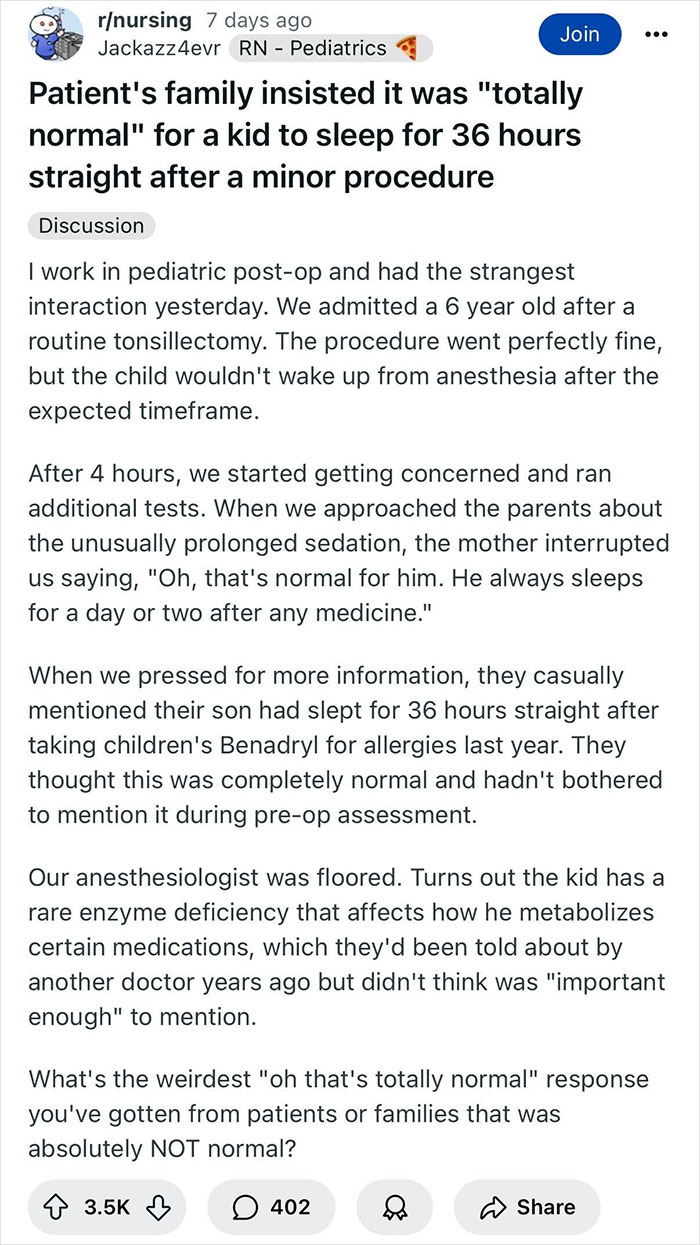
Sometimes what patients or their families consider "normal" can catch healthcare professionals completely off guard. Take the case of today's Original Poster (OP), whose patient's family believed their child's prolonged sleeping after being in anesthesia was normal, not knowing there was something deeper at play.
The OP then prompted netizens to share their most surprising experiences with patients insisting that unusual or alarming symptoms were perfectly normal. The stories range from shocking medical reactions to situations that left staff questioning how certain behaviors were ever considered ordinary. Together, they provide a fascinating look at the moments when "normal" is anything but.
More info: Reddit
This post may include affiliate links.
 Had a young lady brought in for new onset hallucinations while at a friend’s house and parents were *furious* that we wanted to admit her to the inpatient psychiatric unit. They said she’d just started menstruating and “that’s just what happens when girls hit puberty”. Our MD was quick to point out that hallucinations were not, in fact, a normal part of puberty…
Turns out, there was a family history of acute intermittent porphyria, which can in fact cause hallucinations with hormonal changes! So, in their family, hallucinations were a normal part of puberty!
 Had a heavy cycle patient tell me it was normal for her to be bed ridden for a week after her period and that all the women in her family were like that. When I asked about volume of menstrual cycle she said she’d never measured but that she wore adult diapers and changed them EVERY TWO HOURS.
 RN here- I was discussing morning care with an elderly patient and offered to get her a toothbrush and toothpaste. Sure thing. Then she very casually remarked that “even after all these years, she still hasn’t gotten used to the itchy numbness and moderate lips and tongue swelling that happens (and has been happening her whole life) whenever she brushes her teeth.”
I kinda thought she was being a little dramatic about the peppermint taste of the toothpaste until she straight up had angioedema before she even finished brushing. She had great dental hygiene though. It's [annoying] having to silently deal with something you don’t even know is a thing. We called her husband and sent him out to buy her some natural toothpaste and all was right again on the unit.

Wait, hold on. This is a thing? I can't stand normal toothpaste for the same reason. I thought it was the mint. I use Kingfisher Fennel toothpaste instead. I'm off to Google. I need more information.
PsychoTricks explains an interesting phenomenon called the "normalcy bias," where people tend to downplay or ignore potential dangers, assuming that things will continue as they always have or that nothing is serious as they pose to be. However, they explain that his mindset can make people dismiss warnings or delay action during crises.
They also highlight that bias typically unfolds in three stages, which are denial, deliberation, and eventual action, but by the time people reach the final phase, it’s often too late to respond effectively. Essentially, normalcy bias prevents people from recognizing the seriousness of a threat until the consequences are unavoidable.
 Someone complained of shoulder pain, but didnt mention anywhere on the paper work they LOST THEIR ARM and had it reattached in a farming accident 20 years ago. I saw the scar and that triggered additional questions from me that prompted him to mention this casually.
 My own : i played a bunch of sports growing up, but I was hot garbage at running distances. Most of my sports were short bursts (baseball, softball, football). I did basketball for a handful of seasons, but always felt like I was dying after 4 or 5 minutes. The only sustained activity I could do was swim team. I just assumed i was out of shape, which was b******t because I was absolutely not.
In my late 20s, I decided to start biking to work, and realized over an hour after sitting at my desk, I still couldn't take a deep breath without coughing, and I was hacking up multiple globs of mucus. Yeah, I have exercise-induced asthma. Hot+humid is best for my lungs, cold and dry is worst. So shoveling always made me want to die, but swimming in an indoor pool was absolutely fine. But now, I really am fat and out of shape lol.
 Mine was from my daughter. She thought it was normal to get dizzy and grey out for a few seconds when standing. After puberty, she started completely passing out and falling, and commented that it was weird because she usually just blacks out. Um... what?!? Once we started monitoring it, her BP was 50s/30s during some of her "normal" episodes when she didn't lose consciousness and just became dizzy with vision loss. She said she'd been doing that for several years.
In this context, we can then see that patients or their parents may sincerely view concerning symptoms as harmless, but this is due to psychological and perceptual factors. According to Positive Reset, this happens when ordinary bodily sensations or mild discomforts are misread as non-serious, especially if past experiences with similar symptoms didn’t lead to major issues.
They note that limited health knowledge can also reinforce this false sense of reassurance. Since the body frequently produces sensations that feel unpleasant but aren’t dangerous, people may grow accustomed to overlooking them, mistakenly assuming that every unusual feeling is just part of their "normal."
 Not quite the same, but we had a kiddo with really profound craniofacial abnormalities whose eyeballs would pop out of her sockets every time she sneezed. Mom was totally unfazed by this- would just wash her hands and pop em back in. Obviously mom knew it wasn't objectively normal, but it was amazing how it was very obviously this family's normal.

I can just picture the way that would be at school. "Helen's eyes fell out!" "That's normal for her, Suzy"
 I asked a patient if she had any urinary trouble during a postpartum visit. She replied, “Nope! I set alarms to make sure I pee before my bladder gets too full and I pee myself, but I know that happens after having a baby so it’s all good!”
I gently informed her that it was not all good and we discussed pelvic floor PT, which she was thrilled about!

this is why education about the body is crucial! in school and later in life as well!
 I slept for an additional 6hr after having what should have been an abbreviated outpatient procedure....When the nurses kept checking on me, all concerned, my husband just said, "Let her sleep. She works nights and takes care of our 3 kids when she's not working." God bless him. ❤️.

I hope that last bit is sarcasm because he's an absolute ÀSS making his wife take care of the kids after getting off from working all night
In fact, Stepcare emphasizes that downplaying symptoms as "normal" is a common thing in today's world, although not the best, as it can lead to delayed diagnosis and treatment. They further note commonly ignored symptoms like sudden confusion or personality changes, persistent fever lasting more than a week, unexplained bleeding or weight loss, and severe, sudden headaches.
They point out that other red flags, like frequent infections, slow healing, or noticeable changes in bowel or urinary habits, are often minimized as routine issues. And in the case of the OP, even rare conditions such as enzyme deficiencies affecting medication metabolism can go unnoticed when patients assume their reactions are typical.
 Not a patient experience, but from my wife. She has a severe nut allergy and was hospitalized a few times. When she had pine nuts on accident when she was a teen, she went mostly deaf and had tunnel vision and swelling throat as part of anaphylaxis. She was just talking to the EMTs like in a normal conversation. No panic, no nothing. Just trying to tell them what happened all calm-like but can’t hear or see or make intelligible sounds.
They were just floored that she was so calm.
How exactly waas she talking to the EMTs if she couldn't make intelligible sounds? "Hrrrrrk aaaaargh mrrrrggh ouuuuurgh "oh she's so calmly talking to us like in a normal conversation"?
 My dad would become psychotic and combative from etomodate. The second time it happened, an ER was trying to put his shoulder back into place. We tried to warn them and offered to stay as we could usually calm him, but they refused. It took five people to restrain him, and they ended up pulling his shoulder back out of place and destroying his rotator cuff in the process.
We mentioned to the hospitals in that system multiple times about the etomodate issue, but they would never note in his chart or on his allergy and reaction info. I was finally like “Well, if he beats the s**t out of you, don’t say we didn’t warn you.”.
 The amount of adult children who thought it perfectly acceptable their demented parents “take care of each other” with zero assistance was a good reason why I left the ER. Pretty sure one of my coworkers called APS on a case like that it was so bad.

Grandma was suffering from dementia. My dumb a$$ uncle (who went to and dropped out of nursing school) was left to care for her for 24 hours. He decided he could quickly run home (7 ish miles away) and take out his trash while she napped...after being told to absolutely NEVER leave her alone. I happened to stop by unannounced and found her unconscious, on the concrete patio behind her house. She fell coming outside to find him, hit her head on the ground, needed 7 staples...oh, and it was 103 outside. When the ambulance got her to the helicopter, her temp was 107. My uncle decided none of it was her fault because her "electrolytes were out of balance." Yeah- because she laid on 100+ degree pavement for 20 minutes before I found her. I thought she was dead. It was the single most terrifying moment of my life. My other uncle lived 1 mile down the road and had told him MULTIPLE times to call if he needed to leave.
Still, as in the case of the OP, some patients are aware of the conditions and may choose to withhold important health information from doctors for a variety of reasons. The Pharmaceutical Journal notes that common factors include fear of judgment, embarrassment, being lectured, as well as a desire to maintain autonomy over their care.
Some patients may also avoid sharing details because they distrust the doctor’s attitude, want additional tests first, or believe the information is irrelevant. However, these behaviors can complicate diagnosis and treatment, highlighting the importance of trust and open communication in healthcare.
 A mom slept for 2 days not feeling well. Family wasn’t worried until she wouldn’t wake up to any stimuli. Blood sugar 1734.
 Way too many people think bleeding through their b******e is normal. Sure, it could be hemorrhoids, but it could also be cancer. Check in with your doctor. .

I get regular checks now in Scotland, and last time they found some blood. Colonoscopies are not as horrible as people make it sound. It was actually fascinating. after all, that's not a part of you you get to see very often. Get it checked, especially if it's free where you live!
 I did health lodge check-in’s at Scout camp; we intentionally had everybody scheduled to go for swim tests right after they saw us so they were in bathing suits when they came in, but it was also so we could eyeball kids for signs of a***e without asking in front of everybody else in line. We had everybody’s health forms with H&P from their PCPs before they arrived.
So this Scoutmaster comes in with an obvious comparatively recent median sternotomy scar and chest tube scars. I blinked, said to myself, Hmmm, I didn’t see that on his health form, and looked again. Nope, not there. So I asked, “Did you have open heart surgery?”
“Oh yeah, I had an aortic valve replacement after I saw him.” On cardiac meds, etc., etc., also not on health form …
And you didn’t think to mention this as potentially significant at camp? Oy.

Know of something similar in that someone had been having severe chest pains for a while, family history of heart issues, but didn’t mention anything when she joined a local scouts group on a hike. Sure what happened? Halfway up, full blown heart attack. Lived due to the scouts having medically trained volunteers but like… don’t go on a hike if you’re having chest pains???
At the heart of these stories, what seems "normal" to one person may not necessarily be. These anecdotes aren’t just entertaining; they also highlight the importance of paying attention, asking questions, and understanding context when it comes to health and medicine.
Some patients and families shrug off unusual reactions, others underestimate risks, and some simply don’t realize the significance of what they’re describing. Reading through these experiences is a reminder that perspective matters, and that what one person calls normal can be eye-opening, shocking, or downright dangerous.
 I had a male patient tell me urinating once a day was normal for him. He would wake up every morning and urinate 3-3.5 liters then never pee again the rest of the day.

My ancient, weak 43-year-old-woman bladder just wept in bitter jealousy of this patient XD
 Student was referred to me for suspected substance a***e. Assessed them and noticed their eyes weren’t dilating. After further assessment determined the kid was just tired and their eyes legit don’t dilate. Weird.

"Jeff, your eyes look terrible." "Yeah, it's an allergy." "What are you allergic to?" "Weed." "What do you take for it?" "Weed." ~ Jeffrey Ross
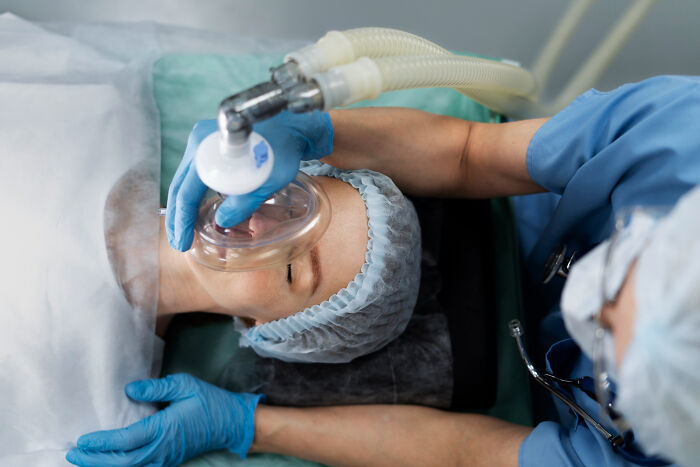 I'm the opposite problem but I always make sure I let everyone taking care of me know that whatever anesthesia you think is going to keep me out will probably only keep me out for about half or less of your planned time. I woke up during my gallbladder removal and my first colonoscopy, but only because they didn't really listen to me when I told them before the second one...
poor kid though, must be rough if everything knocks you out for a thousand times longer because your body can't process it quickly.
 I'm the opposite and wake up on the table. D**n red head gene. Tbf , I've forgotten to tell them that I have hemophilia.
Why has the medical profession not caught up on this yet? I have red hair and adhd and it takes a truckload….or a truck to knock me out. A bottle of vodka and I am cleaning the house from top to bottom. Give me a local anaesthetic and not lying when I say I can still feel it
 Nobody believes me when I say I have a paradoxical reaction to [allergy medication] and will turn into a toddler until I’m [bare] and ranting about the Power Rangers while constantly falling off the bed. That was my last allergic reaction, asked for my husband to come back because he can distract me enough until my facial swelling goes down. They brought him back eventually. I have almost no memory of this. And I have no idea why I always strip naked when I’m on [allergy medication] of any sort. I know it’s necessary for the allergic reaction but I’m also warning staff and it’s always dismissed until I blackout and start monologues about things I don’t care about (different color carrots, power rangers, MySpace, calluses, sun bears, etc.).
I remember that I was on a migraine preventative medication once that flipped my emotions 180 degrees suddenly after I'd been on it for a few weeks. I remember watching funny cat YouTube videos with my then-bf one day and some (probably orange) cat did something completely ludicrously hilarious, and I started crying. Bf was super concerned and I was like "no no what? it's hilarious! It's funny! I can't stop laughing!" because at first I didn't even realize I was *sobbing* and weeping tears. Few days later I was really sad and upset about something that had gone wrong with my dad's condition (he was still alive at that point) and I started laughing when trying to tell my bf about what my mom had said. At that point I went into panic and got even more upset and said "I can't stop laughing". We both freaked. Checked the medication's rare side effects list more carefully - yup, pseudobulbar affect was one of them XD
 I had chest pain with physical exertion that would stop when I rested. Weight lifting and other non-cardio workouts were fine but I couldn’t run for longer than 10 minutes without the chest pain returning and having a bit of a hard time catching my breath. I went to the emergency room a few times growing up with these complaints and they’d always do an EKG, angiogram, echo, and MRI. They said I had a mild heart murmur. At 22 I presented post cardiac arrest while riding my bike to work on campus. After rechecking they found that I had anomalous left coronary artery from the pulmonary artery. It’s a very rare birth defect, 1 in every 300,000 live births has it, only 1 in 10 survive past infancy if it’s caught before the infant goes into cardiac arrest.
this is where machine learning could be useful! Looks on all things and not excluding anything?
 I was similar as a kid. After general anesthesia I’d sleep for 12-24 hours. My parents would routinely warn medical staff, and it was one of the biggest things they told my husband when we married. It got worse the older I got, nearly 30 hours asleep at 18 after a minor ear procedure. I’m generally fairly sensitive to things such as [relaxing medication] and [anti-allergy medication]. I’d take 0.25 mg of [relaxing medication] and sleep for 20+ hours. Half a normal [anti-allergy medication] puts me out 12+.
LOL omg XD So in OP's original comment, "[relaxing medication]" is Xánáx and "[anti-allergy medication]" = Benádryl. Apparently we cannot even say the NAMES of medications any more.
 Had a pt who was post-op from a regular procedure. Her hand at the wrist looked like a Tetris piece. I asked her about it and she says, "Oh yeah. I went for a CT and had a tumble. It swelled up but I put some ice on it until the swelling went away. It doesn't really hurt anymore. Should I get an x ray?".
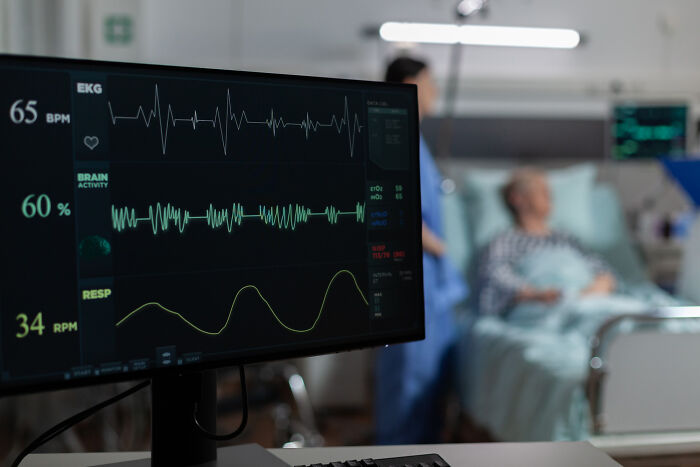 I recently had a patient with a hx of conversion disorder, unknown to our team. Patient is new to the state, transfer of medical record nonsense. Two days in a row, dayshift called a level one stroke alert on this patient because they went completely catatonic. BP was dropping, pacer was switching between A-paced and AV-paced (it was interrogated and nothing was wrong with it). CT and other workup was negative. The tele-health stroke neurologist wanted to ship the patient to get a full work up, ship the patient to a tertiary facility for a pacemaker safe MRI and continuous EEG. When dayshift contacted the son, he was PIIIIISSED. He said “We aren’t doing this again. Just send her over to ~facility 45 min away~. She’s been there a few times this month and they said she just plays dead for a while when she’s sick.” She did in fact “wake up” 2 hours into my shift requesting a carton of milk and said “oh man, it happened twice in two days. That probably scared you guys.”.
 RT here.
I had a patient once tell me they have a CPAP but don't use it. I asked why, and they said that it gives a copper/metallic taste, as if there's something wrong with the CPAP.
I pondered this for a moment until I asked if they're on well water. They were. They were using tap water to fill the humidifier.
I’m an ER RN now but when I was a firefighter paramedic we had a family drive up to the fire station in a panic. Their 12yo daughter was unconscious and unresponsive. Breathing 4-6x/min, pinpoint pupils. She’d had surgery that morning at a children’s hospital for wisdom teeth and was discharged alert/normal. Apparently she hadn’t metabolized the anesthesia fully and the reversal wore off first. We had to give her 8mg of [medicine] to bring her around, but she ended up admitted on a [medicine] drip for a couple days before being released!! I still have a newspaper article about it here somewhere. Wild stuff.
 My husband was recently admitted with sepsis. He fought me about even going in. At one point in the ED I mentioned that I was concerned about his rapid respiratory rate and he said he just needed to tell himself to slow his breathing. 😒.
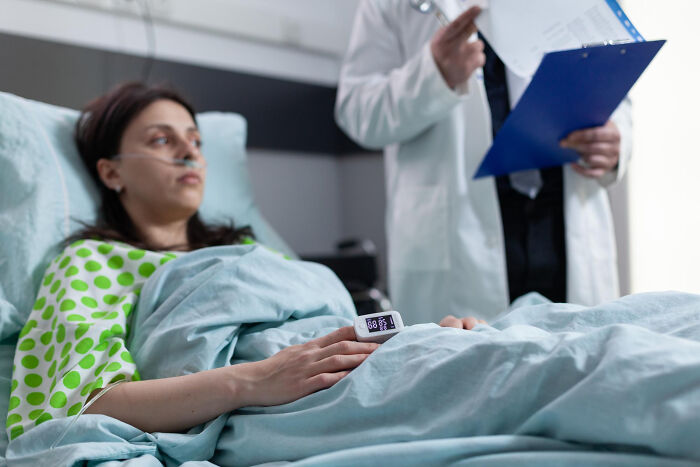 We had a patient in the ICU that was unresponsive, ended up on a ventilator and remained unresponsive. They were trying to figure out what was causing her condition. Her husband would come in with their two small children and just stand there with a flat affect, no emotion whatsoever at the end of the bed. The second day she was there the nurse said to him that it might be best for their kids if they weren’t there seeing their mother like that. His reply was “they’ve seen her worse than this.” Huh? Worse? The interactions with him were very strange.
 I work in an ambulatory center and had a family tell me their 6 year old spikes a 102-103F fever at least once or twice a day for no known reason, he had full work ups with specialists and they still couldn’t find out why so they were hoping having his tonsils out would help. We had to cancel him bc how would we know if he was randomly spiking a temp or if it was MH…I felt bad but that was absolutely something that needed to be done in hospital setting.
 It takes me 30 hours to metabolize 20mg of [sinus decongestant]. I mention this to the anesthesiologist as a warning that I may process stuff weirdly.
 Peds PACU here…parents lie on purpose or omit things because of low IQ levels all the time. Illnesses, autism, allergies, etc. haven’t heard this one though!
Also, some anesthesia consults are so quick they would never ask this many questions to get to the bottom of something like this.
Wow, that’s wild. I’ve gotten “oh, my arm’s always numb” or “I bruise easily, it’s fine” before but 36 hours sleeping post-anesthesia? No, not fine. Thanks for sharing this it’s a good reminder to dig deeper when families say “this is normal.”.

What's wrong with I bruise easily? I will be covered in bruises to the point that people will ask if I've been in some kind of crash, unless I eat dark green leafy veg like rocket frequently...and sometimes I don't, so I'd say I bruise easily, but what difference does it make?
I've had pretty bad migraines my whole life, but 15ish(?) years ago, they got REALLY bad. I literally had 20+ migraine days a month. Had to be in a dark room with no sounds and I could barely even stand clothing touching my skin. I also had visual aura and would smell phantom smells. The pain was atrocious; it filled my entire existence when I had a migraine and I could barely even think coherently. When I finally saw a neurologist about it (convinced, of course, that I had a brain tumor, lol) he was like "HOW MANY migraine days do you have a month??? omg" XD I had just dealt with the pain and lived with it. (Turns out I actually DO have a pituitary tumor, ironically, but it's small XD and definitely not what causes my migraines.)

OMG, that's terrible! I also suffer from migraines, but not as bad as you. I have a slight headache maybe 10days per month, but only one laying-in-the-dark-hoping-to-die migraine maybe every other month. And the throwing up kind of intensity every five years, or so. Did you find a treatment that works for you?
Load More Replies...
These were interesting. I'll add mine: my spouse has a track record of having the most rare side effects from medication regardless of what it is. Half of 1 percent of people have some odd side effect, guaranteed they will be in that group. Too bad those inverted odds don't work on lotto tickets right?

Same. A few years ago I was on a medication that had been on the market for decades, and now it has a new side effect warning. The company actually held a meeting about it (known possible side effect was tanking white blood cell production, for me, it tanked my red blood cell production and I ended up needing 12 units of blood in the first 90 days). This was a medication meant to deal with the iron overload that occurs in pts who need regular blood transfusions. I always warn medical staff that if there is some rare side effect, I will most likely be in that group. I say I hit the genetic jackpot, if only it also applied to the lottery as you said!
Load More Replies...
My mom ignored and down played increasing issues with her digestion for years. I kept pestering her to tell her doctor and that eating shouldn't make her so unwell. She eventually got really sick and they found stage 3 colon cancer after her appendix became infected and septic. She survived and has recently past the 5 year cancer free mark but it was a close call and it's made everyone in our family more paranoid about our health.
I've had pretty bad migraines my whole life, but 15ish(?) years ago, they got REALLY bad. I literally had 20+ migraine days a month. Had to be in a dark room with no sounds and I could barely even stand clothing touching my skin. I also had visual aura and would smell phantom smells. The pain was atrocious; it filled my entire existence when I had a migraine and I could barely even think coherently. When I finally saw a neurologist about it (convinced, of course, that I had a brain tumor, lol) he was like "HOW MANY migraine days do you have a month??? omg" XD I had just dealt with the pain and lived with it. (Turns out I actually DO have a pituitary tumor, ironically, but it's small XD and definitely not what causes my migraines.)
OMG, that's terrible! I also suffer from migraines, but not as bad as you. I have a slight headache maybe 10days per month, but only one laying-in-the-dark-hoping-to-die migraine maybe every other month. And the throwing up kind of intensity every five years, or so. Did you find a treatment that works for you?
Load More Replies... These were interesting. I'll add mine: my spouse has a track record of having the most rare side effects from medication regardless of what it is. Half of 1 percent of people have some odd side effect, guaranteed they will be in that group. Too bad those inverted odds don't work on lotto tickets right?
Same. A few years ago I was on a medication that had been on the market for decades, and now it has a new side effect warning. The company actually held a meeting about it (known possible side effect was tanking white blood cell production, for me, it tanked my red blood cell production and I ended up needing 12 units of blood in the first 90 days). This was a medication meant to deal with the iron overload that occurs in pts who need regular blood transfusions. I always warn medical staff that if there is some rare side effect, I will most likely be in that group. I say I hit the genetic jackpot, if only it also applied to the lottery as you said!
Load More Replies... My mom ignored and down played increasing issues with her digestion for years. I kept pestering her to tell her doctor and that eating shouldn't make her so unwell. She eventually got really sick and they found stage 3 colon cancer after her appendix became infected and septic. She survived and has recently past the 5 year cancer free mark but it was a close call and it's made everyone in our family more paranoid about our health.

































 No fees, cancel anytime
 then open in external browser


 and click "Open in External Browser"