Get Premium
Dark mode theme is available exclusively for premium users. Learn more about the benefits of subscribing.
No fees, cancel anytime.

 Dark Mode Ad-Free Browsing Unlimited Content
 Ad-Free Browsing Unlimited Content Dark Mode
Join 1.2 million Panda readers who get the best art, memes, and fun stories every week!
Christmas is one of the coziest and warmest holidays of the year. Families come together, gifts are passed around, the table is full of comforting food, and the festive atmosphere brings it all together. It’s no wonder so many people look forward to it.
But that kind of celebration doesn’t come together on its own. Making Christmas feel special usually takes effort from everyone involved, and over the years, one woman has grown increasingly frustrated with her father-in-law’s refusal to contribute anything at all. He doesn’t help with cooking or picking out presents, yet never misses a chance to criticize what he doesn’t like.
Tired of his entitled behavior, she took to the internet to vent and ask whether anyone else deals with a male relative like this. Read the full story below.
Image credits: Michael T (not the actual photo)
Image credits: Getty Images (not the actual photo)
Image source: GooseyGandalf
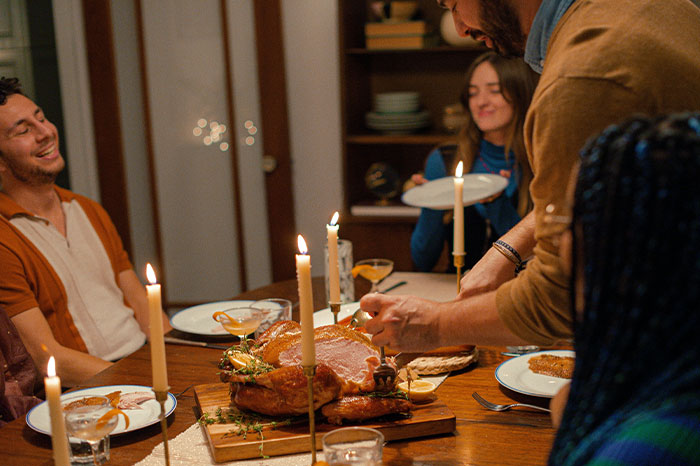
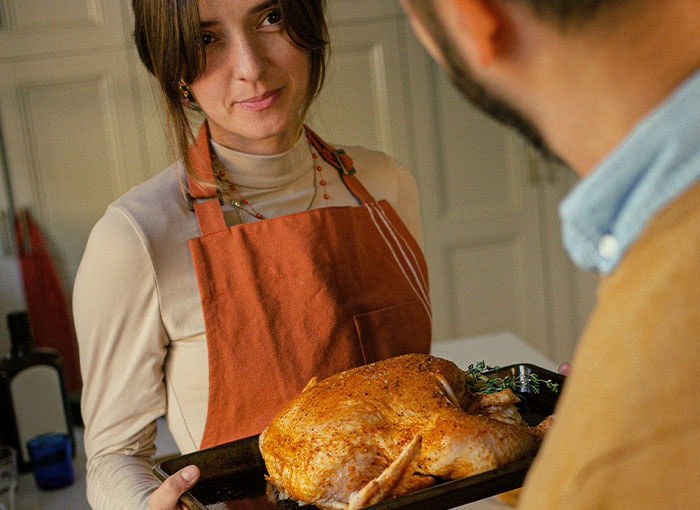
Image credits: SJ Objio (not the actual photo)
Your mom is racing around the kitchen, checking the turkey in the oven, boiling the potatoes, and mixing the salad all at once. The night before, she wrapped presents for the entire family. Your sister is helping clean the house, while your aunt keeps an eye on the younger kids. Meanwhile, your dad, grandad, and uncles are likely parked in front of the TV, waiting for Christmas dinner to be served.
Despite society being less rigidly patriarchal than it once was, scenes like this are still common in many households during the holidays. Most people have seen it happen at least once, if not in their own family, then at someone else’s. Even if the men in your household pitch in equally, chances are you’ve witnessed this imbalance play out somewhere along the way.
And research suggests it’s far from rare. According to a study by Starling Bank reported by GoodtoKnow, men typically handle just 4 out of 23 Christmas-related tasks. These tend to include carving the turkey, getting rid of the tree after the holidays, washing up after Christmas dinner, and untangling fairy lights.
The rest—buying and wrapping presents, planning meals, shopping for ingredients, cooking, attending nativity plays, laying out snacks for Santa, and keeping everything running—often falls on women’s shoulders. With that in mind, it’s easy to see why the woman in the story above feels so frustrated watching her father-in-law contribute nothing while still finding faults. Her irritation is both relatable and understandable.
It’s also no surprise that this uneven division of holiday labor can strain relationships. Nearly one in five people who handle most of the Christmas workload say they feel taken for granted. That number rises to 22% for women, compared to 12% for men. Women are also twice as likely to feel exhausted once the festive season ends and twice as likely to feel like they’re nagging.
Image credits: Michael T (not the actual photo)
You’d think numbers like these would have sparked more honest conversations during family gatherings by now. But in reality, few people want to rock the boat during Christmas, the time when everyone is supposed to feel closest. Still, experts say there are ways to handle difficult relatives while also keeping your own stress in check.
One starting point is examining our expectations. Therapist Joel D. Walton, M.A., LMFT, has written about how heavily loaded the holidays can be with unspoken assumptions. We expect to give the perfect gift and receive a thoughtful one in return, attend every family event, and cook a Martha Stewart–worthy meal that everyone loves, all while smiling like we’re in a Coca-Cola commercial.
But, as Walton puts it: “Rather than getting what we expected, we instead get Uncle Frank showing up late, your mother-in-law criticizing your mediocre decorations, your cousin bringing up politics at a divided table, and oh yeah, a dry turkey.” And in this case, a father-in-law who does nothing while nitpicking everything.
When those expectations aren’t met, frustration and resentment can build before you even realize it. That’s why adjusting them can help. Christmas will never be perfect, and there will almost always be something or someone that gets under your skin. Remembering that can make it easier to let small things go when they don’t go as planned.
At the same time, it’s worth looking at what’s actually fueling that anger and whether anything can be changed. In this story, the woman is upset that she and others shoulder most of the responsibility. But in reality, not everything has to fall on the same people. Families can try redistributing tasks or setting clearer expectations around who does what.
Alongside that, it can be helpful to actively look for positives to balance out the stressful moments. “Intentionally create little pockets of bliss throughout your day,” Walton suggests. “Maybe it’s a quiet moment to sit and enjoy the winter scenery or perhaps it’s enjoying a warm, baked goodie. Maybe your little moment of joy is grabbing a few minutes on the couch with a loved one. As your expectations are hijacked, create your own positives.”
Dr. Marny Lishman, writing for Body+Soul, also recommends identifying your triggers ahead of time. Knowing what tends to set you off makes it easier to manage your reaction when it happens. Having a plan—taking a short walk, stepping away from the table, or chatting with another relative—can keep stress from spiraling. And taking that time is okay.
At the end of the day, setting boundaries is always an option. You can be firm yet polite about what behavior you will and won’t tolerate in your own home. In this case, if comments about food or dismissive reactions to gifts are upsetting, that can be communicated. Ignoring the issue may keep the peace in the moment, but over time, it rarely solves anything and often only makes the frustration grow.

By entering your email and clicking Subscribe, you're agreeing to let us send you customized marketing messages about us and our advertising partners. You are also agreeing to our Privacy Policy.
Thank you! You've successfully subscribed to newsletters!

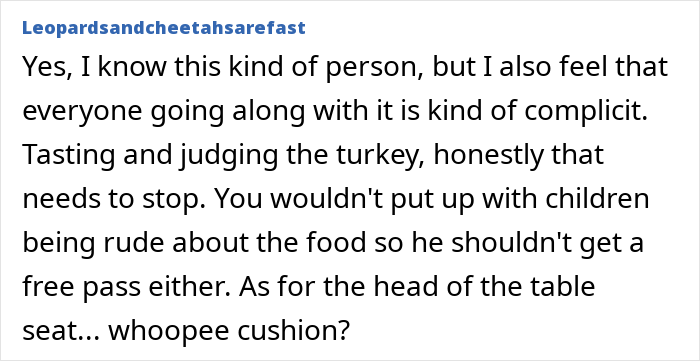
Carve the turkey before bringing it to the table. Have everyone sit first, then set the carved bird as far away from FIL as possible.

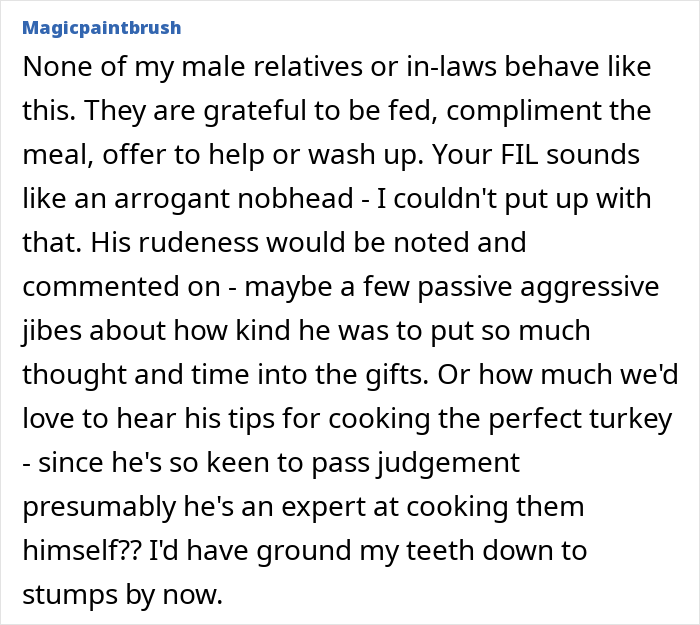
My dad was a sh!t gift receiver. Nothing was ever quite right. One year I told him he could make a choice. He could be nice and appreciative of the gifts he got or we would stop buying him gifts. He chose gifts. It was the right choice.

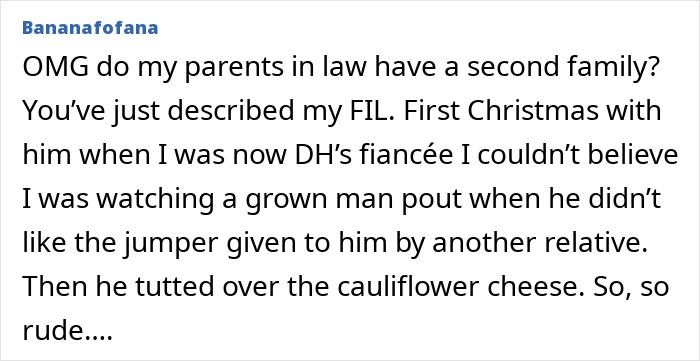
I was on the verge of turning into a sh!t gift receiver ("Oh, wow, a well-thumbed copy of The Da Vinci Code!"). I now tell people to donate money in my name. The local monkey sanctuary needs the money more than I need to wipe my b#tt with bad writing.
Load More Replies...
Time to stop enabling him. Put the turkey in front of your husband. Serve FIL last.

Or if he wants to be traditional, go all the way. Ladies first, then children!
Load More Replies... Carve the turkey before bringing it to the table. Have everyone sit first, then set the carved bird as far away from FIL as possible.
My dad was a sh!t gift receiver. Nothing was ever quite right. One year I told him he could make a choice. He could be nice and appreciative of the gifts he got or we would stop buying him gifts. He chose gifts. It was the right choice.
I was on the verge of turning into a sh!t gift receiver ("Oh, wow, a well-thumbed copy of The Da Vinci Code!"). I now tell people to donate money in my name. The local monkey sanctuary needs the money more than I need to wipe my b#tt with bad writing.
Load More Replies... Time to stop enabling him. Put the turkey in front of your husband. Serve FIL last.
Or if he wants to be traditional, go all the way. Ladies first, then children!
Load More Replies...

































 No fees, cancel anytime






















17
30