Get Premium
Dark mode theme is available exclusively for premium users. Learn more about the benefits of subscribing.
No fees, cancel anytime.

 Dark Mode Ad-Free Browsing Unlimited Content
 Ad-Free Browsing Unlimited Content Dark Mode
Join 1.2 million Panda readers who get the best art, memes, and fun stories every week!
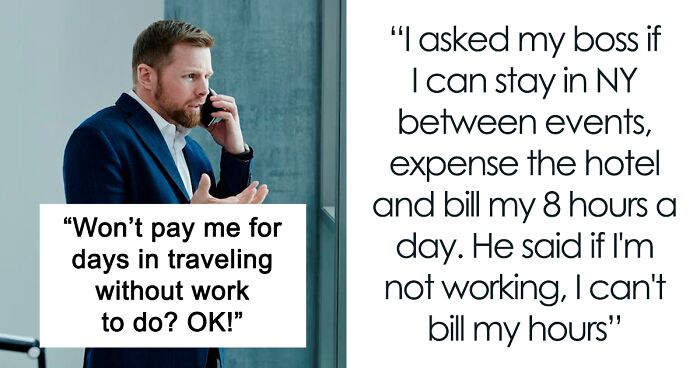
Good evening, ladies and gentlemen, this is your captain speaking. Welcome aboard ‘Malicious Compliance.’ Today, we’re heading into the land of willingly following orders that you know are leading to some pretty unfortunate consequences, with a very real chance of sighs and chuckles along the way. So buckle up!
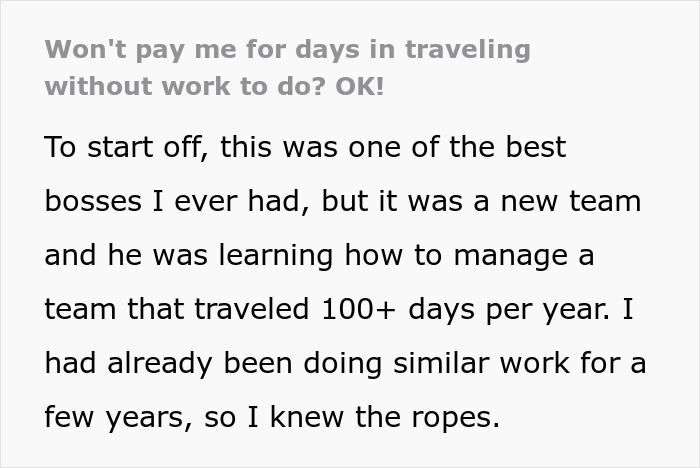
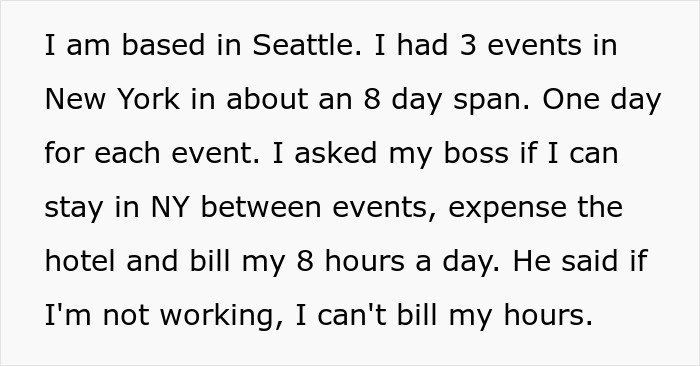
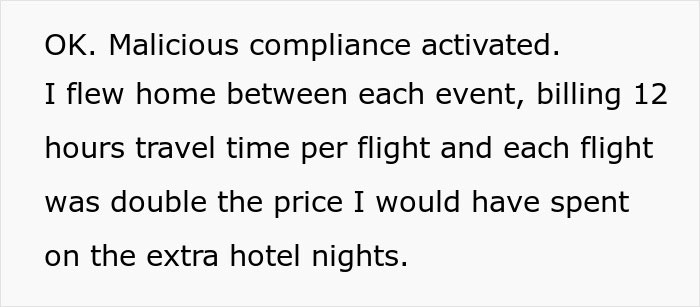
Our protagonist is Reddit user Djskaw. They needed to attend three work events in New York City in just eight days, so naturally, they asked their boss for a hotel room. However, instead of booking his worker accommodation, he made them fly for each meeting.
Now, you might be thinking, “Hey, at least they got to visit the city that never sleeps!” But let’s be real, during such a hectic back-and-forth, I’m guessing the only thing they wanted to do was sleep.
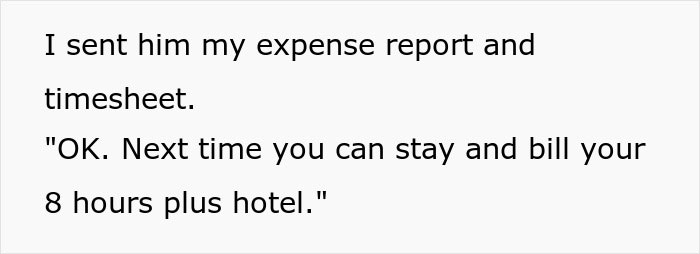
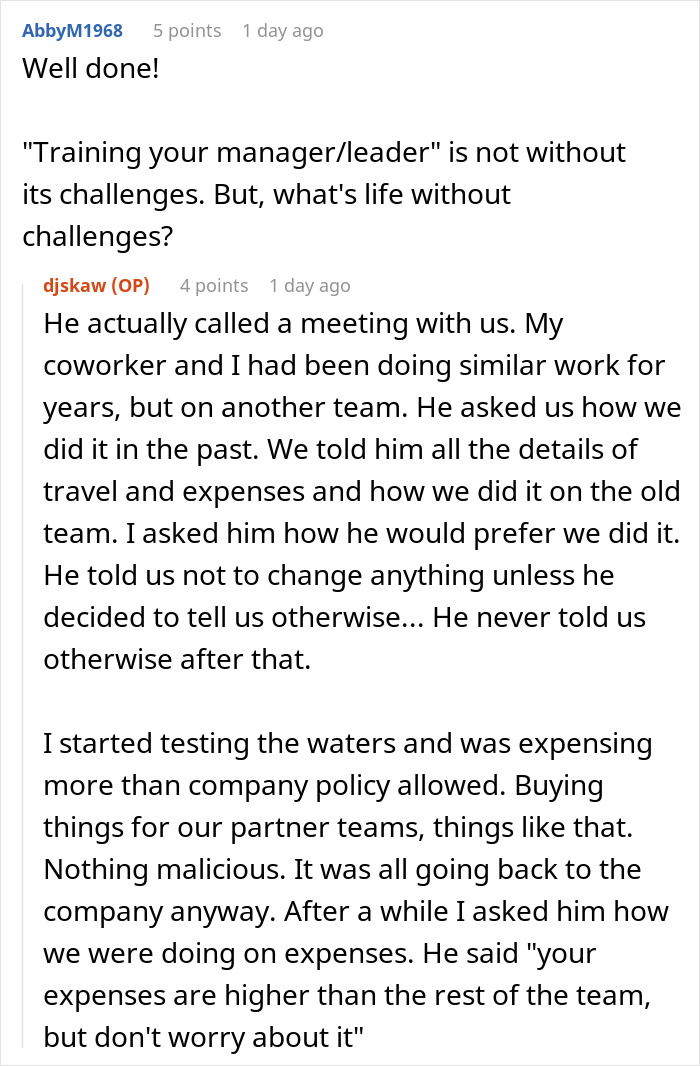
However, it’s not all bad news. Djskaw was able to put together quite an impressive expense list, which ultimately convinced their superior to change his strategy for the future.
Image credits: Tiger Lily (not the atcual photo)
Image credits: Mariya Oliynyk (not the atcual photo)
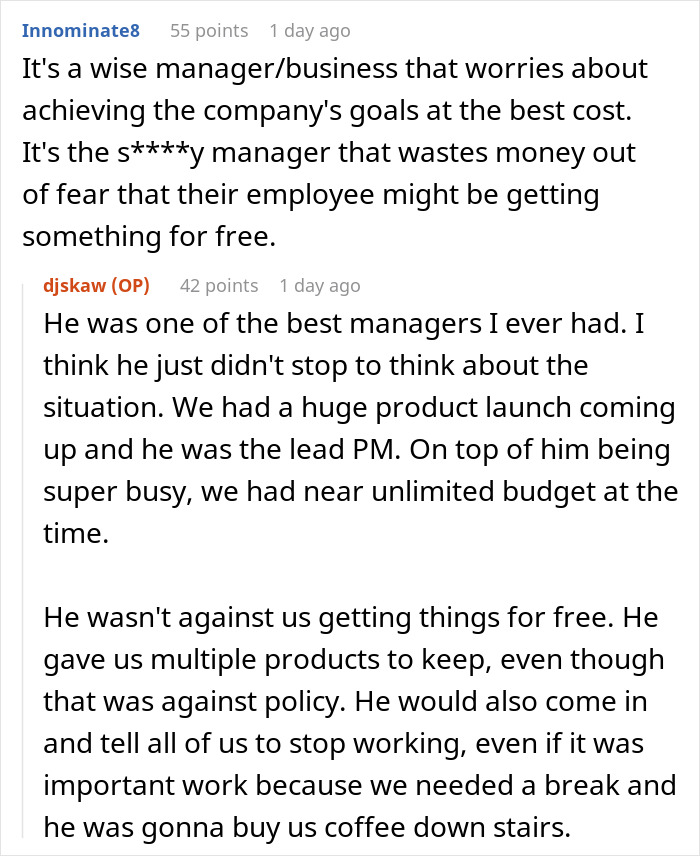
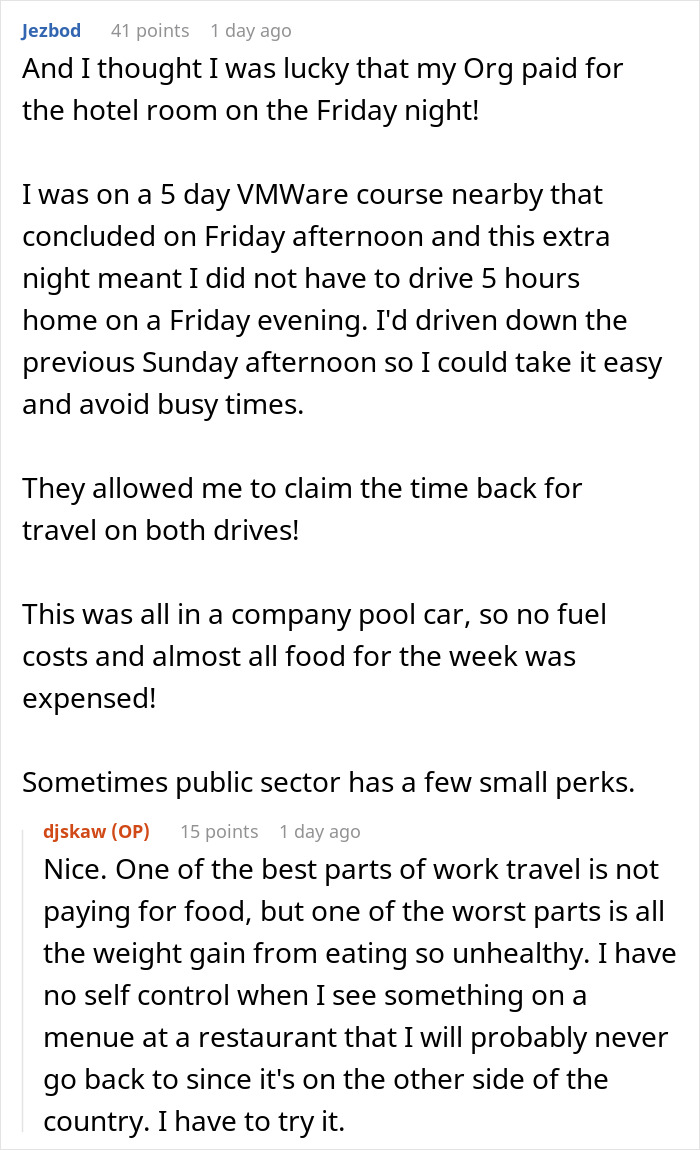
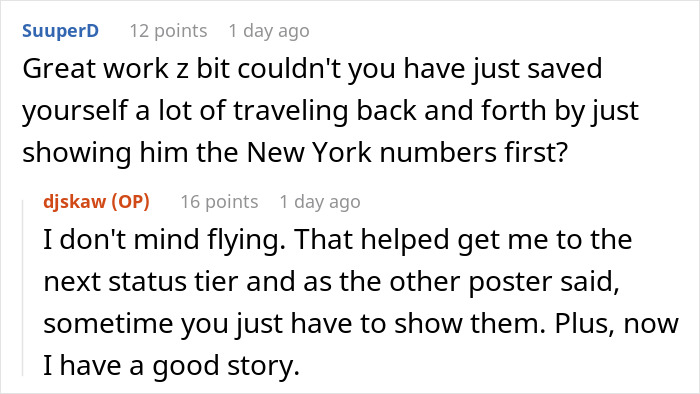
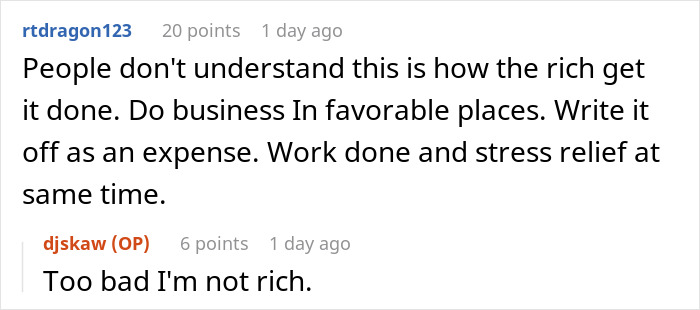
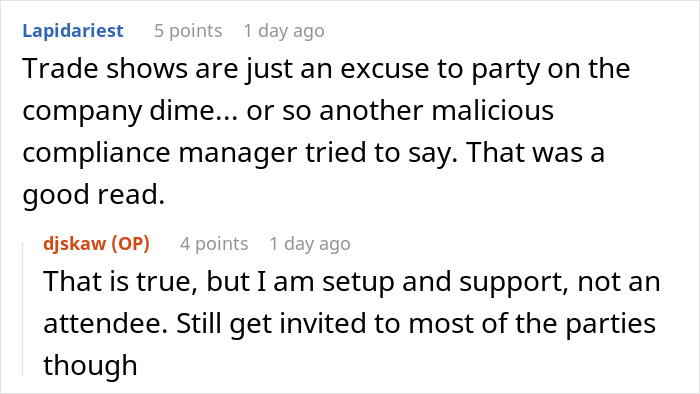
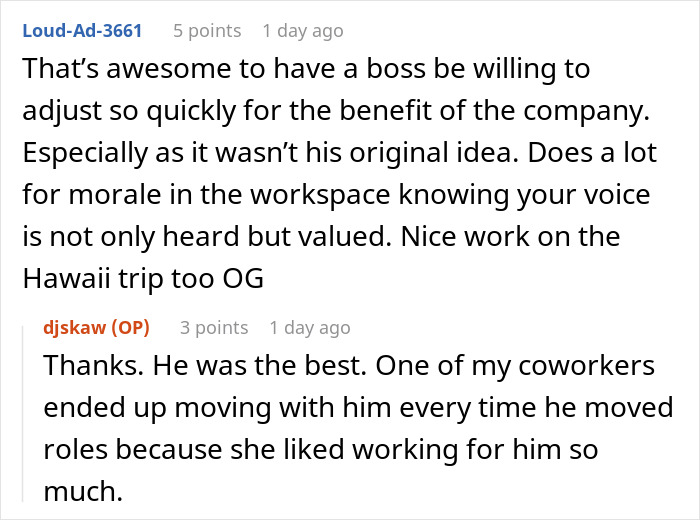
Image credits: djskaw
Airlines (and hotels) rely heavily on people like Djskaw.
While business trips currently account for roughly 13.6% of total US air travel, they make up to 75% of airlines’ profits. It makes sense; instead of saving money, more and more companies are looking to provide their employees with maximum comfort and convenience. Doing so makes them look better, and these decisions are often made due to competition.
The average business trip costs Americans $949 in travel fees and ME&I travel (meetings, events, and incentives) amounts to $139.3 billion or 42% of the whole industry.
In 2016 alone, business travel contributed $547 billion to the American economy. That’s around 3% of the country’s total GDP, a number which stayed rather stable until 2020 when the pandemic crushed the sector.
(In reality, these high numbers might never return, as experts predict roughly a third less business travel post-covid.)
Statistically speaking, Djskaw’s boss’s decision to not book them a hotel made sense. It just didn’t fit this particular situation.
You might be surprised to learn that airfare isn’t the most expensive part of business travel, making up around a quarter (17-27%) of a typical company’s travel budget. The priciest part is lodging, which sums up to around a third (34%). Hotels make a lot of money from busy business travelers and their employers who sponsor everything, as up to four-in-ten of their guests are staying there for work.
However, if airlines are to avoid repeats of recent service problems, they’ll need to have a lot more backup in place.
“You can’t run an airline like it’s 2019, and the reason is because the system is just stressed to the max,” United CEO Scott Kirby told CNN. “There’s strains everywhere, whether it’s in security or FAA staffing or systems. Across the board there are strains in the system, aircraft manufacturers delivering, having enough pilots and all of those stresses and strains means that the system is tighter.”
“And when something happens, the straws are much more likely to break the camel’s back. And you’ve seen it over and over again,” he added. “It just doesn’t take much to break the back of the system.”
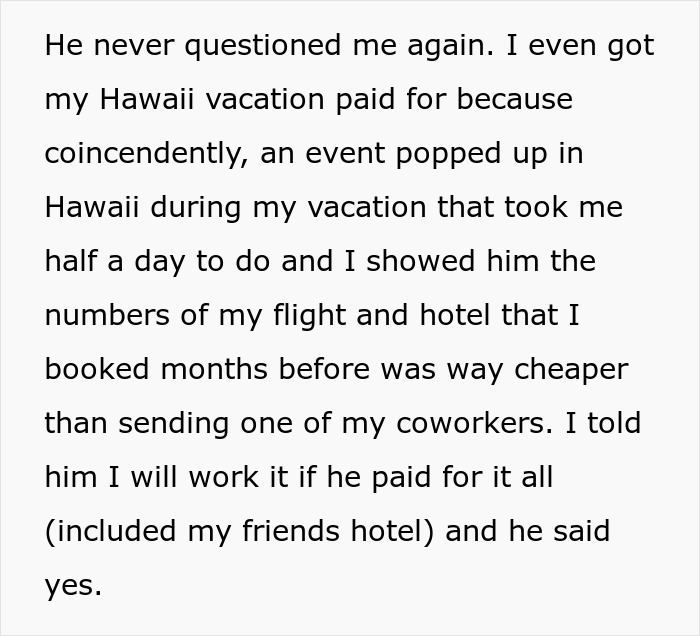
So maybe it’s a good thing that Djskaw’s superior is now willing to splash some extra bucks on his worker’s hotel.

One of the best ways to do this is to provide the boss/accounts with two different proposals. The first would be travelling to NY, billing for the time there, plus travel, and multiply it by three for the three events. The second is to work out the one return flight, the hotel costs, and 8 hours a day. When the second option comes out significantly cheaper most places will say to take the second option. Show them how to save money, and they'll take it.

Sadly some employers go to great lengths to NOT pay anything that helps their employees and sometimes go to ridiculous amounts to make sure they don't pay even a minute that couldn't be considered working. I live in Germany. German labour laws are quite strict. Still one boss tried to call me in the evenings or on my days off for questions or to ask me to log in for a few hours, trying to make me just log the exact time spent working. But HR put a stop to it very quickly because that's very much verboten. Calling me on my day off counts as a full workday and violates my contract and labour law that say I have to get at least 1 day off per week. Also the law clearly states there must be 12 hours between shifts, if she called me at 8pm and my shift started at 6 am, then this was against the law. Also your employer cannot demand you to accept calls or work spontaneously if you're not on call. So they would have to pay me on call rates, and it would have to be added to my contract.
Load More Replies...
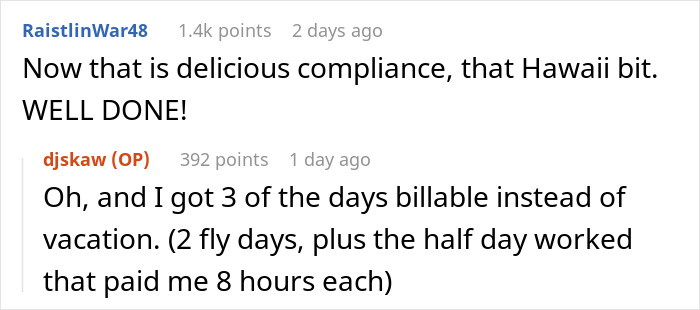
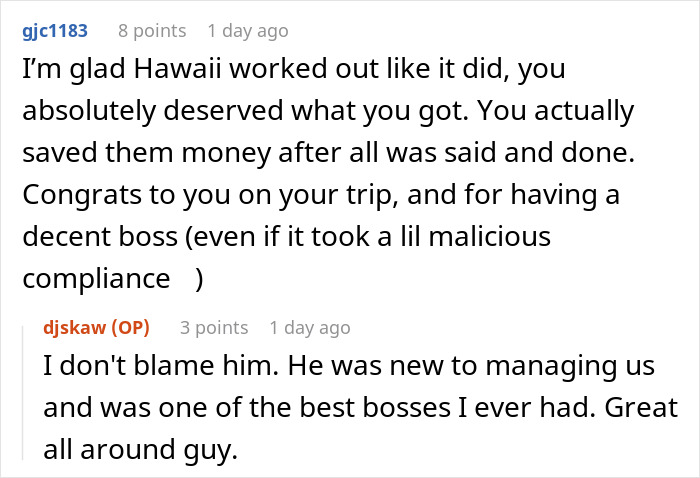
This was only a misunderstanding, not a problem. What surprised me most was how reasonable the boss was once he saw the evidence and how quickly he made the change. His agreeing to send the employee to Hawaii was another plus. Sounds like a great boss.

I agree. Subconsciously though, I'm still waiting for the malicious compliance from the employer to the employee lol
Load More Replies...
This is the best BP article I have read. The authors gave interesting stats instead of repeating exactly what the posts say. Bravo
One of the best ways to do this is to provide the boss/accounts with two different proposals. The first would be travelling to NY, billing for the time there, plus travel, and multiply it by three for the three events. The second is to work out the one return flight, the hotel costs, and 8 hours a day. When the second option comes out significantly cheaper most places will say to take the second option. Show them how to save money, and they'll take it.
Sadly some employers go to great lengths to NOT pay anything that helps their employees and sometimes go to ridiculous amounts to make sure they don't pay even a minute that couldn't be considered working. I live in Germany. German labour laws are quite strict. Still one boss tried to call me in the evenings or on my days off for questions or to ask me to log in for a few hours, trying to make me just log the exact time spent working. But HR put a stop to it very quickly because that's very much verboten. Calling me on my day off counts as a full workday and violates my contract and labour law that say I have to get at least 1 day off per week. Also the law clearly states there must be 12 hours between shifts, if she called me at 8pm and my shift started at 6 am, then this was against the law. Also your employer cannot demand you to accept calls or work spontaneously if you're not on call. So they would have to pay me on call rates, and it would have to be added to my contract.
Load More Replies... This was only a misunderstanding, not a problem. What surprised me most was how reasonable the boss was once he saw the evidence and how quickly he made the change. His agreeing to send the employee to Hawaii was another plus. Sounds like a great boss.
I agree. Subconsciously though, I'm still waiting for the malicious compliance from the employer to the employee lol
Load More Replies... This is the best BP article I have read. The authors gave interesting stats instead of repeating exactly what the posts say. Bravo

























 No fees, cancel anytime







71
21