Get Premium
Dark mode theme is available exclusively for premium users. Learn more about the benefits of subscribing.
No fees, cancel anytime.

 Dark Mode Ad-Free Browsing Unlimited Content
 Ad-Free Browsing Unlimited Content Dark Mode
Join 1.2 million Panda readers who get the best art, memes, and fun stories every week!

Punctuality is important at work—most of us know this. However, sometimes unforeseen circumstances happen, and we’re forced to be late against our best wishes. A supportive manager should understand this and be flexible, especially if it’s not a frequent occurrence.
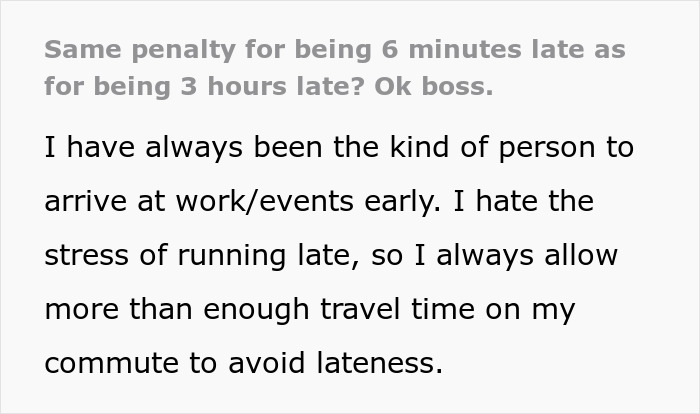
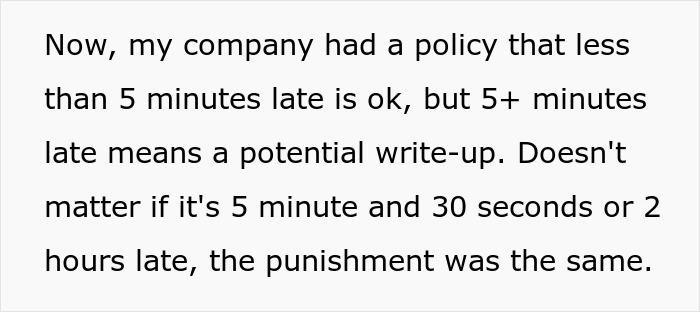
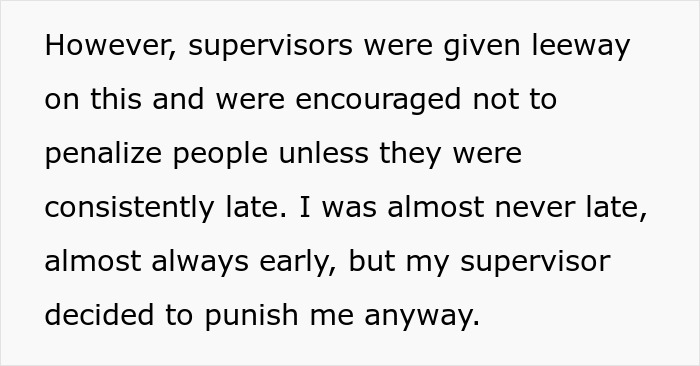
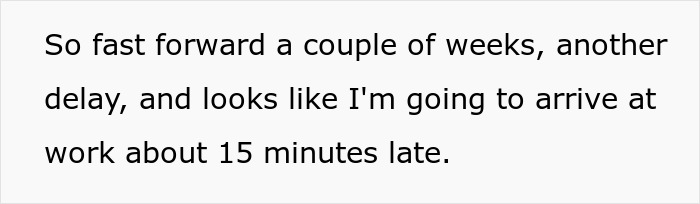
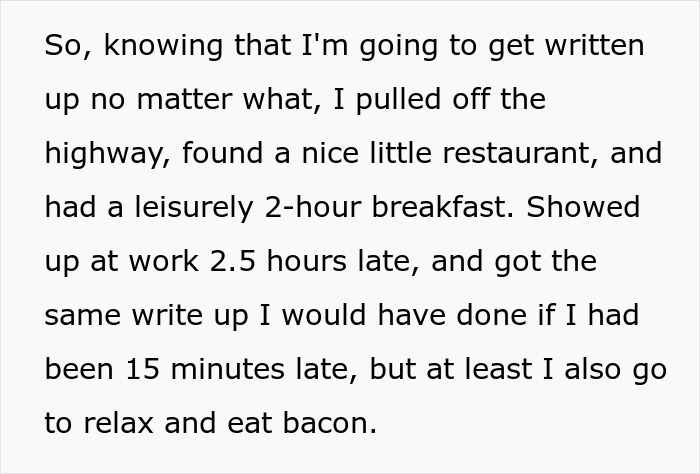
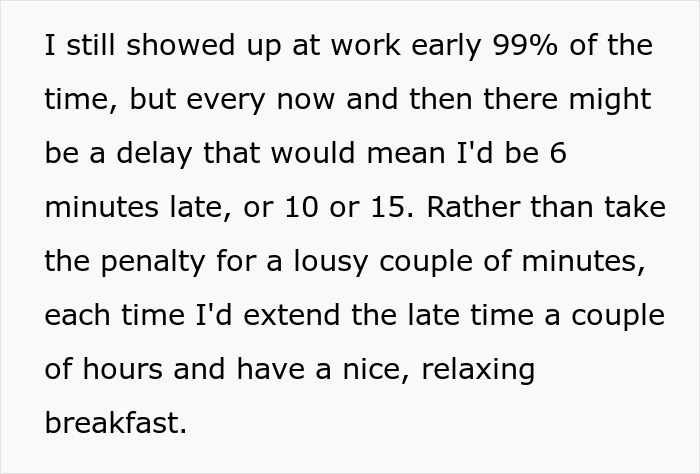
However, not all bosses are like this. For example, this employee’s supervisor wrote him up for being 6 minutes late for something that was entirely out of the worker’s control. Granted, he was following the company’s policy, but the employee decided to start mischievously complying every time he saw he was going to be late.
Scroll down to find the full story and a conversation with Jeanniey Walden, business and marketing expert and CEO of Liftoff Enterprises, who kindly agreed to share her insights on tardiness.
Image credits: pointstudio/Envato (not the actual photo)
Image credits: LightFieldStudios/Envato (not the actual photo)
Image credits: Icy-Computer-Poop
Image credits: Getty Images/Unsplash (not the actual photo)
According to the U.S. Bureau of Labor Statistics, an estimated 20% of workers are late to work on a regular basis, which costs businesses around $3 billion each year in America alone. The top three reasons why employees couldn’t make it on time were traffic, personal problems, and oversleeping—all totally understandable. Other common causes for tardiness include health issues, family-related problems, searching for a lost item, and home-related issues.
Interestingly enough, Gen Z is the most likely of all age groups to be late for work, while a whopping 70% of boomers said they have zero tolerance for any level of tardiness. Baby boomer bosses are also intolerant of being late, even when it’s just a minute, because they believe that if a person arrives after an agreed time, then it means they’re late.
In general, the youngest generation is quite laid-back when it comes to showing up at work, as they believe being 10 minutes late is still right on time. This might be because they tend to value their work-life balance more.
“Gen Z is more likely than other generations to value and prioritize work-life balance and mental health above workplace stresses—and that includes rushing around to be on time for a meeting,” Meeting Canary’s founder, Laura van Beers, told Fortune.
“Where working from home has blurred the lines in what good meeting etiquette is for the younger generations, older office workers still have a more established, traditional view,” she explains.
Image credits: Tim van der Kuip/Unsplash (not the actual photo)
If it’s not common, arriving a few minutes late appears to be harmless. “If there are fair reasons for being late and it’s not impacting others, we can relax the expectations… [but] it’s when we’re burdening someone else that causes the most concern,” Monster career expert Vicki Salemi told Fortune.
“The top excuses of being late to work are mainly the ones that people don’t have control over,” said WorkYard CEO and co-founder Nic De Bonis. “As an employer, you probably can’t tell anything when your employee is late to work because of a family issue or traffic.”
“Life happens,” agrees Jeanniey Walden, business and marketing expert and CEO of Liftoff Enterprises. “Traffic, toddlers, tech meltdowns, and more. They don’t RSVP. If you’re consistently rolling in ten minutes late with a latte but no remorse? That’s not cute. It’s disrespectful. But if you’re someone who shows up with energy, gets results, and occasionally has a “my children’s school line was long” moment? That’s human. And good leaders know the difference.”
That’s why Walden believes that different instances of lateness should be treated differently. “Six minutes late because your kid’s school drop-off line was a NASCAR pit stop? Not the same as rolling in three hours late with zero communication and a sunburn from “working remotely.” Policies should have structure and sense. Think: guideline, not guillotine. Treating every case equally when the context isn’t equal breeds resentment, not results. There’s a difference between being fair and being robotic. Be human. Be consistent. But also, be real,” she advises.
Walden suggests that brief, occasional tardiness should be handled with the AIR strategy:
Walden says that overly rigid workplace tardiness policies are a recipe for disaster. “It breeds anxiety, resentment, and poor customer service at work. Overly strict policies say, “We care more about your minutes than your magic.” That breeds fear. Fear breeds disengagement. Disengagement kills momentum. You want a team that brings their best, not one that’s terrified of a time clock. Flexibility within bounds fuels performance. Trust your people and they’ll give you more than minutes, they’ll give you mastery.”
That said, extreme and frequent tardiness is unacceptable, as it can show that the employee doesn’t take their job seriously enough and can cost businesses a pretty penny. “It may not seem like a critical issue when employees run slightly late but over time it all adds up and can have serious repercussions for the business, the employee and other team members left to cover for their colleagues,” said Ashik Ahmed, Deputy’s co-founder and CEO.
But even if an employee is chronically late, their manager shouldn’t start addressing the issue by imposing consequences. First, they have to talk with the worker and figure out the reason why they’re late. Perhaps they have some personal issues going on behind the scenes, and they need a different kind of support than they’re getting.
If the cause for being late is poor time management, it’s reason enough to issue a warning and impose consequences specified in the company policy in case they continue with tardiness.

By entering your email and clicking Subscribe, you're agreeing to let us send you customized marketing messages about us and our advertising partners. You are also agreeing to our Privacy Policy.
Thank you! You've successfully subscribed to newsletters!


I'm sure, this post is from USA. Why? Because mentioning write ups. Are you freaking still in high-school, or what? I am in the workfield for like 25 years, in different european countires. Some Eastern-, some Western-Europe ones. To be fair, the word "write up" didn't hear since primary school, not to mention high-school or university. It's insane, how that system is dealing with their people, managing them like toddlers.

Being written up is simply a matter of documenting things. What matters is when and why you're written up, and whether or not there are immediate consequences. Writing an employee up for being 10 or 15 minutes late on rare occasions is stupid, but I suspect that behind the scenes, where this guy doesn't see what's really happening, there's some evaluation that makes a big difference between being 10 minutes late and 2 or 3 hours late.
Load More Replies...
Unless there's a chronic issue with an employee, emergencies shouldn't count as "late" to warrant a write up. No one can predict traffic, the weather, and car trouble on top of the family issues like sick kid, burst pipe, school function, and an infinite number of emergencies. Unless the employee is an overall slacker, managers need to let this kind of thing go. It really brings down morale. Adults don't want to be treated like children.
This. Shit happens, and in most jobs 8 hours is 8 hours, whether it's 9 to 5 or 9:15 to 5:15. Treating employees who occasionally have trouble the same as habitual offenders is great way to encourage good employees to find new jobs.
Load More Replies... I'm sure, this post is from USA. Why? Because mentioning write ups. Are you freaking still in high-school, or what? I am in the workfield for like 25 years, in different european countires. Some Eastern-, some Western-Europe ones. To be fair, the word "write up" didn't hear since primary school, not to mention high-school or university. It's insane, how that system is dealing with their people, managing them like toddlers.
Being written up is simply a matter of documenting things. What matters is when and why you're written up, and whether or not there are immediate consequences. Writing an employee up for being 10 or 15 minutes late on rare occasions is stupid, but I suspect that behind the scenes, where this guy doesn't see what's really happening, there's some evaluation that makes a big difference between being 10 minutes late and 2 or 3 hours late.
Load More Replies... Unless there's a chronic issue with an employee, emergencies shouldn't count as "late" to warrant a write up. No one can predict traffic, the weather, and car trouble on top of the family issues like sick kid, burst pipe, school function, and an infinite number of emergencies. Unless the employee is an overall slacker, managers need to let this kind of thing go. It really brings down morale. Adults don't want to be treated like children.
This. Shit happens, and in most jobs 8 hours is 8 hours, whether it's 9 to 5 or 9:15 to 5:15. Treating employees who occasionally have trouble the same as habitual offenders is great way to encourage good employees to find new jobs.
Load More Replies...
































 No fees, cancel anytime











44
18