“I Am Rude And Disrespectful”: Woman Starts Behaving Like Male Colleague To Prove A Point
Interview With ExpertThe number one rule of sending work-related emails is to remain professional. This ensures that workplace communication is clear and appropriate. However, email style can slightly vary depending on the individual who is writing the letter. For instance, women are usually more friendly and apologetic in their emails, while men tend to be more curt and direct.
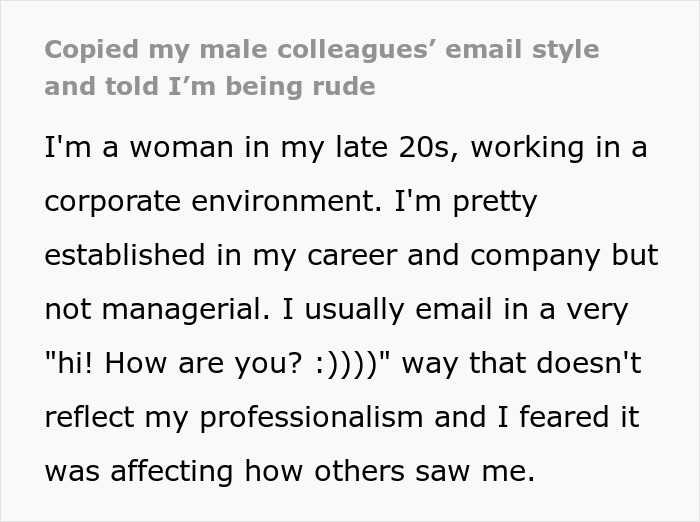
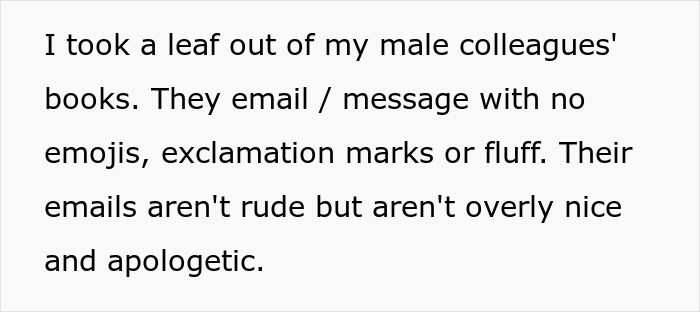
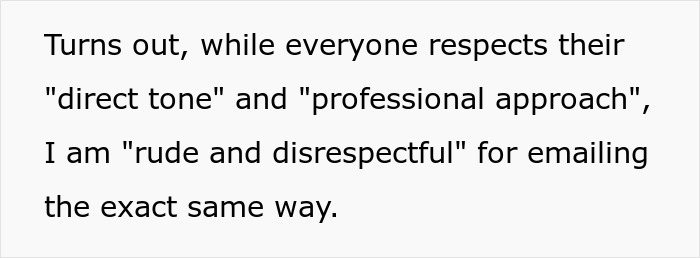
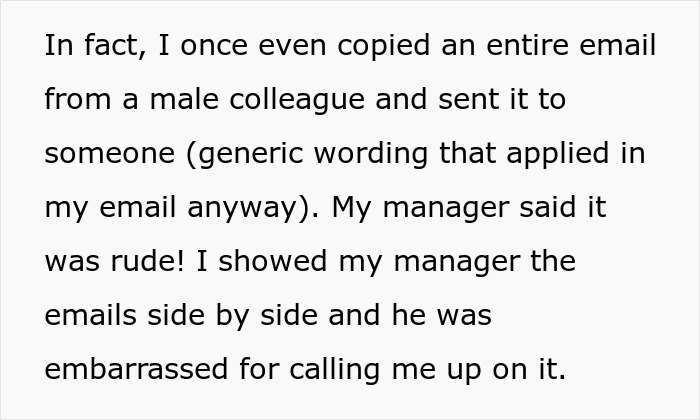
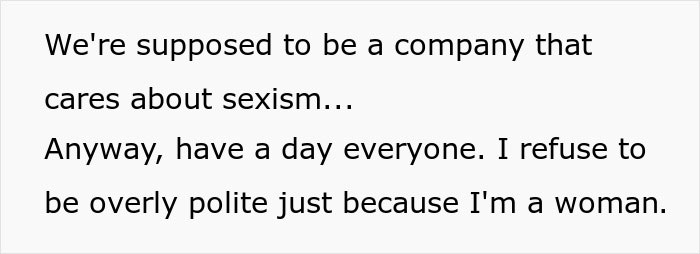
Recently, fearing that she wasn’t being professional enough, this woman tried reversing the roles and adopted an email style that resembled her male coworkers. But to her surprise, her manager wasn’t happy with the way she was communicating and even called her rude.
Scroll down to find the full story and a conversation with career clarity expert and certified career coach, Theresa White, and executive career coach at Wishingwell Coaching, Jessica Sweet, who kindly agreed to tell us more about women vs. men email styles.
Even in the most professional emails, employee’s personalities still shine through
Image credits: user18526052 / Freepik (not the actual photo)
Fearing that she wasn’t being professional enough, this woman changed her email style, for which she was called rude
Image credits: rawpixel.com / Freepik (not the actual photo)
Image credits: Afraid_Respect_3189
Several studies have found that women email differently than men
Image credits: Image by Freepik (not the actual photo)
Several studies have found that women email differently than men. They suggest that females are more likely to use exclamation marks in their emails and phrases like ‘just,’ ‘I think,’ or ‘I feel.’ While men tend to be more confident, emotionally detached, and lighter on the exclamation points.
“Women often use more polite, apologetic, and inclusive language, such as “just checking in” or “I think we should consider…” to soften their tone,” adds career clarity expert and certified career coach, Theresa White. “Men, on the other hand, tend to write more directly and assertively.”
“This difference likely stems from social conditioning—women are often taught to be agreeable and accommodating, while men are encouraged to be confident and decisive,” she further explains. “Workplace power dynamics also play a role, as women may feel pressure to come across as likable to avoid being perceived as aggressive.”
Men are generally writing shorter and more direct emails because (stereotypically) they worry less about what others think of them, making them less concerned about their recipients and offending them.
Meanwhile, women’s style of communication can sometimes be seen as soft or amateurish, stopping people from taking women seriously. In fact, a 2006 study has found that women’s communication style tends to be described in negative terms. Their use of exclamation points is seen as ‘markers of excitability’—implying that they lack stability and are emotionally random.
Should women write emails like men?
Image credits: Image by Freepik (not the actual photo)
So does this all mean that women should write like men? “Rather than women adopting a “male” style or vice versa, the best approach is to be intentional about communication,” White said to Bored Panda. “Women shouldn’t feel obligated to strip their emails of warmth, but they also shouldn’t default to overly apologetic language if it undermines their authority.”
“A person’s email style should match their personal conversation style,” said executive career coach at Wishingwell Coaching, Jessica Sweet. “A reader of your email should get a sense of what it’s like to speak with you or work with you from reading your emails. For example, are you an all-business type of person? Are you warmer and more personable? Your email style should convey that. No one should try to be someone they aren’t, even over email. The exception is if they receive feedback that they are being rude or unprofessional, in which case their style may need to adapt overall, not just in email.”
White mentions that men may also benefit from incorporating more collaborative language to build stronger workplace relationships. “The goal isn’t to conform but to communicate effectively—balancing clarity with approachability based on the situation and audience,” she explains.
According to Sweet, the best way to write an email is to be warm yet maintain good boundaries, be clear and offer concise next steps or action. “For example, it might open with a greeting and an expression of hope that the other person had a good weekend, the meat of the email, and then the next steps, ask or action needed.”
“A professional email should be clear, concise, and respectful,” agrees White. “Start with a direct subject line, get to the point in the first sentence, and avoid unnecessary softening language like “just” or “sorry to bother you.” Use a confident but courteous tone, and end with a clear call to action. If warmth is appropriate, a simple “Hope you’re doing well” or “Looking forward to your thoughts” can maintain approachability without diminishing authority. The key is to ensure your message is understood while also fostering positive professional relationships.”

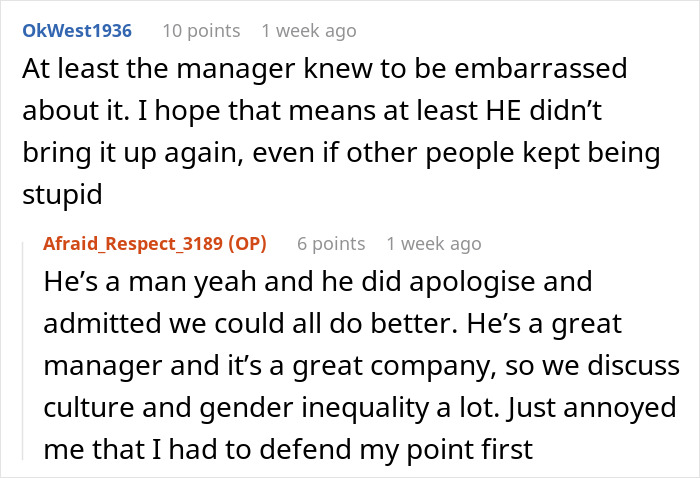
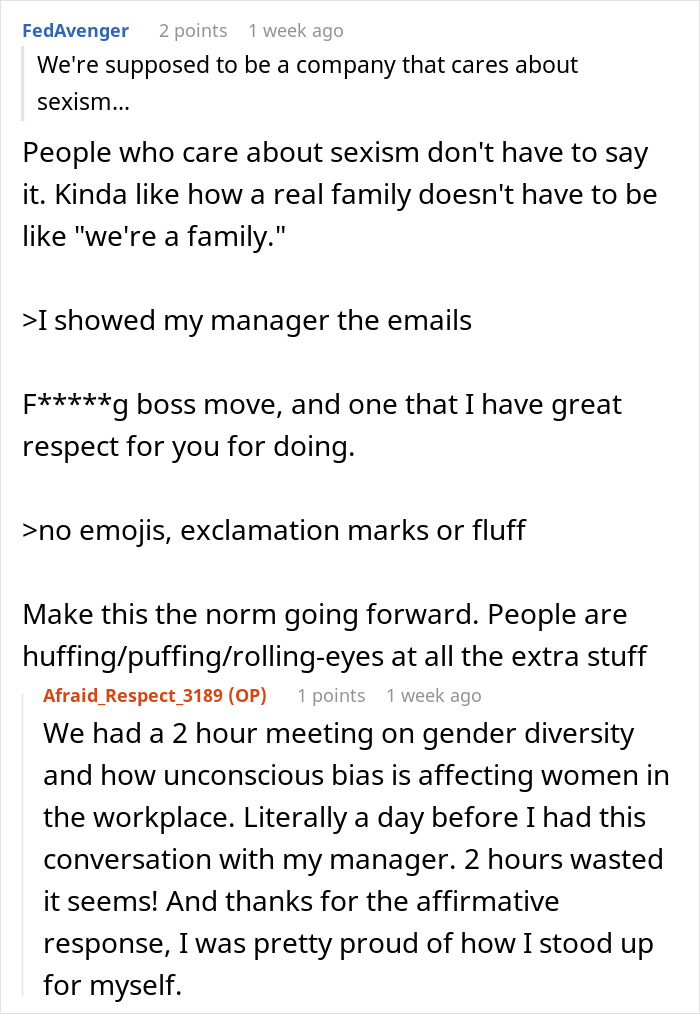
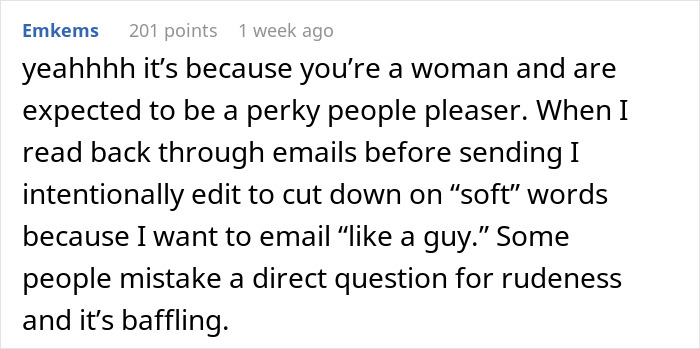
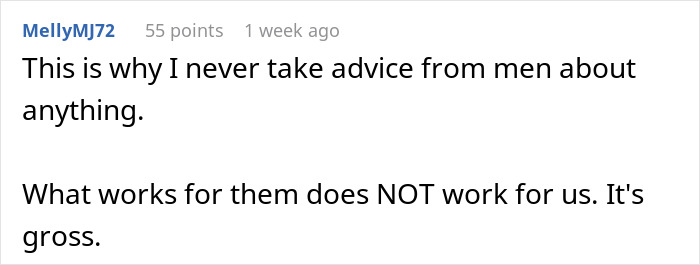
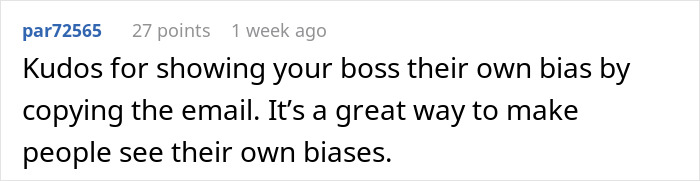
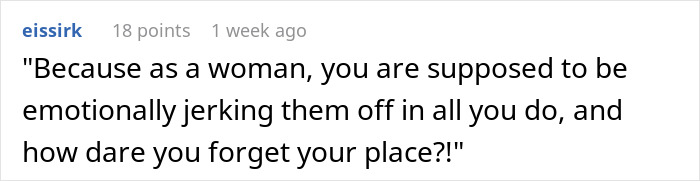
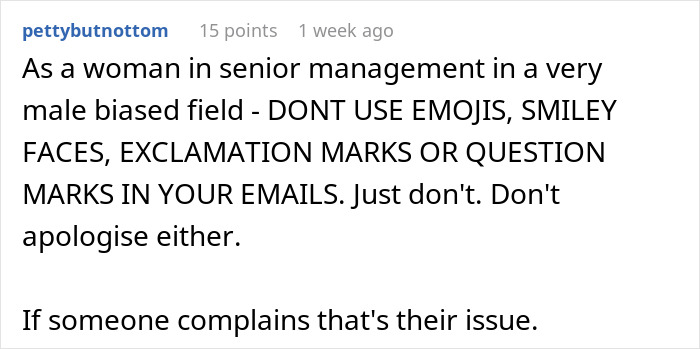
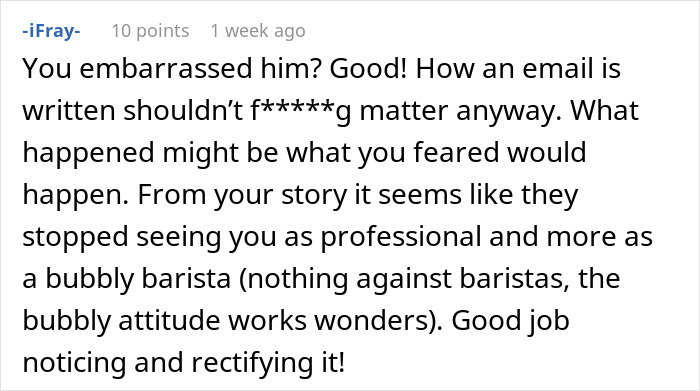
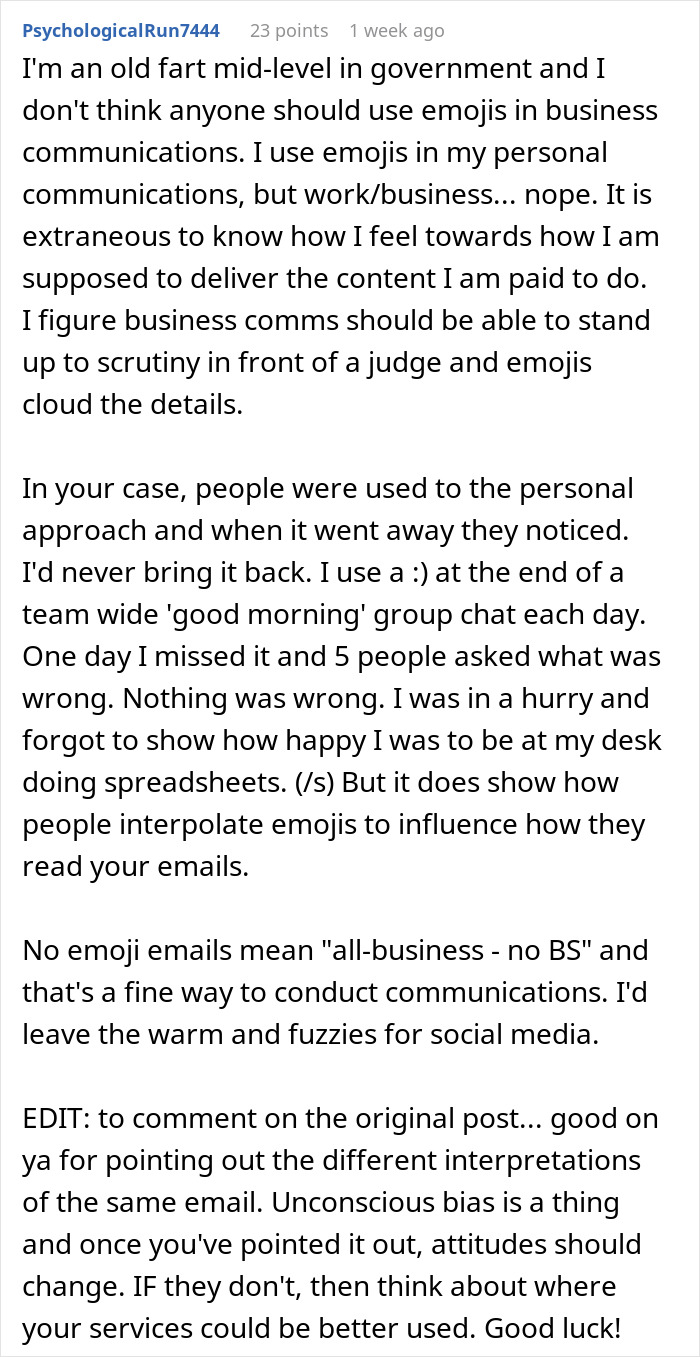
Readers applauded the woman for bringing up this issue with management
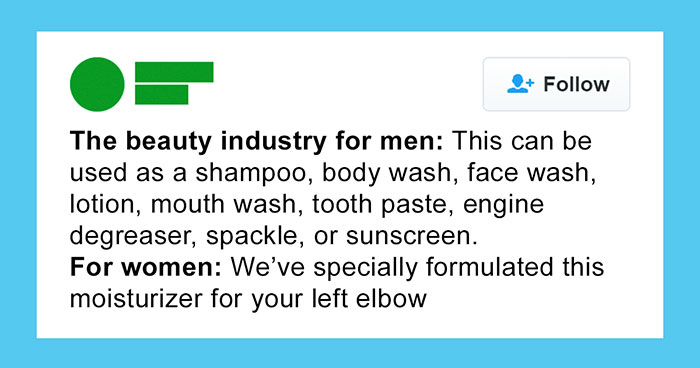
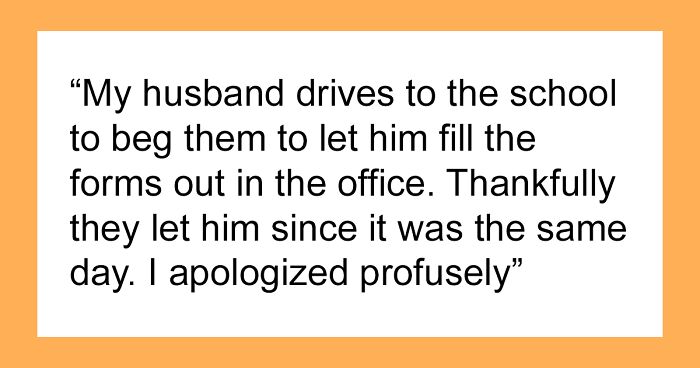
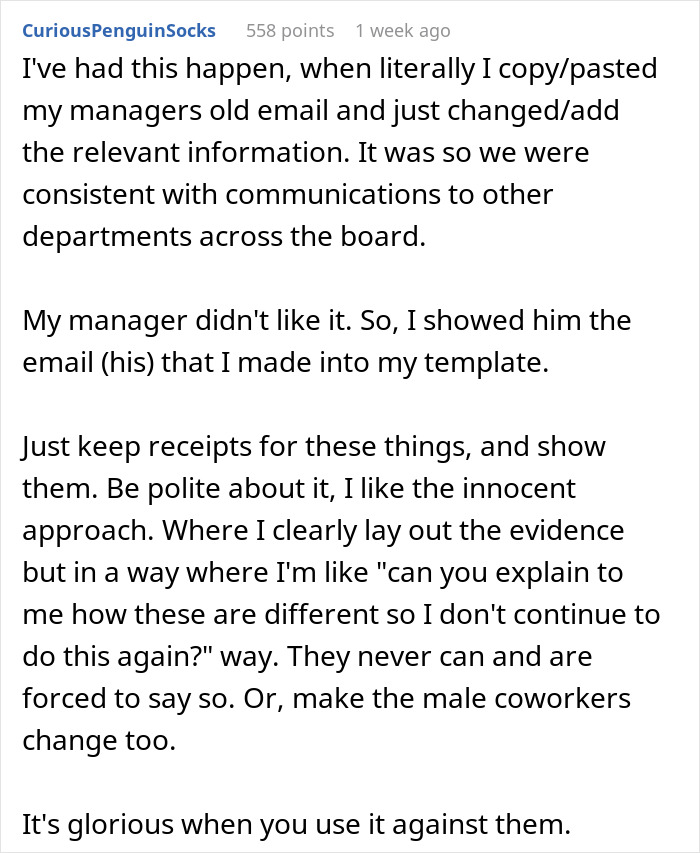
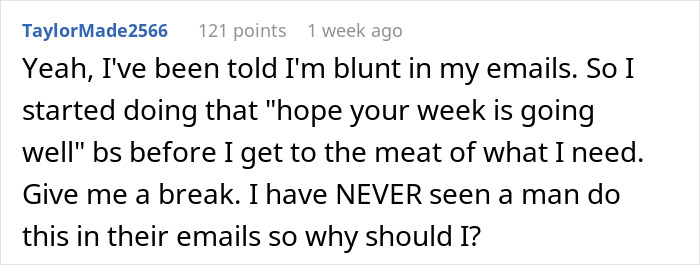
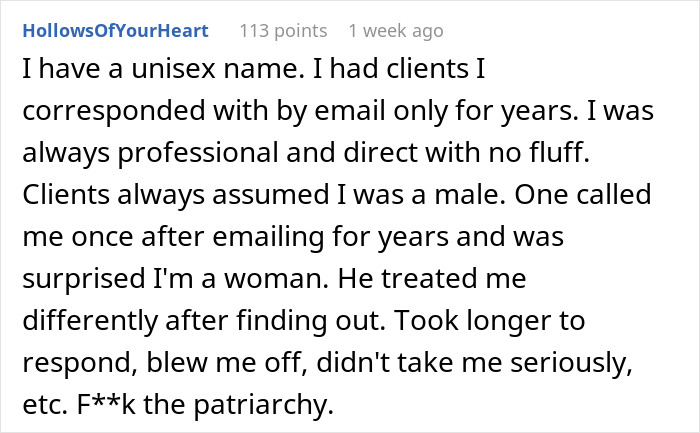
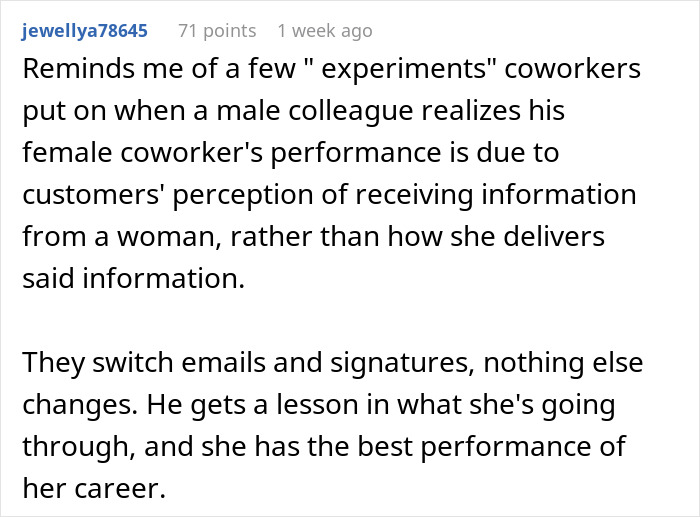
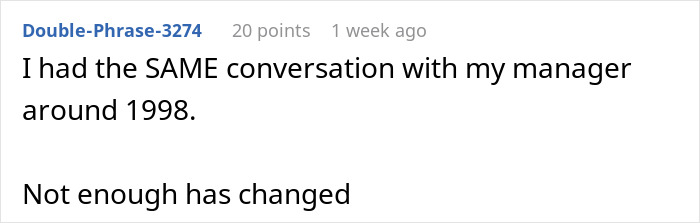
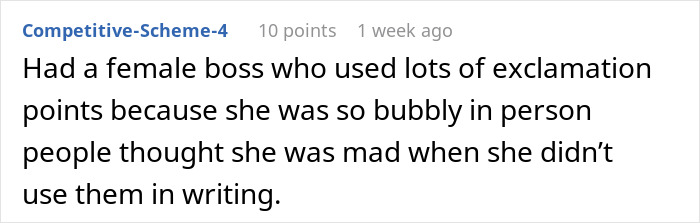
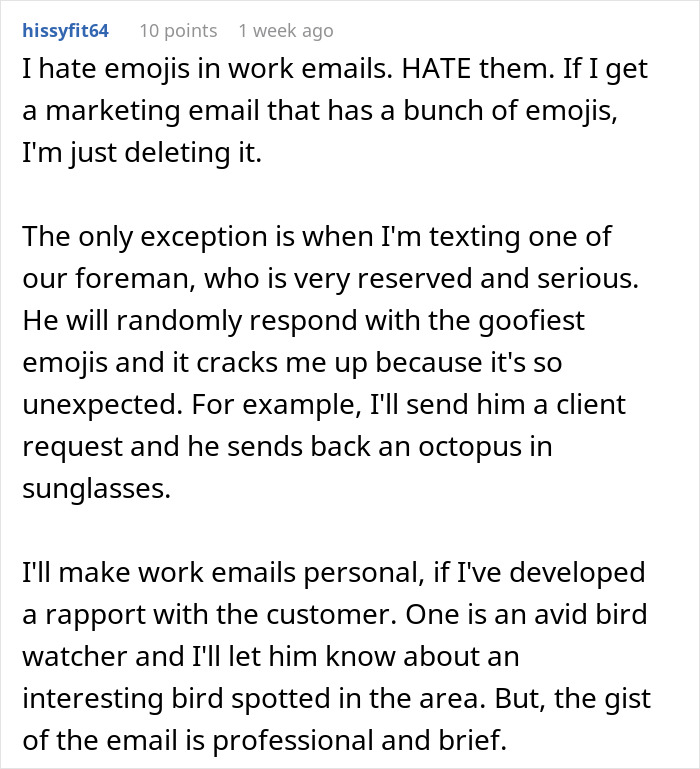
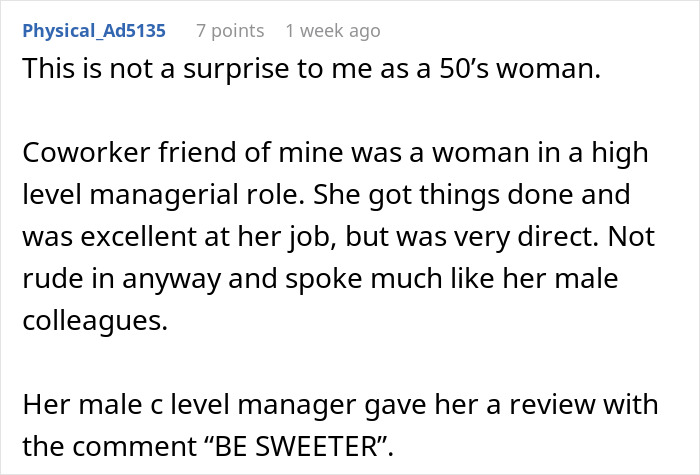
While others also shared similar stories
Poll Question
Thanks! Check out the results:
It's a bad company/manager. In my office, men and women have similar email style and noone would think that one is rude and another isn't. I'd say... get out of there and find a normal company, not a bunch of morons.

To you, that problem may be a huge red flag and you might prefer to look for another job. The OP thought of the situation as a problem to solve. Since her boss actually listens and learns, she might feel that it's easier to correct him than leave and start fresh elsewhere.
Load More Replies...That seems to be a culture and gender thing. People would think I lost my mind if I used emojis and fluff in work related emails. Nobody does that here regardless of gender.

Where are you at and may I come live with you? (
Load More Replies...i've been in my role for 18 years. if i like someone, they get cat memes and jokes. if i don't, they get direct communication. it works great- i had a supplier give me a $2k discount on a $13k order because, "we like you and we want to save you money." i've also convinced sales to go with one supplier over another because one is a jerk. relationships matter and if i have to use emojis and cat memes to ingratiate myself, i totally will. it's part of my job.
I was being failed history in school unfairly so I copied the geek's paper almost verbatim, still got failed. Took that to the head of standard. Miraculously passed history until that final exam which you didn't get your papers back from... ;-) My dad however knew it was happening so all good.
Vaguely wondering if this is a North American thing? When I immigrated 20 years ago, I’d already been working for over a decade. We were taught (UK) that there’s no place in professional written communication for anything other than information and facts. Be as pleasant as you want in person speaking to someone but expressing emotions in writing was highly unprofessional. I start working in Canada, suddenly I’m being called out for aggressive and hostile behaviour. One especially painful incident happened when a colleague stated in an email he copied to my manager and everyone else on the team that I hadn’t provided information he had requested. I replied to all that I had sent the info within 24 hours and attached the email trail. Hoo boy! Called into my manager’s office to answer to a serious complaint about my “attitude”. It was unprofessional of me to have replied to all instead of resending the info without making it public that my colleague was wrong. Honestly bewildered, I ask, “Is X also in trouble for unprofessional behaviour?” No, all he did was ask a question. Now even more confused. “But he didn’t ask a question. He explicitly wrote that he had asked for [info] on [date] and it’s now a week overdue. He copied everyone on his statement that I hadn’t responded but when I let everyone know in the exact same way, I’m unprofessional but he isn’t?” My manager threaded his fingers together and in one of the most patronizing tones I’ve been subjected to said, “JB we expect our colleagues to be respectful and supportive. There was no need for you to call X out. X was wrong about what he thought, you were rude.” I learned that day that it’s perfectly fine for a colleague to throw me under the bus but unprofessional to defend myself. The most frustrating part was I thought X’s email was a perfectly normal follow up; he cc’d the team plus manager to keep everyone in the loop. I replied the same way, confirming I had sent the info, also keeping everyone in the loop.
I write very "manly": few niceties, if it's back and forth in a ticket I skip the "hi colleague, could you.." and the "thank youuuu! kind regards, sturmwesen". It's exactly like my male colleagues and male team leaders write, only I feel like I write more information in it. Guess who was told to add more sugar? F that
Lol! After the first ever email I sent out as a Captain, 6 men have quit on the spot, 10 people retracted their bid for a place on the team and a teammate spent 15 minutes screaming at me on the phone. It was an invitation for a meeting that was mandated by LAW to be held within a certain time frame. I copy pasted the invitation of a male manager and simply changed the date and location.
I'm on the fence - couldn't at least part of it be explained by merely the difference in tone? If I ususally email everyone in a overly pleasing and bubbly way, and suddenly that changes to 'Dear John, please have document x ready by tomorrow." people are going to feel like I'm being callous or rude (or perhaps having an off day).
i was thinking the same thing if she usually is very bubbly and cheerful style changing to that can seem like they are being rude. Similar other way if you usually send quite generic emails and then start being all bubbly it might come across as being unprofessional or overly familiar
Load More Replies...It's a bad company/manager. In my office, men and women have similar email style and noone would think that one is rude and another isn't. I'd say... get out of there and find a normal company, not a bunch of morons.
To you, that problem may be a huge red flag and you might prefer to look for another job. The OP thought of the situation as a problem to solve. Since her boss actually listens and learns, she might feel that it's easier to correct him than leave and start fresh elsewhere.
Load More Replies...That seems to be a culture and gender thing. People would think I lost my mind if I used emojis and fluff in work related emails. Nobody does that here regardless of gender.
Where are you at and may I come live with you? (
Load More Replies...i've been in my role for 18 years. if i like someone, they get cat memes and jokes. if i don't, they get direct communication. it works great- i had a supplier give me a $2k discount on a $13k order because, "we like you and we want to save you money." i've also convinced sales to go with one supplier over another because one is a jerk. relationships matter and if i have to use emojis and cat memes to ingratiate myself, i totally will. it's part of my job.
I was being failed history in school unfairly so I copied the geek's paper almost verbatim, still got failed. Took that to the head of standard. Miraculously passed history until that final exam which you didn't get your papers back from... ;-) My dad however knew it was happening so all good.
Vaguely wondering if this is a North American thing? When I immigrated 20 years ago, I’d already been working for over a decade. We were taught (UK) that there’s no place in professional written communication for anything other than information and facts. Be as pleasant as you want in person speaking to someone but expressing emotions in writing was highly unprofessional. I start working in Canada, suddenly I’m being called out for aggressive and hostile behaviour. One especially painful incident happened when a colleague stated in an email he copied to my manager and everyone else on the team that I hadn’t provided information he had requested. I replied to all that I had sent the info within 24 hours and attached the email trail. Hoo boy! Called into my manager’s office to answer to a serious complaint about my “attitude”. It was unprofessional of me to have replied to all instead of resending the info without making it public that my colleague was wrong. Honestly bewildered, I ask, “Is X also in trouble for unprofessional behaviour?” No, all he did was ask a question. Now even more confused. “But he didn’t ask a question. He explicitly wrote that he had asked for [info] on [date] and it’s now a week overdue. He copied everyone on his statement that I hadn’t responded but when I let everyone know in the exact same way, I’m unprofessional but he isn’t?” My manager threaded his fingers together and in one of the most patronizing tones I’ve been subjected to said, “JB we expect our colleagues to be respectful and supportive. There was no need for you to call X out. X was wrong about what he thought, you were rude.” I learned that day that it’s perfectly fine for a colleague to throw me under the bus but unprofessional to defend myself. The most frustrating part was I thought X’s email was a perfectly normal follow up; he cc’d the team plus manager to keep everyone in the loop. I replied the same way, confirming I had sent the info, also keeping everyone in the loop.
I write very "manly": few niceties, if it's back and forth in a ticket I skip the "hi colleague, could you.." and the "thank youuuu! kind regards, sturmwesen". It's exactly like my male colleagues and male team leaders write, only I feel like I write more information in it. Guess who was told to add more sugar? F that
Lol! After the first ever email I sent out as a Captain, 6 men have quit on the spot, 10 people retracted their bid for a place on the team and a teammate spent 15 minutes screaming at me on the phone. It was an invitation for a meeting that was mandated by LAW to be held within a certain time frame. I copy pasted the invitation of a male manager and simply changed the date and location.
I'm on the fence - couldn't at least part of it be explained by merely the difference in tone? If I ususally email everyone in a overly pleasing and bubbly way, and suddenly that changes to 'Dear John, please have document x ready by tomorrow." people are going to feel like I'm being callous or rude (or perhaps having an off day).
i was thinking the same thing if she usually is very bubbly and cheerful style changing to that can seem like they are being rude. Similar other way if you usually send quite generic emails and then start being all bubbly it might come across as being unprofessional or overly familiar
Load More Replies...


48
32