Get Premium
Dark mode theme is available exclusively for premium users. Learn more about the benefits of subscribing.
No fees, cancel anytime.

 Dark Mode Ad-Free Browsing Unlimited Content
 Ad-Free Browsing Unlimited Content Dark Mode
Join 1.2 million Panda readers who get the best art, memes, and fun stories every week!
Did you know that there are 7,139 officially known languages in the world? Humans created thousands of unique ways to communicate and connect. That’s super impressive, isn’t it? We have no idea how long it would take you to learn even half of them, but we can certainly introduce them to you bit by bit. Do you have the curiosity to know and learn the different languages created by mankind? We hope your answer is yes!
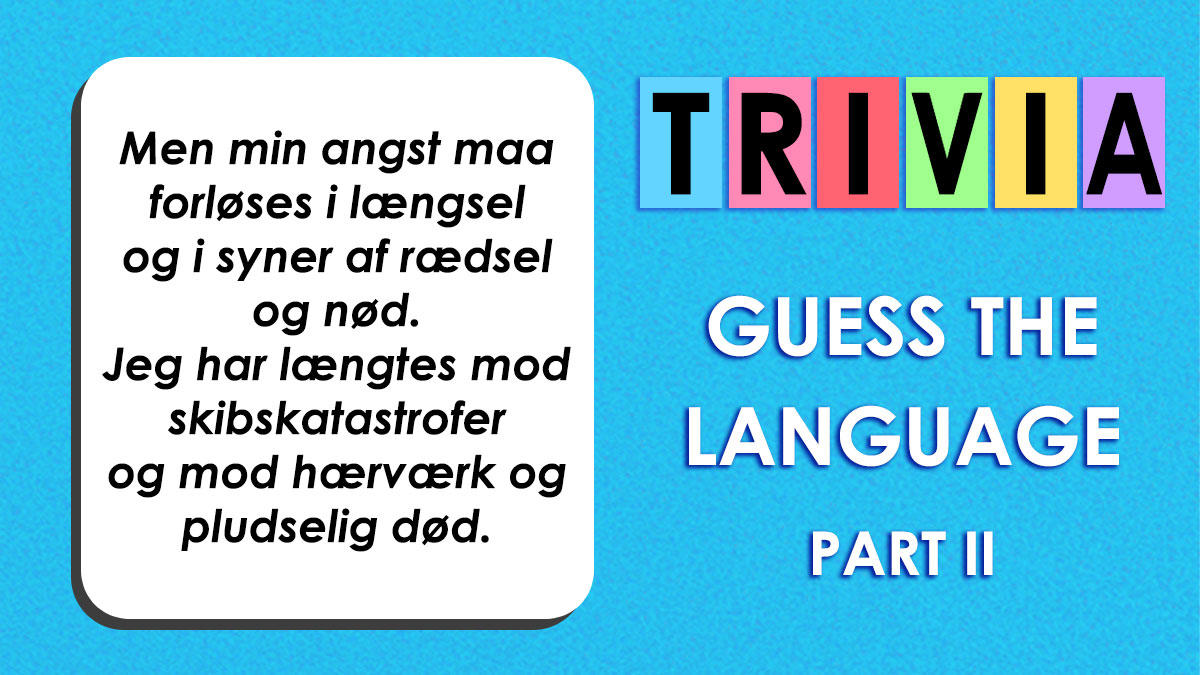
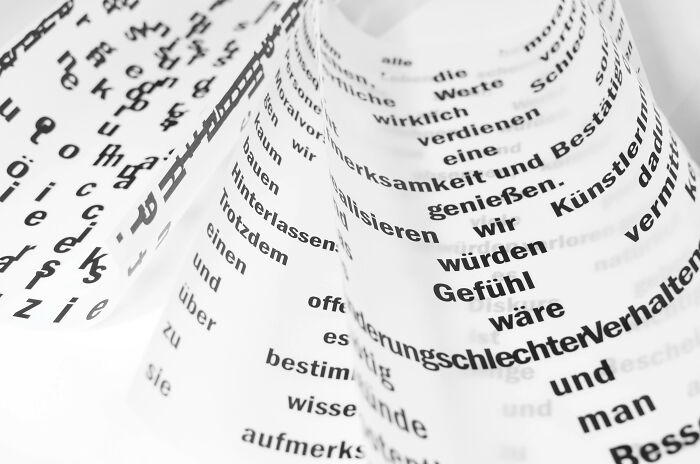
For this purpose, we gathered 20 different languages and created the second part of the language quiz. Everything is very simple: we give you a passage from a song or poem, and you have to guess which language it is.
If you missed the first part of this quiz, you can test your skills here.
Are you ready for a language adventure? Let’s get started! 🌎
Image credits: Skylar Kang
Not Quite Done Yet!
Subscribe Premium to Compare Your Stats with Others
| User | Result | Reward |
|---|---|---|
  | / 20 | |
| | / 20 | |



If Croatian and Serbian are different languages, the "languages" in Maine and Texas would be different languages too. There are more linguistic differences between New England dialect and Texan dialect than between Croatian and Serbian (add Bosnian and Montenegrin to this group), but there are national borders between the countries.

Are they THAT similar? Maine and Texas, unlike the US and UK, don't have any dissimilar spellings, or unfamiliar words at all? They're mostly simply different idioms and pronunciations. Fun fact: The most distinctive American dialect I've ever encountered is Scrantonian, with dozens of bizarre, unique words, like "Updinan" ("North", possibly from "up the line and on?"), "Innanna" ("Right," possibly from "Ain't it or no?"), etc. Several Polish loan words, also, but not moreso that Yiddish loan words in New Yorker; I just wasn't aware that all the Yiddish loan words weren't universally known when I was a kid, and by now they probably are much more widely known.
Load More Replies... Huh. Never would've guessed Mongolian looked so much like a Slavic language. 14 out of 20 is pretty good for someone who's never had the chance to leave North America, no? Some of these were HARD! Norse vs Icelandic? (I went with Icelandic simply because I didn't recognize any Norse, which thinking back was illogical.) Estonian vs Lithuanian?
If Croatian and Serbian are different languages, the "languages" in Maine and Texas would be different languages too. There are more linguistic differences between New England dialect and Texan dialect than between Croatian and Serbian (add Bosnian and Montenegrin to this group), but there are national borders between the countries.
Are they THAT similar? Maine and Texas, unlike the US and UK, don't have any dissimilar spellings, or unfamiliar words at all? They're mostly simply different idioms and pronunciations. Fun fact: The most distinctive American dialect I've ever encountered is Scrantonian, with dozens of bizarre, unique words, like "Updinan" ("North", possibly from "up the line and on?"), "Innanna" ("Right," possibly from "Ain't it or no?"), etc. Several Polish loan words, also, but not moreso that Yiddish loan words in New Yorker; I just wasn't aware that all the Yiddish loan words weren't universally known when I was a kid, and by now they probably are much more widely known.
Load More Replies... Huh. Never would've guessed Mongolian looked so much like a Slavic language. 14 out of 20 is pretty good for someone who's never had the chance to leave North America, no? Some of these were HARD! Norse vs Icelandic? (I went with Icelandic simply because I didn't recognize any Norse, which thinking back was illogical.) Estonian vs Lithuanian?






























 No fees, cancel anytime





16
19