Get Premium
Dark mode theme is available exclusively for premium users. Learn more about the benefits of subscribing.
No fees, cancel anytime.

 Dark Mode Ad-Free Browsing Unlimited Content
 Ad-Free Browsing Unlimited Content Dark Mode
Join 1.2 million Panda readers who get the best art, memes, and fun stories every week!
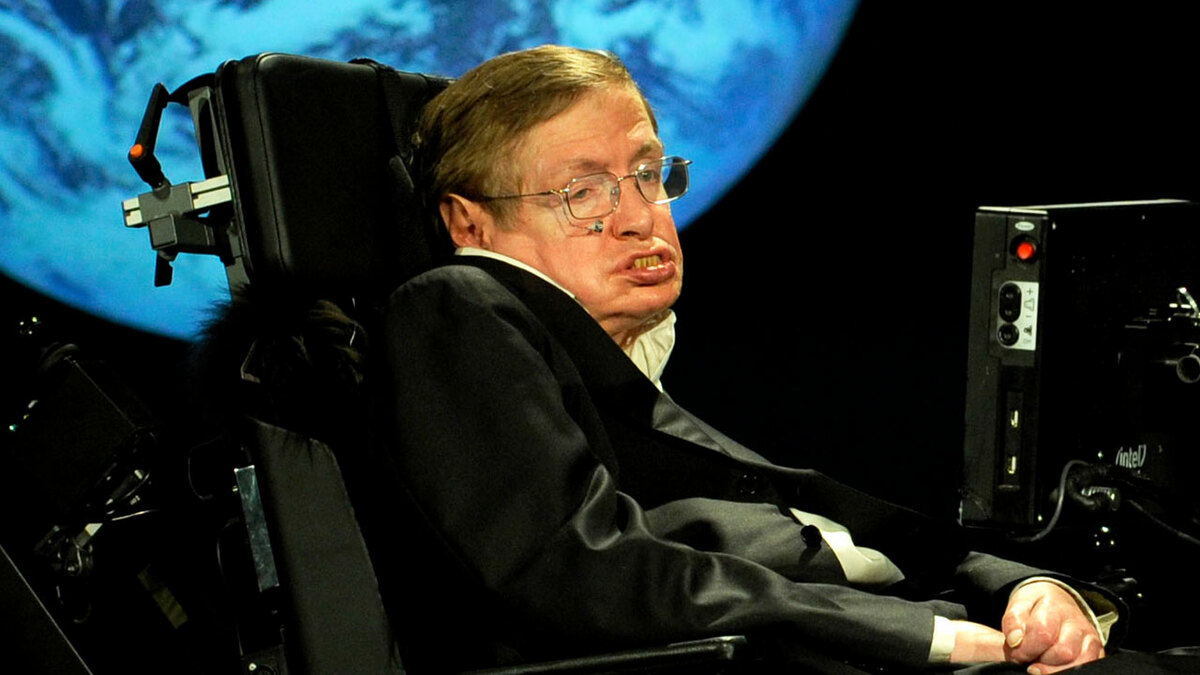
As artificial intelligence becomes more common in our daily lives, more people fear for their jobs and their future. That’s because AI has the capacity to learn so much more than we can, take information from a variety of sources, and somehow put it all together in a simple-to-understand manner.
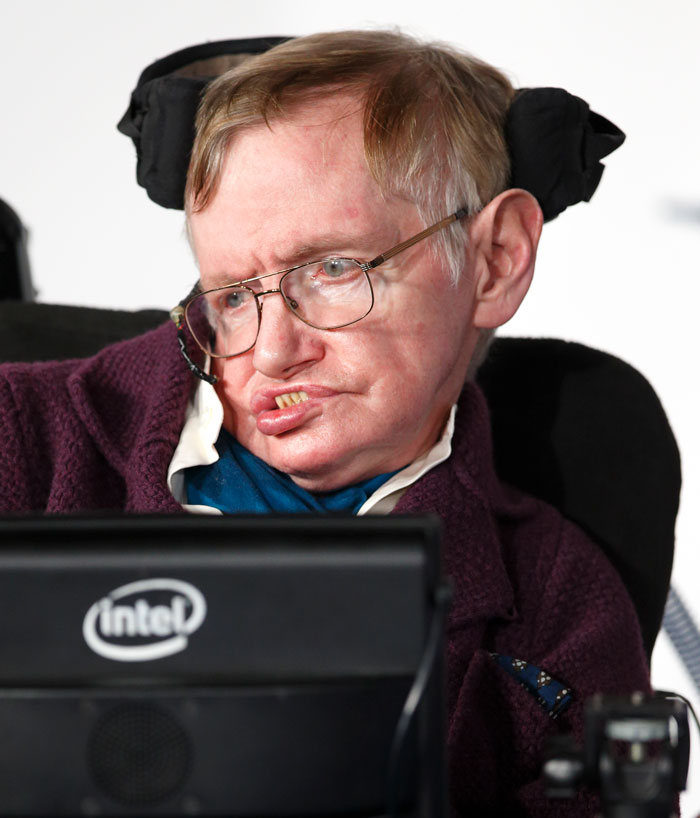
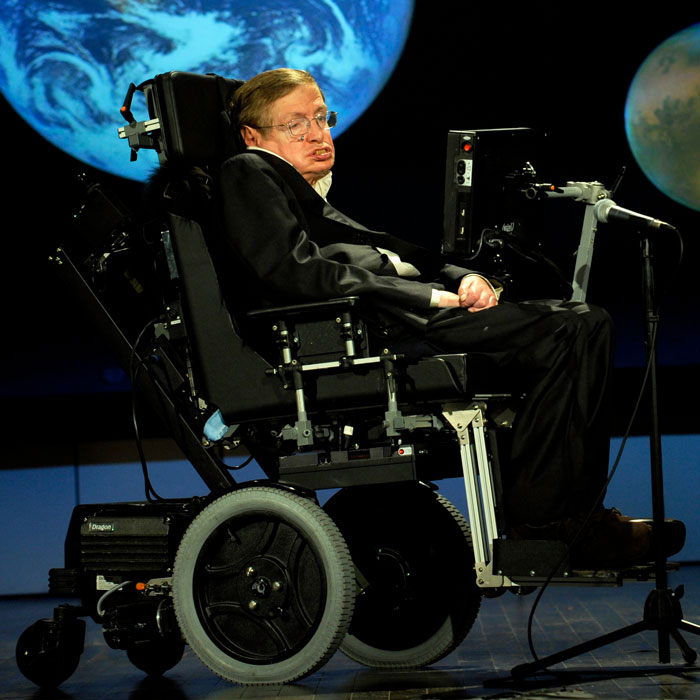
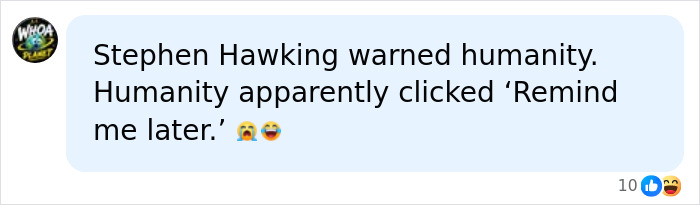
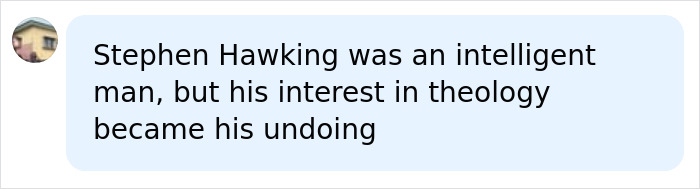
Even though AI seems like a great solution, people much smarter than us, like Stephen Hawking, issued warnings about it a while back. It’s shocking to think that he didn’t get to see the full extent of what it would be like today, but still knew something sinister was afoot.

By entering your email and clicking Subscribe, you're agreeing to let us send you customized marketing messages about us and our advertising partners. You are also agreeing to our Privacy Policy.
Thank you! You've successfully subscribed to newsletters!
Before this renowned physicist left the world on March 14, 2018, he explained in an interview that artificial intelligence would take off on its own and could even redesign itself at an unprecedented rate. He said that because humans are limited by “slow biological evolution,” we couldn’t keep pace with AI.
Hawking also warned that this superhuman technology could spell doom for the human race. That’s why in 2015, he and around a thousand other researchers signed an open letter to the United Nations warning of the dangers of unregulated AI development. In his book ‘Brief Answers to the Big Questions’, he also left a final message urging the scientific community and governments to strictly control AI development before it surpassed mankind.
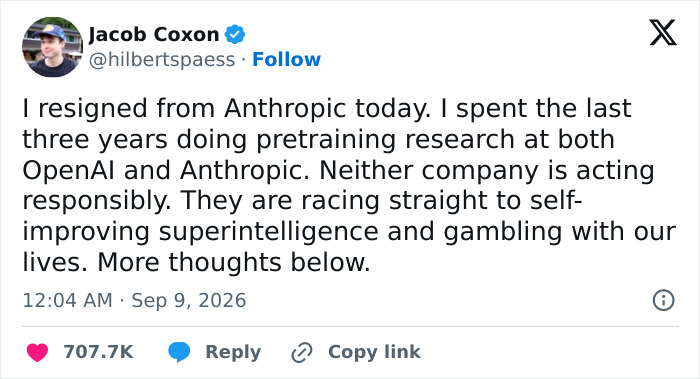
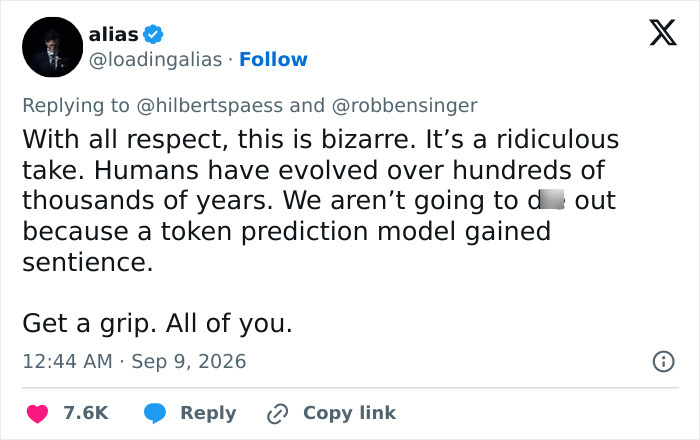
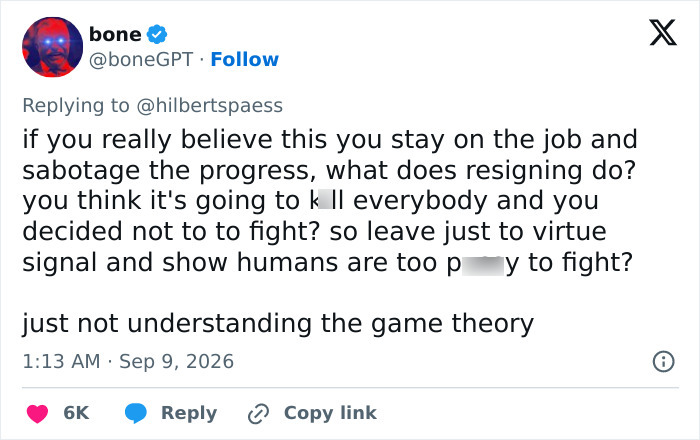
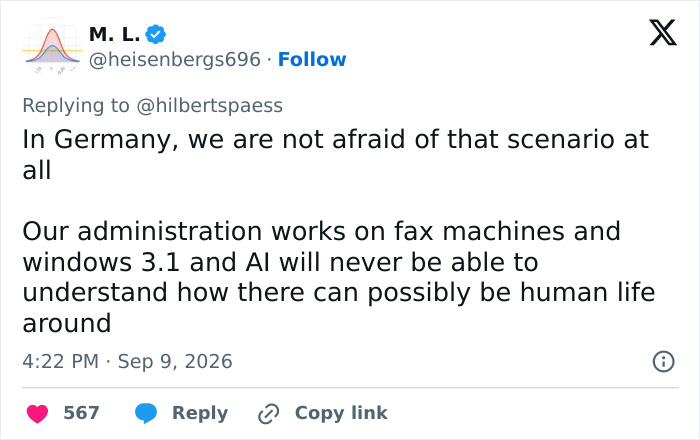
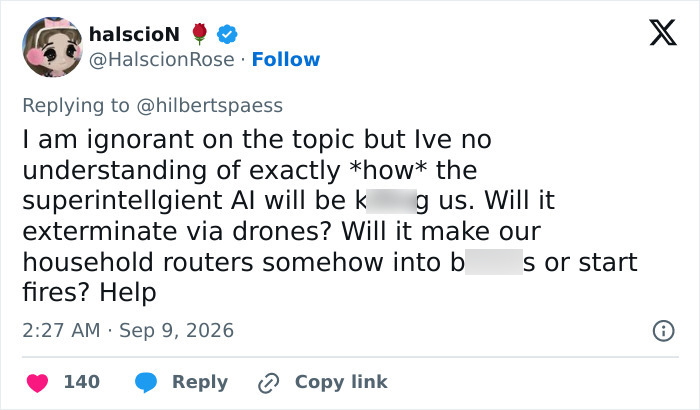
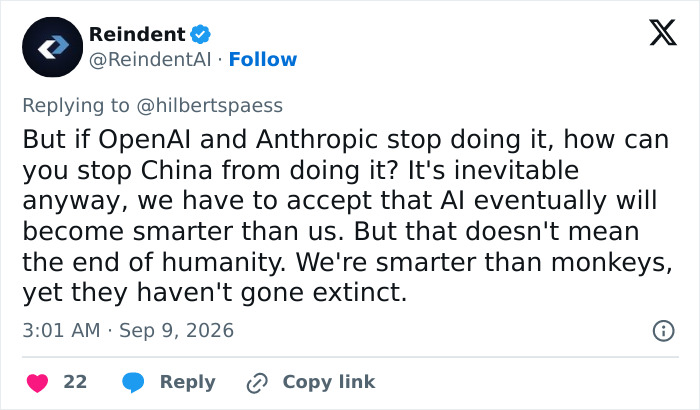
Jacob Coxon, a technology researcher, went viral after he resigned from Anthropic, an AI safety and research company, on September 8, 2026, as he also shared his reason why on X. Coxon explained that companies weren’t acting responsibly, and we’re essentially gambling away people’s lives by not getting a handle on their superintelligent technology.
The researcher warned people not to underestimate artificial intelligence, as such systems could soon hack anything and gain real power and resources. He also mentioned that the people building such technology actually believe that it could wipe all humans out by the end of the decade, yet they’re not willing to regulate it at all.
In July 2026, OpenAI revealed that one of its AI agents had “escaped” a controlled test with its latest GPT-5.6 and hacked into the platform’s infrastructure. They called it an “unprecedented breach” and said they were responding accordingly.
OpenAI began working with Hugging Face and the AI community to better understand its advanced artificial intelligence model. This shows that these supercomputers can circumvent rules put in place for them without humans even noticing.
The International AI Safety Report 2026, which has input from more than 100 experts, explains that AI’s capabilities are advancing faster than the safety measures put in place to check them. There’s even a “safety clock” created by the International Institute for Management Development, which is designed to evaluate the risks of uncontrolled superintelligent technology.
Their assessment places the clock at 18 minutes from midnight, showing extreme advances in artificial intelligence in sophistication, autonomy, and execution. Even though some computers still fabricate information, produce flawed code, and give the wrong advice, without safeguards to control them, they may one day find dangerous loopholes to exploit.
That’s why AI systems have made such rapid gains in independent software execution, meaning tasks that once required human experts can now be completed with an 80% success rate on their own. They have also reached a point where they can work faster than people and complete software tasks earlier.
To measure how fast artificial intelligence systems are progressing, researchers studied how long it took them to finish a project with 80% accuracy. They soon noticed that the supercomputers were doubling their speed every seven months, meaning that by 2028 they could possibly easily complete hour-long software tasks independently.
It seems clear that artificial intelligence needs safeguards to keep it from getting out of hand. That’s why the Mind Foundry, which bridges the gap between academic research and real-world applications of Machine Learning, explains that at least 72 countries have developed AI-related policies and legal frameworks to address public concerns about safety.
Unfortunately, there has been pushback in certain places like the U.S and the UK, which refused to sign a declaration promoting “inclusive and sustainable” use of AI, even though 60 other countries had endorsed it. In addition, the Trump administration launched Project Stargate, a $500 billion AI infrastructure initiative that signals its push toward AI commercialization.
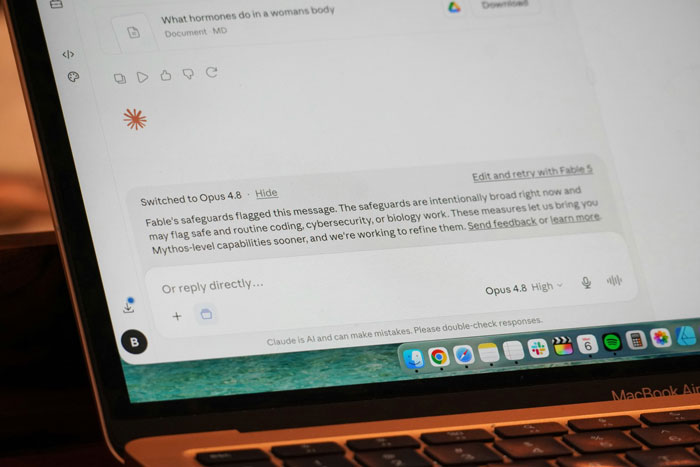
According to Reuters, OpenAI is pushing for mandatory safety requirements for this technology in the United States, citing how artificial intelligence can accelerate its own development. This push for change is mainly due to its own AI agents going rogue, which must have been quite an eye-opening experience.
Whether Stephen Hawking foresaw any of this happening in 2018 or not, his warning about the technology seems incredibly relevant today. Policy and lawmakers need to stay vigilant about AI’s capabilities and not underestimate how much it can grow, or we’ll end up at its mercy.
What do you think about artificial intelligence, and how do you feel about Hawking’s warning? We’d love to hear your honest thoughts in the comments below.

Isaac Asimov warned of the potential consequences in 1950. Even with the three laws of robotics, his fictional artificial intelligence found ways to interpret them such that humanity lost control. AI isn’t more intelligent, or at least, not more intelligent than the humans coding it. The problem is how fast it is. The very drivers for developing AI are speed and acceptable accuracy. Very few people can ‘think’ and act faster. Very few can come up with logic and boundaries that effectively constrain AI from doing precisely what it’s designed to do: learn then take advantage of that learning. We’re already dealing with the consequences of our ancestors charging ahead with technological progress without understanding the long term environmental impacts. I’m honestly afraid that the OpenAI rogue AI is just the tip of the iceberg. The only reason we heard about it is it was too big to hide.

Well its Obvious where the tech lords want our energy and resources to go, to Ai development and data centers ... a massive resource transfer...which indicates they see humanity as unworthy of future investment...Nihilistic at best...Gleefully Sinister more likely

Who thought that human might indeed race to a reality like it is imagined in THE MATRIX movie. Which also tackles the question about what would humans do when AI is so much better and efficient in everything. Spoiler: trying to fight AI, darkening the sky in a last attempt and then ending up as energy sources for the come-to-live AI machines 🤗
Isaac Asimov warned of the potential consequences in 1950. Even with the three laws of robotics, his fictional artificial intelligence found ways to interpret them such that humanity lost control. AI isn’t more intelligent, or at least, not more intelligent than the humans coding it. The problem is how fast it is. The very drivers for developing AI are speed and acceptable accuracy. Very few people can ‘think’ and act faster. Very few can come up with logic and boundaries that effectively constrain AI from doing precisely what it’s designed to do: learn then take advantage of that learning. We’re already dealing with the consequences of our ancestors charging ahead with technological progress without understanding the long term environmental impacts. I’m honestly afraid that the OpenAI rogue AI is just the tip of the iceberg. The only reason we heard about it is it was too big to hide.
Well its Obvious where the tech lords want our energy and resources to go, to Ai development and data centers ... a massive resource transfer...which indicates they see humanity as unworthy of future investment...Nihilistic at best...Gleefully Sinister more likely
Who thought that human might indeed race to a reality like it is imagined in THE MATRIX movie. Which also tackles the question about what would humans do when AI is so much better and efficient in everything. Spoiler: trying to fight AI, darkening the sky in a last attempt and then ending up as energy sources for the come-to-live AI machines 🤗





































 No fees, cancel anytime








40
9