Get Premium
Dark mode theme is available exclusively for premium users. Learn more about the benefits of subscribing.
No fees, cancel anytime.

 Dark Mode Ad-Free Browsing Unlimited Content
 Ad-Free Browsing Unlimited Content Dark Mode
Join 1.2 million Panda readers who get the best art, memes, and fun stories every week!

Working remotely has never been this easy and omnipresent. In August 2023, 12.2% of all workers in the U.S. worked from home and more than 4.7 million worked remotely at least half of the time. Yet not all employers are so understanding when it comes to letting their workers do the job remotely.
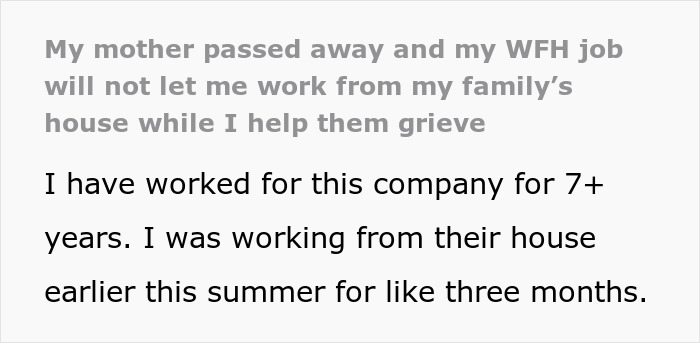
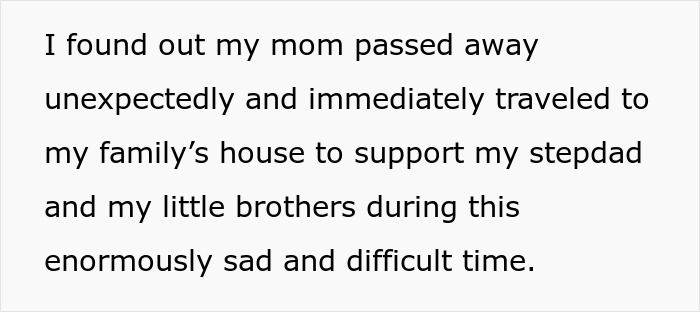
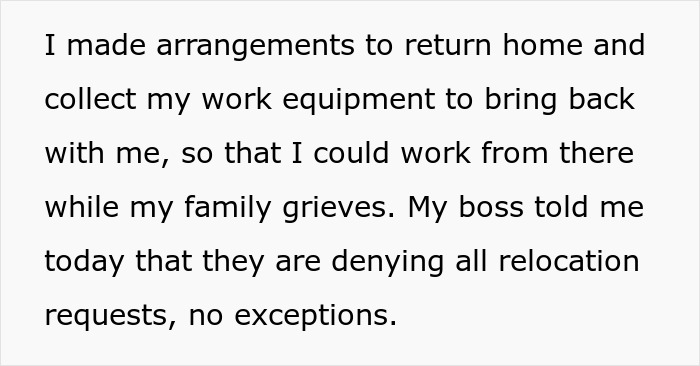
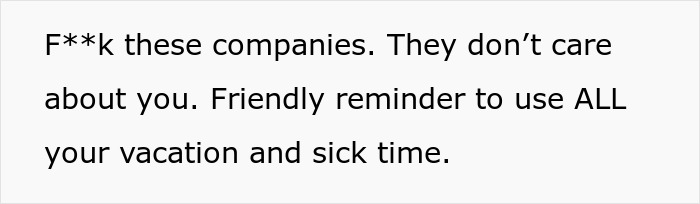
Some even don’t bend the rules when tragedy strikes in the family. This person’s company denied them permission to work from home after their mother passed away. Angry and disappointed, the person took to the r/antiwork subreddit to share their story.
To find out more about what a person could do in this situation, Bored Panda reached out to Louise Carnachan. She’s an organization development consultant and award-winning author of Work Jerks: How to Cope with Difficult Bosses and Colleagues, and she kindly agreed to lend us her expertise. Read her insights below!
More info: Louise Carnachan | LinkedIn | Facebook
Image credits: Thought Catalog / unsplash (not the actual photo)
Image credits: Ivan Samkov / pexels (not the actual photo)
Image credits: Sora Shimazaki / pexels (not the actual photo)
Image credits: tr3mbling
Image credits: Kaboompics.com / pexels (not the actual photo)
Organizational expert Louise Carnachan tells Bored Panda that most companies that are large enough have a bereavement policy that should give employees a certain amount of days off after a loved one passes.
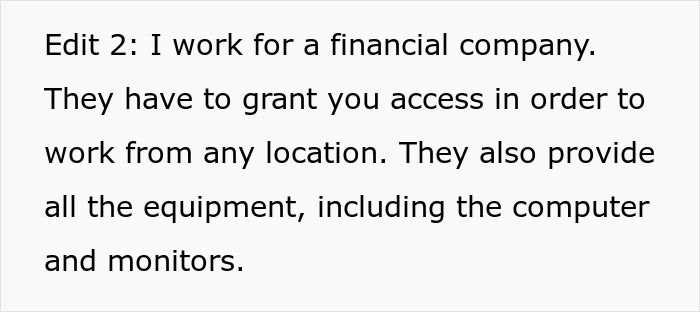
“How much time off may depend on which family member it was, for example, a parent or child vs. sibling,” Carnachan explains. “Given that it was the mother and they worked in a financial institution, I assume PTO was provided although it may have only been a few days.”
“Depending upon the organization, managers may have discretion about the amount of bereavement time granted and whether additional accommodations can be made. It sounds like the manager in this instance was following a strict relocation policy,” Carnachan notes.
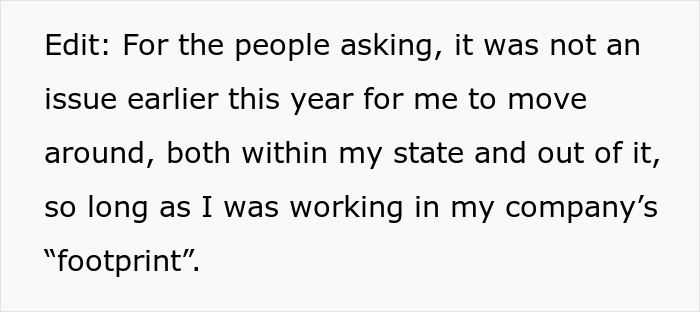
“But it’s not clear whether the employee had moved to an area that is not part of the company’s ‘footprint’—or even whether the employee and boss had spoken in advance about the necessity for remote work and a timeframe. Regardless, the manager in this situation comes across as heartless,” she observes.
If a company has more than 50 employees, they must offer FMLA (Family and Medical Leave). “A company’s bereavement policy may be insufficient to handle the fallout of a [passing], however, a [passing] may not fulfill the requirements to access FMLA,” Carnachan explains.
‘Since specific conditions must be met to access it, speaking to the company’s FMLA administrator is important,” she adds.
“In addition, some states have leave laws that go beyond FMLA. While FMLA protects an employee from losing employment under specific conditions, it is unpaid leave. The employee may use their PTO while on FMLA or the employer may require it be used.”
The author emphasized how they had worked from home in the past and couldn’t understand why the company wouldn’t let them do it again in time of need. Louise Carnachan notes that bereavement policies and FMLA are different from WFH policies. “They are all separate issues,” she says.
With big companies like Amazon asking their employees to return to the office full-time, many have started to wonder whether this will trickle down and result in a crackdown on WFH policies on a larger scale.
“WFH has a long history of contentiousness,” Carnachan notes. “Those who support it say productivity is higher outside the office with fewer distractions and they have better work/life balance without a commute. Additionally, there can be flexibility in when one is working.”
“Those who decry WFH say that it erodes company culture, teams don’t work as well together and informal communication that leads to innovation doesn’t naturally arise, among other things,” Carnachan adds.
“The problem is it’s very hard to quantify anything but task completion. We don’t have good data on the effects of in-person communication or building relationships and how that affects the bottom line—and it’s impossible to quantify missed opportunities.”
“Even with the ups and downs of remote work we read about, it’s likely that a range of hybrid work will be the norm for many businesses,” Carnachan believes.

By entering your email and clicking Subscribe, you're agreeing to let us send you customized marketing messages about us and our advertising partners. You are also agreeing to our Privacy Policy.
Thank you! You've successfully subscribed to newsletters!

Not all bosses. My sister lives in UK, and when it became evident that my mother's cancer would carry her away, my sister asked for permission to work from France. Her boss said no problem, as long as the work is done. Same when my Dad fell ill 2 years later. She'd been WFH since Covid, anyway.

Yep dame here in ireland. One company I worked for did have some restrictions on where you could work from which was fair enough as it was due to licensing issues in other countries. Even with a vpn I couldn't log into my work from some countries. But they gave me as much paid time off as I needed due to a bereavement. Any companies I've worked for since I've had no issues so long as the work is being done. I don't think I could work for a company that treated employees the way I'm constantly reading about on reddit.
Load More Replies...
It is ALL about controlling the employees. If your job can be done remotely there is no reason why it shouldn't be. If your job only needs you on premises a few days a month, the employee should be able to do that. Companies hire adults yet turn around and treat them like naughty children. IS the job getting done? Are they producing good work? Then if they can do it from home, step off and let them continue. Trust the people you hired are doing what you hired them to do and for those that you do not think are doing the job, deal with them individually, you don't need to make stupid sweeping policies.

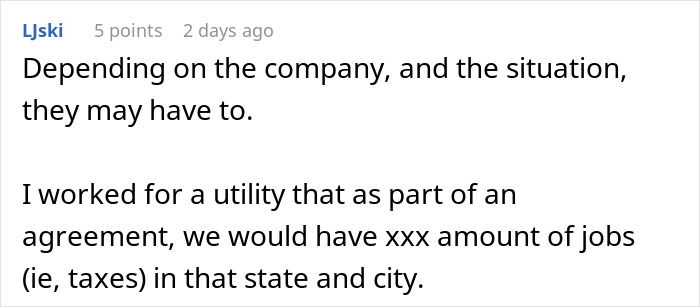
While it's usually a control issue, sometimes it's a tax problem. Whatever state you're WFH in wants income taxes, and the state your employer has a presence in might withhold taxes which you don't actually owe. Now you have to file two returns and might have to pay taxes out of pocket until the withholding refund from the other state comes in, but people don't realize that so they start howling at their employer. The employer now has to figure out what to do, which gets complicated. Span that out across 50 states and it gets expensive to manage. Large corporations that have a presence in most states can handle it pretty well but some mid-tier corp that only spans 2 or 3 states can find it getting messy pretty quick.

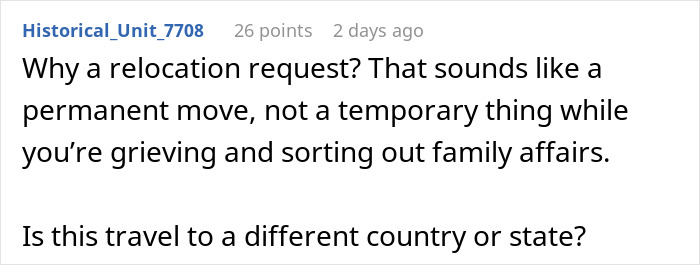
I’m curious. My impression, and it could be wrong, was the relocation was lengthy but not permanent. Would a temporary relocation matter if OP was maintaining his original permanent residence?
Load More Replies...
Iif you work from home anyways why is it a big deal to them? The job I have I can't work from home because I am a chef. I wish there was mandatory PTO for bereavement in the USA. If you don't

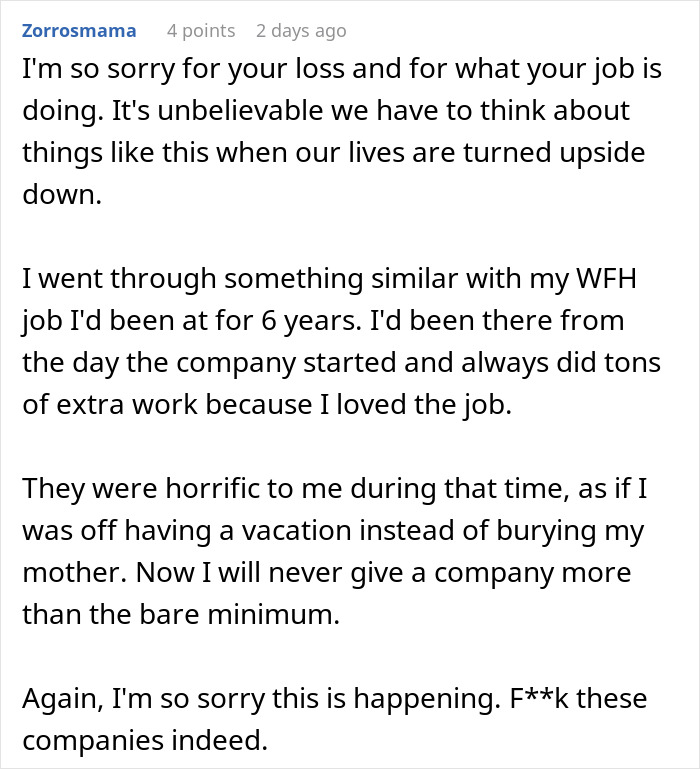
Not being an American, I find this post absolutely amazing. American companies appear to be totally heartless and want to work everyone to death to make every dollar. I'm so glad that my working life was not like that. As far as I'd be concerned, "home" is where the wi-fi and laptop are. Stuff the lot of them.

This is interesting. I WFH for a mostly-remote company. We can work (read:live) in several states, as long as there is a tax agreement between the state you live in and our headquarters. I don't pretend to know any details, but some of my coworkers say that if you need to work in another state temporarily, just don't mention it. I'm going to a state where we don't have a tax agreement to help my sister after surgery. Am I going to share my location? Nope. They'd have to look at my IP address to find out, and it's not likely they will go that far. It's a shame that some companies choose to be jerks about it.

My partner was given 3 months of paid time off when his mum died 2 years ago. He was the executor of her will and had to make funeral arrangements etc. He also suffered terribly with his mental health as he was very close to his mum and he cared for her in the last few years of her life. The company was brilliant in the whole thing. This is a US company who operates worldwide, the UK in this instance.


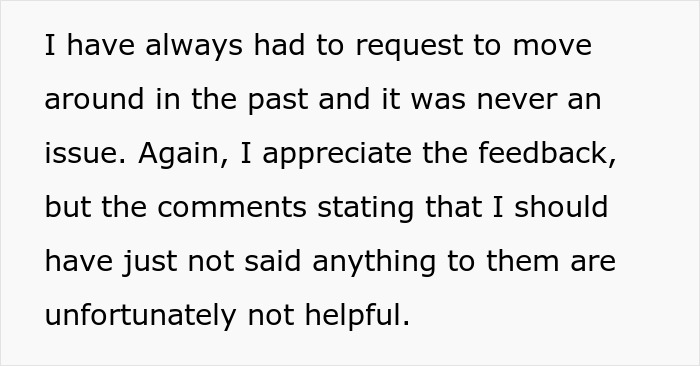
Doesn't provide all the Information, says people in the comments aren't helpful with their advice. F this person. You posted it looking to get your story out there, then you get mad when people try to offer advice based on the information you provided.
Grow up. A company is made up of hundreds if not thousands of individuals and can not accommodate each person’s individual requests. A “company’s” priority it the health of the company, not individuals because without that, the company will fail for EVERYONE. You have to remember, the world does NOT revolve around you and you are not the only pebble on the beach. You want special treatment because your mother died, the next may want it because their “emotional support” rat died. Again, grow up, use the time offered within the company’s benefits. Smh

If something happens to you on company time they are liable. Might also be a factor in the decision
Not all bosses. My sister lives in UK, and when it became evident that my mother's cancer would carry her away, my sister asked for permission to work from France. Her boss said no problem, as long as the work is done. Same when my Dad fell ill 2 years later. She'd been WFH since Covid, anyway.
Yep dame here in ireland. One company I worked for did have some restrictions on where you could work from which was fair enough as it was due to licensing issues in other countries. Even with a vpn I couldn't log into my work from some countries. But they gave me as much paid time off as I needed due to a bereavement. Any companies I've worked for since I've had no issues so long as the work is being done. I don't think I could work for a company that treated employees the way I'm constantly reading about on reddit.
Load More Replies... It is ALL about controlling the employees. If your job can be done remotely there is no reason why it shouldn't be. If your job only needs you on premises a few days a month, the employee should be able to do that. Companies hire adults yet turn around and treat them like naughty children. IS the job getting done? Are they producing good work? Then if they can do it from home, step off and let them continue. Trust the people you hired are doing what you hired them to do and for those that you do not think are doing the job, deal with them individually, you don't need to make stupid sweeping policies.
While it's usually a control issue, sometimes it's a tax problem. Whatever state you're WFH in wants income taxes, and the state your employer has a presence in might withhold taxes which you don't actually owe. Now you have to file two returns and might have to pay taxes out of pocket until the withholding refund from the other state comes in, but people don't realize that so they start howling at their employer. The employer now has to figure out what to do, which gets complicated. Span that out across 50 states and it gets expensive to manage. Large corporations that have a presence in most states can handle it pretty well but some mid-tier corp that only spans 2 or 3 states can find it getting messy pretty quick.
I’m curious. My impression, and it could be wrong, was the relocation was lengthy but not permanent. Would a temporary relocation matter if OP was maintaining his original permanent residence?
Load More Replies... Iif you work from home anyways why is it a big deal to them? The job I have I can't work from home because I am a chef. I wish there was mandatory PTO for bereavement in the USA. If you don't
Not being an American, I find this post absolutely amazing. American companies appear to be totally heartless and want to work everyone to death to make every dollar. I'm so glad that my working life was not like that. As far as I'd be concerned, "home" is where the wi-fi and laptop are. Stuff the lot of them.
This is interesting. I WFH for a mostly-remote company. We can work (read:live) in several states, as long as there is a tax agreement between the state you live in and our headquarters. I don't pretend to know any details, but some of my coworkers say that if you need to work in another state temporarily, just don't mention it. I'm going to a state where we don't have a tax agreement to help my sister after surgery. Am I going to share my location? Nope. They'd have to look at my IP address to find out, and it's not likely they will go that far. It's a shame that some companies choose to be jerks about it.
My partner was given 3 months of paid time off when his mum died 2 years ago. He was the executor of her will and had to make funeral arrangements etc. He also suffered terribly with his mental health as he was very close to his mum and he cared for her in the last few years of her life. The company was brilliant in the whole thing. This is a US company who operates worldwide, the UK in this instance.
Doesn't provide all the Information, says people in the comments aren't helpful with their advice. F this person. You posted it looking to get your story out there, then you get mad when people try to offer advice based on the information you provided.
Grow up. A company is made up of hundreds if not thousands of individuals and can not accommodate each person’s individual requests. A “company’s” priority it the health of the company, not individuals because without that, the company will fail for EVERYONE. You have to remember, the world does NOT revolve around you and you are not the only pebble on the beach. You want special treatment because your mother died, the next may want it because their “emotional support” rat died. Again, grow up, use the time offered within the company’s benefits. Smh
If something happens to you on company time they are liable. Might also be a factor in the decision




































 No fees, cancel anytime

















30
28