Get Premium
Dark mode theme is available exclusively for premium users. Learn more about the benefits of subscribing.
No fees, cancel anytime.

 Dark Mode Ad-Free Browsing Unlimited Content
 Ad-Free Browsing Unlimited Content Dark Mode
Join 1.2 million Panda readers who get the best art, memes, and fun stories every week!

A new reason for millennials’ inability to buy a house in the current market has emerged.
Home ownership among the 25-40 age group has been a subject of controversy in the real estate industry, as the percentage of millennials owning property has steadily decreased each year.
Recent research in the Australian real estate market has shown that a viral trend, popularized by Hollywood, could be hurting millennials’ borrowing capacity.
Potential homeowners spending heavily on this new fixation is reportedly a factor that money-lending institutions are taking into account when deciding who gets to take out a house loan, according to an expert.
Image credits: Vitaly Gariev/Pexels (Not the real image)
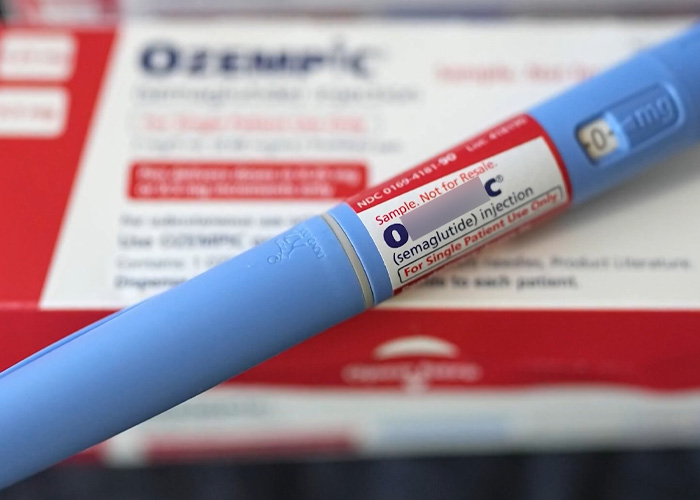
According to Money.com.au, the use of viral GLP-1 weight-loss medications, such as Oz*mpic, Mounjaro, and Wegovy, is affecting Australian millennials’ homebuying capacity.
GLP-1 injections are prescription medicines that help diabetic patients manage weight by regulating blood sugar levels and appetite. However, it became popular as a weight-loss solution after several Hollywood celebrities and influencers admitted to using GLP-1.
The study found that the average Australian is spending $610 a month on weight-loss injections, which is significantly reducing their borrowing power.
Image credits: Andrea Piacquadio/Pexels (Not the real image)
The platform’s senior mortgage broker specialist, Debbie Hays, said that a regular expense of that magnitude could raise questions when calculating the Household Expenditure Measure (HEM). It is a benchmark used by Australian lenders to assess the minimum expected level of household spending of the loan applicant.
“When you submit your bank statements to a lender, it is their obligation to go through them, and if they find a regular direct debit of $700, they will question what it is,” Hays told Daily Mail.
“It’s a higher expense than private health cover for a single applicant, so a lender can determine it reduces their borrowing capacity by $80,000 to $100,000.”
The American dream is dead. Housing ownership was already out of reach for Gen Z and young millennials
Now rent is unaffordable to the point where they need BNPL for it
We have destroyed upward economic mobility and family formation for the younger generation https://t.co/eMPe5zimK0pic.twitter.com/0XnJzFLmik
— Boring_Business (@BoringBiz_) February 6, 2026
A $610 monthly expense is about 15% of the average $4,180 monthly mortgage payment in Australia.
Even if an individual was taking the medication as prescribed, the outcome would be the same.
About 17% of Australians currently take GLP-1 injections, but only 7% take them for a medical condition like diabetes, according to the Daily Mail report.
Image credits: Freepik (Not the real image)
“If someone is overweight and starts taking these dr*gs and they also want to save for a home, it impacts their borrowing ability,” Hays added.
In the current market, borrowers should consider every expense to be held against them and disclose their expenses accordingly, Hays warned.
Another Money.com.au report, published in January, showed that one in five potential homeowners significantly underestimated their living expenses when applying for a mortgage.
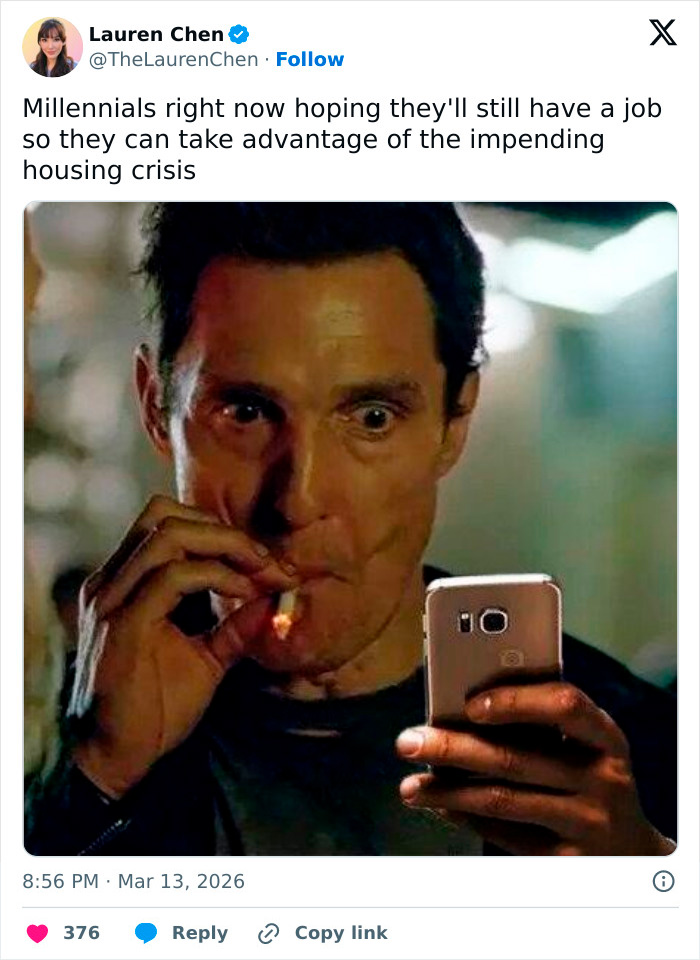
Image credits: TheLaurenChen
“Most people don’t know how much they spend each month,” Hays said in the report.
“More often than not, mortgage applicants will have an estimate of their living expenses, and when you go through their bank statements, you find glaring inconsistencies. You want to find those errors before you submit your loan application.”
Image credits: pavel-danilyuk/Pexels (Not the real image)
Over the past three decades, the real estate ownership scenario in the United States has changed dramatically.
An infographic by Markets in a Minute, reported by Visual Capitalist based on Federal Reserve data, showed that millennials own less than two-thirds of the real estate that baby boomers owned at the same age.
In 1991, the silent generation owned 65% of the homes, and baby boomers owned the rest. In 2025, boomers account for 41% of real estate ownership, Gen X owns 30% of the homes, and the silent generation’s share has dropped to 9%.
Image credits: WFAA
Millennials, who owned zero percent homes in 1991, now account for only 21%.
In 2020, only 37.3% of homeowners in the USA were under age 35, according to a report by The Zebra Insurance.
A National Association of Realtors (NAR) survey found that some of the largest and most expensive housing markets in the country had the lowest percentage of millennial homeowners.
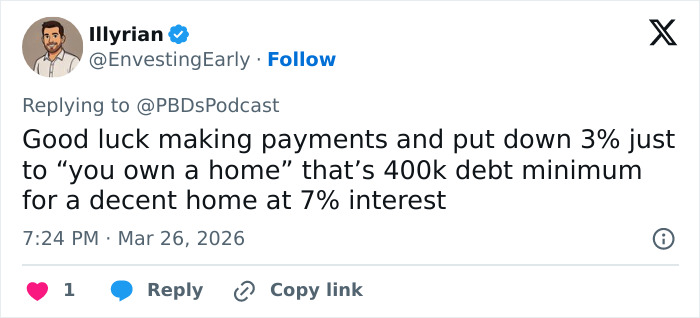
Image credits: EnvestingEarly
Image credits: Deborah Hays
In Los Angeles, only about 30% of households aged 25-44 own their home. In San Jose, the home-ownership rate for this age group is about 34%, and in San Francisco, around 37%.
In New York and San Diego, the percentage is well below the national average.
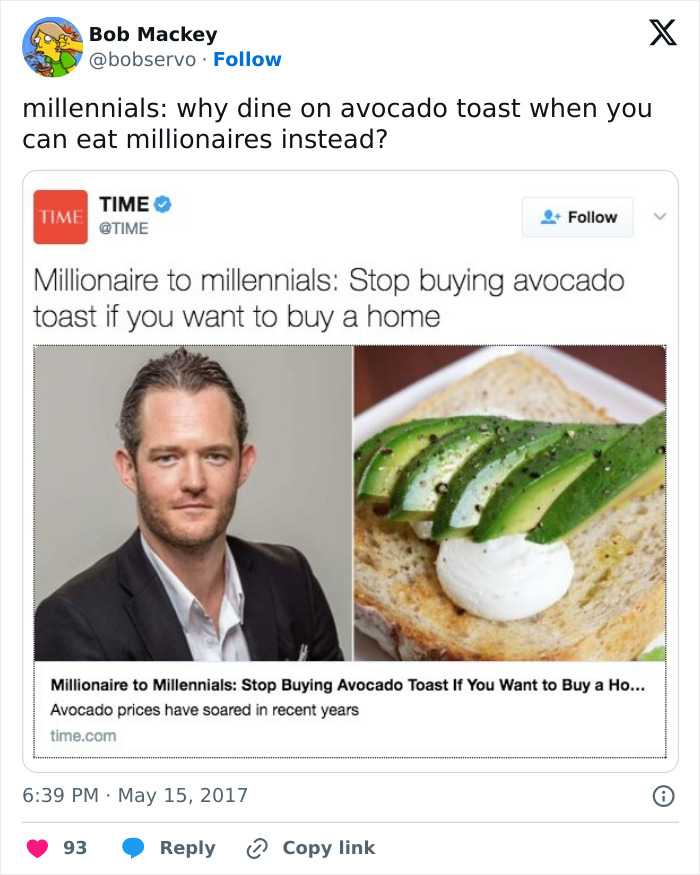
Image credits: bobservo
Australian real estate mogul Tim Gurner said in 2017 that millennials were not able to buy homes because they were spending on things like “avocado toast brunches.”
His suggestion gave rise to the viral avocado toast memes. “I ate avocado toast this morning and now I’m homeless,” one of the jokes from the time read.
But it also kick-started a discourse in which several other everyday expenses, such as lattes and streaming services like Netflix, were blamed for the low millennial home-ownership rate.
However, surveys show that the reality is much different.
Image credits: antiAntag0nist
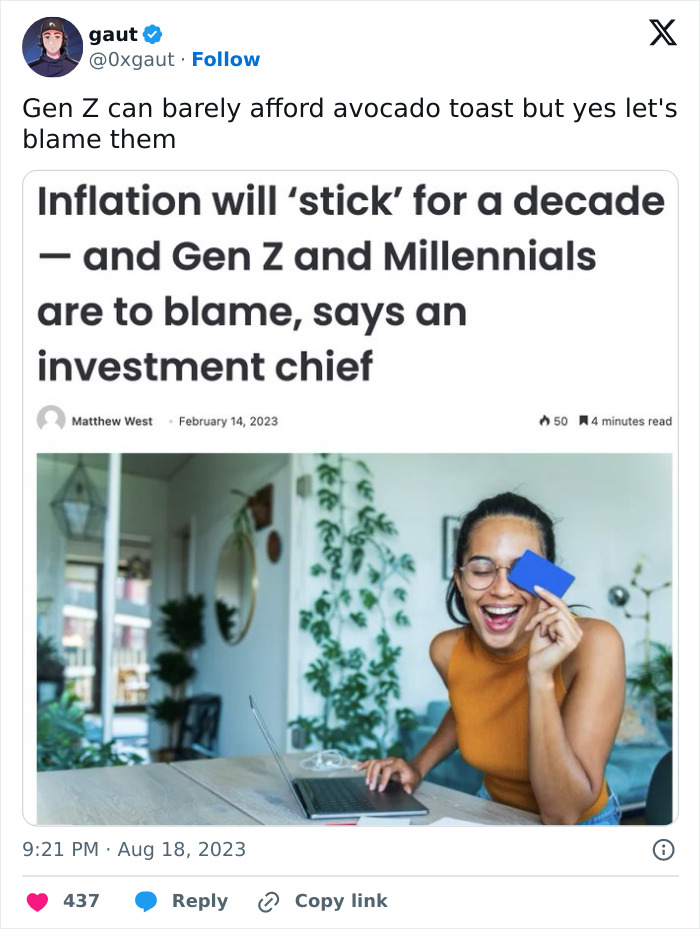
Image credits: 0xgaut
A Redfin report published by National Mortgage Professional said that since mortgage rates began rising in 2022, from 3% to 7%, housing affordability plummeted even further. In early 2024, the average monthly payment for a new home hit a record high of $2,800.
For millennials, there were several other factors as well.
According to NAR, more than 50% of home buyers under 36 said student debt delayed their home buying.
Image credits: Marta Klement/Pexels (Not the real image)
A tighter lending standard is another reason.
Banks have tightened credit underwriting to reduce risk and doubled down on the 20% down payment rule for homebuyers. With inflation, millennials are requiring longer to accumulate enough wealth to put down on a home.
“Remember that the bulk of the current 25- to 34-year-old cohort started their careers during the financial crisis and early stages of the recovery, when the economy and labor market were fragile,”
Millennials are unable to own a house now because the prices have been completely jacked up, and to make matters worse, rent has also gone up—so you can’t even save enough to pay for a mortgage. pic.twitter.com/6u89F8pmWY
— Ian Miles Cheong (@ianmiles) November 11, 2023
Getting married or starting families later in life, compared to baby boomers, is another reason often cited for the delay in millennial homebuying. However, in many cases, it is the other way round.
Studies have found that the inability to buy a home has often deterred millennials from tying the knot or having a baby.
“Millennials are trying to navigate a constricted and racist housing market and a nation with outdated urban infrastructure, so much of which is out of line with what we want and what we need to remain gainfully employed, financially stable, and moderately happy,” journalist Jill Filipovic wrote in her 2019 book, Ok Boomer, Let’s Talk.
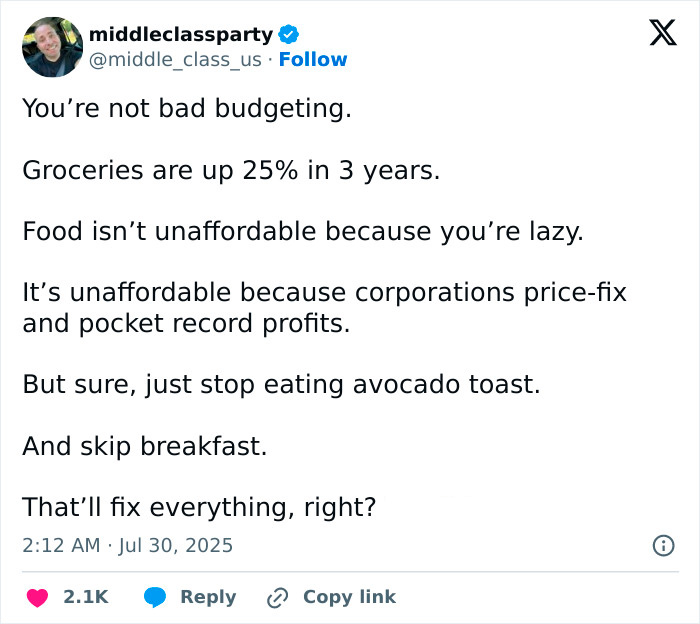
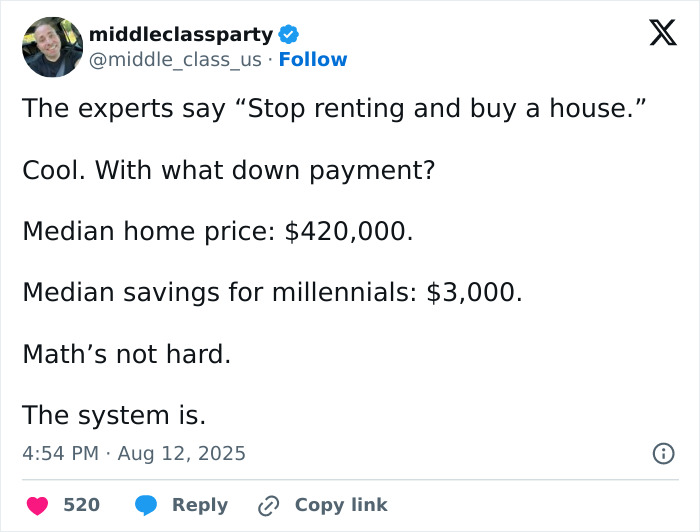
Image credits: middle_class_us
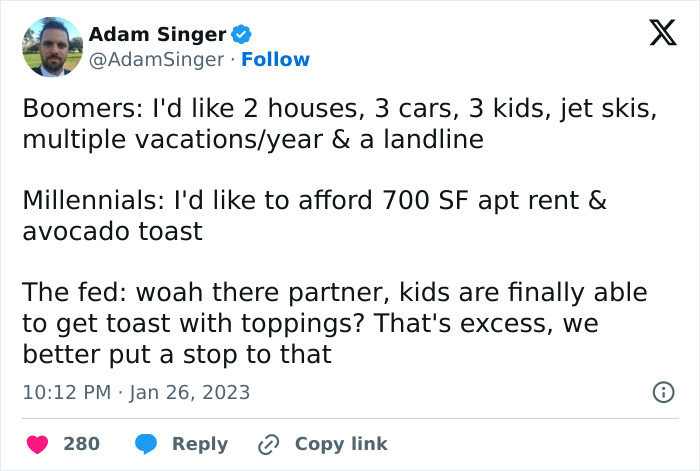
Image credits: AdamSinger
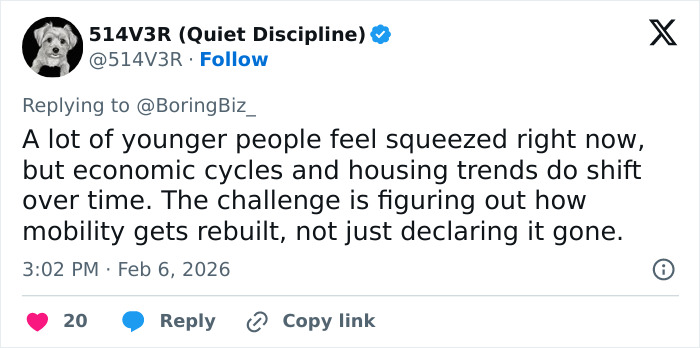
Image credits: 514V3R
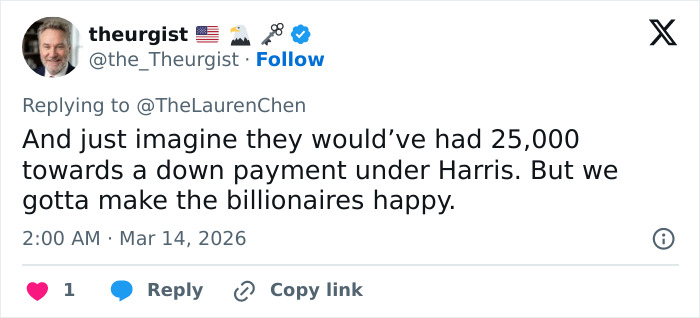
Image credits: the_Theurgist
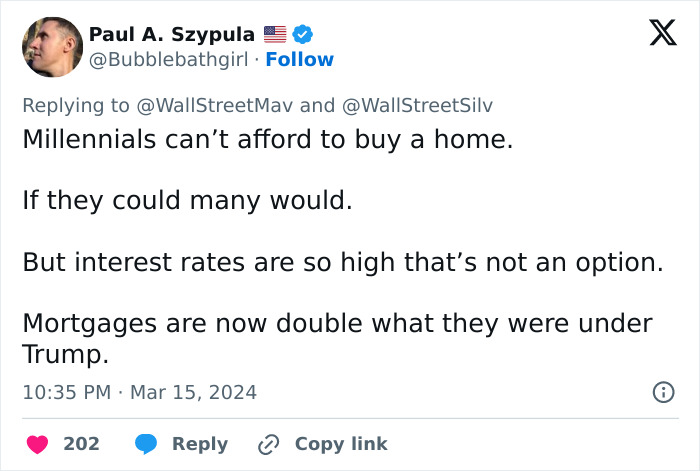
Image credits: Bubblebathgirl
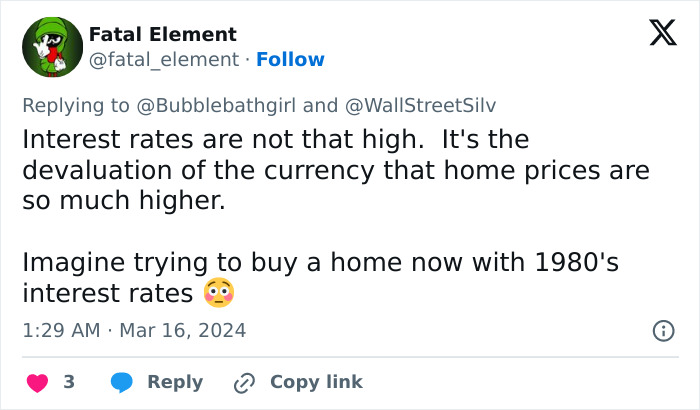
Image credits: fatal_element
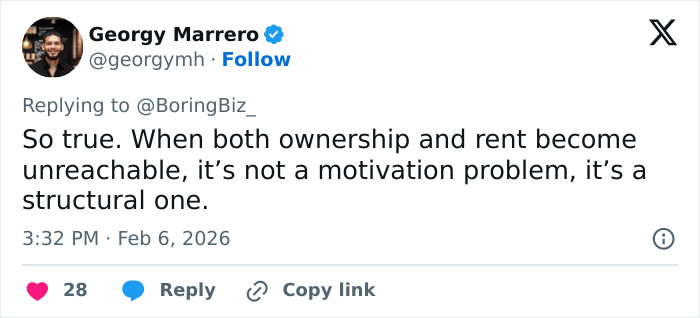
Image credits: georgymh
Image credits: middle_class_us
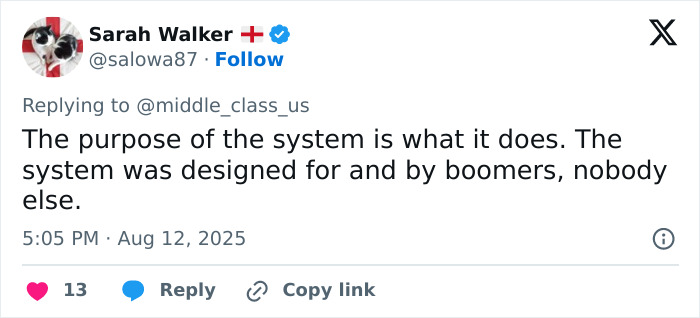
Image credits: salowa87
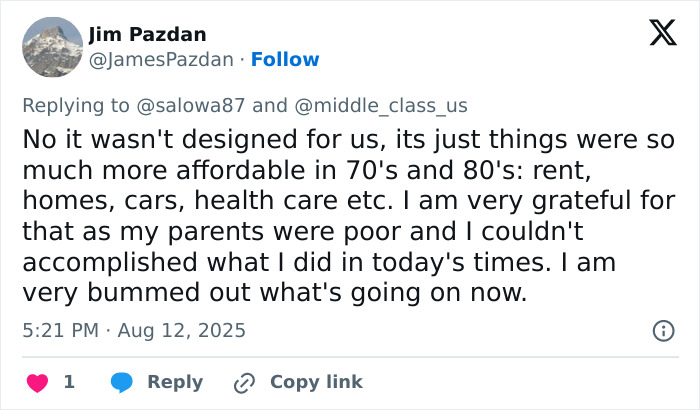
Image credits: JamesPazdan

By entering your email and clicking Subscribe, you're agreeing to let us send you customized marketing messages about us and our advertising partners. You are also agreeing to our Privacy Policy.
Thank you! You've successfully subscribed to newsletters!



14% of the readers of this [???] are born before 1981? Cause 14% have voted "They don’t save enough".
14% of the readers of this [???] are born before 1981? Cause 14% have voted "They don’t save enough".























 No fees, cancel anytime










23
3