Get Premium
Dark mode theme is available exclusively for premium users. Learn more about the benefits of subscribing.
No fees, cancel anytime.

 Dark Mode Ad-Free Browsing Unlimited Content
 Ad-Free Browsing Unlimited Content Dark Mode
Join 1.2 million Panda readers who get the best art, memes, and fun stories every week!
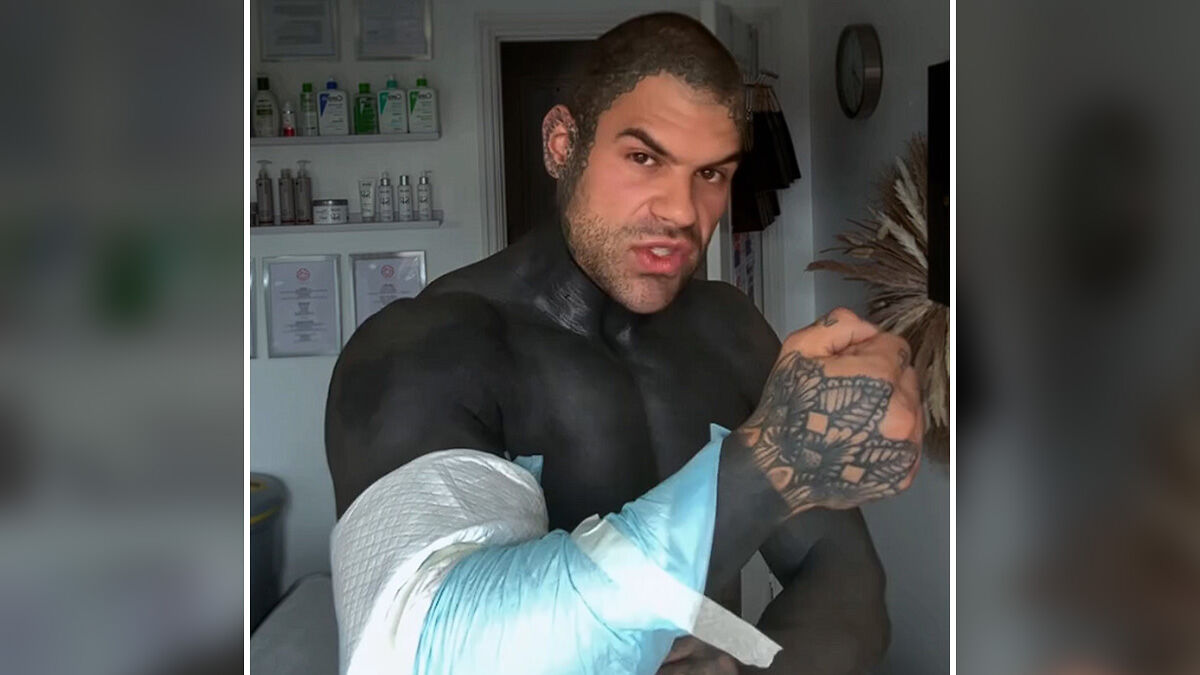
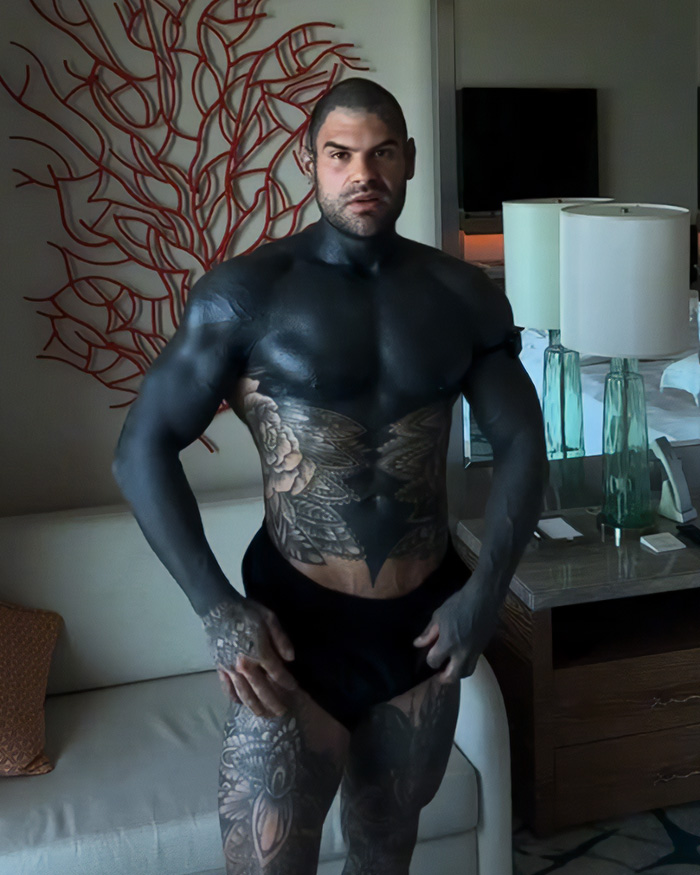
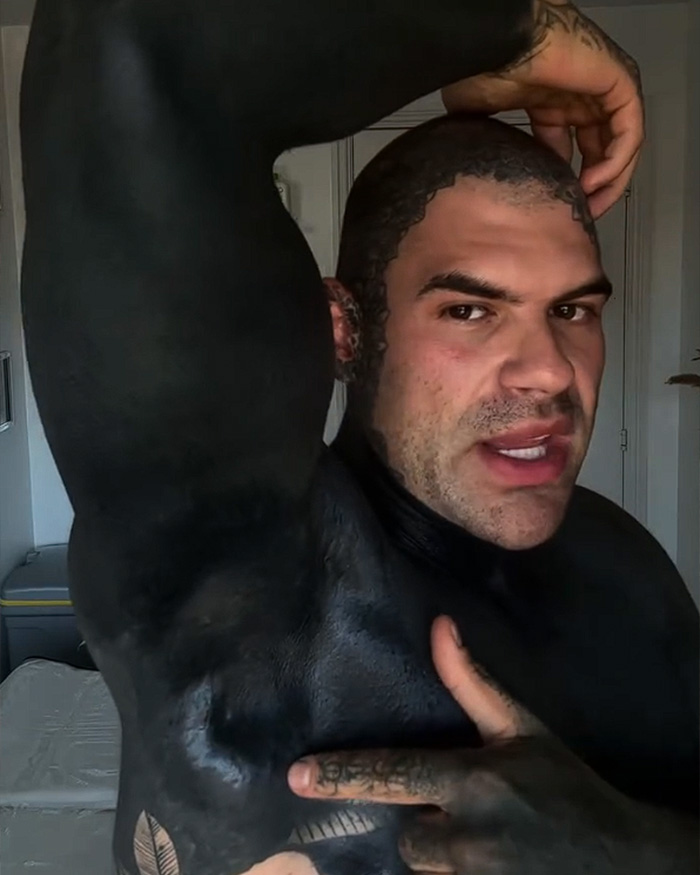
Dave Chudley, a Portsmouth, England-based influencer working toward covering 90 percent of his body in blackout tattoos, has over the past few months shared some of the harsh realities he wishes he had understood before committing to the trend.
He initially assumed blackout tattoos were simply “coloring in” and therefore an easier option compared to detailed tattoo work. However, he now says that reality is far more complex.
“It’s not just coloring in,” Chudley explained. “It’s about not damaging the skin in the process and achieving that smooth finish and complete saturation.”
He also noted that the process requires a highly skilled specialist rather than a general tattoo artist—something that was particularly difficult to find when he began his journey.
Image credits: ink.body1/Instagram
During one Q&A session, Chudley was asked why he chose this form of tattoo, to which he simply replied, “I just like how it looks.”
However, he later clarified in another post, “People think it’s easy; it’s not. It’s far from it. It’s actually very, very difficult.”
He used his own first attempt to illustrate that point.
Image credits: ink.body1/Instagram
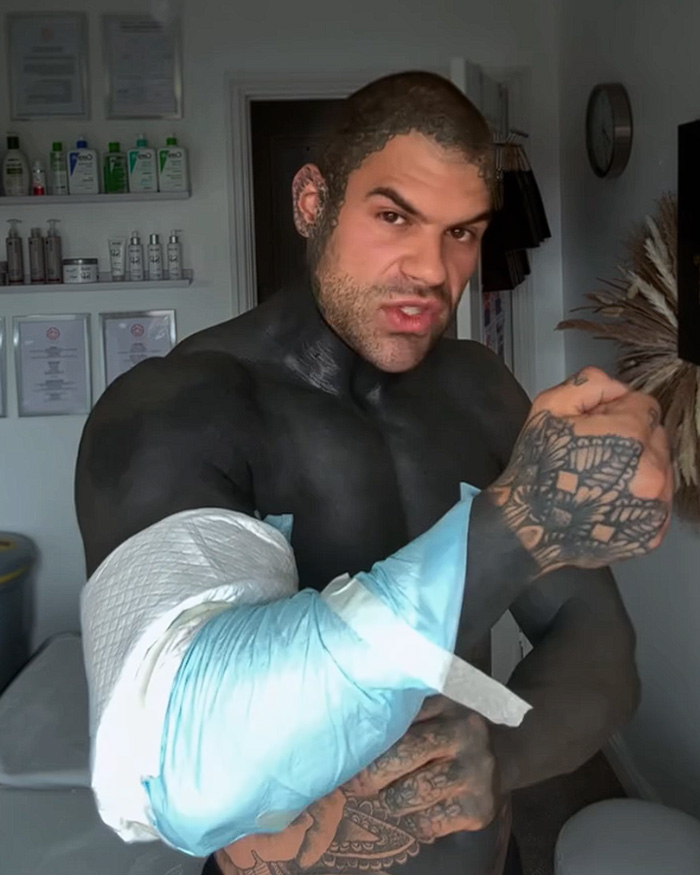
Chudley began his blackout journey with his forearm in 2020, but the result didn’t turn out as he had envisioned. It was unsatisfactory enough that he ultimately had it fully removed and started again from scratch.
He explained that part of the issue was that blackout tattooing was new at the time.
“We didn’t know a lot about it back then. It was more than artists would experiment alongside you as they were doing the work,” he said.
That experience led him to seek out Johnny Ransom, a tattooist who works out of Berkshire and focuses exclusively on blackout work.
Image credits: ink.body1/Instagram
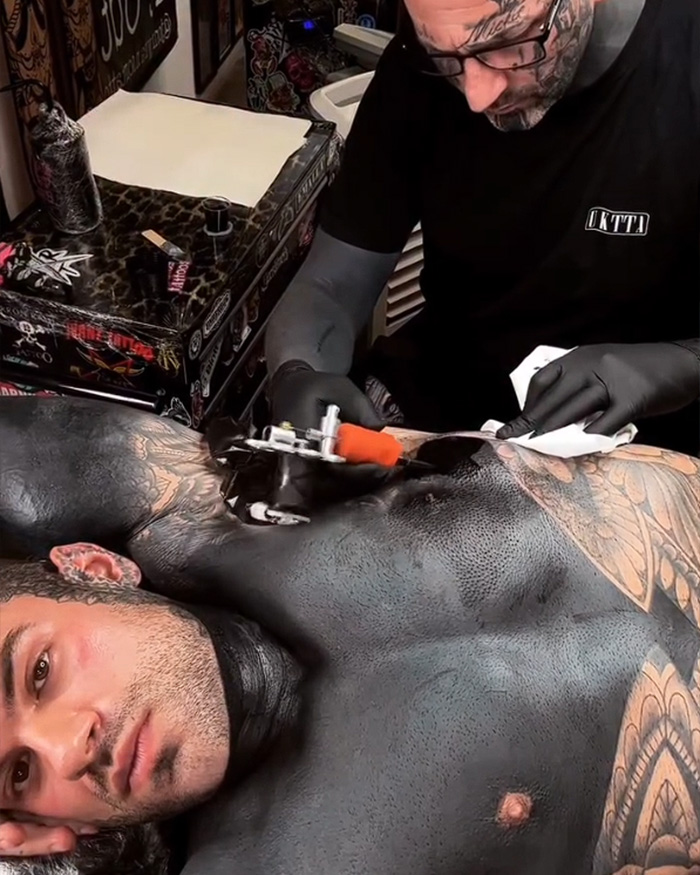
Blackout tattoos are among the most technically demanding forms of tattooing, requiring extensive time and precision to uniformly cover large areas of skin
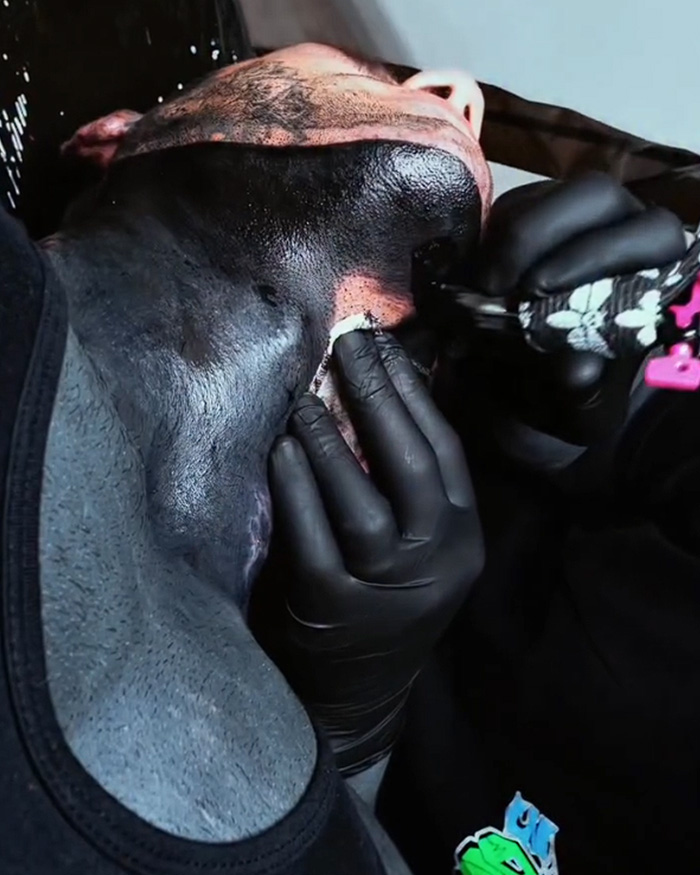
The process is challenging not only for the tattoo artist but also for the client, who has to endure multiple long sessions to achieve the desired result.
As the tattoo heals, it is normal to experience redness, swelling, peeling, and itching, as documented by Chudley.
The influencer now believes that what was once a trial-and-error process has become far more standardized across the industry.
“There is a very clear blueprint for how the work is done. We know what inks to use, what needles to use, what machines to use, and exactly how to achieve the best healing results,” he said.
Healing, however, only comes after enduring the initial pain of the blackout process itself.
According to Chudley, it is significantly more intense than traditional tattooing, as it involves “beating the same spot over and over for hours on end in order to get it all black without patches or gaps.”
Image credits: roxx_____/Instagram
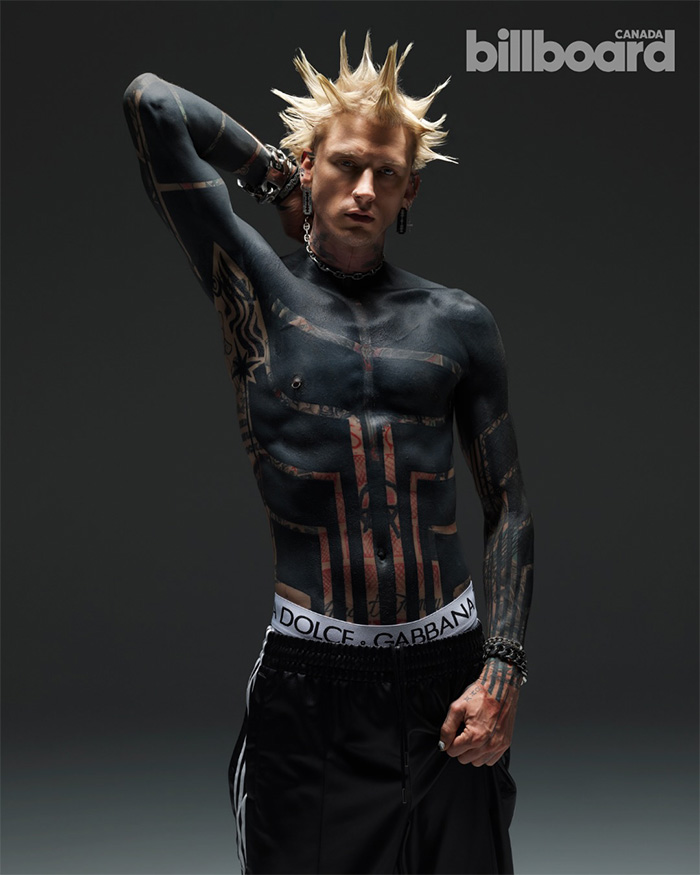
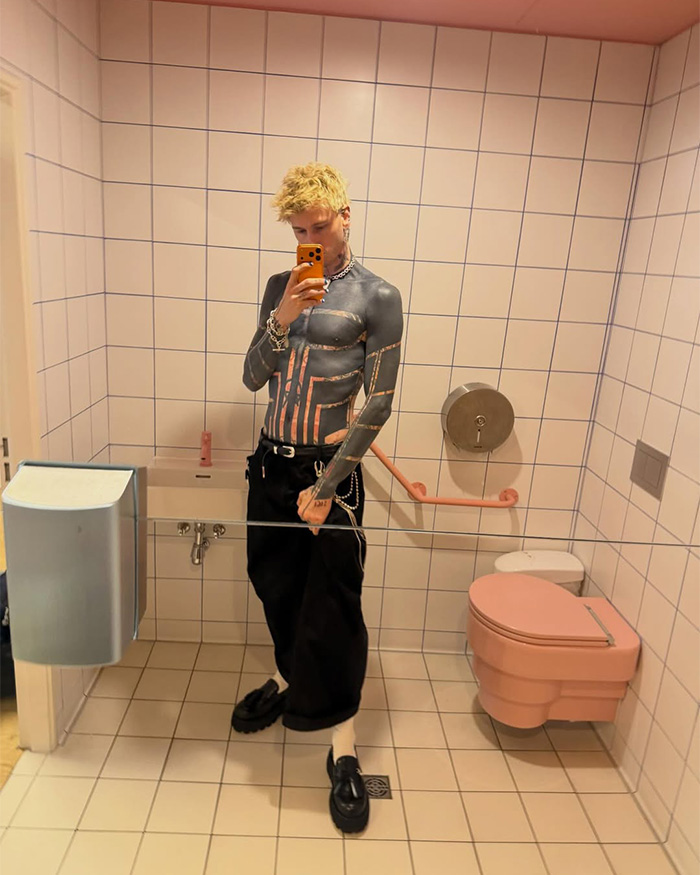
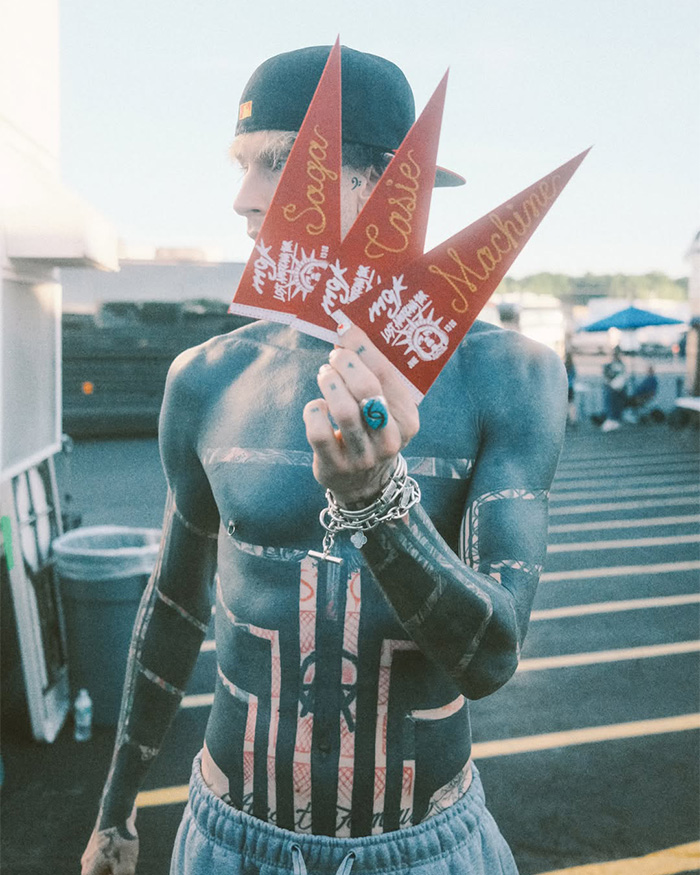
Machine Gun Kelly debuted a blackout tattoo covering his upper body, including both arms and chest, on Instagram in February 2024.
“For spiritual purposes only,” he captioned his post.
Image credits: machinegunkelly/Instagram
While the tattoo appeared impressive and unique to his followers, the behind-the-scenes toll it took on the musician was immense.
In an exclusive cover story interview with Billboard Canada, published on Monday, June 8, MGK detailed various physical complications he experienced during and after the tattooing process.
Image credits: machinegunkelly/Instagram
It all began when the musician compressed the proposed safer two-year timeline from his tattoo artist ROXX into two months.
“After the first week, we hit my lymph nodes around my armpits and shoulders, and I got really sick,” MGK told the outlet.
“My skin was turning yellow. I wasn’t able to sleep. I stopped being able to move certain parts of my upper body,” he added.
Speaking with Logan Paul on his Impaulsive podcast in August 2024, MGK had said that getting a blackout tattoo was “the most excruciating thing” he’d done in his life.
“There was a point where I gave up and just felt like I was d**ng,” the rocker confessed at the time, noting that he would sit through six-hour-long sessions every single day.
He added that the process felt even worse because his “body was already tattooed” underneath the blackout, “so essentially you’re just tattooing over scar tissue.”
Image credits: ink.body1/Instagram
David E. Bank, director of The Center for Dermatology, Cosmetic and Laser Surgery in New York, told Women’s Health magazine in 2016 that “since the black ink contains iron oxide, it makes it difficult for MRI scanners to heat up and actually take a reading.
“The area might also swell or feel like it is burning while under an MRI.”
New York dermatologist Dr. Howard Sobel added, “With such large, dark tattoos, it’s very difficult for a physician to distinguish between a normal mole and one that’s abnormal or even melanoma.”
Image credits: ink.body1/Instagram
Earlier this month, Dr. Ben LaHood, an ophthalmologist and clinical lecturer based in Adelaide, spoke exclusively with Bored Panda and shared a case in which he faced “difficulty determining whether a small inflammatory lump was cancerous” in a patient who had their eyes injected with black ink.
“The pathologist also had difficulty analyzing the sample as the ink made microscope analysis difficult to look for cancer cells,” he detailed.
“They eventually underwent biochemical analysis to look for cancer markers, and this came back negative.”

By entering your email and clicking Subscribe, you're agreeing to let us send you customized marketing messages about us and our advertising partners. You are also agreeing to our Privacy Policy.
Thank you! You've successfully subscribed to newsletters!


TIL B*****D is censored. Reminds me when I worked at UPS (in USA), we weren't allowed to swear on the radios, but I worked with a English guy who said "bloody" all the time, but that was okay lol.
Load More Replies...
TIL B*****D is censored. Reminds me when I worked at UPS (in USA), we weren't allowed to swear on the radios, but I worked with a English guy who said "bloody" all the time, but that was okay lol.
Load More Replies... 





 No fees, cancel anytime























24
24