Get Premium
Dark mode theme is available exclusively for premium users. Learn more about the benefits of subscribing.
No fees, cancel anytime.

 Dark Mode Ad-Free Browsing Unlimited Content
 Ad-Free Browsing Unlimited Content Dark Mode
Join 1.2 million Panda readers who get the best art, memes, and fun stories every week!

Childhood logic has a special way of turning one tiny observation into an elaborate rule that somehow feels more believable than reality itself. A harmless noise, a strange phrase, or something an adult casually said can become the foundation for an entire imaginary system of facts, and once a kid decides that’s how the world works, there’s usually no reason to question it.
That was the idea behind a recent Threads prompt asking people to share something they genuinely believed as children that they now realize was completely insane, with a specific request for the weird ones rather than the usual Santa stories. The responses delivered plenty of interesting, deeply specific lore that their younger selves apparently accepted without a second thought.
From completely invented explanations about how everyday things worked to oddly detailed beliefs that somehow went unchallenged for years, these confessions show just how confidently children can build their own version of reality.
This post may include affiliate links.
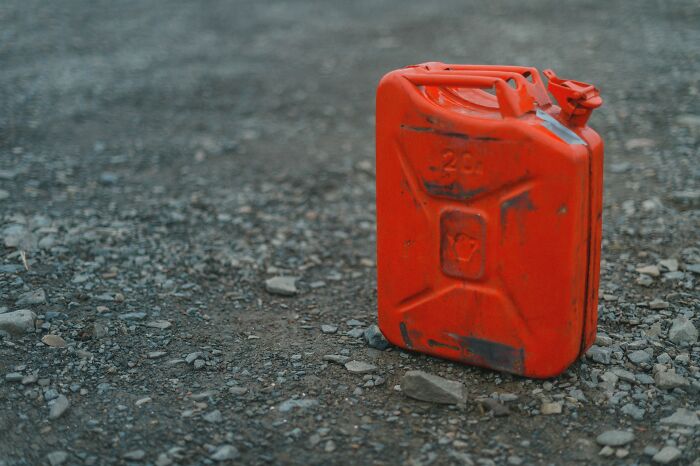 When I was little I dumped a gas can over my head, ingesting a fair amount. My parents told me I could never smoke because of it, that Id blow up. Im embarrassed by how old I was when I realized the truth. But also, it kept me from smoking, so yay!?
 I believed my stuffies had feelings and would rotate them around in my bed so they all had a chance to be close to me/in a good spot.

I would do this too! I didn't want any of mine to feel left out. My stuffed German Shepherd, Chace, always got the prime spot (hugged in my arms!) but everyone else got put in a rotation XD I still have Chace and he still sleeps in bed with me! He is 39 years old now XD (see photo below.)
 I thought the sole qualification for becoming a librarian was to read every book in the library. Nobody ever told me this - I just assumed. So whenever I visited the huge downtown library with multiple floors, I was deeply impressed by the librarians for having read so many books.
(I’m still impressed by librarians but it’s no longer based on this assumption).

Totally agree with last sentence. Librarians are awesome and libraries are like an amazing gift to us all.
Children have a remarkable ability to turn a confusing moment into a perfectly reasonable explanation, even when that explanation makes very little sense to an adult. Parenting Science explains that children are naturally motivated to make the world feel predictable and understandable, so when something surprises them or doesn't fit with what they already know, they try to fill the gap.
Rather than simply accepting that they don't know why something happened, they may build a simple explanation using ideas about cause and effect, purpose, or agency. The stranger the event, the more tempting it can be to come up with a reason for it.
 During flu season, some classmates had missed a week of school. When they returned, the teacher had them all go to a separate room during recess to do a “make up lesson”, which I assumed was about lipstick and mascara. I asked the teacher when the rest of us would be doing the makeup lesson, and she said the next time we got sick. So I assumed that, whether you were a boy or girl, after your first major illness you would be taught makeup techniques as, like, a rite of passage.
 My name is Larissa but my whole family always just called me Rissa and I was only Larissa if my mom was mad at me. So I thought you just added “La” before someone’s name when you’re mad at them. I was mad at my uncle DJ and called him (angrily) LaDJ and everyone laughed.
 My brother’s name is Aaron. When my mom said she needed to run errands, I thought she said she was running Aarons, and that it was her way of saying she was shopping for/spending time with my brother. For a couple of years I stayed home wondering when she’d start running Leahs.
That tendency is actually part of how children learn. An unexpected event can prompt them to form a hypothesis about what caused it, giving them a chance to adjust their understanding as they encounter new information. The explanation might be wrong, but the process is useful because children are essentially testing different ways of making sense of the world.
This helps explain why a child can develop an elaborate rule about something completely ordinary: once the explanation makes sense within their limited mental model, there may be little reason for them to question it. They also point to children's tendency to assume that objects and events have a purpose, meaning a child may look at something in nature and instinctively decide that it must exist for something.
 My grandmas house was full of weird knickknacks and figurines. I had convinced myself that I could make myself invisible to all of them (in case they were evil, of course), but she had this one statue of a beetle thing in the room I’d sleep in. For whatever reason, I believed that bug statue could see me even when i was ‘invisible’, and it FREAKED me out.
 I thought that I had to go and live with my grandparents because my parents were having another baby (my only sibling). Mum was having a home birth and they had told me that when mum goes into labour that I’ll have to go to grandma and grandad’s house. My autistic a*s just assumed that since the new baby was gunna be there they didn’t need me anymore. I was picked up in the middle of the night and was really sad that my parents didn’t seem that upset that I was going. I stayed up all night cont.
 …that vapour trails from planes was when someone flushed the toilet on a plane. Ha ha they all laughed and laughed at me. Then breaking news, a huge chunk of blue ice crashed through someone’s roof and was from an airplane lavatory. Who’s laughing now!?
We all told each other that the vapor contrails were from planes "releasing" their pée tanks into the sky XD I guess believing that planes dumped their peé tanks mid-flight in midair is my ridiculous childhood belief :p
As children develop, however, they are also learning where imagination ends and reality begins. Tulsa Kids notes that by around ages 3–4, many children can distinguish pretend situations from real ones in straightforward circumstances. Yet that boundary isn't always firm.
A child can know that an imaginary friend isn't physically present while still saving them a seat at dinner, or understand that monsters aren't real while becoming genuinely worried about one after a frightening story. Their judgment can shift depending on how emotionally powerful or vivid an idea feels, which helps explain why something imaginary can occasionally become convincing enough to influence their behavior.
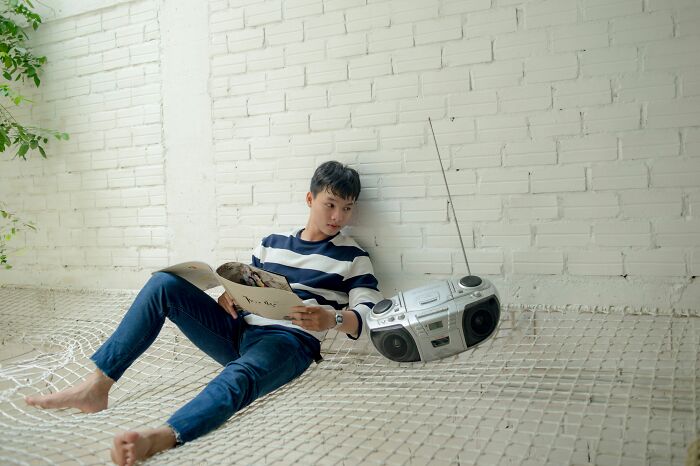 Absolutely convinced all music on the radio was being played live. And when there was d**d air, that was when the previous band was taking too long to get out of the studio for the new band to start their song. Mind boggling realization in the 5th grade.
Ah yes, I too spent time sitting on a horizontally-mounted soccer-goal net with my boom box next to me, much like the youth pictured in the stock photo above! :p /s seriously what the hell is up with that net??
 I heard someone say “turn that fat into muscle” so I thought that was literal for a very long time.
Up until 8 months ago, I thought underwater basketweaving was happening with the person fully submerged in the water as well…like in scuba gear, like underwater welders.
 My mom used to tell me that if I didn’t eat the crusts on my sandwich that I would never be able to whistle.
The situation surrounding an idea can make that effect even stronger. Something that seems obviously fictional in one setting may feel much more believable in another, particularly when darkness, an adult's tone of voice, or repeated warnings are involved. Vivid and recently encountered ideas are also easier to picture, which can make them feel more plausible.
A child who has heard about something repeatedly may therefore give it more weight than an adult would. Their ability to think about their own thoughts and evaluate what they actually know is still developing, so they may rely heavily on familiarity, emotion, and whatever explanation feels most immediately convincing.
 Okay so...
You don't have to pay for cold water.
You only have to pay for hot water. Because you've got to pay to heat it up.
I learned, at the tender age of nineteen, that in fact, you pay for the water regardless if it's hot or cold.
 Chocolate milk came from black and white cows.
 My parents would often asked each other "what are we going to do in the mean time?" meaning the time between two other events. I did not know this and would absolute lose it thinking my parents were trying to plot ways to be mean to me at an unspecified future time.
That also helps explain the famous childhood habit of asking "why?" According to Psychology Today, children aren't simply trying to annoy adults with an endless stream of questions; they are working out how causes and consequences fit together.
They want explanations that make events feel complete and predictable, but an explanation doesn't necessarily have to be accurate to satisfy that need. Children can be more interested in whether an answer seems to fit their question than whether it has been properly verified. A simple explanation can therefore become surprisingly powerful if it neatly fills the gap in their understanding.
 All my school teachers lived together. Like in a giant frat house of sorts.
 I use to think my mom said "patience or ill hurt you" it wasnt till I was in my late teens I realized she was saying patience is a virtue.
 When I was a kid I would sleep with the covers over my head because I was afraid of monsters in the dark, but I would keep the top of my head exposed thinking the monsters would see my hair and think “oh the werewolf already got to him we can leave”
Little did the monsters know, there wasn’t a werewolf and it was just little me under those covers. D**n fools.
Purpose-based explanations can be particularly appealing because they make complicated things easier to understand. Instead of dealing with a complicated chain of causes, a child can decide that something exists because it has a particular job or purpose. They may also assume that everything must have an explanation, making "nobody knows" an unsatisfying answer.
Add a trusted adult, an exciting story, or a frightening idea, and the explanation can become even harder to challenge. A child may technically know that something isn't real while still treating it as a useful rule for navigating the world.
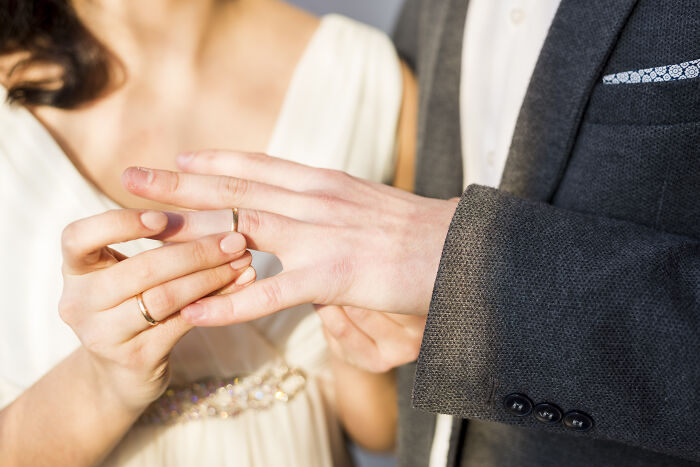 I believed that when the husband put the wedding ring on his bride, that something magical went into her hand, traveled down her arm, into her body and made a baby in her tummy. Until I was about 12 or 13. (A girlfriend finally wised me up).
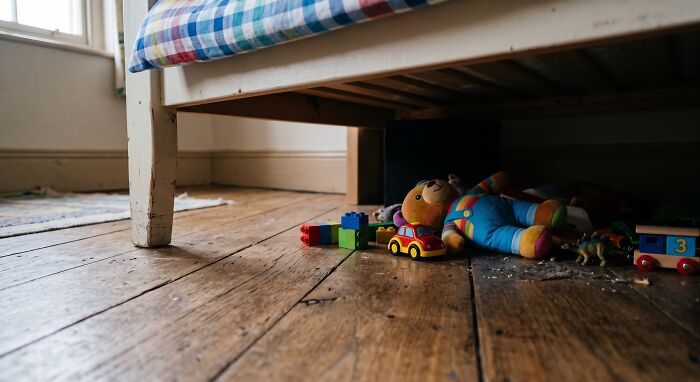 I had this weird belief that the monsters under the bed would replace my dolls if I dropped them. But they HAD to replace them when they hit the floor. So if one fell I had to “drop” it a second time to get the non-monster doll back.
 I thought my parents put presents under the tree at Christmas because THEY didn’t think Santa Claus was real (I knew he was real, of
course ). So, when Santa got to my house on Christmas Eve and saw all of the presents already under the tree, he brought my gifts to less fortunate children.
Another reason these unusual beliefs can become so detailed is that children are remarkably good at filling in information that isn't actually there. Research into children's reasoning and comprehension suggests that they quickly combine new clues with what they already know, using familiar patterns to create a complete picture.
If part of a story or routine is missing, they can draw on their existing knowledge to work out what probably happened. They can even use clues to rule out possibilities and arrive at an answer when important information is hidden. The same basic tendency appears in perception, where the developing brain can interpret incomplete shapes and fragments as whole objects.
 In the early 70s I had heard about moon rocks and reached an understanding that all rocks came from the moon, which even at the time seemed very inefficient.
 I was in kindergarten and my mom had a note for the bus driver. The driver was a woman and she always wore dark sunglasses.
I got on the bus and gave her the note. The driver said, “You’ll have to read it to me.” I asked why, and she said it was because she was blind. I didn’t know what to do so I left the note in her hand and found a seat. I was terrified of being on the bus with a blind driver.
My mom loved the song “save a horse ride a cowboy” so it played a lot and quickly became my favorite song. I would be in elementary/middle school belting the words cause it was stuck in my head fully believing it was like a cowboy on all fours and her sitting on his back.
When I learned the truth it felt like ultimate betrayal.
That ability to create a coherent picture is useful for learning, but it can also leave plenty of room for some spectacularly wrong conclusions. When children combine incomplete information, prior knowledge, imagination, emotional reactions, and simple cause-and-effect reasoning, they can end up with explanations that are internally consistent even if they have almost nothing to do with reality.
What sounds completely unhinged years later may once have been a perfectly functional answer to a question that a child had no other way of solving. And because the explanation helped make the world feel understandable, there was little reason for their younger selves to stop and wonder whether they had accidentally invented an entire piece of lore.
 My parents told me that my dog got drafted and had to go fight in Vietnam.
OP detailed: "When I was a child, my family lived on Sandia Air Force Base in Albuquerque, NM. While I was in first grade, I had a small black and white terrier named Max. Max was a great little dog who could climb the crabapple tree in our backyard. Max was my best friend and protector. He protected me too well, and a couple of neighbourhood kids were bitten by Max while playing too roughly. One day, I returned home from school, and Max was gone. My parents told me that the President had called, and they needed Max to go to Vietnam. Of course, Max had never gone anywhere but the pound where he was euthanized, but this was not revealed to me until years later."
 A cloud break with a visible beam of light coming down was transport to heaven, and someone had d**d wherever the beam fell.
 My mom always talked about how she’d automatically triple the amount of garlic in a recipe when she cooked. When I asked why, she always said it was to keep elephants away. There were never any elephants where we lived so it must have really worked. I have no idea how long I believed this, but I distinctly remember her telling me this several times.
Childhood logic may not always have been scientifically accurate, but it certainly made the world more interesting. Kids have a remarkable talent for taking one small observation, adding a few assumptions, and somehow turning it into a rule they can confidently live by. Looking back, those strange beliefs can be hilarious precisely because they once felt so completely obvious.
And sometimes the funniest part is remembering how long you believed something before finally discovering the truth. What is the strangest thing you genuinely believed as a child? We would love to hear from you in the comments!
 This is about to get embarrassing
I believed that gas tanker trucks that had adverts for coffee on them were actually full of coffee....
Also that when I was at school everyone was somewhere and no one was on the road driving around.
 As a gross little kid I would sometimes get athlete's foot and I always thought everyone was saying "Ashley's foot." I got very confused when my brother Andrew ALSO got Ashley's foot.
 Coconuts are “laid” by cows, in the same way that eggs are laid by birds.
That’s why coconut milk is a thing.
 one time I couldn’t sleep and I told my mom. she said, “oh it’s because your sheets and pillowcases don’t match!” so she changed them and I fell asleep super fast.
literally took me until age 25 to realize she just made that up to make me feel better at the time.
That the letter g was in the word platinum. I believed it was platignum well into adulthood. Absolutely no rhyme or reason to it and it still looks weird to me spelled the correct way.

My sister convinced me that if you ate on the toilet, you’d get cancer. Not sure what provoked this, as no one was eating on the loo in the first place. But alas.
I was completely convinced that men went bald or got white in their hair because they weren't concentrating. They weren't willing it to stay.
I also thought I was the only person who was actually “real”. I was genuinely convinced that everyone around me were just side characters and once I walked out of the room, their lives would just pause. I thought the whole world revolved around me quite literally.
Ooh! I remember another one: I remember thinking that the wheels on my dad’s car would actually rotate the earth under it. My evidence for this? The fact that the moon stayed in the same place in the sky so obviously we weren’t the ones that were moving.
I thought game show contestants were chosen like jury duty. Like the Smith Family on family feud got a letter in the mail one day saying they need to come be on the show. Or Jessica on Deal or No Deal got a letter and her flight and hotel info and said she had to be there.
When I was like five years old I thought women gave birth to girls and men gave birth to boys.
I was convinced that babies were born through the belly button. What else should a hole in the belly be for? And tbh I still think that was a reasonable thing to believe.
Can’t go swimming until like 3 hours after you eat coz you might get the bends. And for many Italian Americans it meant they never went in the water coz 3 hours without eating is unthinkable.
That every time you drove past a graveyard you had to hold your breath otherwise the d**d souls would enter your body.
I thought Apple bottom jeans was jeans women would wear with actual apples in the back pockets or embroidered apples on the b**t.
Swallowed gum will stay in your stomach forever.
I genuinely believed 100.060 was the largest number there was in the universe for a very long time.
I thought if I ate too much spaghetti, I’d get pregnant. Not just any food…specifically spaghetti. I have NO IDEA why I thought that.
Disney had me believing that when animals hibernate for the winter (I’m talking about you bears) they actually slept right through until spring! It was only a few years ago (I’m in my 50s) that I was talking about it and realised how ridiculous that sounds .
But bears do stay in their dens for about 6 months. Not in true hibernation admittedly, but even so.
That bus drivers took them home after the last run at night and parked on their driveways until the morning buses started running.
Sigh. My father. First, I’m 53. Relevant.
They used to have radar detectors that caught when cops were using….radar. My dad told my brother and I that every time it went off, we needed to hold up two fingers to all the cars around us to warn them.
For years, we flashed peace signs everywhere we went. Long car trips? HOURS of them. I didn’t figure it out until a couple of years ago.
Dad was one of a kind.
I wouldn’t say we normalized it, but my dad had this briefcase and inside he had rigged up a voice activated cassette tape recorder and drilled a hole for the mic in the briefcase. He would leave it in the room with us and go to the bathroom to see what we were saying about him. We never mentioned it out loud to him, but once we recorded a bunch of screaming and nonsense for him. He never mentioned it. I’m sure he would deny it ever happened now.
I knew the answer to what is black and white and red all over was newspaper, but for some reason, I believed the red was part of the newspaper making process.
It wasn’t until a few years ago, I realized it was read. I’m 53, now. Had never thought to question it.
Also, that women had an extra rib.
When I was a child, my mom always told me to cook popcorn in the microwave for three minutes and fifty seconds. 3:50, no matter what. Being an innocent child, I accepted this without question or challenge.
Finally, at the tender age of 11 or 12, I asked Mom why we set the timer to 3:50 for microwave popcorn.
"Because," my dearly departed mother began, "that's three and a half minutes."
Turns out, the disc had exploded in the drive and the entire disc drive was full of shards. My mom took it out and we eventually got a different computer and I lost all my stories. But I believed from then on that if I touched keys on the keyboard and I wasn't 100% sure of their purpose, that the computer would explode. I spent over a decade fearing all function keys lmao. 2/2.
BP literally posted the second half of this post and not the first: "When I was little, my little brother had a Thomas the Tank Engine computer game. One night, my mom, little sister, and I were all gathered around the computer watching him play it. The game suddenly froze and we heard this whirring that got steadily louder. My mom leaned down over the back of the chair to mess around with the keyboard, and suddenly there was this BANG and the computer shut off."
I work on game shows for a living and I was kind of stunned by a comment from a grown-a*s adult on social media indicating that they thought the celebrity bookings worked like that. Like Caroline Rhea is coming to the studio because we told her she had to.
I thought manikins were made when humans got sucked into the escalator. Some escalators had a weird orange glow between the steps back then.
That people didn’t have s*x til marriage.





















 No fees, cancel anytime