Get Premium
Dark mode theme is available exclusively for premium users. Learn more about the benefits of subscribing.
No fees, cancel anytime.

 Dark Mode Ad-Free Browsing Unlimited Content
 Ad-Free Browsing Unlimited Content Dark Mode
Join 1.2 million Panda readers who get the best art, memes, and fun stories every week!

Managing a chronic illness while holding down a full-time job cannot be easy. If you’re lucky, you’ll have understanding and supportive colleagues. But that doesn’t mean you should take advantage…
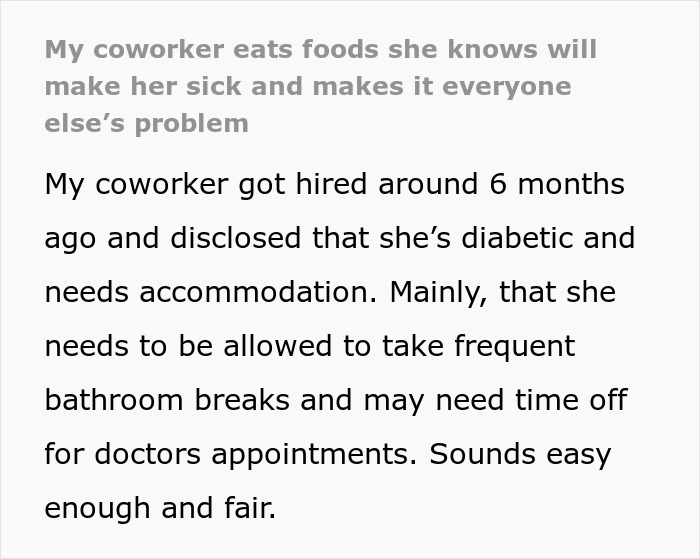
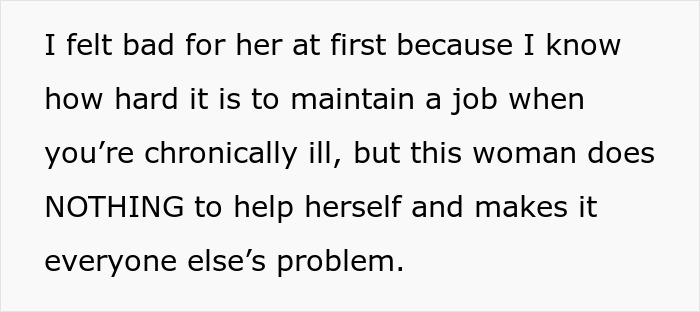
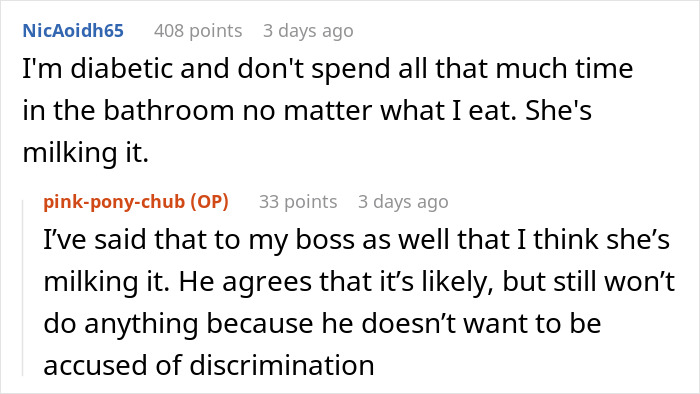
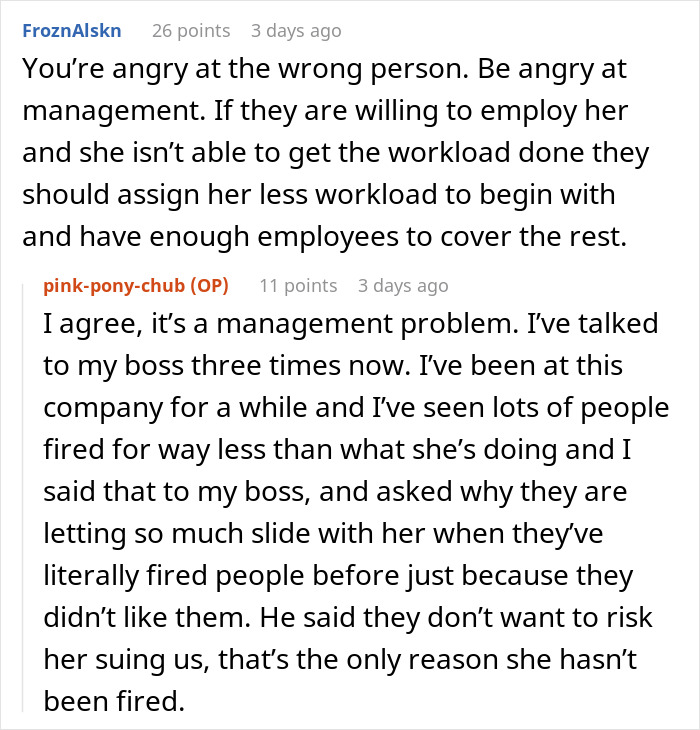
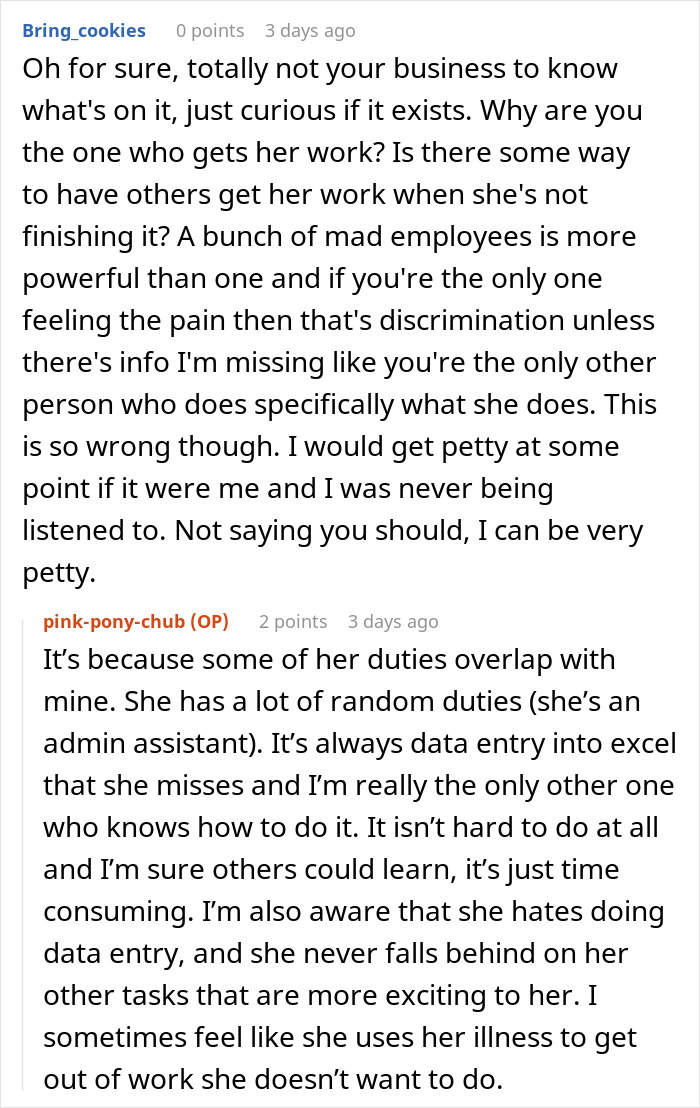
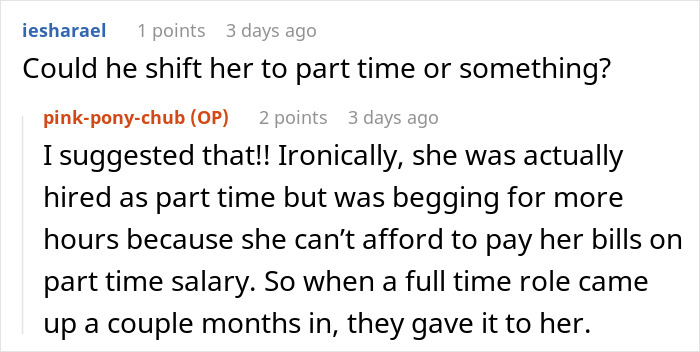
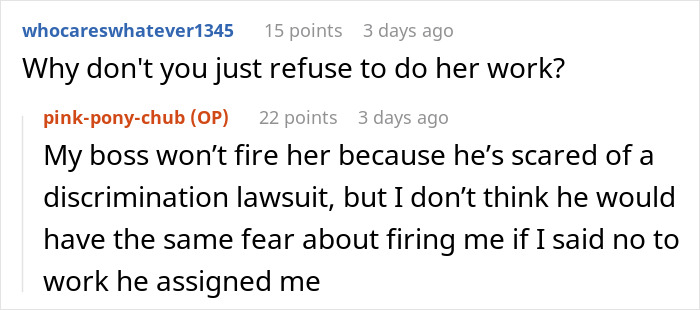
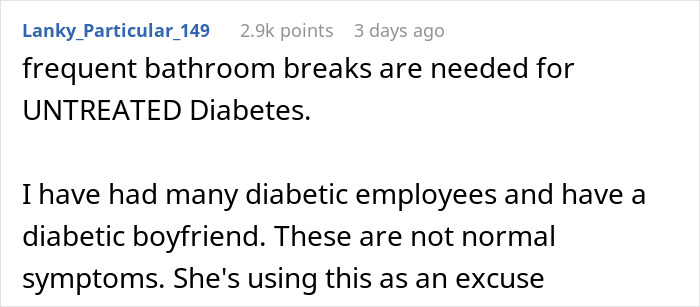
A woman is at her wits’ end because of her diabetic co-worker, who she says insists on eating food she knows she shouldn’t. Apparently, the worker gets sick frequently, and when she does, her colleagues are forced to do her work. The woman says she often finds herself working overtime to finish her sick co-worker’s tasks. Management is scared of being sued, so they’ve refused to intervene.
Image credits: Oleg Ivanov / Unsplash (not the actual photo)
Image credits: Aleksandar Andreev / Unsplash (not the actual photo)
Image credits: KamranAydinov / freepik (not the actual photo)
Image credits: pink-pony-chub
According to the World Health Organization (WHO), 200 million people were living with the disease in 1990. That number had risen to a whopping 830 million by 2022. Low- and middle-income countries are seeing the biggest increases.
The World Health Organization defines diabetes as a chronic disease that occurs either when the pancreas does not produce enough insulin or when the body cannot effectively use the insulin it produces.
“Insulin is a hormone that regulates blood glucose,” explains the site. “Hyperglycaemia, also called raised blood glucose or raised blood sugar, is a common effect of uncontrolled diabetes and over time leads to serious damage to many of the body’s systems, especially the nerves and blood vessels.”
One of the biggest problems, says WHO, is that more than half of those with diabetes did not take any medication for it in 2022. That’s despite over 2 million diabetics succumbing to the illness the year before.
A healthy diet, physical activity, medication, and regular screening and treatment for complications are some of the ways diabetes can be treated. Experts also advise maintaining a normal body weight and avoiding tobacco use to prevent or delay the onset of type 2 diabetes.
Image credits: Pablo Merchán Montes / Unsplash (not the actual photo)
Type 1, which was previously known as insulin-dependent, juvenile, or childhood-onset, is when someone has a deficiency in insulin production and has to administer insulin every day. Health experts haven’t yet figured out the cause, nor how to prevent it.
More than 95% of people with diabetes have type 2 diabetes. This type used to be called non-insulin dependent, or adult-onset. It was previously only seen in adults, but recently, more and more children are being diagnosed with it.
“Type 2 diabetes affects how your body uses sugar (glucose) for energy. It stops the body from using insulin properly, which can lead to high levels of blood sugar if not treated,” explains WHO. “Over time, type 2 diabetes can cause serious damage to the body, especially nerves and blood vessels.”
The global health body notes that type 2 diabetes is often preventable. Being overweight, not getting enough exercise, and genetics are some of the factors that play a part in someone getting type 2 diabetes.
In terms of what to eat, experts stress that veggies every day are a must, whether they’re fresh, grilled, or steamed. “The American Diabetes Association recommends that you fill half of your plate with non-starchy vegetables, such as spinach, carrots, and tomatoes, at every meal,” notes WebMD. “This gives you lots of nutrition and fiber for a small amount of calories, which can help you keep your blood sugar levels lower.”
The site adds that no foods are completely off-limits. However, moderation is key. “You can replace unhealthy foods with healthier choices and save your sweets calories for an occasional treat,” advises WebMD.
The best course of action is to speak to your doctor and ask them to help you draw up an eating plan that works for your lifestyle, your likes and dislikes, while still helping you meet your health goals.

By entering your email and clicking Subscribe, you're agreeing to let us send you customized marketing messages about us and our advertising partners. You are also agreeing to our Privacy Policy.
Thank you! You've successfully subscribed to newsletters!

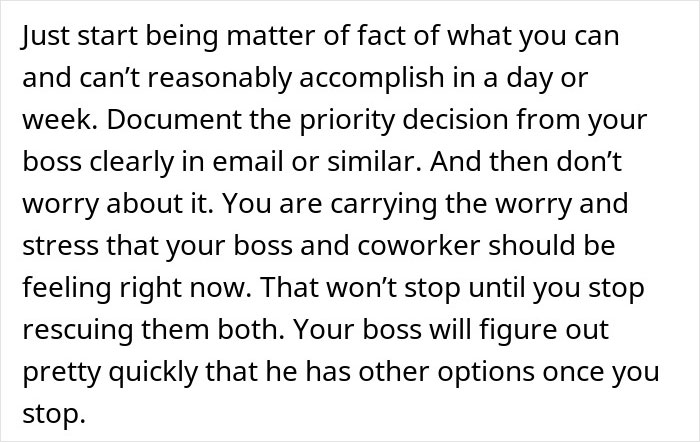
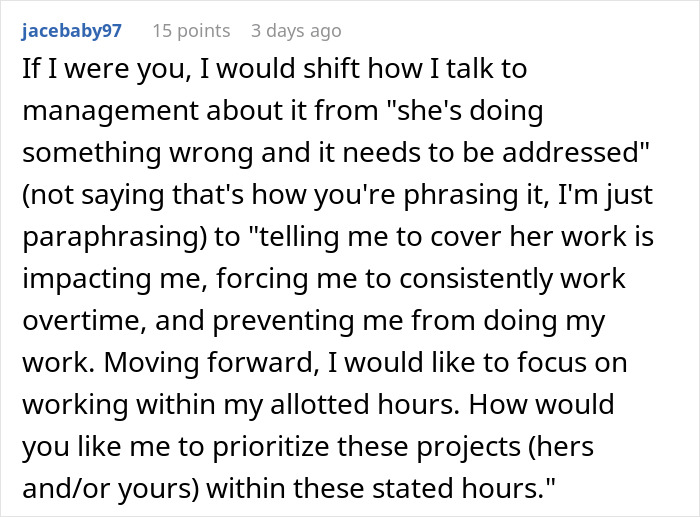
I think the trick is that OP has to let go of WHY the coworker can't do her assigned duties (that part isn't her business) and now has to focus on her increased workload and the unpredictable nature of the shifting deadlines. She has to go into her boss and HR and discuss rewriting her job description and pay bracket to account for these sudden duties (i.e. being an ad hoc fill-in for 'other employees'). Document for a month how much extra work she takes on and what kinds of demands that makes on her (staying late, skipping breaks, having to be late on other deadlines). When the company starts to see that it is going to cost them organizationally (promoting OP, maybe a pay raise, giving her access to an assistant of her own), then they stop handwaving the issue away and making it OP's problem to solve. It comes back to them and they have to figure it out one way or another.

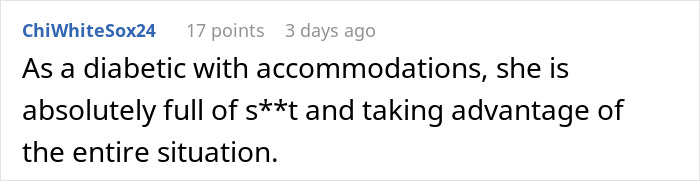
As a type 2 Diabetic with insulin resistance (so insulin wont correct blood sugars), I can say whatever this woman has its not diabeties that is the issue. Even untreated, going pee can scientifically take a max of 21 seconds and there is no diarrhea or vomiting involved, so any pee breaks longer than 5 min are impossible, and typically every 2-3 hours minimum between. When I eat wrong I get dizzy, nauseous, and present with "drunk" like symptoms, so unless she is exhibiting these issues, she can withstand the discomfort of normal activities. As for her inability to maintain her job duties, well, that's not a disability issue, especially if there is a pattern of failure, it's and incompetence issue. I got fired once because they thought I didnt wash my hair before a surprise meeting before my working hours (I went home and showered before I started my shift), so anything can be a reason to fire someone these days.

Oh, you can’t leave us hanging like this, Laser! Why was the washing or not washing of your hair important? I’m imagining you were doing the photoshop of the last on the Prell bottle and so needed your hair to be extra gorgeous. Please tell us why your hair was important for your job; I’m on tenterhooks wondering!
Load More Replies...
I only know about the US' (I'm assuming the OP is from the US) laws accommodations from reading Ask a Manager, so I don't know much about how it works. But surely something can be done where the co-worker isn't *able* to do their job because of their illness, because that isn't discriminatory so much as the co-worker simply isn't able to fulfil the requirements of the job and therefore disciplinary action is warranted. This person sounds like the type to run to Fair Work (or whatever the US equivalent is) though, so the company would have to make sure that they can prove that the disciplinary action is because she isn't fulfilling her role, otherwise that'd leave them open.
I don’t understand what the problem is. She can’t do her job, so fire her for not fulfilling her role. Her condition need never be mentioned. Others are fired for not doing their jobs, so what’s the problem? Sure, she’ll need to be reprimanded so she has a chance to correct the problem, but once it becomes obvious she can’t do her job, where do labor laws come into it? EVERYONE hasta do the job for which he’s hired. If you can’t, you’re gone.
Load More Replies... I think the trick is that OP has to let go of WHY the coworker can't do her assigned duties (that part isn't her business) and now has to focus on her increased workload and the unpredictable nature of the shifting deadlines. She has to go into her boss and HR and discuss rewriting her job description and pay bracket to account for these sudden duties (i.e. being an ad hoc fill-in for 'other employees'). Document for a month how much extra work she takes on and what kinds of demands that makes on her (staying late, skipping breaks, having to be late on other deadlines). When the company starts to see that it is going to cost them organizationally (promoting OP, maybe a pay raise, giving her access to an assistant of her own), then they stop handwaving the issue away and making it OP's problem to solve. It comes back to them and they have to figure it out one way or another.
As a type 2 Diabetic with insulin resistance (so insulin wont correct blood sugars), I can say whatever this woman has its not diabeties that is the issue. Even untreated, going pee can scientifically take a max of 21 seconds and there is no diarrhea or vomiting involved, so any pee breaks longer than 5 min are impossible, and typically every 2-3 hours minimum between. When I eat wrong I get dizzy, nauseous, and present with "drunk" like symptoms, so unless she is exhibiting these issues, she can withstand the discomfort of normal activities. As for her inability to maintain her job duties, well, that's not a disability issue, especially if there is a pattern of failure, it's and incompetence issue. I got fired once because they thought I didnt wash my hair before a surprise meeting before my working hours (I went home and showered before I started my shift), so anything can be a reason to fire someone these days.
Oh, you can’t leave us hanging like this, Laser! Why was the washing or not washing of your hair important? I’m imagining you were doing the photoshop of the last on the Prell bottle and so needed your hair to be extra gorgeous. Please tell us why your hair was important for your job; I’m on tenterhooks wondering!
Load More Replies... I only know about the US' (I'm assuming the OP is from the US) laws accommodations from reading Ask a Manager, so I don't know much about how it works. But surely something can be done where the co-worker isn't *able* to do their job because of their illness, because that isn't discriminatory so much as the co-worker simply isn't able to fulfil the requirements of the job and therefore disciplinary action is warranted. This person sounds like the type to run to Fair Work (or whatever the US equivalent is) though, so the company would have to make sure that they can prove that the disciplinary action is because she isn't fulfilling her role, otherwise that'd leave them open.
I don’t understand what the problem is. She can’t do her job, so fire her for not fulfilling her role. Her condition need never be mentioned. Others are fired for not doing their jobs, so what’s the problem? Sure, she’ll need to be reprimanded so she has a chance to correct the problem, but once it becomes obvious she can’t do her job, where do labor laws come into it? EVERYONE hasta do the job for which he’s hired. If you can’t, you’re gone.
Load More Replies...
































 No fees, cancel anytime















22
22