Get Premium
Dark mode theme is available exclusively for premium users. Learn more about the benefits of subscribing.
No fees, cancel anytime.

 Dark Mode Ad-Free Browsing Unlimited Content
 Ad-Free Browsing Unlimited Content Dark Mode
Join 1.2 million Panda readers who get the best art, memes, and fun stories every week!

When many of us think of marriage, we think of two people making a commitment to each other. Maybe that’s just us single folks, though. Because as just about any married couple can confirm, tying the knot often means joining two families, too.
After seven years together, more than a year engaged, and with the wedding only two months away, one 24-year-old woman thought everything was falling into place—the ceremony had been booked, the reception planned, and the decorations bought. But then the woman’s future in-laws sat the couple down for a private “talk” that completely changed how she felt about celebrating with them.
Keep reading to find out what they said that left the bride-to-be wondering whether she’d be overreacting if she canceled the wedding reception altogether.
Image credits: SHVETS production / Pexels (not the actual photo)

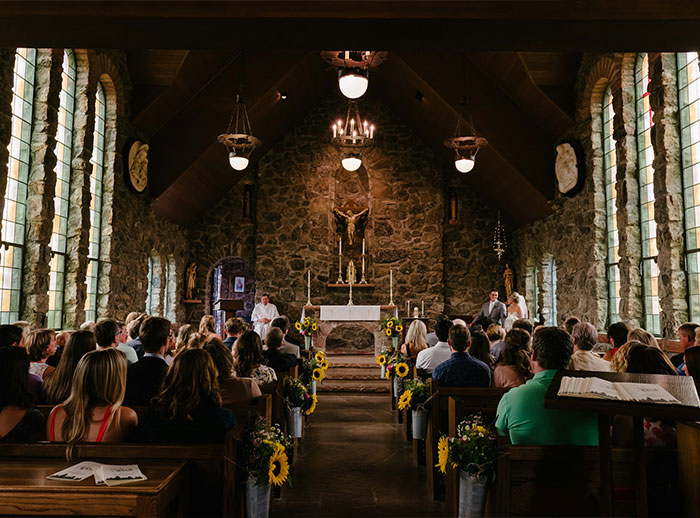
Image credits: Josh Applegate / Unsplash (not the actual photo)
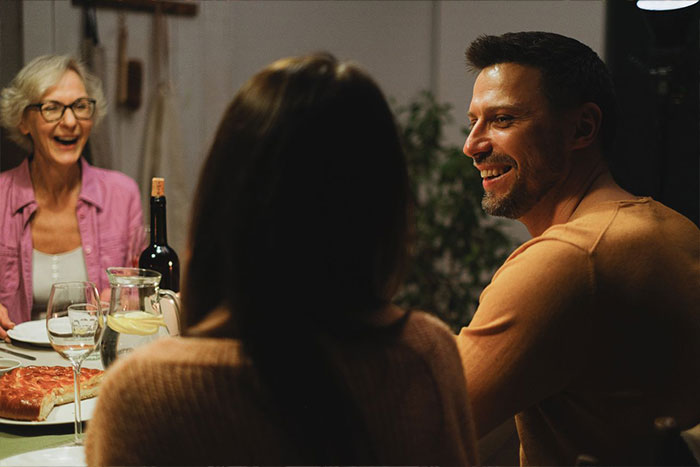
Image credits: Timur Weber / Pexels (not the actual photo)
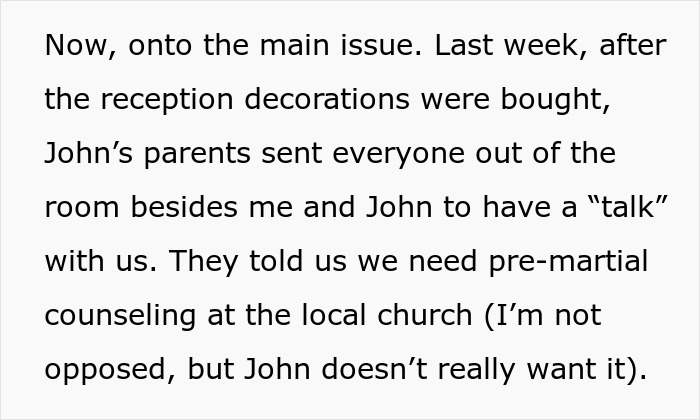
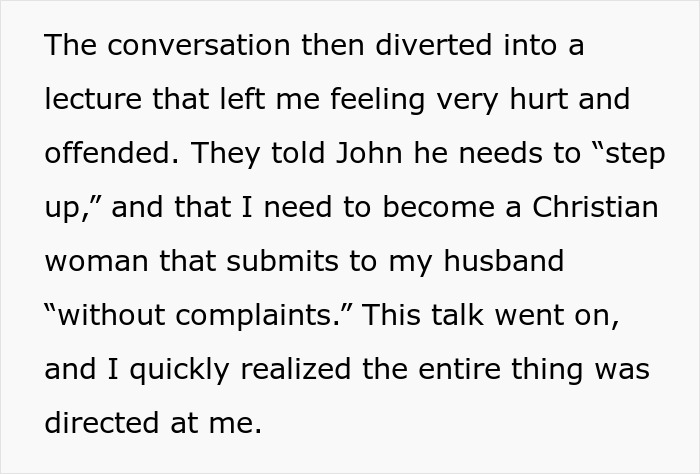
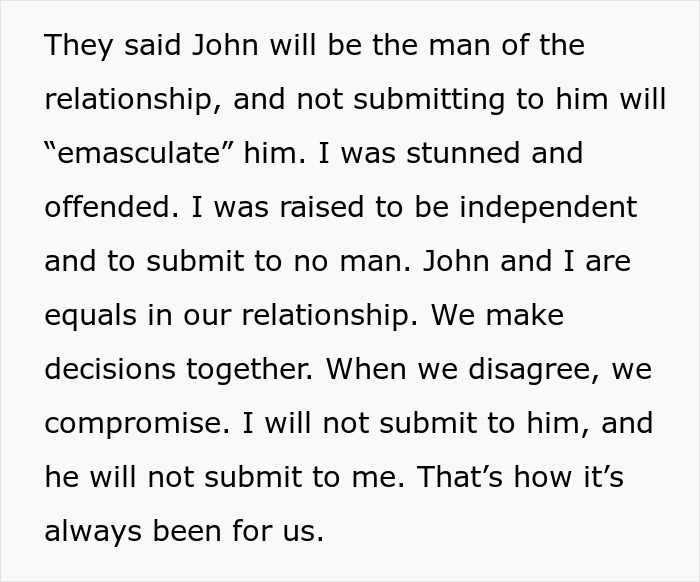
Image credits: MART PRODUCTION / Pexels (not the actual photo)

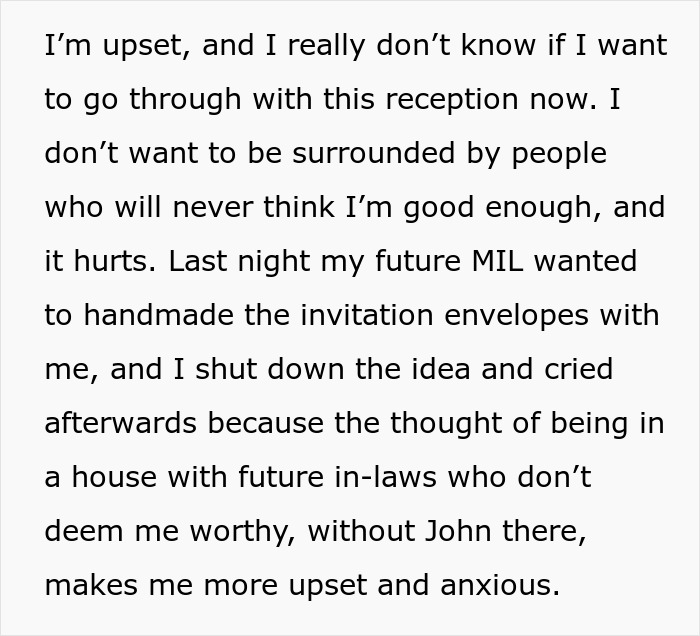
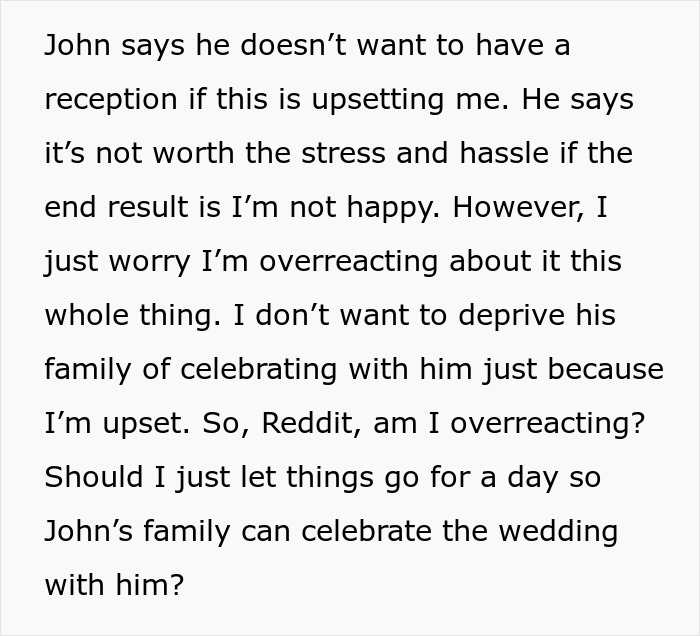
Image credits: ReplacementMental370
Image credits: Gustavo Fring / Pexels (not the actual photo)
Disagreements between partners and in-laws are common. After all, marriage is more of a package deal than simply the union of two people. Each partner’s family is also often part of the equation. And while 2021 research from Purdue University found that most couples go into their marriage anticipating these ties to be positive, those hopes don’t always match with reality.
And that matters more than many people realize, as in-law relationships can have a significant impact on marital happiness. In fact, according to Dr. John Gottman, author of Why Marriages Succeed or Fail: And How You Can Make Yours Last, in-law troubles are among the most common reasons for marital discord.
Couples therapist Tasha Seiter, MS, PhD, LMFT, similarly says that it’s one of the most common problems she sees. As she explains, “It can be hard enough to deal with your own parents, let alone your partner’s parents, who may disapprove of you (openly or covertly), be protective of their child (or the opposite, treat their child in ways that make you want to protect your partner), or feel threatening to you or the relationship in some other way.”
Everyone comes to the proverbial family dinner table with their own ideas and ways of doing things. That’s why dealing with in-laws, as Utah State University’s Amy Torres and Lisa Schainker explain, is “a dance of expectations, traditions, and emotions, requiring a delicate balance.”
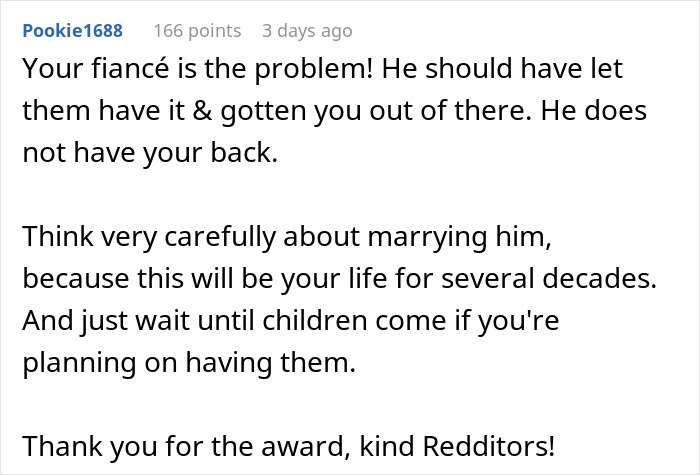
That’s what makes the poster’s story relatable. The uncomfortable conversation became about more than simply whether she should “submit” to her husband. Instead, it exposed something deeper: a clash of values, traditions, and expectations around the roles each partner should play in the marriage.
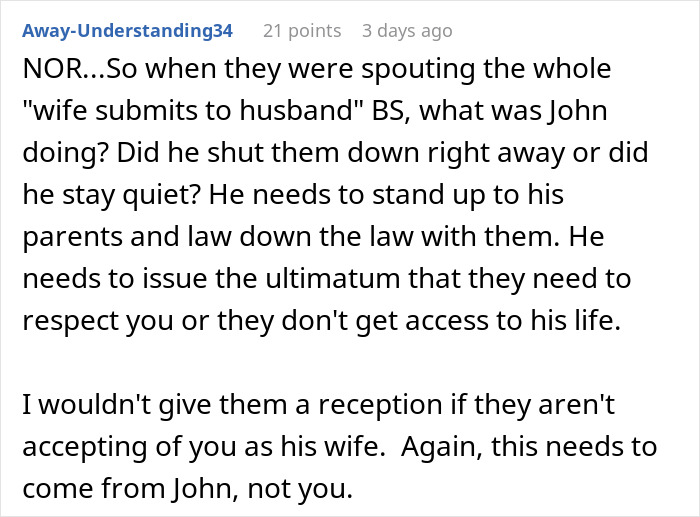
While the poster viewed marriage as an equal partnership built on compromise, her future in-laws envisioned a wholly different dynamic. She left the conversation feeling that her future in-laws had never truly approved of her, while the in-laws’ comments suggested they believed they were protecting their son’s future marriage. To the poster, however, the conversation felt like an attempt to define her role as a wife before the marriage had even begun.
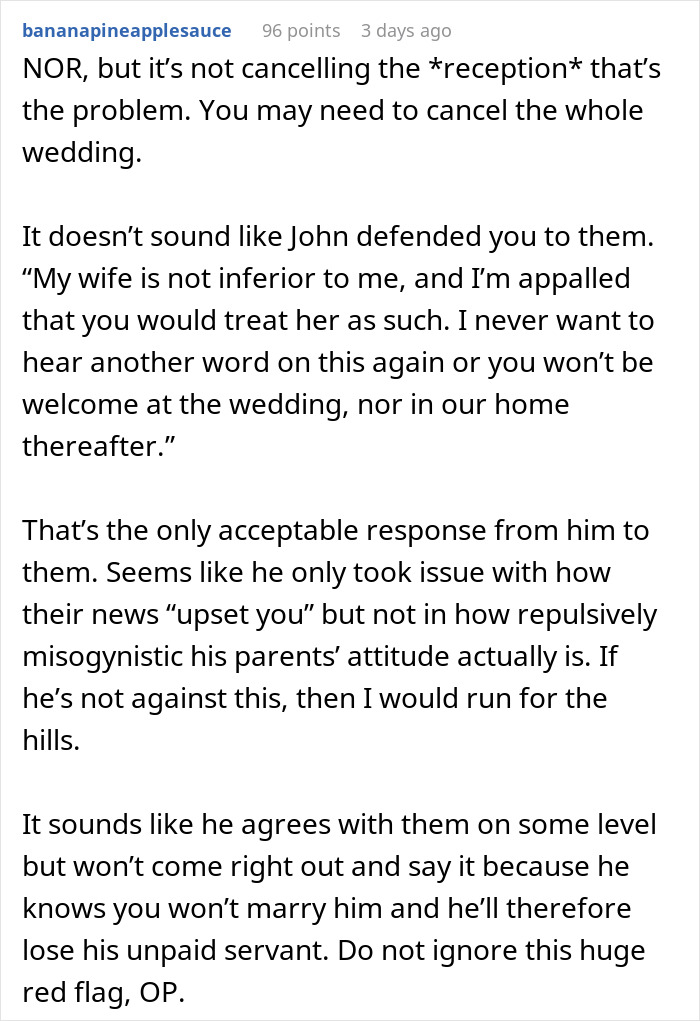
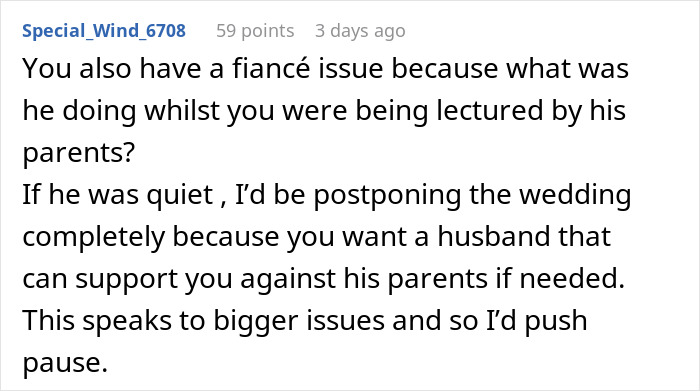
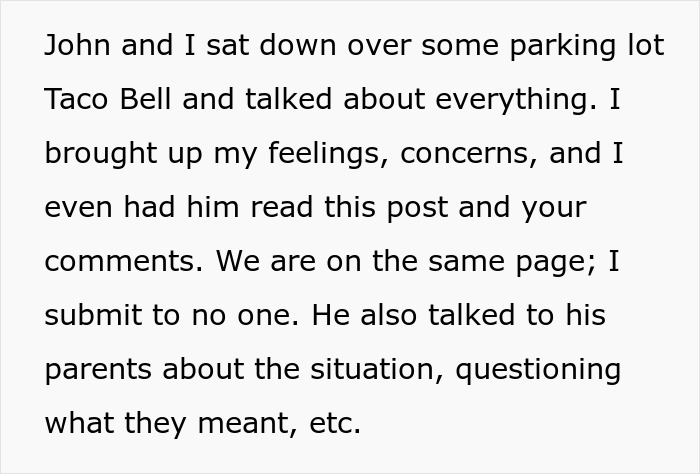
When it comes to such complex and tricky situations as this, experts agree that it’s important for couples to present a united front. As Karen Sosnoski, PhD, writes for PsychCentral, “Seeing eye-to-eye with your partner about your in-laws matters more to your marriage than seeing eye-to-eye with your in-laws.”
That means discussing the issue openly and deciding together how to respond. Once couples are aligned, experts say they should establish respectful boundaries and uphold them consistently. Exactly what those boundaries look like will differ from one relationship to the next. They may involve difficult conversations, declining certain requests, or deciding together how to handle family disagreements.
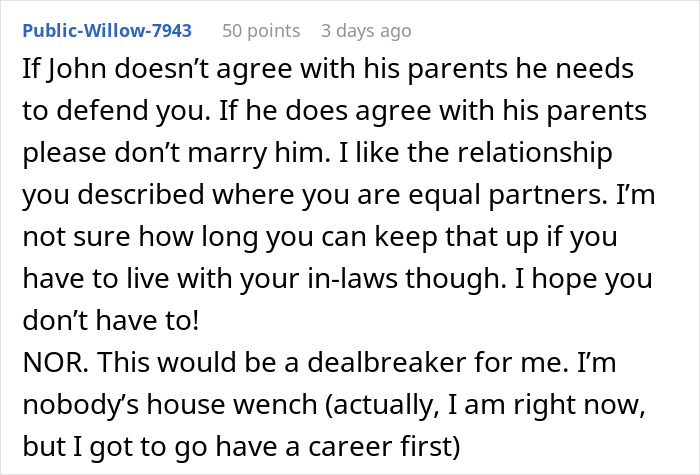
Ultimately, what’s important is that both partners decide together how they want their marriage to work and support each other in communicating those decisions to their families. Doing so helps ensure that decisions about the marriage remain theirs to make—as they should be.


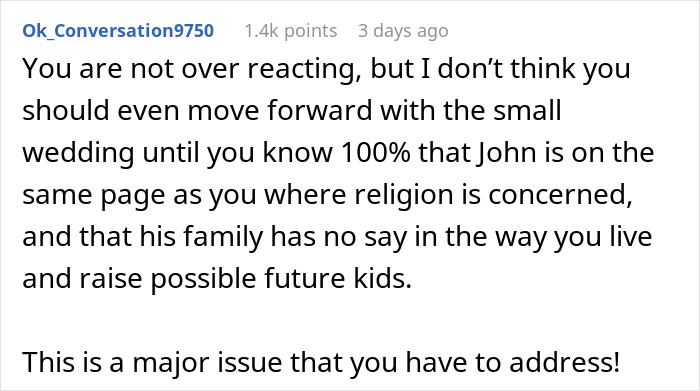
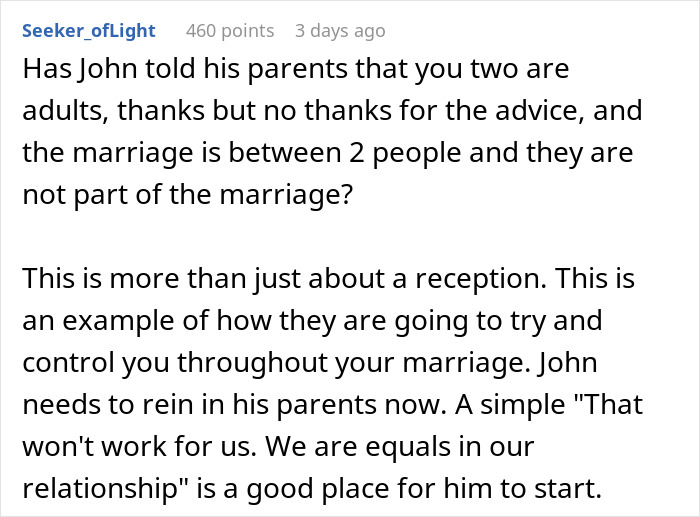

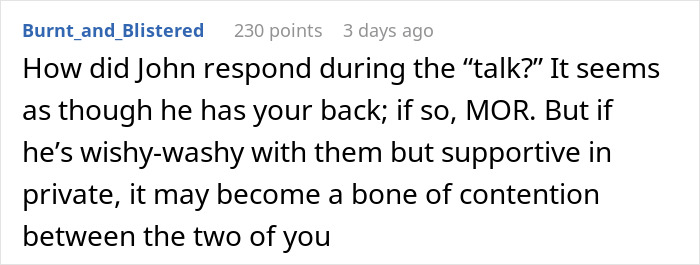









By entering your email and clicking Subscribe, you're agreeing to let us send you customized marketing messages about us and our advertising partners. You are also agreeing to our Privacy Policy.
Thank you! You've successfully subscribed to newsletters!


Religion is a bane on rational society, American "religion" even more so.

religion is not the problem.these individual parents are the problem
Load More Replies...
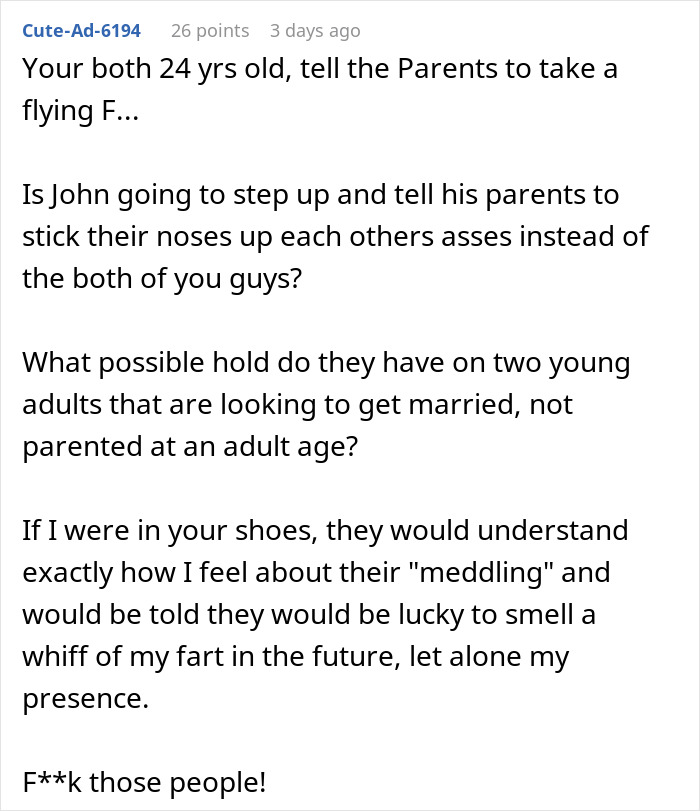
From what OP said, John doesn't want a reception, would've been happy going to city hall then calling it a day. John should bring up to the parents that if OP submitted to him, there would be no reception, it's OP who said let's do it for his parents sake.

I would say go ahead with the reception, then tell the parents you’ve prepared some vows to read to out loud. In the vows make sure you say it’s an equal relationship and neither of you submit to each other. Standard marriage vows used to have the woman say “honour and OBEY”, but that disappeared after the 1950’s.

I'm sure that would work for a lot of people. However, I sense that the OP and her fiance may not be feeling combative on their wedding day. Avoiding the reception sounds like a good start to reducing contact with judgmental people who are unlikely to change.
Load More Replies... Religion is a bane on rational society, American "religion" even more so.
religion is not the problem.these individual parents are the problem
Load More Replies... From what OP said, John doesn't want a reception, would've been happy going to city hall then calling it a day. John should bring up to the parents that if OP submitted to him, there would be no reception, it's OP who said let's do it for his parents sake.
I would say go ahead with the reception, then tell the parents you’ve prepared some vows to read to out loud. In the vows make sure you say it’s an equal relationship and neither of you submit to each other. Standard marriage vows used to have the woman say “honour and OBEY”, but that disappeared after the 1950’s.
I'm sure that would work for a lot of people. However, I sense that the OP and her fiance may not be feeling combative on their wedding day. Avoiding the reception sounds like a good start to reducing contact with judgmental people who are unlikely to change.
Load More Replies...
























 No fees, cancel anytime









32
25